FP7-ICT-2011-7-287733 – ScilabTEC – Oliver Oey – oliver.oey@kit.edu 1
FP7-ICT-2011-7-287733
ALMA Project Overview
Simplifying programming for multi-cores
Oliver Oey
FP7-ICT-2011-7-287733 – ScilabTEC – Oliver Oey – oliver.oey@kit.edu 2
Outline
 ALMA EU Project Overview
 Project Overview
 Motivation
 Results
 MatrixFrontend
 Type inference
 Loopify
 Simplify
 emmtrix Technologies
 Summary
FP7-ICT-2011-7-287733 – ScilabTEC – Oliver Oey – oliver.oey@kit.edu 3
ALMA Project ID Card
 Three year project: 01/09/2011 – 31/01/2015
 Funded by FP7: 3.2 Million Euros
 Official web site: http://www.alma-project.eu/
 Coordinator: Juergen Becker (KIT) and Timo Stripf (KIT)
 Scientific Coordinator: Nikos Voros (TWG)
FP7-ICT-2011-7-287733 – ScilabTEC – Oliver Oey – oliver.oey@kit.edu 4
Why do we need multi-core processors?
 Until ~2005 processor
performance increase
driven by
 Clock speed
 Execution optimization
 Cache
 Power wall
 ILP wall
 Led to multicore
processors
 Parallelism must be
exposed by the
programmer
(source http://www.gotw.ca/publications/concurrency-ddj.htm)
FP7-ICT-2011-7-287733 – ScilabTEC – Oliver Oey – oliver.oey@kit.edu 5
Motivation
End user perspective Target architecture perspective
• Explore/Develop algorithms
• Use a simple, comfortable language
• E.g. Matlab, Scilab, …
• Don’t want to care about
• data types
• parallelism
• End result
• Performance
• Energy efficient
• Cost efficient
• Fast development time
• Multi-Processor System-on-Chip
• Parallel processor cores
• Explicit parallel programming
• Distributed memory model, e.g. MPI
• Parallelism within the processor
cores
• Single Instruction Multiple Data
• Very Long Instruction Word
• Native data types
• E.g. 32-bit integer
• Floating-point perform inefficient
 Hide the complexity from the end user
FP7-ICT-2011-7-287733 – ScilabTEC – Oliver Oey – oliver.oey@kit.edu 6
ALMA Development Flow (overview)
Optimized
application code on
multi-core platform
Embedded application design Multi-core hardware design
Translation to
Scilab &
annotations
Abstract
hardware
description
(ADL)
KIT
C-compiler
Multi-core
simulator
Parameters for
algorithm
optimization
C-based code with parallel descriptions
ALMA
algorithm
parallelization
tools
Executable binary (for simulator and HW)
Recore
C-compiler
Structural
hardware
description
Feedback for
optimization
FP7-ICT-2011-7-287733 – ScilabTEC – Oliver Oey – oliver.oey@kit.edu 7
Challenges for Compiling Scilab to MPSoCs
 Scilab programming language
 Sequential, imperative language
 Dynamic typing (scalars, vectors, matrices)
 End users typically use floating-point data types
 Pointer-free, i.e. no memory aliasing problems
 Natural parallelism within vector operations
 MPSoC target architectures
 Exploit coarse-grain parallelism (task-level)
 Distributed memory
 Exploit fine-grain parallelism (instruction-level)
FP7-ICT-2011-7-287733 – ScilabTEC – Oliver Oey – oliver.oey@kit.edu 8
ALMA Target Architectures
 Xentium® processing tile
 Fixed-point DSP processing
 10-issue VLIW processor
 SIMD capability
 Streaming communication services
 Multicore Architectures
 Distributed memory
 => No shared memory required
 No floating point unit
 => Use fixed-point arithmetic
 Example Architecture: Recore X2014
FP7-ICT-2011-7-287733 – ScilabTEC – Oliver Oey – oliver.oey@kit.edu 9
Application Test Cases - Telecommunications
Rx
1
Rx
NR
FFT
Equaliz
er
Channe
l
Estimat
or
Derand
o mizer
Deinter
leaver
Symbol
Decons
truction
- Cyclic
Prefix
Diversity
Combine
r
- Cyclic
Prefix
FFT
SDU
Gener
ation
Data
SDU
s
Uplink
Frame
Decon
structio
n
MAC
-PHY
I/F
BS Rx
`
ALMA 1st
Increment
ALMA 2nd
Increment Tx 1
Tx
NT
FEC
Enco
der
Interl
eaver
Constel
.
Mappin
g
IFFT
+ Cyclic
Prefix
S-T
Coding
IFFT
+
Cyclic
Prefix
+ Pre
amble
Data
SDU
s
PHY
MA
C
UL/DL
Frame
Mappe
r
UL/DL
Sched
uler
BS Tx
PDU
Generati
on
MAC
-PHY
I/F
Fram
e
Cons
tructi
on
Downlin
k
MAC/P
HY
Control
Symb
ol
Const
ructio
n
Rand
omiz
er
.
.
.
..
.
..
.
.
.
.
.
.
.
.
.
.
.
.
.
FEC
Decode
r
Const.
Demap
IEEE 802.16e PHY Layer
in NT x NR MIMO
Configuration
Speedup:
~2,8
FP7-ICT-2011-7-287733 – ScilabTEC – Oliver Oey – oliver.oey@kit.edu 10
Application Test Cases – Image Processing
Scale Invariant Feature Transform (SIFT)
Speedup:
~1,8
FP7-ICT-2011-7-287733 – ScilabTEC – Oliver Oey – oliver.oey@kit.edu 11
0
20
40
60
80
Telecommunication Image processing
Workingdays
Manual
Using autom.
Parallelization
Development effort
-57% -30%
 Reduction of development effort by partially over 50%
FP7-ICT-2011-7-287733 – ScilabTEC – Oliver Oey – oliver.oey@kit.edu 12
ALMA Workflow
Parallel
C Code
Development
Cycle II
Development using
Scilab
Development
Cycle I
ALMA
Parallelization
Tools
Testing
plattform
CPU
CPU CPU
CPU
Testing
PC
Multi-core
Processor
FP7-ICT-2011-7-287733 – ScilabTEC – Oliver Oey – oliver.oey@kit.edu 13
ALMA Workflow (Details)
Parallel C
Code
Development Cycle I
Development with
Scilab
Sequential
Static
C Code
Paralleliza
tion
Matrix
Frontend
Parallelization
Development Cycle II
FP7-ICT-2011-7-287733 – ScilabTEC – Oliver Oey – oliver.oey@kit.edu 14
Outline
 ALMA EU Project Overview
 Project Overview
 Motivation
 Results
 MatrixFrontend
 Type inference
 Loopify
 Simplify
 emmtrix Technologies
 Summary
FP7-ICT-2011-7-287733 – ScilabTEC – Oliver Oey – oliver.oey@kit.edu 15
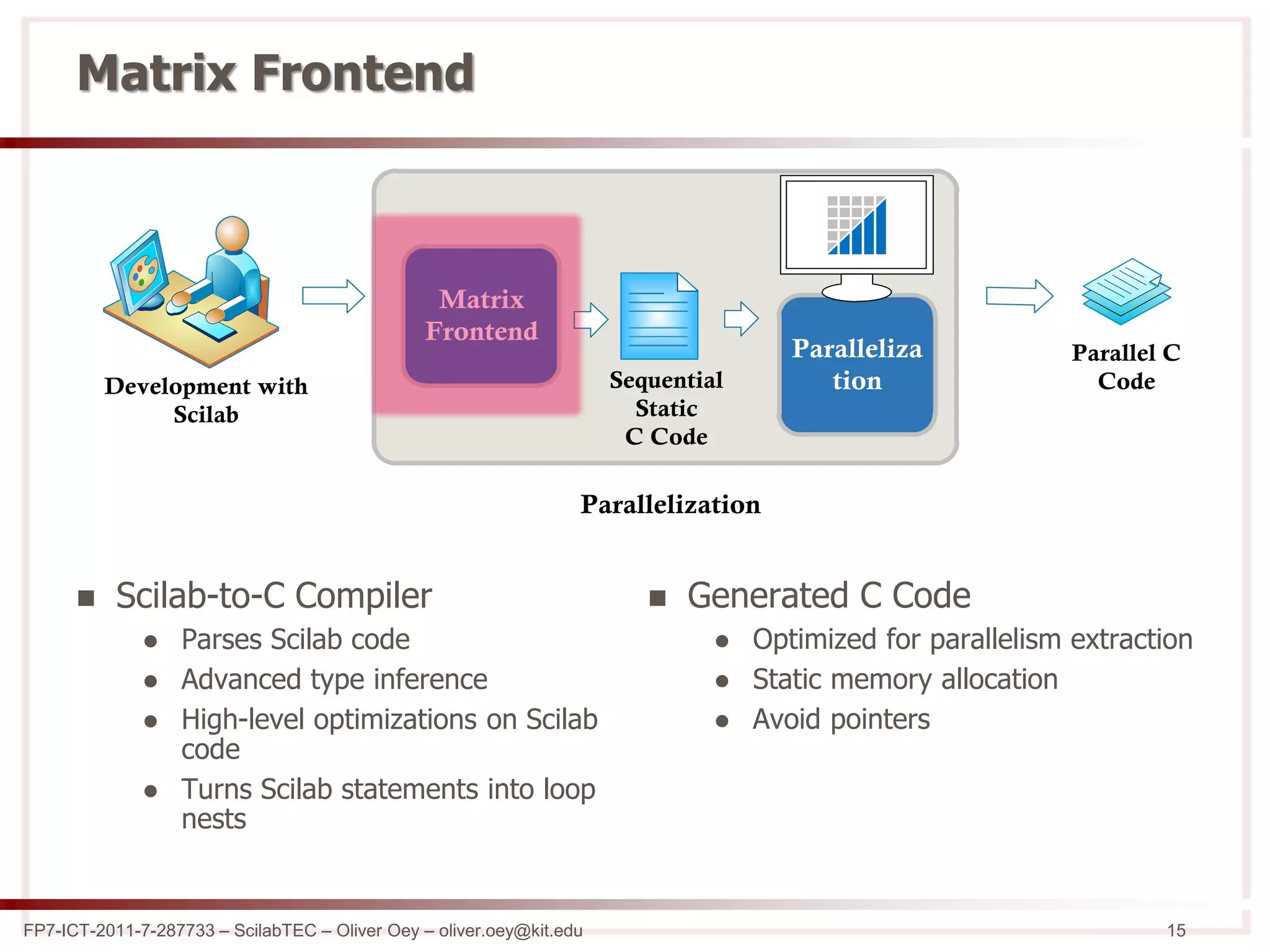
Matrix Frontend
Parallel C
CodeDevelopment with
Scilab
Sequential
Static
C Code
Paralleliza
tion
Matrix
Frontend
Parallelization
 Scilab-to-C Compiler
 Parses Scilab code
 Advanced type inference
 High-level optimizations on Scilab
code
 Turns Scilab statements into loop
nests
 Generated C Code
 Optimized for parallelism extraction
 Static memory allocation
 Avoid pointers
FP7-ICT-2011-7-287733 – ScilabTEC – Oliver Oey – oliver.oey@kit.edu 16
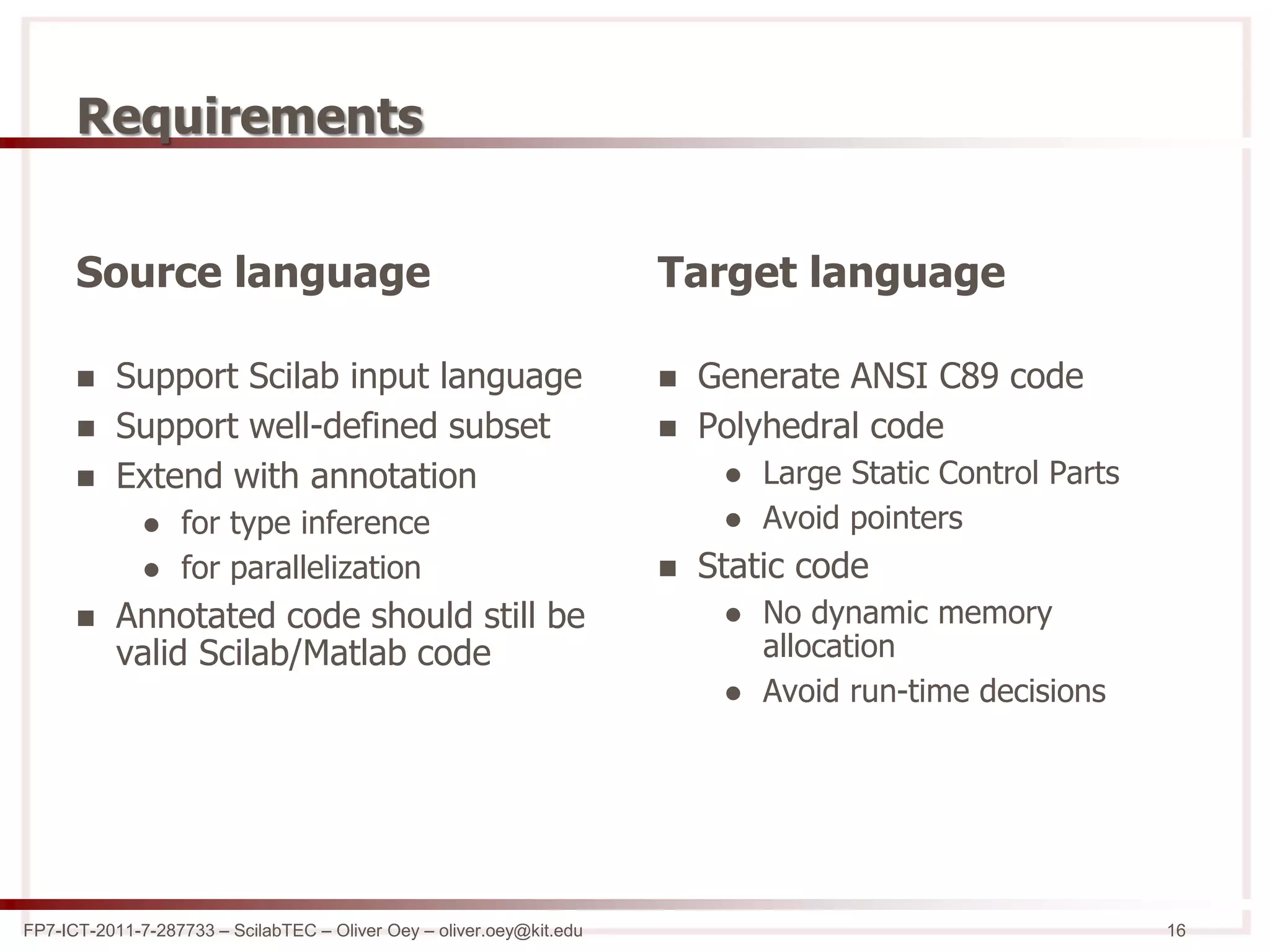
Requirements
Source language
 Support Scilab input language
 Support well-defined subset
 Extend with annotation
 for type inference
 for parallelization
 Annotated code should still be
valid Scilab/Matlab code
Target language
 Generate ANSI C89 code
 Polyhedral code
 Large Static Control Parts
 Avoid pointers
 Static code
 No dynamic memory
allocation
 Avoid run-time decisions
FP7-ICT-2011-7-287733 – ScilabTEC – Oliver Oey – oliver.oey@kit.edu 17
Type Inference
 Calculate types for expressions and variables
“Type” = “Data Type” + “Shape”
 Separated into 3 passes
1. Shape Inference
2. Data Type Inference
3. Variable Inference
Scilab
Type Inference
Loopify
Simplify
C Code Output
C Code
FP7-ICT-2011-7-287733 – ScilabTEC – Oliver Oey – oliver.oey@kit.edu 18
Type Inference - Shape
 Calculate shape of each Scilab statement
s = [1 2 3]; // s = 1x3
for f = 1:10 // f = 1x1
s = s + f // s = 1x3
end
Scilab
Type Inference
Loopify
Simplify
C Code Output
C Code
FP7-ICT-2011-7-287733 – ScilabTEC – Oliver Oey – oliver.oey@kit.edu 19
Type Inference – Growing Arrays
 Support growing arrays
a = 1;
a(1,5) = 1;
 [1 0 0 0 1]
 Maximum size must be known!
 What happens if matrix is indexed by variable?
a(1,b) = 1; // Maximum value of b unknown
 Two solutions:
Scilab
Type Inference
Loopify
Simplify
C Code Output
C Code
a = zeros(1,5);
mfe_fixedsize(a);
a = 1;
a(1,b) = 1;
a = 1;
mfe_size(a, 1, 1:5);
a(1,b) = 1;
FP7-ICT-2011-7-287733 – ScilabTEC – Oliver Oey – oliver.oey@kit.edu 20
Type Inference – Data Type
 Scilab has data type function
 double
 int32, int16, int8
 uint32, uint16, uint8
 boolean
 complex, real, imag
a = uint8([255 256]);
 [255 0]
Scilab
Type Inference
Loopify
Simplify
C Code Output
C Code
FP7-ICT-2011-7-287733 – ScilabTEC – Oliver Oey – oliver.oey@kit.edu 21
Type Inference – Data Type (2)
 Problem: Data type is run-time specific
sqrt(1) => double
sqrt(-1) => complex double
sqrt(a) => ?
 We cannot guarantee Scilab conform
execution
 Solution
 Generate warning
 Ask end user to specify data type
real(sqrt(a)) => double
sqrt(complex(a)) => complex double
Scilab
Type Inference
Loopify
Simplify
C Code Output
C Code
FP7-ICT-2011-7-287733 – ScilabTEC – Oliver Oey – oliver.oey@kit.edu 22
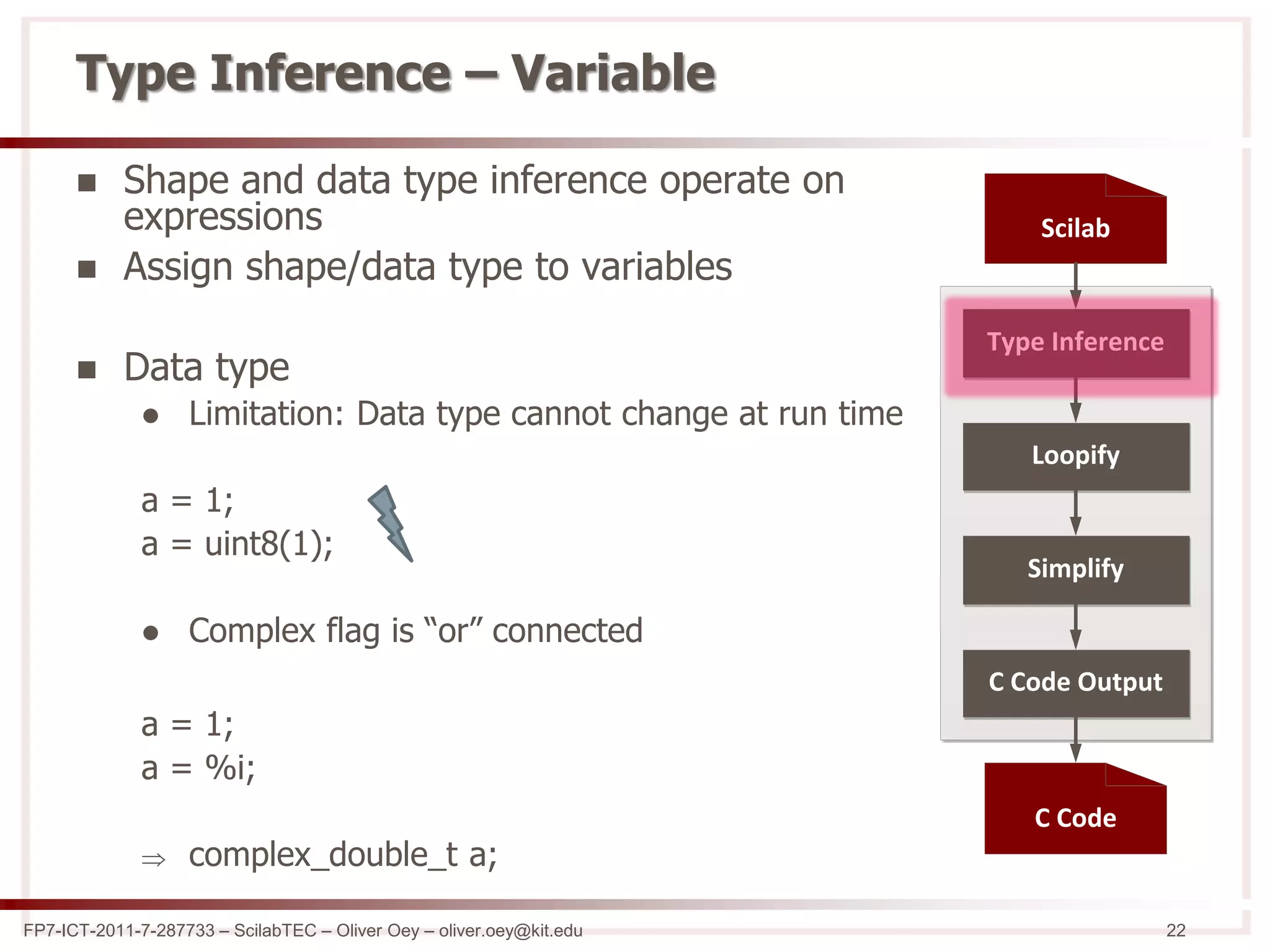
Type Inference – Variable
 Shape and data type inference operate on
expressions
 Assign shape/data type to variables
 Data type
 Limitation: Data type cannot change at run time
a = 1;
a = uint8(1);
 Complex flag is “or” connected
a = 1;
a = %i;
 complex_double_t a;
Scilab
Type Inference
Loopify
Simplify
C Code Output
C Code
FP7-ICT-2011-7-287733 – ScilabTEC – Oliver Oey – oliver.oey@kit.edu 23
Type Inference – Variable (2)
 Shape
 Variable shape is maximum of all dimensions
a = zeros(1,3);
a = zeros(4,1);
 double a[4,3];
 Limitation: Number of dimensions cannot
change
a = zeros(3,3);
a = zeros(3,3,3);
Scilab
Type Inference
Loopify
Simplify
C Code Output
C Code
FP7-ICT-2011-7-287733 – ScilabTEC – Oliver Oey – oliver.oey@kit.edu 24
Loopify
 Translates Matlab/Scilab variables into
 Data
 Dynamic size
 Static (maximum) size
 Translates Matlab/Scilab statements into
 Loop nest
 Size calculation
Scilab C code
a = zeros(2,3); int32_t a_data[3][2] = {{0}};
int32_t a_size[2];
const int32_t a_ssize[2] = {2, 3};
for (v1 = 0; v1 < 3; ++v1) {
for (v0 = 0; v0 < 2; ++v0) {
a_data[v1][v0] = 0;
}
}
a_size[0] = 2;
a_size[1] = 3;
Scilab
Type Inference
Loopify
Simplify
C Code Output
C Code
FP7-ICT-2011-7-287733 – ScilabTEC – Oliver Oey – oliver.oey@kit.edu 25
Simplify
 Remove unnecessary “for loops”
 Remove unnecessary variable dimensions
 Remove size variables and statements for fixed
size variables
Scilab C code
a = 1;
(before simplify)
int32_t a_data[1][1] = {{0}};
…
for (v1 = 0; v1 < 1; ++v1) {
for (v0 = 0; v0 < 1; ++v0) {
a_data[v1][v0] = 1;
}
}
a = 1;
(after simplify)
int32_t a_data = 0;
…
a_data[v1][v0] = 1;
Scilab
Type Inference
Loopify
Simplify
C Code Output
C Code
FP7-ICT-2011-7-287733 – ScilabTEC – Oliver Oey – oliver.oey@kit.edu 26
Results – Lines of Code
0
500
1000
1500
2000
2500
3000
3500
4000
4500
5000
SIFT Magic IFFT Intracom
Scilab
C (After Simplify)
C (Before Simplify)
FP7-ICT-2011-7-287733 – ScilabTEC – Oliver Oey – oliver.oey@kit.edu 27
Start-up company
Solutions for a parallel world
 Will be founded from KIT with results from ALMA
 www.emmtrix.com
FP7-ICT-2011-7-287733 – ScilabTEC – Oliver Oey – oliver.oey@kit.edu 28
Interactive Parallelization
 Control parallelization by high-level decisions in GUI
 Control, Traceability, Usability
 Automatic test generation
 Reliability
CPU
CPU
CPUCPU
CPU
FP7-ICT-2011-7-287733 – ScilabTEC – Oliver Oey – oliver.oey@kit.edu 29
emmtrix Workflow Integration
Parallel
C Code
Verification
Development with
Scilab
Iteration
emmtrix
Parallelization
Solution Test Platform
CPU
CPU CPU
CPU
Test PC
Multicore
Processor
 Integration into Scilab workflow
 Planned Xcos integration for model-based design
FP7-ICT-2011-7-287733 – ScilabTEC – Oliver Oey – oliver.oey@kit.edu 30
Plans for emmtrix
 Soon:
 Release of MatrixFrontend for Scilab community
 Free to use
 Convert Scilab code to C code
 Product launch of emmtrix Parallel Studio (not final name)
at Embedded World 2016 (Feb, 2016)
 Integration into workflow
 Support for different hardware platforms
 Support for model-based design
FP7-ICT-2011-7-287733 – ScilabTEC – Oliver Oey – oliver.oey@kit.edu 31
Summary
 ALMA Toolchain
 MatrixFrontend: Convert Scilab code to C
 Parallelization of generated code
 Speedup development for multi-core systems by 30-60%
 emmtrix Technologies
 Distribution of ALMA results
 Free Scilab to C converter: Matrix Frontend
 Interactive parallelization tool
FP7-ICT-2011-7-287733 – ScilabTEC – Oliver Oey – oliver.oey@kit.edu 32
Thank you !

ScilabTEC 2015 - KIT

  • 1.
    FP7-ICT-2011-7-287733 – ScilabTEC– Oliver Oey – oliver.oey@kit.edu 1 FP7-ICT-2011-7-287733 ALMA Project Overview Simplifying programming for multi-cores Oliver Oey
  • 2.
    FP7-ICT-2011-7-287733 – ScilabTEC– Oliver Oey – oliver.oey@kit.edu 2 Outline  ALMA EU Project Overview  Project Overview  Motivation  Results  MatrixFrontend  Type inference  Loopify  Simplify  emmtrix Technologies  Summary
  • 3.
    FP7-ICT-2011-7-287733 – ScilabTEC– Oliver Oey – oliver.oey@kit.edu 3 ALMA Project ID Card  Three year project: 01/09/2011 – 31/01/2015  Funded by FP7: 3.2 Million Euros  Official web site: http://www.alma-project.eu/  Coordinator: Juergen Becker (KIT) and Timo Stripf (KIT)  Scientific Coordinator: Nikos Voros (TWG)
  • 4.
    FP7-ICT-2011-7-287733 – ScilabTEC– Oliver Oey – oliver.oey@kit.edu 4 Why do we need multi-core processors?  Until ~2005 processor performance increase driven by  Clock speed  Execution optimization  Cache  Power wall  ILP wall  Led to multicore processors  Parallelism must be exposed by the programmer (source http://www.gotw.ca/publications/concurrency-ddj.htm)
  • 5.
    FP7-ICT-2011-7-287733 – ScilabTEC– Oliver Oey – oliver.oey@kit.edu 5 Motivation End user perspective Target architecture perspective • Explore/Develop algorithms • Use a simple, comfortable language • E.g. Matlab, Scilab, … • Don’t want to care about • data types • parallelism • End result • Performance • Energy efficient • Cost efficient • Fast development time • Multi-Processor System-on-Chip • Parallel processor cores • Explicit parallel programming • Distributed memory model, e.g. MPI • Parallelism within the processor cores • Single Instruction Multiple Data • Very Long Instruction Word • Native data types • E.g. 32-bit integer • Floating-point perform inefficient  Hide the complexity from the end user
  • 6.
    FP7-ICT-2011-7-287733 – ScilabTEC– Oliver Oey – oliver.oey@kit.edu 6 ALMA Development Flow (overview) Optimized application code on multi-core platform Embedded application design Multi-core hardware design Translation to Scilab & annotations Abstract hardware description (ADL) KIT C-compiler Multi-core simulator Parameters for algorithm optimization C-based code with parallel descriptions ALMA algorithm parallelization tools Executable binary (for simulator and HW) Recore C-compiler Structural hardware description Feedback for optimization
  • 7.
    FP7-ICT-2011-7-287733 – ScilabTEC– Oliver Oey – oliver.oey@kit.edu 7 Challenges for Compiling Scilab to MPSoCs  Scilab programming language  Sequential, imperative language  Dynamic typing (scalars, vectors, matrices)  End users typically use floating-point data types  Pointer-free, i.e. no memory aliasing problems  Natural parallelism within vector operations  MPSoC target architectures  Exploit coarse-grain parallelism (task-level)  Distributed memory  Exploit fine-grain parallelism (instruction-level)
  • 8.
    FP7-ICT-2011-7-287733 – ScilabTEC– Oliver Oey – oliver.oey@kit.edu 8 ALMA Target Architectures  Xentium® processing tile  Fixed-point DSP processing  10-issue VLIW processor  SIMD capability  Streaming communication services  Multicore Architectures  Distributed memory  => No shared memory required  No floating point unit  => Use fixed-point arithmetic  Example Architecture: Recore X2014
  • 9.
    FP7-ICT-2011-7-287733 – ScilabTEC– Oliver Oey – oliver.oey@kit.edu 9 Application Test Cases - Telecommunications Rx 1 Rx NR FFT Equaliz er Channe l Estimat or Derand o mizer Deinter leaver Symbol Decons truction - Cyclic Prefix Diversity Combine r - Cyclic Prefix FFT SDU Gener ation Data SDU s Uplink Frame Decon structio n MAC -PHY I/F BS Rx ` ALMA 1st Increment ALMA 2nd Increment Tx 1 Tx NT FEC Enco der Interl eaver Constel . Mappin g IFFT + Cyclic Prefix S-T Coding IFFT + Cyclic Prefix + Pre amble Data SDU s PHY MA C UL/DL Frame Mappe r UL/DL Sched uler BS Tx PDU Generati on MAC -PHY I/F Fram e Cons tructi on Downlin k MAC/P HY Control Symb ol Const ructio n Rand omiz er . . . .. . .. . . . . . . . . . . . . . FEC Decode r Const. Demap IEEE 802.16e PHY Layer in NT x NR MIMO Configuration Speedup: ~2,8
  • 10.
    FP7-ICT-2011-7-287733 – ScilabTEC– Oliver Oey – oliver.oey@kit.edu 10 Application Test Cases – Image Processing Scale Invariant Feature Transform (SIFT) Speedup: ~1,8
  • 11.
    FP7-ICT-2011-7-287733 – ScilabTEC– Oliver Oey – oliver.oey@kit.edu 11 0 20 40 60 80 Telecommunication Image processing Workingdays Manual Using autom. Parallelization Development effort -57% -30%  Reduction of development effort by partially over 50%
  • 12.
    FP7-ICT-2011-7-287733 – ScilabTEC– Oliver Oey – oliver.oey@kit.edu 12 ALMA Workflow Parallel C Code Development Cycle II Development using Scilab Development Cycle I ALMA Parallelization Tools Testing plattform CPU CPU CPU CPU Testing PC Multi-core Processor
  • 13.
    FP7-ICT-2011-7-287733 – ScilabTEC– Oliver Oey – oliver.oey@kit.edu 13 ALMA Workflow (Details) Parallel C Code Development Cycle I Development with Scilab Sequential Static C Code Paralleliza tion Matrix Frontend Parallelization Development Cycle II
  • 14.
    FP7-ICT-2011-7-287733 – ScilabTEC– Oliver Oey – oliver.oey@kit.edu 14 Outline  ALMA EU Project Overview  Project Overview  Motivation  Results  MatrixFrontend  Type inference  Loopify  Simplify  emmtrix Technologies  Summary
  • 15.
    FP7-ICT-2011-7-287733 – ScilabTEC– Oliver Oey – oliver.oey@kit.edu 15 Matrix Frontend Parallel C CodeDevelopment with Scilab Sequential Static C Code Paralleliza tion Matrix Frontend Parallelization  Scilab-to-C Compiler  Parses Scilab code  Advanced type inference  High-level optimizations on Scilab code  Turns Scilab statements into loop nests  Generated C Code  Optimized for parallelism extraction  Static memory allocation  Avoid pointers
  • 16.
    FP7-ICT-2011-7-287733 – ScilabTEC– Oliver Oey – oliver.oey@kit.edu 16 Requirements Source language  Support Scilab input language  Support well-defined subset  Extend with annotation  for type inference  for parallelization  Annotated code should still be valid Scilab/Matlab code Target language  Generate ANSI C89 code  Polyhedral code  Large Static Control Parts  Avoid pointers  Static code  No dynamic memory allocation  Avoid run-time decisions
  • 17.
    FP7-ICT-2011-7-287733 – ScilabTEC– Oliver Oey – oliver.oey@kit.edu 17 Type Inference  Calculate types for expressions and variables “Type” = “Data Type” + “Shape”  Separated into 3 passes 1. Shape Inference 2. Data Type Inference 3. Variable Inference Scilab Type Inference Loopify Simplify C Code Output C Code
  • 18.
    FP7-ICT-2011-7-287733 – ScilabTEC– Oliver Oey – oliver.oey@kit.edu 18 Type Inference - Shape  Calculate shape of each Scilab statement s = [1 2 3]; // s = 1x3 for f = 1:10 // f = 1x1 s = s + f // s = 1x3 end Scilab Type Inference Loopify Simplify C Code Output C Code
  • 19.
    FP7-ICT-2011-7-287733 – ScilabTEC– Oliver Oey – oliver.oey@kit.edu 19 Type Inference – Growing Arrays  Support growing arrays a = 1; a(1,5) = 1;  [1 0 0 0 1]  Maximum size must be known!  What happens if matrix is indexed by variable? a(1,b) = 1; // Maximum value of b unknown  Two solutions: Scilab Type Inference Loopify Simplify C Code Output C Code a = zeros(1,5); mfe_fixedsize(a); a = 1; a(1,b) = 1; a = 1; mfe_size(a, 1, 1:5); a(1,b) = 1;
  • 20.
    FP7-ICT-2011-7-287733 – ScilabTEC– Oliver Oey – oliver.oey@kit.edu 20 Type Inference – Data Type  Scilab has data type function  double  int32, int16, int8  uint32, uint16, uint8  boolean  complex, real, imag a = uint8([255 256]);  [255 0] Scilab Type Inference Loopify Simplify C Code Output C Code
  • 21.
    FP7-ICT-2011-7-287733 – ScilabTEC– Oliver Oey – oliver.oey@kit.edu 21 Type Inference – Data Type (2)  Problem: Data type is run-time specific sqrt(1) => double sqrt(-1) => complex double sqrt(a) => ?  We cannot guarantee Scilab conform execution  Solution  Generate warning  Ask end user to specify data type real(sqrt(a)) => double sqrt(complex(a)) => complex double Scilab Type Inference Loopify Simplify C Code Output C Code
  • 22.
    FP7-ICT-2011-7-287733 – ScilabTEC– Oliver Oey – oliver.oey@kit.edu 22 Type Inference – Variable  Shape and data type inference operate on expressions  Assign shape/data type to variables  Data type  Limitation: Data type cannot change at run time a = 1; a = uint8(1);  Complex flag is “or” connected a = 1; a = %i;  complex_double_t a; Scilab Type Inference Loopify Simplify C Code Output C Code
  • 23.
    FP7-ICT-2011-7-287733 – ScilabTEC– Oliver Oey – oliver.oey@kit.edu 23 Type Inference – Variable (2)  Shape  Variable shape is maximum of all dimensions a = zeros(1,3); a = zeros(4,1);  double a[4,3];  Limitation: Number of dimensions cannot change a = zeros(3,3); a = zeros(3,3,3); Scilab Type Inference Loopify Simplify C Code Output C Code
  • 24.
    FP7-ICT-2011-7-287733 – ScilabTEC– Oliver Oey – oliver.oey@kit.edu 24 Loopify  Translates Matlab/Scilab variables into  Data  Dynamic size  Static (maximum) size  Translates Matlab/Scilab statements into  Loop nest  Size calculation Scilab C code a = zeros(2,3); int32_t a_data[3][2] = {{0}}; int32_t a_size[2]; const int32_t a_ssize[2] = {2, 3}; for (v1 = 0; v1 < 3; ++v1) { for (v0 = 0; v0 < 2; ++v0) { a_data[v1][v0] = 0; } } a_size[0] = 2; a_size[1] = 3; Scilab Type Inference Loopify Simplify C Code Output C Code
  • 25.
    FP7-ICT-2011-7-287733 – ScilabTEC– Oliver Oey – oliver.oey@kit.edu 25 Simplify  Remove unnecessary “for loops”  Remove unnecessary variable dimensions  Remove size variables and statements for fixed size variables Scilab C code a = 1; (before simplify) int32_t a_data[1][1] = {{0}}; … for (v1 = 0; v1 < 1; ++v1) { for (v0 = 0; v0 < 1; ++v0) { a_data[v1][v0] = 1; } } a = 1; (after simplify) int32_t a_data = 0; … a_data[v1][v0] = 1; Scilab Type Inference Loopify Simplify C Code Output C Code
  • 26.
    FP7-ICT-2011-7-287733 – ScilabTEC– Oliver Oey – oliver.oey@kit.edu 26 Results – Lines of Code 0 500 1000 1500 2000 2500 3000 3500 4000 4500 5000 SIFT Magic IFFT Intracom Scilab C (After Simplify) C (Before Simplify)
  • 27.
    FP7-ICT-2011-7-287733 – ScilabTEC– Oliver Oey – oliver.oey@kit.edu 27 Start-up company Solutions for a parallel world  Will be founded from KIT with results from ALMA  www.emmtrix.com
  • 28.
    FP7-ICT-2011-7-287733 – ScilabTEC– Oliver Oey – oliver.oey@kit.edu 28 Interactive Parallelization  Control parallelization by high-level decisions in GUI  Control, Traceability, Usability  Automatic test generation  Reliability CPU CPU CPUCPU CPU
  • 29.
    FP7-ICT-2011-7-287733 – ScilabTEC– Oliver Oey – oliver.oey@kit.edu 29 emmtrix Workflow Integration Parallel C Code Verification Development with Scilab Iteration emmtrix Parallelization Solution Test Platform CPU CPU CPU CPU Test PC Multicore Processor  Integration into Scilab workflow  Planned Xcos integration for model-based design
  • 30.
    FP7-ICT-2011-7-287733 – ScilabTEC– Oliver Oey – oliver.oey@kit.edu 30 Plans for emmtrix  Soon:  Release of MatrixFrontend for Scilab community  Free to use  Convert Scilab code to C code  Product launch of emmtrix Parallel Studio (not final name) at Embedded World 2016 (Feb, 2016)  Integration into workflow  Support for different hardware platforms  Support for model-based design
  • 31.
    FP7-ICT-2011-7-287733 – ScilabTEC– Oliver Oey – oliver.oey@kit.edu 31 Summary  ALMA Toolchain  MatrixFrontend: Convert Scilab code to C  Parallelization of generated code  Speedup development for multi-core systems by 30-60%  emmtrix Technologies  Distribution of ALMA results  Free Scilab to C converter: Matrix Frontend  Interactive parallelization tool
  • 32.
    FP7-ICT-2011-7-287733 – ScilabTEC– Oliver Oey – oliver.oey@kit.edu 32 Thank you !