Towards Model-based Design of Mission-Critical
Avionics using Scilab/Xcos
David Müller and Umut Durak
German Aerospace Center (DLR), Institute of Flight Systems
• Introduction:
• the 4th Revolution of Aeronautics and its challenge
• the ARGO project
• DLR‘s use case for ARGO
• introduction of Terrain Awareness and Warning Systems
• selected examples of the implementation in Scilab/Xcos
• our user experience
• The ARGO workflow
• X-in-the-Loop Testing
• Outlook
Outline
> Towards Model-based Design of Mission-Critical Avionics using Scilab/Xcos > David Müller > 20.11.2018DLR.de • Chart 2
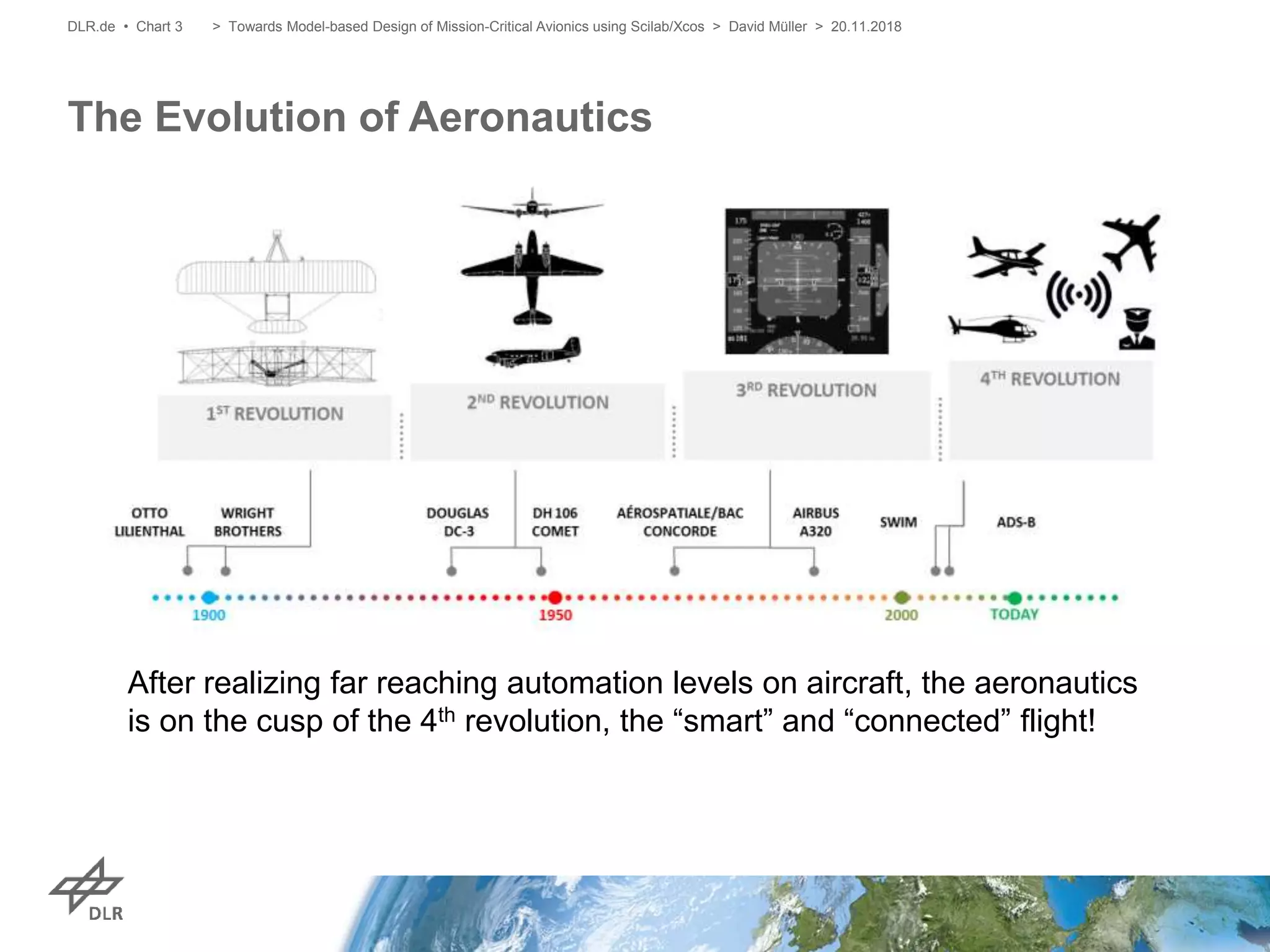
The Evolution of Aeronautics
DLR.de • Chart 3
After realizing far reaching automation levels on aircraft, the aeronautics
is on the cusp of the 4th revolution, the “smart” and “connected” flight!
> Towards Model-based Design of Mission-Critical Avionics using Scilab/Xcos > David Müller > 20.11.2018
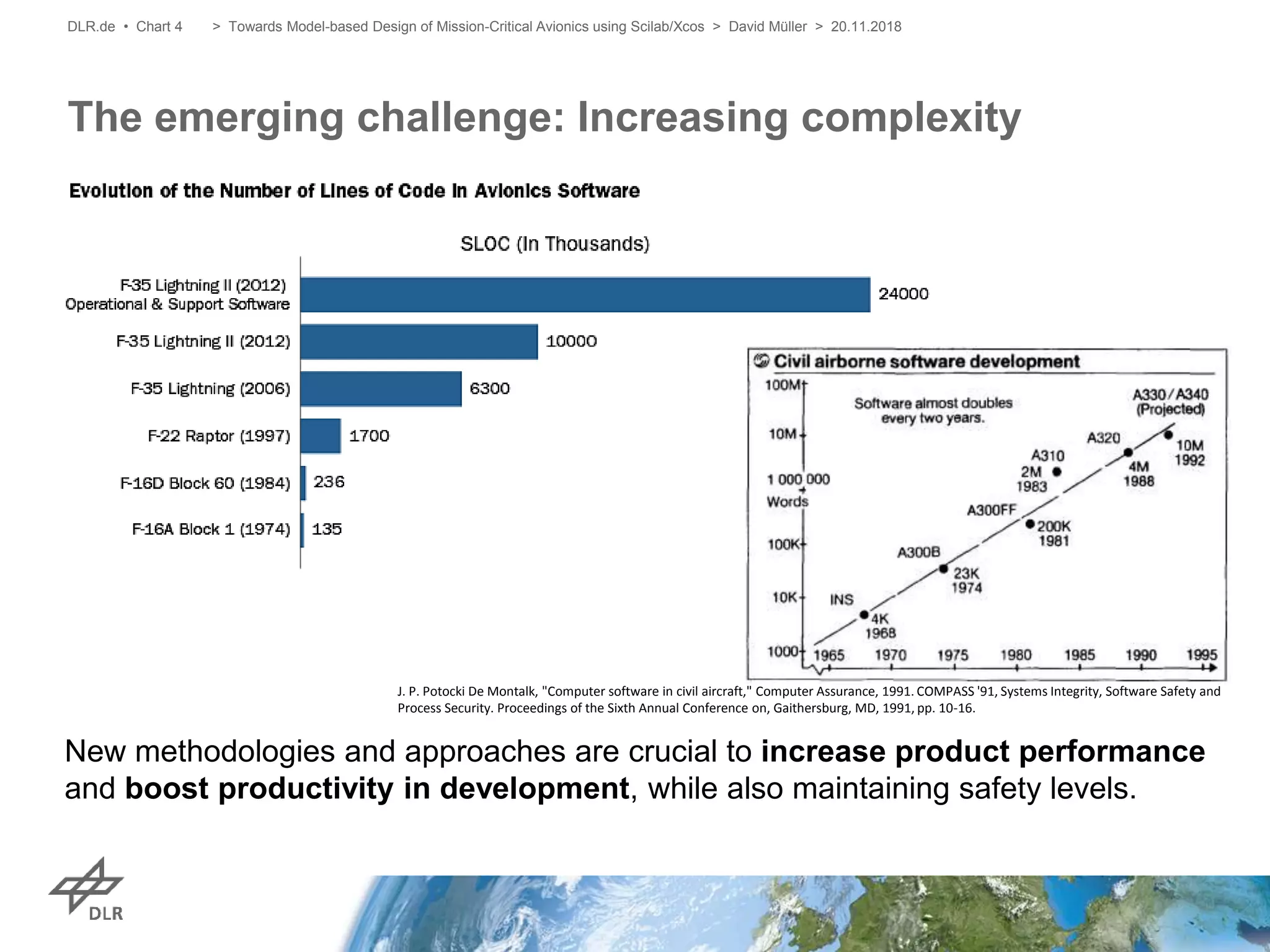
New methodologies and approaches are crucial to increase product performance
and boost productivity in development, while also maintaining safety levels.
The emerging challenge: Increasing complexity
DLR.de • Chart 4
J. P. Potocki De Montalk, "Computer software in civil aircraft," Computer Assurance, 1991. COMPASS '91, Systems Integrity, Software Safety and
Process Security. Proceedings of the Sixth Annual Conference on, Gaithersburg, MD, 1991, pp. 10-16.
> Towards Model-based Design of Mission-Critical Avionics using Scilab/Xcos > David Müller > 20.11.2018
2012 - EADS Innovation Works: utilization of multi-core systems in partitioned
environments
2013 – CASSIDIAN: application of multi-core architectures for a degraded vision
landing system for a helicopter
2014 – THALES: design principles of predictable and efficient multi-core
systems to meet embedded computer requirements in avionics
2014 - Saab Aeronautics: guaranteeing determinism for avionic applications
running on multiple cores and interacting through shared memory
Trend in Avionic Systems – recent research projects
DLR.de • Chart 5 > Towards Model-based Design of Mission-Critical Avionics using Scilab/Xcos > David Müller > 20.11.2018
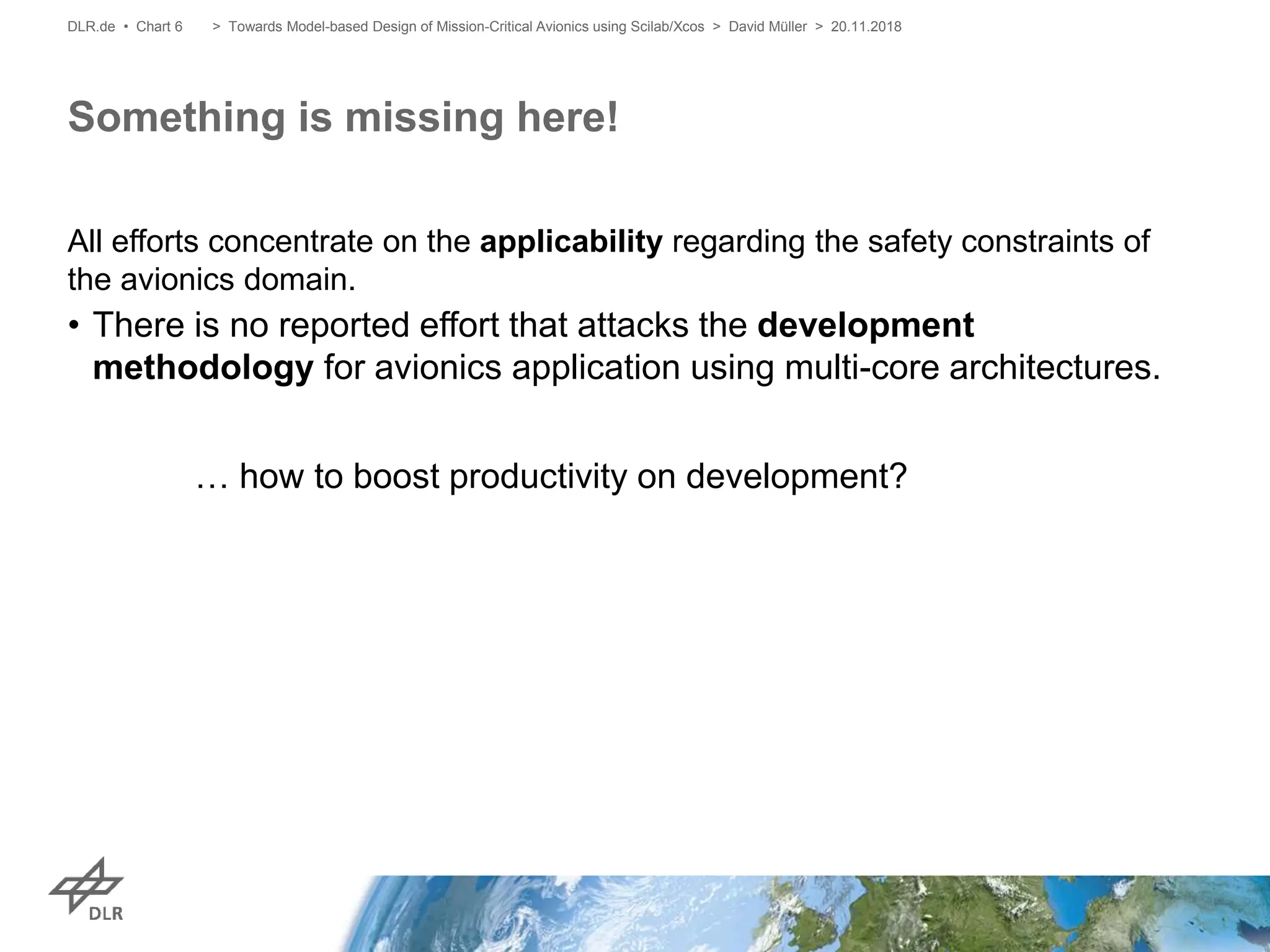
All efforts concentrate on the applicability regarding the safety constraints of
the avionics domain.
• There is no reported effort that attacks the development
methodology for avionics application using multi-core architectures.
… how to boost productivity on development?
Something is missing here!
DLR.de • Chart 6 > Towards Model-based Design of Mission-Critical Avionics using Scilab/Xcos > David Müller > 20.11.2018
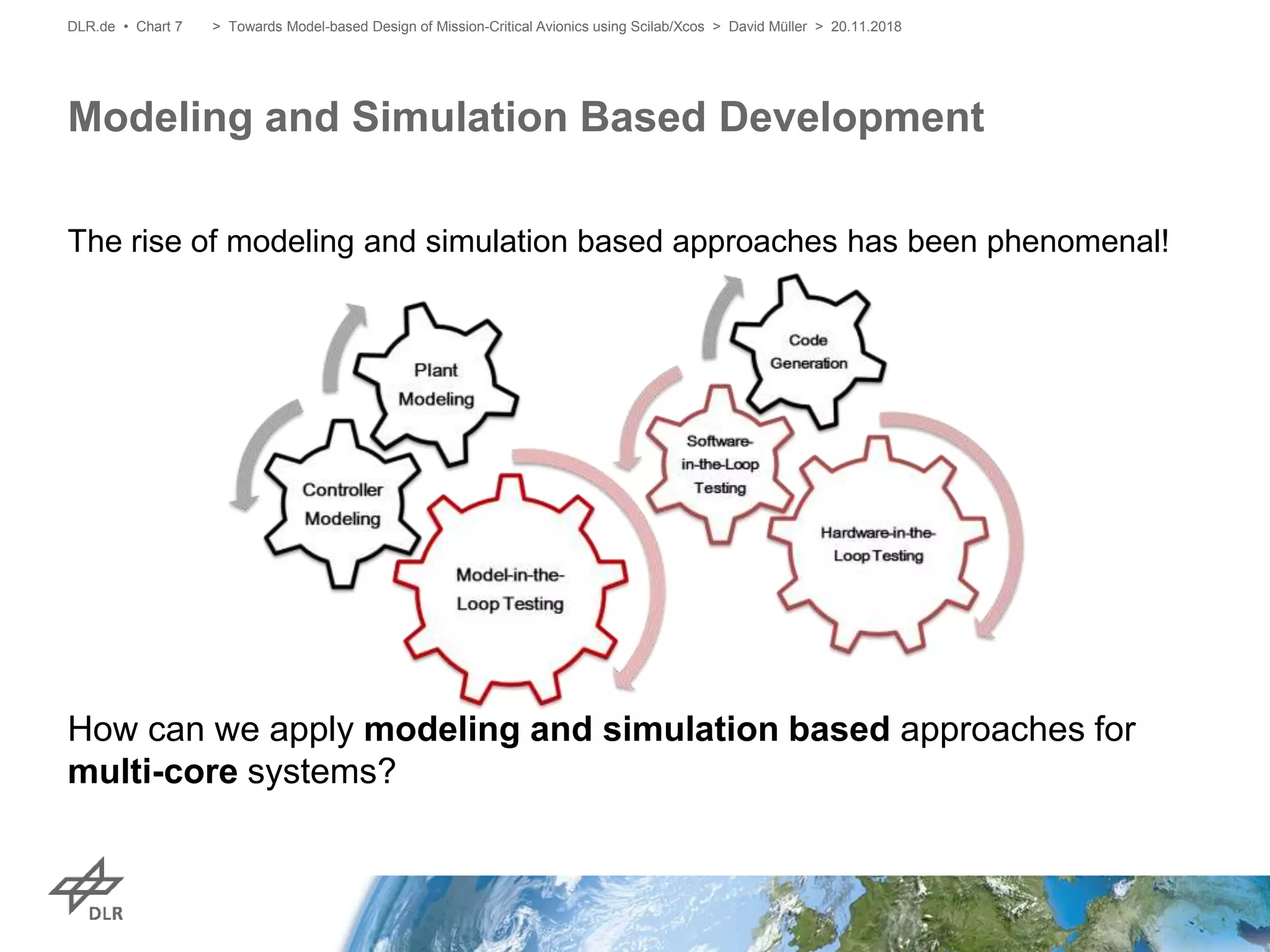
The rise of modeling and simulation based approaches has been phenomenal!
How can we apply modeling and simulation based approaches for
multi-core systems?
Modeling and Simulation Based Development
DLR.de • Chart 7 > Towards Model-based Design of Mission-Critical Avionics using Scilab/Xcos > David Müller > 20.11.2018
Developing embedded parallel real-time software for
multicore processors is time-consuming and error-
prone.
ARGO aims to help software developers in achieving
better utilization of the benefits of multiprocessor hardware platforms, regardless
of their level of experience with parallel programming
DLR’s role in ARGO: to develop a Terrain Awareness and Warning System
(TAWS) as a use case for the ARGO toolchain and integrate it into the A320
cockpit of AVES, DLR’s Air Vehicle Simulator.
This project has received funding from the European Union’s Horizon 2020 research and innovation
programme under grant agreement No 688131 — ARGO.
http://www.argo-project.eu/
The ARGO project
Worst Case Execution Time (WCET)-Aware PaRallelization of Model-Based
Applications for HeteroGeneOus Parallel Systems
DLR.de • Chart 8 > Towards Model-based Design of Mission-Critical Avionics using Scilab/Xcos > David Müller > 20.11.2018
A TAWS is a flight system (a supervisory controller) that creates visual and
aural warnings in order to avoid Controlled Flight into the Terrain.
Terrain Awareness and Warning System
Example Case
DLR.de • Chart 9
Basic Modes:
Mode 1: Excessive Descent Rate
Mode 2: Excessive Terrain Closure Rate
Mode 3: Altitude Loss After Take-off
Mode 4: Unsafe Terrain Clearance
Mode 5: Excessive Deviation Below Glideslope
Enhanced Features:
Terrain Awareness and Display (TAD) provides an image of the
surrounding terrain as well as warnings and cautions regarding terrain
interactions within the next 60 seconds of flight.
> Towards Model-based Design of Mission-Critical Avionics using Scilab/Xcos > David Müller > 20.11.2018
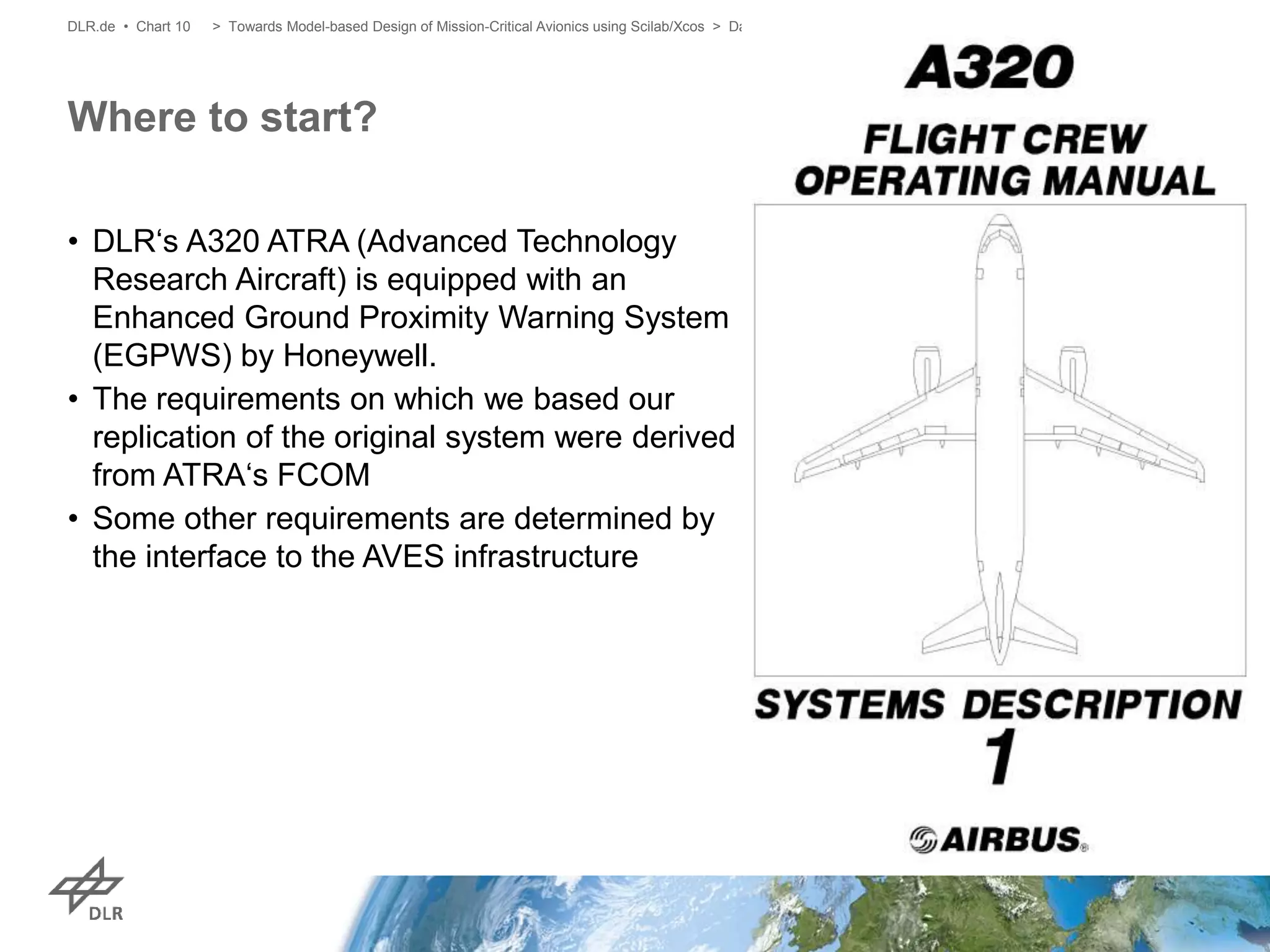
• DLR‘s A320 ATRA (Advanced Technology
Research Aircraft) is equipped with an
Enhanced Ground Proximity Warning System
(EGPWS) by Honeywell.
• The requirements on which we based our
replication of the original system were derived
from ATRA‘s FCOM
• Some other requirements are determined by
the interface to the AVES infrastructure
Where to start?
> Towards Model-based Design of Mission-Critical Avionics using Scilab/Xcos > David Müller > 20.11.2018DLR.de • Chart 10
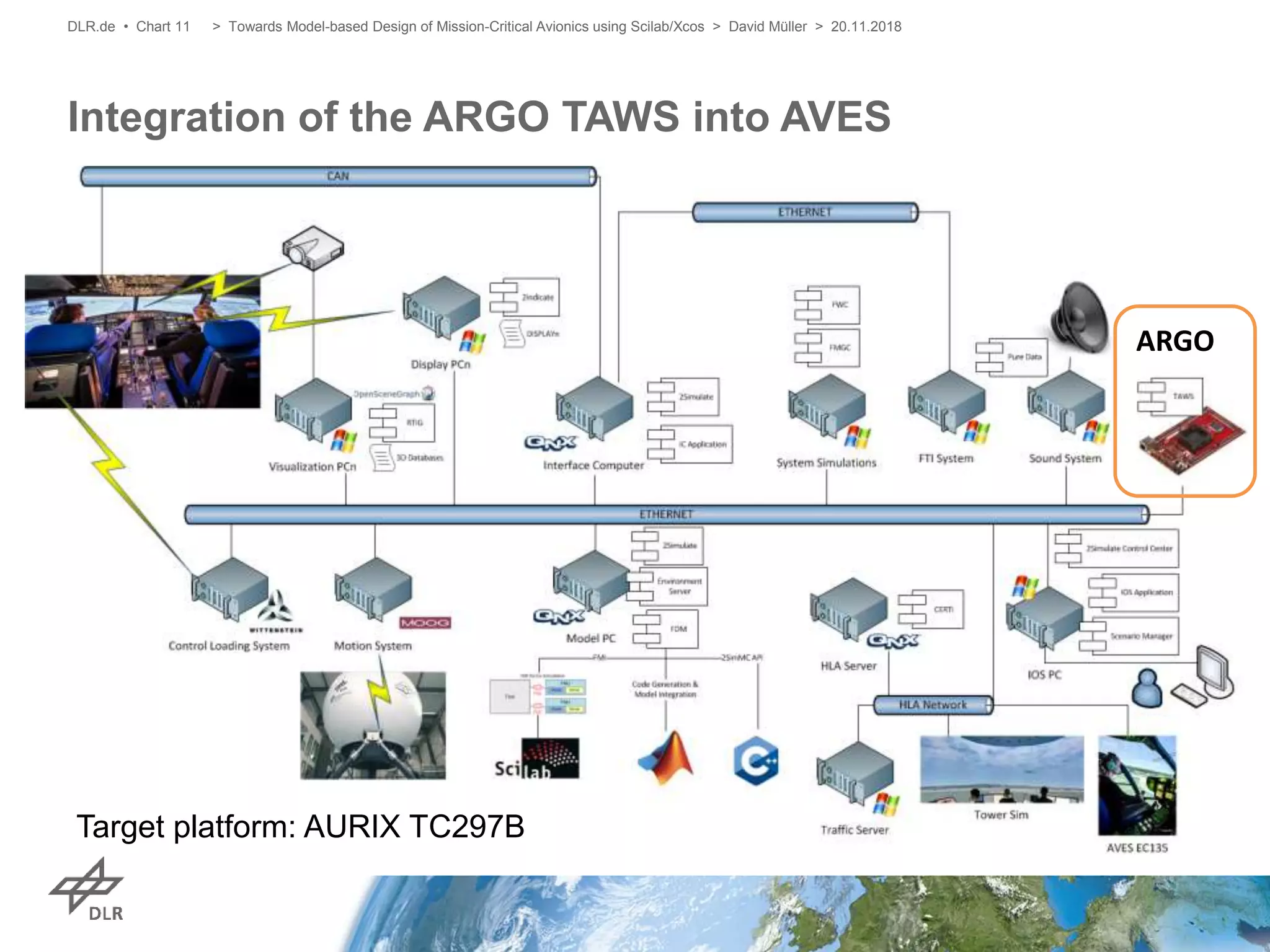
Integration of the ARGO TAWS into AVES
> Towards Model-based Design of Mission-Critical Avionics using Scilab/Xcos > David Müller > 20.11.2018DLR.de • Chart 11
ARGO
Target platform: AURIX TC297B
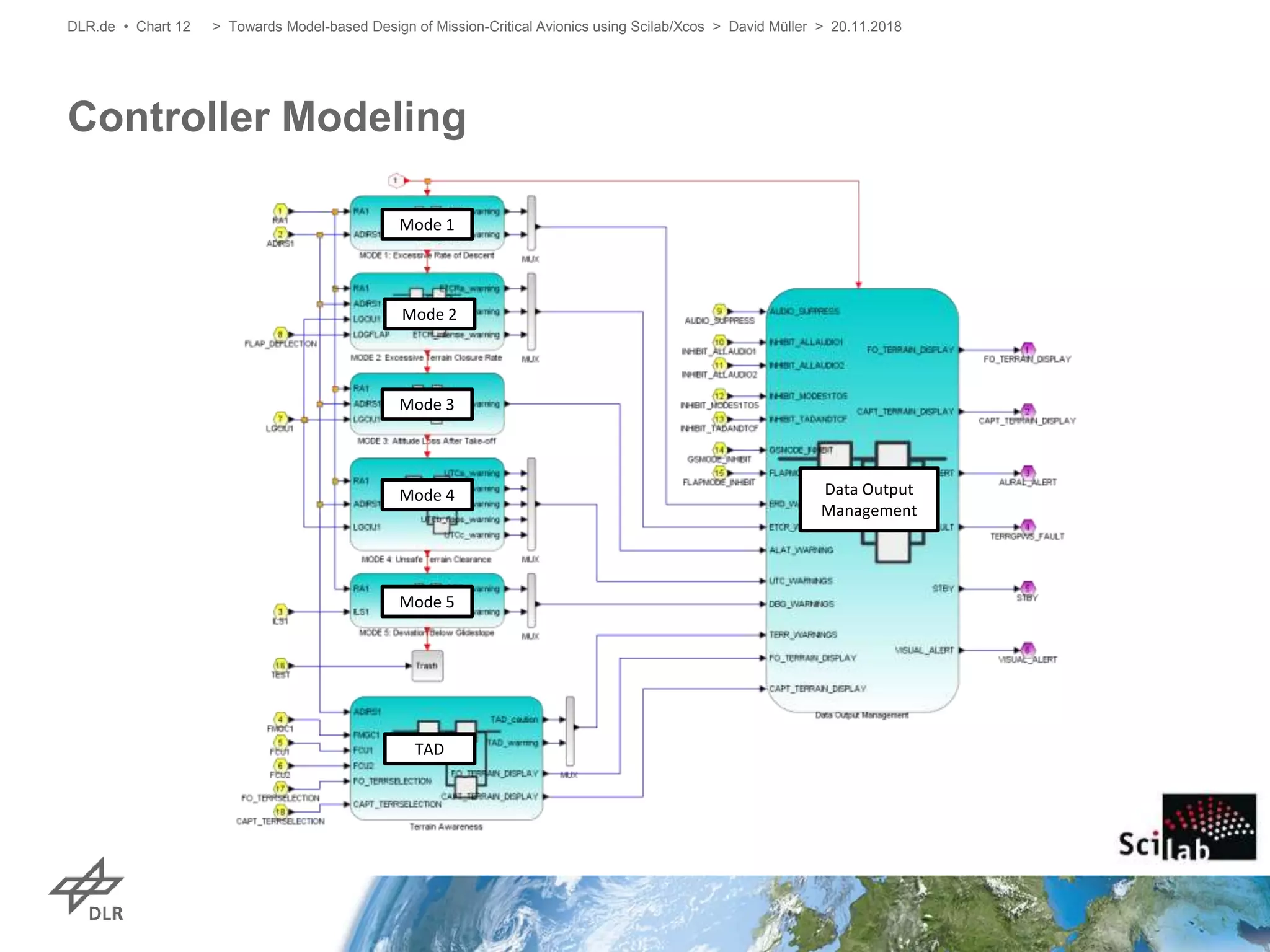
Controller Modeling
DLR.de • Chart 12
Mode 1
Mode 2
Mode 3
Mode 4
Mode 5
TAD
Data Output
Management
> Towards Model-based Design of Mission-Critical Avionics using Scilab/Xcos > David Müller > 20.11.2018
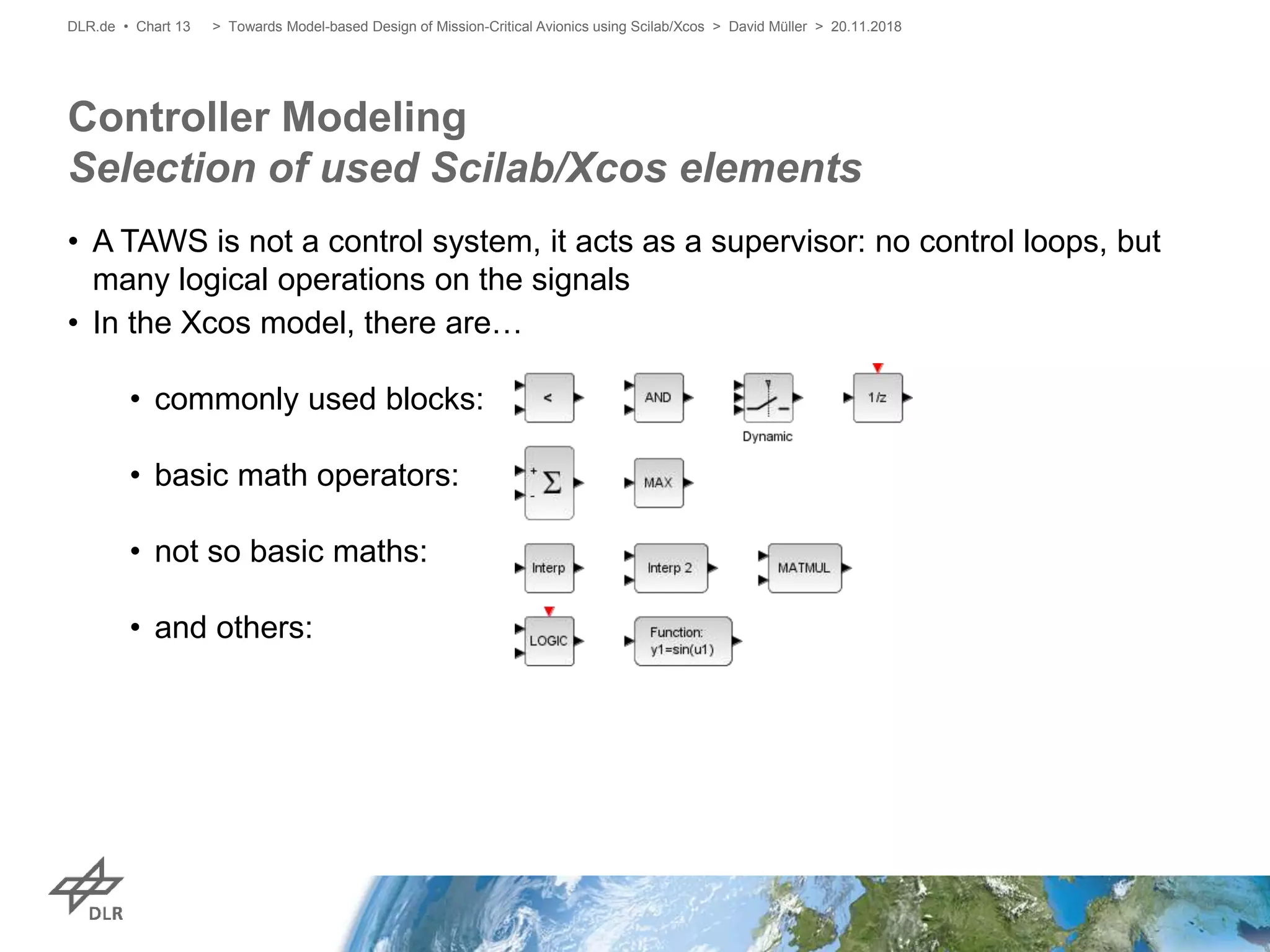
• A TAWS is not a control system, it acts as a supervisor: no control loops, but
many logical operations on the signals
• In the Xcos model, there are…
• commonly used blocks:
• basic math operators:
• not so basic maths:
• and others:
Controller Modeling
Selection of used Scilab/Xcos elements
> Towards Model-based Design of Mission-Critical Avionics using Scilab/Xcos > David Müller > 20.11.2018DLR.de • Chart 13
Controller Modeling
Basic Modes
DLR.de • Chart 14
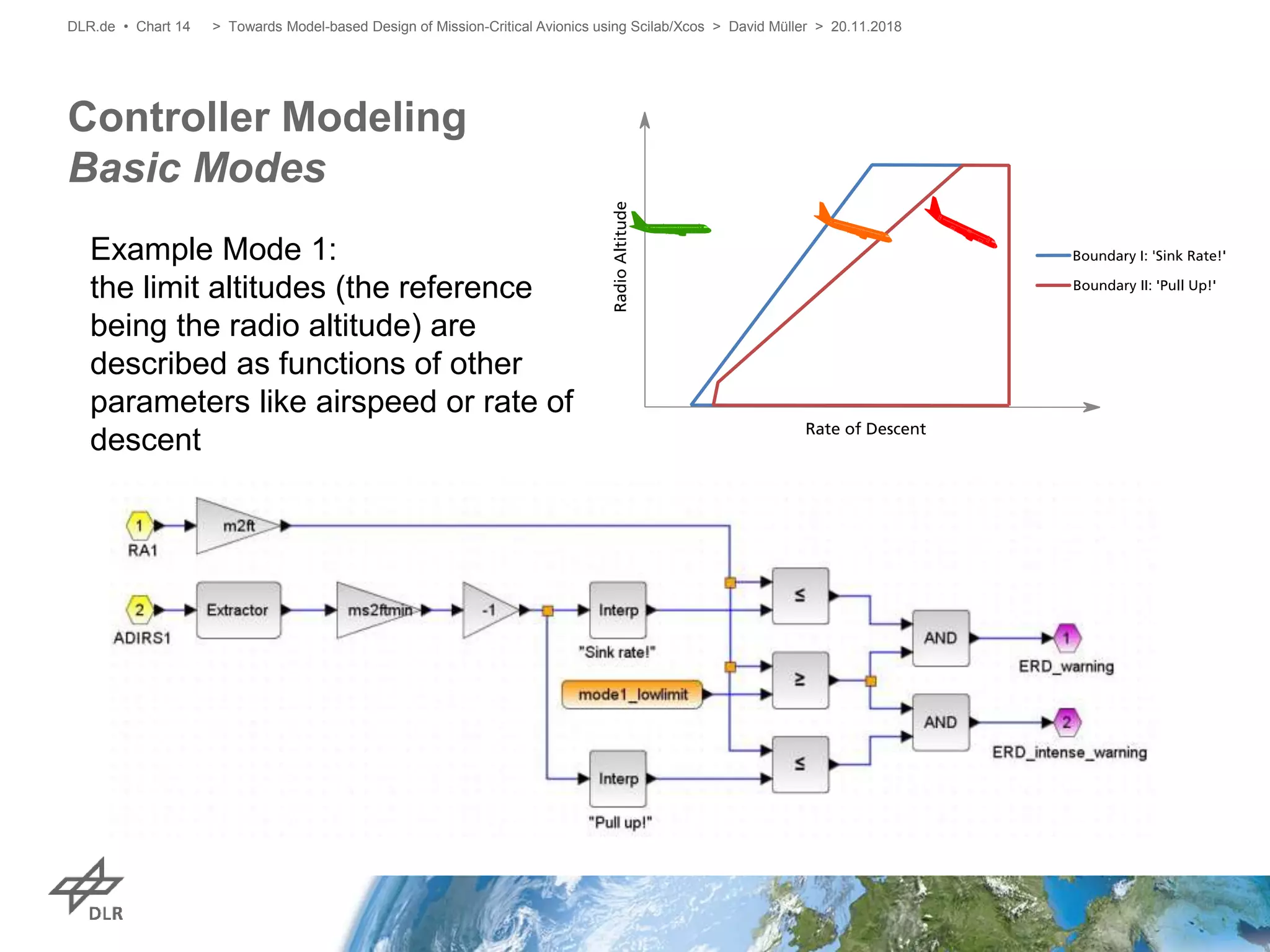
Example Mode 1:
the limit altitudes (the reference
being the radio altitude) are
described as functions of other
parameters like airspeed or rate of
descent
> Towards Model-based Design of Mission-Critical Avionics using Scilab/Xcos > David Müller > 20.11.2018
Controller Modeling
Basic Modes
DLR.de • Chart 15 > Towards Model-based Design of Mission-Critical Avionics using Scilab/Xcos > David Müller > 20.11.2018
Controller Modeling
Enhanced Features
DLR.de • Chart 16
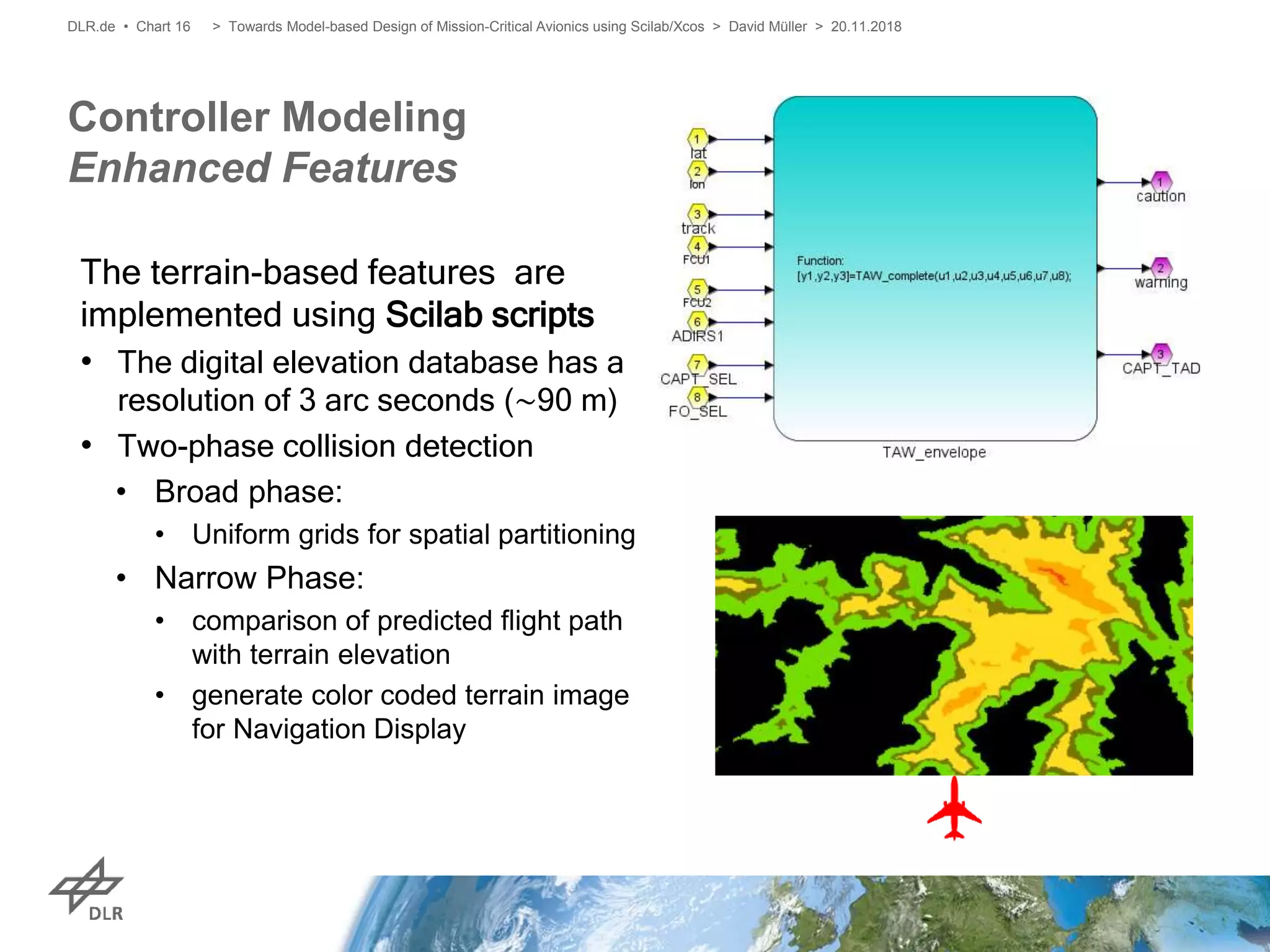
The terrain-based features are
implemented using Scilab scripts
• The digital elevation database has a
resolution of 3 arc seconds (∼90 m)
• Two-phase collision detection
• Broad phase:
• Uniform grids for spatial partitioning
• Narrow Phase:
• comparison of predicted flight path
with terrain elevation
• generate color coded terrain image
for Navigation Display
> Towards Model-based Design of Mission-Critical Avionics using Scilab/Xcos > David Müller > 20.11.2018
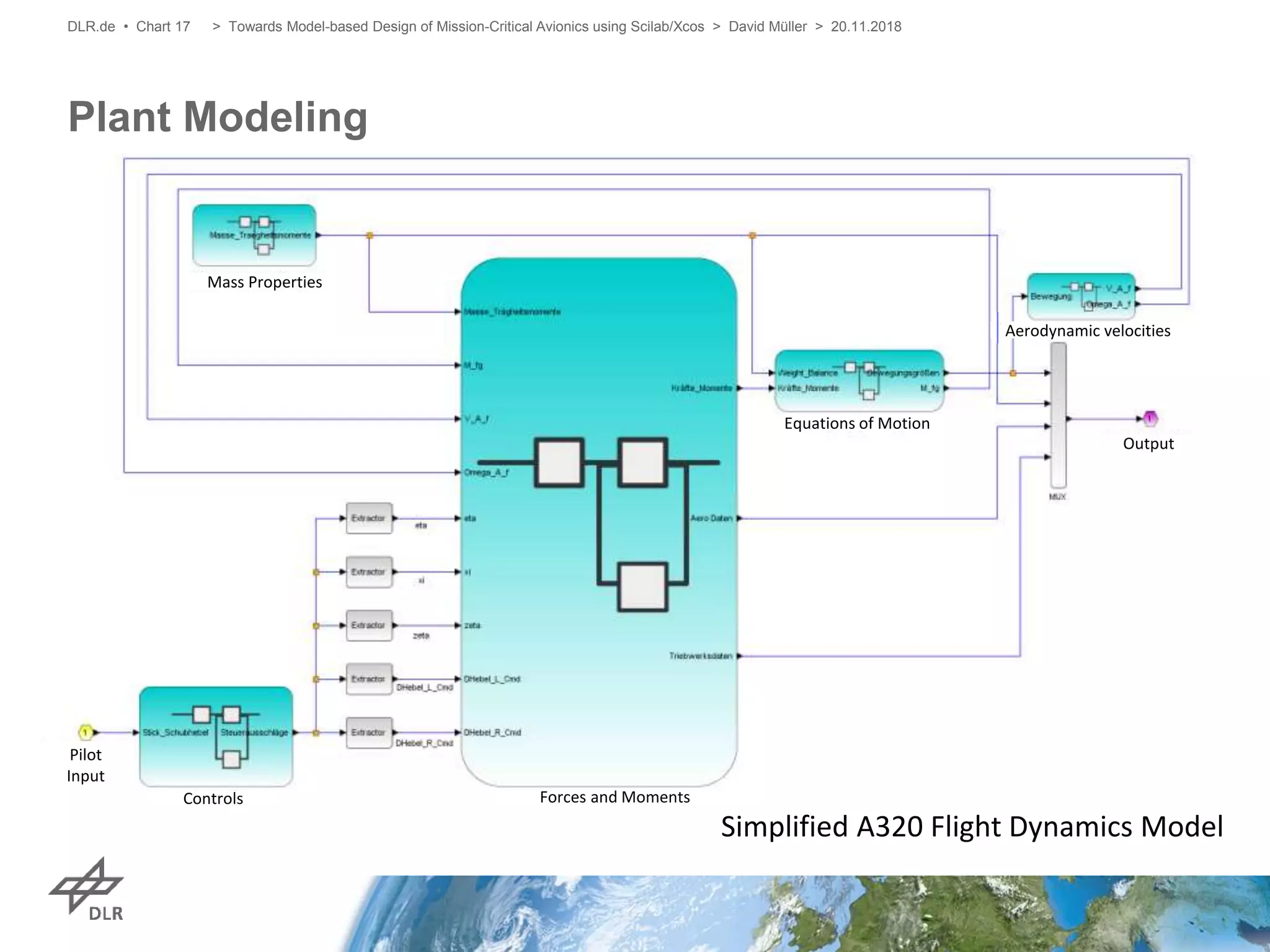
Plant Modeling
DLR.de • Chart 17
Simplified A320 Flight Dynamics Model
Mass Properties
Forces and MomentsControls
Pilot
Input
Equations of Motion
Output
> Towards Model-based Design of Mission-Critical Avionics using Scilab/Xcos > David Müller > 20.11.2018
Aerodynamic velocities
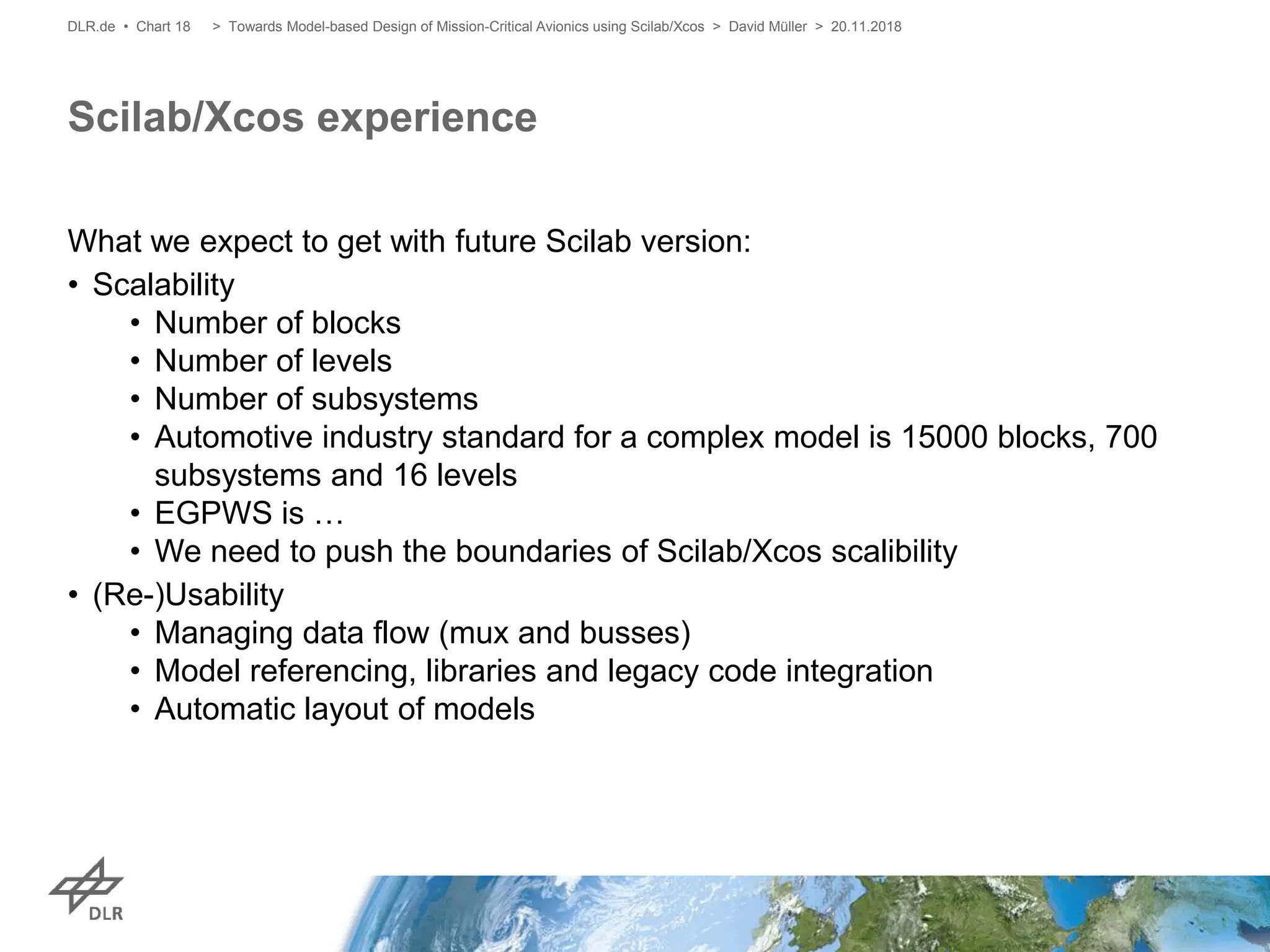
What we expect to get with future Scilab version:
• Scalability
• Number of blocks
• Number of levels
• Number of subsystems
• Automotive industry standard for a complex model is 15000 blocks, 700
subsystems and 16 levels
• EGPWS is …
• We need to push the boundaries of Scilab/Xcos scalibility
• (Re-)Usability
• Managing data flow (mux and busses)
• Model referencing, libraries and legacy code integration
• Automatic layout of models
Scilab/Xcos experience
> Towards Model-based Design of Mission-Critical Avionics using Scilab/Xcos > David Müller > 20.11.2018DLR.de • Chart 18
ARGO Model-Based Design Workflow
DLR.de • Chart 19
Application Test
Cases
Xcos / Scilab
Application Models
Cross-layer
Programming Interface
Feedback&Control
Scheduling and High-Level
Decisions
Code Transformations for
Predictability
Enhancement
Data Management,
Synchronization and Code
Generation
Code-Level WCET
System-Level WCET
CPU
CPU CPU
CPU
Multicore
ArchitecturesIterative
Optimization
Front-End Tools
ADL Description
int m, n, p, q, c, d, k, sum = 0;
int first[10][10], second[10][10],
multiply[10][10];
for (c = 0; c < m; c++) {
for (d = 0; d < q; d++) {
for (k = 0; k < p; k++) {
sum = sum + first[c][k]*second[k][d];
}
multiply[c][d] = sum;
sum = 0;
}
}
Xcos
model
Scilab
script
Sequential
Code
Parallel
Code
> Towards Model-based Design of Mission-Critical Avionics using Scilab/Xcos > David Müller > 20.11.2018
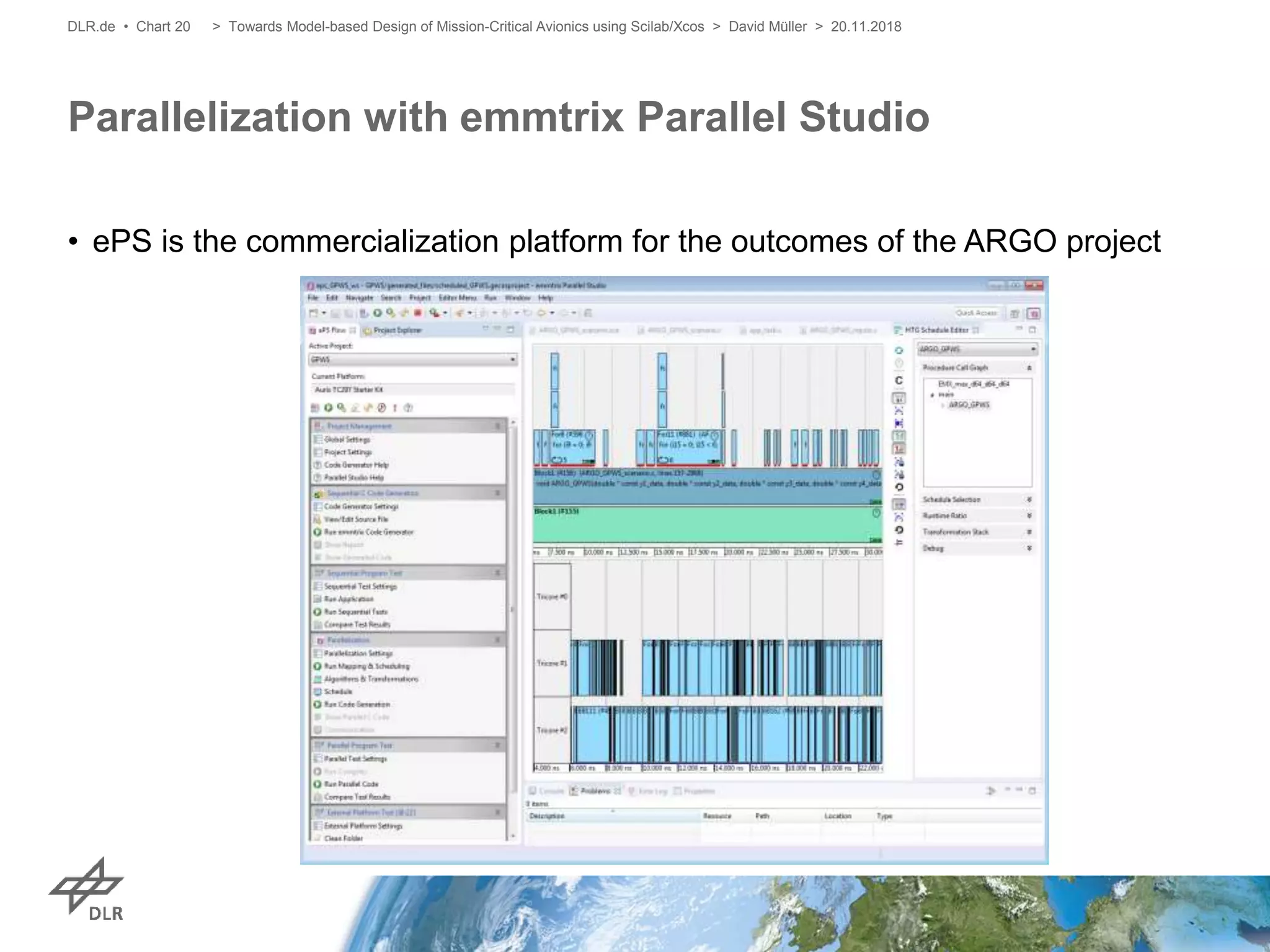
• ePS is the commercialization platform for the outcomes of the ARGO project
Parallelization with emmtrix Parallel Studio
> Towards Model-based Design of Mission-Critical Avionics using Scilab/Xcos > David Müller > 20.11.2018DLR.de • Chart 20
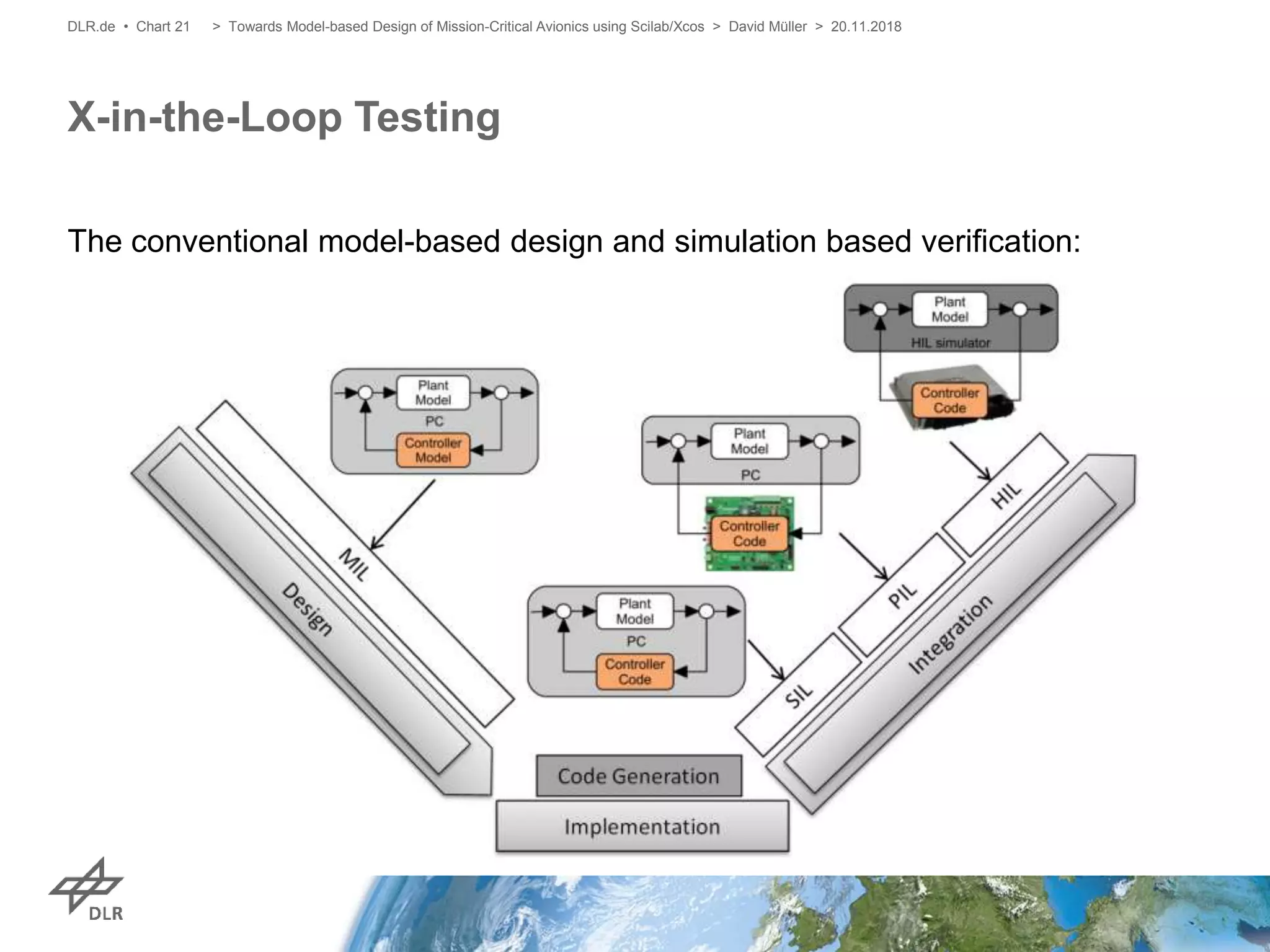
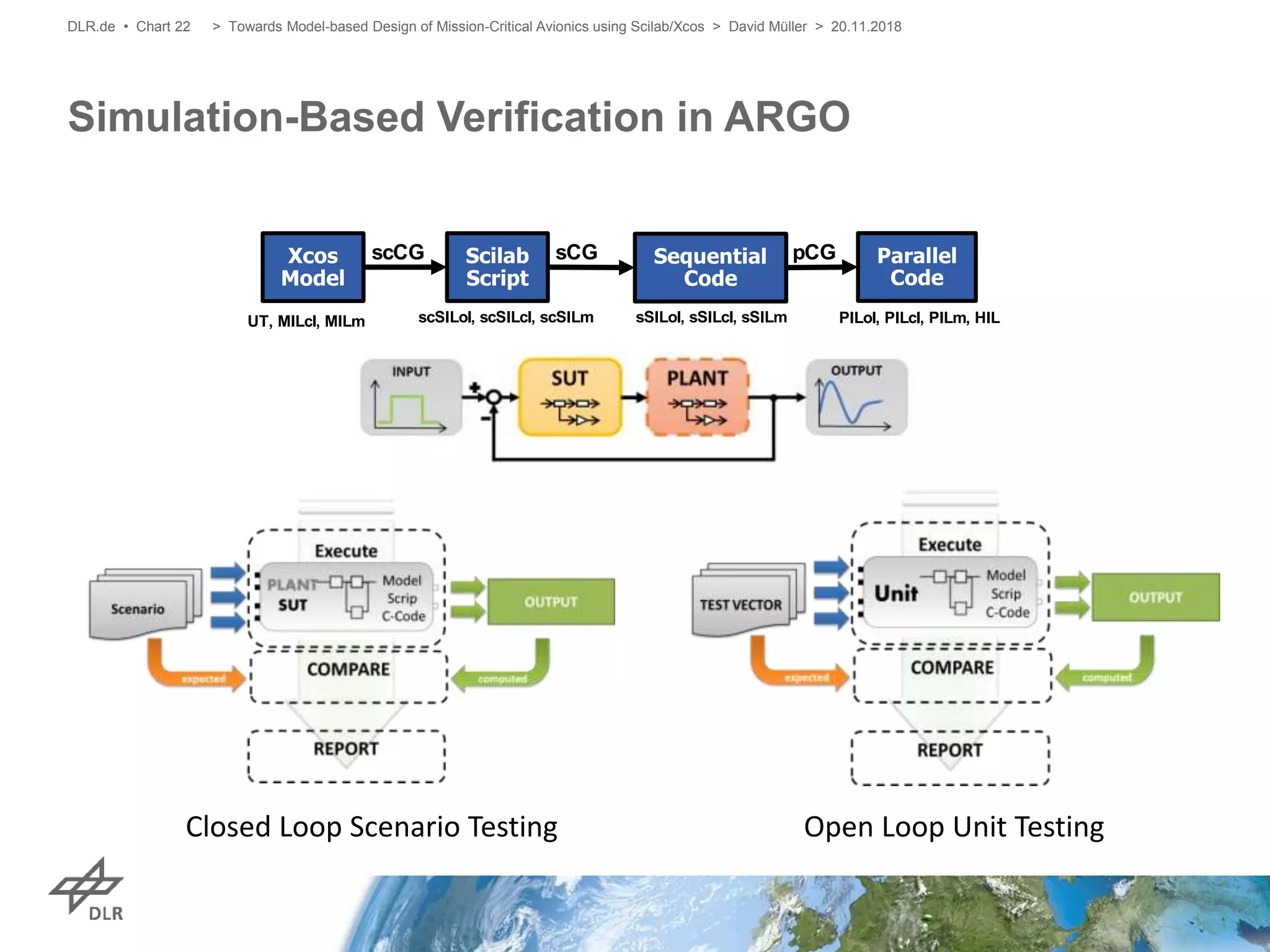
The conventional model-based design and simulation based verification:
X-in-the-Loop Testing
> Towards Model-based Design of Mission-Critical Avionics using Scilab/Xcos > David Müller > 20.11.2018DLR.de • Chart 21
Simulation-Based Verification in ARGO
DLR.de • Chart 22
Open Loop Unit TestingClosed Loop Scenario Testing
> Towards Model-based Design of Mission-Critical Avionics using Scilab/Xcos > David Müller > 20.11.2018
Xcos
Model
Scilab
Script
Sequential
Code
Parallel
Code
scSILol, scSILcl, scSILm sSILol, sSILcl, sSILm PILol, PILcl, PILm, HIL
pCGsCGscCG
UT, MILcl, MILm
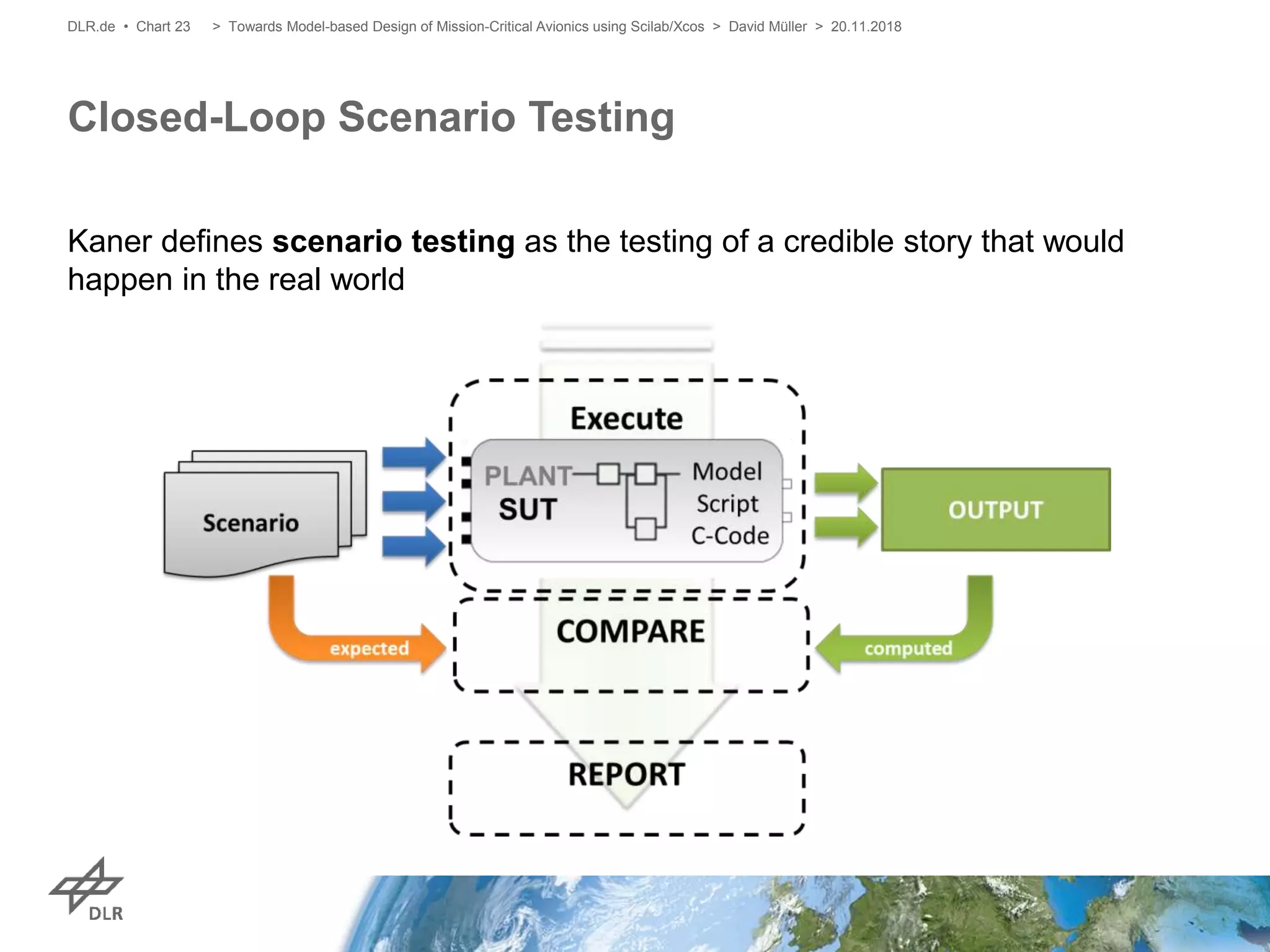
Kaner defines scenario testing as the testing of a credible story that would
happen in the real world
Closed-Loop Scenario Testing
DLR.de • Chart 23 > Towards Model-based Design of Mission-Critical Avionics using Scilab/Xcos > David Müller > 20.11.2018
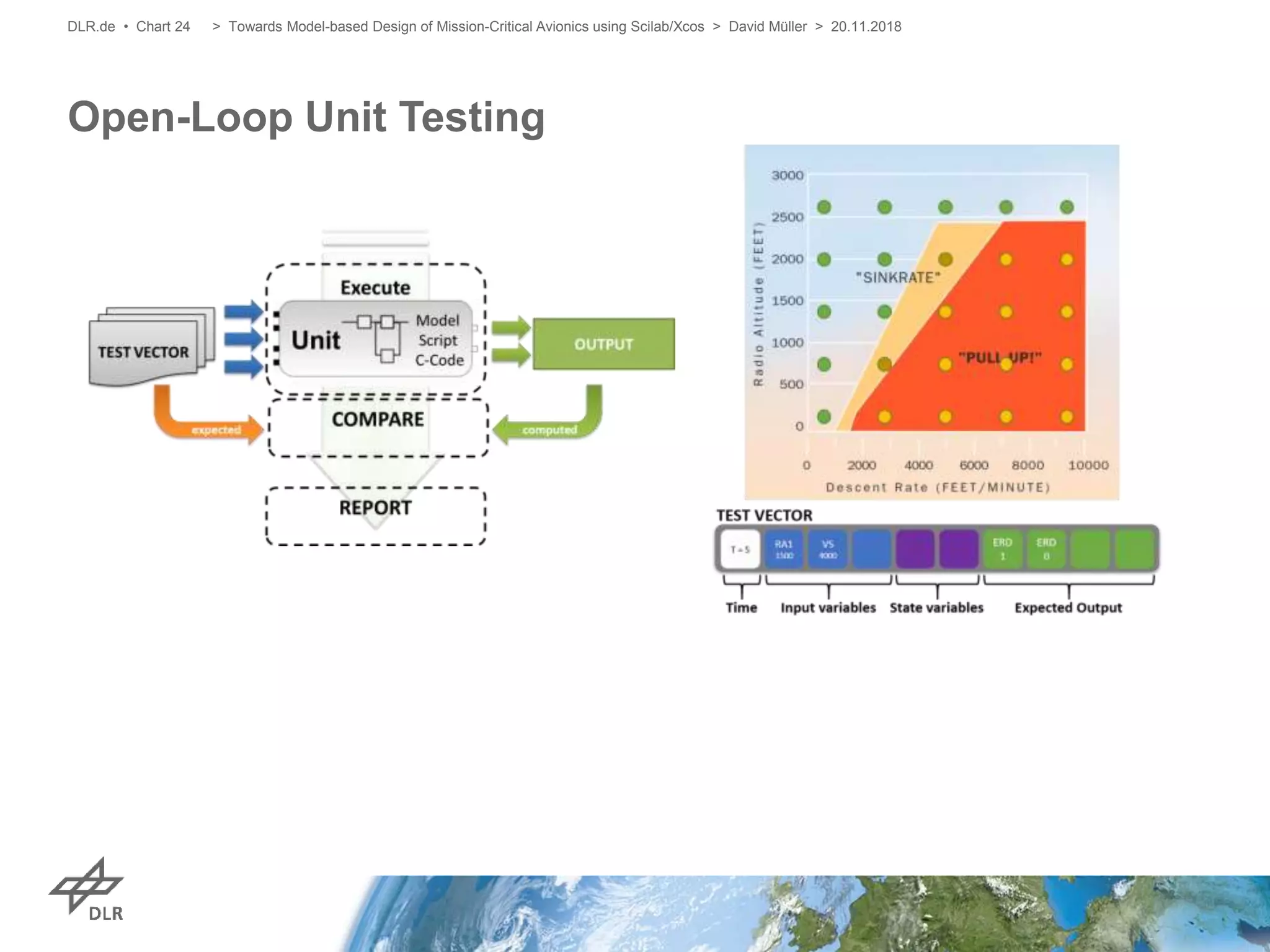
Open-Loop Unit Testing
DLR.de • Chart 24 > Towards Model-based Design of Mission-Critical Avionics using Scilab/Xcos > David Müller > 20.11.2018
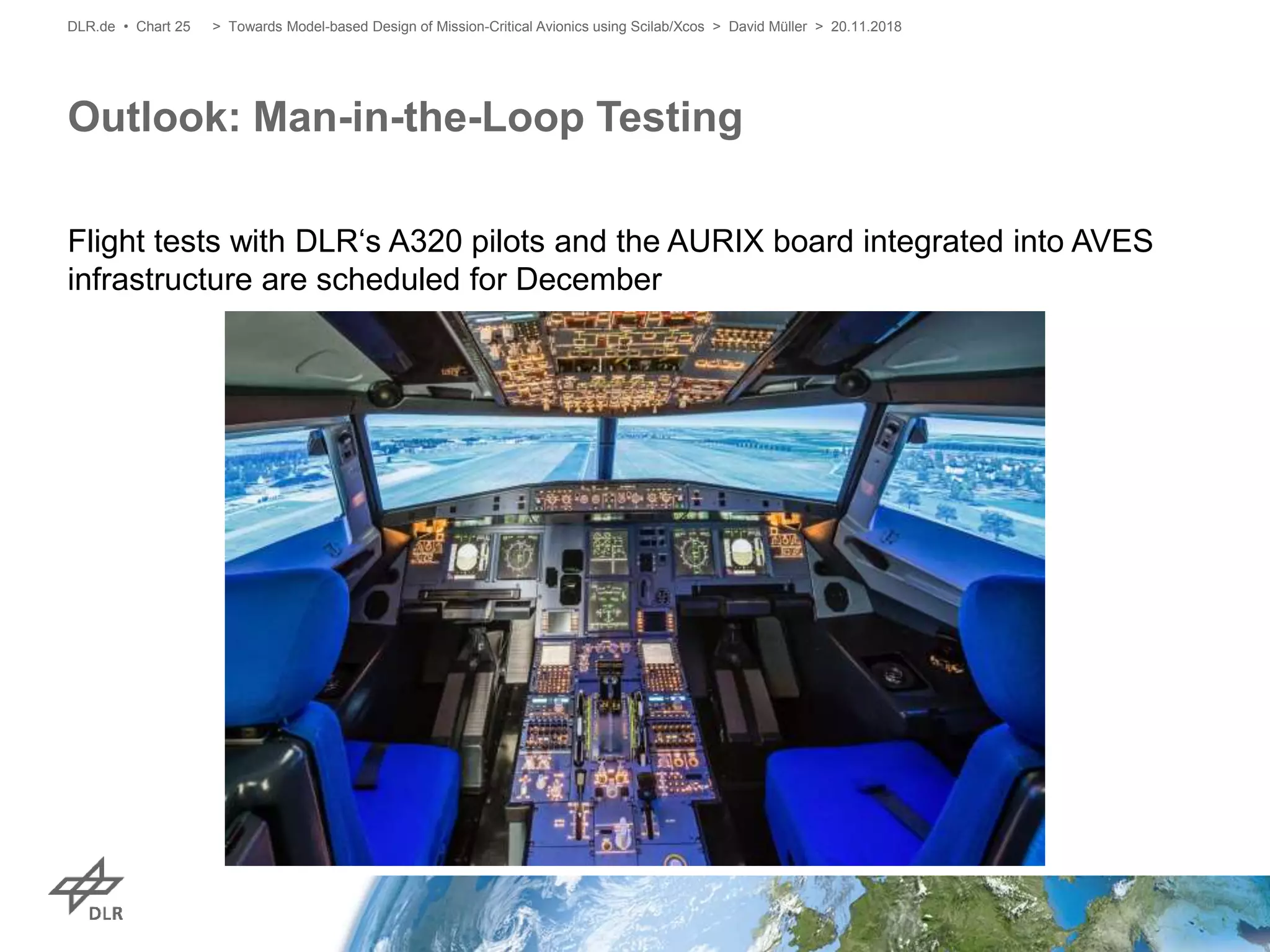
Flight tests with DLR‘s A320 pilots and the AURIX board integrated into AVES
infrastructure are scheduled for December
Outlook: Man-in-the-Loop Testing
> Towards Model-based Design of Mission-Critical Avionics using Scilab/Xcos > David Müller > 20.11.2018DLR.de • Chart 25
Thank you for your attention!
Any questions?
> Towards Model-based Design of Mission-Critical Avionics using Scilab/Xcos > David Müller > 20.11.2018DLR.de • Chart 26

DLR @ Scilab Conference 2018

  • 1.
    Towards Model-based Designof Mission-Critical Avionics using Scilab/Xcos David Müller and Umut Durak German Aerospace Center (DLR), Institute of Flight Systems
  • 2.
    • Introduction: • the4th Revolution of Aeronautics and its challenge • the ARGO project • DLR‘s use case for ARGO • introduction of Terrain Awareness and Warning Systems • selected examples of the implementation in Scilab/Xcos • our user experience • The ARGO workflow • X-in-the-Loop Testing • Outlook Outline > Towards Model-based Design of Mission-Critical Avionics using Scilab/Xcos > David Müller > 20.11.2018DLR.de • Chart 2
  • 3.
    The Evolution ofAeronautics DLR.de • Chart 3 After realizing far reaching automation levels on aircraft, the aeronautics is on the cusp of the 4th revolution, the “smart” and “connected” flight! > Towards Model-based Design of Mission-Critical Avionics using Scilab/Xcos > David Müller > 20.11.2018
  • 4.
    New methodologies andapproaches are crucial to increase product performance and boost productivity in development, while also maintaining safety levels. The emerging challenge: Increasing complexity DLR.de • Chart 4 J. P. Potocki De Montalk, "Computer software in civil aircraft," Computer Assurance, 1991. COMPASS '91, Systems Integrity, Software Safety and Process Security. Proceedings of the Sixth Annual Conference on, Gaithersburg, MD, 1991, pp. 10-16. > Towards Model-based Design of Mission-Critical Avionics using Scilab/Xcos > David Müller > 20.11.2018
  • 5.
    2012 - EADSInnovation Works: utilization of multi-core systems in partitioned environments 2013 – CASSIDIAN: application of multi-core architectures for a degraded vision landing system for a helicopter 2014 – THALES: design principles of predictable and efficient multi-core systems to meet embedded computer requirements in avionics 2014 - Saab Aeronautics: guaranteeing determinism for avionic applications running on multiple cores and interacting through shared memory Trend in Avionic Systems – recent research projects DLR.de • Chart 5 > Towards Model-based Design of Mission-Critical Avionics using Scilab/Xcos > David Müller > 20.11.2018
  • 6.
    All efforts concentrateon the applicability regarding the safety constraints of the avionics domain. • There is no reported effort that attacks the development methodology for avionics application using multi-core architectures. … how to boost productivity on development? Something is missing here! DLR.de • Chart 6 > Towards Model-based Design of Mission-Critical Avionics using Scilab/Xcos > David Müller > 20.11.2018
  • 7.
    The rise ofmodeling and simulation based approaches has been phenomenal! How can we apply modeling and simulation based approaches for multi-core systems? Modeling and Simulation Based Development DLR.de • Chart 7 > Towards Model-based Design of Mission-Critical Avionics using Scilab/Xcos > David Müller > 20.11.2018
  • 8.
    Developing embedded parallelreal-time software for multicore processors is time-consuming and error- prone. ARGO aims to help software developers in achieving better utilization of the benefits of multiprocessor hardware platforms, regardless of their level of experience with parallel programming DLR’s role in ARGO: to develop a Terrain Awareness and Warning System (TAWS) as a use case for the ARGO toolchain and integrate it into the A320 cockpit of AVES, DLR’s Air Vehicle Simulator. This project has received funding from the European Union’s Horizon 2020 research and innovation programme under grant agreement No 688131 — ARGO. http://www.argo-project.eu/ The ARGO project Worst Case Execution Time (WCET)-Aware PaRallelization of Model-Based Applications for HeteroGeneOus Parallel Systems DLR.de • Chart 8 > Towards Model-based Design of Mission-Critical Avionics using Scilab/Xcos > David Müller > 20.11.2018
  • 9.
    A TAWS isa flight system (a supervisory controller) that creates visual and aural warnings in order to avoid Controlled Flight into the Terrain. Terrain Awareness and Warning System Example Case DLR.de • Chart 9 Basic Modes: Mode 1: Excessive Descent Rate Mode 2: Excessive Terrain Closure Rate Mode 3: Altitude Loss After Take-off Mode 4: Unsafe Terrain Clearance Mode 5: Excessive Deviation Below Glideslope Enhanced Features: Terrain Awareness and Display (TAD) provides an image of the surrounding terrain as well as warnings and cautions regarding terrain interactions within the next 60 seconds of flight. > Towards Model-based Design of Mission-Critical Avionics using Scilab/Xcos > David Müller > 20.11.2018
  • 10.
    • DLR‘s A320ATRA (Advanced Technology Research Aircraft) is equipped with an Enhanced Ground Proximity Warning System (EGPWS) by Honeywell. • The requirements on which we based our replication of the original system were derived from ATRA‘s FCOM • Some other requirements are determined by the interface to the AVES infrastructure Where to start? > Towards Model-based Design of Mission-Critical Avionics using Scilab/Xcos > David Müller > 20.11.2018DLR.de • Chart 10
  • 11.
    Integration of theARGO TAWS into AVES > Towards Model-based Design of Mission-Critical Avionics using Scilab/Xcos > David Müller > 20.11.2018DLR.de • Chart 11 ARGO Target platform: AURIX TC297B
  • 12.
    Controller Modeling DLR.de •Chart 12 Mode 1 Mode 2 Mode 3 Mode 4 Mode 5 TAD Data Output Management > Towards Model-based Design of Mission-Critical Avionics using Scilab/Xcos > David Müller > 20.11.2018
  • 13.
    • A TAWSis not a control system, it acts as a supervisor: no control loops, but many logical operations on the signals • In the Xcos model, there are… • commonly used blocks: • basic math operators: • not so basic maths: • and others: Controller Modeling Selection of used Scilab/Xcos elements > Towards Model-based Design of Mission-Critical Avionics using Scilab/Xcos > David Müller > 20.11.2018DLR.de • Chart 13
  • 14.
    Controller Modeling Basic Modes DLR.de• Chart 14 Example Mode 1: the limit altitudes (the reference being the radio altitude) are described as functions of other parameters like airspeed or rate of descent > Towards Model-based Design of Mission-Critical Avionics using Scilab/Xcos > David Müller > 20.11.2018
  • 15.
    Controller Modeling Basic Modes DLR.de• Chart 15 > Towards Model-based Design of Mission-Critical Avionics using Scilab/Xcos > David Müller > 20.11.2018
  • 16.
    Controller Modeling Enhanced Features DLR.de• Chart 16 The terrain-based features are implemented using Scilab scripts • The digital elevation database has a resolution of 3 arc seconds (∼90 m) • Two-phase collision detection • Broad phase: • Uniform grids for spatial partitioning • Narrow Phase: • comparison of predicted flight path with terrain elevation • generate color coded terrain image for Navigation Display > Towards Model-based Design of Mission-Critical Avionics using Scilab/Xcos > David Müller > 20.11.2018
  • 17.
    Plant Modeling DLR.de •Chart 17 Simplified A320 Flight Dynamics Model Mass Properties Forces and MomentsControls Pilot Input Equations of Motion Output > Towards Model-based Design of Mission-Critical Avionics using Scilab/Xcos > David Müller > 20.11.2018 Aerodynamic velocities
  • 18.
    What we expectto get with future Scilab version: • Scalability • Number of blocks • Number of levels • Number of subsystems • Automotive industry standard for a complex model is 15000 blocks, 700 subsystems and 16 levels • EGPWS is … • We need to push the boundaries of Scilab/Xcos scalibility • (Re-)Usability • Managing data flow (mux and busses) • Model referencing, libraries and legacy code integration • Automatic layout of models Scilab/Xcos experience > Towards Model-based Design of Mission-Critical Avionics using Scilab/Xcos > David Müller > 20.11.2018DLR.de • Chart 18
  • 19.
    ARGO Model-Based DesignWorkflow DLR.de • Chart 19 Application Test Cases Xcos / Scilab Application Models Cross-layer Programming Interface Feedback&Control Scheduling and High-Level Decisions Code Transformations for Predictability Enhancement Data Management, Synchronization and Code Generation Code-Level WCET System-Level WCET CPU CPU CPU CPU Multicore ArchitecturesIterative Optimization Front-End Tools ADL Description int m, n, p, q, c, d, k, sum = 0; int first[10][10], second[10][10], multiply[10][10]; for (c = 0; c < m; c++) { for (d = 0; d < q; d++) { for (k = 0; k < p; k++) { sum = sum + first[c][k]*second[k][d]; } multiply[c][d] = sum; sum = 0; } } Xcos model Scilab script Sequential Code Parallel Code > Towards Model-based Design of Mission-Critical Avionics using Scilab/Xcos > David Müller > 20.11.2018
  • 20.
    • ePS isthe commercialization platform for the outcomes of the ARGO project Parallelization with emmtrix Parallel Studio > Towards Model-based Design of Mission-Critical Avionics using Scilab/Xcos > David Müller > 20.11.2018DLR.de • Chart 20
  • 21.
    The conventional model-baseddesign and simulation based verification: X-in-the-Loop Testing > Towards Model-based Design of Mission-Critical Avionics using Scilab/Xcos > David Müller > 20.11.2018DLR.de • Chart 21
  • 22.
    Simulation-Based Verification inARGO DLR.de • Chart 22 Open Loop Unit TestingClosed Loop Scenario Testing > Towards Model-based Design of Mission-Critical Avionics using Scilab/Xcos > David Müller > 20.11.2018 Xcos Model Scilab Script Sequential Code Parallel Code scSILol, scSILcl, scSILm sSILol, sSILcl, sSILm PILol, PILcl, PILm, HIL pCGsCGscCG UT, MILcl, MILm
  • 23.
    Kaner defines scenariotesting as the testing of a credible story that would happen in the real world Closed-Loop Scenario Testing DLR.de • Chart 23 > Towards Model-based Design of Mission-Critical Avionics using Scilab/Xcos > David Müller > 20.11.2018
  • 24.
    Open-Loop Unit Testing DLR.de• Chart 24 > Towards Model-based Design of Mission-Critical Avionics using Scilab/Xcos > David Müller > 20.11.2018
  • 25.
    Flight tests withDLR‘s A320 pilots and the AURIX board integrated into AVES infrastructure are scheduled for December Outlook: Man-in-the-Loop Testing > Towards Model-based Design of Mission-Critical Avionics using Scilab/Xcos > David Müller > 20.11.2018DLR.de • Chart 25
  • 26.
    Thank you foryour attention! Any questions? > Towards Model-based Design of Mission-Critical Avionics using Scilab/Xcos > David Müller > 20.11.2018DLR.de • Chart 26

Editor's Notes

  • #3 This presentation is about our work creating a use case TAWS within the ARGO project, for which we relied on Scilab/Xcos
  • #4 1st: heavier-than-air (not zeppelins/balloons) 2nd: hydraulic actuators / electric drives / metal aircraft -> beginning of automation 3rd: glass cockpits and digital flight systems ADS-B: Automatic Dependent Surveillance – Broadcast
  • #5 F-16 Fighting Falcon and F-35 Lightning by Lockheed Martin
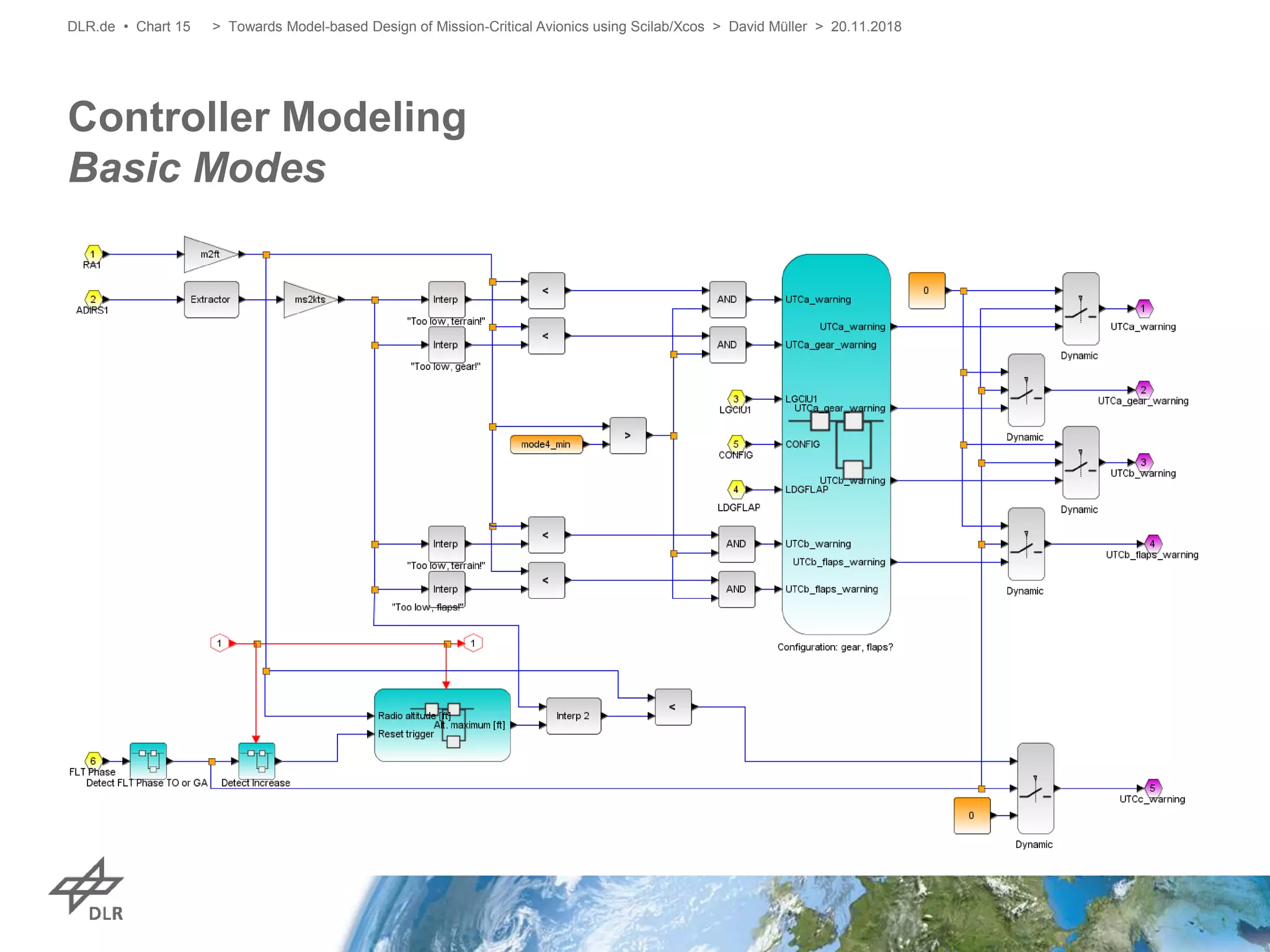
  • #15 ADIRS = air data inertial reference system
  • #16 ADIRS = air data inertial reference system
  • #19 Industry standard from 6 years ago…
  • #20 ARGO Model based design workflow starts with the controller modelling with Scilab/Xcos using front end tools. Using front end tools first model-to-text transformation is employed to generate Scilab scripts from the Scilab/Xcos models. In the scheduling and high level decisions step, Scilab scripts are compiled into sequential C code. The GeCoS source-to-source transformation framework then takes the sequential C Code as an input for program transformations. First Hierarchical Task Graphs (HTG) are generated at the task extraction HTG contain information about data task dependencies in terms of data need to be communicated between tasks as well as share resource access characteristics. The target architecture is also specified at the very beginning using an Architecture Description Language (ADL). In the scheduling and mapping stage, the HTG is mapped on to the target platform. In the data management, synchronization and code generation step the results of the scheduling and mapping are used to generate an explicit parallel program representation with synchronizations and address mappings. The code and system level WCET step calculates the multi-core worst case execution time for the target architecture. Then this information is fed to previous step for iterative optimization of the parallelization.
  • #22 Evaluation board in PIL and real hardware in HIL
  • #23 Due to the different steps of Code Generation, several steps of software verification are necessary