Page 1 of 17
Daily Lesson
Log
Grade 12
School ITLUGAN NATIONAL HIGH
SCHOOL (GR.7-12)
Grade Level 12
Teacher CHRISTIAN JAY D. SALAZAR Learning Area Practical Research I for Grade 12 HUMSS, TVL, ABM
Teaching Dates and Time Week 2 June 11-15, 2018 Quarter 1st
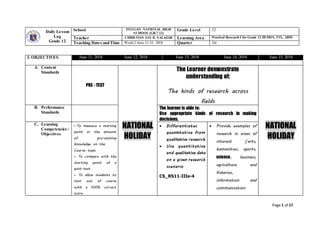
I. OBJECTIVES June 11, 2018 June 12, 2018 June 13, 2018 June 14, 2018 June 15, 2018
A. Content
Standards
PRE - TEST
NATIONAL
HOLIDAY
The Learner demonstrate
understanding of:
The kinds of research across
fields
NATIONAL
HOLIDAY
B. Performance
Standards
The learner is able to:
Use appropriate kinds of research in making
decisions.
C. Learning
Competencies /
Objectives
• To measure a starting
point or the amount
of pre-existing
knowledge on the
Course topic
• To compare with the
starting point of a
post-test
• To allow students to
test out of course
with a 100% correct
score
 Differentiates
quantitative from
qualitative research
 Use quantitative
and qualitative data
on a given research
scenario
CS_RS11-IIIa-4
 Provide examples of
research in areas of
interest (arts,
humanities, sports,
science, business,
agriculture and
fisheries,
information and
communication
Page 2 of 17
• To inform the
instructor about topics
that are/are not
needed to cover in the
Course based on
student’s previous
knowledge
• To indicate to the
student the learning
level of the course
topic
technology, and
social inquiry)
CS_RS11-IIIa-5
II. CONTENT PRE-TEST NATIONAL
HOLIDAY
QUALITATIVE AND
QUANTITAVE
RESEARCH
Kinds of Research
Across Fields
NATIONAL
HOLIDAY
III. LEARNING
RESOURCES
A. References
Teacher’s Guide
1. Learner’s
Materials
Guide
2. Textbook pages
3. Additional
Materials from
Learning
Resource (LR)
portal
Page 3 of 17
4. B. Other
learning
Resources
http://www.xavier.e
du/library/students/
documents/qualitativ
e_quantitative.pdf
http://www.thirteen
.org/edonline/lessons
/data/b.html
https://www.slidesha
re.net/ejfitzgerald/in
troduction-to-
quantitative-and-
qualitative-research
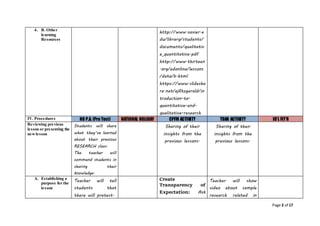
IV. Procedures NO P.A. (Pre Test) NATIONAL HOLIDAY CPFM ACTIVITY TDAR ACTIVITY ID’L FIT’R
Reviewing previous
lesson or presenting the
newlesson
Students will share
what they’ve learned
about their previous
RESEARCH class.
The teacher will
commend students in
sharing their
knowledge.
Sharing of their
insights from the
previous lessons.
Sharing of their
insights from the
previous lessons.
A. Establishing a
purpose for the
lesson
Teacher will tell
students that
there will pretest.
Create
Transparency of
Expectation: Ask
Teacher will show
video about sample
research related in
Page 4 of 17
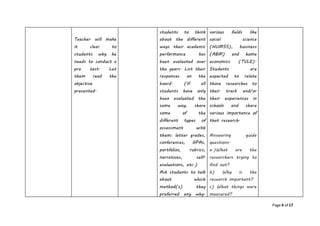
Teacher will make
it clear to
students why he
needs to conduct a
pre test. Let
them read the
objective
presented.
students to think
about the different
ways their academic
performance has
been evaluated over
the years. List their
responses on the
board. (If all
students have only
been evaluated the
same way, share
some of the
different types of
assessment with
them: letter grades,
conferences, GPAs,
portfolios, rubrics,
narratives, self-
evaluations, etc.)
Ask students to talk
about which
method(s) they
preferred any why.
various fields like
social science
(HUMSS), business
(ABM) and home
economics (TVLE).
Students are
expected to relate
those researches to
their track and/or
their experiences in
schools and share
various importance of
that research.
Answering guide
questions.
a.)What are the
researchers trying to
find out?
b) Why is the
research important?
c) What things were
measured?
Page 5 of 17
Before beginning this
discussion, have
students define what
they think a good
assessment system
would do, e.g, give
them feedback on
their performance
relative to others in
the class, give them
constructive
criticism, etc. After
creating this list, ask
them which
type(s) of
assessment would
best meet these
criteria, and why.
Record their
responses on the
board.
Next, ask students
to name a strength
d) What were the
results?
e) What do the
authors conclude and
to what factors do
they attribute the
findings?
f) Can you accept
the findings as true?
Discuss any failings or
shortcomings of the
methods used to
support the findings.
Page 6 of 17
and weakness of each
type of assessment
they listed.
B. Presenting
examples/instan
ces ofthe new
lesson
Teacher will give
instruction for 1-
50 test item.
Write the words
“qualitative” and
“quantitative” data
on the board. Ask
students what they
know about these
types of data. If
they don’t know
what these words
mean, ask them to
look at the roots of
the words for clues:
(qual, quant).
Explain what the
words mean to the
students, then ask
them to categorize
the types of
assessment they
listed earlier as
Presentation of their
answer.
Page 7 of 17
“qualitative” or
“quantitative” data.
C. Discussing new
concepts and
practicing new
skills #1
TEST PROPER. Provide clear
instruction:
Teacher will show a
video differentiating
quali/quanti type of
research and the
teacher will further
discuss the topic.
And the teacher will
give instruction for
students activity.
Parts of Research.
Teacher will discuss
or show different
format and research
protocol that
students can choose
in their own research
output.
Sample:
IMRAD
(Introduction,
Methodology, Result
and Discussion or
D. Discussing new
concepts and
practicing new
skills #2
Chapter 1 – 5 (
Chapter 1: The
Problem, Chapter 2:
Review of Related
Literature, Chapter
3: Methodology
Chapter 4: Analysis
Page 8 of 17
of Data
Chapter 5: Results
and Recommendation
E. Developing
Mastery
TEST PROPER. Form a small
group: Students
will be group into 4
groups: 2 groups for
qualitative and 2
groups for
quantitative
research. They will
be given one the
same topic: “Although
the Internet brings
people together via
chatrooms, e-mail, etc.,
it ultimately isolates
people from one
another because they
talk less face-to-face
and over the phone.”
Tell the students
from the qualitative
group to each pick
Students will be
given sample research
output and they are
ask to arrange the
research statement
to the proper parts
it belongs.
Page 9 of 17
one person from the
quantitative group
to interview. The
qualitative student
should ask the
quantitative student
to respond to the
statement, and
record their
response. Then, the
quantitative student
should ask the
qualitative student
to respond to the
question using a
scale of one to five.
Give each student
the
appropriate STUDEN
T ORGANIZER:
ACTIVITY ONE-
QUANTITATIVE or
QUALITATIVE hando
Page 10 of 17
ut.
(Handout attached
to this DLL)
Once the students
have gathered their
data, ask both
groups to compile
and assess their
findings using the
information on their
handouts.
Note: Before asking
students to compile
and analyze their
results, you may
want to review the
types of analyses
described on the
handouts with the
students. If your
students are rusty
Page 11 of 17
or unfamiliar with
calculating
percentages, they
may need a review
or guidance.
Monitor and
Support: Have each
group share their
data and findings.
F. Finding
practical
applications of
concepts and
skills in daily
living
Why research
important to
student like you?
Why research
important to your
school and your
community?
G. Making
generalization
and
abstractions
about the lesson
CHECKING OF
THEIR ANSWERS.
Monitor and
Support: Students
will share their
experience while
doing the activity.
Students’ answers
are expected to
PRESENTATION OF
OUTPUT.
Page 12 of 17
differentiate
Quali/Quanti
Research.
H. Evaluating
learning
RECORDING. Choose one scenario
listed below, identify
whether it would be
best to gather
qualitative data,
quantitative data, or
a combination of
both to answer the
questions being
asked.
Scenario 1: You work
in an office that has
a water cooler. The
water cooler holds
twenty gallons of
water. Your boss
asks you to figure
out how many refills
your office will need
every month,
Performance Based
See Rubric
Page 13 of 17
because shes trying
to do the budget.
Type of data
collecting method
you would use?
(qualitative and/or
quantitative) Why?
Briefly describe how
you would collect
the data (what
tools would you
used, e.g., a ruler, a
questionnaire).
Scenario 2: Youre a
new restaurant
owner. Your
restaurant has been
open for several
weeks, and so far, it
looks like your
customers enjoy your
restaurant. But you
Page 14 of 17
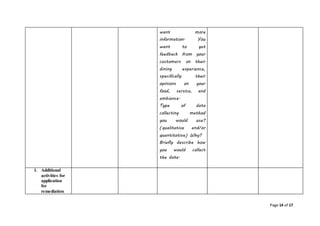
want more
information. You
want to get
feedback from your
customers on their
dining experience,
specifically their
opinions on your
food, service, and
ambiance.
Type of data
collecting method
you would use?
(qualitative and/or
quantitative) Why?
Briefly describe how
you would collect
the data.
I. Additional
activities for
application
for
remediation
Page 15 of 17
V. REMARKS
VI. REFLECTION
A. A. No. of
learners who
earned 80% on
the formative
assessment
B. No. of learners
who require
additional
activities for
remediation
C. Did the
remedial lessons
work? No. of
learners who
have caught up
with the
lessons
D. No. of
learning’s who
continue to
Page 16 of 17
require
remediation
E. Which of my
teaching
strategies
worked well?
Why did this
work?
F. What
difficulties did I
encounter which
my principal can
help me solve?
G. What
innovations or
localize
materials did I
use which I
wish to share
with other
teachers?
PREPARED BY:
CHRISTIAN JAY D. SALAZAR
Teacher III
Page 17 of 17
GRADE LEVEL HEAD:
Mrs. Girene D. Solpico
MasterTeacher I Noted by:
________________
________________ JACQUELINE A. ARIAS
________________ Officer – in – Charge
________________
________________

Practical Research 1 2nd week

  • 1.
    Page 1 of17 Daily Lesson Log Grade 12 School ITLUGAN NATIONAL HIGH SCHOOL (GR.7-12) Grade Level 12 Teacher CHRISTIAN JAY D. SALAZAR Learning Area Practical Research I for Grade 12 HUMSS, TVL, ABM Teaching Dates and Time Week 2 June 11-15, 2018 Quarter 1st I. OBJECTIVES June 11, 2018 June 12, 2018 June 13, 2018 June 14, 2018 June 15, 2018 A. Content Standards PRE - TEST NATIONAL HOLIDAY The Learner demonstrate understanding of: The kinds of research across fields NATIONAL HOLIDAY B. Performance Standards The learner is able to: Use appropriate kinds of research in making decisions. C. Learning Competencies / Objectives • To measure a starting point or the amount of pre-existing knowledge on the Course topic • To compare with the starting point of a post-test • To allow students to test out of course with a 100% correct score  Differentiates quantitative from qualitative research  Use quantitative and qualitative data on a given research scenario CS_RS11-IIIa-4  Provide examples of research in areas of interest (arts, humanities, sports, science, business, agriculture and fisheries, information and communication
  • 2.
    Page 2 of17 • To inform the instructor about topics that are/are not needed to cover in the Course based on student’s previous knowledge • To indicate to the student the learning level of the course topic technology, and social inquiry) CS_RS11-IIIa-5 II. CONTENT PRE-TEST NATIONAL HOLIDAY QUALITATIVE AND QUANTITAVE RESEARCH Kinds of Research Across Fields NATIONAL HOLIDAY III. LEARNING RESOURCES A. References Teacher’s Guide 1. Learner’s Materials Guide 2. Textbook pages 3. Additional Materials from Learning Resource (LR) portal
  • 3.
    Page 3 of17 4. B. Other learning Resources http://www.xavier.e du/library/students/ documents/qualitativ e_quantitative.pdf http://www.thirteen .org/edonline/lessons /data/b.html https://www.slidesha re.net/ejfitzgerald/in troduction-to- quantitative-and- qualitative-research IV. Procedures NO P.A. (Pre Test) NATIONAL HOLIDAY CPFM ACTIVITY TDAR ACTIVITY ID’L FIT’R Reviewing previous lesson or presenting the newlesson Students will share what they’ve learned about their previous RESEARCH class. The teacher will commend students in sharing their knowledge. Sharing of their insights from the previous lessons. Sharing of their insights from the previous lessons. A. Establishing a purpose for the lesson Teacher will tell students that there will pretest. Create Transparency of Expectation: Ask Teacher will show video about sample research related in
  • 4.
    Page 4 of17 Teacher will make it clear to students why he needs to conduct a pre test. Let them read the objective presented. students to think about the different ways their academic performance has been evaluated over the years. List their responses on the board. (If all students have only been evaluated the same way, share some of the different types of assessment with them: letter grades, conferences, GPAs, portfolios, rubrics, narratives, self- evaluations, etc.) Ask students to talk about which method(s) they preferred any why. various fields like social science (HUMSS), business (ABM) and home economics (TVLE). Students are expected to relate those researches to their track and/or their experiences in schools and share various importance of that research. Answering guide questions. a.)What are the researchers trying to find out? b) Why is the research important? c) What things were measured?
  • 5.
    Page 5 of17 Before beginning this discussion, have students define what they think a good assessment system would do, e.g, give them feedback on their performance relative to others in the class, give them constructive criticism, etc. After creating this list, ask them which type(s) of assessment would best meet these criteria, and why. Record their responses on the board. Next, ask students to name a strength d) What were the results? e) What do the authors conclude and to what factors do they attribute the findings? f) Can you accept the findings as true? Discuss any failings or shortcomings of the methods used to support the findings.
  • 6.
    Page 6 of17 and weakness of each type of assessment they listed. B. Presenting examples/instan ces ofthe new lesson Teacher will give instruction for 1- 50 test item. Write the words “qualitative” and “quantitative” data on the board. Ask students what they know about these types of data. If they don’t know what these words mean, ask them to look at the roots of the words for clues: (qual, quant). Explain what the words mean to the students, then ask them to categorize the types of assessment they listed earlier as Presentation of their answer.
  • 7.
    Page 7 of17 “qualitative” or “quantitative” data. C. Discussing new concepts and practicing new skills #1 TEST PROPER. Provide clear instruction: Teacher will show a video differentiating quali/quanti type of research and the teacher will further discuss the topic. And the teacher will give instruction for students activity. Parts of Research. Teacher will discuss or show different format and research protocol that students can choose in their own research output. Sample: IMRAD (Introduction, Methodology, Result and Discussion or D. Discussing new concepts and practicing new skills #2 Chapter 1 – 5 ( Chapter 1: The Problem, Chapter 2: Review of Related Literature, Chapter 3: Methodology Chapter 4: Analysis
  • 8.
    Page 8 of17 of Data Chapter 5: Results and Recommendation E. Developing Mastery TEST PROPER. Form a small group: Students will be group into 4 groups: 2 groups for qualitative and 2 groups for quantitative research. They will be given one the same topic: “Although the Internet brings people together via chatrooms, e-mail, etc., it ultimately isolates people from one another because they talk less face-to-face and over the phone.” Tell the students from the qualitative group to each pick Students will be given sample research output and they are ask to arrange the research statement to the proper parts it belongs.
  • 9.
    Page 9 of17 one person from the quantitative group to interview. The qualitative student should ask the quantitative student to respond to the statement, and record their response. Then, the quantitative student should ask the qualitative student to respond to the question using a scale of one to five. Give each student the appropriate STUDEN T ORGANIZER: ACTIVITY ONE- QUANTITATIVE or QUALITATIVE hando
  • 10.
    Page 10 of17 ut. (Handout attached to this DLL) Once the students have gathered their data, ask both groups to compile and assess their findings using the information on their handouts. Note: Before asking students to compile and analyze their results, you may want to review the types of analyses described on the handouts with the students. If your students are rusty
  • 11.
    Page 11 of17 or unfamiliar with calculating percentages, they may need a review or guidance. Monitor and Support: Have each group share their data and findings. F. Finding practical applications of concepts and skills in daily living Why research important to student like you? Why research important to your school and your community? G. Making generalization and abstractions about the lesson CHECKING OF THEIR ANSWERS. Monitor and Support: Students will share their experience while doing the activity. Students’ answers are expected to PRESENTATION OF OUTPUT.
  • 12.
    Page 12 of17 differentiate Quali/Quanti Research. H. Evaluating learning RECORDING. Choose one scenario listed below, identify whether it would be best to gather qualitative data, quantitative data, or a combination of both to answer the questions being asked. Scenario 1: You work in an office that has a water cooler. The water cooler holds twenty gallons of water. Your boss asks you to figure out how many refills your office will need every month, Performance Based See Rubric
  • 13.
    Page 13 of17 because shes trying to do the budget. Type of data collecting method you would use? (qualitative and/or quantitative) Why? Briefly describe how you would collect the data (what tools would you used, e.g., a ruler, a questionnaire). Scenario 2: Youre a new restaurant owner. Your restaurant has been open for several weeks, and so far, it looks like your customers enjoy your restaurant. But you
  • 14.
    Page 14 of17 want more information. You want to get feedback from your customers on their dining experience, specifically their opinions on your food, service, and ambiance. Type of data collecting method you would use? (qualitative and/or quantitative) Why? Briefly describe how you would collect the data. I. Additional activities for application for remediation
  • 15.
    Page 15 of17 V. REMARKS VI. REFLECTION A. A. No. of learners who earned 80% on the formative assessment B. No. of learners who require additional activities for remediation C. Did the remedial lessons work? No. of learners who have caught up with the lessons D. No. of learning’s who continue to
  • 16.
    Page 16 of17 require remediation E. Which of my teaching strategies worked well? Why did this work? F. What difficulties did I encounter which my principal can help me solve? G. What innovations or localize materials did I use which I wish to share with other teachers? PREPARED BY: CHRISTIAN JAY D. SALAZAR Teacher III
  • 17.
    Page 17 of17 GRADE LEVEL HEAD: Mrs. Girene D. Solpico MasterTeacher I Noted by: ________________ ________________ JACQUELINE A. ARIAS ________________ Officer – in – Charge ________________ ________________