26TH December, 1880
South Australia was
blessed with
social scientist of the age.
Skilled and charming lecturer
Psychologist, industrial
researcher
Internationally acclaimed, ETC.
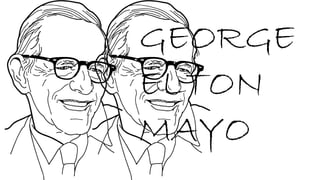
GEORGE
ELTON
MAYO
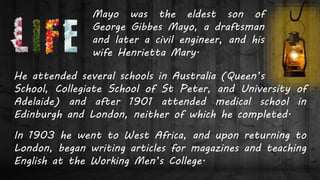
Mayo was the eldest son of
George Gibbes Mayo, a draftsman
and later a civil engineer, and his
wife Henrietta Mary.
He attended several schools in Australia (Queen’s
School, Collegiate School of St Peter, and University of
Adelaide) and after 1901 attended medical school in
Edinburgh and London, neither of which he completed.
In 1903 he went to West Africa, and upon returning to
London, began writing articles for magazines and teaching
English at the Working Men’s College.
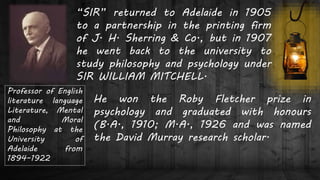
Professor of English
literature language
Literature, Mental
and Moral
Philosophy at the
University of
Adelaide from
1894–1922
“SIR” returned to Adelaide in 1905
to a partnership in the printing firm
of J. H. Sherring & Co., but in 1907
he went back to the university to
study philosophy and psychology under
SIR WILLIAM MITCHELL.
He won the Roby Fletcher prize in
psychology and graduated with honours
(B.A., 1910; M.A., 1926 and was named
the David Murray research scholar.
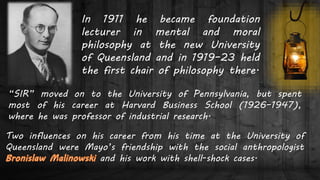
In 1911 he became foundation
lecturer in mental and moral
philosophy at the new University
of Queensland and in 1919–23 held
the first chair of philosophy there.
“SIR” moved on to the University of Pennsylvania, but spent
most of his career at Harvard Business School (1926–1947),
where he was professor of industrial research.
Two influences on his career from his time at the University of
Queensland were Mayo’s friendship with the social anthropologist
and his work with shell-shock cases.
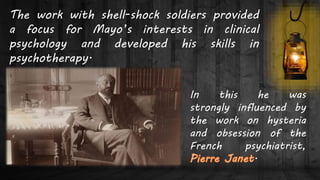
The work with shell-shock soldiers provided
a focus for Mayo’s interests in clinical
psychology and developed his skills in
psychotherapy.
In this he was
strongly influenced by
the work on hysteria
and obsession of the
French psychiatrist,
.
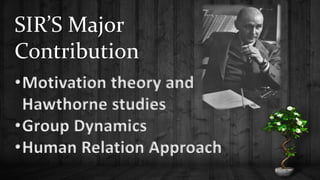
SIR’S Major
Contribution
•Motivation theory and
Hawthorne studies
•Group Dynamics
•Human Relation Approach
STUDIES CONDUCTED
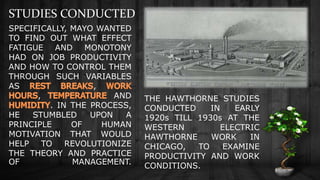
THE HAWTHORNE STUDIES
CONDUCTED IN EARLY
1920s TILL 1930s AT THE
WESTERN ELECTRIC
HAWTHORNE WORK IN
CHICAGO, TO EXAMINE
PRODUCTIVITY AND WORK
CONDITIONS.
SPECIFICALLY, MAYO WANTED
TO FIND OUT WHAT EFFECT
FATIGUE AND MONOTONY
HAD ON JOB PRODUCTIVITY
AND HOW TO CONTROL THEM
THROUGH SUCH VARIABLES
AS ,
, AND
. IN THE PROCESS,
HE STUMBLED UPON A
PRINCIPLE OF HUMAN
MOTIVATION THAT WOULD
HELP TO REVOLUTIONIZE
THE THEORY AND PRACTICE
OF MANAGEMENT.
EXPERIMENT
WAS
CONDUCTED IN
FOUR PHASE
ILLUMINATION EXPERIMENT
RELAY ASSEMBLY TEST ROOM EXPERIMENT
INTERVIEW PHASE
BANK WIRING OBSERVATION ROOM
ILLUMINATION EXPERIMENT
• HE FIRST, A SEQUENCE OF ILLUMINATION TESTS FROM 1924 TO 1927, SET
OUT TO DETERMINE THE EFFECT OF LIGHTING ON WORKER EFFICIENCY IN
THREE SEPARATE MANUFACTURING DEPARTMENTS.
• ACCOUNTS OF THE STUDY REVEALS NO SIGNIFICANT
CORRELTION BETWEEN PRODUCTIVITY AND LIGHT LEVELS.
• THE RESULTS PROMPTED RESEARCHERS TO INVESTIGATE OTHER
FACTORS AFFECTING WORKER OUTPUT.
IN THE FIRST SERIES TWO GROUPS WERE MADE.
ONE GROUP WAS EXPOSED TO VARYING INTENSITIES OF ILLUMINATION
SINCE THE GROUP WAS SUBJECT TO EXPERIMENTAL CHANGES, IT WAS
TERMED AS EXPERIMENTAL GROUP.
ANOTHER GROUP WAS CALLED CONTROL GROUP, CONTINUED TO WORK UNDER
CONSTANT INTENSITIES OF ILLUMINATION
THE RESEARCHERS FOUND THAT AS THEY INCREASE THE ILLUMINATION IN THE
EXPERIMENTAL GROUP BOTH GROUP INCREASED PRODUCTION.
WHEN THE INTENSITY IS DECREASED THE PRODUCTION CONTINUED TO
INCRESE IN BOTH THE GROUPS.
THE PRODUCTION DECREASED WHEN THE ILLUMINATION WAS BELOW THE
LEVEL OF MOONLIGHT.
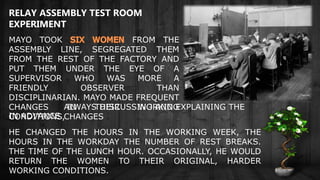
MAYO TOOK FROM THE
ASSEMBLY LINE, SEGREGATED THEM
FROM THE REST OF THE FACTORY AND
PUT THEM UNDER THE EYE OF A
SUPERVISOR WHO WAS MORE A
FRIENDLY OBSERVER THAN
DISCIPLINARIAN. MAYO MADE FREQUENT
CHANGES IN THEIR WORKING
CONDITIONS,
HE CHANGED THE HOURS IN THE WORKING WEEK, THE
HOURS IN THE WORKDAY THE NUMBER OF REST BREAKS.
THE TIME OF THE LUNCH HOUR. OCCASIONALLY, HE WOULD
RETURN THE WOMEN TO THEIR ORIGINAL, HARDER
WORKING CONDITIONS.
RELAY ASSEMBLY TEST ROOM
EXPERIMENT
ALWAYS DISCUSSING AND EXPLAINING THE
CHANGESIN ADVANCE.
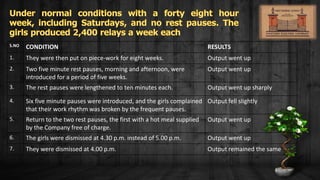
S.NO CONDITION RESULTS
1. They were then put on piece-work for eight weeks. Output went up
2. Two five minute rest pauses, morning and afternoon, were
introduced for a period of five weeks.
Output went up
3. The rest pauses were lengthened to ten minutes each. Output went up sharply
4. Six five minute pauses were introduced, and the girls complained
that their work rhythm was broken by the frequent pauses.
Output fell slightly
5. Return to the two rest pauses, the first with a hot meal supplied
by the Company free of charge.
Output went up
6. The girls were dismissed at 4.30 p.m. instead of 5.00 p.m. Output went up
7. They were dismissed at 4.00 p.m. Output remained the same
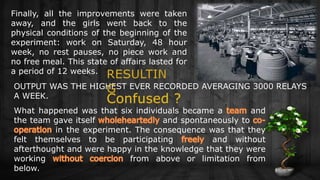
Finally, all the improvements were taken
away, and the girls went back to the
physical conditions of the beginning of the
experiment: work on Saturday, 48 hour
week, no rest pauses, no piece work and
no free meal. This state of affairs lasted for
a period of 12 weeks.
OUTPUT WAS THE HIGHEST EVER RECORDED AVERAGING 3000 RELAYS
A WEEK.
What happened was that six individuals became a and
the team gave itself and spontaneously to
in the experiment. The consequence was that they
felt themselves to be participating and without
afterthought and were happy in the knowledge that they were
working from above or limitation from
below..
They were themselves satisfied at the consequence
for they felt that they were working under
than ever before. In fact regular medical
checks showed no signs of cumulative fatigue and
from work per cent.
It was noted too, that each girl had her own of putting the
component parts of the relay together - sometimes she varied this
technique in order to avoid monotony and it was found that the more
intelligent the girl, the greater was the number of variations.
The experimental group had considerable
. They were not pushed around or by
anyone. Under these conditions they developed an
and instead of discipline
from higher authority being imposed, it came from within
the itself.
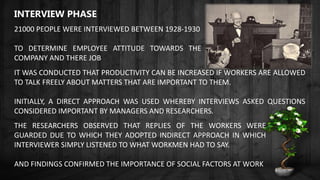
INTERVIEW PHASE
21000 PEOPLE WERE INTERVIEWED BETWEEN 1928-1930
TO DETERMINE EMPLOYEE ATTITUDE TOWARDS THE
COMPANY AND THERE JOB
IT WAS CONDUCTED THAT PRODUCTIVITY CAN BE INCREASED IF WORKERS ARE ALLOWED
TO TALK FREELY ABOUT MATTERS THAT ARE IMPORTANT TO THEM.
INITIALLY, A DIRECT APPROACH WAS USED WHEREBY INTERVIEWS ASKED QUESTIONS
CONSIDERED IMPORTANT BY MANAGERS AND RESEARCHERS.
THE RESEARCHERS OBSERVED THAT REPLIES OF THE WORKERS WERE
GUARDED DUE TO WHICH THEY ADOPTED INDIRECT APPROACH IN WHICH
INTERVIEWER SIMPLY LISTENED TO WHAT WORKMEN HAD TO SAY.
AND FINDINGS CONFIRMED THE IMPORTANCE OF SOCIAL FACTORS AT WORK
BANK WIRING OBSERVATION ROOM
CONDUCTED DURING 193-1932
A GROUP OF 14 MALE WORKERS IN THE BANK WIRING
ROOM WERE PLACED UNDER OBSERVATION FOR SIX
MONTHS.
A WORKER’S PAY DEPENDED ON THE PERFORMANCE OF A
GROUP AS A WHOLE. RESEARCHERS THOUGHT THAT THE EFFICIENT WORKERS WOULD
PUT PRESURE ON THE LESS EFFICIENT WORKERS TO COMPLETE THE WORK.
HOWEVER IT WAS FOUND THAT THE GROUP ESTABLISHED ITS OWN
STANDARDS OF OUTPUT AND SOCIAL PRESSURE WAS USED TO ACHIEVE
THE STANDARD OUTPUT.
THE HYPOTHESIS WAS THAT IN ORDER TO EARN MORE
WORKERS WOULD PRODUCE MORE AND IN ORDER TO
TAKE ADVANTAGES OF GROUP BONUS, THEY WOULD
HELP EACH OTHER TO PRODUCE MORE.
BUT THE REASON FAILED AS THE WORKERS DECIDED
THE TARGET WHICH WAS LOWER THAN COMPANIES
TARGET.
• FEAR OF UNEMPLOYMENT
• FEAR OF RAISING STANDARDS
• PROTECTION OF SOWER
WORKERS
• SATISFACTION ON THE
PART OF
MANAGEMENT
EX. TARGET FOR A DAY WAS CONNECTING 6600 TERMINALS AGAINST 7300 TERMINALS AS
THE STANDARD GIVEN BY CO. WORKER GAVE FOLLOWING REASONS OF DEFICIENCY.
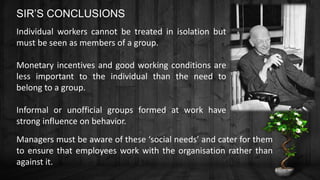
Individual workers cannot be treated in isolation but
must be seen as members of a group.
Monetary incentives and good working conditions are
less important to the individual than the need to
belong to a group.
Informal or unofficial groups formed at work have
strong influence on behavior.
Managers must be aware of these ‘social needs’ and cater for them
to ensure that employees work with the organisation rather than
against it.
SIR’S CONCLUSIONS
BOOKS BY SIR
THE PSYCHOLOGY OF
PIERRE JANET
THE HUMAN
PROBLEM OF AN
INDUSTRIAL
CIVILIZATION
THE SOCIAL
PROBLEMS OF AN
INDUSTRIAL
CIVILIZATION
CRITICAL
EVALUATION IN
BUSINESS AND
MANAGEMENT
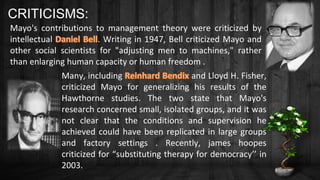
Many, including and Lloyd H. Fisher,
criticized Mayo for generalizing his results of the
Hawthorne studies. The two state that Mayo's
research concerned small, isolated groups, and it was
not clear that the conditions and supervision he
achieved could have been replicated in large groups
and factory settings . Recently, james hoopes
criticized for “substituting therapy for democracy’’ in
2003.
CRITICISMS:
Mayo's contributions to management theory were criticized by
intellectual . Writing in 1947, Bell criticized Mayo and
other social scientists for "adjusting men to machines," rather
than enlarging human capacity or human freedom .
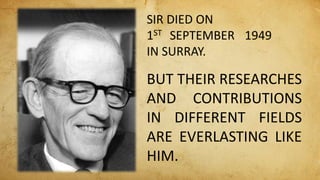
SIR DIED ON
1ST SEPTEMBER 1949
IN SURRAY.
BUT THEIR RESEARCHES
AND CONTRIBUTIONS
IN DIFFERENT FIELDS
ARE EVERLASTING LIKE
HIM.
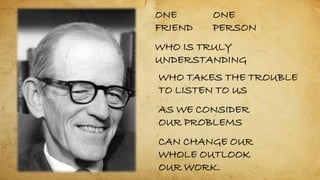
ONE
FRIEND
ONE
PERSON
WHO IS TRULY
UNDERSTANDING
WHO TAKES THE TROUBLE
TO LISTEN TO US
AS WE CONSIDER
OUR PROBLEMS
CAN CHANGE OUR
WHOLE OUTLOOK
OUR WORK.
THANK YOU
SUBMITTED TO,
BHADU SIR
ANY QUERIES

Elton mayo

  • 2.
    26TH December, 1880 SouthAustralia was blessed with social scientist of the age. Skilled and charming lecturer Psychologist, industrial researcher Internationally acclaimed, ETC.
  • 3.
  • 4.
    Mayo was theeldest son of George Gibbes Mayo, a draftsman and later a civil engineer, and his wife Henrietta Mary. He attended several schools in Australia (Queen’s School, Collegiate School of St Peter, and University of Adelaide) and after 1901 attended medical school in Edinburgh and London, neither of which he completed. In 1903 he went to West Africa, and upon returning to London, began writing articles for magazines and teaching English at the Working Men’s College.
  • 5.
    Professor of English literaturelanguage Literature, Mental and Moral Philosophy at the University of Adelaide from 1894–1922 “SIR” returned to Adelaide in 1905 to a partnership in the printing firm of J. H. Sherring & Co., but in 1907 he went back to the university to study philosophy and psychology under SIR WILLIAM MITCHELL. He won the Roby Fletcher prize in psychology and graduated with honours (B.A., 1910; M.A., 1926 and was named the David Murray research scholar.
  • 6.
    In 1911 hebecame foundation lecturer in mental and moral philosophy at the new University of Queensland and in 1919–23 held the first chair of philosophy there. “SIR” moved on to the University of Pennsylvania, but spent most of his career at Harvard Business School (1926–1947), where he was professor of industrial research. Two influences on his career from his time at the University of Queensland were Mayo’s friendship with the social anthropologist and his work with shell-shock cases.
  • 7.
    The work withshell-shock soldiers provided a focus for Mayo’s interests in clinical psychology and developed his skills in psychotherapy. In this he was strongly influenced by the work on hysteria and obsession of the French psychiatrist, .
  • 8.
    SIR’S Major Contribution •Motivation theoryand Hawthorne studies •Group Dynamics •Human Relation Approach
  • 9.
    STUDIES CONDUCTED THE HAWTHORNESTUDIES CONDUCTED IN EARLY 1920s TILL 1930s AT THE WESTERN ELECTRIC HAWTHORNE WORK IN CHICAGO, TO EXAMINE PRODUCTIVITY AND WORK CONDITIONS. SPECIFICALLY, MAYO WANTED TO FIND OUT WHAT EFFECT FATIGUE AND MONOTONY HAD ON JOB PRODUCTIVITY AND HOW TO CONTROL THEM THROUGH SUCH VARIABLES AS , , AND . IN THE PROCESS, HE STUMBLED UPON A PRINCIPLE OF HUMAN MOTIVATION THAT WOULD HELP TO REVOLUTIONIZE THE THEORY AND PRACTICE OF MANAGEMENT.
  • 10.
    EXPERIMENT WAS CONDUCTED IN FOUR PHASE ILLUMINATIONEXPERIMENT RELAY ASSEMBLY TEST ROOM EXPERIMENT INTERVIEW PHASE BANK WIRING OBSERVATION ROOM ILLUMINATION EXPERIMENT • HE FIRST, A SEQUENCE OF ILLUMINATION TESTS FROM 1924 TO 1927, SET OUT TO DETERMINE THE EFFECT OF LIGHTING ON WORKER EFFICIENCY IN THREE SEPARATE MANUFACTURING DEPARTMENTS. • ACCOUNTS OF THE STUDY REVEALS NO SIGNIFICANT CORRELTION BETWEEN PRODUCTIVITY AND LIGHT LEVELS. • THE RESULTS PROMPTED RESEARCHERS TO INVESTIGATE OTHER FACTORS AFFECTING WORKER OUTPUT.
  • 11.
    IN THE FIRSTSERIES TWO GROUPS WERE MADE. ONE GROUP WAS EXPOSED TO VARYING INTENSITIES OF ILLUMINATION SINCE THE GROUP WAS SUBJECT TO EXPERIMENTAL CHANGES, IT WAS TERMED AS EXPERIMENTAL GROUP. ANOTHER GROUP WAS CALLED CONTROL GROUP, CONTINUED TO WORK UNDER CONSTANT INTENSITIES OF ILLUMINATION THE RESEARCHERS FOUND THAT AS THEY INCREASE THE ILLUMINATION IN THE EXPERIMENTAL GROUP BOTH GROUP INCREASED PRODUCTION. WHEN THE INTENSITY IS DECREASED THE PRODUCTION CONTINUED TO INCRESE IN BOTH THE GROUPS. THE PRODUCTION DECREASED WHEN THE ILLUMINATION WAS BELOW THE LEVEL OF MOONLIGHT.
  • 12.
    MAYO TOOK FROMTHE ASSEMBLY LINE, SEGREGATED THEM FROM THE REST OF THE FACTORY AND PUT THEM UNDER THE EYE OF A SUPERVISOR WHO WAS MORE A FRIENDLY OBSERVER THAN DISCIPLINARIAN. MAYO MADE FREQUENT CHANGES IN THEIR WORKING CONDITIONS, HE CHANGED THE HOURS IN THE WORKING WEEK, THE HOURS IN THE WORKDAY THE NUMBER OF REST BREAKS. THE TIME OF THE LUNCH HOUR. OCCASIONALLY, HE WOULD RETURN THE WOMEN TO THEIR ORIGINAL, HARDER WORKING CONDITIONS. RELAY ASSEMBLY TEST ROOM EXPERIMENT ALWAYS DISCUSSING AND EXPLAINING THE CHANGESIN ADVANCE.
  • 13.
    S.NO CONDITION RESULTS 1.They were then put on piece-work for eight weeks. Output went up 2. Two five minute rest pauses, morning and afternoon, were introduced for a period of five weeks. Output went up 3. The rest pauses were lengthened to ten minutes each. Output went up sharply 4. Six five minute pauses were introduced, and the girls complained that their work rhythm was broken by the frequent pauses. Output fell slightly 5. Return to the two rest pauses, the first with a hot meal supplied by the Company free of charge. Output went up 6. The girls were dismissed at 4.30 p.m. instead of 5.00 p.m. Output went up 7. They were dismissed at 4.00 p.m. Output remained the same
  • 14.
    Finally, all theimprovements were taken away, and the girls went back to the physical conditions of the beginning of the experiment: work on Saturday, 48 hour week, no rest pauses, no piece work and no free meal. This state of affairs lasted for a period of 12 weeks. OUTPUT WAS THE HIGHEST EVER RECORDED AVERAGING 3000 RELAYS A WEEK. What happened was that six individuals became a and the team gave itself and spontaneously to in the experiment. The consequence was that they felt themselves to be participating and without afterthought and were happy in the knowledge that they were working from above or limitation from below..
  • 15.
    They were themselvessatisfied at the consequence for they felt that they were working under than ever before. In fact regular medical checks showed no signs of cumulative fatigue and from work per cent. It was noted too, that each girl had her own of putting the component parts of the relay together - sometimes she varied this technique in order to avoid monotony and it was found that the more intelligent the girl, the greater was the number of variations. The experimental group had considerable . They were not pushed around or by anyone. Under these conditions they developed an and instead of discipline from higher authority being imposed, it came from within the itself.
  • 16.
    INTERVIEW PHASE 21000 PEOPLEWERE INTERVIEWED BETWEEN 1928-1930 TO DETERMINE EMPLOYEE ATTITUDE TOWARDS THE COMPANY AND THERE JOB IT WAS CONDUCTED THAT PRODUCTIVITY CAN BE INCREASED IF WORKERS ARE ALLOWED TO TALK FREELY ABOUT MATTERS THAT ARE IMPORTANT TO THEM. INITIALLY, A DIRECT APPROACH WAS USED WHEREBY INTERVIEWS ASKED QUESTIONS CONSIDERED IMPORTANT BY MANAGERS AND RESEARCHERS. THE RESEARCHERS OBSERVED THAT REPLIES OF THE WORKERS WERE GUARDED DUE TO WHICH THEY ADOPTED INDIRECT APPROACH IN WHICH INTERVIEWER SIMPLY LISTENED TO WHAT WORKMEN HAD TO SAY. AND FINDINGS CONFIRMED THE IMPORTANCE OF SOCIAL FACTORS AT WORK
  • 17.
    BANK WIRING OBSERVATIONROOM CONDUCTED DURING 193-1932 A GROUP OF 14 MALE WORKERS IN THE BANK WIRING ROOM WERE PLACED UNDER OBSERVATION FOR SIX MONTHS. A WORKER’S PAY DEPENDED ON THE PERFORMANCE OF A GROUP AS A WHOLE. RESEARCHERS THOUGHT THAT THE EFFICIENT WORKERS WOULD PUT PRESURE ON THE LESS EFFICIENT WORKERS TO COMPLETE THE WORK. HOWEVER IT WAS FOUND THAT THE GROUP ESTABLISHED ITS OWN STANDARDS OF OUTPUT AND SOCIAL PRESSURE WAS USED TO ACHIEVE THE STANDARD OUTPUT.
  • 18.
    THE HYPOTHESIS WASTHAT IN ORDER TO EARN MORE WORKERS WOULD PRODUCE MORE AND IN ORDER TO TAKE ADVANTAGES OF GROUP BONUS, THEY WOULD HELP EACH OTHER TO PRODUCE MORE. BUT THE REASON FAILED AS THE WORKERS DECIDED THE TARGET WHICH WAS LOWER THAN COMPANIES TARGET. • FEAR OF UNEMPLOYMENT • FEAR OF RAISING STANDARDS • PROTECTION OF SOWER WORKERS • SATISFACTION ON THE PART OF MANAGEMENT EX. TARGET FOR A DAY WAS CONNECTING 6600 TERMINALS AGAINST 7300 TERMINALS AS THE STANDARD GIVEN BY CO. WORKER GAVE FOLLOWING REASONS OF DEFICIENCY.
  • 19.
    Individual workers cannotbe treated in isolation but must be seen as members of a group. Monetary incentives and good working conditions are less important to the individual than the need to belong to a group. Informal or unofficial groups formed at work have strong influence on behavior. Managers must be aware of these ‘social needs’ and cater for them to ensure that employees work with the organisation rather than against it. SIR’S CONCLUSIONS
  • 20.
    BOOKS BY SIR THEPSYCHOLOGY OF PIERRE JANET THE HUMAN PROBLEM OF AN INDUSTRIAL CIVILIZATION THE SOCIAL PROBLEMS OF AN INDUSTRIAL CIVILIZATION CRITICAL EVALUATION IN BUSINESS AND MANAGEMENT
  • 21.
    Many, including andLloyd H. Fisher, criticized Mayo for generalizing his results of the Hawthorne studies. The two state that Mayo's research concerned small, isolated groups, and it was not clear that the conditions and supervision he achieved could have been replicated in large groups and factory settings . Recently, james hoopes criticized for “substituting therapy for democracy’’ in 2003. CRITICISMS: Mayo's contributions to management theory were criticized by intellectual . Writing in 1947, Bell criticized Mayo and other social scientists for "adjusting men to machines," rather than enlarging human capacity or human freedom .
  • 22.
    SIR DIED ON 1STSEPTEMBER 1949 IN SURRAY. BUT THEIR RESEARCHES AND CONTRIBUTIONS IN DIFFERENT FIELDS ARE EVERLASTING LIKE HIM.
  • 23.
    ONE FRIEND ONE PERSON WHO IS TRULY UNDERSTANDING WHOTAKES THE TROUBLE TO LISTEN TO US AS WE CONSIDER OUR PROBLEMS CAN CHANGE OUR WHOLE OUTLOOK OUR WORK.
  • 24.