Organization and Management
of Educational Institutions
NATURE AND PURPOSE OF EDUCATIONAL

INSTITUTIONS
DEVELOPMENT OF ADMINISTRATIVE
THEORY
FOCUS ON CLASSICAL ORGANIZATIONAL
THEORY
(Scientific Management)
By: Mr. BOYET B. ALUAN
Objectives
• Delineate classical organizational
theory.
• Depict scientific management
• Explain the four principles of
scientific management
• Familiarized with Taylor as
associated to scientific
management.
“one best way”
“optimizing the way that tasks were
performed and simplifying the jobs
enough so that workers could be
trained to perform their specialized
sequence of motions in the one
"best" way” Taylor(1917)
Source: Taylor and the Scientific Management
http://www.netmba.com/mgmt/scientific/
Classical Organization
Classical organization theory
evolved during the first half of this
century. It represents the merger of
scientific management, bureaucratic
theory, and administrative theory*
*David S. Walonick, Ph.D. “Organizational Theory and
Behavior” © 1993,
Scientific Management
(Taylorism)
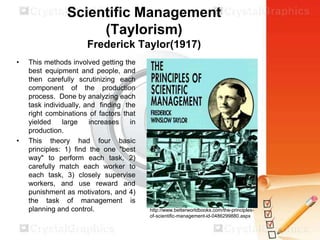
Frederick Taylor(1917)
•

•

This methods involved getting the
best equipment and people, and
then carefully scrutinizing each
component of the production
process. Done by analyzing each
task individually, and finding the
right combinations of factors that
yielded
large
increases
in
production.
This theory had four basic
principles: 1) find the one "best
way" to perform each task, 2)
carefully match each worker to
each task, 3) closely supervise
workers, and use reward and
punishment as motivators, and 4)
the task of management is
planning and control.

http://www.betterworldbooks.com/the-principlesof-scientific-management-id-0486299880.aspx
Experiment Prior to
Scientific Management
• Soldiering- purposely operating well below
their capacity. Three causes are
•
•

•

belief among workers that if they became more productive,
fewer of them would be needed and jobs would be eliminated.
Non-incentive wage systems encourage low productivity if the
employee will receive the same pay regardless of how much is
produced, assuming the employee can convince the employer
that the slow pace really is a good pace for the job.
Employees take great care never to work at a good pace for
fear that this faster pace would become the new standard. If
employees are paid by the quantity they produce, they fear
that management will decrease their per-unit pay if the
quantity increases.
Workers waste much of their effort by relying on rule-of-thumb
methods rather than on optimal work methods that can be
determined by scientific study of the task
Cont’d

• Time Studies- also known as time and motion
studies. These studies were characterized by the use of a
stopwatch to time a worker's sequence of motions, with
the goal of determining the one best way to perform a job

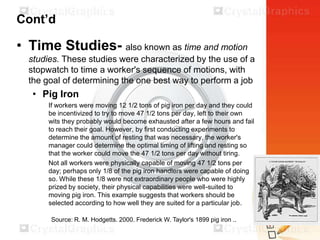
• Pig Iron
If workers were moving 12 1/2 tons of pig iron per day and they could
be incentivized to try to move 47 1/2 tons per day, left to their own
wits they probably would become exhausted after a few hours and fail
to reach their goal. However, by first conducting experiments to
determine the amount of resting that was necessary, the worker's
manager could determine the optimal timing of lifting and resting so
that the worker could move the 47 1/2 tons per day without tiring.
Not all workers were physically capable of moving 47 1/2 tons per
day; perhaps only 1/8 of the pig iron handlers were capable of doing
so. While these 1/8 were not extraordinary people who were highly
prized by society, their physical capabilities were well-suited to
moving pig iron. This example suggests that workers should be
selected according to how well they are suited for a particular job.
Source: R. M. Hodgetts. 2000. Frederick W. Taylor's 1899 pig iron ..
Cont’d
• The Science of Shoveling
• In another study of the "science of shoveling", Taylor ran time studies
to determine that the optimal weight that a worker should lift in a shovel
was 21 pounds. Since there is a wide range of densities of materials,
the shovel should be sized so that it would hold 21 pounds of the
substance being shoveled. The firm provided the workers with optimal
shovels. The result was a three to four fold increase in productivity and
workers were rewarded with pay increases. Prior to scientific
management, workers used their own shovels and rarely had the
optimal one for the job.

• Bricklaying
• Others performed experiments that focused on specific motions, such
as Gilbreth's bricklaying experiments that resulted in a dramatic
decrease in the number of motions required to lay bricks. The husband
and wife Gilbreth team used motion picture technology to study the
motions of the workers in some of their experiments
Taylor's 4 Principles of Scientific
Management
1) Scientific Job Analysis-Replace rule-of-thumb work methods
with methods based on a scientific study of the tasks.
2) Selection of Personnel- Scientifically select, train, and develop
each worker rather than passively leaving them to train
themselves.
3) Management Cooperation-Cooperate with the workers to
ensure that the scientifically developed methods are being
followed.
4) Functional Supervising-Divide work nearly equally between
managers and workers, so that the managers apply scientific
management principles to planning the work and the workers
actually perform the tasks.
These principles were implemented in many factories, often increasing
productivity by a factor of three or more. Henry Ford applied Taylor's
principles in his automobile factories, and families even began to perform
their household tasks based on the results of time and motion studies.
Drawbacks of Scientific Management
Copyright © 2002-2010 NetMBA.com

• While scientific management principles improved
productivity and had a substantial impact on industry,
they also increased the monotony of work. The core job
dimensions of skill variety, task identity, task
significance, autonomy, and feedback all were missing
from the picture of scientific management.
• While in many cases the new ways of working were
accepted by the workers, in some cases they were not.
The use of stopwatches often was a protested issue and
led to a strike at one factory where "Taylorism" was
being tested. Complaints that Taylorism was
dehumanizing led to an investigation by the United
States Congress. Despite its controversy, scientific
management changed the way that work was done, and
forms of it continue to be used today.
References
•
•

•

netMBAPublication http://www.netmba.com/mgmt/scientific/
David S. Walonick, Ph.D. Organizational Theory and
Behavior © 1993
http://www.statpac.org/walonick/organizationaltheory.htm
http://faculty.babson.edu/krollag/org_site/encyclop/admin_theo
ry.html

Classical organizational theory(scientific management)

  • 1.
    Organization and Management ofEducational Institutions NATURE AND PURPOSE OF EDUCATIONAL INSTITUTIONS DEVELOPMENT OF ADMINISTRATIVE THEORY FOCUS ON CLASSICAL ORGANIZATIONAL THEORY (Scientific Management) By: Mr. BOYET B. ALUAN
  • 2.
    Objectives • Delineate classicalorganizational theory. • Depict scientific management • Explain the four principles of scientific management • Familiarized with Taylor as associated to scientific management.
  • 3.
    “one best way” “optimizingthe way that tasks were performed and simplifying the jobs enough so that workers could be trained to perform their specialized sequence of motions in the one "best" way” Taylor(1917) Source: Taylor and the Scientific Management http://www.netmba.com/mgmt/scientific/
  • 4.
    Classical Organization Classical organizationtheory evolved during the first half of this century. It represents the merger of scientific management, bureaucratic theory, and administrative theory* *David S. Walonick, Ph.D. “Organizational Theory and Behavior” © 1993,
  • 5.
    Scientific Management (Taylorism) Frederick Taylor(1917) • • Thismethods involved getting the best equipment and people, and then carefully scrutinizing each component of the production process. Done by analyzing each task individually, and finding the right combinations of factors that yielded large increases in production. This theory had four basic principles: 1) find the one "best way" to perform each task, 2) carefully match each worker to each task, 3) closely supervise workers, and use reward and punishment as motivators, and 4) the task of management is planning and control. http://www.betterworldbooks.com/the-principlesof-scientific-management-id-0486299880.aspx
  • 6.
    Experiment Prior to ScientificManagement • Soldiering- purposely operating well below their capacity. Three causes are • • • belief among workers that if they became more productive, fewer of them would be needed and jobs would be eliminated. Non-incentive wage systems encourage low productivity if the employee will receive the same pay regardless of how much is produced, assuming the employee can convince the employer that the slow pace really is a good pace for the job. Employees take great care never to work at a good pace for fear that this faster pace would become the new standard. If employees are paid by the quantity they produce, they fear that management will decrease their per-unit pay if the quantity increases. Workers waste much of their effort by relying on rule-of-thumb methods rather than on optimal work methods that can be determined by scientific study of the task
  • 7.
    Cont’d • Time Studies-also known as time and motion studies. These studies were characterized by the use of a stopwatch to time a worker's sequence of motions, with the goal of determining the one best way to perform a job • Pig Iron If workers were moving 12 1/2 tons of pig iron per day and they could be incentivized to try to move 47 1/2 tons per day, left to their own wits they probably would become exhausted after a few hours and fail to reach their goal. However, by first conducting experiments to determine the amount of resting that was necessary, the worker's manager could determine the optimal timing of lifting and resting so that the worker could move the 47 1/2 tons per day without tiring. Not all workers were physically capable of moving 47 1/2 tons per day; perhaps only 1/8 of the pig iron handlers were capable of doing so. While these 1/8 were not extraordinary people who were highly prized by society, their physical capabilities were well-suited to moving pig iron. This example suggests that workers should be selected according to how well they are suited for a particular job. Source: R. M. Hodgetts. 2000. Frederick W. Taylor's 1899 pig iron ..
  • 8.
    Cont’d • The Scienceof Shoveling • In another study of the "science of shoveling", Taylor ran time studies to determine that the optimal weight that a worker should lift in a shovel was 21 pounds. Since there is a wide range of densities of materials, the shovel should be sized so that it would hold 21 pounds of the substance being shoveled. The firm provided the workers with optimal shovels. The result was a three to four fold increase in productivity and workers were rewarded with pay increases. Prior to scientific management, workers used their own shovels and rarely had the optimal one for the job. • Bricklaying • Others performed experiments that focused on specific motions, such as Gilbreth's bricklaying experiments that resulted in a dramatic decrease in the number of motions required to lay bricks. The husband and wife Gilbreth team used motion picture technology to study the motions of the workers in some of their experiments
  • 9.
    Taylor's 4 Principlesof Scientific Management 1) Scientific Job Analysis-Replace rule-of-thumb work methods with methods based on a scientific study of the tasks. 2) Selection of Personnel- Scientifically select, train, and develop each worker rather than passively leaving them to train themselves. 3) Management Cooperation-Cooperate with the workers to ensure that the scientifically developed methods are being followed. 4) Functional Supervising-Divide work nearly equally between managers and workers, so that the managers apply scientific management principles to planning the work and the workers actually perform the tasks. These principles were implemented in many factories, often increasing productivity by a factor of three or more. Henry Ford applied Taylor's principles in his automobile factories, and families even began to perform their household tasks based on the results of time and motion studies.
  • 10.
    Drawbacks of ScientificManagement Copyright © 2002-2010 NetMBA.com • While scientific management principles improved productivity and had a substantial impact on industry, they also increased the monotony of work. The core job dimensions of skill variety, task identity, task significance, autonomy, and feedback all were missing from the picture of scientific management. • While in many cases the new ways of working were accepted by the workers, in some cases they were not. The use of stopwatches often was a protested issue and led to a strike at one factory where "Taylorism" was being tested. Complaints that Taylorism was dehumanizing led to an investigation by the United States Congress. Despite its controversy, scientific management changed the way that work was done, and forms of it continue to be used today.
  • 11.
    References • • • netMBAPublication http://www.netmba.com/mgmt/scientific/ David S.Walonick, Ph.D. Organizational Theory and Behavior © 1993 http://www.statpac.org/walonick/organizationaltheory.htm http://faculty.babson.edu/krollag/org_site/encyclop/admin_theo ry.html