HOW GRAVITY
AND FRICTION
AFFECTS MOTION
You have learned in the previous
lesson that friction is a factor that can
affect the motion of an object. Sir Isaac
Newton formulated the Three Laws of
Motion explaining how this happens.
These are the Laws of Inertia, Law of
Acceleration and the Law of
Interaction.
In today’s lesson, we will learn about
the other factor that affects the motion
of an object.
Have you ever wondered why the objects
we throw upward tend to fall every time?
That is because there is an invisible force
that causes every object to fall to ground.
That force is what we call gravity. We
cannot see it. We cannot even smell or hear
it but we can feel it. If you are sitting upright
in your chair right now, that is because of the
gravity.
In short, gravity is useful in our
everyday life. This chapter tends to
explain on how gravity affects the
movement of different objects and
relate it to our everyday activities.
After this lesson, you are
expected to understand how
gravity affects the movement of
different objects.
ACTIVITY 1: What I know
https://docs.google.com/form
s/d/e/1FAIpQLSdXz39mIn40
Wq5eBScnOcUCXqpEuAlYZ
YMqJEY4Pq1X9cii0g/viewfor
m?usp=sf_link
What was your score?
If you got all the answers correct,
congratulations! It shows that you have
a wide range of knowledge when it
comes to our topic for today. You may
still review this topic and learn new
things ahead.
If you did not get a high score, no worries.
This module will help you learn more the concept
that you may eventually use in your daily life.
Study carefully this topic and you will be able to
answer all questions in the activities that lie ahead.
Are you ready?
Can an object move by itself? Why does
object move? It is very simple yet seemingly
foolish question. But motion is an important part of
your life. Without motion, no work would have
been done. Suppose you want to move your pencil
on the table. Name some ways by which you could
move it.
Besides the Three Laws of Motion, Sir Isaac
Newton also developed another law regarding
motion. This is the Law of Gravitation. It is based
on the nature of the gravity, a force that makes
everything fall. This law states that every particle
and object in the universe attracts every
particle and object. The amount of gravitational
attraction depends on how far the objects are and
how much mass the objects have. It is greater
when the objects are close together and have
greater mass.
What happens when objects of
different weights are dropped from the
same height at the same time? Of
course, you would assure that the
heavier object would hit the ground
first. But Galileo’s famous experiment
proved it otherwise; - both objects
struck the same time. Why?
Provided air resistance is not
considered, gravity causes objects
to constantly accelerate at 9.8
meters per second for each second
of fall. It is the same no matter what
the mass of the object may be.
But air resistance balances the
gravitational attraction of the earth on any
falling object. The faster an object falls, the
greater is the air resistance. Air resistance is
greater as the speed is increased. Have you
ever held your hand out of the jeepney
traveling at about thirty kilometers per hour?
Do you feel your hand being pushed in the
opposite direction from the direction at which
the jeepney is traveling?
As jeepney increases its speed, it
would be difficult for you to keep your
hand in one direction. Air resistances
make it so. It also makes objects such
as feathers, Ping-Pong balls, and
sheets of paper fall more slowly from
high places than objects such as
marbles, ball bearings, and baseballs.
ACTIVITY 2: “WHICH
FALLS FASTER?”
Direction: Answer the following question.
1. Imagine you have a coin and a feather
and you drop it at the same time in the
same height. Which one will get at the
ground first? Why is that so?
ACTIVITY 3: “PAPER
RACE!”
Crumple a sheet of paper. Get another
sheet of paper but this time, do not
crumple it. Drop both sheets of paper at
the same time at the same height of a
meter. Which paper hits the floor first?
Why?
ACTIVITY 4:
“EXPERIMENT TIME”
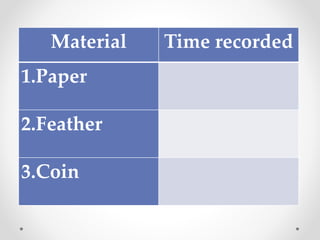
Materials: Feather, coin, paper and stopwatch.
Let’s do these way:
1. Throw the piece of paper up to the air without hitting
your ceiling. Start measuring the time when it leaves
your hand and stop the time when it reaches the
ground.
2. Throw the feather up to the air without hitting your
ceiling. Start measuring the time when it leaves your
hand and stop the time when it reaches the ground.
3. Throw the coin up to the air
without hitting your ceiling. Start
measuring the time when it leaves
your hand and stop the time when
it reaches the ground.
4. Fill up the table below with the
data you have gathered.
Material Time recorded
1.Paper
2.Feather
3.Coin
Let us answer this:
1. Which material lands the ground the
fastest? How about the material that lands the
slowest?
2. Which materials show the presence of air
resistance? How do you say so?
3. What do you think are the reasons why
the paper, coin and feather did not hit the ground
at the same time?
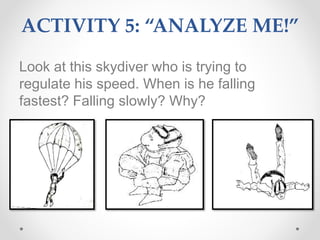
ACTIVITY 5: “ANALYZE ME!”
Look at this skydiver who is trying to
regulate his speed. When is he falling
fastest? Falling slowly? Why?
ACTIVITY 6:
“ASSESSMENT”
https://docs.google.com/forms/d
/e/1FAIpQLSc4RnGpNERw1Ha
d8he0CpHIGqSgP91_oi_SZSO
0Ppi6m9vG7w/viewform?usp=sf
_link
ACTIVITY 7: “THINGS I
LEARNED”
With all the things you have learned, what do you
think are the importance of understanding gravity
in the motion of objects?
The learners, in their notebook, journal, or
portfolio will write their personal insights
about the lesson using the prompts below.
I understand that _____________.
I realize that _________________.