Republic of the Philippines
Department of Education
DepEd Complex, Meralco Avenue
Pasig City
May 2016
K to 12 Curriculum Guide
SCIENCE
(Grade 3 to Grade 10)
K to 12 BASIC EDUCATION CURRICULUM
K to 12 Science Curriculum Guide May 2016 Page 2of 211
Learning Materials are uploaded at http://lrmds.deped.gov.ph/. *These materials are in textbooks that have been delivered to schools.
CONCEPTUAL FRAMEWORK
Science education aims to develop scientific literacy among learners that will prepare them to be informed and participative citizens who are able to make judgments
and decisions regarding applications of scientific knowledge that may have social, health, or environmental impacts.
The science curriculum recognizes the place of science and technology in everyday human affairs. It integrates science and technology in the social, economic,
personal and ethical aspects of life. The science curriculum promotes a strong link between science and technology, including indigenous technology, thus preserving our
country’s cultural heritage.
The K to 12 science curriculum will provide learners with a repertoire of competencies important in the world of work and in a knowledge-based society. It envisions
the development of scientifically, technologically, and environmentally literate and productive members of society who are critical problem solvers, responsible stewards of
nature, innovative and creative citizens, informed decision makers, and effective communicators. This curriculum is designed around the three domains of learning science:
understanding and applying scientific knowledge in local setting as well as global context whenever possible, performing scientific processes and skills, and developing and
demonstrating scientific attitudes and values. The acquisition of these domains is facilitated using the following approaches: multi/interdisciplinary approach, science-
technology-society approach, contextual learning, problem/issue-based learning, and inquiry-based approach. The approaches are based on sound educational pedagogy
namely, constructivism, social cognition learning model, learning style theory, and brain-based learning.
Science content and science processes are intertwined in the K to 12 Curriculum. Without the content, learners will have difficulty utilizing science process skills since
these processes are best learned in context. Organizing the curriculum around situations and problems that challenge and arouse learners’ curiosity motivates them to learn
and appreciate science as relevant and useful. Rather than relying solely on textbooks, varied hands-on, minds-on, and hearts-on activities will be used to develop learners’
interest and let them become active learners.
As a whole, the K to 12 science curriculum is learner-centered and inquiry-based, emphasizing the use of evidence in constructing explanations. Concepts and skills in
Life Sciences, Physics, Chemistry, and Earth Sciences are presented with increasing levels of complexity from one grade level to another in spiral progression, thus paving the
way to a deeper understanding of core concepts. The integration across science topics and other disciplines will lead to a meaningful understanding of concepts and its
application to real-life situations.
K to 12 BASIC EDUCATION CURRICULUM
K to 12 Science Curriculum Guide May 2016 Page 3of 211
Learning Materials are uploaded at http://lrmds.deped.gov.ph/. *These materials are in textbooks that have been delivered to schools.
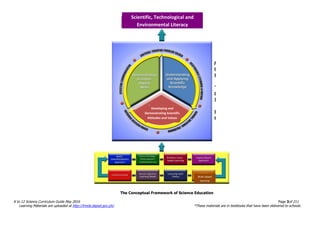
The Conceptual Framework of Science Education
Developing and
Demonstrating Scientific
Attitudes and Values
Brain-based
learning
Scientific, Technological and
Environmental Literacy
K to 12 BASIC EDUCATION CURRICULUM
K to 12 Science Curriculum Guide May 2016 Page 4of 211
Learning Materials are uploaded at http://lrmds.deped.gov.ph/. *These materials are in textbooks that have been delivered to schools.
CORE LEARNING AREA STANDARD: (SCIENCE FOR THE ENTIRE K TO 12)
The learners demonstrate understanding of basic science concepts and application of science-inquiry skills. They exhibit scientific attitudes and values to solve
problems critically, innovate beneficial products, protect the environment and conserve resources, enhance the integrity and wellness of people, make informed
decisions, and engage in discussions of relevant issues that involve science, technology, and environment.
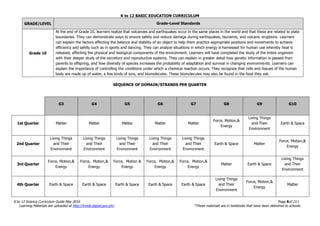
KEY STAGE STANDARDS: (STANDARDS FOR SCIENCE LEARNING AREAS FOR K-3, 4-6, 7-10 AND 11-2)
K–3 4–6 7–10 11-12
At the end of Grade 3, the
learners should have acquired
healthful habits and
havedeveloped curiosity about
self and their environment
using basic process skills of
observing, communicating,
comparing, classifying,
measuring, inferring and
predicting. This curiosity will
help learners value science as
an important tool in helping
them continue to explore their
natural and physical
environment. This should also
include developing scientific
knowledge or concepts.
At the end of Grade 6, the learners
should have developed the essential
skills of scientific inquiry – designing
simple investigations, using appropriate
procedure, materials and tools to gather
evidence, observing patterns,
determining relationships,drawing
conclusions based on evidence, and
communicating ideas in varied ways to
make meaning of the observations
and/or changes that occur in the
environment. The content and skills
learned will be applied to maintain good
health, ensure the protection and
improvement of the environment, and
practice safety measures.
At the end of Grade 10, the learners should
have developed scientific, technological, and
environmental literacyand can make that
would lead to rational choices on issues
confronting them. Having been exposed to
scientific investigations related to real life,
they should recognize that the central feature
of an investigation is that if one variable is
changed (while controlling all others), the
effect of the change on another variable can
be measured. The context of the investigation
can be problems at the local or national level
to allow them to communicate with learners
in other parts of the Philippines or even from
other countries using appropriate technology.
The learners should demonstrate an
understanding of science concepts and apply
science inquiry skills in addressingreal-world
problems through scientific investigations.
At the end of Grade 12, the learners
should have gained skills in obtaining
scientific and technological information
from varied sources about global
issues that have impact on the
country. They should have acquired
scientific attitudes that will allow them
to innovate and/or create products
useful to the community or country.
They should be able to process
information to get relevant data for a
problem at hand. In addition, learners
should have made plans related to
their interests and expertise, with
consideration forthe needs of their
community and the country — to
pursue either employment,
entrepreneurship, or higher education.
K to 12 BASIC EDUCATION CURRICULUM
K to 12 Science Curriculum Guide May 2016 Page 5of 211
Learning Materials are uploaded at http://lrmds.deped.gov.ph/. *These materials are in textbooks that have been delivered to schools.
GRADE/LEVEL Grade-Level Standards
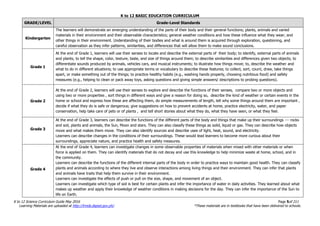
Kindergarten
The learners will demonstrate an emerging understanding of the parts of their body and their general functions; plants, animals and varied
materials in their environment and their observable characteristics; general weather conditions and how these influence what they wear; and
other things in their environment. Understanding of their bodies and what is around them is acquired through exploration, questioning, and
careful observation as they infer patterns, similarities, and differences that will allow them to make sound conclusions.
Grade 1
At the end of Grade 1, learners will use their senses to locate and describe the external parts of their body; to identify, external parts of animals
and plants; to tell the shape, color, texture, taste, and size of things around them; to describe similarities and differences given two objects; to
differentiate sounds produced by animals, vehicles cars, and musical instruments; to illustrate how things move; to, describe the weather and
what to do in different situations; to use appropriate terms or vocabulary to describe these features; to collect, sort, count, draw, take things
apart, or make something out of the things; to practice healthy habits (e.g., washing hands properly, choosing nutritious food) and safety
measures (e.g., helping to clean or pack away toys, asking questions and giving simple answers/ descriptions to probing questions).
Grade 2
At the end of Grade 2, learners will use their senses to explore and describe the functions of their senses, compare two or more objects and
using two or more properties , sort things in different ways and give a reason for doing so, describe the kind of weather or certain events in the
home or school and express how these are affecting them, do simple measurements of length, tell why some things around them are important ,
decide if what they do is safe or dangerous; give suggestions on how to prevent accidents at home, practice electricity, water, and paper
conservation, help take care of pets or of plants , and tell short stories about what they do, what they have seen, or what they feel.
Grade 3
At the end of Grade 3, learners can describe the functions of the different parts of the body and things that make up their surroundings --- rocks
and soil, plants and animals, the Sun, Moon and stars. They can also classify these things as solid, liquid or gas. They can describe how objects
move and what makes them move. They can also identify sources and describe uses of light, heat, sound, and electricity.
Learners can describe changes in the conditions of their surroundings. These would lead learners to become more curious about their
surroundings, appreciate nature, and practice health and safety measures.
Grade 4
At the end of Grade 4, learners can investigate changes in some observable properties of materials when mixed with other materials or when
force is applied on them. They can identify materials that do not decay and use this knowledge to help minimize waste at home, school, and in
the community.
Learners can describe the functions of the different internal parts of the body in order to practice ways to maintain good health. They can classify
plants and animals according to where they live and observe interactions among living things and their environment. They can infer that plants
and animals have traits that help them survive in their environment.
Learners can investigate the effects of push or pull on the size, shape, and movement of an object.
Learners can investigate which type of soil is best for certain plants and infer the importance of water in daily activities. They learned about what
makes up weather and apply their knowledge of weather conditions in making decisions for the day. They can infer the importance of the Sun to
life on Earth.
K to 12 BASIC EDUCATION CURRICULUM
K to 12 Science Curriculum Guide May 2016 Page 6of 211
Learning Materials are uploaded at http://lrmds.deped.gov.ph/. *These materials are in textbooks that have been delivered to schools.
GRADE/LEVEL Grade-Level Standards
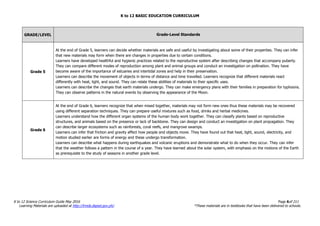
Grade 5
At the end of Grade 5, learners can decide whether materials are safe and useful by investigating about some of their properties. They can infer
that new materials may form when there are changes in properties due to certain conditions.
Learners have developed healthful and hygienic practices related to the reproductive system after describing changes that accompany puberty.
They can compare different modes of reproduction among plant and animal groups and conduct an investigation on pollination. They have
become aware of the importance of estuaries and intertidal zones and help in their preservation.
Learners can describe the movement of objects in terms of distance and time travelled. Learners recognize that different materials react
differently with heat, light, and sound. They can relate these abilities of materials to their specific uses.
Learners can describe the changes that earth materials undergo. They can make emergency plans with their families in preparation for typhoons.
They can observe patterns in the natural events by observing the appearance of the Moon.
Grade 6
At the end of Grade 6, learners recognize that when mixed together, materials may not form new ones thus these materials may be recovered
using different separation techniques. They can prepare useful mixtures such as food, drinks and herbal medicines.
Learners understand how the different organ systems of the human body work together. They can classify plants based on reproductive
structures, and animals based on the presence or lack of backbone. They can design and conduct an investigation on plant propagation. They
can describe larger ecosystems such as rainforests, coral reefs, and mangrove swamps.
Learners can infer that friction and gravity affect how people and objects move. They have found out that heat, light, sound, electricity, and
motion studied earlier are forms of energy and these undergo transformation.
Learners can describe what happens during earthquakes and volcanic eruptions and demonstrate what to do when they occur. They can infer
that the weather follows a pattern in the course of a year. They have learned about the solar system, with emphasis on the motions of the Earth
as prerequisite to the study of seasons in another grade level.
K to 12 BASIC EDUCATION CURRICULUM
K to 12 Science Curriculum Guide May 2016 Page 7of 211
Learning Materials are uploaded at http://lrmds.deped.gov.ph/. *These materials are in textbooks that have been delivered to schools.
GRADE/LEVEL Grade-Level Standards
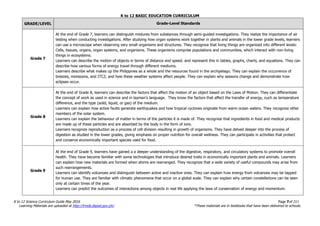
Grade 7
At the end of Grade 7, learners can distinguish mixtures from substances through semi-guided investigations. They realize the importance of air
testing when conducting investigations. After studying how organ systems work together in plants and animals in the lower grade levels, learners
can use a microscope when observing very small organisms and structures. They recognize that living things are organized into different levels:
Cells, tissues, organs, organ systems, and organisms. These organisms comprise populations and communities, which interact with non-living
things in ecosystems.
Learners can describe the motion of objects in terms of distance and speed, and represent this in tables, graphs, charts, and equations. They can
describe how various forms of energy travel through different mediums.
Learners describe what makes up the Philippines as a whole and the resources found in the archipelago. They can explain the occurrence of
breezes, monsoons, and ITCZ, and how these weather systems affect people. They can explain why seasons change and demonstrate how
eclipses occur.
Grade 8
At the end of Grade 8, learners can describe the factors that affect the motion of an object based on the Laws of Motion. They can differentiate
the concept of work as used in science and in layman’s language. They know the factors that affect the transfer of energy, such as temperature
difference, and the type (solid, liquid, or gas) of the medium.
Learners can explain how active faults generate earthquakes and how tropical cyclones originate from warm ocean waters. They recognize other
members of the solar system.
Learners can explain the behaviour of matter in terms of the particles it is made of. They recognize that ingredients in food and medical products
are made up of these particles and are absorbed by the body in the form of ions.
Learners recognize reproduction as a process of cell division resulting in growth of organisms. They have delved deeper into the process of
digestion as studied in the lower grades, giving emphasis on proper nutrition for overall wellness. They can participate in activities that protect
and conserve economically important species used for food.
Grade 9
At the end of Grade 9, learners have gained a a deeper understanding of the digestive, respiratory, and circulatory systems to promote overall
health. They have become familiar with some technologies that introduce desired traits in economically important plants and animals. Learners
can explain how new materials are formed when atoms are rearranged. They recognize that a wide variety of useful compounds may arise from
such rearrangements.
Learners can identify volcanoes and distinguish between active and inactive ones. They can explain how energy from volcanoes may be tapped
for human use. They are familiar with climatic phenomena that occur on a global scale. They can explain why certain constellations can be seen
only at certain times of the year.
Learners can predict the outcomes of interactions among objects in real life applying the laws of conservation of energy and momentum.
K to 12 BASIC EDUCATION CURRICULUM
K to 12 Science Curriculum Guide May 2016 Page 8of 211
Learning Materials are uploaded at http://lrmds.deped.gov.ph/. *These materials are in textbooks that have been delivered to schools.
GRADE/LEVEL Grade-Level Standards
Grade 10
At the end of Grade 10, learners realize that volcanoes and earthquakes occur in the same places in the world and that these are related to plate
boundaries. They can demonstrate ways to ensure safety and reduce damage during earthquakes, tsunamis, and volcanic eruptions. Learners
can explain the factors affecting the balance and stability of an object to help them practice appropriate positions and movements to achieve
efficiency and safety such as in sports and dancing. They can analyze situations in which energy is harnessed for human use whereby heat is
released, affecting the physical and biological components of the environment. Learners will have completed the study of the entire organism
with their deeper study of the excretory and reproductive systems. They can explain in greater detail how genetic information is passed from
parents to offspring, and how diversity of species increases the probability of adaptation and survival in changing environments. Learners can
explain the importance of controlling the conditions under which a chemical reaction occurs. They recognize that cells and tissues of the human
body are made up of water, a few kinds of ions, and biomolecules. These biomolecules may also be found in the food they eat.
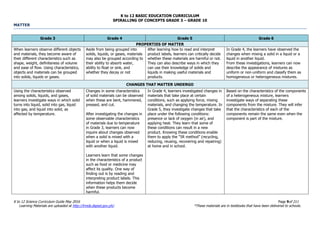
SEQUENCE OF DOMAIN/STRANDS PER QUARTER
G3 G4 G5 G6 G7 G8 G9 G10
1st Quarter Matter Matter Matter Matter Matter
Force, Motion,&
Energy
Living Things
and Their
Environment
Earth & Space
2nd Quarter
Living Things
and Their
Environment
Living Things
and Their
Environment
Living Things
and Their
Environment
Living Things
and Their
Environment
Living Things
and Their
Environment
Earth & Space Matter
Force, Motion,&
Energy
3rd Quarter
Force, Motion,&
Energy
Force, Motion,&
Energy
Force, Motion &
Energy
Force, Motion,&
Energy
Force, Motion,&
Energy
Matter Earth & Space
Living Things
and Their
Environment
4th Quarter Earth & Space Earth & Space Earth & Space Earth & Space Earth & Space
Living Things
and Their
Environment
Force, Motion,&
Energy
Matter
K to 12 BASIC EDUCATION CURRICULUM
K to 12 Science Curriculum Guide May 2016 Page 9of 211
Learning Materials are uploaded at http://lrmds.deped.gov.ph/. *These materials are in textbooks that have been delivered to schools.
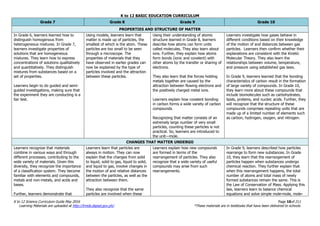
SPIRALLING OF CONCEPTS GRADE 3 – GRADE 10
MATTER
Grade 3 Grade 4 Grade 5 Grade 6
PROPERTIES OF MATTER
When learners observe different objects
and materials, they become aware of
their different characteristics such as
shape, weight, definiteness of volume
and ease of flow. Using characteristics,
objects and materials can be grouped
into solids, liquids or gases.
Aside from being grouped into
solids, liquids, or gases, materials
may also be grouped according to
their ability to absorb water,
ability to float or sink, and
whether they decay or not
After learning how to read and interpret
product labels, learners can critically decide
whether these materials are harmful or not.
They can also describe ways in which they
can use their knowledge of solids and
liquids in making useful materials and
products.
In Grade 4, the learners have observed the
changes when mixing a solid in a liquid or a
liquid in another liquid.
From these investigations, learners can now
describe the appearance of mixtures as
uniform or non-uniform and classify them as
homogeneous or heterogeneous mixtures.
CHANGES THAT MATTER UNDERGO
Using the characteristics observed
among solids, liquids, and gases,
learners investigate ways in which solid
turns into liquid, solid into gas, liquid
into gas, and liquid into solid, as
affected by temperature.
Changes in some characteristics
of solid materials can be observed
when these are bent, hammered,
pressed, and cut.
After investigating the changes in
some observable characteristics
of materials due to temperature
in Grade 3, learners can now
inquire about changes observed
when a solid is mixed with a
liquid or when a liquid is mixed
with another liquid.
Learners learn that some changes
in the characteristics of a product
such as food or medicine may
affect its quality. One way of
finding out is by reading and
interpreting product labels. This
information helps them decide
when these products become
harmful.
In Grade 4, learners investigated changes in
materials that take place at certain
conditions, such as applying force, mixing
materials, and changing the temperature. In
Grade 5, they investigate changes that take
place under the following conditions:
presence or lack of oxygen (in air), and
applying heat. They learn that some of
these conditions can result in a new
product. Knowing these conditions enable
them to apply the “5R method” (recycling,
reducing, reusing, recovering and repairing)
at home and in school.
Based on the characteristics of the components
of a heterogeneous mixture, learners
investigate ways of separating these
components from the mixture. They will infer
that the characteristics of each of the
components remain the same even when the
component is part of the mixture.
K to 12 BASIC EDUCATION CURRICULUM
K to 12 Science Curriculum Guide May 2016 Page 10of 211
Learning Materials are uploaded at http://lrmds.deped.gov.ph/. *These materials are in textbooks that have been delivered to schools.
Grade 7 Grade 8 Grade 9 Grade 10
PROPERTIES AND STRUCTURE OF MATTER
In Grade 6, learners learned how to
distinguish homogenous from
heterogeneous mixtures. In Grade 7,
learners investigate properties of
solutions that are homogeneous
mixtures. They learn how to express
concentrations of solutions qualitatively
and quantitatively. They distinguish
mixtures from substances based on a
set of properties.
Learners begin to do guided and semi-
guided investigations, making sure that
the experiment they are conducting is a
fair test.
Using models, learners learn that
matter is made up of particles, the
smallest of which is the atom. These
particles are too small to be seen
through a microscope. The
properties of materials that they
have observed in earlier grades can
now be explained by the type of
particles involved and the attraction
between these particles.
Using their understanding of atomic
structure learned in Grade 8, learners
describe how atoms can form units
called molecules. They also learn about
ions. Further, they explain how atoms
form bonds (ionic and covalent) with
other atoms by the transfer or sharing of
electrons.
They also learn that the forces holding
metals together are caused by the
attraction between flowing electrons and
the positively charged metal ions.
Learners explain how covalent bonding
in carbon forms a wide variety of carbon
compounds.
Recognizing that matter consists of an
extremely large number of very small
particles, counting these particles is not
practical. So, learners are introduced to
the unit—mole.
Learners investigate how gases behave in
different conditions based on their knowledge
of the motion of and distances between gas
particles. Learners then confirm whether their
explanations are consistent with the Kinetic
Molecular Theory. They also learn the
relationships between volume, temperature,
and pressure using established gas laws.
In Grade 9, learners learned that the bonding
characteristics of carbon result in the formation
of large variety of compounds. In Grade 10,
they learn more about these compounds that
include biomolecules such as carbohydrates,
lipids, proteins, and nucleic acids. Further, they
will recognize that the structure of these
compounds comprises repeating units that are
made up of a limited number of elements such
as carbon, hydrogen, oxygen, and nitrogen.
CHANGES THAT MATTER UNDERGO
Learners recognize that materials
combine in various ways and through
different processes, contributing to the
wide variety of materials. Given this
diversity, they recognize the importance
of a classification system. They become
familiar with elements and compounds,
metals and non-metals, and acids and
bases.
Further, learners demonstrate that
Learners learn that particles are
always in motion. They can now
explain that the changes from solid
to liquid, solid to gas, liquid to solid,
and liquid to gas, involve changes in
the motion of and relative distances
between the particles, as well as the
attraction between them.
They also recognize that the same
particles are involved when these
Learners explain how new compounds
are formed in terms of the
rearrangement of particles. They also
recognize that a wide variety of useful
compounds may arise from such
rearrangements.
In Grade 9, learners described how particles
rearrange to form new substances. In Grade
10, they learn that the rearrangement of
particles happen when substances undergo
chemical reaction. They further explain that
when this rearrangement happens, the total
number of atoms and total mass of newly
formed substances remain the same. This is
the Law of Conservation of Mass. Applying this
law, learners learn to balance chemical
equations and solve simple mole-mole, mole-
K to 12 BASIC EDUCATION CURRICULUM
K to 12 Science Curriculum Guide May 2016 Page 11of 211
Learning Materials are uploaded at http://lrmds.deped.gov.ph/. *These materials are in textbooks that have been delivered to schools.
Grade 7 Grade 8 Grade 9 Grade 10
homogeneous mixtures can be
separated using various techniques.
changes occur. In effect, no new
substances are formed.
mass, and mass-mass problems.
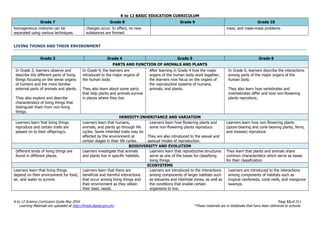
LIVING THINGS AND THEIR ENVIRONMENT
Grade 3 Grade 4 Grade 5 Grade 6
PARTS AND FUNCTION OF ANIMALS AND PLANTS
In Grade 3, learners observe and
describe the different parts of living
things focusing on the sense organs
of humans and the more familiar
external parts of animals and plants.
They also explore and describe
characteristics of living things that
distinguish them from non-living
things.
In Grade 4, the learners are
introduced to the major organs of
the human body.
They also learn about some parts
that help plants and animals survive
in places where they live.
After learning in Grade 4 how the major
organs of the human body work together,
the learners now focus on the organs of
the reproductive systems of humans,
animals, and plants.
In Grade 6, learners describe the interactions
among parts of the major organs of the
human body.
They also learn how vertebrates and
invertebrates differ and how non-flowering
plants reproduce,
HEREDITY:INHERITANCE AND VARIATION
Learners learn that living things
reproduce and certain traits are
passed on to their offspring/s.
Learners learn that humans,
animals, and plants go through life
cycles. Some inherited traits may be
affected by the environment at
certain stages in their life cycles.
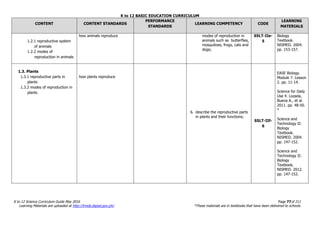
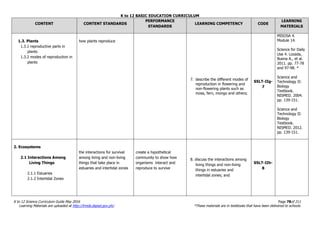
Learners learn how flowering plants and
some non-flowering plants reproduce.
They are also introduced to the sexual and
asexual modes of reproduction.
Learners learn how non-flowering plants
(spore-bearing and cone-bearing plants, ferns,
and mosses) reproduce.
BIODIVERSITY AND EVOLUTION
Different kinds of living things are
found in different places.
Learners investigate that animals
and plants live in specific habitats.
Learners learn that reproductive structures
serve as one of the bases for classifying
living things.
They learn that plants and animals share
common characteristics which serve as bases
for their classification.
ECOSYSTEMS
Learners learn that living things
depend on their environment for food,
air, and water to survive.
Learners learn that there are
beneficial and harmful interactions
that occur among living things and
their environment as they obtain
their basic needs.
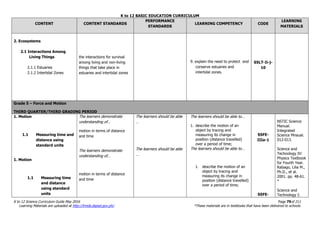
Learners are introduced to the interactions
among components of larger habitats such
as estuaries and intertidal zones, as well as
the conditions that enable certain
organisms to live.
Learners are introduced to the interactions
among components of habitats such as
tropical rainforests, coral reefs, and mangrove
swamps.
K to 12 BASIC EDUCATION CURRICULUM
K to 12 Science Curriculum Guide May 2016 Page 12of 211
Learning Materials are uploaded at http://lrmds.deped.gov.ph/. *These materials are in textbooks that have been delivered to schools.
Grade 7 Grade 8 Grade 9 Grade 10
PARTS AND FUNCTION: ANIMAL AND PLANTS
In Grade 7, learners are introduced to the
levels of organization in the human body
and other organisms. They learn that
organisms consist of cells, most of which
are grouped into organ systems that
perform specialized functions.
In Grade 8, learners gain knowledge of
how the body breaks down food into
forms that can be absorbed through
the digestive system and transported
to cells.
Learners learn that gases are
exchanged through the respiratory
system. This provides the oxygen
needed by cells to release the energy
stored in food.
They also learn that dissolved wastes
are removed through the urinary
system while solid wastes are
eliminated through the excretory
system.
Learners study the coordinated
functions of the digestive, respiratory,
and circulatory systems.
They also learn that nutrients enter
the bloodstream and combine with
oxygen taken in through the
respiratory system. Together, they are
transported to the cells where oxygen
is used to release the stored energy.
Learners learn that organisms have
feedback mechanisms that are
coordinated by the nervous and
endocrine systems. These mechanisms
help the organisms maintain
homeostasis to reproduce and survive.
HEREDITY:INHERITANCE AND VARIATION
After learning how flowering and non
flowering plants reproduce, Grade 7
learners are taught that asexual
reproduction results in genetically identical
offspring whereas sexual reproduction gives
rise to variation.
Learners study the process of cell
division by mitosis and meiosis. They
understand that meiosis is an early
step in sexual reproduction that leads
to variation.
Learners study the structure of genes
and chromosomes, and the functions
they perform in the transmission of
traits from parents to offspring.
Learners are introduced to the structure
of the DNA molecule and its function.
They also learn that changes that take
place in sex cells are inherited while
changes in body cells are not passed on.
BIODIVERSITY AND EVOLUTION
Learners learn that the cells in similar
tissues and organs in other animals are
similar to those in human beings but differ
somewhat from cells found in plants.
Learners learn that species refers to a
group of organisms that can mate with
one another to produce fertile offspring.
They learn that biodiversity is the
collective variety of species living in an
ecosystem. This serves as an
introduction to the topic on hierarchical
taxonomic system.
Learners learn that most species that
have once existed are now extinct.
Species become extinct when they fail
to adapt to changes in the environment.
Learners revisit the mechanisms involved
in the inheritance of traits and the
changes that result from these
mechanisms. Learners explain how
natural selection has produced a
succession of diverse new species.
Variation increases the chance of living
things to survive in a changing
environment.
K to 12 BASIC EDUCATION CURRICULUM
K to 12 Science Curriculum Guide May 2016 Page 13of 211
Learning Materials are uploaded at http://lrmds.deped.gov.ph/. *These materials are in textbooks that have been delivered to schools.
Grade 7 Grade 8 Grade 9 Grade 10
ECOSYSTEMS
Learners learn that interactions occur
among the different levels of organization in
ecosystems. Organisms of the same kind
interact with each other to form
populations; populations interact with other
populations to form communities.
Learners learn how energy is
transformed and how materials are
cycled in ecosystems.
Learners learn how plants capture
energy from the Sun and store energy
in sugar molecules (photosynthesis).
This stored energy is used by cells
during cellular respiration. These two
processes are related to each other.
Learners investigate the impact of
human activities and other organisms on
ecosystems.
They learn how biodiversity influences
the stability of ecosystems.
FORCE, MOTION AND ENERGY
Grade 3 Grade 4 Grade 5 Grade 6
FORCE AND MOTION
Learners observe and explore and
investigate how things around them
move and can be moved. They also
identify things in their environment that
can cause changes in the movement of
objects.
Learners now learn that if force is
applied on an object, its motion, size,
or shape can be changed. They will
further understand that these changes
depend on the amount of force applied
on it (qualitative). They also learn that
magnets can exert force on some
objects and may cause changes in their
movements.
This time, learners begin to accurately
measure the amount of change in the
movement of an object in terms of its
distance travelled and time of travel
using appropriate tools.
Aside from the identified causes of
motion in Grade 3, such as people,
animals, wind, and water, learners
also learn about gravity and friction as
other causes or factors that affect the
movement of objects.
ENERGY
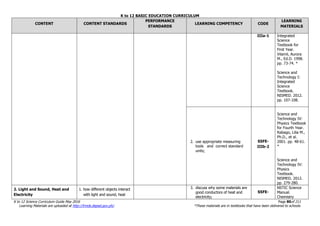
Learners observe and identify different
sources of light, heat, sound, and
electricity in their environment and their
uses in everyday life.
Learners learn that light, heat, and
sound travel from the source. They
perform simple activities that
demonstrate how they travel using
various objects.
Note: Electricity is not included in
Grade 4 because the concept of ‘flow of
charges’ is difficult to understand at
this grade level.
This time, learners explore how different
objects interact with light, heat, sound,
and electricity (e.g., identifying poor and
good conductors of electricity using
simple circuits).
They learn about the relationship
between electricity and magnetism by
constructing an electromagnet.
They also learn about the effects of light,
heat, sound, and electricity on people.
At this grade level, learners are
introduced to the concept of energy.
They learn that energy exists in
different forms, such as light, heat,
sound and electricity, and it can be
transformed from one form to
another. They demonstrate how
energy is transferred using simple
machines.
K to 12 BASIC EDUCATION CURRICULUM
K to 12 Science Curriculum Guide May 2016 Page 14of 211
Learning Materials are uploaded at http://lrmds.deped.gov.ph/. *These materials are in textbooks that have been delivered to schools.
Grade 7 Grade 8 Grade 9 Grade 10
FORCE AND MOTION
From a simple understanding of motion,
learners study more scientific ways of
describing (in terms of distance, speed,
and acceleration) and representing
(using motion diagrams, charts, and
graphs) the motion of objects in one
dimension.
This time, learners study the concept of
force and its relationship to motion.
They use Newton’s Laws of Motion to
explain why objects move (or do not
move) the way they do (as described in
Grade 7). They also realize that if force
is applied on a body, work can be done
and may cause a change in the energy
of the body.
To deepen their understanding of motion,
learners use the Law of Conservation of
Momentum to further explain the motion
of objects.
From motion in one dimension in the
previous grades, they learn at this level
about motion in two dimensions using
projectile motion as an example.
From learning the basics of forces in
Grade 8, learners extend their
understanding of forces by describing
how balanced and unbalanced forces,
either by solids or liquids, affect the
movement, balance, and stability of
objects.
ENERGY
This time learners recognize that
different forms of energy travel in
different ways—light and sound travel
through waves, heat travels through
moving or vibrating particles, and
electrical energy travels through moving
charges.
In Grade 5, they learned about the
different modes of heat transfer. This
time, they explain these modes in terms
of the movement of particles.
Learners realize that transferred energy
may cause changes in the properties of
the object. They relate the observable
changes in temperature, amount of
current, and speed of sound to the
changes in energy of the particles.
Learners explain how conservation of
mechanical energy is applied in some
structures, such as roller coasters, and in
natural environments like waterfalls. They
further describe the transformation of
energy that takes place in hydroelectric
power plants.
Learners also learn about the relationship
between heat and work, and apply this
concept to explain how geothermal power
plants operate.
After they have learned how electricity is
generated in power plants, learners
further develop their understanding of
transmission of electricity from power
stations to homes.
Learners acquire more knowledge about
the properties of light as applied in
optical instruments.
Learners also use the concept of moving
charges and magnetic fields in explaining
the principle behind generators and
motors.
K to 12 BASIC EDUCATION CURRICULUM
K to 12 Science Curriculum Guide May 2016 Page 15of 211
Learning Materials are uploaded at http://lrmds.deped.gov.ph/. *These materials are in textbooks that have been delivered to schools.
EARTH AND SPACE
Grade 3 Grade 4 Grade 5 Grade 6
GEOLOGY
Learners will describe what makes up
their environment, beginning with
the landforms and bodies of water
found in their community.
After familiarizing themselves with
the general landscape, learners will
investigate two components of the
physical environment in more detail:
soil and water. They will classify soils
in their community using simple
criteria. They will identify the
different sources of water in their
community. They will infer the
importance of water in daily
activities and describe ways of using
water wisely.
In this grade level, learners will learn that
our surroundings do not stay the same
forever. For example, rocks undergo
weathering and soil is carried away by
erosion. Learners will infer that the surface
of the Earth changes with the passage of
time.
Learners will learn that aside from weathering
and erosion, there are other processes that
may alter the surface of the Earth: earthquakes
and volcanic eruptions. Only the effects of
earthquakes and volcanic eruptions are taken
up in this grade level, not their causes (which
will be tackled in Grades 8 and 9). Learners
will also gather and report data on earthquakes
and volcanic eruptions in their community or
region.
METEOROLOGY
Learners will describe the different
types of local weather,
After making simple descriptions
about the weather in the previous
grade, learners will now measure the
components of weather using simple
instruments. They will also identify
trends in a simple weather chart.
Learners will learn that the weather does
not stay the same the whole year round.
Weather disturbances such as typhoons
may occur. Learners will describe the
effects of typhoons on the community and
the changes in the weather before, during,
and after a typhoon.
After learning how to measure the different
components of weather in Grades 4 and 5,
learners will now collect weather data within
the span of the school year. Learners will
interpret the data and identify the weather
patterns in their community.
ASTRONOMY
Learners will describe the natural
objects that they see in the sky.
After describing the natural objects
that are seen in the sky, learners will
now focus on the main source of
heat and light on Earth: the Sun, its
role in plant growth and
development, and its effect on the
activities of humans and other
animals.
After learning about the Sun, learners will
now familiarize themselves with the Moon
and the stars. They will describe the
changes in the appearance of the Moon and
discover that the changes are cyclical, and
that the cycle is related to the length of a
month. Learners will identify star patterns
that can be seen during certain times of the
year.
In Grade 6, learners will turn their attention to
Earth as another natural object in space (in
addition to the Sun, Moon, and stars).
Learners will learn about the motions of the
Earth: rotation and revolution. Learners will
also compare the different members that
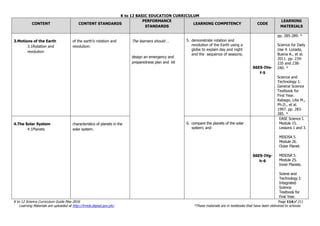
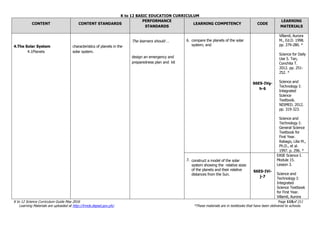
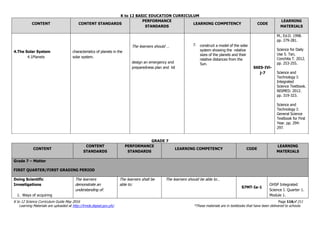
make up the Solar System and construct
models to help them visualize their relative
sizes and distances.
K to 12 BASIC EDUCATION CURRICULUM
K to 12 Science Curriculum Guide May 2016 Page 16of 211
Learning Materials are uploaded at http://lrmds.deped.gov.ph/. *These materials are in textbooks that have been delivered to schools.
Grade 7 Grade 8 Grade 9 Grade 10
GEOLOGY
Learners will explore and locate places
using a coordinate system. They will
discover that our country’s location
near the equator and along the Ring of
Fire influences elements of up
Philippine environment (e.g., natural
resources and climate).
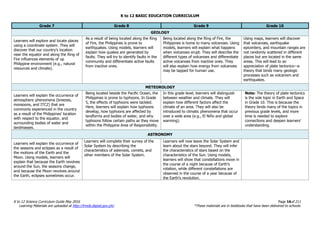
As a result of being located along the Ring
of Fire, the Philippines is prone to
earthquakes. Using models, learners will
explain how quakes are generated by
faults. They will try to identify faults in the
community and differentiate active faults
from inactive ones.
Being located along the Ring of Fire, the
Philippines is home to many volcanoes. Using
models, learners will explain what happens
when volcanoes erupt. They will describe the
different types of volcanoes and differentiate
active volcanoes from inactive ones. They
will also explain how energy from volcanoes
may be tapped for human use.
Using maps, learners will discover
that volcanoes, earthquake
epicenters, and mountain ranges are
not randomly scattered in different
places but are located in the same
areas. This will lead to an
appreciation of plate tectonics—a
theory that binds many geologic
processes such as volcanism and
earthquakes.
METEOROLOGY
Learners will explain the occurrence of
atmospheric phenomena (breezes,
monsoons, and ITCZ) that are
commonly experienced in the country
as a result of the Philippines’ location
with respect to the equator, and
surrounding bodies of water and
landmasses.
Being located beside the Pacific Ocean, the
Philippines is prone to typhoons. In Grade
5, the effects of typhoons were tackled.
Here, learners will explain how typhoons
develop, how typhoons are affected by
landforms and bodies of water, and why
typhoons follow certain paths as they move
within the Philippine Area of Responsibility.
In this grade level, learners will distinguish
between weather and climate. They will
explain how different factors affect the
climate of an area. They will also be
introduced to climatic phenomena that occur
over a wide area (e.g., El Niño and global
warming).
Note: The theory of plate tectonics
is the sole topic in Earth and Space
in Grade 10. This is because the
theory binds many of the topics in
previous grade levels, and more
time is needed to explore
connections and deepen learners’
understanding.
ASTRONOMY
Learners will explain the occurrence of
the seasons and eclipses as a result of
the motions of the Earth and the
Moon. Using models, learners will
explain that because the Earth revolves
around the Sun, the seasons change,
and because the Moon revolves around
the Earth, eclipses sometimes occur.
Learners will complete their survey of the
Solar System by describing the
characteristics of asteroids, comets, and
other members of the Solar System.
Learners will now leave the Solar System and
learn about the stars beyond. They will infer
the characteristics of stars based on the
characteristics of the Sun. Using models,
learners will show that constellations move in
the course of a night because of Earth’s
rotation, while different constellations are
observed in the course of a year because of
the Earth’s revolution.
K to 12 BASIC EDUCATION CURRICULUM
K to 12 Science Curriculum Guide May 2016 Page 17of 211
Learning Materials are uploaded at http://lrmds.deped.gov.ph/. *These materials are in textbooks that have been delivered to schools.
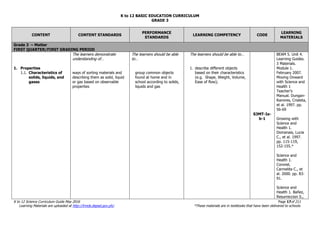
GRADE 3
CONTENT CONTENT STANDARDS
PERFORMANCE
STANDARDS
LEARNING COMPETENCY CODE
LEARNING
MATERIALS
Grade 3 – Matter
FIRST QUARTER/FIRST GRADING PERIOD
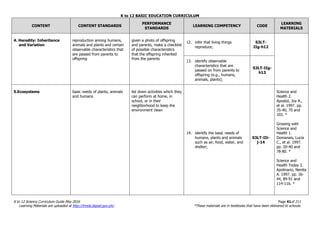
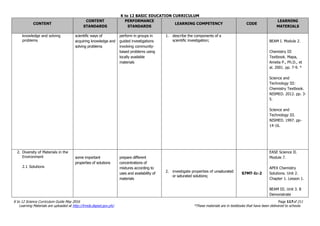
1. Properties
1.1. Characteristics of
solids, liquids, and
gases
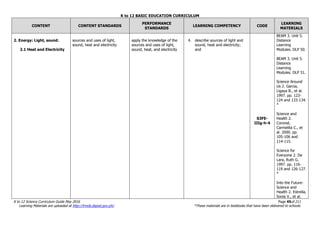
The learners demonstrate
understanding of…
ways of sorting materials and
describing them as solid, liquid
or gas based on observable
properties
The learners should be able
to…
group common objects
found at home and in
school according to solids,
liquids and gas
The learners should be able to…
1. describe different objects
based on their characteristics
(e.g. Shape, Weight, Volume,
Ease of flow);
S3MT-Ia-
b-1
BEAM 5. Unit 4.
Learning Guides.
3 Materials.
Module 1.
February 2007.
Moving Onward
with Science and
Health 1
Teacher’s
Manual. Dungan-
Ramires, Cristeta,
et al. 1997. pp.
56-69
Growing with
Science and
Health 1.
Domanais, Lucia
C., et al. 1997.
pp. 115-119,
152-155.*
Science and
Health 1.
Coronel,
Carmelita C., et
al. 2000. pp. 83-
91.
Science and
Health 1. Bañez,
Resurreccion S.,
K to 12 BASIC EDUCATION CURRICULUM
K to 12 Science Curriculum Guide May 2016 Page 18of 211
Learning Materials are uploaded at http://lrmds.deped.gov.ph/. *These materials are in textbooks that have been delivered to schools.
CONTENT CONTENT STANDARDS
PERFORMANCE
STANDARDS
LEARNING COMPETENCY CODE
LEARNING
MATERIALS
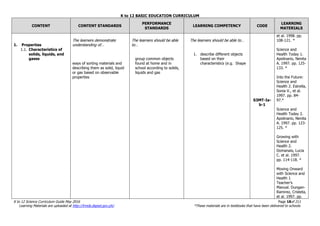
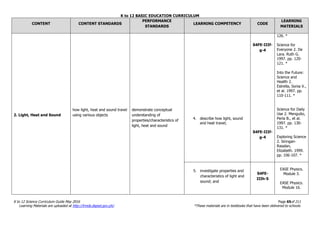
1. Properties
1.1. Characteristics of
solids, liquids, and
gases
The learners demonstrate
understanding of…
ways of sorting materials and
describing them as solid, liquid
or gas based on observable
properties
The learners should be able
to…
group common objects
found at home and in
school according to solids,
liquids and gas
The learners should be able to…
1. describe different objects
based on their
characteristics (e.g. Shape
S3MT-Ia-
b-1
et al. 1998. pp.
108-121. *
Science and
Health Today 1.
Apolinario, Nenita
A. 1997. pp. 125-
133. *
Into the Future:
Science and
Health 2. Estrella,
Sonia V., et al.
1997. pp. 84-
97.*
Science and
Health Today 2.
Apolinario, Nenita
A. 1997. pp. 123-
125. *
Growing with
Science and
Health 2.
Domanais, Lucia
C. et al. 1997.
pp. 114-118. *
Moving Onward
with Science and
Health 1
Teacher’s
Manual. Dungan-
Ramirez, Cristeta,
et al. 1997. pp.
K to 12 BASIC EDUCATION CURRICULUM
K to 12 Science Curriculum Guide May 2016 Page 19of 211
Learning Materials are uploaded at http://lrmds.deped.gov.ph/. *These materials are in textbooks that have been delivered to schools.
CONTENT CONTENT STANDARDS
PERFORMANCE
STANDARDS
LEARNING COMPETENCY CODE
LEARNING
MATERIALS
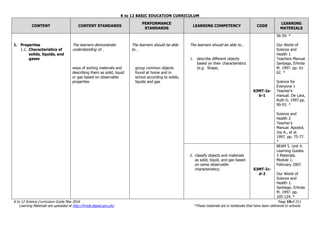
1. Properties
1.1. Characteristics of
solids, liquids, and
gases
The learners demonstrate
understanding of…
ways of sorting materials and
describing them as solid, liquid
or gas based on observable
properties
The learners should be able
to…
group common objects
found at home and in
school according to solids,
liquids and gas
The learners should be able to…
1. describe different objects
based on their characteristics
(e.g. Shape,
S3MT-Ia-
b-1
56-59. *
Our World of
Science and
Health 1
Teachers Manual.
Santiago, Erlinda
M. 1997. pp. 61-
62. *
Science for
Everyone 1
Teacher’s
manual. De Lara,
Ruth G. 1997.pp.
90-93. *
Science and
Health 2
Teacher’s
Manual. Apostol,
Joy A., et al.
1997. pp. 75-77.
*
2. classify objects and materials
as solid, liquid, and gas based
on some observable
characteristics; S3MT-Ic-
d-2
BEAM 5. Unit 4.
Learning Guides.
3 Materials.
Module 1.
February 2007.
Our World of
Science and
Health 1.
Santiago, Erlinda
M. 1997. pp.
105-124. *
K to 12 BASIC EDUCATION CURRICULUM
K to 12 Science Curriculum Guide May 2016 Page 20of 211
Learning Materials are uploaded at http://lrmds.deped.gov.ph/. *These materials are in textbooks that have been delivered to schools.
CONTENT CONTENT STANDARDS
PERFORMANCE
STANDARDS
LEARNING COMPETENCY CODE
LEARNING
MATERIALS
1. Properties
1.1. Characteristics of
solids, liquids, and
gases
The learners demonstrate
understanding of…
ways of sorting materials and
describing them as solid, liquid
or gas based on observable
properties
The learners should be able
to…
group common objects
found at home and in
school according to solids,
liquids and gas
2. classify objects and materials
as solid, liquid, and gas based
on some observable
characteristics;
S3MT-Ic-
d-2
Science and
Health Today 2.
Apolinario, Nenita
A. 1997. pp. 126-
136. *
Exploring Science
2. Siringan-
Rasalan,
Elizabeth. 1999.
pp. 82-100. *
Science and
Health 2.
Apostol, Joy A.,
et al. 1997. pp.
112-123. *
Growing with
Science and
Health 2.
Domanais, Lucia
C., et al. 1997.
114-130. *
Science for Daily
Use 2. Menguito,
Perla B., et al.
1997. pp. 111-
125. *
Science for
Everyone 2. De
Lara, Ruth G.
1997. pp. 98-
K to 12 BASIC EDUCATION CURRICULUM
K to 12 Science Curriculum Guide May 2016 Page 21of 211
Learning Materials are uploaded at http://lrmds.deped.gov.ph/. *These materials are in textbooks that have been delivered to schools.
CONTENT CONTENT STANDARDS
PERFORMANCE
STANDARDS
LEARNING COMPETENCY CODE
LEARNING
MATERIALS
1. Properties
1.1. Characteristics of
solids, liquids, and
gases
The learners demonstrate
understanding of…
ways of sorting materials and
describing them as solid, liquid
or gas based on observable
properties
The learners should be able
to…
group common objects
found at home and in
school according to solids,
liquids and gas
2. classify objects and materials
as solid, liquid, and gas based
on some observable
characteristics;
S3MT-Ic-
d-2
112. *
Science and
Health 2.
Coronel,
Carmelita C.
1997. pp. 114-
137. *
Science Around
Us 2. Garcia,
Ligaya B., et al.
1997. pp. 103-
119. *
Science and
Health for Life 2.
Carale, Dr.
Lourdes R., et al.
1997. pp. 141-
154. *
3. describe ways on the proper
use and handling solid, liquid
and gas found at home and in
school; and
S3MT-Ie-
g-3
Science and
Health 3
Teacher’s
Manual. Jacinto,
Emilio S. Jr., et
al. 1997. pp.
109-111. *
Science Around
Us 3. Garcia,
Ligaya B., et al.
1997. pp. 113-
114. *
K to 12 BASIC EDUCATION CURRICULUM
K to 12 Science Curriculum Guide May 2016 Page 22of 211
Learning Materials are uploaded at http://lrmds.deped.gov.ph/. *These materials are in textbooks that have been delivered to schools.
CONTENT CONTENT STANDARDS
PERFORMANCE
STANDARDS
LEARNING COMPETENCY CODE
LEARNING
MATERIALS
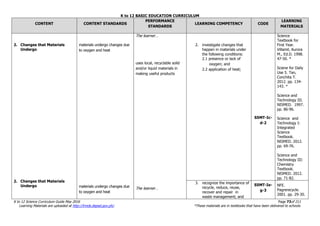
2. Changes that Materials
Undergo
effects of temperature
on materials
investigate the different
changes in materials as
affected by temperature
4. describe changes in materials
based on the effect of
temperature:
4.1 Solid to liquid
4.2 Liquid to solid
4.3 Liquid to gas
4.4 Solid to gas
S3MT-Ih-
j-4
BEAM 5. Unit 4. 8
Physical and
Chemical
Changes.
Distance
Learning
Modules. DLP 26.
Grade 3 – Living Things and Their Environment
SECOND QUARTER/SECOND GRADING PERIOD
1.Living Things
1.1Humans
1.1.a Sense Organs
The learners demonstrate
understanding of…
parts, and functions of the
sense organs of the human
body
The learners should be able
to…
practice healthful habits in
taking care of the sense
organs
The learners should be able to…
1. describe the parts and functions
of the sense organs of the
human body;
S3LT-IIa-
b-1
BEAM 3. Unit 1.
Distance
Learning
Modules. DLP 1.
Science for
Everyone 1. De
Lara, Ruth G.
1997. pp. 1-11. *
Science and
Health 1.
Santiago, Ma.
Lourdes B. 1997.
pp. 1-7. *
Into the Future:
Science and
Health 1. Estrella,
Sonia V., et al.
1997. pp. 1-9. *
Science and
Health Today 1.
Apolinario, Nenita
A. 1997. pp. 2-
K to 12 BASIC EDUCATION CURRICULUM
K to 12 Science Curriculum Guide May 2016 Page 23of 211
Learning Materials are uploaded at http://lrmds.deped.gov.ph/. *These materials are in textbooks that have been delivered to schools.
CONTENT CONTENT STANDARDS
PERFORMANCE
STANDARDS
LEARNING COMPETENCY CODE
LEARNING
MATERIALS
1.Living Things
1.1Humans
1.1.a Sense Organs
The learners demonstrate
understanding of…
parts, and functions of the
sense organs of the human
body
The learners should be able
to…
practice healthful habits in
taking care of the sense
organs
The learners should be able to…
1. describe the parts and
functions of the sense
organs of the human body;
S3LT-IIa-
b-1
17. *
Moving Onward
with Science and
Health 1.
Dungan-Ramirez,
Cristeta. 1997.
pp. 11-17. *
Growing with
Science and
Health 1.
Domanais, Lucia
C., et al. 1997.
pp. 2-4. *
Science and
Health 1. Bañez,
Resurreccion S.,
et al. 1998. pp.
2-8. *
Science and
Health 1.
Coronel,
Carmelita C., et
al. 2000. pp. 3-9.
Our World of
Science and
Health 1.
Santiago, Erlinda
M. 1997. pp. 2-
17. *
Science and
K to 12 BASIC EDUCATION CURRICULUM
K to 12 Science Curriculum Guide May 2016 Page 24of 211
Learning Materials are uploaded at http://lrmds.deped.gov.ph/. *These materials are in textbooks that have been delivered to schools.
CONTENT CONTENT STANDARDS
PERFORMANCE
STANDARDS
LEARNING COMPETENCY CODE
LEARNING
MATERIALS
1.Living Things
1.1Humans
1.1.a Sense Organs
The learners demonstrate
understanding of…
parts, and functions of the
sense organs of the human
body
The Learners should be able
to…
practice healthful habits in
taking care of the sense
organs
The learners should be able to…
1. describe the parts and functions
of the sense organs of the
human body;
S3LT-IIa-
b-1
Health 1.
Coronel,
Carmelita C.
1997. pp. 19-23.
*
Science for
Everyone 2
Teacher’s
Manual. De Lara,
Ruth G. 1997.
pp. 8-18. *
Growing with
Science and
Health 2
Teacher’s
Manual.
Domanais, Lucia
C., et al. 1997.
pp. 2-20. *
Science and
Health 2
Teacher’s
Manual. Coronel,
Carmelita C.
1997. pp. 14-20.
*
Science and
Health 2
Teacher’s
Manual. Apostol,
Joy A., et al.
1997. pp. 1-6. *
K to 12 BASIC EDUCATION CURRICULUM
K to 12 Science Curriculum Guide May 2016 Page 25of 211
Learning Materials are uploaded at http://lrmds.deped.gov.ph/. *These materials are in textbooks that have been delivered to schools.
CONTENT CONTENT STANDARDS
PERFORMANCE
STANDARDS
LEARNING COMPETENCY CODE
LEARNING
MATERIALS
1.Living Things
1.1Humans
1.1.a Sense Organs
The learners demonstrate
understanding of…
parts, and functions of the
sense organs of the human
body
The learners should be able
to…
practice healthful habits in
taking care of the sense
organs
The learners should be able to…
1. describe the parts and
functions of the sense
organs of the human body;
S3LT-IIa-
b-1
Into the Future:
Science and
Health 1
Teacher’s
Manual. Estrella,
Sonia V., et al.
1997. pp. 11-13.
*
2. enumerate healthful habits to
protect the sense organs;
S3LT-IIa-
b-2
BEAM 3. Unit 1.
Distance
Learning
Modules. DLP 9.
BEAM 3. Unit 1.
Distance
Learning
Modules. DLP 10.
BEAM 3. Unit 1.
Distance
Learning
Modules. DLP 11.
BEAM 3. Unit 1.
Distance
Learning
Modules. DLP 12.
Science and
Health 2.
Coronel,
Carmelita C.
1997. pp. 19-23.
*
K to 12 BASIC EDUCATION CURRICULUM
K to 12 Science Curriculum Guide May 2016 Page 26of 211
Learning Materials are uploaded at http://lrmds.deped.gov.ph/. *These materials are in textbooks that have been delivered to schools.
CONTENT CONTENT STANDARDS
PERFORMANCE
STANDARDS
LEARNING COMPETENCY CODE
LEARNING
MATERIALS
1.Living Things
1.1Humans
1.1.a Sense Organs
The learners demonstrate
understanding of…
parts, and functions of the
sense organs of the human
body
The learners should be able
to…
practice healthful habits in
taking care of the sense
organs
2. enumerate healthful habits to
protect the sense organs;
S3LT-IIa-
b-2
Exploring Science
2. Siringan-
Rasalan,
Elizabeth. 1999.
pp. 9-13. *
Into the Future:
Science and
Health 2. Estrella,
Sonia V., et al.
1997. pp. 4-13. *
Science and
Health 2.
Coronel,
Carmelita C., et
al. 2000. pp. 15-
21.
Science for
Everyone 2. De
Lara, Ruth G.
1997. pp. 19-25.
*
Science and
Health Today 2.
Apolinario, Nenita
A. 1997. pp. 28-
34. *
Growing with
Science and
Health 1
Teacher’s
Manual.
K to 12 BASIC EDUCATION CURRICULUM
K to 12 Science Curriculum Guide May 2016 Page 27of 211
Learning Materials are uploaded at http://lrmds.deped.gov.ph/. *These materials are in textbooks that have been delivered to schools.
CONTENT CONTENT STANDARDS
PERFORMANCE
STANDARDS
LEARNING COMPETENCY CODE
LEARNING
MATERIALS
1.Living Things
1.1Humans
1.1.a Sense Organs
The learners demonstrate
understanding of…
parts, and functions of the
sense organs of the human
body
The learners should be able
to…
practice healthful habits in
taking care of the sense
organs
2. enumerate healthful habits to
protect the sense organs;
S3LT-IIa-
b-2
Domanais, Lucia
C., et al. 1997.
pp. 14-16. *
Science and
Health 1
Teacher’s
Manual. Coronel,
Carmelita C.
1997. pp. 27-29.
*
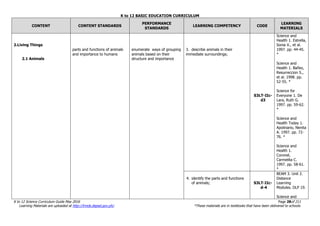
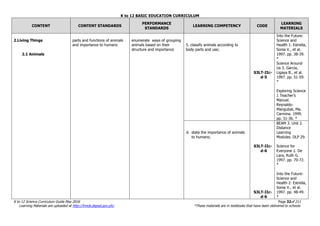
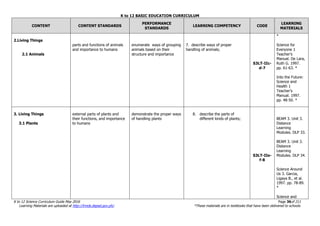
2.Living Things
2.1 Animals
The learners demonstrate
understanding of…
parts and functions of animals
and importance to humans
The learners should be able
to…
enumerate ways of grouping
animals based on their
structure and importance
3. describe animals in their
immediate surroundings;
S3LT-IIc-
d3
BEAM 3. Unit 2.
Distance
Learning
Modules. DLP 18.
Science for Daily
Use. Menguito,
Perla B., et al.
1997. pp. 52-55.
*
Into the Future:
Science and
Health 2. Estrella,
Sonia V., et al.
1997. pp. 36-37.
*
ExploringScience
2. Siringan-
Rasalan,
Elizabeth. 1999.
pp. 33-35. *
Into the Future:
K to 12 BASIC EDUCATION CURRICULUM
K to 12 Science Curriculum Guide May 2016 Page 28of 211
Learning Materials are uploaded at http://lrmds.deped.gov.ph/. *These materials are in textbooks that have been delivered to schools.
CONTENT CONTENT STANDARDS
PERFORMANCE
STANDARDS
LEARNING COMPETENCY CODE
LEARNING
MATERIALS
2.Living Things
2.1 Animals
parts and functions of animals
and importance to humans
enumerate ways of grouping
animals based on their
structure and importance
3. describe animals in their
immediate surroundings;
S3LT-IIc-
d3
Science and
Health 1. Estrella,
Sonia V., et al.
1997. pp. 44-45.
*
Science and
Health 1. Bañez,
Resurreccion S.,
et al. 1998. pp.
52-55. *
Science for
Everyone 1. De
Lara, Ruth G.
1997. pp. 59-62.
*
Science and
Health Today 1.
Apolinario, Nenita
A. 1997. pp. 72-
76. *
Science and
Health 1.
Coronel,
Carmelita C.
1997. pp. 58-61.
*
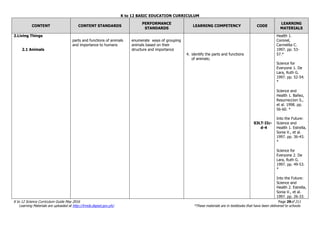
4. identify the parts and functions
of animals; S3LT-IIc-
d-4
BEAM 3. Unit 2.
Distance
Learning
Modules. DLP 19.
Science and
K to 12 BASIC EDUCATION CURRICULUM
K to 12 Science Curriculum Guide May 2016 Page 29of 211
Learning Materials are uploaded at http://lrmds.deped.gov.ph/. *These materials are in textbooks that have been delivered to schools.
CONTENT CONTENT STANDARDS
PERFORMANCE
STANDARDS
LEARNING COMPETENCY CODE
LEARNING
MATERIALS
2.Living Things
2.1 Animals
parts and functions of animals
and importance to humans
enumerate ways of grouping
animals based on their
structure and importance
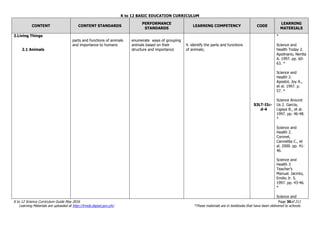
4. identify the parts and functions
of animals;
S3LT-IIc-
d-4
Health 1.
Coronel,
Carmelita C.
1997. pp. 53-
57.*
Science for
Everyone 1. De
Lara, Ruth G.
1997. pp. 52-54.
*
Science and
Health 1. Bañez,
Resurreccion S.,
et al. 1998. pp.
56-60. *
Into the Future:
Science and
Health 1. Estrella,
Sonia V., et al.
1997. pp. 36-43.
*
Science for
Everyone 2. De
Lara, Ruth G.
1997. pp. 49-53.
*
Into the Future:
Science and
Health 2. Estrella,
Sonia V., et al.
1997. pp. 26-33.
K to 12 BASIC EDUCATION CURRICULUM
K to 12 Science Curriculum Guide May 2016 Page 30of 211
Learning Materials are uploaded at http://lrmds.deped.gov.ph/. *These materials are in textbooks that have been delivered to schools.
CONTENT CONTENT STANDARDS
PERFORMANCE
STANDARDS
LEARNING COMPETENCY CODE
LEARNING
MATERIALS
2.Living Things
2.1 Animals
parts and functions of animals
and importance to humans
enumerate ways of grouping
animals based on their
structure and importance
4. identify the parts and functions
of animals;
S3LT-IIc-
d-4
*
Science and
Health Today 2.
Apolinario, Nenita
A. 1997. pp. 60-
63. *
Science and
Health 2.
Apostol, Joy A.,
et al. 1997. p.
57. *
Science Around
Us 2. Garcia,
Ligaya B., et al.
1997. pp. 46-48.
*
Science and
Health 2.
Coronel,
Carmelita C., et
al. 2000. pp. 41-
46.
Science and
Health 3
Teacher’s
Manual. Jacinto,
Emilio Jr. S.
1997. pp. 43-46.
*
Science and
K to 12 BASIC EDUCATION CURRICULUM
K to 12 Science Curriculum Guide May 2016 Page 31of 211
Learning Materials are uploaded at http://lrmds.deped.gov.ph/. *These materials are in textbooks that have been delivered to schools.
CONTENT CONTENT STANDARDS
PERFORMANCE
STANDARDS
LEARNING COMPETENCY CODE
LEARNING
MATERIALS
2.Living Things
2.1 Animals
parts and functions of animals
and importance to humans enumerate ways of grouping
animals based on their
structure and importance
4. identify the parts and functions
of animals;
S3LT-IIc-
d-4
Health 2
Teacher’s
Manual. Apostol,
Joy A., et al.
1997. pp. 23-26.
*
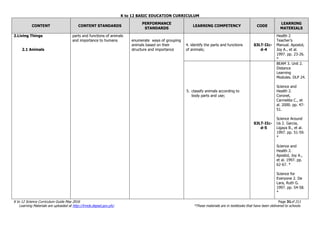
5. classify animals according to
body parts and use;
S3LT-IIc-
d-5
BEAM 3. Unit 2.
Distance
Learning
Modules. DLP 24.
Science and
Health 2.
Coronel,
Carmelita C., et
al. 2000. pp. 47-
51.
Science Around
Us 2. Garcia,
Ligaya B., et al.
1997. pp. 51-59.
*
Science and
Health 2.
Apostol, Joy A.,
et al. 1997. pp.
62-67. *
Science for
Everyone 2. De
Lara, Ruth G.
1997. pp. 54-58.
*
K to 12 BASIC EDUCATION CURRICULUM
K to 12 Science Curriculum Guide May 2016 Page 32of 211
Learning Materials are uploaded at http://lrmds.deped.gov.ph/. *These materials are in textbooks that have been delivered to schools.
CONTENT CONTENT STANDARDS
PERFORMANCE
STANDARDS
LEARNING COMPETENCY CODE
LEARNING
MATERIALS
2.Living Things
2.1 Animals
parts and functions of animals
and importance to humans
enumerate ways of grouping
animals based on their
structure and importance
5. classify animals according to
body parts and use;
S3LT-IIc-
d-5
Into the Future:
Science and
Health 1. Estrella,
Sonia V., et al.
1997. pp. 38-39.
*
Science Around
Us 3. Garcia,
Ligaya B., et al.
1997. pp. 51-59.
*
Exploring Science
1 Teacher’s
Manual.
Reynaldo-
Mangubat, Ma.
Carmina. 1999.
pp. 31-36. *
6. state the importance of animals
to humans;
S3LT-IIc-
d-6
S3LT-IIc-
d-6
BEAM 3. Unit 2.
Distance
Learning
Modules. DLP 29.
Science for
Everyone 1. De
Lara, Ruth G.
1997. pp. 70-72.
*
Into the Future:
Science and
Health 2. Estrella,
Sonia V., et al.
1997. pp. 48-49.
*
K to 12 BASIC EDUCATION CURRICULUM
K to 12 Science Curriculum Guide May 2016 Page 33of 211
Learning Materials are uploaded at http://lrmds.deped.gov.ph/. *These materials are in textbooks that have been delivered to schools.
CONTENT CONTENT STANDARDS
PERFORMANCE
STANDARDS
LEARNING COMPETENCY CODE
LEARNING
MATERIALS
2.Living Things
2.1 Animals
parts and functions of animals
and importance to humans
enumerate ways of grouping
animals based on their
structure and importance
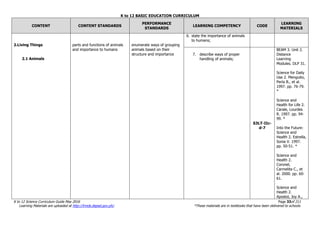
6. state the importance of animals
to humans;
7. describe ways of proper
handling of animals;
S3LT-IIc-
d-7
BEAM 3. Unit 2.
Distance
Learning
Modules. DLP 31.
Science for Daily
Use 2. Menguito,
Perla B., et al.
1997. pp. 76-79.
*
Science and
Health for Life 2.
Carale, Lourdes
R. 1997. pp. 94-
99. *
Into the Future:
Science and
Health 2. Estrella,
Sonia V. 1997.
pp. 50-51. *
Science and
Health 2.
Coronel,
Carmelita C., et
al. 2000. pp. 60-
61.
Science and
Health 2.
Apostol, Joy A.,
K to 12 BASIC EDUCATION CURRICULUM
K to 12 Science Curriculum Guide May 2016 Page 34of 211
Learning Materials are uploaded at http://lrmds.deped.gov.ph/. *These materials are in textbooks that have been delivered to schools.
CONTENT CONTENT STANDARDS
PERFORMANCE
STANDARDS
LEARNING COMPETENCY CODE
LEARNING
MATERIALS
2.Living Things
2.1 Animals
parts and functions of animals
and importance to humans
enumerate ways of grouping
animals based on their
structure and importance
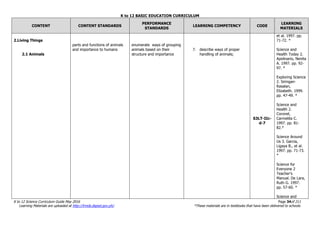
7. describe ways of proper
handling of animals;
S3LT-IIc-
d-7
et al. 1997. pp.
71-72. *
Science and
Health Today 2.
Apolinario, Nenita
A. 1997. pp. 92-
97. *
Exploring Science
2. Siringan-
Rasalan,
Elizabeth. 1999.
pp. 47-49. *
Science and
Health 2.
Coronel,
Carmelita C.
1997. pp. 81-
82.*
Science Around
Us 3. Garcia,
Ligaya B., et al.
1997. pp. 71-73.
*
Science for
Everyone 2
Teacher’s
Manual. De Lara,
Ruth G. 1997.
pp. 57-60. *
Science and
K to 12 BASIC EDUCATION CURRICULUM
K to 12 Science Curriculum Guide May 2016 Page 35of 211
Learning Materials are uploaded at http://lrmds.deped.gov.ph/. *These materials are in textbooks that have been delivered to schools.
CONTENT CONTENT STANDARDS
PERFORMANCE
STANDARDS
LEARNING COMPETENCY CODE
LEARNING
MATERIALS
2.Living Things
2.1 Animals
parts and functions of animals
and importance to humans
enumerate ways of grouping
animals based on their
structure and importance
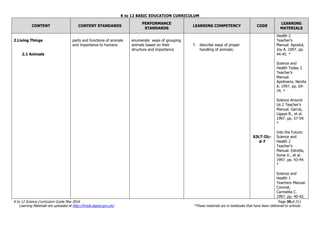
7. describe ways of proper
handling of animals;
S3LT-IIc-
d-7
Health 2
Teacher’s
Manual. Apostol,
Joy A. 1997. pp.
44-45. *
Science and
Health Today 2
Teacher’s
Manual.
Apolinario, Nenita
A. 1997. pp. 69-
74. *
Science Around
Us 2 Teacher’s
Manual. Garcia,
Ligaya B., et al.
1997. pp. 57-59.
*
Into the Future:
Science and
Health 2
Teacher’s
Manual. Estrella,
Sonia V., et al.
1997. pp. 43-44.
*
Science and
Health 1
Teachers Manual.
Coronel,
Carmelita C.
1997. pp. 40-42.
K to 12 BASIC EDUCATION CURRICULUM
K to 12 Science Curriculum Guide May 2016 Page 36of 211
Learning Materials are uploaded at http://lrmds.deped.gov.ph/. *These materials are in textbooks that have been delivered to schools.
CONTENT CONTENT STANDARDS
PERFORMANCE
STANDARDS
LEARNING COMPETENCY CODE
LEARNING
MATERIALS
2.Living Things
2.1 Animals
parts and functions of animals
and importance to humans
enumerate ways of grouping
animals based on their
structure and importance
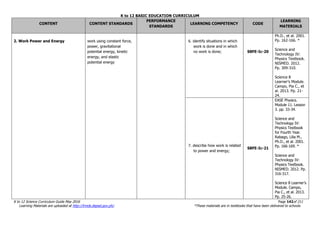
7. describe ways of proper
handling of animals;
S3LT-IIc-
d-7
*
Science for
Everyone 1
Teacher’s
Manual. De Lara,
Ruth G. 1997.
pp. 61-63. *
Into the Future:
Science and
Health 1
Teacher’s
Manual. 1997.
pp. 48-50. *
3. Living Things
3.1 Plants
external parts of plants and
their functions, and importance
to humans
demonstrate the proper ways
of handling plants
8. describe the parts of
different kinds of plants;
S3LT-IIe-
f-8
BEAM 3. Unit 3.
Distance
Learning
Modules. DLP 33.
BEAM 3. Unit 3.
Distance
Learning
Modules. DLP 34.
Science Around
Us 3. Garcia,
Ligaya B., et al.
1997. pp. 78-89.
*
Science and
K to 12 BASIC EDUCATION CURRICULUM
K to 12 Science Curriculum Guide May 2016 Page 37of 211
Learning Materials are uploaded at http://lrmds.deped.gov.ph/. *These materials are in textbooks that have been delivered to schools.
CONTENT CONTENT STANDARDS
PERFORMANCE
STANDARDS
LEARNING COMPETENCY CODE
LEARNING
MATERIALS
3. Living Things
3.1 Plants
external parts of plants and
their functions, and importance
to humans
demonstrate the proper ways
of handling plants
8. describe the parts of
different kinds of plants;
S3LT-IIe-
f-8
Heath 2. Coronel,
Carmelita C.
1997. pp. 86-97.
*
Exploring Science
2. Siringan-
Rasalan,
Elizabeth. 1999.
pp. 56-65. *
Science and
Health Today 2.
Apolinario, Nenita
A. 1997. pp. 106-
108. *
Science and
Health 2.
Coronel,
Carmelita C., et
al. 2000. pp. 65-
67.
Science Around
Us 2. Garcia,
Ligaya B., et al.
1997. pp. 77-83.
*
Exploring Science
1 Teachers
Manual.
Reynaldo-
Mangubat, ma.
Carmina. 1999.
K to 12 BASIC EDUCATION CURRICULUM
K to 12 Science Curriculum Guide May 2016 Page 38of 211
Learning Materials are uploaded at http://lrmds.deped.gov.ph/. *These materials are in textbooks that have been delivered to schools.
CONTENT CONTENT STANDARDS
PERFORMANCE
STANDARDS
LEARNING COMPETENCY CODE
LEARNING
MATERIALS
3. Living Things
3.1 Plants
external parts of plants and
their functions, and importance
to humans
demonstrate the proper ways
of handling plants
8. describe the parts of
different kinds of plants;
S3LT-IIe-
f-8
pp. 58-61. *
Our World of
Science and
Health 1
Teacher’s
Manual.
Santiago, Erlinda
M. 1997. pp. 46-
48. *
Growing with
Science and
Health 1
Teacher’s
Manual.
Domanais, Lucia
C. 1997. pp. 91-
93. *
9. state the importance of
plants to humans;
S3LT-IIe-
f-9
BEAM 3. Unit 3.
Distance
Learning
Modules. DLP 38.
Science and
Health 1.
Santiago, Ma.
Lourdes B. 1997.
pp. 100-101. *
Science and
Health 1
Teacher’s
Manual.
Santiago, Ma.
Lourdes B. 1997.
K to 12 BASIC EDUCATION CURRICULUM
K to 12 Science Curriculum Guide May 2016 Page 39of 211
Learning Materials are uploaded at http://lrmds.deped.gov.ph/. *These materials are in textbooks that have been delivered to schools.
CONTENT CONTENT STANDARDS
PERFORMANCE
STANDARDS
LEARNING COMPETENCY CODE
LEARNING
MATERIALS
3. Living Things
3.1 Plants
external parts of plants and
their functions, and importance
to humans
demonstrate the proper ways
of handling plants
p. 68. *
10. describe ways of caring
and proper handling of
plants;
S3LT-IIe-
f-10
BEAM 3. Unit 3.
Distance
Learning
Modules. DLP 40.
BEAM 3. Unit 3.
Distance
Learning
Modules. DLP 41.
Science and
Health 2.
Apostol, Joy A.
1997. pp. 104-
105. *
Science and
Health 2.
Coronel,
Carmelita C., et
al. 2000. pp. 79-
80.
Science and
Health for Life 2.
Carale, Dr.
Lourdes R., et al.
1997. pp. 136-
140. *
Science for Daily
K to 12 BASIC EDUCATION CURRICULUM
K to 12 Science Curriculum Guide May 2016 Page 40of 211
Learning Materials are uploaded at http://lrmds.deped.gov.ph/. *These materials are in textbooks that have been delivered to schools.
CONTENT CONTENT STANDARDS
PERFORMANCE
STANDARDS
LEARNING COMPETENCY CODE
LEARNING
MATERIALS
3. Living Things
3.1 Plants
external parts of plants and
their functions, and importance
to humans
demonstrate the proper ways
of handling plants
10. describe ways of caring
and proper handling of
plants;
S3LT-IIe-
f-10
Use 2. Menguito,
Perla B., et al.
1997. Pp. 105-
106. *
Science Around
Us 2. Garcia,
Ligaya B., et al.
1997. pp. 97-98.
*
Science for
Everyone 2. De
Lara, Ruth G.
1997. pp. 93-94.
*
Science and
Health 1
Teachers Manual.
Santiago, Ma.
Lourdes B. 1997.
p. 69. *
characteristics of living and
nonliving things
illustrates the difference
between living and non-living
things
11. compare living with nonliving
things;
S3LT-IIe-
f-11
Pilot School MTB-
MLE. Science TG.
Quarter 1. Day 1.
K to 12 BASIC EDUCATION CURRICULUM
K to 12 Science Curriculum Guide May 2016 Page 41of 211
Learning Materials are uploaded at http://lrmds.deped.gov.ph/. *These materials are in textbooks that have been delivered to schools.
CONTENT CONTENT STANDARDS
PERFORMANCE
STANDARDS
LEARNING COMPETENCY CODE
LEARNING
MATERIALS
4. Heredity: Inheritance
and Variation
reproduction among humans,
animals and plants and certain
observable characteristics that
are passed from parents to
offspring
given a photo of offspring
and parents, make a checklist
of possible characteristics
that the offspring inherited
from the parents
12. infer that living things
reproduce;
S3LT-
IIg-h12
13. identify observable
characteristics that are
passed on from parents to
offspring (e.g., humans,
animals, plants);
S3LT-IIg-
h13
5.Ecosystems basic needs of plants, animals
and humans
list down activities which they
can perform at home, in
school, or in their
neighborhood to keep the
environment clean
14. identify the basic needs of
humans, plants and animals
such as air, food, water, and
shelter;
S3LT-IIi-
j-14
Science and
Health 2.
Apostol, Joy A.,
et al. 1997. pp.
35-40, 70 and
103. *
Growing with
Science and
Health 1.
Domanais, Lucia
C., et al. 1997.
pp. 20-40 and
78-80. *
Science and
Health Today 2.
Apolinario, Nenita
A. 1997. pp. 36-
44, 89-91 and
114-116. *
K to 12 BASIC EDUCATION CURRICULUM
K to 12 Science Curriculum Guide May 2016 Page 42of 211
Learning Materials are uploaded at http://lrmds.deped.gov.ph/. *These materials are in textbooks that have been delivered to schools.
CONTENT CONTENT STANDARDS
PERFORMANCE
STANDARDS
LEARNING COMPETENCY CODE
LEARNING
MATERIALS
5.Ecosystems
basic needs of plants, animals
and humans
list down activities which they
can perform at home, in
school, or in their
neighborhood to keep the
environment clean
15. explain how living things
depend on the environment
to meet their basic needs;
and
S3LT-IIi-
j-15
16. recognize that there is a need
to protect and conserve the
environment.
S3LT-IIi-
j-16
Grade 3 – Force and Motion
THIRD QUARTER/THIRD GRADING PERIOD
1. Force and Motion
The learners demonstrate
understanding of…
motion of objects
The learners should be able
to…
observe, describe, and
investigate the position and
movement of things around
them
The Learners should be able to…
1. describe the position of a
person or an object in relation
to a reference point such as
chair, door, another person;
S3FE-
IIIa-b-1
Into the Future:
Science and
Health 2. Estrella,
Sonia V., et al.
1997. pp. 124-
125. *
2. identify things that can make
objects move such as people,
water, wind, magnets;
S3FE-IIIc-
d-2
Science and
Health Today 1.
Apolinario, Nenita
A. 1997. pp. 154-
157. *
Into the Future:
K to 12 BASIC EDUCATION CURRICULUM
K to 12 Science Curriculum Guide May 2016 Page 43of 211
Learning Materials are uploaded at http://lrmds.deped.gov.ph/. *These materials are in textbooks that have been delivered to schools.
CONTENT CONTENT STANDARDS
PERFORMANCE
STANDARDS
LEARNING COMPETENCY CODE
LEARNING
MATERIALS
1. Force and Motion
The learners demonstrate
understanding of…
motion of objects
The learners should be able
to…
observe, describe, and
investigate the position and
movement of things around
them
2. identify things that can
make objects move such as
people, water, wind,
magnets;
Science and
Health 2. Estrella,
Sonia V., et al.
1997. pp. 126-
131. *
Science and
Health for Life 2.
Carale, Dr.
Lourdes R., et al.
1997. pp. 171-
180. *
Science for Daily
Use 2. Menguito,
Perla B., et al.
1997. pp. 144-
150. *
Science and
Health 2.
Apostol, Joy A.,
et al. 1997. pp.
147-153. *
Growing with
Science and
Health 1
Teacher’s
Manual.
Domanais, Lucia
C., et al. 1997.
pp. 157-159. *
Science and
Health 1
K to 12 BASIC EDUCATION CURRICULUM
K to 12 Science Curriculum Guide May 2016 Page 44of 211
Learning Materials are uploaded at http://lrmds.deped.gov.ph/. *These materials are in textbooks that have been delivered to schools.
CONTENT CONTENT STANDARDS
PERFORMANCE
STANDARDS
LEARNING COMPETENCY CODE
LEARNING
MATERIALS
1. Force and Motion
The learners demonstrate
understanding of…
motion of objects
The learners should be able
to…
observe, describe, and
investigate the position and
movement of things around
them
2. identify things that
can make objects
move such as
people, water, wind,
magnets;
Teacher’s
Manual. Bañez,
Resurreccion S.
1998. pp. 100-
102. *
3. describe the movements of
objects such as fast/slow,
forward/backward,
stretching/compressing;
S3FE-
IIIe-f-3
Growing with
Science and
Health 1.
Domanais, Lucia
C., et al. 1997.
pp. 166-168. *
Exploring Science
3 Teacher’s
Manual. Alsim-
Madriaga, Lucita.
2000. pp. 108-
111. *
Exploring Science
1 Teacher’s
Manual.
Reynaldo-
Mangubat, Ma.
Carmina. 1999.
pp. 100-102. *
K to 12 BASIC EDUCATION CURRICULUM
K to 12 Science Curriculum Guide May 2016 Page 45of 211
Learning Materials are uploaded at http://lrmds.deped.gov.ph/. *These materials are in textbooks that have been delivered to schools.
CONTENT CONTENT STANDARDS
PERFORMANCE
STANDARDS
LEARNING COMPETENCY CODE
LEARNING
MATERIALS
2. Energy: Light, sound.
2.1 Heat and Electricity
sources and uses of light,
sound, heat and electricity
apply the knowledge of the
sources and uses of light,
sound, heat, and electricity
4. describe sources of light and
sound, heat and electricity;
and
S3FE-
IIIg-h-4
BEAM 3. Unit 5.
Distance
Learning
Modules. DLP 50.
BEAM 3. Unit 5.
Distance
Learning
Modules. DLP 51.
Science Around
Us 2. Garcia,
Ligaya B., et al.
1997. pp. 123-
124 and 133-134.
*
Science and
Health 2.
Coronel,
Carmelita C., et
al. 2000. pp.
105-106 and
114-115.
Science for
Everyone 2. De
Lara, Ruth G.
1997. pp. 116-
119 and 126-127.
*
Into the Future:
Science and
Health 2. Estrella,
Sonia V., et al.
K to 12 BASIC EDUCATION CURRICULUM
K to 12 Science Curriculum Guide May 2016 Page 46of 211
Learning Materials are uploaded at http://lrmds.deped.gov.ph/. *These materials are in textbooks that have been delivered to schools.
CONTENT CONTENT STANDARDS
PERFORMANCE
STANDARDS
LEARNING COMPETENCY CODE
LEARNING
MATERIALS
2. Energy: Light, sound.
2.1 Heat and Electricity
sources and uses of light,
sound, heat and electricity
apply the knowledge of the
sources and uses of light,
sound, heat, and electricity
4. describe sources of light and
sound, heat and electricity;
and
S3FE-
IIIg-h-4
pp. 105-109 and
114-115. *
Science for Daily
Use 2. Menguito,
Perla B., et al.
1997. pp. 127-
129 and 138-140.
*
Exploring Science
2. Siringan-
Rasalan,
Elizabeth. 1999.
pp. 101-105. *
Science and
Health for Life 2.
Carale, Dr.
Lourdes R., et al.
pp. 156-163. *
5. enumerate uses of light,
sound, heat and electricity.
S3FE-IIIi-
j-3
MISOSA 6.
Module 21.
MISOSA 6.
Module 22.
MISOSA 6.
Module 23.
Science for Daily
Use 4. Lozada,
Buena A., et al.
2002. p. 162. *
K to 12 BASIC EDUCATION CURRICULUM
K to 12 Science Curriculum Guide May 2016 Page 47of 211
Learning Materials are uploaded at http://lrmds.deped.gov.ph/. *These materials are in textbooks that have been delivered to schools.
CONTENT CONTENT STANDARDS
PERFORMANCE
STANDARDS
LEARNING COMPETENCY CODE
LEARNING
MATERIALS
Grade 3 – Earth and Space
FOURTH QUARTER/FOURTH GRADING PERIOD
1. Earth and Space
1.1The Surroundings
The learners demonstrate
understanding of…
people, animals, plants, lakes,
rivers, streams, hills,
mountains, and other landforms,
and their importance
The learners should be able
to…
express their concerns about
their surroundings through
teacher-guided and self –
directed activities
The learners should be able to…
1.describe the things found in the
surroundings;
S3ES-IVa-
b-1
BEAM 3. Unit 6.
Learning Guides.
Me and my
Environment.
January 2007.
Science and
Health 1.
Coronel,
Carmelita C.
1997. pp. 176-
186. *
Moving Onward
with Science and
Health 1.
Dungan-Ramirez,
Cristeta. 1997.
pp. 175-187. *
Science and
Health Today 1.
Apolinario, Nenita
A. 1997. pp. 164-
170. *
Moving Onward
with Science and
Health 1
Teacher’s
Manual. Dungan-
Ramirez, Cristeta.
K to 12 BASIC EDUCATION CURRICULUM
K to 12 Science Curriculum Guide May 2016 Page 48of 211
Learning Materials are uploaded at http://lrmds.deped.gov.ph/. *These materials are in textbooks that have been delivered to schools.
CONTENT CONTENT STANDARDS
PERFORMANCE
STANDARDS
LEARNING COMPETENCY CODE
LEARNING
MATERIALS
1. Earth and Space
1.1The Surroundings
The learners demonstrate
understanding of…
people, animals, plants, lakes,
rivers, streams, hills,
mountains, and other landforms,
and their importance
The learners should be able
to…
express their concerns about
their surroundings through
teacher-guided and self –
directed activities
The learners should be able to…
1. describe the things found in the
surroundings;
S3ES-IVa-
b-1
1997. pp. 83-87.
*
Growing with
Science and
Health 1
Teacher’s
Manual.
Domanais, Lucia
C. 1997. pp. 169-
171. *
2. relate the importance of
surroundings to people and
other living things;
S3ES-IVc-
d-2
BEAM 3. Unit 6.
Learning Guides.
Me and my
Environment.
January 2007.
Science and
Health Today 1.
Apolinario, Nenita
A. 1997. pp. 174-
176.
Growing with
Science and
Health 1.
Domanais, Lucia
C., et al. 1997.
pp. 193-197.
K to 12 BASIC EDUCATION CURRICULUM
K to 12 Science Curriculum Guide May 2016 Page 49of 211
Learning Materials are uploaded at http://lrmds.deped.gov.ph/. *These materials are in textbooks that have been delivered to schools.
CONTENT CONTENT STANDARDS
PERFORMANCE
STANDARDS
LEARNING COMPETENCY CODE
LEARNING
MATERIALS
2. Earth and Space
2.1Weather
types and effects of weather as
they relate to daily activities,
health and safety
express ideas about safety
measures during different
weather conditions creatively
(through artwork, poem,
song)
3. describe the changes in the
weather over a period of time;
S3ES-IVe-
f-3
BEAM 4. Unit 8.
Distance
Learning
Modules. DLP 57.
Science and
Health Today 1.
Apolinario, Nenita
A. 1997. pp. 183-
186. *
Growing with
Science and
Health 1.
Domanais, Lucia
C., et al. 1997.
pp. 202-205. *
Our World of
Science and
Health 1.
Santiago, Erlinda
M. 1997. pp.
166-169. *
4. communicate how different
types of weather affect
activities in the community;
and
S3ES-IVg-
h-4
BEAM 4. Unit 8.
Distance
Learning
Modules. DLP 57.
Our World of
Science and
Health 1.
Santiago, Erlinda
M. 1997. pp.
176-180. *
K to 12 BASIC EDUCATION CURRICULUM
K to 12 Science Curriculum Guide May 2016 Page 50of 211
Learning Materials are uploaded at http://lrmds.deped.gov.ph/. *These materials are in textbooks that have been delivered to schools.
CONTENT CONTENT STANDARDS
PERFORMANCE
STANDARDS
LEARNING COMPETENCY CODE
LEARNING
MATERIALS
2. Earth and Space
2.1Weather
types and effects of weather as
they relate to daily activities,
health and safety
express ideas about safety
measures during different
weather conditions creatively
(through artwork, poem,
song)
4. communicate how different
types of weather affect
activities in the community;
and
S3ES-IVg-
h-4
Science and
Health Today 1.
Apolinario, nenita
A. 1997. pp. 187-
188. *
Growing with
Science and
Health 1.
Domanais, Lucia
C., et al. 1997.
pp. 187-188. *
Science for
Everyone 2. De
Lara, Ruth G.
1997. pp. 177-
178. *
Into the Future:
Science and
Health 2. Estrella,
Sonia V., et al.
1997. pp. 166-
167. *
Growing with
Science and
Health 2
Teacher’s
Manual.
Domanais, Lucia
C., et al. 1997.
pp. 168-170. *
Growing with
K to 12 BASIC EDUCATION CURRICULUM
K to 12 Science Curriculum Guide May 2016 Page 51of 211
Learning Materials are uploaded at http://lrmds.deped.gov.ph/. *These materials are in textbooks that have been delivered to schools.
CONTENT CONTENT STANDARDS
PERFORMANCE
STANDARDS
LEARNING COMPETENCY CODE
LEARNING
MATERIALS
2. Earth and Space
2.1Weather
types and effects of weather as
they relate to daily activities,
health and safety
express ideas about safety
measures during different
weather conditions creatively
(through artwork, poem,
song)
4. communicate how different
types of weather affect
activities in the community;
and
S3ES-IVg-
h-4
Science and
Health 1
Teacher’s
Manual.
Domanais, Lucia
C., et al. 1997.
pp. 186-188. *
Science for
Everyone 1
Teacher’s
Manual. De Lara,
Ruth G. 1997.
pp. 139-140. *
Science and
Health Today 1
Teacher’s
Manual.
Apolinario, Nenita
A. 1997. pp. 132-
138. *
5. enumerate and practice safety
and precautionary measures in
dealing with different types of
weather.
S3ES-IVg-
h-5
BEAM 4. Unit 8.
Distance
Learning
Modules. DLP 58.
Into the Future:
Science and
Health 2. Estrella,
Sonia V., et al.
1997. pp. 168-
169. *
Growing with
Science and
K to 12 BASIC EDUCATION CURRICULUM
K to 12 Science Curriculum Guide May 2016 Page 52of 211
Learning Materials are uploaded at http://lrmds.deped.gov.ph/. *These materials are in textbooks that have been delivered to schools.
CONTENT CONTENT STANDARDS
PERFORMANCE
STANDARDS
LEARNING COMPETENCY CODE
LEARNING
MATERIALS
2. Earth and Space
2.1Weather
types and effects of weather as
they relate to daily activities,
health and safety
express ideas about safety
measures during different
weather conditions creatively
(through artwork, poem,
song)
5. enumerate and practice safety
and precautionary measures in
dealing with different types of
weather.
S3ES-IVg-
h-5
Health 1.
Domanais, Lucia
C., et al. 1997.
pp. 213-216. *
Science and
Health 2.
Apostol, Joy A.,
et al. 1997. pp.
211-212. *
Science for
Everyone 2
Teacher’s
Manual. De Lara,
Ruth G. 1997.
pp. 142-144. *
Growing with
Science and
Health 2
Teacher’s
Manual.
Domanais, Lucia
C. 1997. pp. 171-
173. *
3. Earth and Space
3.1Natural Objects in
the Sky
natural objects in the sky affect
one’s daily activities
list down activities which
affect their daily activities
6. describe the natural objects
that are found in the sky
during daytime and nighttime
S3ES-IVg-
h-6
Pilot School MTB-
MLE. Science TG.
Quarter 4. Week
7.
Science and
Health for Life 2.
Carale, Dr.
Lourdes R., et al.
K to 12 BASIC EDUCATION CURRICULUM
K to 12 Science Curriculum Guide May 2016 Page 53of 211
Learning Materials are uploaded at http://lrmds.deped.gov.ph/. *These materials are in textbooks that have been delivered to schools.
CONTENT CONTENT STANDARDS
PERFORMANCE
STANDARDS
LEARNING COMPETENCY CODE
LEARNING
MATERIALS
3. Earth and Space
3.1Natural Objects in
the Sky
natural objects in the sky affect
one’s daily activities
list down activities which
affect their daily activities
6. describe the natural objects
that are found in the sky
during daytime and nighttime
S3ES-IVg-
h-6
1997., pp. 213-
217. *
Science and
Health 1. Bañez,
Resurreccion S.,
et al. 1998. pp.
198-207. *
Science and
Health 1.
Santiago, Ma.
Lourdes B. 1997.
pp. 189-192. *
Science and
Health Today 1.
Apolinario, Nenita
A. 1997. pp. 196-
198. *
Our World of
Science and
Health 1.
Santiago, Erlinda
M. 1997. pp.
182-186. *
Science and
Health 1
Teacher’s
Manual. Bañez,
Resurreccion S.
1998. pp. 131-
134. *
K to 12 BASIC EDUCATION CURRICULUM
K to 12 Science Curriculum Guide May 2016 Page 54of 211
Learning Materials are uploaded at http://lrmds.deped.gov.ph/. *These materials are in textbooks that have been delivered to schools.
CONTENT CONTENT STANDARDS
PERFORMANCE
STANDARDS
LEARNING COMPETENCY CODE
LEARNING
MATERIALS
3. Earth and Space
3.1Natural Objects in
the Sky
natural objects in the sky affect
one’s daily activities
list down activities which
affect their daily activities
6. describe the natural objects
that are found in the sky
during daytime and nighttime S3ES-IVg-
h-6
Moving Onward
with Science and
Health 1
Teacher’s
Manual. Dungan-
Ramirez, Cristeta,
et al. 1997. pp.
94-96. *
Our World of
Science and
Health 1
Teacher’s
Manual.
Santiago, Erlinda
M. 1997. pp. 96-
98. *
Exploring Science
1 Teacher’s
Manual.
Reynaldo-
Mangubat, ma.
Carmina. 1999.
pp. 133-135. *
7. communicate how the natural
objects in the sky affect daily
activities
S3ES-IVg-
h-7
Pilot School MTB-
MLE. Sciene TG.
Quarter 4. Week
7.
Growing with
Science and
Health 2.
Domanais, Lucia
C., et al. 1997.
pp. 198-200. *
K to 12 BASIC EDUCATION CURRICULUM
K to 12 Science Curriculum Guide May 2016 Page 55of 211
Learning Materials are uploaded at http://lrmds.deped.gov.ph/. *These materials are in textbooks that have been delivered to schools.
CONTENT CONTENT STANDARDS
PERFORMANCE
STANDARDS
LEARNING COMPETENCY CODE
LEARNING
MATERIALS
3. Earth and Space
3.1Natural Objects in
the Sky
natural objects in the sky affect
one’s daily activities
list down activities which
affect their daily activities
7. communicate how the natural
objects in the sky affect daily
activities S3ES-IVg-
h-7
Science Around
Us 3. Garcia,
Ligaya B., et al.
1997. pp. 203-
204. *
Science for Daily
Use 2. Menguito,
Perla B., et al.
1997. pp. 199-
200. *
8. enumerate safety measures to
avoid the harmful effects of the
Sun’s heat and light
S3ES-IVg-
h-8
Pilot School MTB-
MLE. Science TG.
Quarter 4. Week
8.
Science Around
Us 3. Garcia,
Ligaya B., et al.
1997. pp. 205-
206. *
Science and
Health 2.
Coronel,
Carmelita C.
2000. p. 170.
Science and
Health 3
Teacher’s
Manual. Emilio,
Jacinto Jr. S.
1997. pp. 198-
200. *
K to 12 BASIC EDUCATION CURRICULUM
K to 12 Science Curriculum Guide May 2016 Page 56of 211
Learning Materials are uploaded at http://lrmds.deped.gov.ph/. *These materials are in textbooks that have been delivered to schools.
CONTENT CONTENT STANDARDS
PERFORMANCE
STANDARDS
LEARNING COMPETENCY CODE
LEARNING
MATERIALS
3. Earth and Space
3.1Natural Objects in
the Sky
natural objects in the sky affect
one’s daily activities
list down activities which
affect their daily activities
8. enumerate safety measures to
avoid the harmful effects of the
Sun’s heat and light
S3ES-IVg-
h-8
Exploring Science
3 Teacher’s
Manual. Alsim-
Madriaga, Lucita.
2000. pp. 167-
170. *
Science Around
US 3 Teacher’s
Manual. Garcia,
Ligaya B., et al.
1997. 165-167. *
GRADE 4
CONTENT CONTENT STANDARDS
PERFORMANCE
STANDARDS
LEARNING COMPETENCY CODE
LEARNING
MATERIALS
Grade 4 – Matter
FIRST QUARTER/FIRST GRADING PERIOD
1. Properties
1.1. Properties used to
group and store
materials
1.2. Importance of
interpreting product
labels
1.3. Proper disposal of
The learners demonstrate
understanding of…
grouping different materials
based on their properties
The learners should be able
to…
Recognize and practice
proper handling of products
The learners should be able to…
1. classify materials based on
the ability to absorb water,
float, sink, undergo decay;
S4MT-Ia-
1
2. identify the effects of
decaying materials on one’s
health and safety;
S4MT-Ib-
2
Exploring Science
3 Teacher’s
Manual. Alsim-
Madriaga, Lucita.
K to 12 BASIC EDUCATION CURRICULUM
K to 12 Science Curriculum Guide May 2016 Page 57of 211
Learning Materials are uploaded at http://lrmds.deped.gov.ph/. *These materials are in textbooks that have been delivered to schools.
CONTENT CONTENT STANDARDS
PERFORMANCE
STANDARDS
LEARNING COMPETENCY CODE
LEARNING
MATERIALS
waste
1. Properties
1.1. Properties used to
group and store
materials
1.2. Importance of
interpreting product
labels
Proper disposal of
waste
The learners demonstrate
understanding of…
grouping different materials
based on their properties
The learners should be able
to…
Recognize and practice
proper handling of products
2000. pp. 84-89.
*
Science Around
Us 3. Garcia,
Ligaya B., et al.
1997. pp. 110-
115. *
Science Around
Us 3 Techer’s
Manual. Garcia,
Ligaya B., et al.
1997. pp. 87-91.
*
3. demonstrate proper
disposal of waste according
to the properties of its
materials;
S4MT-Ic-
d-3
2. Changes that Materials
Undergo
2.1. Changes that are
useful
2.2. Changes that are
harmful
changes that materials undergo
when exposed to certain
conditions.
evaluate whether changes in
materials are useful or
harmful to one’s environment
4. describe changes in solid
materials when they are
bent, pressed, hammered,
or cut;
S4MT-Ie-
f-5
MISOSA 6.
Module 15.
EASE Science I.
Module 5.
BEAM 5. Unit 4.
8 Physical and
K to 12 BASIC EDUCATION CURRICULUM
K to 12 Science Curriculum Guide May 2016 Page 58of 211
Learning Materials are uploaded at http://lrmds.deped.gov.ph/. *These materials are in textbooks that have been delivered to schools.
CONTENT CONTENT STANDARDS
PERFORMANCE
STANDARDS
LEARNING COMPETENCY CODE
LEARNING
MATERIALS
2. Changes that Materials
Undergo
2.1. Changes that are
useful
Changes that are
harmful
changes that materials undergo
when exposed to certain
conditions.
evaluate whether changes in
materials are useful or
harmful to one’s environment
Chemical
Changes.
Distance
Learning
Modules. DLP 26.
5. describe changes in
properties of materials
when exposed to certain
conditions such as
temperature or when mixed
with other materials; and
5. describe changes in
properties of materials
when exposed to certain
conditions such as
temperature or when
mixed with other materials;
and
S4MT-Ig-
h-6
S4MT-Ig-
h-6
OHSP Chemistry.
Module 15.
MISOSA 4.
Module 21.
Science and
Technology I:
Integrated
Science Textbook
for First Year.
Villamil, Aurora
M., Ed.D. 1998.
pp. 48-50. *
6. identify changes in
materials whether useful
or harmful to one’s
environment.
S4MT-Ii-j-
7
MISOSA 6.
Module 17.
Exploring Science
3 Teacher’s
Manual. Alsim-
Madriaga, Lucita.
2000. pp. 84-89.
*
K to 12 BASIC EDUCATION CURRICULUM
K to 12 Science Curriculum Guide May 2016 Page 59of 211
Learning Materials are uploaded at http://lrmds.deped.gov.ph/. *These materials are in textbooks that have been delivered to schools.
CONTENT CONTENT STANDARDS
PERFORMANCE
STANDARDS
LEARNING COMPETENCY CODE
LEARNING
MATERIALS
Grade 4 – Living Things and Their Environment
SECOND QUARTER/SECOND GRADING PERIOD
Parts and Functions
1. Humans
1.1 Major organs of the
body
1.2 Caring for the major
organs
1.3 Diseases that affect
the major organs of
the human body
Parts and Functions
1. Humans
1.1 Major organs of the
body
1.2 Caring for the major
organs
1.3 Diseases that affect
the major organs of
the human body
The Learners demonstrate
understanding of…
how the major internal organs
such as the brain, heart, lungs,
liver, stomach, intestines,
kidneys, bones, and muscles
keep the body healthy
The learners demonstrate
understanding of…
how the major internal organs
such as the brain, heart, lungs,
liver, stomach, intestines,
kidneys, bones, and muscles
keep the body healthy
The Learners should be able
to…
The learners should be able
to…
The Learners should be able to…
1. describe the main function
of the major organs;
The learners should be able to…
1. describe the main function
of the major organs;
S4LT-IIa-
b-1
S4LT-IIa-
b-1
MISOSA 6.
Module 4.
BEAM 3. Unit 1.
Distance
Learning
Modules. DLP 1.
BEAM 3. Unit 1.
Distance
Learning
Modules. DLP 2.
Science for Daily
Use 4. pp. 13-15
and 30-31. *
Science for Daily
Use 5. pp. 24-26
and 43-44. *
2. communicate that the
major organs work together
to make the body function
properly;
S4LT-IIa-
b-2
MISOSA 5.
Module 1.
MISOSA 5.
Module 2.
MISOSA 5.
Module 4.
MISOSA 5.
K to 12 BASIC EDUCATION CURRICULUM
K to 12 Science Curriculum Guide May 2016 Page 60of 211
Learning Materials are uploaded at http://lrmds.deped.gov.ph/. *These materials are in textbooks that have been delivered to schools.
CONTENT CONTENT STANDARDS
PERFORMANCE
STANDARDS
LEARNING COMPETENCY CODE
LEARNING
MATERIALS
Parts and Functions
1. Humans
1.1 Major organs of the
body
1.2 Caring for the major
organs
1.3 Diseases that affect
the major organs of
the human body
The learners demonstrate
understanding of…
how the major internal organs
such as the brain, heart, lungs,
liver, stomach, intestines,
kidneys, bones, and muscles
keep the body healthy
The learners should be able
to…
Module 6.
MISOSA 4.
Module 5.
Science for Daily
Use 5. Tan,
Conchita T.
2012. pp. 24-26
and 43-44. *
Science for Daily
Use 4. Lozada,
Buena A., et al.
2011. pp. 13-15
and 30-31. *
3. identify the causes and
treatment of diseases of
the major organs;
S4LT-IIa-
b-3
4. practice habits to maintain
a healthy body;
S4LT-IIa-
b-4
Science for Daily
Use 4. Lozada,
Buena A., et al.
2011. p. 34. *
2. Animals
2.1 Live on land or
animals have body parts that
make them adapt to land or
construct a prototype model
of organism that has body
5. infer that body structures
help animals adapt and
survive in their particular
habitat;
S4LT-IIc-
d-5
BEAM 3. Unit 2.
Distance
Learning
Modules. DLP 27.
K to 12 BASIC EDUCATION CURRICULUM
K to 12 Science Curriculum Guide May 2016 Page 61of 211
Learning Materials are uploaded at http://lrmds.deped.gov.ph/. *These materials are in textbooks that have been delivered to schools.
CONTENT CONTENT STANDARDS
PERFORMANCE
STANDARDS
LEARNING COMPETENCY CODE
LEARNING
MATERIALS
in water
2. Animals
2.1 Live on land or in
water
water
animals have body parts that
make them adapt to land or
water
parts which can survive in a
given environment
construct a prototype model
of organism that has body
parts which can survive in a
given environment
Science for Daily
Use 5. Tan,
Conchita T.
2012. pp. 68-69.
*
6. compare body movements
of animals in their habitat;
S4LT-IIc-
d-6
MISOSA 5.
Module 7.
7. make a survey of animals
found in the community
and their specific habitats;
7. make a survey of animals
found in the community
and their specific habitats;
S4LT-IIc-
d-7
S4LT-IIc-
d-7
BEAM 3. Unit 2.
Distance
Learning
Modules. DLP 28.
BEAM 5. Unit 2.
4 Animals and
their Food.
Distance
Learning
Modules. DL 13.
8. choose which animals to
raise in a particular habitat;
S4LT-IIc-
d-8
BEAM 3. Unit 2.
Distance
Learning
Modules. DLP 28.
BEAM 5. Unit 2.
4 Animals and
their Food.
Distance
Learning
Modules. DL 13.
3. Plants
3.1 Live on land or in
plants have body parts that
make them adapt to land or
9. identify the specialized
structures of terrestrial and
S4LT-IIe-
f-9
Learning Guide:
How do plants
Protect
themselves
K to 12 BASIC EDUCATION CURRICULUM
K to 12 Science Curriculum Guide May 2016 Page 62of 211
Learning Materials are uploaded at http://lrmds.deped.gov.ph/. *These materials are in textbooks that have been delivered to schools.
CONTENT CONTENT STANDARDS
PERFORMANCE
STANDARDS
LEARNING COMPETENCY CODE
LEARNING
MATERIALS
water water aquatic plants;
Learning Guide in
Science and
Health: Plants,
Here. There and
Everywhere
10. conduct investigation on the
specialized structures of
plants given varying
environmental conditions:
light, water, temperature,
and soil type;
S4LT-IIe-
f-10
11. make a survey of plants
found in the community and
their specific habitats;
S4LT-IIe-
f-11
12. choose which plants to grow
in a particular habitat;
S4LT-IIe-
f-12
4. Heredity: Inheritance and
Variation
4.1 Life Cycles
4.2Humans, Animals,
and Plants
different organisms go through
life cycle which can be affected
by their environment
13. compare the stages in the
life cycle of organisms;
S4LT-IIg-
h-13
MISOSA 4.
Module 7.
BEAM 4. Unit 3.
Life Cycle of
Animals.
14. describe the effect of the
environment on the life
cycle of organisms;
S4LT-IIg-
h-14
BEAM 4. Unit 3.
Life Cycle of
Animals.
5. Ecosystems
5.1 Beneficial and
Harmful interactions
beneficial and harmful
interactions occur among living
things and their environment as
15. describe some types of
beneficial interactions
among living things;
S4LT-IIi-
j-15
EASE Science I.
Module 10.
Lesson 1.
MISOSA 6.
Interrelationship
among living
organisms.
K to 12 BASIC EDUCATION CURRICULUM
K to 12 Science Curriculum Guide May 2016 Page 63of 211
Learning Materials are uploaded at http://lrmds.deped.gov.ph/. *These materials are in textbooks that have been delivered to schools.
CONTENT CONTENT STANDARDS
PERFORMANCE
STANDARDS
LEARNING COMPETENCY CODE
LEARNING
MATERIALS
5. Ecosystems
5.1 Beneficial and
Harmful interactions
they obtain basic needs
beneficial and harmful
interactions occur among living
things and their environment as
they obtain basic needs
16. describe certain types of
harmful interactions among
living things; and
S4LT-IIi-
j-16
EASE Science I.
Module 10.
Lesson 1.
MISOSA 6.
Interrelationship
among living
organisms.
17. conduct investigations to
determine environmental
conditions needed by living
things to survive.
S4LT-IIi-
j-17
EASE Science I.
Module 10.
Lesson 1.
MISOSA 6.
Interrelationship
among living
organisms.
18. describe the effects of
interactions among
organism in their
environment
S4LT-IIi-
j-18
Grade 4 – Force and Motion
THIRD QUARTER/THIRD GRADING PERIOD
1. Effects of Force on
Objects
1.1 Shape, size and
movement
The learners demonstrate
understanding of…
force that can change the
shape, size or movement of
objects.
The learners should be able
to…
The Learners should be able to…
1. explain the effects of force
applied to an object;
S4FE-
IIIa-1
EASE Science I.
Module 7. Lesson
1.
Science Around
Us 3. Garicia,
Ligaya B., et al.
1997. p. 142. *
K to 12 BASIC EDUCATION CURRICULUM
K to 12 Science Curriculum Guide May 2016 Page 64of 211
Learning Materials are uploaded at http://lrmds.deped.gov.ph/. *These materials are in textbooks that have been delivered to schools.
CONTENT CONTENT STANDARDS
PERFORMANCE
STANDARDS
LEARNING COMPETENCY CODE
LEARNING
MATERIALS
1. Effects of Force on
Objects
1.1 Shape, size and
movement
The learners demonstrate
understanding of…
force that can change the
shape, size or movement of
objects.
The learners should be able
to…
2. practice safety measures in
physical activities and
proper handling of
materials;
S4FE-
IIIb-c-2
MISOSA 4.
Module 19.
3. describe the force exerted
by magnets;
3. describe the force exerted
by magnets;
S4FE-
IIId-e-3
S4FE-
IIId-e-3
EASE Physics.
Module 8.
Into the
Future:Science
and Health 2.
Estrella, Sonia V.,
et al. 1997. pp.
128-131. *
Science and
Health Today 2.
Apolinario,
Nenita A. 1997.
pp. 161-163. *
Science and
Health 2.
Coronel,
Carmelita C.
1997. pp. 160-
162. *
2. Light, Heat and Sound how light, heat and sound travel
using various objects
demonstrate conceptual
understanding of
properties/characteristics of
light, heat and sound
4. describe how light, sound
and heat travel;
BEAM 4. Unit 6.
Distane Learning
Modules. DLP 45.
Science Around
Us 2. Garcia,
Ligaya B., et al.
1997. pp. 125-
K to 12 BASIC EDUCATION CURRICULUM
K to 12 Science Curriculum Guide May 2016 Page 65of 211
Learning Materials are uploaded at http://lrmds.deped.gov.ph/. *These materials are in textbooks that have been delivered to schools.
CONTENT CONTENT STANDARDS
PERFORMANCE
STANDARDS
LEARNING COMPETENCY CODE
LEARNING
MATERIALS
2. Light, Heat and Sound
how light, heat and sound travel
using various objects
demonstrate conceptual
understanding of
properties/characteristics of
light, heat and sound
4. describe how light, sound
and heat travel;
S4FE-IIIf-
g-4
S4FE-IIIf-
g-4
126. *
Science for
Everyone 2. De
Lara. Ruth G.
1997. pp. 120-
121. *
Into the Future:
Science and
Health 2.
Estrella, Sonia V.,
et al. 1997. pp.
110-111. *
Science for Daily
Use 2. Menguito,
Perla B., et al.
1997. pp. 130-
131. *
Exploring Science
2. Siringan-
Rasalan,
Elizabeth. 1999.
pp. 106-107. *
5. investigate properties and
characteristics of light and
sound; and
S4FE-
IIIh-5
EASE Physics.
Module 3.
EASE Physics.
Module 16.
K to 12 BASIC EDUCATION CURRICULUM
K to 12 Science Curriculum Guide May 2016 Page 66of 211
Learning Materials are uploaded at http://lrmds.deped.gov.ph/. *These materials are in textbooks that have been delivered to schools.
CONTENT CONTENT STANDARDS
PERFORMANCE
STANDARDS
LEARNING COMPETENCY CODE
LEARNING
MATERIALS
6. describe ways to protect
oneself from exposure to
excessive light, heat and
sound.
S4FE-IIIi-
j-6
Grade 4 – Earth and Space
FOURTH QUARTER/FOURTH GRADING PERIOD
4. Soil
1.1 Types of soil
The learners demonstrate
understanding of…
the different types of soil
The learners should be able
to…
The Learners should be able to…
1. compare and contrast the
characteristics of different types
of soil;
S4ES-IVa-
1
Science Around
Us 3. Garcia,
Ligaya B., et al.
1997. pp. 151-
153. *
2. Water in the
Environment
2.1 Sources and
importance of
water
the different sources of water
suitable for human consumption
2. explain the use of water from
different sources in the context
of daily activities;
S4ES-IVb-
2
BEAM I. Unit 7.
Powers of Water.
Module 2. August
2009.
EASE Science I.
Module 13.
Science Around
Us 3. Garcia,
Ligaya B., et al.
1997. pp. 163-
165. *
K to 12 BASIC EDUCATION CURRICULUM
K to 12 Science Curriculum Guide May 2016 Page 67of 211
Learning Materials are uploaded at http://lrmds.deped.gov.ph/. *These materials are in textbooks that have been delivered to schools.
CONTENT CONTENT STANDARDS
PERFORMANCE
STANDARDS
LEARNING COMPETENCY CODE
LEARNING
MATERIALS
3. infer the importance of water in
daily activities;
S4ES-IVc-
3
BEAM I. Unit 7.
Powers of Water.
Module 2. August
2009.
Science Around
Us 3. Garcia,
Ligaya B., et al.
1997. pp. 166-
168. *
4. describe the importance of the
water cycle.
S4ES-IVd-
4
BEAM 5. Unit 6.
16 Blowing in the
Wind. Distance
Learning
Modules. DLP 45.
3. Weather
3.1 Components of
weather
3.2 Weather
instruments
3.3 Weather chart
components of weather using
simple instruments
practice precautionary
measures in planning
activities
5. use weather instruments to
measure the different weather
components
S4ES-IVe-
5
Science and
Technology I:
Integrated
Science Textbook
for First Year.
Villamil, Aurora
M., Ed.D. 1998.
pp. 203-204. *
6. record in a chart the weather
conditions;
S4ES-IVf-
6
Into the Future:
Science and
Health 2.
Estrella, Sonia V.,
et al. 1997.p.
163. *
Science and
K to 12 BASIC EDUCATION CURRICULUM
K to 12 Science Curriculum Guide May 2016 Page 68of 211
Learning Materials are uploaded at http://lrmds.deped.gov.ph/. *These materials are in textbooks that have been delivered to schools.
CONTENT CONTENT STANDARDS
PERFORMANCE
STANDARDS
LEARNING COMPETENCY CODE
LEARNING
MATERIALS
3. Weather
3.1 Components of
weather
3.2 Weather
instruments
3.3 Weather chart
components of weather using
simple instruments
practice precautionary
measures in planning
activities
Health for Life 2.
Carale, Dr.
Lourdes R. 1997.
p. 208. *
7. make simple interpretations
about the weather as recorded
in the weather chart;
7. make simple interpretations
about the weather as
recorded in the weather
chart;
S4ES-IVf-
7
S4ES-IVf-
7
BEAM 4. Unit 8.
Distance
Learning
Modules. DLP 54.
BEAM 4. Unit 8.
Distance
Learning
Modules. DLP 55.
Science and
Health 2.
Coronel,
Carmelita C.,
1997. p. 206. *
Into the Future:
Science and
Health 2.
Estrella, Sonia V.,
et al. 1997. pp.
164-165. *
8. identify safety precautions
BEAM 4. Unit 8.
Distance
Learning
K to 12 BASIC EDUCATION CURRICULUM
K to 12 Science Curriculum Guide May 2016 Page 69of 211
Learning Materials are uploaded at http://lrmds.deped.gov.ph/. *These materials are in textbooks that have been delivered to schools.
CONTENT CONTENT STANDARDS
PERFORMANCE
STANDARDS
LEARNING COMPETENCY CODE
LEARNING
MATERIALS
3. Weather
3.1 Components of
weather
3.2 Weather
instruments
3.3 Weather chart
components of weather using
simple instruments
practice precautionary
measures in planning
activities
during different weather
conditions;
8. identify safety precautions
during different weather
conditions;
S4ES-IVg-
8
S4ES-IVg-
8
Modules. DLP 58.
Science for
Everyone 2. De
Lara, Ruth G.
1997. p. 179. *
Science and
Health 2.
Coronel,
Carmelita C.
1997. p. 208. *
Into the Future:
Science and
Health 2.
Estrella, Sonia V.,
et al. 1997. pp.
168-169. *
Science Around
Us 2. Garcia,
Ligaya B. 1997.
pp. 180-181. *
Science Around
Us 2 Teacher’s
Manual. Garcia,
Ligaya B. 1997.
pp. 143-145. *
K to 12 BASIC EDUCATION CURRICULUM
K to 12 Science Curriculum Guide May 2016 Page 70of 211
Learning Materials are uploaded at http://lrmds.deped.gov.ph/. *These materials are in textbooks that have been delivered to schools.
CONTENT CONTENT STANDARDS
PERFORMANCE
STANDARDS
LEARNING COMPETENCY CODE
LEARNING
MATERIALS
4. The Sun
4.1 Importance of the Sun
4.2 Effects of Sun on living
things
4.3 Safety precautions
4. The Sun
4.1 Importance of the Sun
4.2 Effects of Sun on living
things
4.3 Safety precautions
the Sun as the main source of
heat and light on Earth
the Sun as the main source of
heat and light on Earth
9. describe the changes in the
position and length of shadows
in the surroundings as the
position of the Sun changes;
S4ES-IVh-
9
BEAM 4. Unit 7.
11 Solar and
Lunar Eclipse.
Distance
Learning
Modules. DLP 68.
BEAM I. 9 The
Earth and its
Neighbors.
Shadow Cast.
September 2009.
Science and
Health 2.
Apostol, Joy A.
1997. pp. 227-
228. *
10. describes the role of the Sun in
the water cycle; and
S4ES-IVi-
10
BEAM 5. Unit 6.
16 Blowing in the
Wind. Distane
Learnig Modules.
DLP 46.
BEAM 5. Unit 6.
16 Blowing in the
Wind. Distane
Learnig Modules.
DLP 45.
11. describe the effects of the Sun
BEAM 3. Unit 5.
Distance
Learning
Modules. DLP 52.
BEAM 5. Unit 6.
16 Blowing in the
K to 12 BASIC EDUCATION CURRICULUM
K to 12 Science Curriculum Guide May 2016 Page 71of 211
Learning Materials are uploaded at http://lrmds.deped.gov.ph/. *These materials are in textbooks that have been delivered to schools.
CONTENT CONTENT STANDARDS
PERFORMANCE
STANDARDS
LEARNING COMPETENCY CODE
LEARNING
MATERIALS
4. The Sun
4.1 Importance of the Sun
4.2 Effects of Sun on living
things
4.3 Safety precautions
the Sun as the main source of
heat and light on Earth
11. describe the effects of the
Sun
S4ES-IVj-
11
S4ES-IVj-
11
Wind. Distane
Learnig Modules.
DLP 46.
Exploring Science
3 Teacher’s
Manual. Alsim-
Madriaga, Lucita.
2000. pp. 163-
165. *
Science Around
Us 3. Garcia,
Ligaya b. 1997.
pp. 203-204. *
Science for Daily
Use 2. Menguito,
Perla B., et al.
1997. pp. 199-
200. *
Science Around
Us 2. Garcia,
Ligaya B., et al.
1997. pp. 192-
193. *
Science and
Health 3. Emilio,
Jacinto Jr. D., et
al. 1997. pp.
195-197. *
K to 12 BASIC EDUCATION CURRICULUM
K to 12 Science Curriculum Guide May 2016 Page 72of 211
Learning Materials are uploaded at http://lrmds.deped.gov.ph/. *These materials are in textbooks that have been delivered to schools.
GRADE 5
CONTENT CONTENT STANDARDS
PERFORMANCE
STANDARDS
LEARNING COMPETENCY CODE
LEARNING
MATERIALS
Grade 5 – Matter
FIRST QUARTER/FIRST GRADING PERIOD
1. Properties
1.1 Useful and harmful materials
The learners demonstrate
understanding of…
properties of materials to
determine whether they are
useful or harmful
The learner…
uses local, recyclable solid
and/or liquid materials in
making useful products
The learner…
1. use the properties of
materials whether they are
useful or harmful;
S5MT-Ia-
b-1
NFE. Matter 1B:
Forms,
Properties and
Changes. 2001.
p. 18.
2. Changes that Materials
Undergo
materials undergo changes due
to oxygen and heat
2. investigate changes that
happen in materials under
the following conditions:
2.1 presence or lack of
oxygen; and
2.2 application of heat;
S5MT-Ic-
d-2
EASE II.
Chemistry
Module 15.
Lesson 4.
NFE. Matter 1B:
Forms,
Properties and
Changes. 2001.
pp. 33-36.
Chemistry III
Textbook. Mapa,
Amelia P., Ph.D.,
et al. 2001. pp.
36-37. *
Science and
Technology I:
Integrated
K to 12 BASIC EDUCATION CURRICULUM
K to 12 Science Curriculum Guide May 2016 Page 73of 211
Learning Materials are uploaded at http://lrmds.deped.gov.ph/. *These materials are in textbooks that have been delivered to schools.
CONTENT CONTENT STANDARDS
PERFORMANCE
STANDARDS
LEARNING COMPETENCY CODE
LEARNING
MATERIALS
2. Changes that Materials
Undergo
2. Changes that Materials
Undergo
materials undergo changes due
to oxygen and heat
materials undergo changes due
to oxygen and heat
The learner…
uses local, recyclable solid
and/or liquid materials in
making useful products
The learner…
2. investigate changes that
happen in materials under
the following conditions:
2.1 presence or lack of
oxygen; and
2.2 application of heat;
S5MT-Ic-
d-2
Science
Textbook for
First Year.
Villamil, Aurora
M., Ed.D. 1998.
47-50. *
Sciene for Daily
Use 5. Tan,
Conchita T.
2012. pp. 134-
143. *
Science and
Technology III.
NISMED. 1997.
pp. 86-96.
Science and
Technology I:
Integrated
Science
Textbook.
NISMED. 2012.
pp. 69-76.
Science and
Technology III:
Chemistry
Textbook.
NISMED. 2012.
pp. 71-82.
3. recognize the importance of
recycle, reduce, reuse,
recover and repair in
waste management; and
S5MT-Ie-
g-3
NFE.
Pagrerecycle.
2001. pp. 29-30.
K to 12 BASIC EDUCATION CURRICULUM
K to 12 Science Curriculum Guide May 2016 Page 74of 211
Learning Materials are uploaded at http://lrmds.deped.gov.ph/. *These materials are in textbooks that have been delivered to schools.
CONTENT CONTENT STANDARDS
PERFORMANCE
STANDARDS
LEARNING COMPETENCY CODE
LEARNING
MATERIALS
uses local, recyclable solid
and/or liquid materials in
making useful products
4. design a product out of
local, recyclable solid and/
or liquid materials in
making useful products.
S5MT-Ih-
i-4
MISOSA 6.
Module 17. pp.
7-8.
Grade 5 – Living Things and Their Environment
SECOND QUARTER/SECOND GRADING PERIOD
1. Parts and Functions
1.1Humans
1.2 The reproductive
system
1. Parts and Functions
The learners demonstrate
understanding of…
how the parts of the human
reproductive system work
The learners demonstrate
The learners should be able
to…
Practice proper hygiene to
care of the reproductive
organs
The learners should be able
The Learners should be able to…
1. describe the parts of the
reproductive system and their
functions;
The learners should be able to…
S5LT-IIa-
1
BEAM 5. Unit 1.
1 The Human
Reproductive
System. Distance
Learning
Modules. DLP 1.
Science for Daily
Use 5. Tan,
Conchita T.
2012. pp. 2-5. *
Science and
Technology II:
Biology
Textbook.
NISMED. 2004.
pp. 157-159.
Science and
Technology II:
Biology
Textbook.
NISMED. 2012.
K to 12 BASIC EDUCATION CURRICULUM
K to 12 Science Curriculum Guide May 2016 Page 75of 211
Learning Materials are uploaded at http://lrmds.deped.gov.ph/. *These materials are in textbooks that have been delivered to schools.
CONTENT CONTENT STANDARDS
PERFORMANCE
STANDARDS
LEARNING COMPETENCY CODE
LEARNING
MATERIALS
1.1Humans
1.2 The reproductive
system
1. Parts and Functions
understanding of…
how the parts of the human
reproductive system work
The learners demonstrate
to…
Practice proper hygiene to
care of the reproductive
organs
The learners should be able
1. describe the parts of the
reproductive system and
their functions;
S5LT-IIa-
1
pp. 157-159.
NFE. Ang
Reproductive
System. 2001.
pp. 7-10.
2. describe the changes that occur
during puberty;
S5LT-IIb-
2
BEAM 5. Unit 1.
1 The Human
Reproductive
System. Distance
Learning
Modules. DLP 3.
Science for Daily
Use 5. Tan,
Conchita T.
2012. pp. 12-13.
*
NFE. Ang
Reproductive
System. 2001.
pp. 27-29.
3. explain the menstrual cycle;
S5LT-IIc-
3
BEAM 5. Unit 1.
1 The Human
Reproductive
System. Distance
Learning
Modules. DLP 4.
Science for Daily
Use 5. Tan,
Conchita T.
2012. pp. 15-17.
*
K to 12 BASIC EDUCATION CURRICULUM
K to 12 Science Curriculum Guide May 2016 Page 76of 211
Learning Materials are uploaded at http://lrmds.deped.gov.ph/. *These materials are in textbooks that have been delivered to schools.
CONTENT CONTENT STANDARDS
PERFORMANCE
STANDARDS
LEARNING COMPETENCY CODE
LEARNING
MATERIALS
1.1Humans
1.2 The reproductive
system
understanding of…
how the parts of the human
reproductive system work
to…
Practice proper hygiene to
care of the reproductive
organs
3. explain the menstrual cycle; S5LT-IIc-
3 NFE. Ang
Reproductive
System. 2001.
pp. 11-14.
4. give ways of taking care of the
reproductive organs;
S5LT-IId-
4
BEAM 5. Unit 1.
1 The Human
Reproductive
System. Distance
Learning Module.
DLP 5.
Science for Daily
Use 5. Tan,
Conchita T.
2012. pp. 19-22.
*
1.2. Animals
1.2.1 reproductive system
of animals
1.2.2 modes of
reproduction in animals
1.2. Animals
how animals reproduce
5. describe the different modes of
reproduction in animals such as
butterflies, mosquitoes, frogs,
cats and dogs;
5. describe the different
S5LT-IIe-
5
MISOSA 4.
Science Life
Cycle of Animals.
Science for Daily
Use 4. Lozada,
Buena A., et al.
2011. pp. 48-50.
*
Science and
Technoogy II:
Biology
Textbook.
NISMED. 2012.
pp. 153-157.
Science and
Technology II:
K to 12 BASIC EDUCATION CURRICULUM
K to 12 Science Curriculum Guide May 2016 Page 77of 211
Learning Materials are uploaded at http://lrmds.deped.gov.ph/. *These materials are in textbooks that have been delivered to schools.
CONTENT CONTENT STANDARDS
PERFORMANCE
STANDARDS
LEARNING COMPETENCY CODE
LEARNING
MATERIALS
1.2.1 reproductive system
of animals
1.2.2 modes of
reproduction in animals
how animals reproduce modes of reproduction in
animals such as butterflies,
mosquitoes, frogs, cats and
dogs;
S5LT-IIe-
5
Biology
Textbook.
NISMED. 2004.
pp. 153-157.
1.3. Plants
1.3.1 reproductive parts in
plants
1.3.2 modes of reproduction in
plants
how plants reproduce
6. describe the reproductive parts
in plants and their functions;
S5LT-IIf-
6
EASE Biology.
Module 7. Lesson
2. pp. 11-14.
Science for Daily
Use 4. Lozada,
Buena A., et al.
2011. pp. 48-50.
*
Science and
Technology II:
Biology
Textbook.
NISMED. 2004.
pp. 147-152.
Science and
Technology II:
Biology
Textbook.
NISMED. 2012.
pp. 147-152.
K to 12 BASIC EDUCATION CURRICULUM
K to 12 Science Curriculum Guide May 2016 Page 78of 211
Learning Materials are uploaded at http://lrmds.deped.gov.ph/. *These materials are in textbooks that have been delivered to schools.
CONTENT CONTENT STANDARDS
PERFORMANCE
STANDARDS
LEARNING COMPETENCY CODE
LEARNING
MATERIALS
1.3. Plants
1.3.1 reproductive parts in
plants
1.3.2 modes of reproduction in
plants
how plants reproduce
7. describe the different modes of
reproduction in flowering and
non-flowering plants such as
moss, fern, mongo and others;
S5LT-IIg-
7
MISOSA 4.
Module 14.
Science for Daily
Use 4. Lozada,
Buena A., et al.
2011. pp. 77-78
and 97-98. *
Science and
Technology II:
Biology
Textbook.
NISMED. 2004.
pp. 139-151.
Science and
Technology II:
Biology
Textbook.
NISMED. 2012.
pp. 139-151.
2. Ecosystems
2.1 Interactions Among
Living Things
2.1.1 Estuaries
2.1.2 Intertidal Zones
the interactions for survival
among living and non-living
things that take place in
estuaries and intertidal zones
create a hypothetical
community to show how
organisms interact and
reproduce to survive
8. discuss the interactions among
living things and non-living
things in estuaries and
intertidal zones; and
S5LT-IIh-
8
K to 12 BASIC EDUCATION CURRICULUM
K to 12 Science Curriculum Guide May 2016 Page 79of 211
Learning Materials are uploaded at http://lrmds.deped.gov.ph/. *These materials are in textbooks that have been delivered to schools.
CONTENT CONTENT STANDARDS
PERFORMANCE
STANDARDS
LEARNING COMPETENCY CODE
LEARNING
MATERIALS
2. Ecosystems
2.1 Interactions Among
Living Things
2.1.1 Estuaries
2.1.2 Intertidal Zones
the interactions for survival
among living and non-living
things that take place in
estuaries and intertidal zones
9. explain the need to protect and
conserve estuaries and
intertidal zones.
S5LT-Ii-j-
10
Grade 5 – Force and Motion
THIRD QUARTER/THIRD GRADING PERIOD
1. Motion
1.1 Measuring time and
distance using
standard units
1. Motion
1.1 Measuring time
and distance
using standard
units
The learners demonstrate
understanding of…
motion in terms of distance
and time
The learners demonstrate
understanding of…
motion in terms of distance
and time
The learners should be able
…
The learners should be able
…
The learners should be able to…
1. describe the motion of an
object by tracing and
measuring its change in
position (distance travelled)
over a period of time;
The learners should be able to…
1. describe the motion of an
object by tracing and
measuring its change in
position (distance travelled)
over a period of time;
S5FE-
IIIa-1
S5FE-
NSTIC Science
Manual.
Integrated
Science Mnaual.
012-013.
Science and
Technology IV:
Physics Textbook
for Fourth Year.
Rabago, Lilia M.,
Ph.D., et al.
2001. pp. 48-61.
*
Science and
Technology I:
K to 12 BASIC EDUCATION CURRICULUM
K to 12 Science Curriculum Guide May 2016 Page 80of 211
Learning Materials are uploaded at http://lrmds.deped.gov.ph/. *These materials are in textbooks that have been delivered to schools.
CONTENT CONTENT STANDARDS
PERFORMANCE
STANDARDS
LEARNING COMPETENCY CODE
LEARNING
MATERIALS
IIIa-1 Integrated
Science
Textbook for
First Year.
Vilamil, Aurora
M., Ed.D. 1998.
pp. 73-74. *
Science and
Technology I:
Integrated
Science
Textbook.
NISMED. 2012.
pp. 107-108.
2. use appropriate measuring
tools and correct standard
units;
S5FE-
IIIb-2
Science and
Technology IV:
Physics Textbook
for Fourth Year.
Rabago, Lilia M.,
Ph.D., et al.
2001. pp. 48-61.
*
Science and
Technology IV:
Physics
Textbook.
NISMED. 2012.
pp. 279-280.
2. Light and Sound, Heat and
Electricity
1. how different objects interact
with light and sound, heat
3. discuss why some materials are
good conductors of heat and
electricity;
S5FE-
NSTIC Science
Manual.
Chemistry
K to 12 BASIC EDUCATION CURRICULUM
K to 12 Science Curriculum Guide May 2016 Page 81of 211
Learning Materials are uploaded at http://lrmds.deped.gov.ph/. *These materials are in textbooks that have been delivered to schools.
CONTENT CONTENT STANDARDS
PERFORMANCE
STANDARDS
LEARNING COMPETENCY CODE
LEARNING
MATERIALS
2.1 Conductors of heat and
electricity;
2.2 Effects of light and sound,
heat and electricity
2. Light and Sound, Heat and
Electricity
2.1 Conductors of heat and
electricity;
2.2 Effects of light and sound,
heat and electricity
and electricity
2. the effects of heat and
electricity, light and sound on
people and objects
1. how different objects interact
with light and sound, heat
and electricity
2. the effects of heat and
electricity, light and sound on
people and objects
IIIc-3 Science Manual.
075-077.
BEAM 5. Unit 5.
Electric Cicuits.
DLP 32.
Science and
Technology IV:
Physics Textbook
for Fourth Year.
Rabago, Lilia M.,
Ph.D., et al.
2001. p. 350. *
Science and
Technology IV:
Physics
Textbook.
NISMED. 2012.
pp. 22-24.
4. infer how black and colored
objects affect the ability to
absorb heat;
S5FE-
IIId-4
5. relate the ability of the material
to block, absorb or transmit light
to its use;
S5FE-
IIIe-5
Science and
Technology I:
Integrated
Science
Textbook for
First Year.
Villamil, Aurora
M., Ed.D. 1998.
p. 101. *
K to 12 BASIC EDUCATION CURRICULUM
K to 12 Science Curriculum Guide May 2016 Page 82of 211
Learning Materials are uploaded at http://lrmds.deped.gov.ph/. *These materials are in textbooks that have been delivered to schools.
CONTENT CONTENT STANDARDS
PERFORMANCE
STANDARDS
LEARNING COMPETENCY CODE
LEARNING
MATERIALS
Science and
Technology IV:
Physics
Textbook.
NISMED. 2012.
pp. 22-24.
3. Electricity and Magnetism
3.1 Circuits
3.2 Electromagnets
3. Electricity and Magnetism
3.1 Circuits
3.2 Electromagnets
a simple DC circuit and the
relationship between electricity
and magnetism in
electromagnets
a simple DC circuit and the
relationship between electricity
and magnetism in
electromagnets
propose an unusual tool or
device using electromagnet
that is useful for home school
or community
propose an unusual tool or
device using electromagnet
that is useful for home school
or community
6. infer the conditions necessary to
make a bulb light up;
6. infer the conditions necessary to
make a bulb light up;
S5FE-
IIIf-6
S5FE-
IIIf-6
BEAM 5. Unit 5.
12
Electromagnets.
Learning Guides.
Powered
Attraction.
January 2009.
Science and
Technology IV:
Physics Textbook
for Fourth Year.
Rabago, Lilia M.,
Ph.D., et al.
2001. pp. 300-
301. *
7. determine the effects of
changing the number or type of
components in a circuit;
S5FE-
IIIg-7
BEAM 5. Unit 5.
12
Electromagnets.
Learning Guides.
Powered
Attraction.
January 2009.
K to 12 BASIC EDUCATION CURRICULUM
K to 12 Science Curriculum Guide May 2016 Page 83of 211
Learning Materials are uploaded at http://lrmds.deped.gov.ph/. *These materials are in textbooks that have been delivered to schools.
CONTENT CONTENT STANDARDS
PERFORMANCE
STANDARDS
LEARNING COMPETENCY CODE
LEARNING
MATERIALS
3. Electricity and Magnetism
3.1 Circuits
3.2 Electromagnets
a simple DC circuit and the
relationship between electricity
and magnetism in
electromagnets
propose an unusual tool or
device using electromagnet
that is useful for home school
or community
Science and
Technology IV:
Physics Textbook
for Fourth Year.
Rabago, Lilia M.,
Ph.D., et al.
2001. pp. 308-
310. *
8. infer that electricity can be used
to produce magnets; and
8. infer that electricity can be used
to produce magnets; and
S5FE-
IIIh-8
S5FE-
IIIh-8
BEAM 5. Unit 5.
12
Electromagnets.
Learning Guides.
Powered
Attraction.
January 2009.
Science and
Technology IV:
Physics Textbook
for Fourth Year.
Rabago, Lilia M.,
Ph.D., et al.
2001. pp. 320-
326. *
Science and
Technology IV:
Physics Textbook.
NISMED. 2012.
pp. 190-200.
NFE. Magnetism
in Everyday Life.
K to 12 BASIC EDUCATION CURRICULUM
K to 12 Science Curriculum Guide May 2016 Page 84of 211
Learning Materials are uploaded at http://lrmds.deped.gov.ph/. *These materials are in textbooks that have been delivered to schools.
CONTENT CONTENT STANDARDS
PERFORMANCE
STANDARDS
LEARNING COMPETENCY CODE
LEARNING
MATERIALS
2001. pp. 16 and
21-22.
9. design an experiment to
determine the factors that affect
the strength of the
electromagnet.
S5FE-IIIi-
j-9
BEAM 5. Unit 5.
12
Electromagnets.
Learning Guides.
Powered
Attraction.
January 2009.
Grade 5 – Earth and Space
FOURTH QUARTER/FOURTH GRADING PERIOD
1. Processes that Shape Earth’s
Surface
1.1 Weathering and Soil
Erosion
The learners demonstrate
understanding of…
weathering and soil erosion
shape the Earth’s surface and
affect living things and the
environment
The learners should be able
to…
participate in projects that
reduce soil erosion in the
community
The learners should be able to…
1. describe how rocks turn into soil;
S5FE-IVa-
1
BEAM 4. 7
EARTH. Distance
Learning
Modules. DLP 51.
Science and
Technology I:
Integrated
Science
Textbook for
First Year.
Villamil, Aurora
M., Ed.D. 1998.
K to 12 BASIC EDUCATION CURRICULUM
K to 12 Science Curriculum Guide May 2016 Page 85of 211
Learning Materials are uploaded at http://lrmds.deped.gov.ph/. *These materials are in textbooks that have been delivered to schools.
CONTENT CONTENT STANDARDS
PERFORMANCE
STANDARDS
LEARNING COMPETENCY CODE
LEARNING
MATERIALS
1. Processes that Shape Earth’s
Surface
1.1 Weathering and Soil
Erosion
The learners demonstrate
understanding of…
weathering and soil erosion
shape the Earth’s surface and
affect living things and the
environment
The learners should be able
to…
participate in projects that
reduce soil erosion in the
community
The learners should be able to…
1. describe how rocks turn into soil;
S5FE-IVa-
1
p. 164. *
Science and
Technology I:
General Science
Textbook for
First Year.
Rabago, Lilia M.,
Ph.D., et al.
1997. pp. 174-
176. *
Science and
Technology I:
Integrated
Science
Textbook.
NISMED. 2012.
pp. 223-224.
Science for Daily
Use 5. Tan,
Conchita T.
2012. pp. 220-
221. *
K to 12 BASIC EDUCATION CURRICULUM
K to 12 Science Curriculum Guide May 2016 Page 86of 211
Learning Materials are uploaded at http://lrmds.deped.gov.ph/. *These materials are in textbooks that have been delivered to schools.
CONTENT CONTENT STANDARDS
PERFORMANCE
STANDARDS
LEARNING COMPETENCY CODE
LEARNING
MATERIALS
1. Processes that Shape Earth’s
Surface
1.1 Weathering and Soil
Erosion
The learners demonstrate
understanding of…
weathering and soil erosion
shape the Earth’s surface and
affect living things and the
environment
The learners should be able
to…
participate in projects that
reduce soil erosion in the
community
2. investigate extent of soil erosion
in the community and its effects
on living things and the
environment;
S5FE-IVb-
2
BEAM 4. 7
EARTH. Distance
Learning
Modules. DLP 51.
BEAM 4. 7 Earth.
Distance
Learning
Modules. DLP 52.
Science and
Technology I:
General Science
Textbook for
First Year.
Rabago, Lilia M.,
Ph.D., et al.
1997. pp. 268-
269. *
Science for Daily
Use 4. Lozada,
Buena A., et al.
2011. pp. 186-
188 and 192-
194. *
3. communicate the data
collected from the
investigation on soil
erosion;
S5FE-IVc-
3
K to 12 BASIC EDUCATION CURRICULUM
K to 12 Science Curriculum Guide May 2016 Page 87of 211
Learning Materials are uploaded at http://lrmds.deped.gov.ph/. *These materials are in textbooks that have been delivered to schools.
CONTENT CONTENT STANDARDS
PERFORMANCE
STANDARDS
LEARNING COMPETENCY CODE
LEARNING
MATERIALS
2. Weather Disturbances
2.1 Types of weather
disturbances:
2.2 Effects of weather
disturbances on living things
and the environment.
weather disturbances and their
effects on the environment.
prepares individual
emergency kit.
4. observe the changes in the
weather before, during and after
a typhoon;
S5FE-IVd-
4
BEAM 5. Unit 6.
16 Blowing in the
Wind. Distance
Learning
Modules. DLP 50.
5. describe the effects of a typhoon
on the community;
S5FE-IVe-
5
MISOSA 5.
Module 24.
Science for Daily
Use 5. Tan,
Conchita T.
2012. p. 234. *
NFE.
Paghahanda sa
Bagyo. 2011. pp.
5-11.
6. describe the effects of the winds,
given a certain storm warning
signal;
S5FE-IVf-
6
BEAM 5. Unit 6.
16 Blowing in the
Wind. Distance
Learning
Modules. DLP 51.
Science and
Technology I:
Integrated
Science
Textbook for
First Year.
Villamil, Aurora
M., Ed.D. 1998.
pp. 207-210. *
Science 8
K to 12 BASIC EDUCATION CURRICULUM
K to 12 Science Curriculum Guide May 2016 Page 88of 211
Learning Materials are uploaded at http://lrmds.deped.gov.ph/. *These materials are in textbooks that have been delivered to schools.
CONTENT CONTENT STANDARDS
PERFORMANCE
STANDARDS
LEARNING COMPETENCY CODE
LEARNING
MATERIALS
2. Weather Disturbances
2.1 Types of weather
disturbances:
2.2 Effects of weather
disturbances on living things
and the environment.
weather disturbances and their
effects on the environment.
prepares individual
emergency kit.
6. describe the effects of the winds,
given a certain storm warning
signal;
S5FE-IVf-
6
Learner’s
Module. Campo,
Pia C., et al.
2013. pp. 149-
151.
NFE. Typhoons
in the
Philippines.
2001. pp. 10-13.
3. The Moon
3.1 Phases of the Moon
3.2 Beliefs and practices
the phases of the Moon and the
beliefs and practices associated
with it
debug local myths and
folklore about the Moon and
the Stars by presenting pieces
of evidence to convince the
community folks
7. infer the pattern in the changes
in the appearance of the Moon;
S5FE-IVg-
h-7
MISOSA 4.
Module 33.
BEAM 4. 10
Understanding
how the Moon’s
motion affects
Earth. Distance
Learning
Modules. DLP 63.
BEAM 4. 10
Understanding
how the Moon’s
motion affects
Earth. Distance
Learning
Modules. DLP 64.
Science and
Health 1.
Santiago, Ma.
Lourdes B. 1997.
pp. 195-196. *
8. relate the cyclical pattern to the
length of a month; and
S5FE-IVg-
h-8
K to 12 BASIC EDUCATION CURRICULUM
K to 12 Science Curriculum Guide May 2016 Page 89of 211
Learning Materials are uploaded at http://lrmds.deped.gov.ph/. *These materials are in textbooks that have been delivered to schools.
CONTENT CONTENT STANDARDS
PERFORMANCE
STANDARDS
LEARNING COMPETENCY CODE
LEARNING
MATERIALS
3. The Moon
3.1 Phases of the Moon
3.2 Beliefs and practices
the phases of the Moon and the
beliefs and practices associated
with it
debug local myths and
folklore about the Moon and
the Stars by presenting pieces
of evidence to convince the
community folks
8. relate the cyclical pattern to the
length of a month; and
S5FE-IVg-
h-8
Science for Daily
Use 4. Lozada,
Buena A., et al.
2011. pp. 243-
244. *
Science and
Health 2.
Apostol, Joy A.,
et al. 1997. pp.
234-235. *
Science and
Technology I:
Integrated
Science
Textbook for
First Year.
Villamil, Aurora
M., Ed.D. 1998.
pp. 287-289. *
NFE. Myths and
Scientific
Explorations
Behind Natural
Phenomena.
2001.
K to 12 BASIC EDUCATION CURRICULUM
K to 12 Science Curriculum Guide May 2016 Page 90of 211
Learning Materials are uploaded at http://lrmds.deped.gov.ph/. *These materials are in textbooks that have been delivered to schools.
CONTENT CONTENT STANDARDS
PERFORMANCE
STANDARDS
LEARNING COMPETENCY CODE
LEARNING
MATERIALS
debug local myths and
folklore about the Moon and
the Stars by presenting pieces
of evidence to convince the
community folks
4.The Stars
4.1Patterns of stars
(constellation)
constellations and the
information derived from their
location in the sky.
9. identify star patterns that can be
seen at particular times of the
year.
S5FE-IVi-
j-9
BEAM 6. Unit 6.
Science and
Technology I:
Integrated
Science
Textbook for
First Year.
Villamil, Aurora
M., Ed.D. 1998.
pp. 268-272. *
K to 12 BASIC EDUCATION CURRICULUM
K to 12 Science Curriculum Guide May 2016 Page 91of 211
Learning Materials are uploaded at http://lrmds.deped.gov.ph/. *These materials are in textbooks that have been delivered to schools.
GRADE 6
CONTENT CONTENT STANDARDS
PERFORMANCE
STANDARDS
LEARNING COMPETENCY CODE
LEARNING
MATERIALS
Grade 6 – Matter
FIRST QUARTER/FIRST GRADING PERIOD
Properties
1. Mixture and their
Characteristics
1.1 Homogenous and
Heterogeneous
mixtures
The learners demonstrate
understanding of…
different types of mixtures and
their characteristics
The learners should be able
to…
prepare beneficial and useful
mixtures such as drinks, food,
and herbal medicines.
The learners should be able to…
1. describe the appearance and uses
uniform and non-uniform
mixtures;
S6MT-Ia-
c-1
OHSP Integrated
Science. Science
1. Quarter 1.
Module 2. pp. 8-
10.
EASE Science II.
Chemistry
Module 4. Lesson
2.
BEAM 4. 5
Explain what
happens after
Mixing Materials.
Learning Guides.
Mix it Up. July
2009. pp. 5-7.
BEAM 4. 5
Explain what
happens after
mixing it Up.
Distance
Learning Module.
DLP 36.
APEX. Phases of
Matter. Unit 1.
Chapter 2.
Science and
K to 12 BASIC EDUCATION CURRICULUM
K to 12 Science Curriculum Guide May 2016 Page 92of 211
Learning Materials are uploaded at http://lrmds.deped.gov.ph/. *These materials are in textbooks that have been delivered to schools.
CONTENT CONTENT STANDARDS
PERFORMANCE
STANDARDS
LEARNING COMPETENCY CODE
LEARNING
MATERIALS
Properties
1. Mixture and their
Characteristics
1.1 Homogenous and
Heterogeneous
mixtures
The learners demonstrate
understanding of…
different types of mixtures and
their characteristics
The learners should be able
to…
prepare beneficial and useful
mixtures such as drinks, food,
and herbal medicines.
The learners should be able to…
1. describe the appearance and uses
uniform and non-uniform
mixtures;
S6MT-Ia-
c-1
Technology III.
NISMED. 1997.
pp. 29-34.
Chemistry III
Textbook. Mapa,
Amelia P., Ph.D.,
et al. 2001. pp.
38-42. *
Science and
Technology I:
Integrated
Science Textbook
for First Year.
Villamil, Aurora
M., Ed.D. 1998.
pp. 57-58. *
Science and
Technology I:
Integrated
Science
Textbook.
NISMED. 2012.
pp. 53-55.
NFE. Preparation
and Separation
of Mixtures.
2001. pp. 10-24.
K to 12 BASIC EDUCATION CURRICULUM
K to 12 Science Curriculum Guide May 2016 Page 93of 211
Learning Materials are uploaded at http://lrmds.deped.gov.ph/. *These materials are in textbooks that have been delivered to schools.
CONTENT CONTENT STANDARDS
PERFORMANCE
STANDARDS
LEARNING COMPETENCY CODE
LEARNING
MATERIALS
2. Separating Mixtures different techniques to separate
mixtures
separate desired materials
from common and local
products.
2. enumerate techniques in
separating mixtures such as
decantation, evaporation,
filtering, sieving and using
magnet; and
S6MT-Id-
f-2
MISOSA 5.
Module 17.
BEAM III. Unit 2.
7 Demonstrate
knowledge of
simple
techniques.
Sparating and
Preparing
Mixtures. August
2009.
APEX. Phases of
Matter. Unit 1.
Chapter 2. pp.
50-53.
BEAM 4. 5
Explain what
happens after
mixing in
materials.
Distance
Learning
Materials. DLP
40.
BEAM 4. 5
Explain what
happens after
mixing in
materials.
Learning Guides.
Mix it Up. Activity
3.3. July 2009.
K to 12 BASIC EDUCATION CURRICULUM
K to 12 Science Curriculum Guide May 2016 Page 94of 211
Learning Materials are uploaded at http://lrmds.deped.gov.ph/. *These materials are in textbooks that have been delivered to schools.
CONTENT CONTENT STANDARDS
PERFORMANCE
STANDARDS
LEARNING COMPETENCY CODE
LEARNING
MATERIALS
2. Separating Mixtures different techniques to separate
mixtures
separate desired materials
from common and local
products.
2. enumerate techniques in
separating mixtures such as
decantation, evaporation,
filtering, sieving and using
magnet; and
S6MT-Id-
f-2
Chemistry III
Textbook. Mapa,
Amelia P., Ph.D.,
et al. 2001. pp.
42-45. *
Science and
Technology III.
NISMED. 1997.
pp. 36-40.
Science and
Technology I:
Integrated
Science
Textbook.
NISMED. 2012.
pp. 57-58.
NFE. Preparation
and Separation
of Mixtures.
2001. pp. 25-35.
3. tell the benefits of separating
mixtures from products in
community.
S6MT-Ig-
j-3
Science and
Technology III.
NISMED. 1997.
pp. 38-40.
K to 12 BASIC EDUCATION CURRICULUM
K to 12 Science Curriculum Guide May 2016 Page 95of 211
Learning Materials are uploaded at http://lrmds.deped.gov.ph/. *These materials are in textbooks that have been delivered to schools.
CONTENT CONTENT STANDARDS
PERFORMANCE
STANDARDS
LEARNING COMPETENCY CODE
LEARNING
MATERIALS
Grade 6 – Living Things and Their Environment
SECOND QUARTER/SECOND GRADING PERIOD
I. Parts and Functions
1.Human Body Systems
1.1 Musculo-skeletal
1.2 Integumentary
System
1.3 Digestive System
1.4 Respiratory System
1.5 Circulatory System
1.6 Nervous System
The learners demonstrate
understanding of…
how the major organs of the
human body work together to
form organ systems
The learners should be able
to…
make a chart showing
healthful habits that promote
proper functioning of the
musculo-skeletal,
integumentary, digestive,
circulatory, excretory,
respiratory, and nervous
systems
The learners should be able to…
1. explain how the organs of each
organ system work together;
S6LT-IIa-
b-1
APEX. Biology
Unit 4. pp. 88-
157.
EASE Biology.
Module 13.
BEAM 6. Unit 1.
2 The Nervous
System. 1
Message Sent.
Module 1.
February 2008.
BEAM II. 4
Organ System.
The Digestive
System. April
2009. pp. 22-27.
BEAM II. 4
Organ System.
Circulatory
System. June
2009.
BEAM 6. Unit 1.
2 The Nervous
System. Module
1. September
2008.
BEAM 5. Unit 1.
3 The Urinary
K to 12 BASIC EDUCATION CURRICULUM
K to 12 Science Curriculum Guide May 2016 Page 96of 211
Learning Materials are uploaded at http://lrmds.deped.gov.ph/. *These materials are in textbooks that have been delivered to schools.
CONTENT CONTENT STANDARDS
PERFORMANCE
STANDARDS
LEARNING COMPETENCY CODE
LEARNING
MATERIALS
I. Parts and Functions
1.Human Body Systems
1.1 Musculo-skeletal
1.2 Integumentary
System
1.3 Digestive System
1.4 Respiratory System
1.5 Circulatory System
1.6 Nervous System
The learners demonstrate
understanding of…
how the major organs of the
human body work together to
form organ systems
The learners should be able
to…
make a chart showing
healthful habits that promote
proper functioning of the
musculo-skeletal,
integumentary, digestive,
circulatory, excretory,
respiratory, and nervous
systems
The learners should be able to…
1. explain how the organs of each
organ system work together;
S6LT-IIa-
b-1
System. Learning
Guides. Urinary
System. January
2008.
BEAM 4. 2
People_Human
Digestive.
Learning Guides.
Break it down.
May 2009.
BEAM 5. Unit 1.
2 The Human
Respiratory
System. Learning
Guides.
Respiratory
System. April
2008.
BEAM 5. Unit 1.
1 The Human
Reproductive
System. Learning
Guides. Human
Reproductive
System. March
2008.
MISOSA 5.
Module 6. The
Urinary System.
MISOSA 5.
Module 4. The
K to 12 BASIC EDUCATION CURRICULUM
K to 12 Science Curriculum Guide May 2016 Page 97of 211
Learning Materials are uploaded at http://lrmds.deped.gov.ph/. *These materials are in textbooks that have been delivered to schools.
CONTENT CONTENT STANDARDS
PERFORMANCE
STANDARDS
LEARNING COMPETENCY CODE
LEARNING
MATERIALS
I. Parts and Functions
1.Human Body Systems
1.1 Musculo-skeletal
1.2 Integumentary
System
1.3 Digestive System
1.4 Respiratory System
1.5 Circulatory System
1.6 Nervous System
The learners demonstrate
understanding of…
how the major organs of the
human body work together to
form organ systems
The learners should be able
to…
make a chart showing
healthful habits that promote
proper functioning of the
musculo-skeletal,
integumentary, digestive,
circulatory, excretory,
respiratory, and nervous
systems
The learners should be able to…
1. explain how the organs of each
organ system work together;
S6LT-IIa-
b-1
Respiratory
System.
Science for Daily
Use 5. Tan,
Conchita T.
2012. pp. 25-26
and 49-51. *
Science and
Technology II:
Biology
Textbook.
NISMED. 2004.
pp. 103-119.
Science and
Technology II:
Biology
Textbook.
NISMED. 2012.
pp. 103-119.
Science for Daily
Use 4. Lozada,
Buena A., et al.
2011. pp. 3-8,
13-15 and 30-32.
*
NFE. Ang Organ
System ng
Katawan ng Tao.
2001. pp. 10-40.
NFE. Ang
K to 12 BASIC EDUCATION CURRICULUM
K to 12 Science Curriculum Guide May 2016 Page 98of 211
Learning Materials are uploaded at http://lrmds.deped.gov.ph/. *These materials are in textbooks that have been delivered to schools.
CONTENT CONTENT STANDARDS
PERFORMANCE
STANDARDS
LEARNING COMPETENCY CODE
LEARNING
MATERIALS
I. Parts and Functions
1.Human Body Systems
1.1 Musculo-skeletal
1.2 Integumentary
System
1.3 Digestive System
1.4 Respiratory System
1.5 Circulatory System
1.6 Nervous System
The learners demonstrate
understanding of…
how the major organs of the
human body work together to
form organ systems
The learners should be able
to…
make a chart showing
healthful habits that promote
proper functioning of the
musculo-skeletal,
integumentary, digestive,
circulatory, excretory,
respiratory, and nervous
systems
The learners should be able to…
1. explain how the organs of each
organ system work together;
S6LT-IIa-
b-1
Muscular System
(Unang Bahagi).
2001. pp. 15-25.
NFE. The
Skeletal System.
2001. pp. 10-17.
NFE. Ang
Respiratory
System. 2001.
pp. 3-15.
NFE. The
Nervous System.
2001. pp. 3-26.
NFE. Ang
Reproductive
System. 2001.
pp. 5-10.
NFE. The Urinary
System. 2001.
pp. 4-12.
K to 12 BASIC EDUCATION CURRICULUM
K to 12 Science Curriculum Guide May 2016 Page 99of 211
Learning Materials are uploaded at http://lrmds.deped.gov.ph/. *These materials are in textbooks that have been delivered to schools.
CONTENT CONTENT STANDARDS
PERFORMANCE
STANDARDS
LEARNING COMPETENCY CODE
LEARNING
MATERIALS
I. Parts and Functions
1.Human Body Systems
1.1 Musculo-skeletal
1.2 Integumentary
System
1.3 Digestive System
1.4 Respiratory System
1.5 Circulatory System
1.6 Nervous System
The learners demonstrate
understanding of…
how the major organs of the
human body work together to
form organ systems
The learners should be able
to…
make a chart showing
healthful habits that promote
proper functioning of the
musculo-skeletal,
integumentary, digestive,
circulatory, excretory,
respiratory, and nervous
systems
2. explain how the different organ
systems work together;
S6LT-IIc-
d-2
BEAM 6. Unit 1.
2 The Nervous
System. 1
Message Sent.
Module 1.
February 2008.
BEAM II. 4
Organ System.
The Digestive
System. April
2009. pp. 22-27.
BEAM II. 4
Organ System.
Circulatory
System. June
2009.
APEX. Biology
Unit 4. pp. 77-
137.
BEAM 4. 2
People. Human
Digestive
System.
Learning Guides.
Break it Down.
May 2009.
BEAM 5. Unit 1.
2 The Human
Respiratory
System.
Learning Guides.
K to 12 BASIC EDUCATION CURRICULUM
K to 12 Science Curriculum Guide May 2016 Page 100of 211
Learning Materials are uploaded at http://lrmds.deped.gov.ph/. *These materials are in textbooks that have been delivered to schools.
CONTENT CONTENT STANDARDS
PERFORMANCE
STANDARDS
LEARNING COMPETENCY CODE
LEARNING
MATERIALS
. I. Parts and Functions
1.Human Body Systems
1.1 Musculo-skeletal
1.2 Integumentary
System
1.3 Digestive System
1.4 Respiratory System
1.5 Circulatory System
1.6 Nervous System
The learners demonstrate
understanding of…
how the major organs of the
human body work together to
form organ systems
The learners should be able
to…
make a chart showing
healthful habits that promote
proper functioning of the
musculo-skeletal,
integumentary, digestive,
circulatory, excretory,
respiratory, and nervous
systems
NFE. Respiratory
System. April
2008.
BEAM 5. Unit 1.
1 The Human
Reproductive
System.
Learning Guides.
Human
Reproductive
System. March
2008.
MISOSA 5.
Module 6. The
Urinary System.
MISOSA 5.
Module 4. The
Respiratory
System.
NFE. Ang Organ
System ng
Katawan ng
Tao. 2001. pp.
35-39.
K to 12 BASIC EDUCATION CURRICULUM
K to 12 Science Curriculum Guide May 2016 Page 101of 211
Learning Materials are uploaded at http://lrmds.deped.gov.ph/. *These materials are in textbooks that have been delivered to schools.
CONTENT CONTENT STANDARDS
PERFORMANCE
STANDARDS
LEARNING COMPETENCY CODE
LEARNING
MATERIALS
2.Animal
2.1 Vertebrates and
Invertebrates
the different characteristics of
vertebrates and invertebrates
1. make an inventory of
vertebrates and
invertebrates that are
commonly seen in the
community
2. practice ways of caring
and protecting animals
3. determine the distinguishing
characteristics of vertebrates
and invertebrates;
S6MT-IIe-
f-3
MISOSA 4.
Module 8.
Animals with
Backbones_The
Vertebrates.
BEAM 5. Unit 2.
Vertebrates and
Invertebrates.
Distance
Learning
Modules. DLP 16.
EASE Biology.
Module 17.
Lesson 1.
EASE Biology.
Module 18.
Science for Daily
Use 5. Tan,
Conchita T.
2012. pp. 73-82.
*
Science 8
Learner’s
Module. Campo,
Pia C., et al.
2013. pp. 258-
259.
K to 12 BASIC EDUCATION CURRICULUM
K to 12 Science Curriculum Guide May 2016 Page 102of 211
Learning Materials are uploaded at http://lrmds.deped.gov.ph/. *These materials are in textbooks that have been delivered to schools.
CONTENT CONTENT STANDARDS
PERFORMANCE
STANDARDS
LEARNING COMPETENCY CODE
LEARNING
MATERIALS
3.Plants
3.1Reproduction of
Non-flowering plants
how non-flowering plants
reproduce
1. make a multimedia
presentation on how parts
of the reproductive system
of spore-bearing and
cone-bearing plants
ensure their survival
2. make a flyer on how plants
can be propagated
vegetatively
4. distinguish how spore-bearing
and cone-bearing plants
reproduce;
S6MT-IIg-
h-4
BEAM 5. Unit 3.
7 Diffrences in
the Plant Groups.
Learning Guides.
Plant Kingdom.
January 2009.
Science
andTechnology
II: Biology
Textbook.
NISMED. 2012.
pp. 140-151.
Science and
Technology II:
Biology
Textbook.
NISMED. 2004.
pp. 140-151.
II. Ecosystems
1.Interactions Among
Living Things
2.Tropical rainforests
2.1Coral reefs
2.2 Mangrove swamps
the interactions for survival
among living and non-living
things that take place in tropical
rainforests, coral reefs, and
mangrove swamps
form discussion groups to
tackle issues involving
protection and conservation
of ecosystems that serve as
nurseries, breeding places,
and habitats for economically
important plants and animals
5. discuss the interactions among
living things and non-living things
in tropical rainforests, coral reefs
and mangrove swamps; and S6MT-IIi-
j-5
BEAM 5. Unit 2.
5 Vertebrates
and
Invertebrates.
Distance
Learning
Modules. DLP
18.
BEAM 5. Unit 2.
5 Vertebrates
and
Invertebrates.
Distance
Learning
Modules. DLP
K to 12 BASIC EDUCATION CURRICULUM
K to 12 Science Curriculum Guide May 2016 Page 103of 211
Learning Materials are uploaded at http://lrmds.deped.gov.ph/. *These materials are in textbooks that have been delivered to schools.
CONTENT CONTENT STANDARDS
PERFORMANCE
STANDARDS
LEARNING COMPETENCY CODE
LEARNING
MATERIALS
II. Ecosystems
1.Interactions Among
Living Things
2.Tropical rainforests
2.1Coral reefs
2.2 Mangrove swamps
the interactions for survival
among living and non-living
things that take place in tropical
rainforests, coral reefs, and
mangrove swamps
form discussion groups to
tackle issues involving
protection and conservation
of ecosystems that serve as
nurseries, breeding places,
and habitats for economically
important plants and animals
5. discuss the interactions among
living things and non-living things
in tropical rainforests, coral reefs
and mangrove swamps; and
S6MT-IIi-
j-5
19.
Science and
Technoogy I:
Integrated
Science
Textbook for
First Year.
Villamil, Aurora
M., Ed.D. 1998.
pp. 149-150. *
6. explain the need to protect and
conserve tropical rainforests,
coral reefs and mangrove
swamps. S6MT-Iii-
j-6
MISOSA 5.
Module 11.
Saving the Coral
Reefs.
BEAM 5. Unit 2.
5 Vertebrates
and
Invertebrates.
Distance
Learning
Modules. DLP 18.
BEAM 5. Unit 2.
5 Vertebrates
and
Invertebrates.
Distance
Learning
Modules. DLP 19.
Science 8
Learner’s
Module. Campo,
K to 12 BASIC EDUCATION CURRICULUM
K to 12 Science Curriculum Guide May 2016 Page 104of 211
Learning Materials are uploaded at http://lrmds.deped.gov.ph/. *These materials are in textbooks that have been delivered to schools.
CONTENT CONTENT STANDARDS
PERFORMANCE
STANDARDS
LEARNING COMPETENCY CODE
LEARNING
MATERIALS
II. Ecosystems
1.Interactions Among
Living Things
2.Tropical rainforests
2.1Coral reefs
2.2 Mangrove swamps
the interactions for survival
among living and non-living
things that take place in tropical
rainforests, coral reefs, and
mangrove swamps
form discussion groups to
tackle issues involving
protection and conservation
of ecosystems that serve as
nurseries, breeding places,
and habitats for economically
important plants and animals
6. explain the need to protect and
conserve tropical rainforests,
coral reefs and mangrove
swamps.
S6MT-Iii-
j-6
Pia C., et al.
2013. pp. 269-
272.
Grade 6 – Force, Motion and Energy
THIRD QUARTER/THIRD GRADING PERIOD
1. Gravitation and Frictional
Forces
The learners demonstrate
understanding of…
gravity and friction affect
movement of objects
The learners should be able
to…
produce an advertisement
demonstrates road safety
The learners should be able to…
1. infer how friction and gravity
affect movements of different
objects;
S6FE-
IIIa-c-1
EASE Physics.
Module 10.
Science and
Technology IV:
Physics Textbook
for Fourth Year.
Rabago, Lilia M.,
Ph.D., et al.
2001. pp. 85-91.
*
Science and
Technology I:
Integrated
Science
Textbook.
NISMED. 2012.
pp. 95-96.
K to 12 BASIC EDUCATION CURRICULUM
K to 12 Science Curriculum Guide May 2016 Page 105of 211
Learning Materials are uploaded at http://lrmds.deped.gov.ph/. *These materials are in textbooks that have been delivered to schools.
CONTENT CONTENT STANDARDS
PERFORMANCE
STANDARDS
LEARNING COMPETENCY CODE
LEARNING
MATERIALS
1. Gravitation and Frictional
Forces
The learners demonstrate
understanding of…
gravity and friction affect
movement of objects
The learners should be able
to…
produce an advertisement
demonstrates road safety

The learners should be able to…
1. infer how friction and
gravity affect movements of
different objects;
S6FE-
IIIa-c-1
Science and
Technology I:
Integrated
Science Textbook
for First Year.
Villamil, Aurora
M., Ed.D. 1998.
pp. 68-72. *
Science for Daily
Use 4. Lozada,
Buena A., et al.
2011. pp. 153-
156. *
Science and
Technology I:
General Science
Textbook for
First Year.
Rabago, Lilia M.,
Ph.D., et al.
1997. *
NFE. More on
Forces. 2001. pp.
4-13.
K to 12 BASIC EDUCATION CURRICULUM
K to 12 Science Curriculum Guide May 2016 Page 106of 211
Learning Materials are uploaded at http://lrmds.deped.gov.ph/. *These materials are in textbooks that have been delivered to schools.
CONTENT CONTENT STANDARDS
PERFORMANCE
STANDARDS
LEARNING COMPETENCY CODE
LEARNING
MATERIALS
2.Energy
2.1Energy transformation in
simple machines
how energy is transformed in
simple machines
create a marketing strategy for
a new product on electrical or
light efficiency
2. demonstrate how sound, heat,
light and electricity can be
transformed;
S6FE-
IIId-f-2
EASE Physics.
Module 16.
OHSP. Module
16.
BEAM IV. Unit
3. And there
was Light.
Activities 3.1B
and 3.4A.
August 2009.
BEAM IV. Unit
4. 9 Electrical
Energy
Generation.
Electrical
Energy.
September
2008.
BEAM 5. Unit 5.
11 Electric
Circuits.
Distance
Learning
Modules. DLP
35.
BEAM 5. Unit 5.
11 Electric
Circuits.
Distance
Learning
Modules. DLP
K to 12 BASIC EDUCATION CURRICULUM
K to 12 Science Curriculum Guide May 2016 Page 107of 211
Learning Materials are uploaded at http://lrmds.deped.gov.ph/. *These materials are in textbooks that have been delivered to schools.
CONTENT CONTENT STANDARDS
PERFORMANCE
STANDARDS
LEARNING COMPETENCY CODE
LEARNING
MATERIALS
2.Energy
2.1Energy transformation in
simple machines
how energy is transformed in
simple machines
create a marketing strategy for
a new product on electrical or
light efficiency
2. demonstrate how sound,
heat, light and electricity can
be transformed;
S6FE-
IIId-f-2
34.
Science and
Technology IV:
Physics
Textbook for
Fourth Year.
Rabago, Lilia M.,
Ph.D., et al.
2001. pp. 187-
191, 215-226,
234-235 and
289-315. *
Science and
Technology I:
General Science
Textbook for
First Year.
Rabago, Lilia M.,
Ph.D., et al.
1997. pp. 124-
125. *
3. manipulate simple machines to
describe their characteristics and
uses; and
S6FE-
IIIg-i-3
MISOSA 5.
Module 19.
OHSP. Module 11.
Lesson 3.
EASE Physics.
Module 11.
Lesson 3.
BEAM 5. Unit 5.
13 Simple
K to 12 BASIC EDUCATION CURRICULUM
K to 12 Science Curriculum Guide May 2016 Page 108of 211
Learning Materials are uploaded at http://lrmds.deped.gov.ph/. *These materials are in textbooks that have been delivered to schools.
CONTENT CONTENT STANDARDS
PERFORMANCE
STANDARDS
LEARNING COMPETENCY CODE
LEARNING
MATERIALS
2.Energy
2.1Energy transformation in
simple machines
how energy is transformed in
simple machines
create a marketing strategy for
a new product on electrical or
light efficiency
3. manipulate simple machines
to describe their
characteristics and uses; and
Machines.
Distance Learning
Modules. DLP 40.
Science and
Technology I:
Integrated
Science Textbook
for First Year.
Villamil, Aurora
M., Ed.D. 1998.
pp. 78-82. *
Science for Daily
Use 5. Tan,
Conchita T. 2012.
pp. 178-201. *
Science and
Technology I:
General Science
Textbook for First
Year. Rabago,
Lilia M., Ph.D., et
al. 1997. pp. 53-
64. *
NFE. Simple
Machines. 2001.
pp. 4-25.
4. demonstrate the practical and safe
uses of simple machines.
S6FE-IIIc-
j-4
MISOSA 5.
Module 19.
OHSP. Module 11.
Lesson 3.
K to 12 BASIC EDUCATION CURRICULUM
K to 12 Science Curriculum Guide May 2016 Page 109of 211
Learning Materials are uploaded at http://lrmds.deped.gov.ph/. *These materials are in textbooks that have been delivered to schools.
CONTENT CONTENT STANDARDS
PERFORMANCE
STANDARDS
LEARNING COMPETENCY CODE
LEARNING
MATERIALS
2.Energy
2.1Energy transformation in
simple machines
how energy is transformed in
simple machines

create a marketing strategy for
a new product on electrical or
light efficiency
4. demonstrate the practical
and safe uses of simple
machines.
S6FE-IIIc-
j-4
EASE Physics.
Module 11.
Lesson 3.
BEAM 5. Unit 5.
13 Simple
Machines.
Distance Learning
Modules. DLP 40.
Science for Daily
Use 5. Tan,
Conchita T. 2012.
pp. 202-203. *
Science and
Technology I:
General Science
Textbook for First
Year. Rabago,
Lilia M., Ph.D., et
al. 1997. pp. 57-
59. *
NFE. Simple
Machines. 2001.
pp. 26-52.
K to 12 BASIC EDUCATION CURRICULUM
K to 12 Science Curriculum Guide May 2016 Page 110of 211
Learning Materials are uploaded at http://lrmds.deped.gov.ph/. *These materials are in textbooks that have been delivered to schools.
CONTENT CONTENT STANDARDS
PERFORMANCE
STANDARDS
LEARNING COMPETENCY CODE
LEARNING
MATERIALS
Grade 6 – Earth and Space
FOURTH QUARTER/FOURTH GRADING PERIOD
1. Forces that affect
changes on the earth’s
surface
1.1 Earthquakes
1.2 Volcanic Eruption
The learners demonstrate
understanding of…
the effects of earthquakes and
volcanic eruptions:
The learners should …
design an emergency and
preparedness plan and kit
The learners should be able to…
1. describe the changes on the
Earth’s surface as a result of
earthquakes and volcanic
eruptions;
S6ES-IVa-
1
MISOSA 6.
Module 30.
OHSP Integrated
Science. Science
1. Quarter 2.
Module 5.
MISOSA 6.
Module 13.
MISOSA 6.
Module 27.
Science and
Technology I:
Integrated
Science
Textbook.
NISMED. 2012.
pp. 182-185.
Science and
Technology I:
General Science
Textbook for
First Year.
Rabago, Lilia M.,
Ph.D., et al.
1997. p. 190. *
K to 12 BASIC EDUCATION CURRICULUM
K to 12 Science Curriculum Guide May 2016 Page 111of 211
Learning Materials are uploaded at http://lrmds.deped.gov.ph/. *These materials are in textbooks that have been delivered to schools.
CONTENT CONTENT STANDARDS
PERFORMANCE
STANDARDS
LEARNING COMPETENCY CODE
LEARNING
MATERIALS
1. Forces that affect
changes on the earth’s
surface
1.1 Earthquakes
1.2 Volcanic Eruption
The learners demonstrate
understanding of…
the effects of earthquakes and
volcanic eruptions:
The learners should …
design an emergency and
preparedness plan and kit
2. enumerate what to do before,
during and after earthquake and
volcanic eruptions;
S6ES-IVb-
2
OHSP Integrated
Science. Science
1. Quarter 2.
Module 5. pp.
16-17 and 21.
MISOSA 6.
Module 30. p. 5.
EASE Science I.
Module 12. pp.
32-33.
BEAM 6. Unit 5.
12 Volcanic
Eruptions.
Activity 3.1.
November 2008.
Science and
Technology I:
Integrated
Science
Textbook.
NISMED. 2012.
pp. 191-192.
Science and
Technology I:
General Science
Textbook for
First Year.
Rabago, Lilia M.,
Ph.D., et al.
1997. pp. 318-
323. *
K to 12 BASIC EDUCATION CURRICULUM
K to 12 Science Curriculum Guide May 2016 Page 112of 211
Learning Materials are uploaded at http://lrmds.deped.gov.ph/. *These materials are in textbooks that have been delivered to schools.
CONTENT CONTENT STANDARDS
PERFORMANCE
STANDARDS
LEARNING COMPETENCY CODE
LEARNING
MATERIALS
The learners should …
design an emergency and
preparedness plan and kit2.Weather Patterns in the
Philippines
2.1Weather patterns
and Seasons in the
Philippines.
weather patterns and seasons in
the Philippines:
3. describe the different seasons in
the Philippines;
S6ES-IVc-
3
BEAM 3. Unit 6.
Learning Guide.
Wearther we like
it or not. Module
5. July 2007.
Science and
Technology I:
Integrated
Science Textbook
for First Year.
Villamil, Aurora
M., Ed.D. 1998.
pp. 209-210. *
Science and
Technology I:
Integrated
Science
Textbook.
NISMED. 2012.
pp. 289-290.
Science and
Technology I:
General Science
Textbook for
First Year.
Rabago, Lilia M.,
Ph.D., et al.
1997. pp. 241-
K to 12 BASIC EDUCATION CURRICULUM
K to 12 Science Curriculum Guide May 2016 Page 113of 211
Learning Materials are uploaded at http://lrmds.deped.gov.ph/. *These materials are in textbooks that have been delivered to schools.
CONTENT CONTENT STANDARDS
PERFORMANCE
STANDARDS
LEARNING COMPETENCY CODE
LEARNING
MATERIALS
2.Weather Patterns in the
Philippines
2.1Weather patterns
and Seasons in the
Philippines.
weather patterns and seasons in
the Philippines: The learners should …
design an emergency and
preparedness plan and kit
242. *
4. discuss appropriate activities for
specific seasons of the Philippines;
S6ES-IVd-
4
BEAM 3. Unit 6.
Learning Guide.
Wearther we like
it or not. Module
5. July 2007.
Science for Daily
Use 5. Tan,
Conchita T.
2012. p. 243. *
3.Motions of the Earth
3.1Rotation and
revolution
of the earth’s rotation and
revolution:
5. demonstrate rotation and
revolution of the Earth using a
globe to explain day and night
and the sequence of seasons;
S6ES-IVe-
f-5
BEAM 4. Unit 9.
Distance
Learning
Modules. DLP
59.
BEAM 4. Unit 9.
Distance
Learning
Modules. DLP
60.
BEAM 4. Unit 9.
Distance
Learning
Modules. DLP
62.
Science
Textbook for
First Year.
Villamil, Aurora
M., Ed.D. 1998.
K to 12 BASIC EDUCATION CURRICULUM
K to 12 Science Curriculum Guide May 2016 Page 114of 211
Learning Materials are uploaded at http://lrmds.deped.gov.ph/. *These materials are in textbooks that have been delivered to schools.
CONTENT CONTENT STANDARDS
PERFORMANCE
STANDARDS
LEARNING COMPETENCY CODE
LEARNING
MATERIALS
3.Motions of the Earth
3.1Rotation and
revolution
of the earth’s rotation and
revolution:
The learners should …
design an emergency and
preparedness plan and kit
5. demonstrate rotation and
revolution of the Earth using a
globe to explain day and night
and the sequence of seasons;
S6ES-IVe-
f-5
pp. 285-289. *
Science for Daily
Use 4. Lozada,
Buena A., et al.
2011. pp. 234-
235 and 238-
240. *
Science and
Technology I:
General Science
Textbook for
First Year.
Rabago, Lilia M.,
Ph.D., et al.
1997. pp. 283-
285. *
4.The Solar System
4.1Planets
characteristics of planets in the
solar system.
6. compare the planets of the solar
system; and
S6ES-IVg-
h-6
EASE Science I.
Module 15.
Lessons 1 and 3.
MISOSA 5.
Module 26.
Outer Planet.
MISOSA 5.
Module 25.
Inner Planets.
Sciene and
Technology I:
Integrated
Science
Textbook for
First Year.
K to 12 BASIC EDUCATION CURRICULUM
K to 12 Science Curriculum Guide May 2016 Page 115of 211
Learning Materials are uploaded at http://lrmds.deped.gov.ph/. *These materials are in textbooks that have been delivered to schools.
CONTENT CONTENT STANDARDS
PERFORMANCE
STANDARDS
LEARNING COMPETENCY CODE
LEARNING
MATERIALS
4.The Solar System
4.1Planets
characteristics of planets in the
solar system.
The learners should …
design an emergency and
preparedness plan and kit
6. compare the planets of the solar
system; and
S6ES-IVg-
h-6
Villamil, Aurora
M., Ed.D. 1998.
pp. 279-280. *
Science for Daily
Use 5. Tan,
Conchita T.
2012. pp. 251-
252. *
Science and
Technology I:
Integrated
Science
Textbook.
NISMED. 2012.
pp. 319-323.
Science and
Technology I:
General Science
Textbook for
First Year.
Rabago, Lilia M.,
Ph.D., et al.
1997. p. 296. *
7. construct a model of the solar
system showing the relative sizes
of the planets and their relative
distances from the Sun.
S6ES-IVi-
j-7
EASE Science I.
Module 15.
Lesson 3.
Science and
Technology I:
Integrated
Science Textbook
for First Year.
Villamil, Aurora
K to 12 BASIC EDUCATION CURRICULUM
K to 12 Science Curriculum Guide May 2016 Page 116of 211
Learning Materials are uploaded at http://lrmds.deped.gov.ph/. *These materials are in textbooks that have been delivered to schools.
CONTENT CONTENT STANDARDS
PERFORMANCE
STANDARDS
LEARNING COMPETENCY CODE
LEARNING
MATERIALS
4.The Solar System
4.1Planets
characteristics of planets in the
solar system.
The learners should …
design an emergency and
preparedness plan and kit
7. construct a model of the solar
system showing the relative
sizes of the planets and their
relative distances from the
Sun.
S6ES-IVi-
j-7
M., Ed.D. 1998.
pp. 279-281.
Science for Daily
Use 5. Tan,
Conchita T. 2012.
pp. 253-255.
Science and
Technology I:
Integrated
Science Textbook.
NISMED. 2012.
pp. 319-323.
Science and
Technology I:
General Science
Textbook for First
Year. pp. 294-
297.
GRADE 7
CONTENT
CONTENT
STANDARDS
PERFORMANCE
STANDARDS
LEARNING COMPETENCY CODE
LEARNING
MATERIALS
Grade 7 – Matter
FIRST QUARTER/FIRST GRADING PERIOD
Doing Scientific
Investigations
1. Ways of acquiring
The learners
demonstrate an
understanding of:
The learners shall be
able to:
The learners should be able to…
S7MT-Ia-1
OHSP Integrated
Science I. Quarter 1.
Module 1.
K to 12 BASIC EDUCATION CURRICULUM
K to 12 Science Curriculum Guide May 2016 Page 117of 211
Learning Materials are uploaded at http://lrmds.deped.gov.ph/. *These materials are in textbooks that have been delivered to schools.
CONTENT
CONTENT
STANDARDS
PERFORMANCE
STANDARDS
LEARNING COMPETENCY CODE
LEARNING
MATERIALS
knowledge and solving
problems
scientific ways of
acquiring knowledge and
solving problems
perform in groups in
guided investigations
involving community-
based problems using
locally available
materials
1. describe the components of a
scientific investigation; BEAM I. Module 2.
Chemistry III
Textbook. Mapa,
Amelia P., Ph.D., et
al. 2001. pp. 7-9. *
Science and
Technology III:
Chemistry Textbook.
NISMED. 2012. pp. 3-
5.
Science and
Technology III.
NISMED. 1997. pp-
14-16.
2. Diversity of Materials in the
Environment
2.1 Solutions
some important
properties of solutions
prepare different
concentrations of
mixtures according to
uses and availability of
materials
2. investigate properties of unsaturated
or saturated solutions;
S7MT-Ic-2
EASE Science II.
Module 7.
APEX Chemistry
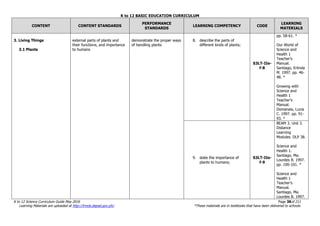
Solutions. Unit 2.
Chapter 1. Lesson 1.
BEAM III. Unit 3. 8
Demonstrate
K to 12 BASIC EDUCATION CURRICULUM
K to 12 Science Curriculum Guide May 2016 Page 118of 211
Learning Materials are uploaded at http://lrmds.deped.gov.ph/. *These materials are in textbooks that have been delivered to schools.
CONTENT
CONTENT
STANDARDS
PERFORMANCE
STANDARDS
LEARNING COMPETENCY CODE
LEARNING
MATERIALS
2. Diversity of Materials in
the Environment
2.1 Solutions
some important
properties of solutions
prepare different
concentrations of
mixtures according to
uses and availability of
materials
Understanding of
Solutions. The
Marvels of Solutions.
Septermber 2009.
Chemistry III
Textbook. Mapa,
Amelia P., Ph.D., et
al. 2001. pp. 272-
273. *
Science and
Technology III:
Chemistry Textbook.
NISMED. 2012. pp.
114-119.
Science and
Technology III.
NISMED. 1997. pp.
129-133.
3. express concentrations of solutions
quantitatively by preparing different
concentrations of mixtures according
to uses and availability of materials;
S7MT-Id-3
EASE Science II.
Module 7.
APEX Chemistry
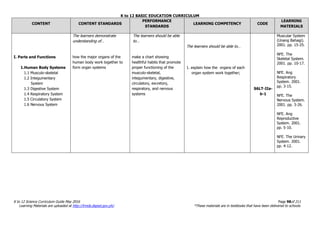
Solutions. Unit 2.
Chapter 1. Lessons 6-
7.
BEAM III. Unit 3. 8
Demonstrate
K to 12 BASIC EDUCATION CURRICULUM
K to 12 Science Curriculum Guide May 2016 Page 119of 211
Learning Materials are uploaded at http://lrmds.deped.gov.ph/. *These materials are in textbooks that have been delivered to schools.
CONTENT
CONTENT
STANDARDS
PERFORMANCE
STANDARDS
LEARNING COMPETENCY CODE
LEARNING
MATERIALS
Understanding of
Solutions. The Marvels
of Solutions.
September 2009.
Chemistry III
Textbook. Mapa,
Amelia P., Ph.D., et al.
2001. pp. 283-290. *
Science and
Technology III:
Chemistry Textbook.
NISMED. 2012. pp.
132-136.
Science and
Technology III.
NISMED. 1997. pp.
142-153.
2.2 Substances and Mixtures the properties of
substances that
distinguish them from
mixtures
investigate the
properties of mixtures of
varying concentrations
using available materials
in the community for
specific purposes
4. distinguish mixtures from
substances based on a set of
properties;
S7MT-Ie-f-4
EASE II. Module 3.
Lesson 2.
BEAM III. Unit 2. 5
Demonstrate Skill in
Identifying Chemical
System. Pure
Substance and
Mixture. August
K to 12 BASIC EDUCATION CURRICULUM
K to 12 Science Curriculum Guide May 2016 Page 120of 211
Learning Materials are uploaded at http://lrmds.deped.gov.ph/. *These materials are in textbooks that have been delivered to schools.
CONTENT
CONTENT
STANDARDS
PERFORMANCE
STANDARDS
LEARNING COMPETENCY CODE
LEARNING
MATERIALS
2009.
EASE I. Module 5.
Lesson 3.
Chemistry III
Textbook. Mapa,
Amelia P., Ph.D., et
al. 2001. pp. 38-42.
Science and
Technology III:
Chemistry Textbook.
NISMED. 2012. pp.
34-38.
Science and
Technology III.
NISMED. 1997. pp.
30-34.
2.3 Elements and
Compounds
classifying substances as
elements or compounds
make a chart, poster,
or multimedia
presentation of
common elements
showing their names,
symbols, and uses
5. recognize that substances are
classified into elements and
compounds;
S7MT-Ig-h-5
EASE II. Module 3.
Lesson 3.
BEAM III. Unit 2. 6
Demonstrate
Understanding of
Elements. Elements
and Compounds.
August 2009.
K to 12 BASIC EDUCATION CURRICULUM
K to 12 Science Curriculum Guide May 2016 Page 121of 211
Learning Materials are uploaded at http://lrmds.deped.gov.ph/. *These materials are in textbooks that have been delivered to schools.
CONTENT
CONTENT
STANDARDS
PERFORMANCE
STANDARDS
LEARNING COMPETENCY CODE
LEARNING
MATERIALS
EASE I. Module 5.
Lesson 3.
Chemistry III
Textbook. Mapa,
Amelia P., Ph.D., et
al. 2001. pp. 45-49.
Science and
Technology III:
Chemistry Textbook.
NISMED. 2012. pp.
52-56.
Science and
Technology III.
NISMED. 1997. pp.
42-52.
2.4 Acids and Bases the common properties
of acidic and basic
mixtures
properly interpret
product labels of acidic
and basic mixture, and
practice safe ways of
handling acids and
bases using protective
clothing and safety gear
6. investigate properties of acidic and
basic mixtures using natural
indicators; and
S7MT-Ii-6
BEAM III. Module 3.
Lesson 3.
NSTIC Science
Manual. Biology
Science Manual .413.
1.d Acids and Bases.
K to 12 BASIC EDUCATION CURRICULUM
K to 12 Science Curriculum Guide May 2016 Page 122of 211
Learning Materials are uploaded at http://lrmds.deped.gov.ph/. *These materials are in textbooks that have been delivered to schools.
CONTENT
CONTENT
STANDARDS
PERFORMANCE
STANDARDS
LEARNING COMPETENCY CODE
LEARNING
MATERIALS
NSTIC Science
Manual. Chemistry
Science Manual. pp.
34-39.
Chemistry III
Textbook. Mapa,
Amelia P., Ph.D., et
al. 2001. pp. 51-52. *
Science and
Technology III:
Chemistry Textbook.
NISMED. 2012. pp.
62-65.
2.5 Metals and Non-metals properties of metals and
nonmetals
7. describe some properties of metals
and non-metals such as luster,
malleability, ductility, and
conductivity.
S7MT-Ij-7
APEX. Phases of
Matter. Unit 1.
Chapter 2.
EASE II. Module II.
Lesson 3.
EASE I. Module 5. pp.
16-18 and 23.
K to 12 BASIC EDUCATION CURRICULUM
K to 12 Science Curriculum Guide May 2016 Page 123of 211
Learning Materials are uploaded at http://lrmds.deped.gov.ph/. *These materials are in textbooks that have been delivered to schools.
CONTENT
CONTENT
STANDARDS
PERFORMANCE
STANDARDS
LEARNING COMPETENCY CODE
LEARNING
MATERIALS
Science and
Technology III.
NISMED. 1997. pp.
48-51.
Grade 7 – Living Things and Their Environment
SECOND QUARTER/SECOND GRADING PERIOD
I.Parts and Functions
1. Microscopy
I.Parts and Functions
1. Microscopy
The learners
demonstrate an
understanding of:
the parts and functions
of the compound
microscope
The learners
demonstrate an
understanding of:
the parts and functions
of the compound
microscope
The learners should be
able to:
employ appropriate
techniques using the
compound microscope
to gather data about
very small objects
The learners should be
able to:
employ appropriate
techniques using the
compound microscope
to gather data about
very small objects
The learners should be able to…
1. Identify parts of the microscope
and their functions;
S7LT-IIa-1
BEAM II. 1 Nature of
Biology. Tools in
Biology. April 2009.
pp. 21-37.
NSTIC Science
Manual. Biology
Science Manual
.413M. 27b
Microscope.
NSTIC Science
Manual. Biology
Science Manual
.413M. 4 The
Compound
Microscope.
Science and
Technology II:
Biology Textbook.
NISMED. 2012. pp.
12-15.
2. focus specimens using the
compound microscope;
2. focus specimens using the
compound microscope;
S7LT-IIb-2
S7LT-IIb-2
K to 12 BASIC EDUCATION CURRICULUM
K to 12 Science Curriculum Guide May 2016 Page 124of 211
Learning Materials are uploaded at http://lrmds.deped.gov.ph/. *These materials are in textbooks that have been delivered to schools.
CONTENT
CONTENT
STANDARDS
PERFORMANCE
STANDARDS
LEARNING COMPETENCY CODE
LEARNING
MATERIALS
Science and
Technology II:
Biology Textbook.
NISMED. 2004. pp.
12-15.
2. Levels of Biological
Organization
the different levels of
biological organization 3. describe the different levels of
biological organization from cell
to biosphere;
S7LT-IIc-3
EASE Biology. Module
6.
3. Animal and Plant Cells
the difference between
animal and plant cells
the difference between
animal and plant cells
4. differentiate plant and animal
cells according to presence or
absence of certain organelles;
a. differentiate plant and animal
cells according to presence or
absence of certain organelles;
S7LT-IId-4
S7LT-IId-4
Science and
Technology II:
Biology Textbook.
NISMED. 2012. pp.
22-28.
Science and
Technology II:
Biology Textbook.
NISMED. 2004. pp.
22-28.
5. explain why the cell is considered
the basic structural and
functional unit of all organisms;
S7LT-IIe-5
APEX. Unit 2. The
Unit Cycle of Life.
BEAM II. Module 2.
The Basic Units of
Life.
EASE Biology. Module
2.
K to 12 BASIC EDUCATION CURRICULUM
K to 12 Science Curriculum Guide May 2016 Page 125of 211
Learning Materials are uploaded at http://lrmds.deped.gov.ph/. *These materials are in textbooks that have been delivered to schools.
CONTENT
CONTENT
STANDARDS
PERFORMANCE
STANDARDS
LEARNING COMPETENCY CODE
LEARNING
MATERIALS
Science and
Technology II:
Biology Textbook.
NISMED. 2012. pp.
21-22.
Science and
Technology II:
Biology Textbook.
NISMED. 2004. pp.
21-22.
4. Fungi, Protists, and
Bacteria
4. Fungi, Protists, and
Bacteria
organisms that can only
be seen through the
microscope, many of
which consist of only
one cell
organisms that can only
be seen through the
microscope, many of
which consist of only
one cell
6. identify beneficial and harmful
microorganisms;
6. identify beneficial and harmful
microorganisms;
S7LT-IIf-6
S7LT-IIf-6
Science and
Technology II:
Biology Textbook.
NISMED. 2012. pp.
247-268.
Science and
Technology II:
Biology Textbook.
NISMED. 2004. pp.
247-268.
II. Heredity: Inheritance and
Variation
1. Asexual reproduction
2. Sexual reproduction
reproduction being both
asexual or sexual 7. differentiate asexual from sexual
reproduction in terms of:
7. 1 number of individuals
involved;
7. 2 similarities of offspring to
APEX Biology. Unit 5.
Life Reproduction.
BEAM II. Unit 1.
Different Life Process.
Process of Life. April
2009.
K to 12 BASIC EDUCATION CURRICULUM
K to 12 Science Curriculum Guide May 2016 Page 126of 211
Learning Materials are uploaded at http://lrmds.deped.gov.ph/. *These materials are in textbooks that have been delivered to schools.
CONTENT
CONTENT
STANDARDS
PERFORMANCE
STANDARDS
LEARNING COMPETENCY CODE
LEARNING
MATERIALS
II. Heredity: Inheritance and
Variation
1. Asexual reproduction
2. Sexual reproduction
reproduction being both
asexual or sexual
parents;
7. differentiate asexual from sexual
reproduction in terms of:
7. 1 number of individuals
involved;
7. 2 similarities of offspring to
parents;
S7LT-IIg-7
S7LT-IIg-7
BEAM II. Unit 5.
Reproduction. Cell
Growth and
Reproduction. April
2009.
EASE Biology. Module
12. Lesson 3.
Science and
Technology II:
Biology Textbook.
NISMED. 2012. pp.
139-142.
Science and
Technology II:
Biology Textbook.
NISMED. 2004. pp.
139-142.
8. describe the process of
MISOSA 5. Module 3.
BEAM 5. Unit 1. 1 The
Human Reproductive
System. Distance
K to 12 BASIC EDUCATION CURRICULUM
K to 12 Science Curriculum Guide May 2016 Page 127of 211
Learning Materials are uploaded at http://lrmds.deped.gov.ph/. *These materials are in textbooks that have been delivered to schools.
CONTENT
CONTENT
STANDARDS
PERFORMANCE
STANDARDS
LEARNING COMPETENCY CODE
LEARNING
MATERIALS
II. Heredity: Inheritance and
Variation
1. Asexual reproduction
2. Sexual reproduction
reproduction being both
asexual or sexual
fertilization;
8. describe the process of
fertilization;
S7LT-IIg-8
S7LT-IIg-8
Learning Modules.
DLP2.
BEAM 4. Unit 4.
Distance Learning
Modules. DLP31.
MISOSA 4. Module 6.
APEX. Biology Unit 5.
Science for Daily Use
4. Lozada, Buena A.,
et al. 2011. pp. 76-78.
*
Science for Daily Use
5. Tan, Conchita T.
2012. pp. 6-10. *
Science and
Technology II:
Biology Textbook.
NISMED. 2012. pp.
153-157.
Science and
Technology II:
Biology Textbook.
NISMED. 2004. pp.
153-157.
K to 12 BASIC EDUCATION CURRICULUM
K to 12 Science Curriculum Guide May 2016 Page 128of 211
Learning Materials are uploaded at http://lrmds.deped.gov.ph/. *These materials are in textbooks that have been delivered to schools.
CONTENT
CONTENT
STANDARDS
PERFORMANCE
STANDARDS
LEARNING COMPETENCY CODE
LEARNING
MATERIALS
II. Ecosystems
1. Components of an
ecosystem
2. Ecological relationships
2.1 Symbiotic relationships
2.2 Non symbiotic
relationships
3. Transfer of energy
through trophic levels
II. Ecosystems
1. Components of an
ecosystem
2. Ecological relationships
2.1 Symbiotic relationships
2.2 Non symbiotic
relationships
3. Transfer of energy
through trophic levels
organisms interacting
with each other and
with their environment
to survive
organisms interacting
with each other and
with their environment
to survive
conduct a collaborative
action to preserve the
ecosystem in the locality
conduct a collaborative
action to preserve the
ecosystem in the locality
9. differentiate biotic from abiotic
components of an ecosystem;
S7LT-IIh-9
BEAM I. Unit 5. 1
Living Things and
Their Interactions.
June 2009.
EASE I. Module 9.
MISOSA 6.
Components of an
Ecosystem.
Science and
Technology I:
Integrated Science
Textbook for First
Year. Villamil, Aurora
M., Ed.D. 1998. p.
222. *
10. describe the different ecological
relationships found in an
ecosystem;
S7LT-IIh-10
MISOSA 6.
Interrelationship
among Organisms.
BEAM I. Unit 5. 1
Living Things and
their Interactions.
June 2009.
EASE Biology. Module
19.
K to 12 BASIC EDUCATION CURRICULUM
K to 12 Science Curriculum Guide May 2016 Page 129of 211
Learning Materials are uploaded at http://lrmds.deped.gov.ph/. *These materials are in textbooks that have been delivered to schools.
CONTENT
CONTENT
STANDARDS
PERFORMANCE
STANDARDS
LEARNING COMPETENCY CODE
LEARNING
MATERIALS
EASE I. Module 10.
Science and
Technology I:
Integrated Science
Textbook for First
Year. Villamil, Aurora
M., Ed.D. 1998. pp.
223-226. *
11. predict the effect of changes in
one population on other
populations in the ecosystem; and
S7LT-IIi-11
MISOSA 6. Module 11.
12. predict the effect of changes in
abiotic factors on the ecosystem.
S7LT-IIj-12
MISOSA 6.
Components of an
Ecosystem.
EASE I. Module 9.
Grade 7 – Force, Motion and, Energy
THIRD QUARTER/THIRD GRADING PERIOD
I. Motion in One Dimension
1. Descriptors of Motion
1.1 Distance or
Displacement
1.2 Speed or Velocity
1.3 Acceleration
2. Motion Detectors
The learners
demonstrate an
understanding of:
motion in one
dimension
The learners shall be
able to:
conduct a forum on
mitigation and disaster
risk reduction
The learners should be able to…
1. describe the motion of an object in
terms of distance or displacement,
speed or velocity, and
acceleration;
S7FE-IIIa-1
NSTIC Science
Manual. Integrated
Science Manual. 413
M. pp. 2-13. (Module
8).
MISOSA 6. Module
24.
EASE Physics. Module
10.
K to 12 BASIC EDUCATION CURRICULUM
K to 12 Science Curriculum Guide May 2016 Page 130of 211
Learning Materials are uploaded at http://lrmds.deped.gov.ph/. *These materials are in textbooks that have been delivered to schools.
CONTENT
CONTENT
STANDARDS
PERFORMANCE
STANDARDS
LEARNING COMPETENCY CODE
LEARNING
MATERIALS
I. Motion in One Dimension
1. Descriptors of Motion
1.1 Distance or
Displacement
1.2 Speed or Velocity
1.4 Acceleration
2. Motion Detectors
The learners
demonstrate an
understanding of:
motion in one
dimension
The learners shall be
able to:
conduct a forum on
mitigation and disaster
risk reduction
Science and
Technology I:
Integrated Science
Textbook for First
Year. Villamil, Aurora
M., Ed.D. 1998. pp.
73-74. *
Science and
Technology IV:
Physics Textbook for
Fourth Year. Rabago,
Lilia M., Ph.D., et al.
2001. pp. 50-61. *
2. differentiate quantities in terms of
magnitude and direction;
S7FE-IIIa-2
Science and
Technology IV: Pysics
Textbook. NISMED.
2012. p. 258.
3. create and interpret visual
representation of the motion of
objects such as tape charts and
motion graphs;
S7FE-IIIb-3
Science and
Technology IV:
Physics Textbook.
NISMED. 2012. p.
285.
II. Waves
1. Types of Waves
waves as a carriers of
energy
4. infer that waves carry energy;
S7LT-IIIc-4
OHSP. Module 15.
EASE Physics. Module
K to 12 BASIC EDUCATION CURRICULUM
K to 12 Science Curriculum Guide May 2016 Page 131of 211
Learning Materials are uploaded at http://lrmds.deped.gov.ph/. *These materials are in textbooks that have been delivered to schools.
CONTENT
CONTENT
STANDARDS
PERFORMANCE
STANDARDS
LEARNING COMPETENCY CODE
LEARNING
MATERIALS
2. Characteristics of Waves
2.1 Amplitude
2.2 Wavelength
3. Wave Velocity
II. Waves
1. Types of Waves
2. Characteristics of Waves
2.1 Amplitude
2.2 Wavelength
3. Wave Velocity
waves as a carriers of
energy
15.
Science and
Technology IV:
Physics Textbook for
Fourth Year. Rabago,
Lilia M., Ph.D., et al.
2001. pp. 194-197. *
5. differentiate transverse from
longitudinal waves, and
mechanical from electromagnetic
waves;
5. differentiate transverse from
longitudinal waves, and
mechanical from electromagnetic
waves;
S7LT-IIIc-5
S7LT-IIIc-5
OHSP. Module 15.
EASE Physics. Module
15.
Science and
Tecnology IV: Physics
Textbook for Fourth
Year. Rabago, Lilia
M., Ph.D., et al.
2001. pp. 202-203.
6. relate the characteristics of waves; S7LT-IIId-6
OHSP. Module 15.
EASE Physics. Module
15.
Science and
Technology IV:
Physics Textbook for
Fourth Year. Rabago,
Lilia M., Ph.D., et al.
2001. pp. 198-200. *
K to 12 BASIC EDUCATION CURRICULUM
K to 12 Science Curriculum Guide May 2016 Page 132of 211
Learning Materials are uploaded at http://lrmds.deped.gov.ph/. *These materials are in textbooks that have been delivered to schools.
CONTENT
CONTENT
STANDARDS
PERFORMANCE
STANDARDS
LEARNING COMPETENCY CODE
LEARNING
MATERIALS
III. Sound
1. Characteristics of sound
1.1.Pitch
1.2 Loudness
1.3 Quality
III. Sound
1. Characteristics of sound
1.1.Pitch
1.2 Loudness
1.3 Quality
the characteristics of
sound
the characteristics of
sound
7. describe the characteristics of
sound using the concepts of
wavelength, velocity, and
amplitude ;
S7LT-IIId-7
EASE Physics. Module
16.
OHSP. Module 16.
Science and
Technology IV:
Physics Textbook.
NISMED. 2012. pp.
371-372.
8. explain sound production in the
human voice box, and how
pitch, loudness, and quality of
sound vary from one person to
another;
8. explain sound production in the
human voice box, and how pitch,
loudness, and quality of sound
vary from one person to another;
S7LT-IIIe-8
S7LT-IIIe-8
EASE Physics. Module
16.
OHSP. Module 16.
Science and
Technology IV:
Physics Textbook.
NISMED. 2012. pp.
372-375.
9. describe how organisms produce,
transmit, and receive sound of
various frequencies (infrasonic,
audible, and ultrasonic sound);
S7LT-IIIe-9
EASE Physics. Module
16.
OHSP. Module 16.
Science and
Technology IV:
Physics Textbook for
Fourth Year. Rabago,
Lilia M., Ph.D., et al.
K to 12 BASIC EDUCATION CURRICULUM
K to 12 Science Curriculum Guide May 2016 Page 133of 211
Learning Materials are uploaded at http://lrmds.deped.gov.ph/. *These materials are in textbooks that have been delivered to schools.
CONTENT
CONTENT
STANDARDS
PERFORMANCE
STANDARDS
LEARNING COMPETENCY CODE
LEARNING
MATERIALS
2001. pp. 221-226. *
IV. Light
1. Characteristics of Light
1.1 Intensity or
Brightness
1.2 Color
IV. Light
1. Characteristics of Light
1.1 Intensity or
Brightness
1.2 Color
the characteristics of
light
the characteristics of
light
suggest proper lighting
in various activities
suggest proper lighting
in various activities
10. relate characteristics of light
such as color and intensity to
frequency and wavelength;
S7LT-IIIf-10
EASE Physics. Module
3.
Science and
Technology IV:
Physics Textbook for
Fourth Year. Rabago,
Lilia M., Ph.D., et al.
2001. P. 246. *
11. infer that light travels in a
straight line;
11. infer that light travels in a
straight line;
S7LT-IIIg-11
S7LT-IIIg-11
EASE Physics. Module
3.
Science and
Technology IV:
Physics Textbook for
Fourth Year. Rabago,
Lilia M., Ph.D., et al.
2001. P. 236. *
V. Heat
1. Heat Transfer
1.1 Conduction
1.2 Convection
1.3 Radiation
how heat is transferred
12. infer the conditions necessary
for heat transfer to occur;
S7LT-IIIh-i-
12
MISOSA 4. Methods
of Heat Transfer.
Science and
Technology I:
Integrated Science
Textbook for First
Year. Villamil, Aurora
K to 12 BASIC EDUCATION CURRICULUM
K to 12 Science Curriculum Guide May 2016 Page 134of 211
Learning Materials are uploaded at http://lrmds.deped.gov.ph/. *These materials are in textbooks that have been delivered to schools.
CONTENT
CONTENT
STANDARDS
PERFORMANCE
STANDARDS
LEARNING COMPETENCY CODE
LEARNING
MATERIALS
M., Ed.D. 1998. P.
97. *
Science and
Technology IV:
Physics Textbook for
Fourth Year. Rabago,
Lilia M., Ph.D., et al.
2001. P. 187. *
VI. Electricity
1. Charges
2. Charging processes
VI. Electricity
1. Charges
2. Charging processes
charges and the
different charging
processes
charges and the
different charging
processes
13. describe the different types of
charging processes; and
S7LT-IIIj-13
EASE Physics. Module
6. Lesson 2.
Science and
Technology IV:
Physics Textbook for
Fourth Year. Rabago,
Lilia M., Ph.D., et al.
2001. P. 290. *
14. explain the importance of
earthing or grounding.
S7LT-IIIj-14
EASE Science II.
Module 2. p. 19.
Grade 7 – Earth and Space
FOURTH QUARTER/FOURTH GRADING PERIOD
1.The Philippine Environment
1.1 Location of the Philippines
using a coordinate system
1.2. Location of the Philippines
with respect to
landmasses and bodies of
The learners
demonstrate an
understanding of:
the relation of
geographical location of
the Philippines to its
The learners shall be
able to:
analyze the advantage
of the location of the
Philippines in relation
to the climate,
The learners should be able to…
1. demonstrate how places on Earth may
be located using a coordinate system;
S7ES-IVa-1
EASE 1. Module 14.
2. describe the location of the Philippines
S7ES-IVa-2
K to 12 BASIC EDUCATION CURRICULUM
K to 12 Science Curriculum Guide May 2016 Page 135of 211
Learning Materials are uploaded at http://lrmds.deped.gov.ph/. *These materials are in textbooks that have been delivered to schools.
CONTENT
CONTENT
STANDARDS
PERFORMANCE
STANDARDS
LEARNING COMPETENCY CODE
LEARNING
MATERIALS
water
1.3. Protection and
conservation of natural
resources
environment weather, and seasons with respect to the continents and
oceans of the world;
3. recognize that soil, water, rocks, coal,
and other fossil fuels are Earth
materials that people use as
resources;
S7ES-IVb-3
EASE Science I.
Module 11.
4. describe ways of using Earth’s
resources sustainably;
S7ES-IVc-4
EASE Science I.
Module 11.
Science and
Technology I:
Integrated Science
Textbook for First
Year. Villamil, Aurora
M., Ed.D. 1998. Pp.
146-150. *
2.Interactions in the
Atmosphere
2.1. Greenhouse effect and
global warming
2.3. Land and sea breezes
2.4. Monsoons
2.5. Intertropical convergence
zone
the different
phenomena that
occur in the
atmosphere
5. discuss how energy from the Sun
interacts with the layers of the
atmosphere;
S7ES-IVd-5
EASE Science I.
Module 14.
Science and
Technology I:
Integrated Science
Textbook. NISMED.
2012. Pp. 310-311.
6. explain how some human activities
affect the atmosphere ;
S7ES-IVe-6
EASE Science I.
Module 14. Lesson 4.
BEAM I. 8 Changes in
the Atmosphere.
K to 12 BASIC EDUCATION CURRICULUM
K to 12 Science Curriculum Guide May 2016 Page 136of 211
Learning Materials are uploaded at http://lrmds.deped.gov.ph/. *These materials are in textbooks that have been delivered to schools.
CONTENT
CONTENT
STANDARDS
PERFORMANCE
STANDARDS
LEARNING COMPETENCY CODE
LEARNING
MATERIALS
Learning Guides.
Point and Non-point.
September 2009.
Science and
Technology I:
Integrated Science
Textbook. NISMED.
2012. Pp. 301-311.
7. account for the occurrence of land
and sea breezes, monsoons, and
intertropical convergence zone
(ITCZ)
S7ES-IVf-7
Science and
Technology I:
Integrated Science
Textbook. NISMED.
2012. Pp. 296-299.
8. describe the effects of certain
weather systems in the Philippines;
S7ES-IVg-8
MISOSA 5. Module
24.
K to 12 BASIC EDUCATION CURRICULUM
K to 12 Science Curriculum Guide May 2016 Page 137of 211
Learning Materials are uploaded at http://lrmds.deped.gov.ph/. *These materials are in textbooks that have been delivered to schools.
CONTENT
CONTENT
STANDARDS
PERFORMANCE
STANDARDS
LEARNING COMPETENCY CODE
LEARNING
MATERIALS
3. Seasons in the Philippines
3.1. Relation of seasons to the
position of the Sun in the
sky
3.2. Causes of seasons in the
Philippines
the relationship of the
seasons and the
position of the Sun in
the sky
9. using models, relate:
9.1 the tilt of the Earth to the length
of daytime;
9.2 the length of daytime to the
amount of energy received;
9.3 the position of the Earth in its
orbit to the height of the Sun in
the sky;
9.4 the height of the Sun in the sky
to the amount of energy
received;
9.5 the latitude of an area to the
amount of energy the area
receives;
S7ES-IVh-9
Science and
Technology I:
Integrated Science
Textbook. NISMED.
2012. pp. 308-310.
Science and
Technology I:
Integrated Science
Textbook. NISMED.
2012. pp. 287-289.
10. show what causes change in the
seasons in the Philippines using
models;
S7ES-IVi-10
Science and
Technology I:
Integrated Science
Textbook. NISMED.
2012. pp. 287-290.
4. Eclipses
4.1. Solar Eclipse
4.2. Lunar Eclipse
the occurrence of
eclipses 11. explain how solar and lunar eclipses
occur; and
S7ES-IVj-11
BEAM 4. 11 Solar and
Lunar Eclipse.
Distance Learning
Module. DLP 66.
BEAM 4. 11 Solar and
Lunar Eclipse.
Distance Learning
K to 12 BASIC EDUCATION CURRICULUM
K to 12 Science Curriculum Guide May 2016 Page 138of 211
Learning Materials are uploaded at http://lrmds.deped.gov.ph/. *These materials are in textbooks that have been delivered to schools.
CONTENT
CONTENT
STANDARDS
PERFORMANCE
STANDARDS
LEARNING COMPETENCY CODE
LEARNING
MATERIALS
4. Eclipses
4.1. Solar Eclipse
4.2. Lunar Eclipse
the occurrence of
eclipses 11. explain how solar and lunar eclipses
occur; and
S7ES-IVj-11
Module. DLP 67.
BEAM 4. 11 Solar and
Lunar Eclipse.
Distance Learning
Module. DLP 68.
Science and
Technology I:
Integrated Science
Textbook for First
Year. Villamil, Aurora
M., Ed.D. 1997. pp.
290-291. *
Science and
Technology I:
Integrated Science
Textbook. NISMED.
2012. pp. 324-325.
12. collect, record, and report data on the
beliefs and practices of the community
in relation to eclipses.
S7ES-IVj-12
BEAM 4. 11 Solar and
Lunar Eclipse.
Learning Guide.
Eclipse. September
2009.
BEAM 4. 11 Solar and
Lunar Eclipse.
Distance Learning
Module. DLP 69.
K to 12 BASIC EDUCATION CURRICULUM
K to 12 Science Curriculum Guide May 2016 Page 139of 211
Learning Materials are uploaded at http://lrmds.deped.gov.ph/. *These materials are in textbooks that have been delivered to schools.
GRADE 8
CONTENT CONTENT STANDARDS
PERFORMANCE
STANDARDS
LEARNING COMPETENCY CODE
LEARNING
MATERIALS
Grade 8 – Force, Motion, and Energy
FIRST QUARTER/FIRST GRADING PERIOD
1. Laws of Motion
1.1 Law of Inertia
1.2 Law of Acceleration
1.3 Law of Interaction
The learners demonstrate
an understanding of:
Newton’s three laws of
motion and uniform circular
motion
The learners shall be able
to:
develop a written plan
and implement a
“Newton’s Olympics”
The learners should be able
to…
1. investigate the relationship
between the amount of
force applied and the mass
of the object to the amount
of change in the object’s
motion;
S8FE-Ia-15
EASE Physics.
Module 10. Lesson
3.
Science and
Technology IV:
Physics Textbook.
NISMED. 2012.
pp. 292-296.
Science 8
Learner’s Module.
Campo, Pia C., et
al. 2013. pp. 12-
17.
Science and
Technologyy IV:
Physics Textbook
for Fourth Year.
Rabago, Lilia M.,
Ph.D., et al. 2001.
pp. 75-82. *
2. infer that when a body
exerts a force on another,
an equal amount of force is
exerted back on it; S8FE-Ia-16
EASE Physics.
Module 10. Lesson
3.
Science and
Technology IV:
Physics Textbook.
NISMED. 2012.
K to 12 BASIC EDUCATION CURRICULUM
K to 12 Science Curriculum Guide May 2016 Page 140of 211
Learning Materials are uploaded at http://lrmds.deped.gov.ph/. *These materials are in textbooks that have been delivered to schools.
CONTENT CONTENT STANDARDS
PERFORMANCE
STANDARDS
LEARNING COMPETENCY CODE
LEARNING
MATERIALS
1. Laws of Motion
1.1 Law of Inertia
1.2 Law of Acceleration
1.3 Law of Interaction
The learners demonstrate
an understanding of:
Newton’s three laws of
motion and uniform circular
motion
The learners shall be able
to:
develop a written plan
and implement a
“Newton’s Olympics”
2. infer that when a body
exerts a force on another,
an equal amount of force is
exerted back on it; S8FE-Ia-16
pp. 296-297.
Science 8
Learner’s Module.
Campo, Pia C., et
al. 2013. pp. 18-
20.
Science and
Technology IV:
Physics Textbook
for Fourth Year.
Rabago, Lilia M.,
Ph.D., et al. 2001.
pp. 83-84. *
3. demonstrate how a body
responds to changes in
motion;
S8FE-Ib-17
EASE Physics.
Module 10. Lesson
3.
Science and
Technology IV:
Physics Textbook
for Fourth Year.
Ragabo, Lilia M.,
Ph.D., et al. 2001.
p. 83. *
Science 8
Learner’s Module.
Campo, Pia C., et
al. 2013. pp. 8-10.
4. relate the laws of motion to
bodies in uniform circular
motion; S8FE-Ib-18
EASE Physics.
Module 9.
Science and
Technology IV:
K to 12 BASIC EDUCATION CURRICULUM
K to 12 Science Curriculum Guide May 2016 Page 141of 211
Learning Materials are uploaded at http://lrmds.deped.gov.ph/. *These materials are in textbooks that have been delivered to schools.
CONTENT CONTENT STANDARDS
PERFORMANCE
STANDARDS
LEARNING COMPETENCY CODE
LEARNING
MATERIALS
1. Laws of Motion
1.1 Law of Inertia
1.2 Law of Acceleration
1.3 Law of Interaction
The learners demonstrate
an understanding of:
Newton’s three laws of
motion and uniform circular
motion
The learners shall be able
to:
develop a written plan
and implement a
“Newton’s Olympics”
4. relate the laws of motion to
bodies in uniform circular
motion;
S8FE-Ib-18
Physics Textbook
for Fourth Year.
Rabago, Lilia M.,
Ph.D., et al. 2001.
Pp. 58-61. *
Science 8
Learner’s Module.
Campo, Pia C., et
al. 2013. Pp. 17-
18.
5. infer that circular motion
requires the application of
constant force directed
toward the center of the
circle;
S8FE-Ib-19
EASE Physics.
Module 9.
Science and
Technology IV:
Physics Textbook
for Fourth Year.
Rabago, Lilia M.,
Ph.D., et al. 2001.
Pp. 106-108. *
Science 8
Learner’s Module.
Campo, Pia C., et
al. 2013. P. 18.
2. Work Power and Energy work using constant force,
power, gravitational
potential energy, kinetic
energy, and elastic
potential energy
6. identify situations in which
work is done and in which
no work is done;
S8FE-Ic-20
EASE Physics.
Module 11. Lesson
2. pp. 5-8.
Science and
Technology IV:
Physics Textbook
for Fourth Year.
Rabago, Lilia M.,
K to 12 BASIC EDUCATION CURRICULUM
K to 12 Science Curriculum Guide May 2016 Page 142of 211
Learning Materials are uploaded at http://lrmds.deped.gov.ph/. *These materials are in textbooks that have been delivered to schools.
CONTENT CONTENT STANDARDS
PERFORMANCE
STANDARDS
LEARNING COMPETENCY CODE
LEARNING
MATERIALS
2. Work Power and Energy work using constant force,
power, gravitational
potential energy, kinetic
energy, and elastic
potential energy
6. identify situations in which
work is done and in which
no work is done; S8FE-Ic-20
Ph.D., et al. 2001.
Pp. 162-166. *
Science and
Technology IV:
Physics Textbook.
NISMED. 2012.
Pp. 309-310.
Science 8
Learner’s Module.
Campo, Pia C., et
al. 2013. Pp. 21-
24.
7. describe how work is related
to power and energy;
S8FE-Ic-21
EASE Physics.
Module 11. Lesson
3. pp. 33-34.
Science and
Technology IV:
Physics Textbook
for Fourth Year.
Rabago, Lilia M.,
Ph.D., et al. 2001.
Pp. 166-169. *
Science and
Technology IV:
Physics Textbook.
NISMED. 2012. Pp.
316-317.
Science 8 Learner’s
Module. Campo,
Pia C., et al. 2013.
Pp. 25-26.
K to 12 BASIC EDUCATION CURRICULUM
K to 12 Science Curriculum Guide May 2016 Page 143of 211
Learning Materials are uploaded at http://lrmds.deped.gov.ph/. *These materials are in textbooks that have been delivered to schools.
CONTENT CONTENT STANDARDS
PERFORMANCE
STANDARDS
LEARNING COMPETENCY CODE
LEARNING
MATERIALS
2. Work Power and Energy
work using constant force,
power, gravitational
potential energy, kinetic
energy, and elastic
potential energy
8. differentiate potential and
kinetic energy;
S8FE-Id-22
BEAM IV. Unit 1.
EASE Science 1.
Module 8. Lesson
3.
OHSP Module.
Module 11. Lesson
2.
Science and
Technology IV:
Physics Textbook
for Fourth Year.
Rabago, Lilia M.,
Ph.D., et al. 2001.
Pp. 171-174. *
Science and
Technology IV:
Physics Textbook.
NISMED. 2012. Pp.
310-314.
Science 8 Learner’s
Module. Campo,
Pia C., et al. 2013.
Pp. 26-31.
9. relate speed and position of
object to the amount of
energy possessed by a body; S8FE-Id-23
Science and
Technology IV:
Physics Textbook
for Fourth Year.
Rabago, Lilia M.,
Ph.D., et al. 2001.
Pp. 175-181. *
K to 12 BASIC EDUCATION CURRICULUM
K to 12 Science Curriculum Guide May 2016 Page 144of 211
Learning Materials are uploaded at http://lrmds.deped.gov.ph/. *These materials are in textbooks that have been delivered to schools.
CONTENT CONTENT STANDARDS
PERFORMANCE
STANDARDS
LEARNING COMPETENCY CODE
LEARNING
MATERIALS
2. Work Power and Energy work using constant force,
power, gravitational
potential energy, kinetic
energy, and elastic
potential energy
9. relate speed and position of
object to the amount of
energy possessed by a body; S8FE-Id-23
Science and
Technology IV:
Physics Textbook.
NISMED. 2012. Pp.
314-316.
Science 8 Learner’s
Module. Campo,
Pia C., et al. 2013.
Pp. 25-26.
3. Sound
the propagation of sound
through solid, liquid, and
gas
10. infer how the movement of
particles of an object
affects the speed of sound
through it;
S8FE-Ie-24
OHSP. Module 16.
Science and
Technology IV:
Physics Textbook
for Fourth Year.
Rabago, Lilia M.,
Ph.D., et al. 2001.
Pp. 216-218. *
Science and
Technology IV:
Physics Textbook.
NISMED. 2012.
Pp. 369-370. *
Science 8
Learner’s Module.
Campo, Pia C., et
al. 2013. P. 70.
11. investigates the effect of
temperature to speed of
sound through fair testing; S8FE-Ie-25
OHSP. Module 16.
Science and
Technology IV:
Physics Textbook.
K to 12 BASIC EDUCATION CURRICULUM
K to 12 Science Curriculum Guide May 2016 Page 145of 211
Learning Materials are uploaded at http://lrmds.deped.gov.ph/. *These materials are in textbooks that have been delivered to schools.
CONTENT CONTENT STANDARDS
PERFORMANCE
STANDARDS
LEARNING COMPETENCY CODE
LEARNING
MATERIALS
3. Sound
the propagation of sound
through solid, liquid, and
gas
11. investigates the effect of
temperature to speed of
sound through fair testing;
S8FE-Ie-25
NISMED. 2012.
pp. 369-370.
Science 8
Learner’s Module.
Campo, Pia C., et
al. 2013. pp. 83-
87.
4. Light
some properties and
characteristics of visible
light
discuss phenomena such
as blue sky, rainbow, and
red sunset using the
concept of wavelength
and frequency of visible
light
12. demonstrate the existence
of the color components of
visible light using a prism
or diffraction grating;
S8FE-If-26
EASE Physics.
Module 3. Lesson
4.
Science and
Technology IV:
Physics Textbook
for Fourth Year.
Rabago, Lilia M.,
Ph.D., et al. 2001.
pp. 266-267. *
Science and
Technology IV:
Physics Textbook.
NISMED. 2012. p.
27.
Science 8
Learner’s Module.
Campo, Pia C., et
al. 2013. p. 91.
K to 12 BASIC EDUCATION CURRICULUM
K to 12 Science Curriculum Guide May 2016 Page 146of 211
Learning Materials are uploaded at http://lrmds.deped.gov.ph/. *These materials are in textbooks that have been delivered to schools.
CONTENT CONTENT STANDARDS
PERFORMANCE
STANDARDS
LEARNING COMPETENCY CODE
LEARNING
MATERIALS
4. Light some properties and
characteristics of visible
light
discuss phenomena such
as blue sky, rainbow, and
red sunset using the
concept of wavelength
and frequency of visible
light
13. explain the hierarchy of
colors in relation to
energy;
S8FE-If-27
EASE Physics.
Module 3. Lesson
4.
Science and
Technology III:
Chemistry
Textbook for Third
Year. Mapa,
Amelia P., Ph.D.,
et al. 1999. pp.
67-69. *
Science 8
Learner’s Module.
Campo, Pia C., et
al. 2013. pp. 98-
105.
Chemistry III
Textbook. Mapa,
Amelia P., Ph.D.,
et al. 2001. pp.
65-66. *
14. explain that red is the least
bent and violet the most
bent according to their
wavelengths or
frequencies;
S8FE-If-28
EASE Physics.
Module 3. Lesson
4.
Chemistry III
Textbook. Mapa,
Amelia P., Ph.D.,
et al. 2001. pp.
65-66. *
Science and
Technology III:
K to 12 BASIC EDUCATION CURRICULUM
K to 12 Science Curriculum Guide May 2016 Page 147of 211
Learning Materials are uploaded at http://lrmds.deped.gov.ph/. *These materials are in textbooks that have been delivered to schools.
CONTENT CONTENT STANDARDS
PERFORMANCE
STANDARDS
LEARNING COMPETENCY CODE
LEARNING
MATERIALS
4. Light some properties and
characteristics of visible
light
discuss phenomena such
as blue sky, rainbow, and
red sunset using the
concept of wavelength
and frequency of visible
light
14. explain that red is the least
bent and violet the most
bent according to their
wavelengths or
frequencies;
S8FE-If-28
Chemistry
Textbook for Third
Year. Mapa,
Amelia P., Ph.D.,
et al. 1999. pp.
67-69. *
Science 8
Learner’s Module.
Campo, Pia C., et
al. 2013. pp. 98-
105.
5. Heat heat and temperature, and
the effects of heat on the
body 15. differentiate between heat
and temperature at the
molecular level;
S8FE-Ig-29
EASE Physics.
Module 13.
Science 8
Learner’s Module.
Campo, Pia C., et
al. 2013. pp. 37-
38.
6. Electricity
current- voltage-resistance
relationship, electric power,
electric energy, and home
circuitry
16. infer the relationship
between current and
charge;
S8FE-Ih-30
Science and
Technology IV:
Physics Textbook
for Fourth Year.
Rabago, Lilia M.,
Ph.D., et al. 2001.
pp. 290-293. *
Science and
Technology IV:
Physics Textbook.
NISMED. 2012.
pp. 142-143.
Science 8
Learner’s Module.
K to 12 BASIC EDUCATION CURRICULUM
K to 12 Science Curriculum Guide May 2016 Page 148of 211
Learning Materials are uploaded at http://lrmds.deped.gov.ph/. *These materials are in textbooks that have been delivered to schools.
CONTENT CONTENT STANDARDS
PERFORMANCE
STANDARDS
LEARNING COMPETENCY CODE
LEARNING
MATERIALS
6. Electricity
16. infer the relationship
between current and
charge;
S8FE-Ih-30
Campo, Pia C., et
al. 2013. pp. 54-
55.
17. explain the advantages and
disadvantages of series
and parallel connections in
homes;
S8FE-li-31
EASE Physiscs.
Module 7. Lesson
2.
Science and
Technology IV:
Physics Textbook.
NISMED. 2012.
pp. 156-160.
Science 8
Learner’s Module.
Campo, Pia C., et
al. 2013. pp. 61-
63.
18. differentiate electrical
power and electrical
energy; and
S9FE-li-32
Science and
Technology IV:
Physics Textbook
for Fourth Year.
Rabago, Lilia M.,
Ph.D., et al. 2001.
pp. 294-296 and
315. *
Science and
Technology IV:
Physics Textbook.
NISMED. 2012.
pp. 166-168 and
177-178.
K to 12 BASIC EDUCATION CURRICULUM
K to 12 Science Curriculum Guide May 2016 Page 149of 211
Learning Materials are uploaded at http://lrmds.deped.gov.ph/. *These materials are in textbooks that have been delivered to schools.
CONTENT CONTENT STANDARDS
PERFORMANCE
STANDARDS
LEARNING COMPETENCY CODE
LEARNING
MATERIALS
6. Electricity
current- voltage-resistance
relationship, electric power,
electric energy, and home
circuitry
19. explain the functions of
circuit breakers, fuses,
earthing, double insulation,
and other safety devices in
the home.
S8FE-li-33
EASE Physics.
Module 7. Lessons
3 and 4.
Science and
Technology IV:
Physics Textbook.
NISMED. 2012.
pp. 174-177.
Grade 8 – Earth and Space
SECOND QUARTER/ SECOND GRADING PERIOD
1. Earthquakes and Faults
1.1 Active and inactive faults
1.2 How movements along faults
generate earthquakes
1.3 How earthquakes generate
tsunamis
1.4 Earthquake focus and epicenter
1.5 Earthquake intensity and
magnitude
1.6 Earthquake preparedness
1.7 How earthquake waves provide
information about the interior of
the Earth
The learners demonstrate
an understanding of:
the relationship between
faults and earthquakes
The learners shall be able
to:
1. participate in decision
making on where to
build structures based
on knowledge of the
location of active faults
in the community
2. make an emergency
plan and prepare an
emergency kit for use
at home and in school
The learners should be able
to…
1. using models or
illustrations, explain how
movements along faults
generate earthquakes;
S8ES-IIa-14
MISOSA 6. Module
26.
Science and
Technology I:
Integrated Science
Textbook.
NISMED. 2012.
pp. 192-193.
Science 8
Learner’s Module.
Campo, Pia C., et
al. 2013. pp. 116-
127.
K to 12 BASIC EDUCATION CURRICULUM
K to 12 Science Curriculum Guide May 2016 Page 150of 211
Learning Materials are uploaded at http://lrmds.deped.gov.ph/. *These materials are in textbooks that have been delivered to schools.
CONTENT CONTENT STANDARDS
PERFORMANCE
STANDARDS
LEARNING COMPETENCY CODE
LEARNING
MATERIALS
1. Earthquakes and Faults
1.1 Active and inactive faults
1.2 How movements along faults
generate earthquakes
1.3 How earthquakes generate
tsunamis
1.4 Earthquake focus and epicenter
1.5 Earthquake intensity and
magnitude
1.6 Earthquake preparedness
1.7 How earthquake waves provide
information about the interior of
the Earth
The learners demonstrate
an understanding of:
the relationship between
faults and earthquakes
The learners shall be able
to:
1. participate in decision
making on where to
build structures based
on knowledge of the
location of active faults
in the community
2. make an emergency
plan and prepare an
emergency kit for use
at home and in school
2. differentiate the
2.1 epicenter of an
earthquake from its
focus;
2.2 intensity of an
earthquake from its
magnitude;
2.3 active and inactive
faults;
S8ES-IIa-15
MISOSA 6. Module
28.
Science and
Technology I:
Integrated Science
Textbook.
NISMED. 2012.
pp. 193-196.
Science 8
Learner’s Module.
Campo, Pia C., et
al. 2013. pp. 125-
132.
3. demonstrate how
underwater earthquakes
generate tsunamis;
S8ES-IIb-16
MISOSA 6. Module
27.
Science 8
Learner’s Module.
Campo, Pia C., et
al. 2013. pp. 133-
136.
K to 12 BASIC EDUCATION CURRICULUM
K to 12 Science Curriculum Guide May 2016 Page 151of 211
Learning Materials are uploaded at http://lrmds.deped.gov.ph/. *These materials are in textbooks that have been delivered to schools.
CONTENT CONTENT STANDARDS
PERFORMANCE
STANDARDS
LEARNING COMPETENCY CODE
LEARNING
MATERIALS
1. Earthquakes and Faults
1.1 Active and inactive faults
1.2 How movements along faults
generate earthquakes
1.3 How earthquakes generate
tsunamis
1.4 Earthquake focus and epicenter
1.5 Earthquake intensity and
magnitude
1.6 Earthquake preparedness
1.7 How earthquake waves provide
information about the interior of
the Earth
The learners demonstrate
an understanding of:
the relationship between
faults and earthquakes
The learners shall be able
to:
1. participate in decision
making on where to
build structures based
on knowledge of the
location of active faults
in the community
2. make an emergency
plan and prepare an
emergency kit for use
at home and in school
4. explain how earthquake
waves provide
information about the
interior of the earth
S8ES-IIc-17
Science 8
Learner’s Module.
Campo, Pia C., et
al. 2013. pp. 135-
136.
2. Understanding Typhoons
2.1 How typhoons develop
2.2 Why the Philippines is prone to
typhoons
2.3 How landforms and bodies of
water affect typhoons within the
Philippine Area of Responsibility
(PAR)
the formation of
typhoons and their
movement within the
PAR
1. demonstrate
precautionary
measures before,
during, and after a
typhoon, including
following advisories,
storm signals, and calls
for evacuation given by
government agencies
in charge
5. explain how typhoons
develop;
S8ES-IId-18
BEAM 5. Unit 6. 18
Tropical Cyclones.
Learning Guides.
Tropical Cyclones.
Septermber 2008.
Science and
Technology I:
Integrated Science
Textbook.
NISMED. 2012.
pp. 285-287.
Sciene 8 Learner’s
Module. Campo,
Pia C., et al. 2013.
K to 12 BASIC EDUCATION CURRICULUM
K to 12 Science Curriculum Guide May 2016 Page 152of 211
Learning Materials are uploaded at http://lrmds.deped.gov.ph/. *These materials are in textbooks that have been delivered to schools.
CONTENT CONTENT STANDARDS
PERFORMANCE
STANDARDS
LEARNING COMPETENCY CODE
LEARNING
MATERIALS
2. Understanding Typhoons
2.1 How typhoons develop
2.2 Why the Philippines is prone to
typhoons
2.3 How landforms and bodies of
water affect typhoons within the
Philippine Area of Responsibility
(PAR)
the formation of
typhoons and their
movement within the
PAR
1. demonstrate
precautionary
measures before,
during, and after a
typhoon, including
following advisories,
storm signals, and calls
for evacuation given by
government agencies
in charge
5. explain how typhoons
develop;
S8ES-IId-18
pp. 138-139.
Science and
Technology I:
Integrated Science
Textbook for First
Year. Villamil,
Aurora M., Ed.D.
1998. pp. 207-
208.
6. infer why the Philippines
is prone to typhoons;
S8ES-IId-19
Science and
Technology I:
Integrated Science
Textbook for First
Year. Villamil,
Aurora M., Ed.D.
1998. p. 207. *
Science adn
Technology I:
Integrated Science
Textbook.
NISMED. 2012.
pp. 286-287.
Science 8
Learner’s Module.
Campo, Pia C., et
al. 2013. pp. 143-
144.
K to 12 BASIC EDUCATION CURRICULUM
K to 12 Science Curriculum Guide May 2016 Page 153of 211
Learning Materials are uploaded at http://lrmds.deped.gov.ph/. *These materials are in textbooks that have been delivered to schools.
CONTENT CONTENT STANDARDS
PERFORMANCE
STANDARDS
LEARNING COMPETENCY CODE
LEARNING
MATERIALS
2. Understanding Typhoons
2.1 How typhoons develop
2.2 Why the Philippines is prone to
typhoons
2.3 How landforms and bodies of
water affect typhoons within the
Philippine Area of Responsibility
(PAR)
the formation of
typhoons and their
movement within
the PAR
2. participate in activities
that lessen the risks
brought by typhoons
7. explain how landmasses
and bodies of water
affect typhoons;
S8ES-IIe-20
Science 8
Learner’s Module.
Campo, Pia C., et
al. 2013. pp. 142-
144
.
8. trace the path of
typhoons that enter the
Philippine Area of
Responsibility (PAR)
using a map and
tracking data;
S8ES-IIf-21
Science 8
Learner’s Module.
Campo, Pia C., et
al. 2013. pp. 139-
142.
3. Other members of the Solar
System
3.1 Comets
3.2 Meteors
3.3 Asteroids
characteristics of comets,
meteors, and asteroids
discuss whether or not
beliefs and practices
about comets and
meteors have scientific
basis
9. compare and contrast
comets, meteors, and
asteroids;
S8ES-IIg-22
BEAM 3. Unit 6.
DLP 54.
MISOSA 5, Module
27.
Science and
Technology I:
Integrated Science
Textbook for First
Year. Villamil,
Aurora M., Ed.D.
1998. pp. 281-
283. *
Science and
Technology I:
Integrated Science
Textbook.
NISMED. 2012.
pp. 339-340.
K to 12 BASIC EDUCATION CURRICULUM
K to 12 Science Curriculum Guide May 2016 Page 154of 211
Learning Materials are uploaded at http://lrmds.deped.gov.ph/. *These materials are in textbooks that have been delivered to schools.
CONTENT CONTENT STANDARDS
PERFORMANCE
STANDARDS
LEARNING COMPETENCY CODE
LEARNING
MATERIALS
3. Other members of the Solar
System
3.1 Comets
3.2 Meteors
3.3 Asteroids
characteristics of comets,
meteors, and asteroids
discuss whether or not
beliefs and practices
about comets and
meteors have scientific
basis
9. compare and contrast
comets, meteors, and
asteroids;
S8ES-IIg-22
Science 8
Learner’s Module.
Campo, Pia C., et
al. 2013. pp.156-
164.
10. predict the appearance
of comets based on
recorded data of
previous appearances;
and
S8ES-IIh-23
BEAM 3. Unit 6.
DLP 54.
MISOSA 5. Module
27.
Science and
Technology I:
Integrated Science
Textbook for First
Year. Villamil,
Aurora M., Ed.D.
1998. pp. 282-
283.
Science and
Technology I:
Integrated Science
Textbook.
NISMED. 2012. p.
340.
Science 8
Learner’s Module.
Campo, Pia C., et
al. 2013. pp. 156-
158.
K to 12 BASIC EDUCATION CURRICULUM
K to 12 Science Curriculum Guide May 2016 Page 155of 211
Learning Materials are uploaded at http://lrmds.deped.gov.ph/. *These materials are in textbooks that have been delivered to schools.
CONTENT CONTENT STANDARDS
PERFORMANCE
STANDARDS
LEARNING COMPETENCY CODE
LEARNING
MATERIALS
3. Other members of the Solar
System
3.1 Comets
3.2 Meteors
3.3 Asteroids
characteristics of comets,
meteors, and asteroids
discuss whether or not
beliefs and practices
about comets and
meteors have scientific
basis
11. explain the regular
occurrence of meteor
showers
S8ES-IIi-j-24
Science and
Technology I:
Integrated Science
Textbook for First
Year. Villamil,
Aurora M., Ed.D.
1998. p. 281. *
Science 8
Learner’s Module.
Campo, Pia C., et
al. 2013. p. 163.
Grade 8 – Matter
THIRD QUARTER/THIRD GRADING PERIOD
1. The Particle Nature of Matter
1.1 Elements, Compounds, and
Mixtures
1.2 Atoms and Molecules
The learners demonstrate
an understanding of:
the particle nature of
matter as basis for
explaining properties,
physical changes, and
structure of
substances and
mixtures
The learners shall be able
to:
present how water
behaves in its different
states within the water
cycle
The learners should be able
to…
1. explain the properties of
solids, liquids, and gases
based on the particle nature
of matter;
S8MT-IIIa-
b-8
EASE Science I.
Module 5. Lesson
2.
Science and
Technology III.
NISMED. 1997. pp.
55-64.
Chemistry III
Textbook. Mapa,
Amelia P., Ph.D.,
et al. 2001. pp.
32-33.
K to 12 BASIC EDUCATION CURRICULUM
K to 12 Science Curriculum Guide May 2016 Page 156of 211
Learning Materials are uploaded at http://lrmds.deped.gov.ph/. *These materials are in textbooks that have been delivered to schools.
CONTENT CONTENT STANDARDS
PERFORMANCE
STANDARDS
LEARNING COMPETENCY CODE
LEARNING
MATERIALS
1. The Particle Nature of Matter
1.1 Elements, Compounds, and
Mixtures
1.2 Atoms and Molecules
The learners demonstrate
an understanding of:
the particle nature of
matter as basis for
explaining properties,
physical changes, and
structure of
substances and
mixtures
The learners shall be able
to:
present how water
behaves in its different
states within the water
cycle
The learners should be able
to…
1. explain the properties of
solids, liquids, and gases
based on the particle nature
of matter; S8MT-IIIa-
b-8
Science and
Technology I:
Integrated Science
Textbook for First
Year. Villamil,
Aurora M., Ed.D.
1998. pp. 46-47. *
Science 8 Learner’s
Module. Campo,
Pia C., et al. 2013.
pp. 179-182.
Science and
Technology I:
Integrated Science
Textbook.
NISMED. 2012. pp.
80-81.
2. explain physical changes in
terms of the arrangement
and motion of atoms and
molecules;
S8MT-IIIc-
d-9
Chemistry III
Textbook. Mapa,
Amelia P., Ph.D.,
et al. 2001. p. 137.
*
Science and
Technology I:
Integrated Science
Textbook for First
Year. Villamil,
Aurora M., Ed.D.
1998. *
K to 12 BASIC EDUCATION CURRICULUM
K to 12 Science Curriculum Guide May 2016 Page 157of 211
Learning Materials are uploaded at http://lrmds.deped.gov.ph/. *These materials are in textbooks that have been delivered to schools.
CONTENT CONTENT STANDARDS
PERFORMANCE
STANDARDS
LEARNING COMPETENCY CODE
LEARNING
MATERIALS
2. Atomic Structure
2.1 Protons
2.2 Neutrons
2.3 Electrons
the identity of a substance
according to its atomic
structure
3. determine the number of
protons, neutrons, and
electrons in a particular
atom;
S8MT-IIIe-f-
10
EASE Science II.
Module 10. Lesson
2.
BEAM III. Unit 1. 4
Demonstrate
Understanding of
Mathematical.
Number Makeover.
Intro to Chemistry.
August 2009.
Science and
Technology III.
NISMED. 1997. pp.
220-221.
Chemistry III
Textbook. Mapa,
Amelia P., Ph.D.,
et al. 2001. pp.
58-64. *
Science 8 Learner’s
Module. Campo,
Pia C., et al. 2013.
pp. 203-205.
3. Periodic Table (PT) of Elements
3.1 Development of the PT
3.2 Arrangement of elements
3.3 Reactive and nonreactive metals
the periodic table of
elements as an organizing
tool to determine the
chemical properties of
elements
4. trace the development of the
periodic table from
observations based on
similarities in properties of
elements; and
S8MT-IIIg-
h-11
EASE Science II.
Module 11. Lesson
1.
Chemistry III
Textbook. Mapa,
Amelia P., Ph.D.,
et al. 2001. pp.
86-88. *
K to 12 BASIC EDUCATION CURRICULUM
K to 12 Science Curriculum Guide May 2016 Page 158of 211
Learning Materials are uploaded at http://lrmds.deped.gov.ph/. *These materials are in textbooks that have been delivered to schools.
CONTENT CONTENT STANDARDS
PERFORMANCE
STANDARDS
LEARNING COMPETENCY CODE
LEARNING
MATERIALS
3. Periodic Table (PT) of Elements
3.1 Development of the PT
3.2 Arrangement of elements
3.3 Reactive and nonreactive metals
the periodic table of
elements as an organizing
tool to determine the
chemical properties of
elements
4. trace the development of the
periodic table from
observations based on
similarities in properties of
elements; and
S8MT-IIIg-
h-11
Science and
Technology III.
NISMED. 1997. pp.
237-245.
Science and
Technology I:
Integrated Science
Textbook for First
Year. Villamil,
Aurora M., Ed.D.
1998. pp. 52-53. *
Science 8 Learner’s
Module. Campo,
Pia C., et al. 2013.
pp. 211-212.
5. use the periodic table to
predict the chemical
behaviour of an element.
S8MT-IIIi-j-
12
EASE Science II.
Module 11. Lesson
2.
Chemistry III
Textbook. Mapa,
Amelia P., Ph.D.,
et al. 2001. pp.
90-91.
Science and
Technology III.
NISMED. 1997. pp.
253-259.
K to 12 BASIC EDUCATION CURRICULUM
K to 12 Science Curriculum Guide May 2016 Page 159of 211
Learning Materials are uploaded at http://lrmds.deped.gov.ph/. *These materials are in textbooks that have been delivered to schools.
CONTENT CONTENT STANDARDS
PERFORMANCE
STANDARDS
LEARNING COMPETENCY CODE
LEARNING
MATERIALS
3. Periodic Table (PT) of Elements
3.1 Development of the PT
3.2 Arrangement of elements
3.3 Reactive and nonreactive metals
the periodic table of
elements as an organizing
tool to determine the
chemical properties of
elements
5. use the periodic table to
predict the chemical
behaviour of an element. S8MT-IIIi-j-
12
Science and
Technology I:
Integrated Science
Textbook.
NISMED. 2012. pp.
60-61.
Science 8 Learner’s
Module. Campo,
Pia C., et al. 2013.
pp. 212-217.
Grade 8 – Living Things and Their Environment
FOURTH QUARTER/ FOURTH GRADING PERIOD
1. Structures and Functions: Focus
on the Digestive System
1.1 Organs of the digestive
system and their interaction
with organs of the
respiratory, circulatory, and
excretory systems
1.2 Changes in food as it
undergoes physical and
chemical digestion
1.3 Diseases resulting from
nutrient deficiency and
The learners demonstrate
an understanding of:
1. the digestive system and
its interaction with the
circulatory, respiratory,
and excretory systems in
providing the body with
nutrients for energy
2. diseases that result from
nutrient deficiency and
ingestion of harmful
substances, and their
prevention and
treatment
The learners should be
able to:
present an analysis of the
data gathered on diseases
resulting from nutrient
deficiency
The learners should be able
to…
1. explain ingestion,
absorption, assimilation, and
excretion;
S8LT-IVa-13
EASE Biology.
Module 1. Lesson
1.
Science and
Technology II:
Biology Textbook.
NISMED. 2012.
pp. 99; 109-110.
2. explain how diseases of the
digestive system are
prevented, detected, and
treated;
S8LT-IVb-14
BEAM 4. Unit 2.
Distance Learning
Modules. DLP 16.
Science for Daily
Use 4. Lozada,
Buena A., et al.
2011. pp. 35-36. *
K to 12 BASIC EDUCATION CURRICULUM
K to 12 Science Curriculum Guide May 2016 Page 160of 211
Learning Materials are uploaded at http://lrmds.deped.gov.ph/. *These materials are in textbooks that have been delivered to schools.
CONTENT CONTENT STANDARDS
PERFORMANCE
STANDARDS
LEARNING COMPETENCY CODE
LEARNING
MATERIALS
ingestion of harmful
substances
1.4 Prevention, detection, and
treatment of diseases of the
digestive system
3. identify healthful practices
that affect the digestive
system;
S8LT-IVc-15
Science for Daily
Use 4. Lozada,
Buena A., et al.
2011. p. 34. *
Science 8
Learner’s Module.
Campo, Pia C., et
al. 2013. pp. 308-
313.
2. Heredity: Inheritance and
Variation of Traits
2.1 Stages of mitosis
2.2 Stages of meiosis
2.3 Mendelian Genetics
1. how cells divide to
produce new cells
2. meiosis as one of the
processes producing
genetic variations of the
Mendelian Pattern of
Inheritance
report on the importance
of variation in plant and
animal breeding
4. compare mitosis and
meiosis, and their role in the
cell-division cycle;
S8LT-IVd-16
EASE Biology.
Module 12.
Lessons 1 and 2.
BEAM II. Unit 5.
Learning Guide.
Reproduction. Cell
Growth and
Reproduction.
April 2009.
Science and
Technology II:
Biology Textbook.
NISMED. 2012.
pp. 132-133.
Science and
Technology II:
Biology Textbook.
NISMED. 2004.
pp. 132-133.
Science 8
K to 12 BASIC EDUCATION CURRICULUM
K to 12 Science Curriculum Guide May 2016 Page 161of 211
Learning Materials are uploaded at http://lrmds.deped.gov.ph/. *These materials are in textbooks that have been delivered to schools.
CONTENT CONTENT STANDARDS
PERFORMANCE
STANDARDS
LEARNING COMPETENCY CODE
LEARNING
MATERIALS
2. Heredity: Inheritance and
Variation of Traits
2.1 Stages of mitosis
2.2 Stages of meiosis
2.3 Mendelian Genetics
1. how cells divide to
produce new cells
2. meiosis as one of the
processes producing
genetic variations of the
Mendelian Pattern of
Inheritance
report on the importance
of variation in plant and
animal breeding
Learner’s Module.
Campo, Pia C., et
al. 2013. pp. 321-
326.
5. explain the significance of
meiosis in maintaining the
chromosome number;
S8LT-IVe-17
EASE Biology.
Module 12. Lesson
2.
Science and
Technology II:
Biology Textbook.
NISMED. 2012.
pp. 133-134.
Science and
Technology II:
Biology Textbook.
NISMED. 2004.
pp. 133-134.
Science 8
Learner’s Module.
Campo, Pia C., et
al. 2013. pp. 327-
328.
6. predict phenotypic
expressions of traits
following simple patterns of
inheritance; S8LT-IVf-18
EASE Biology.
Module 14.
Science and
Technology II:
Biology Textbook.
NISMED. 2012.
Pp. 188-189.
Science and
K to 12 BASIC EDUCATION CURRICULUM
K to 12 Science Curriculum Guide May 2016 Page 162of 211
Learning Materials are uploaded at http://lrmds.deped.gov.ph/. *These materials are in textbooks that have been delivered to schools.
CONTENT CONTENT STANDARDS
PERFORMANCE
STANDARDS
LEARNING COMPETENCY CODE
LEARNING
MATERIALS
2. Heredity: Inheritance and
Variation of Traits
2.1 Stages of mitosis
2.2 Stages of meiosis
2.3 Mendelian Genetics
1. how cells divide to
produce new cells
2. meiosis as one of the
processes producing
genetic variations of the
Mendelian Pattern of
Inheritance
report on the importance
of variation in plant and
animal breeding
6. predict phenotypic
expressions of traits
following simple patterns of
inheritance;
S8LT-IVf-18
Technology II:
Biology Textbook.
NISMED. 2004.
Pp. 188-189.
Science 8
Learner’s Module.
Campo, Pia C., et
al. 2013. P. 334.
3. Biodiversity
3.1 Species diversity
3.2 Hierarchical taxonomic
system of classification
3.3 Protection and conservation
of endangered and
economically important
species
1. the concept of a species
2. the species as being
further classified into a
hierarchical taxonomic
system
report (e.g., through a
travelogue) on the
activities that
communities engage in to
protect and conserve
endangered and
economically important
species
7. explain the concept of a
species;
S8LT-Ivg-19
Science 8
Learner’s Module.
Campo, Pia, et al.
2013. P. 224.
8. classify organisms using the
hierarchical taxonomic
system;
S8LT-Ivh-20
Science 8
Learner’s Module.
Campo, Pia C., et
al. 2013. Pp. 226-
227.
9. explain the advantage of
high biodiversity in
maintaining the stability of
an ecosystem; S8LT-Ivh-21
Science and
Technology I:
Integrated Science
Textbook for First
Year. Villamil,
Aurora M., Ed.D.
1998. P. 231. *
Science and
Technology II:
Biology Textbook.
NISMED. 2012.
K to 12 BASIC EDUCATION CURRICULUM
K to 12 Science Curriculum Guide May 2016 Page 163of 211
Learning Materials are uploaded at http://lrmds.deped.gov.ph/. *These materials are in textbooks that have been delivered to schools.
CONTENT CONTENT STANDARDS
PERFORMANCE
STANDARDS
LEARNING COMPETENCY CODE
LEARNING
MATERIALS
3. Biodiversity
3.1 Species diversity
3.2 Hierarchical taxonomic
system of classification
3.3 Protection and conservation
of endangered and
economically important
species
1. the concept of a species
2. the species as being
further classified into a
hierarchical taxonomic
system
report (e.g., through a
travelogue) on the
activities that
communities engage in to
protect and conserve
endangered and
economically important
species
9. explain the advantage of
high biodiversity in
maintaining the stability of
an ecosystem;
S8LT-Ivh-21
Pp. 330-333.
Science and
Technology II:
Biology Textbook.
NISMED. 2004.
Pp. 330-333.
Science 8
Learner’s Module.
Campo, Pia C., et
al. 2013. P. 266.
4. Ecosystems
4.1 Transfer of Energy in Trophic
Levels
4.2 Cycling of materials in the
ecosystem
4.2.1Water cycle
4.2.2Oxygen-carbon cycle
4.2.3Nitrogen cycle
4.3 Impact of human activities in
an ecosystem
the one-way flow of energy
and the cycling of materials
in an ecosystem
make a poster comparing
food choices based on the
trophic levels’
10. describe the transfer of
energy through the trophic
levels;
S8LT-Ivi-22
Science and
Technology I:
Integrated Science
Textbook for First
Year. Villamil,
Aurora M., Ed.D.
1998. P. 228. *
Science 8
Learner’s Module.
Campo, Pia C., et
al. 2013. Pp. 273-
274.
11. analyze the roles of
organisms in the cycling of
materials;
S8LT-Ivi-23
EASE Science I.
Module 10. Lesson
3.
12. explain how materials cycle
in an ecosystem; and
S8LT-IVi-24
EASE Science I.
Module 10. Lesson
3.
Science and
K to 12 BASIC EDUCATION CURRICULUM
K to 12 Science Curriculum Guide May 2016 Page 164of 211
Learning Materials are uploaded at http://lrmds.deped.gov.ph/. *These materials are in textbooks that have been delivered to schools.
CONTENT CONTENT STANDARDS
PERFORMANCE
STANDARDS
LEARNING COMPETENCY CODE
LEARNING
MATERIALS
4. Ecosystems
4.1 Transfer of Energy in Trophic
Levels
4.2 Cycling of materials in the
ecosystem
4.2.1Water cycle
4.2.2Oxygen-carbon cycle
4.2.3Nitrogen cycle
4.3 Impact of human activities in
an ecosystem
the one-way flow of energy
and the cycling of materials
in an ecosystem
make a poster comparing
food choices based on the
trophic levels
12. explain how materials cycle
in an ecosystem; and
S8LT-IVi-24
Technology I:
Integrated Science
Textbook for First
Year. 1998. pp.
150-151 and pp.
228-231. *
Science 8
Learner’s Module.
Campo, Pia C., et
al. 2013. pp. 284-
287.
13.suggest ways to minimize
human impact on the
environment.
S8LT-IVj-25
EASE Biology.
Module 19.
Science and
Technology I:
Integrated Science
Textbook for First
Year. Villamil,
Aurora M., Ed.D.
1998. p. 231. *
Science 8
Learner’s Module.
Campo, Pia C., et
al. 2013. pp. 288-
289.
K to 12 BASIC EDUCATION CURRICULUM
K to 12 Science Curriculum Guide May 2016 Page 165of 211
Learning Materials are uploaded at http://lrmds.deped.gov.ph/. *These materials are in textbooks that have been delivered to schools.
GRADE 9
CONTENT CONTENT STANDARDS
PERFORMANCE
STANDARDS
LEARNING COMPETENCY CODE
LEARNING
MATERIALS
Grade 9 – Living Things and Their Environment
FIRST QUARTER/ FIRST GRADING PERIOD
1. Respiratory and Circulatory
Systems Working with the other
Organ Systems
The learners demonstrate
an understanding of:
1. how the different
structures of the
circulatory and
respiratory systems work
together to transport
oxygen-rich blood and
nutrients to the different
parts of the body
2. the prevention,
detection, and treatment
of diseases affecting the
circulatory and
respiratory systems
The learners should be
able to:
conduct an information
dissemination activity on
effective ways of taking
care of the respiratory
and circulatory systems
based on data gathered
from the school or local
health workers
The learners should be able
to…
1. explain how the respiratory
and circulatory systems work
together to transport
nutrients, gases, and other
molecules to and from the
different parts of the body;
S9LT-la-b-26
BEAM II. 4 Organ
Systems.
Circulatory
System. June
2008.
EASE Biology.
Module 11.
Lessons 2 and 3.
NFE. Ang
Respiratory
System. 2001. pp.
3-5.
2. infer how one’s lifestyle can
affect the functioning of
respiratory and circulatory
systems;
S9LT-lc-27
APEX. Biology
Unit 4. Lessons 11
and 12.
NFE. Ang
Respiratory
System. 2001. pp.
16-24.
Science for Daily
Use 5. Tan,
Conchita T. 2012.
pp. 34-35 and 38-
39. *
K to 12 BASIC EDUCATION CURRICULUM
K to 12 Science Curriculum Guide May 2016 Page 166of 211
Learning Materials are uploaded at http://lrmds.deped.gov.ph/. *These materials are in textbooks that have been delivered to schools.
CONTENT CONTENT STANDARDS
PERFORMANCE
STANDARDS
LEARNING COMPETENCY CODE
LEARNING
MATERIALS
2. Heredity: Inheritance and
Variation
2.1 Location of genes on
chromosomes
2.2 Non-Mendelian inheritance
2.2.1 Incomplete dominance
2.2.2 Sex-linked traits
2.2.3 Multiple alleles
2.3 Multiple genes
1. how genetic information
is organized in genes on
chromosomes
2. the different patterns of
inheritance
3. describe the location of genes
in chromosomes;
S9LT-Id-28
BEAM II. Your
Genetic Book of
Life.
APEX. Unit 6.
Lesson 3.
Science and
Technology II:
Biology Textbook.
NISMED. 2012. pp.
184-185.
Science and
Technology II:
Biology Textbook.
NISMED. 2004. pp.
184-185.
4. explain the different patterns
of non-Mendelian inheritance ;
S9LT-Id-29
EASE Biology.
Module 14. Lesson
3.
Science and
Technology:
Biology Textbook.
NISMED. 2012.
pp. 179-182.
Science and
Technology II:
Biology Textbook.
NISMED. 2004.
PP. 179-182.
K to 12 BASIC EDUCATION CURRICULUM
K to 12 Science Curriculum Guide May 2016 Page 167of 211
Learning Materials are uploaded at http://lrmds.deped.gov.ph/. *These materials are in textbooks that have been delivered to schools.
CONTENT CONTENT STANDARDS
PERFORMANCE
STANDARDS
LEARNING COMPETENCY CODE
LEARNING
MATERIALS
3. Biodiversity and Evolution
3.1 Causes of Species Extinction
3.1.1 natural
3.1.2 anthropogenic
how changes in the
environment may affect
species extinction
make a multimedia
presentation of a timeline
of extinction of
representative
microorganisms, plants,
and animals
5. relate species extinction to
the failure of populations of
organisms to adapt to abrupt
changes in the environment;
and
S9LT-Ie-f-30
EASE Science I.
Module 11.
Lesson 6.
Science and
Technology II:
Biology Textbook.
NISMED. 2012.
pp. 328-329.
Science and
Technology II:
Biology Textbook.
NISMED. 2004.
328-329.
Science and
Technology I:
Integrated
Science Textbook.
NISMED. 2012.
pp. 146-147.
K to 12 BASIC EDUCATION CURRICULUM
K to 12 Science Curriculum Guide May 2016 Page 168of 211
Learning Materials are uploaded at http://lrmds.deped.gov.ph/. *These materials are in textbooks that have been delivered to schools.
CONTENT CONTENT STANDARDS
PERFORMANCE
STANDARDS
LEARNING COMPETENCY CODE
LEARNING
MATERIALS
4. Ecosystems
4.1 Flow of Energy and Matter in
Ecosystems
4.1.1 Photosynthesis
4.1.2 Respiration
1. the structure and
function of plant parts
and organelles involved
in photosynthesis
2. the structure and
function of
mitochondrion as the
main organelle involved
in respiration
design and conduct an
investigation to provide
evidence that plants can
manufacture their own
food
6. differentiate basic features
and importance of
photosynthesis and
respiration.
S9LT-lg-j-31
BEAMLearning
Guide Biology
Food for Life
BEAMLearning
Guide Biology
Creating Energy
for Life
EASEBiology
Module 4
Photosynthesis
EASE Biology
Module 5 Cellular
Respiration
APEXBiology Unit
3 Life Energy
Science for Daily
Use 5. Tan,
Conchita T. 2012.
pp. 96-99. *
Science and
Technology II:
Biology Textbook.
NISMED. 2012.
pp. 58-66 and 70-
72.
Science and
Technology II:
Biology Textbook.
K to 12 BASIC EDUCATION CURRICULUM
K to 12 Science Curriculum Guide May 2016 Page 169of 211
Learning Materials are uploaded at http://lrmds.deped.gov.ph/. *These materials are in textbooks that have been delivered to schools.
CONTENT CONTENT STANDARDS
PERFORMANCE
STANDARDS
LEARNING COMPETENCY CODE
LEARNING
MATERIALS
4. Ecosystems
4.1 Flow of Energy and Matter in
Ecosystems
4.1.1 Photosynthesis
4.1.2 Respiration
1. the structure and
function of plant parts
and organelles involved
in photosynthesis
2. the structure and
function of
mitochondrion as the
main organelle involved
in respiration
design and conduct an
investigation to provide
evidence that plants can
manufacture their own
food
6. differentiate basic features
and importance of
photosynthesis and
respiration.
S9LT-lg-j-31
NISMED. 2004.
pp. 58-66 and 70-
72.
NFE. Food
Production and
Utilization in
Plants. 2001. pp.
4-25.
Grade 9 – Matter
SECOND QUARTER/SECOND GRADING PERIOD
1. Chemical Bonding
1.1 Ionic and Covalent Bonding
1.2 Metallic Bonding
The learners demonstrate
an understanding of…
1. how atoms combine
with other atoms by
transferring or by
sharing electrons
2. forces that hold
metals together
The learners shall be able
to:
The learners should be able to…
1. explain the formation of ionic
and covalent bonds;
S9MT-IIa-13
EASE II.
Chemistry Module
14. Lesson 1.
BEAM III. Unit 7.
18 Demonstrate
Understanding of
the Processes.
Bonding. Module
1. March 2009.
EASE Science 1.
Module 6. Lesson
1.
Science and
Technology III:
Chemistry
K to 12 BASIC EDUCATION CURRICULUM
K to 12 Science Curriculum Guide May 2016 Page 170of 211
Learning Materials are uploaded at http://lrmds.deped.gov.ph/. *These materials are in textbooks that have been delivered to schools.
CONTENT CONTENT STANDARDS
PERFORMANCE
STANDARDS
LEARNING COMPETENCY CODE
LEARNING
MATERIALS
1. Chemical Bonding
1.1 Ionic and Covalent Bonding
1.2 Metallic Bonding
The learners demonstrate
an understanding of…
1. how atoms combine
with other atoms by
transferring or by
sharing electrons
forces that hold
metals together
The learners shall be able
to:
The learners should be able to…
1. explain the formation of ionic
and covalent bonds;
S9MT-IIa-13
Textbook for
Third Year. Mapa,
Amelia P., Ph.D.,
et al. 1999. pp.
111-115. *
Chemistry III
Textbook. Mapa,
Amelia P., Ph.D.,
et al. 2001. pp.
107-112. *
Science and
Technology III.
NISMED. 1997.
pp. 270-273.
Science and
Technology III:
Chemistry
Textbook.
NISMED. 2012.
pp. 329-333.
2. recognize different types of
compounds (ionic or covalent)
based on their properties such
as melting point, hardness,
polarity, and electrical and
thermal conductivity;
S9MT-IIb-14
EASE Science II.
Chemistry Module
14. Lesson 1.
Chemistry III
Textbook. Mapa,
Amelia P., Ph.D.,
et al. 2001. pp.
117-120.
Science and
Technology III.
K to 12 BASIC EDUCATION CURRICULUM
K to 12 Science Curriculum Guide May 2016 Page 171of 211
Learning Materials are uploaded at http://lrmds.deped.gov.ph/. *These materials are in textbooks that have been delivered to schools.
CONTENT CONTENT STANDARDS
PERFORMANCE
STANDARDS
LEARNING COMPETENCY CODE
LEARNING
MATERIALS
1. Chemical Bonding
1.1 Ionic and Covalent Bonding
1.2 Metallic Bonding
The learners demonstrate
an understanding of…
1. how atoms combine
with other atoms by
transferring or by
sharing electrons
forces that hold
metals together
The learners shall be able
to: 2. recognize different types of
compounds (ionic or covalent)
based on their properties such
as melting point, hardness,
polarity, and electrical and
thermal conductivity;
S9MT-IIb-14
NISMED. 1997. p.
283.
3. explain properties of metals in
terms of their structure;
S9MT-IIc-d-
15
BEAM III. Unit 8.
20 Demonstrate
Understanding of
Chemical Bonds.
Metallic Link.
Module 3.
Chemistry III
Textbook. Mapa,
Amelia P., Ph.D.,
et al. 2001. pp.
113-115.
Science and
Technology III.
NISMED. 1997.
pp. 279-280.
Science and
Technology III:
Chemistry
Textbook.
NISMED. 2012.
pp. 333-33.
K to 12 BASIC EDUCATION CURRICULUM
K to 12 Science Curriculum Guide May 2016 Page 172of 211
Learning Materials are uploaded at http://lrmds.deped.gov.ph/. *These materials are in textbooks that have been delivered to schools.
CONTENT CONTENT STANDARDS
PERFORMANCE
STANDARDS
LEARNING COMPETENCY CODE
LEARNING
MATERIALS
1. Chemical Bonding
1.1 Ionic and Covalent Bonding
1.2 Metallic Bonding
The learners demonstrate
an understanding of…
1. how atoms combine
with other atoms by
transferring or by
sharing electrons
forces that hold
metals together
The learners shall be able
to:
4. explain how ions are formed;
S9MT-IIe-f-
16
EASE Science I.
Module 6.
EASE Science II.
Module 14.
Lesson 1.
Chemistry III
Textbook. Mapa,
Amelia P., Ph.D.,
et al. 2001. pp.
92-94. *
Science and
Technology III.
NISMED. 1997.
pp. 277-279.
Science and
Technology III:
Chemistry
Textbook.
NISMED. 2012.
pp. 293-294.
Science and
Technology III:
Chemistry
Textbook for
Third Year. Mapa,
Amelia P., Ph.D.,
et al. 1999. P.
110. *
K to 12 BASIC EDUCATION CURRICULUM
K to 12 Science Curriculum Guide May 2016 Page 173of 211
Learning Materials are uploaded at http://lrmds.deped.gov.ph/. *These materials are in textbooks that have been delivered to schools.
CONTENT CONTENT STANDARDS
PERFORMANCE
STANDARDS
LEARNING COMPETENCY CODE
LEARNING
MATERIALS
The Variety of Carbon Compounds
2.1 Carbon Atoms
2.2 Organic Compounds
the type of bonds that
carbon forms that result in
the diversity of carbon
compounds
5. explain how the structure of
the carbon atom affects the
type of bonds it forms;
S9MT-IIg-17
EASE II. Module
14.
Chemistry III
Textbook. Mapa,
Amelia P., Ph.D.,
et al. 2001. pp.
343-356. *
Science and
Technology.
NISMED. 1997.
pp. 334-340.
Science and
Technology III:
Chemistry
Textbook for
Third Year. Mapa,
Amelia P., Ph.D.,
et al. 1999. pp.
349-353. *
6. recognize the general classes
and uses of organic
compounds;
S9MT-IIh-18
Chemistry III
Textbook. Mapa,
Amelia P., Ph.D.,
et al. 2001. pp.
356-367. *
Science and
Technology III.
NISMED. 1997.
pp. 331-340.
Science and
Technology III:
Chemistry
K to 12 BASIC EDUCATION CURRICULUM
K to 12 Science Curriculum Guide May 2016 Page 174of 211
Learning Materials are uploaded at http://lrmds.deped.gov.ph/. *These materials are in textbooks that have been delivered to schools.
CONTENT CONTENT STANDARDS
PERFORMANCE
STANDARDS
LEARNING COMPETENCY CODE
LEARNING
MATERIALS
The Variety of Carbon Compounds
2.1 Carbon Atoms
2.2 Organic Compounds
the type of bonds that
carbon forms that result in
the diversity of carbon
compounds
6. recognize the general classes
and uses of organic
compounds;
S9MT-IIh-18
Textbook for
Third Year. Mapa,
Amelia P., Ph.D.,
et al. 1999. pp.
367-373. *
8. Mole Concept
3.1 Mass
3.2 Moles
3.3 Percentage Composition of a
Compound
9. Mole Concept
the unit, mole, that
quantitatively measures the
number of very small
particles of matter
the unit, mole, that
analyze the percentage
composition of different
brands of two food
products and decide on
the products’ appropriate
percentage composition
analyze the percentage
7. use the mole concept to
express mass of substances;
and
S9MT-IIi-19
EASE Science II.
Chemistry Module
16. Lesson 2.
OHSP. Chemistry
Module 16.
Lesson 2.
Science and
Technology III:
Chemistry
Textbook.
NISMED. 2012.
pp. 84-91.
Chemistry III
Textbook. Mapa,
Amelia P., Ph.D.,
et al. 2001. pp.
174-183. *
Science and
Technology III.
NISMED. 1997.
pp. 112-123.
8. determine the percentage
composition of a compound
S9MT-IIj-20
EASE Science II.
K to 12 BASIC EDUCATION CURRICULUM
K to 12 Science Curriculum Guide May 2016 Page 175of 211
Learning Materials are uploaded at http://lrmds.deped.gov.ph/. *These materials are in textbooks that have been delivered to schools.
CONTENT CONTENT STANDARDS
PERFORMANCE
STANDARDS
LEARNING COMPETENCY CODE
LEARNING
MATERIALS
3.1 Mass
3.2 Moles
3.3 Percentage Composition of a
Compound
quantitatively measures the
number of very small
particles of matter
composition of different
brands of two food
products and decide on
the products’ appropriate
percentage composition
given its chemical formula
and vice versa.
Chemistry Module
16. Lesson 4.
OHSP. Chemistry
Module 16.
Lesson 4.
Chemistry III
Textbook. Mapa,
Amelia P., Ph.D.,
et al. 2001. pp.
174-183. *
Science and
Technology III.
NISMED. 1997.
pp. 112-123.
Science and
Technology III:
Chemistry
Textbook for
Third Year. Mapa,
Amelia P., Ph.D.,
et al. 1999. pp.
157-158. *
Grade 9 – Earth and Space
THIRD QUARTER/THIRD GRADING PERIOD
1.Volcanoes
1.1 Type of volcanoes
The learners demonstrate
an understanding of:
volcanoes found in the
The learners shall be able
to:
The learners should be able to…
1. describe the different types
of volcanoes;
S9ES -IIIa-
25
EASE Science I.
Module 12. p. 24.
K to 12 BASIC EDUCATION CURRICULUM
K to 12 Science Curriculum Guide May 2016 Page 176of 211
Learning Materials are uploaded at http://lrmds.deped.gov.ph/. *These materials are in textbooks that have been delivered to schools.
CONTENT CONTENT STANDARDS
PERFORMANCE
STANDARDS
LEARNING COMPETENCY CODE
LEARNING
MATERIALS
1.2 Volcanic Eruption
1.3 Energy from volcanoes
Philippines
2. differentiate between active
and inactive volcanoes;
S9ES -IIIa-
27
MISOSA 6. Active
and Inactive
Volcanoes.
3. explain what happens when
volcanoes erupt ;
S9ES -IIIb-
28
MISOSA 6.
Module 29.
BEAM 6. Unit 5.
12 Volcanic
Erruptions.
Volcano Mania.
Module 12.
Activity 3.2.
Science and
Technology I:
Integrated
Science Textbook.
NISMED. 2012.
pp. 189-191.
4. illustrate how energy from
volcanoes may be tapped for
human use;
S9ES –IIIc-d-
29
MISOSA 6.
Module 30. p. 8.
2.Climate
2.1 Factors that affect climate
2.2 Global climate phenomenon
factors that affect climate,
and the effects of changing
climate and how to adapt
accordingly
participate in activities
that reduce risks and
lessen effects of climate
change
5. explain how different factors
affect the climate of an area;
S9ES-IIIe-30
BEAM 6. Unit 5.
Module 13.
Science and
Technology I:
Integrated
Science Textbook.
NISMED. 2012.
K to 12 BASIC EDUCATION CURRICULUM
K to 12 Science Curriculum Guide May 2016 Page 177of 211
Learning Materials are uploaded at http://lrmds.deped.gov.ph/. *These materials are in textbooks that have been delivered to schools.
CONTENT CONTENT STANDARDS
PERFORMANCE
STANDARDS
LEARNING COMPETENCY CODE
LEARNING
MATERIALS
pp. 275-282.
Science and
Technology I:
Integrated
Science Textbook
for First Year.
Villamil, Aurora
M., Ed.D. 1998.
pp. 185-202. *
6. describe certain climatic
phenomena that occur on a
global level;
S9ES-IIIf-31
BEAM 6. Unit 5.
Module 13.
Science and
Technology I:
Integrated
Science Textbook.
NISMED. 2012.
pp. 300-301.
3. Constellations
3.1 Characteristics of stars
3.2 Arrangement of stars in a group
3.3 Changing position of
constellations during the night
and at different times of the year
3.4 Beliefs and practices about
constellations and astrology
the relationship between the
visible constellations in the
sky and Earth’s position
along its orbit
discuss whether or not
popular beliefs and
practices with regard to
constellations and
astrology have scientific
basis
7. infer the characteristics of
stars based on the
characteristics of the Sun;
S9ES-IIIg-32
BEAM 5. Unit 7. 20
The Sun.
EASE Science I.
Module 18.
Science and
Technology I:
Integrated
Science Textbook.
Villamil, Aurora
K to 12 BASIC EDUCATION CURRICULUM
K to 12 Science Curriculum Guide May 2016 Page 178of 211
Learning Materials are uploaded at http://lrmds.deped.gov.ph/. *These materials are in textbooks that have been delivered to schools.
CONTENT CONTENT STANDARDS
PERFORMANCE
STANDARDS
LEARNING COMPETENCY CODE
LEARNING
MATERIALS
3. Constellations
3.1 Characteristics of stars
3.2 Arrangement of stars in a group
3.3 Changing position of
constellations during the night
and at different times of the year
3.4 Beliefs and practices about
constellations and astrology
the relationship between the
visible constellations in the
sky and Earth’s position
along its orbit
discuss whether or not
popular beliefs and
practices with regard to
constellations and
astrology have scientific
basis
M., Ed.D. 1998.
pp. 268-270. *
8. infer that the arrangement of
stars in a group
(constellation) does not
change;
S9ES-IIIh-33
EASE Science I.
Module 18.
Science and
Technology I:
Integrated
Science Textbook.
Villamil, Aurora
M., Ed.D. 1998. p.
272. *
9. observe that the position of a
constellation changes in the
course of a night; and
S9ES-IIIi-34
EASE Science I.
Module 18.
10. show which constellations
may be observed at different
times of the year using
models.
S9ES-IIIj-35
EASE Science I.
Module 18.
Grade 9 – Force, Motion, and Energy
FOURTH QUARTER/FOURTH GRADING PERIOD
Motion in Two Dimensions
The Learners demonstrate
an understanding of:
The Learners shall be able
to:
The Learners should be able
to… OHSP Integrated
Science. Quarter
K to 12 BASIC EDUCATION CURRICULUM
K to 12 Science Curriculum Guide May 2016 Page 179of 211
Learning Materials are uploaded at http://lrmds.deped.gov.ph/. *These materials are in textbooks that have been delivered to schools.
CONTENT CONTENT STANDARDS
PERFORMANCE
STANDARDS
LEARNING COMPETENCY CODE
LEARNING
MATERIALS
1. Projectile Motion
1.2.Impulse, Momentum and
Impulse
1.3.Conservation of Linear
Momentum
Motion in Two Dimensions
1. Projectile Motion
1.2.Impulse, Momentum and
Impulse
1.3.Conservation of Linear
Momentum
projectile motion, impulse
and momentum, and
conservation of linear
momentum
The learners demonstrate
an understanding of:
projectile motion, impulse
and momentum, and
conservation of linear
momentum
propose ways to enhance
sports related to projectile
motion
The learners shall be able
to:
propose ways to enhance
sports related to projectile
motion
1. describe the horizontal and
vertical motions of a
projectile;
S9FE-IVa-34 2. Module 3. pp.
4-5.
EASE Physics.
Module 9. Lesson
3.
Science and
Technology IV:
Physics Textbook
for Fourth Year.
Rabago, Lilia M.,
Ph.D., et al. 2001.
pp. 93-109. *
2. investigate the relationship
between the angle of release
and the height and range of
the projectile;
S9FE-IVa-35
EASE Physics.
Module 9. Lesson
3.
Science and
Technology IV:
Physics Textbook
for Fourth Year.
Rabago, Lilia M.,
Ph.D., et al. 2001.
pp. 93-109. *
3. relate impulse and momentum
to collision of objects (e.g.,
vehicular collision);
S9FE-IVb-36
Science and
Technology IV:
Physics Textbook.
NISMED. 2012.
pp. 298-301.
4. infer that the total momentum
before and after collision is
equal;
S9FE-IVb-37
BEAM IV. Unit 5.
12 Force and
Motion. Energy in
Transportation.
K to 12 BASIC EDUCATION CURRICULUM
K to 12 Science Curriculum Guide May 2016 Page 180of 211
Learning Materials are uploaded at http://lrmds.deped.gov.ph/. *These materials are in textbooks that have been delivered to schools.
CONTENT CONTENT STANDARDS
PERFORMANCE
STANDARDS
LEARNING COMPETENCY CODE
LEARNING
MATERIALS
Motion in Two Dimensions
1. Projectile Motion
1.2.Impulse, Momentum and
Impulse
1.3.Conservation of Linear
Momentum
The learners demonstrate
an understanding of:
projectile motion, impulse
and momentum, and
conservation of linear
momentum
The learners shall be able
to:
propose ways to enhance
sports related to projectile
motion
August 2008.
Science and
Technology IV:
Physics Textbook
for Fourth Year.
Rabago, Lilia M.,
Ph.D., et al. 2001.
pp. 112-114. *
Science and
Technology IV:
Physics Textbook.
NISMED. 2012.
pp. 301-303 and
306.
5. examine effects and predict
causes of collision-related
damages/injuries;
S9FE-IVc-38
Science and
Technology IV:
Physics Textbook.
NISMED. p. 298.
2. Work Power and Energy
2.1 Changes in form of mechanical
energy
2.2 Conservation of energy
conservation of mechanical
energy
create a device that
shows conservation of
mechanical energy
6. explain energy
transformation in various
activities/events (e.g.,
waterfalls, archery,
amusement rides);
S9FE-IVc-39
EASE Science I.
Module 8. p. 18.
BEAM 5. Unit 5.
11. Electric
Circuits. DLP 35.
K to 12 BASIC EDUCATION CURRICULUM
K to 12 Science Curriculum Guide May 2016 Page 181of 211
Learning Materials are uploaded at http://lrmds.deped.gov.ph/. *These materials are in textbooks that have been delivered to schools.
CONTENT CONTENT STANDARDS
PERFORMANCE
STANDARDS
LEARNING COMPETENCY CODE
LEARNING
MATERIALS
2. Work Power and Energy
2.1 Changes in form of mechanical
energy
2.2 Conservation of energy
conservation of mechanical
energy
create a device that
shows conservation of
mechanical energy
Science and
Technology IV:
Physics Textbook
for Fourth Year.
Rabago, Lilia M.,
Ph.D., et al. 2001.
pp. 170-171. *
Science and
Technology I:
Integrated
Science Textbook.
NISMED. 2012.
pp. 116-119.
7. perform activities to
demonstrate conservation of
mechanical energy;
S9FE-IVd-40
BEAM IV. Unit 5.
11 Force, Power,
Work and Energy.
August 2009.
EASE Physics.
Module 11. pp.
18-22.
OHSP Modules.
Module 11. pp.
18-22.
Science and
Technology IV:
Physics Textbook
for Fourth Year.
Rabago, Lilia M.,
Ph.D., et al. 2001.
pp. 179-181. *
K to 12 BASIC EDUCATION CURRICULUM
K to 12 Science Curriculum Guide May 2016 Page 182of 211
Learning Materials are uploaded at http://lrmds.deped.gov.ph/. *These materials are in textbooks that have been delivered to schools.
CONTENT CONTENT STANDARDS
PERFORMANCE
STANDARDS
LEARNING COMPETENCY CODE
LEARNING
MATERIALS
2. Work Power and Energy
2.1 Changes in form of mechanical
energy
2.2 Conservation of energy
conservation of mechanical
energy
create a device that
shows conservation of
mechanical energy
Science and
Technology I:
Integrated
Science Textbook.
NISMED. 2012.
pp. 119-121.
Science and
Technology IV:
Physics Textbook.
NISMED. 2012.
pp. 314-316.
8. infer that the total
mechanical energy remains
the same during any
process;
S9FE-IVe-41
EASE Physics.
Module 11.
Lesson 2.
OHSP Modules.
Module 11,
Lesson 2.
Science and
Technology IV:
Physics Textbook
for Fourth Year.
Rabago, Lilia M.,
Ph.D., et al. 2001.
p. 177. *
Science and
Technology I:
Integrated
Science Textbook.
K to 12 BASIC EDUCATION CURRICULUM
K to 12 Science Curriculum Guide May 2016 Page 183of 211
Learning Materials are uploaded at http://lrmds.deped.gov.ph/. *These materials are in textbooks that have been delivered to schools.
CONTENT CONTENT STANDARDS
PERFORMANCE
STANDARDS
LEARNING COMPETENCY CODE
LEARNING
MATERIALS
NISMED. 2012.
pp. 121-122.
Science and
Technology IV:
Physics Textbook.
NISMED. 2012. p.
315.
3. Heat, Work, and Efficiency the relationship among
heat, work, and efficiency
analyze how power plants
generate and transmit
electrical energy
9. construct a model to
demonstrate that heat can do
work;
S9FE-IVe-42
Science and
Technology IV:
Physics Textbook
for Fourth Year.
Rabago, Lilia M.,
Ph. D., et al.
2001. pp. 187-
188. *
10. infer that heat transfer can
be used to do work, and that
work involves the release of
heat;
S9FE-IVf-43
Science and
Technology IV:
Physics Textbook
for Fourth Year.
Rabago, Lilia M.,
Ph. D., et al.
2001. pp. 187-
188. *
11. explain why machines are
never 100-percent efficient;
S9FE-IVf-44
OHSP. Module 11.
EASE Physics.
Module 11.
K to 12 BASIC EDUCATION CURRICULUM
K to 12 Science Curriculum Guide May 2016 Page 184of 211
Learning Materials are uploaded at http://lrmds.deped.gov.ph/. *These materials are in textbooks that have been delivered to schools.
CONTENT CONTENT STANDARDS
PERFORMANCE
STANDARDS
LEARNING COMPETENCY CODE
LEARNING
MATERIALS
12. explain how heat transfer
and energy transformation
make heat engines like
geothermal plants work; and
S9FE-IVg-45
Science and
Technology IV:
Physics Textbook
for Fourth Year.
Ragabo, Lilia M.,
Ph.D., et al. 2001.
pp. 188-191. *
Science and
Technology IV:
Physics Textbook.
NISMED. 2012.
pp. 325-327.
4. Electricity and magnetism
4.1 Power generation and energy
losses
4.2 Transmission and distribution of
electrical energy from power
plants to homes
generation, transmission,
and distribution of electrical
energy from power plants
(hydroelectric, geothermal,
wind, nuclear) to home
13. explain how electrical
energy is generated,
transmitted, and distributed.
S9FE-IVh-j-
46
BEAM IV. 9
Electrical Energy
Generation.
Electrical Energy.
Science and
Technology IV:
Physics Textbook
for Fourth Year.
Rabago, Lilia M.,
Ph.D., et al. 2001.
pp. 342-343. *
Science and
Technology I:
Integrated
Science. NISMED.
2012. pp. 131-
134.
Science and
Technology IV:
Physics Textbook.
K to 12 BASIC EDUCATION CURRICULUM
K to 12 Science Curriculum Guide May 2016 Page 185of 211
Learning Materials are uploaded at http://lrmds.deped.gov.ph/. *These materials are in textbooks that have been delivered to schools.
CONTENT CONTENT STANDARDS
PERFORMANCE
STANDARDS
LEARNING COMPETENCY CODE
LEARNING
MATERIALS
NISMED. 2012.
pp. 242-246.
NFE. Proper Use
of Electricity.
2001. pp. 4-6.
K to 12 BASIC EDUCATION CURRICULUM
K to 12 Science Curriculum Guide May 2016 Page 186of 211
Learning Materials are uploaded at http://lrmds.deped.gov.ph/. *These materials are in textbooks that have been delivered to schools.
GRADE 10
CONTENT CONTENT STANDARDS
PERFORMANCE
STANDARDS
LEARNING COMPETENCY CODE
LEARNING
MATERIALS
Grade 10 – Earth and Space
FIRST QUARTER/FIRST GRADING PERIOD
1. Plate Tectonics
1.1 Distribution
1.1.1 volcanoes
1.1.2 earthquake epicenters
1.1.3 mountain ranges
1.2 Plate boundaries
1.3 Processes and landforms along
plate boundaries
1.4 Internal structure of the Earth
1.5 Mechanism (possible causes of
movement)
1.6 Evidence of plate movement
The learners demonstrate
an understanding of:
the relationship among the
locations of volcanoes,
earthquake epicenters, and
mountain ranges
The learners shall be able
to:
1. demonstrate ways to
ensure disaster
preparedness during
earthquakes, tsunamis,
and volcanic eruptions
2. suggest ways by which
he/she can contribute
to government efforts
in reducing damage due
to earthquakes,
tsunamis, and volcanic
eruptions
The learners should be able
to…
1. describe the distribution of
active volcanoes, earthquake
epicenters, and major
mountain belts;
S10ES –Ia-
j-36.1
OHSP Integrated
Science. Quarter
2. Module 5.
EASE Science I.
Module 12.
Science and
Technology I:
Integrated Science
Textbook.
NISMED. 2012.
pp. 183-189.
Science and
Technology I:
Integrated Science
Textbook for First
Year. Villamil,
Aurora M., Ed.D.
1998. pp. 170-
178. *
2. describe the different types of
plate boundaries; S10ES –Ia-
j-36.2
OHSP Integrated
Science. Quarter
2. Module 5.
Lesson 2.
K to 12 BASIC EDUCATION CURRICULUM
K to 12 Science Curriculum Guide May 2016 Page 187of 211
Learning Materials are uploaded at http://lrmds.deped.gov.ph/. *These materials are in textbooks that have been delivered to schools.
CONTENT CONTENT STANDARDS
PERFORMANCE
STANDARDS
LEARNING COMPETENCY CODE
LEARNING
MATERIALS
1. Plate Tectonics
1.1 Distribution
1.1.1 volcanoes
1.1.2 earthquake epicenters
1.1.3 mountain ranges
1.2 Plate boundaries
1.3 Processes and landforms along
plate boundaries
1.4 Internal structure of the Earth
1.5 Mechanism (possible causes of
movement)
1.6 Evidence of plate movement
The learners demonstrate
an understanding of:
the relationship among the
locations of volcanoes,
earthquake epicenters, and
mountain ranges
The learners shall be able
to:
1. demonstrate ways to
ensure disaster
preparedness during
earthquakes, tsunamis,
and volcanic eruptions
2. suggest ways by which
he/she can contribute
to government efforts
in reducing damage due
to earthquakes,
tsunamis, and volcanic
eruptions
EASE Science I.
Module 12. Lesson
4.
Science and
Technology I:
General Science
Textbook for First
Year. Rabago,
Lillia M., Ph.D., et
al. 1997. p. 183. *
Science and
Technology I:
Integrated Science
Textbook.
NISMED. 2012.
pp. 180-182.
Science and
Technology I:
Integrated Science
Textbook for First
Year. Villamil,
Aurora M., Ed.D.
1998. pp. 173-
174. *
3. explain the different
processes that occur along
the plate boundaries;
S10ES –Ia-
j-36.3
OHSP Integrated
Science. Quarter
2. Module 5.
Lesson 2.
K to 12 BASIC EDUCATION CURRICULUM
K to 12 Science Curriculum Guide May 2016 Page 188of 211
Learning Materials are uploaded at http://lrmds.deped.gov.ph/. *These materials are in textbooks that have been delivered to schools.
CONTENT CONTENT STANDARDS
PERFORMANCE
STANDARDS
LEARNING COMPETENCY CODE
LEARNING
MATERIALS
1. Plate Tectonics
1.1 Distribution
1.1.1 volcanoes
1.1.2 earthquake epicenters
1.1.3 mountain ranges
1.2 Plate boundaries
1.3 Processes and landforms along
plate boundaries
1.4 Internal structure of the Earth
1.5 Mechanism (possible causes of
movement)
1.6 Evidence of plate movement
The learners demonstrate
an understanding of:
the relationship among the
locations of volcanoes,
earthquake epicenters, and
mountain ranges
The learners shall be able
to:
1. demonstrate ways to
ensure disaster
preparedness during
earthquakes, tsunamis,
and volcanic eruptions
2. suggest ways by which
he/she can contribute
to government efforts
in reducing damage due
to earthquakes,
tsunamis, and volcanic
eruptions
EASE Science I.
Module 12. Lesson
4.
Sciecne and
Technology I:
Integrated Science
Textbook.
NISMED. 2012.
pp. 180-182.
4. describe the internal structure
of the Earth;
S10ES –Ia-
j-36.4
EASE Science I.
Module 12. Lesson
1.
BEAM 6. Unit 5. 10
The Structure of
Earth’s Interior.
2008.
MISOSA 6. Module
25.
Science and
Technology I:
Integrated Science
Textbook for First
Year. Villamil,
Aurora M, Ed.D.
1998. pp. 157-
159.
Science and
Technology I:
Integrated Science
Textbook.
NISMED. 2012.
K to 12 BASIC EDUCATION CURRICULUM
K to 12 Science Curriculum Guide May 2016 Page 189of 211
Learning Materials are uploaded at http://lrmds.deped.gov.ph/. *These materials are in textbooks that have been delivered to schools.
CONTENT CONTENT STANDARDS
PERFORMANCE
STANDARDS
LEARNING COMPETENCY CODE
LEARNING
MATERIALS
1. Plate Tectonics
1.1 Distribution
1.1.1 volcanoes
1.1.2 earthquake epicenters
1.1.3 mountain ranges
1.2 Plate boundaries
1.3 Processes and landforms along
plate boundaries
1.4 Internal structure of the Earth
1.5 Mechanism (possible causes of
movement)
1.6 Evidence of plate movement
The learners demonstrate
an understanding of:
the relationship among the
locations of volcanoes,
earthquake epicenters, and
mountain ranges
The learners shall be able
to:
1. demonstrate ways to
ensure disaster
preparedness during
earthquakes, tsunamis,
and volcanic eruptions
2. suggest ways by which
he/she can contribute
to government efforts
in reducing damage due
to earthquakes,
tsunamis, and volcanic
eruptions
4. describe the internal
structure of the Earth;
S10ES –Ia-
j-36.4
pp. 175-176.
Science and
Technology I:
General Science
Textbook for First
Year. Rabago, Lilia
M, Ph.D., et al.
1997. pp. 180-
182. *
5. describe the possible causes
of plate movement; and
S10ES –Ia-
j-36.5
EASE Science I.
Module 12. Lesson
4.
OHSP Integrated
Science. Quarter
2. Module 5.
Lesson 2.
MISOSA 6. Module
26.
Science and
Technology I:
Integrated Science
Textbook for First
Year. Villamil,
Aurora M., Ed.D.
1998 pp. 170-174.
*
Science and
Technology I:
Integrated Science
Textbook.
K to 12 BASIC EDUCATION CURRICULUM
K to 12 Science Curriculum Guide May 2016 Page 190of 211
Learning Materials are uploaded at http://lrmds.deped.gov.ph/. *These materials are in textbooks that have been delivered to schools.
CONTENT CONTENT STANDARDS
PERFORMANCE
STANDARDS
LEARNING COMPETENCY CODE
LEARNING
MATERIALS
1. Plate Tectonics
1.1 Distribution
1.1.1 volcanoes
1.1.2 earthquake epicenters
1.1.3 mountain ranges
1.2 Plate boundaries
1.3 Processes and landforms along
plate boundaries
1.4 Internal structure of the Earth
1.5 Mechanism (possible causes of
movement)
1.6 Evidence of plate movement
The learners demonstrate
an understanding of:
the relationship among the
locations of volcanoes,
earthquake epicenters, and
mountain ranges
The learners shall be able
to:
1. demonstrate ways to
ensure disaster
preparedness during
earthquakes, tsunamis,
and volcanic eruptions
2. suggest ways by which
he/she can contribute
to government efforts
in reducing damage due
to earthquakes,
tsunamis, and volcanic
eruptions
NISMED. 2012.
pp. 181-182.
Science and
Technology I:
General Science
Textbook for First
Year. Rabago, Lilia
M, Ph.D., et al.
1997. pp.185-190.
*
6. enumerate the lines of
evidence that support plate
movement
S9ES –Ia-j-
36.6
OHSP Integrated
Science. Quarter
2. Module 5.
Lesson 1.
Science and
Technology I:
Integrated Science
Textbook for First
Year. Villamil,
Aurora M., Ed.D.
1998. pp. 172-
174. *
Science and
Technology I:
General Science
Textbook for First
Year. Rabago, Lilia
M., Ph.D., et al.
1997. p. 188. *
K to 12 BASIC EDUCATION CURRICULUM
K to 12 Science Curriculum Guide May 2016 Page 191of 211
Learning Materials are uploaded at http://lrmds.deped.gov.ph/. *These materials are in textbooks that have been delivered to schools.
CONTENT CONTENT STANDARDS
PERFORMANCE
STANDARDS
LEARNING COMPETENCY CODE
LEARNING
MATERIALS
1. Plate Tectonics
1.1 Distribution
1.1.1 volcanoes
1.1.2 earthquake epicenters
1.1.3 mountain ranges
1.2 Plate boundaries
1.3 Processes and landforms along
plate boundaries
1.4 Internal structure of the Earth
1.5 Mechanism (possible causes of
movement)
1.6 Evidence of plate movement
The learners demonstrate
an understanding of:
the relationship among the
locations of volcanoes,
earthquake epicenters, and
mountain ranges
The learners shall be able
to:
1. demonstrate ways to
ensure disaster
preparedness during
earthquakes, tsunamis,
and volcanic eruptions
2. suggest ways by
which he/she can
contribute to
government
efforts in reducing
damage due to
earthquakes,
tsunamis, and
volcanic eruptions
5. enumerate the lines of
evidence that support
plate movement
S9ES –Ia-j-
36.6
Grade 10 – Force, Motion and, Energy
SECOND QUARTER/SECOND GRADING PERIOD
1. Electromagnetic Spectrum
The learners demonstrate
an understanding of:
the different regions of the
electromagnetic spectrum
The learners shall be able
to:
The learners should be able
to…
1. compare the relative
wavelengths of different
forms of electromagnetic
waves; S10FE-IIa-b-
47
BEAM IV. Unit 6.
16 Radio
Communications. 1
Our World of
Waves.
Electromagnetic
Waves and
Communication.
October 2008. pp.
25-39.
K to 12 BASIC EDUCATION CURRICULUM
K to 12 Science Curriculum Guide May 2016 Page 192of 211
Learning Materials are uploaded at http://lrmds.deped.gov.ph/. *These materials are in textbooks that have been delivered to schools.
CONTENT CONTENT STANDARDS
PERFORMANCE
STANDARDS
LEARNING COMPETENCY CODE
LEARNING
MATERIALS
1. Electromagnetic Spectrum The learners demonstrate
an understanding of:
the different regions of the
electromagnetic spectrum
The learners shall be able
to:
S10FE-IIa-b-
47
EASE Physics.
Module 17. Lesson
1.
Science and
Technology IV:
Physics Textbook
for Fourth Year.
Rabago, Lilia M.,
Ph.D., et al. 2001.
pp. 267-271. *
Science and
Technology IV:
Physics Textbook.
NISMED. 2012.
pp. 393-394.
2. cite examples of practical
applications of the different
regions of EM waves, such
as the use of radio waves in
telecommunications;
S10FE-IIc-d-
48
BEAM IV. Unit 6.
16 Radio
Communications.
1 Our World of
Waves.
Electromagnetic
Wave and
Communication.
October 2008. pp.
25-39.
EASE Physics.
Module 17. Lesson
2.
Science and
Technology IV:
K to 12 BASIC EDUCATION CURRICULUM
K to 12 Science Curriculum Guide May 2016 Page 193of 211
Learning Materials are uploaded at http://lrmds.deped.gov.ph/. *These materials are in textbooks that have been delivered to schools.
CONTENT CONTENT STANDARDS
PERFORMANCE
STANDARDS
LEARNING COMPETENCY CODE
LEARNING
MATERIALS
1. Electromagnetic Spectrum The learners demonstrate
an understanding of:
the different regions of the
electromagnetic spectrum
The learners shall be
able to: 2. cite examples of practical
applications of the different
regions of EM waves, such
as the use of radio waves in
telecommunications;
S10FE-IIc-d-
48
Physics Textbook
for Fourth Year.
Rabago, Lilia M.,
Ph.D., et al. 2001.
pp. 271-284. *
Science and
Technology IV:
Physics Textbook.
NISMED. 2012.
pp. 394-405.
3. explain the effects of EM
radiation on living things and
the environment;
S10FE-IIe-f-
49
EASE Physics.
Module 5.
Science and
Technology IV:
Physics Textbook
for Fourth Year.
Rabago, Lilia M.,
Ph.D., et al. 2001.
pp. 268-271. *
2. Light
2.1 Reflection of Light in Mirrors
2.2 Refraction of Light in Lenses
the images formed by the
different types of mirrors
and lenses
4. predict the qualitative
characteristics (orientation,
type, and magnification) of
images formed by plane
and curved mirrors and
lenses;
S10FE-IIg-
50
EASE Physics.
Module 3. Lessons
3 and 4.
BEAM IV. Unit 2.
2 Optical
Instruments.
Bouncing Light.
August 2009.
Science and
K to 12 BASIC EDUCATION CURRICULUM
K to 12 Science Curriculum Guide May 2016 Page 194of 211
Learning Materials are uploaded at http://lrmds.deped.gov.ph/. *These materials are in textbooks that have been delivered to schools.
CONTENT CONTENT STANDARDS
PERFORMANCE
STANDARDS
LEARNING COMPETENCY CODE
LEARNING
MATERIALS
2. Light
2.1 Reflection of Light in Mirrors
2.2 Refraction of Light in Lenses
the images formed by the
different types of mirrors
and lenses
4. predict the qualitative
characteristics (orientation,
type, and magnification) of
images formed by plane
and curved mirrors and
lenses;
S10FE-IIg-
50
Technology IV:
Physics Textbook
for Fourth Year.
Rabago, Lilia M.,
Ph.D., et al. 2001.
pp. 238-240. *
Science and
Technology IV:
Physics Textbook.
NISMED. 2012.
pp. 38-46.
5. apply ray diagramming
techniques in describing the
characteristics and positions
of images formed by lenses;
S10FE-IIg-
51
BEAM IV. Unit 2.
2 Optical
Instruments.
Bouncing Light.
August 2009.
EASE Physics.
Module 4. Lesson
2.
Science and
Technology IV:
Physics Textbook
for Fourth Year.
Rabago, Lilia M.,
Ph.D., et al. 2001.
pp. 246-248. *
Science and
Technology IV:
Physics Textbook.
K to 12 BASIC EDUCATION CURRICULUM
K to 12 Science Curriculum Guide May 2016 Page 195of 211
Learning Materials are uploaded at http://lrmds.deped.gov.ph/. *These materials are in textbooks that have been delivered to schools.
CONTENT CONTENT STANDARDS
PERFORMANCE
STANDARDS
LEARNING COMPETENCY CODE
LEARNING
MATERIALS
2. Light
2.1 Reflection of Light in Mirrors
2.2 Refraction of Light in Lenses
the images formed by the
different types of mirrors
and lenses
NISMED. 2012.
pp. 62-65.
6. identify ways in which the
properties of mirrors and
lenses determine their use in
optical instruments (e.g.,
cameras and binoculars);
S10FE-IIh-
52
EASE Physics.
Module 4. Lesson
2.
Science and
Technology IV:
Physics Textbook
for Fourth Year.
Rabago, Lilia M.,
Ph.D., et al. 2001.
pp. 246-254. *
Science and
Technology IV:
Physics Textbook.
NISMED. 2012.
pp. 73-79.
3. Electricity and Magnetism
3.1 Electromagnetic effects
the relationship between
electricity and magnetism in
electric motors and
generators
7. demonstrate the generation
of electricity by movement
of a magnet through a coil;
and
S10FE-IIi-53
BEAM IV. Unit 4.
9 Electrical Energy
Generation.
Electrical Energy
UP. Student
Activity 4.
September 2008.
EASE Physics.
Module 8. Activity
3.2.
Science and
K to 12 BASIC EDUCATION CURRICULUM
K to 12 Science Curriculum Guide May 2016 Page 196of 211
Learning Materials are uploaded at http://lrmds.deped.gov.ph/. *These materials are in textbooks that have been delivered to schools.
CONTENT CONTENT STANDARDS
PERFORMANCE
STANDARDS
LEARNING COMPETENCY CODE
LEARNING
MATERIALS
3. Electricity and Magnetism
3.1 Electromagnetic effects
the relationship between
electricity and magnetism in
electric motors and
generators
7. demonstrate the generation
of electricity by movement
of a magnet through a coil;
and
S10FE-IIi-53
Technology IV:
Physics Textbook
for Fourth Year.
Rabago, Lilia M.,
Ph.D., et al. 2001.
pp. 326-328. *
Science and
Technology IV:
Physics Textbook.
NISMED. 2012.
pp. 197-199.
8. explain the operation of a
simple electric motor and
generator.
S10FE-IIj-54
EASE Physics.
Module 8. pp. 18-
19.
NSTIC Science
Manual. Physics
Activity Sheets
413 M. pp. 39-42.
BEAM IV. Unit 4.
9 Electrical Energy
Generation.
Electrical Energy
UP. Student
Activities 10 and
11.
Science and
Technology IV:
Physics Textbook
for Fourth Year.
Rabago, Lilia M.,
Ph.D., et al. 2001.
pp. 328-332. *
K to 12 BASIC EDUCATION CURRICULUM
K to 12 Science Curriculum Guide May 2016 Page 197of 211
Learning Materials are uploaded at http://lrmds.deped.gov.ph/. *These materials are in textbooks that have been delivered to schools.
CONTENT CONTENT STANDARDS
PERFORMANCE
STANDARDS
LEARNING COMPETENCY CODE
LEARNING
MATERIALS
Science and
Technology IV:
Physics Textbook.
NISMED. 2012.
pp. 202-210.
Grade 10 – Living Things and Their Environment
THIRD QUARTER/THIRD GRADING PERIOD
1. Coordinated Functions of the
Reproductive, Endocrine, and
Nervous Systems
The learners demonstrate
an understanding of:
1. organisms as having
feedback mechanisms,
which are coordinated
by the nervous and
endocrine systems
2. how these feedback
mechanisms help the
organism maintain
homeostasis to
reproduce and survive
The learners should be
able to:
The learners should be able
to…
1. describe the parts of the
reproductive system and
their functions;
S10LT-IIIa-
33
APEX Biology.
Unit 5. Lesson 5.
MISOSA 5.
Module 1.
MISOSA 5.
Module 2.
BEAM 5. Unit 1. 1
The Human
Reproductive
System. DLP 1.
EASE Biology.
Module 13.
Lessons 1 and 2.
BEAM 5. Unit 1. 1
The Human
Reproductive
System. Human
Reproductive
System. March
2. explain the role of hormones
involved in the female and
male reproductive systems;
S10LT-IIIb-
34
K to 12 BASIC EDUCATION CURRICULUM
K to 12 Science Curriculum Guide May 2016 Page 198of 211
Learning Materials are uploaded at http://lrmds.deped.gov.ph/. *These materials are in textbooks that have been delivered to schools.
CONTENT CONTENT STANDARDS
PERFORMANCE
STANDARDS
LEARNING COMPETENCY CODE
LEARNING
MATERIALS
1. Coordinated Functions of the
Reproductive, Endocrine, and
Nervous Systems
The learners demonstrate
an understanding of:
1. organisms as having
feedback mechanisms,
which are coordinated
by the nervous and
endocrine systems
2. how these feedback
mechanisms help the
organism maintain
homeostasis to
reproduce and survive
The learners should be
able to:
2. explain the role of hormones
involved in the female and
male reproductive systems;
S10LT-IIIb-
34
2008. pp. 17-22.
Science for Daily
Use 5. Tan,
Conchita T. 2012.
pp. 2-5. *
Science and
Technology II:
Biology Textbook.
NISMED. 2012.
pp. 157-158.
Science and
Technology II:
Biology Textbook.
NISMED. 2004.
pp. 157-158.
NFE. Ang
Reprodutive
System. 2001. pp.
7-10.
EASE Biology.
Module 13.
Lesson 1.
BEAM 5. Unit 1. 1
The Human
Reproductive
System. Human
Reproductive
System. March
2008. pp. 28-32.
K to 12 BASIC EDUCATION CURRICULUM
K to 12 Science Curriculum Guide May 2016 Page 199of 211
Learning Materials are uploaded at http://lrmds.deped.gov.ph/. *These materials are in textbooks that have been delivered to schools.
CONTENT CONTENT STANDARDS
PERFORMANCE
STANDARDS
LEARNING COMPETENCY CODE
LEARNING
MATERIALS
1. Coordinated Functions of the
Reproductive, Endocrine, and
Nervous Systems
The learners demonstrate
an understanding of:
1. organisms as having
feedback mechanisms,
which are coordinated
by the nervous and
endocrine systems
2. how these feedback
mechanisms help the
organism maintain
homeostasis to
reproduce and survive
2. explain the role of hormones
involved in the female and
male reproductive systems;
S10LT-IIIb-
34
APEX Biology.
Unit 5. pp. 58-61.
EASE Biology.
Module 9. p. 29.
Science and
Tehnology II:
Biology Textbook.
NISMED. 2012.
pp. 158-159.
Science and
Technology II:
Biology Textbook.
NISMED. 2004.
pp. 158-159.
NFE. Ang
Reproductive
System. 2001. pp.
8 and 10.
3. describe the feedback
mechanisms involved in
regulating processes in the
female reproductive system
(e.g., menstrual cycle);
S10LT-IIIc-
35
APEX Biology.
Unit 5. pp. 60-61.
BEAM 5. Unit 1. 1
The Human
Reproductive
System. DLP 4.
EASE Biology.
Module 13. pp. 7-
10.
Science for Daily
K to 12 BASIC EDUCATION CURRICULUM
K to 12 Science Curriculum Guide May 2016 Page 200of 211
Learning Materials are uploaded at http://lrmds.deped.gov.ph/. *These materials are in textbooks that have been delivered to schools.
CONTENT CONTENT STANDARDS
PERFORMANCE
STANDARDS
LEARNING COMPETENCY CODE
LEARNING
MATERIALS
1. Coordinated Functions of the
Reproductive, Endocrine, and
Nervous Systems
The learners demonstrate
an understanding of:
1. organisms as having
feedback mechanisms,
which are coordinated
by the nervous and
endocrine systems
2. how these feedback
mechanisms help the
organism maintain
homeostasis to
reproduce and survive
3. describe the feedback
mechanisms involved in
regulating processes in the
female reproductive system
(e.g., menstrual cycle);
S10LT-IIIc-
35
Use 5. Tan,
Conchita. 2012.
pp. 15-17. *
NFE. Ang
Reproductive
System. 2001. pp.
11-12.
4. describe how the nervous
system coordinates and
regulates these feedback
mechanisms to maintain
homeostasis;
S10LT-IIIc-
36
BEAM 6. Unit 1. 2
The Nervous
System. Module
1. September
2008.
Science and
Technology II:
Biology Textbook.
NISMED. 2004.
pp. 114-117.
Science and
Technology II:
Biology Textbook.
NISMED. 2012.
pp. 114-117.
NFE. The Nervous
System. 2001. pp.
3-6.
K to 12 BASIC EDUCATION CURRICULUM
K to 12 Science Curriculum Guide May 2016 Page 201of 211
Learning Materials are uploaded at http://lrmds.deped.gov.ph/. *These materials are in textbooks that have been delivered to schools.
CONTENT CONTENT STANDARDS
PERFORMANCE
STANDARDS
LEARNING COMPETENCY CODE
LEARNING
MATERIALS
2. Heredity: Inheritance and
Variation
1. the information stored in
DNA as being used to
make proteins
2. how changes in a DNA
molecule may cause
changes in its product
3. mutations that occur in
sex cells as being
heritable
5. explain how protein is made
using information from
DNA;
S10LT-IIId-
37
APEX. Unit 6. pp.
88-89.
EASE Biology.
Module 14. p. 24.
Sience and
Technology II:
Biology Textbook.
NISMED. 2012.
pp. 184-186.
Science and
Technology II:
Biology Textbook.
NISMED. 2004.
pp. 184-186.
6. explain how mutations may
cause changes in the
structure and function of a
protein;
S10LT-IIIe-
38
APEX. Unit 6. p.
88.
EASE Biology.
Module 15. pp.
14-15.
Science and
Technology II:
Biology Textbook.
NISMED. 2012. p.
195.
Science and
Technology II:
Biology Textbook.
NISMED. 2004. p.
195.
K to 12 BASIC EDUCATION CURRICULUM
K to 12 Science Curriculum Guide May 2016 Page 202of 211
Learning Materials are uploaded at http://lrmds.deped.gov.ph/. *These materials are in textbooks that have been delivered to schools.
CONTENT CONTENT STANDARDS
PERFORMANCE
STANDARDS
LEARNING COMPETENCY CODE
LEARNING
MATERIALS
3. Biodiversity and Evolution how evolution through
natural selection can result
in biodiversity
write an essay on the
importance of
adaptation as a
mechanism for the
survival of a species
7. explain how fossil records,
comparative anatomy, and
genetic information provide
evidence for evolution;
S10LT-IIIf-
39
APEX. Unit 7.
Lesson 3.
EASE Biology.
Module 15.
Lesson 2.
Science and
Technology II:
Biology Textbook.
NISMED. 2012.
pp. 210-218.
Science and
Technology II:
Biology Textbook.
NISMED. 2004.
pp. 210-218.
Science and
Technology II:
Biology Teacher’s
Manual for
Second Year.
Rabago, Lilia M.,
Ph.D., et al. 1997.
pp. 140-144*.
8. explain the occurrence of
evolution;
S10LT-IIIg-
40
APEX. Unit 7.
Lesson 2.
EASE Biology.
Module 15.
Science and
Technology II:
Biology Textbook.
K to 12 BASIC EDUCATION CURRICULUM
K to 12 Science Curriculum Guide May 2016 Page 203of 211
Learning Materials are uploaded at http://lrmds.deped.gov.ph/. *These materials are in textbooks that have been delivered to schools.
CONTENT CONTENT STANDARDS
PERFORMANCE
STANDARDS
LEARNING COMPETENCY CODE
LEARNING
MATERIALS
3. Biodiversity and Evolution how evolution through
natural selection can result
in biodiversity
write an essay on the
importance of
adaptation as a
mechanism for the
survival of a species
8. explain the occurrence of
evolution;
S10LT-IIIg-
40
NISMED. 2012.
pp. 202-207.
Science and
Technology II:
Biology Textbook.
NISMED. 2004.
pp. 202-207.
Science and
Technology II:
Biology Teacher’s
Manual for
Second Year.
Rabago, Lilia M.,
Ph.D., et al. 1997.
p. 145. *
4. Ecosystems
4.1 Flow of Energy and Matter in
Ecosystems
4.2 Biodiversity and Stability
4.3 Population Growth and
Carrying Capacity
1. the influence of
biodiversity on the
stability of ecosystems
2. an ecosystem as being
capable of supporting a
limited number of
organisms
9. explain how species
diversity increases the
probability of adaptation
and survival of organisms in
changing environments;
S10LT-IIIh-
41
Science and
Technology II:
Biology Textbook.
NISMED. 2012.
pp. 220-224.
Science and
Technology II:
Biology Textbook.
NISMED. 2004.
pp. 220-224.
10. explain the relationship
between population
growth and carrying
capacity; and
S10LT-IIIi-
42
APEX Biology.
Unit 5. Lesson 8.
BEAM I. 5 Living
Things. Module 1.
September 2006.
K to 12 BASIC EDUCATION CURRICULUM
K to 12 Science Curriculum Guide May 2016 Page 204of 211
Learning Materials are uploaded at http://lrmds.deped.gov.ph/. *These materials are in textbooks that have been delivered to schools.
CONTENT CONTENT STANDARDS
PERFORMANCE
STANDARDS
LEARNING COMPETENCY CODE
LEARNING
MATERIALS
4. Ecosystems
4.1 Flow of Energy and Matter in
Ecosystems
4.2 Biodiversity and Stability
4.3 Population Growth and
Carrying Capacity
1. the influence of
biodiversity on the
stability of ecosystems
2. an ecosystem as being
capable of supporting a
limited number of
organisms
11. suggest ways to minimize
human impact on the
environment.
S10LT-IIIj-
43
EASE 1. Module
13. Lesson 4.
Science and
Technology I:
General Science
Textbook for First
Year. Rabago,
Lilia M., Ph.D., et
al. 1997. p. 271. *
Grade 10 – Matter
FOURTH QUARTER/FOURTH GRADING PERIOD
1. Gas Laws
1.1 Kinetic Molecular Theory
1.2 Volume, pressure, and
temperature relationship
1.3 Ideal gas law
The learners demonstrate
an understanding of…
how gases behave based
on the motion and relative
distances between gas
particles
The learners shall be able
to:
The learners should be able
to…
1. investigate the relationship
between:
1.1 volume and pressure at
constant temperature of
a gas;
1.2 volume and temperature
at constant pressure of a
gas;
1.3 explains these
relationships using the
kinetic molecular theory;
S10MT-IVa-
b-21
APEX Chemistry.
Unit 2. Chapeter
3. Lessons 5, 6
and 8.
EASE Science II.
Module 9.
Chemistry III
Textbook. Mapa,
Amelia P., Ph.D.,
et al. 2001. pp.
244-253. *
Science and
Technology III:
Chemistry
Textbook.
K to 12 BASIC EDUCATION CURRICULUM
K to 12 Science Curriculum Guide May 2016 Page 205of 211
Learning Materials are uploaded at http://lrmds.deped.gov.ph/. *These materials are in textbooks that have been delivered to schools.
CONTENT CONTENT STANDARDS
PERFORMANCE
STANDARDS
LEARNING COMPETENCY CODE
LEARNING
MATERIALS
1. Gas Laws
1.1 Kinetic Molecular Theory
1.2 Volume, pressure, and
temperature relationship
1.3 Ideal gas law
The learners demonstrate
an understanding of…
how gases behave based
on the motion and relative
distances between gas
particles
The learners shall be able
to:
The learners should be able
to…
1. investigate the relationship
between:
1.1 volume and pressure at
constant temperature of
a gas;
1.2 volume and temperature
at constant pressure of a
gas;
1.3 explains these
relationships using the
kinetic molecular theory
S10MT-IVa-
b-21
NISMED. 1997.
pp. 68-81.
NFE. Gases:
Molecules in
Motion. 2001. pp.
12-29.
2. Biomolecules
2.1 Elements present in biomolecules
2.2 Carbohydrates, lipids, proteins,
and nucleic acids
2.2.1 Food Labels
the structure of
biomolecules, which are
made up mostly of a limited
number of elements, such
as carbon, hydrogen,
oxygen, and nitrogen
2. recognize the major
categories of biomolecules
such as carbohydrates,
lipids, proteins, and nucleic
acids;
S10MT-IVc-
d-22
EASE Biology.
Module 6. Lesson
1.
Science and
Technology III:
Chemistry
Textbook.
NISMED. 1997.
pp. 363-391.
Chemistry III
Textbook. Mapa,
Amelia P., Ph.D.,
et al. 2001. pp.
373-385. *
K to 12 BASIC EDUCATION CURRICULUM
K to 12 Science Curriculum Guide May 2016 Page 206of 211
Learning Materials are uploaded at http://lrmds.deped.gov.ph/. *These materials are in textbooks that have been delivered to schools.
CONTENT CONTENT STANDARDS
PERFORMANCE
STANDARDS
LEARNING COMPETENCY CODE
LEARNING
MATERIALS
2. Biomolecules
2.1 Elements present in biomolecules
2.2 Carbohydrates, lipids, proteins,
and nucleic acids
2.2.1 Food Labels
the structure of
biomolecules, which are
made up mostly of a limited
number of elements, such
as carbon, hydrogen,
oxygen, and nitrogen
2. recognize the major
categories of biomolecules
such as carbohydrates,
lipids, proteins, and nucleic
acids;
S10MT-IVc-
d-22
Science and
Technology III:
Chemistry
Textbook for Third
Year. Mapa,
Amelia P., Ph.D.,
et al. 1999. pp.
378-392. *
3. Chemical reactions the chemical reactions
associated with biological
and industrial processes
affecting life and the
environment
using any form of media,
present chemical
reactions involved in
biological and industrial
processes affecting life
and the environment
3. apply the principles of
conservation of mass to
chemical reactions; and
S10MT-IVe-
g-23
OHSP. Chemistry
Module 13.
Lesson 1.
EASE Science II.
Module 13.
Lesson 1.
Chemistry III
Textbook. Mapa,
Amelia P., Ph.D.,
et al. 2001. pp.
142-144. *
Science and
Technology III:
Chemistry
Textbook.
NISMED. 1997.
pp. 94-95.
Science and
Technology III:
Chemistry
K to 12 BASIC EDUCATION CURRICULUM
K to 12 Science Curriculum Guide May 2016 Page 207of 211
Learning Materials are uploaded at http://lrmds.deped.gov.ph/. *These materials are in textbooks that have been delivered to schools.
CONTENT CONTENT STANDARDS
PERFORMANCE
STANDARDS
LEARNING COMPETENCY CODE
LEARNING
MATERIALS
3. Chemical reactions the chemical reactions
associated with biological
and industrial processes
affecting life and the
environment
using any form of media,
present chemical
reactions involved in
biological and industrial
processes affecting life
and the environment
3. apply the principles of
conservation of mass to
chemical reactions; and
S10MT-IVe-
g-23
Textbook.
NISMED. 2012.
pp. 78-81.
Science and
Technology III:
Chemistry
Textbook for
Third Year. Mapa,
Amelia P., Ph.D.,
et al. 1999. pp.
147-149. *
4. explain how the factors
affecting rates of chemical
reactions are applied in
food preservation and
materials production,
control of fire, pollution,
and corrosion.
S10MT-IVh-
j-24
OHSP. Chemistry
Module 17. Lesson
1.
EASE Science II.
Module 17. Lesson
1.
Chemistry III
Textbook. Mapa,
Amelia P., Ph.D.,
et al. 2001. pp.
202-210. *
Science and
Technology III:
Chemistry
Textbook.
NISMED. 1997.
pp. 187-199.
K to 12 BASIC EDUCATION CURRICULUM
K to 12 Science Curriculum Guide May 2016 Page 208of 211
Learning Materials are uploaded at http://lrmds.deped.gov.ph/. *These materials are in textbooks that have been delivered to schools.
GLOSSARY
Climate change A significant and lasting change in the statistical distribution of weather patterns over periods ranging from decades to millions of years.
Earth The third planet from the Sun; the densest and the fifth-largest of the eight planets in the Solar System.
Earthquake The result of a sudden release of energy in the Earth’s crust that creates seismic waves.
Ecosystem
A community of living organisms (plants, animals and microbes) in conjunction with the non-living components (air, water and mineral
soil), interacting as a system.
Electricity In physics, it is one of the basic quantitative properties describing a physical system or an object’s state
Energy The set of physical phenomena associated with the presence and flow of electric charge.
Environment Surroundings.
Force The exertion of physical strength.
Friction
The force which opposes the movement of one surface sliding or rolling over another with which it is in contact; the act of rubbing the
surface of the body.
Gas
One of the four fundamental states of matter (the others being solid, liquid and plasma); its particles are widely separated from one
another.
Gravity A natural phenomenon by which all physical bodies attract each other.
Heat The condition of being hot; the energy of a material body associated with the random motions of a constituent particles.
Light An electromagnetic radiation that is visible to the human eye.
Liquid
One of the four fundamental states of matter (the others being solid, gas and plasma); the only state with definite volume but no fixed
shape.
Living Things Anything that has life; all objects that have self-sustaining processes.
Magnetism A group of physical phenomenon associated with the interaction of a magnetic field with matter.
Matter Anything that has space and mass.
Motion A push or a pull; any movement or change in position.
Natural event An event pertaining to, existing in or produced by nature.
Solar system
Comprises the Sun and its planetary system of eight planets, as well as a number of dwarf planets, satellites, and other objects that orbit
the Sun.
K to 12 BASIC EDUCATION CURRICULUM
K to 12 Science Curriculum Guide May 2016 Page 209of 211
Learning Materials are uploaded at http://lrmds.deped.gov.ph/. *These materials are in textbooks that have been delivered to schools.
GLOSSARY
Solid
Characterized by structural rigidity and resistance to changes of shape or volume; one of the four fundamental states of matter.
Sound The sensation experienced when the brain interprets vibration within the structure of the ear caused by rapid variations of air pressure.
Space The distance between two points or objects.
Volcanic eruption A phenomenon in which material from the depths of the earth explodes to the surface in the form of lava, or clouds of gas and ashes.
Weather The state of the atmosphere, to the degree that it is hot or cold, wet or dry, calm or stormy, clear or cloudy.
K to 12 BASIC EDUCATION CURRICULUM
K to 12 Science Curriculum Guide May 2016 Page 210of 211
Learning Materials are uploaded at http://lrmds.deped.gov.ph/. *These materials are in textbooks that have been delivered to schools.
CODE BOOK LEGEND
Sample: S8ES-IId-19
LEGEND SAMPLE
First Entry
Learning Area and
Strand/ Subject or
Specialization
Science
S8
Grade Level Grade 8
Uppercase Letter/s
Domain/Content/
Component/ Topic
Earth and Space ES
-
Roman Numeral
*Zero if no specific quarter
Quarter Second Quarter II
Lowercase Letter/s
*Put a hyphen (-) in between
letters to indicate more than a
specific week
Week Week Four d
-
Arabic Number Competency
Infer why the Philippines
is prone to typhoons
19
DOMAIN/ COMPONENT CODE
Living things and their Environment LT
Force, Motion and Energy FE
Earth and Space ES
Matter MT
K to 12 BASIC EDUCATION CURRICULUM
K to 12 Science Curriculum Guide May 2016 Page 211of 211
Learning Materials are uploaded at http://lrmds.deped.gov.ph/. *These materials are in textbooks that have been delivered to schools.
REFERENCES
“Hongkong Curriculum Framework.” Accessed May 11, 2007. http://cd1.edb.hkedcity.net/cd/EN/Content_2908/e00/summary.pdf
American Association for the Advancement of Science (AAAS). Designs for Science Literacy: Project 2061. New York: Oxford University Press, 2000.
Australian Curriculum, Assessment and Reporting Authority. “ACARA’s Response to the Consultation Feedback on the K-10 Australian Curriculum. Australia: ACARA, 2010.
Department of Education, 2002 Basic Education Curriculum : Handbook in Science and Health (Elementary Level ), (Pasig City : Department of Education, 2002)
Department of Education, 2002 Basic Education Curriculum, Department of Education, (Pasig City: Department of Education, 2002).
Department of Education, Curricular Reforms on Education, (Pasig City: Department of Education, 2012)
Department of Education, New Elementary School Curriculum (NESC): Program for Decentralized Education Development, (Manila: Department of Education, 1982).
Ministry of Education and Training. “The Ontario Curriculum Grades 1-8: Science and Technology.” Accessed August 7, 2009.
http://www.edu.gov.on.ca/eng/curriculum/elementary/sciencetec18.pdf
Ministry of Education, Wellington. “The New Zealand Curriculum Framework.” Accessed May 25, 2007. http://www.tki.org.nz/r/governance/nzcf/NZcurriculum_e.php
Mullis, I.V., M.O. Martin, D.F. Robitaille, & P. Foy. Trends in International Mathematics and Science. (Chestnut Hill : TIMMS Publication, 2009).
Science Education Institute-Department of Science and Technology (SEI-DOST) and University of the Philippines National Institute for Science and Mathematics Education
Development (UPNISMED). Framework for Philippine Science Teacher Education. Manila: SEI-DOST & UPNISMED, 2011.
SciMathMN. “Minnesota K-12 Framework for Science.” Accessed June 16, 2009. http://ww.scimathmn.org/frameworks_science.htm
Singapore. Ministry of Education-Curriculum Planning and Development Division. Science Syllabus: Lower Secondary, Normal (Technical). Singapore: Ministry of Education,
2008.
Singapore. Ministry of Education-Curriculum Planning and Development Division. Science Syllabus: Primary. Singapore: Ministry of Education, 2008.
The Curriculum Development Council. “Hongkong Science Education Curriculum Guide.” Hongkong: The Curriculum Development Council, 2002.
National Institute for Science and Mathematics Education University of the Philippines and Department of Education. Proposed Science Curriculum Framework for Basic
Education. December 2008.
Western Australian Curriculum Council. “The Western Australian Curriculum Framework 1998.” Accessed May 20, 2007.
http://www.curriculum.wa.edu.au/files/pdf/science.pdf

Science CG 2016

  • 1.
    Republic of thePhilippines Department of Education DepEd Complex, Meralco Avenue Pasig City May 2016 K to 12 Curriculum Guide SCIENCE (Grade 3 to Grade 10)
  • 2.
    K to 12BASIC EDUCATION CURRICULUM K to 12 Science Curriculum Guide May 2016 Page 2of 211 Learning Materials are uploaded at http://lrmds.deped.gov.ph/. *These materials are in textbooks that have been delivered to schools. CONCEPTUAL FRAMEWORK Science education aims to develop scientific literacy among learners that will prepare them to be informed and participative citizens who are able to make judgments and decisions regarding applications of scientific knowledge that may have social, health, or environmental impacts. The science curriculum recognizes the place of science and technology in everyday human affairs. It integrates science and technology in the social, economic, personal and ethical aspects of life. The science curriculum promotes a strong link between science and technology, including indigenous technology, thus preserving our country’s cultural heritage. The K to 12 science curriculum will provide learners with a repertoire of competencies important in the world of work and in a knowledge-based society. It envisions the development of scientifically, technologically, and environmentally literate and productive members of society who are critical problem solvers, responsible stewards of nature, innovative and creative citizens, informed decision makers, and effective communicators. This curriculum is designed around the three domains of learning science: understanding and applying scientific knowledge in local setting as well as global context whenever possible, performing scientific processes and skills, and developing and demonstrating scientific attitudes and values. The acquisition of these domains is facilitated using the following approaches: multi/interdisciplinary approach, science- technology-society approach, contextual learning, problem/issue-based learning, and inquiry-based approach. The approaches are based on sound educational pedagogy namely, constructivism, social cognition learning model, learning style theory, and brain-based learning. Science content and science processes are intertwined in the K to 12 Curriculum. Without the content, learners will have difficulty utilizing science process skills since these processes are best learned in context. Organizing the curriculum around situations and problems that challenge and arouse learners’ curiosity motivates them to learn and appreciate science as relevant and useful. Rather than relying solely on textbooks, varied hands-on, minds-on, and hearts-on activities will be used to develop learners’ interest and let them become active learners. As a whole, the K to 12 science curriculum is learner-centered and inquiry-based, emphasizing the use of evidence in constructing explanations. Concepts and skills in Life Sciences, Physics, Chemistry, and Earth Sciences are presented with increasing levels of complexity from one grade level to another in spiral progression, thus paving the way to a deeper understanding of core concepts. The integration across science topics and other disciplines will lead to a meaningful understanding of concepts and its application to real-life situations.
  • 3.
    K to 12BASIC EDUCATION CURRICULUM K to 12 Science Curriculum Guide May 2016 Page 3of 211 Learning Materials are uploaded at http://lrmds.deped.gov.ph/. *These materials are in textbooks that have been delivered to schools. The Conceptual Framework of Science Education Developing and Demonstrating Scientific Attitudes and Values Brain-based learning Scientific, Technological and Environmental Literacy
  • 4.
    K to 12BASIC EDUCATION CURRICULUM K to 12 Science Curriculum Guide May 2016 Page 4of 211 Learning Materials are uploaded at http://lrmds.deped.gov.ph/. *These materials are in textbooks that have been delivered to schools. CORE LEARNING AREA STANDARD: (SCIENCE FOR THE ENTIRE K TO 12) The learners demonstrate understanding of basic science concepts and application of science-inquiry skills. They exhibit scientific attitudes and values to solve problems critically, innovate beneficial products, protect the environment and conserve resources, enhance the integrity and wellness of people, make informed decisions, and engage in discussions of relevant issues that involve science, technology, and environment. KEY STAGE STANDARDS: (STANDARDS FOR SCIENCE LEARNING AREAS FOR K-3, 4-6, 7-10 AND 11-2) K–3 4–6 7–10 11-12 At the end of Grade 3, the learners should have acquired healthful habits and havedeveloped curiosity about self and their environment using basic process skills of observing, communicating, comparing, classifying, measuring, inferring and predicting. This curiosity will help learners value science as an important tool in helping them continue to explore their natural and physical environment. This should also include developing scientific knowledge or concepts. At the end of Grade 6, the learners should have developed the essential skills of scientific inquiry – designing simple investigations, using appropriate procedure, materials and tools to gather evidence, observing patterns, determining relationships,drawing conclusions based on evidence, and communicating ideas in varied ways to make meaning of the observations and/or changes that occur in the environment. The content and skills learned will be applied to maintain good health, ensure the protection and improvement of the environment, and practice safety measures. At the end of Grade 10, the learners should have developed scientific, technological, and environmental literacyand can make that would lead to rational choices on issues confronting them. Having been exposed to scientific investigations related to real life, they should recognize that the central feature of an investigation is that if one variable is changed (while controlling all others), the effect of the change on another variable can be measured. The context of the investigation can be problems at the local or national level to allow them to communicate with learners in other parts of the Philippines or even from other countries using appropriate technology. The learners should demonstrate an understanding of science concepts and apply science inquiry skills in addressingreal-world problems through scientific investigations. At the end of Grade 12, the learners should have gained skills in obtaining scientific and technological information from varied sources about global issues that have impact on the country. They should have acquired scientific attitudes that will allow them to innovate and/or create products useful to the community or country. They should be able to process information to get relevant data for a problem at hand. In addition, learners should have made plans related to their interests and expertise, with consideration forthe needs of their community and the country — to pursue either employment, entrepreneurship, or higher education.
  • 5.
    K to 12BASIC EDUCATION CURRICULUM K to 12 Science Curriculum Guide May 2016 Page 5of 211 Learning Materials are uploaded at http://lrmds.deped.gov.ph/. *These materials are in textbooks that have been delivered to schools. GRADE/LEVEL Grade-Level Standards Kindergarten The learners will demonstrate an emerging understanding of the parts of their body and their general functions; plants, animals and varied materials in their environment and their observable characteristics; general weather conditions and how these influence what they wear; and other things in their environment. Understanding of their bodies and what is around them is acquired through exploration, questioning, and careful observation as they infer patterns, similarities, and differences that will allow them to make sound conclusions. Grade 1 At the end of Grade 1, learners will use their senses to locate and describe the external parts of their body; to identify, external parts of animals and plants; to tell the shape, color, texture, taste, and size of things around them; to describe similarities and differences given two objects; to differentiate sounds produced by animals, vehicles cars, and musical instruments; to illustrate how things move; to, describe the weather and what to do in different situations; to use appropriate terms or vocabulary to describe these features; to collect, sort, count, draw, take things apart, or make something out of the things; to practice healthy habits (e.g., washing hands properly, choosing nutritious food) and safety measures (e.g., helping to clean or pack away toys, asking questions and giving simple answers/ descriptions to probing questions). Grade 2 At the end of Grade 2, learners will use their senses to explore and describe the functions of their senses, compare two or more objects and using two or more properties , sort things in different ways and give a reason for doing so, describe the kind of weather or certain events in the home or school and express how these are affecting them, do simple measurements of length, tell why some things around them are important , decide if what they do is safe or dangerous; give suggestions on how to prevent accidents at home, practice electricity, water, and paper conservation, help take care of pets or of plants , and tell short stories about what they do, what they have seen, or what they feel. Grade 3 At the end of Grade 3, learners can describe the functions of the different parts of the body and things that make up their surroundings --- rocks and soil, plants and animals, the Sun, Moon and stars. They can also classify these things as solid, liquid or gas. They can describe how objects move and what makes them move. They can also identify sources and describe uses of light, heat, sound, and electricity. Learners can describe changes in the conditions of their surroundings. These would lead learners to become more curious about their surroundings, appreciate nature, and practice health and safety measures. Grade 4 At the end of Grade 4, learners can investigate changes in some observable properties of materials when mixed with other materials or when force is applied on them. They can identify materials that do not decay and use this knowledge to help minimize waste at home, school, and in the community. Learners can describe the functions of the different internal parts of the body in order to practice ways to maintain good health. They can classify plants and animals according to where they live and observe interactions among living things and their environment. They can infer that plants and animals have traits that help them survive in their environment. Learners can investigate the effects of push or pull on the size, shape, and movement of an object. Learners can investigate which type of soil is best for certain plants and infer the importance of water in daily activities. They learned about what makes up weather and apply their knowledge of weather conditions in making decisions for the day. They can infer the importance of the Sun to life on Earth.
  • 6.
    K to 12BASIC EDUCATION CURRICULUM K to 12 Science Curriculum Guide May 2016 Page 6of 211 Learning Materials are uploaded at http://lrmds.deped.gov.ph/. *These materials are in textbooks that have been delivered to schools. GRADE/LEVEL Grade-Level Standards Grade 5 At the end of Grade 5, learners can decide whether materials are safe and useful by investigating about some of their properties. They can infer that new materials may form when there are changes in properties due to certain conditions. Learners have developed healthful and hygienic practices related to the reproductive system after describing changes that accompany puberty. They can compare different modes of reproduction among plant and animal groups and conduct an investigation on pollination. They have become aware of the importance of estuaries and intertidal zones and help in their preservation. Learners can describe the movement of objects in terms of distance and time travelled. Learners recognize that different materials react differently with heat, light, and sound. They can relate these abilities of materials to their specific uses. Learners can describe the changes that earth materials undergo. They can make emergency plans with their families in preparation for typhoons. They can observe patterns in the natural events by observing the appearance of the Moon. Grade 6 At the end of Grade 6, learners recognize that when mixed together, materials may not form new ones thus these materials may be recovered using different separation techniques. They can prepare useful mixtures such as food, drinks and herbal medicines. Learners understand how the different organ systems of the human body work together. They can classify plants based on reproductive structures, and animals based on the presence or lack of backbone. They can design and conduct an investigation on plant propagation. They can describe larger ecosystems such as rainforests, coral reefs, and mangrove swamps. Learners can infer that friction and gravity affect how people and objects move. They have found out that heat, light, sound, electricity, and motion studied earlier are forms of energy and these undergo transformation. Learners can describe what happens during earthquakes and volcanic eruptions and demonstrate what to do when they occur. They can infer that the weather follows a pattern in the course of a year. They have learned about the solar system, with emphasis on the motions of the Earth as prerequisite to the study of seasons in another grade level.
  • 7.
    K to 12BASIC EDUCATION CURRICULUM K to 12 Science Curriculum Guide May 2016 Page 7of 211 Learning Materials are uploaded at http://lrmds.deped.gov.ph/. *These materials are in textbooks that have been delivered to schools. GRADE/LEVEL Grade-Level Standards Grade 7 At the end of Grade 7, learners can distinguish mixtures from substances through semi-guided investigations. They realize the importance of air testing when conducting investigations. After studying how organ systems work together in plants and animals in the lower grade levels, learners can use a microscope when observing very small organisms and structures. They recognize that living things are organized into different levels: Cells, tissues, organs, organ systems, and organisms. These organisms comprise populations and communities, which interact with non-living things in ecosystems. Learners can describe the motion of objects in terms of distance and speed, and represent this in tables, graphs, charts, and equations. They can describe how various forms of energy travel through different mediums. Learners describe what makes up the Philippines as a whole and the resources found in the archipelago. They can explain the occurrence of breezes, monsoons, and ITCZ, and how these weather systems affect people. They can explain why seasons change and demonstrate how eclipses occur. Grade 8 At the end of Grade 8, learners can describe the factors that affect the motion of an object based on the Laws of Motion. They can differentiate the concept of work as used in science and in layman’s language. They know the factors that affect the transfer of energy, such as temperature difference, and the type (solid, liquid, or gas) of the medium. Learners can explain how active faults generate earthquakes and how tropical cyclones originate from warm ocean waters. They recognize other members of the solar system. Learners can explain the behaviour of matter in terms of the particles it is made of. They recognize that ingredients in food and medical products are made up of these particles and are absorbed by the body in the form of ions. Learners recognize reproduction as a process of cell division resulting in growth of organisms. They have delved deeper into the process of digestion as studied in the lower grades, giving emphasis on proper nutrition for overall wellness. They can participate in activities that protect and conserve economically important species used for food. Grade 9 At the end of Grade 9, learners have gained a a deeper understanding of the digestive, respiratory, and circulatory systems to promote overall health. They have become familiar with some technologies that introduce desired traits in economically important plants and animals. Learners can explain how new materials are formed when atoms are rearranged. They recognize that a wide variety of useful compounds may arise from such rearrangements. Learners can identify volcanoes and distinguish between active and inactive ones. They can explain how energy from volcanoes may be tapped for human use. They are familiar with climatic phenomena that occur on a global scale. They can explain why certain constellations can be seen only at certain times of the year. Learners can predict the outcomes of interactions among objects in real life applying the laws of conservation of energy and momentum.
  • 8.
    K to 12BASIC EDUCATION CURRICULUM K to 12 Science Curriculum Guide May 2016 Page 8of 211 Learning Materials are uploaded at http://lrmds.deped.gov.ph/. *These materials are in textbooks that have been delivered to schools. GRADE/LEVEL Grade-Level Standards Grade 10 At the end of Grade 10, learners realize that volcanoes and earthquakes occur in the same places in the world and that these are related to plate boundaries. They can demonstrate ways to ensure safety and reduce damage during earthquakes, tsunamis, and volcanic eruptions. Learners can explain the factors affecting the balance and stability of an object to help them practice appropriate positions and movements to achieve efficiency and safety such as in sports and dancing. They can analyze situations in which energy is harnessed for human use whereby heat is released, affecting the physical and biological components of the environment. Learners will have completed the study of the entire organism with their deeper study of the excretory and reproductive systems. They can explain in greater detail how genetic information is passed from parents to offspring, and how diversity of species increases the probability of adaptation and survival in changing environments. Learners can explain the importance of controlling the conditions under which a chemical reaction occurs. They recognize that cells and tissues of the human body are made up of water, a few kinds of ions, and biomolecules. These biomolecules may also be found in the food they eat. SEQUENCE OF DOMAIN/STRANDS PER QUARTER G3 G4 G5 G6 G7 G8 G9 G10 1st Quarter Matter Matter Matter Matter Matter Force, Motion,& Energy Living Things and Their Environment Earth & Space 2nd Quarter Living Things and Their Environment Living Things and Their Environment Living Things and Their Environment Living Things and Their Environment Living Things and Their Environment Earth & Space Matter Force, Motion,& Energy 3rd Quarter Force, Motion,& Energy Force, Motion,& Energy Force, Motion & Energy Force, Motion,& Energy Force, Motion,& Energy Matter Earth & Space Living Things and Their Environment 4th Quarter Earth & Space Earth & Space Earth & Space Earth & Space Earth & Space Living Things and Their Environment Force, Motion,& Energy Matter
  • 9.
    K to 12BASIC EDUCATION CURRICULUM K to 12 Science Curriculum Guide May 2016 Page 9of 211 Learning Materials are uploaded at http://lrmds.deped.gov.ph/. *These materials are in textbooks that have been delivered to schools. SPIRALLING OF CONCEPTS GRADE 3 – GRADE 10 MATTER Grade 3 Grade 4 Grade 5 Grade 6 PROPERTIES OF MATTER When learners observe different objects and materials, they become aware of their different characteristics such as shape, weight, definiteness of volume and ease of flow. Using characteristics, objects and materials can be grouped into solids, liquids or gases. Aside from being grouped into solids, liquids, or gases, materials may also be grouped according to their ability to absorb water, ability to float or sink, and whether they decay or not After learning how to read and interpret product labels, learners can critically decide whether these materials are harmful or not. They can also describe ways in which they can use their knowledge of solids and liquids in making useful materials and products. In Grade 4, the learners have observed the changes when mixing a solid in a liquid or a liquid in another liquid. From these investigations, learners can now describe the appearance of mixtures as uniform or non-uniform and classify them as homogeneous or heterogeneous mixtures. CHANGES THAT MATTER UNDERGO Using the characteristics observed among solids, liquids, and gases, learners investigate ways in which solid turns into liquid, solid into gas, liquid into gas, and liquid into solid, as affected by temperature. Changes in some characteristics of solid materials can be observed when these are bent, hammered, pressed, and cut. After investigating the changes in some observable characteristics of materials due to temperature in Grade 3, learners can now inquire about changes observed when a solid is mixed with a liquid or when a liquid is mixed with another liquid. Learners learn that some changes in the characteristics of a product such as food or medicine may affect its quality. One way of finding out is by reading and interpreting product labels. This information helps them decide when these products become harmful. In Grade 4, learners investigated changes in materials that take place at certain conditions, such as applying force, mixing materials, and changing the temperature. In Grade 5, they investigate changes that take place under the following conditions: presence or lack of oxygen (in air), and applying heat. They learn that some of these conditions can result in a new product. Knowing these conditions enable them to apply the “5R method” (recycling, reducing, reusing, recovering and repairing) at home and in school. Based on the characteristics of the components of a heterogeneous mixture, learners investigate ways of separating these components from the mixture. They will infer that the characteristics of each of the components remain the same even when the component is part of the mixture.
  • 10.
    K to 12BASIC EDUCATION CURRICULUM K to 12 Science Curriculum Guide May 2016 Page 10of 211 Learning Materials are uploaded at http://lrmds.deped.gov.ph/. *These materials are in textbooks that have been delivered to schools. Grade 7 Grade 8 Grade 9 Grade 10 PROPERTIES AND STRUCTURE OF MATTER In Grade 6, learners learned how to distinguish homogenous from heterogeneous mixtures. In Grade 7, learners investigate properties of solutions that are homogeneous mixtures. They learn how to express concentrations of solutions qualitatively and quantitatively. They distinguish mixtures from substances based on a set of properties. Learners begin to do guided and semi- guided investigations, making sure that the experiment they are conducting is a fair test. Using models, learners learn that matter is made up of particles, the smallest of which is the atom. These particles are too small to be seen through a microscope. The properties of materials that they have observed in earlier grades can now be explained by the type of particles involved and the attraction between these particles. Using their understanding of atomic structure learned in Grade 8, learners describe how atoms can form units called molecules. They also learn about ions. Further, they explain how atoms form bonds (ionic and covalent) with other atoms by the transfer or sharing of electrons. They also learn that the forces holding metals together are caused by the attraction between flowing electrons and the positively charged metal ions. Learners explain how covalent bonding in carbon forms a wide variety of carbon compounds. Recognizing that matter consists of an extremely large number of very small particles, counting these particles is not practical. So, learners are introduced to the unit—mole. Learners investigate how gases behave in different conditions based on their knowledge of the motion of and distances between gas particles. Learners then confirm whether their explanations are consistent with the Kinetic Molecular Theory. They also learn the relationships between volume, temperature, and pressure using established gas laws. In Grade 9, learners learned that the bonding characteristics of carbon result in the formation of large variety of compounds. In Grade 10, they learn more about these compounds that include biomolecules such as carbohydrates, lipids, proteins, and nucleic acids. Further, they will recognize that the structure of these compounds comprises repeating units that are made up of a limited number of elements such as carbon, hydrogen, oxygen, and nitrogen. CHANGES THAT MATTER UNDERGO Learners recognize that materials combine in various ways and through different processes, contributing to the wide variety of materials. Given this diversity, they recognize the importance of a classification system. They become familiar with elements and compounds, metals and non-metals, and acids and bases. Further, learners demonstrate that Learners learn that particles are always in motion. They can now explain that the changes from solid to liquid, solid to gas, liquid to solid, and liquid to gas, involve changes in the motion of and relative distances between the particles, as well as the attraction between them. They also recognize that the same particles are involved when these Learners explain how new compounds are formed in terms of the rearrangement of particles. They also recognize that a wide variety of useful compounds may arise from such rearrangements. In Grade 9, learners described how particles rearrange to form new substances. In Grade 10, they learn that the rearrangement of particles happen when substances undergo chemical reaction. They further explain that when this rearrangement happens, the total number of atoms and total mass of newly formed substances remain the same. This is the Law of Conservation of Mass. Applying this law, learners learn to balance chemical equations and solve simple mole-mole, mole-
  • 11.
    K to 12BASIC EDUCATION CURRICULUM K to 12 Science Curriculum Guide May 2016 Page 11of 211 Learning Materials are uploaded at http://lrmds.deped.gov.ph/. *These materials are in textbooks that have been delivered to schools. Grade 7 Grade 8 Grade 9 Grade 10 homogeneous mixtures can be separated using various techniques. changes occur. In effect, no new substances are formed. mass, and mass-mass problems. LIVING THINGS AND THEIR ENVIRONMENT Grade 3 Grade 4 Grade 5 Grade 6 PARTS AND FUNCTION OF ANIMALS AND PLANTS In Grade 3, learners observe and describe the different parts of living things focusing on the sense organs of humans and the more familiar external parts of animals and plants. They also explore and describe characteristics of living things that distinguish them from non-living things. In Grade 4, the learners are introduced to the major organs of the human body. They also learn about some parts that help plants and animals survive in places where they live. After learning in Grade 4 how the major organs of the human body work together, the learners now focus on the organs of the reproductive systems of humans, animals, and plants. In Grade 6, learners describe the interactions among parts of the major organs of the human body. They also learn how vertebrates and invertebrates differ and how non-flowering plants reproduce, HEREDITY:INHERITANCE AND VARIATION Learners learn that living things reproduce and certain traits are passed on to their offspring/s. Learners learn that humans, animals, and plants go through life cycles. Some inherited traits may be affected by the environment at certain stages in their life cycles. Learners learn how flowering plants and some non-flowering plants reproduce. They are also introduced to the sexual and asexual modes of reproduction. Learners learn how non-flowering plants (spore-bearing and cone-bearing plants, ferns, and mosses) reproduce. BIODIVERSITY AND EVOLUTION Different kinds of living things are found in different places. Learners investigate that animals and plants live in specific habitats. Learners learn that reproductive structures serve as one of the bases for classifying living things. They learn that plants and animals share common characteristics which serve as bases for their classification. ECOSYSTEMS Learners learn that living things depend on their environment for food, air, and water to survive. Learners learn that there are beneficial and harmful interactions that occur among living things and their environment as they obtain their basic needs. Learners are introduced to the interactions among components of larger habitats such as estuaries and intertidal zones, as well as the conditions that enable certain organisms to live. Learners are introduced to the interactions among components of habitats such as tropical rainforests, coral reefs, and mangrove swamps.
  • 12.
    K to 12BASIC EDUCATION CURRICULUM K to 12 Science Curriculum Guide May 2016 Page 12of 211 Learning Materials are uploaded at http://lrmds.deped.gov.ph/. *These materials are in textbooks that have been delivered to schools. Grade 7 Grade 8 Grade 9 Grade 10 PARTS AND FUNCTION: ANIMAL AND PLANTS In Grade 7, learners are introduced to the levels of organization in the human body and other organisms. They learn that organisms consist of cells, most of which are grouped into organ systems that perform specialized functions. In Grade 8, learners gain knowledge of how the body breaks down food into forms that can be absorbed through the digestive system and transported to cells. Learners learn that gases are exchanged through the respiratory system. This provides the oxygen needed by cells to release the energy stored in food. They also learn that dissolved wastes are removed through the urinary system while solid wastes are eliminated through the excretory system. Learners study the coordinated functions of the digestive, respiratory, and circulatory systems. They also learn that nutrients enter the bloodstream and combine with oxygen taken in through the respiratory system. Together, they are transported to the cells where oxygen is used to release the stored energy. Learners learn that organisms have feedback mechanisms that are coordinated by the nervous and endocrine systems. These mechanisms help the organisms maintain homeostasis to reproduce and survive. HEREDITY:INHERITANCE AND VARIATION After learning how flowering and non flowering plants reproduce, Grade 7 learners are taught that asexual reproduction results in genetically identical offspring whereas sexual reproduction gives rise to variation. Learners study the process of cell division by mitosis and meiosis. They understand that meiosis is an early step in sexual reproduction that leads to variation. Learners study the structure of genes and chromosomes, and the functions they perform in the transmission of traits from parents to offspring. Learners are introduced to the structure of the DNA molecule and its function. They also learn that changes that take place in sex cells are inherited while changes in body cells are not passed on. BIODIVERSITY AND EVOLUTION Learners learn that the cells in similar tissues and organs in other animals are similar to those in human beings but differ somewhat from cells found in plants. Learners learn that species refers to a group of organisms that can mate with one another to produce fertile offspring. They learn that biodiversity is the collective variety of species living in an ecosystem. This serves as an introduction to the topic on hierarchical taxonomic system. Learners learn that most species that have once existed are now extinct. Species become extinct when they fail to adapt to changes in the environment. Learners revisit the mechanisms involved in the inheritance of traits and the changes that result from these mechanisms. Learners explain how natural selection has produced a succession of diverse new species. Variation increases the chance of living things to survive in a changing environment.
  • 13.
    K to 12BASIC EDUCATION CURRICULUM K to 12 Science Curriculum Guide May 2016 Page 13of 211 Learning Materials are uploaded at http://lrmds.deped.gov.ph/. *These materials are in textbooks that have been delivered to schools. Grade 7 Grade 8 Grade 9 Grade 10 ECOSYSTEMS Learners learn that interactions occur among the different levels of organization in ecosystems. Organisms of the same kind interact with each other to form populations; populations interact with other populations to form communities. Learners learn how energy is transformed and how materials are cycled in ecosystems. Learners learn how plants capture energy from the Sun and store energy in sugar molecules (photosynthesis). This stored energy is used by cells during cellular respiration. These two processes are related to each other. Learners investigate the impact of human activities and other organisms on ecosystems. They learn how biodiversity influences the stability of ecosystems. FORCE, MOTION AND ENERGY Grade 3 Grade 4 Grade 5 Grade 6 FORCE AND MOTION Learners observe and explore and investigate how things around them move and can be moved. They also identify things in their environment that can cause changes in the movement of objects. Learners now learn that if force is applied on an object, its motion, size, or shape can be changed. They will further understand that these changes depend on the amount of force applied on it (qualitative). They also learn that magnets can exert force on some objects and may cause changes in their movements. This time, learners begin to accurately measure the amount of change in the movement of an object in terms of its distance travelled and time of travel using appropriate tools. Aside from the identified causes of motion in Grade 3, such as people, animals, wind, and water, learners also learn about gravity and friction as other causes or factors that affect the movement of objects. ENERGY Learners observe and identify different sources of light, heat, sound, and electricity in their environment and their uses in everyday life. Learners learn that light, heat, and sound travel from the source. They perform simple activities that demonstrate how they travel using various objects. Note: Electricity is not included in Grade 4 because the concept of ‘flow of charges’ is difficult to understand at this grade level. This time, learners explore how different objects interact with light, heat, sound, and electricity (e.g., identifying poor and good conductors of electricity using simple circuits). They learn about the relationship between electricity and magnetism by constructing an electromagnet. They also learn about the effects of light, heat, sound, and electricity on people. At this grade level, learners are introduced to the concept of energy. They learn that energy exists in different forms, such as light, heat, sound and electricity, and it can be transformed from one form to another. They demonstrate how energy is transferred using simple machines.
  • 14.
    K to 12BASIC EDUCATION CURRICULUM K to 12 Science Curriculum Guide May 2016 Page 14of 211 Learning Materials are uploaded at http://lrmds.deped.gov.ph/. *These materials are in textbooks that have been delivered to schools. Grade 7 Grade 8 Grade 9 Grade 10 FORCE AND MOTION From a simple understanding of motion, learners study more scientific ways of describing (in terms of distance, speed, and acceleration) and representing (using motion diagrams, charts, and graphs) the motion of objects in one dimension. This time, learners study the concept of force and its relationship to motion. They use Newton’s Laws of Motion to explain why objects move (or do not move) the way they do (as described in Grade 7). They also realize that if force is applied on a body, work can be done and may cause a change in the energy of the body. To deepen their understanding of motion, learners use the Law of Conservation of Momentum to further explain the motion of objects. From motion in one dimension in the previous grades, they learn at this level about motion in two dimensions using projectile motion as an example. From learning the basics of forces in Grade 8, learners extend their understanding of forces by describing how balanced and unbalanced forces, either by solids or liquids, affect the movement, balance, and stability of objects. ENERGY This time learners recognize that different forms of energy travel in different ways—light and sound travel through waves, heat travels through moving or vibrating particles, and electrical energy travels through moving charges. In Grade 5, they learned about the different modes of heat transfer. This time, they explain these modes in terms of the movement of particles. Learners realize that transferred energy may cause changes in the properties of the object. They relate the observable changes in temperature, amount of current, and speed of sound to the changes in energy of the particles. Learners explain how conservation of mechanical energy is applied in some structures, such as roller coasters, and in natural environments like waterfalls. They further describe the transformation of energy that takes place in hydroelectric power plants. Learners also learn about the relationship between heat and work, and apply this concept to explain how geothermal power plants operate. After they have learned how electricity is generated in power plants, learners further develop their understanding of transmission of electricity from power stations to homes. Learners acquire more knowledge about the properties of light as applied in optical instruments. Learners also use the concept of moving charges and magnetic fields in explaining the principle behind generators and motors.
  • 15.
    K to 12BASIC EDUCATION CURRICULUM K to 12 Science Curriculum Guide May 2016 Page 15of 211 Learning Materials are uploaded at http://lrmds.deped.gov.ph/. *These materials are in textbooks that have been delivered to schools. EARTH AND SPACE Grade 3 Grade 4 Grade 5 Grade 6 GEOLOGY Learners will describe what makes up their environment, beginning with the landforms and bodies of water found in their community. After familiarizing themselves with the general landscape, learners will investigate two components of the physical environment in more detail: soil and water. They will classify soils in their community using simple criteria. They will identify the different sources of water in their community. They will infer the importance of water in daily activities and describe ways of using water wisely. In this grade level, learners will learn that our surroundings do not stay the same forever. For example, rocks undergo weathering and soil is carried away by erosion. Learners will infer that the surface of the Earth changes with the passage of time. Learners will learn that aside from weathering and erosion, there are other processes that may alter the surface of the Earth: earthquakes and volcanic eruptions. Only the effects of earthquakes and volcanic eruptions are taken up in this grade level, not their causes (which will be tackled in Grades 8 and 9). Learners will also gather and report data on earthquakes and volcanic eruptions in their community or region. METEOROLOGY Learners will describe the different types of local weather, After making simple descriptions about the weather in the previous grade, learners will now measure the components of weather using simple instruments. They will also identify trends in a simple weather chart. Learners will learn that the weather does not stay the same the whole year round. Weather disturbances such as typhoons may occur. Learners will describe the effects of typhoons on the community and the changes in the weather before, during, and after a typhoon. After learning how to measure the different components of weather in Grades 4 and 5, learners will now collect weather data within the span of the school year. Learners will interpret the data and identify the weather patterns in their community. ASTRONOMY Learners will describe the natural objects that they see in the sky. After describing the natural objects that are seen in the sky, learners will now focus on the main source of heat and light on Earth: the Sun, its role in plant growth and development, and its effect on the activities of humans and other animals. After learning about the Sun, learners will now familiarize themselves with the Moon and the stars. They will describe the changes in the appearance of the Moon and discover that the changes are cyclical, and that the cycle is related to the length of a month. Learners will identify star patterns that can be seen during certain times of the year. In Grade 6, learners will turn their attention to Earth as another natural object in space (in addition to the Sun, Moon, and stars). Learners will learn about the motions of the Earth: rotation and revolution. Learners will also compare the different members that make up the Solar System and construct models to help them visualize their relative sizes and distances.
  • 16.
    K to 12BASIC EDUCATION CURRICULUM K to 12 Science Curriculum Guide May 2016 Page 16of 211 Learning Materials are uploaded at http://lrmds.deped.gov.ph/. *These materials are in textbooks that have been delivered to schools. Grade 7 Grade 8 Grade 9 Grade 10 GEOLOGY Learners will explore and locate places using a coordinate system. They will discover that our country’s location near the equator and along the Ring of Fire influences elements of up Philippine environment (e.g., natural resources and climate). As a result of being located along the Ring of Fire, the Philippines is prone to earthquakes. Using models, learners will explain how quakes are generated by faults. They will try to identify faults in the community and differentiate active faults from inactive ones. Being located along the Ring of Fire, the Philippines is home to many volcanoes. Using models, learners will explain what happens when volcanoes erupt. They will describe the different types of volcanoes and differentiate active volcanoes from inactive ones. They will also explain how energy from volcanoes may be tapped for human use. Using maps, learners will discover that volcanoes, earthquake epicenters, and mountain ranges are not randomly scattered in different places but are located in the same areas. This will lead to an appreciation of plate tectonics—a theory that binds many geologic processes such as volcanism and earthquakes. METEOROLOGY Learners will explain the occurrence of atmospheric phenomena (breezes, monsoons, and ITCZ) that are commonly experienced in the country as a result of the Philippines’ location with respect to the equator, and surrounding bodies of water and landmasses. Being located beside the Pacific Ocean, the Philippines is prone to typhoons. In Grade 5, the effects of typhoons were tackled. Here, learners will explain how typhoons develop, how typhoons are affected by landforms and bodies of water, and why typhoons follow certain paths as they move within the Philippine Area of Responsibility. In this grade level, learners will distinguish between weather and climate. They will explain how different factors affect the climate of an area. They will also be introduced to climatic phenomena that occur over a wide area (e.g., El Niño and global warming). Note: The theory of plate tectonics is the sole topic in Earth and Space in Grade 10. This is because the theory binds many of the topics in previous grade levels, and more time is needed to explore connections and deepen learners’ understanding. ASTRONOMY Learners will explain the occurrence of the seasons and eclipses as a result of the motions of the Earth and the Moon. Using models, learners will explain that because the Earth revolves around the Sun, the seasons change, and because the Moon revolves around the Earth, eclipses sometimes occur. Learners will complete their survey of the Solar System by describing the characteristics of asteroids, comets, and other members of the Solar System. Learners will now leave the Solar System and learn about the stars beyond. They will infer the characteristics of stars based on the characteristics of the Sun. Using models, learners will show that constellations move in the course of a night because of Earth’s rotation, while different constellations are observed in the course of a year because of the Earth’s revolution.
  • 17.
    K to 12BASIC EDUCATION CURRICULUM K to 12 Science Curriculum Guide May 2016 Page 17of 211 Learning Materials are uploaded at http://lrmds.deped.gov.ph/. *These materials are in textbooks that have been delivered to schools. GRADE 3 CONTENT CONTENT STANDARDS PERFORMANCE STANDARDS LEARNING COMPETENCY CODE LEARNING MATERIALS Grade 3 – Matter FIRST QUARTER/FIRST GRADING PERIOD 1. Properties 1.1. Characteristics of solids, liquids, and gases The learners demonstrate understanding of… ways of sorting materials and describing them as solid, liquid or gas based on observable properties The learners should be able to… group common objects found at home and in school according to solids, liquids and gas The learners should be able to… 1. describe different objects based on their characteristics (e.g. Shape, Weight, Volume, Ease of flow); S3MT-Ia- b-1 BEAM 5. Unit 4. Learning Guides. 3 Materials. Module 1. February 2007. Moving Onward with Science and Health 1 Teacher’s Manual. Dungan- Ramires, Cristeta, et al. 1997. pp. 56-69 Growing with Science and Health 1. Domanais, Lucia C., et al. 1997. pp. 115-119, 152-155.* Science and Health 1. Coronel, Carmelita C., et al. 2000. pp. 83- 91. Science and Health 1. Bañez, Resurreccion S.,
  • 18.
    K to 12BASIC EDUCATION CURRICULUM K to 12 Science Curriculum Guide May 2016 Page 18of 211 Learning Materials are uploaded at http://lrmds.deped.gov.ph/. *These materials are in textbooks that have been delivered to schools. CONTENT CONTENT STANDARDS PERFORMANCE STANDARDS LEARNING COMPETENCY CODE LEARNING MATERIALS 1. Properties 1.1. Characteristics of solids, liquids, and gases The learners demonstrate understanding of… ways of sorting materials and describing them as solid, liquid or gas based on observable properties The learners should be able to… group common objects found at home and in school according to solids, liquids and gas The learners should be able to… 1. describe different objects based on their characteristics (e.g. Shape S3MT-Ia- b-1 et al. 1998. pp. 108-121. * Science and Health Today 1. Apolinario, Nenita A. 1997. pp. 125- 133. * Into the Future: Science and Health 2. Estrella, Sonia V., et al. 1997. pp. 84- 97.* Science and Health Today 2. Apolinario, Nenita A. 1997. pp. 123- 125. * Growing with Science and Health 2. Domanais, Lucia C. et al. 1997. pp. 114-118. * Moving Onward with Science and Health 1 Teacher’s Manual. Dungan- Ramirez, Cristeta, et al. 1997. pp.
  • 19.
    K to 12BASIC EDUCATION CURRICULUM K to 12 Science Curriculum Guide May 2016 Page 19of 211 Learning Materials are uploaded at http://lrmds.deped.gov.ph/. *These materials are in textbooks that have been delivered to schools. CONTENT CONTENT STANDARDS PERFORMANCE STANDARDS LEARNING COMPETENCY CODE LEARNING MATERIALS 1. Properties 1.1. Characteristics of solids, liquids, and gases The learners demonstrate understanding of… ways of sorting materials and describing them as solid, liquid or gas based on observable properties The learners should be able to… group common objects found at home and in school according to solids, liquids and gas The learners should be able to… 1. describe different objects based on their characteristics (e.g. Shape, S3MT-Ia- b-1 56-59. * Our World of Science and Health 1 Teachers Manual. Santiago, Erlinda M. 1997. pp. 61- 62. * Science for Everyone 1 Teacher’s manual. De Lara, Ruth G. 1997.pp. 90-93. * Science and Health 2 Teacher’s Manual. Apostol, Joy A., et al. 1997. pp. 75-77. * 2. classify objects and materials as solid, liquid, and gas based on some observable characteristics; S3MT-Ic- d-2 BEAM 5. Unit 4. Learning Guides. 3 Materials. Module 1. February 2007. Our World of Science and Health 1. Santiago, Erlinda M. 1997. pp. 105-124. *
  • 20.
    K to 12BASIC EDUCATION CURRICULUM K to 12 Science Curriculum Guide May 2016 Page 20of 211 Learning Materials are uploaded at http://lrmds.deped.gov.ph/. *These materials are in textbooks that have been delivered to schools. CONTENT CONTENT STANDARDS PERFORMANCE STANDARDS LEARNING COMPETENCY CODE LEARNING MATERIALS 1. Properties 1.1. Characteristics of solids, liquids, and gases The learners demonstrate understanding of… ways of sorting materials and describing them as solid, liquid or gas based on observable properties The learners should be able to… group common objects found at home and in school according to solids, liquids and gas 2. classify objects and materials as solid, liquid, and gas based on some observable characteristics; S3MT-Ic- d-2 Science and Health Today 2. Apolinario, Nenita A. 1997. pp. 126- 136. * Exploring Science 2. Siringan- Rasalan, Elizabeth. 1999. pp. 82-100. * Science and Health 2. Apostol, Joy A., et al. 1997. pp. 112-123. * Growing with Science and Health 2. Domanais, Lucia C., et al. 1997. 114-130. * Science for Daily Use 2. Menguito, Perla B., et al. 1997. pp. 111- 125. * Science for Everyone 2. De Lara, Ruth G. 1997. pp. 98-
  • 21.
    K to 12BASIC EDUCATION CURRICULUM K to 12 Science Curriculum Guide May 2016 Page 21of 211 Learning Materials are uploaded at http://lrmds.deped.gov.ph/. *These materials are in textbooks that have been delivered to schools. CONTENT CONTENT STANDARDS PERFORMANCE STANDARDS LEARNING COMPETENCY CODE LEARNING MATERIALS 1. Properties 1.1. Characteristics of solids, liquids, and gases The learners demonstrate understanding of… ways of sorting materials and describing them as solid, liquid or gas based on observable properties The learners should be able to… group common objects found at home and in school according to solids, liquids and gas 2. classify objects and materials as solid, liquid, and gas based on some observable characteristics; S3MT-Ic- d-2 112. * Science and Health 2. Coronel, Carmelita C. 1997. pp. 114- 137. * Science Around Us 2. Garcia, Ligaya B., et al. 1997. pp. 103- 119. * Science and Health for Life 2. Carale, Dr. Lourdes R., et al. 1997. pp. 141- 154. * 3. describe ways on the proper use and handling solid, liquid and gas found at home and in school; and S3MT-Ie- g-3 Science and Health 3 Teacher’s Manual. Jacinto, Emilio S. Jr., et al. 1997. pp. 109-111. * Science Around Us 3. Garcia, Ligaya B., et al. 1997. pp. 113- 114. *
  • 22.
    K to 12BASIC EDUCATION CURRICULUM K to 12 Science Curriculum Guide May 2016 Page 22of 211 Learning Materials are uploaded at http://lrmds.deped.gov.ph/. *These materials are in textbooks that have been delivered to schools. CONTENT CONTENT STANDARDS PERFORMANCE STANDARDS LEARNING COMPETENCY CODE LEARNING MATERIALS 2. Changes that Materials Undergo effects of temperature on materials investigate the different changes in materials as affected by temperature 4. describe changes in materials based on the effect of temperature: 4.1 Solid to liquid 4.2 Liquid to solid 4.3 Liquid to gas 4.4 Solid to gas S3MT-Ih- j-4 BEAM 5. Unit 4. 8 Physical and Chemical Changes. Distance Learning Modules. DLP 26. Grade 3 – Living Things and Their Environment SECOND QUARTER/SECOND GRADING PERIOD 1.Living Things 1.1Humans 1.1.a Sense Organs The learners demonstrate understanding of… parts, and functions of the sense organs of the human body The learners should be able to… practice healthful habits in taking care of the sense organs The learners should be able to… 1. describe the parts and functions of the sense organs of the human body; S3LT-IIa- b-1 BEAM 3. Unit 1. Distance Learning Modules. DLP 1. Science for Everyone 1. De Lara, Ruth G. 1997. pp. 1-11. * Science and Health 1. Santiago, Ma. Lourdes B. 1997. pp. 1-7. * Into the Future: Science and Health 1. Estrella, Sonia V., et al. 1997. pp. 1-9. * Science and Health Today 1. Apolinario, Nenita A. 1997. pp. 2-
  • 23.
    K to 12BASIC EDUCATION CURRICULUM K to 12 Science Curriculum Guide May 2016 Page 23of 211 Learning Materials are uploaded at http://lrmds.deped.gov.ph/. *These materials are in textbooks that have been delivered to schools. CONTENT CONTENT STANDARDS PERFORMANCE STANDARDS LEARNING COMPETENCY CODE LEARNING MATERIALS 1.Living Things 1.1Humans 1.1.a Sense Organs The learners demonstrate understanding of… parts, and functions of the sense organs of the human body The learners should be able to… practice healthful habits in taking care of the sense organs The learners should be able to… 1. describe the parts and functions of the sense organs of the human body; S3LT-IIa- b-1 17. * Moving Onward with Science and Health 1. Dungan-Ramirez, Cristeta. 1997. pp. 11-17. * Growing with Science and Health 1. Domanais, Lucia C., et al. 1997. pp. 2-4. * Science and Health 1. Bañez, Resurreccion S., et al. 1998. pp. 2-8. * Science and Health 1. Coronel, Carmelita C., et al. 2000. pp. 3-9. Our World of Science and Health 1. Santiago, Erlinda M. 1997. pp. 2- 17. * Science and
  • 24.
    K to 12BASIC EDUCATION CURRICULUM K to 12 Science Curriculum Guide May 2016 Page 24of 211 Learning Materials are uploaded at http://lrmds.deped.gov.ph/. *These materials are in textbooks that have been delivered to schools. CONTENT CONTENT STANDARDS PERFORMANCE STANDARDS LEARNING COMPETENCY CODE LEARNING MATERIALS 1.Living Things 1.1Humans 1.1.a Sense Organs The learners demonstrate understanding of… parts, and functions of the sense organs of the human body The Learners should be able to… practice healthful habits in taking care of the sense organs The learners should be able to… 1. describe the parts and functions of the sense organs of the human body; S3LT-IIa- b-1 Health 1. Coronel, Carmelita C. 1997. pp. 19-23. * Science for Everyone 2 Teacher’s Manual. De Lara, Ruth G. 1997. pp. 8-18. * Growing with Science and Health 2 Teacher’s Manual. Domanais, Lucia C., et al. 1997. pp. 2-20. * Science and Health 2 Teacher’s Manual. Coronel, Carmelita C. 1997. pp. 14-20. * Science and Health 2 Teacher’s Manual. Apostol, Joy A., et al. 1997. pp. 1-6. *
  • 25.
    K to 12BASIC EDUCATION CURRICULUM K to 12 Science Curriculum Guide May 2016 Page 25of 211 Learning Materials are uploaded at http://lrmds.deped.gov.ph/. *These materials are in textbooks that have been delivered to schools. CONTENT CONTENT STANDARDS PERFORMANCE STANDARDS LEARNING COMPETENCY CODE LEARNING MATERIALS 1.Living Things 1.1Humans 1.1.a Sense Organs The learners demonstrate understanding of… parts, and functions of the sense organs of the human body The learners should be able to… practice healthful habits in taking care of the sense organs The learners should be able to… 1. describe the parts and functions of the sense organs of the human body; S3LT-IIa- b-1 Into the Future: Science and Health 1 Teacher’s Manual. Estrella, Sonia V., et al. 1997. pp. 11-13. * 2. enumerate healthful habits to protect the sense organs; S3LT-IIa- b-2 BEAM 3. Unit 1. Distance Learning Modules. DLP 9. BEAM 3. Unit 1. Distance Learning Modules. DLP 10. BEAM 3. Unit 1. Distance Learning Modules. DLP 11. BEAM 3. Unit 1. Distance Learning Modules. DLP 12. Science and Health 2. Coronel, Carmelita C. 1997. pp. 19-23. *
  • 26.
    K to 12BASIC EDUCATION CURRICULUM K to 12 Science Curriculum Guide May 2016 Page 26of 211 Learning Materials are uploaded at http://lrmds.deped.gov.ph/. *These materials are in textbooks that have been delivered to schools. CONTENT CONTENT STANDARDS PERFORMANCE STANDARDS LEARNING COMPETENCY CODE LEARNING MATERIALS 1.Living Things 1.1Humans 1.1.a Sense Organs The learners demonstrate understanding of… parts, and functions of the sense organs of the human body The learners should be able to… practice healthful habits in taking care of the sense organs 2. enumerate healthful habits to protect the sense organs; S3LT-IIa- b-2 Exploring Science 2. Siringan- Rasalan, Elizabeth. 1999. pp. 9-13. * Into the Future: Science and Health 2. Estrella, Sonia V., et al. 1997. pp. 4-13. * Science and Health 2. Coronel, Carmelita C., et al. 2000. pp. 15- 21. Science for Everyone 2. De Lara, Ruth G. 1997. pp. 19-25. * Science and Health Today 2. Apolinario, Nenita A. 1997. pp. 28- 34. * Growing with Science and Health 1 Teacher’s Manual.
  • 27.
    K to 12BASIC EDUCATION CURRICULUM K to 12 Science Curriculum Guide May 2016 Page 27of 211 Learning Materials are uploaded at http://lrmds.deped.gov.ph/. *These materials are in textbooks that have been delivered to schools. CONTENT CONTENT STANDARDS PERFORMANCE STANDARDS LEARNING COMPETENCY CODE LEARNING MATERIALS 1.Living Things 1.1Humans 1.1.a Sense Organs The learners demonstrate understanding of… parts, and functions of the sense organs of the human body The learners should be able to… practice healthful habits in taking care of the sense organs 2. enumerate healthful habits to protect the sense organs; S3LT-IIa- b-2 Domanais, Lucia C., et al. 1997. pp. 14-16. * Science and Health 1 Teacher’s Manual. Coronel, Carmelita C. 1997. pp. 27-29. * 2.Living Things 2.1 Animals The learners demonstrate understanding of… parts and functions of animals and importance to humans The learners should be able to… enumerate ways of grouping animals based on their structure and importance 3. describe animals in their immediate surroundings; S3LT-IIc- d3 BEAM 3. Unit 2. Distance Learning Modules. DLP 18. Science for Daily Use. Menguito, Perla B., et al. 1997. pp. 52-55. * Into the Future: Science and Health 2. Estrella, Sonia V., et al. 1997. pp. 36-37. * ExploringScience 2. Siringan- Rasalan, Elizabeth. 1999. pp. 33-35. * Into the Future:
  • 28.
    K to 12BASIC EDUCATION CURRICULUM K to 12 Science Curriculum Guide May 2016 Page 28of 211 Learning Materials are uploaded at http://lrmds.deped.gov.ph/. *These materials are in textbooks that have been delivered to schools. CONTENT CONTENT STANDARDS PERFORMANCE STANDARDS LEARNING COMPETENCY CODE LEARNING MATERIALS 2.Living Things 2.1 Animals parts and functions of animals and importance to humans enumerate ways of grouping animals based on their structure and importance 3. describe animals in their immediate surroundings; S3LT-IIc- d3 Science and Health 1. Estrella, Sonia V., et al. 1997. pp. 44-45. * Science and Health 1. Bañez, Resurreccion S., et al. 1998. pp. 52-55. * Science for Everyone 1. De Lara, Ruth G. 1997. pp. 59-62. * Science and Health Today 1. Apolinario, Nenita A. 1997. pp. 72- 76. * Science and Health 1. Coronel, Carmelita C. 1997. pp. 58-61. * 4. identify the parts and functions of animals; S3LT-IIc- d-4 BEAM 3. Unit 2. Distance Learning Modules. DLP 19. Science and
  • 29.
    K to 12BASIC EDUCATION CURRICULUM K to 12 Science Curriculum Guide May 2016 Page 29of 211 Learning Materials are uploaded at http://lrmds.deped.gov.ph/. *These materials are in textbooks that have been delivered to schools. CONTENT CONTENT STANDARDS PERFORMANCE STANDARDS LEARNING COMPETENCY CODE LEARNING MATERIALS 2.Living Things 2.1 Animals parts and functions of animals and importance to humans enumerate ways of grouping animals based on their structure and importance 4. identify the parts and functions of animals; S3LT-IIc- d-4 Health 1. Coronel, Carmelita C. 1997. pp. 53- 57.* Science for Everyone 1. De Lara, Ruth G. 1997. pp. 52-54. * Science and Health 1. Bañez, Resurreccion S., et al. 1998. pp. 56-60. * Into the Future: Science and Health 1. Estrella, Sonia V., et al. 1997. pp. 36-43. * Science for Everyone 2. De Lara, Ruth G. 1997. pp. 49-53. * Into the Future: Science and Health 2. Estrella, Sonia V., et al. 1997. pp. 26-33.
  • 30.
    K to 12BASIC EDUCATION CURRICULUM K to 12 Science Curriculum Guide May 2016 Page 30of 211 Learning Materials are uploaded at http://lrmds.deped.gov.ph/. *These materials are in textbooks that have been delivered to schools. CONTENT CONTENT STANDARDS PERFORMANCE STANDARDS LEARNING COMPETENCY CODE LEARNING MATERIALS 2.Living Things 2.1 Animals parts and functions of animals and importance to humans enumerate ways of grouping animals based on their structure and importance 4. identify the parts and functions of animals; S3LT-IIc- d-4 * Science and Health Today 2. Apolinario, Nenita A. 1997. pp. 60- 63. * Science and Health 2. Apostol, Joy A., et al. 1997. p. 57. * Science Around Us 2. Garcia, Ligaya B., et al. 1997. pp. 46-48. * Science and Health 2. Coronel, Carmelita C., et al. 2000. pp. 41- 46. Science and Health 3 Teacher’s Manual. Jacinto, Emilio Jr. S. 1997. pp. 43-46. * Science and
  • 31.
    K to 12BASIC EDUCATION CURRICULUM K to 12 Science Curriculum Guide May 2016 Page 31of 211 Learning Materials are uploaded at http://lrmds.deped.gov.ph/. *These materials are in textbooks that have been delivered to schools. CONTENT CONTENT STANDARDS PERFORMANCE STANDARDS LEARNING COMPETENCY CODE LEARNING MATERIALS 2.Living Things 2.1 Animals parts and functions of animals and importance to humans enumerate ways of grouping animals based on their structure and importance 4. identify the parts and functions of animals; S3LT-IIc- d-4 Health 2 Teacher’s Manual. Apostol, Joy A., et al. 1997. pp. 23-26. * 5. classify animals according to body parts and use; S3LT-IIc- d-5 BEAM 3. Unit 2. Distance Learning Modules. DLP 24. Science and Health 2. Coronel, Carmelita C., et al. 2000. pp. 47- 51. Science Around Us 2. Garcia, Ligaya B., et al. 1997. pp. 51-59. * Science and Health 2. Apostol, Joy A., et al. 1997. pp. 62-67. * Science for Everyone 2. De Lara, Ruth G. 1997. pp. 54-58. *
  • 32.
    K to 12BASIC EDUCATION CURRICULUM K to 12 Science Curriculum Guide May 2016 Page 32of 211 Learning Materials are uploaded at http://lrmds.deped.gov.ph/. *These materials are in textbooks that have been delivered to schools. CONTENT CONTENT STANDARDS PERFORMANCE STANDARDS LEARNING COMPETENCY CODE LEARNING MATERIALS 2.Living Things 2.1 Animals parts and functions of animals and importance to humans enumerate ways of grouping animals based on their structure and importance 5. classify animals according to body parts and use; S3LT-IIc- d-5 Into the Future: Science and Health 1. Estrella, Sonia V., et al. 1997. pp. 38-39. * Science Around Us 3. Garcia, Ligaya B., et al. 1997. pp. 51-59. * Exploring Science 1 Teacher’s Manual. Reynaldo- Mangubat, Ma. Carmina. 1999. pp. 31-36. * 6. state the importance of animals to humans; S3LT-IIc- d-6 S3LT-IIc- d-6 BEAM 3. Unit 2. Distance Learning Modules. DLP 29. Science for Everyone 1. De Lara, Ruth G. 1997. pp. 70-72. * Into the Future: Science and Health 2. Estrella, Sonia V., et al. 1997. pp. 48-49. *
  • 33.
    K to 12BASIC EDUCATION CURRICULUM K to 12 Science Curriculum Guide May 2016 Page 33of 211 Learning Materials are uploaded at http://lrmds.deped.gov.ph/. *These materials are in textbooks that have been delivered to schools. CONTENT CONTENT STANDARDS PERFORMANCE STANDARDS LEARNING COMPETENCY CODE LEARNING MATERIALS 2.Living Things 2.1 Animals parts and functions of animals and importance to humans enumerate ways of grouping animals based on their structure and importance 6. state the importance of animals to humans; 7. describe ways of proper handling of animals; S3LT-IIc- d-7 BEAM 3. Unit 2. Distance Learning Modules. DLP 31. Science for Daily Use 2. Menguito, Perla B., et al. 1997. pp. 76-79. * Science and Health for Life 2. Carale, Lourdes R. 1997. pp. 94- 99. * Into the Future: Science and Health 2. Estrella, Sonia V. 1997. pp. 50-51. * Science and Health 2. Coronel, Carmelita C., et al. 2000. pp. 60- 61. Science and Health 2. Apostol, Joy A.,
  • 34.
    K to 12BASIC EDUCATION CURRICULUM K to 12 Science Curriculum Guide May 2016 Page 34of 211 Learning Materials are uploaded at http://lrmds.deped.gov.ph/. *These materials are in textbooks that have been delivered to schools. CONTENT CONTENT STANDARDS PERFORMANCE STANDARDS LEARNING COMPETENCY CODE LEARNING MATERIALS 2.Living Things 2.1 Animals parts and functions of animals and importance to humans enumerate ways of grouping animals based on their structure and importance 7. describe ways of proper handling of animals; S3LT-IIc- d-7 et al. 1997. pp. 71-72. * Science and Health Today 2. Apolinario, Nenita A. 1997. pp. 92- 97. * Exploring Science 2. Siringan- Rasalan, Elizabeth. 1999. pp. 47-49. * Science and Health 2. Coronel, Carmelita C. 1997. pp. 81- 82.* Science Around Us 3. Garcia, Ligaya B., et al. 1997. pp. 71-73. * Science for Everyone 2 Teacher’s Manual. De Lara, Ruth G. 1997. pp. 57-60. * Science and
  • 35.
    K to 12BASIC EDUCATION CURRICULUM K to 12 Science Curriculum Guide May 2016 Page 35of 211 Learning Materials are uploaded at http://lrmds.deped.gov.ph/. *These materials are in textbooks that have been delivered to schools. CONTENT CONTENT STANDARDS PERFORMANCE STANDARDS LEARNING COMPETENCY CODE LEARNING MATERIALS 2.Living Things 2.1 Animals parts and functions of animals and importance to humans enumerate ways of grouping animals based on their structure and importance 7. describe ways of proper handling of animals; S3LT-IIc- d-7 Health 2 Teacher’s Manual. Apostol, Joy A. 1997. pp. 44-45. * Science and Health Today 2 Teacher’s Manual. Apolinario, Nenita A. 1997. pp. 69- 74. * Science Around Us 2 Teacher’s Manual. Garcia, Ligaya B., et al. 1997. pp. 57-59. * Into the Future: Science and Health 2 Teacher’s Manual. Estrella, Sonia V., et al. 1997. pp. 43-44. * Science and Health 1 Teachers Manual. Coronel, Carmelita C. 1997. pp. 40-42.
  • 36.
    K to 12BASIC EDUCATION CURRICULUM K to 12 Science Curriculum Guide May 2016 Page 36of 211 Learning Materials are uploaded at http://lrmds.deped.gov.ph/. *These materials are in textbooks that have been delivered to schools. CONTENT CONTENT STANDARDS PERFORMANCE STANDARDS LEARNING COMPETENCY CODE LEARNING MATERIALS 2.Living Things 2.1 Animals parts and functions of animals and importance to humans enumerate ways of grouping animals based on their structure and importance 7. describe ways of proper handling of animals; S3LT-IIc- d-7 * Science for Everyone 1 Teacher’s Manual. De Lara, Ruth G. 1997. pp. 61-63. * Into the Future: Science and Health 1 Teacher’s Manual. 1997. pp. 48-50. * 3. Living Things 3.1 Plants external parts of plants and their functions, and importance to humans demonstrate the proper ways of handling plants 8. describe the parts of different kinds of plants; S3LT-IIe- f-8 BEAM 3. Unit 3. Distance Learning Modules. DLP 33. BEAM 3. Unit 3. Distance Learning Modules. DLP 34. Science Around Us 3. Garcia, Ligaya B., et al. 1997. pp. 78-89. * Science and
  • 37.
    K to 12BASIC EDUCATION CURRICULUM K to 12 Science Curriculum Guide May 2016 Page 37of 211 Learning Materials are uploaded at http://lrmds.deped.gov.ph/. *These materials are in textbooks that have been delivered to schools. CONTENT CONTENT STANDARDS PERFORMANCE STANDARDS LEARNING COMPETENCY CODE LEARNING MATERIALS 3. Living Things 3.1 Plants external parts of plants and their functions, and importance to humans demonstrate the proper ways of handling plants 8. describe the parts of different kinds of plants; S3LT-IIe- f-8 Heath 2. Coronel, Carmelita C. 1997. pp. 86-97. * Exploring Science 2. Siringan- Rasalan, Elizabeth. 1999. pp. 56-65. * Science and Health Today 2. Apolinario, Nenita A. 1997. pp. 106- 108. * Science and Health 2. Coronel, Carmelita C., et al. 2000. pp. 65- 67. Science Around Us 2. Garcia, Ligaya B., et al. 1997. pp. 77-83. * Exploring Science 1 Teachers Manual. Reynaldo- Mangubat, ma. Carmina. 1999.
  • 38.
    K to 12BASIC EDUCATION CURRICULUM K to 12 Science Curriculum Guide May 2016 Page 38of 211 Learning Materials are uploaded at http://lrmds.deped.gov.ph/. *These materials are in textbooks that have been delivered to schools. CONTENT CONTENT STANDARDS PERFORMANCE STANDARDS LEARNING COMPETENCY CODE LEARNING MATERIALS 3. Living Things 3.1 Plants external parts of plants and their functions, and importance to humans demonstrate the proper ways of handling plants 8. describe the parts of different kinds of plants; S3LT-IIe- f-8 pp. 58-61. * Our World of Science and Health 1 Teacher’s Manual. Santiago, Erlinda M. 1997. pp. 46- 48. * Growing with Science and Health 1 Teacher’s Manual. Domanais, Lucia C. 1997. pp. 91- 93. * 9. state the importance of plants to humans; S3LT-IIe- f-9 BEAM 3. Unit 3. Distance Learning Modules. DLP 38. Science and Health 1. Santiago, Ma. Lourdes B. 1997. pp. 100-101. * Science and Health 1 Teacher’s Manual. Santiago, Ma. Lourdes B. 1997.
  • 39.
    K to 12BASIC EDUCATION CURRICULUM K to 12 Science Curriculum Guide May 2016 Page 39of 211 Learning Materials are uploaded at http://lrmds.deped.gov.ph/. *These materials are in textbooks that have been delivered to schools. CONTENT CONTENT STANDARDS PERFORMANCE STANDARDS LEARNING COMPETENCY CODE LEARNING MATERIALS 3. Living Things 3.1 Plants external parts of plants and their functions, and importance to humans demonstrate the proper ways of handling plants p. 68. * 10. describe ways of caring and proper handling of plants; S3LT-IIe- f-10 BEAM 3. Unit 3. Distance Learning Modules. DLP 40. BEAM 3. Unit 3. Distance Learning Modules. DLP 41. Science and Health 2. Apostol, Joy A. 1997. pp. 104- 105. * Science and Health 2. Coronel, Carmelita C., et al. 2000. pp. 79- 80. Science and Health for Life 2. Carale, Dr. Lourdes R., et al. 1997. pp. 136- 140. * Science for Daily
  • 40.
    K to 12BASIC EDUCATION CURRICULUM K to 12 Science Curriculum Guide May 2016 Page 40of 211 Learning Materials are uploaded at http://lrmds.deped.gov.ph/. *These materials are in textbooks that have been delivered to schools. CONTENT CONTENT STANDARDS PERFORMANCE STANDARDS LEARNING COMPETENCY CODE LEARNING MATERIALS 3. Living Things 3.1 Plants external parts of plants and their functions, and importance to humans demonstrate the proper ways of handling plants 10. describe ways of caring and proper handling of plants; S3LT-IIe- f-10 Use 2. Menguito, Perla B., et al. 1997. Pp. 105- 106. * Science Around Us 2. Garcia, Ligaya B., et al. 1997. pp. 97-98. * Science for Everyone 2. De Lara, Ruth G. 1997. pp. 93-94. * Science and Health 1 Teachers Manual. Santiago, Ma. Lourdes B. 1997. p. 69. * characteristics of living and nonliving things illustrates the difference between living and non-living things 11. compare living with nonliving things; S3LT-IIe- f-11 Pilot School MTB- MLE. Science TG. Quarter 1. Day 1.
  • 41.
    K to 12BASIC EDUCATION CURRICULUM K to 12 Science Curriculum Guide May 2016 Page 41of 211 Learning Materials are uploaded at http://lrmds.deped.gov.ph/. *These materials are in textbooks that have been delivered to schools. CONTENT CONTENT STANDARDS PERFORMANCE STANDARDS LEARNING COMPETENCY CODE LEARNING MATERIALS 4. Heredity: Inheritance and Variation reproduction among humans, animals and plants and certain observable characteristics that are passed from parents to offspring given a photo of offspring and parents, make a checklist of possible characteristics that the offspring inherited from the parents 12. infer that living things reproduce; S3LT- IIg-h12 13. identify observable characteristics that are passed on from parents to offspring (e.g., humans, animals, plants); S3LT-IIg- h13 5.Ecosystems basic needs of plants, animals and humans list down activities which they can perform at home, in school, or in their neighborhood to keep the environment clean 14. identify the basic needs of humans, plants and animals such as air, food, water, and shelter; S3LT-IIi- j-14 Science and Health 2. Apostol, Joy A., et al. 1997. pp. 35-40, 70 and 103. * Growing with Science and Health 1. Domanais, Lucia C., et al. 1997. pp. 20-40 and 78-80. * Science and Health Today 2. Apolinario, Nenita A. 1997. pp. 36- 44, 89-91 and 114-116. *
  • 42.
    K to 12BASIC EDUCATION CURRICULUM K to 12 Science Curriculum Guide May 2016 Page 42of 211 Learning Materials are uploaded at http://lrmds.deped.gov.ph/. *These materials are in textbooks that have been delivered to schools. CONTENT CONTENT STANDARDS PERFORMANCE STANDARDS LEARNING COMPETENCY CODE LEARNING MATERIALS 5.Ecosystems basic needs of plants, animals and humans list down activities which they can perform at home, in school, or in their neighborhood to keep the environment clean 15. explain how living things depend on the environment to meet their basic needs; and S3LT-IIi- j-15 16. recognize that there is a need to protect and conserve the environment. S3LT-IIi- j-16 Grade 3 – Force and Motion THIRD QUARTER/THIRD GRADING PERIOD 1. Force and Motion The learners demonstrate understanding of… motion of objects The learners should be able to… observe, describe, and investigate the position and movement of things around them The Learners should be able to… 1. describe the position of a person or an object in relation to a reference point such as chair, door, another person; S3FE- IIIa-b-1 Into the Future: Science and Health 2. Estrella, Sonia V., et al. 1997. pp. 124- 125. * 2. identify things that can make objects move such as people, water, wind, magnets; S3FE-IIIc- d-2 Science and Health Today 1. Apolinario, Nenita A. 1997. pp. 154- 157. * Into the Future:
  • 43.
    K to 12BASIC EDUCATION CURRICULUM K to 12 Science Curriculum Guide May 2016 Page 43of 211 Learning Materials are uploaded at http://lrmds.deped.gov.ph/. *These materials are in textbooks that have been delivered to schools. CONTENT CONTENT STANDARDS PERFORMANCE STANDARDS LEARNING COMPETENCY CODE LEARNING MATERIALS 1. Force and Motion The learners demonstrate understanding of… motion of objects The learners should be able to… observe, describe, and investigate the position and movement of things around them 2. identify things that can make objects move such as people, water, wind, magnets; Science and Health 2. Estrella, Sonia V., et al. 1997. pp. 126- 131. * Science and Health for Life 2. Carale, Dr. Lourdes R., et al. 1997. pp. 171- 180. * Science for Daily Use 2. Menguito, Perla B., et al. 1997. pp. 144- 150. * Science and Health 2. Apostol, Joy A., et al. 1997. pp. 147-153. * Growing with Science and Health 1 Teacher’s Manual. Domanais, Lucia C., et al. 1997. pp. 157-159. * Science and Health 1
  • 44.
    K to 12BASIC EDUCATION CURRICULUM K to 12 Science Curriculum Guide May 2016 Page 44of 211 Learning Materials are uploaded at http://lrmds.deped.gov.ph/. *These materials are in textbooks that have been delivered to schools. CONTENT CONTENT STANDARDS PERFORMANCE STANDARDS LEARNING COMPETENCY CODE LEARNING MATERIALS 1. Force and Motion The learners demonstrate understanding of… motion of objects The learners should be able to… observe, describe, and investigate the position and movement of things around them 2. identify things that can make objects move such as people, water, wind, magnets; Teacher’s Manual. Bañez, Resurreccion S. 1998. pp. 100- 102. * 3. describe the movements of objects such as fast/slow, forward/backward, stretching/compressing; S3FE- IIIe-f-3 Growing with Science and Health 1. Domanais, Lucia C., et al. 1997. pp. 166-168. * Exploring Science 3 Teacher’s Manual. Alsim- Madriaga, Lucita. 2000. pp. 108- 111. * Exploring Science 1 Teacher’s Manual. Reynaldo- Mangubat, Ma. Carmina. 1999. pp. 100-102. *
  • 45.
    K to 12BASIC EDUCATION CURRICULUM K to 12 Science Curriculum Guide May 2016 Page 45of 211 Learning Materials are uploaded at http://lrmds.deped.gov.ph/. *These materials are in textbooks that have been delivered to schools. CONTENT CONTENT STANDARDS PERFORMANCE STANDARDS LEARNING COMPETENCY CODE LEARNING MATERIALS 2. Energy: Light, sound. 2.1 Heat and Electricity sources and uses of light, sound, heat and electricity apply the knowledge of the sources and uses of light, sound, heat, and electricity 4. describe sources of light and sound, heat and electricity; and S3FE- IIIg-h-4 BEAM 3. Unit 5. Distance Learning Modules. DLP 50. BEAM 3. Unit 5. Distance Learning Modules. DLP 51. Science Around Us 2. Garcia, Ligaya B., et al. 1997. pp. 123- 124 and 133-134. * Science and Health 2. Coronel, Carmelita C., et al. 2000. pp. 105-106 and 114-115. Science for Everyone 2. De Lara, Ruth G. 1997. pp. 116- 119 and 126-127. * Into the Future: Science and Health 2. Estrella, Sonia V., et al.
  • 46.
    K to 12BASIC EDUCATION CURRICULUM K to 12 Science Curriculum Guide May 2016 Page 46of 211 Learning Materials are uploaded at http://lrmds.deped.gov.ph/. *These materials are in textbooks that have been delivered to schools. CONTENT CONTENT STANDARDS PERFORMANCE STANDARDS LEARNING COMPETENCY CODE LEARNING MATERIALS 2. Energy: Light, sound. 2.1 Heat and Electricity sources and uses of light, sound, heat and electricity apply the knowledge of the sources and uses of light, sound, heat, and electricity 4. describe sources of light and sound, heat and electricity; and S3FE- IIIg-h-4 pp. 105-109 and 114-115. * Science for Daily Use 2. Menguito, Perla B., et al. 1997. pp. 127- 129 and 138-140. * Exploring Science 2. Siringan- Rasalan, Elizabeth. 1999. pp. 101-105. * Science and Health for Life 2. Carale, Dr. Lourdes R., et al. pp. 156-163. * 5. enumerate uses of light, sound, heat and electricity. S3FE-IIIi- j-3 MISOSA 6. Module 21. MISOSA 6. Module 22. MISOSA 6. Module 23. Science for Daily Use 4. Lozada, Buena A., et al. 2002. p. 162. *
  • 47.
    K to 12BASIC EDUCATION CURRICULUM K to 12 Science Curriculum Guide May 2016 Page 47of 211 Learning Materials are uploaded at http://lrmds.deped.gov.ph/. *These materials are in textbooks that have been delivered to schools. CONTENT CONTENT STANDARDS PERFORMANCE STANDARDS LEARNING COMPETENCY CODE LEARNING MATERIALS Grade 3 – Earth and Space FOURTH QUARTER/FOURTH GRADING PERIOD 1. Earth and Space 1.1The Surroundings The learners demonstrate understanding of… people, animals, plants, lakes, rivers, streams, hills, mountains, and other landforms, and their importance The learners should be able to… express their concerns about their surroundings through teacher-guided and self – directed activities The learners should be able to… 1.describe the things found in the surroundings; S3ES-IVa- b-1 BEAM 3. Unit 6. Learning Guides. Me and my Environment. January 2007. Science and Health 1. Coronel, Carmelita C. 1997. pp. 176- 186. * Moving Onward with Science and Health 1. Dungan-Ramirez, Cristeta. 1997. pp. 175-187. * Science and Health Today 1. Apolinario, Nenita A. 1997. pp. 164- 170. * Moving Onward with Science and Health 1 Teacher’s Manual. Dungan- Ramirez, Cristeta.
  • 48.
    K to 12BASIC EDUCATION CURRICULUM K to 12 Science Curriculum Guide May 2016 Page 48of 211 Learning Materials are uploaded at http://lrmds.deped.gov.ph/. *These materials are in textbooks that have been delivered to schools. CONTENT CONTENT STANDARDS PERFORMANCE STANDARDS LEARNING COMPETENCY CODE LEARNING MATERIALS 1. Earth and Space 1.1The Surroundings The learners demonstrate understanding of… people, animals, plants, lakes, rivers, streams, hills, mountains, and other landforms, and their importance The learners should be able to… express their concerns about their surroundings through teacher-guided and self – directed activities The learners should be able to… 1. describe the things found in the surroundings; S3ES-IVa- b-1 1997. pp. 83-87. * Growing with Science and Health 1 Teacher’s Manual. Domanais, Lucia C. 1997. pp. 169- 171. * 2. relate the importance of surroundings to people and other living things; S3ES-IVc- d-2 BEAM 3. Unit 6. Learning Guides. Me and my Environment. January 2007. Science and Health Today 1. Apolinario, Nenita A. 1997. pp. 174- 176. Growing with Science and Health 1. Domanais, Lucia C., et al. 1997. pp. 193-197.
  • 49.
    K to 12BASIC EDUCATION CURRICULUM K to 12 Science Curriculum Guide May 2016 Page 49of 211 Learning Materials are uploaded at http://lrmds.deped.gov.ph/. *These materials are in textbooks that have been delivered to schools. CONTENT CONTENT STANDARDS PERFORMANCE STANDARDS LEARNING COMPETENCY CODE LEARNING MATERIALS 2. Earth and Space 2.1Weather types and effects of weather as they relate to daily activities, health and safety express ideas about safety measures during different weather conditions creatively (through artwork, poem, song) 3. describe the changes in the weather over a period of time; S3ES-IVe- f-3 BEAM 4. Unit 8. Distance Learning Modules. DLP 57. Science and Health Today 1. Apolinario, Nenita A. 1997. pp. 183- 186. * Growing with Science and Health 1. Domanais, Lucia C., et al. 1997. pp. 202-205. * Our World of Science and Health 1. Santiago, Erlinda M. 1997. pp. 166-169. * 4. communicate how different types of weather affect activities in the community; and S3ES-IVg- h-4 BEAM 4. Unit 8. Distance Learning Modules. DLP 57. Our World of Science and Health 1. Santiago, Erlinda M. 1997. pp. 176-180. *
  • 50.
    K to 12BASIC EDUCATION CURRICULUM K to 12 Science Curriculum Guide May 2016 Page 50of 211 Learning Materials are uploaded at http://lrmds.deped.gov.ph/. *These materials are in textbooks that have been delivered to schools. CONTENT CONTENT STANDARDS PERFORMANCE STANDARDS LEARNING COMPETENCY CODE LEARNING MATERIALS 2. Earth and Space 2.1Weather types and effects of weather as they relate to daily activities, health and safety express ideas about safety measures during different weather conditions creatively (through artwork, poem, song) 4. communicate how different types of weather affect activities in the community; and S3ES-IVg- h-4 Science and Health Today 1. Apolinario, nenita A. 1997. pp. 187- 188. * Growing with Science and Health 1. Domanais, Lucia C., et al. 1997. pp. 187-188. * Science for Everyone 2. De Lara, Ruth G. 1997. pp. 177- 178. * Into the Future: Science and Health 2. Estrella, Sonia V., et al. 1997. pp. 166- 167. * Growing with Science and Health 2 Teacher’s Manual. Domanais, Lucia C., et al. 1997. pp. 168-170. * Growing with
  • 51.
    K to 12BASIC EDUCATION CURRICULUM K to 12 Science Curriculum Guide May 2016 Page 51of 211 Learning Materials are uploaded at http://lrmds.deped.gov.ph/. *These materials are in textbooks that have been delivered to schools. CONTENT CONTENT STANDARDS PERFORMANCE STANDARDS LEARNING COMPETENCY CODE LEARNING MATERIALS 2. Earth and Space 2.1Weather types and effects of weather as they relate to daily activities, health and safety express ideas about safety measures during different weather conditions creatively (through artwork, poem, song) 4. communicate how different types of weather affect activities in the community; and S3ES-IVg- h-4 Science and Health 1 Teacher’s Manual. Domanais, Lucia C., et al. 1997. pp. 186-188. * Science for Everyone 1 Teacher’s Manual. De Lara, Ruth G. 1997. pp. 139-140. * Science and Health Today 1 Teacher’s Manual. Apolinario, Nenita A. 1997. pp. 132- 138. * 5. enumerate and practice safety and precautionary measures in dealing with different types of weather. S3ES-IVg- h-5 BEAM 4. Unit 8. Distance Learning Modules. DLP 58. Into the Future: Science and Health 2. Estrella, Sonia V., et al. 1997. pp. 168- 169. * Growing with Science and
  • 52.
    K to 12BASIC EDUCATION CURRICULUM K to 12 Science Curriculum Guide May 2016 Page 52of 211 Learning Materials are uploaded at http://lrmds.deped.gov.ph/. *These materials are in textbooks that have been delivered to schools. CONTENT CONTENT STANDARDS PERFORMANCE STANDARDS LEARNING COMPETENCY CODE LEARNING MATERIALS 2. Earth and Space 2.1Weather types and effects of weather as they relate to daily activities, health and safety express ideas about safety measures during different weather conditions creatively (through artwork, poem, song) 5. enumerate and practice safety and precautionary measures in dealing with different types of weather. S3ES-IVg- h-5 Health 1. Domanais, Lucia C., et al. 1997. pp. 213-216. * Science and Health 2. Apostol, Joy A., et al. 1997. pp. 211-212. * Science for Everyone 2 Teacher’s Manual. De Lara, Ruth G. 1997. pp. 142-144. * Growing with Science and Health 2 Teacher’s Manual. Domanais, Lucia C. 1997. pp. 171- 173. * 3. Earth and Space 3.1Natural Objects in the Sky natural objects in the sky affect one’s daily activities list down activities which affect their daily activities 6. describe the natural objects that are found in the sky during daytime and nighttime S3ES-IVg- h-6 Pilot School MTB- MLE. Science TG. Quarter 4. Week 7. Science and Health for Life 2. Carale, Dr. Lourdes R., et al.
  • 53.
    K to 12BASIC EDUCATION CURRICULUM K to 12 Science Curriculum Guide May 2016 Page 53of 211 Learning Materials are uploaded at http://lrmds.deped.gov.ph/. *These materials are in textbooks that have been delivered to schools. CONTENT CONTENT STANDARDS PERFORMANCE STANDARDS LEARNING COMPETENCY CODE LEARNING MATERIALS 3. Earth and Space 3.1Natural Objects in the Sky natural objects in the sky affect one’s daily activities list down activities which affect their daily activities 6. describe the natural objects that are found in the sky during daytime and nighttime S3ES-IVg- h-6 1997., pp. 213- 217. * Science and Health 1. Bañez, Resurreccion S., et al. 1998. pp. 198-207. * Science and Health 1. Santiago, Ma. Lourdes B. 1997. pp. 189-192. * Science and Health Today 1. Apolinario, Nenita A. 1997. pp. 196- 198. * Our World of Science and Health 1. Santiago, Erlinda M. 1997. pp. 182-186. * Science and Health 1 Teacher’s Manual. Bañez, Resurreccion S. 1998. pp. 131- 134. *
  • 54.
    K to 12BASIC EDUCATION CURRICULUM K to 12 Science Curriculum Guide May 2016 Page 54of 211 Learning Materials are uploaded at http://lrmds.deped.gov.ph/. *These materials are in textbooks that have been delivered to schools. CONTENT CONTENT STANDARDS PERFORMANCE STANDARDS LEARNING COMPETENCY CODE LEARNING MATERIALS 3. Earth and Space 3.1Natural Objects in the Sky natural objects in the sky affect one’s daily activities list down activities which affect their daily activities 6. describe the natural objects that are found in the sky during daytime and nighttime S3ES-IVg- h-6 Moving Onward with Science and Health 1 Teacher’s Manual. Dungan- Ramirez, Cristeta, et al. 1997. pp. 94-96. * Our World of Science and Health 1 Teacher’s Manual. Santiago, Erlinda M. 1997. pp. 96- 98. * Exploring Science 1 Teacher’s Manual. Reynaldo- Mangubat, ma. Carmina. 1999. pp. 133-135. * 7. communicate how the natural objects in the sky affect daily activities S3ES-IVg- h-7 Pilot School MTB- MLE. Sciene TG. Quarter 4. Week 7. Growing with Science and Health 2. Domanais, Lucia C., et al. 1997. pp. 198-200. *
  • 55.
    K to 12BASIC EDUCATION CURRICULUM K to 12 Science Curriculum Guide May 2016 Page 55of 211 Learning Materials are uploaded at http://lrmds.deped.gov.ph/. *These materials are in textbooks that have been delivered to schools. CONTENT CONTENT STANDARDS PERFORMANCE STANDARDS LEARNING COMPETENCY CODE LEARNING MATERIALS 3. Earth and Space 3.1Natural Objects in the Sky natural objects in the sky affect one’s daily activities list down activities which affect their daily activities 7. communicate how the natural objects in the sky affect daily activities S3ES-IVg- h-7 Science Around Us 3. Garcia, Ligaya B., et al. 1997. pp. 203- 204. * Science for Daily Use 2. Menguito, Perla B., et al. 1997. pp. 199- 200. * 8. enumerate safety measures to avoid the harmful effects of the Sun’s heat and light S3ES-IVg- h-8 Pilot School MTB- MLE. Science TG. Quarter 4. Week 8. Science Around Us 3. Garcia, Ligaya B., et al. 1997. pp. 205- 206. * Science and Health 2. Coronel, Carmelita C. 2000. p. 170. Science and Health 3 Teacher’s Manual. Emilio, Jacinto Jr. S. 1997. pp. 198- 200. *
  • 56.
    K to 12BASIC EDUCATION CURRICULUM K to 12 Science Curriculum Guide May 2016 Page 56of 211 Learning Materials are uploaded at http://lrmds.deped.gov.ph/. *These materials are in textbooks that have been delivered to schools. CONTENT CONTENT STANDARDS PERFORMANCE STANDARDS LEARNING COMPETENCY CODE LEARNING MATERIALS 3. Earth and Space 3.1Natural Objects in the Sky natural objects in the sky affect one’s daily activities list down activities which affect their daily activities 8. enumerate safety measures to avoid the harmful effects of the Sun’s heat and light S3ES-IVg- h-8 Exploring Science 3 Teacher’s Manual. Alsim- Madriaga, Lucita. 2000. pp. 167- 170. * Science Around US 3 Teacher’s Manual. Garcia, Ligaya B., et al. 1997. 165-167. * GRADE 4 CONTENT CONTENT STANDARDS PERFORMANCE STANDARDS LEARNING COMPETENCY CODE LEARNING MATERIALS Grade 4 – Matter FIRST QUARTER/FIRST GRADING PERIOD 1. Properties 1.1. Properties used to group and store materials 1.2. Importance of interpreting product labels 1.3. Proper disposal of The learners demonstrate understanding of… grouping different materials based on their properties The learners should be able to… Recognize and practice proper handling of products The learners should be able to… 1. classify materials based on the ability to absorb water, float, sink, undergo decay; S4MT-Ia- 1 2. identify the effects of decaying materials on one’s health and safety; S4MT-Ib- 2 Exploring Science 3 Teacher’s Manual. Alsim- Madriaga, Lucita.
  • 57.
    K to 12BASIC EDUCATION CURRICULUM K to 12 Science Curriculum Guide May 2016 Page 57of 211 Learning Materials are uploaded at http://lrmds.deped.gov.ph/. *These materials are in textbooks that have been delivered to schools. CONTENT CONTENT STANDARDS PERFORMANCE STANDARDS LEARNING COMPETENCY CODE LEARNING MATERIALS waste 1. Properties 1.1. Properties used to group and store materials 1.2. Importance of interpreting product labels Proper disposal of waste The learners demonstrate understanding of… grouping different materials based on their properties The learners should be able to… Recognize and practice proper handling of products 2000. pp. 84-89. * Science Around Us 3. Garcia, Ligaya B., et al. 1997. pp. 110- 115. * Science Around Us 3 Techer’s Manual. Garcia, Ligaya B., et al. 1997. pp. 87-91. * 3. demonstrate proper disposal of waste according to the properties of its materials; S4MT-Ic- d-3 2. Changes that Materials Undergo 2.1. Changes that are useful 2.2. Changes that are harmful changes that materials undergo when exposed to certain conditions. evaluate whether changes in materials are useful or harmful to one’s environment 4. describe changes in solid materials when they are bent, pressed, hammered, or cut; S4MT-Ie- f-5 MISOSA 6. Module 15. EASE Science I. Module 5. BEAM 5. Unit 4. 8 Physical and
  • 58.
    K to 12BASIC EDUCATION CURRICULUM K to 12 Science Curriculum Guide May 2016 Page 58of 211 Learning Materials are uploaded at http://lrmds.deped.gov.ph/. *These materials are in textbooks that have been delivered to schools. CONTENT CONTENT STANDARDS PERFORMANCE STANDARDS LEARNING COMPETENCY CODE LEARNING MATERIALS 2. Changes that Materials Undergo 2.1. Changes that are useful Changes that are harmful changes that materials undergo when exposed to certain conditions. evaluate whether changes in materials are useful or harmful to one’s environment Chemical Changes. Distance Learning Modules. DLP 26. 5. describe changes in properties of materials when exposed to certain conditions such as temperature or when mixed with other materials; and 5. describe changes in properties of materials when exposed to certain conditions such as temperature or when mixed with other materials; and S4MT-Ig- h-6 S4MT-Ig- h-6 OHSP Chemistry. Module 15. MISOSA 4. Module 21. Science and Technology I: Integrated Science Textbook for First Year. Villamil, Aurora M., Ed.D. 1998. pp. 48-50. * 6. identify changes in materials whether useful or harmful to one’s environment. S4MT-Ii-j- 7 MISOSA 6. Module 17. Exploring Science 3 Teacher’s Manual. Alsim- Madriaga, Lucita. 2000. pp. 84-89. *
  • 59.
    K to 12BASIC EDUCATION CURRICULUM K to 12 Science Curriculum Guide May 2016 Page 59of 211 Learning Materials are uploaded at http://lrmds.deped.gov.ph/. *These materials are in textbooks that have been delivered to schools. CONTENT CONTENT STANDARDS PERFORMANCE STANDARDS LEARNING COMPETENCY CODE LEARNING MATERIALS Grade 4 – Living Things and Their Environment SECOND QUARTER/SECOND GRADING PERIOD Parts and Functions 1. Humans 1.1 Major organs of the body 1.2 Caring for the major organs 1.3 Diseases that affect the major organs of the human body Parts and Functions 1. Humans 1.1 Major organs of the body 1.2 Caring for the major organs 1.3 Diseases that affect the major organs of the human body The Learners demonstrate understanding of… how the major internal organs such as the brain, heart, lungs, liver, stomach, intestines, kidneys, bones, and muscles keep the body healthy The learners demonstrate understanding of… how the major internal organs such as the brain, heart, lungs, liver, stomach, intestines, kidneys, bones, and muscles keep the body healthy The Learners should be able to… The learners should be able to… The Learners should be able to… 1. describe the main function of the major organs; The learners should be able to… 1. describe the main function of the major organs; S4LT-IIa- b-1 S4LT-IIa- b-1 MISOSA 6. Module 4. BEAM 3. Unit 1. Distance Learning Modules. DLP 1. BEAM 3. Unit 1. Distance Learning Modules. DLP 2. Science for Daily Use 4. pp. 13-15 and 30-31. * Science for Daily Use 5. pp. 24-26 and 43-44. * 2. communicate that the major organs work together to make the body function properly; S4LT-IIa- b-2 MISOSA 5. Module 1. MISOSA 5. Module 2. MISOSA 5. Module 4. MISOSA 5.
  • 60.
    K to 12BASIC EDUCATION CURRICULUM K to 12 Science Curriculum Guide May 2016 Page 60of 211 Learning Materials are uploaded at http://lrmds.deped.gov.ph/. *These materials are in textbooks that have been delivered to schools. CONTENT CONTENT STANDARDS PERFORMANCE STANDARDS LEARNING COMPETENCY CODE LEARNING MATERIALS Parts and Functions 1. Humans 1.1 Major organs of the body 1.2 Caring for the major organs 1.3 Diseases that affect the major organs of the human body The learners demonstrate understanding of… how the major internal organs such as the brain, heart, lungs, liver, stomach, intestines, kidneys, bones, and muscles keep the body healthy The learners should be able to… Module 6. MISOSA 4. Module 5. Science for Daily Use 5. Tan, Conchita T. 2012. pp. 24-26 and 43-44. * Science for Daily Use 4. Lozada, Buena A., et al. 2011. pp. 13-15 and 30-31. * 3. identify the causes and treatment of diseases of the major organs; S4LT-IIa- b-3 4. practice habits to maintain a healthy body; S4LT-IIa- b-4 Science for Daily Use 4. Lozada, Buena A., et al. 2011. p. 34. * 2. Animals 2.1 Live on land or animals have body parts that make them adapt to land or construct a prototype model of organism that has body 5. infer that body structures help animals adapt and survive in their particular habitat; S4LT-IIc- d-5 BEAM 3. Unit 2. Distance Learning Modules. DLP 27.
  • 61.
    K to 12BASIC EDUCATION CURRICULUM K to 12 Science Curriculum Guide May 2016 Page 61of 211 Learning Materials are uploaded at http://lrmds.deped.gov.ph/. *These materials are in textbooks that have been delivered to schools. CONTENT CONTENT STANDARDS PERFORMANCE STANDARDS LEARNING COMPETENCY CODE LEARNING MATERIALS in water 2. Animals 2.1 Live on land or in water water animals have body parts that make them adapt to land or water parts which can survive in a given environment construct a prototype model of organism that has body parts which can survive in a given environment Science for Daily Use 5. Tan, Conchita T. 2012. pp. 68-69. * 6. compare body movements of animals in their habitat; S4LT-IIc- d-6 MISOSA 5. Module 7. 7. make a survey of animals found in the community and their specific habitats; 7. make a survey of animals found in the community and their specific habitats; S4LT-IIc- d-7 S4LT-IIc- d-7 BEAM 3. Unit 2. Distance Learning Modules. DLP 28. BEAM 5. Unit 2. 4 Animals and their Food. Distance Learning Modules. DL 13. 8. choose which animals to raise in a particular habitat; S4LT-IIc- d-8 BEAM 3. Unit 2. Distance Learning Modules. DLP 28. BEAM 5. Unit 2. 4 Animals and their Food. Distance Learning Modules. DL 13. 3. Plants 3.1 Live on land or in plants have body parts that make them adapt to land or 9. identify the specialized structures of terrestrial and S4LT-IIe- f-9 Learning Guide: How do plants Protect themselves
  • 62.
    K to 12BASIC EDUCATION CURRICULUM K to 12 Science Curriculum Guide May 2016 Page 62of 211 Learning Materials are uploaded at http://lrmds.deped.gov.ph/. *These materials are in textbooks that have been delivered to schools. CONTENT CONTENT STANDARDS PERFORMANCE STANDARDS LEARNING COMPETENCY CODE LEARNING MATERIALS water water aquatic plants; Learning Guide in Science and Health: Plants, Here. There and Everywhere 10. conduct investigation on the specialized structures of plants given varying environmental conditions: light, water, temperature, and soil type; S4LT-IIe- f-10 11. make a survey of plants found in the community and their specific habitats; S4LT-IIe- f-11 12. choose which plants to grow in a particular habitat; S4LT-IIe- f-12 4. Heredity: Inheritance and Variation 4.1 Life Cycles 4.2Humans, Animals, and Plants different organisms go through life cycle which can be affected by their environment 13. compare the stages in the life cycle of organisms; S4LT-IIg- h-13 MISOSA 4. Module 7. BEAM 4. Unit 3. Life Cycle of Animals. 14. describe the effect of the environment on the life cycle of organisms; S4LT-IIg- h-14 BEAM 4. Unit 3. Life Cycle of Animals. 5. Ecosystems 5.1 Beneficial and Harmful interactions beneficial and harmful interactions occur among living things and their environment as 15. describe some types of beneficial interactions among living things; S4LT-IIi- j-15 EASE Science I. Module 10. Lesson 1. MISOSA 6. Interrelationship among living organisms.
  • 63.
    K to 12BASIC EDUCATION CURRICULUM K to 12 Science Curriculum Guide May 2016 Page 63of 211 Learning Materials are uploaded at http://lrmds.deped.gov.ph/. *These materials are in textbooks that have been delivered to schools. CONTENT CONTENT STANDARDS PERFORMANCE STANDARDS LEARNING COMPETENCY CODE LEARNING MATERIALS 5. Ecosystems 5.1 Beneficial and Harmful interactions they obtain basic needs beneficial and harmful interactions occur among living things and their environment as they obtain basic needs 16. describe certain types of harmful interactions among living things; and S4LT-IIi- j-16 EASE Science I. Module 10. Lesson 1. MISOSA 6. Interrelationship among living organisms. 17. conduct investigations to determine environmental conditions needed by living things to survive. S4LT-IIi- j-17 EASE Science I. Module 10. Lesson 1. MISOSA 6. Interrelationship among living organisms. 18. describe the effects of interactions among organism in their environment S4LT-IIi- j-18 Grade 4 – Force and Motion THIRD QUARTER/THIRD GRADING PERIOD 1. Effects of Force on Objects 1.1 Shape, size and movement The learners demonstrate understanding of… force that can change the shape, size or movement of objects. The learners should be able to… The Learners should be able to… 1. explain the effects of force applied to an object; S4FE- IIIa-1 EASE Science I. Module 7. Lesson 1. Science Around Us 3. Garicia, Ligaya B., et al. 1997. p. 142. *
  • 64.
    K to 12BASIC EDUCATION CURRICULUM K to 12 Science Curriculum Guide May 2016 Page 64of 211 Learning Materials are uploaded at http://lrmds.deped.gov.ph/. *These materials are in textbooks that have been delivered to schools. CONTENT CONTENT STANDARDS PERFORMANCE STANDARDS LEARNING COMPETENCY CODE LEARNING MATERIALS 1. Effects of Force on Objects 1.1 Shape, size and movement The learners demonstrate understanding of… force that can change the shape, size or movement of objects. The learners should be able to… 2. practice safety measures in physical activities and proper handling of materials; S4FE- IIIb-c-2 MISOSA 4. Module 19. 3. describe the force exerted by magnets; 3. describe the force exerted by magnets; S4FE- IIId-e-3 S4FE- IIId-e-3 EASE Physics. Module 8. Into the Future:Science and Health 2. Estrella, Sonia V., et al. 1997. pp. 128-131. * Science and Health Today 2. Apolinario, Nenita A. 1997. pp. 161-163. * Science and Health 2. Coronel, Carmelita C. 1997. pp. 160- 162. * 2. Light, Heat and Sound how light, heat and sound travel using various objects demonstrate conceptual understanding of properties/characteristics of light, heat and sound 4. describe how light, sound and heat travel; BEAM 4. Unit 6. Distane Learning Modules. DLP 45. Science Around Us 2. Garcia, Ligaya B., et al. 1997. pp. 125-
  • 65.
    K to 12BASIC EDUCATION CURRICULUM K to 12 Science Curriculum Guide May 2016 Page 65of 211 Learning Materials are uploaded at http://lrmds.deped.gov.ph/. *These materials are in textbooks that have been delivered to schools. CONTENT CONTENT STANDARDS PERFORMANCE STANDARDS LEARNING COMPETENCY CODE LEARNING MATERIALS 2. Light, Heat and Sound how light, heat and sound travel using various objects demonstrate conceptual understanding of properties/characteristics of light, heat and sound 4. describe how light, sound and heat travel; S4FE-IIIf- g-4 S4FE-IIIf- g-4 126. * Science for Everyone 2. De Lara. Ruth G. 1997. pp. 120- 121. * Into the Future: Science and Health 2. Estrella, Sonia V., et al. 1997. pp. 110-111. * Science for Daily Use 2. Menguito, Perla B., et al. 1997. pp. 130- 131. * Exploring Science 2. Siringan- Rasalan, Elizabeth. 1999. pp. 106-107. * 5. investigate properties and characteristics of light and sound; and S4FE- IIIh-5 EASE Physics. Module 3. EASE Physics. Module 16.
  • 66.
    K to 12BASIC EDUCATION CURRICULUM K to 12 Science Curriculum Guide May 2016 Page 66of 211 Learning Materials are uploaded at http://lrmds.deped.gov.ph/. *These materials are in textbooks that have been delivered to schools. CONTENT CONTENT STANDARDS PERFORMANCE STANDARDS LEARNING COMPETENCY CODE LEARNING MATERIALS 6. describe ways to protect oneself from exposure to excessive light, heat and sound. S4FE-IIIi- j-6 Grade 4 – Earth and Space FOURTH QUARTER/FOURTH GRADING PERIOD 4. Soil 1.1 Types of soil The learners demonstrate understanding of… the different types of soil The learners should be able to… The Learners should be able to… 1. compare and contrast the characteristics of different types of soil; S4ES-IVa- 1 Science Around Us 3. Garcia, Ligaya B., et al. 1997. pp. 151- 153. * 2. Water in the Environment 2.1 Sources and importance of water the different sources of water suitable for human consumption 2. explain the use of water from different sources in the context of daily activities; S4ES-IVb- 2 BEAM I. Unit 7. Powers of Water. Module 2. August 2009. EASE Science I. Module 13. Science Around Us 3. Garcia, Ligaya B., et al. 1997. pp. 163- 165. *
  • 67.
    K to 12BASIC EDUCATION CURRICULUM K to 12 Science Curriculum Guide May 2016 Page 67of 211 Learning Materials are uploaded at http://lrmds.deped.gov.ph/. *These materials are in textbooks that have been delivered to schools. CONTENT CONTENT STANDARDS PERFORMANCE STANDARDS LEARNING COMPETENCY CODE LEARNING MATERIALS 3. infer the importance of water in daily activities; S4ES-IVc- 3 BEAM I. Unit 7. Powers of Water. Module 2. August 2009. Science Around Us 3. Garcia, Ligaya B., et al. 1997. pp. 166- 168. * 4. describe the importance of the water cycle. S4ES-IVd- 4 BEAM 5. Unit 6. 16 Blowing in the Wind. Distance Learning Modules. DLP 45. 3. Weather 3.1 Components of weather 3.2 Weather instruments 3.3 Weather chart components of weather using simple instruments practice precautionary measures in planning activities 5. use weather instruments to measure the different weather components S4ES-IVe- 5 Science and Technology I: Integrated Science Textbook for First Year. Villamil, Aurora M., Ed.D. 1998. pp. 203-204. * 6. record in a chart the weather conditions; S4ES-IVf- 6 Into the Future: Science and Health 2. Estrella, Sonia V., et al. 1997.p. 163. * Science and
  • 68.
    K to 12BASIC EDUCATION CURRICULUM K to 12 Science Curriculum Guide May 2016 Page 68of 211 Learning Materials are uploaded at http://lrmds.deped.gov.ph/. *These materials are in textbooks that have been delivered to schools. CONTENT CONTENT STANDARDS PERFORMANCE STANDARDS LEARNING COMPETENCY CODE LEARNING MATERIALS 3. Weather 3.1 Components of weather 3.2 Weather instruments 3.3 Weather chart components of weather using simple instruments practice precautionary measures in planning activities Health for Life 2. Carale, Dr. Lourdes R. 1997. p. 208. * 7. make simple interpretations about the weather as recorded in the weather chart; 7. make simple interpretations about the weather as recorded in the weather chart; S4ES-IVf- 7 S4ES-IVf- 7 BEAM 4. Unit 8. Distance Learning Modules. DLP 54. BEAM 4. Unit 8. Distance Learning Modules. DLP 55. Science and Health 2. Coronel, Carmelita C., 1997. p. 206. * Into the Future: Science and Health 2. Estrella, Sonia V., et al. 1997. pp. 164-165. * 8. identify safety precautions BEAM 4. Unit 8. Distance Learning
  • 69.
    K to 12BASIC EDUCATION CURRICULUM K to 12 Science Curriculum Guide May 2016 Page 69of 211 Learning Materials are uploaded at http://lrmds.deped.gov.ph/. *These materials are in textbooks that have been delivered to schools. CONTENT CONTENT STANDARDS PERFORMANCE STANDARDS LEARNING COMPETENCY CODE LEARNING MATERIALS 3. Weather 3.1 Components of weather 3.2 Weather instruments 3.3 Weather chart components of weather using simple instruments practice precautionary measures in planning activities during different weather conditions; 8. identify safety precautions during different weather conditions; S4ES-IVg- 8 S4ES-IVg- 8 Modules. DLP 58. Science for Everyone 2. De Lara, Ruth G. 1997. p. 179. * Science and Health 2. Coronel, Carmelita C. 1997. p. 208. * Into the Future: Science and Health 2. Estrella, Sonia V., et al. 1997. pp. 168-169. * Science Around Us 2. Garcia, Ligaya B. 1997. pp. 180-181. * Science Around Us 2 Teacher’s Manual. Garcia, Ligaya B. 1997. pp. 143-145. *
  • 70.
    K to 12BASIC EDUCATION CURRICULUM K to 12 Science Curriculum Guide May 2016 Page 70of 211 Learning Materials are uploaded at http://lrmds.deped.gov.ph/. *These materials are in textbooks that have been delivered to schools. CONTENT CONTENT STANDARDS PERFORMANCE STANDARDS LEARNING COMPETENCY CODE LEARNING MATERIALS 4. The Sun 4.1 Importance of the Sun 4.2 Effects of Sun on living things 4.3 Safety precautions 4. The Sun 4.1 Importance of the Sun 4.2 Effects of Sun on living things 4.3 Safety precautions the Sun as the main source of heat and light on Earth the Sun as the main source of heat and light on Earth 9. describe the changes in the position and length of shadows in the surroundings as the position of the Sun changes; S4ES-IVh- 9 BEAM 4. Unit 7. 11 Solar and Lunar Eclipse. Distance Learning Modules. DLP 68. BEAM I. 9 The Earth and its Neighbors. Shadow Cast. September 2009. Science and Health 2. Apostol, Joy A. 1997. pp. 227- 228. * 10. describes the role of the Sun in the water cycle; and S4ES-IVi- 10 BEAM 5. Unit 6. 16 Blowing in the Wind. Distane Learnig Modules. DLP 46. BEAM 5. Unit 6. 16 Blowing in the Wind. Distane Learnig Modules. DLP 45. 11. describe the effects of the Sun BEAM 3. Unit 5. Distance Learning Modules. DLP 52. BEAM 5. Unit 6. 16 Blowing in the
  • 71.
    K to 12BASIC EDUCATION CURRICULUM K to 12 Science Curriculum Guide May 2016 Page 71of 211 Learning Materials are uploaded at http://lrmds.deped.gov.ph/. *These materials are in textbooks that have been delivered to schools. CONTENT CONTENT STANDARDS PERFORMANCE STANDARDS LEARNING COMPETENCY CODE LEARNING MATERIALS 4. The Sun 4.1 Importance of the Sun 4.2 Effects of Sun on living things 4.3 Safety precautions the Sun as the main source of heat and light on Earth 11. describe the effects of the Sun S4ES-IVj- 11 S4ES-IVj- 11 Wind. Distane Learnig Modules. DLP 46. Exploring Science 3 Teacher’s Manual. Alsim- Madriaga, Lucita. 2000. pp. 163- 165. * Science Around Us 3. Garcia, Ligaya b. 1997. pp. 203-204. * Science for Daily Use 2. Menguito, Perla B., et al. 1997. pp. 199- 200. * Science Around Us 2. Garcia, Ligaya B., et al. 1997. pp. 192- 193. * Science and Health 3. Emilio, Jacinto Jr. D., et al. 1997. pp. 195-197. *
  • 72.
    K to 12BASIC EDUCATION CURRICULUM K to 12 Science Curriculum Guide May 2016 Page 72of 211 Learning Materials are uploaded at http://lrmds.deped.gov.ph/. *These materials are in textbooks that have been delivered to schools. GRADE 5 CONTENT CONTENT STANDARDS PERFORMANCE STANDARDS LEARNING COMPETENCY CODE LEARNING MATERIALS Grade 5 – Matter FIRST QUARTER/FIRST GRADING PERIOD 1. Properties 1.1 Useful and harmful materials The learners demonstrate understanding of… properties of materials to determine whether they are useful or harmful The learner… uses local, recyclable solid and/or liquid materials in making useful products The learner… 1. use the properties of materials whether they are useful or harmful; S5MT-Ia- b-1 NFE. Matter 1B: Forms, Properties and Changes. 2001. p. 18. 2. Changes that Materials Undergo materials undergo changes due to oxygen and heat 2. investigate changes that happen in materials under the following conditions: 2.1 presence or lack of oxygen; and 2.2 application of heat; S5MT-Ic- d-2 EASE II. Chemistry Module 15. Lesson 4. NFE. Matter 1B: Forms, Properties and Changes. 2001. pp. 33-36. Chemistry III Textbook. Mapa, Amelia P., Ph.D., et al. 2001. pp. 36-37. * Science and Technology I: Integrated
  • 73.
    K to 12BASIC EDUCATION CURRICULUM K to 12 Science Curriculum Guide May 2016 Page 73of 211 Learning Materials are uploaded at http://lrmds.deped.gov.ph/. *These materials are in textbooks that have been delivered to schools. CONTENT CONTENT STANDARDS PERFORMANCE STANDARDS LEARNING COMPETENCY CODE LEARNING MATERIALS 2. Changes that Materials Undergo 2. Changes that Materials Undergo materials undergo changes due to oxygen and heat materials undergo changes due to oxygen and heat The learner… uses local, recyclable solid and/or liquid materials in making useful products The learner… 2. investigate changes that happen in materials under the following conditions: 2.1 presence or lack of oxygen; and 2.2 application of heat; S5MT-Ic- d-2 Science Textbook for First Year. Villamil, Aurora M., Ed.D. 1998. 47-50. * Sciene for Daily Use 5. Tan, Conchita T. 2012. pp. 134- 143. * Science and Technology III. NISMED. 1997. pp. 86-96. Science and Technology I: Integrated Science Textbook. NISMED. 2012. pp. 69-76. Science and Technology III: Chemistry Textbook. NISMED. 2012. pp. 71-82. 3. recognize the importance of recycle, reduce, reuse, recover and repair in waste management; and S5MT-Ie- g-3 NFE. Pagrerecycle. 2001. pp. 29-30.
  • 74.
    K to 12BASIC EDUCATION CURRICULUM K to 12 Science Curriculum Guide May 2016 Page 74of 211 Learning Materials are uploaded at http://lrmds.deped.gov.ph/. *These materials are in textbooks that have been delivered to schools. CONTENT CONTENT STANDARDS PERFORMANCE STANDARDS LEARNING COMPETENCY CODE LEARNING MATERIALS uses local, recyclable solid and/or liquid materials in making useful products 4. design a product out of local, recyclable solid and/ or liquid materials in making useful products. S5MT-Ih- i-4 MISOSA 6. Module 17. pp. 7-8. Grade 5 – Living Things and Their Environment SECOND QUARTER/SECOND GRADING PERIOD 1. Parts and Functions 1.1Humans 1.2 The reproductive system 1. Parts and Functions The learners demonstrate understanding of… how the parts of the human reproductive system work The learners demonstrate The learners should be able to… Practice proper hygiene to care of the reproductive organs The learners should be able The Learners should be able to… 1. describe the parts of the reproductive system and their functions; The learners should be able to… S5LT-IIa- 1 BEAM 5. Unit 1. 1 The Human Reproductive System. Distance Learning Modules. DLP 1. Science for Daily Use 5. Tan, Conchita T. 2012. pp. 2-5. * Science and Technology II: Biology Textbook. NISMED. 2004. pp. 157-159. Science and Technology II: Biology Textbook. NISMED. 2012.
  • 75.
    K to 12BASIC EDUCATION CURRICULUM K to 12 Science Curriculum Guide May 2016 Page 75of 211 Learning Materials are uploaded at http://lrmds.deped.gov.ph/. *These materials are in textbooks that have been delivered to schools. CONTENT CONTENT STANDARDS PERFORMANCE STANDARDS LEARNING COMPETENCY CODE LEARNING MATERIALS 1.1Humans 1.2 The reproductive system 1. Parts and Functions understanding of… how the parts of the human reproductive system work The learners demonstrate to… Practice proper hygiene to care of the reproductive organs The learners should be able 1. describe the parts of the reproductive system and their functions; S5LT-IIa- 1 pp. 157-159. NFE. Ang Reproductive System. 2001. pp. 7-10. 2. describe the changes that occur during puberty; S5LT-IIb- 2 BEAM 5. Unit 1. 1 The Human Reproductive System. Distance Learning Modules. DLP 3. Science for Daily Use 5. Tan, Conchita T. 2012. pp. 12-13. * NFE. Ang Reproductive System. 2001. pp. 27-29. 3. explain the menstrual cycle; S5LT-IIc- 3 BEAM 5. Unit 1. 1 The Human Reproductive System. Distance Learning Modules. DLP 4. Science for Daily Use 5. Tan, Conchita T. 2012. pp. 15-17. *
  • 76.
    K to 12BASIC EDUCATION CURRICULUM K to 12 Science Curriculum Guide May 2016 Page 76of 211 Learning Materials are uploaded at http://lrmds.deped.gov.ph/. *These materials are in textbooks that have been delivered to schools. CONTENT CONTENT STANDARDS PERFORMANCE STANDARDS LEARNING COMPETENCY CODE LEARNING MATERIALS 1.1Humans 1.2 The reproductive system understanding of… how the parts of the human reproductive system work to… Practice proper hygiene to care of the reproductive organs 3. explain the menstrual cycle; S5LT-IIc- 3 NFE. Ang Reproductive System. 2001. pp. 11-14. 4. give ways of taking care of the reproductive organs; S5LT-IId- 4 BEAM 5. Unit 1. 1 The Human Reproductive System. Distance Learning Module. DLP 5. Science for Daily Use 5. Tan, Conchita T. 2012. pp. 19-22. * 1.2. Animals 1.2.1 reproductive system of animals 1.2.2 modes of reproduction in animals 1.2. Animals how animals reproduce 5. describe the different modes of reproduction in animals such as butterflies, mosquitoes, frogs, cats and dogs; 5. describe the different S5LT-IIe- 5 MISOSA 4. Science Life Cycle of Animals. Science for Daily Use 4. Lozada, Buena A., et al. 2011. pp. 48-50. * Science and Technoogy II: Biology Textbook. NISMED. 2012. pp. 153-157. Science and Technology II:
  • 77.
    K to 12BASIC EDUCATION CURRICULUM K to 12 Science Curriculum Guide May 2016 Page 77of 211 Learning Materials are uploaded at http://lrmds.deped.gov.ph/. *These materials are in textbooks that have been delivered to schools. CONTENT CONTENT STANDARDS PERFORMANCE STANDARDS LEARNING COMPETENCY CODE LEARNING MATERIALS 1.2.1 reproductive system of animals 1.2.2 modes of reproduction in animals how animals reproduce modes of reproduction in animals such as butterflies, mosquitoes, frogs, cats and dogs; S5LT-IIe- 5 Biology Textbook. NISMED. 2004. pp. 153-157. 1.3. Plants 1.3.1 reproductive parts in plants 1.3.2 modes of reproduction in plants how plants reproduce 6. describe the reproductive parts in plants and their functions; S5LT-IIf- 6 EASE Biology. Module 7. Lesson 2. pp. 11-14. Science for Daily Use 4. Lozada, Buena A., et al. 2011. pp. 48-50. * Science and Technology II: Biology Textbook. NISMED. 2004. pp. 147-152. Science and Technology II: Biology Textbook. NISMED. 2012. pp. 147-152.
  • 78.
    K to 12BASIC EDUCATION CURRICULUM K to 12 Science Curriculum Guide May 2016 Page 78of 211 Learning Materials are uploaded at http://lrmds.deped.gov.ph/. *These materials are in textbooks that have been delivered to schools. CONTENT CONTENT STANDARDS PERFORMANCE STANDARDS LEARNING COMPETENCY CODE LEARNING MATERIALS 1.3. Plants 1.3.1 reproductive parts in plants 1.3.2 modes of reproduction in plants how plants reproduce 7. describe the different modes of reproduction in flowering and non-flowering plants such as moss, fern, mongo and others; S5LT-IIg- 7 MISOSA 4. Module 14. Science for Daily Use 4. Lozada, Buena A., et al. 2011. pp. 77-78 and 97-98. * Science and Technology II: Biology Textbook. NISMED. 2004. pp. 139-151. Science and Technology II: Biology Textbook. NISMED. 2012. pp. 139-151. 2. Ecosystems 2.1 Interactions Among Living Things 2.1.1 Estuaries 2.1.2 Intertidal Zones the interactions for survival among living and non-living things that take place in estuaries and intertidal zones create a hypothetical community to show how organisms interact and reproduce to survive 8. discuss the interactions among living things and non-living things in estuaries and intertidal zones; and S5LT-IIh- 8
  • 79.
    K to 12BASIC EDUCATION CURRICULUM K to 12 Science Curriculum Guide May 2016 Page 79of 211 Learning Materials are uploaded at http://lrmds.deped.gov.ph/. *These materials are in textbooks that have been delivered to schools. CONTENT CONTENT STANDARDS PERFORMANCE STANDARDS LEARNING COMPETENCY CODE LEARNING MATERIALS 2. Ecosystems 2.1 Interactions Among Living Things 2.1.1 Estuaries 2.1.2 Intertidal Zones the interactions for survival among living and non-living things that take place in estuaries and intertidal zones 9. explain the need to protect and conserve estuaries and intertidal zones. S5LT-Ii-j- 10 Grade 5 – Force and Motion THIRD QUARTER/THIRD GRADING PERIOD 1. Motion 1.1 Measuring time and distance using standard units 1. Motion 1.1 Measuring time and distance using standard units The learners demonstrate understanding of… motion in terms of distance and time The learners demonstrate understanding of… motion in terms of distance and time The learners should be able … The learners should be able … The learners should be able to… 1. describe the motion of an object by tracing and measuring its change in position (distance travelled) over a period of time; The learners should be able to… 1. describe the motion of an object by tracing and measuring its change in position (distance travelled) over a period of time; S5FE- IIIa-1 S5FE- NSTIC Science Manual. Integrated Science Mnaual. 012-013. Science and Technology IV: Physics Textbook for Fourth Year. Rabago, Lilia M., Ph.D., et al. 2001. pp. 48-61. * Science and Technology I:
  • 80.
    K to 12BASIC EDUCATION CURRICULUM K to 12 Science Curriculum Guide May 2016 Page 80of 211 Learning Materials are uploaded at http://lrmds.deped.gov.ph/. *These materials are in textbooks that have been delivered to schools. CONTENT CONTENT STANDARDS PERFORMANCE STANDARDS LEARNING COMPETENCY CODE LEARNING MATERIALS IIIa-1 Integrated Science Textbook for First Year. Vilamil, Aurora M., Ed.D. 1998. pp. 73-74. * Science and Technology I: Integrated Science Textbook. NISMED. 2012. pp. 107-108. 2. use appropriate measuring tools and correct standard units; S5FE- IIIb-2 Science and Technology IV: Physics Textbook for Fourth Year. Rabago, Lilia M., Ph.D., et al. 2001. pp. 48-61. * Science and Technology IV: Physics Textbook. NISMED. 2012. pp. 279-280. 2. Light and Sound, Heat and Electricity 1. how different objects interact with light and sound, heat 3. discuss why some materials are good conductors of heat and electricity; S5FE- NSTIC Science Manual. Chemistry
  • 81.
    K to 12BASIC EDUCATION CURRICULUM K to 12 Science Curriculum Guide May 2016 Page 81of 211 Learning Materials are uploaded at http://lrmds.deped.gov.ph/. *These materials are in textbooks that have been delivered to schools. CONTENT CONTENT STANDARDS PERFORMANCE STANDARDS LEARNING COMPETENCY CODE LEARNING MATERIALS 2.1 Conductors of heat and electricity; 2.2 Effects of light and sound, heat and electricity 2. Light and Sound, Heat and Electricity 2.1 Conductors of heat and electricity; 2.2 Effects of light and sound, heat and electricity and electricity 2. the effects of heat and electricity, light and sound on people and objects 1. how different objects interact with light and sound, heat and electricity 2. the effects of heat and electricity, light and sound on people and objects IIIc-3 Science Manual. 075-077. BEAM 5. Unit 5. Electric Cicuits. DLP 32. Science and Technology IV: Physics Textbook for Fourth Year. Rabago, Lilia M., Ph.D., et al. 2001. p. 350. * Science and Technology IV: Physics Textbook. NISMED. 2012. pp. 22-24. 4. infer how black and colored objects affect the ability to absorb heat; S5FE- IIId-4 5. relate the ability of the material to block, absorb or transmit light to its use; S5FE- IIIe-5 Science and Technology I: Integrated Science Textbook for First Year. Villamil, Aurora M., Ed.D. 1998. p. 101. *
  • 82.
    K to 12BASIC EDUCATION CURRICULUM K to 12 Science Curriculum Guide May 2016 Page 82of 211 Learning Materials are uploaded at http://lrmds.deped.gov.ph/. *These materials are in textbooks that have been delivered to schools. CONTENT CONTENT STANDARDS PERFORMANCE STANDARDS LEARNING COMPETENCY CODE LEARNING MATERIALS Science and Technology IV: Physics Textbook. NISMED. 2012. pp. 22-24. 3. Electricity and Magnetism 3.1 Circuits 3.2 Electromagnets 3. Electricity and Magnetism 3.1 Circuits 3.2 Electromagnets a simple DC circuit and the relationship between electricity and magnetism in electromagnets a simple DC circuit and the relationship between electricity and magnetism in electromagnets propose an unusual tool or device using electromagnet that is useful for home school or community propose an unusual tool or device using electromagnet that is useful for home school or community 6. infer the conditions necessary to make a bulb light up; 6. infer the conditions necessary to make a bulb light up; S5FE- IIIf-6 S5FE- IIIf-6 BEAM 5. Unit 5. 12 Electromagnets. Learning Guides. Powered Attraction. January 2009. Science and Technology IV: Physics Textbook for Fourth Year. Rabago, Lilia M., Ph.D., et al. 2001. pp. 300- 301. * 7. determine the effects of changing the number or type of components in a circuit; S5FE- IIIg-7 BEAM 5. Unit 5. 12 Electromagnets. Learning Guides. Powered Attraction. January 2009.
  • 83.
    K to 12BASIC EDUCATION CURRICULUM K to 12 Science Curriculum Guide May 2016 Page 83of 211 Learning Materials are uploaded at http://lrmds.deped.gov.ph/. *These materials are in textbooks that have been delivered to schools. CONTENT CONTENT STANDARDS PERFORMANCE STANDARDS LEARNING COMPETENCY CODE LEARNING MATERIALS 3. Electricity and Magnetism 3.1 Circuits 3.2 Electromagnets a simple DC circuit and the relationship between electricity and magnetism in electromagnets propose an unusual tool or device using electromagnet that is useful for home school or community Science and Technology IV: Physics Textbook for Fourth Year. Rabago, Lilia M., Ph.D., et al. 2001. pp. 308- 310. * 8. infer that electricity can be used to produce magnets; and 8. infer that electricity can be used to produce magnets; and S5FE- IIIh-8 S5FE- IIIh-8 BEAM 5. Unit 5. 12 Electromagnets. Learning Guides. Powered Attraction. January 2009. Science and Technology IV: Physics Textbook for Fourth Year. Rabago, Lilia M., Ph.D., et al. 2001. pp. 320- 326. * Science and Technology IV: Physics Textbook. NISMED. 2012. pp. 190-200. NFE. Magnetism in Everyday Life.
  • 84.
    K to 12BASIC EDUCATION CURRICULUM K to 12 Science Curriculum Guide May 2016 Page 84of 211 Learning Materials are uploaded at http://lrmds.deped.gov.ph/. *These materials are in textbooks that have been delivered to schools. CONTENT CONTENT STANDARDS PERFORMANCE STANDARDS LEARNING COMPETENCY CODE LEARNING MATERIALS 2001. pp. 16 and 21-22. 9. design an experiment to determine the factors that affect the strength of the electromagnet. S5FE-IIIi- j-9 BEAM 5. Unit 5. 12 Electromagnets. Learning Guides. Powered Attraction. January 2009. Grade 5 – Earth and Space FOURTH QUARTER/FOURTH GRADING PERIOD 1. Processes that Shape Earth’s Surface 1.1 Weathering and Soil Erosion The learners demonstrate understanding of… weathering and soil erosion shape the Earth’s surface and affect living things and the environment The learners should be able to… participate in projects that reduce soil erosion in the community The learners should be able to… 1. describe how rocks turn into soil; S5FE-IVa- 1 BEAM 4. 7 EARTH. Distance Learning Modules. DLP 51. Science and Technology I: Integrated Science Textbook for First Year. Villamil, Aurora M., Ed.D. 1998.
  • 85.
    K to 12BASIC EDUCATION CURRICULUM K to 12 Science Curriculum Guide May 2016 Page 85of 211 Learning Materials are uploaded at http://lrmds.deped.gov.ph/. *These materials are in textbooks that have been delivered to schools. CONTENT CONTENT STANDARDS PERFORMANCE STANDARDS LEARNING COMPETENCY CODE LEARNING MATERIALS 1. Processes that Shape Earth’s Surface 1.1 Weathering and Soil Erosion The learners demonstrate understanding of… weathering and soil erosion shape the Earth’s surface and affect living things and the environment The learners should be able to… participate in projects that reduce soil erosion in the community The learners should be able to… 1. describe how rocks turn into soil; S5FE-IVa- 1 p. 164. * Science and Technology I: General Science Textbook for First Year. Rabago, Lilia M., Ph.D., et al. 1997. pp. 174- 176. * Science and Technology I: Integrated Science Textbook. NISMED. 2012. pp. 223-224. Science for Daily Use 5. Tan, Conchita T. 2012. pp. 220- 221. *
  • 86.
    K to 12BASIC EDUCATION CURRICULUM K to 12 Science Curriculum Guide May 2016 Page 86of 211 Learning Materials are uploaded at http://lrmds.deped.gov.ph/. *These materials are in textbooks that have been delivered to schools. CONTENT CONTENT STANDARDS PERFORMANCE STANDARDS LEARNING COMPETENCY CODE LEARNING MATERIALS 1. Processes that Shape Earth’s Surface 1.1 Weathering and Soil Erosion The learners demonstrate understanding of… weathering and soil erosion shape the Earth’s surface and affect living things and the environment The learners should be able to… participate in projects that reduce soil erosion in the community 2. investigate extent of soil erosion in the community and its effects on living things and the environment; S5FE-IVb- 2 BEAM 4. 7 EARTH. Distance Learning Modules. DLP 51. BEAM 4. 7 Earth. Distance Learning Modules. DLP 52. Science and Technology I: General Science Textbook for First Year. Rabago, Lilia M., Ph.D., et al. 1997. pp. 268- 269. * Science for Daily Use 4. Lozada, Buena A., et al. 2011. pp. 186- 188 and 192- 194. * 3. communicate the data collected from the investigation on soil erosion; S5FE-IVc- 3
  • 87.
    K to 12BASIC EDUCATION CURRICULUM K to 12 Science Curriculum Guide May 2016 Page 87of 211 Learning Materials are uploaded at http://lrmds.deped.gov.ph/. *These materials are in textbooks that have been delivered to schools. CONTENT CONTENT STANDARDS PERFORMANCE STANDARDS LEARNING COMPETENCY CODE LEARNING MATERIALS 2. Weather Disturbances 2.1 Types of weather disturbances: 2.2 Effects of weather disturbances on living things and the environment. weather disturbances and their effects on the environment. prepares individual emergency kit. 4. observe the changes in the weather before, during and after a typhoon; S5FE-IVd- 4 BEAM 5. Unit 6. 16 Blowing in the Wind. Distance Learning Modules. DLP 50. 5. describe the effects of a typhoon on the community; S5FE-IVe- 5 MISOSA 5. Module 24. Science for Daily Use 5. Tan, Conchita T. 2012. p. 234. * NFE. Paghahanda sa Bagyo. 2011. pp. 5-11. 6. describe the effects of the winds, given a certain storm warning signal; S5FE-IVf- 6 BEAM 5. Unit 6. 16 Blowing in the Wind. Distance Learning Modules. DLP 51. Science and Technology I: Integrated Science Textbook for First Year. Villamil, Aurora M., Ed.D. 1998. pp. 207-210. * Science 8
  • 88.
    K to 12BASIC EDUCATION CURRICULUM K to 12 Science Curriculum Guide May 2016 Page 88of 211 Learning Materials are uploaded at http://lrmds.deped.gov.ph/. *These materials are in textbooks that have been delivered to schools. CONTENT CONTENT STANDARDS PERFORMANCE STANDARDS LEARNING COMPETENCY CODE LEARNING MATERIALS 2. Weather Disturbances 2.1 Types of weather disturbances: 2.2 Effects of weather disturbances on living things and the environment. weather disturbances and their effects on the environment. prepares individual emergency kit. 6. describe the effects of the winds, given a certain storm warning signal; S5FE-IVf- 6 Learner’s Module. Campo, Pia C., et al. 2013. pp. 149- 151. NFE. Typhoons in the Philippines. 2001. pp. 10-13. 3. The Moon 3.1 Phases of the Moon 3.2 Beliefs and practices the phases of the Moon and the beliefs and practices associated with it debug local myths and folklore about the Moon and the Stars by presenting pieces of evidence to convince the community folks 7. infer the pattern in the changes in the appearance of the Moon; S5FE-IVg- h-7 MISOSA 4. Module 33. BEAM 4. 10 Understanding how the Moon’s motion affects Earth. Distance Learning Modules. DLP 63. BEAM 4. 10 Understanding how the Moon’s motion affects Earth. Distance Learning Modules. DLP 64. Science and Health 1. Santiago, Ma. Lourdes B. 1997. pp. 195-196. * 8. relate the cyclical pattern to the length of a month; and S5FE-IVg- h-8
  • 89.
    K to 12BASIC EDUCATION CURRICULUM K to 12 Science Curriculum Guide May 2016 Page 89of 211 Learning Materials are uploaded at http://lrmds.deped.gov.ph/. *These materials are in textbooks that have been delivered to schools. CONTENT CONTENT STANDARDS PERFORMANCE STANDARDS LEARNING COMPETENCY CODE LEARNING MATERIALS 3. The Moon 3.1 Phases of the Moon 3.2 Beliefs and practices the phases of the Moon and the beliefs and practices associated with it debug local myths and folklore about the Moon and the Stars by presenting pieces of evidence to convince the community folks 8. relate the cyclical pattern to the length of a month; and S5FE-IVg- h-8 Science for Daily Use 4. Lozada, Buena A., et al. 2011. pp. 243- 244. * Science and Health 2. Apostol, Joy A., et al. 1997. pp. 234-235. * Science and Technology I: Integrated Science Textbook for First Year. Villamil, Aurora M., Ed.D. 1998. pp. 287-289. * NFE. Myths and Scientific Explorations Behind Natural Phenomena. 2001.
  • 90.
    K to 12BASIC EDUCATION CURRICULUM K to 12 Science Curriculum Guide May 2016 Page 90of 211 Learning Materials are uploaded at http://lrmds.deped.gov.ph/. *These materials are in textbooks that have been delivered to schools. CONTENT CONTENT STANDARDS PERFORMANCE STANDARDS LEARNING COMPETENCY CODE LEARNING MATERIALS debug local myths and folklore about the Moon and the Stars by presenting pieces of evidence to convince the community folks 4.The Stars 4.1Patterns of stars (constellation) constellations and the information derived from their location in the sky. 9. identify star patterns that can be seen at particular times of the year. S5FE-IVi- j-9 BEAM 6. Unit 6. Science and Technology I: Integrated Science Textbook for First Year. Villamil, Aurora M., Ed.D. 1998. pp. 268-272. *
  • 91.
    K to 12BASIC EDUCATION CURRICULUM K to 12 Science Curriculum Guide May 2016 Page 91of 211 Learning Materials are uploaded at http://lrmds.deped.gov.ph/. *These materials are in textbooks that have been delivered to schools. GRADE 6 CONTENT CONTENT STANDARDS PERFORMANCE STANDARDS LEARNING COMPETENCY CODE LEARNING MATERIALS Grade 6 – Matter FIRST QUARTER/FIRST GRADING PERIOD Properties 1. Mixture and their Characteristics 1.1 Homogenous and Heterogeneous mixtures The learners demonstrate understanding of… different types of mixtures and their characteristics The learners should be able to… prepare beneficial and useful mixtures such as drinks, food, and herbal medicines. The learners should be able to… 1. describe the appearance and uses uniform and non-uniform mixtures; S6MT-Ia- c-1 OHSP Integrated Science. Science 1. Quarter 1. Module 2. pp. 8- 10. EASE Science II. Chemistry Module 4. Lesson 2. BEAM 4. 5 Explain what happens after Mixing Materials. Learning Guides. Mix it Up. July 2009. pp. 5-7. BEAM 4. 5 Explain what happens after mixing it Up. Distance Learning Module. DLP 36. APEX. Phases of Matter. Unit 1. Chapter 2. Science and
  • 92.
    K to 12BASIC EDUCATION CURRICULUM K to 12 Science Curriculum Guide May 2016 Page 92of 211 Learning Materials are uploaded at http://lrmds.deped.gov.ph/. *These materials are in textbooks that have been delivered to schools. CONTENT CONTENT STANDARDS PERFORMANCE STANDARDS LEARNING COMPETENCY CODE LEARNING MATERIALS Properties 1. Mixture and their Characteristics 1.1 Homogenous and Heterogeneous mixtures The learners demonstrate understanding of… different types of mixtures and their characteristics The learners should be able to… prepare beneficial and useful mixtures such as drinks, food, and herbal medicines. The learners should be able to… 1. describe the appearance and uses uniform and non-uniform mixtures; S6MT-Ia- c-1 Technology III. NISMED. 1997. pp. 29-34. Chemistry III Textbook. Mapa, Amelia P., Ph.D., et al. 2001. pp. 38-42. * Science and Technology I: Integrated Science Textbook for First Year. Villamil, Aurora M., Ed.D. 1998. pp. 57-58. * Science and Technology I: Integrated Science Textbook. NISMED. 2012. pp. 53-55. NFE. Preparation and Separation of Mixtures. 2001. pp. 10-24.
  • 93.
    K to 12BASIC EDUCATION CURRICULUM K to 12 Science Curriculum Guide May 2016 Page 93of 211 Learning Materials are uploaded at http://lrmds.deped.gov.ph/. *These materials are in textbooks that have been delivered to schools. CONTENT CONTENT STANDARDS PERFORMANCE STANDARDS LEARNING COMPETENCY CODE LEARNING MATERIALS 2. Separating Mixtures different techniques to separate mixtures separate desired materials from common and local products. 2. enumerate techniques in separating mixtures such as decantation, evaporation, filtering, sieving and using magnet; and S6MT-Id- f-2 MISOSA 5. Module 17. BEAM III. Unit 2. 7 Demonstrate knowledge of simple techniques. Sparating and Preparing Mixtures. August 2009. APEX. Phases of Matter. Unit 1. Chapter 2. pp. 50-53. BEAM 4. 5 Explain what happens after mixing in materials. Distance Learning Materials. DLP 40. BEAM 4. 5 Explain what happens after mixing in materials. Learning Guides. Mix it Up. Activity 3.3. July 2009.
  • 94.
    K to 12BASIC EDUCATION CURRICULUM K to 12 Science Curriculum Guide May 2016 Page 94of 211 Learning Materials are uploaded at http://lrmds.deped.gov.ph/. *These materials are in textbooks that have been delivered to schools. CONTENT CONTENT STANDARDS PERFORMANCE STANDARDS LEARNING COMPETENCY CODE LEARNING MATERIALS 2. Separating Mixtures different techniques to separate mixtures separate desired materials from common and local products. 2. enumerate techniques in separating mixtures such as decantation, evaporation, filtering, sieving and using magnet; and S6MT-Id- f-2 Chemistry III Textbook. Mapa, Amelia P., Ph.D., et al. 2001. pp. 42-45. * Science and Technology III. NISMED. 1997. pp. 36-40. Science and Technology I: Integrated Science Textbook. NISMED. 2012. pp. 57-58. NFE. Preparation and Separation of Mixtures. 2001. pp. 25-35. 3. tell the benefits of separating mixtures from products in community. S6MT-Ig- j-3 Science and Technology III. NISMED. 1997. pp. 38-40.
  • 95.
    K to 12BASIC EDUCATION CURRICULUM K to 12 Science Curriculum Guide May 2016 Page 95of 211 Learning Materials are uploaded at http://lrmds.deped.gov.ph/. *These materials are in textbooks that have been delivered to schools. CONTENT CONTENT STANDARDS PERFORMANCE STANDARDS LEARNING COMPETENCY CODE LEARNING MATERIALS Grade 6 – Living Things and Their Environment SECOND QUARTER/SECOND GRADING PERIOD I. Parts and Functions 1.Human Body Systems 1.1 Musculo-skeletal 1.2 Integumentary System 1.3 Digestive System 1.4 Respiratory System 1.5 Circulatory System 1.6 Nervous System The learners demonstrate understanding of… how the major organs of the human body work together to form organ systems The learners should be able to… make a chart showing healthful habits that promote proper functioning of the musculo-skeletal, integumentary, digestive, circulatory, excretory, respiratory, and nervous systems The learners should be able to… 1. explain how the organs of each organ system work together; S6LT-IIa- b-1 APEX. Biology Unit 4. pp. 88- 157. EASE Biology. Module 13. BEAM 6. Unit 1. 2 The Nervous System. 1 Message Sent. Module 1. February 2008. BEAM II. 4 Organ System. The Digestive System. April 2009. pp. 22-27. BEAM II. 4 Organ System. Circulatory System. June 2009. BEAM 6. Unit 1. 2 The Nervous System. Module 1. September 2008. BEAM 5. Unit 1. 3 The Urinary
  • 96.
    K to 12BASIC EDUCATION CURRICULUM K to 12 Science Curriculum Guide May 2016 Page 96of 211 Learning Materials are uploaded at http://lrmds.deped.gov.ph/. *These materials are in textbooks that have been delivered to schools. CONTENT CONTENT STANDARDS PERFORMANCE STANDARDS LEARNING COMPETENCY CODE LEARNING MATERIALS I. Parts and Functions 1.Human Body Systems 1.1 Musculo-skeletal 1.2 Integumentary System 1.3 Digestive System 1.4 Respiratory System 1.5 Circulatory System 1.6 Nervous System The learners demonstrate understanding of… how the major organs of the human body work together to form organ systems The learners should be able to… make a chart showing healthful habits that promote proper functioning of the musculo-skeletal, integumentary, digestive, circulatory, excretory, respiratory, and nervous systems The learners should be able to… 1. explain how the organs of each organ system work together; S6LT-IIa- b-1 System. Learning Guides. Urinary System. January 2008. BEAM 4. 2 People_Human Digestive. Learning Guides. Break it down. May 2009. BEAM 5. Unit 1. 2 The Human Respiratory System. Learning Guides. Respiratory System. April 2008. BEAM 5. Unit 1. 1 The Human Reproductive System. Learning Guides. Human Reproductive System. March 2008. MISOSA 5. Module 6. The Urinary System. MISOSA 5. Module 4. The
  • 97.
    K to 12BASIC EDUCATION CURRICULUM K to 12 Science Curriculum Guide May 2016 Page 97of 211 Learning Materials are uploaded at http://lrmds.deped.gov.ph/. *These materials are in textbooks that have been delivered to schools. CONTENT CONTENT STANDARDS PERFORMANCE STANDARDS LEARNING COMPETENCY CODE LEARNING MATERIALS I. Parts and Functions 1.Human Body Systems 1.1 Musculo-skeletal 1.2 Integumentary System 1.3 Digestive System 1.4 Respiratory System 1.5 Circulatory System 1.6 Nervous System The learners demonstrate understanding of… how the major organs of the human body work together to form organ systems The learners should be able to… make a chart showing healthful habits that promote proper functioning of the musculo-skeletal, integumentary, digestive, circulatory, excretory, respiratory, and nervous systems The learners should be able to… 1. explain how the organs of each organ system work together; S6LT-IIa- b-1 Respiratory System. Science for Daily Use 5. Tan, Conchita T. 2012. pp. 25-26 and 49-51. * Science and Technology II: Biology Textbook. NISMED. 2004. pp. 103-119. Science and Technology II: Biology Textbook. NISMED. 2012. pp. 103-119. Science for Daily Use 4. Lozada, Buena A., et al. 2011. pp. 3-8, 13-15 and 30-32. * NFE. Ang Organ System ng Katawan ng Tao. 2001. pp. 10-40. NFE. Ang
  • 98.
    K to 12BASIC EDUCATION CURRICULUM K to 12 Science Curriculum Guide May 2016 Page 98of 211 Learning Materials are uploaded at http://lrmds.deped.gov.ph/. *These materials are in textbooks that have been delivered to schools. CONTENT CONTENT STANDARDS PERFORMANCE STANDARDS LEARNING COMPETENCY CODE LEARNING MATERIALS I. Parts and Functions 1.Human Body Systems 1.1 Musculo-skeletal 1.2 Integumentary System 1.3 Digestive System 1.4 Respiratory System 1.5 Circulatory System 1.6 Nervous System The learners demonstrate understanding of… how the major organs of the human body work together to form organ systems The learners should be able to… make a chart showing healthful habits that promote proper functioning of the musculo-skeletal, integumentary, digestive, circulatory, excretory, respiratory, and nervous systems The learners should be able to… 1. explain how the organs of each organ system work together; S6LT-IIa- b-1 Muscular System (Unang Bahagi). 2001. pp. 15-25. NFE. The Skeletal System. 2001. pp. 10-17. NFE. Ang Respiratory System. 2001. pp. 3-15. NFE. The Nervous System. 2001. pp. 3-26. NFE. Ang Reproductive System. 2001. pp. 5-10. NFE. The Urinary System. 2001. pp. 4-12.
  • 99.
    K to 12BASIC EDUCATION CURRICULUM K to 12 Science Curriculum Guide May 2016 Page 99of 211 Learning Materials are uploaded at http://lrmds.deped.gov.ph/. *These materials are in textbooks that have been delivered to schools. CONTENT CONTENT STANDARDS PERFORMANCE STANDARDS LEARNING COMPETENCY CODE LEARNING MATERIALS I. Parts and Functions 1.Human Body Systems 1.1 Musculo-skeletal 1.2 Integumentary System 1.3 Digestive System 1.4 Respiratory System 1.5 Circulatory System 1.6 Nervous System The learners demonstrate understanding of… how the major organs of the human body work together to form organ systems The learners should be able to… make a chart showing healthful habits that promote proper functioning of the musculo-skeletal, integumentary, digestive, circulatory, excretory, respiratory, and nervous systems 2. explain how the different organ systems work together; S6LT-IIc- d-2 BEAM 6. Unit 1. 2 The Nervous System. 1 Message Sent. Module 1. February 2008. BEAM II. 4 Organ System. The Digestive System. April 2009. pp. 22-27. BEAM II. 4 Organ System. Circulatory System. June 2009. APEX. Biology Unit 4. pp. 77- 137. BEAM 4. 2 People. Human Digestive System. Learning Guides. Break it Down. May 2009. BEAM 5. Unit 1. 2 The Human Respiratory System. Learning Guides.
  • 100.
    K to 12BASIC EDUCATION CURRICULUM K to 12 Science Curriculum Guide May 2016 Page 100of 211 Learning Materials are uploaded at http://lrmds.deped.gov.ph/. *These materials are in textbooks that have been delivered to schools. CONTENT CONTENT STANDARDS PERFORMANCE STANDARDS LEARNING COMPETENCY CODE LEARNING MATERIALS . I. Parts and Functions 1.Human Body Systems 1.1 Musculo-skeletal 1.2 Integumentary System 1.3 Digestive System 1.4 Respiratory System 1.5 Circulatory System 1.6 Nervous System The learners demonstrate understanding of… how the major organs of the human body work together to form organ systems The learners should be able to… make a chart showing healthful habits that promote proper functioning of the musculo-skeletal, integumentary, digestive, circulatory, excretory, respiratory, and nervous systems NFE. Respiratory System. April 2008. BEAM 5. Unit 1. 1 The Human Reproductive System. Learning Guides. Human Reproductive System. March 2008. MISOSA 5. Module 6. The Urinary System. MISOSA 5. Module 4. The Respiratory System. NFE. Ang Organ System ng Katawan ng Tao. 2001. pp. 35-39.
  • 101.
    K to 12BASIC EDUCATION CURRICULUM K to 12 Science Curriculum Guide May 2016 Page 101of 211 Learning Materials are uploaded at http://lrmds.deped.gov.ph/. *These materials are in textbooks that have been delivered to schools. CONTENT CONTENT STANDARDS PERFORMANCE STANDARDS LEARNING COMPETENCY CODE LEARNING MATERIALS 2.Animal 2.1 Vertebrates and Invertebrates the different characteristics of vertebrates and invertebrates 1. make an inventory of vertebrates and invertebrates that are commonly seen in the community 2. practice ways of caring and protecting animals 3. determine the distinguishing characteristics of vertebrates and invertebrates; S6MT-IIe- f-3 MISOSA 4. Module 8. Animals with Backbones_The Vertebrates. BEAM 5. Unit 2. Vertebrates and Invertebrates. Distance Learning Modules. DLP 16. EASE Biology. Module 17. Lesson 1. EASE Biology. Module 18. Science for Daily Use 5. Tan, Conchita T. 2012. pp. 73-82. * Science 8 Learner’s Module. Campo, Pia C., et al. 2013. pp. 258- 259.
  • 102.
    K to 12BASIC EDUCATION CURRICULUM K to 12 Science Curriculum Guide May 2016 Page 102of 211 Learning Materials are uploaded at http://lrmds.deped.gov.ph/. *These materials are in textbooks that have been delivered to schools. CONTENT CONTENT STANDARDS PERFORMANCE STANDARDS LEARNING COMPETENCY CODE LEARNING MATERIALS 3.Plants 3.1Reproduction of Non-flowering plants how non-flowering plants reproduce 1. make a multimedia presentation on how parts of the reproductive system of spore-bearing and cone-bearing plants ensure their survival 2. make a flyer on how plants can be propagated vegetatively 4. distinguish how spore-bearing and cone-bearing plants reproduce; S6MT-IIg- h-4 BEAM 5. Unit 3. 7 Diffrences in the Plant Groups. Learning Guides. Plant Kingdom. January 2009. Science andTechnology II: Biology Textbook. NISMED. 2012. pp. 140-151. Science and Technology II: Biology Textbook. NISMED. 2004. pp. 140-151. II. Ecosystems 1.Interactions Among Living Things 2.Tropical rainforests 2.1Coral reefs 2.2 Mangrove swamps the interactions for survival among living and non-living things that take place in tropical rainforests, coral reefs, and mangrove swamps form discussion groups to tackle issues involving protection and conservation of ecosystems that serve as nurseries, breeding places, and habitats for economically important plants and animals 5. discuss the interactions among living things and non-living things in tropical rainforests, coral reefs and mangrove swamps; and S6MT-IIi- j-5 BEAM 5. Unit 2. 5 Vertebrates and Invertebrates. Distance Learning Modules. DLP 18. BEAM 5. Unit 2. 5 Vertebrates and Invertebrates. Distance Learning Modules. DLP
  • 103.
    K to 12BASIC EDUCATION CURRICULUM K to 12 Science Curriculum Guide May 2016 Page 103of 211 Learning Materials are uploaded at http://lrmds.deped.gov.ph/. *These materials are in textbooks that have been delivered to schools. CONTENT CONTENT STANDARDS PERFORMANCE STANDARDS LEARNING COMPETENCY CODE LEARNING MATERIALS II. Ecosystems 1.Interactions Among Living Things 2.Tropical rainforests 2.1Coral reefs 2.2 Mangrove swamps the interactions for survival among living and non-living things that take place in tropical rainforests, coral reefs, and mangrove swamps form discussion groups to tackle issues involving protection and conservation of ecosystems that serve as nurseries, breeding places, and habitats for economically important plants and animals 5. discuss the interactions among living things and non-living things in tropical rainforests, coral reefs and mangrove swamps; and S6MT-IIi- j-5 19. Science and Technoogy I: Integrated Science Textbook for First Year. Villamil, Aurora M., Ed.D. 1998. pp. 149-150. * 6. explain the need to protect and conserve tropical rainforests, coral reefs and mangrove swamps. S6MT-Iii- j-6 MISOSA 5. Module 11. Saving the Coral Reefs. BEAM 5. Unit 2. 5 Vertebrates and Invertebrates. Distance Learning Modules. DLP 18. BEAM 5. Unit 2. 5 Vertebrates and Invertebrates. Distance Learning Modules. DLP 19. Science 8 Learner’s Module. Campo,
  • 104.
    K to 12BASIC EDUCATION CURRICULUM K to 12 Science Curriculum Guide May 2016 Page 104of 211 Learning Materials are uploaded at http://lrmds.deped.gov.ph/. *These materials are in textbooks that have been delivered to schools. CONTENT CONTENT STANDARDS PERFORMANCE STANDARDS LEARNING COMPETENCY CODE LEARNING MATERIALS II. Ecosystems 1.Interactions Among Living Things 2.Tropical rainforests 2.1Coral reefs 2.2 Mangrove swamps the interactions for survival among living and non-living things that take place in tropical rainforests, coral reefs, and mangrove swamps form discussion groups to tackle issues involving protection and conservation of ecosystems that serve as nurseries, breeding places, and habitats for economically important plants and animals 6. explain the need to protect and conserve tropical rainforests, coral reefs and mangrove swamps. S6MT-Iii- j-6 Pia C., et al. 2013. pp. 269- 272. Grade 6 – Force, Motion and Energy THIRD QUARTER/THIRD GRADING PERIOD 1. Gravitation and Frictional Forces The learners demonstrate understanding of… gravity and friction affect movement of objects The learners should be able to… produce an advertisement demonstrates road safety The learners should be able to… 1. infer how friction and gravity affect movements of different objects; S6FE- IIIa-c-1 EASE Physics. Module 10. Science and Technology IV: Physics Textbook for Fourth Year. Rabago, Lilia M., Ph.D., et al. 2001. pp. 85-91. * Science and Technology I: Integrated Science Textbook. NISMED. 2012. pp. 95-96.
  • 105.
    K to 12BASIC EDUCATION CURRICULUM K to 12 Science Curriculum Guide May 2016 Page 105of 211 Learning Materials are uploaded at http://lrmds.deped.gov.ph/. *These materials are in textbooks that have been delivered to schools. CONTENT CONTENT STANDARDS PERFORMANCE STANDARDS LEARNING COMPETENCY CODE LEARNING MATERIALS 1. Gravitation and Frictional Forces The learners demonstrate understanding of… gravity and friction affect movement of objects The learners should be able to… produce an advertisement demonstrates road safety The learners should be able to… 1. infer how friction and gravity affect movements of different objects; S6FE- IIIa-c-1 Science and Technology I: Integrated Science Textbook for First Year. Villamil, Aurora M., Ed.D. 1998. pp. 68-72. * Science for Daily Use 4. Lozada, Buena A., et al. 2011. pp. 153- 156. * Science and Technology I: General Science Textbook for First Year. Rabago, Lilia M., Ph.D., et al. 1997. * NFE. More on Forces. 2001. pp. 4-13.
  • 106.
    K to 12BASIC EDUCATION CURRICULUM K to 12 Science Curriculum Guide May 2016 Page 106of 211 Learning Materials are uploaded at http://lrmds.deped.gov.ph/. *These materials are in textbooks that have been delivered to schools. CONTENT CONTENT STANDARDS PERFORMANCE STANDARDS LEARNING COMPETENCY CODE LEARNING MATERIALS 2.Energy 2.1Energy transformation in simple machines how energy is transformed in simple machines create a marketing strategy for a new product on electrical or light efficiency 2. demonstrate how sound, heat, light and electricity can be transformed; S6FE- IIId-f-2 EASE Physics. Module 16. OHSP. Module 16. BEAM IV. Unit 3. And there was Light. Activities 3.1B and 3.4A. August 2009. BEAM IV. Unit 4. 9 Electrical Energy Generation. Electrical Energy. September 2008. BEAM 5. Unit 5. 11 Electric Circuits. Distance Learning Modules. DLP 35. BEAM 5. Unit 5. 11 Electric Circuits. Distance Learning Modules. DLP
  • 107.
    K to 12BASIC EDUCATION CURRICULUM K to 12 Science Curriculum Guide May 2016 Page 107of 211 Learning Materials are uploaded at http://lrmds.deped.gov.ph/. *These materials are in textbooks that have been delivered to schools. CONTENT CONTENT STANDARDS PERFORMANCE STANDARDS LEARNING COMPETENCY CODE LEARNING MATERIALS 2.Energy 2.1Energy transformation in simple machines how energy is transformed in simple machines create a marketing strategy for a new product on electrical or light efficiency 2. demonstrate how sound, heat, light and electricity can be transformed; S6FE- IIId-f-2 34. Science and Technology IV: Physics Textbook for Fourth Year. Rabago, Lilia M., Ph.D., et al. 2001. pp. 187- 191, 215-226, 234-235 and 289-315. * Science and Technology I: General Science Textbook for First Year. Rabago, Lilia M., Ph.D., et al. 1997. pp. 124- 125. * 3. manipulate simple machines to describe their characteristics and uses; and S6FE- IIIg-i-3 MISOSA 5. Module 19. OHSP. Module 11. Lesson 3. EASE Physics. Module 11. Lesson 3. BEAM 5. Unit 5. 13 Simple
  • 108.
    K to 12BASIC EDUCATION CURRICULUM K to 12 Science Curriculum Guide May 2016 Page 108of 211 Learning Materials are uploaded at http://lrmds.deped.gov.ph/. *These materials are in textbooks that have been delivered to schools. CONTENT CONTENT STANDARDS PERFORMANCE STANDARDS LEARNING COMPETENCY CODE LEARNING MATERIALS 2.Energy 2.1Energy transformation in simple machines how energy is transformed in simple machines create a marketing strategy for a new product on electrical or light efficiency 3. manipulate simple machines to describe their characteristics and uses; and Machines. Distance Learning Modules. DLP 40. Science and Technology I: Integrated Science Textbook for First Year. Villamil, Aurora M., Ed.D. 1998. pp. 78-82. * Science for Daily Use 5. Tan, Conchita T. 2012. pp. 178-201. * Science and Technology I: General Science Textbook for First Year. Rabago, Lilia M., Ph.D., et al. 1997. pp. 53- 64. * NFE. Simple Machines. 2001. pp. 4-25. 4. demonstrate the practical and safe uses of simple machines. S6FE-IIIc- j-4 MISOSA 5. Module 19. OHSP. Module 11. Lesson 3.
  • 109.
    K to 12BASIC EDUCATION CURRICULUM K to 12 Science Curriculum Guide May 2016 Page 109of 211 Learning Materials are uploaded at http://lrmds.deped.gov.ph/. *These materials are in textbooks that have been delivered to schools. CONTENT CONTENT STANDARDS PERFORMANCE STANDARDS LEARNING COMPETENCY CODE LEARNING MATERIALS 2.Energy 2.1Energy transformation in simple machines how energy is transformed in simple machines create a marketing strategy for a new product on electrical or light efficiency 4. demonstrate the practical and safe uses of simple machines. S6FE-IIIc- j-4 EASE Physics. Module 11. Lesson 3. BEAM 5. Unit 5. 13 Simple Machines. Distance Learning Modules. DLP 40. Science for Daily Use 5. Tan, Conchita T. 2012. pp. 202-203. * Science and Technology I: General Science Textbook for First Year. Rabago, Lilia M., Ph.D., et al. 1997. pp. 57- 59. * NFE. Simple Machines. 2001. pp. 26-52.
  • 110.
    K to 12BASIC EDUCATION CURRICULUM K to 12 Science Curriculum Guide May 2016 Page 110of 211 Learning Materials are uploaded at http://lrmds.deped.gov.ph/. *These materials are in textbooks that have been delivered to schools. CONTENT CONTENT STANDARDS PERFORMANCE STANDARDS LEARNING COMPETENCY CODE LEARNING MATERIALS Grade 6 – Earth and Space FOURTH QUARTER/FOURTH GRADING PERIOD 1. Forces that affect changes on the earth’s surface 1.1 Earthquakes 1.2 Volcanic Eruption The learners demonstrate understanding of… the effects of earthquakes and volcanic eruptions: The learners should … design an emergency and preparedness plan and kit The learners should be able to… 1. describe the changes on the Earth’s surface as a result of earthquakes and volcanic eruptions; S6ES-IVa- 1 MISOSA 6. Module 30. OHSP Integrated Science. Science 1. Quarter 2. Module 5. MISOSA 6. Module 13. MISOSA 6. Module 27. Science and Technology I: Integrated Science Textbook. NISMED. 2012. pp. 182-185. Science and Technology I: General Science Textbook for First Year. Rabago, Lilia M., Ph.D., et al. 1997. p. 190. *
  • 111.
    K to 12BASIC EDUCATION CURRICULUM K to 12 Science Curriculum Guide May 2016 Page 111of 211 Learning Materials are uploaded at http://lrmds.deped.gov.ph/. *These materials are in textbooks that have been delivered to schools. CONTENT CONTENT STANDARDS PERFORMANCE STANDARDS LEARNING COMPETENCY CODE LEARNING MATERIALS 1. Forces that affect changes on the earth’s surface 1.1 Earthquakes 1.2 Volcanic Eruption The learners demonstrate understanding of… the effects of earthquakes and volcanic eruptions: The learners should … design an emergency and preparedness plan and kit 2. enumerate what to do before, during and after earthquake and volcanic eruptions; S6ES-IVb- 2 OHSP Integrated Science. Science 1. Quarter 2. Module 5. pp. 16-17 and 21. MISOSA 6. Module 30. p. 5. EASE Science I. Module 12. pp. 32-33. BEAM 6. Unit 5. 12 Volcanic Eruptions. Activity 3.1. November 2008. Science and Technology I: Integrated Science Textbook. NISMED. 2012. pp. 191-192. Science and Technology I: General Science Textbook for First Year. Rabago, Lilia M., Ph.D., et al. 1997. pp. 318- 323. *
  • 112.
    K to 12BASIC EDUCATION CURRICULUM K to 12 Science Curriculum Guide May 2016 Page 112of 211 Learning Materials are uploaded at http://lrmds.deped.gov.ph/. *These materials are in textbooks that have been delivered to schools. CONTENT CONTENT STANDARDS PERFORMANCE STANDARDS LEARNING COMPETENCY CODE LEARNING MATERIALS The learners should … design an emergency and preparedness plan and kit2.Weather Patterns in the Philippines 2.1Weather patterns and Seasons in the Philippines. weather patterns and seasons in the Philippines: 3. describe the different seasons in the Philippines; S6ES-IVc- 3 BEAM 3. Unit 6. Learning Guide. Wearther we like it or not. Module 5. July 2007. Science and Technology I: Integrated Science Textbook for First Year. Villamil, Aurora M., Ed.D. 1998. pp. 209-210. * Science and Technology I: Integrated Science Textbook. NISMED. 2012. pp. 289-290. Science and Technology I: General Science Textbook for First Year. Rabago, Lilia M., Ph.D., et al. 1997. pp. 241-
  • 113.
    K to 12BASIC EDUCATION CURRICULUM K to 12 Science Curriculum Guide May 2016 Page 113of 211 Learning Materials are uploaded at http://lrmds.deped.gov.ph/. *These materials are in textbooks that have been delivered to schools. CONTENT CONTENT STANDARDS PERFORMANCE STANDARDS LEARNING COMPETENCY CODE LEARNING MATERIALS 2.Weather Patterns in the Philippines 2.1Weather patterns and Seasons in the Philippines. weather patterns and seasons in the Philippines: The learners should … design an emergency and preparedness plan and kit 242. * 4. discuss appropriate activities for specific seasons of the Philippines; S6ES-IVd- 4 BEAM 3. Unit 6. Learning Guide. Wearther we like it or not. Module 5. July 2007. Science for Daily Use 5. Tan, Conchita T. 2012. p. 243. * 3.Motions of the Earth 3.1Rotation and revolution of the earth’s rotation and revolution: 5. demonstrate rotation and revolution of the Earth using a globe to explain day and night and the sequence of seasons; S6ES-IVe- f-5 BEAM 4. Unit 9. Distance Learning Modules. DLP 59. BEAM 4. Unit 9. Distance Learning Modules. DLP 60. BEAM 4. Unit 9. Distance Learning Modules. DLP 62. Science Textbook for First Year. Villamil, Aurora M., Ed.D. 1998.
  • 114.
    K to 12BASIC EDUCATION CURRICULUM K to 12 Science Curriculum Guide May 2016 Page 114of 211 Learning Materials are uploaded at http://lrmds.deped.gov.ph/. *These materials are in textbooks that have been delivered to schools. CONTENT CONTENT STANDARDS PERFORMANCE STANDARDS LEARNING COMPETENCY CODE LEARNING MATERIALS 3.Motions of the Earth 3.1Rotation and revolution of the earth’s rotation and revolution: The learners should … design an emergency and preparedness plan and kit 5. demonstrate rotation and revolution of the Earth using a globe to explain day and night and the sequence of seasons; S6ES-IVe- f-5 pp. 285-289. * Science for Daily Use 4. Lozada, Buena A., et al. 2011. pp. 234- 235 and 238- 240. * Science and Technology I: General Science Textbook for First Year. Rabago, Lilia M., Ph.D., et al. 1997. pp. 283- 285. * 4.The Solar System 4.1Planets characteristics of planets in the solar system. 6. compare the planets of the solar system; and S6ES-IVg- h-6 EASE Science I. Module 15. Lessons 1 and 3. MISOSA 5. Module 26. Outer Planet. MISOSA 5. Module 25. Inner Planets. Sciene and Technology I: Integrated Science Textbook for First Year.
  • 115.
    K to 12BASIC EDUCATION CURRICULUM K to 12 Science Curriculum Guide May 2016 Page 115of 211 Learning Materials are uploaded at http://lrmds.deped.gov.ph/. *These materials are in textbooks that have been delivered to schools. CONTENT CONTENT STANDARDS PERFORMANCE STANDARDS LEARNING COMPETENCY CODE LEARNING MATERIALS 4.The Solar System 4.1Planets characteristics of planets in the solar system. The learners should … design an emergency and preparedness plan and kit 6. compare the planets of the solar system; and S6ES-IVg- h-6 Villamil, Aurora M., Ed.D. 1998. pp. 279-280. * Science for Daily Use 5. Tan, Conchita T. 2012. pp. 251- 252. * Science and Technology I: Integrated Science Textbook. NISMED. 2012. pp. 319-323. Science and Technology I: General Science Textbook for First Year. Rabago, Lilia M., Ph.D., et al. 1997. p. 296. * 7. construct a model of the solar system showing the relative sizes of the planets and their relative distances from the Sun. S6ES-IVi- j-7 EASE Science I. Module 15. Lesson 3. Science and Technology I: Integrated Science Textbook for First Year. Villamil, Aurora
  • 116.
    K to 12BASIC EDUCATION CURRICULUM K to 12 Science Curriculum Guide May 2016 Page 116of 211 Learning Materials are uploaded at http://lrmds.deped.gov.ph/. *These materials are in textbooks that have been delivered to schools. CONTENT CONTENT STANDARDS PERFORMANCE STANDARDS LEARNING COMPETENCY CODE LEARNING MATERIALS 4.The Solar System 4.1Planets characteristics of planets in the solar system. The learners should … design an emergency and preparedness plan and kit 7. construct a model of the solar system showing the relative sizes of the planets and their relative distances from the Sun. S6ES-IVi- j-7 M., Ed.D. 1998. pp. 279-281. Science for Daily Use 5. Tan, Conchita T. 2012. pp. 253-255. Science and Technology I: Integrated Science Textbook. NISMED. 2012. pp. 319-323. Science and Technology I: General Science Textbook for First Year. pp. 294- 297. GRADE 7 CONTENT CONTENT STANDARDS PERFORMANCE STANDARDS LEARNING COMPETENCY CODE LEARNING MATERIALS Grade 7 – Matter FIRST QUARTER/FIRST GRADING PERIOD Doing Scientific Investigations 1. Ways of acquiring The learners demonstrate an understanding of: The learners shall be able to: The learners should be able to… S7MT-Ia-1 OHSP Integrated Science I. Quarter 1. Module 1.
  • 117.
    K to 12BASIC EDUCATION CURRICULUM K to 12 Science Curriculum Guide May 2016 Page 117of 211 Learning Materials are uploaded at http://lrmds.deped.gov.ph/. *These materials are in textbooks that have been delivered to schools. CONTENT CONTENT STANDARDS PERFORMANCE STANDARDS LEARNING COMPETENCY CODE LEARNING MATERIALS knowledge and solving problems scientific ways of acquiring knowledge and solving problems perform in groups in guided investigations involving community- based problems using locally available materials 1. describe the components of a scientific investigation; BEAM I. Module 2. Chemistry III Textbook. Mapa, Amelia P., Ph.D., et al. 2001. pp. 7-9. * Science and Technology III: Chemistry Textbook. NISMED. 2012. pp. 3- 5. Science and Technology III. NISMED. 1997. pp- 14-16. 2. Diversity of Materials in the Environment 2.1 Solutions some important properties of solutions prepare different concentrations of mixtures according to uses and availability of materials 2. investigate properties of unsaturated or saturated solutions; S7MT-Ic-2 EASE Science II. Module 7. APEX Chemistry Solutions. Unit 2. Chapter 1. Lesson 1. BEAM III. Unit 3. 8 Demonstrate
  • 118.
    K to 12BASIC EDUCATION CURRICULUM K to 12 Science Curriculum Guide May 2016 Page 118of 211 Learning Materials are uploaded at http://lrmds.deped.gov.ph/. *These materials are in textbooks that have been delivered to schools. CONTENT CONTENT STANDARDS PERFORMANCE STANDARDS LEARNING COMPETENCY CODE LEARNING MATERIALS 2. Diversity of Materials in the Environment 2.1 Solutions some important properties of solutions prepare different concentrations of mixtures according to uses and availability of materials Understanding of Solutions. The Marvels of Solutions. Septermber 2009. Chemistry III Textbook. Mapa, Amelia P., Ph.D., et al. 2001. pp. 272- 273. * Science and Technology III: Chemistry Textbook. NISMED. 2012. pp. 114-119. Science and Technology III. NISMED. 1997. pp. 129-133. 3. express concentrations of solutions quantitatively by preparing different concentrations of mixtures according to uses and availability of materials; S7MT-Id-3 EASE Science II. Module 7. APEX Chemistry Solutions. Unit 2. Chapter 1. Lessons 6- 7. BEAM III. Unit 3. 8 Demonstrate
  • 119.
    K to 12BASIC EDUCATION CURRICULUM K to 12 Science Curriculum Guide May 2016 Page 119of 211 Learning Materials are uploaded at http://lrmds.deped.gov.ph/. *These materials are in textbooks that have been delivered to schools. CONTENT CONTENT STANDARDS PERFORMANCE STANDARDS LEARNING COMPETENCY CODE LEARNING MATERIALS Understanding of Solutions. The Marvels of Solutions. September 2009. Chemistry III Textbook. Mapa, Amelia P., Ph.D., et al. 2001. pp. 283-290. * Science and Technology III: Chemistry Textbook. NISMED. 2012. pp. 132-136. Science and Technology III. NISMED. 1997. pp. 142-153. 2.2 Substances and Mixtures the properties of substances that distinguish them from mixtures investigate the properties of mixtures of varying concentrations using available materials in the community for specific purposes 4. distinguish mixtures from substances based on a set of properties; S7MT-Ie-f-4 EASE II. Module 3. Lesson 2. BEAM III. Unit 2. 5 Demonstrate Skill in Identifying Chemical System. Pure Substance and Mixture. August
  • 120.
    K to 12BASIC EDUCATION CURRICULUM K to 12 Science Curriculum Guide May 2016 Page 120of 211 Learning Materials are uploaded at http://lrmds.deped.gov.ph/. *These materials are in textbooks that have been delivered to schools. CONTENT CONTENT STANDARDS PERFORMANCE STANDARDS LEARNING COMPETENCY CODE LEARNING MATERIALS 2009. EASE I. Module 5. Lesson 3. Chemistry III Textbook. Mapa, Amelia P., Ph.D., et al. 2001. pp. 38-42. Science and Technology III: Chemistry Textbook. NISMED. 2012. pp. 34-38. Science and Technology III. NISMED. 1997. pp. 30-34. 2.3 Elements and Compounds classifying substances as elements or compounds make a chart, poster, or multimedia presentation of common elements showing their names, symbols, and uses 5. recognize that substances are classified into elements and compounds; S7MT-Ig-h-5 EASE II. Module 3. Lesson 3. BEAM III. Unit 2. 6 Demonstrate Understanding of Elements. Elements and Compounds. August 2009.
  • 121.
    K to 12BASIC EDUCATION CURRICULUM K to 12 Science Curriculum Guide May 2016 Page 121of 211 Learning Materials are uploaded at http://lrmds.deped.gov.ph/. *These materials are in textbooks that have been delivered to schools. CONTENT CONTENT STANDARDS PERFORMANCE STANDARDS LEARNING COMPETENCY CODE LEARNING MATERIALS EASE I. Module 5. Lesson 3. Chemistry III Textbook. Mapa, Amelia P., Ph.D., et al. 2001. pp. 45-49. Science and Technology III: Chemistry Textbook. NISMED. 2012. pp. 52-56. Science and Technology III. NISMED. 1997. pp. 42-52. 2.4 Acids and Bases the common properties of acidic and basic mixtures properly interpret product labels of acidic and basic mixture, and practice safe ways of handling acids and bases using protective clothing and safety gear 6. investigate properties of acidic and basic mixtures using natural indicators; and S7MT-Ii-6 BEAM III. Module 3. Lesson 3. NSTIC Science Manual. Biology Science Manual .413. 1.d Acids and Bases.
  • 122.
    K to 12BASIC EDUCATION CURRICULUM K to 12 Science Curriculum Guide May 2016 Page 122of 211 Learning Materials are uploaded at http://lrmds.deped.gov.ph/. *These materials are in textbooks that have been delivered to schools. CONTENT CONTENT STANDARDS PERFORMANCE STANDARDS LEARNING COMPETENCY CODE LEARNING MATERIALS NSTIC Science Manual. Chemistry Science Manual. pp. 34-39. Chemistry III Textbook. Mapa, Amelia P., Ph.D., et al. 2001. pp. 51-52. * Science and Technology III: Chemistry Textbook. NISMED. 2012. pp. 62-65. 2.5 Metals and Non-metals properties of metals and nonmetals 7. describe some properties of metals and non-metals such as luster, malleability, ductility, and conductivity. S7MT-Ij-7 APEX. Phases of Matter. Unit 1. Chapter 2. EASE II. Module II. Lesson 3. EASE I. Module 5. pp. 16-18 and 23.
  • 123.
    K to 12BASIC EDUCATION CURRICULUM K to 12 Science Curriculum Guide May 2016 Page 123of 211 Learning Materials are uploaded at http://lrmds.deped.gov.ph/. *These materials are in textbooks that have been delivered to schools. CONTENT CONTENT STANDARDS PERFORMANCE STANDARDS LEARNING COMPETENCY CODE LEARNING MATERIALS Science and Technology III. NISMED. 1997. pp. 48-51. Grade 7 – Living Things and Their Environment SECOND QUARTER/SECOND GRADING PERIOD I.Parts and Functions 1. Microscopy I.Parts and Functions 1. Microscopy The learners demonstrate an understanding of: the parts and functions of the compound microscope The learners demonstrate an understanding of: the parts and functions of the compound microscope The learners should be able to: employ appropriate techniques using the compound microscope to gather data about very small objects The learners should be able to: employ appropriate techniques using the compound microscope to gather data about very small objects The learners should be able to… 1. Identify parts of the microscope and their functions; S7LT-IIa-1 BEAM II. 1 Nature of Biology. Tools in Biology. April 2009. pp. 21-37. NSTIC Science Manual. Biology Science Manual .413M. 27b Microscope. NSTIC Science Manual. Biology Science Manual .413M. 4 The Compound Microscope. Science and Technology II: Biology Textbook. NISMED. 2012. pp. 12-15. 2. focus specimens using the compound microscope; 2. focus specimens using the compound microscope; S7LT-IIb-2 S7LT-IIb-2
  • 124.
    K to 12BASIC EDUCATION CURRICULUM K to 12 Science Curriculum Guide May 2016 Page 124of 211 Learning Materials are uploaded at http://lrmds.deped.gov.ph/. *These materials are in textbooks that have been delivered to schools. CONTENT CONTENT STANDARDS PERFORMANCE STANDARDS LEARNING COMPETENCY CODE LEARNING MATERIALS Science and Technology II: Biology Textbook. NISMED. 2004. pp. 12-15. 2. Levels of Biological Organization the different levels of biological organization 3. describe the different levels of biological organization from cell to biosphere; S7LT-IIc-3 EASE Biology. Module 6. 3. Animal and Plant Cells 3. Animal and Plant Cells the difference between animal and plant cells the difference between animal and plant cells 4. differentiate plant and animal cells according to presence or absence of certain organelles; a. differentiate plant and animal cells according to presence or absence of certain organelles; S7LT-IId-4 S7LT-IId-4 Science and Technology II: Biology Textbook. NISMED. 2012. pp. 22-28. Science and Technology II: Biology Textbook. NISMED. 2004. pp. 22-28. 5. explain why the cell is considered the basic structural and functional unit of all organisms; S7LT-IIe-5 APEX. Unit 2. The Unit Cycle of Life. BEAM II. Module 2. The Basic Units of Life. EASE Biology. Module 2.
  • 125.
    K to 12BASIC EDUCATION CURRICULUM K to 12 Science Curriculum Guide May 2016 Page 125of 211 Learning Materials are uploaded at http://lrmds.deped.gov.ph/. *These materials are in textbooks that have been delivered to schools. CONTENT CONTENT STANDARDS PERFORMANCE STANDARDS LEARNING COMPETENCY CODE LEARNING MATERIALS Science and Technology II: Biology Textbook. NISMED. 2012. pp. 21-22. Science and Technology II: Biology Textbook. NISMED. 2004. pp. 21-22. 4. Fungi, Protists, and Bacteria 4. Fungi, Protists, and Bacteria organisms that can only be seen through the microscope, many of which consist of only one cell organisms that can only be seen through the microscope, many of which consist of only one cell 6. identify beneficial and harmful microorganisms; 6. identify beneficial and harmful microorganisms; S7LT-IIf-6 S7LT-IIf-6 Science and Technology II: Biology Textbook. NISMED. 2012. pp. 247-268. Science and Technology II: Biology Textbook. NISMED. 2004. pp. 247-268. II. Heredity: Inheritance and Variation 1. Asexual reproduction 2. Sexual reproduction reproduction being both asexual or sexual 7. differentiate asexual from sexual reproduction in terms of: 7. 1 number of individuals involved; 7. 2 similarities of offspring to APEX Biology. Unit 5. Life Reproduction. BEAM II. Unit 1. Different Life Process. Process of Life. April 2009.
  • 126.
    K to 12BASIC EDUCATION CURRICULUM K to 12 Science Curriculum Guide May 2016 Page 126of 211 Learning Materials are uploaded at http://lrmds.deped.gov.ph/. *These materials are in textbooks that have been delivered to schools. CONTENT CONTENT STANDARDS PERFORMANCE STANDARDS LEARNING COMPETENCY CODE LEARNING MATERIALS II. Heredity: Inheritance and Variation 1. Asexual reproduction 2. Sexual reproduction reproduction being both asexual or sexual parents; 7. differentiate asexual from sexual reproduction in terms of: 7. 1 number of individuals involved; 7. 2 similarities of offspring to parents; S7LT-IIg-7 S7LT-IIg-7 BEAM II. Unit 5. Reproduction. Cell Growth and Reproduction. April 2009. EASE Biology. Module 12. Lesson 3. Science and Technology II: Biology Textbook. NISMED. 2012. pp. 139-142. Science and Technology II: Biology Textbook. NISMED. 2004. pp. 139-142. 8. describe the process of MISOSA 5. Module 3. BEAM 5. Unit 1. 1 The Human Reproductive System. Distance
  • 127.
    K to 12BASIC EDUCATION CURRICULUM K to 12 Science Curriculum Guide May 2016 Page 127of 211 Learning Materials are uploaded at http://lrmds.deped.gov.ph/. *These materials are in textbooks that have been delivered to schools. CONTENT CONTENT STANDARDS PERFORMANCE STANDARDS LEARNING COMPETENCY CODE LEARNING MATERIALS II. Heredity: Inheritance and Variation 1. Asexual reproduction 2. Sexual reproduction reproduction being both asexual or sexual fertilization; 8. describe the process of fertilization; S7LT-IIg-8 S7LT-IIg-8 Learning Modules. DLP2. BEAM 4. Unit 4. Distance Learning Modules. DLP31. MISOSA 4. Module 6. APEX. Biology Unit 5. Science for Daily Use 4. Lozada, Buena A., et al. 2011. pp. 76-78. * Science for Daily Use 5. Tan, Conchita T. 2012. pp. 6-10. * Science and Technology II: Biology Textbook. NISMED. 2012. pp. 153-157. Science and Technology II: Biology Textbook. NISMED. 2004. pp. 153-157.
  • 128.
    K to 12BASIC EDUCATION CURRICULUM K to 12 Science Curriculum Guide May 2016 Page 128of 211 Learning Materials are uploaded at http://lrmds.deped.gov.ph/. *These materials are in textbooks that have been delivered to schools. CONTENT CONTENT STANDARDS PERFORMANCE STANDARDS LEARNING COMPETENCY CODE LEARNING MATERIALS II. Ecosystems 1. Components of an ecosystem 2. Ecological relationships 2.1 Symbiotic relationships 2.2 Non symbiotic relationships 3. Transfer of energy through trophic levels II. Ecosystems 1. Components of an ecosystem 2. Ecological relationships 2.1 Symbiotic relationships 2.2 Non symbiotic relationships 3. Transfer of energy through trophic levels organisms interacting with each other and with their environment to survive organisms interacting with each other and with their environment to survive conduct a collaborative action to preserve the ecosystem in the locality conduct a collaborative action to preserve the ecosystem in the locality 9. differentiate biotic from abiotic components of an ecosystem; S7LT-IIh-9 BEAM I. Unit 5. 1 Living Things and Their Interactions. June 2009. EASE I. Module 9. MISOSA 6. Components of an Ecosystem. Science and Technology I: Integrated Science Textbook for First Year. Villamil, Aurora M., Ed.D. 1998. p. 222. * 10. describe the different ecological relationships found in an ecosystem; S7LT-IIh-10 MISOSA 6. Interrelationship among Organisms. BEAM I. Unit 5. 1 Living Things and their Interactions. June 2009. EASE Biology. Module 19.
  • 129.
    K to 12BASIC EDUCATION CURRICULUM K to 12 Science Curriculum Guide May 2016 Page 129of 211 Learning Materials are uploaded at http://lrmds.deped.gov.ph/. *These materials are in textbooks that have been delivered to schools. CONTENT CONTENT STANDARDS PERFORMANCE STANDARDS LEARNING COMPETENCY CODE LEARNING MATERIALS EASE I. Module 10. Science and Technology I: Integrated Science Textbook for First Year. Villamil, Aurora M., Ed.D. 1998. pp. 223-226. * 11. predict the effect of changes in one population on other populations in the ecosystem; and S7LT-IIi-11 MISOSA 6. Module 11. 12. predict the effect of changes in abiotic factors on the ecosystem. S7LT-IIj-12 MISOSA 6. Components of an Ecosystem. EASE I. Module 9. Grade 7 – Force, Motion and, Energy THIRD QUARTER/THIRD GRADING PERIOD I. Motion in One Dimension 1. Descriptors of Motion 1.1 Distance or Displacement 1.2 Speed or Velocity 1.3 Acceleration 2. Motion Detectors The learners demonstrate an understanding of: motion in one dimension The learners shall be able to: conduct a forum on mitigation and disaster risk reduction The learners should be able to… 1. describe the motion of an object in terms of distance or displacement, speed or velocity, and acceleration; S7FE-IIIa-1 NSTIC Science Manual. Integrated Science Manual. 413 M. pp. 2-13. (Module 8). MISOSA 6. Module 24. EASE Physics. Module 10.
  • 130.
    K to 12BASIC EDUCATION CURRICULUM K to 12 Science Curriculum Guide May 2016 Page 130of 211 Learning Materials are uploaded at http://lrmds.deped.gov.ph/. *These materials are in textbooks that have been delivered to schools. CONTENT CONTENT STANDARDS PERFORMANCE STANDARDS LEARNING COMPETENCY CODE LEARNING MATERIALS I. Motion in One Dimension 1. Descriptors of Motion 1.1 Distance or Displacement 1.2 Speed or Velocity 1.4 Acceleration 2. Motion Detectors The learners demonstrate an understanding of: motion in one dimension The learners shall be able to: conduct a forum on mitigation and disaster risk reduction Science and Technology I: Integrated Science Textbook for First Year. Villamil, Aurora M., Ed.D. 1998. pp. 73-74. * Science and Technology IV: Physics Textbook for Fourth Year. Rabago, Lilia M., Ph.D., et al. 2001. pp. 50-61. * 2. differentiate quantities in terms of magnitude and direction; S7FE-IIIa-2 Science and Technology IV: Pysics Textbook. NISMED. 2012. p. 258. 3. create and interpret visual representation of the motion of objects such as tape charts and motion graphs; S7FE-IIIb-3 Science and Technology IV: Physics Textbook. NISMED. 2012. p. 285. II. Waves 1. Types of Waves waves as a carriers of energy 4. infer that waves carry energy; S7LT-IIIc-4 OHSP. Module 15. EASE Physics. Module
  • 131.
    K to 12BASIC EDUCATION CURRICULUM K to 12 Science Curriculum Guide May 2016 Page 131of 211 Learning Materials are uploaded at http://lrmds.deped.gov.ph/. *These materials are in textbooks that have been delivered to schools. CONTENT CONTENT STANDARDS PERFORMANCE STANDARDS LEARNING COMPETENCY CODE LEARNING MATERIALS 2. Characteristics of Waves 2.1 Amplitude 2.2 Wavelength 3. Wave Velocity II. Waves 1. Types of Waves 2. Characteristics of Waves 2.1 Amplitude 2.2 Wavelength 3. Wave Velocity waves as a carriers of energy 15. Science and Technology IV: Physics Textbook for Fourth Year. Rabago, Lilia M., Ph.D., et al. 2001. pp. 194-197. * 5. differentiate transverse from longitudinal waves, and mechanical from electromagnetic waves; 5. differentiate transverse from longitudinal waves, and mechanical from electromagnetic waves; S7LT-IIIc-5 S7LT-IIIc-5 OHSP. Module 15. EASE Physics. Module 15. Science and Tecnology IV: Physics Textbook for Fourth Year. Rabago, Lilia M., Ph.D., et al. 2001. pp. 202-203. 6. relate the characteristics of waves; S7LT-IIId-6 OHSP. Module 15. EASE Physics. Module 15. Science and Technology IV: Physics Textbook for Fourth Year. Rabago, Lilia M., Ph.D., et al. 2001. pp. 198-200. *
  • 132.
    K to 12BASIC EDUCATION CURRICULUM K to 12 Science Curriculum Guide May 2016 Page 132of 211 Learning Materials are uploaded at http://lrmds.deped.gov.ph/. *These materials are in textbooks that have been delivered to schools. CONTENT CONTENT STANDARDS PERFORMANCE STANDARDS LEARNING COMPETENCY CODE LEARNING MATERIALS III. Sound 1. Characteristics of sound 1.1.Pitch 1.2 Loudness 1.3 Quality III. Sound 1. Characteristics of sound 1.1.Pitch 1.2 Loudness 1.3 Quality the characteristics of sound the characteristics of sound 7. describe the characteristics of sound using the concepts of wavelength, velocity, and amplitude ; S7LT-IIId-7 EASE Physics. Module 16. OHSP. Module 16. Science and Technology IV: Physics Textbook. NISMED. 2012. pp. 371-372. 8. explain sound production in the human voice box, and how pitch, loudness, and quality of sound vary from one person to another; 8. explain sound production in the human voice box, and how pitch, loudness, and quality of sound vary from one person to another; S7LT-IIIe-8 S7LT-IIIe-8 EASE Physics. Module 16. OHSP. Module 16. Science and Technology IV: Physics Textbook. NISMED. 2012. pp. 372-375. 9. describe how organisms produce, transmit, and receive sound of various frequencies (infrasonic, audible, and ultrasonic sound); S7LT-IIIe-9 EASE Physics. Module 16. OHSP. Module 16. Science and Technology IV: Physics Textbook for Fourth Year. Rabago, Lilia M., Ph.D., et al.
  • 133.
    K to 12BASIC EDUCATION CURRICULUM K to 12 Science Curriculum Guide May 2016 Page 133of 211 Learning Materials are uploaded at http://lrmds.deped.gov.ph/. *These materials are in textbooks that have been delivered to schools. CONTENT CONTENT STANDARDS PERFORMANCE STANDARDS LEARNING COMPETENCY CODE LEARNING MATERIALS 2001. pp. 221-226. * IV. Light 1. Characteristics of Light 1.1 Intensity or Brightness 1.2 Color IV. Light 1. Characteristics of Light 1.1 Intensity or Brightness 1.2 Color the characteristics of light the characteristics of light suggest proper lighting in various activities suggest proper lighting in various activities 10. relate characteristics of light such as color and intensity to frequency and wavelength; S7LT-IIIf-10 EASE Physics. Module 3. Science and Technology IV: Physics Textbook for Fourth Year. Rabago, Lilia M., Ph.D., et al. 2001. P. 246. * 11. infer that light travels in a straight line; 11. infer that light travels in a straight line; S7LT-IIIg-11 S7LT-IIIg-11 EASE Physics. Module 3. Science and Technology IV: Physics Textbook for Fourth Year. Rabago, Lilia M., Ph.D., et al. 2001. P. 236. * V. Heat 1. Heat Transfer 1.1 Conduction 1.2 Convection 1.3 Radiation how heat is transferred 12. infer the conditions necessary for heat transfer to occur; S7LT-IIIh-i- 12 MISOSA 4. Methods of Heat Transfer. Science and Technology I: Integrated Science Textbook for First Year. Villamil, Aurora
  • 134.
    K to 12BASIC EDUCATION CURRICULUM K to 12 Science Curriculum Guide May 2016 Page 134of 211 Learning Materials are uploaded at http://lrmds.deped.gov.ph/. *These materials are in textbooks that have been delivered to schools. CONTENT CONTENT STANDARDS PERFORMANCE STANDARDS LEARNING COMPETENCY CODE LEARNING MATERIALS M., Ed.D. 1998. P. 97. * Science and Technology IV: Physics Textbook for Fourth Year. Rabago, Lilia M., Ph.D., et al. 2001. P. 187. * VI. Electricity 1. Charges 2. Charging processes VI. Electricity 1. Charges 2. Charging processes charges and the different charging processes charges and the different charging processes 13. describe the different types of charging processes; and S7LT-IIIj-13 EASE Physics. Module 6. Lesson 2. Science and Technology IV: Physics Textbook for Fourth Year. Rabago, Lilia M., Ph.D., et al. 2001. P. 290. * 14. explain the importance of earthing or grounding. S7LT-IIIj-14 EASE Science II. Module 2. p. 19. Grade 7 – Earth and Space FOURTH QUARTER/FOURTH GRADING PERIOD 1.The Philippine Environment 1.1 Location of the Philippines using a coordinate system 1.2. Location of the Philippines with respect to landmasses and bodies of The learners demonstrate an understanding of: the relation of geographical location of the Philippines to its The learners shall be able to: analyze the advantage of the location of the Philippines in relation to the climate, The learners should be able to… 1. demonstrate how places on Earth may be located using a coordinate system; S7ES-IVa-1 EASE 1. Module 14. 2. describe the location of the Philippines S7ES-IVa-2
  • 135.
    K to 12BASIC EDUCATION CURRICULUM K to 12 Science Curriculum Guide May 2016 Page 135of 211 Learning Materials are uploaded at http://lrmds.deped.gov.ph/. *These materials are in textbooks that have been delivered to schools. CONTENT CONTENT STANDARDS PERFORMANCE STANDARDS LEARNING COMPETENCY CODE LEARNING MATERIALS water 1.3. Protection and conservation of natural resources environment weather, and seasons with respect to the continents and oceans of the world; 3. recognize that soil, water, rocks, coal, and other fossil fuels are Earth materials that people use as resources; S7ES-IVb-3 EASE Science I. Module 11. 4. describe ways of using Earth’s resources sustainably; S7ES-IVc-4 EASE Science I. Module 11. Science and Technology I: Integrated Science Textbook for First Year. Villamil, Aurora M., Ed.D. 1998. Pp. 146-150. * 2.Interactions in the Atmosphere 2.1. Greenhouse effect and global warming 2.3. Land and sea breezes 2.4. Monsoons 2.5. Intertropical convergence zone the different phenomena that occur in the atmosphere 5. discuss how energy from the Sun interacts with the layers of the atmosphere; S7ES-IVd-5 EASE Science I. Module 14. Science and Technology I: Integrated Science Textbook. NISMED. 2012. Pp. 310-311. 6. explain how some human activities affect the atmosphere ; S7ES-IVe-6 EASE Science I. Module 14. Lesson 4. BEAM I. 8 Changes in the Atmosphere.
  • 136.
    K to 12BASIC EDUCATION CURRICULUM K to 12 Science Curriculum Guide May 2016 Page 136of 211 Learning Materials are uploaded at http://lrmds.deped.gov.ph/. *These materials are in textbooks that have been delivered to schools. CONTENT CONTENT STANDARDS PERFORMANCE STANDARDS LEARNING COMPETENCY CODE LEARNING MATERIALS Learning Guides. Point and Non-point. September 2009. Science and Technology I: Integrated Science Textbook. NISMED. 2012. Pp. 301-311. 7. account for the occurrence of land and sea breezes, monsoons, and intertropical convergence zone (ITCZ) S7ES-IVf-7 Science and Technology I: Integrated Science Textbook. NISMED. 2012. Pp. 296-299. 8. describe the effects of certain weather systems in the Philippines; S7ES-IVg-8 MISOSA 5. Module 24.
  • 137.
    K to 12BASIC EDUCATION CURRICULUM K to 12 Science Curriculum Guide May 2016 Page 137of 211 Learning Materials are uploaded at http://lrmds.deped.gov.ph/. *These materials are in textbooks that have been delivered to schools. CONTENT CONTENT STANDARDS PERFORMANCE STANDARDS LEARNING COMPETENCY CODE LEARNING MATERIALS 3. Seasons in the Philippines 3.1. Relation of seasons to the position of the Sun in the sky 3.2. Causes of seasons in the Philippines the relationship of the seasons and the position of the Sun in the sky 9. using models, relate: 9.1 the tilt of the Earth to the length of daytime; 9.2 the length of daytime to the amount of energy received; 9.3 the position of the Earth in its orbit to the height of the Sun in the sky; 9.4 the height of the Sun in the sky to the amount of energy received; 9.5 the latitude of an area to the amount of energy the area receives; S7ES-IVh-9 Science and Technology I: Integrated Science Textbook. NISMED. 2012. pp. 308-310. Science and Technology I: Integrated Science Textbook. NISMED. 2012. pp. 287-289. 10. show what causes change in the seasons in the Philippines using models; S7ES-IVi-10 Science and Technology I: Integrated Science Textbook. NISMED. 2012. pp. 287-290. 4. Eclipses 4.1. Solar Eclipse 4.2. Lunar Eclipse the occurrence of eclipses 11. explain how solar and lunar eclipses occur; and S7ES-IVj-11 BEAM 4. 11 Solar and Lunar Eclipse. Distance Learning Module. DLP 66. BEAM 4. 11 Solar and Lunar Eclipse. Distance Learning
  • 138.
    K to 12BASIC EDUCATION CURRICULUM K to 12 Science Curriculum Guide May 2016 Page 138of 211 Learning Materials are uploaded at http://lrmds.deped.gov.ph/. *These materials are in textbooks that have been delivered to schools. CONTENT CONTENT STANDARDS PERFORMANCE STANDARDS LEARNING COMPETENCY CODE LEARNING MATERIALS 4. Eclipses 4.1. Solar Eclipse 4.2. Lunar Eclipse the occurrence of eclipses 11. explain how solar and lunar eclipses occur; and S7ES-IVj-11 Module. DLP 67. BEAM 4. 11 Solar and Lunar Eclipse. Distance Learning Module. DLP 68. Science and Technology I: Integrated Science Textbook for First Year. Villamil, Aurora M., Ed.D. 1997. pp. 290-291. * Science and Technology I: Integrated Science Textbook. NISMED. 2012. pp. 324-325. 12. collect, record, and report data on the beliefs and practices of the community in relation to eclipses. S7ES-IVj-12 BEAM 4. 11 Solar and Lunar Eclipse. Learning Guide. Eclipse. September 2009. BEAM 4. 11 Solar and Lunar Eclipse. Distance Learning Module. DLP 69.
  • 139.
    K to 12BASIC EDUCATION CURRICULUM K to 12 Science Curriculum Guide May 2016 Page 139of 211 Learning Materials are uploaded at http://lrmds.deped.gov.ph/. *These materials are in textbooks that have been delivered to schools. GRADE 8 CONTENT CONTENT STANDARDS PERFORMANCE STANDARDS LEARNING COMPETENCY CODE LEARNING MATERIALS Grade 8 – Force, Motion, and Energy FIRST QUARTER/FIRST GRADING PERIOD 1. Laws of Motion 1.1 Law of Inertia 1.2 Law of Acceleration 1.3 Law of Interaction The learners demonstrate an understanding of: Newton’s three laws of motion and uniform circular motion The learners shall be able to: develop a written plan and implement a “Newton’s Olympics” The learners should be able to… 1. investigate the relationship between the amount of force applied and the mass of the object to the amount of change in the object’s motion; S8FE-Ia-15 EASE Physics. Module 10. Lesson 3. Science and Technology IV: Physics Textbook. NISMED. 2012. pp. 292-296. Science 8 Learner’s Module. Campo, Pia C., et al. 2013. pp. 12- 17. Science and Technologyy IV: Physics Textbook for Fourth Year. Rabago, Lilia M., Ph.D., et al. 2001. pp. 75-82. * 2. infer that when a body exerts a force on another, an equal amount of force is exerted back on it; S8FE-Ia-16 EASE Physics. Module 10. Lesson 3. Science and Technology IV: Physics Textbook. NISMED. 2012.
  • 140.
    K to 12BASIC EDUCATION CURRICULUM K to 12 Science Curriculum Guide May 2016 Page 140of 211 Learning Materials are uploaded at http://lrmds.deped.gov.ph/. *These materials are in textbooks that have been delivered to schools. CONTENT CONTENT STANDARDS PERFORMANCE STANDARDS LEARNING COMPETENCY CODE LEARNING MATERIALS 1. Laws of Motion 1.1 Law of Inertia 1.2 Law of Acceleration 1.3 Law of Interaction The learners demonstrate an understanding of: Newton’s three laws of motion and uniform circular motion The learners shall be able to: develop a written plan and implement a “Newton’s Olympics” 2. infer that when a body exerts a force on another, an equal amount of force is exerted back on it; S8FE-Ia-16 pp. 296-297. Science 8 Learner’s Module. Campo, Pia C., et al. 2013. pp. 18- 20. Science and Technology IV: Physics Textbook for Fourth Year. Rabago, Lilia M., Ph.D., et al. 2001. pp. 83-84. * 3. demonstrate how a body responds to changes in motion; S8FE-Ib-17 EASE Physics. Module 10. Lesson 3. Science and Technology IV: Physics Textbook for Fourth Year. Ragabo, Lilia M., Ph.D., et al. 2001. p. 83. * Science 8 Learner’s Module. Campo, Pia C., et al. 2013. pp. 8-10. 4. relate the laws of motion to bodies in uniform circular motion; S8FE-Ib-18 EASE Physics. Module 9. Science and Technology IV:
  • 141.
    K to 12BASIC EDUCATION CURRICULUM K to 12 Science Curriculum Guide May 2016 Page 141of 211 Learning Materials are uploaded at http://lrmds.deped.gov.ph/. *These materials are in textbooks that have been delivered to schools. CONTENT CONTENT STANDARDS PERFORMANCE STANDARDS LEARNING COMPETENCY CODE LEARNING MATERIALS 1. Laws of Motion 1.1 Law of Inertia 1.2 Law of Acceleration 1.3 Law of Interaction The learners demonstrate an understanding of: Newton’s three laws of motion and uniform circular motion The learners shall be able to: develop a written plan and implement a “Newton’s Olympics” 4. relate the laws of motion to bodies in uniform circular motion; S8FE-Ib-18 Physics Textbook for Fourth Year. Rabago, Lilia M., Ph.D., et al. 2001. Pp. 58-61. * Science 8 Learner’s Module. Campo, Pia C., et al. 2013. Pp. 17- 18. 5. infer that circular motion requires the application of constant force directed toward the center of the circle; S8FE-Ib-19 EASE Physics. Module 9. Science and Technology IV: Physics Textbook for Fourth Year. Rabago, Lilia M., Ph.D., et al. 2001. Pp. 106-108. * Science 8 Learner’s Module. Campo, Pia C., et al. 2013. P. 18. 2. Work Power and Energy work using constant force, power, gravitational potential energy, kinetic energy, and elastic potential energy 6. identify situations in which work is done and in which no work is done; S8FE-Ic-20 EASE Physics. Module 11. Lesson 2. pp. 5-8. Science and Technology IV: Physics Textbook for Fourth Year. Rabago, Lilia M.,
  • 142.
    K to 12BASIC EDUCATION CURRICULUM K to 12 Science Curriculum Guide May 2016 Page 142of 211 Learning Materials are uploaded at http://lrmds.deped.gov.ph/. *These materials are in textbooks that have been delivered to schools. CONTENT CONTENT STANDARDS PERFORMANCE STANDARDS LEARNING COMPETENCY CODE LEARNING MATERIALS 2. Work Power and Energy work using constant force, power, gravitational potential energy, kinetic energy, and elastic potential energy 6. identify situations in which work is done and in which no work is done; S8FE-Ic-20 Ph.D., et al. 2001. Pp. 162-166. * Science and Technology IV: Physics Textbook. NISMED. 2012. Pp. 309-310. Science 8 Learner’s Module. Campo, Pia C., et al. 2013. Pp. 21- 24. 7. describe how work is related to power and energy; S8FE-Ic-21 EASE Physics. Module 11. Lesson 3. pp. 33-34. Science and Technology IV: Physics Textbook for Fourth Year. Rabago, Lilia M., Ph.D., et al. 2001. Pp. 166-169. * Science and Technology IV: Physics Textbook. NISMED. 2012. Pp. 316-317. Science 8 Learner’s Module. Campo, Pia C., et al. 2013. Pp. 25-26.
  • 143.
    K to 12BASIC EDUCATION CURRICULUM K to 12 Science Curriculum Guide May 2016 Page 143of 211 Learning Materials are uploaded at http://lrmds.deped.gov.ph/. *These materials are in textbooks that have been delivered to schools. CONTENT CONTENT STANDARDS PERFORMANCE STANDARDS LEARNING COMPETENCY CODE LEARNING MATERIALS 2. Work Power and Energy work using constant force, power, gravitational potential energy, kinetic energy, and elastic potential energy 8. differentiate potential and kinetic energy; S8FE-Id-22 BEAM IV. Unit 1. EASE Science 1. Module 8. Lesson 3. OHSP Module. Module 11. Lesson 2. Science and Technology IV: Physics Textbook for Fourth Year. Rabago, Lilia M., Ph.D., et al. 2001. Pp. 171-174. * Science and Technology IV: Physics Textbook. NISMED. 2012. Pp. 310-314. Science 8 Learner’s Module. Campo, Pia C., et al. 2013. Pp. 26-31. 9. relate speed and position of object to the amount of energy possessed by a body; S8FE-Id-23 Science and Technology IV: Physics Textbook for Fourth Year. Rabago, Lilia M., Ph.D., et al. 2001. Pp. 175-181. *
  • 144.
    K to 12BASIC EDUCATION CURRICULUM K to 12 Science Curriculum Guide May 2016 Page 144of 211 Learning Materials are uploaded at http://lrmds.deped.gov.ph/. *These materials are in textbooks that have been delivered to schools. CONTENT CONTENT STANDARDS PERFORMANCE STANDARDS LEARNING COMPETENCY CODE LEARNING MATERIALS 2. Work Power and Energy work using constant force, power, gravitational potential energy, kinetic energy, and elastic potential energy 9. relate speed and position of object to the amount of energy possessed by a body; S8FE-Id-23 Science and Technology IV: Physics Textbook. NISMED. 2012. Pp. 314-316. Science 8 Learner’s Module. Campo, Pia C., et al. 2013. Pp. 25-26. 3. Sound the propagation of sound through solid, liquid, and gas 10. infer how the movement of particles of an object affects the speed of sound through it; S8FE-Ie-24 OHSP. Module 16. Science and Technology IV: Physics Textbook for Fourth Year. Rabago, Lilia M., Ph.D., et al. 2001. Pp. 216-218. * Science and Technology IV: Physics Textbook. NISMED. 2012. Pp. 369-370. * Science 8 Learner’s Module. Campo, Pia C., et al. 2013. P. 70. 11. investigates the effect of temperature to speed of sound through fair testing; S8FE-Ie-25 OHSP. Module 16. Science and Technology IV: Physics Textbook.
  • 145.
    K to 12BASIC EDUCATION CURRICULUM K to 12 Science Curriculum Guide May 2016 Page 145of 211 Learning Materials are uploaded at http://lrmds.deped.gov.ph/. *These materials are in textbooks that have been delivered to schools. CONTENT CONTENT STANDARDS PERFORMANCE STANDARDS LEARNING COMPETENCY CODE LEARNING MATERIALS 3. Sound the propagation of sound through solid, liquid, and gas 11. investigates the effect of temperature to speed of sound through fair testing; S8FE-Ie-25 NISMED. 2012. pp. 369-370. Science 8 Learner’s Module. Campo, Pia C., et al. 2013. pp. 83- 87. 4. Light some properties and characteristics of visible light discuss phenomena such as blue sky, rainbow, and red sunset using the concept of wavelength and frequency of visible light 12. demonstrate the existence of the color components of visible light using a prism or diffraction grating; S8FE-If-26 EASE Physics. Module 3. Lesson 4. Science and Technology IV: Physics Textbook for Fourth Year. Rabago, Lilia M., Ph.D., et al. 2001. pp. 266-267. * Science and Technology IV: Physics Textbook. NISMED. 2012. p. 27. Science 8 Learner’s Module. Campo, Pia C., et al. 2013. p. 91.
  • 146.
    K to 12BASIC EDUCATION CURRICULUM K to 12 Science Curriculum Guide May 2016 Page 146of 211 Learning Materials are uploaded at http://lrmds.deped.gov.ph/. *These materials are in textbooks that have been delivered to schools. CONTENT CONTENT STANDARDS PERFORMANCE STANDARDS LEARNING COMPETENCY CODE LEARNING MATERIALS 4. Light some properties and characteristics of visible light discuss phenomena such as blue sky, rainbow, and red sunset using the concept of wavelength and frequency of visible light 13. explain the hierarchy of colors in relation to energy; S8FE-If-27 EASE Physics. Module 3. Lesson 4. Science and Technology III: Chemistry Textbook for Third Year. Mapa, Amelia P., Ph.D., et al. 1999. pp. 67-69. * Science 8 Learner’s Module. Campo, Pia C., et al. 2013. pp. 98- 105. Chemistry III Textbook. Mapa, Amelia P., Ph.D., et al. 2001. pp. 65-66. * 14. explain that red is the least bent and violet the most bent according to their wavelengths or frequencies; S8FE-If-28 EASE Physics. Module 3. Lesson 4. Chemistry III Textbook. Mapa, Amelia P., Ph.D., et al. 2001. pp. 65-66. * Science and Technology III:
  • 147.
    K to 12BASIC EDUCATION CURRICULUM K to 12 Science Curriculum Guide May 2016 Page 147of 211 Learning Materials are uploaded at http://lrmds.deped.gov.ph/. *These materials are in textbooks that have been delivered to schools. CONTENT CONTENT STANDARDS PERFORMANCE STANDARDS LEARNING COMPETENCY CODE LEARNING MATERIALS 4. Light some properties and characteristics of visible light discuss phenomena such as blue sky, rainbow, and red sunset using the concept of wavelength and frequency of visible light 14. explain that red is the least bent and violet the most bent according to their wavelengths or frequencies; S8FE-If-28 Chemistry Textbook for Third Year. Mapa, Amelia P., Ph.D., et al. 1999. pp. 67-69. * Science 8 Learner’s Module. Campo, Pia C., et al. 2013. pp. 98- 105. 5. Heat heat and temperature, and the effects of heat on the body 15. differentiate between heat and temperature at the molecular level; S8FE-Ig-29 EASE Physics. Module 13. Science 8 Learner’s Module. Campo, Pia C., et al. 2013. pp. 37- 38. 6. Electricity current- voltage-resistance relationship, electric power, electric energy, and home circuitry 16. infer the relationship between current and charge; S8FE-Ih-30 Science and Technology IV: Physics Textbook for Fourth Year. Rabago, Lilia M., Ph.D., et al. 2001. pp. 290-293. * Science and Technology IV: Physics Textbook. NISMED. 2012. pp. 142-143. Science 8 Learner’s Module.
  • 148.
    K to 12BASIC EDUCATION CURRICULUM K to 12 Science Curriculum Guide May 2016 Page 148of 211 Learning Materials are uploaded at http://lrmds.deped.gov.ph/. *These materials are in textbooks that have been delivered to schools. CONTENT CONTENT STANDARDS PERFORMANCE STANDARDS LEARNING COMPETENCY CODE LEARNING MATERIALS 6. Electricity 16. infer the relationship between current and charge; S8FE-Ih-30 Campo, Pia C., et al. 2013. pp. 54- 55. 17. explain the advantages and disadvantages of series and parallel connections in homes; S8FE-li-31 EASE Physiscs. Module 7. Lesson 2. Science and Technology IV: Physics Textbook. NISMED. 2012. pp. 156-160. Science 8 Learner’s Module. Campo, Pia C., et al. 2013. pp. 61- 63. 18. differentiate electrical power and electrical energy; and S9FE-li-32 Science and Technology IV: Physics Textbook for Fourth Year. Rabago, Lilia M., Ph.D., et al. 2001. pp. 294-296 and 315. * Science and Technology IV: Physics Textbook. NISMED. 2012. pp. 166-168 and 177-178.
  • 149.
    K to 12BASIC EDUCATION CURRICULUM K to 12 Science Curriculum Guide May 2016 Page 149of 211 Learning Materials are uploaded at http://lrmds.deped.gov.ph/. *These materials are in textbooks that have been delivered to schools. CONTENT CONTENT STANDARDS PERFORMANCE STANDARDS LEARNING COMPETENCY CODE LEARNING MATERIALS 6. Electricity current- voltage-resistance relationship, electric power, electric energy, and home circuitry 19. explain the functions of circuit breakers, fuses, earthing, double insulation, and other safety devices in the home. S8FE-li-33 EASE Physics. Module 7. Lessons 3 and 4. Science and Technology IV: Physics Textbook. NISMED. 2012. pp. 174-177. Grade 8 – Earth and Space SECOND QUARTER/ SECOND GRADING PERIOD 1. Earthquakes and Faults 1.1 Active and inactive faults 1.2 How movements along faults generate earthquakes 1.3 How earthquakes generate tsunamis 1.4 Earthquake focus and epicenter 1.5 Earthquake intensity and magnitude 1.6 Earthquake preparedness 1.7 How earthquake waves provide information about the interior of the Earth The learners demonstrate an understanding of: the relationship between faults and earthquakes The learners shall be able to: 1. participate in decision making on where to build structures based on knowledge of the location of active faults in the community 2. make an emergency plan and prepare an emergency kit for use at home and in school The learners should be able to… 1. using models or illustrations, explain how movements along faults generate earthquakes; S8ES-IIa-14 MISOSA 6. Module 26. Science and Technology I: Integrated Science Textbook. NISMED. 2012. pp. 192-193. Science 8 Learner’s Module. Campo, Pia C., et al. 2013. pp. 116- 127.
  • 150.
    K to 12BASIC EDUCATION CURRICULUM K to 12 Science Curriculum Guide May 2016 Page 150of 211 Learning Materials are uploaded at http://lrmds.deped.gov.ph/. *These materials are in textbooks that have been delivered to schools. CONTENT CONTENT STANDARDS PERFORMANCE STANDARDS LEARNING COMPETENCY CODE LEARNING MATERIALS 1. Earthquakes and Faults 1.1 Active and inactive faults 1.2 How movements along faults generate earthquakes 1.3 How earthquakes generate tsunamis 1.4 Earthquake focus and epicenter 1.5 Earthquake intensity and magnitude 1.6 Earthquake preparedness 1.7 How earthquake waves provide information about the interior of the Earth The learners demonstrate an understanding of: the relationship between faults and earthquakes The learners shall be able to: 1. participate in decision making on where to build structures based on knowledge of the location of active faults in the community 2. make an emergency plan and prepare an emergency kit for use at home and in school 2. differentiate the 2.1 epicenter of an earthquake from its focus; 2.2 intensity of an earthquake from its magnitude; 2.3 active and inactive faults; S8ES-IIa-15 MISOSA 6. Module 28. Science and Technology I: Integrated Science Textbook. NISMED. 2012. pp. 193-196. Science 8 Learner’s Module. Campo, Pia C., et al. 2013. pp. 125- 132. 3. demonstrate how underwater earthquakes generate tsunamis; S8ES-IIb-16 MISOSA 6. Module 27. Science 8 Learner’s Module. Campo, Pia C., et al. 2013. pp. 133- 136.
  • 151.
    K to 12BASIC EDUCATION CURRICULUM K to 12 Science Curriculum Guide May 2016 Page 151of 211 Learning Materials are uploaded at http://lrmds.deped.gov.ph/. *These materials are in textbooks that have been delivered to schools. CONTENT CONTENT STANDARDS PERFORMANCE STANDARDS LEARNING COMPETENCY CODE LEARNING MATERIALS 1. Earthquakes and Faults 1.1 Active and inactive faults 1.2 How movements along faults generate earthquakes 1.3 How earthquakes generate tsunamis 1.4 Earthquake focus and epicenter 1.5 Earthquake intensity and magnitude 1.6 Earthquake preparedness 1.7 How earthquake waves provide information about the interior of the Earth The learners demonstrate an understanding of: the relationship between faults and earthquakes The learners shall be able to: 1. participate in decision making on where to build structures based on knowledge of the location of active faults in the community 2. make an emergency plan and prepare an emergency kit for use at home and in school 4. explain how earthquake waves provide information about the interior of the earth S8ES-IIc-17 Science 8 Learner’s Module. Campo, Pia C., et al. 2013. pp. 135- 136. 2. Understanding Typhoons 2.1 How typhoons develop 2.2 Why the Philippines is prone to typhoons 2.3 How landforms and bodies of water affect typhoons within the Philippine Area of Responsibility (PAR) the formation of typhoons and their movement within the PAR 1. demonstrate precautionary measures before, during, and after a typhoon, including following advisories, storm signals, and calls for evacuation given by government agencies in charge 5. explain how typhoons develop; S8ES-IId-18 BEAM 5. Unit 6. 18 Tropical Cyclones. Learning Guides. Tropical Cyclones. Septermber 2008. Science and Technology I: Integrated Science Textbook. NISMED. 2012. pp. 285-287. Sciene 8 Learner’s Module. Campo, Pia C., et al. 2013.
  • 152.
    K to 12BASIC EDUCATION CURRICULUM K to 12 Science Curriculum Guide May 2016 Page 152of 211 Learning Materials are uploaded at http://lrmds.deped.gov.ph/. *These materials are in textbooks that have been delivered to schools. CONTENT CONTENT STANDARDS PERFORMANCE STANDARDS LEARNING COMPETENCY CODE LEARNING MATERIALS 2. Understanding Typhoons 2.1 How typhoons develop 2.2 Why the Philippines is prone to typhoons 2.3 How landforms and bodies of water affect typhoons within the Philippine Area of Responsibility (PAR) the formation of typhoons and their movement within the PAR 1. demonstrate precautionary measures before, during, and after a typhoon, including following advisories, storm signals, and calls for evacuation given by government agencies in charge 5. explain how typhoons develop; S8ES-IId-18 pp. 138-139. Science and Technology I: Integrated Science Textbook for First Year. Villamil, Aurora M., Ed.D. 1998. pp. 207- 208. 6. infer why the Philippines is prone to typhoons; S8ES-IId-19 Science and Technology I: Integrated Science Textbook for First Year. Villamil, Aurora M., Ed.D. 1998. p. 207. * Science adn Technology I: Integrated Science Textbook. NISMED. 2012. pp. 286-287. Science 8 Learner’s Module. Campo, Pia C., et al. 2013. pp. 143- 144.
  • 153.
    K to 12BASIC EDUCATION CURRICULUM K to 12 Science Curriculum Guide May 2016 Page 153of 211 Learning Materials are uploaded at http://lrmds.deped.gov.ph/. *These materials are in textbooks that have been delivered to schools. CONTENT CONTENT STANDARDS PERFORMANCE STANDARDS LEARNING COMPETENCY CODE LEARNING MATERIALS 2. Understanding Typhoons 2.1 How typhoons develop 2.2 Why the Philippines is prone to typhoons 2.3 How landforms and bodies of water affect typhoons within the Philippine Area of Responsibility (PAR) the formation of typhoons and their movement within the PAR 2. participate in activities that lessen the risks brought by typhoons 7. explain how landmasses and bodies of water affect typhoons; S8ES-IIe-20 Science 8 Learner’s Module. Campo, Pia C., et al. 2013. pp. 142- 144 . 8. trace the path of typhoons that enter the Philippine Area of Responsibility (PAR) using a map and tracking data; S8ES-IIf-21 Science 8 Learner’s Module. Campo, Pia C., et al. 2013. pp. 139- 142. 3. Other members of the Solar System 3.1 Comets 3.2 Meteors 3.3 Asteroids characteristics of comets, meteors, and asteroids discuss whether or not beliefs and practices about comets and meteors have scientific basis 9. compare and contrast comets, meteors, and asteroids; S8ES-IIg-22 BEAM 3. Unit 6. DLP 54. MISOSA 5, Module 27. Science and Technology I: Integrated Science Textbook for First Year. Villamil, Aurora M., Ed.D. 1998. pp. 281- 283. * Science and Technology I: Integrated Science Textbook. NISMED. 2012. pp. 339-340.
  • 154.
    K to 12BASIC EDUCATION CURRICULUM K to 12 Science Curriculum Guide May 2016 Page 154of 211 Learning Materials are uploaded at http://lrmds.deped.gov.ph/. *These materials are in textbooks that have been delivered to schools. CONTENT CONTENT STANDARDS PERFORMANCE STANDARDS LEARNING COMPETENCY CODE LEARNING MATERIALS 3. Other members of the Solar System 3.1 Comets 3.2 Meteors 3.3 Asteroids characteristics of comets, meteors, and asteroids discuss whether or not beliefs and practices about comets and meteors have scientific basis 9. compare and contrast comets, meteors, and asteroids; S8ES-IIg-22 Science 8 Learner’s Module. Campo, Pia C., et al. 2013. pp.156- 164. 10. predict the appearance of comets based on recorded data of previous appearances; and S8ES-IIh-23 BEAM 3. Unit 6. DLP 54. MISOSA 5. Module 27. Science and Technology I: Integrated Science Textbook for First Year. Villamil, Aurora M., Ed.D. 1998. pp. 282- 283. Science and Technology I: Integrated Science Textbook. NISMED. 2012. p. 340. Science 8 Learner’s Module. Campo, Pia C., et al. 2013. pp. 156- 158.
  • 155.
    K to 12BASIC EDUCATION CURRICULUM K to 12 Science Curriculum Guide May 2016 Page 155of 211 Learning Materials are uploaded at http://lrmds.deped.gov.ph/. *These materials are in textbooks that have been delivered to schools. CONTENT CONTENT STANDARDS PERFORMANCE STANDARDS LEARNING COMPETENCY CODE LEARNING MATERIALS 3. Other members of the Solar System 3.1 Comets 3.2 Meteors 3.3 Asteroids characteristics of comets, meteors, and asteroids discuss whether or not beliefs and practices about comets and meteors have scientific basis 11. explain the regular occurrence of meteor showers S8ES-IIi-j-24 Science and Technology I: Integrated Science Textbook for First Year. Villamil, Aurora M., Ed.D. 1998. p. 281. * Science 8 Learner’s Module. Campo, Pia C., et al. 2013. p. 163. Grade 8 – Matter THIRD QUARTER/THIRD GRADING PERIOD 1. The Particle Nature of Matter 1.1 Elements, Compounds, and Mixtures 1.2 Atoms and Molecules The learners demonstrate an understanding of: the particle nature of matter as basis for explaining properties, physical changes, and structure of substances and mixtures The learners shall be able to: present how water behaves in its different states within the water cycle The learners should be able to… 1. explain the properties of solids, liquids, and gases based on the particle nature of matter; S8MT-IIIa- b-8 EASE Science I. Module 5. Lesson 2. Science and Technology III. NISMED. 1997. pp. 55-64. Chemistry III Textbook. Mapa, Amelia P., Ph.D., et al. 2001. pp. 32-33.
  • 156.
    K to 12BASIC EDUCATION CURRICULUM K to 12 Science Curriculum Guide May 2016 Page 156of 211 Learning Materials are uploaded at http://lrmds.deped.gov.ph/. *These materials are in textbooks that have been delivered to schools. CONTENT CONTENT STANDARDS PERFORMANCE STANDARDS LEARNING COMPETENCY CODE LEARNING MATERIALS 1. The Particle Nature of Matter 1.1 Elements, Compounds, and Mixtures 1.2 Atoms and Molecules The learners demonstrate an understanding of: the particle nature of matter as basis for explaining properties, physical changes, and structure of substances and mixtures The learners shall be able to: present how water behaves in its different states within the water cycle The learners should be able to… 1. explain the properties of solids, liquids, and gases based on the particle nature of matter; S8MT-IIIa- b-8 Science and Technology I: Integrated Science Textbook for First Year. Villamil, Aurora M., Ed.D. 1998. pp. 46-47. * Science 8 Learner’s Module. Campo, Pia C., et al. 2013. pp. 179-182. Science and Technology I: Integrated Science Textbook. NISMED. 2012. pp. 80-81. 2. explain physical changes in terms of the arrangement and motion of atoms and molecules; S8MT-IIIc- d-9 Chemistry III Textbook. Mapa, Amelia P., Ph.D., et al. 2001. p. 137. * Science and Technology I: Integrated Science Textbook for First Year. Villamil, Aurora M., Ed.D. 1998. *
  • 157.
    K to 12BASIC EDUCATION CURRICULUM K to 12 Science Curriculum Guide May 2016 Page 157of 211 Learning Materials are uploaded at http://lrmds.deped.gov.ph/. *These materials are in textbooks that have been delivered to schools. CONTENT CONTENT STANDARDS PERFORMANCE STANDARDS LEARNING COMPETENCY CODE LEARNING MATERIALS 2. Atomic Structure 2.1 Protons 2.2 Neutrons 2.3 Electrons the identity of a substance according to its atomic structure 3. determine the number of protons, neutrons, and electrons in a particular atom; S8MT-IIIe-f- 10 EASE Science II. Module 10. Lesson 2. BEAM III. Unit 1. 4 Demonstrate Understanding of Mathematical. Number Makeover. Intro to Chemistry. August 2009. Science and Technology III. NISMED. 1997. pp. 220-221. Chemistry III Textbook. Mapa, Amelia P., Ph.D., et al. 2001. pp. 58-64. * Science 8 Learner’s Module. Campo, Pia C., et al. 2013. pp. 203-205. 3. Periodic Table (PT) of Elements 3.1 Development of the PT 3.2 Arrangement of elements 3.3 Reactive and nonreactive metals the periodic table of elements as an organizing tool to determine the chemical properties of elements 4. trace the development of the periodic table from observations based on similarities in properties of elements; and S8MT-IIIg- h-11 EASE Science II. Module 11. Lesson 1. Chemistry III Textbook. Mapa, Amelia P., Ph.D., et al. 2001. pp. 86-88. *
  • 158.
    K to 12BASIC EDUCATION CURRICULUM K to 12 Science Curriculum Guide May 2016 Page 158of 211 Learning Materials are uploaded at http://lrmds.deped.gov.ph/. *These materials are in textbooks that have been delivered to schools. CONTENT CONTENT STANDARDS PERFORMANCE STANDARDS LEARNING COMPETENCY CODE LEARNING MATERIALS 3. Periodic Table (PT) of Elements 3.1 Development of the PT 3.2 Arrangement of elements 3.3 Reactive and nonreactive metals the periodic table of elements as an organizing tool to determine the chemical properties of elements 4. trace the development of the periodic table from observations based on similarities in properties of elements; and S8MT-IIIg- h-11 Science and Technology III. NISMED. 1997. pp. 237-245. Science and Technology I: Integrated Science Textbook for First Year. Villamil, Aurora M., Ed.D. 1998. pp. 52-53. * Science 8 Learner’s Module. Campo, Pia C., et al. 2013. pp. 211-212. 5. use the periodic table to predict the chemical behaviour of an element. S8MT-IIIi-j- 12 EASE Science II. Module 11. Lesson 2. Chemistry III Textbook. Mapa, Amelia P., Ph.D., et al. 2001. pp. 90-91. Science and Technology III. NISMED. 1997. pp. 253-259.
  • 159.
    K to 12BASIC EDUCATION CURRICULUM K to 12 Science Curriculum Guide May 2016 Page 159of 211 Learning Materials are uploaded at http://lrmds.deped.gov.ph/. *These materials are in textbooks that have been delivered to schools. CONTENT CONTENT STANDARDS PERFORMANCE STANDARDS LEARNING COMPETENCY CODE LEARNING MATERIALS 3. Periodic Table (PT) of Elements 3.1 Development of the PT 3.2 Arrangement of elements 3.3 Reactive and nonreactive metals the periodic table of elements as an organizing tool to determine the chemical properties of elements 5. use the periodic table to predict the chemical behaviour of an element. S8MT-IIIi-j- 12 Science and Technology I: Integrated Science Textbook. NISMED. 2012. pp. 60-61. Science 8 Learner’s Module. Campo, Pia C., et al. 2013. pp. 212-217. Grade 8 – Living Things and Their Environment FOURTH QUARTER/ FOURTH GRADING PERIOD 1. Structures and Functions: Focus on the Digestive System 1.1 Organs of the digestive system and their interaction with organs of the respiratory, circulatory, and excretory systems 1.2 Changes in food as it undergoes physical and chemical digestion 1.3 Diseases resulting from nutrient deficiency and The learners demonstrate an understanding of: 1. the digestive system and its interaction with the circulatory, respiratory, and excretory systems in providing the body with nutrients for energy 2. diseases that result from nutrient deficiency and ingestion of harmful substances, and their prevention and treatment The learners should be able to: present an analysis of the data gathered on diseases resulting from nutrient deficiency The learners should be able to… 1. explain ingestion, absorption, assimilation, and excretion; S8LT-IVa-13 EASE Biology. Module 1. Lesson 1. Science and Technology II: Biology Textbook. NISMED. 2012. pp. 99; 109-110. 2. explain how diseases of the digestive system are prevented, detected, and treated; S8LT-IVb-14 BEAM 4. Unit 2. Distance Learning Modules. DLP 16. Science for Daily Use 4. Lozada, Buena A., et al. 2011. pp. 35-36. *
  • 160.
    K to 12BASIC EDUCATION CURRICULUM K to 12 Science Curriculum Guide May 2016 Page 160of 211 Learning Materials are uploaded at http://lrmds.deped.gov.ph/. *These materials are in textbooks that have been delivered to schools. CONTENT CONTENT STANDARDS PERFORMANCE STANDARDS LEARNING COMPETENCY CODE LEARNING MATERIALS ingestion of harmful substances 1.4 Prevention, detection, and treatment of diseases of the digestive system 3. identify healthful practices that affect the digestive system; S8LT-IVc-15 Science for Daily Use 4. Lozada, Buena A., et al. 2011. p. 34. * Science 8 Learner’s Module. Campo, Pia C., et al. 2013. pp. 308- 313. 2. Heredity: Inheritance and Variation of Traits 2.1 Stages of mitosis 2.2 Stages of meiosis 2.3 Mendelian Genetics 1. how cells divide to produce new cells 2. meiosis as one of the processes producing genetic variations of the Mendelian Pattern of Inheritance report on the importance of variation in plant and animal breeding 4. compare mitosis and meiosis, and their role in the cell-division cycle; S8LT-IVd-16 EASE Biology. Module 12. Lessons 1 and 2. BEAM II. Unit 5. Learning Guide. Reproduction. Cell Growth and Reproduction. April 2009. Science and Technology II: Biology Textbook. NISMED. 2012. pp. 132-133. Science and Technology II: Biology Textbook. NISMED. 2004. pp. 132-133. Science 8
  • 161.
    K to 12BASIC EDUCATION CURRICULUM K to 12 Science Curriculum Guide May 2016 Page 161of 211 Learning Materials are uploaded at http://lrmds.deped.gov.ph/. *These materials are in textbooks that have been delivered to schools. CONTENT CONTENT STANDARDS PERFORMANCE STANDARDS LEARNING COMPETENCY CODE LEARNING MATERIALS 2. Heredity: Inheritance and Variation of Traits 2.1 Stages of mitosis 2.2 Stages of meiosis 2.3 Mendelian Genetics 1. how cells divide to produce new cells 2. meiosis as one of the processes producing genetic variations of the Mendelian Pattern of Inheritance report on the importance of variation in plant and animal breeding Learner’s Module. Campo, Pia C., et al. 2013. pp. 321- 326. 5. explain the significance of meiosis in maintaining the chromosome number; S8LT-IVe-17 EASE Biology. Module 12. Lesson 2. Science and Technology II: Biology Textbook. NISMED. 2012. pp. 133-134. Science and Technology II: Biology Textbook. NISMED. 2004. pp. 133-134. Science 8 Learner’s Module. Campo, Pia C., et al. 2013. pp. 327- 328. 6. predict phenotypic expressions of traits following simple patterns of inheritance; S8LT-IVf-18 EASE Biology. Module 14. Science and Technology II: Biology Textbook. NISMED. 2012. Pp. 188-189. Science and
  • 162.
    K to 12BASIC EDUCATION CURRICULUM K to 12 Science Curriculum Guide May 2016 Page 162of 211 Learning Materials are uploaded at http://lrmds.deped.gov.ph/. *These materials are in textbooks that have been delivered to schools. CONTENT CONTENT STANDARDS PERFORMANCE STANDARDS LEARNING COMPETENCY CODE LEARNING MATERIALS 2. Heredity: Inheritance and Variation of Traits 2.1 Stages of mitosis 2.2 Stages of meiosis 2.3 Mendelian Genetics 1. how cells divide to produce new cells 2. meiosis as one of the processes producing genetic variations of the Mendelian Pattern of Inheritance report on the importance of variation in plant and animal breeding 6. predict phenotypic expressions of traits following simple patterns of inheritance; S8LT-IVf-18 Technology II: Biology Textbook. NISMED. 2004. Pp. 188-189. Science 8 Learner’s Module. Campo, Pia C., et al. 2013. P. 334. 3. Biodiversity 3.1 Species diversity 3.2 Hierarchical taxonomic system of classification 3.3 Protection and conservation of endangered and economically important species 1. the concept of a species 2. the species as being further classified into a hierarchical taxonomic system report (e.g., through a travelogue) on the activities that communities engage in to protect and conserve endangered and economically important species 7. explain the concept of a species; S8LT-Ivg-19 Science 8 Learner’s Module. Campo, Pia, et al. 2013. P. 224. 8. classify organisms using the hierarchical taxonomic system; S8LT-Ivh-20 Science 8 Learner’s Module. Campo, Pia C., et al. 2013. Pp. 226- 227. 9. explain the advantage of high biodiversity in maintaining the stability of an ecosystem; S8LT-Ivh-21 Science and Technology I: Integrated Science Textbook for First Year. Villamil, Aurora M., Ed.D. 1998. P. 231. * Science and Technology II: Biology Textbook. NISMED. 2012.
  • 163.
    K to 12BASIC EDUCATION CURRICULUM K to 12 Science Curriculum Guide May 2016 Page 163of 211 Learning Materials are uploaded at http://lrmds.deped.gov.ph/. *These materials are in textbooks that have been delivered to schools. CONTENT CONTENT STANDARDS PERFORMANCE STANDARDS LEARNING COMPETENCY CODE LEARNING MATERIALS 3. Biodiversity 3.1 Species diversity 3.2 Hierarchical taxonomic system of classification 3.3 Protection and conservation of endangered and economically important species 1. the concept of a species 2. the species as being further classified into a hierarchical taxonomic system report (e.g., through a travelogue) on the activities that communities engage in to protect and conserve endangered and economically important species 9. explain the advantage of high biodiversity in maintaining the stability of an ecosystem; S8LT-Ivh-21 Pp. 330-333. Science and Technology II: Biology Textbook. NISMED. 2004. Pp. 330-333. Science 8 Learner’s Module. Campo, Pia C., et al. 2013. P. 266. 4. Ecosystems 4.1 Transfer of Energy in Trophic Levels 4.2 Cycling of materials in the ecosystem 4.2.1Water cycle 4.2.2Oxygen-carbon cycle 4.2.3Nitrogen cycle 4.3 Impact of human activities in an ecosystem the one-way flow of energy and the cycling of materials in an ecosystem make a poster comparing food choices based on the trophic levels’ 10. describe the transfer of energy through the trophic levels; S8LT-Ivi-22 Science and Technology I: Integrated Science Textbook for First Year. Villamil, Aurora M., Ed.D. 1998. P. 228. * Science 8 Learner’s Module. Campo, Pia C., et al. 2013. Pp. 273- 274. 11. analyze the roles of organisms in the cycling of materials; S8LT-Ivi-23 EASE Science I. Module 10. Lesson 3. 12. explain how materials cycle in an ecosystem; and S8LT-IVi-24 EASE Science I. Module 10. Lesson 3. Science and
  • 164.
    K to 12BASIC EDUCATION CURRICULUM K to 12 Science Curriculum Guide May 2016 Page 164of 211 Learning Materials are uploaded at http://lrmds.deped.gov.ph/. *These materials are in textbooks that have been delivered to schools. CONTENT CONTENT STANDARDS PERFORMANCE STANDARDS LEARNING COMPETENCY CODE LEARNING MATERIALS 4. Ecosystems 4.1 Transfer of Energy in Trophic Levels 4.2 Cycling of materials in the ecosystem 4.2.1Water cycle 4.2.2Oxygen-carbon cycle 4.2.3Nitrogen cycle 4.3 Impact of human activities in an ecosystem the one-way flow of energy and the cycling of materials in an ecosystem make a poster comparing food choices based on the trophic levels 12. explain how materials cycle in an ecosystem; and S8LT-IVi-24 Technology I: Integrated Science Textbook for First Year. 1998. pp. 150-151 and pp. 228-231. * Science 8 Learner’s Module. Campo, Pia C., et al. 2013. pp. 284- 287. 13.suggest ways to minimize human impact on the environment. S8LT-IVj-25 EASE Biology. Module 19. Science and Technology I: Integrated Science Textbook for First Year. Villamil, Aurora M., Ed.D. 1998. p. 231. * Science 8 Learner’s Module. Campo, Pia C., et al. 2013. pp. 288- 289.
  • 165.
    K to 12BASIC EDUCATION CURRICULUM K to 12 Science Curriculum Guide May 2016 Page 165of 211 Learning Materials are uploaded at http://lrmds.deped.gov.ph/. *These materials are in textbooks that have been delivered to schools. GRADE 9 CONTENT CONTENT STANDARDS PERFORMANCE STANDARDS LEARNING COMPETENCY CODE LEARNING MATERIALS Grade 9 – Living Things and Their Environment FIRST QUARTER/ FIRST GRADING PERIOD 1. Respiratory and Circulatory Systems Working with the other Organ Systems The learners demonstrate an understanding of: 1. how the different structures of the circulatory and respiratory systems work together to transport oxygen-rich blood and nutrients to the different parts of the body 2. the prevention, detection, and treatment of diseases affecting the circulatory and respiratory systems The learners should be able to: conduct an information dissemination activity on effective ways of taking care of the respiratory and circulatory systems based on data gathered from the school or local health workers The learners should be able to… 1. explain how the respiratory and circulatory systems work together to transport nutrients, gases, and other molecules to and from the different parts of the body; S9LT-la-b-26 BEAM II. 4 Organ Systems. Circulatory System. June 2008. EASE Biology. Module 11. Lessons 2 and 3. NFE. Ang Respiratory System. 2001. pp. 3-5. 2. infer how one’s lifestyle can affect the functioning of respiratory and circulatory systems; S9LT-lc-27 APEX. Biology Unit 4. Lessons 11 and 12. NFE. Ang Respiratory System. 2001. pp. 16-24. Science for Daily Use 5. Tan, Conchita T. 2012. pp. 34-35 and 38- 39. *
  • 166.
    K to 12BASIC EDUCATION CURRICULUM K to 12 Science Curriculum Guide May 2016 Page 166of 211 Learning Materials are uploaded at http://lrmds.deped.gov.ph/. *These materials are in textbooks that have been delivered to schools. CONTENT CONTENT STANDARDS PERFORMANCE STANDARDS LEARNING COMPETENCY CODE LEARNING MATERIALS 2. Heredity: Inheritance and Variation 2.1 Location of genes on chromosomes 2.2 Non-Mendelian inheritance 2.2.1 Incomplete dominance 2.2.2 Sex-linked traits 2.2.3 Multiple alleles 2.3 Multiple genes 1. how genetic information is organized in genes on chromosomes 2. the different patterns of inheritance 3. describe the location of genes in chromosomes; S9LT-Id-28 BEAM II. Your Genetic Book of Life. APEX. Unit 6. Lesson 3. Science and Technology II: Biology Textbook. NISMED. 2012. pp. 184-185. Science and Technology II: Biology Textbook. NISMED. 2004. pp. 184-185. 4. explain the different patterns of non-Mendelian inheritance ; S9LT-Id-29 EASE Biology. Module 14. Lesson 3. Science and Technology: Biology Textbook. NISMED. 2012. pp. 179-182. Science and Technology II: Biology Textbook. NISMED. 2004. PP. 179-182.
  • 167.
    K to 12BASIC EDUCATION CURRICULUM K to 12 Science Curriculum Guide May 2016 Page 167of 211 Learning Materials are uploaded at http://lrmds.deped.gov.ph/. *These materials are in textbooks that have been delivered to schools. CONTENT CONTENT STANDARDS PERFORMANCE STANDARDS LEARNING COMPETENCY CODE LEARNING MATERIALS 3. Biodiversity and Evolution 3.1 Causes of Species Extinction 3.1.1 natural 3.1.2 anthropogenic how changes in the environment may affect species extinction make a multimedia presentation of a timeline of extinction of representative microorganisms, plants, and animals 5. relate species extinction to the failure of populations of organisms to adapt to abrupt changes in the environment; and S9LT-Ie-f-30 EASE Science I. Module 11. Lesson 6. Science and Technology II: Biology Textbook. NISMED. 2012. pp. 328-329. Science and Technology II: Biology Textbook. NISMED. 2004. 328-329. Science and Technology I: Integrated Science Textbook. NISMED. 2012. pp. 146-147.
  • 168.
    K to 12BASIC EDUCATION CURRICULUM K to 12 Science Curriculum Guide May 2016 Page 168of 211 Learning Materials are uploaded at http://lrmds.deped.gov.ph/. *These materials are in textbooks that have been delivered to schools. CONTENT CONTENT STANDARDS PERFORMANCE STANDARDS LEARNING COMPETENCY CODE LEARNING MATERIALS 4. Ecosystems 4.1 Flow of Energy and Matter in Ecosystems 4.1.1 Photosynthesis 4.1.2 Respiration 1. the structure and function of plant parts and organelles involved in photosynthesis 2. the structure and function of mitochondrion as the main organelle involved in respiration design and conduct an investigation to provide evidence that plants can manufacture their own food 6. differentiate basic features and importance of photosynthesis and respiration. S9LT-lg-j-31 BEAMLearning Guide Biology Food for Life BEAMLearning Guide Biology Creating Energy for Life EASEBiology Module 4 Photosynthesis EASE Biology Module 5 Cellular Respiration APEXBiology Unit 3 Life Energy Science for Daily Use 5. Tan, Conchita T. 2012. pp. 96-99. * Science and Technology II: Biology Textbook. NISMED. 2012. pp. 58-66 and 70- 72. Science and Technology II: Biology Textbook.
  • 169.
    K to 12BASIC EDUCATION CURRICULUM K to 12 Science Curriculum Guide May 2016 Page 169of 211 Learning Materials are uploaded at http://lrmds.deped.gov.ph/. *These materials are in textbooks that have been delivered to schools. CONTENT CONTENT STANDARDS PERFORMANCE STANDARDS LEARNING COMPETENCY CODE LEARNING MATERIALS 4. Ecosystems 4.1 Flow of Energy and Matter in Ecosystems 4.1.1 Photosynthesis 4.1.2 Respiration 1. the structure and function of plant parts and organelles involved in photosynthesis 2. the structure and function of mitochondrion as the main organelle involved in respiration design and conduct an investigation to provide evidence that plants can manufacture their own food 6. differentiate basic features and importance of photosynthesis and respiration. S9LT-lg-j-31 NISMED. 2004. pp. 58-66 and 70- 72. NFE. Food Production and Utilization in Plants. 2001. pp. 4-25. Grade 9 – Matter SECOND QUARTER/SECOND GRADING PERIOD 1. Chemical Bonding 1.1 Ionic and Covalent Bonding 1.2 Metallic Bonding The learners demonstrate an understanding of… 1. how atoms combine with other atoms by transferring or by sharing electrons 2. forces that hold metals together The learners shall be able to: The learners should be able to… 1. explain the formation of ionic and covalent bonds; S9MT-IIa-13 EASE II. Chemistry Module 14. Lesson 1. BEAM III. Unit 7. 18 Demonstrate Understanding of the Processes. Bonding. Module 1. March 2009. EASE Science 1. Module 6. Lesson 1. Science and Technology III: Chemistry
  • 170.
    K to 12BASIC EDUCATION CURRICULUM K to 12 Science Curriculum Guide May 2016 Page 170of 211 Learning Materials are uploaded at http://lrmds.deped.gov.ph/. *These materials are in textbooks that have been delivered to schools. CONTENT CONTENT STANDARDS PERFORMANCE STANDARDS LEARNING COMPETENCY CODE LEARNING MATERIALS 1. Chemical Bonding 1.1 Ionic and Covalent Bonding 1.2 Metallic Bonding The learners demonstrate an understanding of… 1. how atoms combine with other atoms by transferring or by sharing electrons forces that hold metals together The learners shall be able to: The learners should be able to… 1. explain the formation of ionic and covalent bonds; S9MT-IIa-13 Textbook for Third Year. Mapa, Amelia P., Ph.D., et al. 1999. pp. 111-115. * Chemistry III Textbook. Mapa, Amelia P., Ph.D., et al. 2001. pp. 107-112. * Science and Technology III. NISMED. 1997. pp. 270-273. Science and Technology III: Chemistry Textbook. NISMED. 2012. pp. 329-333. 2. recognize different types of compounds (ionic or covalent) based on their properties such as melting point, hardness, polarity, and electrical and thermal conductivity; S9MT-IIb-14 EASE Science II. Chemistry Module 14. Lesson 1. Chemistry III Textbook. Mapa, Amelia P., Ph.D., et al. 2001. pp. 117-120. Science and Technology III.
  • 171.
    K to 12BASIC EDUCATION CURRICULUM K to 12 Science Curriculum Guide May 2016 Page 171of 211 Learning Materials are uploaded at http://lrmds.deped.gov.ph/. *These materials are in textbooks that have been delivered to schools. CONTENT CONTENT STANDARDS PERFORMANCE STANDARDS LEARNING COMPETENCY CODE LEARNING MATERIALS 1. Chemical Bonding 1.1 Ionic and Covalent Bonding 1.2 Metallic Bonding The learners demonstrate an understanding of… 1. how atoms combine with other atoms by transferring or by sharing electrons forces that hold metals together The learners shall be able to: 2. recognize different types of compounds (ionic or covalent) based on their properties such as melting point, hardness, polarity, and electrical and thermal conductivity; S9MT-IIb-14 NISMED. 1997. p. 283. 3. explain properties of metals in terms of their structure; S9MT-IIc-d- 15 BEAM III. Unit 8. 20 Demonstrate Understanding of Chemical Bonds. Metallic Link. Module 3. Chemistry III Textbook. Mapa, Amelia P., Ph.D., et al. 2001. pp. 113-115. Science and Technology III. NISMED. 1997. pp. 279-280. Science and Technology III: Chemistry Textbook. NISMED. 2012. pp. 333-33.
  • 172.
    K to 12BASIC EDUCATION CURRICULUM K to 12 Science Curriculum Guide May 2016 Page 172of 211 Learning Materials are uploaded at http://lrmds.deped.gov.ph/. *These materials are in textbooks that have been delivered to schools. CONTENT CONTENT STANDARDS PERFORMANCE STANDARDS LEARNING COMPETENCY CODE LEARNING MATERIALS 1. Chemical Bonding 1.1 Ionic and Covalent Bonding 1.2 Metallic Bonding The learners demonstrate an understanding of… 1. how atoms combine with other atoms by transferring or by sharing electrons forces that hold metals together The learners shall be able to: 4. explain how ions are formed; S9MT-IIe-f- 16 EASE Science I. Module 6. EASE Science II. Module 14. Lesson 1. Chemistry III Textbook. Mapa, Amelia P., Ph.D., et al. 2001. pp. 92-94. * Science and Technology III. NISMED. 1997. pp. 277-279. Science and Technology III: Chemistry Textbook. NISMED. 2012. pp. 293-294. Science and Technology III: Chemistry Textbook for Third Year. Mapa, Amelia P., Ph.D., et al. 1999. P. 110. *
  • 173.
    K to 12BASIC EDUCATION CURRICULUM K to 12 Science Curriculum Guide May 2016 Page 173of 211 Learning Materials are uploaded at http://lrmds.deped.gov.ph/. *These materials are in textbooks that have been delivered to schools. CONTENT CONTENT STANDARDS PERFORMANCE STANDARDS LEARNING COMPETENCY CODE LEARNING MATERIALS The Variety of Carbon Compounds 2.1 Carbon Atoms 2.2 Organic Compounds the type of bonds that carbon forms that result in the diversity of carbon compounds 5. explain how the structure of the carbon atom affects the type of bonds it forms; S9MT-IIg-17 EASE II. Module 14. Chemistry III Textbook. Mapa, Amelia P., Ph.D., et al. 2001. pp. 343-356. * Science and Technology. NISMED. 1997. pp. 334-340. Science and Technology III: Chemistry Textbook for Third Year. Mapa, Amelia P., Ph.D., et al. 1999. pp. 349-353. * 6. recognize the general classes and uses of organic compounds; S9MT-IIh-18 Chemistry III Textbook. Mapa, Amelia P., Ph.D., et al. 2001. pp. 356-367. * Science and Technology III. NISMED. 1997. pp. 331-340. Science and Technology III: Chemistry
  • 174.
    K to 12BASIC EDUCATION CURRICULUM K to 12 Science Curriculum Guide May 2016 Page 174of 211 Learning Materials are uploaded at http://lrmds.deped.gov.ph/. *These materials are in textbooks that have been delivered to schools. CONTENT CONTENT STANDARDS PERFORMANCE STANDARDS LEARNING COMPETENCY CODE LEARNING MATERIALS The Variety of Carbon Compounds 2.1 Carbon Atoms 2.2 Organic Compounds the type of bonds that carbon forms that result in the diversity of carbon compounds 6. recognize the general classes and uses of organic compounds; S9MT-IIh-18 Textbook for Third Year. Mapa, Amelia P., Ph.D., et al. 1999. pp. 367-373. * 8. Mole Concept 3.1 Mass 3.2 Moles 3.3 Percentage Composition of a Compound 9. Mole Concept the unit, mole, that quantitatively measures the number of very small particles of matter the unit, mole, that analyze the percentage composition of different brands of two food products and decide on the products’ appropriate percentage composition analyze the percentage 7. use the mole concept to express mass of substances; and S9MT-IIi-19 EASE Science II. Chemistry Module 16. Lesson 2. OHSP. Chemistry Module 16. Lesson 2. Science and Technology III: Chemistry Textbook. NISMED. 2012. pp. 84-91. Chemistry III Textbook. Mapa, Amelia P., Ph.D., et al. 2001. pp. 174-183. * Science and Technology III. NISMED. 1997. pp. 112-123. 8. determine the percentage composition of a compound S9MT-IIj-20 EASE Science II.
  • 175.
    K to 12BASIC EDUCATION CURRICULUM K to 12 Science Curriculum Guide May 2016 Page 175of 211 Learning Materials are uploaded at http://lrmds.deped.gov.ph/. *These materials are in textbooks that have been delivered to schools. CONTENT CONTENT STANDARDS PERFORMANCE STANDARDS LEARNING COMPETENCY CODE LEARNING MATERIALS 3.1 Mass 3.2 Moles 3.3 Percentage Composition of a Compound quantitatively measures the number of very small particles of matter composition of different brands of two food products and decide on the products’ appropriate percentage composition given its chemical formula and vice versa. Chemistry Module 16. Lesson 4. OHSP. Chemistry Module 16. Lesson 4. Chemistry III Textbook. Mapa, Amelia P., Ph.D., et al. 2001. pp. 174-183. * Science and Technology III. NISMED. 1997. pp. 112-123. Science and Technology III: Chemistry Textbook for Third Year. Mapa, Amelia P., Ph.D., et al. 1999. pp. 157-158. * Grade 9 – Earth and Space THIRD QUARTER/THIRD GRADING PERIOD 1.Volcanoes 1.1 Type of volcanoes The learners demonstrate an understanding of: volcanoes found in the The learners shall be able to: The learners should be able to… 1. describe the different types of volcanoes; S9ES -IIIa- 25 EASE Science I. Module 12. p. 24.
  • 176.
    K to 12BASIC EDUCATION CURRICULUM K to 12 Science Curriculum Guide May 2016 Page 176of 211 Learning Materials are uploaded at http://lrmds.deped.gov.ph/. *These materials are in textbooks that have been delivered to schools. CONTENT CONTENT STANDARDS PERFORMANCE STANDARDS LEARNING COMPETENCY CODE LEARNING MATERIALS 1.2 Volcanic Eruption 1.3 Energy from volcanoes Philippines 2. differentiate between active and inactive volcanoes; S9ES -IIIa- 27 MISOSA 6. Active and Inactive Volcanoes. 3. explain what happens when volcanoes erupt ; S9ES -IIIb- 28 MISOSA 6. Module 29. BEAM 6. Unit 5. 12 Volcanic Erruptions. Volcano Mania. Module 12. Activity 3.2. Science and Technology I: Integrated Science Textbook. NISMED. 2012. pp. 189-191. 4. illustrate how energy from volcanoes may be tapped for human use; S9ES –IIIc-d- 29 MISOSA 6. Module 30. p. 8. 2.Climate 2.1 Factors that affect climate 2.2 Global climate phenomenon factors that affect climate, and the effects of changing climate and how to adapt accordingly participate in activities that reduce risks and lessen effects of climate change 5. explain how different factors affect the climate of an area; S9ES-IIIe-30 BEAM 6. Unit 5. Module 13. Science and Technology I: Integrated Science Textbook. NISMED. 2012.
  • 177.
    K to 12BASIC EDUCATION CURRICULUM K to 12 Science Curriculum Guide May 2016 Page 177of 211 Learning Materials are uploaded at http://lrmds.deped.gov.ph/. *These materials are in textbooks that have been delivered to schools. CONTENT CONTENT STANDARDS PERFORMANCE STANDARDS LEARNING COMPETENCY CODE LEARNING MATERIALS pp. 275-282. Science and Technology I: Integrated Science Textbook for First Year. Villamil, Aurora M., Ed.D. 1998. pp. 185-202. * 6. describe certain climatic phenomena that occur on a global level; S9ES-IIIf-31 BEAM 6. Unit 5. Module 13. Science and Technology I: Integrated Science Textbook. NISMED. 2012. pp. 300-301. 3. Constellations 3.1 Characteristics of stars 3.2 Arrangement of stars in a group 3.3 Changing position of constellations during the night and at different times of the year 3.4 Beliefs and practices about constellations and astrology the relationship between the visible constellations in the sky and Earth’s position along its orbit discuss whether or not popular beliefs and practices with regard to constellations and astrology have scientific basis 7. infer the characteristics of stars based on the characteristics of the Sun; S9ES-IIIg-32 BEAM 5. Unit 7. 20 The Sun. EASE Science I. Module 18. Science and Technology I: Integrated Science Textbook. Villamil, Aurora
  • 178.
    K to 12BASIC EDUCATION CURRICULUM K to 12 Science Curriculum Guide May 2016 Page 178of 211 Learning Materials are uploaded at http://lrmds.deped.gov.ph/. *These materials are in textbooks that have been delivered to schools. CONTENT CONTENT STANDARDS PERFORMANCE STANDARDS LEARNING COMPETENCY CODE LEARNING MATERIALS 3. Constellations 3.1 Characteristics of stars 3.2 Arrangement of stars in a group 3.3 Changing position of constellations during the night and at different times of the year 3.4 Beliefs and practices about constellations and astrology the relationship between the visible constellations in the sky and Earth’s position along its orbit discuss whether or not popular beliefs and practices with regard to constellations and astrology have scientific basis M., Ed.D. 1998. pp. 268-270. * 8. infer that the arrangement of stars in a group (constellation) does not change; S9ES-IIIh-33 EASE Science I. Module 18. Science and Technology I: Integrated Science Textbook. Villamil, Aurora M., Ed.D. 1998. p. 272. * 9. observe that the position of a constellation changes in the course of a night; and S9ES-IIIi-34 EASE Science I. Module 18. 10. show which constellations may be observed at different times of the year using models. S9ES-IIIj-35 EASE Science I. Module 18. Grade 9 – Force, Motion, and Energy FOURTH QUARTER/FOURTH GRADING PERIOD Motion in Two Dimensions The Learners demonstrate an understanding of: The Learners shall be able to: The Learners should be able to… OHSP Integrated Science. Quarter
  • 179.
    K to 12BASIC EDUCATION CURRICULUM K to 12 Science Curriculum Guide May 2016 Page 179of 211 Learning Materials are uploaded at http://lrmds.deped.gov.ph/. *These materials are in textbooks that have been delivered to schools. CONTENT CONTENT STANDARDS PERFORMANCE STANDARDS LEARNING COMPETENCY CODE LEARNING MATERIALS 1. Projectile Motion 1.2.Impulse, Momentum and Impulse 1.3.Conservation of Linear Momentum Motion in Two Dimensions 1. Projectile Motion 1.2.Impulse, Momentum and Impulse 1.3.Conservation of Linear Momentum projectile motion, impulse and momentum, and conservation of linear momentum The learners demonstrate an understanding of: projectile motion, impulse and momentum, and conservation of linear momentum propose ways to enhance sports related to projectile motion The learners shall be able to: propose ways to enhance sports related to projectile motion 1. describe the horizontal and vertical motions of a projectile; S9FE-IVa-34 2. Module 3. pp. 4-5. EASE Physics. Module 9. Lesson 3. Science and Technology IV: Physics Textbook for Fourth Year. Rabago, Lilia M., Ph.D., et al. 2001. pp. 93-109. * 2. investigate the relationship between the angle of release and the height and range of the projectile; S9FE-IVa-35 EASE Physics. Module 9. Lesson 3. Science and Technology IV: Physics Textbook for Fourth Year. Rabago, Lilia M., Ph.D., et al. 2001. pp. 93-109. * 3. relate impulse and momentum to collision of objects (e.g., vehicular collision); S9FE-IVb-36 Science and Technology IV: Physics Textbook. NISMED. 2012. pp. 298-301. 4. infer that the total momentum before and after collision is equal; S9FE-IVb-37 BEAM IV. Unit 5. 12 Force and Motion. Energy in Transportation.
  • 180.
    K to 12BASIC EDUCATION CURRICULUM K to 12 Science Curriculum Guide May 2016 Page 180of 211 Learning Materials are uploaded at http://lrmds.deped.gov.ph/. *These materials are in textbooks that have been delivered to schools. CONTENT CONTENT STANDARDS PERFORMANCE STANDARDS LEARNING COMPETENCY CODE LEARNING MATERIALS Motion in Two Dimensions 1. Projectile Motion 1.2.Impulse, Momentum and Impulse 1.3.Conservation of Linear Momentum The learners demonstrate an understanding of: projectile motion, impulse and momentum, and conservation of linear momentum The learners shall be able to: propose ways to enhance sports related to projectile motion August 2008. Science and Technology IV: Physics Textbook for Fourth Year. Rabago, Lilia M., Ph.D., et al. 2001. pp. 112-114. * Science and Technology IV: Physics Textbook. NISMED. 2012. pp. 301-303 and 306. 5. examine effects and predict causes of collision-related damages/injuries; S9FE-IVc-38 Science and Technology IV: Physics Textbook. NISMED. p. 298. 2. Work Power and Energy 2.1 Changes in form of mechanical energy 2.2 Conservation of energy conservation of mechanical energy create a device that shows conservation of mechanical energy 6. explain energy transformation in various activities/events (e.g., waterfalls, archery, amusement rides); S9FE-IVc-39 EASE Science I. Module 8. p. 18. BEAM 5. Unit 5. 11. Electric Circuits. DLP 35.
  • 181.
    K to 12BASIC EDUCATION CURRICULUM K to 12 Science Curriculum Guide May 2016 Page 181of 211 Learning Materials are uploaded at http://lrmds.deped.gov.ph/. *These materials are in textbooks that have been delivered to schools. CONTENT CONTENT STANDARDS PERFORMANCE STANDARDS LEARNING COMPETENCY CODE LEARNING MATERIALS 2. Work Power and Energy 2.1 Changes in form of mechanical energy 2.2 Conservation of energy conservation of mechanical energy create a device that shows conservation of mechanical energy Science and Technology IV: Physics Textbook for Fourth Year. Rabago, Lilia M., Ph.D., et al. 2001. pp. 170-171. * Science and Technology I: Integrated Science Textbook. NISMED. 2012. pp. 116-119. 7. perform activities to demonstrate conservation of mechanical energy; S9FE-IVd-40 BEAM IV. Unit 5. 11 Force, Power, Work and Energy. August 2009. EASE Physics. Module 11. pp. 18-22. OHSP Modules. Module 11. pp. 18-22. Science and Technology IV: Physics Textbook for Fourth Year. Rabago, Lilia M., Ph.D., et al. 2001. pp. 179-181. *
  • 182.
    K to 12BASIC EDUCATION CURRICULUM K to 12 Science Curriculum Guide May 2016 Page 182of 211 Learning Materials are uploaded at http://lrmds.deped.gov.ph/. *These materials are in textbooks that have been delivered to schools. CONTENT CONTENT STANDARDS PERFORMANCE STANDARDS LEARNING COMPETENCY CODE LEARNING MATERIALS 2. Work Power and Energy 2.1 Changes in form of mechanical energy 2.2 Conservation of energy conservation of mechanical energy create a device that shows conservation of mechanical energy Science and Technology I: Integrated Science Textbook. NISMED. 2012. pp. 119-121. Science and Technology IV: Physics Textbook. NISMED. 2012. pp. 314-316. 8. infer that the total mechanical energy remains the same during any process; S9FE-IVe-41 EASE Physics. Module 11. Lesson 2. OHSP Modules. Module 11, Lesson 2. Science and Technology IV: Physics Textbook for Fourth Year. Rabago, Lilia M., Ph.D., et al. 2001. p. 177. * Science and Technology I: Integrated Science Textbook.
  • 183.
    K to 12BASIC EDUCATION CURRICULUM K to 12 Science Curriculum Guide May 2016 Page 183of 211 Learning Materials are uploaded at http://lrmds.deped.gov.ph/. *These materials are in textbooks that have been delivered to schools. CONTENT CONTENT STANDARDS PERFORMANCE STANDARDS LEARNING COMPETENCY CODE LEARNING MATERIALS NISMED. 2012. pp. 121-122. Science and Technology IV: Physics Textbook. NISMED. 2012. p. 315. 3. Heat, Work, and Efficiency the relationship among heat, work, and efficiency analyze how power plants generate and transmit electrical energy 9. construct a model to demonstrate that heat can do work; S9FE-IVe-42 Science and Technology IV: Physics Textbook for Fourth Year. Rabago, Lilia M., Ph. D., et al. 2001. pp. 187- 188. * 10. infer that heat transfer can be used to do work, and that work involves the release of heat; S9FE-IVf-43 Science and Technology IV: Physics Textbook for Fourth Year. Rabago, Lilia M., Ph. D., et al. 2001. pp. 187- 188. * 11. explain why machines are never 100-percent efficient; S9FE-IVf-44 OHSP. Module 11. EASE Physics. Module 11.
  • 184.
    K to 12BASIC EDUCATION CURRICULUM K to 12 Science Curriculum Guide May 2016 Page 184of 211 Learning Materials are uploaded at http://lrmds.deped.gov.ph/. *These materials are in textbooks that have been delivered to schools. CONTENT CONTENT STANDARDS PERFORMANCE STANDARDS LEARNING COMPETENCY CODE LEARNING MATERIALS 12. explain how heat transfer and energy transformation make heat engines like geothermal plants work; and S9FE-IVg-45 Science and Technology IV: Physics Textbook for Fourth Year. Ragabo, Lilia M., Ph.D., et al. 2001. pp. 188-191. * Science and Technology IV: Physics Textbook. NISMED. 2012. pp. 325-327. 4. Electricity and magnetism 4.1 Power generation and energy losses 4.2 Transmission and distribution of electrical energy from power plants to homes generation, transmission, and distribution of electrical energy from power plants (hydroelectric, geothermal, wind, nuclear) to home 13. explain how electrical energy is generated, transmitted, and distributed. S9FE-IVh-j- 46 BEAM IV. 9 Electrical Energy Generation. Electrical Energy. Science and Technology IV: Physics Textbook for Fourth Year. Rabago, Lilia M., Ph.D., et al. 2001. pp. 342-343. * Science and Technology I: Integrated Science. NISMED. 2012. pp. 131- 134. Science and Technology IV: Physics Textbook.
  • 185.
    K to 12BASIC EDUCATION CURRICULUM K to 12 Science Curriculum Guide May 2016 Page 185of 211 Learning Materials are uploaded at http://lrmds.deped.gov.ph/. *These materials are in textbooks that have been delivered to schools. CONTENT CONTENT STANDARDS PERFORMANCE STANDARDS LEARNING COMPETENCY CODE LEARNING MATERIALS NISMED. 2012. pp. 242-246. NFE. Proper Use of Electricity. 2001. pp. 4-6.
  • 186.
    K to 12BASIC EDUCATION CURRICULUM K to 12 Science Curriculum Guide May 2016 Page 186of 211 Learning Materials are uploaded at http://lrmds.deped.gov.ph/. *These materials are in textbooks that have been delivered to schools. GRADE 10 CONTENT CONTENT STANDARDS PERFORMANCE STANDARDS LEARNING COMPETENCY CODE LEARNING MATERIALS Grade 10 – Earth and Space FIRST QUARTER/FIRST GRADING PERIOD 1. Plate Tectonics 1.1 Distribution 1.1.1 volcanoes 1.1.2 earthquake epicenters 1.1.3 mountain ranges 1.2 Plate boundaries 1.3 Processes and landforms along plate boundaries 1.4 Internal structure of the Earth 1.5 Mechanism (possible causes of movement) 1.6 Evidence of plate movement The learners demonstrate an understanding of: the relationship among the locations of volcanoes, earthquake epicenters, and mountain ranges The learners shall be able to: 1. demonstrate ways to ensure disaster preparedness during earthquakes, tsunamis, and volcanic eruptions 2. suggest ways by which he/she can contribute to government efforts in reducing damage due to earthquakes, tsunamis, and volcanic eruptions The learners should be able to… 1. describe the distribution of active volcanoes, earthquake epicenters, and major mountain belts; S10ES –Ia- j-36.1 OHSP Integrated Science. Quarter 2. Module 5. EASE Science I. Module 12. Science and Technology I: Integrated Science Textbook. NISMED. 2012. pp. 183-189. Science and Technology I: Integrated Science Textbook for First Year. Villamil, Aurora M., Ed.D. 1998. pp. 170- 178. * 2. describe the different types of plate boundaries; S10ES –Ia- j-36.2 OHSP Integrated Science. Quarter 2. Module 5. Lesson 2.
  • 187.
    K to 12BASIC EDUCATION CURRICULUM K to 12 Science Curriculum Guide May 2016 Page 187of 211 Learning Materials are uploaded at http://lrmds.deped.gov.ph/. *These materials are in textbooks that have been delivered to schools. CONTENT CONTENT STANDARDS PERFORMANCE STANDARDS LEARNING COMPETENCY CODE LEARNING MATERIALS 1. Plate Tectonics 1.1 Distribution 1.1.1 volcanoes 1.1.2 earthquake epicenters 1.1.3 mountain ranges 1.2 Plate boundaries 1.3 Processes and landforms along plate boundaries 1.4 Internal structure of the Earth 1.5 Mechanism (possible causes of movement) 1.6 Evidence of plate movement The learners demonstrate an understanding of: the relationship among the locations of volcanoes, earthquake epicenters, and mountain ranges The learners shall be able to: 1. demonstrate ways to ensure disaster preparedness during earthquakes, tsunamis, and volcanic eruptions 2. suggest ways by which he/she can contribute to government efforts in reducing damage due to earthquakes, tsunamis, and volcanic eruptions EASE Science I. Module 12. Lesson 4. Science and Technology I: General Science Textbook for First Year. Rabago, Lillia M., Ph.D., et al. 1997. p. 183. * Science and Technology I: Integrated Science Textbook. NISMED. 2012. pp. 180-182. Science and Technology I: Integrated Science Textbook for First Year. Villamil, Aurora M., Ed.D. 1998. pp. 173- 174. * 3. explain the different processes that occur along the plate boundaries; S10ES –Ia- j-36.3 OHSP Integrated Science. Quarter 2. Module 5. Lesson 2.
  • 188.
    K to 12BASIC EDUCATION CURRICULUM K to 12 Science Curriculum Guide May 2016 Page 188of 211 Learning Materials are uploaded at http://lrmds.deped.gov.ph/. *These materials are in textbooks that have been delivered to schools. CONTENT CONTENT STANDARDS PERFORMANCE STANDARDS LEARNING COMPETENCY CODE LEARNING MATERIALS 1. Plate Tectonics 1.1 Distribution 1.1.1 volcanoes 1.1.2 earthquake epicenters 1.1.3 mountain ranges 1.2 Plate boundaries 1.3 Processes and landforms along plate boundaries 1.4 Internal structure of the Earth 1.5 Mechanism (possible causes of movement) 1.6 Evidence of plate movement The learners demonstrate an understanding of: the relationship among the locations of volcanoes, earthquake epicenters, and mountain ranges The learners shall be able to: 1. demonstrate ways to ensure disaster preparedness during earthquakes, tsunamis, and volcanic eruptions 2. suggest ways by which he/she can contribute to government efforts in reducing damage due to earthquakes, tsunamis, and volcanic eruptions EASE Science I. Module 12. Lesson 4. Sciecne and Technology I: Integrated Science Textbook. NISMED. 2012. pp. 180-182. 4. describe the internal structure of the Earth; S10ES –Ia- j-36.4 EASE Science I. Module 12. Lesson 1. BEAM 6. Unit 5. 10 The Structure of Earth’s Interior. 2008. MISOSA 6. Module 25. Science and Technology I: Integrated Science Textbook for First Year. Villamil, Aurora M, Ed.D. 1998. pp. 157- 159. Science and Technology I: Integrated Science Textbook. NISMED. 2012.
  • 189.
    K to 12BASIC EDUCATION CURRICULUM K to 12 Science Curriculum Guide May 2016 Page 189of 211 Learning Materials are uploaded at http://lrmds.deped.gov.ph/. *These materials are in textbooks that have been delivered to schools. CONTENT CONTENT STANDARDS PERFORMANCE STANDARDS LEARNING COMPETENCY CODE LEARNING MATERIALS 1. Plate Tectonics 1.1 Distribution 1.1.1 volcanoes 1.1.2 earthquake epicenters 1.1.3 mountain ranges 1.2 Plate boundaries 1.3 Processes and landforms along plate boundaries 1.4 Internal structure of the Earth 1.5 Mechanism (possible causes of movement) 1.6 Evidence of plate movement The learners demonstrate an understanding of: the relationship among the locations of volcanoes, earthquake epicenters, and mountain ranges The learners shall be able to: 1. demonstrate ways to ensure disaster preparedness during earthquakes, tsunamis, and volcanic eruptions 2. suggest ways by which he/she can contribute to government efforts in reducing damage due to earthquakes, tsunamis, and volcanic eruptions 4. describe the internal structure of the Earth; S10ES –Ia- j-36.4 pp. 175-176. Science and Technology I: General Science Textbook for First Year. Rabago, Lilia M, Ph.D., et al. 1997. pp. 180- 182. * 5. describe the possible causes of plate movement; and S10ES –Ia- j-36.5 EASE Science I. Module 12. Lesson 4. OHSP Integrated Science. Quarter 2. Module 5. Lesson 2. MISOSA 6. Module 26. Science and Technology I: Integrated Science Textbook for First Year. Villamil, Aurora M., Ed.D. 1998 pp. 170-174. * Science and Technology I: Integrated Science Textbook.
  • 190.
    K to 12BASIC EDUCATION CURRICULUM K to 12 Science Curriculum Guide May 2016 Page 190of 211 Learning Materials are uploaded at http://lrmds.deped.gov.ph/. *These materials are in textbooks that have been delivered to schools. CONTENT CONTENT STANDARDS PERFORMANCE STANDARDS LEARNING COMPETENCY CODE LEARNING MATERIALS 1. Plate Tectonics 1.1 Distribution 1.1.1 volcanoes 1.1.2 earthquake epicenters 1.1.3 mountain ranges 1.2 Plate boundaries 1.3 Processes and landforms along plate boundaries 1.4 Internal structure of the Earth 1.5 Mechanism (possible causes of movement) 1.6 Evidence of plate movement The learners demonstrate an understanding of: the relationship among the locations of volcanoes, earthquake epicenters, and mountain ranges The learners shall be able to: 1. demonstrate ways to ensure disaster preparedness during earthquakes, tsunamis, and volcanic eruptions 2. suggest ways by which he/she can contribute to government efforts in reducing damage due to earthquakes, tsunamis, and volcanic eruptions NISMED. 2012. pp. 181-182. Science and Technology I: General Science Textbook for First Year. Rabago, Lilia M, Ph.D., et al. 1997. pp.185-190. * 6. enumerate the lines of evidence that support plate movement S9ES –Ia-j- 36.6 OHSP Integrated Science. Quarter 2. Module 5. Lesson 1. Science and Technology I: Integrated Science Textbook for First Year. Villamil, Aurora M., Ed.D. 1998. pp. 172- 174. * Science and Technology I: General Science Textbook for First Year. Rabago, Lilia M., Ph.D., et al. 1997. p. 188. *
  • 191.
    K to 12BASIC EDUCATION CURRICULUM K to 12 Science Curriculum Guide May 2016 Page 191of 211 Learning Materials are uploaded at http://lrmds.deped.gov.ph/. *These materials are in textbooks that have been delivered to schools. CONTENT CONTENT STANDARDS PERFORMANCE STANDARDS LEARNING COMPETENCY CODE LEARNING MATERIALS 1. Plate Tectonics 1.1 Distribution 1.1.1 volcanoes 1.1.2 earthquake epicenters 1.1.3 mountain ranges 1.2 Plate boundaries 1.3 Processes and landforms along plate boundaries 1.4 Internal structure of the Earth 1.5 Mechanism (possible causes of movement) 1.6 Evidence of plate movement The learners demonstrate an understanding of: the relationship among the locations of volcanoes, earthquake epicenters, and mountain ranges The learners shall be able to: 1. demonstrate ways to ensure disaster preparedness during earthquakes, tsunamis, and volcanic eruptions 2. suggest ways by which he/she can contribute to government efforts in reducing damage due to earthquakes, tsunamis, and volcanic eruptions 5. enumerate the lines of evidence that support plate movement S9ES –Ia-j- 36.6 Grade 10 – Force, Motion and, Energy SECOND QUARTER/SECOND GRADING PERIOD 1. Electromagnetic Spectrum The learners demonstrate an understanding of: the different regions of the electromagnetic spectrum The learners shall be able to: The learners should be able to… 1. compare the relative wavelengths of different forms of electromagnetic waves; S10FE-IIa-b- 47 BEAM IV. Unit 6. 16 Radio Communications. 1 Our World of Waves. Electromagnetic Waves and Communication. October 2008. pp. 25-39.
  • 192.
    K to 12BASIC EDUCATION CURRICULUM K to 12 Science Curriculum Guide May 2016 Page 192of 211 Learning Materials are uploaded at http://lrmds.deped.gov.ph/. *These materials are in textbooks that have been delivered to schools. CONTENT CONTENT STANDARDS PERFORMANCE STANDARDS LEARNING COMPETENCY CODE LEARNING MATERIALS 1. Electromagnetic Spectrum The learners demonstrate an understanding of: the different regions of the electromagnetic spectrum The learners shall be able to: S10FE-IIa-b- 47 EASE Physics. Module 17. Lesson 1. Science and Technology IV: Physics Textbook for Fourth Year. Rabago, Lilia M., Ph.D., et al. 2001. pp. 267-271. * Science and Technology IV: Physics Textbook. NISMED. 2012. pp. 393-394. 2. cite examples of practical applications of the different regions of EM waves, such as the use of radio waves in telecommunications; S10FE-IIc-d- 48 BEAM IV. Unit 6. 16 Radio Communications. 1 Our World of Waves. Electromagnetic Wave and Communication. October 2008. pp. 25-39. EASE Physics. Module 17. Lesson 2. Science and Technology IV:
  • 193.
    K to 12BASIC EDUCATION CURRICULUM K to 12 Science Curriculum Guide May 2016 Page 193of 211 Learning Materials are uploaded at http://lrmds.deped.gov.ph/. *These materials are in textbooks that have been delivered to schools. CONTENT CONTENT STANDARDS PERFORMANCE STANDARDS LEARNING COMPETENCY CODE LEARNING MATERIALS 1. Electromagnetic Spectrum The learners demonstrate an understanding of: the different regions of the electromagnetic spectrum The learners shall be able to: 2. cite examples of practical applications of the different regions of EM waves, such as the use of radio waves in telecommunications; S10FE-IIc-d- 48 Physics Textbook for Fourth Year. Rabago, Lilia M., Ph.D., et al. 2001. pp. 271-284. * Science and Technology IV: Physics Textbook. NISMED. 2012. pp. 394-405. 3. explain the effects of EM radiation on living things and the environment; S10FE-IIe-f- 49 EASE Physics. Module 5. Science and Technology IV: Physics Textbook for Fourth Year. Rabago, Lilia M., Ph.D., et al. 2001. pp. 268-271. * 2. Light 2.1 Reflection of Light in Mirrors 2.2 Refraction of Light in Lenses the images formed by the different types of mirrors and lenses 4. predict the qualitative characteristics (orientation, type, and magnification) of images formed by plane and curved mirrors and lenses; S10FE-IIg- 50 EASE Physics. Module 3. Lessons 3 and 4. BEAM IV. Unit 2. 2 Optical Instruments. Bouncing Light. August 2009. Science and
  • 194.
    K to 12BASIC EDUCATION CURRICULUM K to 12 Science Curriculum Guide May 2016 Page 194of 211 Learning Materials are uploaded at http://lrmds.deped.gov.ph/. *These materials are in textbooks that have been delivered to schools. CONTENT CONTENT STANDARDS PERFORMANCE STANDARDS LEARNING COMPETENCY CODE LEARNING MATERIALS 2. Light 2.1 Reflection of Light in Mirrors 2.2 Refraction of Light in Lenses the images formed by the different types of mirrors and lenses 4. predict the qualitative characteristics (orientation, type, and magnification) of images formed by plane and curved mirrors and lenses; S10FE-IIg- 50 Technology IV: Physics Textbook for Fourth Year. Rabago, Lilia M., Ph.D., et al. 2001. pp. 238-240. * Science and Technology IV: Physics Textbook. NISMED. 2012. pp. 38-46. 5. apply ray diagramming techniques in describing the characteristics and positions of images formed by lenses; S10FE-IIg- 51 BEAM IV. Unit 2. 2 Optical Instruments. Bouncing Light. August 2009. EASE Physics. Module 4. Lesson 2. Science and Technology IV: Physics Textbook for Fourth Year. Rabago, Lilia M., Ph.D., et al. 2001. pp. 246-248. * Science and Technology IV: Physics Textbook.
  • 195.
    K to 12BASIC EDUCATION CURRICULUM K to 12 Science Curriculum Guide May 2016 Page 195of 211 Learning Materials are uploaded at http://lrmds.deped.gov.ph/. *These materials are in textbooks that have been delivered to schools. CONTENT CONTENT STANDARDS PERFORMANCE STANDARDS LEARNING COMPETENCY CODE LEARNING MATERIALS 2. Light 2.1 Reflection of Light in Mirrors 2.2 Refraction of Light in Lenses the images formed by the different types of mirrors and lenses NISMED. 2012. pp. 62-65. 6. identify ways in which the properties of mirrors and lenses determine their use in optical instruments (e.g., cameras and binoculars); S10FE-IIh- 52 EASE Physics. Module 4. Lesson 2. Science and Technology IV: Physics Textbook for Fourth Year. Rabago, Lilia M., Ph.D., et al. 2001. pp. 246-254. * Science and Technology IV: Physics Textbook. NISMED. 2012. pp. 73-79. 3. Electricity and Magnetism 3.1 Electromagnetic effects the relationship between electricity and magnetism in electric motors and generators 7. demonstrate the generation of electricity by movement of a magnet through a coil; and S10FE-IIi-53 BEAM IV. Unit 4. 9 Electrical Energy Generation. Electrical Energy UP. Student Activity 4. September 2008. EASE Physics. Module 8. Activity 3.2. Science and
  • 196.
    K to 12BASIC EDUCATION CURRICULUM K to 12 Science Curriculum Guide May 2016 Page 196of 211 Learning Materials are uploaded at http://lrmds.deped.gov.ph/. *These materials are in textbooks that have been delivered to schools. CONTENT CONTENT STANDARDS PERFORMANCE STANDARDS LEARNING COMPETENCY CODE LEARNING MATERIALS 3. Electricity and Magnetism 3.1 Electromagnetic effects the relationship between electricity and magnetism in electric motors and generators 7. demonstrate the generation of electricity by movement of a magnet through a coil; and S10FE-IIi-53 Technology IV: Physics Textbook for Fourth Year. Rabago, Lilia M., Ph.D., et al. 2001. pp. 326-328. * Science and Technology IV: Physics Textbook. NISMED. 2012. pp. 197-199. 8. explain the operation of a simple electric motor and generator. S10FE-IIj-54 EASE Physics. Module 8. pp. 18- 19. NSTIC Science Manual. Physics Activity Sheets 413 M. pp. 39-42. BEAM IV. Unit 4. 9 Electrical Energy Generation. Electrical Energy UP. Student Activities 10 and 11. Science and Technology IV: Physics Textbook for Fourth Year. Rabago, Lilia M., Ph.D., et al. 2001. pp. 328-332. *
  • 197.
    K to 12BASIC EDUCATION CURRICULUM K to 12 Science Curriculum Guide May 2016 Page 197of 211 Learning Materials are uploaded at http://lrmds.deped.gov.ph/. *These materials are in textbooks that have been delivered to schools. CONTENT CONTENT STANDARDS PERFORMANCE STANDARDS LEARNING COMPETENCY CODE LEARNING MATERIALS Science and Technology IV: Physics Textbook. NISMED. 2012. pp. 202-210. Grade 10 – Living Things and Their Environment THIRD QUARTER/THIRD GRADING PERIOD 1. Coordinated Functions of the Reproductive, Endocrine, and Nervous Systems The learners demonstrate an understanding of: 1. organisms as having feedback mechanisms, which are coordinated by the nervous and endocrine systems 2. how these feedback mechanisms help the organism maintain homeostasis to reproduce and survive The learners should be able to: The learners should be able to… 1. describe the parts of the reproductive system and their functions; S10LT-IIIa- 33 APEX Biology. Unit 5. Lesson 5. MISOSA 5. Module 1. MISOSA 5. Module 2. BEAM 5. Unit 1. 1 The Human Reproductive System. DLP 1. EASE Biology. Module 13. Lessons 1 and 2. BEAM 5. Unit 1. 1 The Human Reproductive System. Human Reproductive System. March 2. explain the role of hormones involved in the female and male reproductive systems; S10LT-IIIb- 34
  • 198.
    K to 12BASIC EDUCATION CURRICULUM K to 12 Science Curriculum Guide May 2016 Page 198of 211 Learning Materials are uploaded at http://lrmds.deped.gov.ph/. *These materials are in textbooks that have been delivered to schools. CONTENT CONTENT STANDARDS PERFORMANCE STANDARDS LEARNING COMPETENCY CODE LEARNING MATERIALS 1. Coordinated Functions of the Reproductive, Endocrine, and Nervous Systems The learners demonstrate an understanding of: 1. organisms as having feedback mechanisms, which are coordinated by the nervous and endocrine systems 2. how these feedback mechanisms help the organism maintain homeostasis to reproduce and survive The learners should be able to: 2. explain the role of hormones involved in the female and male reproductive systems; S10LT-IIIb- 34 2008. pp. 17-22. Science for Daily Use 5. Tan, Conchita T. 2012. pp. 2-5. * Science and Technology II: Biology Textbook. NISMED. 2012. pp. 157-158. Science and Technology II: Biology Textbook. NISMED. 2004. pp. 157-158. NFE. Ang Reprodutive System. 2001. pp. 7-10. EASE Biology. Module 13. Lesson 1. BEAM 5. Unit 1. 1 The Human Reproductive System. Human Reproductive System. March 2008. pp. 28-32.
  • 199.
    K to 12BASIC EDUCATION CURRICULUM K to 12 Science Curriculum Guide May 2016 Page 199of 211 Learning Materials are uploaded at http://lrmds.deped.gov.ph/. *These materials are in textbooks that have been delivered to schools. CONTENT CONTENT STANDARDS PERFORMANCE STANDARDS LEARNING COMPETENCY CODE LEARNING MATERIALS 1. Coordinated Functions of the Reproductive, Endocrine, and Nervous Systems The learners demonstrate an understanding of: 1. organisms as having feedback mechanisms, which are coordinated by the nervous and endocrine systems 2. how these feedback mechanisms help the organism maintain homeostasis to reproduce and survive 2. explain the role of hormones involved in the female and male reproductive systems; S10LT-IIIb- 34 APEX Biology. Unit 5. pp. 58-61. EASE Biology. Module 9. p. 29. Science and Tehnology II: Biology Textbook. NISMED. 2012. pp. 158-159. Science and Technology II: Biology Textbook. NISMED. 2004. pp. 158-159. NFE. Ang Reproductive System. 2001. pp. 8 and 10. 3. describe the feedback mechanisms involved in regulating processes in the female reproductive system (e.g., menstrual cycle); S10LT-IIIc- 35 APEX Biology. Unit 5. pp. 60-61. BEAM 5. Unit 1. 1 The Human Reproductive System. DLP 4. EASE Biology. Module 13. pp. 7- 10. Science for Daily
  • 200.
    K to 12BASIC EDUCATION CURRICULUM K to 12 Science Curriculum Guide May 2016 Page 200of 211 Learning Materials are uploaded at http://lrmds.deped.gov.ph/. *These materials are in textbooks that have been delivered to schools. CONTENT CONTENT STANDARDS PERFORMANCE STANDARDS LEARNING COMPETENCY CODE LEARNING MATERIALS 1. Coordinated Functions of the Reproductive, Endocrine, and Nervous Systems The learners demonstrate an understanding of: 1. organisms as having feedback mechanisms, which are coordinated by the nervous and endocrine systems 2. how these feedback mechanisms help the organism maintain homeostasis to reproduce and survive 3. describe the feedback mechanisms involved in regulating processes in the female reproductive system (e.g., menstrual cycle); S10LT-IIIc- 35 Use 5. Tan, Conchita. 2012. pp. 15-17. * NFE. Ang Reproductive System. 2001. pp. 11-12. 4. describe how the nervous system coordinates and regulates these feedback mechanisms to maintain homeostasis; S10LT-IIIc- 36 BEAM 6. Unit 1. 2 The Nervous System. Module 1. September 2008. Science and Technology II: Biology Textbook. NISMED. 2004. pp. 114-117. Science and Technology II: Biology Textbook. NISMED. 2012. pp. 114-117. NFE. The Nervous System. 2001. pp. 3-6.
  • 201.
    K to 12BASIC EDUCATION CURRICULUM K to 12 Science Curriculum Guide May 2016 Page 201of 211 Learning Materials are uploaded at http://lrmds.deped.gov.ph/. *These materials are in textbooks that have been delivered to schools. CONTENT CONTENT STANDARDS PERFORMANCE STANDARDS LEARNING COMPETENCY CODE LEARNING MATERIALS 2. Heredity: Inheritance and Variation 1. the information stored in DNA as being used to make proteins 2. how changes in a DNA molecule may cause changes in its product 3. mutations that occur in sex cells as being heritable 5. explain how protein is made using information from DNA; S10LT-IIId- 37 APEX. Unit 6. pp. 88-89. EASE Biology. Module 14. p. 24. Sience and Technology II: Biology Textbook. NISMED. 2012. pp. 184-186. Science and Technology II: Biology Textbook. NISMED. 2004. pp. 184-186. 6. explain how mutations may cause changes in the structure and function of a protein; S10LT-IIIe- 38 APEX. Unit 6. p. 88. EASE Biology. Module 15. pp. 14-15. Science and Technology II: Biology Textbook. NISMED. 2012. p. 195. Science and Technology II: Biology Textbook. NISMED. 2004. p. 195.
  • 202.
    K to 12BASIC EDUCATION CURRICULUM K to 12 Science Curriculum Guide May 2016 Page 202of 211 Learning Materials are uploaded at http://lrmds.deped.gov.ph/. *These materials are in textbooks that have been delivered to schools. CONTENT CONTENT STANDARDS PERFORMANCE STANDARDS LEARNING COMPETENCY CODE LEARNING MATERIALS 3. Biodiversity and Evolution how evolution through natural selection can result in biodiversity write an essay on the importance of adaptation as a mechanism for the survival of a species 7. explain how fossil records, comparative anatomy, and genetic information provide evidence for evolution; S10LT-IIIf- 39 APEX. Unit 7. Lesson 3. EASE Biology. Module 15. Lesson 2. Science and Technology II: Biology Textbook. NISMED. 2012. pp. 210-218. Science and Technology II: Biology Textbook. NISMED. 2004. pp. 210-218. Science and Technology II: Biology Teacher’s Manual for Second Year. Rabago, Lilia M., Ph.D., et al. 1997. pp. 140-144*. 8. explain the occurrence of evolution; S10LT-IIIg- 40 APEX. Unit 7. Lesson 2. EASE Biology. Module 15. Science and Technology II: Biology Textbook.
  • 203.
    K to 12BASIC EDUCATION CURRICULUM K to 12 Science Curriculum Guide May 2016 Page 203of 211 Learning Materials are uploaded at http://lrmds.deped.gov.ph/. *These materials are in textbooks that have been delivered to schools. CONTENT CONTENT STANDARDS PERFORMANCE STANDARDS LEARNING COMPETENCY CODE LEARNING MATERIALS 3. Biodiversity and Evolution how evolution through natural selection can result in biodiversity write an essay on the importance of adaptation as a mechanism for the survival of a species 8. explain the occurrence of evolution; S10LT-IIIg- 40 NISMED. 2012. pp. 202-207. Science and Technology II: Biology Textbook. NISMED. 2004. pp. 202-207. Science and Technology II: Biology Teacher’s Manual for Second Year. Rabago, Lilia M., Ph.D., et al. 1997. p. 145. * 4. Ecosystems 4.1 Flow of Energy and Matter in Ecosystems 4.2 Biodiversity and Stability 4.3 Population Growth and Carrying Capacity 1. the influence of biodiversity on the stability of ecosystems 2. an ecosystem as being capable of supporting a limited number of organisms 9. explain how species diversity increases the probability of adaptation and survival of organisms in changing environments; S10LT-IIIh- 41 Science and Technology II: Biology Textbook. NISMED. 2012. pp. 220-224. Science and Technology II: Biology Textbook. NISMED. 2004. pp. 220-224. 10. explain the relationship between population growth and carrying capacity; and S10LT-IIIi- 42 APEX Biology. Unit 5. Lesson 8. BEAM I. 5 Living Things. Module 1. September 2006.
  • 204.
    K to 12BASIC EDUCATION CURRICULUM K to 12 Science Curriculum Guide May 2016 Page 204of 211 Learning Materials are uploaded at http://lrmds.deped.gov.ph/. *These materials are in textbooks that have been delivered to schools. CONTENT CONTENT STANDARDS PERFORMANCE STANDARDS LEARNING COMPETENCY CODE LEARNING MATERIALS 4. Ecosystems 4.1 Flow of Energy and Matter in Ecosystems 4.2 Biodiversity and Stability 4.3 Population Growth and Carrying Capacity 1. the influence of biodiversity on the stability of ecosystems 2. an ecosystem as being capable of supporting a limited number of organisms 11. suggest ways to minimize human impact on the environment. S10LT-IIIj- 43 EASE 1. Module 13. Lesson 4. Science and Technology I: General Science Textbook for First Year. Rabago, Lilia M., Ph.D., et al. 1997. p. 271. * Grade 10 – Matter FOURTH QUARTER/FOURTH GRADING PERIOD 1. Gas Laws 1.1 Kinetic Molecular Theory 1.2 Volume, pressure, and temperature relationship 1.3 Ideal gas law The learners demonstrate an understanding of… how gases behave based on the motion and relative distances between gas particles The learners shall be able to: The learners should be able to… 1. investigate the relationship between: 1.1 volume and pressure at constant temperature of a gas; 1.2 volume and temperature at constant pressure of a gas; 1.3 explains these relationships using the kinetic molecular theory; S10MT-IVa- b-21 APEX Chemistry. Unit 2. Chapeter 3. Lessons 5, 6 and 8. EASE Science II. Module 9. Chemistry III Textbook. Mapa, Amelia P., Ph.D., et al. 2001. pp. 244-253. * Science and Technology III: Chemistry Textbook.
  • 205.
    K to 12BASIC EDUCATION CURRICULUM K to 12 Science Curriculum Guide May 2016 Page 205of 211 Learning Materials are uploaded at http://lrmds.deped.gov.ph/. *These materials are in textbooks that have been delivered to schools. CONTENT CONTENT STANDARDS PERFORMANCE STANDARDS LEARNING COMPETENCY CODE LEARNING MATERIALS 1. Gas Laws 1.1 Kinetic Molecular Theory 1.2 Volume, pressure, and temperature relationship 1.3 Ideal gas law The learners demonstrate an understanding of… how gases behave based on the motion and relative distances between gas particles The learners shall be able to: The learners should be able to… 1. investigate the relationship between: 1.1 volume and pressure at constant temperature of a gas; 1.2 volume and temperature at constant pressure of a gas; 1.3 explains these relationships using the kinetic molecular theory S10MT-IVa- b-21 NISMED. 1997. pp. 68-81. NFE. Gases: Molecules in Motion. 2001. pp. 12-29. 2. Biomolecules 2.1 Elements present in biomolecules 2.2 Carbohydrates, lipids, proteins, and nucleic acids 2.2.1 Food Labels the structure of biomolecules, which are made up mostly of a limited number of elements, such as carbon, hydrogen, oxygen, and nitrogen 2. recognize the major categories of biomolecules such as carbohydrates, lipids, proteins, and nucleic acids; S10MT-IVc- d-22 EASE Biology. Module 6. Lesson 1. Science and Technology III: Chemistry Textbook. NISMED. 1997. pp. 363-391. Chemistry III Textbook. Mapa, Amelia P., Ph.D., et al. 2001. pp. 373-385. *
  • 206.
    K to 12BASIC EDUCATION CURRICULUM K to 12 Science Curriculum Guide May 2016 Page 206of 211 Learning Materials are uploaded at http://lrmds.deped.gov.ph/. *These materials are in textbooks that have been delivered to schools. CONTENT CONTENT STANDARDS PERFORMANCE STANDARDS LEARNING COMPETENCY CODE LEARNING MATERIALS 2. Biomolecules 2.1 Elements present in biomolecules 2.2 Carbohydrates, lipids, proteins, and nucleic acids 2.2.1 Food Labels the structure of biomolecules, which are made up mostly of a limited number of elements, such as carbon, hydrogen, oxygen, and nitrogen 2. recognize the major categories of biomolecules such as carbohydrates, lipids, proteins, and nucleic acids; S10MT-IVc- d-22 Science and Technology III: Chemistry Textbook for Third Year. Mapa, Amelia P., Ph.D., et al. 1999. pp. 378-392. * 3. Chemical reactions the chemical reactions associated with biological and industrial processes affecting life and the environment using any form of media, present chemical reactions involved in biological and industrial processes affecting life and the environment 3. apply the principles of conservation of mass to chemical reactions; and S10MT-IVe- g-23 OHSP. Chemistry Module 13. Lesson 1. EASE Science II. Module 13. Lesson 1. Chemistry III Textbook. Mapa, Amelia P., Ph.D., et al. 2001. pp. 142-144. * Science and Technology III: Chemistry Textbook. NISMED. 1997. pp. 94-95. Science and Technology III: Chemistry
  • 207.
    K to 12BASIC EDUCATION CURRICULUM K to 12 Science Curriculum Guide May 2016 Page 207of 211 Learning Materials are uploaded at http://lrmds.deped.gov.ph/. *These materials are in textbooks that have been delivered to schools. CONTENT CONTENT STANDARDS PERFORMANCE STANDARDS LEARNING COMPETENCY CODE LEARNING MATERIALS 3. Chemical reactions the chemical reactions associated with biological and industrial processes affecting life and the environment using any form of media, present chemical reactions involved in biological and industrial processes affecting life and the environment 3. apply the principles of conservation of mass to chemical reactions; and S10MT-IVe- g-23 Textbook. NISMED. 2012. pp. 78-81. Science and Technology III: Chemistry Textbook for Third Year. Mapa, Amelia P., Ph.D., et al. 1999. pp. 147-149. * 4. explain how the factors affecting rates of chemical reactions are applied in food preservation and materials production, control of fire, pollution, and corrosion. S10MT-IVh- j-24 OHSP. Chemistry Module 17. Lesson 1. EASE Science II. Module 17. Lesson 1. Chemistry III Textbook. Mapa, Amelia P., Ph.D., et al. 2001. pp. 202-210. * Science and Technology III: Chemistry Textbook. NISMED. 1997. pp. 187-199.
  • 208.
    K to 12BASIC EDUCATION CURRICULUM K to 12 Science Curriculum Guide May 2016 Page 208of 211 Learning Materials are uploaded at http://lrmds.deped.gov.ph/. *These materials are in textbooks that have been delivered to schools. GLOSSARY Climate change A significant and lasting change in the statistical distribution of weather patterns over periods ranging from decades to millions of years. Earth The third planet from the Sun; the densest and the fifth-largest of the eight planets in the Solar System. Earthquake The result of a sudden release of energy in the Earth’s crust that creates seismic waves. Ecosystem A community of living organisms (plants, animals and microbes) in conjunction with the non-living components (air, water and mineral soil), interacting as a system. Electricity In physics, it is one of the basic quantitative properties describing a physical system or an object’s state Energy The set of physical phenomena associated with the presence and flow of electric charge. Environment Surroundings. Force The exertion of physical strength. Friction The force which opposes the movement of one surface sliding or rolling over another with which it is in contact; the act of rubbing the surface of the body. Gas One of the four fundamental states of matter (the others being solid, liquid and plasma); its particles are widely separated from one another. Gravity A natural phenomenon by which all physical bodies attract each other. Heat The condition of being hot; the energy of a material body associated with the random motions of a constituent particles. Light An electromagnetic radiation that is visible to the human eye. Liquid One of the four fundamental states of matter (the others being solid, gas and plasma); the only state with definite volume but no fixed shape. Living Things Anything that has life; all objects that have self-sustaining processes. Magnetism A group of physical phenomenon associated with the interaction of a magnetic field with matter. Matter Anything that has space and mass. Motion A push or a pull; any movement or change in position. Natural event An event pertaining to, existing in or produced by nature. Solar system Comprises the Sun and its planetary system of eight planets, as well as a number of dwarf planets, satellites, and other objects that orbit the Sun.
  • 209.
    K to 12BASIC EDUCATION CURRICULUM K to 12 Science Curriculum Guide May 2016 Page 209of 211 Learning Materials are uploaded at http://lrmds.deped.gov.ph/. *These materials are in textbooks that have been delivered to schools. GLOSSARY Solid Characterized by structural rigidity and resistance to changes of shape or volume; one of the four fundamental states of matter. Sound The sensation experienced when the brain interprets vibration within the structure of the ear caused by rapid variations of air pressure. Space The distance between two points or objects. Volcanic eruption A phenomenon in which material from the depths of the earth explodes to the surface in the form of lava, or clouds of gas and ashes. Weather The state of the atmosphere, to the degree that it is hot or cold, wet or dry, calm or stormy, clear or cloudy.
  • 210.
    K to 12BASIC EDUCATION CURRICULUM K to 12 Science Curriculum Guide May 2016 Page 210of 211 Learning Materials are uploaded at http://lrmds.deped.gov.ph/. *These materials are in textbooks that have been delivered to schools. CODE BOOK LEGEND Sample: S8ES-IId-19 LEGEND SAMPLE First Entry Learning Area and Strand/ Subject or Specialization Science S8 Grade Level Grade 8 Uppercase Letter/s Domain/Content/ Component/ Topic Earth and Space ES - Roman Numeral *Zero if no specific quarter Quarter Second Quarter II Lowercase Letter/s *Put a hyphen (-) in between letters to indicate more than a specific week Week Week Four d - Arabic Number Competency Infer why the Philippines is prone to typhoons 19 DOMAIN/ COMPONENT CODE Living things and their Environment LT Force, Motion and Energy FE Earth and Space ES Matter MT
  • 211.
    K to 12BASIC EDUCATION CURRICULUM K to 12 Science Curriculum Guide May 2016 Page 211of 211 Learning Materials are uploaded at http://lrmds.deped.gov.ph/. *These materials are in textbooks that have been delivered to schools. REFERENCES “Hongkong Curriculum Framework.” Accessed May 11, 2007. http://cd1.edb.hkedcity.net/cd/EN/Content_2908/e00/summary.pdf American Association for the Advancement of Science (AAAS). Designs for Science Literacy: Project 2061. New York: Oxford University Press, 2000. Australian Curriculum, Assessment and Reporting Authority. “ACARA’s Response to the Consultation Feedback on the K-10 Australian Curriculum. Australia: ACARA, 2010. Department of Education, 2002 Basic Education Curriculum : Handbook in Science and Health (Elementary Level ), (Pasig City : Department of Education, 2002) Department of Education, 2002 Basic Education Curriculum, Department of Education, (Pasig City: Department of Education, 2002). Department of Education, Curricular Reforms on Education, (Pasig City: Department of Education, 2012) Department of Education, New Elementary School Curriculum (NESC): Program for Decentralized Education Development, (Manila: Department of Education, 1982). Ministry of Education and Training. “The Ontario Curriculum Grades 1-8: Science and Technology.” Accessed August 7, 2009. http://www.edu.gov.on.ca/eng/curriculum/elementary/sciencetec18.pdf Ministry of Education, Wellington. “The New Zealand Curriculum Framework.” Accessed May 25, 2007. http://www.tki.org.nz/r/governance/nzcf/NZcurriculum_e.php Mullis, I.V., M.O. Martin, D.F. Robitaille, & P. Foy. Trends in International Mathematics and Science. (Chestnut Hill : TIMMS Publication, 2009). Science Education Institute-Department of Science and Technology (SEI-DOST) and University of the Philippines National Institute for Science and Mathematics Education Development (UPNISMED). Framework for Philippine Science Teacher Education. Manila: SEI-DOST & UPNISMED, 2011. SciMathMN. “Minnesota K-12 Framework for Science.” Accessed June 16, 2009. http://ww.scimathmn.org/frameworks_science.htm Singapore. Ministry of Education-Curriculum Planning and Development Division. Science Syllabus: Lower Secondary, Normal (Technical). Singapore: Ministry of Education, 2008. Singapore. Ministry of Education-Curriculum Planning and Development Division. Science Syllabus: Primary. Singapore: Ministry of Education, 2008. The Curriculum Development Council. “Hongkong Science Education Curriculum Guide.” Hongkong: The Curriculum Development Council, 2002. National Institute for Science and Mathematics Education University of the Philippines and Department of Education. Proposed Science Curriculum Framework for Basic Education. December 2008. Western Australian Curriculum Council. “The Western Australian Curriculum Framework 1998.” Accessed May 20, 2007. http://www.curriculum.wa.edu.au/files/pdf/science.pdf