Good Afternoon
Preparedby:Sir
Review:
_ V _ L U _ I _ N
E V O L U T I O N
C H A R L E S
D A R W I N
C _ A R _ E _
D _ R _ I _
F O S S I L S
_ O _ S _ L S
Processing Questions.
1. Have you already watch this
movie?
2. What have you observed in the
video?
3. What do you think is the
lesson you can get in this movie?
4. How can you protect these
kinds of species?
What is Biodiversity?
• Degree of the variation
of living organisms in a
particular environment.
Examples of areas with
great biodiversity;
• Rainforests
• Coral Reefs
• Describes how varied
living things are in a
specific area.
Organisms
• Parts of biodiversity
• May be economically and ecologically
valuable.
• Their products can be source of
FOODS
CLOTHING
MEDICINE
SHELTER
ENERGY
The value of species can be divided into various categories.
1.Direct Economic
Value
2.Indirect Economic
Value
3.Aesthetic Value
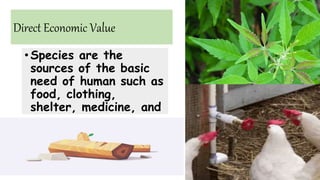
Direct Economic Value
• Species are the
sources of the basic
need of human such as
food, clothing,
shelter, medicine, and
energy.
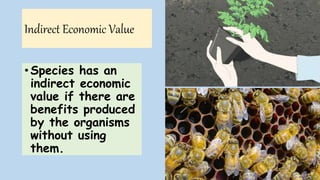
Indirect Economic Value
• Species has an
indirect economic
value if there are
benefits produced
by the organisms
without using
them.
Aesthetic Value
• Lot of species provides
visual or artistic or
enjoyment.
Activity 1: Classifying the Value of
Biodiversity
•As a group, you are going to think of a specific area or
ecosystem.
•You will list down the organisms found in that area
and describe the value of the organism.
• Then you will classify the value by putting a happy
face 🙂 on the space under the correct column
Why Biodiversity is
Important?
• It sustains
through flow of
energy the food
web on earth.
• Contributes to
environmental
stability
Population
• Group of organisms of
the same species that
live in a certain area.
• Ecologist regularly
monitor the numbers
of organisms in many
populations.
Why population’s size increasing or decreasing?
NATALITY MORTALITY
Natality
• The number of births
in a population.
• If the birth rate is
greater than the death
rate, population will
grow.
Mortality
• The number of
organisms that are dying
in a population.
• If the death rate is
greater than the
birthrate, then the
population will decrease.
Population Growth
• A population's growth is limited by
two general factors:
DENSITY-INDEPENDENT
FACTORS
DENSITY-DEPENDENT FACTORS
Density-Independent limiting
factors
• Factors like natural disasters,
temperature, sunlight, and
activities of humans in the
environment.
• Natural disasters such as
tropical cyclones, floods,
earthquakes, and fires will
stop a population from growing
no matter how many organisms
are living in a certain area.
Density-Dependent Limiting Factors
• Come into play when a
population reaches a
certain number of
organisms.
• For example, when
population reaches a
certain size, there
won’t be enough
resources (food,
shelter, water) for all
the organisms.
• Causes the population to stop growing
when it reaches the maximum no. of
organisms that can be supported or
“carried” by the environment.
Graph Analysis
• What is the
carrying capacity?
Why?
• What have you
noticed with the
population of goat
between mid-May
and mid-June?
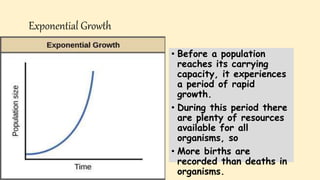
Exponential Growth
• Before a population
reaches its carrying
capacity, it experiences
a period of rapid
growth.
• During this period there
are plenty of resources
available for all
organisms, so
• More births are
recorded than deaths in
organisms.
Logistic Growth
• If the resources is
limited.
• Population growth
stops when it
reaches the carrying
capacity of the
environment.
Limiting Factors that
depend on Population
Density
1. Diseases and Parasites
Infectious diseases and parasites
spread faster in densely
populated area.
2. Competition for Resources
Organisms with better
adaptation to obtain resources
will be able to reproduce more
of often, and its population will
grow.
The organisms that have limited
ability to compete for the
resources will not reproduce as
often, may not be fit enough to
live long, and can cause their
population to decrease
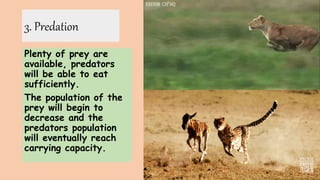
3. Predation
Plenty of prey are
available, predators
will be able to eat
sufficiently.
The population of the
prey will begin to
decrease and the
predators population
will eventually reach
carrying capacity.
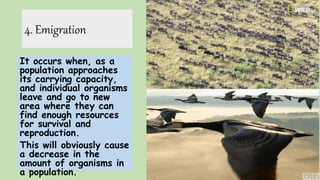
4. Emigration
It occurs when, as a
population approaches
its carrying capacity,
and individual organisms
leave and go to new
area where they can
find enough resources
for survival and
reproduction.
This will obviously cause
a decrease in the
amount of organisms in
a population.

GRADE 10 1ST WEEK.pptx

  • 1.
  • 2.
    Review: _ V _L U _ I _ N E V O L U T I O N
  • 3.
    C H AR L E S D A R W I N C _ A R _ E _ D _ R _ I _
  • 4.
    F O SS I L S _ O _ S _ L S
  • 6.
    Processing Questions. 1. Haveyou already watch this movie? 2. What have you observed in the video? 3. What do you think is the lesson you can get in this movie? 4. How can you protect these kinds of species?
  • 7.
    What is Biodiversity? •Degree of the variation of living organisms in a particular environment. Examples of areas with great biodiversity; • Rainforests • Coral Reefs • Describes how varied living things are in a specific area.
  • 8.
    Organisms • Parts ofbiodiversity • May be economically and ecologically valuable. • Their products can be source of FOODS CLOTHING MEDICINE SHELTER ENERGY
  • 9.
    The value ofspecies can be divided into various categories. 1.Direct Economic Value 2.Indirect Economic Value 3.Aesthetic Value
  • 10.
    Direct Economic Value •Species are the sources of the basic need of human such as food, clothing, shelter, medicine, and energy.
  • 11.
    Indirect Economic Value •Species has an indirect economic value if there are benefits produced by the organisms without using them.
  • 12.
    Aesthetic Value • Lotof species provides visual or artistic or enjoyment.
  • 13.
    Activity 1: Classifyingthe Value of Biodiversity •As a group, you are going to think of a specific area or ecosystem. •You will list down the organisms found in that area and describe the value of the organism. • Then you will classify the value by putting a happy face 🙂 on the space under the correct column
  • 15.
    Why Biodiversity is Important? •It sustains through flow of energy the food web on earth. • Contributes to environmental stability
  • 16.
    Population • Group oforganisms of the same species that live in a certain area. • Ecologist regularly monitor the numbers of organisms in many populations.
  • 17.
    Why population’s sizeincreasing or decreasing? NATALITY MORTALITY
  • 18.
    Natality • The numberof births in a population. • If the birth rate is greater than the death rate, population will grow.
  • 19.
    Mortality • The numberof organisms that are dying in a population. • If the death rate is greater than the birthrate, then the population will decrease.
  • 20.
    Population Growth • Apopulation's growth is limited by two general factors: DENSITY-INDEPENDENT FACTORS DENSITY-DEPENDENT FACTORS
  • 21.
    Density-Independent limiting factors • Factorslike natural disasters, temperature, sunlight, and activities of humans in the environment. • Natural disasters such as tropical cyclones, floods, earthquakes, and fires will stop a population from growing no matter how many organisms are living in a certain area.
  • 22.
    Density-Dependent Limiting Factors •Come into play when a population reaches a certain number of organisms. • For example, when population reaches a certain size, there won’t be enough resources (food, shelter, water) for all the organisms. • Causes the population to stop growing when it reaches the maximum no. of organisms that can be supported or “carried” by the environment.
  • 23.
    Graph Analysis • Whatis the carrying capacity? Why? • What have you noticed with the population of goat between mid-May and mid-June?
  • 24.
    Exponential Growth • Beforea population reaches its carrying capacity, it experiences a period of rapid growth. • During this period there are plenty of resources available for all organisms, so • More births are recorded than deaths in organisms.
  • 25.
    Logistic Growth • Ifthe resources is limited. • Population growth stops when it reaches the carrying capacity of the environment.
  • 26.
    Limiting Factors that dependon Population Density
  • 27.
    1. Diseases andParasites Infectious diseases and parasites spread faster in densely populated area.
  • 28.
    2. Competition forResources Organisms with better adaptation to obtain resources will be able to reproduce more of often, and its population will grow. The organisms that have limited ability to compete for the resources will not reproduce as often, may not be fit enough to live long, and can cause their population to decrease
  • 29.
    3. Predation Plenty ofprey are available, predators will be able to eat sufficiently. The population of the prey will begin to decrease and the predators population will eventually reach carrying capacity.
  • 30.
    4. Emigration It occurswhen, as a population approaches its carrying capacity, and individual organisms leave and go to new area where they can find enough resources for survival and reproduction. This will obviously cause a decrease in the amount of organisms in a population.