Temperate deciduous forest
By Paola Cervantes
World distribution
The Temperate deciduous
forest (tdf) is a forest that is
located in several parts of such
as:
● East United States
● Most of Europe
● East Australia
● East China
● Most of Japan and Korea
● Also the western edge of
British Columbia
● New Zealand
Climatograph
In the Temperate deciduous
Forest it is very rainy! There is
about 50-150 cm of rain each
year in these forests, also during
the winter the temperature
doesn’t fall much (or none)
below zero, during the summer
the temperature is in the range
of 20-25 degrees Celsius.
Abiotic Characteristics
Latitude: They are normally found between the 40°- 60° north
south of the equator

Temperature:Summers range from 20-25°c, Winters are
normally just below or above 0°c

Elevation: The elevation is approx. 900m
Soil: Brown earth soil (fertile soil caused by the fallen leaves in the
fall)
Animals and Plants
Animals:

Plants:

American Bald Eagle

American Beech

American Black Bear

Carpet Moss

Duckbill Platypus

Lady Fern

White-tailed deer

Northern arrowwood

Fat Dormouse

Pecan

Least Weasel

White Birch

Coyote

White Oak
Invasive Species
There are certain invasive species of the Temperate deciduous forest and their
impact
● Asian gypsy moth: It is a voracious pest of trees that threatens habitants.
● Brown fir long-horned beetle: It attacks many of the native conifers.
● Nun moth: It feeds on conifers, and it feed on the vegetation and colonize in lots of
places

●
●

Screwworm:This parasite kills livestock and wildlife
Siberian moth: This moth does the same as the gypsy moth except for the fact that

●

the impact caused by this moth is greater
Tropical bont tick: It produces and spreads a fatal livestock and reduces the milk and
meat production in the area of the habitat
Bioaccumulation
(Bioaccumulation is when toxic substances are consumed by plants or animals, which later on get
eaten by other animals and these toxins build up and become of high concentration because they are
eating the contaminated food.)

What affects my biome is pesticides and pollution because
this is where most get their food from, having certain
polluted areas cause the cycle to begin, also pesticides grow
into the earth and do the same effect.
Predator-prey interactions.
Timber rattlesnakes (predator) prey on small mammals(for
ex. chipmunks.)
Mountain lions (predator) prey on deer.
Each prey and predator have their limits which would be
put to how the forest is built, each animal will have their
own niche with a fair amount of competition for the food.
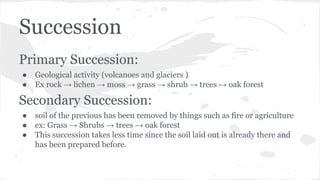
Succession
Primary Succession:
●
●

Geological activity (volcanoes and glaciers )
Ex rock → lichen → moss → grass → shrub → trees → oak forest

Secondary Succession:
●
●
●

soil of the previous has been removed by things such as fire or agriculture
ex: Grass → Shrubs → trees → oak forest
This succession takes less time since the soil laid out is already there and
has been prepared before.
Biotic relationships
Mutualism:Deer and Birds, The bird eat insects off of the deer, the bird
gets food, the deer gets free of insects

Parasitism: Tapeworm and an animal.
Commensalism: A squirrel and a tree, the tree gains nothing but
loses nothing while the squirrel gains shelter and protection.
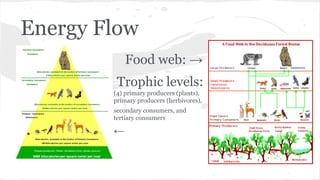
Energy Flow
Food web: →
Trophic levels:
(4) primary producers (plants),
primary producers (herbivores),
secondary consumers, and
tertiary consumers

←
Sources
“Climatograph”-http://www.bbc.co.
uk/schools/gcsebitesize/geography/ecosystems/deciduous_woodlands_rev1.
shtml
“Abiotic Characteristics”- http://www.bbc.co.
uk/schools/gcsebitesize/geography/ecosystems/deciduous_woodlands_rev1.
shtml , http://www.ask.com/question/range-of-elevation-of-a-deciduousforest
“Animals and plants”http://www.blueplanetbiomes.org/deciduous_animal_page.htm
Sources
“Invasive species”http://www.invasivespeciesinfo.gov/animals/notestablished.shtml
“Bioaccumulation”-http://www.thinktrees.
org/my_folders/Manitoba_Model_Forest_Teaching_Kits/Interactions_within
_Forest_Ecosystems.pdf
“Prey-Predator interactions”- http://answers.yahoo.com/question/index?
qid=20111212095234AAJTls3
“Succession”- https://www.marietta.edu/~biol/biomes/succession.htm
Sources
“Biotic relationships”- http://temperatedeciduousforest3rd.weebly.
com/examples-of-mutalism-commensalism-parasitism-and-predator-andprey.html
“Energy Flow” - http://biomed08.wikispaces.com/Deciduous+Forest

Temperate deciduous forest