as a Subject
This is the Scientific World View
1. The universe is understandable.
2. The universe is a vast single system in which
the basic rules everywhere are the same.
3. Scientific ideas are subject to change.
4. Scientific knowledge is durable.
5. Science cannot provide complete answers to
all questions.
NATURE OF SCIENCE
• SCIENCE is defined as
organized knowledge,
sometimes referred to as
empirical knowledge.
• SCIENCE is a field of
scientific inquiry.

 True
 Tested
 In accordance
with facts and
evidences
 Explore
 Probe
 Look deeper
NATURE OF SCIENCE

• SCIENCE is a method, a
technique and a system.

 Activity based
 Discoveryoriented

Anything discovered assumes meaningful and lasting mementos.

• SCIENCE is about nature
and natural phenomena.

 Appreciation for
“the beautiful
and the
wonderful”
NATURE OF SCIENCE

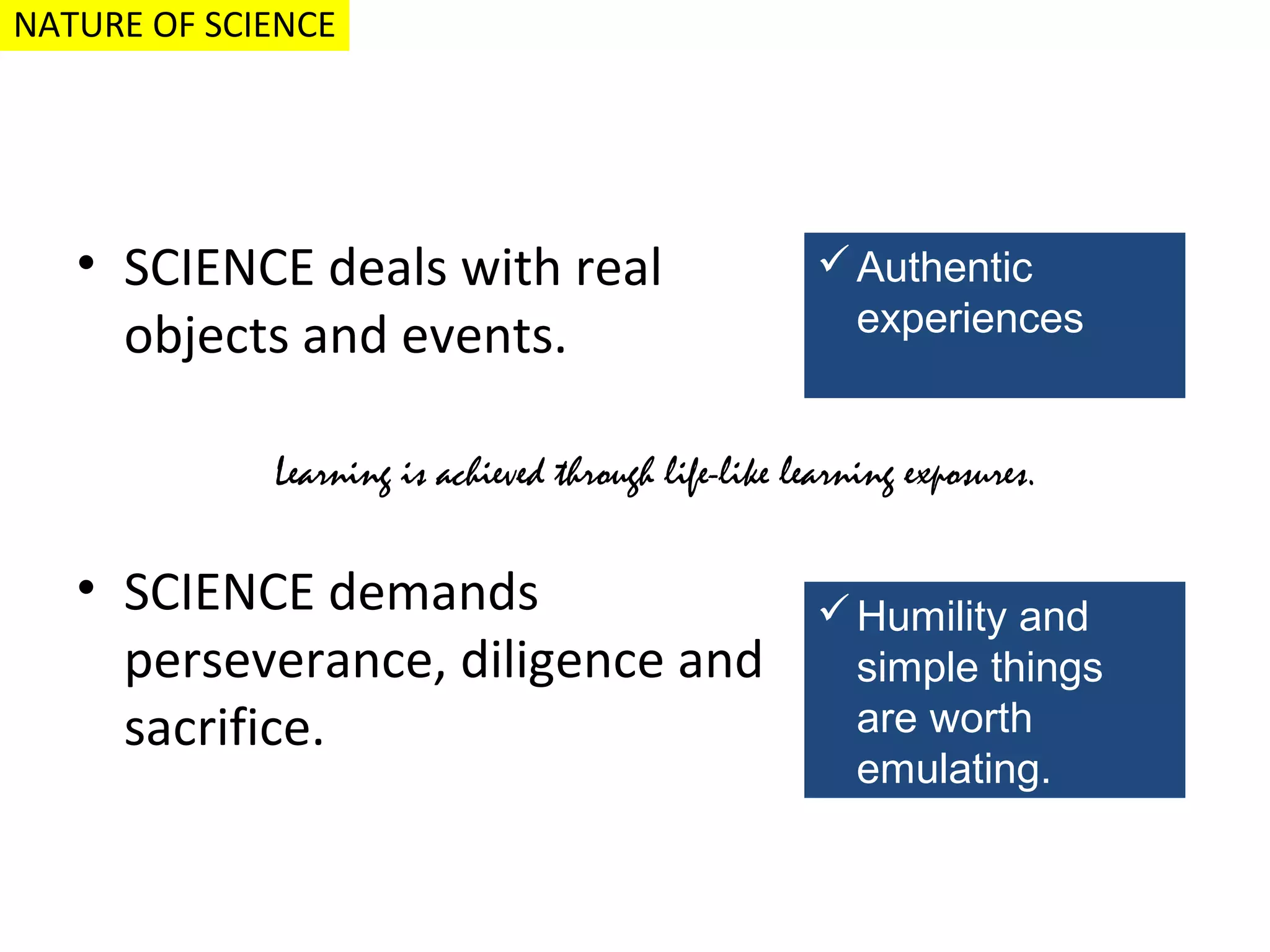
• SCIENCE deals with real
objects and events.

 Authentic
experiences

Learning is achieved through life-like learning exposures.

• SCIENCE demands
perseverance, diligence and
sacrifice.

 Humility and
simple things
are worth
emulating.
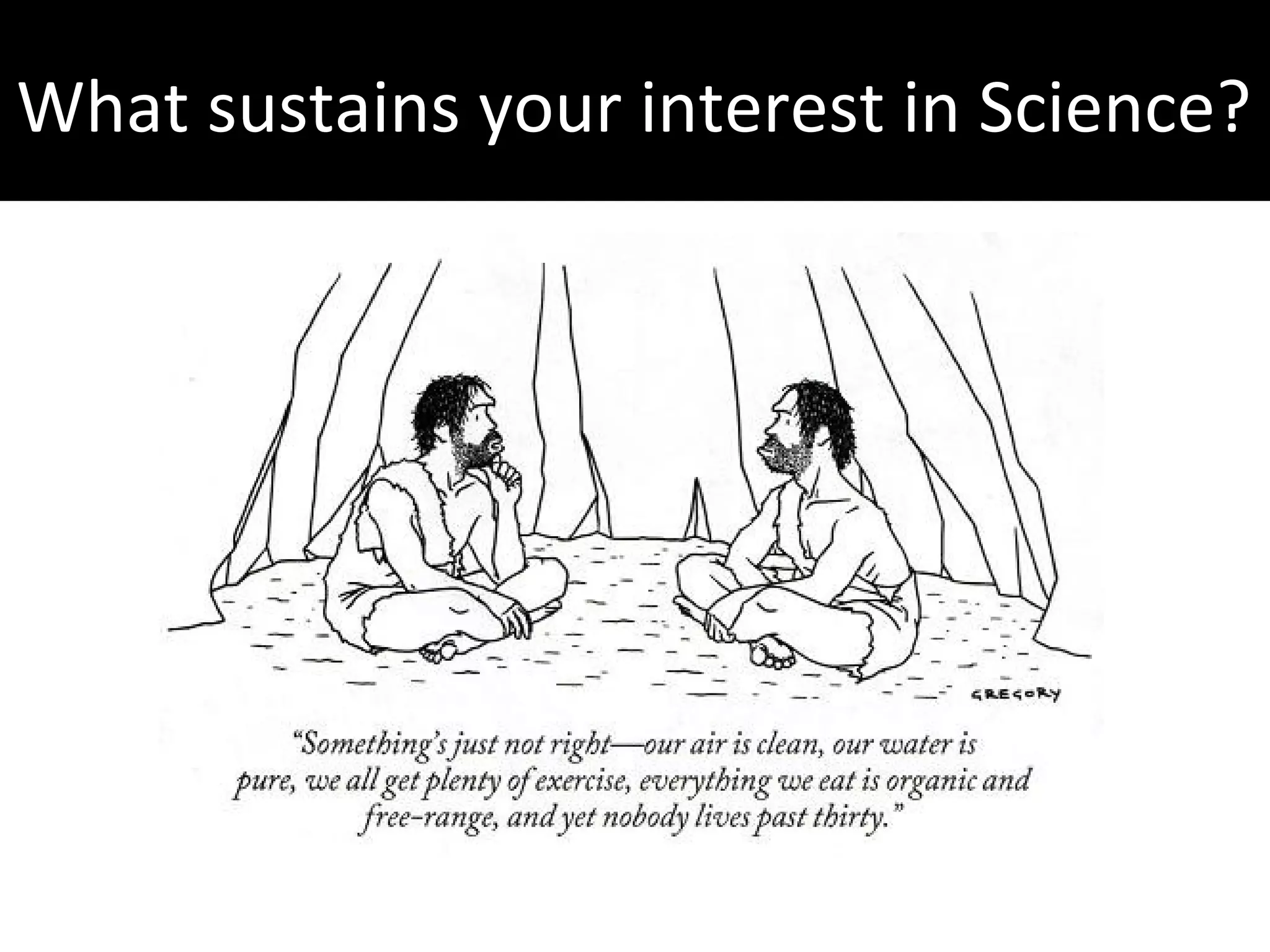
What sustains your interest in Science?
Interest in SCIENCE
• Science as a subject deals with almost
everything in the environment.
• The instructional materials that can be used in
teaching are abundant, rich and easily
available.
• The principles and laws in science when
applied enables us to come up with new and
improved products.
Interest in SCIENCE
• Equipped with scientific knowledge we
become creative.
• Scientific knowledge and procedures make us
competent.
• Science teaching keeps us abreast with
discoveries and inventions, thus at pace with
global trends and modernization.
Goals of

Teaching
GOALS
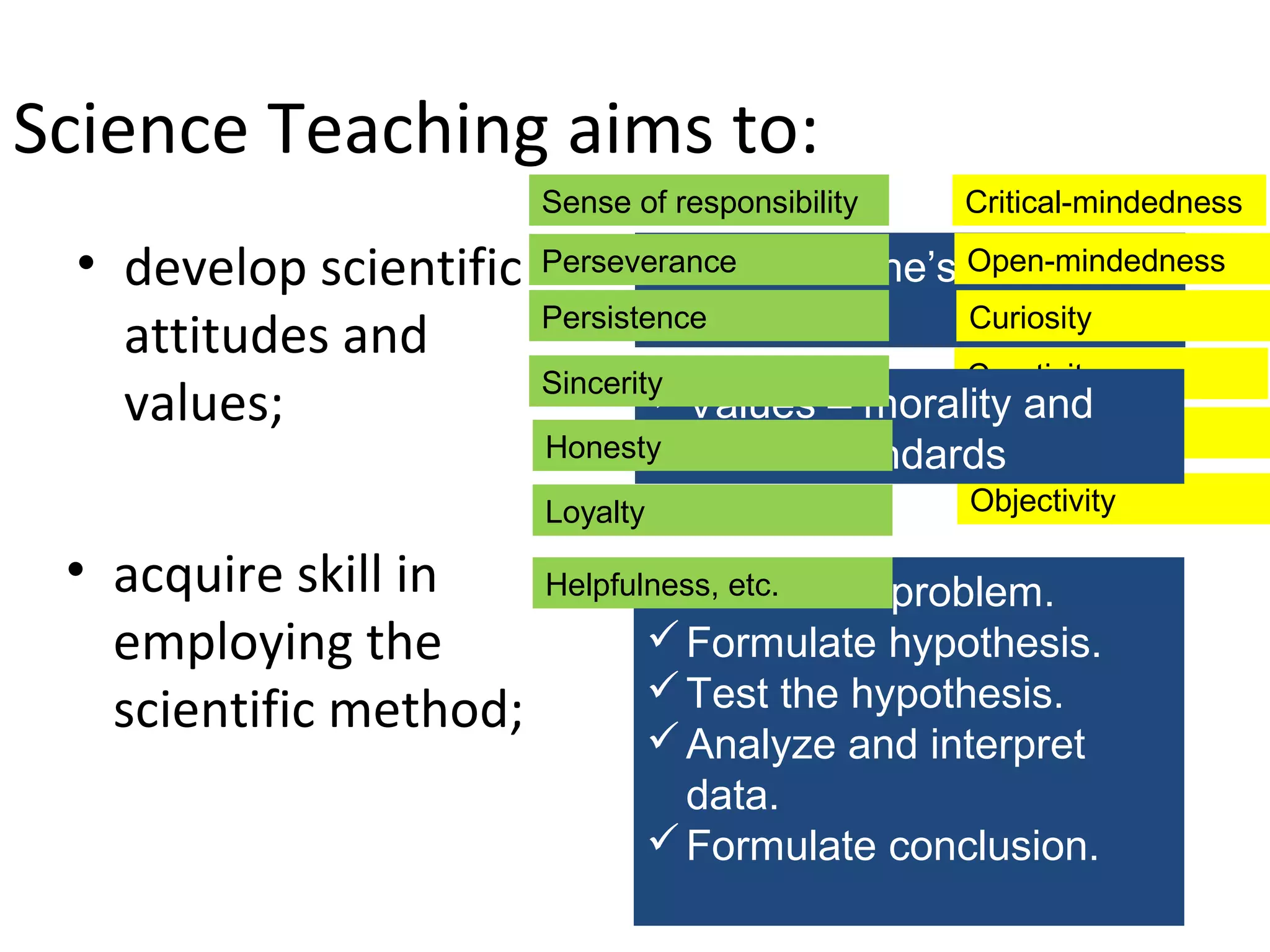
Science Teaching aims to:
Sense of responsibility

• develop scientific
attitudes and
values;

Perseverance
 Attitude-

Critical-mindedness

one’s Open-mindedness
frame of
Curiosity

Sincerity

Creativity

Loyalty

• acquire skill in
employing the
scientific method;

Persistence
mind

Objectivity

 Values – morality and
Persistence
Honesty ethical standards
Helpfulness, etc.
 Define

the problem.
 Formulate hypothesis.
 Test the hypothesis.
 Analyze and interpret
data.
 Formulate conclusion.
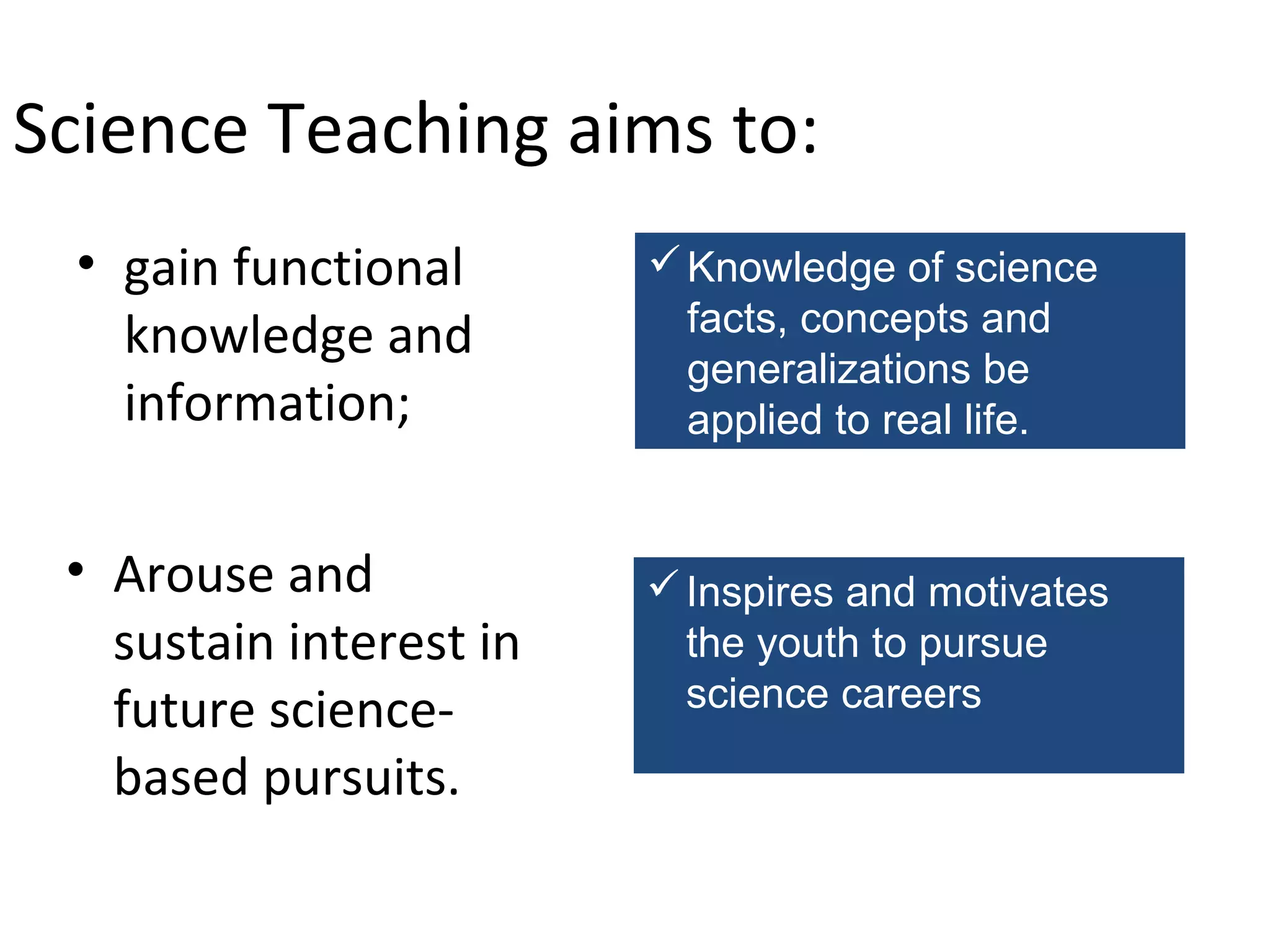
Science Teaching aims to:
• gain functional
knowledge and
information;
• Arouse and
sustain interest in
future sciencebased pursuits.

 Knowledge of science
facts, concepts and
generalizations be
applied to real life.

 Inspires and motivates
the youth to pursue
science careers
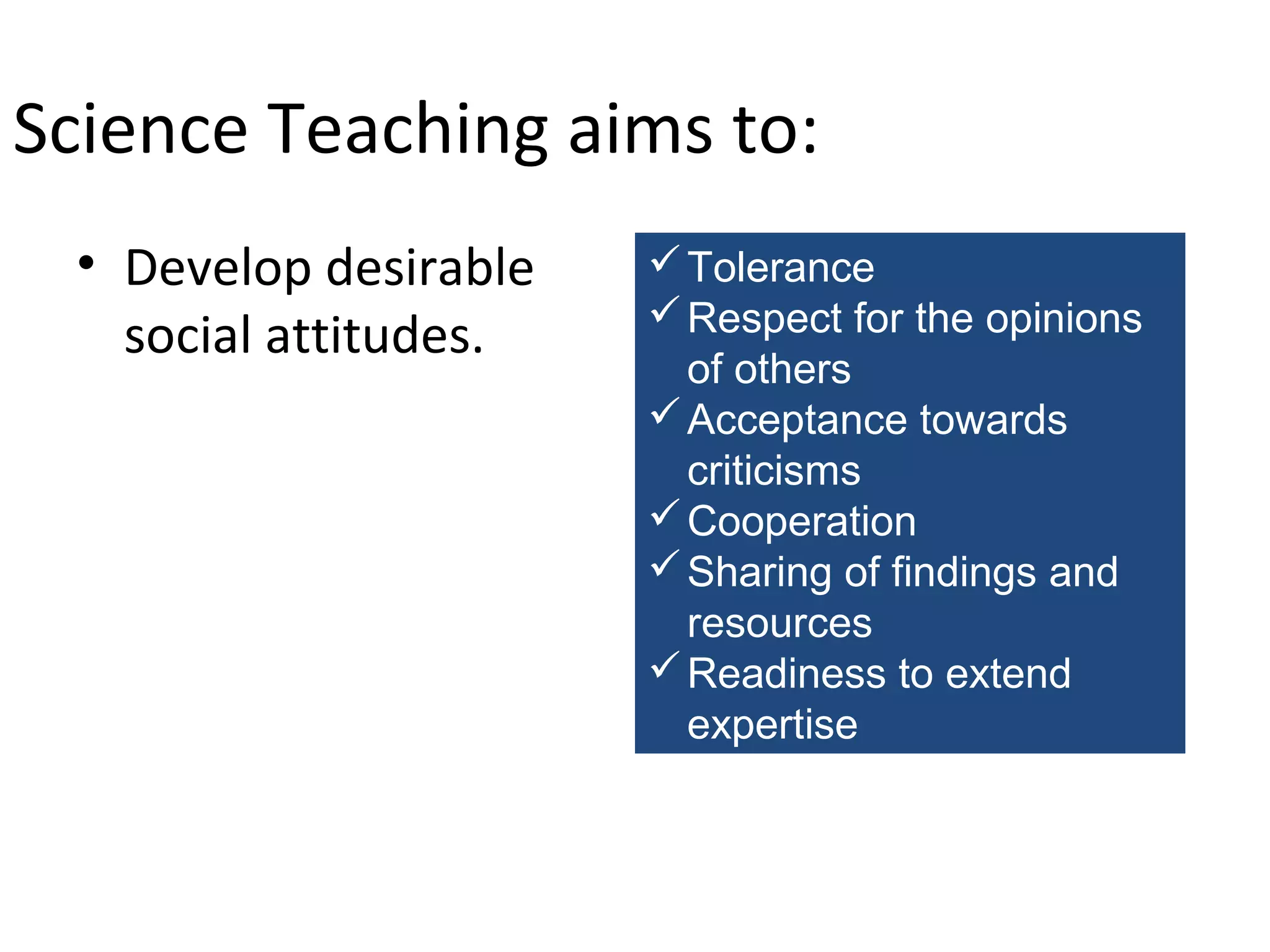
Science Teaching aims to:
• Develop desirable
social attitudes.

 Tolerance
 Respect for the opinions
of others
 Acceptance towards
criticisms
 Cooperation
 Sharing of findings and
resources
 Readiness to extend
expertise
TRANSLATING GOALS
INTO INSTRUCTIONAL
OBJECTIVES
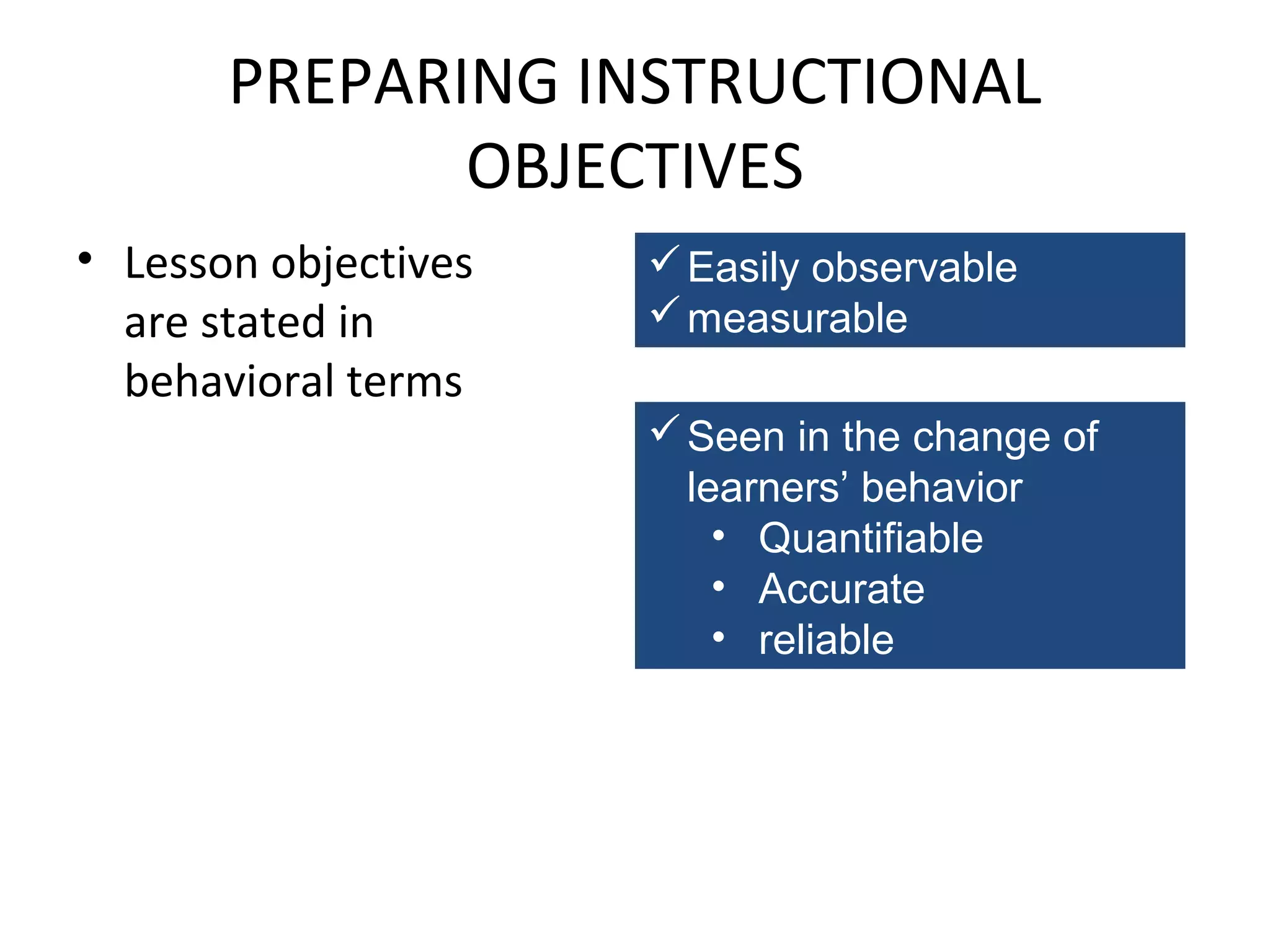
PREPARING INSTRUCTIONAL
OBJECTIVES
• Lesson objectives
are stated in
behavioral terms

 Easily observable
 measurable
 Seen in the change of
learners’ behavior
• Quantifiable
• Accurate
• reliable
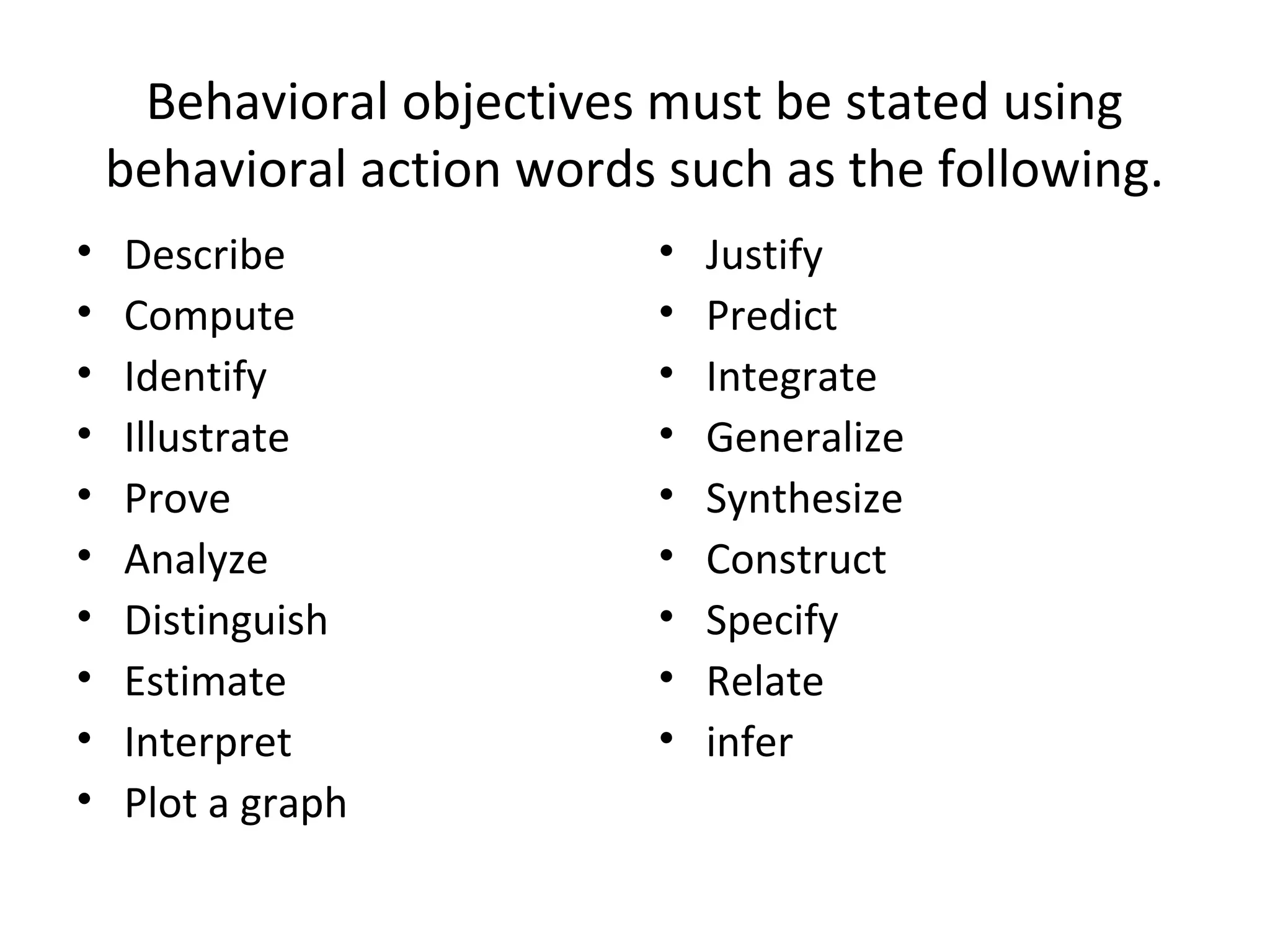
Behavioral objectives must be stated using
behavioral action words such as the following.
•
•
•
•
•
•
•
•
•
•

Describe
Compute
Identify
Illustrate
Prove
Analyze
Distinguish
Estimate
Interpret
Plot a graph

•
•
•
•
•
•
•
•
•

Justify
Predict
Integrate
Generalize
Synthesize
Construct
Specify
Relate
infer
OBJECTIVES OF SCIENCE
INTSTRUCTION
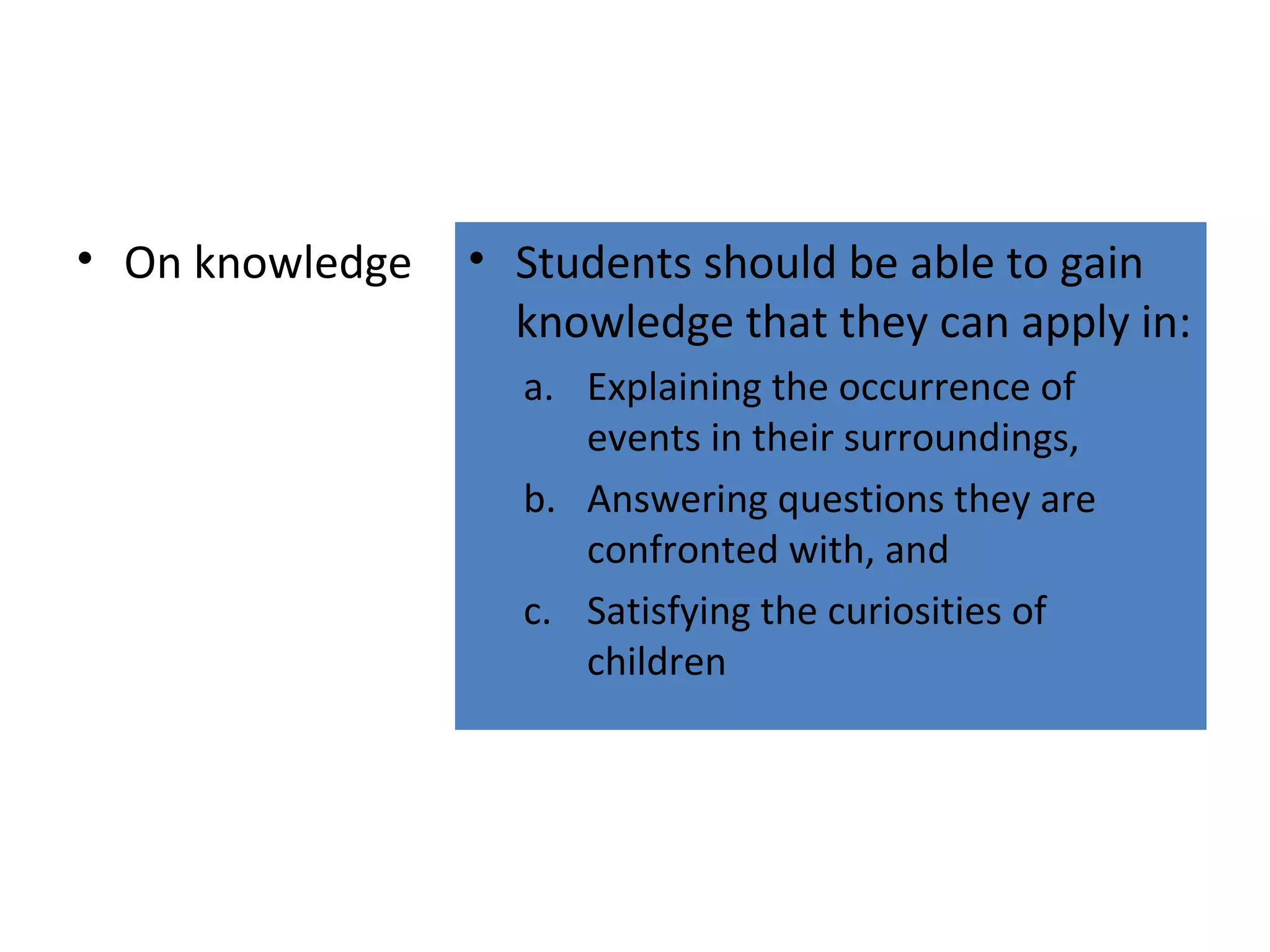
• On knowledge

• Students should be able to gain
knowledge that they can apply in:
a. Explaining the occurrence of
events in their surroundings,
b. Answering questions they are
confronted with, and
c. Satisfying the curiosities of
children
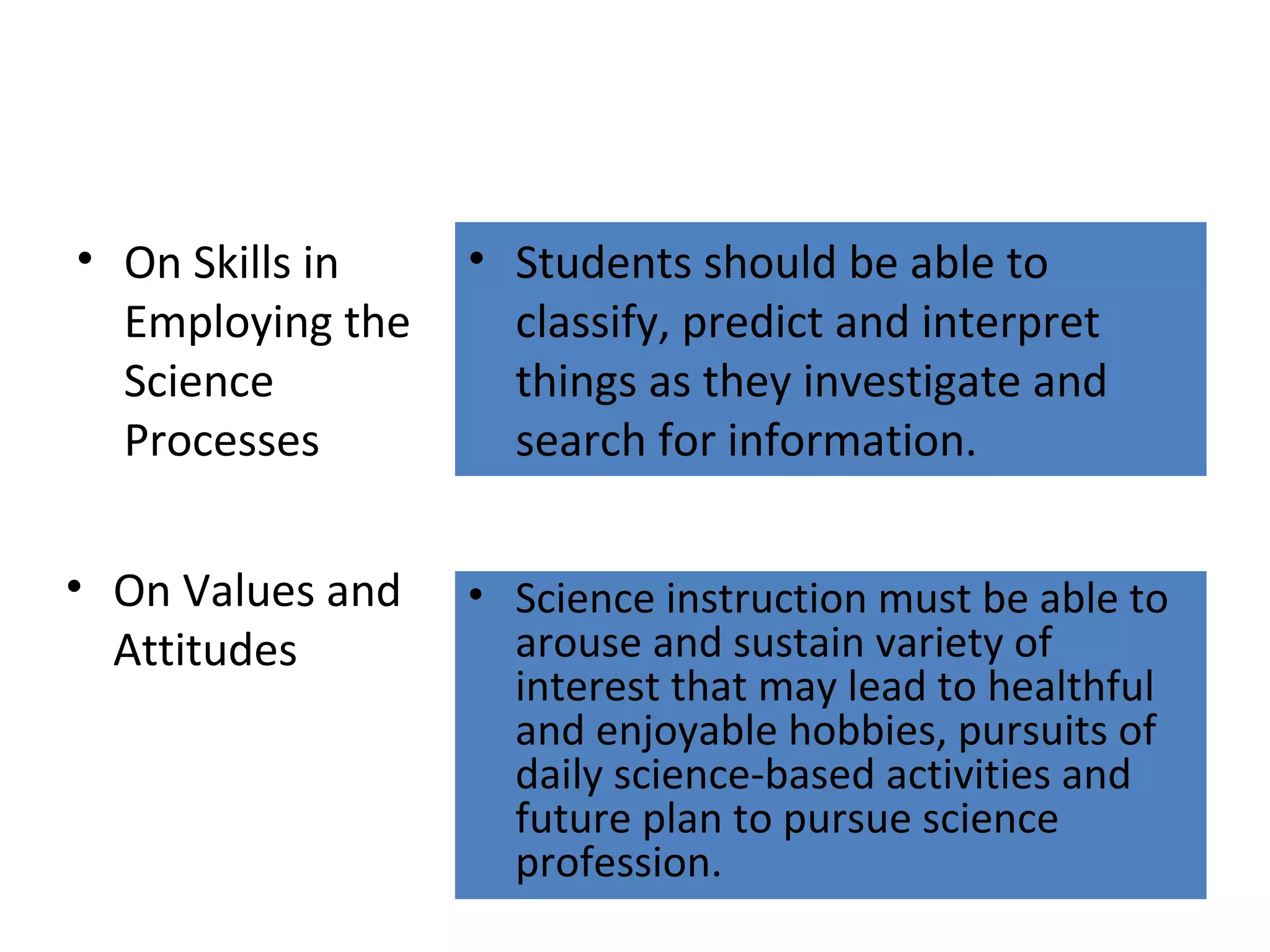
• On Skills in
Employing the
Science
Processes

• Students should be able to
classify, predict and interpret
things as they investigate and
search for information.

• On Values and
Attitudes

• Science instruction must be able to
arouse and sustain variety of
interest that may lead to healthful
and enjoyable hobbies, pursuits of
daily science-based activities and
future plan to pursue science
profession.
THANK YOU

Science as a subject

  • 1.
  • 2.
    This is theScientific World View 1. The universe is understandable. 2. The universe is a vast single system in which the basic rules everywhere are the same. 3. Scientific ideas are subject to change. 4. Scientific knowledge is durable. 5. Science cannot provide complete answers to all questions.
  • 3.
    NATURE OF SCIENCE •SCIENCE is defined as organized knowledge, sometimes referred to as empirical knowledge. • SCIENCE is a field of scientific inquiry.  True  Tested  In accordance with facts and evidences  Explore  Probe  Look deeper
  • 4.
    NATURE OF SCIENCE •SCIENCE is a method, a technique and a system.  Activity based  Discoveryoriented Anything discovered assumes meaningful and lasting mementos. • SCIENCE is about nature and natural phenomena.  Appreciation for “the beautiful and the wonderful”
  • 5.
    NATURE OF SCIENCE •SCIENCE deals with real objects and events.  Authentic experiences Learning is achieved through life-like learning exposures. • SCIENCE demands perseverance, diligence and sacrifice.  Humility and simple things are worth emulating.
  • 6.
    What sustains yourinterest in Science?
  • 7.
    Interest in SCIENCE •Science as a subject deals with almost everything in the environment. • The instructional materials that can be used in teaching are abundant, rich and easily available. • The principles and laws in science when applied enables us to come up with new and improved products.
  • 8.
    Interest in SCIENCE •Equipped with scientific knowledge we become creative. • Scientific knowledge and procedures make us competent. • Science teaching keeps us abreast with discoveries and inventions, thus at pace with global trends and modernization.
  • 9.
  • 10.
  • 11.
    Science Teaching aimsto: Sense of responsibility • develop scientific attitudes and values; Perseverance  Attitude- Critical-mindedness one’s Open-mindedness frame of Curiosity Sincerity Creativity Loyalty • acquire skill in employing the scientific method; Persistence mind Objectivity  Values – morality and Persistence Honesty ethical standards Helpfulness, etc.  Define the problem.  Formulate hypothesis.  Test the hypothesis.  Analyze and interpret data.  Formulate conclusion.
  • 12.
    Science Teaching aimsto: • gain functional knowledge and information; • Arouse and sustain interest in future sciencebased pursuits.  Knowledge of science facts, concepts and generalizations be applied to real life.  Inspires and motivates the youth to pursue science careers
  • 13.
    Science Teaching aimsto: • Develop desirable social attitudes.  Tolerance  Respect for the opinions of others  Acceptance towards criticisms  Cooperation  Sharing of findings and resources  Readiness to extend expertise
  • 14.
  • 15.
    PREPARING INSTRUCTIONAL OBJECTIVES • Lessonobjectives are stated in behavioral terms  Easily observable  measurable  Seen in the change of learners’ behavior • Quantifiable • Accurate • reliable
  • 16.
    Behavioral objectives mustbe stated using behavioral action words such as the following. • • • • • • • • • • Describe Compute Identify Illustrate Prove Analyze Distinguish Estimate Interpret Plot a graph • • • • • • • • • Justify Predict Integrate Generalize Synthesize Construct Specify Relate infer
  • 17.
  • 18.
    • On knowledge •Students should be able to gain knowledge that they can apply in: a. Explaining the occurrence of events in their surroundings, b. Answering questions they are confronted with, and c. Satisfying the curiosities of children
  • 19.
    • On Skillsin Employing the Science Processes • Students should be able to classify, predict and interpret things as they investigate and search for information. • On Values and Attitudes • Science instruction must be able to arouse and sustain variety of interest that may lead to healthful and enjoyable hobbies, pursuits of daily science-based activities and future plan to pursue science profession.
  • 20.