Authentic Learning
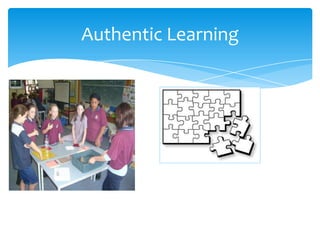
Authentic Learning

Authentic learning is an approach in teaching and learning
that can be used practically. The use of authentic tasks is to
introduce the outside world or practical activities in the
classroom. The learners get to interact socially with one
another and be able to give their point of view based on the
given tasks. In authentic tasks the learners can create and
think critically.
Continue….


Authentic tasks are used in a wide range of classroom
settings, including mathematics, science, and history
classrooms. Furthermore, an increasing number of
instructional programs feature authentic tasks as a
means to situate learning in real-world contexts
(Blumenfeld, Marx, & Harris, 2006).
Characteristics of authentic learning


  Use of open-ended inquiry, thinking skills and
  metacognition.
  Students engage in discourse and social learning in a
  community of learners.
  Students direct their own learning in project work.
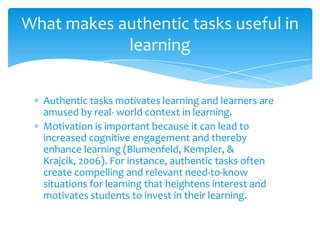
What makes authentic tasks useful in
            learning


  Authentic tasks motivates learning and learners are
  amused by real- world context in learning.
  Motivation is important because it can lead to
  increased cognitive engagement and thereby
  enhance learning (Blumenfeld, Kempler, &
  Krajcik, 2006). For instance, authentic tasks often
  create compelling and relevant need-to-know
  situations for learning that heightens interest and
  motivates students to invest in their learning.
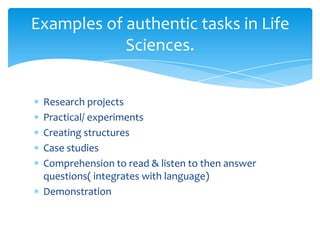
Examples of authentic tasks in Life
            Sciences.


 Research projects
 Practical/ experiments
 Creating structures
 Case studies
 Comprehension to read & listen to then answer
 questions( integrates with language)
 Demonstration
Tradition vs. authentic


 Authentic assessments are "direct" measures of
student performance, tasks are designed to
incorporate the contexts, that students would use in
real life. Traditional are seen as "indirect" measures,
designed to "represent competence" by extracting
knowledge and skills from their real-life contexts.
Conducting authentic tasks
Use of Web technology in reducing
 water pollution in learning ( life
            sciences)
Continue…


Student collaborate in authentic
tasks on how to reduce water
pollution.
Learners will interact with one
another in accomplishing authentic
activities in social context.
Learners can be given an audio
based on water pollution and given
questions, where there are expected
to critically answer questions or
make a research project.
Continue…


    Learners share information online about the factors
    that pollute water.
    Looking at the :
   What is water pollution.
   Factors that pollutes water.
   How can it be reduced
   conclusion
Continue…..


To make things more constructive they must have a
specific educational side where they can share
information e.g. face book page or via e-mail.
Learners can submit their work on the educational
side where the teacher can access all their work
CONCLUSION


Authentic learning is very in important, learners can
work practically and all engaging in that work.
Authentic tasks introduce the real- world practices in
the classroom. Authentic tasks are much better than
traditional tasks, authentic tasks are practical
whereas traditional tasks not practical( face- to
face, question answering) and is also content based
only.
Reference
Blumenfeld, P. C., Marx, R. W. & Harris, C. J.
(2006). Learning environments. New York:
Cambridge University Press.

Blumenfeld, P. C., Kempler, T., & Krajcik, J. S.
(2006). Motivation and cognitive
engagement in learning environment. New
York: Cambridge University Press.

Authentic learning

  • 1.
  • 2.
    Authentic Learning Authentic learningis an approach in teaching and learning that can be used practically. The use of authentic tasks is to introduce the outside world or practical activities in the classroom. The learners get to interact socially with one another and be able to give their point of view based on the given tasks. In authentic tasks the learners can create and think critically.
  • 3.
    Continue…. Authentic tasks areused in a wide range of classroom settings, including mathematics, science, and history classrooms. Furthermore, an increasing number of instructional programs feature authentic tasks as a means to situate learning in real-world contexts (Blumenfeld, Marx, & Harris, 2006).
  • 4.
    Characteristics of authenticlearning Use of open-ended inquiry, thinking skills and metacognition. Students engage in discourse and social learning in a community of learners. Students direct their own learning in project work.
  • 5.
    What makes authentictasks useful in learning Authentic tasks motivates learning and learners are amused by real- world context in learning. Motivation is important because it can lead to increased cognitive engagement and thereby enhance learning (Blumenfeld, Kempler, & Krajcik, 2006). For instance, authentic tasks often create compelling and relevant need-to-know situations for learning that heightens interest and motivates students to invest in their learning.
  • 6.
    Examples of authentictasks in Life Sciences. Research projects Practical/ experiments Creating structures Case studies Comprehension to read & listen to then answer questions( integrates with language) Demonstration
  • 7.
    Tradition vs. authentic Authentic assessments are "direct" measures of student performance, tasks are designed to incorporate the contexts, that students would use in real life. Traditional are seen as "indirect" measures, designed to "represent competence" by extracting knowledge and skills from their real-life contexts.
  • 8.
  • 9.
    Use of Webtechnology in reducing water pollution in learning ( life sciences)
  • 10.
    Continue… Student collaborate inauthentic tasks on how to reduce water pollution. Learners will interact with one another in accomplishing authentic activities in social context. Learners can be given an audio based on water pollution and given questions, where there are expected to critically answer questions or make a research project.
  • 11.
    Continue… Learners share information online about the factors that pollute water. Looking at the :  What is water pollution.  Factors that pollutes water.  How can it be reduced  conclusion
  • 12.
    Continue….. To make thingsmore constructive they must have a specific educational side where they can share information e.g. face book page or via e-mail. Learners can submit their work on the educational side where the teacher can access all their work
  • 13.
    CONCLUSION Authentic learning isvery in important, learners can work practically and all engaging in that work. Authentic tasks introduce the real- world practices in the classroom. Authentic tasks are much better than traditional tasks, authentic tasks are practical whereas traditional tasks not practical( face- to face, question answering) and is also content based only.
  • 14.
    Reference Blumenfeld, P. C.,Marx, R. W. & Harris, C. J. (2006). Learning environments. New York: Cambridge University Press. Blumenfeld, P. C., Kempler, T., & Krajcik, J. S. (2006). Motivation and cognitive engagement in learning environment. New York: Cambridge University Press.