Scholarly vs. Popular Journals
• Research Minute
Clues to a Scholarly Article/Journal
• Usually published or
sponsored by a
professional society or
association
• List of reviewers on the first
few pages (juried,
refereed, peer-reviewed)
• Language of the discipline
• May have the word
“Journal” in title
• Includes references,
bibliography, works cited,
statistics, and/or charts
• Author
information/affiliation
indicated
• Articles are usually lengthy,
and include an Abstract
• In-depth coverage of a
topic, often presentation of
new research
• No illustrations, unless a
chart, cover usually plain
• Articles are indexed in
specialized databases and
indexes, such as PsycInfo
or MLA Bibliography
Clues to a Popular
Article/Magazine
• Written for general public
• Vocabulary for general
usage and reading level
• Author may be not named
• Contains glossy
photographs, catchy
graphics
• Short articles, no
bibliography, footnotes,
references, etc.
• Main purpose to entertain,
sell a product, promote a
viewpoint
• Probably contains a lot of
advertising
• Broad range of topics
• Published by commercial
enterprises or individuals
Goal: $$$
Electronic Resources:
Scholarly vs. Popular
• The more subject-specific
the index, the higher the
probability that the articles
indexed are scholarly.
– PsycINFO indexes more
scholarly articles in
psychology than
Academic Search Complete
• Journal titles with the words
"Journal of the" or "Journal
for the" in the title are
usually scholarly
• Footnotes and/or a
bibliography in online
scholarly articles
• Typically, the longer the
article, the more scholarly
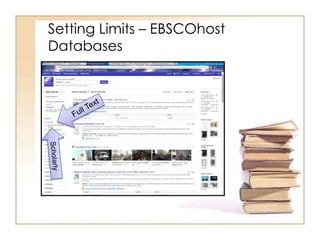
Setting Limits – EBSCOhost
Databases
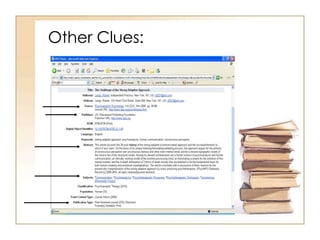
Other Clues:
Other Types of Periodicals
Professional, Trade, Industry
Written for practitioners –
current trends, news, etc.
Commentary & Opinion
Written for general
educated audience –
commentaries, political
opinion, viewpoints
• Newspapers
– Written for general public –
current information, news,
local & regional information,
etc.

Scholarly vs Popular Journal Articles

  • 1.
  • 2.
  • 3.
    Clues to aScholarly Article/Journal • Usually published or sponsored by a professional society or association • List of reviewers on the first few pages (juried, refereed, peer-reviewed) • Language of the discipline • May have the word “Journal” in title
  • 4.
    • Includes references, bibliography,works cited, statistics, and/or charts • Author information/affiliation indicated • Articles are usually lengthy, and include an Abstract
  • 5.
    • In-depth coverageof a topic, often presentation of new research • No illustrations, unless a chart, cover usually plain • Articles are indexed in specialized databases and indexes, such as PsycInfo or MLA Bibliography
  • 6.
    Clues to aPopular Article/Magazine • Written for general public • Vocabulary for general usage and reading level • Author may be not named • Contains glossy photographs, catchy graphics
  • 7.
    • Short articles,no bibliography, footnotes, references, etc. • Main purpose to entertain, sell a product, promote a viewpoint • Probably contains a lot of advertising
  • 8.
    • Broad rangeof topics • Published by commercial enterprises or individuals Goal: $$$
  • 9.
    Electronic Resources: Scholarly vs.Popular • The more subject-specific the index, the higher the probability that the articles indexed are scholarly. – PsycINFO indexes more scholarly articles in psychology than Academic Search Complete
  • 10.
    • Journal titleswith the words "Journal of the" or "Journal for the" in the title are usually scholarly • Footnotes and/or a bibliography in online scholarly articles • Typically, the longer the article, the more scholarly
  • 11.
    Setting Limits –EBSCOhost Databases
  • 12.
  • 13.
    Other Types ofPeriodicals Professional, Trade, Industry Written for practitioners – current trends, news, etc. Commentary & Opinion Written for general educated audience – commentaries, political opinion, viewpoints
  • 14.
    • Newspapers – Writtenfor general public – current information, news, local & regional information, etc.