A Closer Look at Periodicals
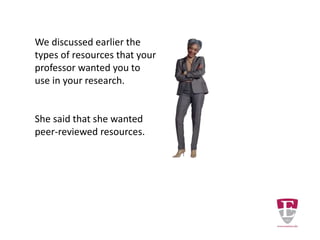
We discussed earlier the
types of resources that your
professor wanted you to
use in your research.
She said that she wanted
peer-reviewed resources.
Periodicals are the most
common source of peer-
reviewed content.
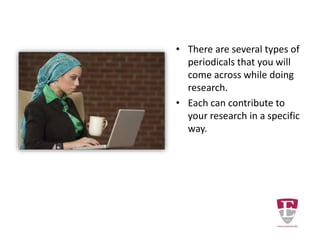
However, there are several
types of periodicals that you
will come across while doing
research.
Each type can contribute to
your research in a specific
way.
Popular Magazines
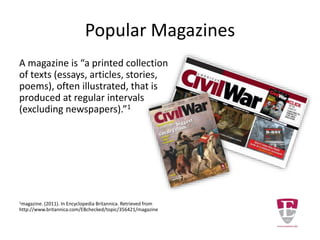
A magazine is “a printed collection
of texts (essays, articles, stories,
poems), often illustrated, that is
produced at regular intervals
(excluding newspapers).”1
1magazine. (2011). In Encyclopedia Britannica. Retrieved from
http://www.britannica.com/EBchecked/topic/356421/magazine
What makes a popular periodical?
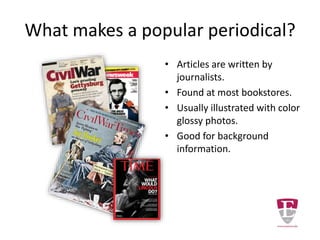
• Articles are written by
journalists.
• Found at most bookstores.
• Usually illustrated with color
glossy photos.
• Good for background
information.
Trade and Technical Periodical
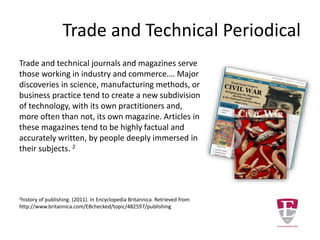
Trade and technical journals and magazines serve
those working in industry and commerce…. Major
discoveries in science, manufacturing methods, or
business practice tend to create a new subdivision
of technology, with its own practitioners and,
more often than not, its own magazine. Articles in
these magazines tend to be highly factual and
accurately written, by people deeply immersed in
their subjects. 2
2history of publishing. (2011). In Encyclopedia Britannica. Retrieved from
http://www.britannica.com/EBchecked/topic/482597/publishing
What makes a trade periodical?
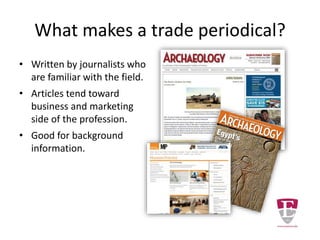
• Written by journalists who
are familiar with the field.
• Articles tend toward
business and marketing
side of the profession.
• Good for background
information.
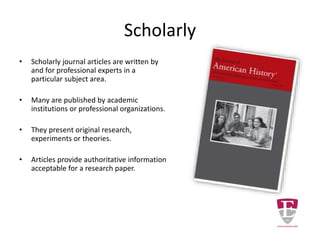
Scholarly
• Scholarly journal articles are written by and
for professional experts in a particular
subject area.
• Many are published by academic institutions
or professional organizations.
• They present original research, experiments
or theories.
• Articles provide authoritative and verifiable
information acceptable for a research paper.
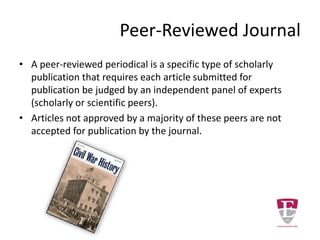
Peer-Reviewed Journal
• We discussed earlier that q peer-reviewed periodical is a
specific type of scholarly publication that requires each article
submitted for publication be judged by an independent panel
of experts (scholarly or scientific peers).
• Articles not approved by a majority of these peers are not
accepted for publication by the journal.
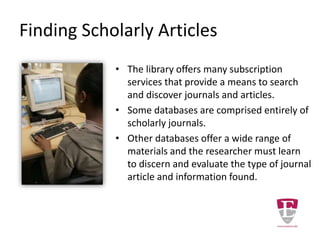
Finding Scholarly Articles
• The library offers many subscription
services that provide a means to search
and discover journals and articles.
• Some databases are comprised entirely of
scholarly journals.
• Other databases offer a wide range of
materials and the researcher must learn
to discern and evaluate the type of journal
article and information found.
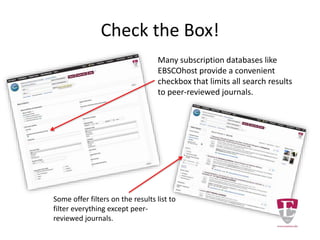
Check the Box!
Many subscription databases like
EBSCOhost provide a convenient
checkbox that limits all search results
to peer-reviewed journals.
Some offer filters on the results list to
eliminate everything except peer-
reviewed journals.
All Peer-Reviewed!
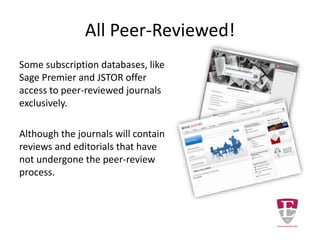
Some subscription databases, like
Sage Premier and JSTOR offer
access to peer-reviewed journals
exclusively.
Although the journals will contain
reviews and editorials that have
not undergone the peer-review
process.
Anatomy of a Peer-Reviewed Article
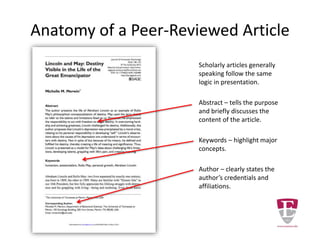
Scholarly articles generally
speaking follow the same
logic in presentation.
Abstract – tells the purpose
and briefly discusses the
content of the article.
Keywords – highlight major
concepts.
Author – clearly states the
author’s credentials and
affiliations.
Beginning and Ending of a
Scholarly Article
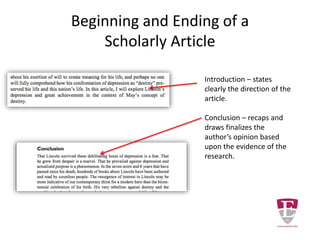
Introduction – states
clearly the direction of the
article.
Conclusion – recaps and
finalizes the author’s
opinion based upon the
evidence of the research.
The Body
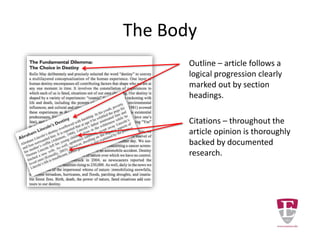
Outline – article follows a
logical progression clearly
marked out by section
headings.
Citations – throughout the
article opinion is thoroughly
backed by documented
research.
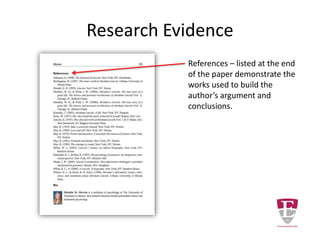
Research Evidence
References – listed at the end
of the paper demonstrate the
works used to build the
author’s argument and
conclusions.
Conclusion
Generally scholarly peer-reviewed articles
follow the same plan.
• Author’s Credentials and Affiliation
• Abstract (article in short form)
• Keywords
• Introduction (statement of purpose and
direction)
• Body (with citations to defend the argument)
• Conclusion (summation and final defense of
the argument)
• References (all the research used by the
author)
Next we’ll look at books for academic research.
We’ll answer the question
“Do we still need books?”

Closer Look at Periodicals

  • 1.
    A Closer Lookat Periodicals
  • 2.
    We discussed earlierthe types of resources that your professor wanted you to use in your research. She said that she wanted peer-reviewed resources. Periodicals are the most common source of peer- reviewed content.
  • 3.
    However, there areseveral types of periodicals that you will come across while doing research. Each type can contribute to your research in a specific way.
  • 4.
    Popular Magazines A magazineis “a printed collection of texts (essays, articles, stories, poems), often illustrated, that is produced at regular intervals (excluding newspapers).”1 1magazine. (2011). In Encyclopedia Britannica. Retrieved from http://www.britannica.com/EBchecked/topic/356421/magazine
  • 5.
    What makes apopular periodical? • Articles are written by journalists. • Found at most bookstores. • Usually illustrated with color glossy photos. • Good for background information.
  • 6.
    Trade and TechnicalPeriodical Trade and technical journals and magazines serve those working in industry and commerce…. Major discoveries in science, manufacturing methods, or business practice tend to create a new subdivision of technology, with its own practitioners and, more often than not, its own magazine. Articles in these magazines tend to be highly factual and accurately written, by people deeply immersed in their subjects. 2 2history of publishing. (2011). In Encyclopedia Britannica. Retrieved from http://www.britannica.com/EBchecked/topic/482597/publishing
  • 7.
    What makes atrade periodical? • Written by journalists who are familiar with the field. • Articles tend toward business and marketing side of the profession. • Good for background information.
  • 8.
    Scholarly • Scholarly journalarticles are written by and for professional experts in a particular subject area. • Many are published by academic institutions or professional organizations. • They present original research, experiments or theories. • Articles provide authoritative and verifiable information acceptable for a research paper.
  • 9.
    Peer-Reviewed Journal • Wediscussed earlier that q peer-reviewed periodical is a specific type of scholarly publication that requires each article submitted for publication be judged by an independent panel of experts (scholarly or scientific peers). • Articles not approved by a majority of these peers are not accepted for publication by the journal.
  • 10.
    Finding Scholarly Articles •The library offers many subscription services that provide a means to search and discover journals and articles. • Some databases are comprised entirely of scholarly journals. • Other databases offer a wide range of materials and the researcher must learn to discern and evaluate the type of journal article and information found.
  • 11.
    Check the Box! Manysubscription databases like EBSCOhost provide a convenient checkbox that limits all search results to peer-reviewed journals. Some offer filters on the results list to eliminate everything except peer- reviewed journals.
  • 12.
    All Peer-Reviewed! Some subscriptiondatabases, like Sage Premier and JSTOR offer access to peer-reviewed journals exclusively. Although the journals will contain reviews and editorials that have not undergone the peer-review process.
  • 13.
    Anatomy of aPeer-Reviewed Article Scholarly articles generally speaking follow the same logic in presentation. Abstract – tells the purpose and briefly discusses the content of the article. Keywords – highlight major concepts. Author – clearly states the author’s credentials and affiliations.
  • 14.
    Beginning and Endingof a Scholarly Article Introduction – states clearly the direction of the article. Conclusion – recaps and finalizes the author’s opinion based upon the evidence of the research.
  • 15.
    The Body Outline –article follows a logical progression clearly marked out by section headings. Citations – throughout the article opinion is thoroughly backed by documented research.
  • 16.
    Research Evidence References –listed at the end of the paper demonstrate the works used to build the author’s argument and conclusions.
  • 17.
    Conclusion Generally scholarly peer-reviewedarticles follow the same plan. • Author’s Credentials and Affiliation • Abstract (article in short form) • Keywords • Introduction (statement of purpose and direction) • Body (with citations to defend the argument) • Conclusion (summation and final defense of the argument) • References (all the research used by the author)
  • 18.
    Next we’ll lookat books for academic research. We’ll answer the question “Do we still need books?”