

MORE THAN BOOKS:
SELECTION AND
ACQUISITION OF NON-
BOOKS MATERIALS
SERIALS:
SERIALS:
ALA define serial as “a publication issued in
successive parts, usually at regular intervals and
as a rule, intended to be continued indefinitely.
Serials include periodicals, annuals, magazines,
newspapers, tabloids, proceedings, transactions
of societies and memoirs.”
SERIALS: SAMPLES
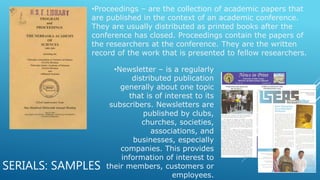
•Proceedings – are the collection of academic papers that
are published in the context of an academic conference.
They are usually distributed as printed books after the
conference has closed. Proceedings contain the papers of
the researchers at the conference. They are the written
record of the work that is presented to fellow researchers.
•Newsletter – is a regularly
distributed publication
generally about one topic
that is of interest to its
subscribers. Newsletters are
published by clubs,
churches, societies,
associations, and
businesses, especially
companies. This provides
information of interest to
their members, customers or
employees.
SERIALS: SAMPLES
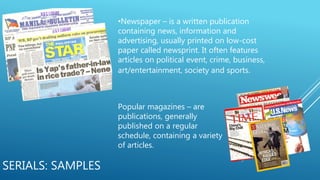
•Newspaper – is a written publication
containing news, information and
advertising, usually printed on low-cost
paper called newsprint. It often features
articles on political event, crime, business,
art/entertainment, society and sports.
Popular magazines – are
publications, generally
published on a regular
schedule, containing a variety
of articles.
SERIALS: SAMPLES
• Referred materials are of high quality. The contents,
articles and manuscripts included in these publications
are reviewed and evaluated by experts. The purpose of
this is to protect, maintain and raise the quality of
scholarly materials published in serials.
• This must contain graph and charts
• Author includes a list of cited sources in footnotes and/or
bibliography
• Includes limited advertisements related to that example :
scholarly books or publication subject field
• Terminology used is specific to a subject discipline
• Found in libraries and other academic, medical or
scientific settings
• Articles approved by author’s peers of Editorial Boards
• Long articles 7 + pages.JOURNAL
FACTORS WHICH AFFECT THE
DECISION IN SELECTING SERIALS
A decision to subscribe to or place a standing order for a serial is a much bigger
decision than for a book.
1. A serial normally implies a long-term commitment, but under some vendors plans,
the renewal is automatic without any further decision from the collection
development staff.
2. Because of the long term commitment, the cost of the subscription become almost
a fixed feature of the budget and each year takes an increasing proportion of the
total materials budgets.
3. Another “fixed” cost is processing.
4. On-going cost to package each serial year after year.
5. Serials are not only taking up an ever-increasing percentage of the total funds
available for collection development, they are also occupying a greater portion of
the available storage space.
6. An important consideration in serials selection is how the patron gains access to the
information each issue contains.
7. Serials have also tendency to increase the volume of photocopying activities.
Photocopying is a legal or a copyright issue.
8. Finally, if a library is not starting a subscription with volume 1 Number 1, the
librarian also make a decision regarding back issues or volumes.
FACTORS WHICH AFFECT THE
DECISION IN SELECTING SERIALS

More than books

  • 1.
    MORE THAN BOOKS: SELECTIONAND ACQUISITION OF NON- BOOKS MATERIALS SERIALS:
  • 2.
    SERIALS: ALA define serialas “a publication issued in successive parts, usually at regular intervals and as a rule, intended to be continued indefinitely. Serials include periodicals, annuals, magazines, newspapers, tabloids, proceedings, transactions of societies and memoirs.”
  • 3.
    SERIALS: SAMPLES •Proceedings –are the collection of academic papers that are published in the context of an academic conference. They are usually distributed as printed books after the conference has closed. Proceedings contain the papers of the researchers at the conference. They are the written record of the work that is presented to fellow researchers. •Newsletter – is a regularly distributed publication generally about one topic that is of interest to its subscribers. Newsletters are published by clubs, churches, societies, associations, and businesses, especially companies. This provides information of interest to their members, customers or employees.
  • 4.
    SERIALS: SAMPLES •Newspaper –is a written publication containing news, information and advertising, usually printed on low-cost paper called newsprint. It often features articles on political event, crime, business, art/entertainment, society and sports. Popular magazines – are publications, generally published on a regular schedule, containing a variety of articles.
  • 5.
    SERIALS: SAMPLES • Referredmaterials are of high quality. The contents, articles and manuscripts included in these publications are reviewed and evaluated by experts. The purpose of this is to protect, maintain and raise the quality of scholarly materials published in serials. • This must contain graph and charts • Author includes a list of cited sources in footnotes and/or bibliography • Includes limited advertisements related to that example : scholarly books or publication subject field • Terminology used is specific to a subject discipline • Found in libraries and other academic, medical or scientific settings • Articles approved by author’s peers of Editorial Boards • Long articles 7 + pages.JOURNAL
  • 6.
    FACTORS WHICH AFFECTTHE DECISION IN SELECTING SERIALS A decision to subscribe to or place a standing order for a serial is a much bigger decision than for a book. 1. A serial normally implies a long-term commitment, but under some vendors plans, the renewal is automatic without any further decision from the collection development staff. 2. Because of the long term commitment, the cost of the subscription become almost a fixed feature of the budget and each year takes an increasing proportion of the total materials budgets. 3. Another “fixed” cost is processing. 4. On-going cost to package each serial year after year.
  • 7.
    5. Serials arenot only taking up an ever-increasing percentage of the total funds available for collection development, they are also occupying a greater portion of the available storage space. 6. An important consideration in serials selection is how the patron gains access to the information each issue contains. 7. Serials have also tendency to increase the volume of photocopying activities. Photocopying is a legal or a copyright issue. 8. Finally, if a library is not starting a subscription with volume 1 Number 1, the librarian also make a decision regarding back issues or volumes. FACTORS WHICH AFFECT THE DECISION IN SELECTING SERIALS