Scholarly Journals vs. Popular Magazines
Instructors often make assignments that require the use of articles from
scholarly or professional trade journals. The terms peer-reviewed,
refereed, academic, or research are also used. It is often difficult,
especially when using online databases or the Internet, to recognize and
decide what an appropriate article is. This handout provides general
guidance in recognizing the difference between scholarly journal articles
and popular magazine articles.
CHARACTERISTICS OF SCHOLARLY JOURNALS
 Articles are usually lengthy.
 Articles usually have cited references at the end.
 Usually illustrated by graphs, charts, or diagrams.
 Written and signed by authorities in the field.
 Purpose - Report on original research or
experimentation.
 Usually contain an abstract, problem statement, and methodology.
 Use vocabulary requiring some knowledge of the subject. Geared towards
scholars, researchers, or professionals.
 Often published by a professional organization or university.
 Usually published on a monthly or quarterly basis.
 Reviewed by panel or board.
 Contain few advertisements.
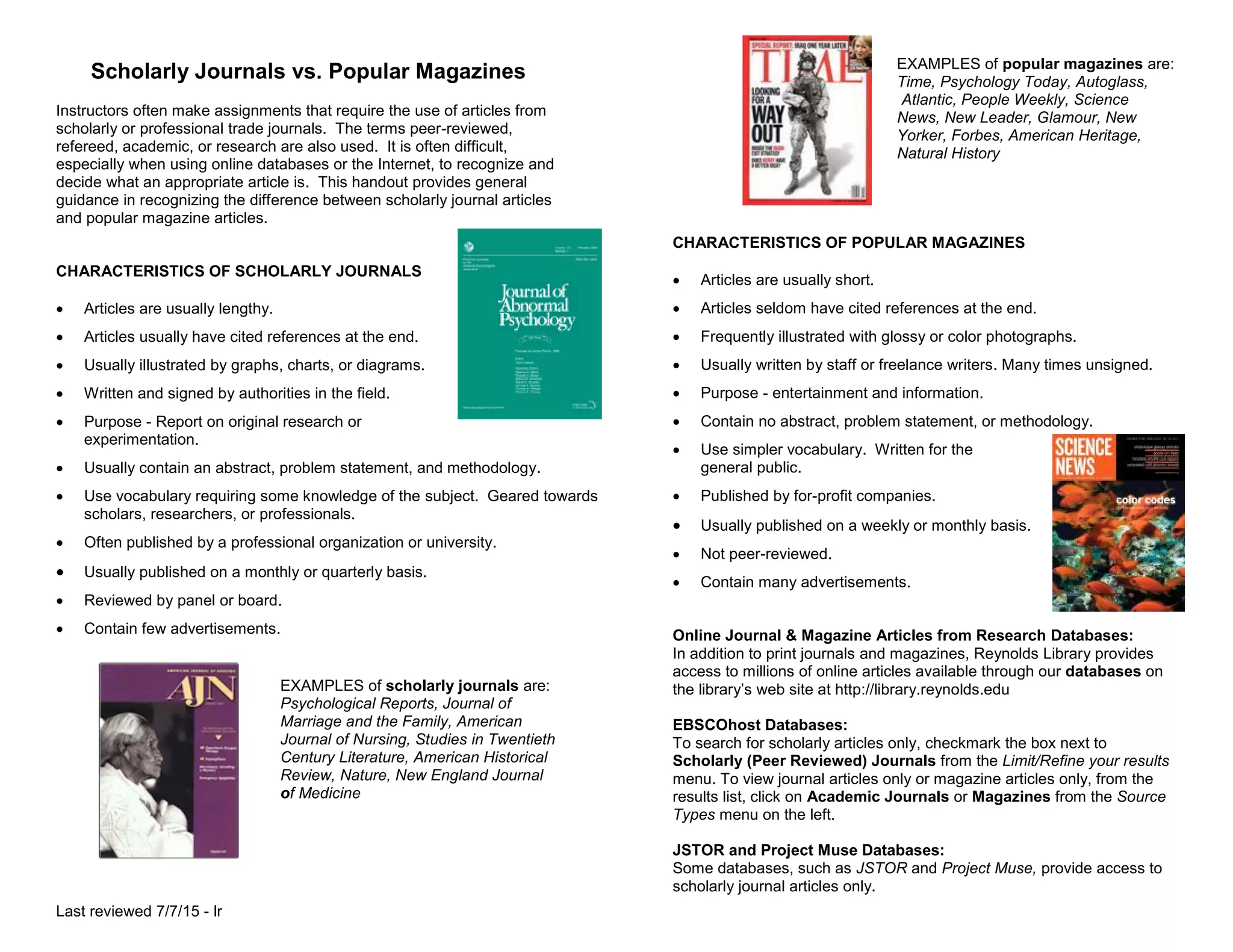
EXAMPLES of scholarly journals are:
Psychological Reports, Journal of
Marriage and the Family, American
Journal of Nursing, Studies in Twentieth
Century Literature, American Historical
Review, Nature, New England Journal
of Medicine
Last reviewed 7/7/15 - lr
EXAMPLES of popular magazines are:
Time, Psychology Today, Autoglass,
Atlantic, People Weekly, Science
News, New Leader, Glamour, New
Yorker, Forbes, American Heritage,
Natural History
CHARACTERISTICS OF POPULAR MAGAZINES
 Articles are usually short.
 Articles seldom have cited references at the end.
 Frequently illustrated with glossy or color photographs.
 Usually written by staff or freelance writers. Many times unsigned.
 Purpose - entertainment and information.
 Contain no abstract, problem statement, or methodology.
 Use simpler vocabulary. Written for the
general public.
 Published by for-profit companies.
 Usually published on a weekly or monthly basis.
 Not peer-reviewed.
 Contain many advertisements.
Online Journal & Magazine Articles from Research Databases:
In addition to print journals and magazines, Reynolds Library provides
access to millions of online articles available through our databases on
the library’s web site at http://library.reynolds.edu
EBSCOhost Databases:
To search for scholarly articles only, checkmark the box next to
Scholarly (Peer Reviewed) Journals from the Limit/Refine your results
menu. To view journal articles only or magazine articles only, from the
results list, click on Academic Journals or Magazines from the Source
Types menu on the left.
JSTOR and Project Muse Databases:
Some databases, such as JSTOR and Project Muse, provide access to
scholarly journal articles only.

Scholarlypopular

  • 1.
    Scholarly Journals vs.Popular Magazines Instructors often make assignments that require the use of articles from scholarly or professional trade journals. The terms peer-reviewed, refereed, academic, or research are also used. It is often difficult, especially when using online databases or the Internet, to recognize and decide what an appropriate article is. This handout provides general guidance in recognizing the difference between scholarly journal articles and popular magazine articles. CHARACTERISTICS OF SCHOLARLY JOURNALS  Articles are usually lengthy.  Articles usually have cited references at the end.  Usually illustrated by graphs, charts, or diagrams.  Written and signed by authorities in the field.  Purpose - Report on original research or experimentation.  Usually contain an abstract, problem statement, and methodology.  Use vocabulary requiring some knowledge of the subject. Geared towards scholars, researchers, or professionals.  Often published by a professional organization or university.  Usually published on a monthly or quarterly basis.  Reviewed by panel or board.  Contain few advertisements. EXAMPLES of scholarly journals are: Psychological Reports, Journal of Marriage and the Family, American Journal of Nursing, Studies in Twentieth Century Literature, American Historical Review, Nature, New England Journal of Medicine Last reviewed 7/7/15 - lr EXAMPLES of popular magazines are: Time, Psychology Today, Autoglass, Atlantic, People Weekly, Science News, New Leader, Glamour, New Yorker, Forbes, American Heritage, Natural History CHARACTERISTICS OF POPULAR MAGAZINES  Articles are usually short.  Articles seldom have cited references at the end.  Frequently illustrated with glossy or color photographs.  Usually written by staff or freelance writers. Many times unsigned.  Purpose - entertainment and information.  Contain no abstract, problem statement, or methodology.  Use simpler vocabulary. Written for the general public.  Published by for-profit companies.  Usually published on a weekly or monthly basis.  Not peer-reviewed.  Contain many advertisements. Online Journal & Magazine Articles from Research Databases: In addition to print journals and magazines, Reynolds Library provides access to millions of online articles available through our databases on the library’s web site at http://library.reynolds.edu EBSCOhost Databases: To search for scholarly articles only, checkmark the box next to Scholarly (Peer Reviewed) Journals from the Limit/Refine your results menu. To view journal articles only or magazine articles only, from the results list, click on Academic Journals or Magazines from the Source Types menu on the left. JSTOR and Project Muse Databases: Some databases, such as JSTOR and Project Muse, provide access to scholarly journal articles only.