Academic Research & Writing
Start with a solid research topic. Consider: What do you know on the subject? Who will your audience be? What do they already know about it? What do you want to inform your audience about? Before you start searching for information, brainstorm and choose a research topic.
Once you choose a topic, decide what your “angle” or goal will be. Will you be proving a point? Making a case? Analyzing information? It is important determine the goal of your paper, so that you can find the best genre to meet your writing needs.
The most common genres for academic, research-based writing are: Analytical  Offers a critical interpretation on a subject, shows the writer’s “analysis” of the subject-matter. Does not take a stance. Explores existing information and tries to present a new understanding. Argumentative Takes a stance on a topic and tries to persuade readers to agree with the writer’s position. Both genres require that the writer support their points with authoritative information from credible, scholarly sources.
Once you choose a subject and an angle, it is time to start searching for information to support your ideas. By searching for and reading articles related to your subject, you will: Understand the different views proposed by other writers and experts Find information and data to support your arguments  Become an informed writer
Library Databases and news banks: http://www.stu.edu/eResearch   The library’s E-Research page provides direct access to a variety of general and subject-specific databases, including full-text databases.
Library Databases vs. Online Search Engines Authority Scholarly Credibility
A good place to start your research. ABI/INFORM Academic Search Premier ProQuest Central General Reference Center InfoTrac/InfoTrac OneFile Not sure how to start your research…  Ask your STU librarians!
General Business File ASAP (Gale)   Health Business Elite (EBSCO) LexisNexis Academic Mergent Online   Statistical Datasets ProQuest Central Your source for reference assistance:  Larry Treadwell:  [email_address]
SportDiscus   ABI/INFORM   Academic Search Premier
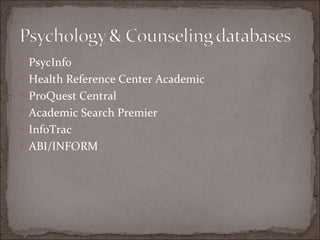
PsycInfo Health Reference Center Academic ProQuest Central Academic Search Premier InfoTrac ABI/INFORM
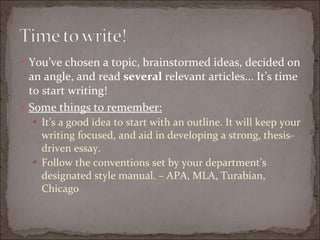
You’ve chosen a topic, brainstormed ideas, decided on an angle, and read  several  relevant articles... It’s time to start writing! Some things to remember: It’s a good idea to start with an outline. It will keep your writing focused, and aid in developing a strong, thesis-driven essay. Follow the conventions set by your department’s designated style manual. – APA, MLA, Turabian, Chicago

Library Research & Graduate Writing

  • 1.
  • 2.
    Start with asolid research topic. Consider: What do you know on the subject? Who will your audience be? What do they already know about it? What do you want to inform your audience about? Before you start searching for information, brainstorm and choose a research topic.
  • 3.
    Once you choosea topic, decide what your “angle” or goal will be. Will you be proving a point? Making a case? Analyzing information? It is important determine the goal of your paper, so that you can find the best genre to meet your writing needs.
  • 4.
    The most commongenres for academic, research-based writing are: Analytical Offers a critical interpretation on a subject, shows the writer’s “analysis” of the subject-matter. Does not take a stance. Explores existing information and tries to present a new understanding. Argumentative Takes a stance on a topic and tries to persuade readers to agree with the writer’s position. Both genres require that the writer support their points with authoritative information from credible, scholarly sources.
  • 5.
    Once you choosea subject and an angle, it is time to start searching for information to support your ideas. By searching for and reading articles related to your subject, you will: Understand the different views proposed by other writers and experts Find information and data to support your arguments Become an informed writer
  • 6.
    Library Databases andnews banks: http://www.stu.edu/eResearch The library’s E-Research page provides direct access to a variety of general and subject-specific databases, including full-text databases.
  • 7.
    Library Databases vs.Online Search Engines Authority Scholarly Credibility
  • 8.
    A good placeto start your research. ABI/INFORM Academic Search Premier ProQuest Central General Reference Center InfoTrac/InfoTrac OneFile Not sure how to start your research… Ask your STU librarians!
  • 9.
    General Business FileASAP (Gale)   Health Business Elite (EBSCO) LexisNexis Academic Mergent Online   Statistical Datasets ProQuest Central Your source for reference assistance: Larry Treadwell: [email_address]
  • 10.
    SportDiscus   ABI/INFORM  Academic Search Premier
  • 11.
    PsycInfo Health ReferenceCenter Academic ProQuest Central Academic Search Premier InfoTrac ABI/INFORM
  • 12.
    You’ve chosen atopic, brainstormed ideas, decided on an angle, and read several relevant articles... It’s time to start writing! Some things to remember: It’s a good idea to start with an outline. It will keep your writing focused, and aid in developing a strong, thesis-driven essay. Follow the conventions set by your department’s designated style manual. – APA, MLA, Turabian, Chicago

Editor's Notes

  • #8 Authority: library databases provide access to authoritative, scholarly, credible sources that undergo a rigorous publication process. These works are published and recognized by experts in their respective fields. Anyone can publish information on the open web. The web is a good place for general information on a topic, but scholarly research requires scholarly sources, most of which are unavailable on the open web.