Books
Particularly scholarly books
Adapted from Jim Alderman’s “Beginning Library & Information Systems Strategies”, 2014.
Role in Research
Books can be invaluable sources for research. Some are written with a more
general or popular audience in mind and others target a technical or
occupational audience, while others focus on an academic/scholarly audience.
Just like articles, which we covered in a previous unit.
Book Features
Features that can be of benefit to researchers include:
• References
• Key concepts & Terminology
• Detailed Index or Table of Contents
• Charts, tables, graphs, and other illustrative materials
• Literature surveys or reviews
References
Scholarly works (usually) will document sources used in developing concepts and ideas
treated within them.*
Bibliographies included in books will provide researchers with names of seminal works
in the field as well as with names of key authorities in their areas of interest.
*This is true for quality secondary sources and some tertiary ones.
Key concepts & Terminology
Researchers starting an investigation of a topic will likely need to identify key
concepts and terminology in order to effectively search databases for relevant
current literature.
So, books, because of the depth which they cover their topics, are prime
sources to use for finding proper vocabulary to use in searches.
Often books will also point out research needs that have yet to be fulfilled,
which can provide ideas for future research directions.
Detailed Index or Table of Contents
An index is valuable because it helps researchers quickly locate information
within the book.
If there isn’t an index, ideally there will be a very detailed table of contents.
You may not find a book devoted entirely to your topic, but there may be a
chapter or section about it in another work—indexes and table of contents can
help you find these parts.
Charts, tables, graphs, and other illustrative
materials
Often books will include illustrative materials that help clarify concepts that are
covered.
Literature surveys or reviews
Many academic publications routinely include literature surveys or reviews.
(Literature in this sense is different than what you learn about in English
classes.)
A part of the research process is to identify key works of literature that have
been produced before launching into new studies.
For example, if I am researching the biological traits of a dachshund, before I
begin writing, I need to know what research has already been done and what’s
been found in order to situate my new study in the conversation and in context.
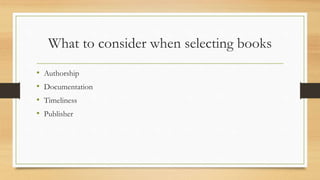
What to consider when selecting books
• Authorship
• Documentation
• Timeliness
• Publisher
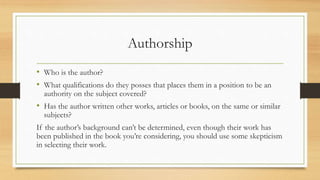
Authorship
• Who is the author?
• What qualifications do they posses that places them in a position to be an
authority on the subject covered?
• Has the author written other works, articles or books, on the same or similar
subjects?
If the author’s background can’t be determined, even though their work has
been published in the book you’re considering, you should use some skepticism
in selecting their work.
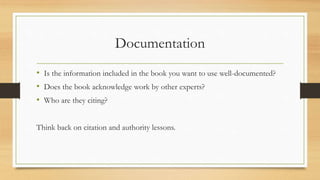
Documentation
• Is the information included in the book you want to use well-documented?
• Does the book acknowledge work by other experts?
• Who are they citing?
Think back on citation and authority lessons.
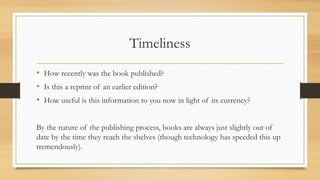
Timeliness
• How recently was the book published?
• Is this a reprint of an earlier edition?
• How useful is this information to you now in light of its currency?
By the nature of the publishing process, books are always just slightly out of
date by the time they reach the shelves (though technology has speeded this up
tremendously).
Publisher
• Who is the publisher?
• Is this an academic press? (one that publishes academic work)
• Is this a university press? (one that publishes various types of work but is located within a
university. SHSU has a press.)
The publisher alone may not be the most important thing to consider, but it is of some
consequence. University & academic presses will direct their publishing efforts to scholarly and
research publications and are less concerned with popular information.
In fact, there are some publishers, because of their notoriety with publishing Wikipedia articles
and passing them off as nonfiction, academic work, won’t be purchased by libraries.
Use
Use books when you require background information and related research on a
topic, when you want to add depth to a research topic, or when you need to put
your topic in context with other important issues.

Books - NGLI 1101

  • 1.
    Books Particularly scholarly books Adaptedfrom Jim Alderman’s “Beginning Library & Information Systems Strategies”, 2014.
  • 2.
    Role in Research Bookscan be invaluable sources for research. Some are written with a more general or popular audience in mind and others target a technical or occupational audience, while others focus on an academic/scholarly audience. Just like articles, which we covered in a previous unit.
  • 3.
    Book Features Features thatcan be of benefit to researchers include: • References • Key concepts & Terminology • Detailed Index or Table of Contents • Charts, tables, graphs, and other illustrative materials • Literature surveys or reviews
  • 4.
    References Scholarly works (usually)will document sources used in developing concepts and ideas treated within them.* Bibliographies included in books will provide researchers with names of seminal works in the field as well as with names of key authorities in their areas of interest. *This is true for quality secondary sources and some tertiary ones.
  • 5.
    Key concepts &Terminology Researchers starting an investigation of a topic will likely need to identify key concepts and terminology in order to effectively search databases for relevant current literature. So, books, because of the depth which they cover their topics, are prime sources to use for finding proper vocabulary to use in searches. Often books will also point out research needs that have yet to be fulfilled, which can provide ideas for future research directions.
  • 6.
    Detailed Index orTable of Contents An index is valuable because it helps researchers quickly locate information within the book. If there isn’t an index, ideally there will be a very detailed table of contents. You may not find a book devoted entirely to your topic, but there may be a chapter or section about it in another work—indexes and table of contents can help you find these parts.
  • 7.
    Charts, tables, graphs,and other illustrative materials Often books will include illustrative materials that help clarify concepts that are covered.
  • 8.
    Literature surveys orreviews Many academic publications routinely include literature surveys or reviews. (Literature in this sense is different than what you learn about in English classes.) A part of the research process is to identify key works of literature that have been produced before launching into new studies. For example, if I am researching the biological traits of a dachshund, before I begin writing, I need to know what research has already been done and what’s been found in order to situate my new study in the conversation and in context.
  • 9.
    What to considerwhen selecting books • Authorship • Documentation • Timeliness • Publisher
  • 10.
    Authorship • Who isthe author? • What qualifications do they posses that places them in a position to be an authority on the subject covered? • Has the author written other works, articles or books, on the same or similar subjects? If the author’s background can’t be determined, even though their work has been published in the book you’re considering, you should use some skepticism in selecting their work.
  • 11.
    Documentation • Is theinformation included in the book you want to use well-documented? • Does the book acknowledge work by other experts? • Who are they citing? Think back on citation and authority lessons.
  • 12.
    Timeliness • How recentlywas the book published? • Is this a reprint of an earlier edition? • How useful is this information to you now in light of its currency? By the nature of the publishing process, books are always just slightly out of date by the time they reach the shelves (though technology has speeded this up tremendously).
  • 13.
    Publisher • Who isthe publisher? • Is this an academic press? (one that publishes academic work) • Is this a university press? (one that publishes various types of work but is located within a university. SHSU has a press.) The publisher alone may not be the most important thing to consider, but it is of some consequence. University & academic presses will direct their publishing efforts to scholarly and research publications and are less concerned with popular information. In fact, there are some publishers, because of their notoriety with publishing Wikipedia articles and passing them off as nonfiction, academic work, won’t be purchased by libraries.
  • 14.
    Use Use books whenyou require background information and related research on a topic, when you want to add depth to a research topic, or when you need to put your topic in context with other important issues.