
Finding High Quality Business
Information
Strategic Management/
Economics/Enterprise Dissertations
Today we will...
• Reflect on what a literature
review is
• Review structured approaches to
literature searching
• Plan a literature search
• Consider and evaluate different
types of information
What do we mean by “Literature”?
???
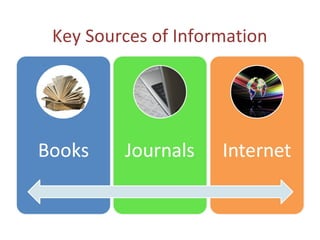
Key Sources of Information
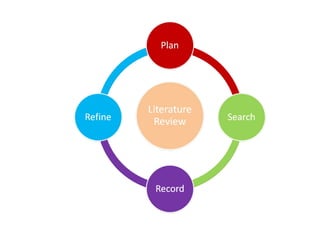
What is a “Literature review”?
A literature review is a select analysis of existing research
which is relevant to your dissertation or assignment,
showing how it relates to your investigation.
A literature review is not a straightforward summary of
everything you have read on the topic and it is not a
chronological description of what was discovered in your
field.
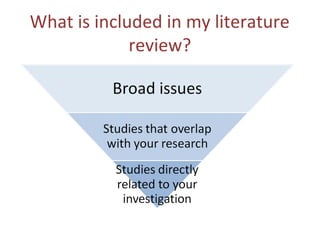
What is included in my literature
review?
Literature search and practitioner
research
Identify published material relevant to your research
– Identify primary and secondary sources
– Provide academic basis for your research
– Clarify your ideas and findings
– Find research methods
– Communication process - demonstrate your
understanding and the work you have done in a
wider context
Keywords
• Choose your keywords carefully
• Think about:
– Singulars, plurals, phrases
– How terms are combined
– Alternative terminology and variation in language
– Major influence on search effectiveness
Search strategies
• Search effectiveness depends on WHERE you look
and HOW you search
– Where
– What discipline(s)
– What focus (academic, practitioner)
– Need to use a range because of dispersed nature of
business information
Think about how business
information is generated
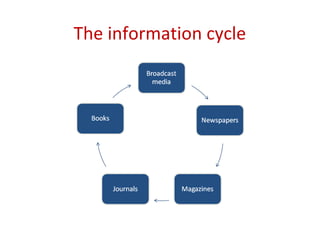
The information cycle
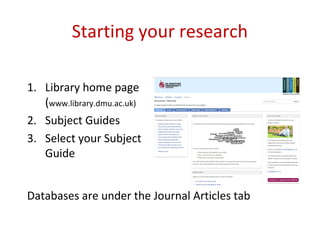
Starting your research
1. Library home page
(www.library.dmu.ac.uk)
2. Subject Guides
3. Select your Subject
Guide
Databases are under the Journal Articles tab
Academic sources - books
• Books at DMU
– Library catalogue
• Outside DMU
– Local library catalogues
– Internet booksellers
– COPAC (for UK)
– Other academic or
specialist libraries
• Interlibrary loans
Key sources of Academic Research
Books
Journals
Introducing Journals
Three types: ‘general interest’,
‘trade’ journals and ‘peer-reviewed’
academic journals
Best Source: Depends if you have
a reference!
Published periodically in volumes and issues, and consist
of articles.
Can be in print or electronic/online format (E-Journals) or
both.
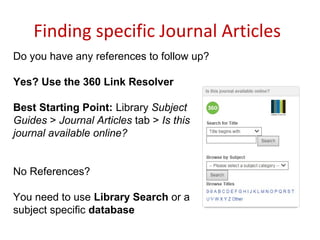
Finding specific Journal Articles
Do you have any references to follow up?
Yes? Use the 360 Link Resolver
Best Starting Point: Library Subject
Guides > Journal Articles tab > Is this
journal available online?
No References?
You need to use Library Search or a
subject specific database
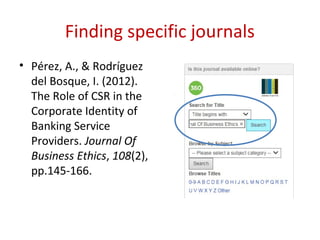
Finding specific journals
• Pérez, A., & Rodríguez
del Bosque, I. (2012).
The Role of CSR in the
Corporate Identity of
Banking Service
Providers. Journal Of
Business Ethics, 108(2),
pp.145-166.
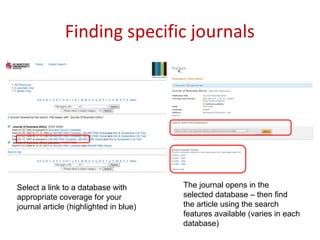
Finding specific journals
Select a link to a database with
appropriate coverage for your
journal article (highlighted in blue)
The journal opens in the
selected database – then find
the article using the search
features available (varies in each
database)
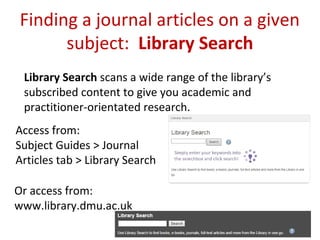
Finding a journal articles on a given
subject: Library Search
Library Search scans a wide range of the library’s
subscribed content to give you academic and
practitioner-orientated research.
Access from:
Subject Guides > Journal
Articles tab > Library Search
Or access from:
www.library.dmu.ac.uk
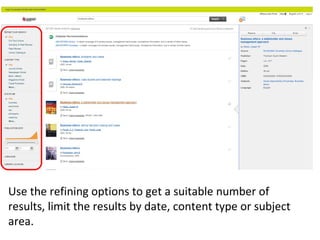
Use the refining options to get a suitable number of
results, limit the results by date, content type or subject
area.
Finding a journal articles on a given
subject: Subject Specific Databases
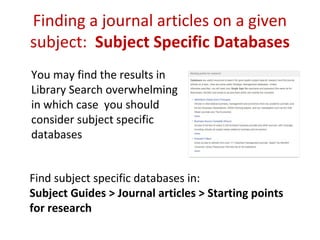
You may find the results in
Library Search overwhelming
in which case you should
consider subject specific
databases
Find subject specific databases in:
Subject Guides > Journal articles > Starting points
for research
Finding a journal articles on a given
subject: Subject Specific Databases
What is a subject specific database?
An online collection of abstracts, journal articles,
book chapters, conference proceedings, datasets on
a specific subject area. The content is indexed so
that it is easily searchable online. The content of the
databases varies which is why it is a good idea to
use the subject guide to point you towards the best
database for your topic.
Essential sources for business research
Core business databases
• ABI/Inform
• Business Source
Complete
Multidisciplinary sources
• Academic Source
Premier
• Science Direct
• LexisLibrary for
newspapers
• Web of Knowledge or
Scopus
Remember:
Library Search will explore all these databases for
you in one search!
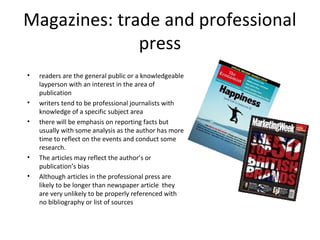
Magazines: trade and professional
press
• readers are the general public or a knowledgeable
layperson with an interest in the area of
publication
• writers tend to be professional journalists with
knowledge of a specific subject area
• there will be emphasis on reporting facts but
usually with some analysis as the author has more
time to reflect on the events and conduct some
research.
• The articles may reflect the author’s or
publication’s bias
• Although articles in the professional press are
likely to be longer than newspaper article they
are very unlikely to be properly referenced with
no bibliography or list of sources
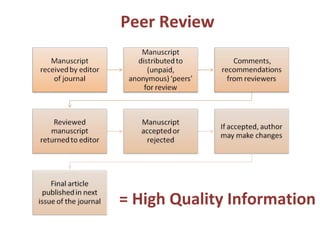
Peer Review
= High Quality Information
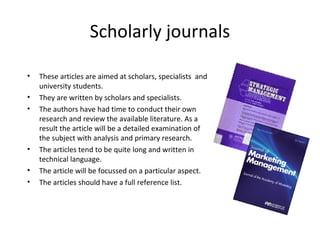
Scholarly journals
• These articles are aimed at scholars, specialists and
university students.
• They are written by scholars and specialists.
• The authors have had time to conduct their own
research and review the available literature. As a
result the article will be a detailed examination of
the subject with analysis and primary research.
• The articles tend to be quite long and written in
technical language.
• The article will be focussed on a particular aspect.
• The articles should have a full reference list.
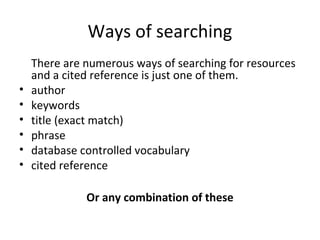
Ways of searching
There are numerous ways of searching for resources
and a cited reference is just one of them.
• author
• keywords
• title (exact match)
• phrase
• database controlled vocabulary
• cited reference
Or any combination of these
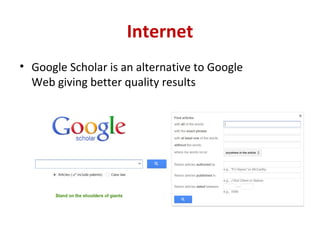
Internet
• Google Scholar is an alternative to Google
Web giving better quality results
Planning your search
Four ways:
• Systematic – trying to find all relevant material
• Retrospective – finding the most recent material and
working backwards
• Citation – following leads from useful articles, books
and reading lists
• Targeted – restricting your topic and focus in on a
narrow area of the literature.
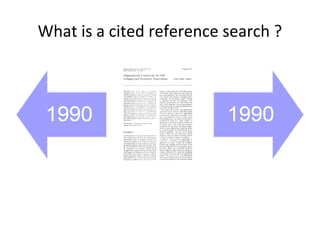
What is a cited reference search ?
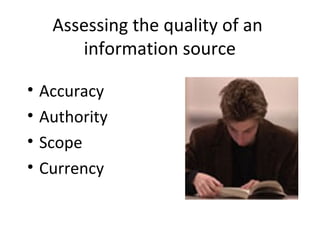
Assessing the quality of an
information source
• Accuracy
• Authority
• Scope
• Currency
Support
Nathan Rush
Assistant Librarian: Business School
bal-library-enquiries@dmu.ac.uk
Quick enquiries:
justask@dmu.ac.uk 0116 257 7042
Piecing the story together
• Books
• Internet
• Trade and professional
press
• Newspapers
• Company information
• Academic journals
Summary
• Plan carefully how and
where you search
• Every project is different
• Start specific and then
review or broaden
• Get in touch if any queries

Corp3400 econ3530 ente3532 2015

  • 1.
    Finding High QualityBusiness Information Strategic Management/ Economics/Enterprise Dissertations
  • 2.
    Today we will... •Reflect on what a literature review is • Review structured approaches to literature searching • Plan a literature search • Consider and evaluate different types of information
  • 3.
    What do wemean by “Literature”? ???
  • 4.
    Key Sources ofInformation
  • 5.
    What is a“Literature review”? A literature review is a select analysis of existing research which is relevant to your dissertation or assignment, showing how it relates to your investigation. A literature review is not a straightforward summary of everything you have read on the topic and it is not a chronological description of what was discovered in your field.
  • 6.
    What is includedin my literature review?
  • 7.
    Literature search andpractitioner research Identify published material relevant to your research – Identify primary and secondary sources – Provide academic basis for your research – Clarify your ideas and findings – Find research methods – Communication process - demonstrate your understanding and the work you have done in a wider context
  • 9.
    Keywords • Choose yourkeywords carefully • Think about: – Singulars, plurals, phrases – How terms are combined – Alternative terminology and variation in language – Major influence on search effectiveness
  • 10.
    Search strategies • Searcheffectiveness depends on WHERE you look and HOW you search – Where – What discipline(s) – What focus (academic, practitioner) – Need to use a range because of dispersed nature of business information Think about how business information is generated
  • 11.
  • 12.
    Starting your research 1.Library home page (www.library.dmu.ac.uk) 2. Subject Guides 3. Select your Subject Guide Databases are under the Journal Articles tab
  • 13.
    Academic sources -books • Books at DMU – Library catalogue • Outside DMU – Local library catalogues – Internet booksellers – COPAC (for UK) – Other academic or specialist libraries • Interlibrary loans
  • 14.
    Key sources ofAcademic Research Books Journals
  • 15.
    Introducing Journals Three types:‘general interest’, ‘trade’ journals and ‘peer-reviewed’ academic journals Best Source: Depends if you have a reference! Published periodically in volumes and issues, and consist of articles. Can be in print or electronic/online format (E-Journals) or both.
  • 16.
    Finding specific JournalArticles Do you have any references to follow up? Yes? Use the 360 Link Resolver Best Starting Point: Library Subject Guides > Journal Articles tab > Is this journal available online? No References? You need to use Library Search or a subject specific database
  • 17.
    Finding specific journals •Pérez, A., & Rodríguez del Bosque, I. (2012). The Role of CSR in the Corporate Identity of Banking Service Providers. Journal Of Business Ethics, 108(2), pp.145-166.
  • 18.
    Finding specific journals Selecta link to a database with appropriate coverage for your journal article (highlighted in blue) The journal opens in the selected database – then find the article using the search features available (varies in each database)
  • 19.
    Finding a journalarticles on a given subject: Library Search Library Search scans a wide range of the library’s subscribed content to give you academic and practitioner-orientated research. Access from: Subject Guides > Journal Articles tab > Library Search Or access from: www.library.dmu.ac.uk
  • 20.
    Use the refiningoptions to get a suitable number of results, limit the results by date, content type or subject area.
  • 21.
    Finding a journalarticles on a given subject: Subject Specific Databases You may find the results in Library Search overwhelming in which case you should consider subject specific databases Find subject specific databases in: Subject Guides > Journal articles > Starting points for research
  • 22.
    Finding a journalarticles on a given subject: Subject Specific Databases What is a subject specific database? An online collection of abstracts, journal articles, book chapters, conference proceedings, datasets on a specific subject area. The content is indexed so that it is easily searchable online. The content of the databases varies which is why it is a good idea to use the subject guide to point you towards the best database for your topic.
  • 23.
    Essential sources forbusiness research Core business databases • ABI/Inform • Business Source Complete Multidisciplinary sources • Academic Source Premier • Science Direct • LexisLibrary for newspapers • Web of Knowledge or Scopus Remember: Library Search will explore all these databases for you in one search!
  • 25.
    Magazines: trade andprofessional press • readers are the general public or a knowledgeable layperson with an interest in the area of publication • writers tend to be professional journalists with knowledge of a specific subject area • there will be emphasis on reporting facts but usually with some analysis as the author has more time to reflect on the events and conduct some research. • The articles may reflect the author’s or publication’s bias • Although articles in the professional press are likely to be longer than newspaper article they are very unlikely to be properly referenced with no bibliography or list of sources
  • 26.
    Peer Review = HighQuality Information
  • 27.
    Scholarly journals • Thesearticles are aimed at scholars, specialists and university students. • They are written by scholars and specialists. • The authors have had time to conduct their own research and review the available literature. As a result the article will be a detailed examination of the subject with analysis and primary research. • The articles tend to be quite long and written in technical language. • The article will be focussed on a particular aspect. • The articles should have a full reference list.
  • 28.
    Ways of searching Thereare numerous ways of searching for resources and a cited reference is just one of them. • author • keywords • title (exact match) • phrase • database controlled vocabulary • cited reference Or any combination of these
  • 29.
    Internet • Google Scholaris an alternative to Google Web giving better quality results
  • 30.
    Planning your search Fourways: • Systematic – trying to find all relevant material • Retrospective – finding the most recent material and working backwards • Citation – following leads from useful articles, books and reading lists • Targeted – restricting your topic and focus in on a narrow area of the literature.
  • 31.
    What is acited reference search ?
  • 32.
    Assessing the qualityof an information source • Accuracy • Authority • Scope • Currency
  • 33.
    Support Nathan Rush Assistant Librarian:Business School bal-library-enquiries@dmu.ac.uk Quick enquiries: justask@dmu.ac.uk 0116 257 7042
  • 34.
    Piecing the storytogether • Books • Internet • Trade and professional press • Newspapers • Company information • Academic journals
  • 35.
    Summary • Plan carefullyhow and where you search • Every project is different • Start specific and then review or broaden • Get in touch if any queries

Editor's Notes

  • #4 - “Quality” - Peer Review - Appropriate sources / audience