Reactive Attachment Disorder
& Disinhibited Social
Engagement Disorder
Jane F. Gilgun, Ph.D., LICSW
School of Social Work
University of Minnesota, Twin Cities, USA
Topics
Reactive Attachment Disorder (RAD)
Disinhibited Social
Engagement Disorder (DSED)
“disturbances in the regulation of
affect/emotion are the core deficits
underlying symptomatology related to
traumatic responses or attachment
disturbances” (Hinshaw-Fuselier et al.,
1999, p. 56).
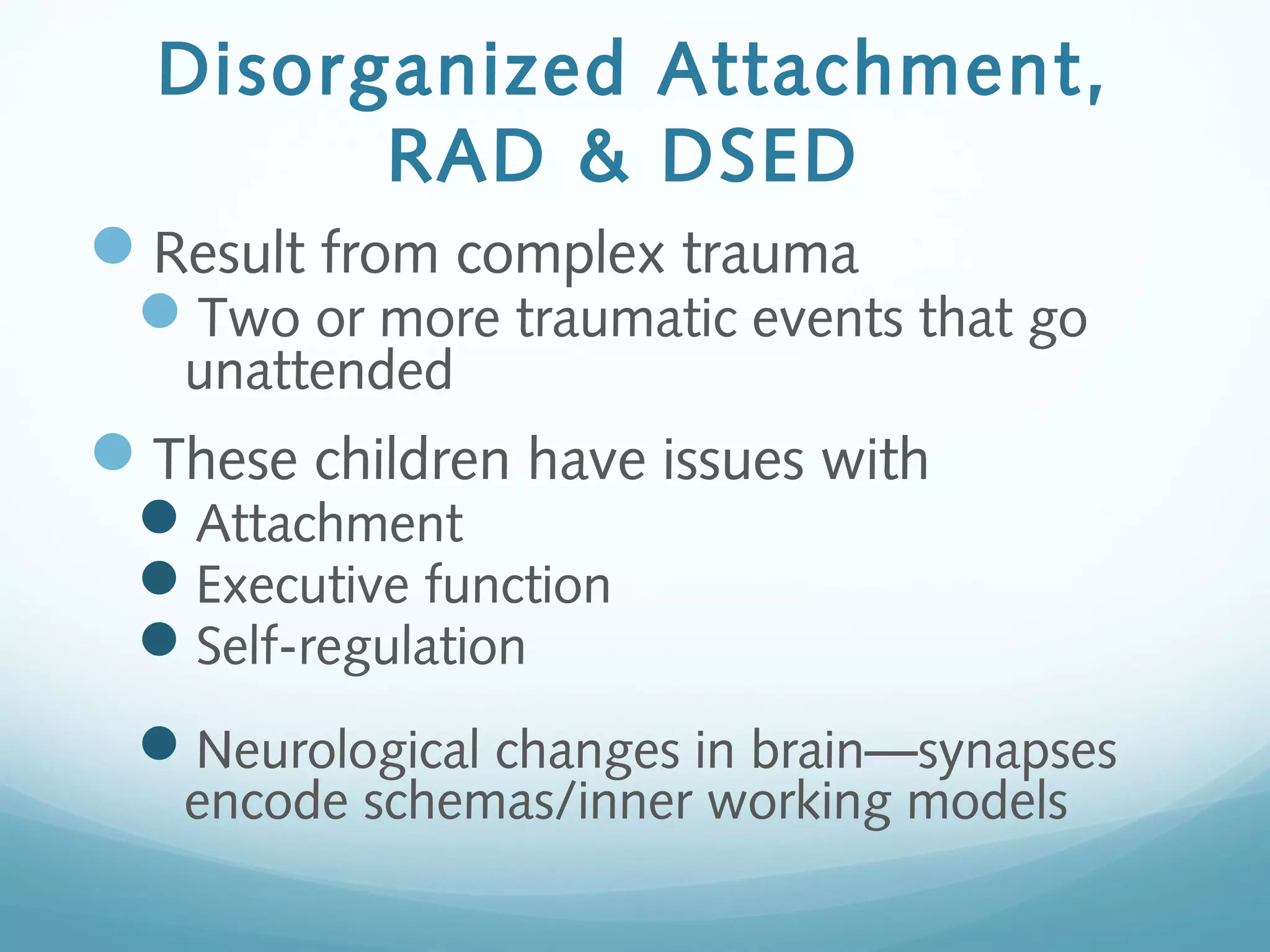
Disorganized Attachment,
RAD & DSED
Result from complex trauma
Two or more traumatic events that go
unattended
These children have issues with
Attachment
Executive function
Self-regulation
Neurological changes in brain—synapses
encode schemas/inner working models
Children with These
Issues
Can do well when parents
Are emotionally available
Give love and set clear rules
Affirm behaviors they want children to repeat
Give minimal attention to children’s difficult
behaviors
Ensure safety
Children with These
Issues
Can do well when
They do not also have fetal alcohol effects,
autism, and other co-occurring conditions
Parents deal well with their own issues
Have good executive function and self-regulation
Can manage own traumas well
Have emotional and instrumental support
Parent support groups
Spend time with others who have common
interests
Children with These
Issues
Can do well when
Other people are fair, consistent, loving, and clear
in their expectations
Extended family members
Neighbors
Other children
Teachers
Youth workers
Anyone else who has contact with the children
Reactive Attachment Disorder
A. A consistent pattern of inhibited,
emotionally withdrawn behavior toward
adult caregivers, manifested by both of the
following:
The child rarely or minimally seeks comfort
when distressed.
The child rarely or minimally responds to
comfort when distressed.
Reactive Attachment
Disorder
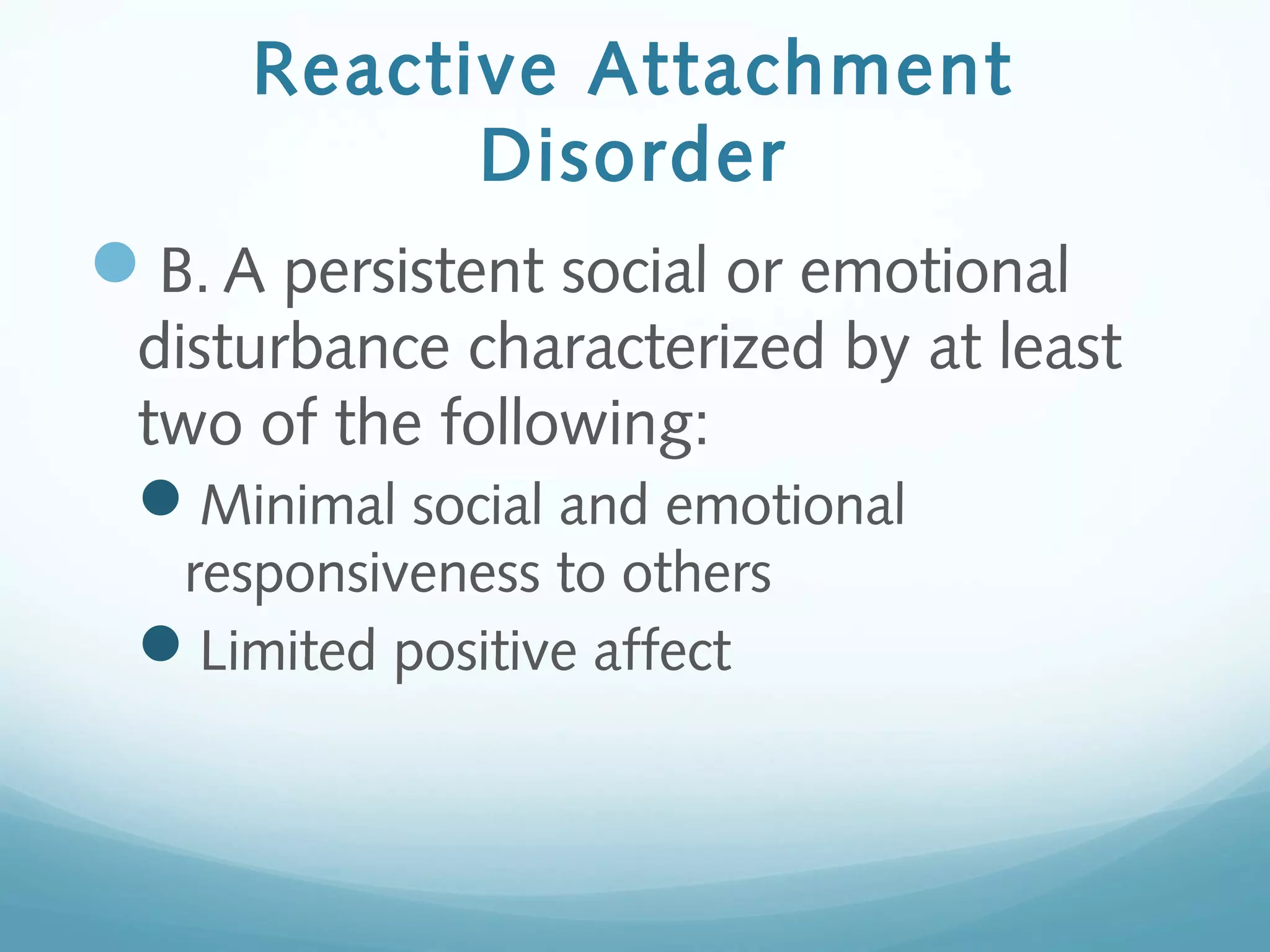
B. A persistent social or emotional
disturbance characterized by at least
two of the following:
Minimal social and emotional
responsiveness to others
Limited positive affect
Reactive Attachment
Disorder
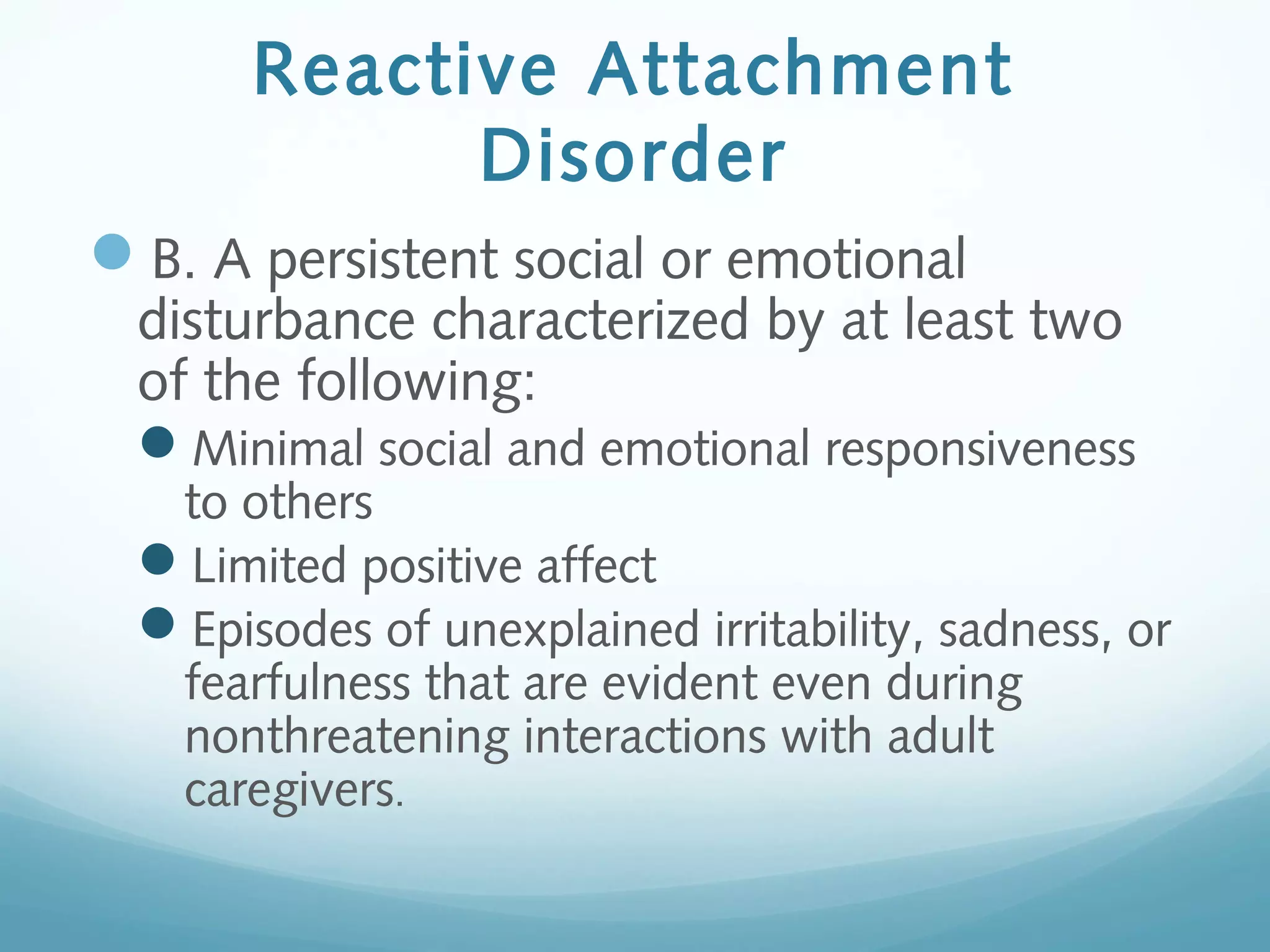
B. A persistent social or emotional
disturbance characterized by at least two
of the following:
Minimal social and emotional responsiveness
to others
Limited positive affect
Episodes of unexplained irritability, sadness, or
fearfulness that are evident even during
nonthreatening interactions with adult
caregivers.
Reactive Attachment
Disorder
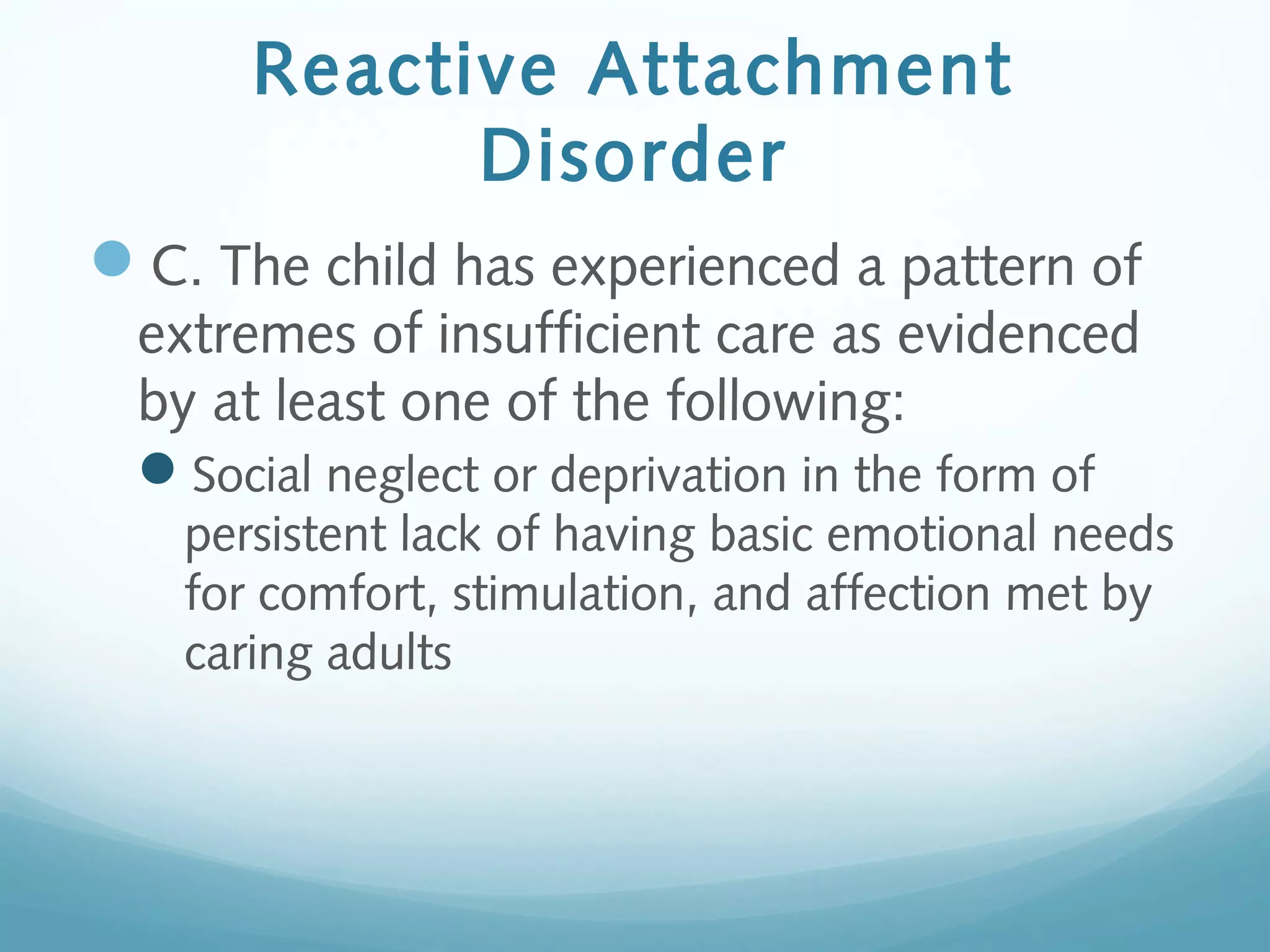
C. The child has experienced a pattern of
extremes of insufficient care as evidenced
by at least one of the following:
Social neglect or deprivation in the form of
persistent lack of having basic emotional needs
for comfort, stimulation, and affection met by
caring adults
Reactive Attachment
Disorder
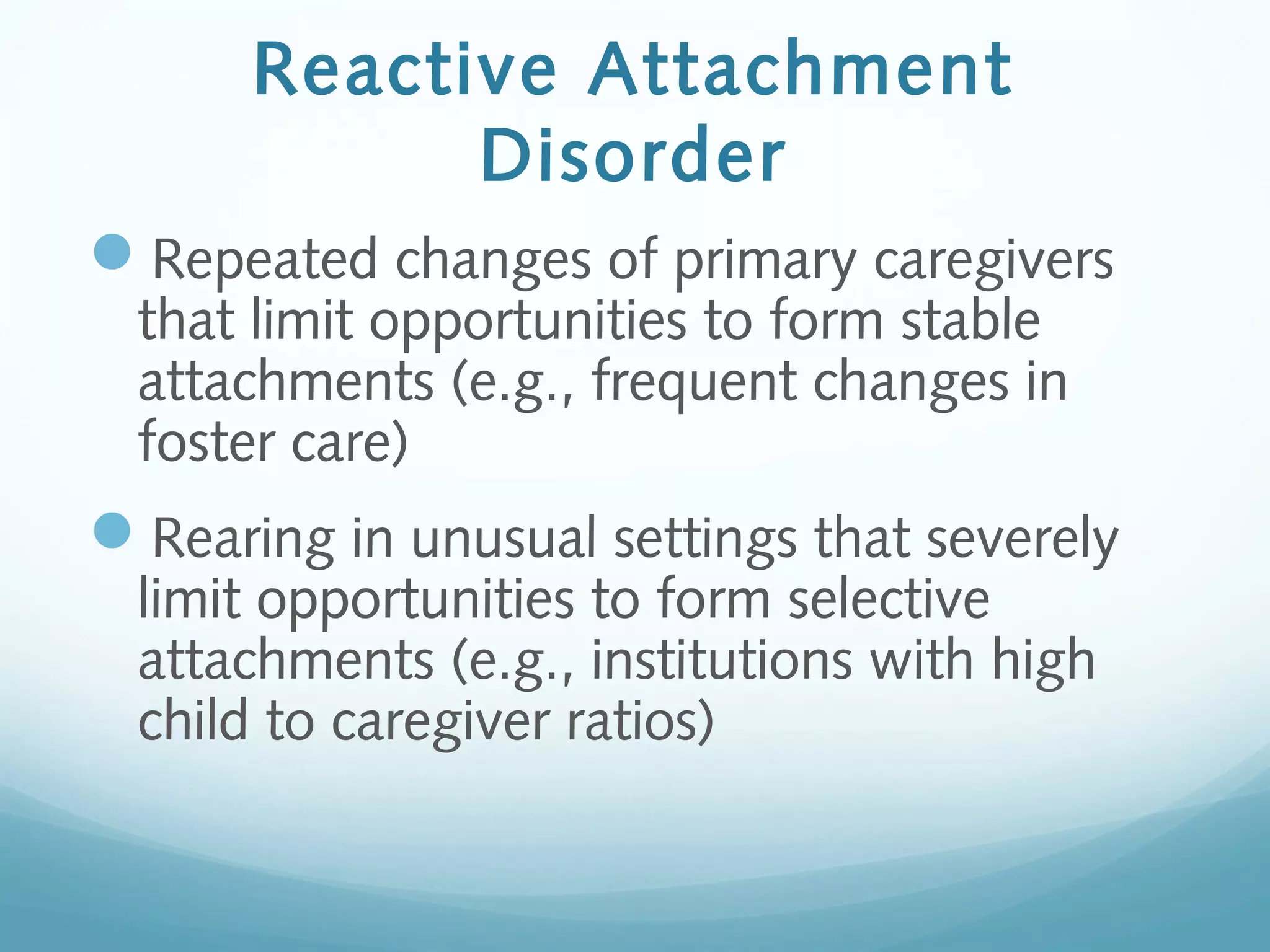
Repeated changes of primary caregivers
that limit opportunities to form stable
attachments (e.g., frequent changes in
foster care)
Rearing in unusual settings that severely
limit opportunities to form selective
attachments (e.g., institutions with high
child to caregiver ratios)
Reactive Attachment
Disorder
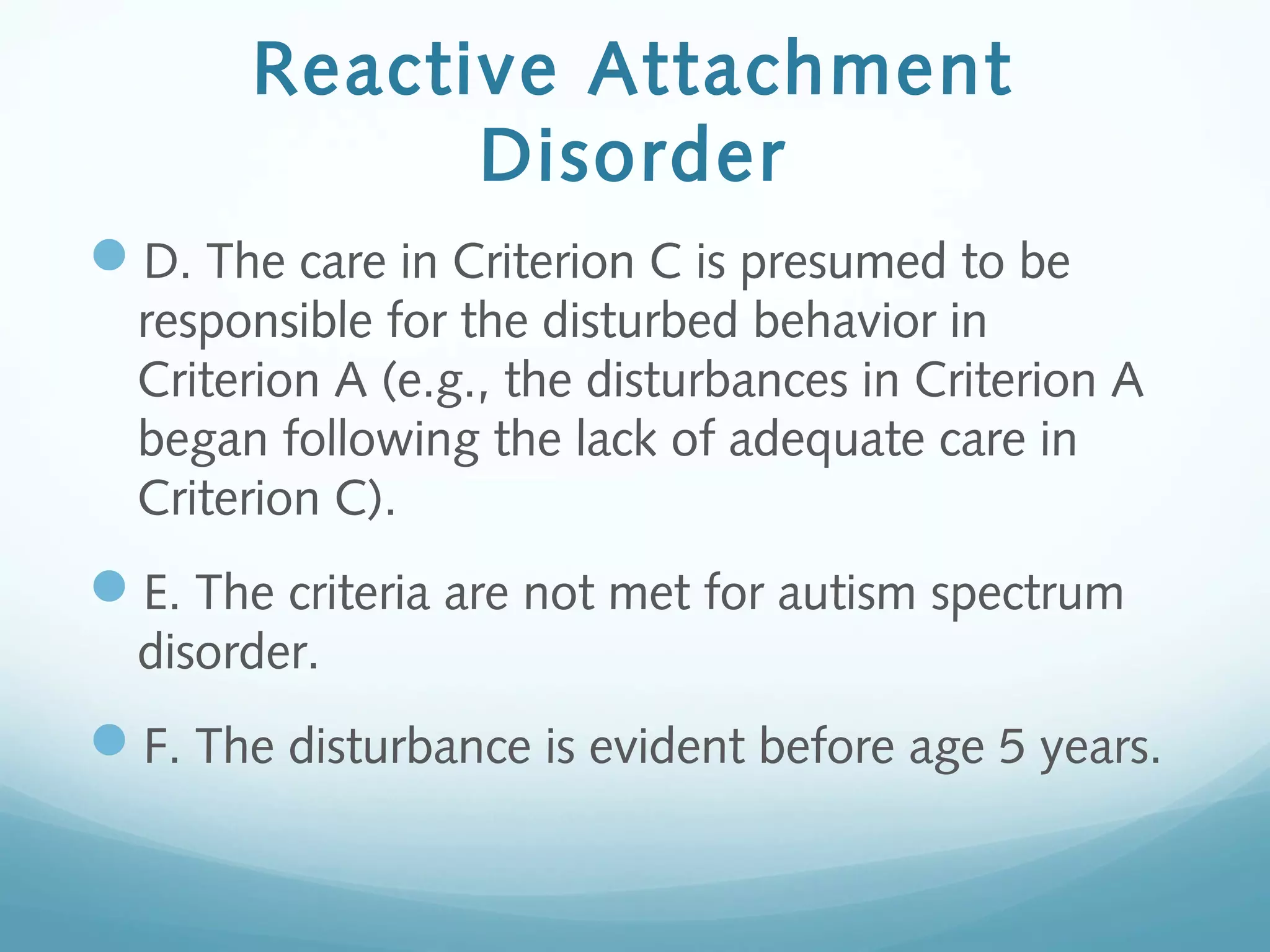
D. The care in Criterion C is presumed to be
responsible for the disturbed behavior in
Criterion A (e.g., the disturbances in Criterion A
began following the lack of adequate care in
Criterion C).
E. The criteria are not met for autism spectrum
disorder.
F. The disturbance is evident before age 5 years.
Reactive Attachment
Disorder
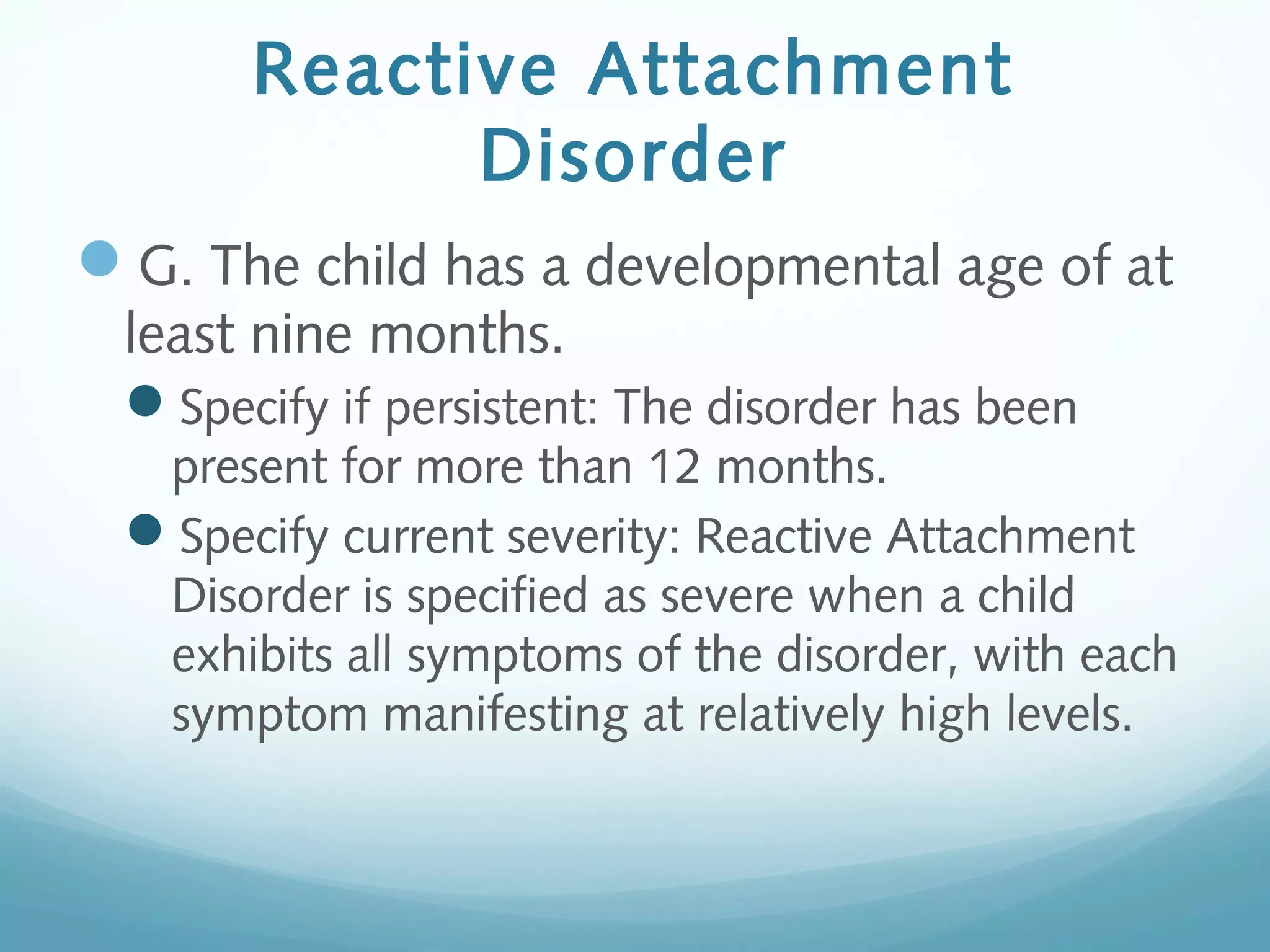
G. The child has a developmental age of at
least nine months.
Specify if persistent: The disorder has been
present for more than 12 months.
Specify current severity: Reactive Attachment
Disorder is specified as severe when a child
exhibits all symptoms of the disorder, with each
symptom manifesting at relatively high levels.
Disinhibited Social
Engagement Disorder
(DSED0
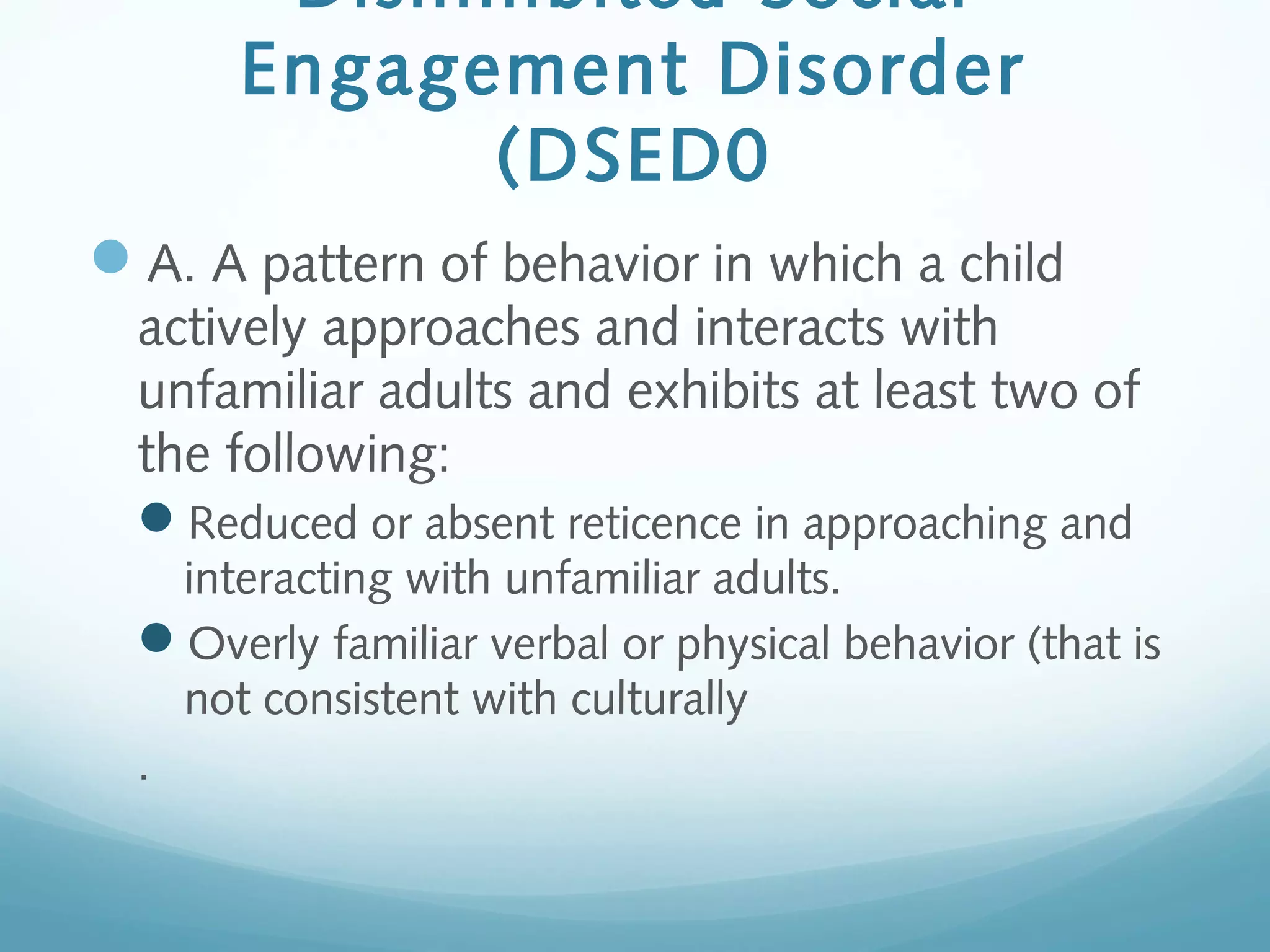
A. A pattern of behavior in which a child
actively approaches and interacts with
unfamiliar adults and exhibits at least two of
the following:
Reduced or absent reticence in approaching and
interacting with unfamiliar adults.
Overly familiar verbal or physical behavior (that is
not consistent with culturally
.
Disinhibited Social
Engagement Disorder (DSED)
A. A pattern of behavior in which a child
actively approaches and interacts with
unfamiliar adults and exhibits at least two
of the following:
Reduced or absent reticence in approaching
and interacting with unfamiliar adults.
Overly familiar verbal or physical behavior
(that is not consistent with culturally
sanctioned and with age-appropriate social
boundaries).
Disinhibited Social
Engagement Disorder (DSED)
Diminished or absent checking back with adult caregiver
after venturing away, even
in unfamiliar settings.
Willingness to go off with an unfamiliar adult with minimal
or no hesitation.
B. The behaviors in Criterion A are not limited to
impulsivity (as in ADHD) but include socially disinhibited
behavior.
 
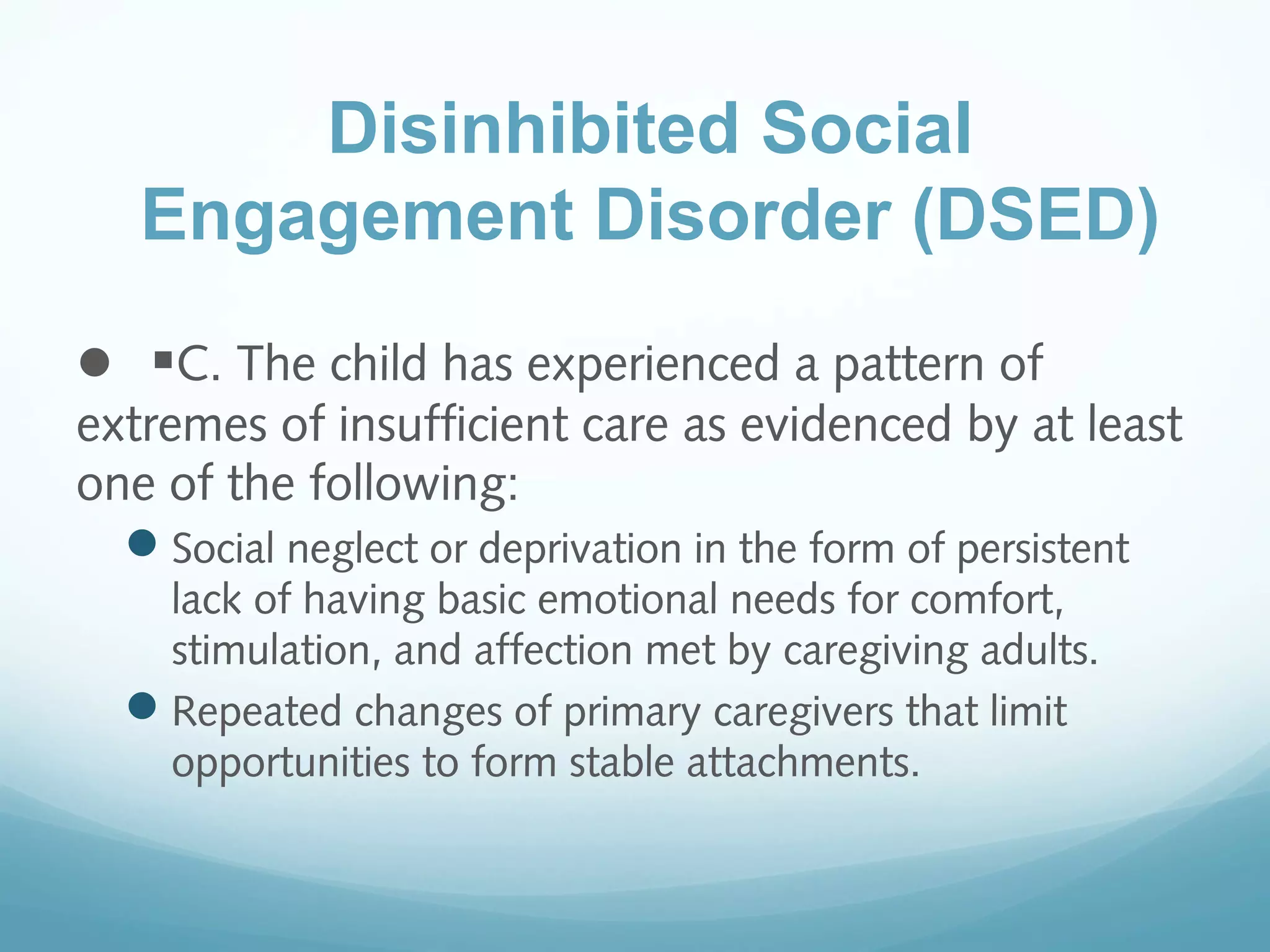
C. The child has experienced a pattern of
extremes of insufficient care as evidenced by at least
one of the following:
Social neglect or deprivation in the form of persistent
lack of having basic emotional needs for comfort,
stimulation, and affection met by caregiving adults.
Repeated changes of primary caregivers that limit
opportunities to form stable attachments.
Disinhibited Social
Engagement Disorder (DSED)
 
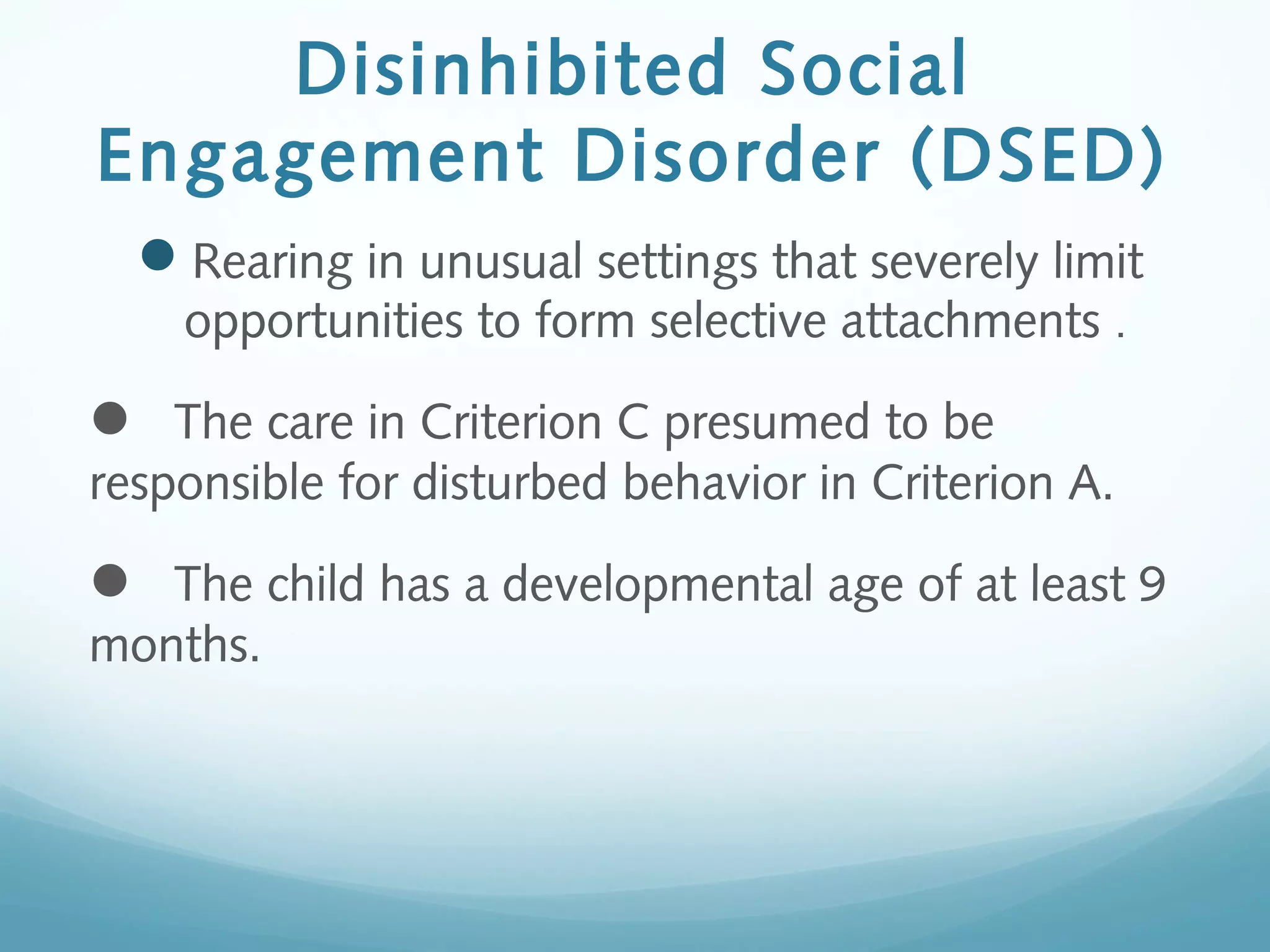
Disinhibited Social
Engagement Disorder (DSED)
Rearing in unusual settings that severely limit
opportunities to form selective attachments .
The care in Criterion C presumed to be
responsible for disturbed behavior in Criterion A.
The child has a developmental age of at least 9
months.
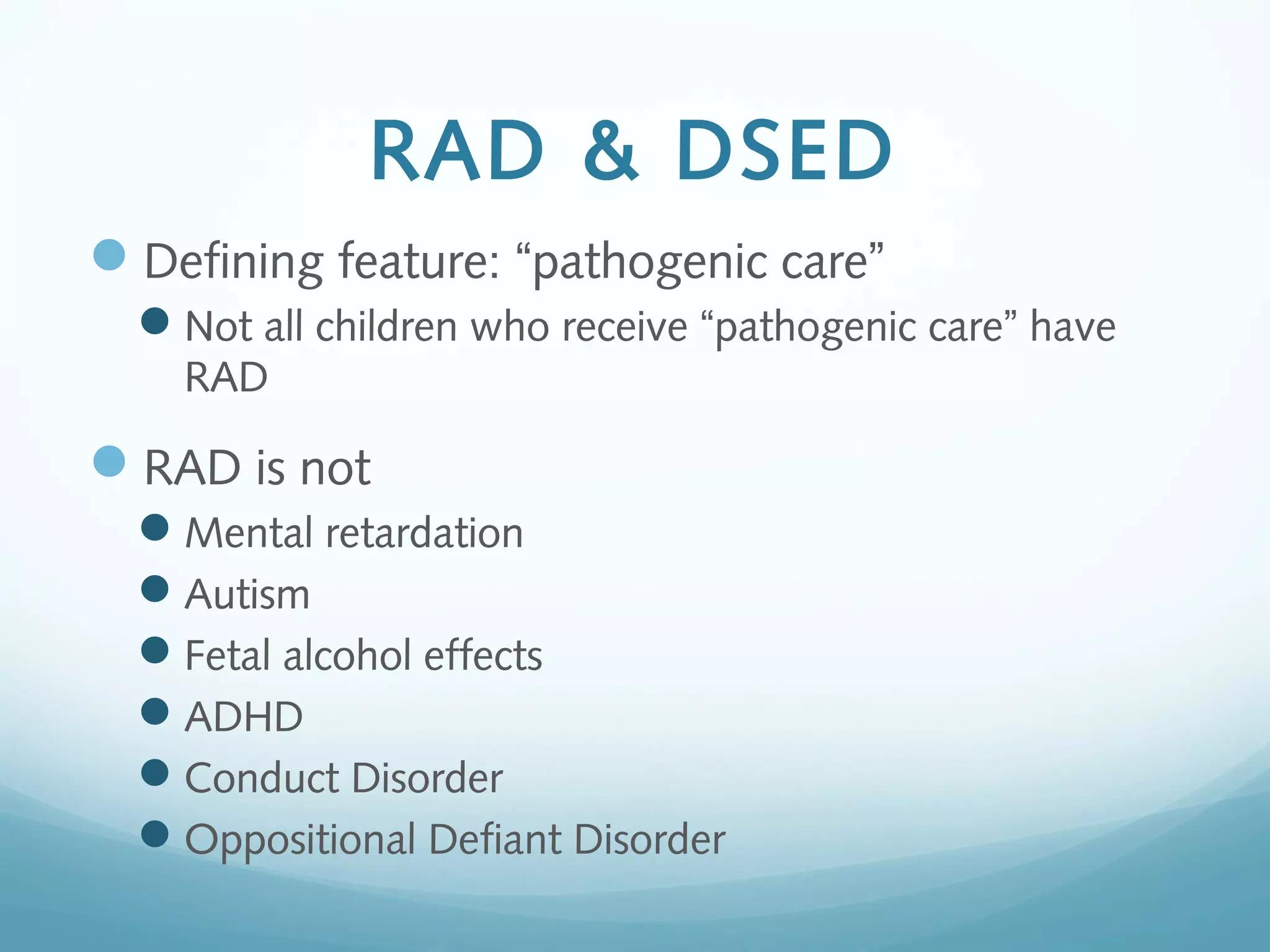
RAD & DSED
Defining feature: “pathogenic care”
Not all children who receive “pathogenic care” have
RAD
RAD is not
Mental retardation
Autism
Fetal alcohol effects
ADHD
Conduct Disorder
Oppositional Defiant Disorder
“disturbances in the regulation of
affect/emotion are the core deficits
underlying symptomatology related to
traumatic responses or attachment
disturbances” (Hinshaw-Fuselier et al., 1999,
p. 56).
Emotion Regulation
Emotion Regulation: Capacities to
modulate emotional responses in a
range of situations
Teach parents and children methods of
self-regulation
References
 American Psychiatric Association. (2013). Diagnostic and
statistical manual of mental disorders (5th ed.). Washington, DC:
Author.
 Gilgun, Jane F. (2011). The NEATS: A Child and Family Assessment.
Amazon.
 Heller, Sherryl Scott, Neil W. Boris, Sarah Hinshaw Fuselier, Timoty
Page, Nina Koren-Karie, & Devi Miron (2006). Reactive attachment
disorder in maltreated twins follow-up: From 18 months to 8 years.
Attachment & Human Development, 8(1), 63-86.
 Hinshaw-Fuselier, S., Boris, N. W., & Zeanah, C. Z. (1999). Reactive
attachment disorder in maltreated twins. Infant Mental Health
Journal, 20, 42 – 59.

Reactive Attachment Disorder (RAD) and Disinhibited Social Engagement Disorder (DSED)

  • 1.
    Reactive Attachment Disorder &Disinhibited Social Engagement Disorder Jane F. Gilgun, Ph.D., LICSW School of Social Work University of Minnesota, Twin Cities, USA
  • 2.
    Topics Reactive Attachment Disorder(RAD) Disinhibited Social Engagement Disorder (DSED)
  • 3.
    “disturbances in theregulation of affect/emotion are the core deficits underlying symptomatology related to traumatic responses or attachment disturbances” (Hinshaw-Fuselier et al., 1999, p. 56).
  • 4.
    Disorganized Attachment, RAD &DSED Result from complex trauma Two or more traumatic events that go unattended These children have issues with Attachment Executive function Self-regulation Neurological changes in brain—synapses encode schemas/inner working models
  • 5.
    Children with These Issues Cando well when parents Are emotionally available Give love and set clear rules Affirm behaviors they want children to repeat Give minimal attention to children’s difficult behaviors Ensure safety
  • 6.
    Children with These Issues Cando well when They do not also have fetal alcohol effects, autism, and other co-occurring conditions Parents deal well with their own issues Have good executive function and self-regulation Can manage own traumas well Have emotional and instrumental support Parent support groups Spend time with others who have common interests
  • 7.
    Children with These Issues Cando well when Other people are fair, consistent, loving, and clear in their expectations Extended family members Neighbors Other children Teachers Youth workers Anyone else who has contact with the children
  • 8.
    Reactive Attachment Disorder A.A consistent pattern of inhibited, emotionally withdrawn behavior toward adult caregivers, manifested by both of the following: The child rarely or minimally seeks comfort when distressed. The child rarely or minimally responds to comfort when distressed.
  • 9.
    Reactive Attachment Disorder B. Apersistent social or emotional disturbance characterized by at least two of the following: Minimal social and emotional responsiveness to others Limited positive affect
  • 10.
    Reactive Attachment Disorder B. Apersistent social or emotional disturbance characterized by at least two of the following: Minimal social and emotional responsiveness to others Limited positive affect Episodes of unexplained irritability, sadness, or fearfulness that are evident even during nonthreatening interactions with adult caregivers.
  • 11.
    Reactive Attachment Disorder C. Thechild has experienced a pattern of extremes of insufficient care as evidenced by at least one of the following: Social neglect or deprivation in the form of persistent lack of having basic emotional needs for comfort, stimulation, and affection met by caring adults
  • 12.
    Reactive Attachment Disorder Repeated changesof primary caregivers that limit opportunities to form stable attachments (e.g., frequent changes in foster care) Rearing in unusual settings that severely limit opportunities to form selective attachments (e.g., institutions with high child to caregiver ratios)
  • 13.
    Reactive Attachment Disorder D. Thecare in Criterion C is presumed to be responsible for the disturbed behavior in Criterion A (e.g., the disturbances in Criterion A began following the lack of adequate care in Criterion C). E. The criteria are not met for autism spectrum disorder. F. The disturbance is evident before age 5 years.
  • 14.
    Reactive Attachment Disorder G. Thechild has a developmental age of at least nine months. Specify if persistent: The disorder has been present for more than 12 months. Specify current severity: Reactive Attachment Disorder is specified as severe when a child exhibits all symptoms of the disorder, with each symptom manifesting at relatively high levels.
  • 15.
    Disinhibited Social Engagement Disorder (DSED0 A.A pattern of behavior in which a child actively approaches and interacts with unfamiliar adults and exhibits at least two of the following: Reduced or absent reticence in approaching and interacting with unfamiliar adults. Overly familiar verbal or physical behavior (that is not consistent with culturally .
  • 16.
    Disinhibited Social Engagement Disorder(DSED) A. A pattern of behavior in which a child actively approaches and interacts with unfamiliar adults and exhibits at least two of the following: Reduced or absent reticence in approaching and interacting with unfamiliar adults. Overly familiar verbal or physical behavior (that is not consistent with culturally sanctioned and with age-appropriate social boundaries).
  • 17.
    Disinhibited Social Engagement Disorder(DSED) Diminished or absent checking back with adult caregiver after venturing away, even in unfamiliar settings. Willingness to go off with an unfamiliar adult with minimal or no hesitation. B. The behaviors in Criterion A are not limited to impulsivity (as in ADHD) but include socially disinhibited behavior.
  • 18.
      C. The childhas experienced a pattern of extremes of insufficient care as evidenced by at least one of the following: Social neglect or deprivation in the form of persistent lack of having basic emotional needs for comfort, stimulation, and affection met by caregiving adults. Repeated changes of primary caregivers that limit opportunities to form stable attachments. Disinhibited Social Engagement Disorder (DSED)
  • 19.
      Disinhibited Social Engagement Disorder(DSED) Rearing in unusual settings that severely limit opportunities to form selective attachments . The care in Criterion C presumed to be responsible for disturbed behavior in Criterion A. The child has a developmental age of at least 9 months.
  • 20.
    RAD & DSED Definingfeature: “pathogenic care” Not all children who receive “pathogenic care” have RAD RAD is not Mental retardation Autism Fetal alcohol effects ADHD Conduct Disorder Oppositional Defiant Disorder
  • 21.
    “disturbances in theregulation of affect/emotion are the core deficits underlying symptomatology related to traumatic responses or attachment disturbances” (Hinshaw-Fuselier et al., 1999, p. 56).
  • 22.
    Emotion Regulation Emotion Regulation:Capacities to modulate emotional responses in a range of situations Teach parents and children methods of self-regulation
  • 23.
    References  American PsychiatricAssociation. (2013). Diagnostic and statistical manual of mental disorders (5th ed.). Washington, DC: Author.  Gilgun, Jane F. (2011). The NEATS: A Child and Family Assessment. Amazon.  Heller, Sherryl Scott, Neil W. Boris, Sarah Hinshaw Fuselier, Timoty Page, Nina Koren-Karie, & Devi Miron (2006). Reactive attachment disorder in maltreated twins follow-up: From 18 months to 8 years. Attachment & Human Development, 8(1), 63-86.  Hinshaw-Fuselier, S., Boris, N. W., & Zeanah, C. Z. (1999). Reactive attachment disorder in maltreated twins. Infant Mental Health Journal, 20, 42 – 59.