Role of Protective Clothing in enhancing
worker safety- Global Perspective
July 14,2011
Protective Wear Applications....
ILO Global Estimates Of
Occupational Accidents
Country Industrial
Workers
(Millions)
Fatal
Accidents
per 100000
Accidents
causing
leave for 3+
days due to
injury/1
million
workers
Work
related
deaths
Per Capita $
spent on
PPE
Industrial 335 5 0.04 297000 14
India 40 100 0.75 302000 0.33
20-30 % of PPE budget is normally spent on Protective Clothing
Protection At The Work Place
Global Trends
• OSHA ,USA estimates that for every $1 spent on effective HSE
programme about $4 are saved
• The USA protective market grew by 6% during 2007-
10(economy grew 1-2 %)
• Protection from Fire/Heat is a major requirement for
Protective Clothing
• Regulatory framework is essential for the adoption of good
PPE and safety practices
• The death toll is higher in Developing countries, where more
workers are engaged in blue collar work
• CSR is becoming an important aspect within a company
• Globalisation of manufacturing- Make in India sell in Europe
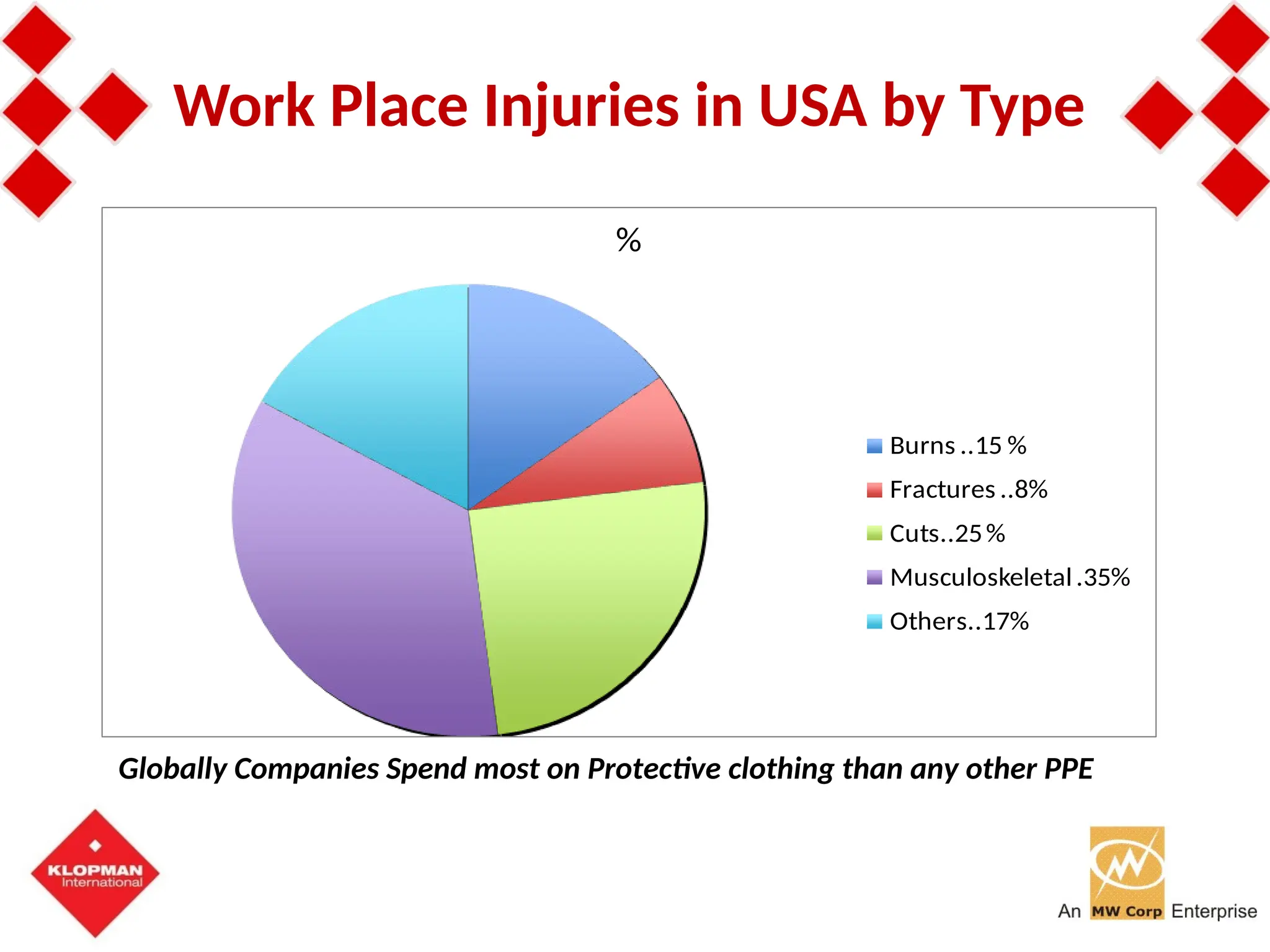
Work Place Injuries in USA by Type
%
Burns ..15 %
Fractures ..8%
Cuts..25%
Musculoskeletal.35%
Others..17%
Globally Companies Spend most on Protective clothing than any other PPE
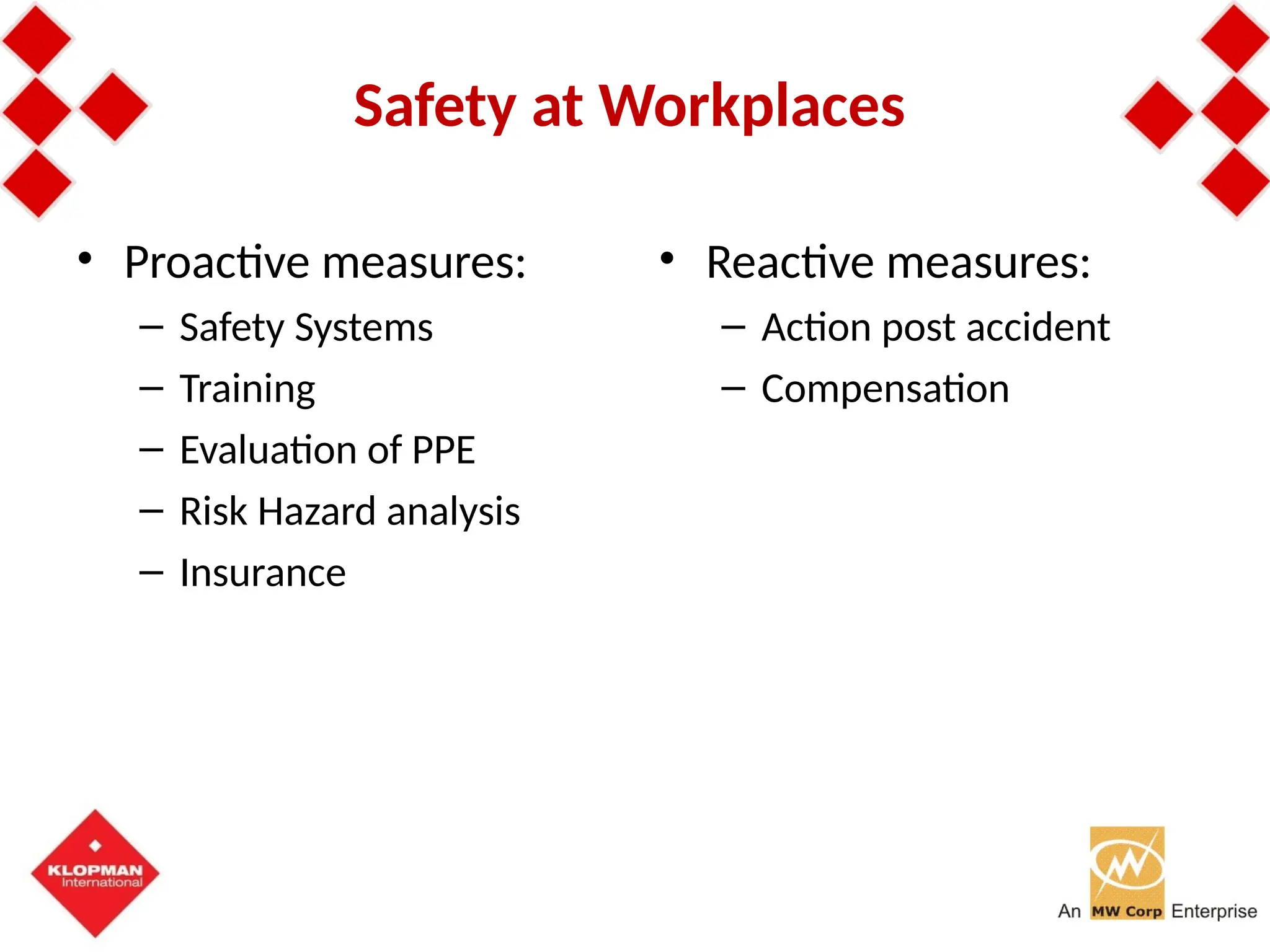
Safety at Workplaces
• Proactive measures:
– Safety Systems
– Training
– Evaluation of PPE
– Risk Hazard analysis
– Insurance
• Reactive measures:
– Action post accident
– Compensation
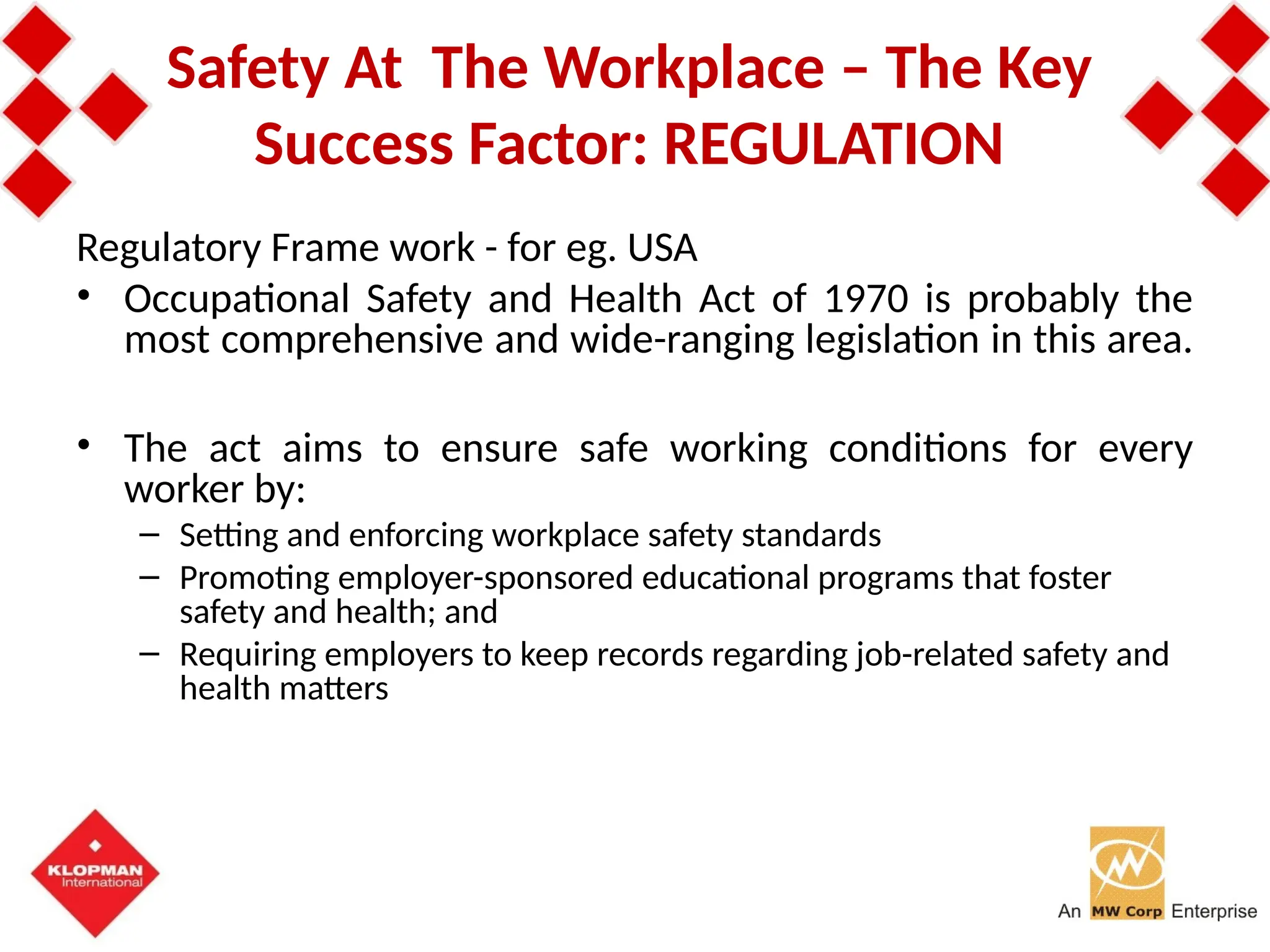
Safety At The Workplace – The Key
Success Factor: REGULATION
Regulatory Frame work - for eg. USA
• Occupational Safety and Health Act of 1970 is probably the
most comprehensive and wide-ranging legislation in this area.
• The act aims to ensure safe working conditions for every
worker by:
– Setting and enforcing workplace safety standards
– Promoting employer-sponsored educational programs that foster
safety and health; and
– Requiring employers to keep records regarding job-related safety and
health matters
Safety At Work Place- The Key
Success Factor: REGULATION
Three separate agencies were created by the act:
• The Occupational Safety and Health Administration (OSHA) to
develop and enforce health and safety standards
• The Occupational Safety and Health Review Commission to
evaluate the appeals from employers who wish to contest
OSHA rulings
• The National Institute for Occupational Safety and Health to
conduct health and safety research and suggest new
standards and update previous ones
Protective Clothing-Definition
Garments that are worn, that prevents a person (or product)
• from coming into contact with
• that protects from
• and/or reduces the risk of exposure to
hostile elements or environments.
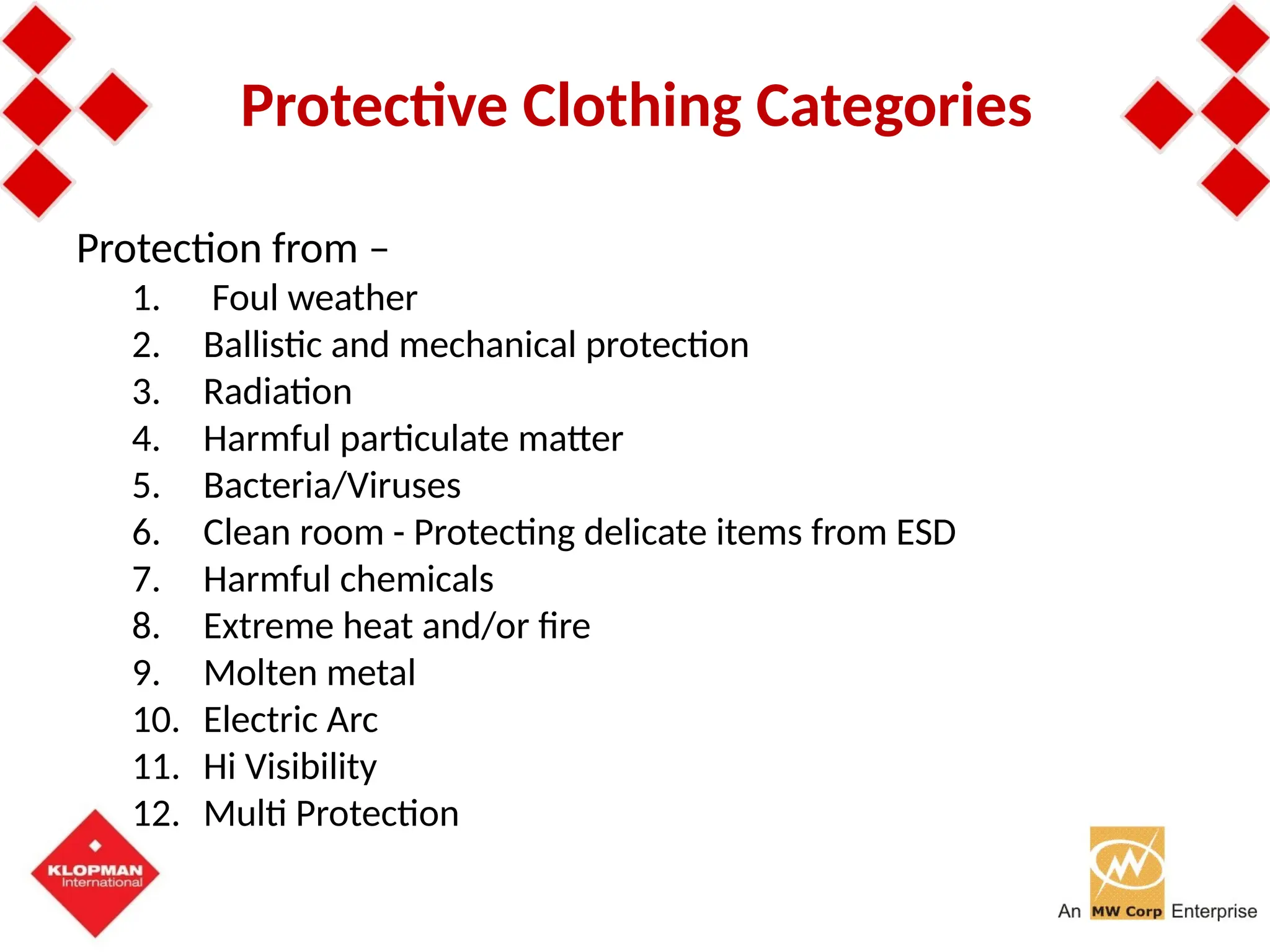
Protective Clothing Categories
Protection from –
1. Foul weather
2. Ballistic and mechanical protection
3. Radiation
4. Harmful particulate matter
5. Bacteria/Viruses
6. Clean room - Protecting delicate items from ESD
7. Harmful chemicals
8. Extreme heat and/or fire
9. Molten metal
10. Electric Arc
11. Hi Visibility
12. Multi Protection
Protective Wear Examples…
BACTERIAL/VIRAL
• Sophisticated Barrier fabrics garments along with anti-
bacterial finishes are been used by hospital and medical
personnel, emergency responders such as ambulances,
firemen, and police
Protective Wear Examples…
CLEAN ROOM
• The human body emits over 250,000 submicron particles
(<.05 microns) every minute. Protective Clothing helps to keep
these particles from escaping and contaminating the
Product / Environment / Worker
Protective Wear Examples…
CHEMICAL
• Protective clothing offers permeation and penetration
protection from a wide range of chemicals
THERMAL
• Protection from fire and extreme heat, has long witnessed a
need for protective clothing which has helped to protect the
fireman, those working in primary metal industries with
molten metal, and similar areas involving exposure to high
heat such as welding, foundries, ceramics manufacture,
electrical maintenance, etc.
Protective Wear Examples…
Important factors for adoption of
Protective Clothing at the
Workplace
• Evaluate solutions conforming to universally accepted and
followed standards and specifications
• Check the credentials of the supplier
• Comfort of the Protective Clothing
• Proper garment maintenance
• Increase worker efficiency
Klopman
 Started in 1968 by Bill Klopman in Europe.
 Acquired by MW Corp of India in 2008
 Klopman introduced the concept of poly/cotton work wear
fabrics to Europe
 Klopman is Europe's No.1 Work-Wear and Protective-Wear
brand with over a 30% market share
 Produces 45 Million meters per annum
MW Corp
 A generation-next enterprise founded by Mr. Mukul Kasliwal
and Mr. Warij Kasliwal
 Interest across verticals such as Textiles, Renewable Energy
and Real Estate
 Has operations across three continents
Industries We Cater To
• Heavy Industry
• Auto Manufacturing
• Auto Distribution
• Oil and Gas
• Metal
• Hospital and Health care
• Pharma
• Hotel and services
• Electronic
flame retardant
Flamesafe: Flame retardant
fabrics for welders & industrial
workers exposed to heat
chemical protection
Chemex: Chemical protection
fabrics for accidental splash
high visibility
Luminex: High Visibility fabrics
for safety wear
barrier
Vektron: Barrier fabrics for
Cleanrooms, Food industry &
Operating theatres, Anti-Allergy
Protection
antistatic
Coverstat: Anti-static fabrics
for critical anti-static areas
multiprotection
Multi-Pro: Multi protection fabrics
for anti-static, flame retardant &
chemical splash environments
antimicrobial
Bioguard: Anti-Microbial
protection for critical hygiene
areas
•
Solutions From Klopman For Work
Place Hazards….
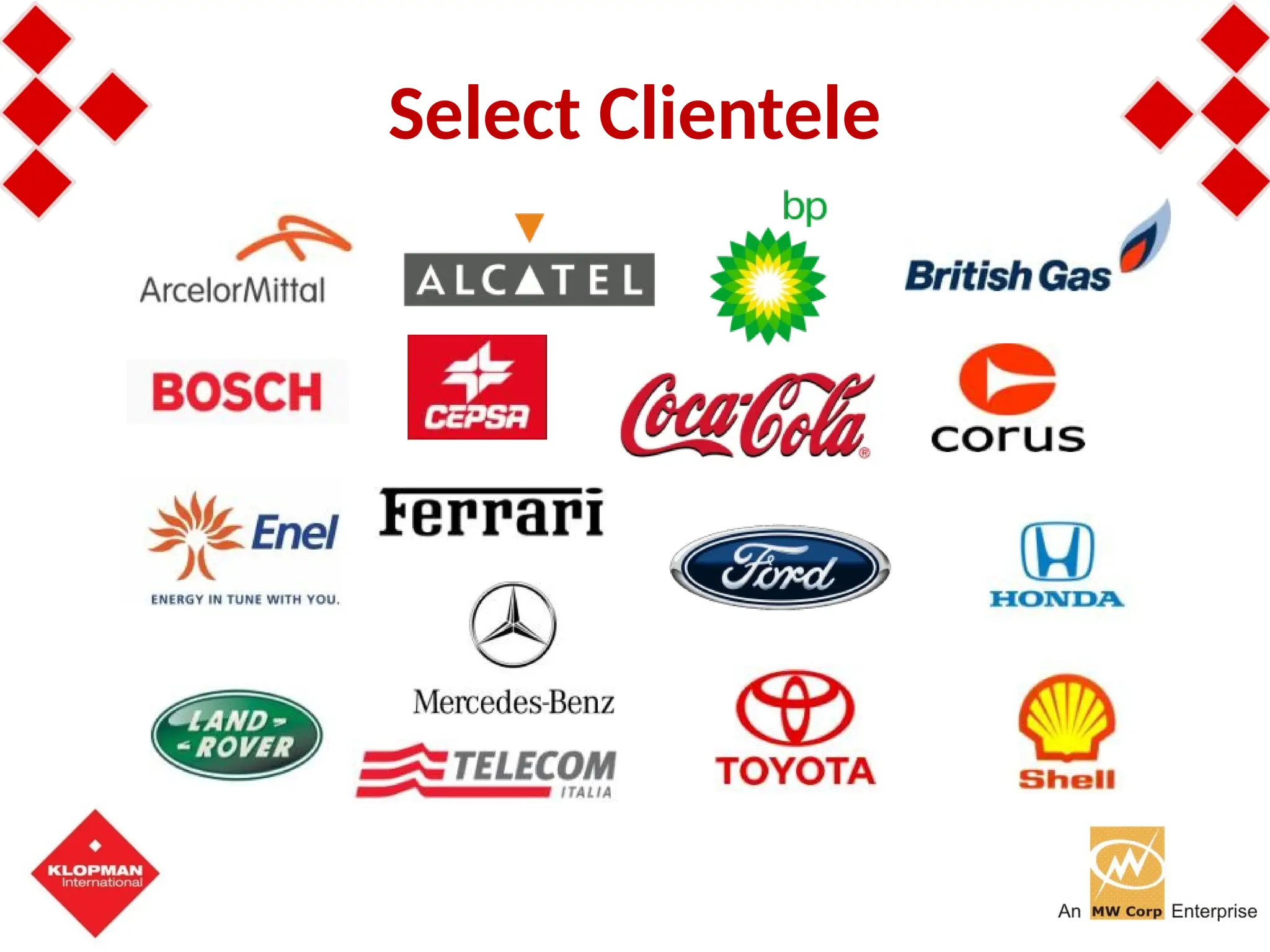
Select Clientele
Klopman International
 www.klopman.com

MVijaywargi-Klopman SAFETY GEARS AND EQUIPMENT

  • 1.
    Role of ProtectiveClothing in enhancing worker safety- Global Perspective July 14,2011
  • 2.
  • 3.
    ILO Global EstimatesOf Occupational Accidents Country Industrial Workers (Millions) Fatal Accidents per 100000 Accidents causing leave for 3+ days due to injury/1 million workers Work related deaths Per Capita $ spent on PPE Industrial 335 5 0.04 297000 14 India 40 100 0.75 302000 0.33 20-30 % of PPE budget is normally spent on Protective Clothing
  • 4.
  • 5.
    Global Trends • OSHA,USA estimates that for every $1 spent on effective HSE programme about $4 are saved • The USA protective market grew by 6% during 2007- 10(economy grew 1-2 %) • Protection from Fire/Heat is a major requirement for Protective Clothing • Regulatory framework is essential for the adoption of good PPE and safety practices • The death toll is higher in Developing countries, where more workers are engaged in blue collar work • CSR is becoming an important aspect within a company • Globalisation of manufacturing- Make in India sell in Europe
  • 6.
    Work Place Injuriesin USA by Type % Burns ..15 % Fractures ..8% Cuts..25% Musculoskeletal.35% Others..17% Globally Companies Spend most on Protective clothing than any other PPE
  • 7.
    Safety at Workplaces •Proactive measures: – Safety Systems – Training – Evaluation of PPE – Risk Hazard analysis – Insurance • Reactive measures: – Action post accident – Compensation
  • 8.
    Safety At TheWorkplace – The Key Success Factor: REGULATION Regulatory Frame work - for eg. USA • Occupational Safety and Health Act of 1970 is probably the most comprehensive and wide-ranging legislation in this area. • The act aims to ensure safe working conditions for every worker by: – Setting and enforcing workplace safety standards – Promoting employer-sponsored educational programs that foster safety and health; and – Requiring employers to keep records regarding job-related safety and health matters
  • 9.
    Safety At WorkPlace- The Key Success Factor: REGULATION Three separate agencies were created by the act: • The Occupational Safety and Health Administration (OSHA) to develop and enforce health and safety standards • The Occupational Safety and Health Review Commission to evaluate the appeals from employers who wish to contest OSHA rulings • The National Institute for Occupational Safety and Health to conduct health and safety research and suggest new standards and update previous ones
  • 10.
    Protective Clothing-Definition Garments thatare worn, that prevents a person (or product) • from coming into contact with • that protects from • and/or reduces the risk of exposure to hostile elements or environments.
  • 11.
    Protective Clothing Categories Protectionfrom – 1. Foul weather 2. Ballistic and mechanical protection 3. Radiation 4. Harmful particulate matter 5. Bacteria/Viruses 6. Clean room - Protecting delicate items from ESD 7. Harmful chemicals 8. Extreme heat and/or fire 9. Molten metal 10. Electric Arc 11. Hi Visibility 12. Multi Protection
  • 12.
    Protective Wear Examples… BACTERIAL/VIRAL •Sophisticated Barrier fabrics garments along with anti- bacterial finishes are been used by hospital and medical personnel, emergency responders such as ambulances, firemen, and police
  • 13.
    Protective Wear Examples… CLEANROOM • The human body emits over 250,000 submicron particles (<.05 microns) every minute. Protective Clothing helps to keep these particles from escaping and contaminating the Product / Environment / Worker
  • 14.
    Protective Wear Examples… CHEMICAL •Protective clothing offers permeation and penetration protection from a wide range of chemicals
  • 15.
    THERMAL • Protection fromfire and extreme heat, has long witnessed a need for protective clothing which has helped to protect the fireman, those working in primary metal industries with molten metal, and similar areas involving exposure to high heat such as welding, foundries, ceramics manufacture, electrical maintenance, etc. Protective Wear Examples…
  • 16.
    Important factors foradoption of Protective Clothing at the Workplace • Evaluate solutions conforming to universally accepted and followed standards and specifications • Check the credentials of the supplier • Comfort of the Protective Clothing • Proper garment maintenance • Increase worker efficiency
  • 17.
    Klopman  Started in1968 by Bill Klopman in Europe.  Acquired by MW Corp of India in 2008  Klopman introduced the concept of poly/cotton work wear fabrics to Europe  Klopman is Europe's No.1 Work-Wear and Protective-Wear brand with over a 30% market share  Produces 45 Million meters per annum
  • 18.
    MW Corp  Ageneration-next enterprise founded by Mr. Mukul Kasliwal and Mr. Warij Kasliwal  Interest across verticals such as Textiles, Renewable Energy and Real Estate  Has operations across three continents
  • 19.
    Industries We CaterTo • Heavy Industry • Auto Manufacturing • Auto Distribution • Oil and Gas • Metal • Hospital and Health care • Pharma • Hotel and services • Electronic
  • 20.
    flame retardant Flamesafe: Flameretardant fabrics for welders & industrial workers exposed to heat chemical protection Chemex: Chemical protection fabrics for accidental splash high visibility Luminex: High Visibility fabrics for safety wear barrier Vektron: Barrier fabrics for Cleanrooms, Food industry & Operating theatres, Anti-Allergy Protection antistatic Coverstat: Anti-static fabrics for critical anti-static areas multiprotection Multi-Pro: Multi protection fabrics for anti-static, flame retardant & chemical splash environments antimicrobial Bioguard: Anti-Microbial protection for critical hygiene areas • Solutions From Klopman For Work Place Hazards….
  • 21.
  • 22.