Risk Management in ERP
                 Implementation


“The biggest risk to any project is not using Risk Management”
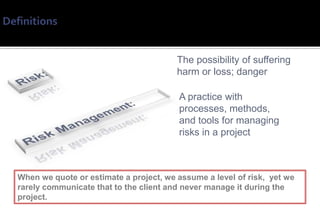
The possibility of suffering
                                        harm or loss; danger

                                        A practice with
                                        processes, methods,
                                        and tools for managing
                                        risks in a project


When we quote or estimate a project, we assume a level of risk, yet we
rarely communicate that to the client and never manage it during the
project.
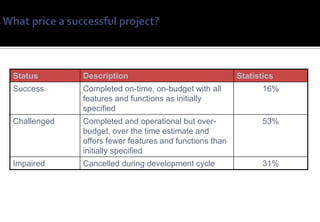
Status       Description                                 Statistics
Success      Completed on-time, on-budget with all               16%
             features and functions as initially
             specified
Challenged   Completed and operational but over-                 53%
             budget, over the time estimate and
             offers fewer features and functions than
             initially specified
Impaired     Cancelled during development cycle                  31%


                                          Info from The Standish Group - 1998
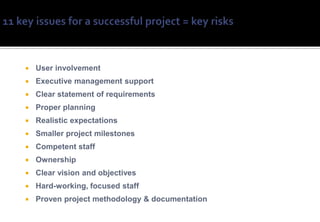
   User involvement
   Executive management support
   Clear statement of requirements
   Proper planning
   Realistic expectations
   Smaller project milestones
   Competent staff
   Ownership
   Clear vision and objectives
   Hard-working, focused staff
                                         Info from The Standish Group - 1998
   Proven project methodology & documentation
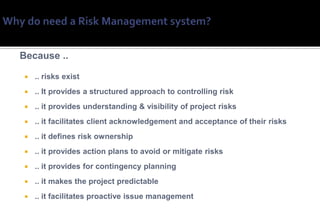
Because ..

   .. risks exist
   .. It provides a structured approach to controlling risk
   .. it provides understanding & visibility of project risks
   .. it facilitates client acknowledgement and acceptance of their risks
   .. it defines risk ownership
   .. it provides action plans to avoid or mitigate risks
   .. it provides for contingency planning
   .. it makes the project predictable
   .. it facilitates proactive issue management
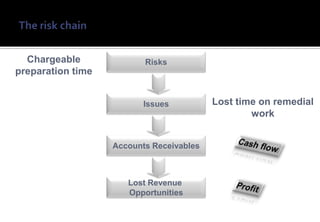
Chargeable              Risks
preparation time


                          Issues          Lost time on remedial
                                                  work


                   Accounts Receivables


                      Lost Revenue
                      Opportunities
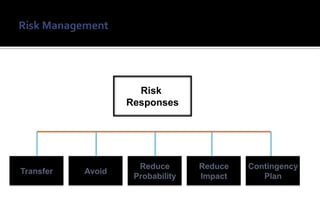
Risk
                   Responses


                     Reduce       Reduce   Contingency
Transfer   Avoid
                    Probability   Impact      Plan
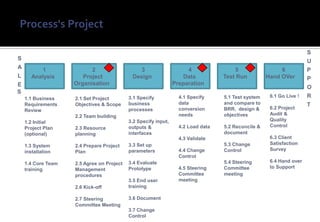
S
S                                                                                                                    U
A         1               2                    3                     4                5                  6           P
L      Analysis        Project              Design                  Data          Test Run          Hand OVer        P
E                   Organisation                                Preparation
                                                                                                                     O
S
    1.1 Business    2.1 Set Project        3.1 Specify            4.1 Specify     5.1 Test system    6.1 Go Live !   R
    Requirements    Objectives & Scope     business               data            and compare to                     T
                                           processes              conversion      BRR, design &      6.2 Project
    Review
                    2.2 Team building                             needs           objectives         Audit &
                                           3.2 Specify input,                                        Quality
    1.2 Initial
                                           outputs &              4.2 Load data   5.2 Reconcile &    Control
    Project Plan    2.3 Resource
    (optional)      planning               interfaces                             document
                                                                  4.3 Validate                       6.3 Client
                                           3.3 Set up                             5.3 Change         Satisfaction
    1.3 System      2.4 Prepare Project
    installation    Plan                   parameters             4.4 Change      Control            Survey
                                                                  Control
                                           3.4 Evaluate                           5.4 Steering       6.4 Hand over
    1.4 Core Team   2.5 Agree on Project
                                           Prototype              4.5 Steering    Committee          to Support
    training        Management
                    procedures                                    Committee       meeting
                                           3.5 End user           meeting
                    2.6 Kick-off           training

                    2.7 Steering           3.6 Document
                    Committee Meeting
                                           3.7 Change
                                           Control
S
S                                                                                    U
A       1             2             3                4            5           6      P
L    Analysis      Project       Design            Data       Test Run   Hand OVer   P
E               Organisation                    Preparation
                                                                                     O
S
                                                                                     R
                                                                                     T


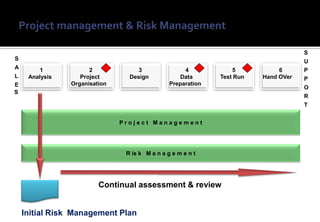
                               Project Management


                                R is k M a n a g e m e n t


                         Continual assessment & review


    Initial Risk Management Plan
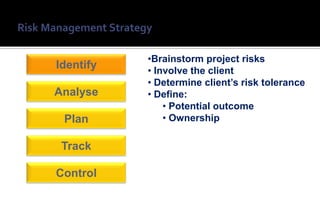
•Brainstorm project risks
Identify   • Involve the client
           • Determine client’s risk tolerance
Analyse    • Define:
               • Potential outcome
 Plan          • Ownership

 Track

Control
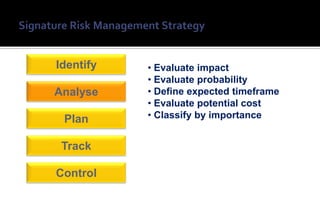
Identify   • Evaluate impact
           • Evaluate probability
Analyse    • Define expected timeframe
           • Evaluate potential cost
 Plan      • Classify by importance


 Track

Control
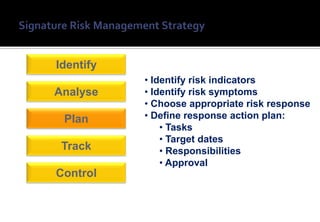
Identify
           • Identify risk indicators
Analyse    • Identify risk symptoms
           • Choose appropriate risk response
 Plan      • Define response action plan:
               • Tasks
               • Target dates
 Track         • Responsibilities
               • Approval
Control
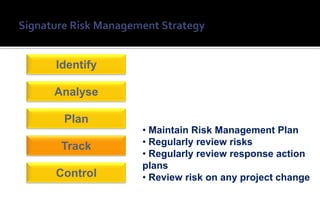
Identify

Analyse

 Plan
           • Maintain Risk Management Plan
 Track     • Regularly review risks
           • Regularly review response action
           plans
Control    • Review risk on any project change
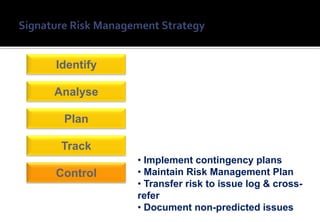
Identify

Analyse

 Plan

 Track
           • Implement contingency plans
Control    • Maintain Risk Management Plan
           • Transfer risk to issue log & cross-
           refer
           • Document non-predicted issues
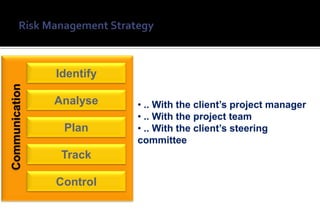
Identify
Communication


                Analyse    • .. With the client’s project manager
                           • .. With the project team
                 Plan      • .. With the client’s steering
                           committee
                 Track

                Control
   improves the chances of a successful project

   reduces issues and the impact of issues

   reduces costly remedial work

   improves accounts receivables
RISK MANAGEMENT
(Based on Signature Methodology)

Risk Management

  • 1.
    Risk Management inERP Implementation “The biggest risk to any project is not using Risk Management”
  • 2.
    The possibility ofsuffering harm or loss; danger A practice with processes, methods, and tools for managing risks in a project When we quote or estimate a project, we assume a level of risk, yet we rarely communicate that to the client and never manage it during the project.
  • 3.
    Status Description Statistics Success Completed on-time, on-budget with all 16% features and functions as initially specified Challenged Completed and operational but over- 53% budget, over the time estimate and offers fewer features and functions than initially specified Impaired Cancelled during development cycle 31% Info from The Standish Group - 1998
  • 4.
    User involvement  Executive management support  Clear statement of requirements  Proper planning  Realistic expectations  Smaller project milestones  Competent staff  Ownership  Clear vision and objectives  Hard-working, focused staff Info from The Standish Group - 1998  Proven project methodology & documentation
  • 6.
    Because ..  .. risks exist  .. It provides a structured approach to controlling risk  .. it provides understanding & visibility of project risks  .. it facilitates client acknowledgement and acceptance of their risks  .. it defines risk ownership  .. it provides action plans to avoid or mitigate risks  .. it provides for contingency planning  .. it makes the project predictable  .. it facilitates proactive issue management
  • 7.
    Chargeable Risks preparation time Issues Lost time on remedial work Accounts Receivables Lost Revenue Opportunities
  • 8.
    Risk Responses Reduce Reduce Contingency Transfer Avoid Probability Impact Plan
  • 9.
    S S U A 1 2 3 4 5 6 P L Analysis Project Design Data Test Run Hand OVer P E Organisation Preparation O S 1.1 Business 2.1 Set Project 3.1 Specify 4.1 Specify 5.1 Test system 6.1 Go Live ! R Requirements Objectives & Scope business data and compare to T processes conversion BRR, design & 6.2 Project Review 2.2 Team building needs objectives Audit & 3.2 Specify input, Quality 1.2 Initial outputs & 4.2 Load data 5.2 Reconcile & Control Project Plan 2.3 Resource (optional) planning interfaces document 4.3 Validate 6.3 Client 3.3 Set up 5.3 Change Satisfaction 1.3 System 2.4 Prepare Project installation Plan parameters 4.4 Change Control Survey Control 3.4 Evaluate 5.4 Steering 6.4 Hand over 1.4 Core Team 2.5 Agree on Project Prototype 4.5 Steering Committee to Support training Management procedures Committee meeting 3.5 End user meeting 2.6 Kick-off training 2.7 Steering 3.6 Document Committee Meeting 3.7 Change Control
  • 10.
    S S U A 1 2 3 4 5 6 P L Analysis Project Design Data Test Run Hand OVer P E Organisation Preparation O S R T Project Management R is k M a n a g e m e n t Continual assessment & review Initial Risk Management Plan
  • 11.
    •Brainstorm project risks Identify • Involve the client • Determine client’s risk tolerance Analyse • Define: • Potential outcome Plan • Ownership Track Control
  • 12.
    Identify • Evaluate impact • Evaluate probability Analyse • Define expected timeframe • Evaluate potential cost Plan • Classify by importance Track Control
  • 13.
    Identify • Identify risk indicators Analyse • Identify risk symptoms • Choose appropriate risk response Plan • Define response action plan: • Tasks • Target dates Track • Responsibilities • Approval Control
  • 14.
    Identify Analyse Plan • Maintain Risk Management Plan Track • Regularly review risks • Regularly review response action plans Control • Review risk on any project change
  • 15.
    Identify Analyse Plan Track • Implement contingency plans Control • Maintain Risk Management Plan • Transfer risk to issue log & cross- refer • Document non-predicted issues
  • 16.
    Identify Communication Analyse • .. With the client’s project manager • .. With the project team Plan • .. With the client’s steering committee Track Control
  • 17.
    improves the chances of a successful project  reduces issues and the impact of issues  reduces costly remedial work  improves accounts receivables
  • 18.
    RISK MANAGEMENT (Based onSignature Methodology)