
Anna Brady
Aurora House
AN INTRODUCTION
TO THE SCERTS
MODEL
1. Introduction
2. What is SCERTS?
3. SCERTS Domains
4. SCERTS Core Principles
Session Overview
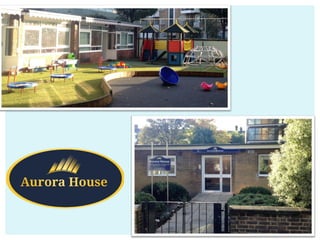
 New Primary Lambeth Autism Provision
16 children with Autism
 Growing to 56 in the coming three years
 Team of 16, including part time music therapist,
OT and SaLT all included and enthused about
SCERTS.
Aurora House
www. auro raho use . o rg . uk
An Introduction To The SCERTS
®
Model
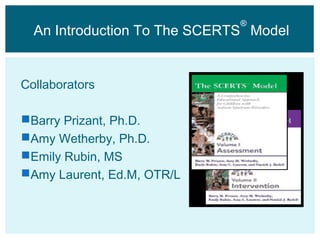
Collaborators
Barry Prizant, Ph.D.
Amy Wetherby, Ph.D.
Emily Rubin, MS
Amy Laurent, Ed.M, OTR/L
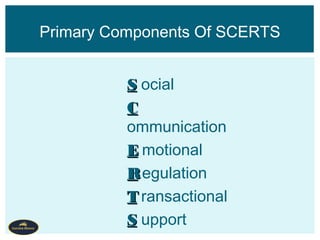
SS ocial
CC
ommunication
EE motional
RRegulation
TT ransactional
SS upport
Primary Components Of SCERTS
Is focused on improving the quality of life of
children with ASD and their families
Based on 25 years of research in child
development and core challenges of autism
The SCERTS Model
The SCERTS Model is not exclusionary of other
practices or approaches.  
It is flexible enough to incorporate practices from
a variety of approaches and teaching strategies.
THE SCERTS MODEL
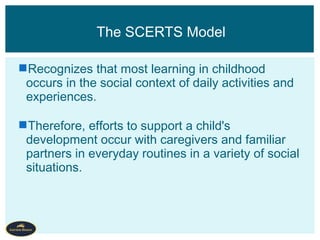
Recognizes that most learning in childhood
occurs in the social context of daily activities and
experiences.
Therefore, efforts to support a child's
development occur with caregivers and familiar
partners in everyday routines in a variety of social
situations.
The SCERTS Model
SCERTS Model
SCERTS Components
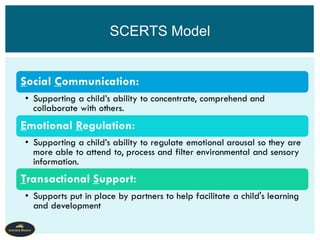
The Social Communication domain of the
SCERTS Model is focused on helping a child to
become an increasingly competent and confident
communicator so they can engage and actively
participate in social activities.
Children who communicate effectively have
access to increased opportunities for play and
learning and are able to enjoy social relationships.
Social Communication Domain
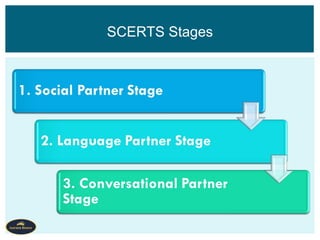
SCERTS Stages
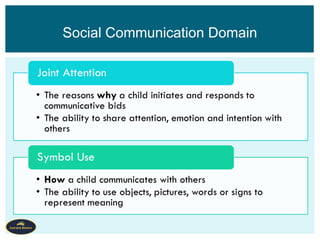
Social Communication Domain
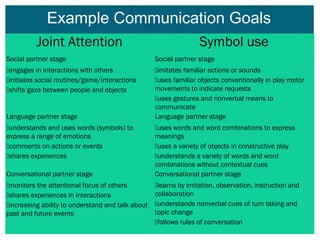
Joint Attention Symbol use
Social partner stage
engages in interactions with others
initiates social routines/game/interactions
shifts gaze between people and objects
Social partner stage
imitates familiar actions or sounds
uses familiar objects conventionally in play motor
movements to indicate requests
uses gestures and nonverbal means to
communicate
Language partner stage
understands and uses words (symbols) to
express a range of emotions
comments on actions or events
shares experiences
Language partner stage
uses words and word combinations to express
meanings
uses a variety of objects in constructive play
understands a variety of words and word
combinations without contextual cues
Conversational partner stage
monitors the attentional focus of others
shares experiences in interactions
increasing ability to understand and talk about
past and future events
Conversational partner stage
learns by imitation, observation, instruction and
collaboration
understands nonverbal cues of turn taking and
topic change
follows rules of conversation
Example Communication Goals
ACTIVITY
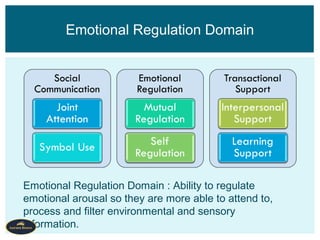
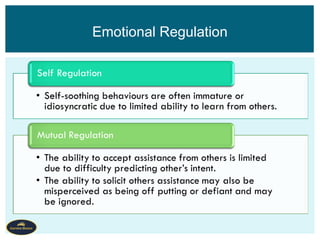
Emotional Regulation Domain
Emotional Regulation Domain : Ability to regulate
emotional arousal so they are more able to attend to,
process and filter environmental and sensory
information.
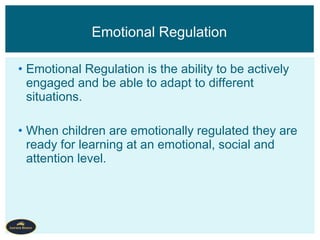
• Emotional Regulation is the ability to be actively
engaged and be able to adapt to different
situations.
• When children are emotionally regulated they are
ready for learning at an emotional, social and
attention level.
Emotional Regulation
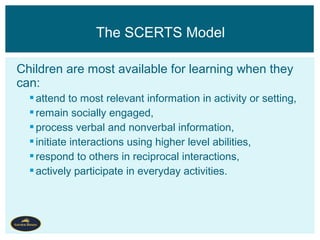
Children are most available for learning when they
can:
attend to most relevant information in activity or setting,
remain socially engaged,
process verbal and nonverbal information,
initiate interactions using higher level abilities,
respond to others in reciprocal interactions,
actively participate in everyday activities.
The SCERTS Model
Emotional Regulation
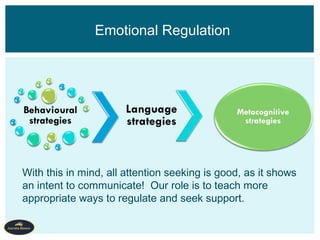
With this in mind, all attention seeking is good, as it shows
an intent to communicate! Our role is to teach more
appropriate ways to regulate and seek support.
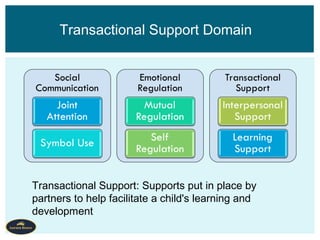
Transactional Support Domain
Transactional Support: Supports put in place by
partners to help facilitate a child's learning and
development
Interpersonal Supports are adjustments made by
communicative partners in language use, emotional
expression, and interactive style that are effective in
helping a child with ASD process language,
participate in social interaction, experience social
activities as emotionally satisfying, and maintain a
well-regulated state.
The SCERTS Model
Learning supports include environmental arrangement
or other ways activities are set up or modified to
foster social communication and emotional
regulation (e.g., visual supports, curriculum
modifications, etc.).
The SCERTS Model
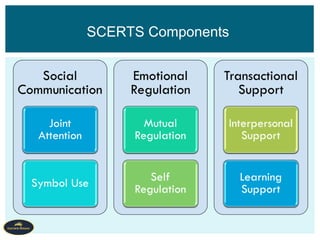
 Transactional Support components include:
Interpersonal Support
Learning Support
Support to Families- educational and emotional support
Support to Professionals- educational and emotional
support
The SCERTS Model
Why the focus on SC, ER, and TS?
This focus is consistent with the National Research
Council's (2001) priorities of fostering functional
spontaneous communication, development of social
relationships, and acquisition of functional abilities in
meaningful activities.
The SCERTS Model
Why the focus on SC, ER, and TS?
The SCERTS collaborators believe that the focus on
these domains is well supported by research on core
challenges with ASD, as well as priorities and concerns
identified by parents and experts in the field.
SC, ER, and TS enhance human development and
quality of life.
The SCERTS Model
Prizant, B., Wetherby, A., Rubin, E., & Laurent, A.
One:
Highest priority is the development of
spontaneous, functional communication abilities
and emotional regulatory capacities
The SCERTS Model:
Core Values And Guiding Principles
Two:
Principles and research on child development
frame assessment and educational efforts.
Goals and activities are developmentally
appropriate and functional.
The SCERTS Model:
Core Values And Guiding Principles
Three:
All domains of a child’s development (e.g.
communicative, socio-emotional, cognitive, and
motor) are viewed as interrelated and
interdependent. Assessment and educational
efforts must address these relationships.
The SCERTS Model:
Core Values And Guiding Principles
Four:
All behavior is viewed as purposeful serving a
variety of functions (e.g., communication,
emotional regulation).
For children who display unconventional or
problem behaviors, there is an emphasis on
developing a range of supports for emotional
regulation.
The SCERTS Model:
Core Values And Guiding Principles
Five:
A child’s unique learning profile of strengths and
weaknesses determines appropriate
accommodations for facilitating competence in
the domains of social-communication and
emotional regulation.
The SCERTS Model:
Core Values And Guiding Principles
Six:
Natural routines across home, school, and
community environments provide the contexts for
learning and for developing positive relationships.
Progress is measured in daily experiences and
routines.
The SCERTS Model:
Core Values And Guiding Principles
Seven:
It is the primary responsibility of professionals to
establish positive relationships with children and
with family members. All children and family
members are treated with dignity and respect.
The SCERTS Model:
Core Values And Guiding Principles
Eight:
Family members are considered experts about their
child. Assessment and educational efforts are
viewed as collaborative processes with family
members.
The SCERTS Model:
Core Values And Guiding Principles
For further information about the SCERTS manual, see
www.brookespublishing.com/store/books/prizant-8183
For a listing of research supporting the SCERTS model, see the
Research Corner on www.SCERTS.com
For further information, including published articles on SCERTS and a
detailed list of FAQ's , see Frequently Asked Questions on
www.SCERTS.com
www.amy-laurent.com
www.puzzlecentre.org.uk
Where Can I Find Out More About
SCERTS And The SCERTS Manual?

An Introduction to The SCERTS Model - Anna Brady

  • 1.
    Anna Brady Aurora House ANINTRODUCTION TO THE SCERTS MODEL
  • 2.
    1. Introduction 2. Whatis SCERTS? 3. SCERTS Domains 4. SCERTS Core Principles Session Overview
  • 4.
     New PrimaryLambeth Autism Provision 16 children with Autism  Growing to 56 in the coming three years  Team of 16, including part time music therapist, OT and SaLT all included and enthused about SCERTS. Aurora House www. auro raho use . o rg . uk
  • 5.
    An Introduction ToThe SCERTS ® Model Collaborators Barry Prizant, Ph.D. Amy Wetherby, Ph.D. Emily Rubin, MS Amy Laurent, Ed.M, OTR/L
  • 6.
    SS ocial CC ommunication EE motional RRegulation TTransactional SS upport Primary Components Of SCERTS
  • 7.
    Is focused onimproving the quality of life of children with ASD and their families Based on 25 years of research in child development and core challenges of autism The SCERTS Model
  • 8.
    The SCERTS Modelis not exclusionary of other practices or approaches.   It is flexible enough to incorporate practices from a variety of approaches and teaching strategies. THE SCERTS MODEL
  • 9.
    Recognizes that mostlearning in childhood occurs in the social context of daily activities and experiences. Therefore, efforts to support a child's development occur with caregivers and familiar partners in everyday routines in a variety of social situations. The SCERTS Model
  • 10.
  • 11.
  • 13.
    The Social Communicationdomain of the SCERTS Model is focused on helping a child to become an increasingly competent and confident communicator so they can engage and actively participate in social activities. Children who communicate effectively have access to increased opportunities for play and learning and are able to enjoy social relationships. Social Communication Domain
  • 14.
  • 15.
  • 16.
    Joint Attention Symboluse Social partner stage engages in interactions with others initiates social routines/game/interactions shifts gaze between people and objects Social partner stage imitates familiar actions or sounds uses familiar objects conventionally in play motor movements to indicate requests uses gestures and nonverbal means to communicate Language partner stage understands and uses words (symbols) to express a range of emotions comments on actions or events shares experiences Language partner stage uses words and word combinations to express meanings uses a variety of objects in constructive play understands a variety of words and word combinations without contextual cues Conversational partner stage monitors the attentional focus of others shares experiences in interactions increasing ability to understand and talk about past and future events Conversational partner stage learns by imitation, observation, instruction and collaboration understands nonverbal cues of turn taking and topic change follows rules of conversation Example Communication Goals
  • 17.
  • 18.
    Emotional Regulation Domain EmotionalRegulation Domain : Ability to regulate emotional arousal so they are more able to attend to, process and filter environmental and sensory information.
  • 19.
    • Emotional Regulationis the ability to be actively engaged and be able to adapt to different situations. • When children are emotionally regulated they are ready for learning at an emotional, social and attention level. Emotional Regulation
  • 20.
    Children are mostavailable for learning when they can: attend to most relevant information in activity or setting, remain socially engaged, process verbal and nonverbal information, initiate interactions using higher level abilities, respond to others in reciprocal interactions, actively participate in everyday activities. The SCERTS Model
  • 21.
  • 22.
    Emotional Regulation With thisin mind, all attention seeking is good, as it shows an intent to communicate! Our role is to teach more appropriate ways to regulate and seek support.
  • 23.
    Transactional Support Domain TransactionalSupport: Supports put in place by partners to help facilitate a child's learning and development
  • 24.
    Interpersonal Supports areadjustments made by communicative partners in language use, emotional expression, and interactive style that are effective in helping a child with ASD process language, participate in social interaction, experience social activities as emotionally satisfying, and maintain a well-regulated state. The SCERTS Model
  • 25.
    Learning supports includeenvironmental arrangement or other ways activities are set up or modified to foster social communication and emotional regulation (e.g., visual supports, curriculum modifications, etc.). The SCERTS Model
  • 26.
     Transactional Supportcomponents include: Interpersonal Support Learning Support Support to Families- educational and emotional support Support to Professionals- educational and emotional support The SCERTS Model
  • 27.
    Why the focuson SC, ER, and TS? This focus is consistent with the National Research Council's (2001) priorities of fostering functional spontaneous communication, development of social relationships, and acquisition of functional abilities in meaningful activities. The SCERTS Model
  • 28.
    Why the focuson SC, ER, and TS? The SCERTS collaborators believe that the focus on these domains is well supported by research on core challenges with ASD, as well as priorities and concerns identified by parents and experts in the field. SC, ER, and TS enhance human development and quality of life. The SCERTS Model Prizant, B., Wetherby, A., Rubin, E., & Laurent, A.
  • 29.
    One: Highest priority isthe development of spontaneous, functional communication abilities and emotional regulatory capacities The SCERTS Model: Core Values And Guiding Principles
  • 30.
    Two: Principles and researchon child development frame assessment and educational efforts. Goals and activities are developmentally appropriate and functional. The SCERTS Model: Core Values And Guiding Principles
  • 31.
    Three: All domains ofa child’s development (e.g. communicative, socio-emotional, cognitive, and motor) are viewed as interrelated and interdependent. Assessment and educational efforts must address these relationships. The SCERTS Model: Core Values And Guiding Principles
  • 32.
    Four: All behavior isviewed as purposeful serving a variety of functions (e.g., communication, emotional regulation). For children who display unconventional or problem behaviors, there is an emphasis on developing a range of supports for emotional regulation. The SCERTS Model: Core Values And Guiding Principles
  • 33.
    Five: A child’s uniquelearning profile of strengths and weaknesses determines appropriate accommodations for facilitating competence in the domains of social-communication and emotional regulation. The SCERTS Model: Core Values And Guiding Principles
  • 34.
    Six: Natural routines acrosshome, school, and community environments provide the contexts for learning and for developing positive relationships. Progress is measured in daily experiences and routines. The SCERTS Model: Core Values And Guiding Principles
  • 35.
    Seven: It is theprimary responsibility of professionals to establish positive relationships with children and with family members. All children and family members are treated with dignity and respect. The SCERTS Model: Core Values And Guiding Principles
  • 36.
    Eight: Family members areconsidered experts about their child. Assessment and educational efforts are viewed as collaborative processes with family members. The SCERTS Model: Core Values And Guiding Principles
  • 37.
    For further informationabout the SCERTS manual, see www.brookespublishing.com/store/books/prizant-8183 For a listing of research supporting the SCERTS model, see the Research Corner on www.SCERTS.com For further information, including published articles on SCERTS and a detailed list of FAQ's , see Frequently Asked Questions on www.SCERTS.com www.amy-laurent.com www.puzzlecentre.org.uk Where Can I Find Out More About SCERTS And The SCERTS Manual?

Editor's Notes

  • #8 Based on 25 years of research across child development and core challenges of autism
  • #23 Behavioural level Simple motor actions or sensori-motor strategies the child uses to regulate their arousal level, remain alert, and/or self-soothe such as rocking or spinning an object, being massaged Language level The words or symbols the child uses to regulate their arousal level, such as looking at a schedule or saying “it’s ok” Metacognitive level The child’s ability to think about, plan and talk about ways of helping themselves regulate