Behavioural Assessment
A few observations and much reasoning lead to error; many
observations and a little reasoning to truth.
- Alexis Carrel
PSYC 3370 Behavioural Assessments C. Brannen 1
Learning Objectives
• Be able to discuss the different situations that require behavioural
observation
• Describe different types of behavioural observation
• Discuss the various uses of behavioural observation with children
• Summarize the behavioural observation activity that we did in class
• Describe commonly used assessments of childhood behavioural and
emotional problems.
PSYC 3370 Behavioural Assessments C. Brannen 2
Assessing Behaviour
• We all engage in the assessment of behaviour on a
regular basis
• We observe others behavior, or perhaps our own, and make
inferences about internal processes (e.g., thoughts, emotions,
motivations)
• Two major uses:
• When the goal is to measure overt behavior
• When it is difficult or impossible to evaluate the underlying
processes guiding behavior (emotions and thoughts)
PSYC 3370 Behavioural Assessments C. Brannen 3
Behavioural Assessment
• Behavioural assessments help practitioners and
researchers determine:
• The degree to which specific behaviours cluster together
• The associations between behaviours and covert processes
(emotions and thoughts)
• Behavioural assessments can be used to predict
outcomes, such as the likelihood of a clinical diagnosis
PSYC 3370 Behavioural Assessments C. Brannen 4
Behavioural Rating Scales
• Behaviour rating scales can measure:
• The frequency of a behavior
• The intensity of a behavior
• Can be completed by:
• A trained observer
• A reliable informant
• The person of interest
PSYC 3370 Behavioural Assessments C. Brannen 5
Behaviour Rating Scales, cont’d.
• Inventories that ask informants to rate an individual on
a number of dimensions
• Informants may be parents, teachers, a spouse, or
health care worker
• Often used with children and adolescents
PSYC 3370 Behavioural Assessments C. Brannen 6
Benefits of Behaviour Rating Scales
• Children may have difficulty reporting feelings and
thoughts
• Cost-effective and time-efficient
• Having informants complete the scales allows
evaluation of less common behaviours, across different
settings
• Multiple raters/informants provide a broad sample of
behaviours across settings and times
PSYC 3370 Behavioural Assessments C. Brannen 7
Benefits of Behaviour Rating Scales, cont’d.
• Facilitate accurate diagnosis
• Predicts future behaviour and learning problems
• Helps detect changes in behaviour
• Predicts what types of interventions are likely to be
effective
• Crucial for clinical child interventions
• Important in the practice of evidence-based treatments
PSYC 3370 Behavioural Assessments C. Brannen 8
Weaknesses of Behaviour Rating Scales
• Subject to response sets
• May be less helpful when assessing “internalizing”
problems
• Ratings of behaviour are impressionistic
PSYC 3370 Behavioural Assessments C. Brannen 9
Direct Observation
• Oldest method of behavioural assessment; still widely
used
• Observe the examinee in natural setting
• Behaviours are specified and counted
• Provides true ratio scale data
• Adds another dimension to assessment
• Observer can note antecedents, as well as
consequences.
PSYC 3370 Behavioural Assessments C. Brannen 10
Direct Observation
• Can occur with or without a standardized recording
scheme
• Standardized observation forms:
• Enhance observer training
• Observer impartiality
• Improve consistency and accuracy
• Do limit the flexibility of direct observation
• Advantages seen as outweighing the limitations
PSYC 3370 Behavioural Assessments C. Brannen 11
Behaviour Assessment of Children:
Direct Observation
• Behaviour specialists observe behaviour and count the
frequency and intensity of target behaviours.
• Two types:
• Structured interaction between a child and a caregiver
(usually the mom).
• Observation of the child performing various tasks, sometimes
in different settings
• Used in research settings, early childhood primary
health programs, clinical diagnostic approaches, schools
PSYC 3370 Behavioural Assessments C. Brannen 12
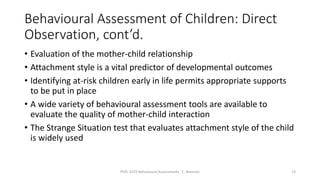
Behavioural Assessment of Children: Direct
Observation, cont’d.
• Evaluation of the mother-child relationship
• Attachment style is a vital predictor of developmental outcomes
• Identifying at-risk children early in life permits appropriate supports
to be put in place
• A wide variety of behavioural assessment tools are available to
evaluate the quality of mother-child interaction
• The Strange Situation test that evaluates attachment style of the child
is widely used
PSYC 3370 Behavioural Assessments C. Brannen 13
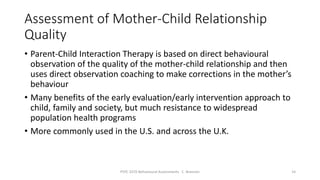
Assessment of Mother-Child Relationship
Quality
• Parent-Child Interaction Therapy is based on direct behavioural
observation of the quality of the mother-child relationship and then
uses direct observation coaching to make corrections in the mother’s
behaviour
• Many benefits of the early evaluation/early intervention approach to
child, family and society, but much resistance to widespread
population health programs
• More commonly used in the U.S. and across the U.K.
PSYC 3370 Behavioural Assessments C. Brannen 14
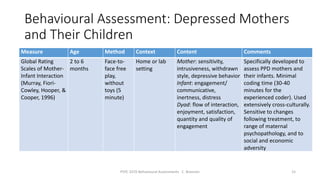
Behavioural Assessment: Depressed Mothers
and Their Children
PSYC 3370 Behavioural Assessments C. Brannen 15
Measure Age Method Context Content Comments
Global Rating
Scales of Mother-
Infant Interaction
(Murray, Fiori-
Cowley, Hooper, &
Cooper, 1996)
2 to 6
months
Face-to-
face free
play,
without
toys (5
minute)
Home or lab
setting
Mother: sensitivity,
intrusiveness, withdrawn
style, depressive behavior
Infant: engagement/
communicative,
inertness, distress
Dyad: flow of interaction,
enjoyment, satisfaction,
quantity and quality of
engagement
Specifically developed to
assess PPD mothers and
their infants. Minimal
coding time (30-40
minutes for the
experienced coder). Used
extensively cross-culturally.
Sensitive to changes
following treatment, to
range of maternal
psychopathology, and to
social and economic
adversity
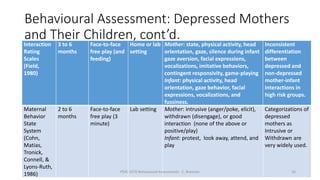
Behavioural Assessment: Depressed Mothers
and Their Children, cont’d.Interaction
Rating
Scales
(Field,
1980)
3 to 6
months
Face-to-face
free play (and
feeding)
Home or lab
setting
Mother: state, physical activity, head
orientation, gaze, silence during infant
gaze aversion, facial expressions,
vocalizations, imitative behaviors,
contingent responsivity, game-playing
Infant: physical activity, head
orientation, gaze behavior, facial
expressions, vocalizations, and
fussiness.
Inconsistent
differentiation
between
depressed and
non-depressed
mother-infant
interactions in
high risk groups.
Maternal
Behavior
State
System
(Cohn,
Matias,
Tronick,
Connell, &
Lyons-Ruth,
1986)
2 to 6
months
Face-to-face
free play (3
minute)
Lab setting Mother: intrusive (anger/poke, elicit),
withdrawn (disengage), or good
interaction (none of the above or
positive/play)
Infant: protest, look away, attend, and
play
Categorizations of
depressed
mothers as
Intrusive or
Withdrawn are
very widely used.
PSYC 3370 Behavioural Assessments C. Brannen 16
Behavioural Assessment: Depressed Mothers
and Their Children, cont’d.
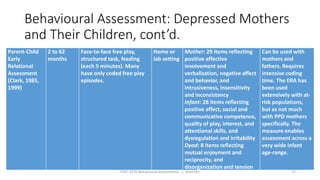
Parent-Child
Early
Relational
Assessment
(Clark, 1985,
1999)
2 to 62
months
Face-to-face free play,
structured task, feeding
(each 5 minutes). Many
have only coded free play
episodes.
Home or
lab setting
Mother: 29 items reflecting
positive affective
involvement and
verbalization, negative affect
and behavior, and
intrusiveness, insensitivity
and inconsistency
Infant: 28 items reflecting
positive affect, social and
communicative competence,
quality of play, interest, and
attentional skills, and
dysregulation and irritability
Dyad: 8 items reflecting
mutual enjoyment and
reciprocity, and
disorganization and tension
Can be used with
mothers and
fathers. Requires
intensive coding
time. The ERA has
been used
extensively with at-
risk populations,
but as not much
with PPD mothers
specifically. The
measure enables
assessment across a
very wide infant
age-range.
PSYC 3370 Behavioural Assessments C. Brannen 17
Behavioural Assessment: Depressed Mothers and
Their Children, cont’d.
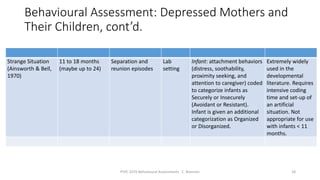
Strange Situation
(Ainsworth & Bell,
1970)
11 to 18 months
(maybe up to 24)
Separation and
reunion episodes
Lab
setting
Infant: attachment behaviors
(distress, soothability,
proximity seeking, and
attention to caregiver) coded
to categorize infants as
Securely or Insecurely
(Avoidant or Resistant).
Infant is given an additional
categorization as Organized
or Disorganized.
Extremely widely
used in the
developmental
literature. Requires
intensive coding
time and set-up of
an artificial
situation. Not
appropriate for use
with infants < 11
months.
PSYC 3370 Behavioural Assessments C. Brannen 18
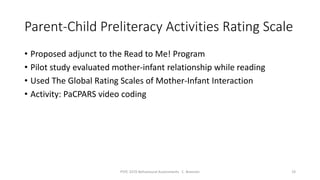
Parent-Child Preliteracy Activities Rating Scale
• Proposed adjunct to the Read to Me! Program
• Pilot study evaluated mother-infant relationship while reading
• Used The Global Rating Scales of Mother-Infant Interaction
• Activity: PaCPARS video coding
PSYC 3370 Behavioural Assessments C. Brannen 19
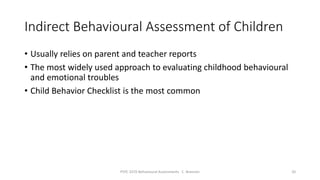
Indirect Behavioural Assessment of Children
• Usually relies on parent and teacher reports
• The most widely used approach to evaluating childhood behavioural
and emotional troubles
• Child Behavior Checklist is the most common
PSYC 3370 Behavioural Assessments C. Brannen 20
Achenbach System of Empirically
Based Assessment (ASEBA)
• Child behaviour Checklist (CBCL)
• Teacher Report Form (TRF)
• Scales contain two basic sections
• The first section collects information about the child’s
activities and competencies in areas such as recreation, social
functioning, and school.
• The second section assesses problem behaviours.
PSYC 3370 Behavioural Assessments C. Brannen 21
ASEBA
• Computer-scoring software is available
• Strengths
• Relatively easy to use
• Time efficient
• Have a rich history of clinical and research applications
PSYC 3370 Behavioural Assessments C. Brannen 22
BASC 3rd Edition
• Behavioural Assessment Scales for Children
• A Pearson product…like the text book
• An integrated set of instruments that includes:
• Teacher Rating Scale (TRS)
• Parent Rating Scale (PRS)
• Self-report scales
• A classroom observation system
• The Parenting Relationship Questionnaire
• A structured developmental history
PSYC 3370 Behavioural Assessments C. Brannen 23
BASC-3, cont’d.
• Authors recommend that interpretation follow a “top-
down” approach
• The clinician starts at the most global level
• Then progresses to more specific levels
• Most global measure is the behavioural symptoms
Index (BSI)
• Reflects the overall level of behavioural problems
• Provides clinicians nonspecific index of pathology
PSYC 3370 Behavioural Assessments C. Brannen 24
BASC-3, cont’d.
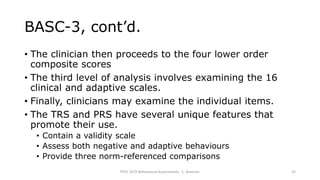
• The clinician then proceeds to the four lower order
composite scores
• The third level of analysis involves examining the 16
clinical and adaptive scales.
• Finally, clinicians may examine the individual items.
• The TRS and PRS have several unique features that
promote their use.
• Contain a validity scale
• Assess both negative and adaptive behaviours
• Provide three norm-referenced comparisons
PSYC 3370 Behavioural Assessments C. Brannen 25
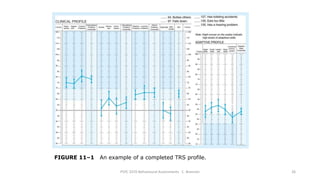
FIGURE 11–1 An example of a completed TRS profile.
PSYC 3370 Behavioural Assessments C. Brannen 26
Student Observation System (SOS)
• A component of the BASC-3
• Allows for the observation of 14 dimensions of
behaviour
• Useful in any structured setting that has educational
goals
• Uses a momentary time sampling (MTS) procedure
PSYC 3370 Behavioural Assessments C. Brannen 27
Student Observation System (SOS)
• Important to have good operational definitions of
behaviours
• This contributes to good inter-rater reliability
PSYC 3370 Behavioural Assessments C. Brannen 28
Student Observation System (SOS)
• MTS is also important in making direct observation
practical, as well as accurate.
• The observer watches the target individual for a specified
period then marks the relevant behaviours.
• BASC-3 SOS MTS is set to be a total of 15 minutes.
• Learn more: BASC website
• Learn more: BASC-3 webinar
PSYC 3370 Behavioural Assessments C. Brannen 29
Omnibus Rating Scales
• Measure a wide range of symptoms – examples:
• BASC-2 TRS and PRS
• The CBCL and TRF
• Sensitive to symptoms of both internalizing and
externalizing disorders
• Should always be used for initial screening and
assessment
PSYC 3370 Behavioural Assessments C. Brannen 30
Single-Domain Rating Scales
• Provide a more thorough assessment of a specific
domain or syndrome
• Resemble the omnibus scales in format, but focus on a
single disorder or behavioural dimension
• Can be useful in supplementing more comprehensive
assessment techniques
PSYC 3370 Behavioural Assessments C. Brannen 31
Single-Domain Rating Scales
• Childhood Autism Rating Scale (CARS)
• Designed to help identify autism
• Adequate reliability and validity evidence
• BASC Monitor for ADHD
• Designed for use with children suffering from ADHD
• Contains a teacher’s and parent’s rating scale
• Good reliability and validity evidence
• Pediatric Behaviour Rating Scale
• Contains a teacher’s and parent’s rating scale
• Help identify early onset bipolar disorder
• Adequate initial reliability and validity evidence
PSYC 3370 Behavioural Assessments C. Brannen 32
Adaptive Behaviour Rating Scales
• Adaptive behaviour
• Conceptual skills
• Practical skills
• Social skills
• Important in the assessment of individuals
with developmental and intellectual
disabilities
• The Vineland Adaptive behaviour Scales –
Second Edition (Vineland-II)
PSYC 3370 Behavioural Assessments C. Brannen 33
Adult Behaviour Rating Scales
• Clinical Assessment Scales for the Elderly (CASE)
• Omnibus behaviour rating scale
• Completed by a caregiver with frequent contact with
examinee
• Contains separate self-report scale for cognitively intact
seniors to complete
• Various clinical scales focus Axis I or clinical disorders
• Three validity scales are provided with the full-length
scales.
• Screening versions of the CASE are also available.
• Typically completed in 30 minutes or less
PSYC 3370 Behavioural Assessments C. Brannen 34
The Brief Child and Family Telephone
Interview (BCFPI)
•Helps to reduce self-report problems
•Not a clinical interview but the scores are
highly predictive of childhood mental illness
•Activity: BCFPI discussion
PSYC 3370 Behavioural Assessments C. Brannen 35
Other Types of Assssment
• Continuous Performance Tests (CPTs)
• Specific type of behavioural test originally designed to
measure the following:
• Vigilance
• Attention
• And more generally, executive control
• Different CPT paradigms have been devised
PSYC 3370 Behavioural Assessments C. Brannen 36
CPT
• Typically, a CPT requires an examinee to view a
computer screen.
• Respond when a simple stimulus or sequence of stimuli
appear on the screen
• Inhibit responding at all other times
• Can be complex and use auditory presentation
• Highly sensitive to problems with self-regulatory and
executive control systems
PSYC 3370 Behavioural Assessments C. Brannen 37
CPT
• A recent CPT added working memory assessment to the
standard CPT paradigms.
• Tasks of Executive Control (TEC)
• Consists of a set of six different tasks
• Manipulates working memory as a component of:
• Attention
• Vigilance
• Response inhibition
PSYC 3370 Behavioural Assessments C. Brannen 38
Psychophysiological Assessments
• Typically involves recording physical changes in the
body
• Lie detector or polygraph is perhaps the best-known
example
• Other examples:
• Electroencephalographs (EEGs)
• Electromyographs
PSYC 3370 Behavioural Assessments C. Brannen 39

Behavioural assessment

  • 1.
    Behavioural Assessment A fewobservations and much reasoning lead to error; many observations and a little reasoning to truth. - Alexis Carrel PSYC 3370 Behavioural Assessments C. Brannen 1
  • 2.
    Learning Objectives • Beable to discuss the different situations that require behavioural observation • Describe different types of behavioural observation • Discuss the various uses of behavioural observation with children • Summarize the behavioural observation activity that we did in class • Describe commonly used assessments of childhood behavioural and emotional problems. PSYC 3370 Behavioural Assessments C. Brannen 2
  • 3.
    Assessing Behaviour • Weall engage in the assessment of behaviour on a regular basis • We observe others behavior, or perhaps our own, and make inferences about internal processes (e.g., thoughts, emotions, motivations) • Two major uses: • When the goal is to measure overt behavior • When it is difficult or impossible to evaluate the underlying processes guiding behavior (emotions and thoughts) PSYC 3370 Behavioural Assessments C. Brannen 3
  • 4.
    Behavioural Assessment • Behaviouralassessments help practitioners and researchers determine: • The degree to which specific behaviours cluster together • The associations between behaviours and covert processes (emotions and thoughts) • Behavioural assessments can be used to predict outcomes, such as the likelihood of a clinical diagnosis PSYC 3370 Behavioural Assessments C. Brannen 4
  • 5.
    Behavioural Rating Scales •Behaviour rating scales can measure: • The frequency of a behavior • The intensity of a behavior • Can be completed by: • A trained observer • A reliable informant • The person of interest PSYC 3370 Behavioural Assessments C. Brannen 5
  • 6.
    Behaviour Rating Scales,cont’d. • Inventories that ask informants to rate an individual on a number of dimensions • Informants may be parents, teachers, a spouse, or health care worker • Often used with children and adolescents PSYC 3370 Behavioural Assessments C. Brannen 6
  • 7.
    Benefits of BehaviourRating Scales • Children may have difficulty reporting feelings and thoughts • Cost-effective and time-efficient • Having informants complete the scales allows evaluation of less common behaviours, across different settings • Multiple raters/informants provide a broad sample of behaviours across settings and times PSYC 3370 Behavioural Assessments C. Brannen 7
  • 8.
    Benefits of BehaviourRating Scales, cont’d. • Facilitate accurate diagnosis • Predicts future behaviour and learning problems • Helps detect changes in behaviour • Predicts what types of interventions are likely to be effective • Crucial for clinical child interventions • Important in the practice of evidence-based treatments PSYC 3370 Behavioural Assessments C. Brannen 8
  • 9.
    Weaknesses of BehaviourRating Scales • Subject to response sets • May be less helpful when assessing “internalizing” problems • Ratings of behaviour are impressionistic PSYC 3370 Behavioural Assessments C. Brannen 9
  • 10.
    Direct Observation • Oldestmethod of behavioural assessment; still widely used • Observe the examinee in natural setting • Behaviours are specified and counted • Provides true ratio scale data • Adds another dimension to assessment • Observer can note antecedents, as well as consequences. PSYC 3370 Behavioural Assessments C. Brannen 10
  • 11.
    Direct Observation • Canoccur with or without a standardized recording scheme • Standardized observation forms: • Enhance observer training • Observer impartiality • Improve consistency and accuracy • Do limit the flexibility of direct observation • Advantages seen as outweighing the limitations PSYC 3370 Behavioural Assessments C. Brannen 11
  • 12.
    Behaviour Assessment ofChildren: Direct Observation • Behaviour specialists observe behaviour and count the frequency and intensity of target behaviours. • Two types: • Structured interaction between a child and a caregiver (usually the mom). • Observation of the child performing various tasks, sometimes in different settings • Used in research settings, early childhood primary health programs, clinical diagnostic approaches, schools PSYC 3370 Behavioural Assessments C. Brannen 12
  • 13.
    Behavioural Assessment ofChildren: Direct Observation, cont’d. • Evaluation of the mother-child relationship • Attachment style is a vital predictor of developmental outcomes • Identifying at-risk children early in life permits appropriate supports to be put in place • A wide variety of behavioural assessment tools are available to evaluate the quality of mother-child interaction • The Strange Situation test that evaluates attachment style of the child is widely used PSYC 3370 Behavioural Assessments C. Brannen 13
  • 14.
    Assessment of Mother-ChildRelationship Quality • Parent-Child Interaction Therapy is based on direct behavioural observation of the quality of the mother-child relationship and then uses direct observation coaching to make corrections in the mother’s behaviour • Many benefits of the early evaluation/early intervention approach to child, family and society, but much resistance to widespread population health programs • More commonly used in the U.S. and across the U.K. PSYC 3370 Behavioural Assessments C. Brannen 14
  • 15.
    Behavioural Assessment: DepressedMothers and Their Children PSYC 3370 Behavioural Assessments C. Brannen 15 Measure Age Method Context Content Comments Global Rating Scales of Mother- Infant Interaction (Murray, Fiori- Cowley, Hooper, & Cooper, 1996) 2 to 6 months Face-to- face free play, without toys (5 minute) Home or lab setting Mother: sensitivity, intrusiveness, withdrawn style, depressive behavior Infant: engagement/ communicative, inertness, distress Dyad: flow of interaction, enjoyment, satisfaction, quantity and quality of engagement Specifically developed to assess PPD mothers and their infants. Minimal coding time (30-40 minutes for the experienced coder). Used extensively cross-culturally. Sensitive to changes following treatment, to range of maternal psychopathology, and to social and economic adversity
  • 16.
    Behavioural Assessment: DepressedMothers and Their Children, cont’d.Interaction Rating Scales (Field, 1980) 3 to 6 months Face-to-face free play (and feeding) Home or lab setting Mother: state, physical activity, head orientation, gaze, silence during infant gaze aversion, facial expressions, vocalizations, imitative behaviors, contingent responsivity, game-playing Infant: physical activity, head orientation, gaze behavior, facial expressions, vocalizations, and fussiness. Inconsistent differentiation between depressed and non-depressed mother-infant interactions in high risk groups. Maternal Behavior State System (Cohn, Matias, Tronick, Connell, & Lyons-Ruth, 1986) 2 to 6 months Face-to-face free play (3 minute) Lab setting Mother: intrusive (anger/poke, elicit), withdrawn (disengage), or good interaction (none of the above or positive/play) Infant: protest, look away, attend, and play Categorizations of depressed mothers as Intrusive or Withdrawn are very widely used. PSYC 3370 Behavioural Assessments C. Brannen 16
  • 17.
    Behavioural Assessment: DepressedMothers and Their Children, cont’d. Parent-Child Early Relational Assessment (Clark, 1985, 1999) 2 to 62 months Face-to-face free play, structured task, feeding (each 5 minutes). Many have only coded free play episodes. Home or lab setting Mother: 29 items reflecting positive affective involvement and verbalization, negative affect and behavior, and intrusiveness, insensitivity and inconsistency Infant: 28 items reflecting positive affect, social and communicative competence, quality of play, interest, and attentional skills, and dysregulation and irritability Dyad: 8 items reflecting mutual enjoyment and reciprocity, and disorganization and tension Can be used with mothers and fathers. Requires intensive coding time. The ERA has been used extensively with at- risk populations, but as not much with PPD mothers specifically. The measure enables assessment across a very wide infant age-range. PSYC 3370 Behavioural Assessments C. Brannen 17
  • 18.
    Behavioural Assessment: DepressedMothers and Their Children, cont’d. Strange Situation (Ainsworth & Bell, 1970) 11 to 18 months (maybe up to 24) Separation and reunion episodes Lab setting Infant: attachment behaviors (distress, soothability, proximity seeking, and attention to caregiver) coded to categorize infants as Securely or Insecurely (Avoidant or Resistant). Infant is given an additional categorization as Organized or Disorganized. Extremely widely used in the developmental literature. Requires intensive coding time and set-up of an artificial situation. Not appropriate for use with infants < 11 months. PSYC 3370 Behavioural Assessments C. Brannen 18
  • 19.
    Parent-Child Preliteracy ActivitiesRating Scale • Proposed adjunct to the Read to Me! Program • Pilot study evaluated mother-infant relationship while reading • Used The Global Rating Scales of Mother-Infant Interaction • Activity: PaCPARS video coding PSYC 3370 Behavioural Assessments C. Brannen 19
  • 20.
    Indirect Behavioural Assessmentof Children • Usually relies on parent and teacher reports • The most widely used approach to evaluating childhood behavioural and emotional troubles • Child Behavior Checklist is the most common PSYC 3370 Behavioural Assessments C. Brannen 20
  • 21.
    Achenbach System ofEmpirically Based Assessment (ASEBA) • Child behaviour Checklist (CBCL) • Teacher Report Form (TRF) • Scales contain two basic sections • The first section collects information about the child’s activities and competencies in areas such as recreation, social functioning, and school. • The second section assesses problem behaviours. PSYC 3370 Behavioural Assessments C. Brannen 21
  • 22.
    ASEBA • Computer-scoring softwareis available • Strengths • Relatively easy to use • Time efficient • Have a rich history of clinical and research applications PSYC 3370 Behavioural Assessments C. Brannen 22
  • 23.
    BASC 3rd Edition •Behavioural Assessment Scales for Children • A Pearson product…like the text book • An integrated set of instruments that includes: • Teacher Rating Scale (TRS) • Parent Rating Scale (PRS) • Self-report scales • A classroom observation system • The Parenting Relationship Questionnaire • A structured developmental history PSYC 3370 Behavioural Assessments C. Brannen 23
  • 24.
    BASC-3, cont’d. • Authorsrecommend that interpretation follow a “top- down” approach • The clinician starts at the most global level • Then progresses to more specific levels • Most global measure is the behavioural symptoms Index (BSI) • Reflects the overall level of behavioural problems • Provides clinicians nonspecific index of pathology PSYC 3370 Behavioural Assessments C. Brannen 24
  • 25.
    BASC-3, cont’d. • Theclinician then proceeds to the four lower order composite scores • The third level of analysis involves examining the 16 clinical and adaptive scales. • Finally, clinicians may examine the individual items. • The TRS and PRS have several unique features that promote their use. • Contain a validity scale • Assess both negative and adaptive behaviours • Provide three norm-referenced comparisons PSYC 3370 Behavioural Assessments C. Brannen 25
  • 26.
    FIGURE 11–1 Anexample of a completed TRS profile. PSYC 3370 Behavioural Assessments C. Brannen 26
  • 27.
    Student Observation System(SOS) • A component of the BASC-3 • Allows for the observation of 14 dimensions of behaviour • Useful in any structured setting that has educational goals • Uses a momentary time sampling (MTS) procedure PSYC 3370 Behavioural Assessments C. Brannen 27
  • 28.
    Student Observation System(SOS) • Important to have good operational definitions of behaviours • This contributes to good inter-rater reliability PSYC 3370 Behavioural Assessments C. Brannen 28
  • 29.
    Student Observation System(SOS) • MTS is also important in making direct observation practical, as well as accurate. • The observer watches the target individual for a specified period then marks the relevant behaviours. • BASC-3 SOS MTS is set to be a total of 15 minutes. • Learn more: BASC website • Learn more: BASC-3 webinar PSYC 3370 Behavioural Assessments C. Brannen 29
  • 30.
    Omnibus Rating Scales •Measure a wide range of symptoms – examples: • BASC-2 TRS and PRS • The CBCL and TRF • Sensitive to symptoms of both internalizing and externalizing disorders • Should always be used for initial screening and assessment PSYC 3370 Behavioural Assessments C. Brannen 30
  • 31.
    Single-Domain Rating Scales •Provide a more thorough assessment of a specific domain or syndrome • Resemble the omnibus scales in format, but focus on a single disorder or behavioural dimension • Can be useful in supplementing more comprehensive assessment techniques PSYC 3370 Behavioural Assessments C. Brannen 31
  • 32.
    Single-Domain Rating Scales •Childhood Autism Rating Scale (CARS) • Designed to help identify autism • Adequate reliability and validity evidence • BASC Monitor for ADHD • Designed for use with children suffering from ADHD • Contains a teacher’s and parent’s rating scale • Good reliability and validity evidence • Pediatric Behaviour Rating Scale • Contains a teacher’s and parent’s rating scale • Help identify early onset bipolar disorder • Adequate initial reliability and validity evidence PSYC 3370 Behavioural Assessments C. Brannen 32
  • 33.
    Adaptive Behaviour RatingScales • Adaptive behaviour • Conceptual skills • Practical skills • Social skills • Important in the assessment of individuals with developmental and intellectual disabilities • The Vineland Adaptive behaviour Scales – Second Edition (Vineland-II) PSYC 3370 Behavioural Assessments C. Brannen 33
  • 34.
    Adult Behaviour RatingScales • Clinical Assessment Scales for the Elderly (CASE) • Omnibus behaviour rating scale • Completed by a caregiver with frequent contact with examinee • Contains separate self-report scale for cognitively intact seniors to complete • Various clinical scales focus Axis I or clinical disorders • Three validity scales are provided with the full-length scales. • Screening versions of the CASE are also available. • Typically completed in 30 minutes or less PSYC 3370 Behavioural Assessments C. Brannen 34
  • 35.
    The Brief Childand Family Telephone Interview (BCFPI) •Helps to reduce self-report problems •Not a clinical interview but the scores are highly predictive of childhood mental illness •Activity: BCFPI discussion PSYC 3370 Behavioural Assessments C. Brannen 35
  • 36.
    Other Types ofAssssment • Continuous Performance Tests (CPTs) • Specific type of behavioural test originally designed to measure the following: • Vigilance • Attention • And more generally, executive control • Different CPT paradigms have been devised PSYC 3370 Behavioural Assessments C. Brannen 36
  • 37.
    CPT • Typically, aCPT requires an examinee to view a computer screen. • Respond when a simple stimulus or sequence of stimuli appear on the screen • Inhibit responding at all other times • Can be complex and use auditory presentation • Highly sensitive to problems with self-regulatory and executive control systems PSYC 3370 Behavioural Assessments C. Brannen 37
  • 38.
    CPT • A recentCPT added working memory assessment to the standard CPT paradigms. • Tasks of Executive Control (TEC) • Consists of a set of six different tasks • Manipulates working memory as a component of: • Attention • Vigilance • Response inhibition PSYC 3370 Behavioural Assessments C. Brannen 38
  • 39.
    Psychophysiological Assessments • Typicallyinvolves recording physical changes in the body • Lie detector or polygraph is perhaps the best-known example • Other examples: • Electroencephalographs (EEGs) • Electromyographs PSYC 3370 Behavioural Assessments C. Brannen 39

Editor's Notes

  • #20 For more info on The Global Rating Scales of Mother-Infant Interaction, see…Murray, L., Fiori-Cowley, A., Hooper, R. & Cooper, P. J. (1996a). The Impact of Postnatal Depression and Associated Adversity on Early Mother-Infant Interactions and Later Infant Outcome. Child Development, 67: 2512–2526. https://www.reading.ac.uk/psychology/about/staff/lynne-murray.aspx