The Assessment of
Basic Language and
Learning Skills-
Revised (ABLLS-R)
Presented by Callie Terry
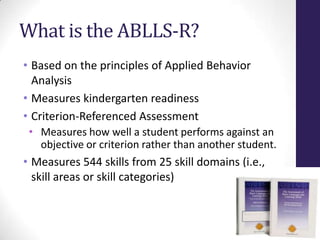
What is the ABLLS-R?
• Based on the principles of Applied Behavior
  Analysis
• Measures kindergarten readiness
• Criterion-Referenced Assessment
 • Measures how well a student performs against an
   objective or criterion rather than another student.
• Measures 544 skills from 25 skill domains (i.e.,
  skill areas or skill categories)
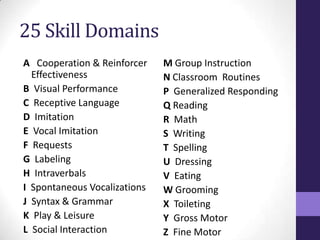
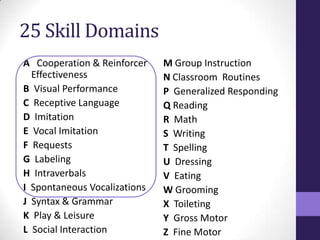
25 Skill Domains
A Cooperation & Reinforcer    M Group Instruction
  Effectiveness               N Classroom Routines
B Visual Performance          P Generalized Responding
C Receptive Language          Q Reading
D Imitation                   R Math
E Vocal Imitation             S Writing
F Requests                    T Spelling
G Labeling                    U Dressing
H Intraverbals                V Eating
I Spontaneous Vocalizations   W Grooming
J Syntax & Grammar            X Toileting
K Play & Leisure              Y Gross Motor
L Social Interaction          Z Fine Motor
25 Skill Domains
A Cooperation & Reinforcer    M Group Instruction
  Effectiveness               N Classroom Routines
B Visual Performance          P Generalized Responding
C Receptive Language          Q Reading
D Imitation                   R Math
E Vocal Imitation             S Writing
F Requests                    T Spelling
G Labeling                    U Dressing
H Intraverbals                V Eating
I Spontaneous Vocalizations   W Grooming
J Syntax & Grammar            X Toileting
K Play & Leisure              Y Gross Motor
L Social Interaction          Z Fine Motor
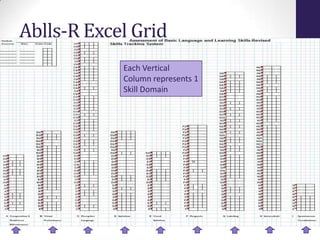
Ablls-R Excel Grid
            Each Vertical
            Column represents 1
            Skill Domain
544 Skills
• Each Skill Domain is broken down into individual
  skills
• For example, let’s look at Skill Domain G:
  Labeling
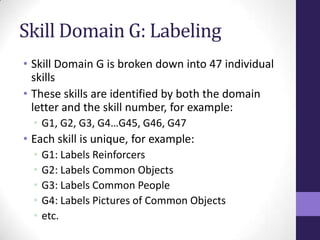
Skill Domain G: Labeling
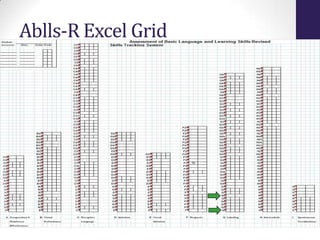
• Skill Domain G is broken down into 47 individual
  skills
• These skills are identified by both the domain
  letter and the skill number, for example:
  • G1, G2, G3, G4…G45, G46, G47
• Each skill is unique, for example:
  •   G1: Labels Reinforcers
  •   G2: Labels Common Objects
  •   G3: Labels Common People
  •   G4: Labels Pictures of Common Objects
  •   etc.
Ablls-R Excel Grid
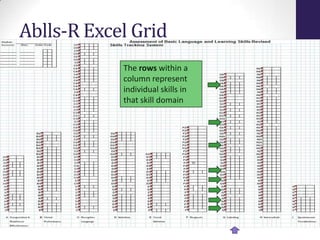
            The rows within a
            column represent
            individual skills in
            that skill domain
Scoring
• Each skill has a maximum score that varies from one
  skill to the next. The maximum score is always
  either a 1, a 2, or a 4.
• For skills with a maximum score of 1, the child either
  exhibits the skill or not (all or nothing)
• For skills with a maximum score of 2, the child may
  score a 0, a 1, or a 2.
• For skills with a maximum score of 4, the child may
  score a 0, 1, 2, 3, or a 4.
• The score DOES NOT tell you how important the skill
  is. For example, a skill with a maximum score of 4 is
  not a “better” skill than a skill with a maximum score
  of 2.
Ablls-R Excel Grid
Ablls-R Excel Grid
End of ABLLS-R Presentation Part 1

Ablls r part 1

  • 1.
    The Assessment of BasicLanguage and Learning Skills- Revised (ABLLS-R) Presented by Callie Terry
  • 2.
    What is theABLLS-R? • Based on the principles of Applied Behavior Analysis • Measures kindergarten readiness • Criterion-Referenced Assessment • Measures how well a student performs against an objective or criterion rather than another student. • Measures 544 skills from 25 skill domains (i.e., skill areas or skill categories)
  • 3.
    25 Skill Domains ACooperation & Reinforcer M Group Instruction Effectiveness N Classroom Routines B Visual Performance P Generalized Responding C Receptive Language Q Reading D Imitation R Math E Vocal Imitation S Writing F Requests T Spelling G Labeling U Dressing H Intraverbals V Eating I Spontaneous Vocalizations W Grooming J Syntax & Grammar X Toileting K Play & Leisure Y Gross Motor L Social Interaction Z Fine Motor
  • 4.
    25 Skill Domains ACooperation & Reinforcer M Group Instruction Effectiveness N Classroom Routines B Visual Performance P Generalized Responding C Receptive Language Q Reading D Imitation R Math E Vocal Imitation S Writing F Requests T Spelling G Labeling U Dressing H Intraverbals V Eating I Spontaneous Vocalizations W Grooming J Syntax & Grammar X Toileting K Play & Leisure Y Gross Motor L Social Interaction Z Fine Motor
  • 5.
    Ablls-R Excel Grid Each Vertical Column represents 1 Skill Domain
  • 6.
    544 Skills • EachSkill Domain is broken down into individual skills • For example, let’s look at Skill Domain G: Labeling
  • 7.
    Skill Domain G:Labeling • Skill Domain G is broken down into 47 individual skills • These skills are identified by both the domain letter and the skill number, for example: • G1, G2, G3, G4…G45, G46, G47 • Each skill is unique, for example: • G1: Labels Reinforcers • G2: Labels Common Objects • G3: Labels Common People • G4: Labels Pictures of Common Objects • etc.
  • 8.
    Ablls-R Excel Grid The rows within a column represent individual skills in that skill domain
  • 9.
    Scoring • Each skillhas a maximum score that varies from one skill to the next. The maximum score is always either a 1, a 2, or a 4. • For skills with a maximum score of 1, the child either exhibits the skill or not (all or nothing) • For skills with a maximum score of 2, the child may score a 0, a 1, or a 2. • For skills with a maximum score of 4, the child may score a 0, 1, 2, 3, or a 4. • The score DOES NOT tell you how important the skill is. For example, a skill with a maximum score of 4 is not a “better” skill than a skill with a maximum score of 2.
  • 10.
  • 11.
  • 12.
    End of ABLLS-RPresentation Part 1