SocialSkills
Development
Ann Kennedy
AUT/503
3/24/2014
Current
Research in
SocialSkills
Development
Theory
 Applied BehavioralAnalysis (ABA)
 DevelopmentalTheory
 Social-ConstructivistTheory
Applied
Behavioral
Analysis
 Focus on areas of strength as starting point for teaching
 Control the environmental variables
 Reinforcement of approximations of social behaviors
 Data collection
 Strategies to teach generalization
(Hall, 2013)
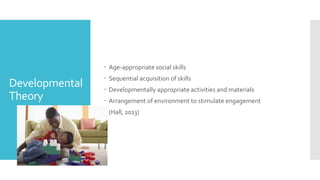
Developmental
Theory
 Age-appropriate social skills
 Sequential acquisition of skills
 Developmentally appropriate activities and materials
 Arrangement of environment to stimulate engagement
 (Hall, 2013)
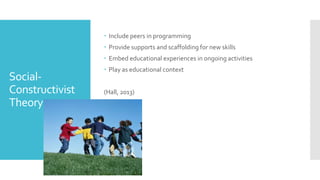
Social-
Constructivist
Theory
 Include peers in programming
 Provide supports and scaffolding for new skills
 Embed educational experiences in ongoing activities
 Play as educational context
(Hall, 2013)
SocialSkill
Deficits in
Autism
Spectrum
Disorders
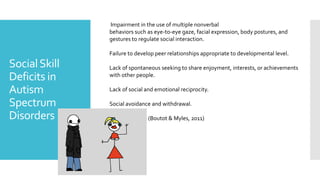
Impairment in the use of multiple nonverbal
behaviors such as eye-to-eye gaze, facial expression, body postures, and
gestures to regulate social interaction.
Failure to develop peer relationships appropriate to developmental level.
Lack of spontaneous seeking to share enjoyment, interests, or achievements
with other people.
Lack of social and emotional reciprocity.
Social avoidance and withdrawal.
m (Boutot & Myles, 2011)
Examples of
deficits inSocial
Communication
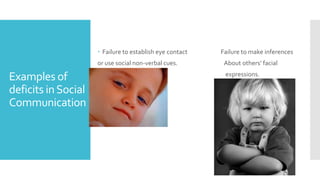
 Failure to establish eye contact Failure to make inferences
or use social non-verbal cues. About others’ facial
expressions.
Examples of
Deficits in
Social
Initiation
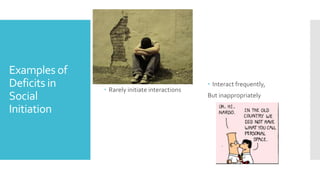
 Rarely initiate interactions
 Interact frequently,
But inappropriately
Examples of
Deficits in
Social
Reciprocity
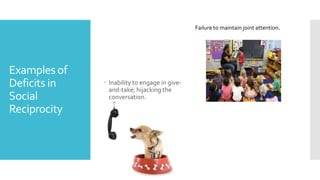
 Inability to engage in give-
and-take; hijacking the
conversation.
Failure to maintain joint attention.
Examples of
Deficits in
Social
Cognition
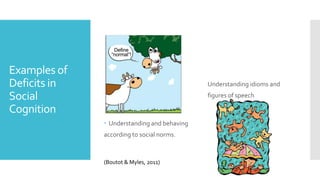
 Understanding and behaving
according to social norms.
Understanding idioms and
figures of speech
(Boutot & Myles, 2011)
References
 Boutot, E. A., & Myles, B. S. (2011) Autism spectrum disorders:
Foundations, characteristics, and effective strategies. Upper Saddle
River, NJ: Pearson Education
 Hall, L. J. (2013). Autism spectrum disorders: From theory to practice
(2nd ed.). Upper Saddle River, NJ: Pearson Education
SocialSkills
Acquisition
Tools and Methods
 Social Stories
 Video Modeling andVideo Self-Modeling
 Social Problem-Solving
 Pivotal ResponseTraining
 Social Scripts
SocialStories
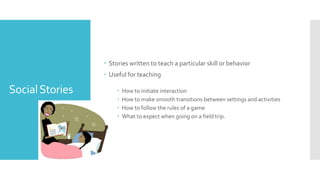
 Stories written to teach a particular skill or behavior
 Useful for teaching
 How to initiate interaction
 How to make smooth transitions between settings and activities
 How to follow the rules of a game
 What to expect when going on a field trip.
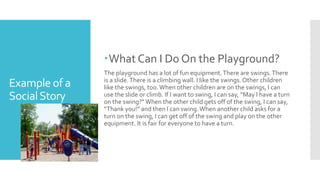
Example of a
SocialStory
What Can I Do On the Playground?
The playground has a lot of fun equipment.There are swings.There
is a slide.There is a climbing wall. I like the swings.Other children
like the swings, too.When other children are on the swings, I can
use the slide or climb. If I want to swing, I can say, “May I have a turn
on the swing?”When the other child gets off of the swing, I can say,
“Thank you!” and then I can swing.When another child asks for a
turn on the swing, I can get off of the swing and play on the other
equipment. It is fair for everyone to have a turn.
Video
Modeling
&
VideoSelf-
Monitoring
(VSM)
 Videos of the student (VSM) or another person (adult or child)
acting out a situation to model correct behavior. Requires
sufficient attention from the student. Benefits include:
 Visual field can be reduced so that extraneous information is
reduced and student can focus attention on correct issue.
 Reduced stress for the student because human interaction is limited.
 Children tend to love to watch videos, so motivation to attend in
naturally reinforced.
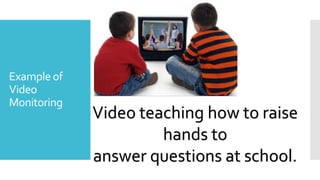
Example of
Video
Monitoring
Video teaching how to raise
hands to
answer questions at school.
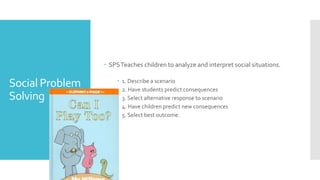
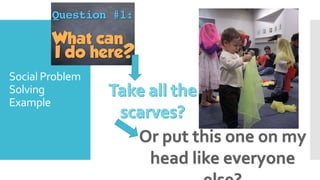
Social Problem
Solving
 SPSTeaches children to analyze and interpret social situations.
 1. Describe a scenario
 2. Have students predict consequences
 3. Select alternative response to scenario
 4. Have children predict new consequences
 5. Select best outcome.
Social Problem
Solving
Example
Pivotal
Response
Training
(PRT)
PRT
 Teaches a child to respond to multiple cues
 Teaches a child to initiate interactions
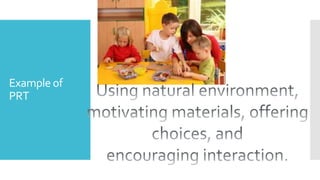
 Enhances motivation by offering the child choices and using
natural reinforcers in the environment.
 Teaches greater self-management by fading prompt levels so
that the child is less dependent of prompts to respond.
Example of
PRT
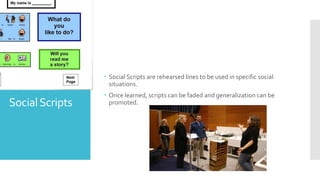
SocialScripts
 Social Scripts are rehearsed lines to be used in specific social
situations.
 Once learned, scripts can be faded and generalization can be
promoted.
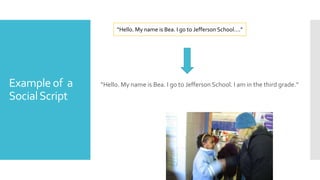
Example of a
SocialScript
“Hello. My name is Bea. I go to Jefferson School. I am in the third grade.”
“Hello. My name is Bea. I go to Jefferson School….”
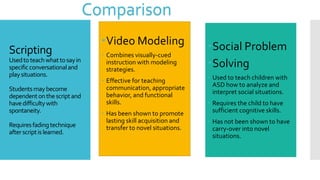
Scripting
Usedtoteachwhattosayin
specificconversationaland
playsituations.
Studentsmaybecome
dependentonthescriptand
havedifficultywith
spontaneity.
Requiresfadingtechnique
afterscriptislearned.
Video Modeling
 Combines visually-cued
instruction with modeling
strategies.
 Effective for teaching
communication, appropriate
behavior, and functional
skills.
 Has been shown to promote
lasting skill acquisition and
transfer to novel situations.
Social Problem
Solving
 Used to teach children with
ASD how to analyze and
interpret social situations.
 Requires the child to have
sufficient cognitive skills.
 Has not been shown to have
carry-over into novel
situations.
Comparison
References
 Boutot, E. A., & Myles, B. S. (2011) Autism spectrum disorders:
Foundations, characteristics, and effective strategies. Upper Saddle
River, NJ: Pearson Education
 Hall, L. J. (2013). Autism spectrum disorders: From theory to practice
(2nd ed.). Upper Saddle River, NJ: Pearson Education

Understanding Social Issues in Autism Spectrum Disorders

  • 1.
  • 2.
    Current Research in SocialSkills Development Theory  AppliedBehavioralAnalysis (ABA)  DevelopmentalTheory  Social-ConstructivistTheory
  • 3.
    Applied Behavioral Analysis  Focus onareas of strength as starting point for teaching  Control the environmental variables  Reinforcement of approximations of social behaviors  Data collection  Strategies to teach generalization (Hall, 2013)
  • 4.
    Developmental Theory  Age-appropriate socialskills  Sequential acquisition of skills  Developmentally appropriate activities and materials  Arrangement of environment to stimulate engagement  (Hall, 2013)
  • 5.
    Social- Constructivist Theory  Include peersin programming  Provide supports and scaffolding for new skills  Embed educational experiences in ongoing activities  Play as educational context (Hall, 2013)
  • 6.
    SocialSkill Deficits in Autism Spectrum Disorders Impairment inthe use of multiple nonverbal behaviors such as eye-to-eye gaze, facial expression, body postures, and gestures to regulate social interaction. Failure to develop peer relationships appropriate to developmental level. Lack of spontaneous seeking to share enjoyment, interests, or achievements with other people. Lack of social and emotional reciprocity. Social avoidance and withdrawal. m (Boutot & Myles, 2011)
  • 7.
    Examples of deficits inSocial Communication Failure to establish eye contact Failure to make inferences or use social non-verbal cues. About others’ facial expressions.
  • 8.
    Examples of Deficits in Social Initiation Rarely initiate interactions  Interact frequently, But inappropriately
  • 9.
    Examples of Deficits in Social Reciprocity Inability to engage in give- and-take; hijacking the conversation. Failure to maintain joint attention.
  • 10.
    Examples of Deficits in Social Cognition Understanding and behaving according to social norms. Understanding idioms and figures of speech (Boutot & Myles, 2011)
  • 11.
    References  Boutot, E.A., & Myles, B. S. (2011) Autism spectrum disorders: Foundations, characteristics, and effective strategies. Upper Saddle River, NJ: Pearson Education  Hall, L. J. (2013). Autism spectrum disorders: From theory to practice (2nd ed.). Upper Saddle River, NJ: Pearson Education
  • 12.
    SocialSkills Acquisition Tools and Methods Social Stories  Video Modeling andVideo Self-Modeling  Social Problem-Solving  Pivotal ResponseTraining  Social Scripts
  • 13.
    SocialStories  Stories writtento teach a particular skill or behavior  Useful for teaching  How to initiate interaction  How to make smooth transitions between settings and activities  How to follow the rules of a game  What to expect when going on a field trip.
  • 14.
    Example of a SocialStory WhatCan I Do On the Playground? The playground has a lot of fun equipment.There are swings.There is a slide.There is a climbing wall. I like the swings.Other children like the swings, too.When other children are on the swings, I can use the slide or climb. If I want to swing, I can say, “May I have a turn on the swing?”When the other child gets off of the swing, I can say, “Thank you!” and then I can swing.When another child asks for a turn on the swing, I can get off of the swing and play on the other equipment. It is fair for everyone to have a turn.
  • 15.
    Video Modeling & VideoSelf- Monitoring (VSM)  Videos ofthe student (VSM) or another person (adult or child) acting out a situation to model correct behavior. Requires sufficient attention from the student. Benefits include:  Visual field can be reduced so that extraneous information is reduced and student can focus attention on correct issue.  Reduced stress for the student because human interaction is limited.  Children tend to love to watch videos, so motivation to attend in naturally reinforced.
  • 16.
    Example of Video Monitoring Video teachinghow to raise hands to answer questions at school.
  • 17.
    Social Problem Solving  SPSTeacheschildren to analyze and interpret social situations.  1. Describe a scenario  2. Have students predict consequences  3. Select alternative response to scenario  4. Have children predict new consequences  5. Select best outcome.
  • 18.
  • 19.
    Pivotal Response Training (PRT) PRT  Teaches achild to respond to multiple cues  Teaches a child to initiate interactions  Enhances motivation by offering the child choices and using natural reinforcers in the environment.  Teaches greater self-management by fading prompt levels so that the child is less dependent of prompts to respond.
  • 20.
  • 21.
    SocialScripts  Social Scriptsare rehearsed lines to be used in specific social situations.  Once learned, scripts can be faded and generalization can be promoted.
  • 22.
    Example of a SocialScript “Hello.My name is Bea. I go to Jefferson School. I am in the third grade.” “Hello. My name is Bea. I go to Jefferson School….”
  • 23.
    Scripting Usedtoteachwhattosayin specificconversationaland playsituations. Studentsmaybecome dependentonthescriptand havedifficultywith spontaneity. Requiresfadingtechnique afterscriptislearned. Video Modeling  Combinesvisually-cued instruction with modeling strategies.  Effective for teaching communication, appropriate behavior, and functional skills.  Has been shown to promote lasting skill acquisition and transfer to novel situations. Social Problem Solving  Used to teach children with ASD how to analyze and interpret social situations.  Requires the child to have sufficient cognitive skills.  Has not been shown to have carry-over into novel situations. Comparison
  • 24.
    References  Boutot, E.A., & Myles, B. S. (2011) Autism spectrum disorders: Foundations, characteristics, and effective strategies. Upper Saddle River, NJ: Pearson Education  Hall, L. J. (2013). Autism spectrum disorders: From theory to practice (2nd ed.). Upper Saddle River, NJ: Pearson Education