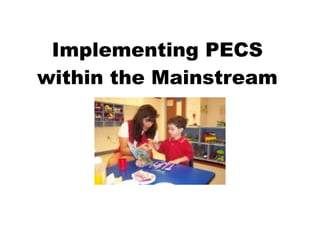
Implementing PECS within the Mainstream
What makes it hard for children to communicate and why PECS meets these needs Integrating PECS within the school environment: 4 things to consider PECS, Phases and implementation Developing the prosthetic environment Creating communicative opportunities Collaboration
Why is it hard for children to communicate? Learning new words. Remembering vocabulary. Putting longer sentences together. Understanding new ‘concepts’ (colours, sizes, shapes, verbs etc). Using language socially: for example making requests and sharing information.   Using language across different settings
How Do these Difficulties Manifest? Not trying to communicate Use of non-verbal communication strategies to communicate Learned helplessness: “Everything gets done for me” No control over their decisions Self Harm? Frustration Lack of experience in communicating Confrontation, tantrums, ‘behavioural difficulties’ Loss of independence – reliance on others
Why is PECS successful? Depends on visual not auditory information. Permanent vocabulary - words don’t fade away. Gives visual meaning to abstract vocabulary. Uses children’s own interests in meaningful settings. Encourages independent and ‘social’ communication. Communication can be successful because it doesn’t rely solely on language.
Why is PECS successful? Language is formulated internally before it is constructed Emphasis is on successful, independent communication rather than use of spoken language Preliminary studies show that PECS can support spoken language development Allows children to rehearse their language before they say it Doesn’t rely on pre teaching lots of vocabulary. Children can ‘say what they see’
Aims of successful communication systems Integration into the mainstream environment: Increases independence Meaningful communication system Spontaneous communication Meaningful relationships on an appropriate level Enabling students to contribute to class lessons
The child works through 6 phases as part of the structured programme. Each phase is completed in sequence before you move onto the next phase.  Each child moves through the phases at their own pace.  Social exchanges taught P icture  E xchange  C ommunication  S ystem
Teaching PECS phases Increasing Communicative Opportunities Developing the Prosthetic Environment Integrated use of PECS Joint ownership of planning and evaluation 4 layers needing to be developed simultaneously
Teaching PECS: Targets and requirements
Phase 1 Preparation Commitment to carry out 35+ exchanges a day from staff and/or family Accurate re-inforcer assessment  Put all of the motivators in a box accompanied by symbols Winners: Balloons Food  Balloons with water inside Squidgy toys Noise chutes Things with buttons that make a noise Bubbles instruments Things that flash Watch what the child does to self occupy
By the end of  Phase 1  students will be able to independently hand over a picture to request an object from a range of different people 2 people: at least 1 trained with PECS. Accurate motivator assessment completed. 35 + structured opportunities for exchanges. Student’s own motivator box labelled and visible, continuously added to. Bank of sensory bags. Moving towards concept of prosthetic environment: PECS book always on display in a consistent place
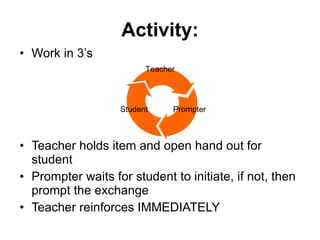
Activity: Work in 3’s Teacher holds item and open hand out for student Prompter waits for student to initiate, if not, then prompt the exchange Teacher reinforces IMMEDIATELY  Student Prompter Teacher
By the end of  Phase 2  students will identify who has an object they want, approach them and hand over a picture to request what they want.  2 members of staff: prompter’s role to ensure distance and persistence.  Ongoing use of strong motivators. May start introducing peer exchanges i.e. at a ‘snack shop’ Begin thinking about communicative temptations corresponding with environmental choice boards (with only 1 displayed symbol though)
By the end of  Phase 3  students will be able to look in a communication book, choose from many pictures and take the relevant picture to an adult to make a request . Use of strong motivators v’s non preferred / contextually irrelevant Building up a range of familiar activities throughout the day; snack, jigsaws, play (Intensive Interaction Type) Formalise existing idiosyncratic communication Communication should be entrenched within all activities Choice boards can be built up to contain a small range of pictures Evaluate discrimination through correspondence checks
Preferred item v’s blank symbol Preferred item v’s non preferred item Preferred item v’s contextually inappropriate symbol Preferred item v’s preferred item Hierarchy when introducing discrimination Correspondance checks 4 step error correction: 2 or 3 at the most for one error If student fails a correspondence check then use 4 step error correction
4 step error correction Procedure Praise and give item Gives correct picture Entice with both items REPEAT Perform switch ‘ Do this’ SWITCH Praise (do not give item) Gives target picture Hold open hand near target picture or physically prompt PROMPT Show or tap picture: student looks at target picture MODEL or SHOW Reacts negatively Give corresponding item Gives incorrect picture Entice with both items Student Teacher Step
Activity: Work in 2’s Practice 4 step error correction   procedure Teacher Student
Correspondence checks Allow access, praise, label  Takes correct item ‘ Go Ahead’ etc Gives picture Entice with both items REPEAT Performs action ‘ Do this’, ‘Touch…’ etc CHANGE Praise (do not give item) Gives target picture Holds open hand near picture MODEL, SHOW or PROMPT Block Access Reaches for wrong item ‘ Take it’, ‘Go Ahead’  Gives picture Entice with both items STUDENT TEACHER STEP
Activity: Work in 2’s Practice Correspondence Checks Teacher Student
Formalise  existing   non verbal  communication skills Teach  new  communication skills Teaching Formal Communication Skills Can you replace communicative behaviours such as pulling, vocalising ‘negative behaviours’ etc with PECS? Is the communication skill you want to teach useful and motivating for your child? “ Communication  has to be  motivating” Scot Greathead 2005
Planning on developing a student’s communication skills. Activity:  Deciding on which communication skills you can develop within the classroom setting 1. Decide whether or not you want to teach a new skills or change existing communicative behaviour. 2. Complete a worksheet.
By the end of  Phase 4  students will be able to make a sentence from pictures and take it to an adult to make requests.  As before but using sentence strips, should still be reinforcing requests with immediate rewards. A range of activities across the school day based around play and academic subjects – moving towards requests being an intrinsic part of sessions Environmental adaptations with corresponding choice boards should be well established to encourage spontaneous communication
Sentence Structure Remove ‘I want’ symbol Place on the sentence strip Remove reinforcer symbol Place on the sentence strip Remove sentence strip Give strip to partner Support:   You can have the ‘I want’ already on the sentence strip so you’re just teaching to bring the reinforcer symbol down first If student puts pictures in the wrong order then back step Student points to pictures as teacher speaks: DO NOT DEMAND SPEECH
By the end of  Phase 5  you will be able to ask your students ‘What do you want?’ and they will use their communication book to answer you. As before but introducing a question prompt Communicative temptations and sabotage should now feature regularly Communication can become more problem solving i.e. asking what do you want when student are displaying behavioural difficulties, anxiety, stress etc. Needs to be accompanied with symbols though. (ECB’s) Range of symbols continually extending for each setting – still led by students interests and motivators
By the end of  phase 6  students will be commenting on things within their environment using ‘ I hear ,  I see ,  It’s ’ I see + ______ Commenting as a language function may not be spontaneous as the reward is ‘social’. Try to shape a ‘surprise’ response into a comment. Comments therefore need to be tied into the students range of interests: Contrived settings: Surprise boxes Photo albums All About Me Books Commenting Posts Commenting stations Big Books Need symbols representing family, friends and characters
I hear + _______ You may want to start with sounds you know the students can identify i.e. listening tapes Alternating between starters Instruments in different sized/coloured boxes: student choose box then listen to see if they can name the sound. Pictures in boxes with coloured shapes on them: student requests shape then names what they see. Students choose a particular book before a commenting exercise. Students choose a coloured tape with a particular sound on.
Attributes Attributes serve to make request more specific Allow students to develop additional semantic information related to a request Essential that they are generalised across different settings Size is relative so may be harder to teach
Making Sentences Longer I want  blue  pen I want  red  sweet I want  big  balloon I want  Tweenies  video I want  3  biscuits I want  wheels on the bus  song  I want  throw  ball I want  triangle  paper I want  loud  singing I want  cold  water I want  yellow  drink I want  soft  ball I want  small  brick I want play  Thom
Communication  is  learning Requesting Choosing cause and effect toys Counters within maths Food within snack Games within PE Jigsaw pieces Contrived opportunities through sabotage etc Try to incorporate elements of communication within each lesson Commenting Big books in literacy ‘ All About Me’ Books ‘ Surprise’ game  On the weather Videos  Computer games
Scot Greathead 2005
Extending PECS Important that PECS is considered to be pupils’ communication system – represents a cultural shift.  Communicating about themselves Supporting talking about themselves All about me books I see Today at school/home I (news sharing) Context based commenting boards, mats, big books
Empowering choices Interactive schedules Choice boards Reflecting on the lesson / day  I liked/didn’t like
Additional Skills to reinforce PECS Critical Communication Skills: Requesting ‘Help’ Requesting ‘I need a break’ Requesting a reward for ‘I am working for’ Contributing to ‘interactive schedules’ Refer to 9 Critical Communication Skills
Colourful Semantics A system for supporting: spoken and written language comprehension vocabulary development literacy hour Certain types of words are colour coded – students then use a sequence of colours to guide their sentence construction Tied in with commenting posts / windows / big books at Hatton
Supporting Literacy Use to prompt language when using sequencing cards Developing a sight vocabulary:  Fade the size of the picture and increase the size of the text
Developing the prosthetic environment
An adapted environment aimed at increasing understanding, communication and independence. Recognises the differences in the way individuals think and learn - the environment, social demands and attitudes of others may be contributing to difficulties developing communication skills and independence.  Applies to an environment that favours normalisation. Prevent disabilities from becoming handicaps -  ‘help to do’  rather than ‘do for’. Includes accessible communication systems. Rita Jordan 2002 - Autistic Spectrum Disorders The Prosthetic Environment:
A compatible prosthetic environment Accessible communication systems Commenting prompts Supporting choice making Labelling ensures a shared understanding
Putting vocabulary into context Encourage choice making
Context based communication boards To communicate feelings To bridge communication breakdown
Interactive schedules Student involvement in negotiating their own time Support development of planning, organising and choice making
Increasing Communicative Opportunities
Creating the need to communicate The classroom environment: Consider putting child locks/locking on cupboard doors etc Food in containers with tight lids/high on shelves Lock doors i.e. restricting access to the  Take control over activities: only let pupils have a toy for a certain amount of time before they need to ask for it again
Don’t make items accessible: Motivators on a high shelf/cabinet Rotate access to toys by putting them on high shelves in boxes or in boxes with lids on. Mark the boxes with a symbol: children can request them with a corresponding symbol from a choice boards. Offer small portions/one item of food at a time to create the need to ask for ‘more’ Creating the need to communicate
Creating the need to communicate Always  offer choices  Stop co-operating : if you’re playing a repetitive game, pushing a swing, etc Children will need to communicate they want ‘more’ Make deliberate mistakes : do something wrong, give children the wrong item. Can they communicate what they wanted?
Sabotage! Making unexpected changes within a familiar routine can introduce the need to communicate. Give work with no pencil, juice carton without a straw or an unopened bag of crisps. Putting a favourite toy/food in a clear box with a lid they can’t open Hide favourite toys and offer a ‘menu’ of items. Tell children to do something you know they will need help with i.e. get a coat which is out of reach ‘ Wait’ – see what happens! Will children bridge the break in the routine.
Joint Ownership: planning and evaluation
Evaluating PECS Scot Greathead 2005
Evaluating Critical Communication Skills School need to be involved in identifying communicative opportunities, planning, implementation and evaluation of PECS Scot Greathead 2005
Generalisation within Mainstream Shared vision and culture Training issues? Requires a dedicated and evolving prosthetic environment to support independence and develop understanding and use of language To successfully integrate PECS into school there needs to be ‘ownership’ and commitment from the school Visual support considered an integral part to accessing the curriculum for  all  students
Involving teachers and parents in implementing PECS Generalisation of skills means children learn how to communicate quicker Give parents the opportunity and skills to choose which skills they want to develop at home to help communication The same, consistent communication system gives a clear message to children about how to communicate Can parents feed into Hatton parent workshop sessions? HOR build up a bank of session plans to share
Involving teachers and parents in implementing PECS Basic understanding required Better if student is exchanging spontaneously Is there a commitment to developing a supportive communicative environment? Meaningful: careful assessment of setting communication is to be implemented in  Begin by formalising existing non verbal communication skills – consider communicative temptations Video exactly the students are able to do to support modelling
When is somebody ‘past’ PECS? Time Spoken language Use of PECS Continues to underpin language learning, choice making, sentence construction, syntax, narrative literacy etc May continue alongside colourful semantics. Spontaneous language is more frequent but still presents with poor  vocabulary, difficulties with word retrieval, reduced sentence lengths  Scot Greathead 2005
Why it is important to maintain PECS skills Are students going to have successful opportunities to formulate written sentences at other times? To learn language students need to internally process and independently formulate grammar and syntax Supports independent learning: students can rehearse at the own pace Culture supports visual representations of language ‘as the norm’ Link in with schemes like colourful semantics Use as a vehicle for teaching syntax and grammar Good for students’ status

Setting up PECS in the classroom

  • 1.
  • 2.
    What makes ithard for children to communicate and why PECS meets these needs Integrating PECS within the school environment: 4 things to consider PECS, Phases and implementation Developing the prosthetic environment Creating communicative opportunities Collaboration
  • 3.
    Why is ithard for children to communicate? Learning new words. Remembering vocabulary. Putting longer sentences together. Understanding new ‘concepts’ (colours, sizes, shapes, verbs etc). Using language socially: for example making requests and sharing information. Using language across different settings
  • 4.
    How Do theseDifficulties Manifest? Not trying to communicate Use of non-verbal communication strategies to communicate Learned helplessness: “Everything gets done for me” No control over their decisions Self Harm? Frustration Lack of experience in communicating Confrontation, tantrums, ‘behavioural difficulties’ Loss of independence – reliance on others
  • 5.
    Why is PECSsuccessful? Depends on visual not auditory information. Permanent vocabulary - words don’t fade away. Gives visual meaning to abstract vocabulary. Uses children’s own interests in meaningful settings. Encourages independent and ‘social’ communication. Communication can be successful because it doesn’t rely solely on language.
  • 6.
    Why is PECSsuccessful? Language is formulated internally before it is constructed Emphasis is on successful, independent communication rather than use of spoken language Preliminary studies show that PECS can support spoken language development Allows children to rehearse their language before they say it Doesn’t rely on pre teaching lots of vocabulary. Children can ‘say what they see’
  • 7.
    Aims of successfulcommunication systems Integration into the mainstream environment: Increases independence Meaningful communication system Spontaneous communication Meaningful relationships on an appropriate level Enabling students to contribute to class lessons
  • 8.
    The child worksthrough 6 phases as part of the structured programme. Each phase is completed in sequence before you move onto the next phase. Each child moves through the phases at their own pace. Social exchanges taught P icture E xchange C ommunication S ystem
  • 9.
    Teaching PECS phasesIncreasing Communicative Opportunities Developing the Prosthetic Environment Integrated use of PECS Joint ownership of planning and evaluation 4 layers needing to be developed simultaneously
  • 10.
    Teaching PECS: Targetsand requirements
  • 11.
    Phase 1 PreparationCommitment to carry out 35+ exchanges a day from staff and/or family Accurate re-inforcer assessment Put all of the motivators in a box accompanied by symbols Winners: Balloons Food Balloons with water inside Squidgy toys Noise chutes Things with buttons that make a noise Bubbles instruments Things that flash Watch what the child does to self occupy
  • 12.
    By the endof Phase 1 students will be able to independently hand over a picture to request an object from a range of different people 2 people: at least 1 trained with PECS. Accurate motivator assessment completed. 35 + structured opportunities for exchanges. Student’s own motivator box labelled and visible, continuously added to. Bank of sensory bags. Moving towards concept of prosthetic environment: PECS book always on display in a consistent place
  • 13.
    Activity: Work in3’s Teacher holds item and open hand out for student Prompter waits for student to initiate, if not, then prompt the exchange Teacher reinforces IMMEDIATELY Student Prompter Teacher
  • 14.
    By the endof Phase 2 students will identify who has an object they want, approach them and hand over a picture to request what they want. 2 members of staff: prompter’s role to ensure distance and persistence. Ongoing use of strong motivators. May start introducing peer exchanges i.e. at a ‘snack shop’ Begin thinking about communicative temptations corresponding with environmental choice boards (with only 1 displayed symbol though)
  • 15.
    By the endof Phase 3 students will be able to look in a communication book, choose from many pictures and take the relevant picture to an adult to make a request . Use of strong motivators v’s non preferred / contextually irrelevant Building up a range of familiar activities throughout the day; snack, jigsaws, play (Intensive Interaction Type) Formalise existing idiosyncratic communication Communication should be entrenched within all activities Choice boards can be built up to contain a small range of pictures Evaluate discrimination through correspondence checks
  • 16.
    Preferred item v’sblank symbol Preferred item v’s non preferred item Preferred item v’s contextually inappropriate symbol Preferred item v’s preferred item Hierarchy when introducing discrimination Correspondance checks 4 step error correction: 2 or 3 at the most for one error If student fails a correspondence check then use 4 step error correction
  • 17.
    4 step errorcorrection Procedure Praise and give item Gives correct picture Entice with both items REPEAT Perform switch ‘ Do this’ SWITCH Praise (do not give item) Gives target picture Hold open hand near target picture or physically prompt PROMPT Show or tap picture: student looks at target picture MODEL or SHOW Reacts negatively Give corresponding item Gives incorrect picture Entice with both items Student Teacher Step
  • 18.
    Activity: Work in2’s Practice 4 step error correction procedure Teacher Student
  • 19.
    Correspondence checks Allowaccess, praise, label Takes correct item ‘ Go Ahead’ etc Gives picture Entice with both items REPEAT Performs action ‘ Do this’, ‘Touch…’ etc CHANGE Praise (do not give item) Gives target picture Holds open hand near picture MODEL, SHOW or PROMPT Block Access Reaches for wrong item ‘ Take it’, ‘Go Ahead’ Gives picture Entice with both items STUDENT TEACHER STEP
  • 20.
    Activity: Work in2’s Practice Correspondence Checks Teacher Student
  • 21.
    Formalise existing non verbal communication skills Teach new communication skills Teaching Formal Communication Skills Can you replace communicative behaviours such as pulling, vocalising ‘negative behaviours’ etc with PECS? Is the communication skill you want to teach useful and motivating for your child? “ Communication has to be motivating” Scot Greathead 2005
  • 22.
    Planning on developinga student’s communication skills. Activity: Deciding on which communication skills you can develop within the classroom setting 1. Decide whether or not you want to teach a new skills or change existing communicative behaviour. 2. Complete a worksheet.
  • 23.
    By the endof Phase 4 students will be able to make a sentence from pictures and take it to an adult to make requests. As before but using sentence strips, should still be reinforcing requests with immediate rewards. A range of activities across the school day based around play and academic subjects – moving towards requests being an intrinsic part of sessions Environmental adaptations with corresponding choice boards should be well established to encourage spontaneous communication
  • 24.
    Sentence Structure Remove‘I want’ symbol Place on the sentence strip Remove reinforcer symbol Place on the sentence strip Remove sentence strip Give strip to partner Support: You can have the ‘I want’ already on the sentence strip so you’re just teaching to bring the reinforcer symbol down first If student puts pictures in the wrong order then back step Student points to pictures as teacher speaks: DO NOT DEMAND SPEECH
  • 25.
    By the endof Phase 5 you will be able to ask your students ‘What do you want?’ and they will use their communication book to answer you. As before but introducing a question prompt Communicative temptations and sabotage should now feature regularly Communication can become more problem solving i.e. asking what do you want when student are displaying behavioural difficulties, anxiety, stress etc. Needs to be accompanied with symbols though. (ECB’s) Range of symbols continually extending for each setting – still led by students interests and motivators
  • 26.
    By the endof phase 6 students will be commenting on things within their environment using ‘ I hear , I see , It’s ’ I see + ______ Commenting as a language function may not be spontaneous as the reward is ‘social’. Try to shape a ‘surprise’ response into a comment. Comments therefore need to be tied into the students range of interests: Contrived settings: Surprise boxes Photo albums All About Me Books Commenting Posts Commenting stations Big Books Need symbols representing family, friends and characters
  • 27.
    I hear +_______ You may want to start with sounds you know the students can identify i.e. listening tapes Alternating between starters Instruments in different sized/coloured boxes: student choose box then listen to see if they can name the sound. Pictures in boxes with coloured shapes on them: student requests shape then names what they see. Students choose a particular book before a commenting exercise. Students choose a coloured tape with a particular sound on.
  • 28.
    Attributes Attributes serveto make request more specific Allow students to develop additional semantic information related to a request Essential that they are generalised across different settings Size is relative so may be harder to teach
  • 29.
    Making Sentences LongerI want blue pen I want red sweet I want big balloon I want Tweenies video I want 3 biscuits I want wheels on the bus song I want throw ball I want triangle paper I want loud singing I want cold water I want yellow drink I want soft ball I want small brick I want play Thom
  • 30.
    Communication is learning Requesting Choosing cause and effect toys Counters within maths Food within snack Games within PE Jigsaw pieces Contrived opportunities through sabotage etc Try to incorporate elements of communication within each lesson Commenting Big books in literacy ‘ All About Me’ Books ‘ Surprise’ game On the weather Videos Computer games
  • 31.
  • 32.
    Extending PECS Importantthat PECS is considered to be pupils’ communication system – represents a cultural shift. Communicating about themselves Supporting talking about themselves All about me books I see Today at school/home I (news sharing) Context based commenting boards, mats, big books
  • 33.
    Empowering choices Interactiveschedules Choice boards Reflecting on the lesson / day I liked/didn’t like
  • 34.
    Additional Skills toreinforce PECS Critical Communication Skills: Requesting ‘Help’ Requesting ‘I need a break’ Requesting a reward for ‘I am working for’ Contributing to ‘interactive schedules’ Refer to 9 Critical Communication Skills
  • 35.
    Colourful Semantics Asystem for supporting: spoken and written language comprehension vocabulary development literacy hour Certain types of words are colour coded – students then use a sequence of colours to guide their sentence construction Tied in with commenting posts / windows / big books at Hatton
  • 36.
    Supporting Literacy Useto prompt language when using sequencing cards Developing a sight vocabulary: Fade the size of the picture and increase the size of the text
  • 37.
  • 38.
    An adapted environmentaimed at increasing understanding, communication and independence. Recognises the differences in the way individuals think and learn - the environment, social demands and attitudes of others may be contributing to difficulties developing communication skills and independence. Applies to an environment that favours normalisation. Prevent disabilities from becoming handicaps - ‘help to do’ rather than ‘do for’. Includes accessible communication systems. Rita Jordan 2002 - Autistic Spectrum Disorders The Prosthetic Environment:
  • 39.
    A compatible prostheticenvironment Accessible communication systems Commenting prompts Supporting choice making Labelling ensures a shared understanding
  • 40.
    Putting vocabulary intocontext Encourage choice making
  • 41.
    Context based communicationboards To communicate feelings To bridge communication breakdown
  • 42.
    Interactive schedules Studentinvolvement in negotiating their own time Support development of planning, organising and choice making
  • 43.
  • 44.
    Creating the needto communicate The classroom environment: Consider putting child locks/locking on cupboard doors etc Food in containers with tight lids/high on shelves Lock doors i.e. restricting access to the Take control over activities: only let pupils have a toy for a certain amount of time before they need to ask for it again
  • 45.
    Don’t make itemsaccessible: Motivators on a high shelf/cabinet Rotate access to toys by putting them on high shelves in boxes or in boxes with lids on. Mark the boxes with a symbol: children can request them with a corresponding symbol from a choice boards. Offer small portions/one item of food at a time to create the need to ask for ‘more’ Creating the need to communicate
  • 46.
    Creating the needto communicate Always offer choices Stop co-operating : if you’re playing a repetitive game, pushing a swing, etc Children will need to communicate they want ‘more’ Make deliberate mistakes : do something wrong, give children the wrong item. Can they communicate what they wanted?
  • 47.
    Sabotage! Making unexpectedchanges within a familiar routine can introduce the need to communicate. Give work with no pencil, juice carton without a straw or an unopened bag of crisps. Putting a favourite toy/food in a clear box with a lid they can’t open Hide favourite toys and offer a ‘menu’ of items. Tell children to do something you know they will need help with i.e. get a coat which is out of reach ‘ Wait’ – see what happens! Will children bridge the break in the routine.
  • 48.
  • 49.
    Evaluating PECS ScotGreathead 2005
  • 50.
    Evaluating Critical CommunicationSkills School need to be involved in identifying communicative opportunities, planning, implementation and evaluation of PECS Scot Greathead 2005
  • 51.
    Generalisation within MainstreamShared vision and culture Training issues? Requires a dedicated and evolving prosthetic environment to support independence and develop understanding and use of language To successfully integrate PECS into school there needs to be ‘ownership’ and commitment from the school Visual support considered an integral part to accessing the curriculum for all students
  • 52.
    Involving teachers andparents in implementing PECS Generalisation of skills means children learn how to communicate quicker Give parents the opportunity and skills to choose which skills they want to develop at home to help communication The same, consistent communication system gives a clear message to children about how to communicate Can parents feed into Hatton parent workshop sessions? HOR build up a bank of session plans to share
  • 53.
    Involving teachers andparents in implementing PECS Basic understanding required Better if student is exchanging spontaneously Is there a commitment to developing a supportive communicative environment? Meaningful: careful assessment of setting communication is to be implemented in Begin by formalising existing non verbal communication skills – consider communicative temptations Video exactly the students are able to do to support modelling
  • 54.
    When is somebody‘past’ PECS? Time Spoken language Use of PECS Continues to underpin language learning, choice making, sentence construction, syntax, narrative literacy etc May continue alongside colourful semantics. Spontaneous language is more frequent but still presents with poor vocabulary, difficulties with word retrieval, reduced sentence lengths Scot Greathead 2005
  • 55.
    Why it isimportant to maintain PECS skills Are students going to have successful opportunities to formulate written sentences at other times? To learn language students need to internally process and independently formulate grammar and syntax Supports independent learning: students can rehearse at the own pace Culture supports visual representations of language ‘as the norm’ Link in with schemes like colourful semantics Use as a vehicle for teaching syntax and grammar Good for students’ status