Organizational Behavior
BY: MOATASEM MABROUK
MAY 2015
Content
What managers do.
What is Organizational Behavior (OB).
What is the value of the systematic study of OB.
What is the contributions made by major behavioral science disciplines to OB.
List of the major challenges and opportunities for managers to use OB concepts.
2
What managers do.
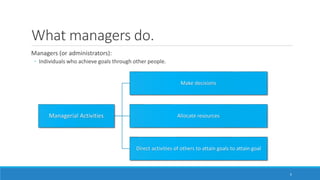
Managers (or administrators):
◦ Individuals who achieve goals through other people.
3
Managerial Activities
Make decisions
Allocate resources
Direct activities of others to attain goals to attain goal
Where Managers Work
Organization
A consciously coordinated social unit, composed of two or more people, that functions on a
relatively continuous basis to achieve a common goal or set of goals.
4
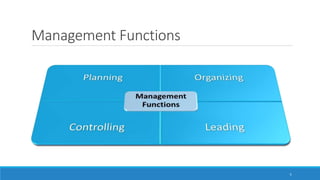
Management Functions
5
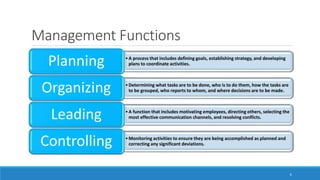
Management Functions
6
•A process that includes defining goals, establishing strategy, and developing
plans to coordinate activities.Planning
•Determining what tasks are to be done, who is to do them, how the tasks are
to be grouped, who reports to whom, and where decisions are to be made.Organizing
•A function that includes motivating employees, directing others, selecting the
most effective communication channels, and resolving conflicts.Leading
•Monitoring activities to ensure they are being accomplished as planned and
correcting any significant deviations.Controlling
Mintzberg’s Managerial Roles
7
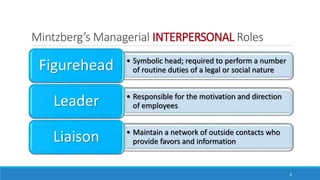
Mintzberg’s Managerial INTERPERSONAL Roles
8
• Symbolic head; required to perform a number
of routine duties of a legal or social natureFigurehead
• Responsible for the motivation and direction
of employeesLeader
• Maintain a network of outside contacts who
provide favors and informationLiaison
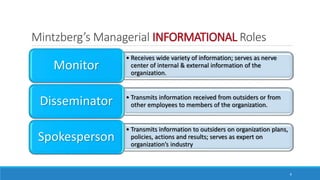
Mintzberg’s Managerial INFORMATIONAL Roles
9
• Receives wide variety of information; serves as nerve
center of internal & external information of the
organization.
Monitor
• Transmits information received from outsiders or from
other employees to members of the organization.Disseminator
• Transmits information to outsiders on organization plans,
policies, actions and results; serves as expert on
organization’s industry
Spokesperson
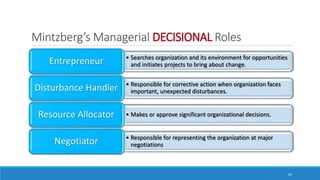
Mintzberg’s Managerial DECISIONAL Roles
10
• Searches organization and its environment for opportunities
and initiates projects to bring about change.Entrepreneur
• Responsible for corrective action when organization faces
important, unexpected disturbances.Disturbance Handler
• Makes or approve significant organizational decisions.Resource Allocator
• Responsible for representing the organization at major
negotiationsNegotiator
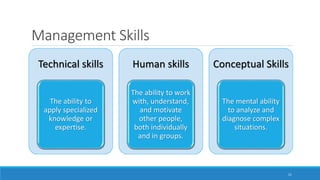
Management Skills
Technical skills
The ability to
apply specialized
knowledge or
expertise.
Human skills
The ability to work
with, understand,
and motivate
other people,
both individually
and in groups.
Conceptual Skills
The mental ability
to analyze and
diagnose complex
situations.
11
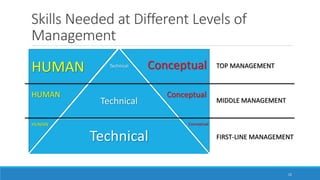
Skills Needed at Different Levels of
Management
Technical
Technical
Technical
12
HUMAN
HUMAN
HUMAN
Conceptual
Conceptual
Conceptual TOP MANAGEMENT
MIDDLE MANAGEMENT
FIRST-LINE MANAGEMENT
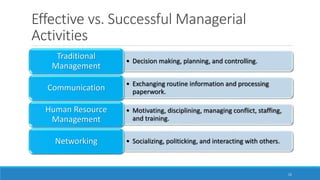
Effective vs. Successful Managerial
Activities
13
• Decision making, planning, and controlling.
Traditional
Management
• Exchanging routine information and processing
paperwork.Communication
• Motivating, disciplining, managing conflict, staffing,
and training.
Human Resource
Management
• Socializing, politicking, and interacting with others.Networking
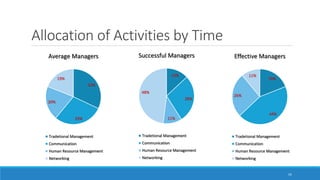
Allocation of Activities by Time
13%
28%
11%
48%
Successful Managers
Tradetional Management
Communication
Human Resource Management
Networking
14
19%
44%
26%
11%
Effective Managers
Tradetional Management
Communication
Human Resource Management
Networking
32%
29%
20%
19%
Average Managers
Tradetional Management
Communication
Human Resource Management
Networking
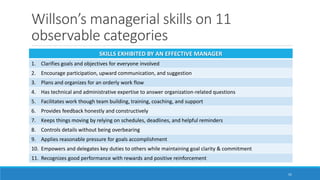
Willson’s managerial skills on 11
observable categories
SKILLS EXHIBITED BY AN EFFECTIVE MANAGER
1. Clarifies goals and objectives for everyone involved
2. Encourage participation, upward communication, and suggestion
3. Plans and organizes for an orderly work flow
4. Has technical and administrative expertise to answer organization-related questions
5. Facilitates work though team building, training, coaching, and support
6. Provides feedback honestly and constructively
7. Keeps things moving by relying on schedules, deadlines, and helpful reminders
8. Controls details without being overbearing
9. Applies reasonable pressure for goals accomplishment
10. Empowers and delegates key duties to others while maintaining goal clarity & commitment
11. Recognizes good performance with rewards and positive reinforcement
15
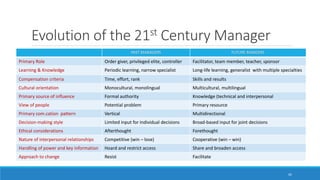
Evolution of the 21st Century Manager
PAST MANAGERS FUTURE MANGERS
Primary Role Order giver, privileged elite, controller Facilitator, team member, teacher, sponsor
Learning & Knowledge Periodic learning, narrow specialist Long-life learning, generalist with multiple specialties
Compensation criteria Time, effort, rank Skills and results
Cultural orientation Monocultural, monolingual Multicultural, multilingual
Primary source of influence Formal authority Knowledge (technical and interpersonal
View of people Potential problem Primary resource
Primary com.cation pattern Vertical Multidirectional
Decision-making style Limited input for individual decisions Broad-based input for joint decisions
Ethical considerations Afterthought Forethought
Nature of interpersonal relationships Competitive (win – lose) Cooperative (win – win)
Handling of power and key information Hoard and restrict access Share and broaden access
Approach to change Resist Facilitate
16
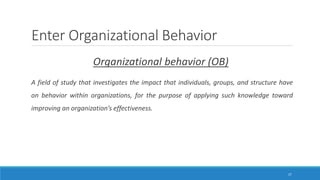
Enter Organizational Behavior
Organizational behavior (OB)
A field of study that investigates the impact that individuals, groups, and structure have
on behavior within organizations, for the purpose of applying such knowledge toward
improving an organization’s effectiveness.
17
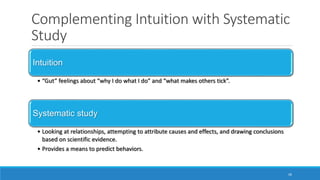
Complementing Intuition with Systematic
Study
Intuition
• “Gut” feelings about “why I do what I do” and “what makes others tick”.
Systematic study
• Looking at relationships, attempting to attribute causes and effects, and drawing conclusions
based on scientific evidence.
• Provides a means to predict behaviors.
18
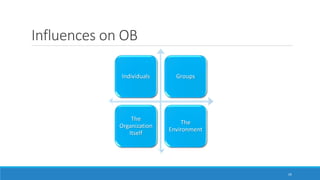
Influences on OB
Individuals Groups
The
Organization
Itself
The
Environment
19
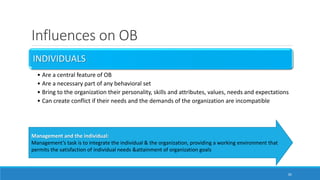
Influences on OB
INDIVIDUALS
• Are a central feature of OB
• Are a necessary part of any behavioral set
• Bring to the organization their personality, skills and attributes, values, needs and expectations
• Can create conflict if their needs and the demands of the organization are incompatible
20
Management and the individual:
Management’s task is to integrate the individual & the organization, providing a working environment that
permits the satisfaction of individual needs &attainment of organization goals
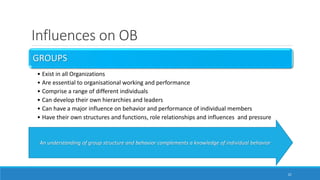
Influences on OB
GROUPS
• Exist in all Organizations
• Are essential to organisational working and performance
• Comprise a range of different individuals
• Can develop their own hierarchies and leaders
• Can have a major influence on behavior and performance of individual members
• Have their own structures and functions, role relationships and influences and pressure
21
An understanding of group structure and behavior complements a knowledge of individual behavior
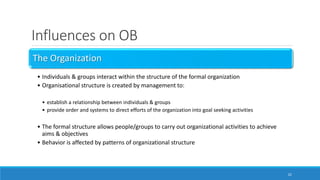
Influences on OB
The Organization
• Individuals & groups interact within the structure of the formal organization
• Organisational structure is created by management to:
• establish a relationship between individuals & groups
• provide order and systems to direct efforts of the organization into goal seeking activities
• The formal structure allows people/groups to carry out organizational activities to achieve
aims & objectives
• Behavior is affected by patterns of organizational structure
22
Influences on OB
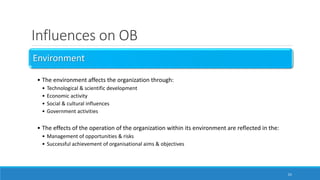
Environment
• The environment affects the organization through:
• Technological & scientific development
• Economic activity
• Social & cultural influences
• Government activities
• The effects of the operation of the organization within its environment are reflected in the:
• Management of opportunities & risks
• Successful achievement of organisational aims & objectives
23
Toward an OB Discipline
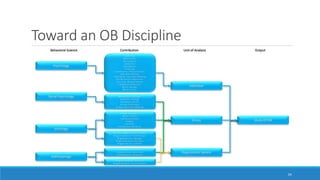
24
Psychology
Behavioral Science Contribution Unit of Analysis Output
Social Psychology
Sociology
Anthropology
L e a rn in g
M o t iv a t io n
P e rs o n a lit y
E m o t io n s
P e rc e p t io n
T ra in in g
L e a d e rs h ip E f f e c t iv e n e s s
J o b S a t is f a c t io n
I n d iv id u a l D e c is io n M a k in g
P e rf o rm a n c e A p p ra is a l
A t t it u d e M e a s u re m e n t
Em p loy e e s e le c t ion
Wo rk D e s ig n
Wo rk S t re s s
B e h a v io ra l C h a n g e
A t t it u d e C h a n g e
C o m m u n ic a t io n
G ro u p P ro c e s s e s
G ro u p D e c is io n M a k in g
G ro u p D y n a m ic s
Wo rk T e a m s
C o m m u n ic a t io n
P ow e r
C o n f lic t
I n t e rg ro u p B e h a v io r
F o rm a l O rg a n iz a t io n T h e o ry
O rg a n iz a t io n a l T e c h n o lo g y
O rg a n iz a t io n C h a n g e
O rg a n iz a t io n a l C u lt u re
O rg a n iz a t io n S y s t e m
C o m p a ra t iv e V a lu e s
C o m p a ra t iv e A t t it u d e s
C o m p a ra t iv e A n a ly s is
O rg a n iz a t io n a l C u lt u re
O rg a n iz a t io n a l E n v iro n m e n t
Individual
Group
Organization System
Study Of OB
Contributing Disciplines to the OB Field
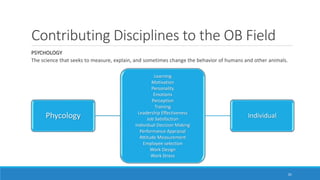
PSYCHOLOGY
The science that seeks to measure, explain, and sometimes change the behavior of humans and other animals.
25
Phycology
Learning
Motivation
Personality
Emotions
Perception
Training
Leadership Effectiveness
Job Satisfaction
Individual Decision Making
Performance Appraisal
Attitude Measurement
Employee selection
Work Design
Work Stress
Individual
Contributing Disciplines to the OB Field
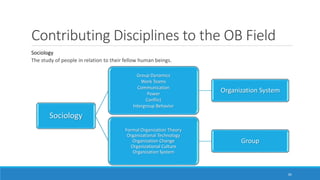
Sociology
The study of people in relation to their fellow human beings.
26
Sociology
Group Dynamics
Work Teams
Communication
Power
Conflict
Intergroup Behavior
Organization System
Formal Organization Theory
Organizational Technology
Organization Change
Organizational Culture
Organization System
Group
Contributing Disciplines to the OB Field
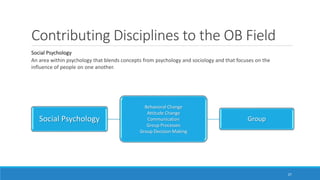
Social Psychology
An area within psychology that blends concepts from psychology and sociology and that focuses on the
influence of people on one another.
27
Social Psychology
Behavioral Change
Attitude Change
Communication
Group Processes
Group Decision Making
Group
Contributing Disciplines to the OB Field
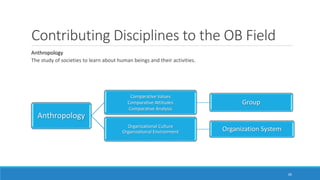
Anthropology
The study of societies to learn about human beings and their activities.
28
Anthropology
Comparative Values
Comparative Attitudes
Comparative Analysis
Group
Organizational Culture
Organizational Environment Organization System
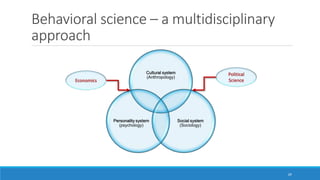
Behavioral science – a multidisciplinary
approach
Cultural system
(Anthropology)
Social system
(Sociology)
Personality system
(psychology)
29
Economics
Political
Science
Why Do We Study OB?
To learn about yourself and how to deal with others
You are part of an organization now, and will continue to be a part of
various organizations
Organizations are increasingly expecting individuals to be able to work in
teams, at some of the time
Some of you may want to be managers or entrepreneurs
30
The importance of the study of
organizational behavior
In its concern for the way people behave in an organizational context,
organizational behavior can be regarded as the key to the whole area of
management
The more technical a manager’s training, the more important
organizational behavior becomes
31
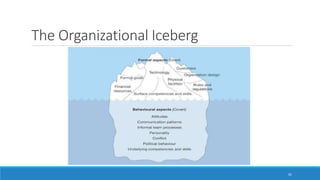
The Organizational Iceberg
32
Morgan’s 8 ways of viewing organizations
1. Machines
2. Organisms
3. Brains
4. Cultures
5. Political systems
6. Psychic prisons
7. Flux & transformation
8. Instruments of domination
The metaphors are not fixed categories and are not mutually exclusive
33
Morgan’s 8 ways of viewing organizations
1. MACHINES
◦ Organizations can be designed as machines with orderly relations between clearly defined parts
◦ This view can provide the basis for efficient operation in a routine, reliable and predictable way
bureaucratic structure
However it may limit the development of human
34
Morgan’s 8 ways of viewing organizations
2. ORGANISMS
◦ Organizations can be designed as machines with orderly relations between clearly defined parts
◦ This view can provide the basis for efficient operation in a routine, reliable and predictable way
bureaucratic structure
35
Morgan’s 8 ways of viewing organizations
3. BRAINS
◦ Involves thinking about the organization as inventive and rational, and in a manner that provides for
flexibility and creative action
The challenge is to create new forms of organization capable of intelligent change and that can disperse
brain like capacities
36
Morgan’s 8 ways of viewing organizations
4. CULTURES
◦ Sees organizations as complex system made up of their own characteristic sets of ideology, values,
rituals, and systems of belief and practice
Attention to specific aspects of social development helps to account for variations among organizations
37
Morgan’s 8 ways of viewing organizations
5. POLITICAL SYSTEMS
◦ Create order and direct people, organizations are intrinsically political
◦ They are about authority, power, superior subordinate relationships and conflicting of interests
This view helps in a understanding of day-to-day organizational life, the wheeling and dealing, and
pursuit of special interests
38
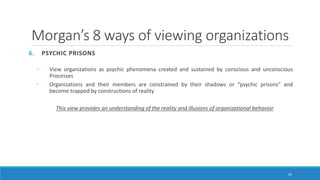
Morgan’s 8 ways of viewing organizations
6. PSYCHIC PRISONS
◦ View organizations as psychic phenomena created and sustained by conscious and unconscious
Processes
◦ Organizations and their members are constrained by their shadows or “psychic prisons” and
become trapped by constructions of reality
This view provides an understanding of the reality and illusions of organizational behavior
39
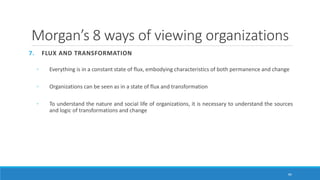
Morgan’s 8 ways of viewing organizations
7. FLUX AND TRANSFORMATION
◦ Everything is in a constant state of flux, embodying characteristics of both permanence and change
◦ Organizations can be seen as in a state of flux and transformation
◦ To understand the nature and social life of organizations, it is necessary to understand the sources
and logic of transformations and change
40
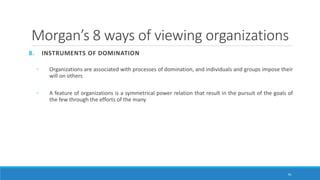
Morgan’s 8 ways of viewing organizations
8. INSTRUMENTS OF DOMINATION
◦ Organizations are associated with processes of domination, and individuals and groups impose their
will on others
◦ A feature of organizations is a symmetrical power relation that result in the pursuit of the goals of
the few through the efforts of the many
41
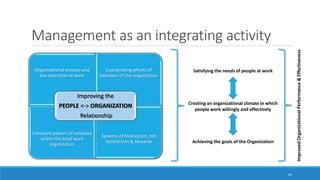
Management as an integrating activity
Organizational process and
the execution of work
Coordinating efforts of
members of the organization
Coherent pattern of activities
within the total work
organization
Systems of Motivation, Job
Satisfaction & Rewards
Improving the
PEOPLE <-> ORGANIZATION
Relationship
42
Satisfying the needs of people at work
Creating an organizational climate in which
people work willingly and effectively
Achieving the goals of the Organization
ImprovedOrganizationalPerformance&Effectiveness
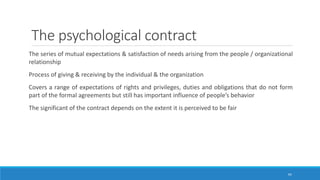
The psychological contract
The series of mutual expectations & satisfaction of needs arising from the people / organizational
relationship
Process of giving & receiving by the individual & the organization
Covers a range of expectations of rights and privileges, duties and obligations that do not form
part of the formal agreements but still has important influence of people’s behavior
The significant of the contract depends on the extent it is perceived to be fair
43
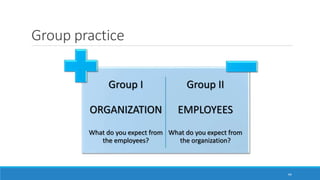
Group practice
Group I
ORGANIZATION
What do you expect from
the employees?
Group II
EMPLOYEES
What do you expect from
the organization?
44
Individuals’ expectations
Provide safe and hygienic working conditions
Make every reasonable effort to provide job security
Attempt to provide challenging and satisfying jobs and reduce alienating aspects of work
Adopt equitable personnel policies and procedures
Allow staff genuine participation in decisions which affect them
Implement best practice in equal opportunity policies and procedures
Provide reasonable opportunities for personal development and career progression
Treat members of staff with respect
Demonstrate an understanding and considerate attitude towards personal problems of staff
45
The organization’s expectation
To accept the ideology of the organization
To work diligently in pursuit of organizational objectives
Not to abuse goodwill shown by management
To uphold the image of the organization
To show loyalty
Not to be betray positions of trust
To observe reasonable and acceptable standards of dress and appearance
46
Process of balancing
It is unlikely that all expectations of the individual or of the organization will be met fully
There is a continual process of balancing, and explicit and implicit bargaining
47
Formula for balancing unwritten needs of
employees with the needs of the organization
48
CARING
•Demonstrating genuine concern for individuals
COMMUNICATING
•Really talking about what the company hopes to achieve
LISTENING
•Hearing not only the words but also what lies behind the words
KNOWING
•Those who work for you, their families, personal wishes, desires & ambitions
REWARDING
•Money is not always necessary stalker
Challenges and Opportunities for OB
49
R E S P O N D I N G TO G LO B A L I Z AT I O N
•Increased foreign assignments
•Working with people from different cultures
•Coping with anti-capitalism backlash
•Overseeing movement of jobs to countries with low-cost labor
•Managing people during the war on terror
M A N A G I N G W O R K F O R C E D I V E R S I T Y
•Embracing diversity
•Changing global demographics
•Implications for managers
•Recognizing and responding to differences
I M P R O V I N G Q UA L I T Y A N D P R O D U C T I V I T Y
•Quality management (QM)
•Process reengineering
R E S P O N D I N G TO T H E L A B O R S H O R TA G E
•Changing work force demographics
•Fewer skilled laborers
•Early retirements and older workers
I M P R O V I N G C U S TO M E R S E R V I C E
•Increased expectation of service quality
•Customer-responsive cultures
What Is Quality Management?
1. Intense focus on the customer.
2. Concern for continuous improvement.
3. Improvement in the quality of everything the organization does.
4. Accurate measurement.
5. Empowerment of employees.
50
Challenges and Opportunity for OB
1. Improving People Skills
2. Empowering People
3. Stimulating Innovation and Change
4. Working in Networked Organizations
5. Helping Employees Balance Work/Life Conflicts
6. Improving Ethical Behavior
51
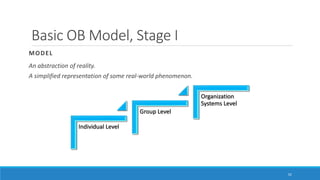
Basic OB Model, Stage I
MODEL
An abstraction of reality.
A simplified representation of some real-world phenomenon.
52
Individual Level
Group Level
Organization
Systems Level
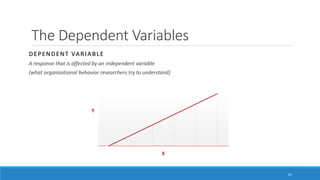
The Dependent Variables
DEPENDENT VARIABLE
A response that is affected by an independent variable
(what organizational behavior researchers try to understand)
53
Y
X
The Dependent Variables
54
•A performance measure that includes effectiveness and efficiency.
•EFFEC TIVENESS [Achievement of goals] <O> EFFICIENCY [Meeting goals at a low cost]
PRODUCTIVITY
•The failure to report to work.ABSENTEEISM
•The voluntary and involuntary permanent withdrawal from an organization.TURNOVER
•Voluntary behavior that violates significant organizational norms and thereby threatens the
well-being of the organization and/or any of its members.
DEVIANT WORKPLACE
BEHAVIOR
•Discretionary behavior that is not part of an employee’s formal job requirements, but that
nevertheless promotes the effective functioning of the organization.
ORGANIZATIONAL
CITIZENSHIP BEHAVIOR
•A general attitude (not a behavior) toward one’s job; a positive feeling of one's job resulting
from an evaluation of its characteristics.
JOB SATISFAC TION
The Independent Variables
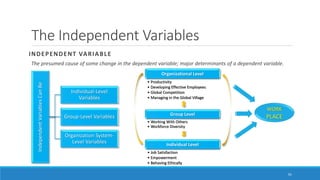
INDEPENDENT VARIABLE
The presumed cause of some change in the dependent variable; major determinants of a dependent variable.
55
IndependentVariablesCanBe
Individual-Level
Variables
Group-Level Variables
Organization System-
Level Variables
Organizational Level
• Productivity
• Developing Effective Employees
• Global Competition
• Managing in the Global Village
Group Level
• Working With Others
• Workforce Diversity
Individual Level
• Job Satisfaction
• Empowerment
• Behaving Ethically
WORK
PLACE
THANK YOU ..
56

Organizational behavior

  • 1.
  • 2.
    Content What managers do. Whatis Organizational Behavior (OB). What is the value of the systematic study of OB. What is the contributions made by major behavioral science disciplines to OB. List of the major challenges and opportunities for managers to use OB concepts. 2
  • 3.
    What managers do. Managers(or administrators): ◦ Individuals who achieve goals through other people. 3 Managerial Activities Make decisions Allocate resources Direct activities of others to attain goals to attain goal
  • 4.
    Where Managers Work Organization Aconsciously coordinated social unit, composed of two or more people, that functions on a relatively continuous basis to achieve a common goal or set of goals. 4
  • 5.
  • 6.
    Management Functions 6 •A processthat includes defining goals, establishing strategy, and developing plans to coordinate activities.Planning •Determining what tasks are to be done, who is to do them, how the tasks are to be grouped, who reports to whom, and where decisions are to be made.Organizing •A function that includes motivating employees, directing others, selecting the most effective communication channels, and resolving conflicts.Leading •Monitoring activities to ensure they are being accomplished as planned and correcting any significant deviations.Controlling
  • 7.
  • 8.
    Mintzberg’s Managerial INTERPERSONALRoles 8 • Symbolic head; required to perform a number of routine duties of a legal or social natureFigurehead • Responsible for the motivation and direction of employeesLeader • Maintain a network of outside contacts who provide favors and informationLiaison
  • 9.
    Mintzberg’s Managerial INFORMATIONALRoles 9 • Receives wide variety of information; serves as nerve center of internal & external information of the organization. Monitor • Transmits information received from outsiders or from other employees to members of the organization.Disseminator • Transmits information to outsiders on organization plans, policies, actions and results; serves as expert on organization’s industry Spokesperson
  • 10.
    Mintzberg’s Managerial DECISIONALRoles 10 • Searches organization and its environment for opportunities and initiates projects to bring about change.Entrepreneur • Responsible for corrective action when organization faces important, unexpected disturbances.Disturbance Handler • Makes or approve significant organizational decisions.Resource Allocator • Responsible for representing the organization at major negotiationsNegotiator
  • 11.
    Management Skills Technical skills Theability to apply specialized knowledge or expertise. Human skills The ability to work with, understand, and motivate other people, both individually and in groups. Conceptual Skills The mental ability to analyze and diagnose complex situations. 11
  • 12.
    Skills Needed atDifferent Levels of Management Technical Technical Technical 12 HUMAN HUMAN HUMAN Conceptual Conceptual Conceptual TOP MANAGEMENT MIDDLE MANAGEMENT FIRST-LINE MANAGEMENT
  • 13.
    Effective vs. SuccessfulManagerial Activities 13 • Decision making, planning, and controlling. Traditional Management • Exchanging routine information and processing paperwork.Communication • Motivating, disciplining, managing conflict, staffing, and training. Human Resource Management • Socializing, politicking, and interacting with others.Networking
  • 14.
    Allocation of Activitiesby Time 13% 28% 11% 48% Successful Managers Tradetional Management Communication Human Resource Management Networking 14 19% 44% 26% 11% Effective Managers Tradetional Management Communication Human Resource Management Networking 32% 29% 20% 19% Average Managers Tradetional Management Communication Human Resource Management Networking
  • 15.
    Willson’s managerial skillson 11 observable categories SKILLS EXHIBITED BY AN EFFECTIVE MANAGER 1. Clarifies goals and objectives for everyone involved 2. Encourage participation, upward communication, and suggestion 3. Plans and organizes for an orderly work flow 4. Has technical and administrative expertise to answer organization-related questions 5. Facilitates work though team building, training, coaching, and support 6. Provides feedback honestly and constructively 7. Keeps things moving by relying on schedules, deadlines, and helpful reminders 8. Controls details without being overbearing 9. Applies reasonable pressure for goals accomplishment 10. Empowers and delegates key duties to others while maintaining goal clarity & commitment 11. Recognizes good performance with rewards and positive reinforcement 15
  • 16.
    Evolution of the21st Century Manager PAST MANAGERS FUTURE MANGERS Primary Role Order giver, privileged elite, controller Facilitator, team member, teacher, sponsor Learning & Knowledge Periodic learning, narrow specialist Long-life learning, generalist with multiple specialties Compensation criteria Time, effort, rank Skills and results Cultural orientation Monocultural, monolingual Multicultural, multilingual Primary source of influence Formal authority Knowledge (technical and interpersonal View of people Potential problem Primary resource Primary com.cation pattern Vertical Multidirectional Decision-making style Limited input for individual decisions Broad-based input for joint decisions Ethical considerations Afterthought Forethought Nature of interpersonal relationships Competitive (win – lose) Cooperative (win – win) Handling of power and key information Hoard and restrict access Share and broaden access Approach to change Resist Facilitate 16
  • 17.
    Enter Organizational Behavior Organizationalbehavior (OB) A field of study that investigates the impact that individuals, groups, and structure have on behavior within organizations, for the purpose of applying such knowledge toward improving an organization’s effectiveness. 17
  • 18.
    Complementing Intuition withSystematic Study Intuition • “Gut” feelings about “why I do what I do” and “what makes others tick”. Systematic study • Looking at relationships, attempting to attribute causes and effects, and drawing conclusions based on scientific evidence. • Provides a means to predict behaviors. 18
  • 19.
    Influences on OB IndividualsGroups The Organization Itself The Environment 19
  • 20.
    Influences on OB INDIVIDUALS •Are a central feature of OB • Are a necessary part of any behavioral set • Bring to the organization their personality, skills and attributes, values, needs and expectations • Can create conflict if their needs and the demands of the organization are incompatible 20 Management and the individual: Management’s task is to integrate the individual & the organization, providing a working environment that permits the satisfaction of individual needs &attainment of organization goals
  • 21.
    Influences on OB GROUPS •Exist in all Organizations • Are essential to organisational working and performance • Comprise a range of different individuals • Can develop their own hierarchies and leaders • Can have a major influence on behavior and performance of individual members • Have their own structures and functions, role relationships and influences and pressure 21 An understanding of group structure and behavior complements a knowledge of individual behavior
  • 22.
    Influences on OB TheOrganization • Individuals & groups interact within the structure of the formal organization • Organisational structure is created by management to: • establish a relationship between individuals & groups • provide order and systems to direct efforts of the organization into goal seeking activities • The formal structure allows people/groups to carry out organizational activities to achieve aims & objectives • Behavior is affected by patterns of organizational structure 22
  • 23.
    Influences on OB Environment •The environment affects the organization through: • Technological & scientific development • Economic activity • Social & cultural influences • Government activities • The effects of the operation of the organization within its environment are reflected in the: • Management of opportunities & risks • Successful achievement of organisational aims & objectives 23
  • 24.
    Toward an OBDiscipline 24 Psychology Behavioral Science Contribution Unit of Analysis Output Social Psychology Sociology Anthropology L e a rn in g M o t iv a t io n P e rs o n a lit y E m o t io n s P e rc e p t io n T ra in in g L e a d e rs h ip E f f e c t iv e n e s s J o b S a t is f a c t io n I n d iv id u a l D e c is io n M a k in g P e rf o rm a n c e A p p ra is a l A t t it u d e M e a s u re m e n t Em p loy e e s e le c t ion Wo rk D e s ig n Wo rk S t re s s B e h a v io ra l C h a n g e A t t it u d e C h a n g e C o m m u n ic a t io n G ro u p P ro c e s s e s G ro u p D e c is io n M a k in g G ro u p D y n a m ic s Wo rk T e a m s C o m m u n ic a t io n P ow e r C o n f lic t I n t e rg ro u p B e h a v io r F o rm a l O rg a n iz a t io n T h e o ry O rg a n iz a t io n a l T e c h n o lo g y O rg a n iz a t io n C h a n g e O rg a n iz a t io n a l C u lt u re O rg a n iz a t io n S y s t e m C o m p a ra t iv e V a lu e s C o m p a ra t iv e A t t it u d e s C o m p a ra t iv e A n a ly s is O rg a n iz a t io n a l C u lt u re O rg a n iz a t io n a l E n v iro n m e n t Individual Group Organization System Study Of OB
  • 25.
    Contributing Disciplines tothe OB Field PSYCHOLOGY The science that seeks to measure, explain, and sometimes change the behavior of humans and other animals. 25 Phycology Learning Motivation Personality Emotions Perception Training Leadership Effectiveness Job Satisfaction Individual Decision Making Performance Appraisal Attitude Measurement Employee selection Work Design Work Stress Individual
  • 26.
    Contributing Disciplines tothe OB Field Sociology The study of people in relation to their fellow human beings. 26 Sociology Group Dynamics Work Teams Communication Power Conflict Intergroup Behavior Organization System Formal Organization Theory Organizational Technology Organization Change Organizational Culture Organization System Group
  • 27.
    Contributing Disciplines tothe OB Field Social Psychology An area within psychology that blends concepts from psychology and sociology and that focuses on the influence of people on one another. 27 Social Psychology Behavioral Change Attitude Change Communication Group Processes Group Decision Making Group
  • 28.
    Contributing Disciplines tothe OB Field Anthropology The study of societies to learn about human beings and their activities. 28 Anthropology Comparative Values Comparative Attitudes Comparative Analysis Group Organizational Culture Organizational Environment Organization System
  • 29.
    Behavioral science –a multidisciplinary approach Cultural system (Anthropology) Social system (Sociology) Personality system (psychology) 29 Economics Political Science
  • 30.
    Why Do WeStudy OB? To learn about yourself and how to deal with others You are part of an organization now, and will continue to be a part of various organizations Organizations are increasingly expecting individuals to be able to work in teams, at some of the time Some of you may want to be managers or entrepreneurs 30
  • 31.
    The importance ofthe study of organizational behavior In its concern for the way people behave in an organizational context, organizational behavior can be regarded as the key to the whole area of management The more technical a manager’s training, the more important organizational behavior becomes 31
  • 32.
  • 33.
    Morgan’s 8 waysof viewing organizations 1. Machines 2. Organisms 3. Brains 4. Cultures 5. Political systems 6. Psychic prisons 7. Flux & transformation 8. Instruments of domination The metaphors are not fixed categories and are not mutually exclusive 33
  • 34.
    Morgan’s 8 waysof viewing organizations 1. MACHINES ◦ Organizations can be designed as machines with orderly relations between clearly defined parts ◦ This view can provide the basis for efficient operation in a routine, reliable and predictable way bureaucratic structure However it may limit the development of human 34
  • 35.
    Morgan’s 8 waysof viewing organizations 2. ORGANISMS ◦ Organizations can be designed as machines with orderly relations between clearly defined parts ◦ This view can provide the basis for efficient operation in a routine, reliable and predictable way bureaucratic structure 35
  • 36.
    Morgan’s 8 waysof viewing organizations 3. BRAINS ◦ Involves thinking about the organization as inventive and rational, and in a manner that provides for flexibility and creative action The challenge is to create new forms of organization capable of intelligent change and that can disperse brain like capacities 36
  • 37.
    Morgan’s 8 waysof viewing organizations 4. CULTURES ◦ Sees organizations as complex system made up of their own characteristic sets of ideology, values, rituals, and systems of belief and practice Attention to specific aspects of social development helps to account for variations among organizations 37
  • 38.
    Morgan’s 8 waysof viewing organizations 5. POLITICAL SYSTEMS ◦ Create order and direct people, organizations are intrinsically political ◦ They are about authority, power, superior subordinate relationships and conflicting of interests This view helps in a understanding of day-to-day organizational life, the wheeling and dealing, and pursuit of special interests 38
  • 39.
    Morgan’s 8 waysof viewing organizations 6. PSYCHIC PRISONS ◦ View organizations as psychic phenomena created and sustained by conscious and unconscious Processes ◦ Organizations and their members are constrained by their shadows or “psychic prisons” and become trapped by constructions of reality This view provides an understanding of the reality and illusions of organizational behavior 39
  • 40.
    Morgan’s 8 waysof viewing organizations 7. FLUX AND TRANSFORMATION ◦ Everything is in a constant state of flux, embodying characteristics of both permanence and change ◦ Organizations can be seen as in a state of flux and transformation ◦ To understand the nature and social life of organizations, it is necessary to understand the sources and logic of transformations and change 40
  • 41.
    Morgan’s 8 waysof viewing organizations 8. INSTRUMENTS OF DOMINATION ◦ Organizations are associated with processes of domination, and individuals and groups impose their will on others ◦ A feature of organizations is a symmetrical power relation that result in the pursuit of the goals of the few through the efforts of the many 41
  • 42.
    Management as anintegrating activity Organizational process and the execution of work Coordinating efforts of members of the organization Coherent pattern of activities within the total work organization Systems of Motivation, Job Satisfaction & Rewards Improving the PEOPLE <-> ORGANIZATION Relationship 42 Satisfying the needs of people at work Creating an organizational climate in which people work willingly and effectively Achieving the goals of the Organization ImprovedOrganizationalPerformance&Effectiveness
  • 43.
    The psychological contract Theseries of mutual expectations & satisfaction of needs arising from the people / organizational relationship Process of giving & receiving by the individual & the organization Covers a range of expectations of rights and privileges, duties and obligations that do not form part of the formal agreements but still has important influence of people’s behavior The significant of the contract depends on the extent it is perceived to be fair 43
  • 44.
    Group practice Group I ORGANIZATION Whatdo you expect from the employees? Group II EMPLOYEES What do you expect from the organization? 44
  • 45.
    Individuals’ expectations Provide safeand hygienic working conditions Make every reasonable effort to provide job security Attempt to provide challenging and satisfying jobs and reduce alienating aspects of work Adopt equitable personnel policies and procedures Allow staff genuine participation in decisions which affect them Implement best practice in equal opportunity policies and procedures Provide reasonable opportunities for personal development and career progression Treat members of staff with respect Demonstrate an understanding and considerate attitude towards personal problems of staff 45
  • 46.
    The organization’s expectation Toaccept the ideology of the organization To work diligently in pursuit of organizational objectives Not to abuse goodwill shown by management To uphold the image of the organization To show loyalty Not to be betray positions of trust To observe reasonable and acceptable standards of dress and appearance 46
  • 47.
    Process of balancing Itis unlikely that all expectations of the individual or of the organization will be met fully There is a continual process of balancing, and explicit and implicit bargaining 47
  • 48.
    Formula for balancingunwritten needs of employees with the needs of the organization 48 CARING •Demonstrating genuine concern for individuals COMMUNICATING •Really talking about what the company hopes to achieve LISTENING •Hearing not only the words but also what lies behind the words KNOWING •Those who work for you, their families, personal wishes, desires & ambitions REWARDING •Money is not always necessary stalker
  • 49.
    Challenges and Opportunitiesfor OB 49 R E S P O N D I N G TO G LO B A L I Z AT I O N •Increased foreign assignments •Working with people from different cultures •Coping with anti-capitalism backlash •Overseeing movement of jobs to countries with low-cost labor •Managing people during the war on terror M A N A G I N G W O R K F O R C E D I V E R S I T Y •Embracing diversity •Changing global demographics •Implications for managers •Recognizing and responding to differences I M P R O V I N G Q UA L I T Y A N D P R O D U C T I V I T Y •Quality management (QM) •Process reengineering R E S P O N D I N G TO T H E L A B O R S H O R TA G E •Changing work force demographics •Fewer skilled laborers •Early retirements and older workers I M P R O V I N G C U S TO M E R S E R V I C E •Increased expectation of service quality •Customer-responsive cultures
  • 50.
    What Is QualityManagement? 1. Intense focus on the customer. 2. Concern for continuous improvement. 3. Improvement in the quality of everything the organization does. 4. Accurate measurement. 5. Empowerment of employees. 50
  • 51.
    Challenges and Opportunityfor OB 1. Improving People Skills 2. Empowering People 3. Stimulating Innovation and Change 4. Working in Networked Organizations 5. Helping Employees Balance Work/Life Conflicts 6. Improving Ethical Behavior 51
  • 52.
    Basic OB Model,Stage I MODEL An abstraction of reality. A simplified representation of some real-world phenomenon. 52 Individual Level Group Level Organization Systems Level
  • 53.
    The Dependent Variables DEPENDENTVARIABLE A response that is affected by an independent variable (what organizational behavior researchers try to understand) 53 Y X
  • 54.
    The Dependent Variables 54 •Aperformance measure that includes effectiveness and efficiency. •EFFEC TIVENESS [Achievement of goals] <O> EFFICIENCY [Meeting goals at a low cost] PRODUCTIVITY •The failure to report to work.ABSENTEEISM •The voluntary and involuntary permanent withdrawal from an organization.TURNOVER •Voluntary behavior that violates significant organizational norms and thereby threatens the well-being of the organization and/or any of its members. DEVIANT WORKPLACE BEHAVIOR •Discretionary behavior that is not part of an employee’s formal job requirements, but that nevertheless promotes the effective functioning of the organization. ORGANIZATIONAL CITIZENSHIP BEHAVIOR •A general attitude (not a behavior) toward one’s job; a positive feeling of one's job resulting from an evaluation of its characteristics. JOB SATISFAC TION
  • 55.
    The Independent Variables INDEPENDENTVARIABLE The presumed cause of some change in the dependent variable; major determinants of a dependent variable. 55 IndependentVariablesCanBe Individual-Level Variables Group-Level Variables Organization System- Level Variables Organizational Level • Productivity • Developing Effective Employees • Global Competition • Managing in the Global Village Group Level • Working With Others • Workforce Diversity Individual Level • Job Satisfaction • Empowerment • Behaving Ethically WORK PLACE
  • 56.