Performance Manglement! 
How to Destroy a Perfectly Good Employee 
Without Really Trying 
© 2014 Malcolm Ryder / archestra research
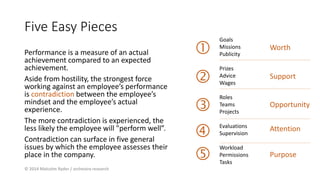
Five Easy Pieces 
Performance is a measure of an actual 
achievement compared to an expected 
achievement. 
Aside from hostility, the strongest force 
working against an employee’s performance 
is contradiction between the employee’s 
mindset and the employee’s actual 
experience. 
The more contradiction is experienced, the 
less likely the employee will "perform well”. 
Contradiction can surface in five general 
issues by which the employee assesses their 
place in the company. 
Goals 
Missions 
Publicity 
 Worth 
Prizes 
Advice 
Wages 
Roles 
Teams 
Projects 
Evaluations 
Supervision 
Workload 
Permissions 
Tasks 
Support 
Opportunity 
Attention 
Purpose 
 
 
 
 
© 2014 Malcolm Ryder / archestra research
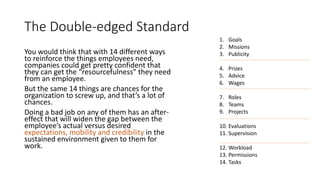
The Double-edged Standard 
You would think that with 14 different ways 
to reinforce the things employees need, 
companies could get pretty confident that 
they can get the “resourcefulness” they need 
from an employee. 
But the same 14 things are chances for the 
organization to screw up, and that’s a lot of 
chances. 
Doing a bad job on any of them has an after-effect 
that will widen the gap between the 
employee’s actual versus desired 
expectations, mobility and credibility in the 
sustained environment given to them for 
work. 
1. Goals 
2. Missions 
3. Publicity 
4. Prizes 
5. Advice 
6. Wages 
7. Roles 
8. Teams 
9. Projects 
10. Evaluations 
11. Supervision 
12. Workload 
13. Permissions 
14. Tasks
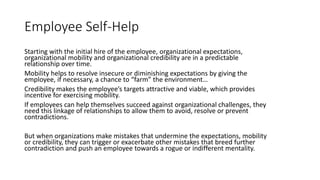
Employee Self-Help 
Starting with the initial hire of the employee, organizational expectations, 
organizational mobility and organizational credibility are in a predictable 
relationship over time. 
Mobility helps to resolve insecure or diminishing expectations by giving the 
employee, if necessary, a chance to “farm” the environment… 
Credibility makes the employee’s targets attractive and viable, which provides 
incentive for exercising mobility. 
If employees can help themselves succeed against organizational challenges, they 
need this linkage of relationships to allow them to avoid, resolve or prevent 
contradictions. 
But when organizations make mistakes that undermine the expectations, mobility 
or credibility, they can trigger or exacerbate other mistakes that breed further 
contradiction and push an employee towards a rogue or indifferent mentality.
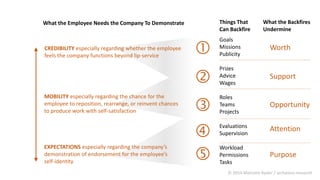
CREDIBILITY especially regarding whether the employee 
feels the company functions beyond lip-service 
MOBILITY especially regarding the chance for the 
employee to reposition, rearrange, or reinvent chances 
to produce work with self-satisfaction 
EXPECTATIONS especially regarding the company’s 
demonstration of endorsement for the employee’s 
self-identity 
Goals 
Missions 
Publicity 
 Worth 
Prizes 
Advice 
Wages 
Roles 
Teams 
Projects 
Evaluations 
Supervision 
Workload 
Permissions 
Tasks 
Support 
Opportunity 
Attention 
Purpose 
 
 
 
 
Things That 
Can Backfire 
What the Backfires 
Undermine 
What the Employee Needs the Company To Demonstrate 
© 2014 Malcolm Ryder / archestra research
How the Worst Case Scenario gets “Worst” 
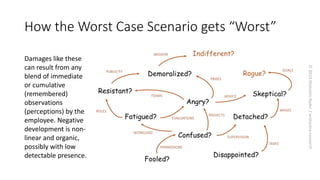
Damages like these 
can result from any 
blend of immediate 
or cumulative 
(remembered) 
observations 
(perceptions) by the 
employee. Negative 
development is non-linear 
and organic, 
possibly with low 
detectable presence. 
© 2014 Malcolm Ryder / archestra research
What can go wrong 
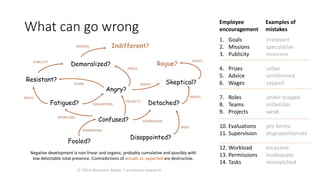
1. Goals 
2. Missions 
3. Publicity 
4. Prizes 
5. Advice 
6. Wages 
7. Roles 
8. Teams 
9. Projects 
10. Evaluations 
11. Supervision 
12. Workload 
13. Permissions 
14. Tasks 
irrelevant 
speculative 
insincere 
unfair 
uninformed 
capped 
under-scoped 
unfamiliar 
weak 
pro forma 
disproportionate 
excessive 
inadequate 
mismatched 
Employee 
encouragement 
Examples of 
mistakes 
Negative development is non-linear and organic, probably cumulative and possibly with 
low detectable total presence. Contradictions of actuals vs. expected are destructive. 
© 2014 Malcolm Ryder / archestra research
© 2014 Malcolm Ryder / archestra research 
mryder@malcolmryder.com

Performance Manglement! How to Ruin an Employee

  • 1.
    Performance Manglement! Howto Destroy a Perfectly Good Employee Without Really Trying © 2014 Malcolm Ryder / archestra research
  • 2.
    Five Easy Pieces Performance is a measure of an actual achievement compared to an expected achievement. Aside from hostility, the strongest force working against an employee’s performance is contradiction between the employee’s mindset and the employee’s actual experience. The more contradiction is experienced, the less likely the employee will "perform well”. Contradiction can surface in five general issues by which the employee assesses their place in the company. Goals Missions Publicity  Worth Prizes Advice Wages Roles Teams Projects Evaluations Supervision Workload Permissions Tasks Support Opportunity Attention Purpose     © 2014 Malcolm Ryder / archestra research
  • 3.
    The Double-edged Standard You would think that with 14 different ways to reinforce the things employees need, companies could get pretty confident that they can get the “resourcefulness” they need from an employee. But the same 14 things are chances for the organization to screw up, and that’s a lot of chances. Doing a bad job on any of them has an after-effect that will widen the gap between the employee’s actual versus desired expectations, mobility and credibility in the sustained environment given to them for work. 1. Goals 2. Missions 3. Publicity 4. Prizes 5. Advice 6. Wages 7. Roles 8. Teams 9. Projects 10. Evaluations 11. Supervision 12. Workload 13. Permissions 14. Tasks
  • 4.
    Employee Self-Help Startingwith the initial hire of the employee, organizational expectations, organizational mobility and organizational credibility are in a predictable relationship over time. Mobility helps to resolve insecure or diminishing expectations by giving the employee, if necessary, a chance to “farm” the environment… Credibility makes the employee’s targets attractive and viable, which provides incentive for exercising mobility. If employees can help themselves succeed against organizational challenges, they need this linkage of relationships to allow them to avoid, resolve or prevent contradictions. But when organizations make mistakes that undermine the expectations, mobility or credibility, they can trigger or exacerbate other mistakes that breed further contradiction and push an employee towards a rogue or indifferent mentality.
  • 5.
    CREDIBILITY especially regardingwhether the employee feels the company functions beyond lip-service MOBILITY especially regarding the chance for the employee to reposition, rearrange, or reinvent chances to produce work with self-satisfaction EXPECTATIONS especially regarding the company’s demonstration of endorsement for the employee’s self-identity Goals Missions Publicity  Worth Prizes Advice Wages Roles Teams Projects Evaluations Supervision Workload Permissions Tasks Support Opportunity Attention Purpose     Things That Can Backfire What the Backfires Undermine What the Employee Needs the Company To Demonstrate © 2014 Malcolm Ryder / archestra research
  • 6.
    How the WorstCase Scenario gets “Worst” Damages like these can result from any blend of immediate or cumulative (remembered) observations (perceptions) by the employee. Negative development is non-linear and organic, possibly with low detectable presence. © 2014 Malcolm Ryder / archestra research
  • 7.
    What can gowrong 1. Goals 2. Missions 3. Publicity 4. Prizes 5. Advice 6. Wages 7. Roles 8. Teams 9. Projects 10. Evaluations 11. Supervision 12. Workload 13. Permissions 14. Tasks irrelevant speculative insincere unfair uninformed capped under-scoped unfamiliar weak pro forma disproportionate excessive inadequate mismatched Employee encouragement Examples of mistakes Negative development is non-linear and organic, probably cumulative and possibly with low detectable total presence. Contradictions of actuals vs. expected are destructive. © 2014 Malcolm Ryder / archestra research
  • 8.
    © 2014 MalcolmRyder / archestra research mryder@malcolmryder.com