Organizational Behavior 17th Edition Robbins
Solutions Manual download
https://testbankfan.com/product/organizational-behavior-17th-
edition-robbins-solutions-manual/
Explore and download more test bank or solution manual
at testbankfan.com
We believe these products will be a great fit for you. Click
the link to download now, or visit testbankfan.com
to discover even more!
Organizational Behavior Global 17th Edition Robbins
Solutions Manual
https://testbankfan.com/product/organizational-behavior-global-17th-
edition-robbins-solutions-manual/
Organizational Behavior 17th Edition Robbins Test Bank
https://testbankfan.com/product/organizational-behavior-17th-edition-
robbins-test-bank/
Organizational Behavior 18th Edition Robbins Solutions
Manual
https://testbankfan.com/product/organizational-behavior-18th-edition-
robbins-solutions-manual/
Macroeconomics 3rd Edition Hubbard Test Bank
https://testbankfan.com/product/macroeconomics-3rd-edition-hubbard-
test-bank/
Basic Building and Construction Skills Australia 5th
Edition Hawkins Solutions Manual
https://testbankfan.com/product/basic-building-and-construction-
skills-australia-5th-edition-hawkins-solutions-manual/
Introduction to Materials Management 8th Edition Chapman
Solutions Manual
https://testbankfan.com/product/introduction-to-materials-
management-8th-edition-chapman-solutions-manual/
Labor Relations Development Structure Process 12th Edition
Fossum Test Bank
https://testbankfan.com/product/labor-relations-development-structure-
process-12th-edition-fossum-test-bank/
Business Law with UCC Applications 13th Edition Brown
Solutions Manual
https://testbankfan.com/product/business-law-with-ucc-
applications-13th-edition-brown-solutions-manual/
Elementary Algebra For College Students 9th Edition Angel
Solutions Manual
https://testbankfan.com/product/elementary-algebra-for-college-
students-9th-edition-angel-solutions-manual/
Understanding Nursing Research Building an Evidence Based
Practice 5th Edition Burns Test Bank
https://testbankfan.com/product/understanding-nursing-research-
building-an-evidence-based-practice-5th-edition-burns-test-bank/
Chapter 6 Perception and Individual Decision Making Page
Copyright © 2017 Pearson Education, Inc.
174
CHAPTER6
Perception and Individual
Decision Making
LEARNING OBJECTIVES
After studying this chapter, your students should be able to:
6-1. Explain the factors that influence perception.
6-2. Describe attribution theory.
6-3. Explain the link between perception and decision making.
6-4. Contrast the rational model of decision making with bounded rationality and
intuition.
6-5. Explain how individual differences and organizational constraints affect
decision making.
6-6. Contrast the three ethical decision criteria.
6-7. Describe the three-stage model of creativity.
INSTRUCTOR RESOURCES
Instructors may wish to use the following resources when presenting this chapter.
Text Exercises
• Career OBjectives: So What If I’m A Few Minutes Late to Work?
• Myth or Science?: “All Stereotypes Are Negative”
• An Ethical Choice: Choosing to Lie
• Personal Inventory Assessments: How Creative Are You?
• Point/Counterpoint: Stereotypes Are Dying
• Questions for Review
• Experiential Exercise: Good Liars and Bad Liars
• Ethical Dilemma: Cheating Is A Decision
Text Cases
• Case Incident 1: Too Much Of A Good Thing
• Case Incident 2: The Youngest Billionaire
Chapter 6 Perception and Individual Decision Making Page
Copyright © 2017 Pearson Education, Inc.
175
Instructor’s Choice
This section presents an exercise that is NOT found in the student's textbook. Instructor's
Choice reinforces the text's emphasis through various activities. Some Instructor's Choice
activities are centered on debates, group exercises, Internet research, and student
experiences. Some can be used in class in their entirety, while others require some
additional work on the student's part. The course instructor may choose to use these at
any time throughout the class—some may be more effective as icebreakers, while some
may be used to pull together various concepts covered in the chapter.
Web Exercises
At the end of each chapter of this Instructor’s Manual, you will find suggested exercises
and ideas for researching OB topics on the Internet. The exercises “Exploring OB Topics
on the Web” are set up so that you can simply photocopy the pages, distribute them to
your class, and make assignments accordingly. You may want to assign the exercises as
an out-of-class activity or as lab activities with your class.
Summary and Implications for Managers
Individuals base their behavior not on the way their external environment actually is, but
rather on the way they see it or believe it to be. An understanding of the way people
make decisions can help us explain and predict behavior, but few important decisions are
simple or unambiguous enough for the rational model’s assumptions to apply. We find
individuals looking for solutions that satisfice rather than optimize, injecting biases and
prejudices into the decision process, and relying on intuition. Managers should encourage
creativity in employees and teams to create a route to innovative decision making.
Specific implications for managers are below:
• Behavior follows perception, so to influence behavior at work, assess how people
perceive their work. Often behaviors we find puzzling can be explained by
understanding the initiating perceptions.
• Make better decisions by recognizing perceptual biases and decision-making
errors we tend to commit. Learning about these problems doesn’t always prevent
us from making mistakes, but it does help.
• Adjust your decision-making approach to the national culture you’re operating in
and to the criteria your organization values. If you’re in a country that doesn’t
value rationality, don’t feel compelled to follow the rational decision-making
model or to try to make your decisions appear rational. Adjust your decision
approach to ensure compatibility with the organizational culture.
• Combine rational analysis with intuition. These are not conflicting approaches to
decision making. By using both, you can actually improve your decision making
effectiveness.
• Try to enhance your creativity. Actively look for novel solutions to problems,
attempt to see problems in new ways, use analogies, and hire creative talent. Try
to remove work and organizational barriers that might impede your creativity.
Chapter 6 Perception and Individual Decision Making Page
Copyright © 2017 Pearson Education, Inc.
176
This chapter begins with an introduction to Palmer Luckey, inventor of the Oculus Rift virtual reality
headset. The case illustrates how important—and perhaps rare—an individual’s creativity can be to an
industry. As we will see later in the chapter, the creativity of individuals can lead to breakthroughs in
innovation. To better understand what influences us and our organizations, we start at the roots of our
thought processes: our perceptions and the way they affect our decision making.
BRIEF CHAPTER OUTLINE
I. What Is Perception?
A. Perception is a process by which individuals organize and interpret their sensory
impressions in order to give meaning to their environment.
B. Why is this important to the study of OB?
1. Because people’s behavior is based on their perception of what reality is, not
on reality itself.
II. Factors That Influence Perception (Exhibit 6-1)
A. Factors that shape and can distort perception:
1. Perceiver
2. Target
3. Situation
B. When an individual looks at a target and attempts to interpret what he or she sees,
that interpretation is heavily influenced by personal characteristics of the
individual perceiver.
C. Characteristics of the target also affect what we perceive.
D. Context matters too.
III. Person Perception: Making Judgments about Others
A. Attribution Theory (Exhibit 6-2)
1. Attribution theory suggests that when we observe an individual’s behavior,
we attempt to determine whether it was internally or externally caused. That
determination depends largely on three factors:
a. Distinctiveness
b. Consensus
c. Consistency
2. Clarification of the differences between internal and external causation:
a. Internally caused behaviors are those that are believed to be under the
personal control of the individual.
b. Externally caused behavior is what we imagine the situation forced the
individual to do.
3. Three determining factors:
a. Distinctiveness refers to whether an individual displays different behaviors
in different situations.
b. Consensus occurs if everyone who is faced with a similar situation
responds in the same way.
c. Consistency in a person’s actions.
4. Fundamental attribution error
Chapter 6 Perception and Individual Decision Making Page
Copyright © 2017 Pearson Education, Inc.
177
a. There is substantial evidence that we have a tendency to underestimate the
influence of external factors and overestimate the influence of internal or
personal factors.
5. Self-serving bias
a. There is also a tendency for individuals to attribute their own successes to
internal factors, such as ability or effort, while putting the blame for
failure on external factors, such as luck.
6. Cultural differences
a. The evidence on cultural differences in perception is mixed, but most
suggest there are differences across cultures in the attributions people
make.
B. Common Shortcuts in Judging Others
1. The shortcuts for judging others often allow us to make accurate perceptions
rapidly and provide valid data for making predictions.
2. However, they can and do sometimes result in significant distortions.
3. Selective perception
a. Any characteristic that makes a person, object, or event stand out will
increase the probability that it will be perceived.
b. Since we can’t observe everything going on about us, we engage in
selective perception.
4. Halo effect
a. The halo effect occurs when we draw a general impression on the basis of
a single characteristic.
5. Contrast effects
a. We do not evaluate a person in isolation. Our reaction to one person is
influenced by other persons we have recently encountered.
b. Contrast effect can distort perception.
i. For example, an interview situation in which one sees a pool of job
applicants can distort perception.
6. Stereotyping
a. Stereotyping—judging someone on the basis of our perception of the
group to which he or she belongs.
b. One problem of stereotypes is that they are widespread generalizations,
though they may not contain a shred of truth when applied to a particular
person or situation.
C. Specific Applications of Shortcuts in Organizations
1. Employment interview
a. Evidence indicates that interviewers make perceptual judgments that are
often inaccurate.
b. Interviewers generally draw early impressions that become very quickly
entrenched.
c. Studies indicate that most interviewers’ decisions change very little after
the first four or five minutes of the interview.
D. Performance Expectations
1. Evidence demonstrates that people will attempt to validate their perceptions of
reality, even when those perceptions are faulty.
Chapter 6 Perception and Individual Decision Making Page
Copyright © 2017 Pearson Education, Inc.
178
2. Self-fulfilling prophecy, or the Pygmalion effect, characterizes the fact that
people’s expectations determine their behavior. Expectations become reality.
E. Performance Evaluation
1. An employee’s performance appraisal is very much dependent on the
perceptual process.
2. Although the appraisal can be objective, many jobs are evaluated in subjective
terms.
3. Subjective measures are problematic because of selective perception, contrast
effects, halo effects, and so on.
IV. The Link Between Perception and Individual Decision Making
A. Individuals in organizations make decisions; they make choices from among two
or more options.
1. A discrepancy between the current state of affairs and some desired state.
B. Every decision requires interpretation and evaluation of information.
C. The perceptions of the decision maker will address these two issues.
V. Decision Making in Organizations
A. The Rational Model, Bounded Rationality, and Intuition
1. Introduction
a. In OB, there are generally accepted constructs of decision making that
each of us employs to make determinations: rational decision making,
bounded rationality, and intuition.
b. There are times when one strategy may lead to a better outcome than
another in a given situation.
2. Rational decision making
a. We often think the best decision maker is rational and makes consistent,
value-maximizing choices within specified constraints.
b. These decisions follow a six-step rational decision making model listed
in Exhibit 6-3
i. Step 1: Define the problem.
ii. Step 2: Identify the decision criteria.
iii. Step 3: Allocate weights to the criteria.
iv. Step 4: Develop the alternatives.
v. Step 5: Evaluate the alternatives.
vi. Step 6: Select the best alternative.
c. The rational decision-making model assumes that the decision maker has
complete information, is able to identify all the relevant options in an
unbiased manner, and chooses the option with the highest utility.
d. Most decisions in the real world don’t follow the rational model.
B. Bounded Rationality
1. When faced with a complex problem, most people respond by reducing the
problem to a level at which it can be readily understood.
a. People satisfice—they seek solutions that are satisfactory and sufficient.
2. Individuals operate within the confines of bounded rationality. They
construct simplified models that extract the essential features.
3. How does bounded rationality work?
a. Once a problem is identified, the search for criteria and options begins.
Chapter 6 Perception and Individual Decision Making Page
Copyright © 2017 Pearson Education, Inc.
179
b. The decision maker will identify a limited list made up of the more
conspicuous choices, which are easy to find and tend to be highly visible,
and they will represent familiar criteria and previously tried-and-true
solutions.
c. Once this limited set of options is identified, the decision maker will begin
reviewing it until we identify one that is “good enough” – that meets an
acceptable level of performance.
i. Thus ends our search. Therefore, the solution represents a satisficing
choice—the first acceptable one we encounter—rather than an optimal
one.
d. To use the rational model in the real world, you need to gather a great deal
of information about all the options, compute applicable weights, and then
calculate values across a huge number of criteria.
C. Intuition
1. Perhaps the least rational way of making decisions is intuitive decision
making, an unconscious process created from distilled experience.
2. It occurs outside conscious thought; it relies on holistic associations, or links
between disparate pieces of information; is fast; and is affectively charged,
meaning it usually engages the emotions.
3. While intuition isn’t rational, it isn’t necessarily wrong.
4. Nor does it always contradict rational analysis; rather, the two can
complement each other.
5. The key is to neither abandon nor rely solely on intuition, but to supplement it
with evidence and good judgment.
VI. Common Biases and Errors in Decision Making
A. Introduction (Exhibit 6-4)
1. Decision makers allow systematic biases and errors to creep into their
judgments.
2. People tend to rely on experience, impulses, gut feelings, and rules of thumb.
These can lead to distortions.
B. Overconfidence Bias
1. Individuals whose intellectual and interpersonal abilities are weakest are most
likely to overestimate their performance and ability.
2. The tendency to be too confident about their ideas might keep some from
planning how to avoid problems that arise.
3. Investor overconfidence operates in a variety of ways.
a. People think they know more than they do, and it costs them.
b. Investors, especially novices, overestimate not just their own skill in
processing information, but also the quality of the information they’re
working with.
C. Anchoring Bias
1. Anchoring bias involves fixating on initial information as a starting point and
failing to adequately adjust for subsequent information.
2. Anchors are widely used by people in advertising, management, politics, real
estate, and lawyers – where persuasion skills are important.
3. Any time a negotiation takes place, so does anchoring.
Chapter 6 Perception and Individual Decision Making Page
Copyright © 2017 Pearson Education, Inc.
180
D. Confirmation Bias
1. Confirmation bias is a type of selective perception: we seek out information
that reaffirms past choices, and discount information that contradicts past
judgments.
E. Availability Bias
1. Availability bias is the tendency for people to base judgments on information
that is readily available.
F. Escalation of Commitment
1. Escalation of commitment occurs when we stay with a decision even when
there is clear evidence that it’s wrong.
2. When is escalation most likely to occur?
a. Evidence indicates it occurs when individuals view themselves as
responsible for the outcome.
G. Randomness Error
1. Decision making becomes impaired when we try to create meaning out of
random events.
2. Our tendency to believe we can predict the outcome of random events is the
randomness error.
H. Risk Aversion
1. The tendency to prefer a sure thing instead of a risky outcome is risk
aversion.
2. Risk aversion has important implications.
a. Risk-averse employees will stick with the established way of doing their
jobs, rather than taking a chance on innovative methods.
b. Ambitious people with power that can be taken away (most managers)
appear to be especially risk averse, perhaps because they don’t want to
lose on a gamble everything they’ve worked so hard to achieve.
3. People will more likely engage in risk-seeking behavior for negative
outcomes, and risk-averse behavior for positive outcomes, when under stress.
I. Hindsight Bias
a. Hindsight bias is the tendency to believe, falsely, that one has accurately
predicted the outcome of an event, after that outcome is actually known.
b. The hindsight bias reduces our ability to learn from the past.
VII. Influences on Decision Making: Individual Differences and Organizational
Constraints
A. Individual Differences
1. Personality influences our decisions.
a. Specific facets of conscientiousness—rather than the broad trait itself—
may affect escalation of commitment.
i Achievement-striving
ii Dutifulness
b. People with high self-esteem are strongly motivated to maintain it, so they
use the self-serving bias to preserve it.
2. Gender
a. Rumination refers to reflecting at length. In decision making, it means
over-thinking about problems.
Chapter 6 Perception and Individual Decision Making Page
Copyright © 2017 Pearson Education, Inc.
181
b. Evidence indicates that women analyze decisions more than men.
3. Mental ability
a. We know people with higher levels of mental ability are able to process
information more quickly, solve problems more accurately, and learn
faster, so you might expect them also to be less susceptible to common
decision errors.
4. Cultural differences
a. The rational model makes no acknowledgment of cultural differences, nor
does the bulk of OB research literature on decision making.
b. We need to recognize that the cultural background of a decision maker can
significantly influence the selection of problems, the depth of analysis, the
importance placed on logic and rationality, and whether organizational
decisions should be made autocratically by an individual manager or
collectively in groups.
c. Cultures differ in their time orientation, the importance of rationality, their
belief in the ability of people to solve problems, and their preference for
collective decision making.
d. While rationality is valued in North America, that’s not true elsewhere in
the world.
e. Some cultures emphasize solving problems, while others focus on
accepting situations as they are.
f. Because problem-solving managers believe they can and should change
situations to their benefit, U.S. managers might identify a problem long
before their Thai or Indonesian counterparts would choose to recognize it.
g. Decision making by Japanese managers is much more group-oriented than
in the United States.
5. Nudging
a. Commercials are one of the most outright forms of an organization’s
attempt to influence our perceptions of a product and our decision to
acquire that product.
b. Nudging has also been used positively in the development of corporate
social responsibility (CSR) initiatives to change people’s expectations for
organizations.
c. People differ in their susceptibility to suggestion, but it is probably fair to
say we are all receptive to nudging to some degree.
B. Organizational Constraints
1. Introduction
a. The organization itself constrains decision makers, creating deviations
from the rational model.
2. Performance evaluation systems
a. Managers are strongly influenced in their decision making by the criteria
by which they are evaluated.
3. Reward systems
a. The organization’s reward system influences decision makers by
suggesting to them what choices are preferable in terms of personal
payoff.
Chapter 6 Perception and Individual Decision Making Page
Copyright © 2017 Pearson Education, Inc.
182
4. Formal regulations
a. Organizations create rules, policies, procedures, and other formalized
regulations to standardize the behavior of their members.
5. System-imposed time constraints
a. Organizations impose deadlines on decisions.
b. Such conditions often make it difficult, if not impossible, for managers to
gather all the information before making a final choice.
6. Historical precedents
a. Decisions have a context. Individual decisions are more accurately
characterized as points in a stream of decisions.
b. Decisions made in the past are ghosts that continually haunt current
choices. It is common knowledge that the largest determining factor of the
size of any given year’s budget is last year’s budget.
VIII. What about Ethics in Decision Making?
A. Introduction
1. Ethical considerations should be an important criterion in organizational
decision making.
B. Three Ethical Decision Criteria
1. Utilitarianism—decisions are made solely on the basis of their outcomes or
consequences.
2. Focus on rights—calls on individuals to make decisions consistent with
fundamental liberties and privileges as set forth in documents such as the Bill
of Rights.
a. This criterion protects whistleblowers when they reveal an organization’s
unethical practices to the press or government agencies, using their right to
free speech.
3. A third criterion is to impose and enforce rules fairly and impartially to ensure
justice or an equitable distribution of benefits and costs.
a. Union members typically favor this view.
4. Each criterion has advantages and liabilities.
a. A focus on utilitarianism promotes efficiency and productivity, but it can
sideline the rights of some individuals, particularly those with minority
representation.
b. The use of rights protects individuals from injury and is consistent with
freedom and privacy, but it can create a legalistic environment that hinders
productivity and efficiency.
c. A focus on justice protects the interests of the underrepresented and less
powerful, but it can encourage a sense of entitlement that reduces risk
taking, innovation, and productivity.
5. Increasingly, researchers are turning to behavioral ethics – an area of study
that analyzes how people actually behave when confronted with ethical
dilemmas.
a. Their research tells us that while ethical standards exist collectively
(society and organizations) and individually (personal ethics), individuals
do not always follow ethical standards promulgated by their organizations,
and we sometimes violate our own standards.
Chapter 6 Perception and Individual Decision Making Page
Copyright © 2017 Pearson Education, Inc.
183
6. How might we increase ethical decision making in organizations?
a. First, sociologist James Q. Wilson promulgated the broken windows
theory—the idea that decayed and disorderly urban environments may
facilitate criminal behavior because they signal antisocial norms.
b. Second, managers should encourage conversations about moral issues;
they may serve as a reminder and increase ethical decision making.
c. Finally, we should be aware of our own moral “blind spots”—the
tendency to see ourselves as more moral than we are, and others as less
moral than they are.
7. Behavioral ethics research stresses the importance of culture to ethical
decision making.
a. There are few global ethical standards, as contrasts between Asia and the
West illustrate.
b. What is ethical in one culture may be unethical in another.
c. Without sensitivity to cultural differences in defining ethical conduct,
organizations may encourage unethical conduct without even knowing it.
8. Lying
a. Lying is one of the top unethical activities we may indulge in daily, and it
undermines all efforts toward sound decision making.
b. Lying is deadly to decision making, whether we sense the lies or not.
i. Managers—and organizations—simply cannot make good decisions
when facts are misrepresented and people give false motives for their
behaviors.
c. Lying is a big ethical problem as well.
IX. Creativity, Creative Decision Making, and Innovation in Organizations
A. Introduction
1. Definition: Creativity is the ability to produce novel and useful ideas. These
are ideas that are different from what has been done before, but that are also
appropriate to the problem.
2. The three-stage model of creativity shown in Exhibit 6-5 suggests that
creativity involves causes (creative potential and creative environment),
creative behavior, and creative outcomes (innovation).
B. Creative Behavior
1. Creative behavior occurs in four steps, each of which leads to the next:
a. Problem formulation: any act of creativity begins with a problem that the
behavior is designed to solve.
i. Problem formulation: the stage of creative behavior in which we
identify a problem or opportunity that requires a solution as yet
unknown.
b. Information gathering: given a problem, the solution is rarely directly at
hand. We need time to learn more and to process that learning.
i. Information gathering: the stage of creative behavior when possible
solutions to a problem incubate in an individual’s mind.
c. Idea generation: once we have collected the relevant information, it is
time to translate that knowledge into ideas.
Visit https://testbankbell.com
now to explore a rich
collection of testbank,
solution manual and enjoy
exciting offers!
Chapter 6 Perception and Individual Decision Making Page
Copyright © 2017 Pearson Education, Inc.
184
i. Idea generation: the process of creative behavior in which we
develop possible solutions to a problem from relevant information and
knowledge.
d. Idea evaluation: finally, it’s time to choose from the ideas we have
generated.
i. Idea evaluation: the process of creative behavior in which we
evaluate potential solutions to identify the best one.
C. Causes of Creative Behavior
1. Creative potential
2. Is there such a thing as a creative personality?
a. Indeed. Most people have some of the characteristics shared by
exceptionally creative people. The more of these characteristics we have,
the higher our creative potential.
3. The potential for creativity is enhanced when individuals have abilities,
knowledge, proficiencies, and similar expertise to their field of endeavor.
4. Creative environment
5. What environmental factors affect whether creative potential translates into
creative behaviors?
a. First, and perhaps most important, is motivation. If you aren’t motivated to
be creative, it is unlikely you will be.
b. It is also valuable to work in an environment that rewards and recognizes
creative work.
c. A recent nation-level study suggests that countries scoring high on
Hofstede’s culture dimension of individuality are more creative.
d. Good leadership matters to creativity too.
e. Studies show that diverse teams can be more creative, but only under
certain conditions.
6. Creative outcomes (Innovation)
7. We can define creative outcomes as ideas or solutions judged to be novel and
useful by relevant stakeholders.
a. Novelty itself does not generate a creative outcome if it isn’t useful. Thus,
“off-the-wall” solutions are creative only if they help solve the problem.
b. Softs skills help translate ideas into results.
X. Summary and Implications for Managers
A. Individuals base their behavior not on the way their external environment actually
is, but rather on the way they see it or believe it to be.
B. An understanding of the way people make decisions can help us explain and
predict behavior, but few important decisions are simple or unambiguous enough
for the rational model’s assumptions to apply.
C. We find individuals looking for solutions that satisfice rather than optimize,
injecting biases and prejudices into the decision process, and relying on intuition.
D. Managers should encourage creativity in employees and teams to create a route to
innovative decision making.
E. Specific implications for managers are below:
Chapter 6 Perception and Individual Decision Making Page
Copyright © 2017 Pearson Education, Inc.
185
1. Behavior follows perception, so to influence behavior at work, assess how
people perceive their work. Often behaviors we find puzzling can be
explained by understanding the initiating perceptions.
2. Make better decisions by recognizing perceptual biases and decision-making
errors we tend to commit. Learning about these problems doesn’t always
prevent us from making mistakes, but it does help.
3. Adjust your decision making approach to the national culture you’re operating
in and to the criteria your organization values. If you’re in a country that
doesn’t value rationality, you don’t feel compelled to follow the rational
decision making model or to try to make your decisions appear rational.
Adjust your decision approach to ensure compatibility with the organizational
culture.
4. Combine rational analysis with intuition. These are not conflicting approaches
to decision making. By using both, you can actually improve your decision
making effectiveness.
5. Try to enhance your creativity. Actively look for novel solutions to problems,
attempt to see problems in new ways, use analogies, and hire creative talent.
Try to remove work and organizational barriers that might impede your
creativity.
EXPANDED CHAPTER OUTLINE
I. What Is Perception?
A. Perception is a process by which individuals organize and interpret their sensory
impressions in order to give meaning to their environment.
B. Why is this important to the study of OB?
1. Because people’s behavior is based on their perception of what reality is, not
on reality itself.
II. Factors That Influence Perception (Exhibit 6-1)
A. Factors that shape and can distort perception:
1. Perceiver
2. Target
3. Situation
B. Perceiver: When an individual looks at a target and attempts to interpret what he
or she sees, that interpretation is heavily influenced by personal characteristics of
the individual perceiver.
C. The more relevant personal characteristics affecting perception of the perceiver
are attitudes, motives, interests, past experiences, and expectations.
D. Target: Characteristics of the target can also affect what is being perceived. This
would include attractiveness, gregariousness, and our tendency to group similar
things together. For example, members of a group with clearly distinguishable
features or color are often perceived as alike in other, unrelated characteristics as
well.
E. Context: The context in which we see objects or events also influences our
attention. This could include time, heat, light, or other situational factors.
III. Person Perception: Making Judgments about Others
Chapter 6 Perception and Individual Decision Making Page
Copyright © 2017 Pearson Education, Inc.
186
A. Attribution Theory (Exhibit 6-2)
1. Our perceptions of people differ from our perceptions of inanimate objects.
2. Our perception and judgment of a person’s actions are influenced by these
assumptions.
3. Attribution theory suggests that when we observe an individual’s behavior,
we attempt to determine whether it was internally or externally caused. That
determination depends largely on three factors:
a. Distinctiveness
b. Consensus
c. Consistency
4. Clarification of the differences between internal and external causation:
a. Internally caused behaviors are those that are believed to be under the
personal control of the individual.
b. Externally caused behavior is what we imagine the situation forced the
individual to do.
5. Three determining factors
a. Distinctiveness refers to whether an individual displays different
behaviors in different situations. What we want to know is whether the
observed behavior is unusual.
b. If it is, the observer is likely to give the behavior an external attribution.
c. If this action is not unusual, it will probably be judged as internal.
d. Consensus occurs if everyone who is faced with a similar situation
responds in the same way. If consensus is high, you would be expected to
give an external attribution to the employee’s tardiness, whereas if other
employees who took the same route made it to work on time, your
conclusion as to causation would be internal.
e. Consistency in a person’s actions. Does the person respond the same way
over time? The more consistent the behavior, the more the observer is
inclined to attribute it to internal causes.
6. Fundamental attribution error
a. There is substantial evidence that we have a tendency to underestimate the
influence of external factors and overestimate the influence of internal or
personal factors.
7. Self-serving bias
a. There is also a tendency for individuals to attribute their own successes to
internal factors, such as ability or effort, while putting the blame for
failure on external factors, such as luck. This is called the “self-serving
bias” and suggests that recipients will distort feedback provided to
employees.
8. Cultural differences
a. The evidence on cultural differences in perception is mixed, but most
suggest there are differences across cultures in the attributions people
make.
i. One study found Asian managers less likely to use the self-serving
bias.
Chapter 6 Perception and Individual Decision Making Page
Copyright © 2017 Pearson Education, Inc.
187
ii. On the other hand, Asian managers are more likely to blame
institutions or whole organizations.
iii. This tendency to make group-based attributions also explains why
individuals from Asian cultures are more likely to make group-based
stereotypes.
b. Differences in attribution tendencies don’t mean the basic concepts of
attribution and blame completely differ across cultures, though.
i. Self-serving biases may be less common in East Asian cultures, but
evidence suggests they still operate across cultures.
ii. Studies indicate Chinese managers assess blame for mistakes using the
same distinctiveness, consensus, and consistency cues Western
managers use.
i They also become angry and punish those deemed responsible for
failure, a reaction shown in many studies of Western managers.
B. Common Shortcuts in Judging Others
1. Introduction
a. We use a number of shortcuts when we judge others. An understanding of
these shortcuts can be helpful toward recognizing when they can result in
significant distortions.
2. Selective perception
a. Any characteristic that makes a person, object, or event stand out will
increase the probability that it will be perceived.
b. Since we can’t observe everything going on about us, we engage in
selective perception.
3. Halo effect
a. The halo effect occurs when we draw a general impression on the basis of
a single characteristic.
4. Contrast effects
a. We do not evaluate a person in isolation. Our reaction to one person is
influenced by other persons we have recently encountered.
b. Contrast effect can distort perception.
c. For example, an interview situation in which one sees a pool of job
applicants can distort perception. Distortions in any given candidate’s
evaluation can occur as a result of his or her place in the interview
schedule.
5. Stereotyping
a. Stereotyping—judging someone on the basis of our perception of the
group to which he or she belongs.
b. Generalization is not without advantages. It is a means of simplifying a
complex world, and it permits us to maintain consistency. The problem, of
course, is when we inaccurately stereotype.
c. One problem of stereotypes is that they are widespread generalizations,
though they may not contain a shred of truth when applied to a particular
person or situation.
i. We have to monitor ourselves to make sure we’re not unfairly
applying a stereotype in our evaluations and decisions.
Chapter 6 Perception and Individual Decision Making Page
Copyright © 2017 Pearson Education, Inc.
188
C. Specific Applications of Shortcuts in Organizations
1. Employment interview
a. Evidence indicates that interviewers make perceptual judgments that are
often inaccurate.
b. Interviewers generally draw early impressions that become very quickly
entrenched.
c. Studies indicate that most interviewers’ decisions change very little after
the first four or five minutes of the interview.
d. Recent research indicates that our individual intuition about a job
candidate is not reliable in predicting job performance, but that collecting
input from multiple independent evaluations can be predictive.
2. Performance expectations
a. Evidence demonstrates that people will attempt to validate their
perceptions of reality, even when those perceptions are faulty.
b. Self-fulfilling prophecy, or the Pygmalion effect, characterizes the fact
that people’s expectations determine their behavior. Expectations become
reality.
3. Performance evaluation
a. An employee’s performance appraisal is very much dependent on the
perceptual process.
b. Although the appraisal can be objective, many jobs are evaluated in
subjective terms.
c. Subjective measures are problematic because of selective perception,
contrast effects, and so on.
IV. The Link Between Perception and Individual Decision Making
A. Individuals in organizations make decisions; they make choices from among two
or more options.
B. Decision making occurs as a reaction to a problem.
1. There is a discrepancy between some current state of affairs and some desired
state, requiring consideration of alternative courses of action.
2. One person’s problem is another’s satisfactory state of affairs.
C. Every decision requires interpretation and evaluation of information. The
perceptions of the decision maker will address these two issues:
1. Data are typically received from multiple sources.
2. Which data are relevant to the decision and which are not?
V. Decision Making in Organizations
A. The Rational Model, Bounded Rationality, and Intuition
1. Introduction
a. In OB, there are generally accepted constructs of decision making each of
us employs to make determinations: rational decision making, bounded
rationality, and intuition.
b. There are times when one strategy may lead to a better outcome than
another in a given situation.
2. Rational decision making
a. We often think the best decision maker is rational and makes consistent,
value-maximizing choices within specified constraints.
Other documents randomly have
different content
HYENA.
The hyena is one of the most fierce and disagreeable of all animals.
The hyena is by nature a nocturnal animal; that is, it seeks its prey
by night, and consequently during the day it remains in a state of
repose. The hyena has been unfairly represented to be perfectly
untameable on account of its great ferocity. If properly treated,
however, and well fed, it is far from being savage or dangerous.
It possesses a great propensity for putrid and buried carcasses,
which it will hunt, and dig for, and devour with disgusting
greediness. Unlike many other animals, the hyena is an unsociable
animal, for it lives a solitary life among rocks and ancient ruins.
There are two kinds of hyenas, the spotted and the striped. The
figure below represents the striped, and the other represents the
spotted hyena.
IBEX.
The ibex is an animal of the goat kind, and inhabits the mountainous
districts of the south of Europe, it is the most graceful of all its
tribes; it is extremely active. It is very wild, and difficult to be shot,
as it always keeps on the highest points. The horns of the ibex are
large and knotty, its skin is of a yellow color, and its beard short and
black. The chase of the ibex, although it is not a very powerful
animal, is attended, at times, with considerable danger; it has been
known, when driven hard, to run full-but at the huntsman, and force
him over the rock, although in doing so, it has at the same time,
sacrificed its own life, falling headlong with its pursuer. The ibex is
said to be a short-lived animal. Its flesh is much esteemed, and its
skin is very thin.
Below is a picture of a bear pursuing a male and female ibex.
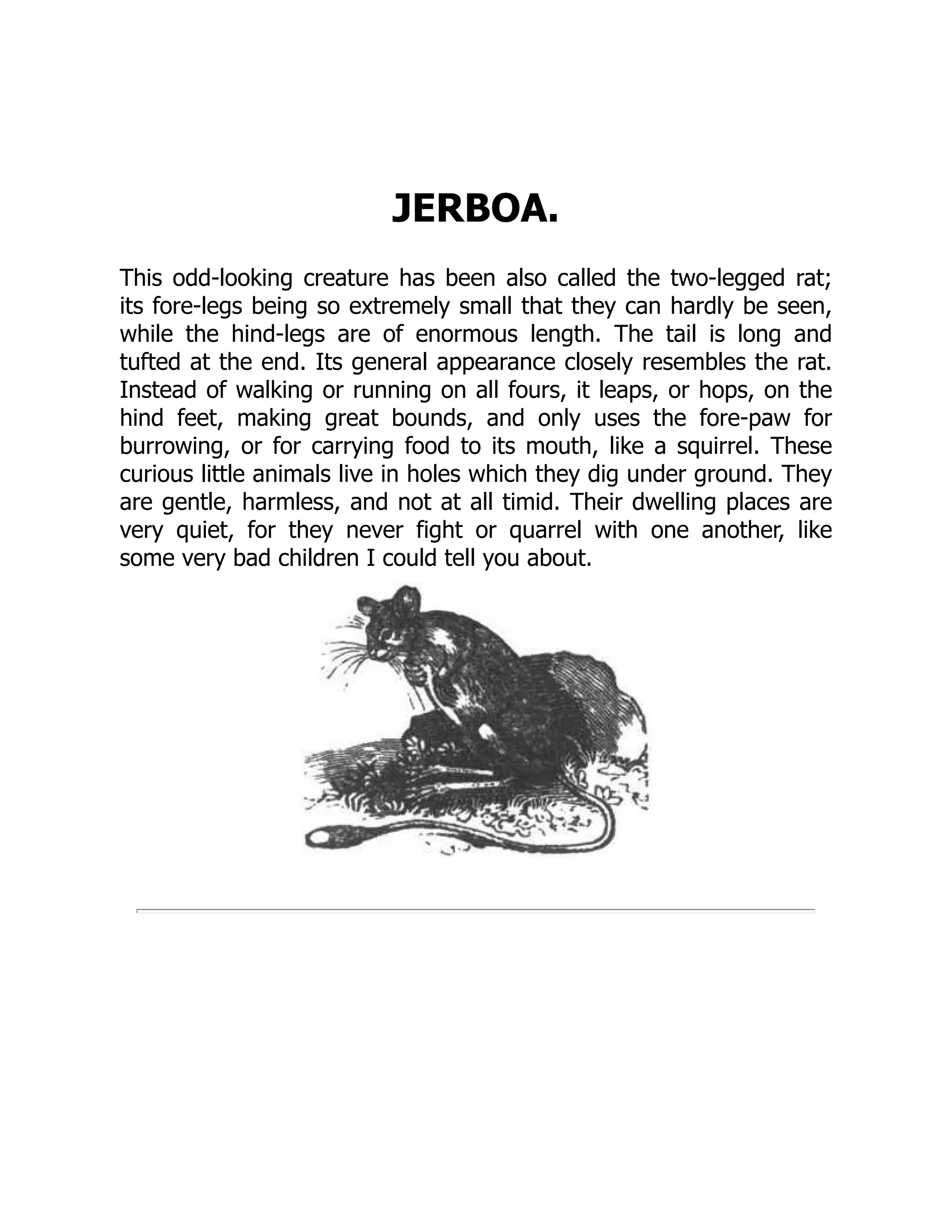
JERBOA.
This odd-looking creature has been also called the two-legged rat;
its fore-legs being so extremely small that they can hardly be seen,
while the hind-legs are of enormous length. The tail is long and
tufted at the end. Its general appearance closely resembles the rat.
Instead of walking or running on all fours, it leaps, or hops, on the
hind feet, making great bounds, and only uses the fore-paw for
burrowing, or for carrying food to its mouth, like a squirrel. These
curious little animals live in holes which they dig under ground. They
are gentle, harmless, and not at all timid. Their dwelling places are
very quiet, for they never fight or quarrel with one another, like
some very bad children I could tell you about.
KANGAROO.
This curious animal, called a Kangaroo, hops on his hind-legs, which
are very long; his fore-legs are short, and he has a very long hard
tail. Kangaroos herd together in great numbers, for they are very
timid creatures. At the least alarm they will run away, and leap over
high bushes. They use their short fore feet for digging, and putting
food in their mouths. They feed upon vegetables and grass, and do
not eat flesh. The mother carries her young ones about her in a sort
of pouch.
The kangaroo is brought from a very large island, a great many
thousand miles from here. We have some in this country, which you
may see by going to the Menagerie, where the keeper will tell you a
great many stories about them. Their nature is not at all fierce. The
picture below shows the manner in which the kangaroo leaps.
LEOPARD.
The leopard is a beautiful animal. He is of a yellowish fawn color,
marked with black spots of different sizes. This animal in its habits
and appearance much resembles a cat. He is very fierce and savage.
He preys upon those animals which are weaker than himself. He
always avoids man, except when closely pursued, when he offers an
obstinate resistance. From the extraordinary flexibility of his limbs,
he can climb a tree as readily as a cat. When taken young, he can
be tamed to a certain degree.
The flesh of the leopard is said to be excellent, resembling veal. The
skins are very valuable, and often sell for upwards of fifty dollars.
The picture below represents a leopard watching a herd of
antelopes. He is hid from their view behind a rock, and when they
come near enough, he will leap into the herd and catch one of them.
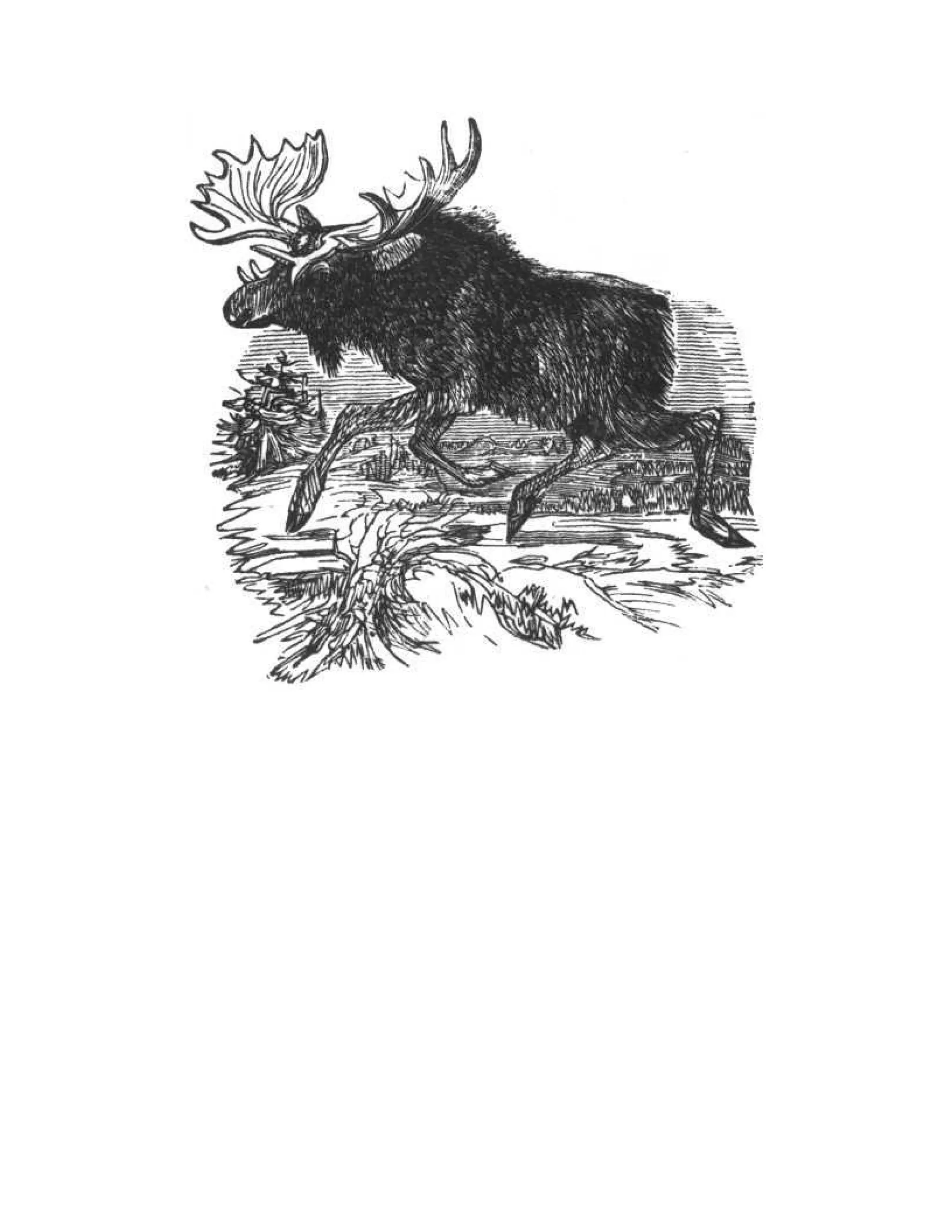
MOOSE.
This animal is perhaps the only kind of deer whose general
appearance can be called ungraceful. The head is large, the mane
short and thick, and the horns knotty and heavy. The body, which is
short and clumsy, is mounted on tall legs. The motion of the animal
is a sort of shambling trot. The moose inhabits the northern parts of
both Europe and America. Its flesh is much liked by the hunters, and
much resembles beef.
The moose attains to a large size, particularly the male, which
sometimes weighs eleven or twelve hundred pounds. Their skins,
when dressed properly, make a soft, thick, pliable leather, which is
useful for many purposes. Sometimes the moose is attacked by
wolves. Here you have a picture of an unfortunate moose, who is
assailed by a whole band of wolves. One is on his back, and has his
teeth in the poor moose's flesh.
NYL GHAU.
This animal is a kind of antelope, but is larger than the usual size of
the antelope, and not so handsome in form. It stands upwards of
four feet in height at the shoulder. It is a powerful and vicious
creature, and its temper is not good. When it is about to make an
attack, it drops down upon its fore-legs, and then darts quickly
forward and gives a blow with its head, which is very dangerous.
The hair of the nyl ghau is short and close, and is generally of a
slate color in the male, and a tawny red in the female, except in the
under parts of the body, which are always white. Its fore-legs are
longer than its hinder-legs, and it has the appearance of having a
small lump at its shoulder. It is usually found in the forests of India,
where it becomes the prey of the tigers and wild boars. The cut
below shows how the nyl ghau defends himself when attacked.
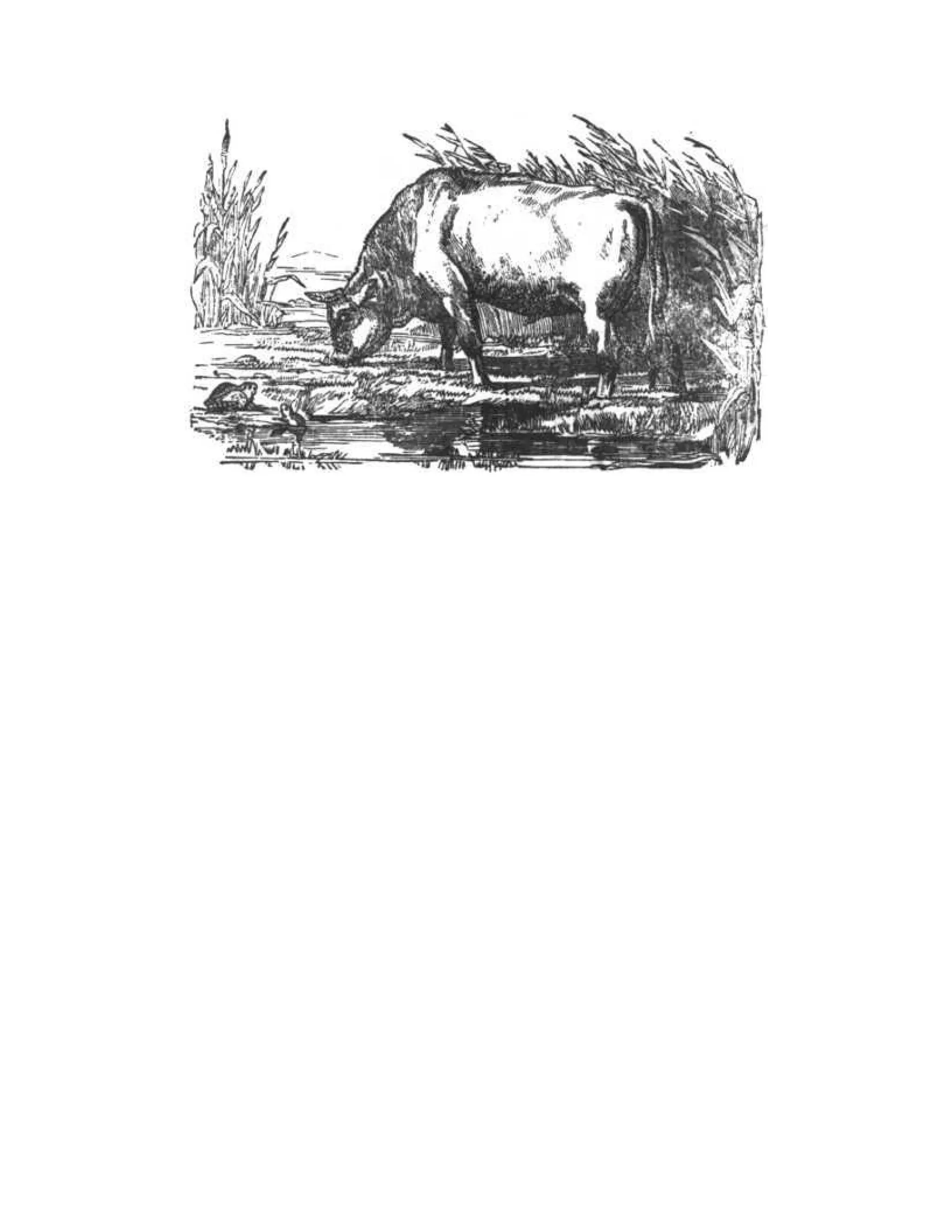
OX.
The ox is very much like the bull and the cow in form, size, and
color, and lives in the fields as they do. As soon as he is large
enough, he is made to work for man; he draws the plough and the
wagon, and in old times used to tread out the corn, instead of
thrashing as people do now. He is not so wild or fierce as the bull,
but its flesh and hide are as useful to us. The ox's foot is of a horny
substance, and is called a hoof, like that of the bull and the cow. It is
not like the horse's hoof, because it is separated in two. The horns of
the ox are made into combs, drinking cups, handles for knives, and
other things. The blood of the ox is very useful, and when boiled
with brown sugar it helps to make it white. The blood also makes a
blue dye. Boys should not tease an ox, or throw stones at him.
Sometimes they turn on their tormentors, and gore them with their
horns.
PORCUPINE.
This is an animal of whom the most ridiculous stories have been
told, particularly as to its power of darting its quills to a considerable
distance when attacked, and in this manner wounding its enemies.
Instead, however of being an enemy to be feared, there is not,
perhaps, a more timid creature in existence. But still, as a means of
defence, these quills are of great service to their possessor, and
preserve it from the attack of most of its enemies; its teeth are very
strong and sharp; and if it had courage enough to use them, it
would become rather a dangerous foe. When full grown, it measures
nearly two feet in length. Its general color is a grizzled, dusky black.
The upper part of the head and neck is furnished with long light
hairs. Most parts of the back and sides are armed with long, sharp
pointed quills, which are raised in a threatening manner whenever
the animal is excited. The porcupine sleeps during the day, and at
night searches for food. Below is a picture of an odd kind of
porcupine. It is called a Brazilian porcupine.
QUAGGA.
This animal is somewhat like the horse, but most like the zebra, as
you may see by comparing the two together. It is found in the
southern parts of Africa, living mostly in the plains in large herds. It
is not so large or so beautiful as the zebra. Its skin is of a dull
brownish white, striped with darker color on the head and neck, and
somewhat on the sides of its body; the upper parts of its legs are
greyish, and the under parts white. It is a wild creature, and rather
vicious in temper. It is made to draw by the natives of the country
where it is found, and its flesh is eaten by them.
The quagga differs from the zebra in his stripes. You may see by the
figure of the zebra, below, that he is striped all over his body and
limbs, while the quagga has stripes only on the head and the fore
part of the body.
RABBIT.
Rabbits are timid little animals, prettily formed, with beautiful long
ears. They run swiftly, and jump very nimbly. Wild rabbits live in
woods and burrow holes in banks of earth, where they hide
themselves from danger. The wild rabbits are of a greyish brown
color, but the tame rabbits are white, black, brown, black and white,
and reddish. The white have pink eyes. Their fur is soft, and is used
for making hats. Their flesh is white and very good to eat. The tame
rabbits are kept in very small huts, and little boys and girls are fond
of feeding them, for they will eat out of their hand, carrots, lettuce,
and other green vegetables. Below is a picture of a pretty kind of
tame rabbits with very long ears.
SHEEP.
The sheep is perhaps the most useful animal we have in our
country; the flesh, called mutton, is most wholesome food. The hair
of the skin, called wool, is made into cloth, flannel, and worsted. The
skin is made into parchment to write upon, and leather; and from
other parts of its body are made the strings for harps and violins,
&c. The finest wool is procured from the sheep which are bred in
Spain. The sheep is very timid and harmless, and lives as you often
may see in flocks, feeding on the grass of the fields and mountains.
The hills and mountains which are too steep and barren for growing
corn afford pasturage for the sheep. It very soon knows the
shepherd who is set over it, and is easily guided by him. The young
of the sheep are called lambs. Here is a picture of a Scotch shepherd
keeping sheep in the Highlands.
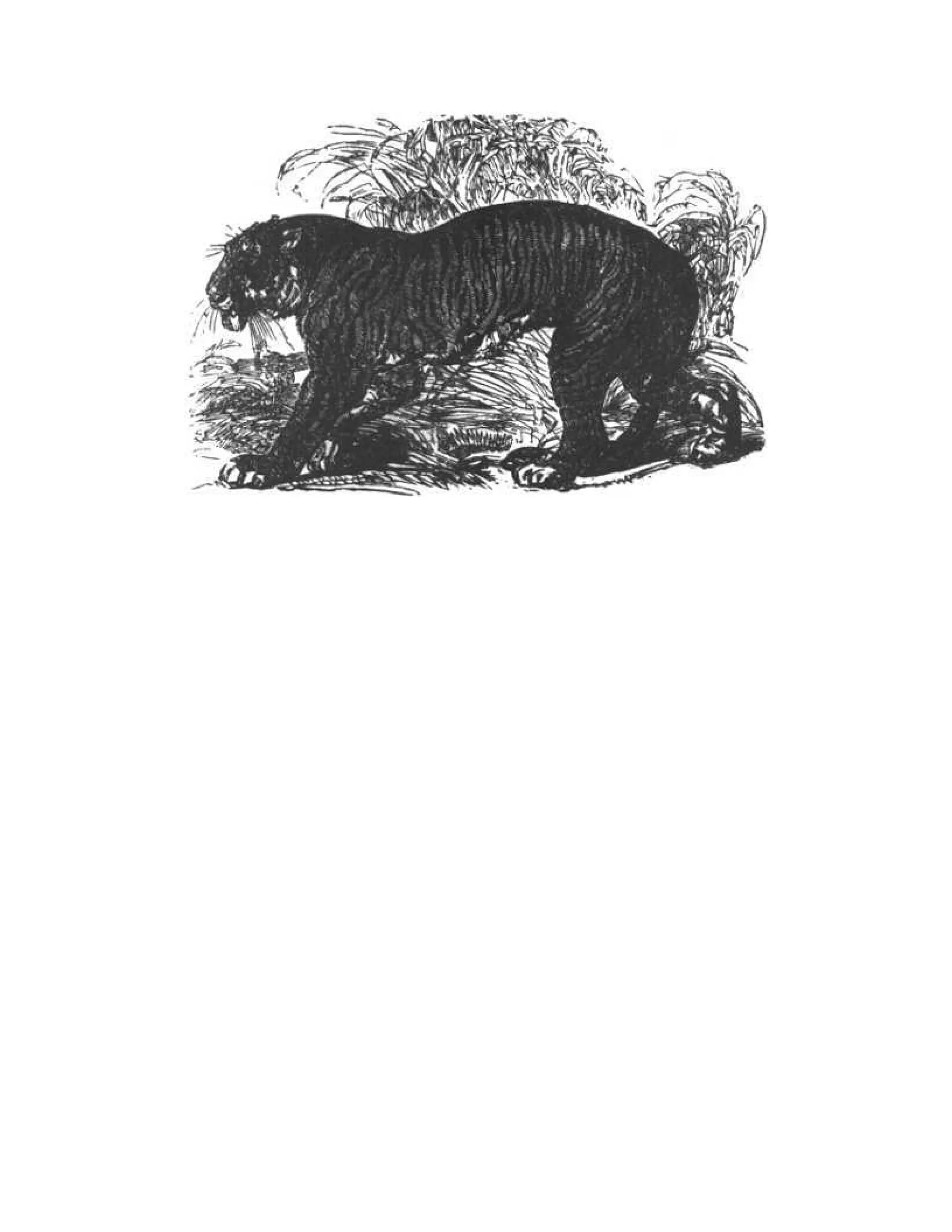
TIGER.
This very beautiful animal, is called a tiger, and is a native of India, a
very hot country in Asia. Tigers are very fierce, and will often kill
men, and animals a great deal larger than themselves. They live in
the woods and thickets, called jungles, where they are hunted.
Tigers eat the flesh of animals which they kill. We have none in
America, except a few carried about for show. The tiger is as big as
a lion, and like the cat in shape, but much larger; he has a long tail,
and a handsome striped skin, covered with short hair, which is used
for a variety of useful and ornamental purposes. He is very active
and can spring far. The tiger has sometimes been tamed by
menagerie keepers, but he is a very sly and dangerous creature, and
never to be trusted.
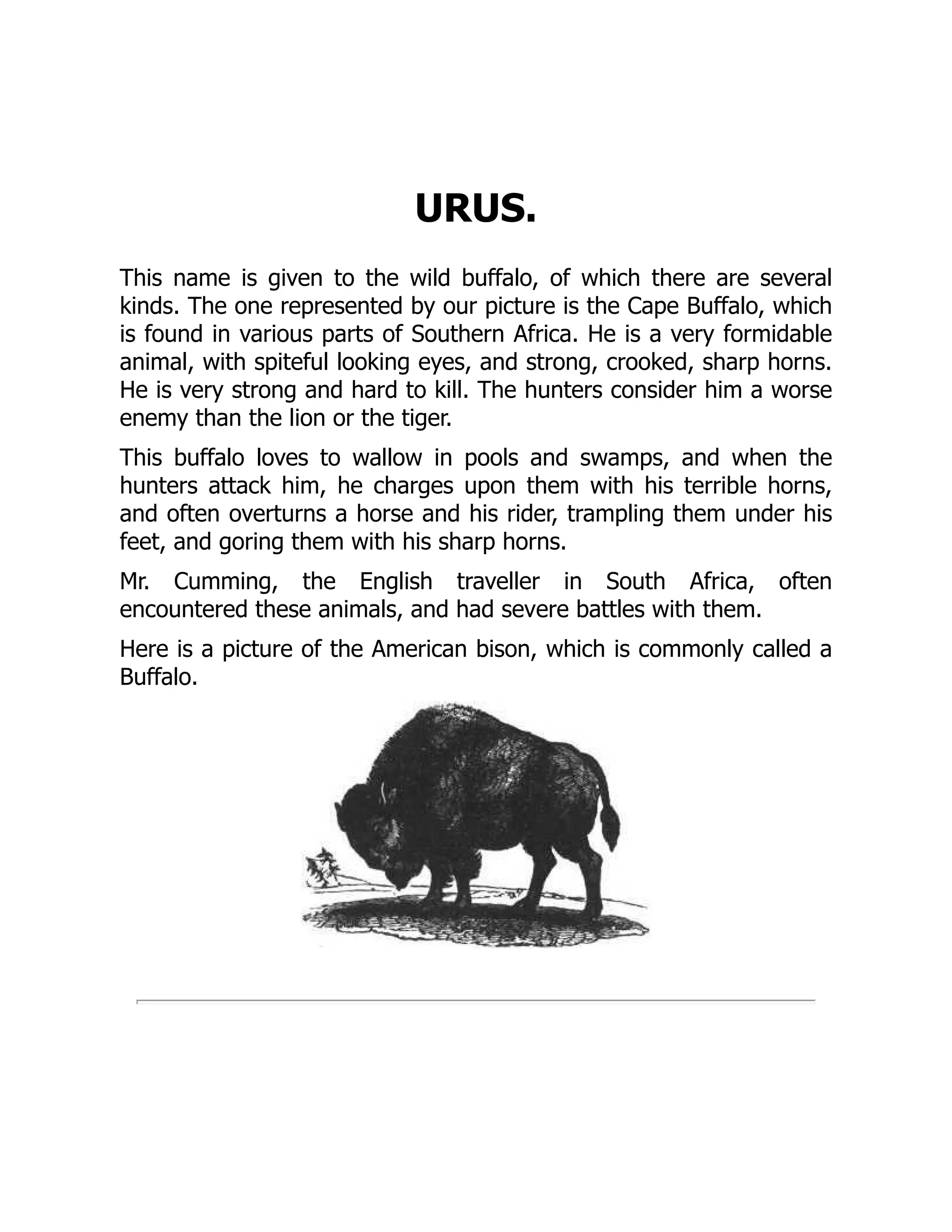
URUS.
This name is given to the wild buffalo, of which there are several
kinds. The one represented by our picture is the Cape Buffalo, which
is found in various parts of Southern Africa. He is a very formidable
animal, with spiteful looking eyes, and strong, crooked, sharp horns.
He is very strong and hard to kill. The hunters consider him a worse
enemy than the lion or the tiger.
This buffalo loves to wallow in pools and swamps, and when the
hunters attack him, he charges upon them with his terrible horns,
and often overturns a horse and his rider, trampling them under his
feet, and goring them with his sharp horns.
Mr. Cumming, the English traveller in South Africa, often
encountered these animals, and had severe battles with them.
Here is a picture of the American bison, which is commonly called a
Buffalo.
Welcome to our website – the perfect destination for book lovers and
knowledge seekers. We believe that every book holds a new world,
offering opportunities for learning, discovery, and personal growth.
That’s why we are dedicated to bringing you a diverse collection of
books, ranging from classic literature and specialized publications to
self-development guides and children's books.
More than just a book-buying platform, we strive to be a bridge
connecting you with timeless cultural and intellectual values. With an
elegant, user-friendly interface and a smart search system, you can
quickly find the books that best suit your interests. Additionally,
our special promotions and home delivery services help you save time
and fully enjoy the joy of reading.
Join us on a journey of knowledge exploration, passion nurturing, and
personal growth every day!
testbankfan.com
Organizational Behavior 17th Edition Robbins Solutions Manual

  • 1.
    Organizational Behavior 17thEdition Robbins Solutions Manual download https://testbankfan.com/product/organizational-behavior-17th- edition-robbins-solutions-manual/ Explore and download more test bank or solution manual at testbankfan.com
  • 2.
    We believe theseproducts will be a great fit for you. Click the link to download now, or visit testbankfan.com to discover even more! Organizational Behavior Global 17th Edition Robbins Solutions Manual https://testbankfan.com/product/organizational-behavior-global-17th- edition-robbins-solutions-manual/ Organizational Behavior 17th Edition Robbins Test Bank https://testbankfan.com/product/organizational-behavior-17th-edition- robbins-test-bank/ Organizational Behavior 18th Edition Robbins Solutions Manual https://testbankfan.com/product/organizational-behavior-18th-edition- robbins-solutions-manual/ Macroeconomics 3rd Edition Hubbard Test Bank https://testbankfan.com/product/macroeconomics-3rd-edition-hubbard- test-bank/
  • 3.
    Basic Building andConstruction Skills Australia 5th Edition Hawkins Solutions Manual https://testbankfan.com/product/basic-building-and-construction- skills-australia-5th-edition-hawkins-solutions-manual/ Introduction to Materials Management 8th Edition Chapman Solutions Manual https://testbankfan.com/product/introduction-to-materials- management-8th-edition-chapman-solutions-manual/ Labor Relations Development Structure Process 12th Edition Fossum Test Bank https://testbankfan.com/product/labor-relations-development-structure- process-12th-edition-fossum-test-bank/ Business Law with UCC Applications 13th Edition Brown Solutions Manual https://testbankfan.com/product/business-law-with-ucc- applications-13th-edition-brown-solutions-manual/ Elementary Algebra For College Students 9th Edition Angel Solutions Manual https://testbankfan.com/product/elementary-algebra-for-college- students-9th-edition-angel-solutions-manual/
  • 4.
    Understanding Nursing ResearchBuilding an Evidence Based Practice 5th Edition Burns Test Bank https://testbankfan.com/product/understanding-nursing-research- building-an-evidence-based-practice-5th-edition-burns-test-bank/
  • 5.
    Chapter 6 Perceptionand Individual Decision Making Page Copyright © 2017 Pearson Education, Inc. 174 CHAPTER6 Perception and Individual Decision Making LEARNING OBJECTIVES After studying this chapter, your students should be able to: 6-1. Explain the factors that influence perception. 6-2. Describe attribution theory. 6-3. Explain the link between perception and decision making. 6-4. Contrast the rational model of decision making with bounded rationality and intuition. 6-5. Explain how individual differences and organizational constraints affect decision making. 6-6. Contrast the three ethical decision criteria. 6-7. Describe the three-stage model of creativity. INSTRUCTOR RESOURCES Instructors may wish to use the following resources when presenting this chapter. Text Exercises • Career OBjectives: So What If I’m A Few Minutes Late to Work? • Myth or Science?: “All Stereotypes Are Negative” • An Ethical Choice: Choosing to Lie • Personal Inventory Assessments: How Creative Are You? • Point/Counterpoint: Stereotypes Are Dying • Questions for Review • Experiential Exercise: Good Liars and Bad Liars • Ethical Dilemma: Cheating Is A Decision Text Cases • Case Incident 1: Too Much Of A Good Thing • Case Incident 2: The Youngest Billionaire
  • 6.
    Chapter 6 Perceptionand Individual Decision Making Page Copyright © 2017 Pearson Education, Inc. 175 Instructor’s Choice This section presents an exercise that is NOT found in the student's textbook. Instructor's Choice reinforces the text's emphasis through various activities. Some Instructor's Choice activities are centered on debates, group exercises, Internet research, and student experiences. Some can be used in class in their entirety, while others require some additional work on the student's part. The course instructor may choose to use these at any time throughout the class—some may be more effective as icebreakers, while some may be used to pull together various concepts covered in the chapter. Web Exercises At the end of each chapter of this Instructor’s Manual, you will find suggested exercises and ideas for researching OB topics on the Internet. The exercises “Exploring OB Topics on the Web” are set up so that you can simply photocopy the pages, distribute them to your class, and make assignments accordingly. You may want to assign the exercises as an out-of-class activity or as lab activities with your class. Summary and Implications for Managers Individuals base their behavior not on the way their external environment actually is, but rather on the way they see it or believe it to be. An understanding of the way people make decisions can help us explain and predict behavior, but few important decisions are simple or unambiguous enough for the rational model’s assumptions to apply. We find individuals looking for solutions that satisfice rather than optimize, injecting biases and prejudices into the decision process, and relying on intuition. Managers should encourage creativity in employees and teams to create a route to innovative decision making. Specific implications for managers are below: • Behavior follows perception, so to influence behavior at work, assess how people perceive their work. Often behaviors we find puzzling can be explained by understanding the initiating perceptions. • Make better decisions by recognizing perceptual biases and decision-making errors we tend to commit. Learning about these problems doesn’t always prevent us from making mistakes, but it does help. • Adjust your decision-making approach to the national culture you’re operating in and to the criteria your organization values. If you’re in a country that doesn’t value rationality, don’t feel compelled to follow the rational decision-making model or to try to make your decisions appear rational. Adjust your decision approach to ensure compatibility with the organizational culture. • Combine rational analysis with intuition. These are not conflicting approaches to decision making. By using both, you can actually improve your decision making effectiveness. • Try to enhance your creativity. Actively look for novel solutions to problems, attempt to see problems in new ways, use analogies, and hire creative talent. Try to remove work and organizational barriers that might impede your creativity.
  • 7.
    Chapter 6 Perceptionand Individual Decision Making Page Copyright © 2017 Pearson Education, Inc. 176 This chapter begins with an introduction to Palmer Luckey, inventor of the Oculus Rift virtual reality headset. The case illustrates how important—and perhaps rare—an individual’s creativity can be to an industry. As we will see later in the chapter, the creativity of individuals can lead to breakthroughs in innovation. To better understand what influences us and our organizations, we start at the roots of our thought processes: our perceptions and the way they affect our decision making. BRIEF CHAPTER OUTLINE I. What Is Perception? A. Perception is a process by which individuals organize and interpret their sensory impressions in order to give meaning to their environment. B. Why is this important to the study of OB? 1. Because people’s behavior is based on their perception of what reality is, not on reality itself. II. Factors That Influence Perception (Exhibit 6-1) A. Factors that shape and can distort perception: 1. Perceiver 2. Target 3. Situation B. When an individual looks at a target and attempts to interpret what he or she sees, that interpretation is heavily influenced by personal characteristics of the individual perceiver. C. Characteristics of the target also affect what we perceive. D. Context matters too. III. Person Perception: Making Judgments about Others A. Attribution Theory (Exhibit 6-2) 1. Attribution theory suggests that when we observe an individual’s behavior, we attempt to determine whether it was internally or externally caused. That determination depends largely on three factors: a. Distinctiveness b. Consensus c. Consistency 2. Clarification of the differences between internal and external causation: a. Internally caused behaviors are those that are believed to be under the personal control of the individual. b. Externally caused behavior is what we imagine the situation forced the individual to do. 3. Three determining factors: a. Distinctiveness refers to whether an individual displays different behaviors in different situations. b. Consensus occurs if everyone who is faced with a similar situation responds in the same way. c. Consistency in a person’s actions. 4. Fundamental attribution error
  • 8.
    Chapter 6 Perceptionand Individual Decision Making Page Copyright © 2017 Pearson Education, Inc. 177 a. There is substantial evidence that we have a tendency to underestimate the influence of external factors and overestimate the influence of internal or personal factors. 5. Self-serving bias a. There is also a tendency for individuals to attribute their own successes to internal factors, such as ability or effort, while putting the blame for failure on external factors, such as luck. 6. Cultural differences a. The evidence on cultural differences in perception is mixed, but most suggest there are differences across cultures in the attributions people make. B. Common Shortcuts in Judging Others 1. The shortcuts for judging others often allow us to make accurate perceptions rapidly and provide valid data for making predictions. 2. However, they can and do sometimes result in significant distortions. 3. Selective perception a. Any characteristic that makes a person, object, or event stand out will increase the probability that it will be perceived. b. Since we can’t observe everything going on about us, we engage in selective perception. 4. Halo effect a. The halo effect occurs when we draw a general impression on the basis of a single characteristic. 5. Contrast effects a. We do not evaluate a person in isolation. Our reaction to one person is influenced by other persons we have recently encountered. b. Contrast effect can distort perception. i. For example, an interview situation in which one sees a pool of job applicants can distort perception. 6. Stereotyping a. Stereotyping—judging someone on the basis of our perception of the group to which he or she belongs. b. One problem of stereotypes is that they are widespread generalizations, though they may not contain a shred of truth when applied to a particular person or situation. C. Specific Applications of Shortcuts in Organizations 1. Employment interview a. Evidence indicates that interviewers make perceptual judgments that are often inaccurate. b. Interviewers generally draw early impressions that become very quickly entrenched. c. Studies indicate that most interviewers’ decisions change very little after the first four or five minutes of the interview. D. Performance Expectations 1. Evidence demonstrates that people will attempt to validate their perceptions of reality, even when those perceptions are faulty.
  • 9.
    Chapter 6 Perceptionand Individual Decision Making Page Copyright © 2017 Pearson Education, Inc. 178 2. Self-fulfilling prophecy, or the Pygmalion effect, characterizes the fact that people’s expectations determine their behavior. Expectations become reality. E. Performance Evaluation 1. An employee’s performance appraisal is very much dependent on the perceptual process. 2. Although the appraisal can be objective, many jobs are evaluated in subjective terms. 3. Subjective measures are problematic because of selective perception, contrast effects, halo effects, and so on. IV. The Link Between Perception and Individual Decision Making A. Individuals in organizations make decisions; they make choices from among two or more options. 1. A discrepancy between the current state of affairs and some desired state. B. Every decision requires interpretation and evaluation of information. C. The perceptions of the decision maker will address these two issues. V. Decision Making in Organizations A. The Rational Model, Bounded Rationality, and Intuition 1. Introduction a. In OB, there are generally accepted constructs of decision making that each of us employs to make determinations: rational decision making, bounded rationality, and intuition. b. There are times when one strategy may lead to a better outcome than another in a given situation. 2. Rational decision making a. We often think the best decision maker is rational and makes consistent, value-maximizing choices within specified constraints. b. These decisions follow a six-step rational decision making model listed in Exhibit 6-3 i. Step 1: Define the problem. ii. Step 2: Identify the decision criteria. iii. Step 3: Allocate weights to the criteria. iv. Step 4: Develop the alternatives. v. Step 5: Evaluate the alternatives. vi. Step 6: Select the best alternative. c. The rational decision-making model assumes that the decision maker has complete information, is able to identify all the relevant options in an unbiased manner, and chooses the option with the highest utility. d. Most decisions in the real world don’t follow the rational model. B. Bounded Rationality 1. When faced with a complex problem, most people respond by reducing the problem to a level at which it can be readily understood. a. People satisfice—they seek solutions that are satisfactory and sufficient. 2. Individuals operate within the confines of bounded rationality. They construct simplified models that extract the essential features. 3. How does bounded rationality work? a. Once a problem is identified, the search for criteria and options begins.
  • 10.
    Chapter 6 Perceptionand Individual Decision Making Page Copyright © 2017 Pearson Education, Inc. 179 b. The decision maker will identify a limited list made up of the more conspicuous choices, which are easy to find and tend to be highly visible, and they will represent familiar criteria and previously tried-and-true solutions. c. Once this limited set of options is identified, the decision maker will begin reviewing it until we identify one that is “good enough” – that meets an acceptable level of performance. i. Thus ends our search. Therefore, the solution represents a satisficing choice—the first acceptable one we encounter—rather than an optimal one. d. To use the rational model in the real world, you need to gather a great deal of information about all the options, compute applicable weights, and then calculate values across a huge number of criteria. C. Intuition 1. Perhaps the least rational way of making decisions is intuitive decision making, an unconscious process created from distilled experience. 2. It occurs outside conscious thought; it relies on holistic associations, or links between disparate pieces of information; is fast; and is affectively charged, meaning it usually engages the emotions. 3. While intuition isn’t rational, it isn’t necessarily wrong. 4. Nor does it always contradict rational analysis; rather, the two can complement each other. 5. The key is to neither abandon nor rely solely on intuition, but to supplement it with evidence and good judgment. VI. Common Biases and Errors in Decision Making A. Introduction (Exhibit 6-4) 1. Decision makers allow systematic biases and errors to creep into their judgments. 2. People tend to rely on experience, impulses, gut feelings, and rules of thumb. These can lead to distortions. B. Overconfidence Bias 1. Individuals whose intellectual and interpersonal abilities are weakest are most likely to overestimate their performance and ability. 2. The tendency to be too confident about their ideas might keep some from planning how to avoid problems that arise. 3. Investor overconfidence operates in a variety of ways. a. People think they know more than they do, and it costs them. b. Investors, especially novices, overestimate not just their own skill in processing information, but also the quality of the information they’re working with. C. Anchoring Bias 1. Anchoring bias involves fixating on initial information as a starting point and failing to adequately adjust for subsequent information. 2. Anchors are widely used by people in advertising, management, politics, real estate, and lawyers – where persuasion skills are important. 3. Any time a negotiation takes place, so does anchoring.
  • 11.
    Chapter 6 Perceptionand Individual Decision Making Page Copyright © 2017 Pearson Education, Inc. 180 D. Confirmation Bias 1. Confirmation bias is a type of selective perception: we seek out information that reaffirms past choices, and discount information that contradicts past judgments. E. Availability Bias 1. Availability bias is the tendency for people to base judgments on information that is readily available. F. Escalation of Commitment 1. Escalation of commitment occurs when we stay with a decision even when there is clear evidence that it’s wrong. 2. When is escalation most likely to occur? a. Evidence indicates it occurs when individuals view themselves as responsible for the outcome. G. Randomness Error 1. Decision making becomes impaired when we try to create meaning out of random events. 2. Our tendency to believe we can predict the outcome of random events is the randomness error. H. Risk Aversion 1. The tendency to prefer a sure thing instead of a risky outcome is risk aversion. 2. Risk aversion has important implications. a. Risk-averse employees will stick with the established way of doing their jobs, rather than taking a chance on innovative methods. b. Ambitious people with power that can be taken away (most managers) appear to be especially risk averse, perhaps because they don’t want to lose on a gamble everything they’ve worked so hard to achieve. 3. People will more likely engage in risk-seeking behavior for negative outcomes, and risk-averse behavior for positive outcomes, when under stress. I. Hindsight Bias a. Hindsight bias is the tendency to believe, falsely, that one has accurately predicted the outcome of an event, after that outcome is actually known. b. The hindsight bias reduces our ability to learn from the past. VII. Influences on Decision Making: Individual Differences and Organizational Constraints A. Individual Differences 1. Personality influences our decisions. a. Specific facets of conscientiousness—rather than the broad trait itself— may affect escalation of commitment. i Achievement-striving ii Dutifulness b. People with high self-esteem are strongly motivated to maintain it, so they use the self-serving bias to preserve it. 2. Gender a. Rumination refers to reflecting at length. In decision making, it means over-thinking about problems.
  • 12.
    Chapter 6 Perceptionand Individual Decision Making Page Copyright © 2017 Pearson Education, Inc. 181 b. Evidence indicates that women analyze decisions more than men. 3. Mental ability a. We know people with higher levels of mental ability are able to process information more quickly, solve problems more accurately, and learn faster, so you might expect them also to be less susceptible to common decision errors. 4. Cultural differences a. The rational model makes no acknowledgment of cultural differences, nor does the bulk of OB research literature on decision making. b. We need to recognize that the cultural background of a decision maker can significantly influence the selection of problems, the depth of analysis, the importance placed on logic and rationality, and whether organizational decisions should be made autocratically by an individual manager or collectively in groups. c. Cultures differ in their time orientation, the importance of rationality, their belief in the ability of people to solve problems, and their preference for collective decision making. d. While rationality is valued in North America, that’s not true elsewhere in the world. e. Some cultures emphasize solving problems, while others focus on accepting situations as they are. f. Because problem-solving managers believe they can and should change situations to their benefit, U.S. managers might identify a problem long before their Thai or Indonesian counterparts would choose to recognize it. g. Decision making by Japanese managers is much more group-oriented than in the United States. 5. Nudging a. Commercials are one of the most outright forms of an organization’s attempt to influence our perceptions of a product and our decision to acquire that product. b. Nudging has also been used positively in the development of corporate social responsibility (CSR) initiatives to change people’s expectations for organizations. c. People differ in their susceptibility to suggestion, but it is probably fair to say we are all receptive to nudging to some degree. B. Organizational Constraints 1. Introduction a. The organization itself constrains decision makers, creating deviations from the rational model. 2. Performance evaluation systems a. Managers are strongly influenced in their decision making by the criteria by which they are evaluated. 3. Reward systems a. The organization’s reward system influences decision makers by suggesting to them what choices are preferable in terms of personal payoff.
  • 13.
    Chapter 6 Perceptionand Individual Decision Making Page Copyright © 2017 Pearson Education, Inc. 182 4. Formal regulations a. Organizations create rules, policies, procedures, and other formalized regulations to standardize the behavior of their members. 5. System-imposed time constraints a. Organizations impose deadlines on decisions. b. Such conditions often make it difficult, if not impossible, for managers to gather all the information before making a final choice. 6. Historical precedents a. Decisions have a context. Individual decisions are more accurately characterized as points in a stream of decisions. b. Decisions made in the past are ghosts that continually haunt current choices. It is common knowledge that the largest determining factor of the size of any given year’s budget is last year’s budget. VIII. What about Ethics in Decision Making? A. Introduction 1. Ethical considerations should be an important criterion in organizational decision making. B. Three Ethical Decision Criteria 1. Utilitarianism—decisions are made solely on the basis of their outcomes or consequences. 2. Focus on rights—calls on individuals to make decisions consistent with fundamental liberties and privileges as set forth in documents such as the Bill of Rights. a. This criterion protects whistleblowers when they reveal an organization’s unethical practices to the press or government agencies, using their right to free speech. 3. A third criterion is to impose and enforce rules fairly and impartially to ensure justice or an equitable distribution of benefits and costs. a. Union members typically favor this view. 4. Each criterion has advantages and liabilities. a. A focus on utilitarianism promotes efficiency and productivity, but it can sideline the rights of some individuals, particularly those with minority representation. b. The use of rights protects individuals from injury and is consistent with freedom and privacy, but it can create a legalistic environment that hinders productivity and efficiency. c. A focus on justice protects the interests of the underrepresented and less powerful, but it can encourage a sense of entitlement that reduces risk taking, innovation, and productivity. 5. Increasingly, researchers are turning to behavioral ethics – an area of study that analyzes how people actually behave when confronted with ethical dilemmas. a. Their research tells us that while ethical standards exist collectively (society and organizations) and individually (personal ethics), individuals do not always follow ethical standards promulgated by their organizations, and we sometimes violate our own standards.
  • 14.
    Chapter 6 Perceptionand Individual Decision Making Page Copyright © 2017 Pearson Education, Inc. 183 6. How might we increase ethical decision making in organizations? a. First, sociologist James Q. Wilson promulgated the broken windows theory—the idea that decayed and disorderly urban environments may facilitate criminal behavior because they signal antisocial norms. b. Second, managers should encourage conversations about moral issues; they may serve as a reminder and increase ethical decision making. c. Finally, we should be aware of our own moral “blind spots”—the tendency to see ourselves as more moral than we are, and others as less moral than they are. 7. Behavioral ethics research stresses the importance of culture to ethical decision making. a. There are few global ethical standards, as contrasts between Asia and the West illustrate. b. What is ethical in one culture may be unethical in another. c. Without sensitivity to cultural differences in defining ethical conduct, organizations may encourage unethical conduct without even knowing it. 8. Lying a. Lying is one of the top unethical activities we may indulge in daily, and it undermines all efforts toward sound decision making. b. Lying is deadly to decision making, whether we sense the lies or not. i. Managers—and organizations—simply cannot make good decisions when facts are misrepresented and people give false motives for their behaviors. c. Lying is a big ethical problem as well. IX. Creativity, Creative Decision Making, and Innovation in Organizations A. Introduction 1. Definition: Creativity is the ability to produce novel and useful ideas. These are ideas that are different from what has been done before, but that are also appropriate to the problem. 2. The three-stage model of creativity shown in Exhibit 6-5 suggests that creativity involves causes (creative potential and creative environment), creative behavior, and creative outcomes (innovation). B. Creative Behavior 1. Creative behavior occurs in four steps, each of which leads to the next: a. Problem formulation: any act of creativity begins with a problem that the behavior is designed to solve. i. Problem formulation: the stage of creative behavior in which we identify a problem or opportunity that requires a solution as yet unknown. b. Information gathering: given a problem, the solution is rarely directly at hand. We need time to learn more and to process that learning. i. Information gathering: the stage of creative behavior when possible solutions to a problem incubate in an individual’s mind. c. Idea generation: once we have collected the relevant information, it is time to translate that knowledge into ideas.
  • 15.
    Visit https://testbankbell.com now toexplore a rich collection of testbank, solution manual and enjoy exciting offers!
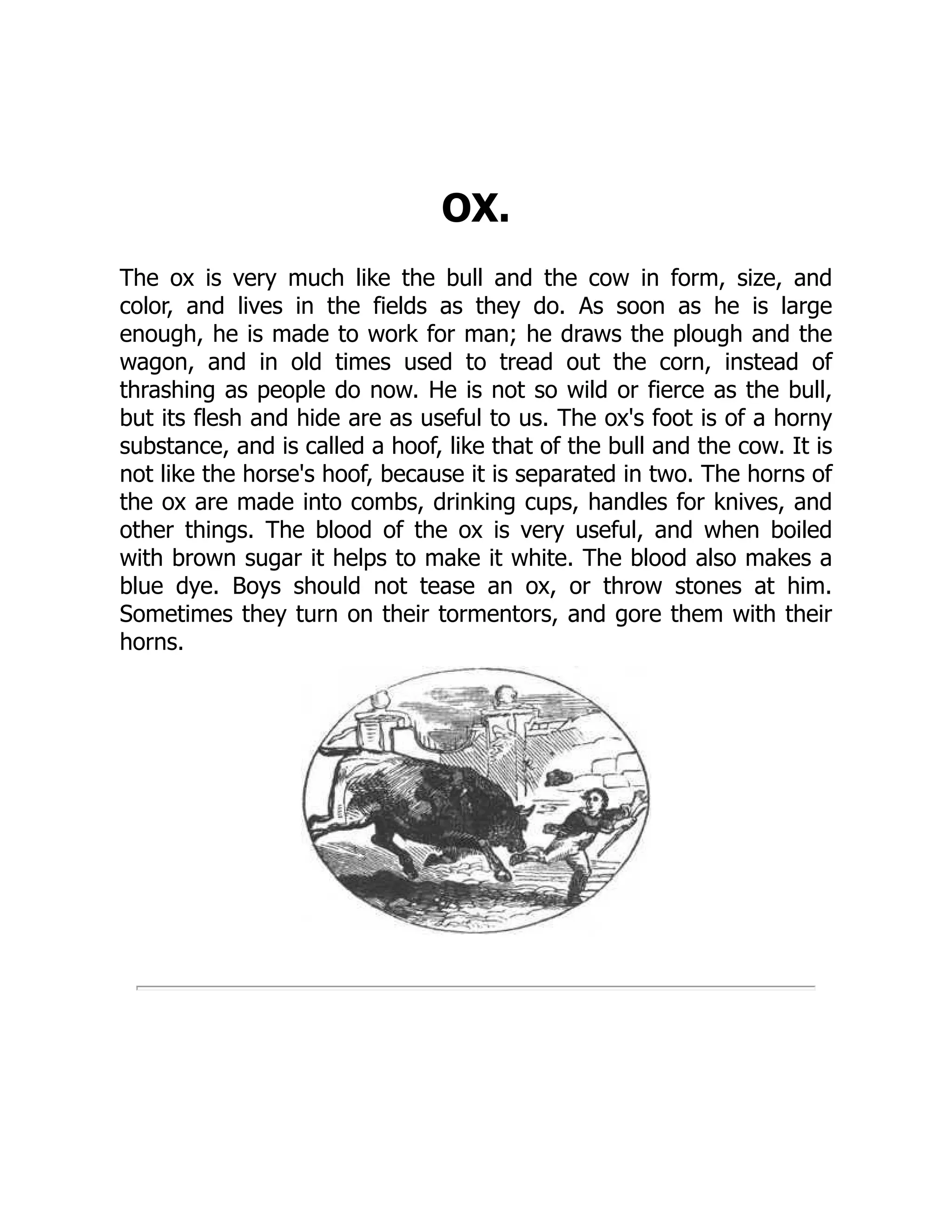
  • 16.
    Chapter 6 Perceptionand Individual Decision Making Page Copyright © 2017 Pearson Education, Inc. 184 i. Idea generation: the process of creative behavior in which we develop possible solutions to a problem from relevant information and knowledge. d. Idea evaluation: finally, it’s time to choose from the ideas we have generated. i. Idea evaluation: the process of creative behavior in which we evaluate potential solutions to identify the best one. C. Causes of Creative Behavior 1. Creative potential 2. Is there such a thing as a creative personality? a. Indeed. Most people have some of the characteristics shared by exceptionally creative people. The more of these characteristics we have, the higher our creative potential. 3. The potential for creativity is enhanced when individuals have abilities, knowledge, proficiencies, and similar expertise to their field of endeavor. 4. Creative environment 5. What environmental factors affect whether creative potential translates into creative behaviors? a. First, and perhaps most important, is motivation. If you aren’t motivated to be creative, it is unlikely you will be. b. It is also valuable to work in an environment that rewards and recognizes creative work. c. A recent nation-level study suggests that countries scoring high on Hofstede’s culture dimension of individuality are more creative. d. Good leadership matters to creativity too. e. Studies show that diverse teams can be more creative, but only under certain conditions. 6. Creative outcomes (Innovation) 7. We can define creative outcomes as ideas or solutions judged to be novel and useful by relevant stakeholders. a. Novelty itself does not generate a creative outcome if it isn’t useful. Thus, “off-the-wall” solutions are creative only if they help solve the problem. b. Softs skills help translate ideas into results. X. Summary and Implications for Managers A. Individuals base their behavior not on the way their external environment actually is, but rather on the way they see it or believe it to be. B. An understanding of the way people make decisions can help us explain and predict behavior, but few important decisions are simple or unambiguous enough for the rational model’s assumptions to apply. C. We find individuals looking for solutions that satisfice rather than optimize, injecting biases and prejudices into the decision process, and relying on intuition. D. Managers should encourage creativity in employees and teams to create a route to innovative decision making. E. Specific implications for managers are below:
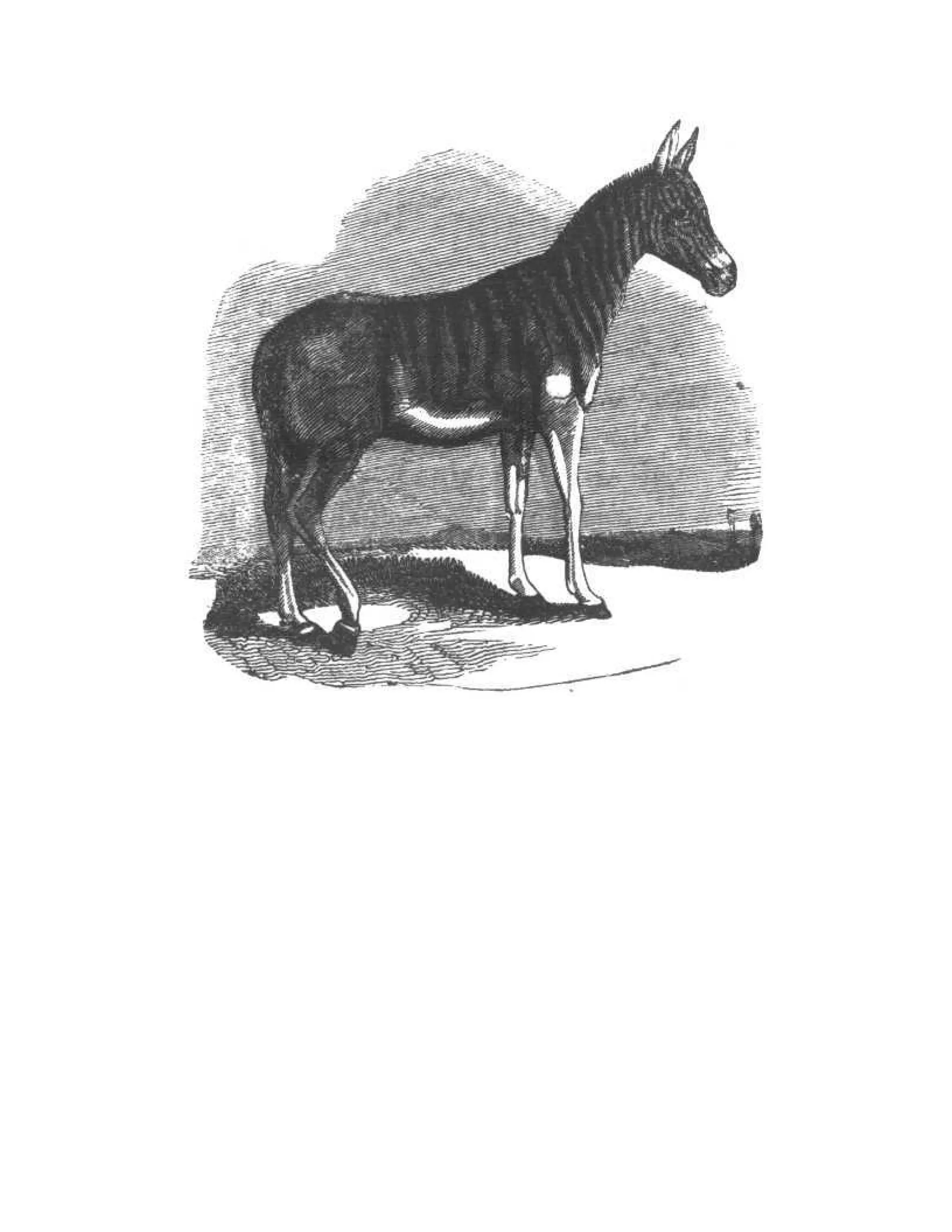
  • 17.
    Chapter 6 Perceptionand Individual Decision Making Page Copyright © 2017 Pearson Education, Inc. 185 1. Behavior follows perception, so to influence behavior at work, assess how people perceive their work. Often behaviors we find puzzling can be explained by understanding the initiating perceptions. 2. Make better decisions by recognizing perceptual biases and decision-making errors we tend to commit. Learning about these problems doesn’t always prevent us from making mistakes, but it does help. 3. Adjust your decision making approach to the national culture you’re operating in and to the criteria your organization values. If you’re in a country that doesn’t value rationality, you don’t feel compelled to follow the rational decision making model or to try to make your decisions appear rational. Adjust your decision approach to ensure compatibility with the organizational culture. 4. Combine rational analysis with intuition. These are not conflicting approaches to decision making. By using both, you can actually improve your decision making effectiveness. 5. Try to enhance your creativity. Actively look for novel solutions to problems, attempt to see problems in new ways, use analogies, and hire creative talent. Try to remove work and organizational barriers that might impede your creativity. EXPANDED CHAPTER OUTLINE I. What Is Perception? A. Perception is a process by which individuals organize and interpret their sensory impressions in order to give meaning to their environment. B. Why is this important to the study of OB? 1. Because people’s behavior is based on their perception of what reality is, not on reality itself. II. Factors That Influence Perception (Exhibit 6-1) A. Factors that shape and can distort perception: 1. Perceiver 2. Target 3. Situation B. Perceiver: When an individual looks at a target and attempts to interpret what he or she sees, that interpretation is heavily influenced by personal characteristics of the individual perceiver. C. The more relevant personal characteristics affecting perception of the perceiver are attitudes, motives, interests, past experiences, and expectations. D. Target: Characteristics of the target can also affect what is being perceived. This would include attractiveness, gregariousness, and our tendency to group similar things together. For example, members of a group with clearly distinguishable features or color are often perceived as alike in other, unrelated characteristics as well. E. Context: The context in which we see objects or events also influences our attention. This could include time, heat, light, or other situational factors. III. Person Perception: Making Judgments about Others
  • 18.
    Chapter 6 Perceptionand Individual Decision Making Page Copyright © 2017 Pearson Education, Inc. 186 A. Attribution Theory (Exhibit 6-2) 1. Our perceptions of people differ from our perceptions of inanimate objects. 2. Our perception and judgment of a person’s actions are influenced by these assumptions. 3. Attribution theory suggests that when we observe an individual’s behavior, we attempt to determine whether it was internally or externally caused. That determination depends largely on three factors: a. Distinctiveness b. Consensus c. Consistency 4. Clarification of the differences between internal and external causation: a. Internally caused behaviors are those that are believed to be under the personal control of the individual. b. Externally caused behavior is what we imagine the situation forced the individual to do. 5. Three determining factors a. Distinctiveness refers to whether an individual displays different behaviors in different situations. What we want to know is whether the observed behavior is unusual. b. If it is, the observer is likely to give the behavior an external attribution. c. If this action is not unusual, it will probably be judged as internal. d. Consensus occurs if everyone who is faced with a similar situation responds in the same way. If consensus is high, you would be expected to give an external attribution to the employee’s tardiness, whereas if other employees who took the same route made it to work on time, your conclusion as to causation would be internal. e. Consistency in a person’s actions. Does the person respond the same way over time? The more consistent the behavior, the more the observer is inclined to attribute it to internal causes. 6. Fundamental attribution error a. There is substantial evidence that we have a tendency to underestimate the influence of external factors and overestimate the influence of internal or personal factors. 7. Self-serving bias a. There is also a tendency for individuals to attribute their own successes to internal factors, such as ability or effort, while putting the blame for failure on external factors, such as luck. This is called the “self-serving bias” and suggests that recipients will distort feedback provided to employees. 8. Cultural differences a. The evidence on cultural differences in perception is mixed, but most suggest there are differences across cultures in the attributions people make. i. One study found Asian managers less likely to use the self-serving bias.
  • 19.
    Chapter 6 Perceptionand Individual Decision Making Page Copyright © 2017 Pearson Education, Inc. 187 ii. On the other hand, Asian managers are more likely to blame institutions or whole organizations. iii. This tendency to make group-based attributions also explains why individuals from Asian cultures are more likely to make group-based stereotypes. b. Differences in attribution tendencies don’t mean the basic concepts of attribution and blame completely differ across cultures, though. i. Self-serving biases may be less common in East Asian cultures, but evidence suggests they still operate across cultures. ii. Studies indicate Chinese managers assess blame for mistakes using the same distinctiveness, consensus, and consistency cues Western managers use. i They also become angry and punish those deemed responsible for failure, a reaction shown in many studies of Western managers. B. Common Shortcuts in Judging Others 1. Introduction a. We use a number of shortcuts when we judge others. An understanding of these shortcuts can be helpful toward recognizing when they can result in significant distortions. 2. Selective perception a. Any characteristic that makes a person, object, or event stand out will increase the probability that it will be perceived. b. Since we can’t observe everything going on about us, we engage in selective perception. 3. Halo effect a. The halo effect occurs when we draw a general impression on the basis of a single characteristic. 4. Contrast effects a. We do not evaluate a person in isolation. Our reaction to one person is influenced by other persons we have recently encountered. b. Contrast effect can distort perception. c. For example, an interview situation in which one sees a pool of job applicants can distort perception. Distortions in any given candidate’s evaluation can occur as a result of his or her place in the interview schedule. 5. Stereotyping a. Stereotyping—judging someone on the basis of our perception of the group to which he or she belongs. b. Generalization is not without advantages. It is a means of simplifying a complex world, and it permits us to maintain consistency. The problem, of course, is when we inaccurately stereotype. c. One problem of stereotypes is that they are widespread generalizations, though they may not contain a shred of truth when applied to a particular person or situation. i. We have to monitor ourselves to make sure we’re not unfairly applying a stereotype in our evaluations and decisions.
  • 20.
    Chapter 6 Perceptionand Individual Decision Making Page Copyright © 2017 Pearson Education, Inc. 188 C. Specific Applications of Shortcuts in Organizations 1. Employment interview a. Evidence indicates that interviewers make perceptual judgments that are often inaccurate. b. Interviewers generally draw early impressions that become very quickly entrenched. c. Studies indicate that most interviewers’ decisions change very little after the first four or five minutes of the interview. d. Recent research indicates that our individual intuition about a job candidate is not reliable in predicting job performance, but that collecting input from multiple independent evaluations can be predictive. 2. Performance expectations a. Evidence demonstrates that people will attempt to validate their perceptions of reality, even when those perceptions are faulty. b. Self-fulfilling prophecy, or the Pygmalion effect, characterizes the fact that people’s expectations determine their behavior. Expectations become reality. 3. Performance evaluation a. An employee’s performance appraisal is very much dependent on the perceptual process. b. Although the appraisal can be objective, many jobs are evaluated in subjective terms. c. Subjective measures are problematic because of selective perception, contrast effects, and so on. IV. The Link Between Perception and Individual Decision Making A. Individuals in organizations make decisions; they make choices from among two or more options. B. Decision making occurs as a reaction to a problem. 1. There is a discrepancy between some current state of affairs and some desired state, requiring consideration of alternative courses of action. 2. One person’s problem is another’s satisfactory state of affairs. C. Every decision requires interpretation and evaluation of information. The perceptions of the decision maker will address these two issues: 1. Data are typically received from multiple sources. 2. Which data are relevant to the decision and which are not? V. Decision Making in Organizations A. The Rational Model, Bounded Rationality, and Intuition 1. Introduction a. In OB, there are generally accepted constructs of decision making each of us employs to make determinations: rational decision making, bounded rationality, and intuition. b. There are times when one strategy may lead to a better outcome than another in a given situation. 2. Rational decision making a. We often think the best decision maker is rational and makes consistent, value-maximizing choices within specified constraints.
  • 21.
    Other documents randomlyhave different content
  • 22.
    HYENA. The hyena isone of the most fierce and disagreeable of all animals. The hyena is by nature a nocturnal animal; that is, it seeks its prey by night, and consequently during the day it remains in a state of repose. The hyena has been unfairly represented to be perfectly untameable on account of its great ferocity. If properly treated, however, and well fed, it is far from being savage or dangerous. It possesses a great propensity for putrid and buried carcasses, which it will hunt, and dig for, and devour with disgusting greediness. Unlike many other animals, the hyena is an unsociable animal, for it lives a solitary life among rocks and ancient ruins. There are two kinds of hyenas, the spotted and the striped. The figure below represents the striped, and the other represents the spotted hyena.
  • 24.
    IBEX. The ibex isan animal of the goat kind, and inhabits the mountainous districts of the south of Europe, it is the most graceful of all its tribes; it is extremely active. It is very wild, and difficult to be shot, as it always keeps on the highest points. The horns of the ibex are large and knotty, its skin is of a yellow color, and its beard short and black. The chase of the ibex, although it is not a very powerful animal, is attended, at times, with considerable danger; it has been known, when driven hard, to run full-but at the huntsman, and force him over the rock, although in doing so, it has at the same time, sacrificed its own life, falling headlong with its pursuer. The ibex is said to be a short-lived animal. Its flesh is much esteemed, and its skin is very thin. Below is a picture of a bear pursuing a male and female ibex.
  • 26.
    JERBOA. This odd-looking creaturehas been also called the two-legged rat; its fore-legs being so extremely small that they can hardly be seen, while the hind-legs are of enormous length. The tail is long and tufted at the end. Its general appearance closely resembles the rat. Instead of walking or running on all fours, it leaps, or hops, on the hind feet, making great bounds, and only uses the fore-paw for burrowing, or for carrying food to its mouth, like a squirrel. These curious little animals live in holes which they dig under ground. They are gentle, harmless, and not at all timid. Their dwelling places are very quiet, for they never fight or quarrel with one another, like some very bad children I could tell you about.
  • 28.
    KANGAROO. This curious animal,called a Kangaroo, hops on his hind-legs, which are very long; his fore-legs are short, and he has a very long hard tail. Kangaroos herd together in great numbers, for they are very timid creatures. At the least alarm they will run away, and leap over high bushes. They use their short fore feet for digging, and putting food in their mouths. They feed upon vegetables and grass, and do not eat flesh. The mother carries her young ones about her in a sort of pouch. The kangaroo is brought from a very large island, a great many thousand miles from here. We have some in this country, which you may see by going to the Menagerie, where the keeper will tell you a great many stories about them. Their nature is not at all fierce. The picture below shows the manner in which the kangaroo leaps.
  • 30.
    LEOPARD. The leopard isa beautiful animal. He is of a yellowish fawn color, marked with black spots of different sizes. This animal in its habits and appearance much resembles a cat. He is very fierce and savage. He preys upon those animals which are weaker than himself. He always avoids man, except when closely pursued, when he offers an obstinate resistance. From the extraordinary flexibility of his limbs, he can climb a tree as readily as a cat. When taken young, he can be tamed to a certain degree. The flesh of the leopard is said to be excellent, resembling veal. The skins are very valuable, and often sell for upwards of fifty dollars. The picture below represents a leopard watching a herd of antelopes. He is hid from their view behind a rock, and when they come near enough, he will leap into the herd and catch one of them.
  • 32.
    MOOSE. This animal isperhaps the only kind of deer whose general appearance can be called ungraceful. The head is large, the mane short and thick, and the horns knotty and heavy. The body, which is short and clumsy, is mounted on tall legs. The motion of the animal is a sort of shambling trot. The moose inhabits the northern parts of both Europe and America. Its flesh is much liked by the hunters, and much resembles beef. The moose attains to a large size, particularly the male, which sometimes weighs eleven or twelve hundred pounds. Their skins, when dressed properly, make a soft, thick, pliable leather, which is useful for many purposes. Sometimes the moose is attacked by wolves. Here you have a picture of an unfortunate moose, who is assailed by a whole band of wolves. One is on his back, and has his teeth in the poor moose's flesh.
  • 34.
    NYL GHAU. This animalis a kind of antelope, but is larger than the usual size of the antelope, and not so handsome in form. It stands upwards of four feet in height at the shoulder. It is a powerful and vicious creature, and its temper is not good. When it is about to make an attack, it drops down upon its fore-legs, and then darts quickly forward and gives a blow with its head, which is very dangerous. The hair of the nyl ghau is short and close, and is generally of a slate color in the male, and a tawny red in the female, except in the under parts of the body, which are always white. Its fore-legs are longer than its hinder-legs, and it has the appearance of having a small lump at its shoulder. It is usually found in the forests of India, where it becomes the prey of the tigers and wild boars. The cut below shows how the nyl ghau defends himself when attacked.
  • 36.
    OX. The ox isvery much like the bull and the cow in form, size, and color, and lives in the fields as they do. As soon as he is large enough, he is made to work for man; he draws the plough and the wagon, and in old times used to tread out the corn, instead of thrashing as people do now. He is not so wild or fierce as the bull, but its flesh and hide are as useful to us. The ox's foot is of a horny substance, and is called a hoof, like that of the bull and the cow. It is not like the horse's hoof, because it is separated in two. The horns of the ox are made into combs, drinking cups, handles for knives, and other things. The blood of the ox is very useful, and when boiled with brown sugar it helps to make it white. The blood also makes a blue dye. Boys should not tease an ox, or throw stones at him. Sometimes they turn on their tormentors, and gore them with their horns.
  • 38.
    PORCUPINE. This is ananimal of whom the most ridiculous stories have been told, particularly as to its power of darting its quills to a considerable distance when attacked, and in this manner wounding its enemies. Instead, however of being an enemy to be feared, there is not, perhaps, a more timid creature in existence. But still, as a means of defence, these quills are of great service to their possessor, and preserve it from the attack of most of its enemies; its teeth are very strong and sharp; and if it had courage enough to use them, it would become rather a dangerous foe. When full grown, it measures nearly two feet in length. Its general color is a grizzled, dusky black. The upper part of the head and neck is furnished with long light hairs. Most parts of the back and sides are armed with long, sharp pointed quills, which are raised in a threatening manner whenever the animal is excited. The porcupine sleeps during the day, and at night searches for food. Below is a picture of an odd kind of porcupine. It is called a Brazilian porcupine.
  • 40.
    QUAGGA. This animal issomewhat like the horse, but most like the zebra, as you may see by comparing the two together. It is found in the southern parts of Africa, living mostly in the plains in large herds. It is not so large or so beautiful as the zebra. Its skin is of a dull brownish white, striped with darker color on the head and neck, and somewhat on the sides of its body; the upper parts of its legs are greyish, and the under parts white. It is a wild creature, and rather vicious in temper. It is made to draw by the natives of the country where it is found, and its flesh is eaten by them. The quagga differs from the zebra in his stripes. You may see by the figure of the zebra, below, that he is striped all over his body and limbs, while the quagga has stripes only on the head and the fore part of the body.
  • 42.
    RABBIT. Rabbits are timidlittle animals, prettily formed, with beautiful long ears. They run swiftly, and jump very nimbly. Wild rabbits live in woods and burrow holes in banks of earth, where they hide themselves from danger. The wild rabbits are of a greyish brown color, but the tame rabbits are white, black, brown, black and white, and reddish. The white have pink eyes. Their fur is soft, and is used for making hats. Their flesh is white and very good to eat. The tame rabbits are kept in very small huts, and little boys and girls are fond of feeding them, for they will eat out of their hand, carrots, lettuce, and other green vegetables. Below is a picture of a pretty kind of tame rabbits with very long ears.
  • 44.
    SHEEP. The sheep isperhaps the most useful animal we have in our country; the flesh, called mutton, is most wholesome food. The hair of the skin, called wool, is made into cloth, flannel, and worsted. The skin is made into parchment to write upon, and leather; and from other parts of its body are made the strings for harps and violins, &c. The finest wool is procured from the sheep which are bred in Spain. The sheep is very timid and harmless, and lives as you often may see in flocks, feeding on the grass of the fields and mountains. The hills and mountains which are too steep and barren for growing corn afford pasturage for the sheep. It very soon knows the shepherd who is set over it, and is easily guided by him. The young of the sheep are called lambs. Here is a picture of a Scotch shepherd keeping sheep in the Highlands.
  • 46.
    TIGER. This very beautifulanimal, is called a tiger, and is a native of India, a very hot country in Asia. Tigers are very fierce, and will often kill men, and animals a great deal larger than themselves. They live in the woods and thickets, called jungles, where they are hunted. Tigers eat the flesh of animals which they kill. We have none in America, except a few carried about for show. The tiger is as big as a lion, and like the cat in shape, but much larger; he has a long tail, and a handsome striped skin, covered with short hair, which is used for a variety of useful and ornamental purposes. He is very active and can spring far. The tiger has sometimes been tamed by menagerie keepers, but he is a very sly and dangerous creature, and never to be trusted.
  • 48.
    URUS. This name isgiven to the wild buffalo, of which there are several kinds. The one represented by our picture is the Cape Buffalo, which is found in various parts of Southern Africa. He is a very formidable animal, with spiteful looking eyes, and strong, crooked, sharp horns. He is very strong and hard to kill. The hunters consider him a worse enemy than the lion or the tiger. This buffalo loves to wallow in pools and swamps, and when the hunters attack him, he charges upon them with his terrible horns, and often overturns a horse and his rider, trampling them under his feet, and goring them with his sharp horns. Mr. Cumming, the English traveller in South Africa, often encountered these animals, and had severe battles with them. Here is a picture of the American bison, which is commonly called a Buffalo.
  • 50.
    Welcome to ourwebsite – the perfect destination for book lovers and knowledge seekers. We believe that every book holds a new world, offering opportunities for learning, discovery, and personal growth. That’s why we are dedicated to bringing you a diverse collection of books, ranging from classic literature and specialized publications to self-development guides and children's books. More than just a book-buying platform, we strive to be a bridge connecting you with timeless cultural and intellectual values. With an elegant, user-friendly interface and a smart search system, you can quickly find the books that best suit your interests. Additionally, our special promotions and home delivery services help you save time and fully enjoy the joy of reading. Join us on a journey of knowledge exploration, passion nurturing, and personal growth every day! testbankfan.com