FOOD HYGIENE AND
SAFETY MANAGEMENT
Dr. Abdirashid Ahmed Hussein
BSc IN Veterinary science department of animal husbandry in
university of Somalia (Uniso)
BSc in public health in Somvill university
Email: abwaanrashka39@gmail.com
Lecture: 10
Outline
 Introduction
 Brief discussion on
 Food hygiene
 Food hazards
 Food borne diseases and causative agents
 Cleaning, disinfection and sanitation
 Personal Hygiene
 Do’s and Don’ts
 Monitoring and Maintenance programs
INTRODUCTIO
N
Definitions
• Food hazards may be biological, chemical,
physical, allergenic, nutritional and/or
biotechnology-related.
• Foodborne illness is any illness resulting from
the spoilage of contaminated food, pathogenic
bacteria, viruses, or parasites that contaminate
food,
• Food safety is used as a scientific discipline
describing handling, preparation, and storage of
food in ways that prevent food-borne illness
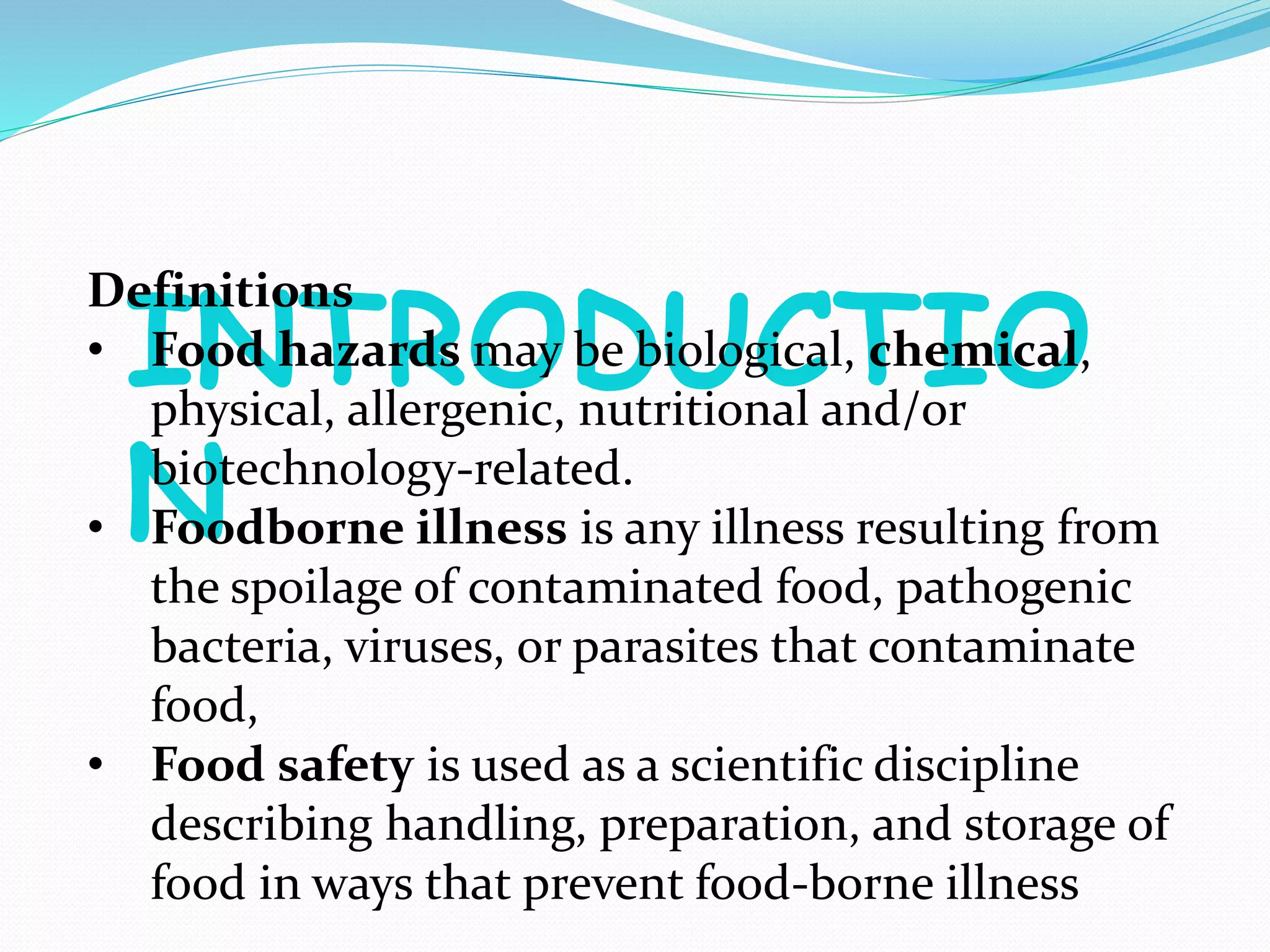
FOOD HYGIENE:
 Food hygiene is the action taken to ensure that food is
handled, stored, prepared and served in such a way that
the food is free from any kind of biological, chemical ,
physical hazards or any allergens.
 All employees working in direct contact with food, food
contact surfaces and food packaging must conform to
hygiene practices. This protect against food contamination
by microorganisms and any other unwanted material.
CONTAMINATION.........?
Food can be contaminated by the following three main hazard types :
 Physical hazards (Presence of foreign objects) – metal, wood, glass,
plastic, etc.
 Chemical hazards – Presence of bleach, caustic soda, detergents,
pesticides, etc.
 Microbiological – Presence of bacteria, viruses, fungus and parasites.
Food that is contaminated with any of these hazards is hazardous for
the health
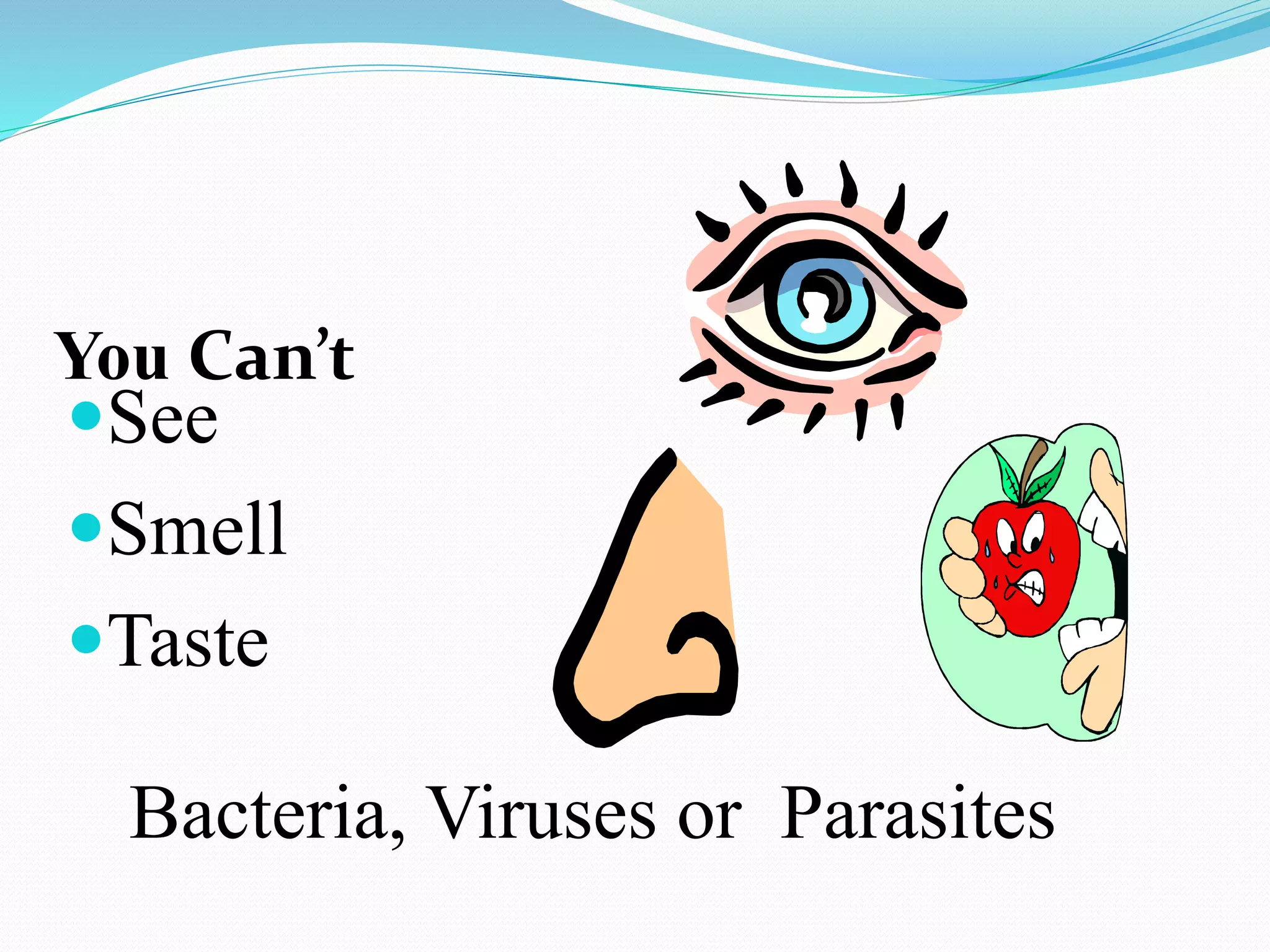
You Can’t
See
Smell
Taste
Bacteria, Viruses or Parasites
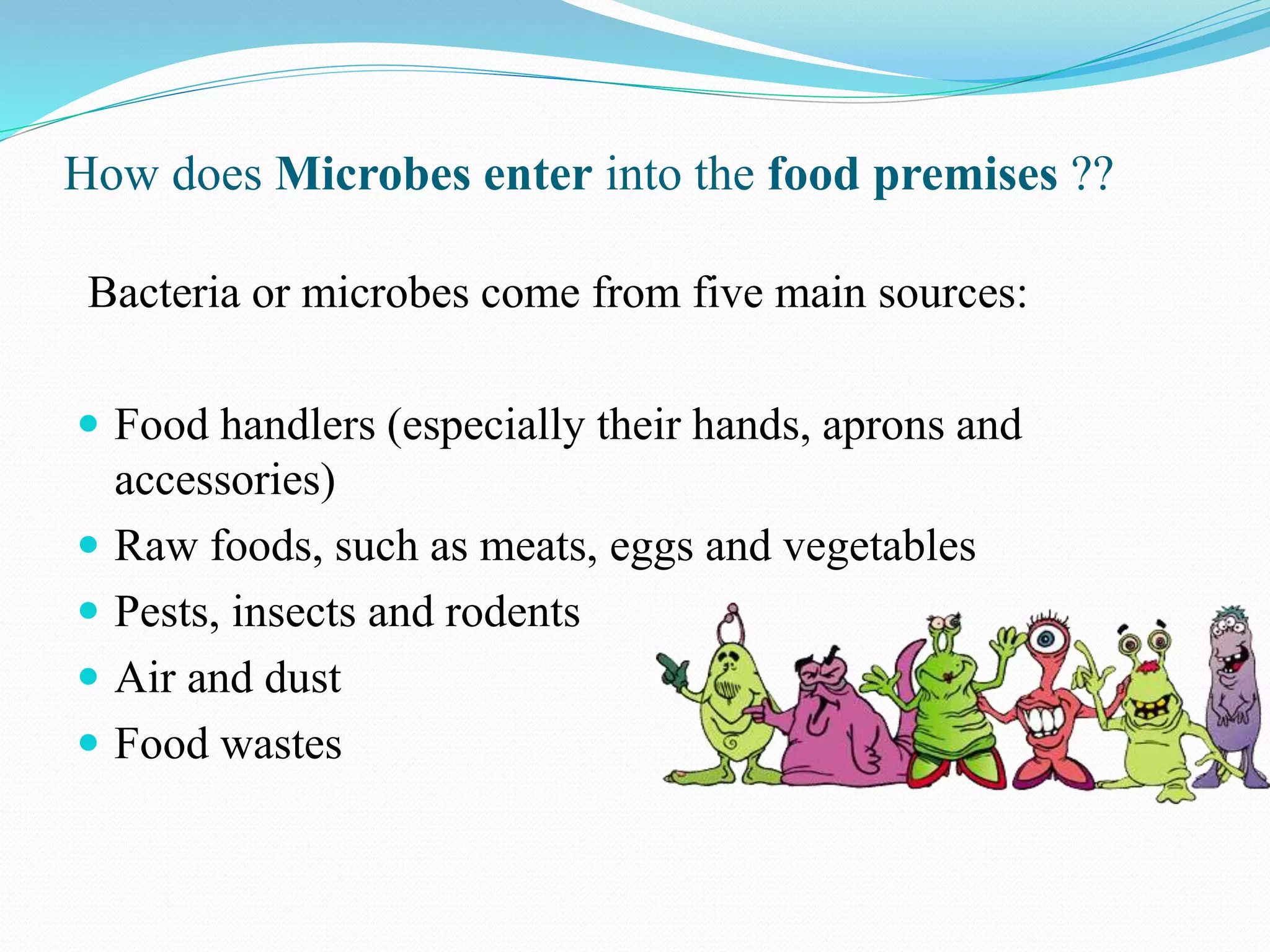
How does Microbes enter into the food premises ??
Bacteria or microbes come from five main sources:
 Food handlers (especially their hands, aprons and
accessories)
 Raw foods, such as meats, eggs and vegetables
 Pests, insects and rodents
 Air and dust
 Food wastes
FOOD BORNE ILLNESS / DISEASES:
• Any type of illness that is caused, or is probably caused, by
the consumption of contaminated food, water or other drink.
(e.g) Salmonella species, E.coli
FOOD POISONING:
• Any illness caused by or thought to be caused by pathogens
or toxins in food. (e.g) Staphylococcus aureus
• It is caused due to bacterial, viral, parasites and chemical
agents/reagents (detergents, caustic soda, disinfectants)
BACTERIAL FOOD POISONING:
The most common form of food poisoning is bacterial food
poisoning.
To survive and multiply, bacteria need:
 water
 food
 correct temperatures
 time
 most, but not all, need oxygen
Under these conditions, bacteria will multiply by dividing in two
every 10-20 minutes. After 6 hours, 1 bacterium can multiply into
262,144 bacteria, more than enough to cause food poisoning.
CLEANING,SANITIZATION & DISINFECTION
 CLEANING:
Removal of dirt, grease & debris using detergents (no
effect on bacteria)
 DISINFECTION:
Reducing pathogens to safe levels
 SANITIZATION:
Cleaning & Sanitizing all in one
BENEFITS OF CLEANING
 Pleasant, safe, attractive working environment
 Favourable image
 Remove matters inducive to the growth of micro
organisms
 Reduce hazard of extraneous matter
 Prevent damage to equipment
 Reduce risk of prosecution
STEPS IN PROPER CLEANING AND SANITATION
1. Remove waste materials
2. Scrape all loose debris and food particles from
surfaces
3. Clean and then sanitize surface
1. Wet cleaning
2. Dry cleaning
4. Please remember that the order of carrying out the
cleaning procedure is followed.
WHAT TO DISINFECT ?
 Food contact surfaces- knives, utensils, containers,
cutting boards, work surfaces, table tops
 Hand contact surfaces- work surfaces, equipments,
handles and doors ( cupboards, utensils and taps)
 Contamination bins-rubbish bins, cleaning
equipments (e.g. cloths & mops)
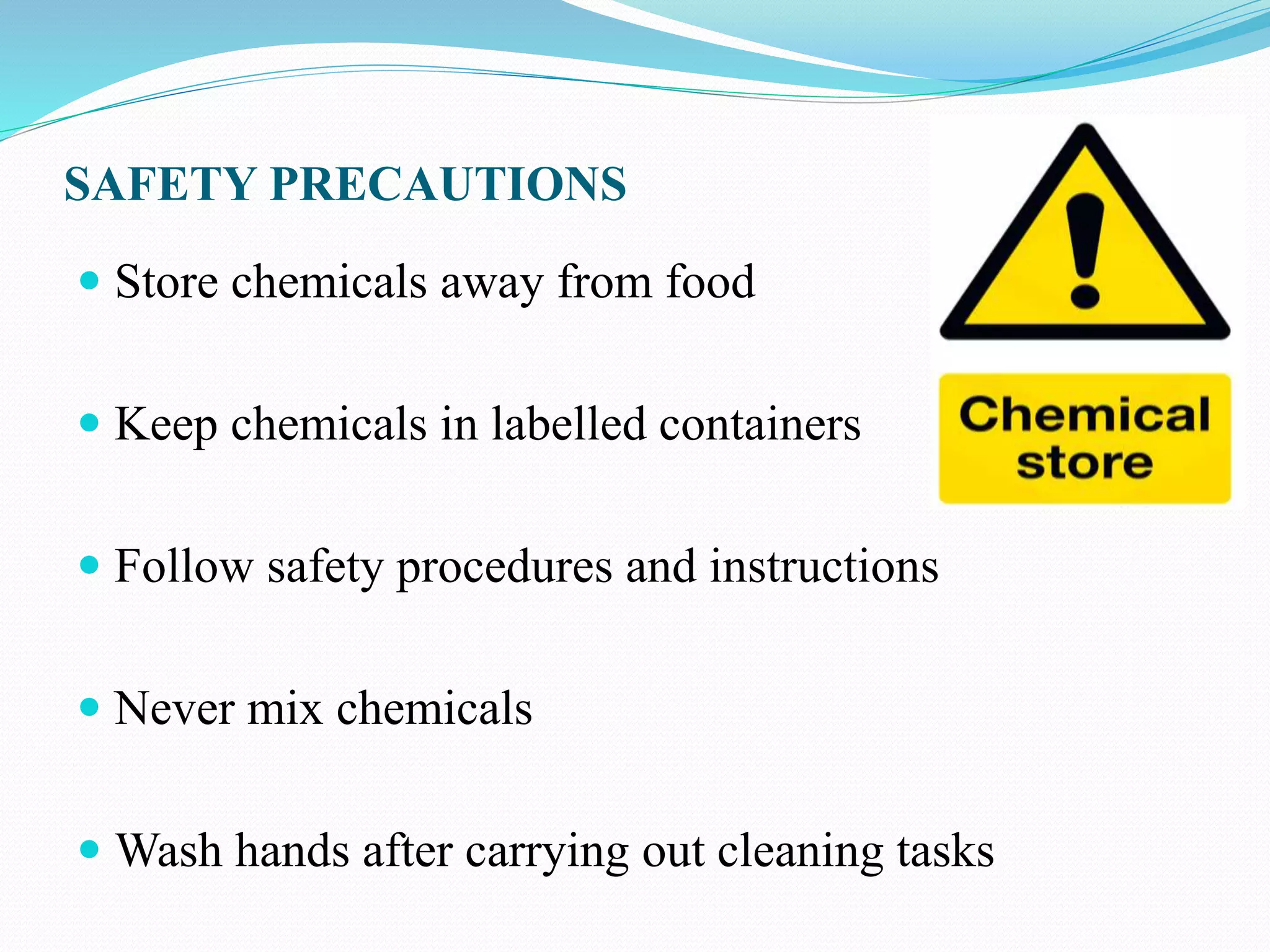
SAFETY PRECAUTIONS
 Store chemicals away from food
 Keep chemicals in labelled containers
 Follow safety procedures and instructions
 Never mix chemicals
 Wash hands after carrying out cleaning tasks
CLEANING SCHEDULES
 These are an effective and essential means of ensuring
that works are carried out correctly and efficiently.
 They co-ordinate all cleaning activities & act as a
major communication link detailing management
requirements and staff duties.
CLEANING SCHEDULE STATES
 What is to be cleaned
 Who is to clean it
 When is to be cleaned
 How is it to be cleaned
 Chemicals, materials and equipments to be used
 Precautions to be taken
 Monitoring procedures
PERSONAL HYGIENE
 An important way to prevent food contamination is to
maintain a high standard of personal hygiene and
sanitation.
 Even healthy people carry food poisoning bacteria on
their body by touching parts of the body such as nose
mouth hair or your clothes.
 Customers like to see food handling staffs who take
hygiene seriously and practice safe food handling
PREVENT FOOD POISONING BY PRACTICING
GOOD PERSONAL HYGIENE
Thoroughly wash and dry hands before
handling food and wash and dry them
frequently during work.
 Dry your hands with clean towels,
disposable paper towels.
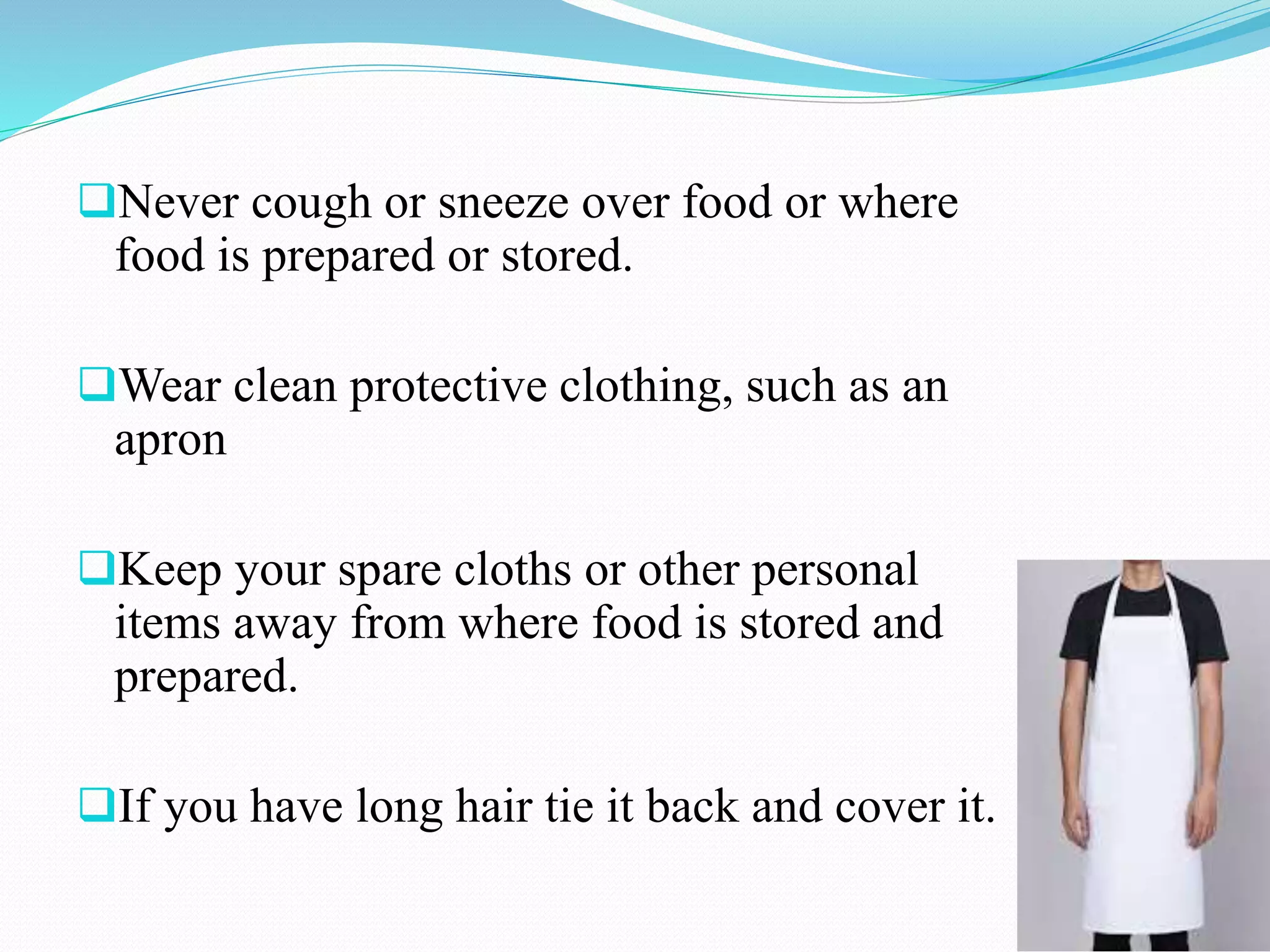
Never smoke, chew gum, spit or eat in a
food handling or storage area.
Never cough or sneeze over food or where
food is prepared or stored.
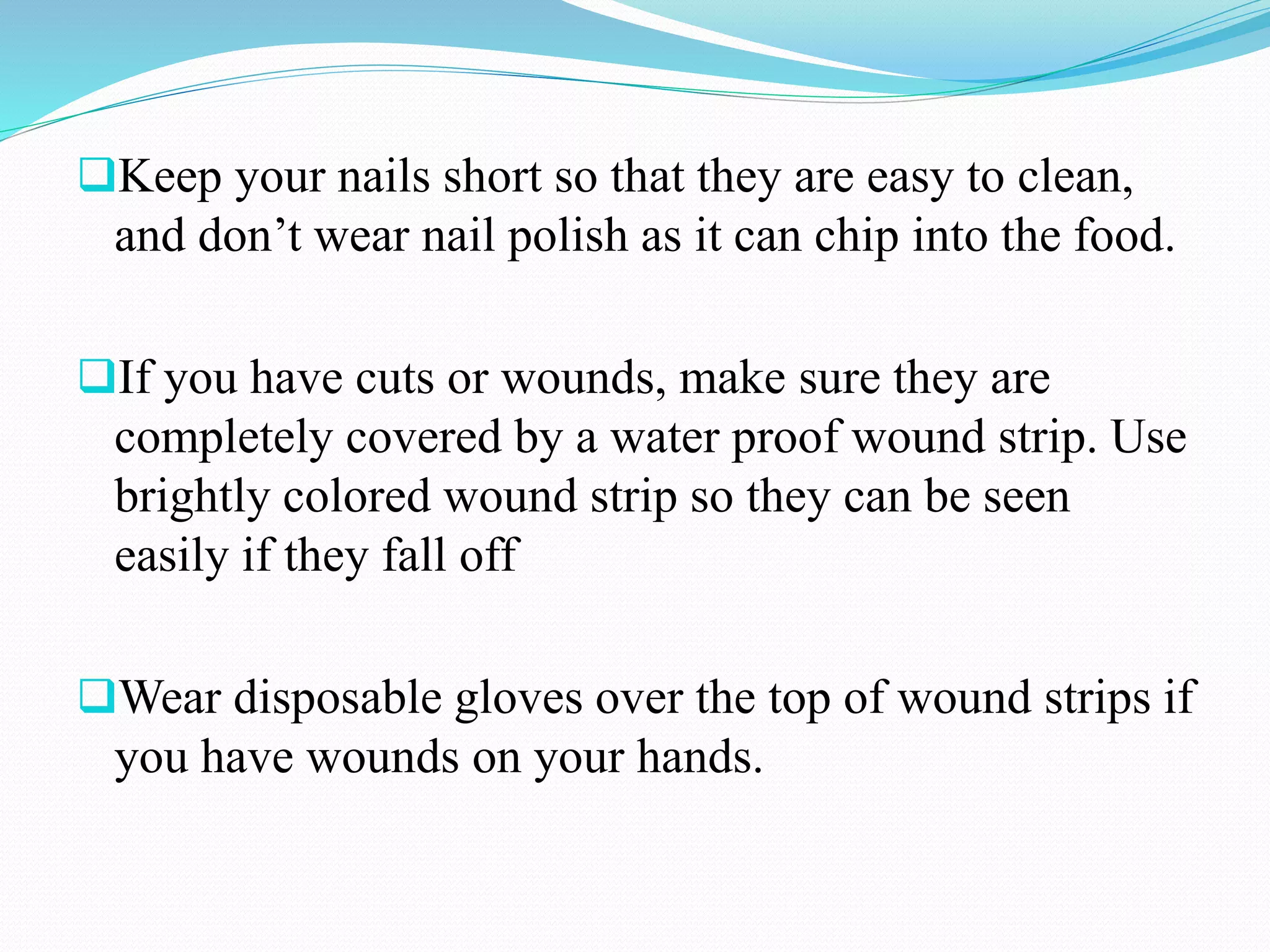
Wear clean protective clothing, such as an
apron
Keep your spare cloths or other personal
items away from where food is stored and
prepared.
If you have long hair tie it back and cover it.
Keep your nails short so that they are easy to clean,
and don’t wear nail polish as it can chip into the food.
If you have cuts or wounds, make sure they are
completely covered by a water proof wound strip. Use
brightly colored wound strip so they can be seen
easily if they fall off
Wear disposable gloves over the top of wound strips if
you have wounds on your hands.
Change disposable gloves regularly
Advise your supervisor if you feel unwell and don’t
handle food.
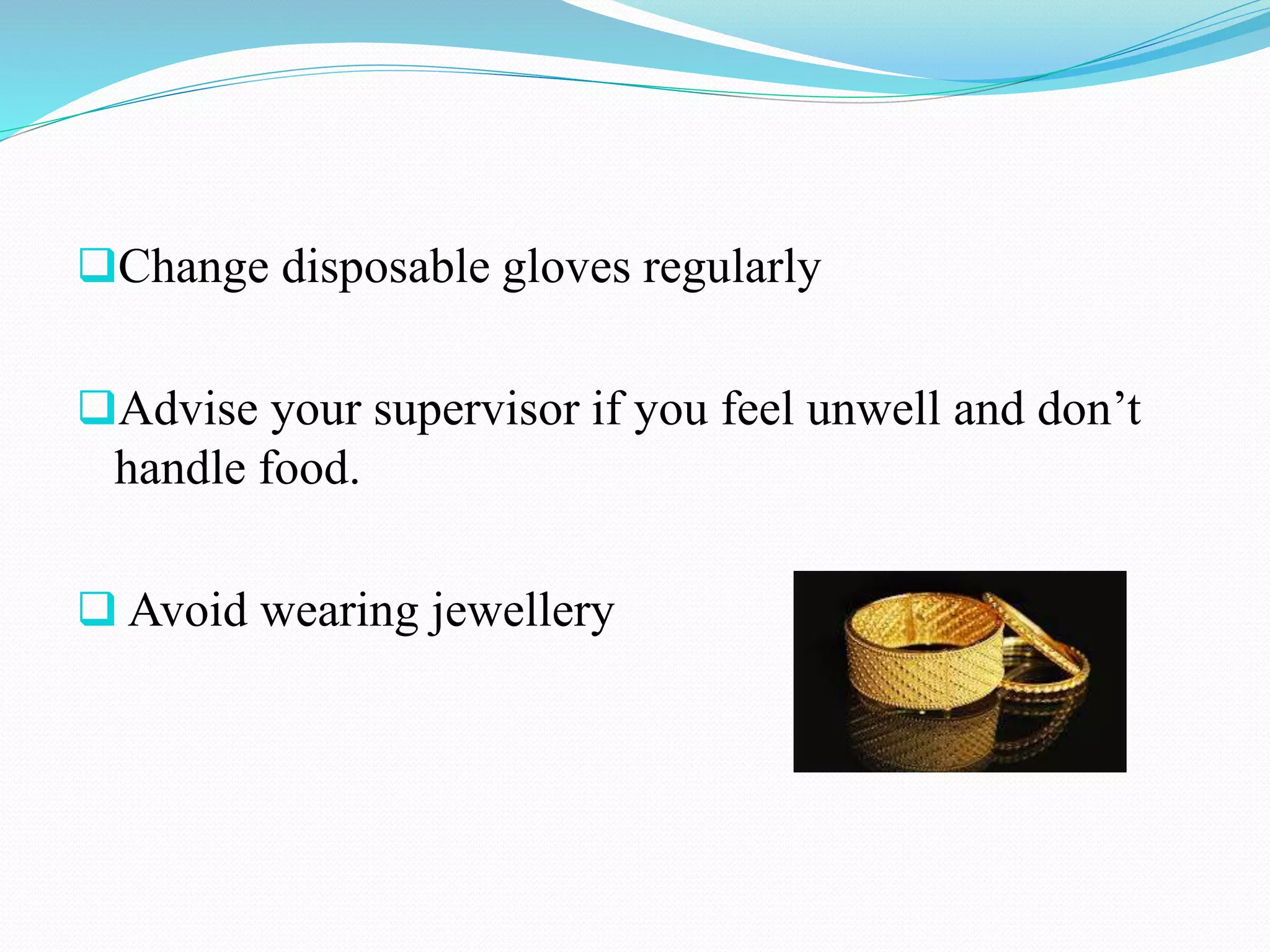
 Avoid wearing jewellery
D0’s and Don’ts
DO’s
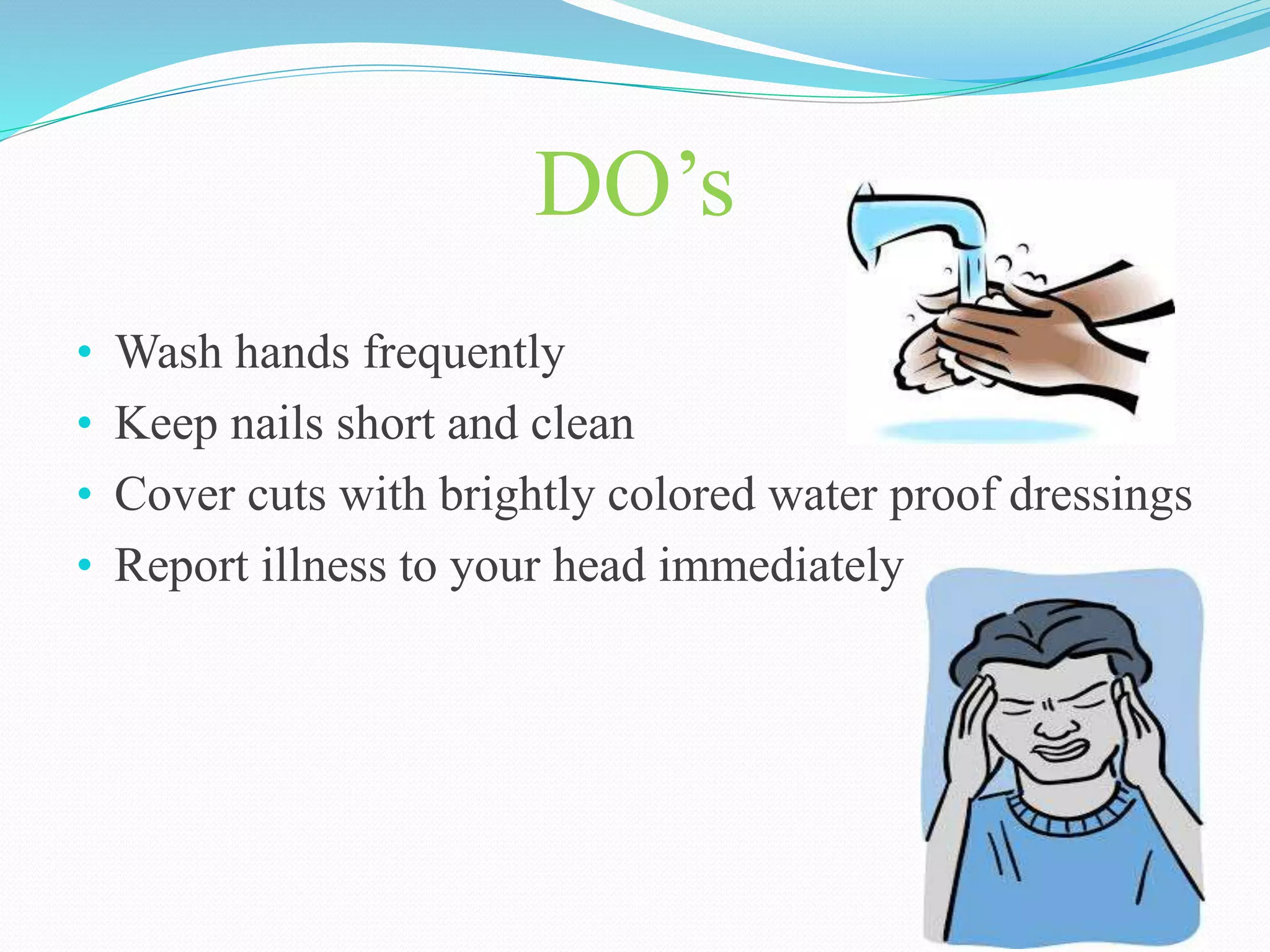
• Wash hands frequently
• Keep nails short and clean
• Cover cuts with brightly colored water proof dressings
• Report illness to your head immediately
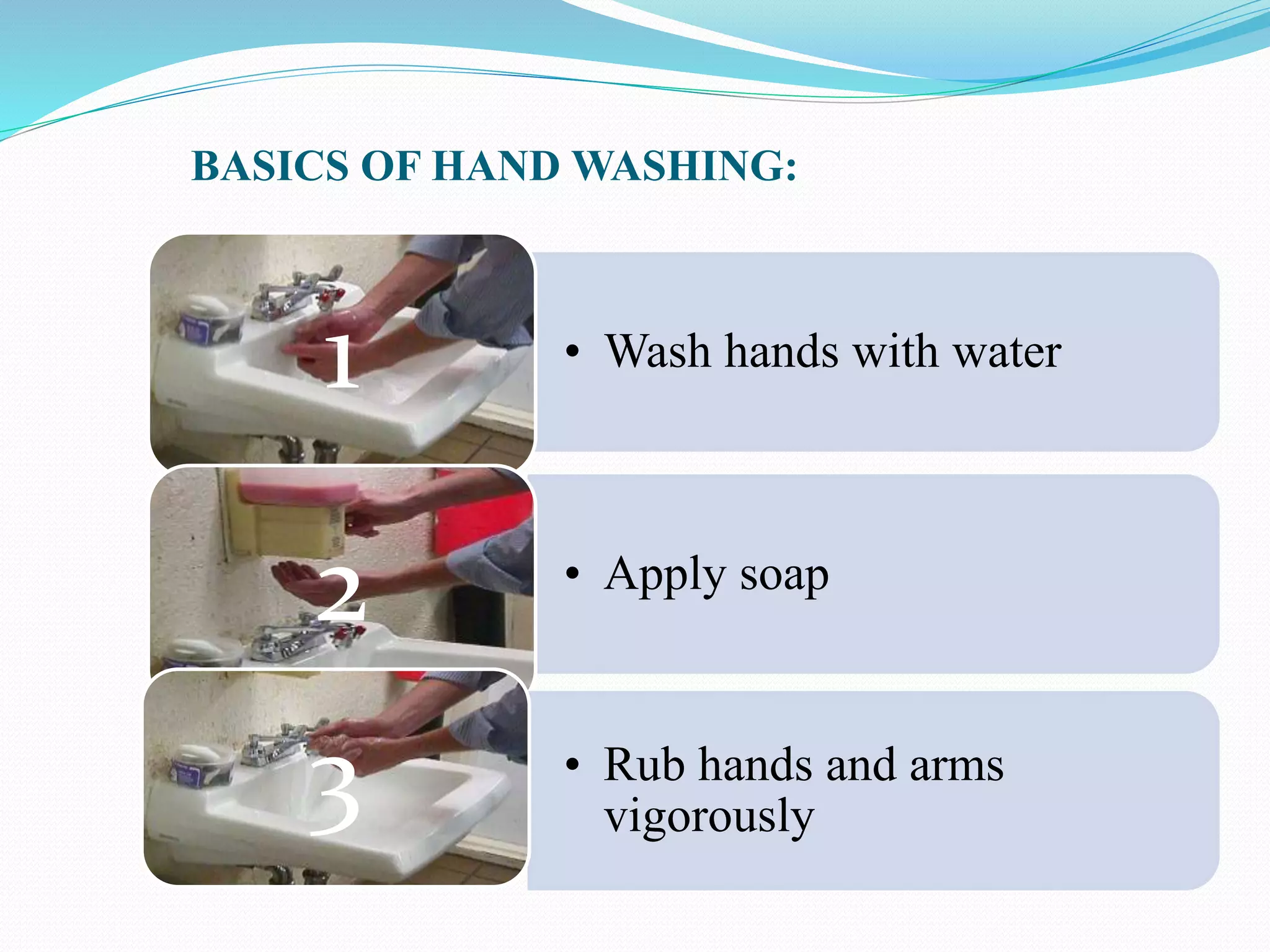
BASICS OF HAND WASHING:
• Wash hands with water
1
• Apply soap
2
• Rub hands and arms
vigorously
3
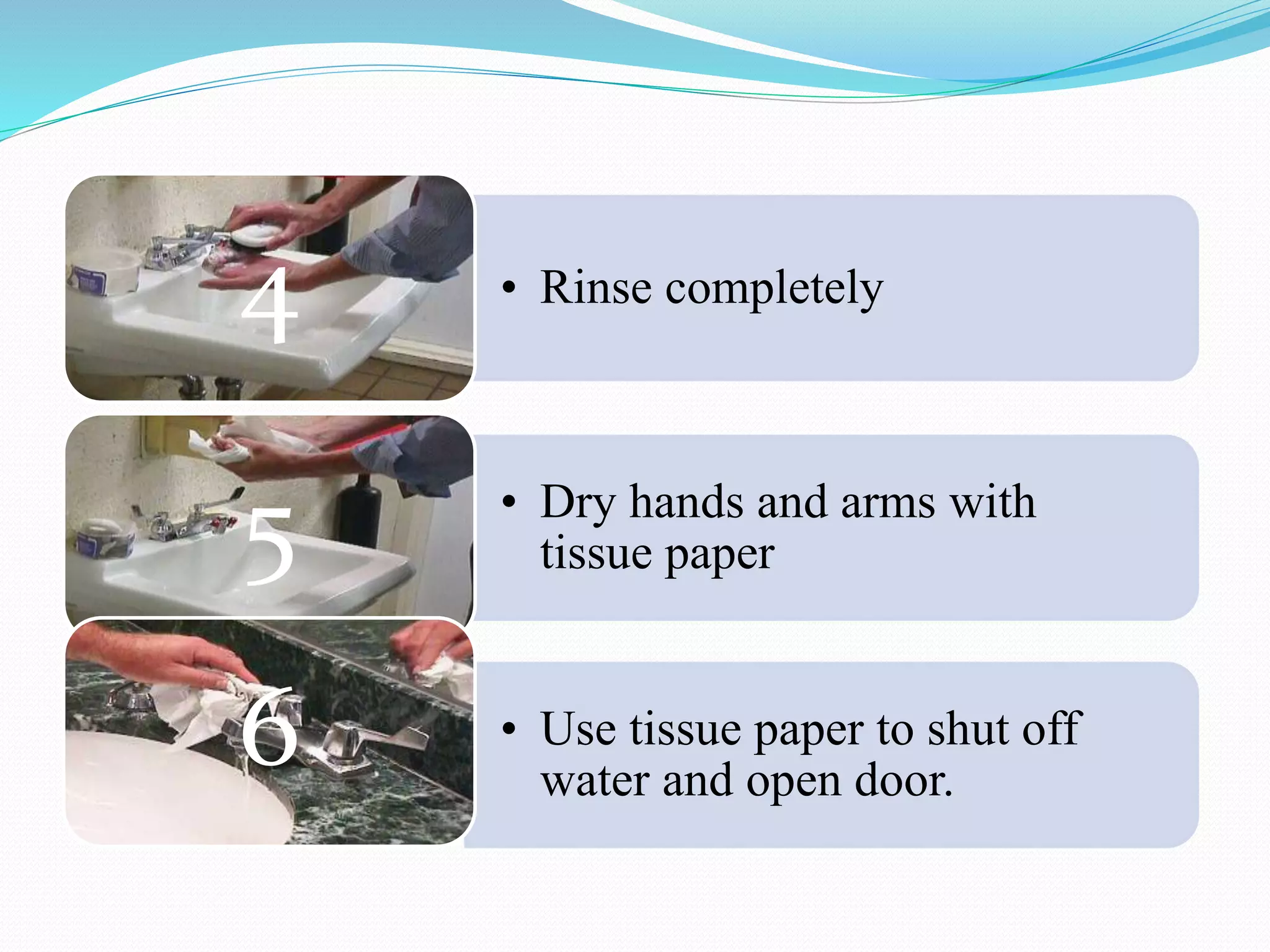
• Rinse completely
4
• Dry hands and arms with
tissue paper
5
• Use tissue paper to shut off
water and open door.
6
ALWAYS WASH HANDS:
 Before food preparation.
 Before wearing gloves
 After using the bathroom
 After coughing, sneezing, smoking, eating, or
drinking
 After bussing a table
 When switching between raw and ready-to-eat food
 After handling garbage or trash
 After handling dirty equipment or utensils
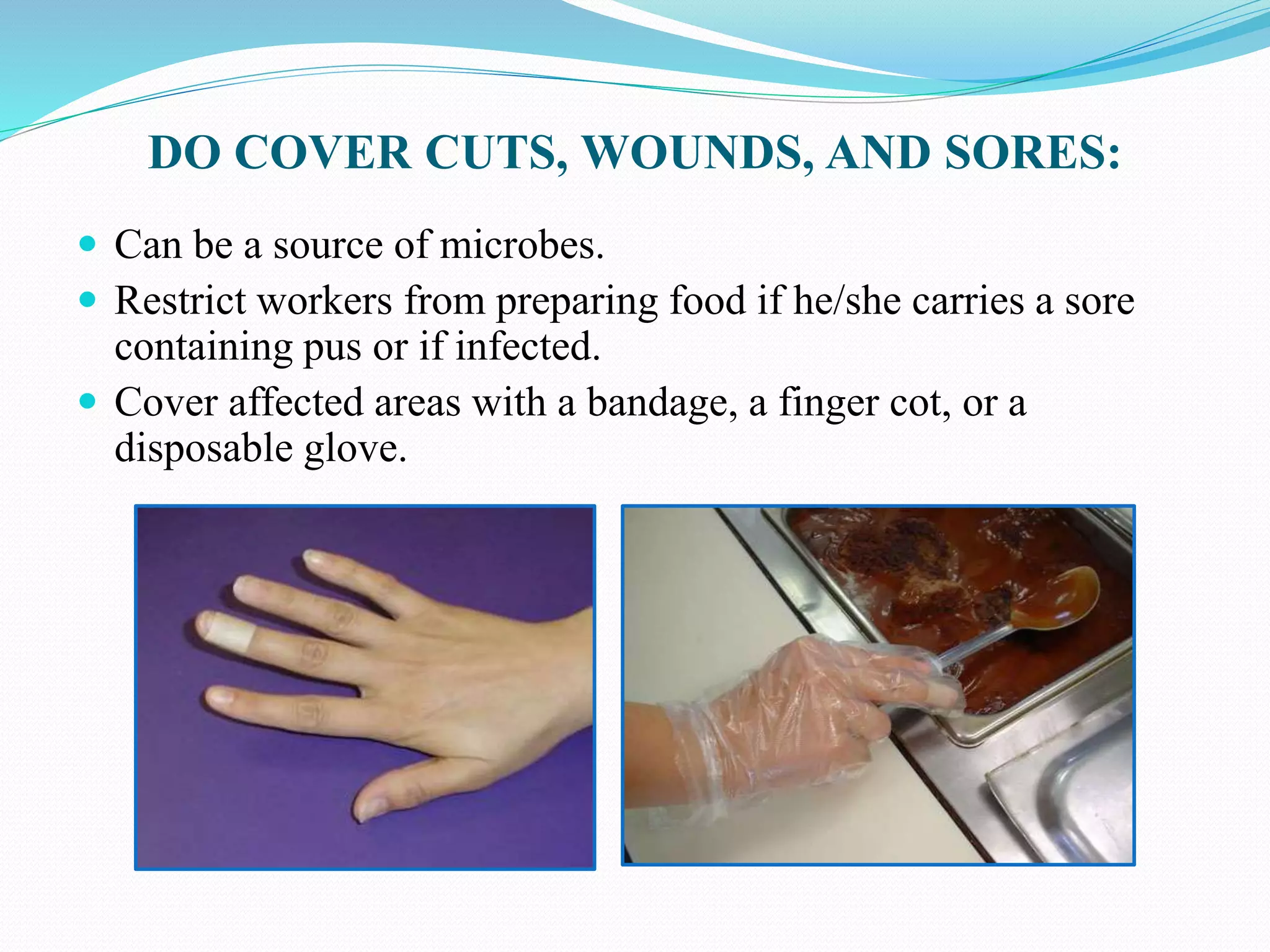
DO COVER CUTS, WOUNDS, AND SORES:
 Can be a source of microbes.
 Restrict workers from preparing food if he/she carries a sore
containing pus or if infected.
 Cover affected areas with a bandage, a finger cot, or a
disposable glove.
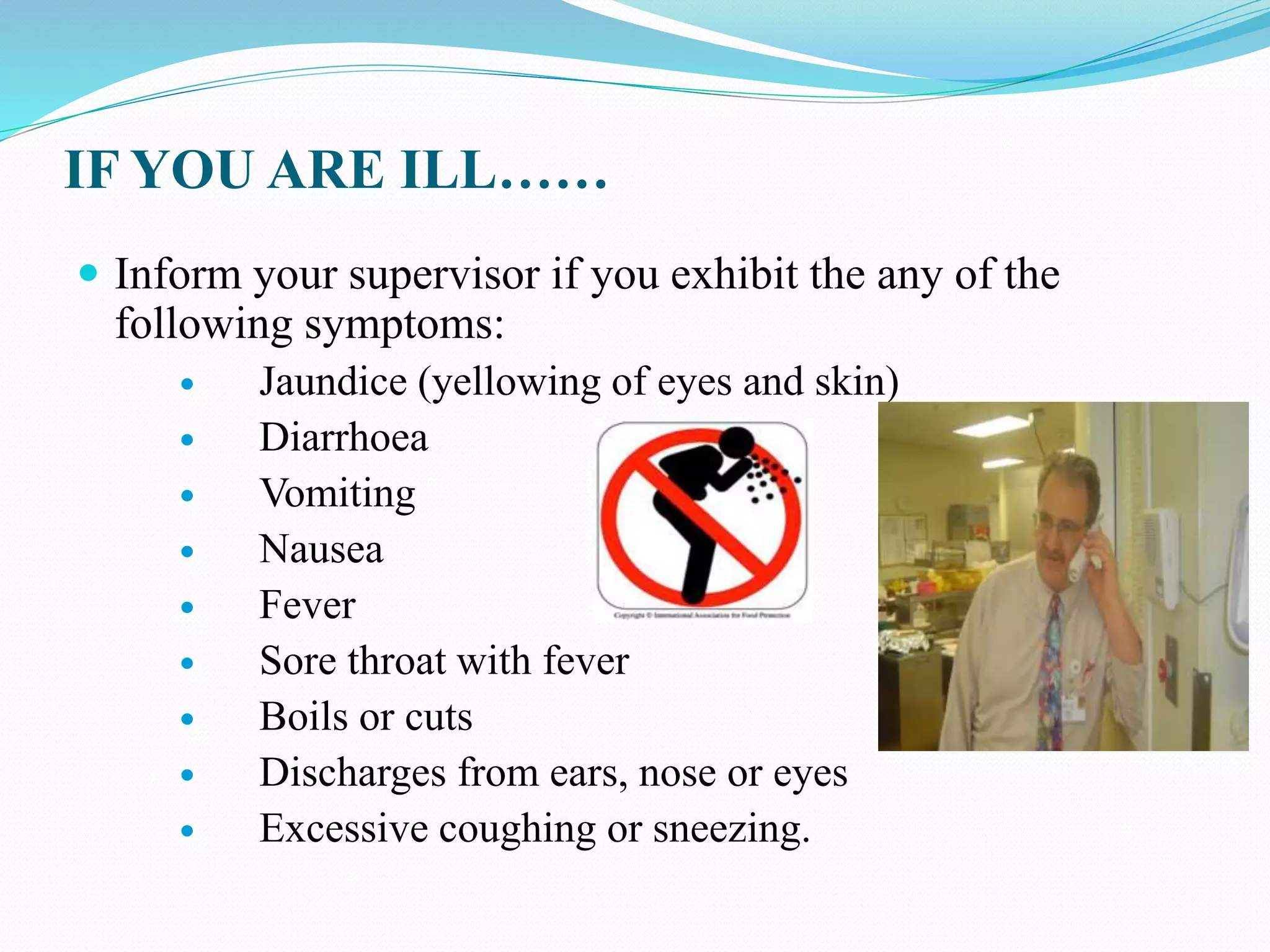
IF YOU ARE ILL……
 Inform your supervisor if you exhibit the any of the
following symptoms:
 Jaundice (yellowing of eyes and skin)
 Diarrhoea
 Vomiting
 Nausea
 Fever
 Sore throat with fever
 Boils or cuts
 Discharges from ears, nose or eyes
 Excessive coughing or sneezing.
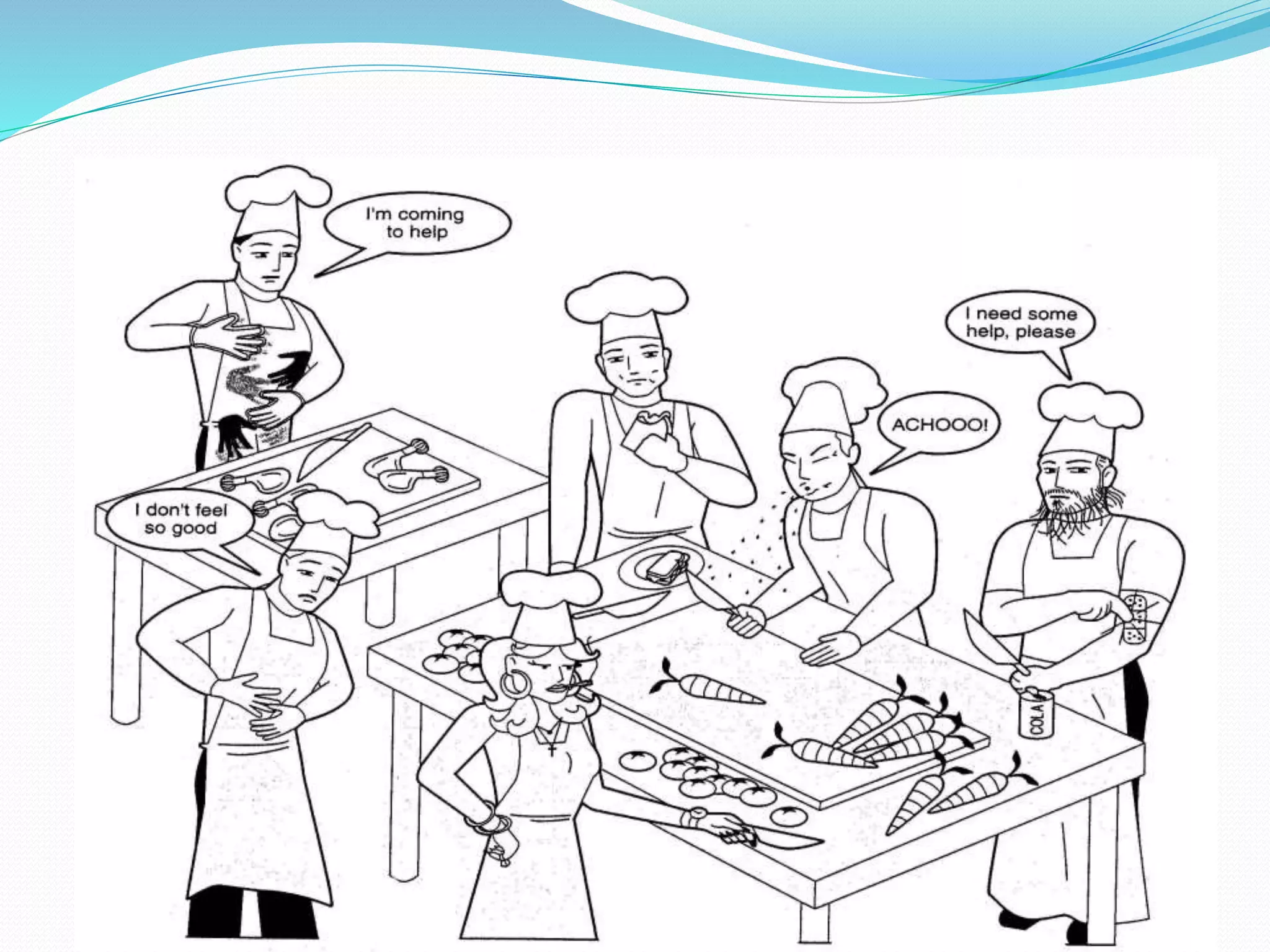
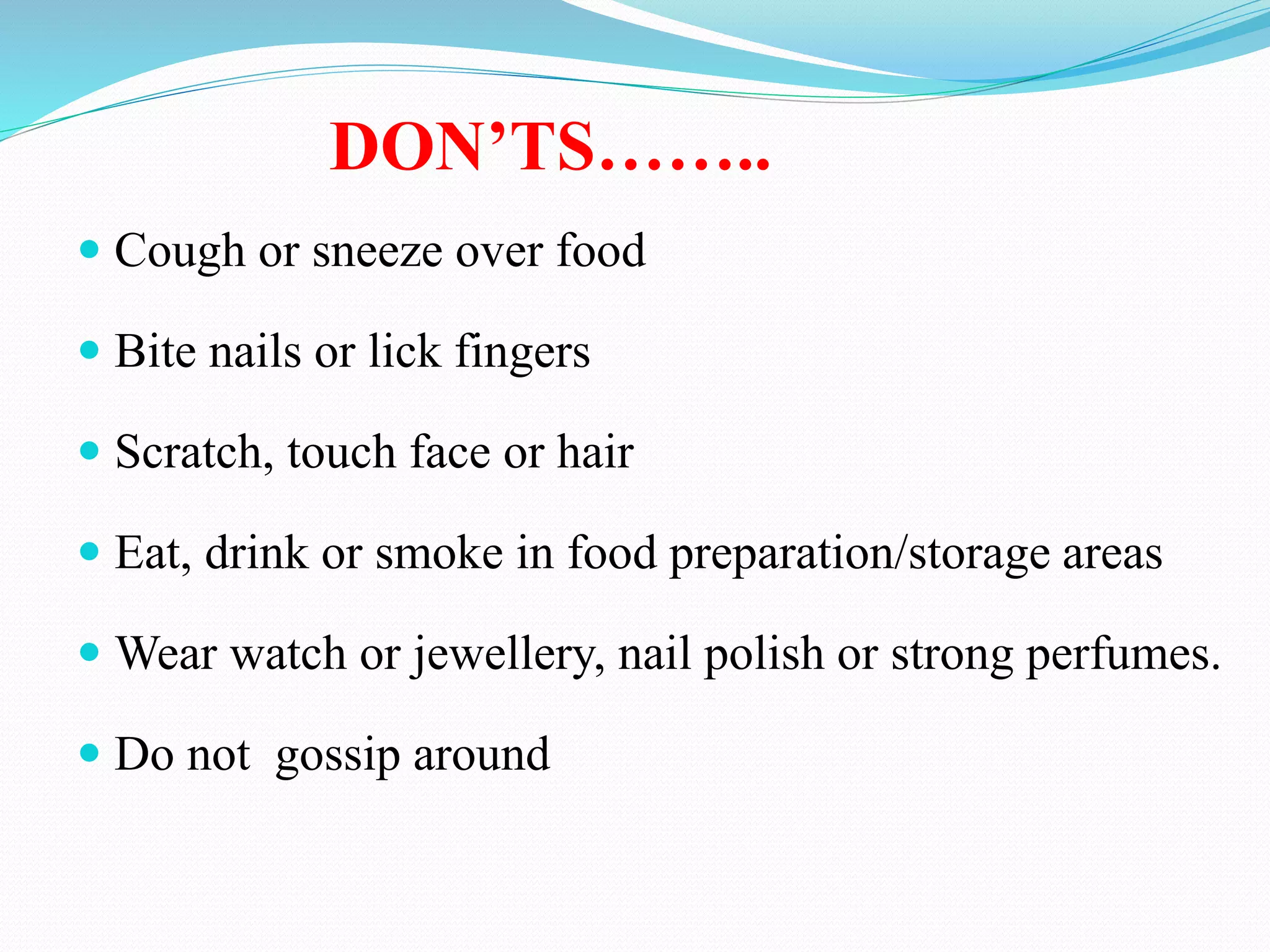
 Cough or sneeze over food
 Bite nails or lick fingers
 Scratch, touch face or hair
 Eat, drink or smoke in food preparation/storage areas
 Wear watch or jewellery, nail polish or strong perfumes.
 Do not gossip around
DON’TS……..
MONITORING
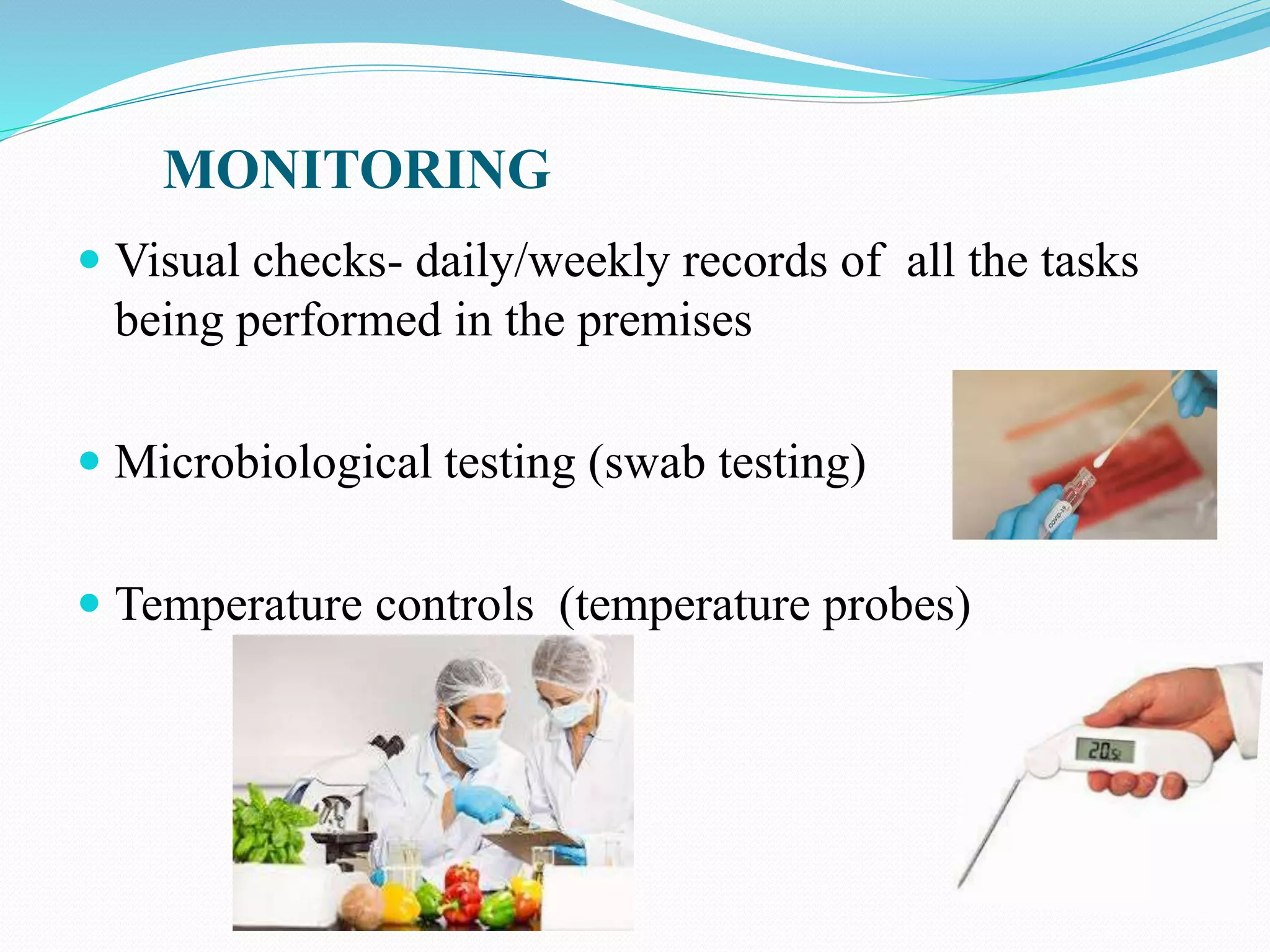
 Visual checks- daily/weekly records of all the tasks
being performed in the premises
 Microbiological testing (swab testing)
 Temperature controls (temperature probes)
FOOD HANDLING MONITORING
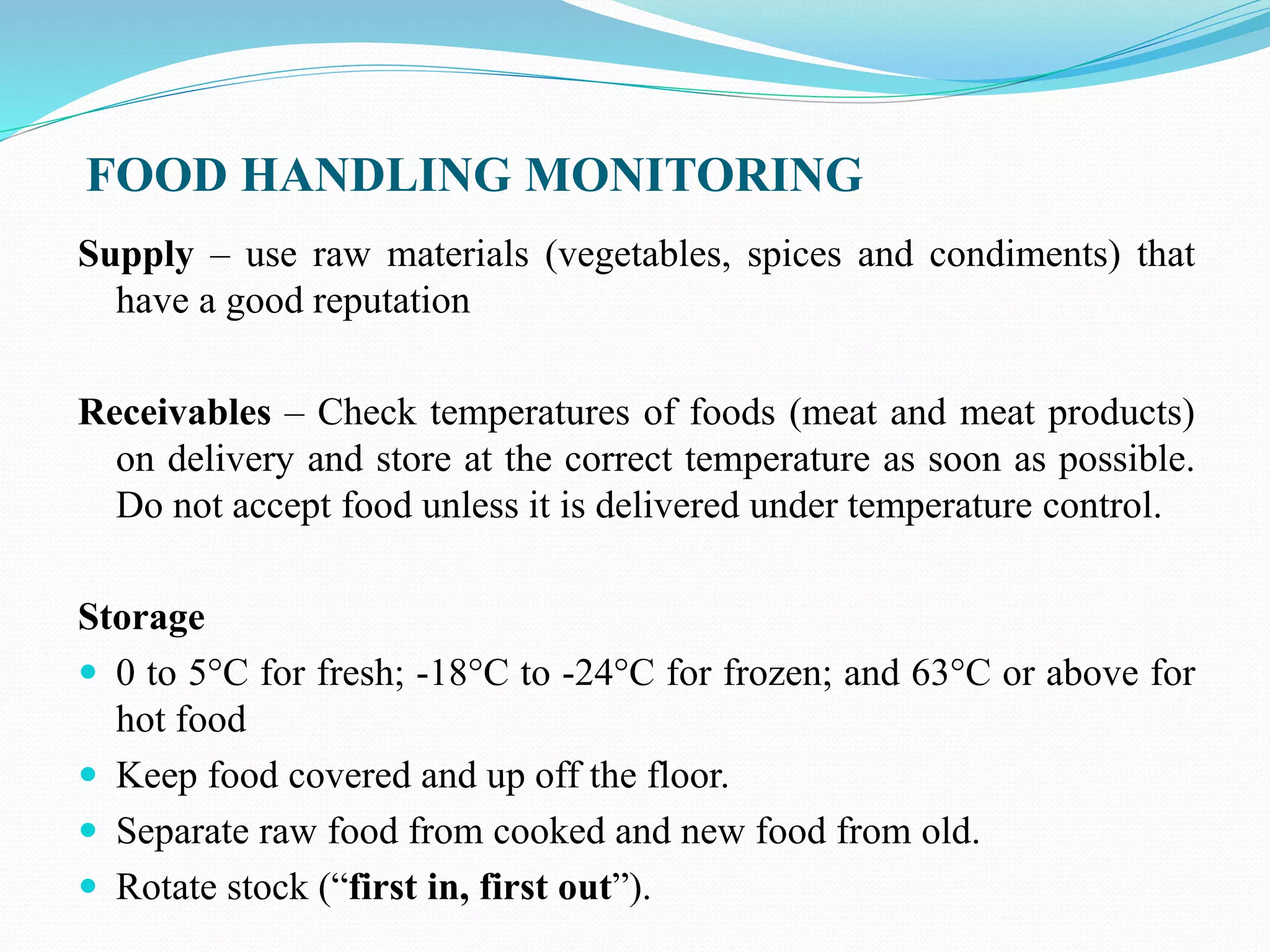
Supply – use raw materials (vegetables, spices and condiments) that
have a good reputation
Receivables – Check temperatures of foods (meat and meat products)
on delivery and store at the correct temperature as soon as possible.
Do not accept food unless it is delivered under temperature control.
Storage
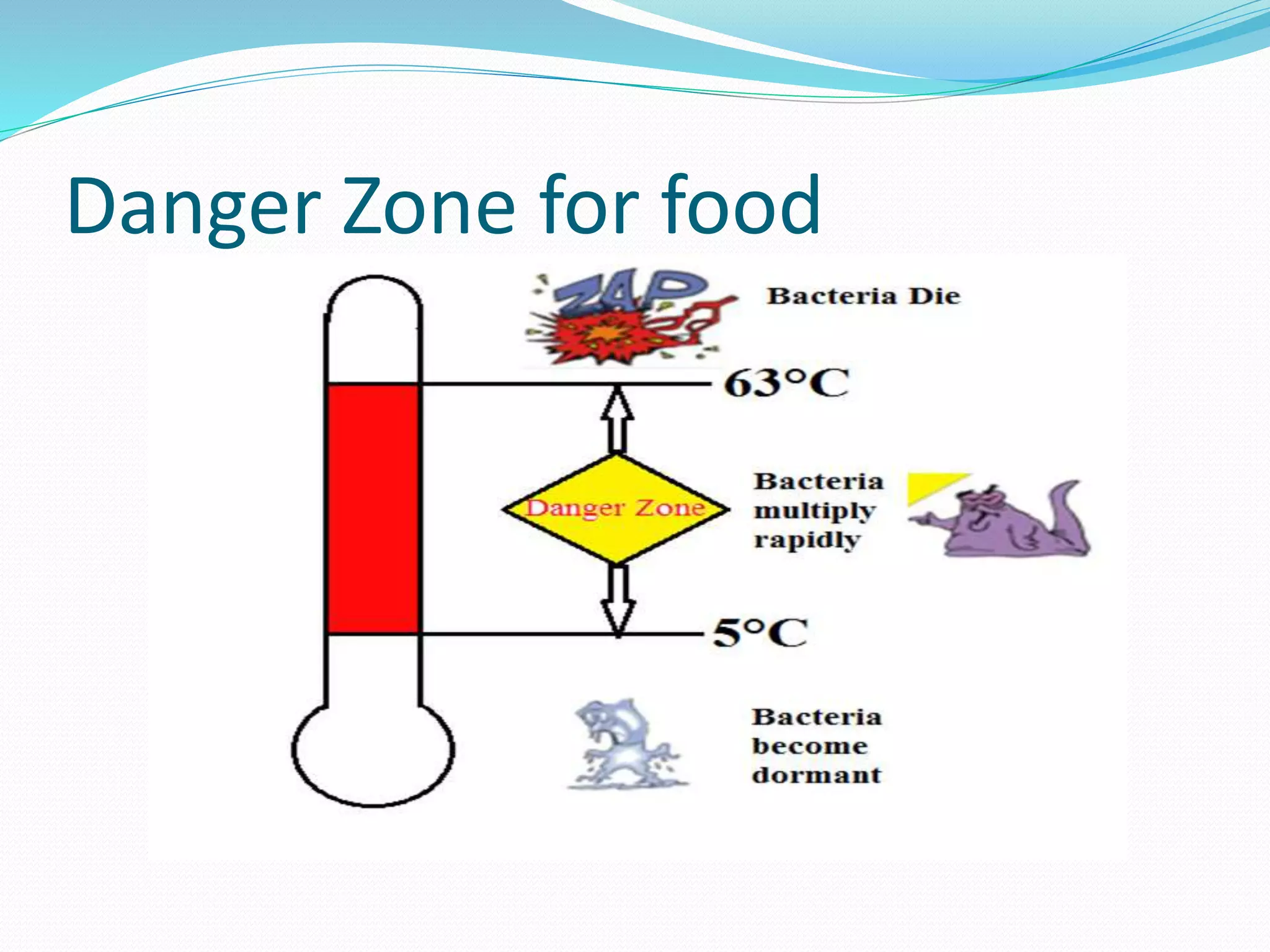
 0 to 5°C for fresh; -18°C to -24°C for frozen; and 63°C or above for
hot food
 Keep food covered and up off the floor.
 Separate raw food from cooked and new food from old.
 Rotate stock (“first in, first out”).
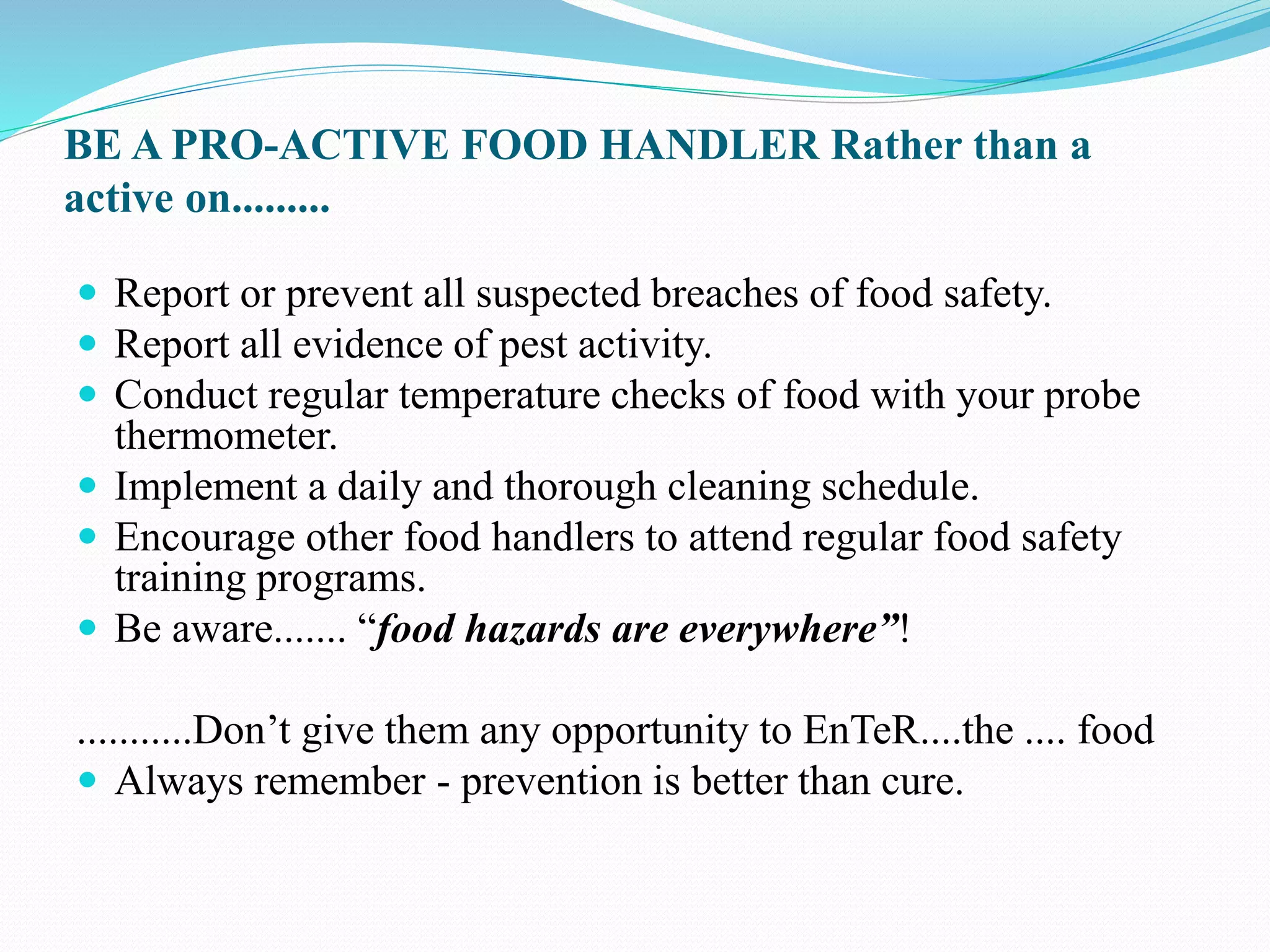
BE A PRO-ACTIVE FOOD HANDLER Rather than a
active on.........
 Report or prevent all suspected breaches of food safety.
 Report all evidence of pest activity.
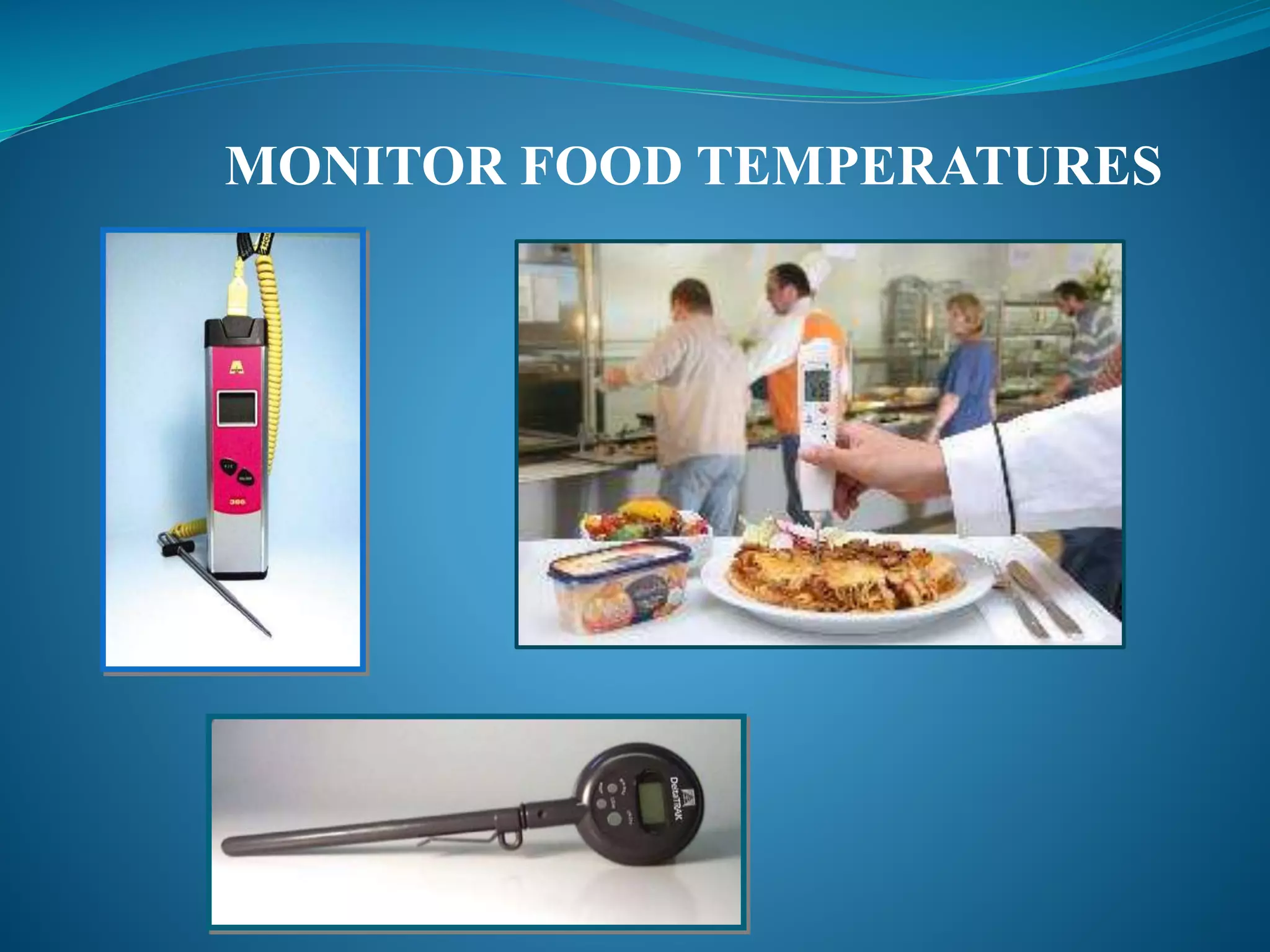
 Conduct regular temperature checks of food with your probe
thermometer.
 Implement a daily and thorough cleaning schedule.
 Encourage other food handlers to attend regular food safety
training programs.
 Be aware....... “food hazards are everywhere”!
...........Don’t give them any opportunity to EnTeR....the .... food
 Always remember - prevention is better than cure.
MONITOR FOOD TEMPERATURES
Danger Zone for food
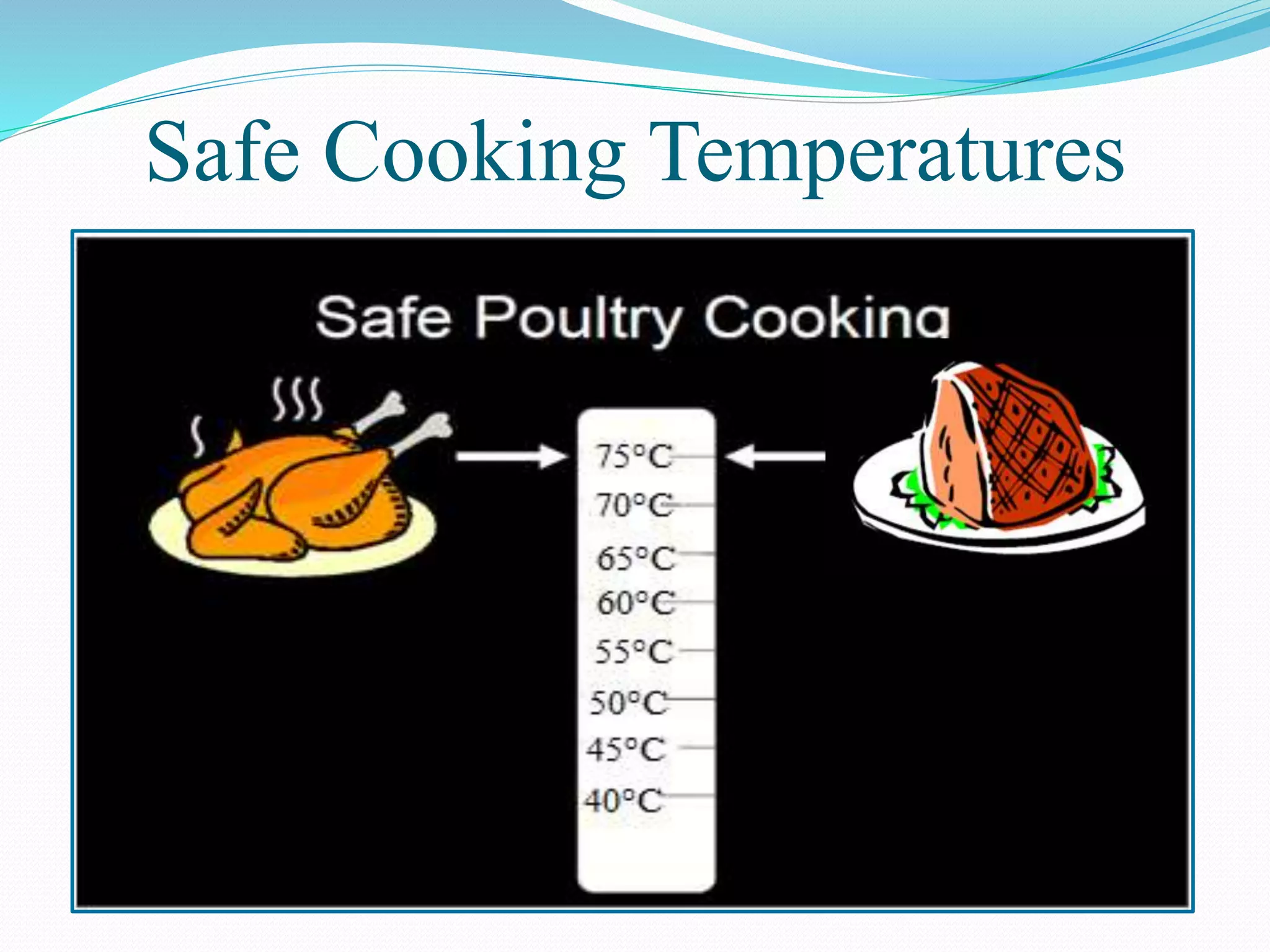
Safe Cooking Temperatures
CONCLUSION
It is essential that food handlers have the required skills
and knowledge of food safety and food handling
controls to minimise the risk of food poisoning.
As a food handler, it is your responsibility to ensure that
food for your customer is safe and suitable to eat.
Happy and safe cooking!
End………………
THANK YOU

Lecture 10 food hygiene and safety management

  • 1.
    FOOD HYGIENE AND SAFETYMANAGEMENT Dr. Abdirashid Ahmed Hussein BSc IN Veterinary science department of animal husbandry in university of Somalia (Uniso) BSc in public health in Somvill university Email: abwaanrashka39@gmail.com Lecture: 10
  • 2.
    Outline  Introduction  Briefdiscussion on  Food hygiene  Food hazards  Food borne diseases and causative agents  Cleaning, disinfection and sanitation  Personal Hygiene  Do’s and Don’ts  Monitoring and Maintenance programs
  • 3.
    INTRODUCTIO N Definitions • Food hazardsmay be biological, chemical, physical, allergenic, nutritional and/or biotechnology-related. • Foodborne illness is any illness resulting from the spoilage of contaminated food, pathogenic bacteria, viruses, or parasites that contaminate food, • Food safety is used as a scientific discipline describing handling, preparation, and storage of food in ways that prevent food-borne illness
  • 4.
    FOOD HYGIENE:  Foodhygiene is the action taken to ensure that food is handled, stored, prepared and served in such a way that the food is free from any kind of biological, chemical , physical hazards or any allergens.  All employees working in direct contact with food, food contact surfaces and food packaging must conform to hygiene practices. This protect against food contamination by microorganisms and any other unwanted material.
  • 5.
    CONTAMINATION.........? Food can becontaminated by the following three main hazard types :  Physical hazards (Presence of foreign objects) – metal, wood, glass, plastic, etc.  Chemical hazards – Presence of bleach, caustic soda, detergents, pesticides, etc.  Microbiological – Presence of bacteria, viruses, fungus and parasites. Food that is contaminated with any of these hazards is hazardous for the health
  • 6.
  • 7.
    How does Microbesenter into the food premises ?? Bacteria or microbes come from five main sources:  Food handlers (especially their hands, aprons and accessories)  Raw foods, such as meats, eggs and vegetables  Pests, insects and rodents  Air and dust  Food wastes
  • 8.
    FOOD BORNE ILLNESS/ DISEASES: • Any type of illness that is caused, or is probably caused, by the consumption of contaminated food, water or other drink. (e.g) Salmonella species, E.coli FOOD POISONING: • Any illness caused by or thought to be caused by pathogens or toxins in food. (e.g) Staphylococcus aureus • It is caused due to bacterial, viral, parasites and chemical agents/reagents (detergents, caustic soda, disinfectants)
  • 9.
    BACTERIAL FOOD POISONING: Themost common form of food poisoning is bacterial food poisoning. To survive and multiply, bacteria need:  water  food  correct temperatures  time  most, but not all, need oxygen Under these conditions, bacteria will multiply by dividing in two every 10-20 minutes. After 6 hours, 1 bacterium can multiply into 262,144 bacteria, more than enough to cause food poisoning.
  • 10.
    CLEANING,SANITIZATION & DISINFECTION CLEANING: Removal of dirt, grease & debris using detergents (no effect on bacteria)  DISINFECTION: Reducing pathogens to safe levels  SANITIZATION: Cleaning & Sanitizing all in one
  • 11.
    BENEFITS OF CLEANING Pleasant, safe, attractive working environment  Favourable image  Remove matters inducive to the growth of micro organisms  Reduce hazard of extraneous matter  Prevent damage to equipment  Reduce risk of prosecution
  • 12.
    STEPS IN PROPERCLEANING AND SANITATION 1. Remove waste materials 2. Scrape all loose debris and food particles from surfaces 3. Clean and then sanitize surface 1. Wet cleaning 2. Dry cleaning 4. Please remember that the order of carrying out the cleaning procedure is followed.
  • 13.
    WHAT TO DISINFECT?  Food contact surfaces- knives, utensils, containers, cutting boards, work surfaces, table tops  Hand contact surfaces- work surfaces, equipments, handles and doors ( cupboards, utensils and taps)  Contamination bins-rubbish bins, cleaning equipments (e.g. cloths & mops)
  • 14.
    SAFETY PRECAUTIONS  Storechemicals away from food  Keep chemicals in labelled containers  Follow safety procedures and instructions  Never mix chemicals  Wash hands after carrying out cleaning tasks
  • 15.
    CLEANING SCHEDULES  Theseare an effective and essential means of ensuring that works are carried out correctly and efficiently.  They co-ordinate all cleaning activities & act as a major communication link detailing management requirements and staff duties.
  • 16.
    CLEANING SCHEDULE STATES What is to be cleaned  Who is to clean it  When is to be cleaned  How is it to be cleaned  Chemicals, materials and equipments to be used  Precautions to be taken  Monitoring procedures
  • 17.
    PERSONAL HYGIENE  Animportant way to prevent food contamination is to maintain a high standard of personal hygiene and sanitation.  Even healthy people carry food poisoning bacteria on their body by touching parts of the body such as nose mouth hair or your clothes.  Customers like to see food handling staffs who take hygiene seriously and practice safe food handling
  • 18.
    PREVENT FOOD POISONINGBY PRACTICING GOOD PERSONAL HYGIENE Thoroughly wash and dry hands before handling food and wash and dry them frequently during work.  Dry your hands with clean towels, disposable paper towels. Never smoke, chew gum, spit or eat in a food handling or storage area.
  • 19.
    Never cough orsneeze over food or where food is prepared or stored. Wear clean protective clothing, such as an apron Keep your spare cloths or other personal items away from where food is stored and prepared. If you have long hair tie it back and cover it.
  • 20.
    Keep your nailsshort so that they are easy to clean, and don’t wear nail polish as it can chip into the food. If you have cuts or wounds, make sure they are completely covered by a water proof wound strip. Use brightly colored wound strip so they can be seen easily if they fall off Wear disposable gloves over the top of wound strips if you have wounds on your hands.
  • 21.
    Change disposable glovesregularly Advise your supervisor if you feel unwell and don’t handle food.  Avoid wearing jewellery
  • 22.
  • 23.
    DO’s • Wash handsfrequently • Keep nails short and clean • Cover cuts with brightly colored water proof dressings • Report illness to your head immediately
  • 24.
    BASICS OF HANDWASHING: • Wash hands with water 1 • Apply soap 2 • Rub hands and arms vigorously 3
  • 25.
    • Rinse completely 4 •Dry hands and arms with tissue paper 5 • Use tissue paper to shut off water and open door. 6
  • 26.
    ALWAYS WASH HANDS: Before food preparation.  Before wearing gloves  After using the bathroom  After coughing, sneezing, smoking, eating, or drinking  After bussing a table  When switching between raw and ready-to-eat food  After handling garbage or trash  After handling dirty equipment or utensils
  • 27.
    DO COVER CUTS,WOUNDS, AND SORES:  Can be a source of microbes.  Restrict workers from preparing food if he/she carries a sore containing pus or if infected.  Cover affected areas with a bandage, a finger cot, or a disposable glove.
  • 28.
    IF YOU AREILL……  Inform your supervisor if you exhibit the any of the following symptoms:  Jaundice (yellowing of eyes and skin)  Diarrhoea  Vomiting  Nausea  Fever  Sore throat with fever  Boils or cuts  Discharges from ears, nose or eyes  Excessive coughing or sneezing.
  • 30.
     Cough orsneeze over food  Bite nails or lick fingers  Scratch, touch face or hair  Eat, drink or smoke in food preparation/storage areas  Wear watch or jewellery, nail polish or strong perfumes.  Do not gossip around DON’TS……..
  • 31.
    MONITORING  Visual checks-daily/weekly records of all the tasks being performed in the premises  Microbiological testing (swab testing)  Temperature controls (temperature probes)
  • 32.
    FOOD HANDLING MONITORING Supply– use raw materials (vegetables, spices and condiments) that have a good reputation Receivables – Check temperatures of foods (meat and meat products) on delivery and store at the correct temperature as soon as possible. Do not accept food unless it is delivered under temperature control. Storage  0 to 5°C for fresh; -18°C to -24°C for frozen; and 63°C or above for hot food  Keep food covered and up off the floor.  Separate raw food from cooked and new food from old.  Rotate stock (“first in, first out”).
  • 33.
    BE A PRO-ACTIVEFOOD HANDLER Rather than a active on.........  Report or prevent all suspected breaches of food safety.  Report all evidence of pest activity.  Conduct regular temperature checks of food with your probe thermometer.  Implement a daily and thorough cleaning schedule.  Encourage other food handlers to attend regular food safety training programs.  Be aware....... “food hazards are everywhere”! ...........Don’t give them any opportunity to EnTeR....the .... food  Always remember - prevention is better than cure.
  • 34.
  • 35.
  • 36.
  • 37.
    CONCLUSION It is essentialthat food handlers have the required skills and knowledge of food safety and food handling controls to minimise the risk of food poisoning. As a food handler, it is your responsibility to ensure that food for your customer is safe and suitable to eat. Happy and safe cooking!
  • 38.