Copyright 2023, Hawkes, Stine
Traditional Lasagna
This week’s recipe from the
Student Workbook is:
We have now produced two
mother sauces (tomato and
béchamel) which we will
combine with other ingredients
to produce a full dish. We will
need to safely defrost both
sauces before we can make the
traditional lasagna.
Chapter Recipe
Cleaning Equipment &
Utensils
What is it?
When tasked with cleaning and sanitizing equipment and utensils, it is
vital to understand the following distinction:
• Cleaning is the process of removing visible organic matter and debris
• Sanitizing is the process of destroying pathogenic microorganisms
• An item must be cleaned before it can be properly sanitized
Cleaning Equipment & Utensils
Objective
A food-contact surface cannot be
adequately sanitized until it is
cleaned of organic matter.
Cleaning objectives:
• Equipment food-contact surfaces and
utensils shall be clean to sight and touch.
• The food-contact surfaces of cooking
equipment and pans shall be kept free of
encrusted grease deposits and other soil
accumulations.
• Nonfood-contact equipment surfaces
shall be free of dust, dirt, food residue,
and other debris.
Cleaning Equipment & Utensils
When to clean:
• Before each use with a different type of raw animal food
• Switching tasks between raw foods and ready-to-eat foods
• Between uses with raw fruits and vegetables and with
TCS foods
• Before using or storing a thermometer; and
• At any time during the operation when contamination
may have occurred
Frequency
Cleaning is an essential step in preventing cross-contamination
within a food establishment. Equipment and utensils used with
TCS foods must be cleaned, at a minimum, every 4 hours.
Cleaning Equipment & Utensils
When to clean:
• Dry Cleaning
• Precleaning
• Washing Rinsing
• Procedures
Methods
The Food Code outlines several methods for cleaning equipment
and utensils based on equipment available, what needs to be
cleaned, and the type of soil required to be removed.
Cleaning Equipment & Utensils
Brush, scrape, or vacuum food contact surfaces of
dry food residue; TCS foods excluded
Scraping equipment or utensils over a garbage
disposal unit or trash can
Removing or completely loosening soils
Rinsing with water or a detergent-sanitizer
solution to remove cleaning chemicals
Types of cleaners:
• Detergents (alkaline)
• Degreasers
• Delimers (acidic)
• Abrasive Cleaners
• Specialty Cleaners
Types of Cleaners
The primary purpose of cleaners is to remove solid dirt and
debris before sanitization.
Cleaning Equipment & Utensils
Alkaline cleaners that combine with and loosen debris and
other impurities. Synthetic
Solvent-based cleaner that removes water-insoluble
substances
acidic cleaner used to remove mineral deposits
contain small particles which help “scrub” at heavy dirt
Specialty cleaners for deep fat fryer cleaners, beverage
dispensers, micro-brewery equipment, etc.
Sanitizing Equipment &
Utensils
What is it?
Again… an item must be cleaned before it can be adequately sanitized.
Sanitizing Equipment & Utensils
Objective & Frequency
Objective:
• After cleaning correctly, pathogens may still be on wiping cloths, food
equipment, or utensils.
• Therefore, sanitization is required to destroy these microorganisms of
public health concern.
• It is essential that sanitization happen after proper cleaning and
rinsing to achieve maximum benefit.
Frequency:
• After cleaning and rinsing any food contact surface, sanitizing must be
performed before it is used again.
Sanitizing Equipment & Utensils
Hot Water Method
Hot Water sanitization (or heat
sanitizing) is achieved when
equipment or utensils are fully
submerged for at least:
• 30 seconds
• 171°F (77°C) water.
Sanitizing Equipment & Utensils
Chemical Sanitization Method
Chemical Sanitization involves the application of sanitizing chemicals by
immersion, brushing, or pressure spray methods.
Sanitizing Equipment & Utensils
* per manufacturer’s EPA-registered label instructions for an effective solution
** Quats is short for quaternary ammonium
Chemical Solution Test Kit
The effectiveness of chemical
sanitizers is determined primarily
by the concentration and pH of the
sanitizer solution.
Testing is necessary to accurately
determine the concentration of
the chemical sanitizer solution.
Sanitizing Equipment & Utensils
Warewashing
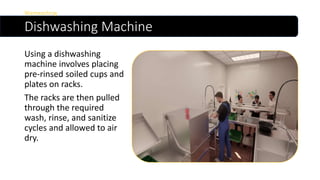
Dishwashing Machine
Using a dishwashing
machine involves placing
pre-rinsed soiled cups and
plates on racks.
The racks are then pulled
through the required
wash, rinse, and sanitize
cycles and allowed to air
dry.
Warewashing
Dishwashing Machine
A dishwashing machine must have a visible data plate indicating the
required conveyor speed, water temperature, and water pressure to
ensure items are properly cleaned and sanitized.
Warewashing
Using high-temperature hot water in place of chemicals is an
effective sanitization method.
Dishwashing machine hot water temperature requirements:
• 180°F (82°C) minimum water temperature
• 165°F (74°C) minimum water temperature for single-
temperature machines with stationary racks
Warewashing
Dishwashing Manually
Protection of Clean Items
What is it?
Protection of Clean Items
Cleaned and sanitized equipment and food contact surfaces must be
protected from contamination.
Drying
Equipment and utensils must be placed in a self-
draining position that allows air drying and never towel-
dried to avoid the possible transfer of microorganisms.
Storing
When equipment, utensils, linens, and single-service
and single-use articles have been cleaned and sanitized,
they must be stored properly to prevent contamination.
Cleaning the Facility
Wiping cloths - Wet
Cleaning the Facility
• Wet cloths are kept in a unique cleaning
bucket with a sanitizing solution.
• These cloths are used to wipe down tables
and worksurfaces between uses.
• Due to ongoing use, the sanitizing solution
must be replaced when it becomes heavily
soiled or no longer meets the required
concentration solution.
Wiping cloths - Dry
Cleaning the Facility
Server
• A server’s cloth, used for wiping food
spills from tableware, must be maintained
dry and not used for any other purpose.
Kitchen Staff
• Kitchen staff often keep a dry towel on
their person to handle hot plates, pots,
and pans.
• These towels may not be used to also clean
up food spills.
Clean-up after Illness Events
Cleaning the Facility
When anyone in a food operation gets sick and vomits or has diarrhea,
steps must be taken to properly clean the affected areas to prevent
cross-contamination and foodborne illness. The Food Code requires a
written plan to ensure the proper steps are taken during this sudden
and dramatic event.
A written plan should consider:
• Close off, or segregate the affected area to limit cross-contamination
• Clean up of vomit or fecal matter and sanitization of affected surfaces
• Disposal of any exposed food being prepared or already served
• Availability and instruction on when/how staff should use PPE and disinfectants
• Procedures to dispose of or clean and sanitize cleaning tools and equipment used
Custodian supplies
Cleaning the Facility
• Mop sinks (or floor sinks) should be
easy to access and well-maintained.
• Wall-mounted mop hooks should be
provided to store mops and allow
them to air dry thoroughly.
• The mop hooks should be positioned
above the floor sink to catch any
dripping from drying mops.
• Any hazardous products should be
stored safely with intact product
labels.
Cleaning Schedule
Cleaning the Facility
• To ensure that cleaning is completed
according to the minimum requirements of
the Food Code, it is important to develop a
cleaning schedule.
• Scheduled cleaning reduces the chances of
these important tasks slipping through the
cracks.
• Tracking these tasks with daily logs helps
avoid the problem of someone thinking
another person performed the required
task.
ICAM Chapter 10.pptx

ICAM Chapter 10.pptx

  • 1.
  • 3.
    Traditional Lasagna This week’srecipe from the Student Workbook is: We have now produced two mother sauces (tomato and béchamel) which we will combine with other ingredients to produce a full dish. We will need to safely defrost both sauces before we can make the traditional lasagna. Chapter Recipe
  • 4.
  • 5.
    What is it? Whentasked with cleaning and sanitizing equipment and utensils, it is vital to understand the following distinction: • Cleaning is the process of removing visible organic matter and debris • Sanitizing is the process of destroying pathogenic microorganisms • An item must be cleaned before it can be properly sanitized Cleaning Equipment & Utensils
  • 6.
    Objective A food-contact surfacecannot be adequately sanitized until it is cleaned of organic matter. Cleaning objectives: • Equipment food-contact surfaces and utensils shall be clean to sight and touch. • The food-contact surfaces of cooking equipment and pans shall be kept free of encrusted grease deposits and other soil accumulations. • Nonfood-contact equipment surfaces shall be free of dust, dirt, food residue, and other debris. Cleaning Equipment & Utensils
  • 7.
    When to clean: •Before each use with a different type of raw animal food • Switching tasks between raw foods and ready-to-eat foods • Between uses with raw fruits and vegetables and with TCS foods • Before using or storing a thermometer; and • At any time during the operation when contamination may have occurred Frequency Cleaning is an essential step in preventing cross-contamination within a food establishment. Equipment and utensils used with TCS foods must be cleaned, at a minimum, every 4 hours. Cleaning Equipment & Utensils
  • 8.
    When to clean: •Dry Cleaning • Precleaning • Washing Rinsing • Procedures Methods The Food Code outlines several methods for cleaning equipment and utensils based on equipment available, what needs to be cleaned, and the type of soil required to be removed. Cleaning Equipment & Utensils Brush, scrape, or vacuum food contact surfaces of dry food residue; TCS foods excluded Scraping equipment or utensils over a garbage disposal unit or trash can Removing or completely loosening soils Rinsing with water or a detergent-sanitizer solution to remove cleaning chemicals
  • 9.
    Types of cleaners: •Detergents (alkaline) • Degreasers • Delimers (acidic) • Abrasive Cleaners • Specialty Cleaners Types of Cleaners The primary purpose of cleaners is to remove solid dirt and debris before sanitization. Cleaning Equipment & Utensils Alkaline cleaners that combine with and loosen debris and other impurities. Synthetic Solvent-based cleaner that removes water-insoluble substances acidic cleaner used to remove mineral deposits contain small particles which help “scrub” at heavy dirt Specialty cleaners for deep fat fryer cleaners, beverage dispensers, micro-brewery equipment, etc.
  • 10.
  • 11.
    What is it? Again…an item must be cleaned before it can be adequately sanitized. Sanitizing Equipment & Utensils
  • 12.
    Objective & Frequency Objective: •After cleaning correctly, pathogens may still be on wiping cloths, food equipment, or utensils. • Therefore, sanitization is required to destroy these microorganisms of public health concern. • It is essential that sanitization happen after proper cleaning and rinsing to achieve maximum benefit. Frequency: • After cleaning and rinsing any food contact surface, sanitizing must be performed before it is used again. Sanitizing Equipment & Utensils
  • 13.
    Hot Water Method HotWater sanitization (or heat sanitizing) is achieved when equipment or utensils are fully submerged for at least: • 30 seconds • 171°F (77°C) water. Sanitizing Equipment & Utensils
  • 14.
    Chemical Sanitization Method ChemicalSanitization involves the application of sanitizing chemicals by immersion, brushing, or pressure spray methods. Sanitizing Equipment & Utensils * per manufacturer’s EPA-registered label instructions for an effective solution ** Quats is short for quaternary ammonium
  • 15.
    Chemical Solution TestKit The effectiveness of chemical sanitizers is determined primarily by the concentration and pH of the sanitizer solution. Testing is necessary to accurately determine the concentration of the chemical sanitizer solution. Sanitizing Equipment & Utensils
  • 16.
  • 17.
    Dishwashing Machine Using adishwashing machine involves placing pre-rinsed soiled cups and plates on racks. The racks are then pulled through the required wash, rinse, and sanitize cycles and allowed to air dry. Warewashing
  • 18.
    Dishwashing Machine A dishwashingmachine must have a visible data plate indicating the required conveyor speed, water temperature, and water pressure to ensure items are properly cleaned and sanitized. Warewashing Using high-temperature hot water in place of chemicals is an effective sanitization method. Dishwashing machine hot water temperature requirements: • 180°F (82°C) minimum water temperature • 165°F (74°C) minimum water temperature for single- temperature machines with stationary racks
  • 19.
  • 20.
  • 21.
    What is it? Protectionof Clean Items Cleaned and sanitized equipment and food contact surfaces must be protected from contamination. Drying Equipment and utensils must be placed in a self- draining position that allows air drying and never towel- dried to avoid the possible transfer of microorganisms. Storing When equipment, utensils, linens, and single-service and single-use articles have been cleaned and sanitized, they must be stored properly to prevent contamination.
  • 22.
  • 23.
    Wiping cloths -Wet Cleaning the Facility • Wet cloths are kept in a unique cleaning bucket with a sanitizing solution. • These cloths are used to wipe down tables and worksurfaces between uses. • Due to ongoing use, the sanitizing solution must be replaced when it becomes heavily soiled or no longer meets the required concentration solution.
  • 24.
    Wiping cloths -Dry Cleaning the Facility Server • A server’s cloth, used for wiping food spills from tableware, must be maintained dry and not used for any other purpose. Kitchen Staff • Kitchen staff often keep a dry towel on their person to handle hot plates, pots, and pans. • These towels may not be used to also clean up food spills.
  • 25.
    Clean-up after IllnessEvents Cleaning the Facility When anyone in a food operation gets sick and vomits or has diarrhea, steps must be taken to properly clean the affected areas to prevent cross-contamination and foodborne illness. The Food Code requires a written plan to ensure the proper steps are taken during this sudden and dramatic event. A written plan should consider: • Close off, or segregate the affected area to limit cross-contamination • Clean up of vomit or fecal matter and sanitization of affected surfaces • Disposal of any exposed food being prepared or already served • Availability and instruction on when/how staff should use PPE and disinfectants • Procedures to dispose of or clean and sanitize cleaning tools and equipment used
  • 26.
    Custodian supplies Cleaning theFacility • Mop sinks (or floor sinks) should be easy to access and well-maintained. • Wall-mounted mop hooks should be provided to store mops and allow them to air dry thoroughly. • The mop hooks should be positioned above the floor sink to catch any dripping from drying mops. • Any hazardous products should be stored safely with intact product labels.
  • 27.
    Cleaning Schedule Cleaning theFacility • To ensure that cleaning is completed according to the minimum requirements of the Food Code, it is important to develop a cleaning schedule. • Scheduled cleaning reduces the chances of these important tasks slipping through the cracks. • Tracking these tasks with daily logs helps avoid the problem of someone thinking another person performed the required task.