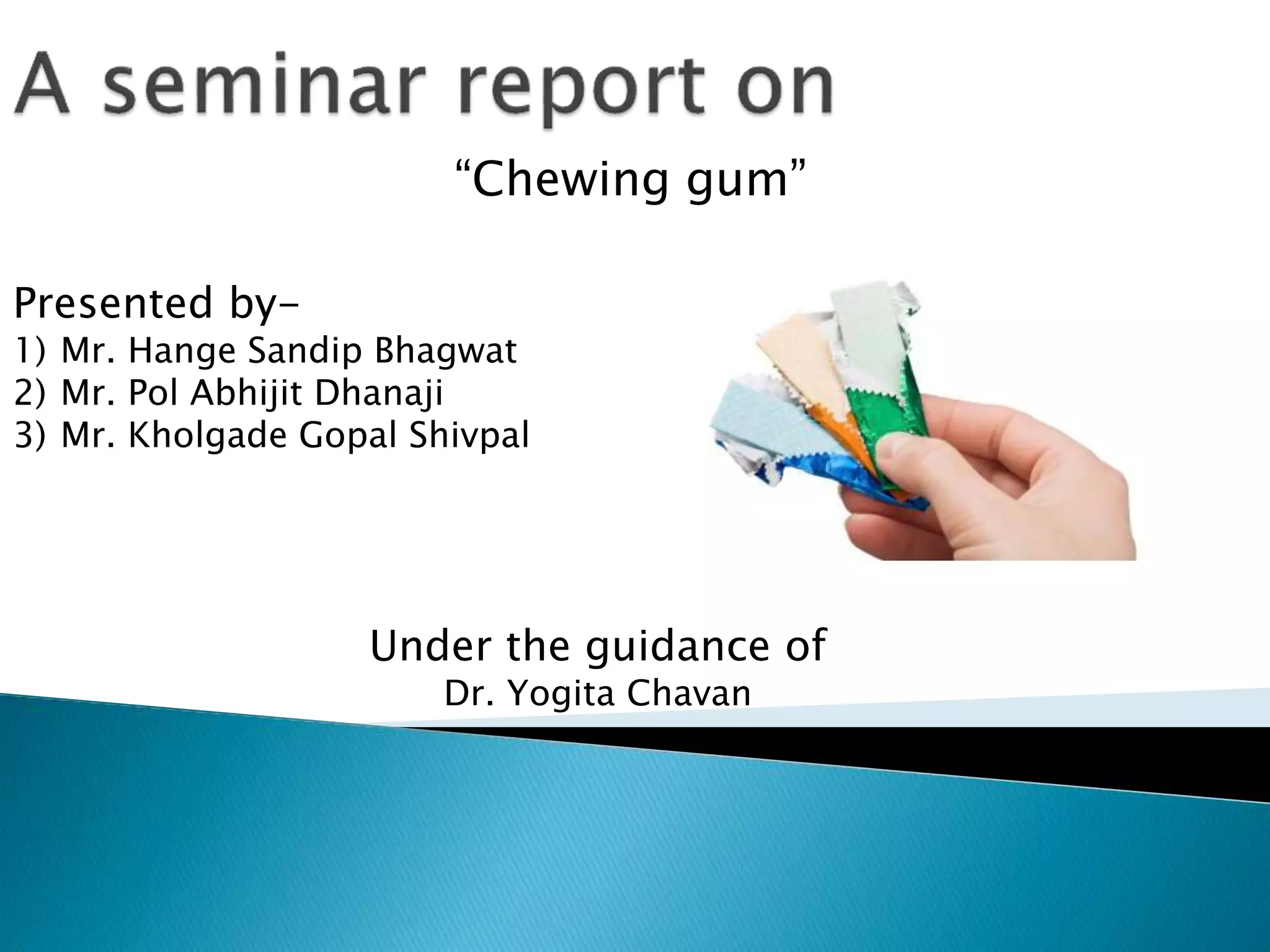
“Chewing gum”
Presented by-
1) Mr. Hange Sandip Bhagwat
2) Mr. Pol Abhijit Dhanaji
3) Mr. Kholgade Gopal Shivpal
Under the guidance of
Dr. Yogita Chavan
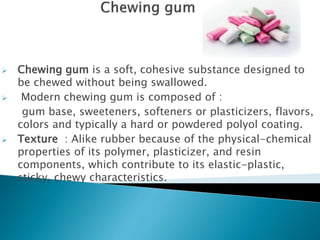
 Chewing gum is a soft, cohesive substance designed to
be chewed without being swallowed.
 Modern chewing gum is composed of :
gum base, sweeteners, softeners or plasticizers, flavors,
colors and typically a hard or powdered polyol coating.
 Texture : Alike rubber because of the physical-chemical
properties of its polymer, plasticizer, and resin
components, which contribute to its elastic-plastic,
sticky, chewy characteristics.
 People worldwide have chewed on natural
materials for hundreds of years.
 In earlier days mastic tree bark, chicle, blubber,
cocoa leaves, tobacco leaves and betel nut are
used as traditional chewing gum.
 Some of these materials include thickened resin
and latex from certain types of trees, various
sweet grasses, leaves, grains and waxes.
 The ancient Greeks chewed mastic gum (or
mastiche, pronounced "mas-tee-ka") for
centuries. This substance is formed from the
resin contained in the bark of the mastic tree
found mainly in Greece and Turkey.
 Modern gum products evolved from a chicle-
based gum brought to the United States in
the early 1860s.
 Chicle is derived from the milky juice (latex)
of the sapodilla tree that grows in tropical
rain forests of Central America. This tree is
found mainly in the areas of Mexico.
 William F. Semple was honored for this work
with the first patent to manufacture chewing
gum in December 1869.
 Now a days we use synthetic or artificial
processed gums.
 Production in world:
35% Wrigley Company (USA)
26% Cadbury Trebor Bassett (UK)
14% Lotte (South Korea + Japan)
6% Perfetti Van Melle (Italy)
2% Hershey's (USA)
The remaining 17% estimated 200 to 250 smaller gum
companies
 Consumption in world:
Iran -82%
saudi Arabia-79%
USA -59%
Spain -54%
France -52%
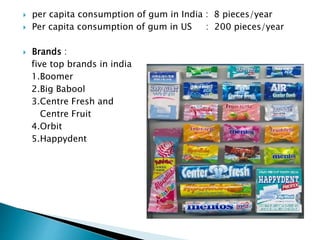
 per capita consumption of gum in India : 8 pieces/year
 Per capita consumption of gum in US : 200 pieces/year
 Brands :
five top brands in india
1.Boomer
2.Big Babool
3.Centre Fresh and
Centre Fruit
4.Orbit
5.Happydent
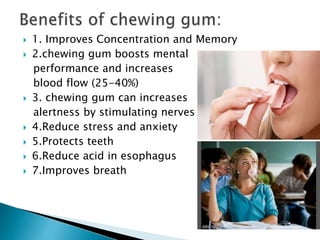
 1. Improves Concentration and Memory
 2.chewing gum boosts mental
performance and increases
blood flow (25-40%)
 3. chewing gum can increases
alertness by stimulating nerves
 4.Reduce stress and anxiety
 5.Protects teeth
 6.Reduce acid in esophagus
 7.Improves breath
 Bubble gum - blowing bubbles because film-
forming characteristics.
 Sugar-free gum - artificial sweeteners to
provide the taste.
 Ball Gum – This gum has shape like ball
 Center-filled Gum – center-filled gum in his
center has a soft mass, usually filled with
some tasty liquid.
 Nicotine gum – nicotine chewing gum is
designed for people who are trying to quit
smoking.
 Gum base
 Texturisers
 Antioxidants
 Sweeteners (Sugar, Dextrose and glucose
syrup)
 Humectants
 Flavors
 Colors
 polyols
 non-nutritive, non-digestible, water-insoluble
 used to carry sweeteners, flavors, and any other
substances in chewing gum
 provides all the basic textural and masticatory
properties of gum.
 The FDA allows 46 different chemicals under the
umbrella of "gum base.
 These chemicals are grouped into the following
categories.
 Natural coagulated or concentrated lattices of
vegetable origin: These include many of the resins
such as chicle that were traditionally chewed as gum.
It also includes natural waxes
like beeswax and latex (natural rubber).
1) Chicle - It is the coagulated latex from sapodilla
tree.
2) Jelutong – pontianank – It is latex of the jelutong
tree which grows mainly in Malesia and Sumatra and
used as partial replacement of chicle.
3) Other Resins- Quit high ratio of synthetics products
may be used in present day formulation of gum
bases.
4) Other natural substances – Guttter slak, latche ,
capsi. Perillo , Nispero tinu and pine tree resin .
5) Synthetic polymer- polyvinyl acetate ,
styrenebutadive rubber , isobutylene-isoprene
copolymer and polyisobutylene .
 Polymers make gum base more extensible
Substances added to the chewing gum to modify the
mouth feel and facilitate processing.
Eg. Calcium carbonate or talc.
Low cost chewing gum base contain 40- 55%
texturiser
High quality chewing gum base 18 – 20%
 Bubble gum base 30 to 60%
 calcium carbonate is not an accepteble texturiser in
product where there is an acid componant to flavour
as acid will react acid to produce Co2.
Acids are used only in fruit flavoured products and
here talk should be used.
If CaCO3 is used then Co2 generated could blow up
the sealed package causing the packaging to fail, and
also acid flavour is lost.
 Gum base normally contain a permitted
antioxidant.
Eg. Butylated hydroxy toluene(BHT),
butylated hydroxy anisole(BHA), Tocopherol.
 Oxidation of gum base occures and antioxidant
work as free radicle
 So, oxidation is a free radicle process and
relatively unaffected by ambient temp.
 To avoid gritty flavour, sugar should have
small particle size.
 Particle size above(20-40%) are judged to be
gritty.
 For chewing gum icing sugar is used.
 Sugar used for chewing gum is 96% parsing
through sieve’
 Milled sugar are agglomerate if exposed to
humidity.
 If introducing the sugar directly into gum
during production is not possible, then 3%
dried starch can be added.
 Dextrose monohydrate is sometimes used as
an alternative to sucrose in chewing gum.
 Gives cooling effect in mouth. (goes well with
mint but not with others.)
 Glucose syrup of 38 DE
 SO level of syrup should be less than 40 ppm
 Not suitable for chewing gum as chewing
gum can contain 25% glucose syrup and not
more than 100 ppm of so2
 Added to lower moist and prevent drying out
 e.g. glycerin and sorbitol.
 humectants are added to chewing gum
formulations to extend the softness of the chewing
gum during storage, distribution and sales.
 Flavours do more than just give taste to the
chewing gum product.
 The flavour is plasticizer for the gum base
and will have an effect on the texture of the
chewing gum.
 Flavours for chewing gums should be
compounded of essential oils, which are the
best plasticizers for the gum base.
 Final product should be prepared by mixing
sugar syrup derived from sucrose, high DE
glucose syrup and dextrose with icing sugar,
flavouring , gum base at a rate of about 25%
of total batch
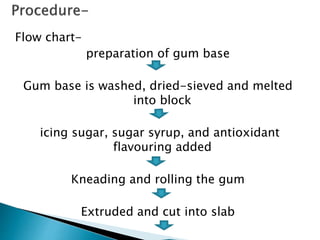
Flow chart-
preparation of gum base
Gum base is washed, dried-sieved and melted
into block
icing sugar, sugar syrup, and antioxidant
flavouring added
Kneading and rolling the gum
Extruded and cut into slab
Let mature for 24 hrs
Slabs kneeded at elevated temp.
Makes ropes/sticks
Wrapping.
 Elastomers: provide the elasticity
eg latex - commercially produced (tunu, jelutong, or
sapodilla) or synthetic rubbers (e.g. styrene-butadiene
rubber, butyl rubber, polyisobutylene).
 Resins: provide a cohesive body or strength eg. glycerol
esters of gum, terpene resins, and polyvinyl acetate.
 Waxes: act as softening agents eg. paraffin or
microcrystalline wax.
 Fats: behave as plasticizers and come from
hydrogenated vegetable oils.
 Emulsifiers: help to hydrate eg.lecithin or glycerol
monostearate.
 Fillers: impart texture and the most commonly used are
calcium carbonate or talc.
 Antioxidants: protect from oxidation and extend shelf-
life eg. BHT.
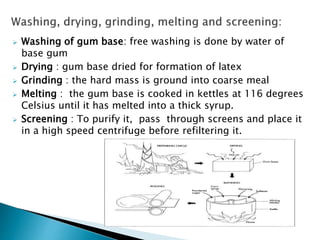
 Washing of gum base: free washing is done by water of
base gum
 Drying : gum base dried for formation of latex
 Grinding : the hard mass is ground into coarse meal
 Melting : the gum base is cooked in kettles at 116 degrees
Celsius until it has melted into a thick syrup.
 Screening : To purify it, pass through screens and place it
in a high speed centrifuge before refiltering it.
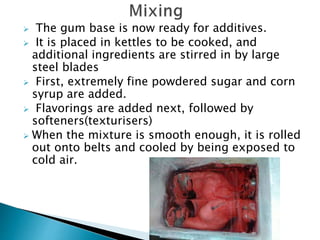
 The gum base is now ready for additives.
 It is placed in kettles to be cooked, and
additional ingredients are stirred in by large
steel blades
 First, extremely fine powdered sugar and corn
syrup are added.
 Flavorings are added next, followed by
softeners(texturisers)
 When the mixture is smooth enough, it is rolled
out onto belts and cooled by being exposed to
cold air.
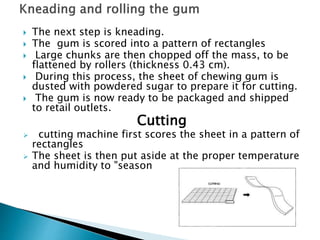
 The next step is kneading.
 The gum is scored into a pattern of rectangles
 Large chunks are then chopped off the mass, to be
flattened by rollers (thickness 0.43 cm).
 During this process, the sheet of chewing gum is
dusted with powdered sugar to prepare it for cutting.
 The gum is now ready to be packaged and shipped
to retail outlets.
Cutting
 cutting machine first scores the sheet in a pattern of
rectangles
 The sheet is then put aside at the proper temperature
and humidity to "season
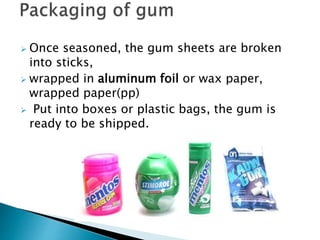
 Once seasoned, the gum sheets are broken
into sticks,
 wrapped in aluminum foil or wax paper,
wrapped paper(pp)
 Put into boxes or plastic bags, the gum is
ready to be shipped.

Chewing gum seminar

  • 1.
    “Chewing gum” Presented by- 1)Mr. Hange Sandip Bhagwat 2) Mr. Pol Abhijit Dhanaji 3) Mr. Kholgade Gopal Shivpal Under the guidance of Dr. Yogita Chavan
  • 2.
     Chewing gumis a soft, cohesive substance designed to be chewed without being swallowed.  Modern chewing gum is composed of : gum base, sweeteners, softeners or plasticizers, flavors, colors and typically a hard or powdered polyol coating.  Texture : Alike rubber because of the physical-chemical properties of its polymer, plasticizer, and resin components, which contribute to its elastic-plastic, sticky, chewy characteristics.
  • 3.
     People worldwidehave chewed on natural materials for hundreds of years.  In earlier days mastic tree bark, chicle, blubber, cocoa leaves, tobacco leaves and betel nut are used as traditional chewing gum.  Some of these materials include thickened resin and latex from certain types of trees, various sweet grasses, leaves, grains and waxes.  The ancient Greeks chewed mastic gum (or mastiche, pronounced "mas-tee-ka") for centuries. This substance is formed from the resin contained in the bark of the mastic tree found mainly in Greece and Turkey.
  • 4.
     Modern gumproducts evolved from a chicle- based gum brought to the United States in the early 1860s.  Chicle is derived from the milky juice (latex) of the sapodilla tree that grows in tropical rain forests of Central America. This tree is found mainly in the areas of Mexico.  William F. Semple was honored for this work with the first patent to manufacture chewing gum in December 1869.  Now a days we use synthetic or artificial processed gums.
  • 5.
     Production inworld: 35% Wrigley Company (USA) 26% Cadbury Trebor Bassett (UK) 14% Lotte (South Korea + Japan) 6% Perfetti Van Melle (Italy) 2% Hershey's (USA) The remaining 17% estimated 200 to 250 smaller gum companies  Consumption in world: Iran -82% saudi Arabia-79% USA -59% Spain -54% France -52%
  • 6.
     per capitaconsumption of gum in India : 8 pieces/year  Per capita consumption of gum in US : 200 pieces/year  Brands : five top brands in india 1.Boomer 2.Big Babool 3.Centre Fresh and Centre Fruit 4.Orbit 5.Happydent
  • 7.
     1. ImprovesConcentration and Memory  2.chewing gum boosts mental performance and increases blood flow (25-40%)  3. chewing gum can increases alertness by stimulating nerves  4.Reduce stress and anxiety  5.Protects teeth  6.Reduce acid in esophagus  7.Improves breath
  • 8.
     Bubble gum- blowing bubbles because film- forming characteristics.  Sugar-free gum - artificial sweeteners to provide the taste.  Ball Gum – This gum has shape like ball  Center-filled Gum – center-filled gum in his center has a soft mass, usually filled with some tasty liquid.  Nicotine gum – nicotine chewing gum is designed for people who are trying to quit smoking.
  • 9.
     Gum base Texturisers  Antioxidants  Sweeteners (Sugar, Dextrose and glucose syrup)  Humectants  Flavors  Colors  polyols
  • 10.
     non-nutritive, non-digestible,water-insoluble  used to carry sweeteners, flavors, and any other substances in chewing gum  provides all the basic textural and masticatory properties of gum.  The FDA allows 46 different chemicals under the umbrella of "gum base.  These chemicals are grouped into the following categories.  Natural coagulated or concentrated lattices of vegetable origin: These include many of the resins such as chicle that were traditionally chewed as gum. It also includes natural waxes like beeswax and latex (natural rubber).
  • 11.
    1) Chicle -It is the coagulated latex from sapodilla tree. 2) Jelutong – pontianank – It is latex of the jelutong tree which grows mainly in Malesia and Sumatra and used as partial replacement of chicle. 3) Other Resins- Quit high ratio of synthetics products may be used in present day formulation of gum bases. 4) Other natural substances – Guttter slak, latche , capsi. Perillo , Nispero tinu and pine tree resin . 5) Synthetic polymer- polyvinyl acetate , styrenebutadive rubber , isobutylene-isoprene copolymer and polyisobutylene .  Polymers make gum base more extensible
  • 12.
    Substances added tothe chewing gum to modify the mouth feel and facilitate processing. Eg. Calcium carbonate or talc. Low cost chewing gum base contain 40- 55% texturiser High quality chewing gum base 18 – 20%  Bubble gum base 30 to 60%  calcium carbonate is not an accepteble texturiser in product where there is an acid componant to flavour as acid will react acid to produce Co2. Acids are used only in fruit flavoured products and here talk should be used. If CaCO3 is used then Co2 generated could blow up the sealed package causing the packaging to fail, and also acid flavour is lost.
  • 13.
     Gum basenormally contain a permitted antioxidant. Eg. Butylated hydroxy toluene(BHT), butylated hydroxy anisole(BHA), Tocopherol.  Oxidation of gum base occures and antioxidant work as free radicle  So, oxidation is a free radicle process and relatively unaffected by ambient temp.
  • 14.
     To avoidgritty flavour, sugar should have small particle size.  Particle size above(20-40%) are judged to be gritty.  For chewing gum icing sugar is used.  Sugar used for chewing gum is 96% parsing through sieve’  Milled sugar are agglomerate if exposed to humidity.  If introducing the sugar directly into gum during production is not possible, then 3% dried starch can be added.
  • 15.
     Dextrose monohydrateis sometimes used as an alternative to sucrose in chewing gum.  Gives cooling effect in mouth. (goes well with mint but not with others.)
  • 16.
     Glucose syrupof 38 DE  SO level of syrup should be less than 40 ppm  Not suitable for chewing gum as chewing gum can contain 25% glucose syrup and not more than 100 ppm of so2
  • 17.
     Added tolower moist and prevent drying out  e.g. glycerin and sorbitol.  humectants are added to chewing gum formulations to extend the softness of the chewing gum during storage, distribution and sales.
  • 18.
     Flavours domore than just give taste to the chewing gum product.  The flavour is plasticizer for the gum base and will have an effect on the texture of the chewing gum.  Flavours for chewing gums should be compounded of essential oils, which are the best plasticizers for the gum base.
  • 19.
     Final productshould be prepared by mixing sugar syrup derived from sucrose, high DE glucose syrup and dextrose with icing sugar, flavouring , gum base at a rate of about 25% of total batch
  • 20.
    Flow chart- preparation ofgum base Gum base is washed, dried-sieved and melted into block icing sugar, sugar syrup, and antioxidant flavouring added Kneading and rolling the gum Extruded and cut into slab
  • 21.
    Let mature for24 hrs Slabs kneeded at elevated temp. Makes ropes/sticks Wrapping.
  • 22.
     Elastomers: providethe elasticity eg latex - commercially produced (tunu, jelutong, or sapodilla) or synthetic rubbers (e.g. styrene-butadiene rubber, butyl rubber, polyisobutylene).  Resins: provide a cohesive body or strength eg. glycerol esters of gum, terpene resins, and polyvinyl acetate.  Waxes: act as softening agents eg. paraffin or microcrystalline wax.  Fats: behave as plasticizers and come from hydrogenated vegetable oils.  Emulsifiers: help to hydrate eg.lecithin or glycerol monostearate.  Fillers: impart texture and the most commonly used are calcium carbonate or talc.  Antioxidants: protect from oxidation and extend shelf- life eg. BHT.
  • 23.
     Washing ofgum base: free washing is done by water of base gum  Drying : gum base dried for formation of latex  Grinding : the hard mass is ground into coarse meal  Melting : the gum base is cooked in kettles at 116 degrees Celsius until it has melted into a thick syrup.  Screening : To purify it, pass through screens and place it in a high speed centrifuge before refiltering it.
  • 24.
     The gumbase is now ready for additives.  It is placed in kettles to be cooked, and additional ingredients are stirred in by large steel blades  First, extremely fine powdered sugar and corn syrup are added.  Flavorings are added next, followed by softeners(texturisers)  When the mixture is smooth enough, it is rolled out onto belts and cooled by being exposed to cold air.
  • 25.
     The nextstep is kneading.  The gum is scored into a pattern of rectangles  Large chunks are then chopped off the mass, to be flattened by rollers (thickness 0.43 cm).  During this process, the sheet of chewing gum is dusted with powdered sugar to prepare it for cutting.  The gum is now ready to be packaged and shipped to retail outlets. Cutting  cutting machine first scores the sheet in a pattern of rectangles  The sheet is then put aside at the proper temperature and humidity to "season
  • 26.
     Once seasoned,the gum sheets are broken into sticks,  wrapped in aluminum foil or wax paper, wrapped paper(pp)  Put into boxes or plastic bags, the gum is ready to be shipped.