medicated chewing gums
PRESENTED BY
BHAVSAR SHWETA H.
(M.PHARM FIRST YEAR SECOND SEM.)
GUIDED BY
Dr. G.D.BASARKAR
M.PHARM, Ph.D.
DEPARTMENT OF PHARMACEUTICS
SNJB’ S S.S.D.J.COLLEGE OF PHARMACY, NEMINAGAR,
CHANDWAD
11/13/16 1SNJB's SSDJ COP, Chandwad
Introduction
Advantages
Disadvantages
Composition of mcg
Methods & Limitations for manufacturing
packaging
Factors affecting on drug release
Evaluation
Application
Marketed Formulations
Future trends
Conclusion
References11/13/16 2SNJB's SSDJ COP,
Chandwad
 Chewing gum has been used worldwide since ancient times when
man experienced the pleasure of chewing a variety of substances.
 In recent years chewing gums are considered to be friendly oral
mucosal drug delivery systems .
 Commercially available medicated chewing gums are currently
available for ,
 pain relief,
 Smoking cessation
 travel illness and freshening of breath.
11/13/16 3SNJB's SSDJ COP,
Chandwad
11/13/16 SNJB's SSDJ COP,
Chandwad
4
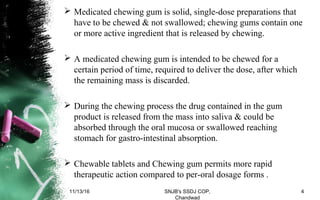
 Medicated chewing gum is solid, single-dose preparations that
have to be chewed & not swallowed; chewing gums contain one
or more active ingredient that is released by chewing.
 A medicated chewing gum is intended to be chewed for a
certain period of time, required to deliver the dose, after which
the remaining mass is discarded.
 During the chewing process the drug contained in the gum
product is released from the mass into saliva & could be
absorbed through the oral mucosa or swallowed reaching
stomach for gastro-intestinal absorption.
 Chewable tablets and Chewing gum permits more rapid
therapeutic action compared to per-oral dosage forms .
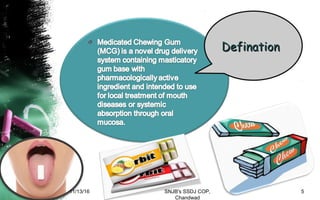
DefinationDefination
11/13/16 5SNJB's SSDJ COP,
Chandwad
The first medicated chewing gum was introduced
in the USA in 1924 with the brand name
Aspergum for Analgesic Activity.
In 1848, the first commercial chewing gum
named State of Maine Pure Spruce Gum
appeared in the market whereas the first patent
was issued to Dr. W.F. Semple who was a
dentist at Ohio in 1869.
11/13/16 SNJB's SSDJ COP,
Chandwad
6
history
11/13/16 7SNJB's SSDJ COP,
Chandwad
11/13/16 8SNJB's SSDJ COP,
Chandwad
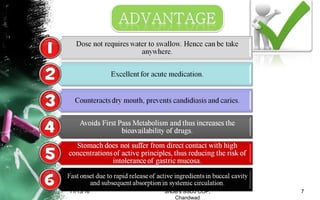
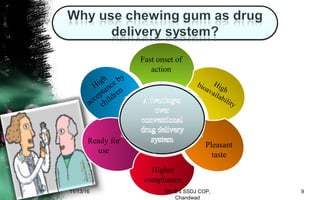
Fast onset of
action
High
bioavailability
Pleasant
taste
Higher
compliance
Ready for
use
High
acceptance by
children
11/13/16 9SNJB's SSDJ COP,
Chandwad
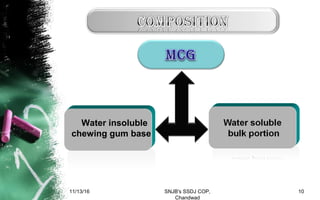
Water insoluble
chewing gum base
11/13/16 10SNJB's SSDJ COP,
Chandwad
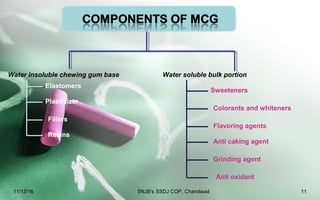
Water insoluble chewing gum base Water soluble bulk portion
Elastomers
Plasticizer
Fillers
Resins
Sweeteners
Colorants and whiteners
Flavoring agents
Anti caking agent
Grinding agent
Anti oxidant
11/13/16 11SNJB's SSDJ COP, Chandwad
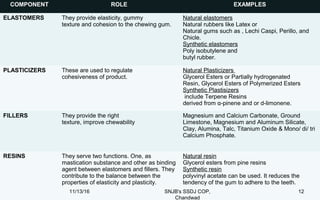
COMPONENT ROLE EXAMPLES
ELASTOMERS They provide elasticity, gummy
texture and cohesion to the chewing gum.
Natural elastomers
Natural rubbers like Latex or
Natural gums such as , Lechi Caspi, Perillo, and
Chicle.
Synthetic elastomers
Poly isobutylene and
butyl rubber.
PLASTICIZERS These are used to regulate
cohesiveness of product.
Natural Plasticizers
Glycerol Esters or Partially hydrogenated
Resin, Glycerol Esters of Polymerized Esters
Synthetic Plastisizers
include Terpene Resins
derived from α-pinene and or d-limonene.
FILLERS They provide the right
texture, improve chewability
Magnesium and Calcium Carbonate, Ground
Limestone, Magnesium and Aluminum Silicate,
Clay, Alumina, Talc, Titanium Oxide & Mono/ di/ tri
Calcium Phosphate.
RESINS They serve two functions. One, as
mastication substance and other as binding
agent between elastomers and fillers. They
contribute to the balance between the
properties of elasticity and plasticity.
Natural resin
Glycerol esters from pine resins
Synthetic resin
polyvinyl acetate can be used. It reduces the
tendency of the gum to adhere to the teeth.
11/13/16 12SNJB's SSDJ COP,
Chandwad
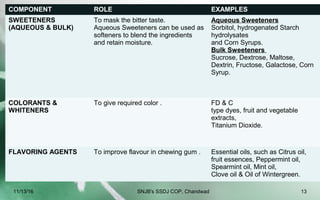
COMPONENT ROLE EXAMPLES
SWEETENERS
(AQUEOUS & BULK)
To mask the bitter taste.
Aqueous Sweeteners can be used as
softeners to blend the ingredients
and retain moisture.
Aqueous Sweeteners
Sorbitol, hydrogenated Starch
hydrolysates
and Corn Syrups.
Bulk Sweeteners
Sucrose, Dextrose, Maltose,
Dextrin, Fructose, Galactose, Corn
Syrup.
COLORANTS &
WHITENERS
To give required color . FD & C
type dyes, fruit and vegetable
extracts,
Titanium Dioxide.
FLAVORING AGENTS To improve flavour in chewing gum . Essential oils, such as Citrus oil,
fruit essences, Peppermint oil,
Spearmint oil, Mint oil,
Clove oil & Oil of Wintergreen.
11/13/16 13SNJB's SSDJ COP, Chandwad
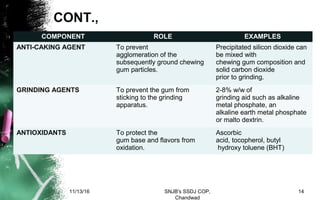
CONT.,
COMPONENT ROLE EXAMPLES
ANTI-CAKING AGENT To prevent
agglomeration of the
subsequently ground chewing
gum particles.
Precipitated silicon dioxide can
be mixed with
chewing gum composition and
solid carbon dioxide
prior to grinding.
GRINDING AGENTS To prevent the gum from
sticking to the grinding
apparatus.
2-8% w/w of
grinding aid such as alkaline
metal phosphate, an
alkaline earth metal phosphate
or malto dextrin.
ANTIOXIDANTS To protect the
gum base and flavors from
oxidation.
Ascorbic
acid, tocopherol, butyl
hydroxy toluene (BHT)
11/13/16 14SNJB's SSDJ COP,
Chandwad
11/13/16 15SNJB's SSDJ COP,
Chandwad
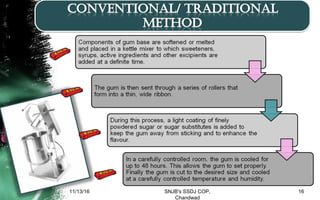
11/13/16 16SNJB's SSDJ COP,
Chandwad
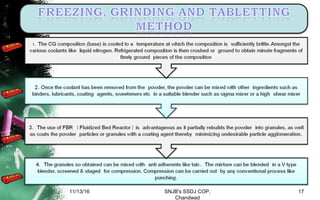
11/13/16 17SNJB's SSDJ COP,
Chandwad
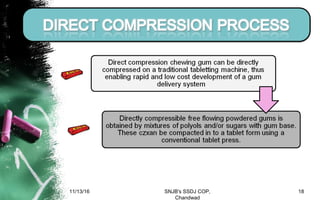
11/13/16 18SNJB's SSDJ COP,
Chandwad
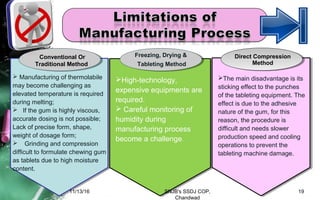
Conventional Or
Traditional Method
Freezing, Drying &
Tableting Method
Freezing, Drying &
Tableting Method
Direct Compression
Method
 Manufacturing of thermolabile
may become challenging as
elevated temperature is required
during melting;
 If the gum is highly viscous,
accurate dosing is not possible;
Lack of precise form, shape,
weight of dosage form;
 Grinding and compression
difficult to formulate chewing gum
as tablets due to high moisture
content.
High-technology,
expensive equipments are
required.
 Careful monitoring of
humidity during
manufacturing process
become a challenge.
The main disadvantage is its
sticking effect to the punches
of the tableting equipment. The
effect is due to the adhesive
nature of the gum, for this
reason, the procedure is
difficult and needs slower
production speed and cooling
operations to prevent the
tableting machine damage.
11/13/16 19SNJB's SSDJ COP,
Chandwad
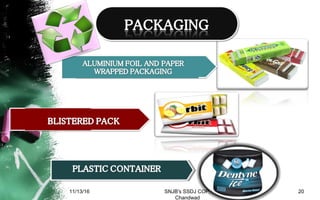
Plastic container
11/13/16 20SNJB's SSDJ COP,
Chandwad
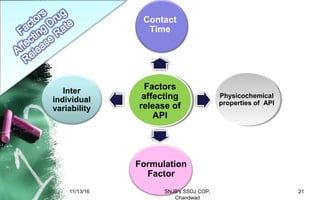
Factors
affecting
release of
API
Physicochemical
properties of API
Inter
individual
variability
Contact
Time
Formulation
Factor
11/13/16 21SNJB's SSDJ COP,
Chandwad
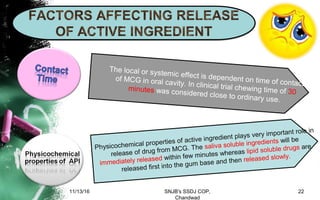
Physicochemical properties of active ingredient plays very important role in
release of drug from MCG. The saliva soluble ingredients will be
immediately released within few minutes whereas lipid soluble drugs are
released first into the gum base and then released slowly.
The local or systemic effect is dependent on time of contact
of MCG in oral cavity. In clinical trial chewing time of 30minutes was considered close to ordinary use.
11/13/16 22SNJB's SSDJ COP,
Chandwad
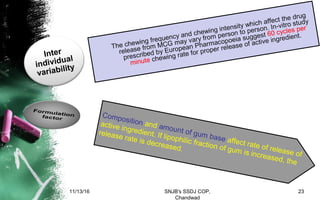
The chewing frequency and chewing intensity which affect the drug
release from MCG may vary from person to person. In-vitro study
prescribed by European Pharmacopoeia suggest 60 cycles per
minute chewing rate for proper release of active ingredient.
Composition and amount of gum base affect rate of release of
active ingredient. If lipophilic fraction of gum is increased, the
release rate is decreased.
Inter
individual
variability
11/13/16 23SNJB's SSDJ COP,
Chandwad
Weight variation
Ten chewing gums of each formulation are weighed. The average
weight and standard deviation are calculated.
Uniformity of content
Ten gums are elected randomly. Each gum is first dissolved in 50
ml suitable solvent. The amount of active ingredient is determined
by measuring UV absorbance. The experiment is repeated three
times.
11/13/16 24SNJB's SSDJ COP,
Chandwad
In vitro drug release
A mastication device which simulates the mastication of
chewing gum in human is used to perform the drug release
study. The device consisted of a piston which strokes the
gum (60 strokes/min) at different points on a random base
and a chamber which holds the gum and the release
medium (pH 6.8 phosphate buffer). Water (37°C) was
circulated through a jacket around the receiver chamber to
simulate the in vivo temperature. Sample taken at different
time interval are analyzed by UV spectroscopy.
Others
Color, shape, fragrance, taste etc are observed.
11/13/16 25SNJB's SSDJ COP,
Chandwad
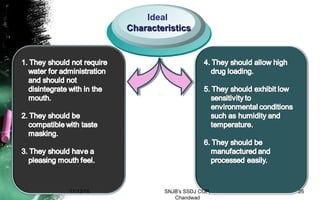
Ideal
CharacteristicsCharacteristics
11/13/16 26SNJB's SSDJ COP,
Chandwad
The MCGs can also be used as an alternative tool to buccal and
sublingual tablets which are intended to act systemically because
active ingredient is released more uniformly and cover greater area of
absorption in oral cavity.
Oral diseases are prevented or cured with MCG.
MCGs can be used for systemic effect in conditions like vitamin C
deficiency, pain & fever, alertness, motion sickness, smoking
cessation, as well as for local effect in conditions like fresh breath,
dental caries, antiplaque, fungal, and bacterial infections
Prevention and cure of oral diseases is a prime target for chewing
gum formulations.
11/13/16 27SNJB's SSDJ COP, Chandwad
11
Fluoride containing gums have been useful
in preventing dental caries in children and
in adults with. Xerostomia(dry mouth)
 Chlorhexidine chewing gum can be used to
treat gingivitis, periodontitis, oral and
pharyngeal infections.
 It can also be used for inhibition of plaque
growth.
Chlorhexidine chewing gum offers large flexibility
in its formulation as it gives less staining of the
teeth and is distributed evenly in the oral cavity.[42]
 The bitter taste of chlorhexidine can be
masked quite well in a chewing gum
formulation.
11/13/16 28SNJB's SSDJ COP, Chandwad
22
3
33
Xerostomia, Allergy, Motion sickness, Acidity, etc are all indications for
which chewing gum is a means of drug delivery.
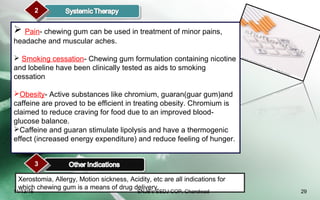
 Pain- chewing gum can be used in treatment of minor pains,
headache and muscular aches.
 Smoking cessation- Chewing gum formulation containing nicotine
and lobeline have been clinically tested as aids to smoking
cessation
Obesity- Active substances like chromium, guaran(guar gum)and
caffeine are proved to be efficient in treating obesity. Chromium is
claimed to reduce craving for food due to an improved blood-
glucose balance.
Caffeine and guaran stimulate lipolysis and have a thermogenic
effect (increased energy expenditure) and reduce feeling of hunger.
29SNJB's SSDJ COP, Chandwad11/13/16
NICOTINE GUMNICOTINE GUMNICOTINE GUMNICOTINE GUM
Nicotine gum is a type of chewing gum that delivers nicotine toNicotine gum is a type of chewing gum that delivers nicotine to
the body. It is used as an aid inthe body. It is used as an aid in Nicotine Replacement TherapyNicotine Replacement Therapy
(NRT), a process for smoking cessation .The nicotine is(NRT), a process for smoking cessation .The nicotine is
delivered to the bloodstream via absorption by the tissues of thedelivered to the bloodstream via absorption by the tissues of the
mouth.mouth.
It is currently available .The pieces are usually available inIt is currently available .The pieces are usually available in
individual foil packages and come in various flavors. Nicotineindividual foil packages and come in various flavors. Nicotine
content is usually either 2 or 4 mg of nicotine, roughly thecontent is usually either 2 or 4 mg of nicotine, roughly the
nicotine content of 1 or 2 cigarettes, with the appropriate contentnicotine content of 1 or 2 cigarettes, with the appropriate content
and dosage depending on the smoking habits of the user.and dosage depending on the smoking habits of the user.
Nicotine gum is a type of chewing gum that delivers nicotine toNicotine gum is a type of chewing gum that delivers nicotine to
the body. It is used as an aid inthe body. It is used as an aid in Nicotine Replacement TherapyNicotine Replacement Therapy
(NRT), a process for smoking cessation .The nicotine is(NRT), a process for smoking cessation .The nicotine is
delivered to the bloodstream via absorption by the tissues of thedelivered to the bloodstream via absorption by the tissues of the
mouth.mouth.
It is currently available .The pieces are usually available inIt is currently available .The pieces are usually available in
individual foil packages and come in various flavors. Nicotineindividual foil packages and come in various flavors. Nicotine
content is usually either 2 or 4 mg of nicotine, roughly thecontent is usually either 2 or 4 mg of nicotine, roughly the
nicotine content of 1 or 2 cigarettes, with the appropriate contentnicotine content of 1 or 2 cigarettes, with the appropriate content
and dosage depending on the smoking habits of the user.and dosage depending on the smoking habits of the user.
11/13/16 30SNJB's SSDJ COP,
Chandwad
31SNJB's SSDJ COP,
Chandwad
11/13/16
11/13/16 32SNJB's SSDJ COP,
Chandwad
 Nowadays more and more disease can be treated with NDDS.
 Generally it takes time for a new drug delivery system to establish
itself in the market.
 But MCG is believed to manifest its position as a convenient and
advantageous drug delivery system as it meets the high quality
standards of Pharmaceutical Industry and can be formulated to
obtain different release profiles of active substances.
 In the future we may see that more and more drugs formulated
into chewing gum in preference to other delivery systems.
 The reason is simple that the chewing gum delivery system is
convenient , easy to administer anywhere, anytime and its
pleasant taste increases the product acceptability and patient
compliance.
11/13/16 33SNJB's SSDJ COP,
Chandwad
Finally it is concluded that chewing gum is an excellent
drug delivery system for self medication and having its
own merits.
So in forth coming years it will be a much more common
and popular drug delivery system.
11/13/16 34SNJB's SSDJ COP,
Chandwad
CONCLUSION
11/13/16 35SNJB's SSDJ COP,
Chandwad
11/13/16 36SNJB's SSDJ COP,
Chandwad

medicated chewing gum

  • 1.
    medicated chewing gums PRESENTEDBY BHAVSAR SHWETA H. (M.PHARM FIRST YEAR SECOND SEM.) GUIDED BY Dr. G.D.BASARKAR M.PHARM, Ph.D. DEPARTMENT OF PHARMACEUTICS SNJB’ S S.S.D.J.COLLEGE OF PHARMACY, NEMINAGAR, CHANDWAD 11/13/16 1SNJB's SSDJ COP, Chandwad
  • 2.
    Introduction Advantages Disadvantages Composition of mcg Methods& Limitations for manufacturing packaging Factors affecting on drug release Evaluation Application Marketed Formulations Future trends Conclusion References11/13/16 2SNJB's SSDJ COP, Chandwad
  • 3.
     Chewing gumhas been used worldwide since ancient times when man experienced the pleasure of chewing a variety of substances.  In recent years chewing gums are considered to be friendly oral mucosal drug delivery systems .  Commercially available medicated chewing gums are currently available for ,  pain relief,  Smoking cessation  travel illness and freshening of breath. 11/13/16 3SNJB's SSDJ COP, Chandwad
  • 4.
    11/13/16 SNJB's SSDJCOP, Chandwad 4  Medicated chewing gum is solid, single-dose preparations that have to be chewed & not swallowed; chewing gums contain one or more active ingredient that is released by chewing.  A medicated chewing gum is intended to be chewed for a certain period of time, required to deliver the dose, after which the remaining mass is discarded.  During the chewing process the drug contained in the gum product is released from the mass into saliva & could be absorbed through the oral mucosa or swallowed reaching stomach for gastro-intestinal absorption.  Chewable tablets and Chewing gum permits more rapid therapeutic action compared to per-oral dosage forms .
  • 5.
  • 6.
    The first medicatedchewing gum was introduced in the USA in 1924 with the brand name Aspergum for Analgesic Activity. In 1848, the first commercial chewing gum named State of Maine Pure Spruce Gum appeared in the market whereas the first patent was issued to Dr. W.F. Semple who was a dentist at Ohio in 1869. 11/13/16 SNJB's SSDJ COP, Chandwad 6 history
  • 7.
    11/13/16 7SNJB's SSDJCOP, Chandwad
  • 8.
    11/13/16 8SNJB's SSDJCOP, Chandwad
  • 9.
    Fast onset of action High bioavailability Pleasant taste Higher compliance Readyfor use High acceptance by children 11/13/16 9SNJB's SSDJ COP, Chandwad
  • 10.
    Water insoluble chewing gumbase 11/13/16 10SNJB's SSDJ COP, Chandwad
  • 11.
    Water insoluble chewinggum base Water soluble bulk portion Elastomers Plasticizer Fillers Resins Sweeteners Colorants and whiteners Flavoring agents Anti caking agent Grinding agent Anti oxidant 11/13/16 11SNJB's SSDJ COP, Chandwad
  • 12.
    COMPONENT ROLE EXAMPLES ELASTOMERSThey provide elasticity, gummy texture and cohesion to the chewing gum. Natural elastomers Natural rubbers like Latex or Natural gums such as , Lechi Caspi, Perillo, and Chicle. Synthetic elastomers Poly isobutylene and butyl rubber. PLASTICIZERS These are used to regulate cohesiveness of product. Natural Plasticizers Glycerol Esters or Partially hydrogenated Resin, Glycerol Esters of Polymerized Esters Synthetic Plastisizers include Terpene Resins derived from α-pinene and or d-limonene. FILLERS They provide the right texture, improve chewability Magnesium and Calcium Carbonate, Ground Limestone, Magnesium and Aluminum Silicate, Clay, Alumina, Talc, Titanium Oxide & Mono/ di/ tri Calcium Phosphate. RESINS They serve two functions. One, as mastication substance and other as binding agent between elastomers and fillers. They contribute to the balance between the properties of elasticity and plasticity. Natural resin Glycerol esters from pine resins Synthetic resin polyvinyl acetate can be used. It reduces the tendency of the gum to adhere to the teeth. 11/13/16 12SNJB's SSDJ COP, Chandwad
  • 13.
    COMPONENT ROLE EXAMPLES SWEETENERS (AQUEOUS& BULK) To mask the bitter taste. Aqueous Sweeteners can be used as softeners to blend the ingredients and retain moisture. Aqueous Sweeteners Sorbitol, hydrogenated Starch hydrolysates and Corn Syrups. Bulk Sweeteners Sucrose, Dextrose, Maltose, Dextrin, Fructose, Galactose, Corn Syrup. COLORANTS & WHITENERS To give required color . FD & C type dyes, fruit and vegetable extracts, Titanium Dioxide. FLAVORING AGENTS To improve flavour in chewing gum . Essential oils, such as Citrus oil, fruit essences, Peppermint oil, Spearmint oil, Mint oil, Clove oil & Oil of Wintergreen. 11/13/16 13SNJB's SSDJ COP, Chandwad
  • 14.
    CONT., COMPONENT ROLE EXAMPLES ANTI-CAKINGAGENT To prevent agglomeration of the subsequently ground chewing gum particles. Precipitated silicon dioxide can be mixed with chewing gum composition and solid carbon dioxide prior to grinding. GRINDING AGENTS To prevent the gum from sticking to the grinding apparatus. 2-8% w/w of grinding aid such as alkaline metal phosphate, an alkaline earth metal phosphate or malto dextrin. ANTIOXIDANTS To protect the gum base and flavors from oxidation. Ascorbic acid, tocopherol, butyl hydroxy toluene (BHT) 11/13/16 14SNJB's SSDJ COP, Chandwad
  • 15.
  • 16.
  • 17.
  • 18.
  • 19.
    Conventional Or Traditional Method Freezing,Drying & Tableting Method Freezing, Drying & Tableting Method Direct Compression Method  Manufacturing of thermolabile may become challenging as elevated temperature is required during melting;  If the gum is highly viscous, accurate dosing is not possible; Lack of precise form, shape, weight of dosage form;  Grinding and compression difficult to formulate chewing gum as tablets due to high moisture content. High-technology, expensive equipments are required.  Careful monitoring of humidity during manufacturing process become a challenge. The main disadvantage is its sticking effect to the punches of the tableting equipment. The effect is due to the adhesive nature of the gum, for this reason, the procedure is difficult and needs slower production speed and cooling operations to prevent the tableting machine damage. 11/13/16 19SNJB's SSDJ COP, Chandwad
  • 20.
  • 21.
    Factors affecting release of API Physicochemical properties ofAPI Inter individual variability Contact Time Formulation Factor 11/13/16 21SNJB's SSDJ COP, Chandwad
  • 22.
    Physicochemical properties ofactive ingredient plays very important role in release of drug from MCG. The saliva soluble ingredients will be immediately released within few minutes whereas lipid soluble drugs are released first into the gum base and then released slowly. The local or systemic effect is dependent on time of contact of MCG in oral cavity. In clinical trial chewing time of 30minutes was considered close to ordinary use. 11/13/16 22SNJB's SSDJ COP, Chandwad
  • 23.
    The chewing frequencyand chewing intensity which affect the drug release from MCG may vary from person to person. In-vitro study prescribed by European Pharmacopoeia suggest 60 cycles per minute chewing rate for proper release of active ingredient. Composition and amount of gum base affect rate of release of active ingredient. If lipophilic fraction of gum is increased, the release rate is decreased. Inter individual variability 11/13/16 23SNJB's SSDJ COP, Chandwad
  • 24.
    Weight variation Ten chewinggums of each formulation are weighed. The average weight and standard deviation are calculated. Uniformity of content Ten gums are elected randomly. Each gum is first dissolved in 50 ml suitable solvent. The amount of active ingredient is determined by measuring UV absorbance. The experiment is repeated three times. 11/13/16 24SNJB's SSDJ COP, Chandwad
  • 25.
    In vitro drugrelease A mastication device which simulates the mastication of chewing gum in human is used to perform the drug release study. The device consisted of a piston which strokes the gum (60 strokes/min) at different points on a random base and a chamber which holds the gum and the release medium (pH 6.8 phosphate buffer). Water (37°C) was circulated through a jacket around the receiver chamber to simulate the in vivo temperature. Sample taken at different time interval are analyzed by UV spectroscopy. Others Color, shape, fragrance, taste etc are observed. 11/13/16 25SNJB's SSDJ COP, Chandwad
  • 26.
  • 27.
    The MCGs canalso be used as an alternative tool to buccal and sublingual tablets which are intended to act systemically because active ingredient is released more uniformly and cover greater area of absorption in oral cavity. Oral diseases are prevented or cured with MCG. MCGs can be used for systemic effect in conditions like vitamin C deficiency, pain & fever, alertness, motion sickness, smoking cessation, as well as for local effect in conditions like fresh breath, dental caries, antiplaque, fungal, and bacterial infections Prevention and cure of oral diseases is a prime target for chewing gum formulations. 11/13/16 27SNJB's SSDJ COP, Chandwad
  • 28.
    11 Fluoride containing gumshave been useful in preventing dental caries in children and in adults with. Xerostomia(dry mouth)  Chlorhexidine chewing gum can be used to treat gingivitis, periodontitis, oral and pharyngeal infections.  It can also be used for inhibition of plaque growth. Chlorhexidine chewing gum offers large flexibility in its formulation as it gives less staining of the teeth and is distributed evenly in the oral cavity.[42]  The bitter taste of chlorhexidine can be masked quite well in a chewing gum formulation. 11/13/16 28SNJB's SSDJ COP, Chandwad
  • 29.
    22 3 33 Xerostomia, Allergy, Motionsickness, Acidity, etc are all indications for which chewing gum is a means of drug delivery.  Pain- chewing gum can be used in treatment of minor pains, headache and muscular aches.  Smoking cessation- Chewing gum formulation containing nicotine and lobeline have been clinically tested as aids to smoking cessation Obesity- Active substances like chromium, guaran(guar gum)and caffeine are proved to be efficient in treating obesity. Chromium is claimed to reduce craving for food due to an improved blood- glucose balance. Caffeine and guaran stimulate lipolysis and have a thermogenic effect (increased energy expenditure) and reduce feeling of hunger. 29SNJB's SSDJ COP, Chandwad11/13/16
  • 30.
    NICOTINE GUMNICOTINE GUMNICOTINEGUMNICOTINE GUM Nicotine gum is a type of chewing gum that delivers nicotine toNicotine gum is a type of chewing gum that delivers nicotine to the body. It is used as an aid inthe body. It is used as an aid in Nicotine Replacement TherapyNicotine Replacement Therapy (NRT), a process for smoking cessation .The nicotine is(NRT), a process for smoking cessation .The nicotine is delivered to the bloodstream via absorption by the tissues of thedelivered to the bloodstream via absorption by the tissues of the mouth.mouth. It is currently available .The pieces are usually available inIt is currently available .The pieces are usually available in individual foil packages and come in various flavors. Nicotineindividual foil packages and come in various flavors. Nicotine content is usually either 2 or 4 mg of nicotine, roughly thecontent is usually either 2 or 4 mg of nicotine, roughly the nicotine content of 1 or 2 cigarettes, with the appropriate contentnicotine content of 1 or 2 cigarettes, with the appropriate content and dosage depending on the smoking habits of the user.and dosage depending on the smoking habits of the user. Nicotine gum is a type of chewing gum that delivers nicotine toNicotine gum is a type of chewing gum that delivers nicotine to the body. It is used as an aid inthe body. It is used as an aid in Nicotine Replacement TherapyNicotine Replacement Therapy (NRT), a process for smoking cessation .The nicotine is(NRT), a process for smoking cessation .The nicotine is delivered to the bloodstream via absorption by the tissues of thedelivered to the bloodstream via absorption by the tissues of the mouth.mouth. It is currently available .The pieces are usually available inIt is currently available .The pieces are usually available in individual foil packages and come in various flavors. Nicotineindividual foil packages and come in various flavors. Nicotine content is usually either 2 or 4 mg of nicotine, roughly thecontent is usually either 2 or 4 mg of nicotine, roughly the nicotine content of 1 or 2 cigarettes, with the appropriate contentnicotine content of 1 or 2 cigarettes, with the appropriate content and dosage depending on the smoking habits of the user.and dosage depending on the smoking habits of the user. 11/13/16 30SNJB's SSDJ COP, Chandwad
  • 31.
  • 32.
  • 33.
     Nowadays moreand more disease can be treated with NDDS.  Generally it takes time for a new drug delivery system to establish itself in the market.  But MCG is believed to manifest its position as a convenient and advantageous drug delivery system as it meets the high quality standards of Pharmaceutical Industry and can be formulated to obtain different release profiles of active substances.  In the future we may see that more and more drugs formulated into chewing gum in preference to other delivery systems.  The reason is simple that the chewing gum delivery system is convenient , easy to administer anywhere, anytime and its pleasant taste increases the product acceptability and patient compliance. 11/13/16 33SNJB's SSDJ COP, Chandwad
  • 34.
    Finally it isconcluded that chewing gum is an excellent drug delivery system for self medication and having its own merits. So in forth coming years it will be a much more common and popular drug delivery system. 11/13/16 34SNJB's SSDJ COP, Chandwad CONCLUSION
  • 35.
  • 36.