k.Shalini [B.sc MB]
The leishman derived from the word “laece”
meaning “leech” and indicating “one who used
leeches to let blood”.
What is leishmaniasis?
• Leishmania is a genus of trypansomatid protozoa ,
which cause a fatal-borne parasitic disease called
leishmaniasis.
• It is spread by the bites of sand flies of the genus
phlebotomus in the old world , and of the genus
lutzomyia in the new world.
• Leishmania is the second largest parasitic killer in
the world (after malaria) and is endemic in many
parts of Africa, Asia, and south America.
• There are over >20 different species can infects
human.
• There are over 1.3 million new cases annually.
• 20-30,000 deaths
• Affects poorest countries in the world.
• The leishmaniasis is transmitted to human by
the bites of sandflies.
• The sandflies can get infected when they bitted
infected person or animal like rodents, dogs,
foxes, etc...
• Very Uncommonly the leishmaniasis can passed
person to person by blood transfusions, unsterile
needle or mother to baby.
• Not everyone is responsible to develops the
disease.
• Sometimes there will be asymptomatic .
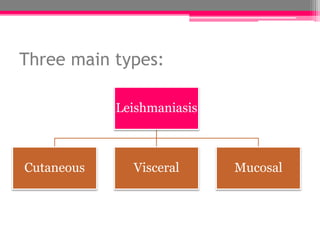
Three main types:
Leishmaniasis
Cutaneous Visceral Mucosal
L.CUTANEOUS
• It is the most common form of leishmaniasis
affecting humans.
• It is a skin infection caused by a single-celled
parasite that transmitted by the bite of
phlenotomine sandfly.
• Cause ulcers , sores on the skin.
• Incubation-week to a months ,multiple sores
also can have swollen glands near the sores.
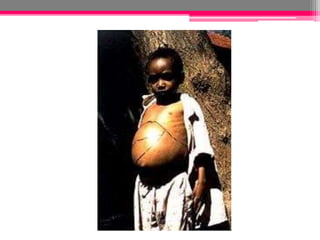
L.VISCERAL
• Commenly known as kala-azar
• It is more severe form of the disease.
• It incubates days to years after the bite of the
infected sand flies.
• It affects the internal organs like spleen, liver
and bone marrow.
• People affects with the symptoms like fever,
weight loss, anemia, enlargement of spleen and
liver.
L.MUCOSAL:
• It is the less common form.
• It can lead to partial or complete destruction of
mucous membranes in the nose , throat or
mouth.
• It sometimes can be occur the consequence of
the cutaneous leishmaniasis.
LIFE CYCLE:
• The life cycle begins when the infected female
sand fly bites the human host.
STAGE 1:
• Sand fly takes the blood meal.
• Injects promastigote stage into the skin.
• The promastigotes that reach the puncture
wound are phagocytized by macrophages.
STAGE 2:
• Promastigotes transform into amastigotes
STAGE 3:
• Amastigotes multiply in cell of various tissue and
other cells.
STAGE 4:
• Amastigotes multiply in cells of various tissuse
and infect other cells.
STAGE 5:
• Sandfly takes a blood meal
• Ingests macrophages infected with amastigotes.
STAGE 6:
• Ingestion of parasitized cell.
STAGE 7:
• Amastigotes transform into promastigote stage
in the gut.
STAGE 8:
• Divide in the gut and migrate to proboscis.
MODE OF TRANSMISSION:
• Mainly bites of sand fly.
• Blood transfustion
• Congenital infection
• Accidental inoculation of cultured promastigotes
in the lab.
• Sexual intercourse
• Mother to baby
• Males are affected more due to increased
exposure to sand flies through the occupation
and leisure activities.
RESERVOIR:
• Humans: in indian subcontinent
• Rodents: in africa
• Foxes: in brazil and central asia
• Dogs: in china
CLINICAL MANIFESTATIONS:
• Fever
• Spleen enlargement
• Lymphadenopathy
• Darkening of skin
• Sores in skin
• Complication: pneumonia, TB, uncontrolled
haemorrhage.
• Prognosis: with an early treatment , cure rate
>90% if not treated , death occurs within 2
years.
DIAGNOSIS:
• The disease can be diagnosed by performing
blood test that look for antibodies against the
parasite or antigen .
• Or can be diagnosed by the urine test.
• PCR can be identified by parasite based on the
genetic fingerprint.
• The best test is to identify the parasite through
the microscope.
TREATMENT:
• The only food and drug administration[FAD]
approved medications for treatment of
leishmaniasis are intravenous liposomal
amphotericin B [L-AmB] for VL .
• oral miltefosine for CL, ML AND VL caused by
particular species.
Leishmaniasis
Leishmaniasis
Leishmaniasis
Leishmaniasis
Leishmaniasis

Leishmaniasis

  • 1.
  • 2.
    The leishman derivedfrom the word “laece” meaning “leech” and indicating “one who used leeches to let blood”.
  • 3.
    What is leishmaniasis? •Leishmania is a genus of trypansomatid protozoa , which cause a fatal-borne parasitic disease called leishmaniasis. • It is spread by the bites of sand flies of the genus phlebotomus in the old world , and of the genus lutzomyia in the new world. • Leishmania is the second largest parasitic killer in the world (after malaria) and is endemic in many parts of Africa, Asia, and south America.
  • 5.
    • There areover >20 different species can infects human. • There are over 1.3 million new cases annually. • 20-30,000 deaths • Affects poorest countries in the world. • The leishmaniasis is transmitted to human by the bites of sandflies.
  • 6.
    • The sandfliescan get infected when they bitted infected person or animal like rodents, dogs, foxes, etc... • Very Uncommonly the leishmaniasis can passed person to person by blood transfusions, unsterile needle or mother to baby. • Not everyone is responsible to develops the disease. • Sometimes there will be asymptomatic .
  • 7.
  • 8.
    L.CUTANEOUS • It isthe most common form of leishmaniasis affecting humans. • It is a skin infection caused by a single-celled parasite that transmitted by the bite of phlenotomine sandfly. • Cause ulcers , sores on the skin. • Incubation-week to a months ,multiple sores also can have swollen glands near the sores.
  • 10.
    L.VISCERAL • Commenly knownas kala-azar • It is more severe form of the disease. • It incubates days to years after the bite of the infected sand flies. • It affects the internal organs like spleen, liver and bone marrow. • People affects with the symptoms like fever, weight loss, anemia, enlargement of spleen and liver.
  • 12.
    L.MUCOSAL: • It isthe less common form. • It can lead to partial or complete destruction of mucous membranes in the nose , throat or mouth. • It sometimes can be occur the consequence of the cutaneous leishmaniasis.
  • 14.
    LIFE CYCLE: • Thelife cycle begins when the infected female sand fly bites the human host. STAGE 1: • Sand fly takes the blood meal. • Injects promastigote stage into the skin. • The promastigotes that reach the puncture wound are phagocytized by macrophages.
  • 15.
    STAGE 2: • Promastigotestransform into amastigotes STAGE 3: • Amastigotes multiply in cell of various tissue and other cells. STAGE 4: • Amastigotes multiply in cells of various tissuse and infect other cells. STAGE 5: • Sandfly takes a blood meal • Ingests macrophages infected with amastigotes.
  • 16.
    STAGE 6: • Ingestionof parasitized cell. STAGE 7: • Amastigotes transform into promastigote stage in the gut. STAGE 8: • Divide in the gut and migrate to proboscis.
  • 17.
    MODE OF TRANSMISSION: •Mainly bites of sand fly. • Blood transfustion • Congenital infection • Accidental inoculation of cultured promastigotes in the lab. • Sexual intercourse • Mother to baby • Males are affected more due to increased exposure to sand flies through the occupation and leisure activities.
  • 18.
    RESERVOIR: • Humans: inindian subcontinent • Rodents: in africa • Foxes: in brazil and central asia • Dogs: in china
  • 19.
    CLINICAL MANIFESTATIONS: • Fever •Spleen enlargement • Lymphadenopathy • Darkening of skin • Sores in skin • Complication: pneumonia, TB, uncontrolled haemorrhage. • Prognosis: with an early treatment , cure rate >90% if not treated , death occurs within 2 years.
  • 20.
    DIAGNOSIS: • The diseasecan be diagnosed by performing blood test that look for antibodies against the parasite or antigen . • Or can be diagnosed by the urine test. • PCR can be identified by parasite based on the genetic fingerprint. • The best test is to identify the parasite through the microscope.
  • 21.
    TREATMENT: • The onlyfood and drug administration[FAD] approved medications for treatment of leishmaniasis are intravenous liposomal amphotericin B [L-AmB] for VL . • oral miltefosine for CL, ML AND VL caused by particular species.