TYPES OF SAMPLING METHODS.
N A M E - T A M A N N A
R E G I S T R A T I O N N U M B E R - 1 2 1 1 5 9 0 2
C O U R S E C O D E - P O L 2 0 4
P U B L I C O P I N I O N A N D S U R V E Y R E S E A R C H
1. WHAT IS SAMPLING?
• Population or Universe :
• The aggregate of all the units pertaining to a study
is called population or universe. In a statistical
investigation, the set of all the items or
observations related with the investigation is
called the universe or population.
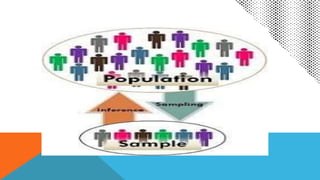
• Sample : a collection consisting of a part or
subset of the objects or individuals of population
which is selected for the purpose of representing
the population.
• Sampling is the statistical process of selecting a
subset (called a “sample”) of a population of
interest for purposes of making observations and
statistical inferences about that population.
ADVANTAGES OF SAMPLING
1. Low cost of sampling
2. Less time consuming in sampling
3. Accuracy of data is high
4. Organization of convenience
5. Suitable in limited resources
DISADVANTAGES OF SAMPLING
• Chances of bias
• Difficulties in selecting truly a representative sample
• Need for subject specific knowledge
• Changeability of sampling units
• Impossibility of sampling.
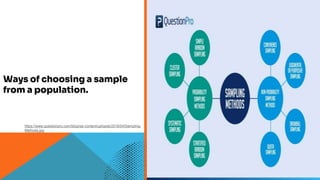
Ways of choosing a sample
from a population.
https://www.questionpro.com/blog/wp-content/uploads/2018/04/Sampling-
Methods.jpg
It technique in which researchers choose samples from a
larger population based on the theory of probability. This
sampling method considers every member of the population
and forms samples based on a fixed process.
For example, in a population of 1000 members, every member
will have a 1/1000 chance of being selected to be a part of a
sample. Probability sampling eliminates sampling bias in the
population and allows all members to be included in the
sample.
PROBABILITY SAMPLING
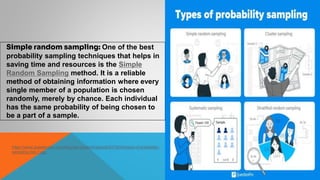
Simple random sampling: One of the best
probability sampling techniques that helps in
saving time and resources is the Simple
Random Sampling method. It is a reliable
method of obtaining information where every
single member of a population is chosen
randomly, merely by chance. Each individual
has the same probability of being chosen to
be a part of a sample.
https://www.questionpro.com/blog/wp-content/uploads/2018/04/types-of-probability-
sampling-min-1.jpg
Clusture sampling: It is a method where the researchers
divide the entire population into sections or clusters
representing a population. Clusters are identified and included
in a sample based on demographic parameters like age, sex,
location, etc. This makes it very simple for a survey creator to
derive effective inferences from the feedback.
Systematic sampling: Researchers use the systematic
sampling method to choose the sample members of a
population at regular intervals. It requires selecting a starting
point for the sample and sample size that can be repeated at
regular intervals. This type of sampling method has a predefined
range; hence, this sampling technique is the least time-
consuming.
Stratified random sampling: It is a method in which the researcher divides
the population into smaller groups that don’t overlap but represent the
entire population. While sampling, these groups can be organized, and
then draw a sample from each group separately.
researcher looking to analyse the characteristics of people belonging to
different annual income divisions will create strata (groups) according to
the annual family income. Ex – less than $20,000, $21,000 – $30,000,
$31,000 to $40,000, $41,000 to $50,000, etc. By doing this, the
researcher concludes the characteristics of people belonging to
different income groups. Marketers can analyse which income groups to
target and which ones to eliminate to create a roadmap that would bear
fruitful results.
Non probability methods:
Convenience sampling: This method depends
on the ease of access to subjects such as
surveying customers at a mall or passers-by on a
busy street. It is usually termed as convenience
sampling because of the researcher’s ease of
carrying it out and getting in touch with the
subjects.
Judgmental or purposive sampling: Judgmental
or purposive samples are formed at the
researcher’s discretion. Researchers purely
consider the purpose of the study, along with
the understanding of the target audience.
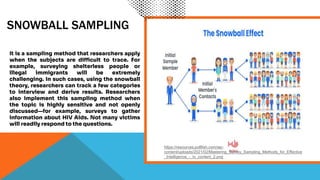
It is a sampling method that researchers apply
when the subjects are difficult to trace. For
example, surveying shelterless people or
illegal immigrants will be extremely
challenging. In such cases, using the snowball
theory, researchers can track a few categories
to interview and derive results. Researchers
also implement this sampling method when
the topic is highly sensitive and not openly
discussed—for example, surveys to gather
information about HIV Aids. Not many victims
will readily respond to the questions.
SNOWBALL SAMPLING
https://resources.pollfish.com/wp-
content/uploads/2021/02/Mastering_Survey_Sampling_Methods_for_Effective
_Intelligence_-_in_content_2.png
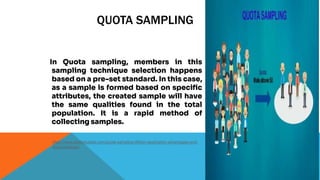
In Quota sampling, members in this
sampling technique selection happens
based on a pre-set standard. In this case,
as a sample is formed based on specific
attributes, the created sample will have
the same qualities found in the total
population. It is a rapid method of
collecting samples.
QUOTA SAMPLING
https://www.statisticalaid.com/quota-sampling-difition-application-advantages-and-
disadvantages/
THANK YOU!
• Fleetwood, Dan. Sampling Methods: Types with Examples.Questionpro.
https://www.questionpro.com/blog/types-of-sampling-for-social-research.
• McCombes, S. (2022, December 1). Sampling Methods | Types, Techniques & Examples.
Scribbr. https://www.scribbr.com/methodology/sampling-methods/
• A. (2021, September 14). Sampling Methods (Techniques) - Types of Sampling Methods
and Examples. BYJUS. https://byjus.com/maths/sampling-methods/
• L. (2021b, February 9). Mastering Survey Sampling Methods for Consumer Intelligence.
Pollfish Resources. https://resources.pollfish.com/market-research/mastering-
survey-sampling-methods-for-effective-intelligence/
REFERENCES

types of sampling methods.pptx

  • 1.
    TYPES OF SAMPLINGMETHODS. N A M E - T A M A N N A R E G I S T R A T I O N N U M B E R - 1 2 1 1 5 9 0 2 C O U R S E C O D E - P O L 2 0 4 P U B L I C O P I N I O N A N D S U R V E Y R E S E A R C H
  • 2.
    1. WHAT ISSAMPLING? • Population or Universe : • The aggregate of all the units pertaining to a study is called population or universe. In a statistical investigation, the set of all the items or observations related with the investigation is called the universe or population. • Sample : a collection consisting of a part or subset of the objects or individuals of population which is selected for the purpose of representing the population. • Sampling is the statistical process of selecting a subset (called a “sample”) of a population of interest for purposes of making observations and statistical inferences about that population.
  • 4.
    ADVANTAGES OF SAMPLING 1.Low cost of sampling 2. Less time consuming in sampling 3. Accuracy of data is high 4. Organization of convenience 5. Suitable in limited resources
  • 5.
    DISADVANTAGES OF SAMPLING •Chances of bias • Difficulties in selecting truly a representative sample • Need for subject specific knowledge • Changeability of sampling units • Impossibility of sampling.
  • 6.
    Ways of choosinga sample from a population. https://www.questionpro.com/blog/wp-content/uploads/2018/04/Sampling- Methods.jpg
  • 7.
    It technique inwhich researchers choose samples from a larger population based on the theory of probability. This sampling method considers every member of the population and forms samples based on a fixed process. For example, in a population of 1000 members, every member will have a 1/1000 chance of being selected to be a part of a sample. Probability sampling eliminates sampling bias in the population and allows all members to be included in the sample. PROBABILITY SAMPLING
  • 8.
    Simple random sampling:One of the best probability sampling techniques that helps in saving time and resources is the Simple Random Sampling method. It is a reliable method of obtaining information where every single member of a population is chosen randomly, merely by chance. Each individual has the same probability of being chosen to be a part of a sample. https://www.questionpro.com/blog/wp-content/uploads/2018/04/types-of-probability- sampling-min-1.jpg
  • 9.
    Clusture sampling: Itis a method where the researchers divide the entire population into sections or clusters representing a population. Clusters are identified and included in a sample based on demographic parameters like age, sex, location, etc. This makes it very simple for a survey creator to derive effective inferences from the feedback. Systematic sampling: Researchers use the systematic sampling method to choose the sample members of a population at regular intervals. It requires selecting a starting point for the sample and sample size that can be repeated at regular intervals. This type of sampling method has a predefined range; hence, this sampling technique is the least time- consuming.
  • 10.
    Stratified random sampling:It is a method in which the researcher divides the population into smaller groups that don’t overlap but represent the entire population. While sampling, these groups can be organized, and then draw a sample from each group separately. researcher looking to analyse the characteristics of people belonging to different annual income divisions will create strata (groups) according to the annual family income. Ex – less than $20,000, $21,000 – $30,000, $31,000 to $40,000, $41,000 to $50,000, etc. By doing this, the researcher concludes the characteristics of people belonging to different income groups. Marketers can analyse which income groups to target and which ones to eliminate to create a roadmap that would bear fruitful results.
  • 11.
    Non probability methods: Conveniencesampling: This method depends on the ease of access to subjects such as surveying customers at a mall or passers-by on a busy street. It is usually termed as convenience sampling because of the researcher’s ease of carrying it out and getting in touch with the subjects. Judgmental or purposive sampling: Judgmental or purposive samples are formed at the researcher’s discretion. Researchers purely consider the purpose of the study, along with the understanding of the target audience.
  • 12.
    It is asampling method that researchers apply when the subjects are difficult to trace. For example, surveying shelterless people or illegal immigrants will be extremely challenging. In such cases, using the snowball theory, researchers can track a few categories to interview and derive results. Researchers also implement this sampling method when the topic is highly sensitive and not openly discussed—for example, surveys to gather information about HIV Aids. Not many victims will readily respond to the questions. SNOWBALL SAMPLING https://resources.pollfish.com/wp- content/uploads/2021/02/Mastering_Survey_Sampling_Methods_for_Effective _Intelligence_-_in_content_2.png
  • 13.
    In Quota sampling,members in this sampling technique selection happens based on a pre-set standard. In this case, as a sample is formed based on specific attributes, the created sample will have the same qualities found in the total population. It is a rapid method of collecting samples. QUOTA SAMPLING https://www.statisticalaid.com/quota-sampling-difition-application-advantages-and- disadvantages/
  • 14.
  • 15.
    • Fleetwood, Dan.Sampling Methods: Types with Examples.Questionpro. https://www.questionpro.com/blog/types-of-sampling-for-social-research. • McCombes, S. (2022, December 1). Sampling Methods | Types, Techniques & Examples. Scribbr. https://www.scribbr.com/methodology/sampling-methods/ • A. (2021, September 14). Sampling Methods (Techniques) - Types of Sampling Methods and Examples. BYJUS. https://byjus.com/maths/sampling-methods/ • L. (2021b, February 9). Mastering Survey Sampling Methods for Consumer Intelligence. Pollfish Resources. https://resources.pollfish.com/market-research/mastering- survey-sampling-methods-for-effective-intelligence/ REFERENCES