SAMPLING DESIGN
The Nature of Sampling The basic idea of sampling is that by  selecting some of the elements in  population, we may draw conclusions  about the entire population
Nature of Sampling A population element is the unit of study The unit of study might be a person or just about anything else
Why Sample? Lower cost Greater accuracy of results Greater speed of data collection Availability of Population elements.
What is Good Sample? How well it represents the characteristics of the population it purports to represent In measurement terms, the sample must be valid.  Validity of a sample depends on two considerations  Accuracy and precision.
Accuracy Degree to which bias is absent from the sample. Some sample elements underestimate the population values being studied and other overestimate them.
How do Bring in Accuracy? Under-estimation and over-estimation offset each other and gives a sample value that is generally close to the population value.  Offsetting requires large number of elements
Precision No sample will fully represent its population in all respects  Differences in the sample and population values occurs due to random fluctuations inherent in the sampling process.  This is called sampling error and reflects the influences of chance in drawing the sample members.
Sampling Error What is left after all known sources of systematic variance have been accounted for.  In theory, sampling error consists of random fluctuations only Some unknown systematic variance may be included when too many or too few sample elements possess a particular characteristic.
Precision Measured by the standard error of estimate Type of standard deviation measurement The smaller the standard error of estimate, the higher is the precision Samples of the same size can produce different amounts of error variance.
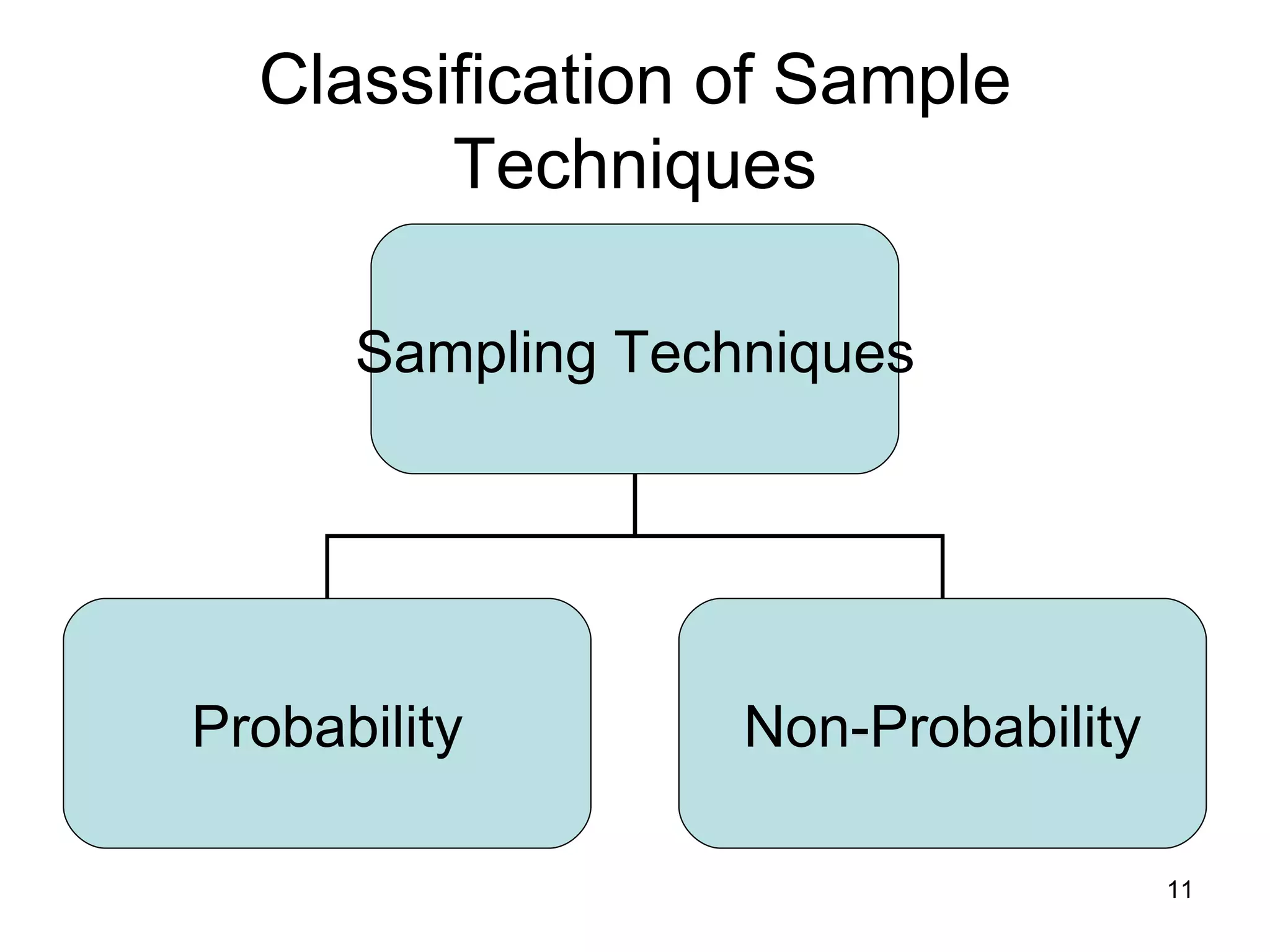
Classification of Sample Techniques Sampling Techniques Probability Non-Probability
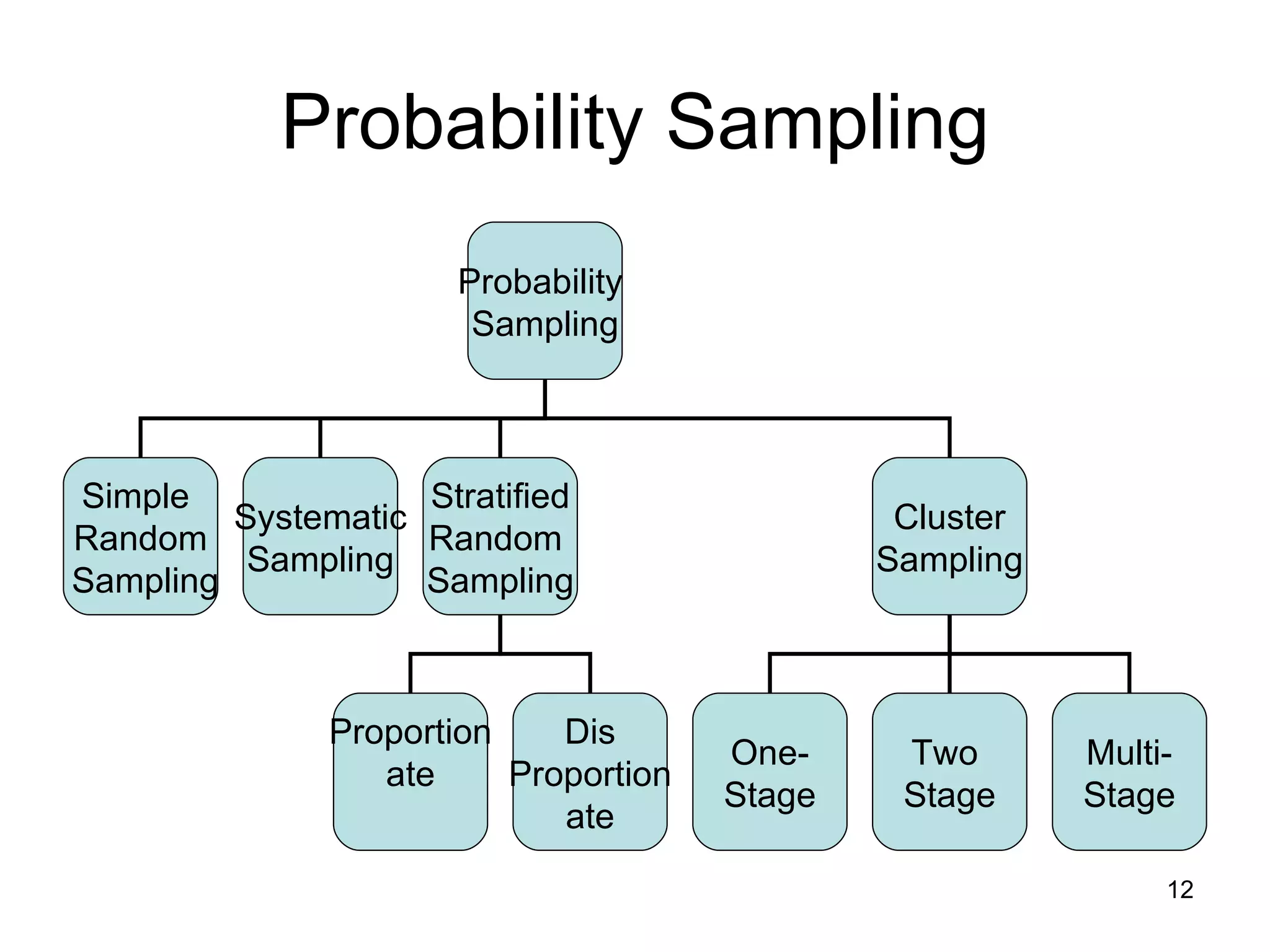
Probability Sampling Probability  Sampling Simple  Random Sampling Systematic Sampling Cluster Sampling Stratified Random  Sampling Proportion ate Dis Proportion ate One- Stage Two  Stage Multi- Stage
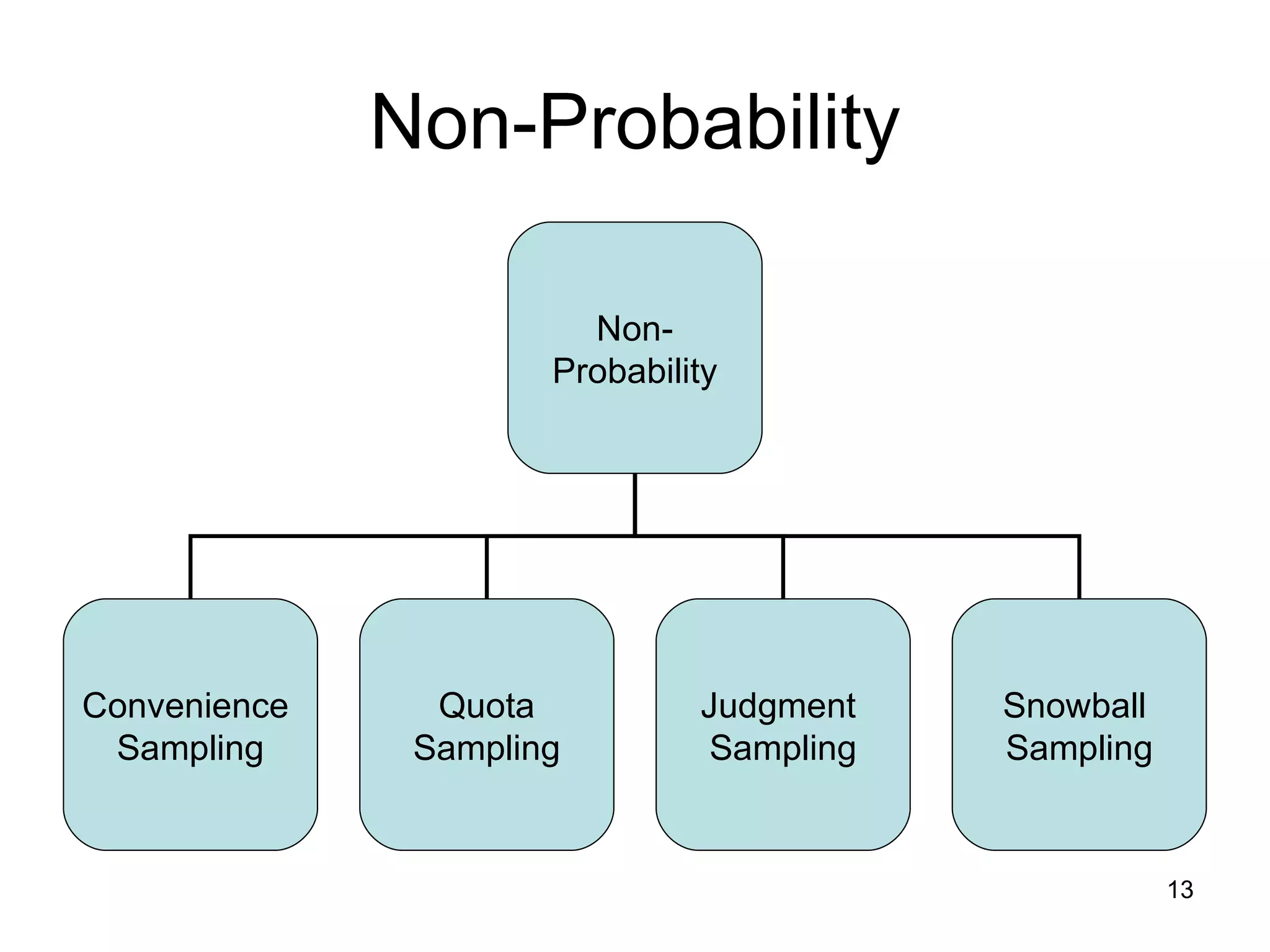
Non-Probability Non- Probability Convenience  Sampling Quota Sampling Judgment  Sampling Snowball  Sampling
Steps in Sampling Design What is the Relevant Population? The definition of the population Whether the population consists of individuals, households, families or a combination of these
What are the Parameters of Interest? Population parameters are summary descriptors (proportion, mean, variance) of variables of interest in the population. Sample statistics are descriptors of the relevant variables computed from sample data.  Sample statistics are used as estimators of population parameters
What is the Sampling Frame? The sampling frame is closely related to the population.  It is the list of elements from which the sample is actually drawn.  Ideally, it is a complete and correct list of population members only.
What is the Type of Sample? Choosing a probability sampling technique has several consequences.  A researcher must follow appropriate procedures, so that :
What is the Type of Sample? Interviewers cannot modify the selections made. Only those selected elements from the original sampling frame are included. Substitutions are excluded except as clearly specified and controlled according to pre-determined decisions rules.
What Size Sample is Needed ? Some Myths A sample must be large or it is not representative. A sample should bear some proportional relationship to the size of the population from which it is drawn.
Some principles that influence sample size include : The greater the dispersion or variance within the population, the larger the sample must be to provide estimation precision. The greater the desired precision of the estimate, the large the sample must be. The narrower the interval range, the larger the sample must be.
Some Principles that Influence Sample Size Include : The higher the confidence level in the estimate, greater the sample size must be If the calculated sample size exceeds 5 percent of the population, sample size may be reduced without sacrificing precision.
How Much Will it Cost? Almost all studies have some budgetary constraint, and this may encourage a  researcher to use a non-probability sample Probability sample surveys incur list costs for sample frames,  and other costs that are not necessary when more haphazard or arbitrary methods are used.
Probability Sampling Based on the concept of random selection A controlled procedure Assures that each population  element is given a known nonzero chance of selection.
Non-probability Sampling In contrast, is arbitrary (nonrandom) and subjective Allowing interviewers to choose sample elements “at random”
Probability Sampling- Simple Random Sampling Each element in the target population has an equal chance or probability of being selected in the population Numbers can be randomly generated by computers or picked out of a box In small population random sampling is done without replacement
Requisites Target population size is small Homogeneous sampling frame is defined Not much information is available regarding the population
Advantages Free of classification error Requires minimum advance knowledge about the population Elimination of human bias Non-dependency on the availability of the element
Disadvantages Imperative to list every item in the population prior to sampling Requires constructing very large sampling frames Hence requires extensive sampling calculations Hence excessive costs
Systematic Sampling Selecting every  k th  from a sampling frame K represents the skip interval Formula k =  population size / Sample Size
Advantages Used in industrial operations where equipments in the production are checked for defects Questioning people in a sample survey Necessary to select first element randomly and then apply k  Economical and less time consuming
Stratified Random Sampling Process of grouping members into relatively homogenous groups before sampling Each element of the population must be included in a stratum Strata should be exhaustive so as not to leave any element of the population Then random sampling is applied within each stratum
Proportional Stratified sampling Number selected from each strata depends on the homogeneity and std dev of elements present in it Proportional Stratified sampling – A smaller sample can be drawn out of the  stratum known to have the same value
Disproportionate Stratified Sampling Samples can be drawn in a much higher proportion from another stratum where values are known to differ.  Higher number of respondents are required to minimise sampling errors because of the high variability
Advantages and Disadvantages Improves representativeness by reducing sampling error Greater statistical efficiency over simple random sampling Groups are represented when strata are combined There can be errors in designating bases due to time and cost factors
Multistage Cluster Sampling Involves grouping the population into various clusters and then selecting a few clusters for study Clusters should be homogenous in nature Elements within each cluster should be heterogeneous Cluster should be similar to the population
Multistage Cluster Sampling Suitable for studies that cover large geographic areas Researcher can go for 1, 2 or multi-stage cluster sampling In single stage- all elements from each cluster are studied
Two Stage Two stage - uses random sampling to select a few elements from each of selected clusters Multi-stage - selecting a sample in 2 or more successive stages.  Cluster / units is selected in the first stage and further divided into clusters / units
Non- Probability Sampling

26738157 sampling-design

  • 1.
  • 2.
    The Nature ofSampling The basic idea of sampling is that by selecting some of the elements in population, we may draw conclusions about the entire population
  • 3.
    Nature of SamplingA population element is the unit of study The unit of study might be a person or just about anything else
  • 4.
    Why Sample? Lowercost Greater accuracy of results Greater speed of data collection Availability of Population elements.
  • 5.
    What is GoodSample? How well it represents the characteristics of the population it purports to represent In measurement terms, the sample must be valid. Validity of a sample depends on two considerations Accuracy and precision.
  • 6.
    Accuracy Degree towhich bias is absent from the sample. Some sample elements underestimate the population values being studied and other overestimate them.
  • 7.
    How do Bringin Accuracy? Under-estimation and over-estimation offset each other and gives a sample value that is generally close to the population value. Offsetting requires large number of elements
  • 8.
    Precision No samplewill fully represent its population in all respects Differences in the sample and population values occurs due to random fluctuations inherent in the sampling process. This is called sampling error and reflects the influences of chance in drawing the sample members.
  • 9.
    Sampling Error Whatis left after all known sources of systematic variance have been accounted for. In theory, sampling error consists of random fluctuations only Some unknown systematic variance may be included when too many or too few sample elements possess a particular characteristic.
  • 10.
    Precision Measured bythe standard error of estimate Type of standard deviation measurement The smaller the standard error of estimate, the higher is the precision Samples of the same size can produce different amounts of error variance.
  • 11.
    Classification of SampleTechniques Sampling Techniques Probability Non-Probability
  • 12.
    Probability Sampling Probability Sampling Simple Random Sampling Systematic Sampling Cluster Sampling Stratified Random Sampling Proportion ate Dis Proportion ate One- Stage Two Stage Multi- Stage
  • 13.
    Non-Probability Non- ProbabilityConvenience Sampling Quota Sampling Judgment Sampling Snowball Sampling
  • 14.
    Steps in SamplingDesign What is the Relevant Population? The definition of the population Whether the population consists of individuals, households, families or a combination of these
  • 15.
    What are theParameters of Interest? Population parameters are summary descriptors (proportion, mean, variance) of variables of interest in the population. Sample statistics are descriptors of the relevant variables computed from sample data. Sample statistics are used as estimators of population parameters
  • 16.
    What is theSampling Frame? The sampling frame is closely related to the population. It is the list of elements from which the sample is actually drawn. Ideally, it is a complete and correct list of population members only.
  • 17.
    What is theType of Sample? Choosing a probability sampling technique has several consequences. A researcher must follow appropriate procedures, so that :
  • 18.
    What is theType of Sample? Interviewers cannot modify the selections made. Only those selected elements from the original sampling frame are included. Substitutions are excluded except as clearly specified and controlled according to pre-determined decisions rules.
  • 19.
    What Size Sampleis Needed ? Some Myths A sample must be large or it is not representative. A sample should bear some proportional relationship to the size of the population from which it is drawn.
  • 20.
    Some principles thatinfluence sample size include : The greater the dispersion or variance within the population, the larger the sample must be to provide estimation precision. The greater the desired precision of the estimate, the large the sample must be. The narrower the interval range, the larger the sample must be.
  • 21.
    Some Principles thatInfluence Sample Size Include : The higher the confidence level in the estimate, greater the sample size must be If the calculated sample size exceeds 5 percent of the population, sample size may be reduced without sacrificing precision.
  • 22.
    How Much Willit Cost? Almost all studies have some budgetary constraint, and this may encourage a researcher to use a non-probability sample Probability sample surveys incur list costs for sample frames, and other costs that are not necessary when more haphazard or arbitrary methods are used.
  • 23.
    Probability Sampling Basedon the concept of random selection A controlled procedure Assures that each population element is given a known nonzero chance of selection.
  • 24.
    Non-probability Sampling Incontrast, is arbitrary (nonrandom) and subjective Allowing interviewers to choose sample elements “at random”
  • 25.
    Probability Sampling- SimpleRandom Sampling Each element in the target population has an equal chance or probability of being selected in the population Numbers can be randomly generated by computers or picked out of a box In small population random sampling is done without replacement
  • 26.
    Requisites Target populationsize is small Homogeneous sampling frame is defined Not much information is available regarding the population
  • 27.
    Advantages Free ofclassification error Requires minimum advance knowledge about the population Elimination of human bias Non-dependency on the availability of the element
  • 28.
    Disadvantages Imperative tolist every item in the population prior to sampling Requires constructing very large sampling frames Hence requires extensive sampling calculations Hence excessive costs
  • 29.
    Systematic Sampling Selectingevery k th from a sampling frame K represents the skip interval Formula k = population size / Sample Size
  • 30.
    Advantages Used inindustrial operations where equipments in the production are checked for defects Questioning people in a sample survey Necessary to select first element randomly and then apply k Economical and less time consuming
  • 31.
    Stratified Random SamplingProcess of grouping members into relatively homogenous groups before sampling Each element of the population must be included in a stratum Strata should be exhaustive so as not to leave any element of the population Then random sampling is applied within each stratum
  • 32.
    Proportional Stratified samplingNumber selected from each strata depends on the homogeneity and std dev of elements present in it Proportional Stratified sampling – A smaller sample can be drawn out of the stratum known to have the same value
  • 33.
    Disproportionate Stratified SamplingSamples can be drawn in a much higher proportion from another stratum where values are known to differ. Higher number of respondents are required to minimise sampling errors because of the high variability
  • 34.
    Advantages and DisadvantagesImproves representativeness by reducing sampling error Greater statistical efficiency over simple random sampling Groups are represented when strata are combined There can be errors in designating bases due to time and cost factors
  • 35.
    Multistage Cluster SamplingInvolves grouping the population into various clusters and then selecting a few clusters for study Clusters should be homogenous in nature Elements within each cluster should be heterogeneous Cluster should be similar to the population
  • 36.
    Multistage Cluster SamplingSuitable for studies that cover large geographic areas Researcher can go for 1, 2 or multi-stage cluster sampling In single stage- all elements from each cluster are studied
  • 37.
    Two Stage Twostage - uses random sampling to select a few elements from each of selected clusters Multi-stage - selecting a sample in 2 or more successive stages. Cluster / units is selected in the first stage and further divided into clusters / units
  • 38.