STRATIFIED RANDOM SAMPLING
Types and Problems
Sundar B. N.
Assistant Professor
When the units of the population are scattered and not completely
homogeneous in nature, then simple random sample does not give proper
representation of the population. So if the population is heterogeneous
the simple random sampling is not found suitable.
In stratified sampling the whole population is to be divided in some
homogeneous groups or classes with respect to the characteristic under
study which are known as strata. That means, we have to do the
stratification of the population. Stratification means division into layers.
The auxiliary information related to the character under study may be
used to divide the population into various groups or strata in such a way
that units within each stratum are as homogeneous as possible and the
strata are as widely different as possible.
PRINCIPLES OF STRATIFICATION
The principles to be kept in mind while stratifying a population are given
below:
1. The strata should not be overlapping and should together comprise the
whole population.
2. The strata should be homogeneous within themselves and heterogeneous
between themselves with respect to characteristic under study.
3. If a investigator is facing difficulties in stratifying a population with respect
to the characteristic under study, then he/she has to consider the
administrative convenience as the basis for stratification.
4. If the limit of precision is given for certain sub-population then it should be
treated as stratum
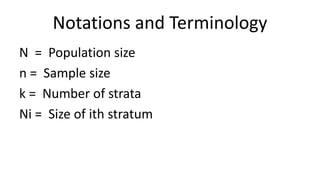
Notations and Terminology
N = Population size
n = Sample size
k = Number of strata
Ni = Size of ith stratum
Types of Allocation of Sample Size
• Equal Number of Units from Each Stratum
• Proportional Allocation
• Neyman’s Allocation
• Optimum Allocation
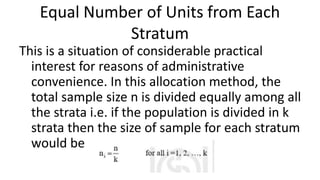
Equal Number of Units from Each
Stratum
This is a situation of considerable practical
interest for reasons of administrative
convenience. In this allocation method, the
total sample size n is divided equally among all
the strata i.e. if the population is divided in k
strata then the size of sample for each stratum
would be
Proportional Allocation
This allocation was originally proposed by Bowley in
1926. This procedure of allocation is very common in
practice because of its simplicity.
As its name indicates, proportional allocation means that
we select a small sample from a small stratum and a
large sample from a large stratum.
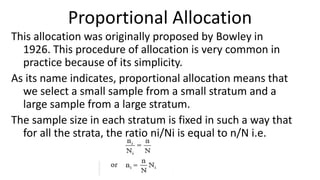
The sample size in each stratum is fixed in such a way that
for all the strata, the ratio ni/Ni is equal to n/N i.e.
Problem
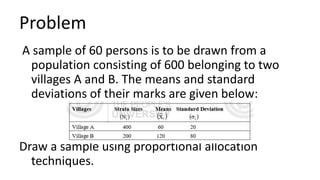
A sample of 60 persons is to be drawn from a
population consisting of 600 belonging to two
villages A and B. The means and standard
deviations of their marks are given below:
Draw a sample using proportional allocation
techniques.
Solution
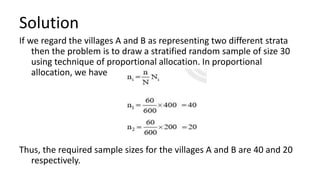
If we regard the villages A and B as representing two different strata
then the problem is to draw a stratified random sample of size 30
using technique of proportional allocation. In proportional
allocation, we have
Thus, the required sample sizes for the villages A and B are 40 and 20
respectively.
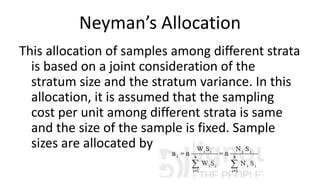
Neyman’s Allocation
This allocation of samples among different strata
is based on a joint consideration of the
stratum size and the stratum variance. In this
allocation, it is assumed that the sampling
cost per unit among different strata is same
and the size of the sample is fixed. Sample
sizes are allocated by
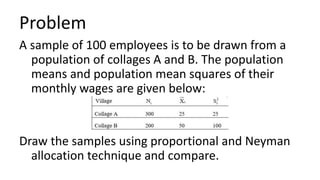
Problem
A sample of 100 employees is to be drawn from a
population of collages A and B. The population
means and population mean squares of their
monthly wages are given below:
Draw the samples using proportional and Neyman
allocation technique and compare.
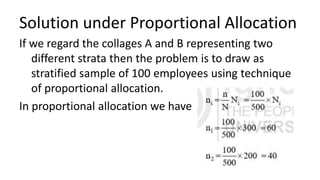
Solution under Proportional Allocation
If we regard the collages A and B representing two
different strata then the problem is to draw as
stratified sample of 100 employees using technique
of proportional allocation.
In proportional allocation we have
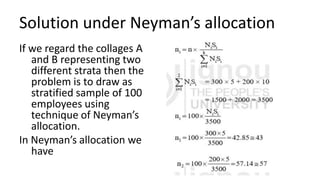
Solution under Neyman’s allocation
If we regard the collages A
and B representing two
different strata then the
problem is to draw as
stratified sample of 100
employees using
technique of Neyman’s
allocation.
In Neyman’s allocation we
have
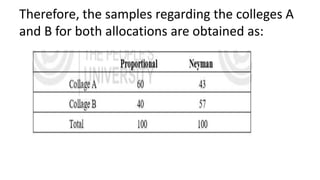
Therefore, the samples regarding the colleges A
and B for both allocations are obtained as:
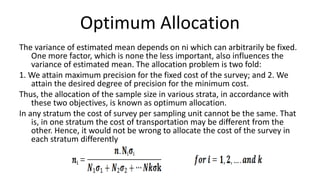
Optimum Allocation
The variance of estimated mean depends on ni which can arbitrarily be fixed.
One more factor, which is none the less important, also influences the
variance of estimated mean. The allocation problem is two fold:
1. We attain maximum precision for the fixed cost of the survey; and 2. We
attain the desired degree of precision for the minimum cost.
Thus, the allocation of the sample size in various strata, in accordance with
these two objectives, is known as optimum allocation.
In any stratum the cost of survey per sampling unit cannot be the same. That
is, in one stratum the cost of transportation may be different from the
other. Hence, it would not be wrong to allocate the cost of the survey in
each stratum differently
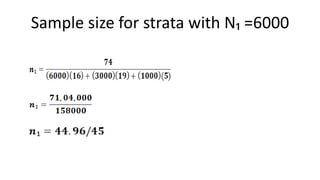
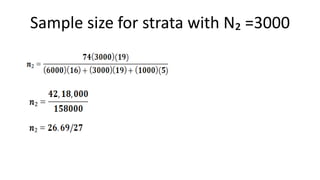
Problem
A population is divided into three strata so that
N₁=6000, N₂=3000 and N₃=1000. Respective
SD of 1=16, 2=19 and 3=5. How should a
sample size n=74 be allocated to the three
strata if we want optimum allocation using
disproportionate sampling designs?
Sample size for strata with N₁ =6000
Sample size for strata with N₂ =3000
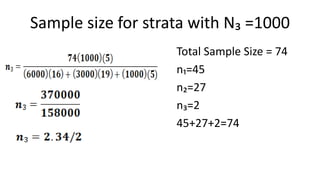
Sample size for strata with N₃ =1000
Total Sample Size = 74
n₁=45
n₂=27
n₃=2
45+27+2=74
Reference
“Unit-3 STRATIFIED RANDOM SAMPLING.
IGNOU. (2017).

Stratified Random Sampling - Problems

  • 1.
    STRATIFIED RANDOM SAMPLING Typesand Problems Sundar B. N. Assistant Professor
  • 2.
    When the unitsof the population are scattered and not completely homogeneous in nature, then simple random sample does not give proper representation of the population. So if the population is heterogeneous the simple random sampling is not found suitable. In stratified sampling the whole population is to be divided in some homogeneous groups or classes with respect to the characteristic under study which are known as strata. That means, we have to do the stratification of the population. Stratification means division into layers. The auxiliary information related to the character under study may be used to divide the population into various groups or strata in such a way that units within each stratum are as homogeneous as possible and the strata are as widely different as possible.
  • 3.
    PRINCIPLES OF STRATIFICATION Theprinciples to be kept in mind while stratifying a population are given below: 1. The strata should not be overlapping and should together comprise the whole population. 2. The strata should be homogeneous within themselves and heterogeneous between themselves with respect to characteristic under study. 3. If a investigator is facing difficulties in stratifying a population with respect to the characteristic under study, then he/she has to consider the administrative convenience as the basis for stratification. 4. If the limit of precision is given for certain sub-population then it should be treated as stratum
  • 4.
    Notations and Terminology N= Population size n = Sample size k = Number of strata Ni = Size of ith stratum
  • 5.
    Types of Allocationof Sample Size • Equal Number of Units from Each Stratum • Proportional Allocation • Neyman’s Allocation • Optimum Allocation
  • 6.
    Equal Number ofUnits from Each Stratum This is a situation of considerable practical interest for reasons of administrative convenience. In this allocation method, the total sample size n is divided equally among all the strata i.e. if the population is divided in k strata then the size of sample for each stratum would be
  • 7.
    Proportional Allocation This allocationwas originally proposed by Bowley in 1926. This procedure of allocation is very common in practice because of its simplicity. As its name indicates, proportional allocation means that we select a small sample from a small stratum and a large sample from a large stratum. The sample size in each stratum is fixed in such a way that for all the strata, the ratio ni/Ni is equal to n/N i.e.
  • 8.
    Problem A sample of60 persons is to be drawn from a population consisting of 600 belonging to two villages A and B. The means and standard deviations of their marks are given below: Draw a sample using proportional allocation techniques.
  • 9.
    Solution If we regardthe villages A and B as representing two different strata then the problem is to draw a stratified random sample of size 30 using technique of proportional allocation. In proportional allocation, we have Thus, the required sample sizes for the villages A and B are 40 and 20 respectively.
  • 10.
    Neyman’s Allocation This allocationof samples among different strata is based on a joint consideration of the stratum size and the stratum variance. In this allocation, it is assumed that the sampling cost per unit among different strata is same and the size of the sample is fixed. Sample sizes are allocated by
  • 11.
    Problem A sample of100 employees is to be drawn from a population of collages A and B. The population means and population mean squares of their monthly wages are given below: Draw the samples using proportional and Neyman allocation technique and compare.
  • 12.
    Solution under ProportionalAllocation If we regard the collages A and B representing two different strata then the problem is to draw as stratified sample of 100 employees using technique of proportional allocation. In proportional allocation we have
  • 13.
    Solution under Neyman’sallocation If we regard the collages A and B representing two different strata then the problem is to draw as stratified sample of 100 employees using technique of Neyman’s allocation. In Neyman’s allocation we have
  • 14.
    Therefore, the samplesregarding the colleges A and B for both allocations are obtained as:
  • 15.
    Optimum Allocation The varianceof estimated mean depends on ni which can arbitrarily be fixed. One more factor, which is none the less important, also influences the variance of estimated mean. The allocation problem is two fold: 1. We attain maximum precision for the fixed cost of the survey; and 2. We attain the desired degree of precision for the minimum cost. Thus, the allocation of the sample size in various strata, in accordance with these two objectives, is known as optimum allocation. In any stratum the cost of survey per sampling unit cannot be the same. That is, in one stratum the cost of transportation may be different from the other. Hence, it would not be wrong to allocate the cost of the survey in each stratum differently
  • 16.
    Problem A population isdivided into three strata so that N₁=6000, N₂=3000 and N₃=1000. Respective SD of 1=16, 2=19 and 3=5. How should a sample size n=74 be allocated to the three strata if we want optimum allocation using disproportionate sampling designs?
  • 17.
    Sample size forstrata with N₁ =6000
  • 18.
    Sample size forstrata with N₂ =3000
  • 19.
    Sample size forstrata with N₃ =1000 Total Sample Size = 74 n₁=45 n₂=27 n₃=2 45+27+2=74
  • 20.
    Reference “Unit-3 STRATIFIED RANDOMSAMPLING. IGNOU. (2017).