Quality control in Analytical
Chemistry
1September 29, 2015 Andhra university
Quality
• In manufacturing, a measure of excellence or a state of
being free from defects, deficiencies and significant variations. It is
brought about by strict and consistent commitment to certain
standards that achieve uniformity of a product in order to satisfy
specific customer or user requirements.
• ISO 8402-1986 standard defines quality as "the totality
of features and characteristics of a product
or service that bears its ability to satisfy stated or implied needs."
• If an automobile company finds a defect in one of their cars and
makes a product recall, customer reliability and
therefore production will decrease because trust will be lost in the
car's quality.
2September 29, 2015 Andhra university
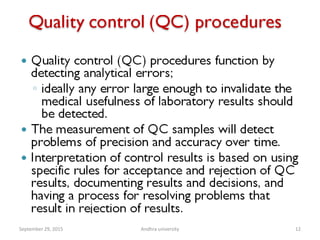
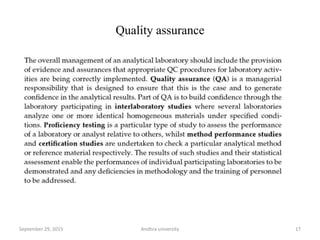
• Quality control is an essential operation of the pharmaceutical industry.
Drugs must be marketed as safe and therapeutically active formulations
whose performance is consistent and predictable. New and better medicinal
agents are being produced at an accelerated rate. At the same time more
exacting and sophisticated analytical methods are being developed for their
evaluation.
Dictionary definition of QC:
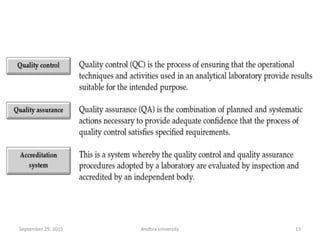
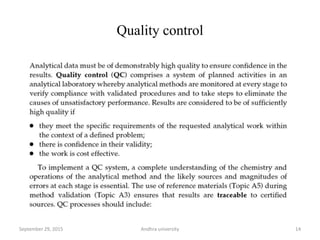
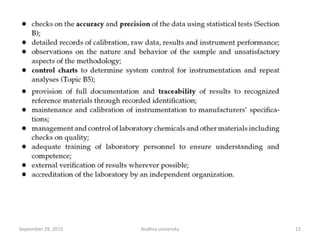
Quality control means checking and directing the degree or grade of
excellence of processes and products
ISO-Quality
The totality of features and characteristics of a product, process or service
that bear on its ability to satisfy stated or implied needs
ISO-QA
All those planned and systematic actions necessary to provide adequate confidence
that a product, process or service will satisfy given quality requirements
3September 29, 2015 Andhra university
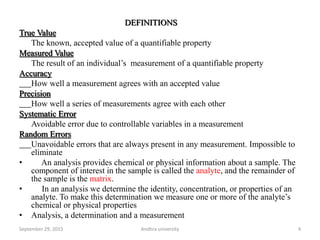
DEFINITIONS
True Value
The known, accepted value of a quantifiable property
Measured Value
The result of an individual’s measurement of a quantifiable property
Accuracy
How well a measurement agrees with an accepted value
Precision
How well a series of measurements agree with each other
Systematic Error
Avoidable error due to controllable variables in a measurement
Random Errors
Unavoidable errors that are always present in any measurement. Impossible to
eliminate
• An analysis provides chemical or physical information about a sample. The
component of interest in the sample is called the analyte, and the remainder of
the sample is the matrix.
• In an analysis we determine the identity, concentration, or properties of an
analyte. To make this determination we measure one or more of the analyte’s
chemical or physical properties
• Analysis, a determination and a measurement
4September 29, 2015 Andhra university
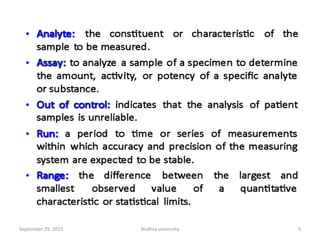
5September 29, 2015 Andhra university
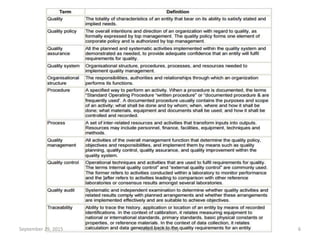
6September 29, 2015 Andhra university
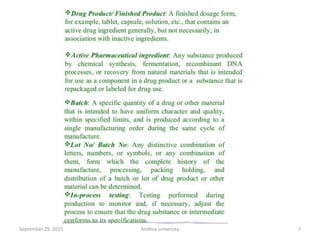
September 29, 2015 Andhra university 7
September 29, 2015 Andhra university 8
September 29, 2015 Andhra university 9
September 29, 2015 Andhra university 10
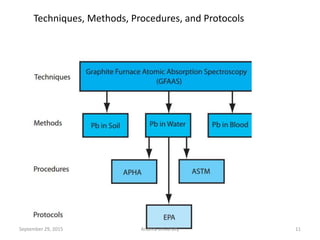
Techniques, Methods, Procedures, and Protocols
11September 29, 2015 Andhra university
12September 29, 2015 Andhra university
13September 29, 2015 Andhra university
Quality control
14September 29, 2015 Andhra university
15September 29, 2015 Andhra university
For Drug
1.The identifying name or mark of the new drug, along with its
accepted chemical name, as well as any code names, synonyms,
non-proprietary and brand names which may be known.
2. The chemical structure or other specific identification of the
composition of the new drug, such as its molecular formula and
molecular weight.
3. The source of the new drug, along with information concerning the
role of the manufacturer in its production, packaging and
distribution, relevant data showing whether the drug is of domestic
or foreign origin, and whether or not it is a product of private
formula or custom manufacture.
4. The tests applied to control the potency, purity and safety of the new
drug, and
5. The methods, equipment, plant and controls used in the manufacture,
processing and packaging of the new drug.
16September 29, 2015 Andhra university
Quality assurance
17September 29, 2015 Andhra university
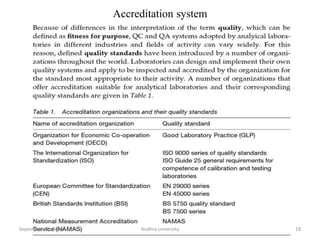
Accreditation system
18September 29, 2015 Andhra university
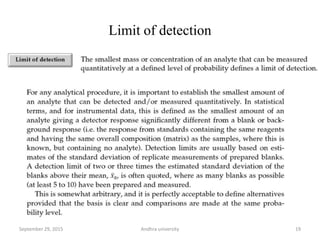
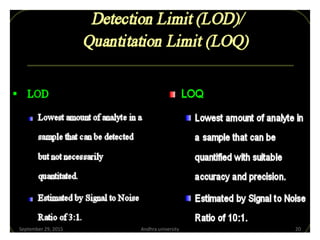
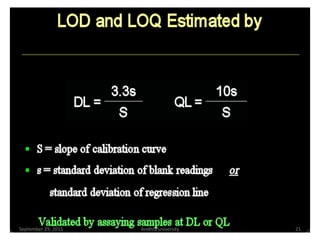
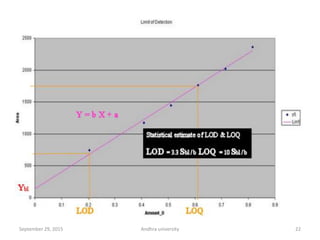
Limit of detection
19September 29, 2015 Andhra university
20September 29, 2015 Andhra university
21September 29, 2015 Andhra university
22September 29, 2015 Andhra university
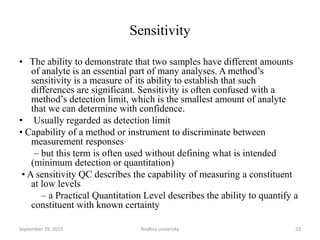
Sensitivity
• The ability to demonstrate that two samples have different amounts
of analyte is an essential part of many analyses. A method’s
sensitivity is a measure of its ability to establish that such
differences are significant. Sensitivity is often confused with a
method’s detection limit, which is the smallest amount of analyte
that we can determine with confidence.
• Usually regarded as detection limit
• Capability of a method or instrument to discriminate between
measurement responses
– but this term is often used without defining what is intended
(minimum detection or quantitation)
• A sensitivity QC describes the capability of measuring a constituent
at low levels
– a Practical Quantitation Level describes the ability to quantify a
constituent with known certainty
23September 29, 2015 Andhra university
Bias
• Bias is systematic or persistent distortion of a measurement
process that causes error in one direction
• A bias can result from:
– biased sampling design
– calibration errors
– response factor shifts
– unaccounted
-for interferences
– chronic sample contamination
24September 29, 2015 Andhra university
Safety
• Materials
- High quality raw materials. This includes defining specifications for the materials
• Preparation
- Preventing foreign bodies from entering products, enabling the management of
allergens, and controlling pests
- a clean and safe water supply, for air filtration, and for any material that will come
into contact with our product, to guarantee that the materials, equipment and
manufacturing environment are all designed to produce safe products.
- We follow certified cleaning and sanitation practices at every step of production
• Processing
- We prepare products in quantities that provide an appropriate and consistent dosage
of any nutrient, to avoid any harm linked to over- or under-dosage. And we process
at optimum temperatures to retain its nutritious value, while removing dangerous
microorganisms and preventing the formation of chemical contaminants
• Testing
• Packaging and transportation
25September 29, 2015 Andhra university
Specificity & Selectivity
• Selectivity of a method refers to the extent to which it can determine
particular analytes under given conditions in mixtures or matrices, simple
or complex, without interferences from other components in the mixture.
“Specificity is the ultimate of Selectivity”
• Selectivity is very often expressed in combination with words such as
adjustment ,tuning ,optimization ,predetermined ,enhancement ,and
coefficients ,as well as selective enrichment
• The term “specific” can of course be used without confusion to denote a
physical quantity obtained after division of a measurement by mass, e.g.,
specific volume.
26September 29, 2015 Andhra university
Robustness and Ruggedness
• For a method to be useful it must provide reliable results.
Unfortunately, methods are subject to a variety of chemical
and physical interferences that contribute uncertainty to the
analysis. When a method is relatively free from chemical
interferences, we can use it on many analytes in a wide variety
of sample matrices. Such methods are considered robust.
• Random variations in experimental conditions also introduces
uncertainty. If a method’s sensitivity, k, is too dependent on
experimental conditions, such as temperature, acidity, or
reaction time, then a slight change in any of these conditions
may give a significantly different result. A rugged method is
relatively insensitive to changes in experimental conditions. 27September 29, 2015 Andhra university
– The Mean- measure of central tendency
– The Range- difference between largest/smallest
observations in a set of data
– Standard Deviation measures the amount of data
dispersion around mean
28
Statistical control
September 29, 2015 Andhra university
The Mean
• To compute the mean we simply sum all the observations and divide by the total
no. of observations.
29September 29, 2015 Andhra university
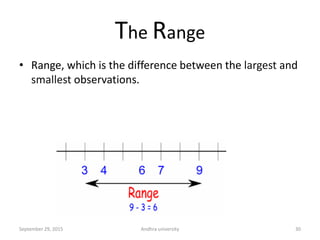
The Range
• Range, which is the difference between the largest and
smallest observations.
30September 29, 2015 Andhra university
Standard Deviation
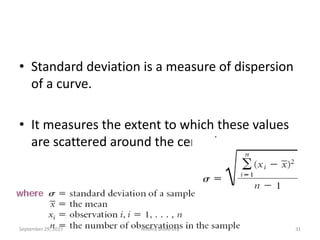
• Standard deviation is a measure of dispersion
of a curve.
• It measures the extent to which these values
are scattered around the central mean.
31September 29, 2015 Andhra university
• Extend the use of descriptive statistics to monitor
the quality of the product and process
• Statistical process control help to determine the
amount of variation
• To make sure the process is in a state of control
Statistical process
control
32
32September 29, 2015 Andhra university
Control chart
• Powerful, easy-to-use technique for the control of routine
analyses
• ISO/IEC 17025 demands use wherever practicable
• It is hard to imagine quality management systems in
laboratories without control chart
• Assign a target value
• Certified value of a RM/CRM (if available)
• Mean of often repeated measurements of the control sample
(in most cases)
33September 29, 2015 Andhra university
September 29, 2015 Andhra university 34
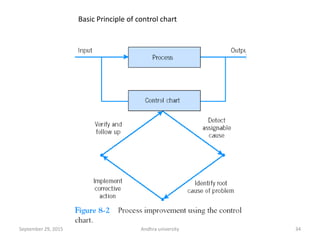
Basic Principle of control chart
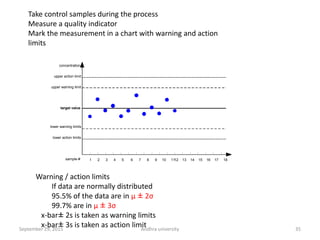
concentration
upper action limit
upper warning limit
target value
lower warning limits
lower action limits
sample-# 1 2 3 4 5 6 7 8 9 10 1112 13 14 15 16 17 18
Take control samples during the process
Measure a quality indicator
Mark the measurement in a chart with warning and action
limits
Warning / action limits
If data are normally distributed
95.5% of the data are in µ ± 2σ
99.7% are in µ ± 3σ
x-bar± 2s is taken as warning limits
x-bar± 3s is taken as action limit 35September 29, 2015 Andhra university
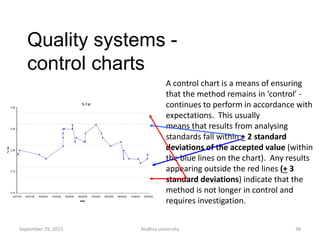
Quality systems -
control charts
% Fat
3.10
3.15
3.20
3.25
3.30
14/01/02 24/01/02 03/02/02 13/02/02 23/02/02 05/03/02 15/03/02 25/03/02 04/04/02 14/04/02 24/04/02
date
%fat
A control chart is a means of ensuring
that the method remains in ‘control’ -
continues to perform in accordance with
expectations. This usually
means that results from analysing
standards fall within + 2 standard
deviations of the accepted value (within
the blue lines on the chart). Any results
appearing outside the red lines (+ 3
standard deviations) indicate that the
method is not longer in control and
requires investigation.
36September 29, 2015 Andhra university
37September 29, 2015 Andhra university
Action Limits:
• There is a probability of only (100-99.7) 0.3 % that a (correct)
measurement is outside the action limits (3 out of 1000
measurements)
• Therefore the process should be stopped immediately and searched
for errors
Warning Limits:
• (100-95.5) 4.5% of the (correct) values are outside the warning
limits.
• This is not very unlikely.
• Therefore this is only for warning, no immediate action required
38September 29, 2015 Andhra university
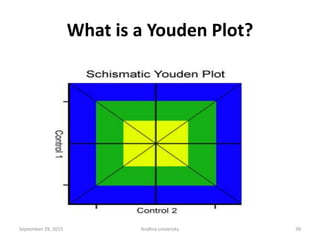
What is a Youden Plot?
39September 29, 2015 Andhra university
40September 29, 2015 Andhra university
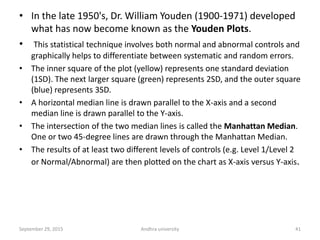
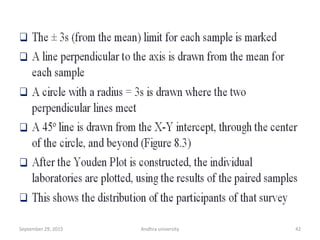
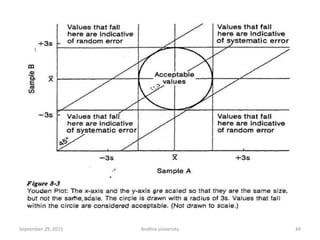
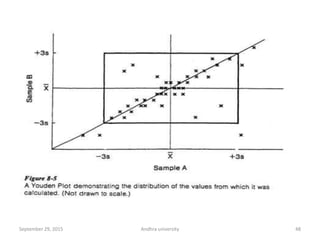
• In the late 1950's, Dr. William Youden (1900-1971) developed
what has now become known as the Youden Plots.
• This statistical technique involves both normal and abnormal controls and
graphically helps to differentiate between systematic and random errors.
• The inner square of the plot (yellow) represents one standard deviation
(1SD). The next larger square (green) represents 2SD, and the outer square
(blue) represents 3SD.
• A horizontal median line is drawn parallel to the X-axis and a second
median line is drawn parallel to the Y-axis.
• The intersection of the two median lines is called the Manhattan Median.
One or two 45-degree lines are drawn through the Manhattan Median.
• The results of at least two different levels of controls (e.g. Level 1/Level 2
or Normal/Abnormal) are then plotted on the chart as X-axis versus Y-axis.
41September 29, 2015 Andhra university
42September 29, 2015 Andhra university
Using a Youden Plot
43September 29, 2015 Andhra university
44September 29, 2015 Andhra university
45September 29, 2015 Andhra university
46September 29, 2015 Andhra university
47September 29, 2015 Andhra university
48September 29, 2015 Andhra university
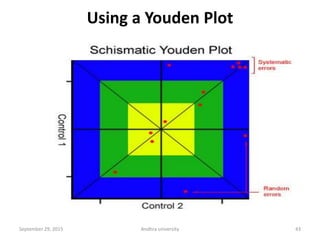
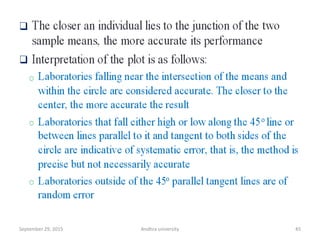
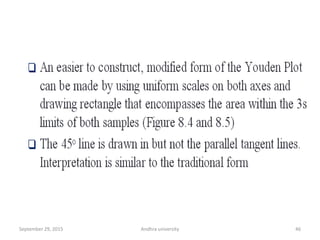
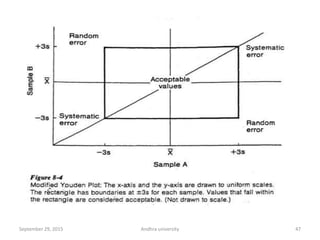
• Controls are run and plotted.
• Plots that lie near the 45-degree reference line
and within the one and two standard deviation
squares show acceptable results.
• Points that lie near the 45-degree reference
lines but outside the 2SD square indicate a
systematic error.
• Points that lie far from ether 45-degree
reference line indicate a random error.
49September 29, 2015 Andhra university
Elements of quality Assessment & Assurance
• Legal base
• Regulatory elements
- Governmental drug control agencies
i. Inspection services
ii. Drug quality control laboratory
• Technical elements
- Quality specifications
- Basic tests
- Requirements for good manufacturing practices
September 29, 2015 Andhra university 50
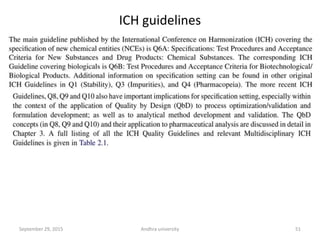
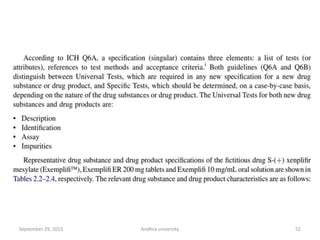
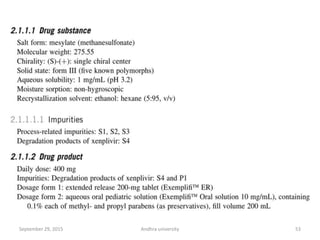
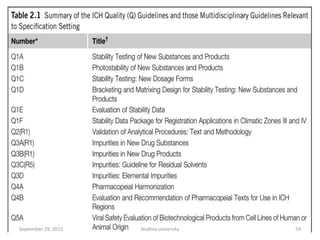
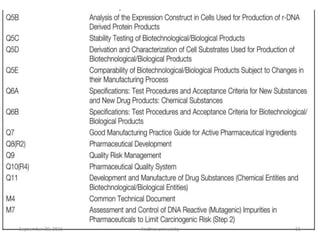
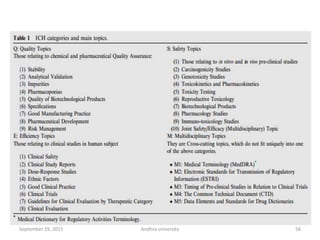
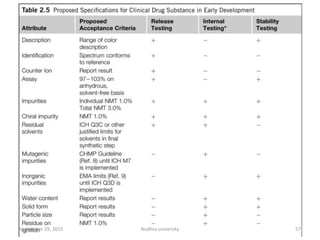
ICH guidelines
51September 29, 2015 Andhra university
52September 29, 2015 Andhra university
53September 29, 2015 Andhra university
54September 29, 2015 Andhra university
55September 29, 2015 Andhra university
56September 29, 2015 Andhra university
57September 29, 2015 Andhra university
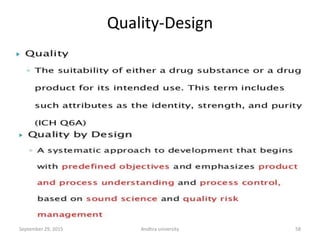
Quality-Design
September 29, 2015 Andhra university 58
September 29, 2015 Andhra university 59
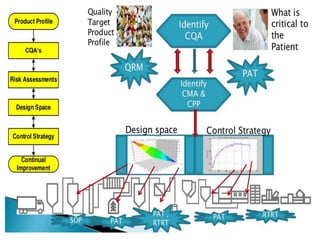
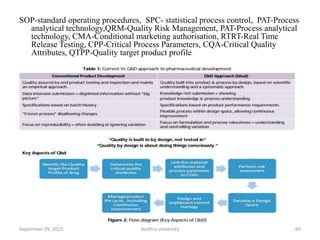
SOP-standard operating procedures, SPC- statistical process control, PAT-Process
analytical technology,QRM-Quality Risk Management, PAT-Process analytical
technology, CMA-Conditional marketing authorisation, RTRT-Real Time
Release Testing, CPP-Critical Process Parameters, CQA-Critical Quality
Attributes, QTPP-Quality target product profile
September 29, 2015 Andhra university 60
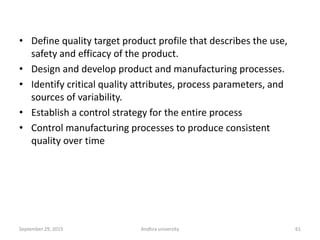
• Define quality target product profile that describes the use,
safety and efficacy of the product.
• Design and develop product and manufacturing processes.
• Identify critical quality attributes, process parameters, and
sources of variability.
• Establish a control strategy for the entire process
• Control manufacturing processes to produce consistent
quality over time
September 29, 2015 Andhra university 61
September 29, 2015 Andhra university 62
September 29, 2015 Andhra university 63
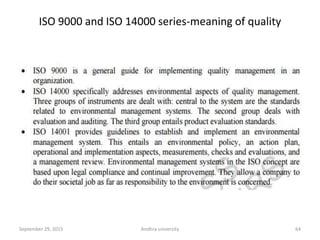
ISO 9000 and ISO 14000 series-meaning of quality
64September 29, 2015 Andhra university
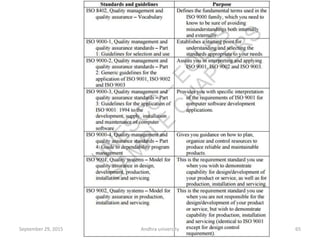
65September 29, 2015 Andhra university
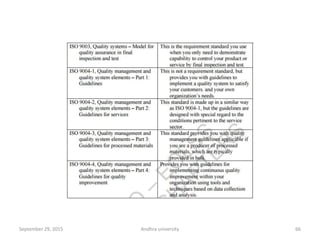
66September 29, 2015 Andhra university
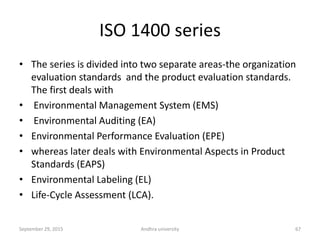
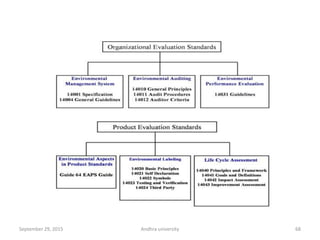
ISO 1400 series
• The series is divided into two separate areas-the organization
evaluation standards and the product evaluation standards.
The first deals with
• Environmental Management System (EMS)
• Environmental Auditing (EA)
• Environmental Performance Evaluation (EPE)
• whereas later deals with Environmental Aspects in Product
Standards (EAPS)
• Environmental Labeling (EL)
• Life-Cycle Assessment (LCA).
67September 29, 2015 Andhra university
68September 29, 2015 Andhra university
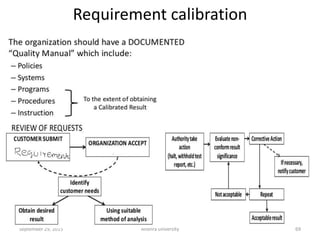
Requirement calibration
September 29, 2015 Andhra university 69
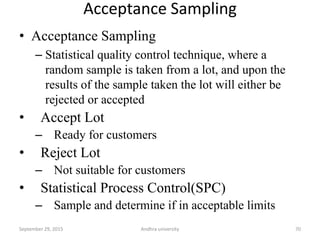
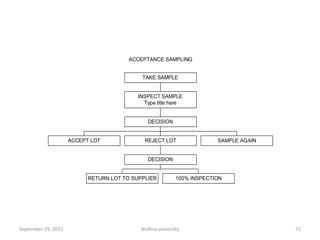
Acceptance Sampling
• Acceptance Sampling
– Statistical quality control technique, where a
random sample is taken from a lot, and upon the
results of the sample taken the lot will either be
rejected or accepted
• Accept Lot
– Ready for customers
• Reject Lot
– Not suitable for customers
• Statistical Process Control(SPC)
– Sample and determine if in acceptable limits
70September 29, 2015 Andhra university
• Purposes
– Determine the quality level of an incoming
shipment or, at the end production
– Ensure that the quality level is within the level that
has been predetermined
• Can be either 100% inspection, or a few items
of a lot.
• Complete inspection
– Inspecting each item produced to see if each item
meets the level desired
– Used when defective items would be very
detrimental in some way
71September 29, 2015 Andhra university
ACCEPTANCE SAMPLING
ACCEPT LOT
RETURN LOT TO SUPPLIER 100% INSPECTION
DECISION
REJECT LOT SAMPLE AGAIN
DECISION
INSPECT SAMPLE
Type title here
TAKE SAMPLE
72September 29, 2015 Andhra university
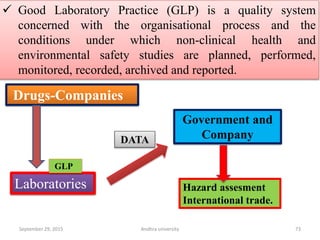
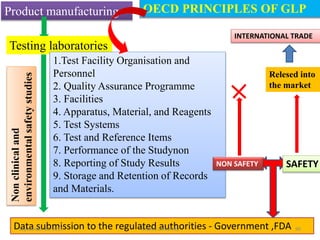
 Good Laboratory Practice (GLP) is a quality system
concerned with the organisational process and the
conditions under which non-clinical health and
environmental safety studies are planned, performed,
monitored, recorded, archived and reported.
Drugs-Companies
Laboratories
Government and
Company
Hazard assesment
International trade.
GLP
DATA
September 29, 2015 73Andhra university
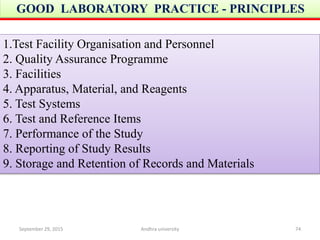
1.Test Facility Organisation and Personnel
2. Quality Assurance Programme
3. Facilities
4. Apparatus, Material, and Reagents
5. Test Systems
6. Test and Reference Items
7. Performance of the Study
8. Reporting of Study Results
9. Storage and Retention of Records and Materials
GOOD LABORATORY PRACTICE - PRINCIPLES
September 29, 2015 74Andhra university
1.Test Facility Organisation and Personnel
A. Test Facility Management’s Responsibilities
B. Study Director’s Responsibilities
C. Principal Investigator’s Responsibilities
D. Study Personnel’s Responsibilities
September 29, 2015 75Andhra university
A.Test Facility Management’s Responsibilities.
 Responsibilities of management as defined by
these principles of good laboratory practice.
 Sufficient number of qualified personnel,
appropriate facilities, equipment, and materials are
available for the timely and proper conduct of the
Study
 Ensure the maintenance of a record of the
qualifications, training, experience.
 Job description for each professional and technical
individual.
 Documented approval of the study plan by the
Study Director.September 29, 2015 76Andhra university
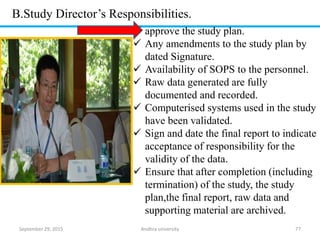
B.Study Director’s Responsibilities.
 approve the study plan.
 Any amendments to the study plan by
dated Signature.
 Availability of SOPS to the personnel.
 Raw data generated are fully
documented and recorded.
 Computerised systems used in the study
have been validated.
 Sign and date the final report to indicate
acceptance of responsibility for the
validity of the data.
 Ensure that after completion (including
termination) of the study, the study
plan,the final report, raw data and
supporting material are archived.
September 29, 2015 77Andhra university
C.Principal Investigator’s Responsibilities
 The Principal Investigator will ensure that the delegated
phases of the study are conducted in accordance with the
applicable Principles of Good Laboratory Practice
September 29, 2015 78Andhra university
Knowledgeable
Instructions
Recording
Health
precautions
Responsibilities
September 29, 2015 79Andhra university
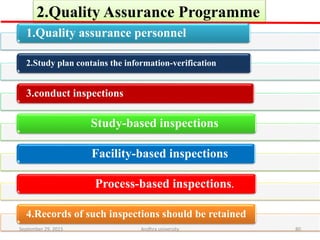
2.Quality Assurance Programme
1.Quality assurance personnel
2.Study plan contains the information-verification
3.conduct inspections
Study-based inspections
Facility-based inspections
Process-based inspections.
4.Records of such inspections should be retained
September 29, 2015 80Andhra university
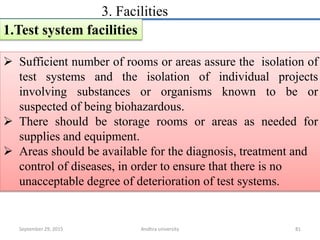
3. Facilities
1.Test system facilities
 Sufficient number of rooms or areas assure the isolation of
test systems and the isolation of individual projects
involving substances or organisms known to be or
suspected of being biohazardous.
 There should be storage rooms or areas as needed for
supplies and equipment.
 Areas should be available for the diagnosis, treatment and
control of diseases, in order to ensure that there is no
unacceptable degree of deterioration of test systems.
September 29, 2015 81Andhra university
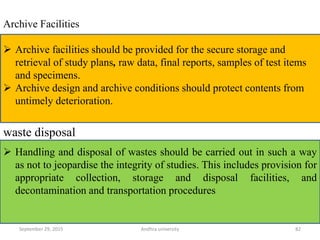
Archive Facilities
 Archive facilities should be provided for the secure storage and
retrieval of study plans, raw data, final reports, samples of test items
and specimens.
 Archive design and archive conditions should protect contents from
untimely deterioration.
 Handling and disposal of wastes should be carried out in such a way
as not to jeopardise the integrity of studies. This includes provision for
appropriate collection, storage and disposal facilities, and
decontamination and transportation procedures
waste disposal
September 29, 2015 82Andhra university
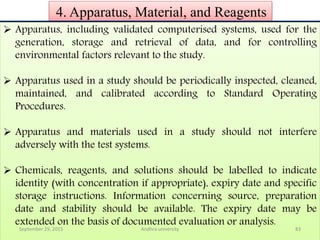
4. Apparatus, Material, and Reagents
 Apparatus, including validated computerised systems, used for the
generation, storage and retrieval of data, and for controlling
environmental factors relevant to the study.
 Apparatus used in a study should be periodically inspected, cleaned,
maintained, and calibrated according to Standard Operating
Procedures.
 Apparatus and materials used in a study should not interfere
adversely with the test systems.
 Chemicals, reagents, and solutions should be labelled to indicate
identity (with concentration if appropriate), expiry date and specific
storage instructions. Information concerning source, preparation
date and stability should be available. The expiry date may be
extended on the basis of documented evaluation or analysis.
September 29, 2015 83Andhra university
5&6.Test Items and test systems and
characterisation
September 29, 2015 84Andhra university
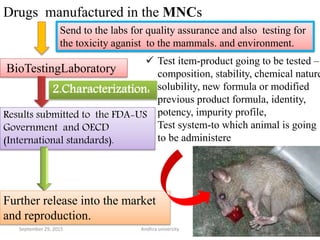
Drugs manufactured in the MNCs
BioTestingLaboratory
Send to the labs for quality assurance and also testing for
the toxicity aganist to the mammals. and environment.
2.Characterization:
 Test item-product going to be tested –
composition, stability, chemical nature
solubility, new formula or modified
previous product formula, identity,
potency, impurity profile,
 Test system-to which animal is going
to be administere
Results submitted to the FDA-US
Government and OECD
(International standards).
Further release into the market
and reproduction.
September 29, 2015 85Andhra university
7.Performance of the Study
1. Study Plan
2. Content of the Study Plan
3. Dates
4. Test Methods
5. Issues (where applicable)
6. Records.
7. A list of records to be retained.
8. Conduct of the Study.
September 29, 2015 86Andhra university
8.Reporting of Study Results
1. Content of the Final Report
2. Identification of the Study, the Test Item and Reference
Item
3. Information Concerning the Sponsor and the Test Facility
4. Dates
5. Statement
6. Description of Materials and Test Methods
7. Results
8. Storage
September 29, 2015 87Andhra university
9. Storage and Retention of Records and Materials
 The study plan, raw data, samples of test and reference
items, specimens and the final report of each study.
 Records of all inspections performed by the Quality
Assurance Programme, as well as master schedules.
 Records of qualifications, training, experience and job
descriptions of personnel.
 Records and reports of the maintenance and calibration of
apparatus.
 Validation documentation for computerised systems.
September 29, 2015 88Andhra university
GLP AT A GLANCE
September 29, 2015 89Andhra university
Product manufacturing
Testing laboratories
Nonclinicaland
environmentalsafetystudies
1.Test Facility Organisation and
Personnel
2. Quality Assurance Programme
3. Facilities
4. Apparatus, Material, and Reagents
5. Test Systems
6. Test and Reference Items
7. Performance of the Studynon
8. Reporting of Study Results
9. Storage and Retention of Records
and Materials.
Data submission to the regulated authorities - Government ,FDA
SAFETYNON SAFETY
Relesed into
the market
OECD PRINCIPLES OF GLP
INTERNATIONAL TRADE
September 29, 2015 90Andhra university
GLP IN OUR COUNTRY
INDIA
September 29, 2015 91Andhra university
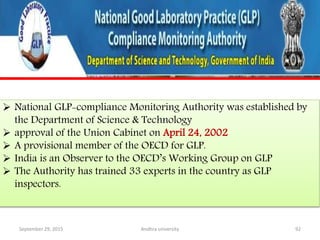
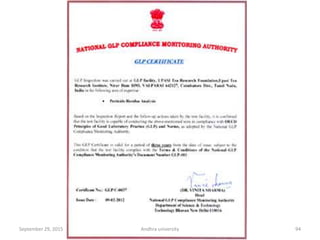
 National GLP-compliance Monitoring Authority was established by
the Department of Science & Technology
 approval of the Union Cabinet on April 24, 2002
 A provisional member of the OECD for GLP.
 India is an Observer to the OECD’s Working Group on GLP
 The Authority has trained 33 experts in the country as GLP
inspectors.
September 29, 2015 92Andhra university
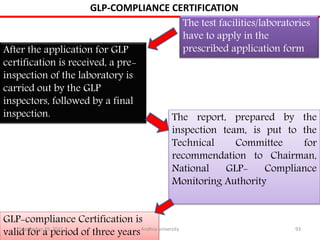
GLP-COMPLIANCE CERTIFICATION
The test facilities/laboratories
have to apply in the
prescribed application form
GLP-compliance Certification is
valid for a period of three years
The report, prepared by the
inspection team, is put to the
Technical Committee for
recommendation to Chairman,
National GLP- Compliance
Monitoring Authority
After the application for GLP
certification is received, a pre-
inspection of the laboratory is
carried out by the GLP
inspectors, followed by a final
inspection.
September 29, 2015 93Andhra university
September 29, 2015 94Andhra university
Dr D R Prasada Raju
Head /Scientist G
drpraju@nic.in
National GLP Compliance Monitoring Authority
Department of Science and Technology
Technology Bhawan, New Mehrauli Road,
New Delhi-110 016 (Telefax 011-26510686)
Mrs Ekta Kapoor
Scientist D
Department of Science and Technology
Technology Bhawan, New Mehrauli Road,
New Delhi-110 016 (Phone: 011-26590242)
E-mail: -ektakapoor.glp@gmail.com
HEAD OF NGCMA:
September 29, 2015 95Andhra university
Our aim :
is to be get the status of full membership in the
near future so that the Indian industries do not have
to get their test facility (products) certified from
safety angle by other GLP monitoring authorities and
do not lose on the trade front.
September 29, 2015 96Andhra university
September 29, 2015 Andhra university 97
Thanking you
by
lavakusa Nayak
September 29, 2015 Andhra university 98

Quality control & Assurance in Analytical Chemistry

  • 1.
    Quality control inAnalytical Chemistry 1September 29, 2015 Andhra university
  • 2.
    Quality • In manufacturing,a measure of excellence or a state of being free from defects, deficiencies and significant variations. It is brought about by strict and consistent commitment to certain standards that achieve uniformity of a product in order to satisfy specific customer or user requirements. • ISO 8402-1986 standard defines quality as "the totality of features and characteristics of a product or service that bears its ability to satisfy stated or implied needs." • If an automobile company finds a defect in one of their cars and makes a product recall, customer reliability and therefore production will decrease because trust will be lost in the car's quality. 2September 29, 2015 Andhra university
  • 3.
    • Quality controlis an essential operation of the pharmaceutical industry. Drugs must be marketed as safe and therapeutically active formulations whose performance is consistent and predictable. New and better medicinal agents are being produced at an accelerated rate. At the same time more exacting and sophisticated analytical methods are being developed for their evaluation. Dictionary definition of QC: Quality control means checking and directing the degree or grade of excellence of processes and products ISO-Quality The totality of features and characteristics of a product, process or service that bear on its ability to satisfy stated or implied needs ISO-QA All those planned and systematic actions necessary to provide adequate confidence that a product, process or service will satisfy given quality requirements 3September 29, 2015 Andhra university
  • 4.
    DEFINITIONS True Value The known,accepted value of a quantifiable property Measured Value The result of an individual’s measurement of a quantifiable property Accuracy How well a measurement agrees with an accepted value Precision How well a series of measurements agree with each other Systematic Error Avoidable error due to controllable variables in a measurement Random Errors Unavoidable errors that are always present in any measurement. Impossible to eliminate • An analysis provides chemical or physical information about a sample. The component of interest in the sample is called the analyte, and the remainder of the sample is the matrix. • In an analysis we determine the identity, concentration, or properties of an analyte. To make this determination we measure one or more of the analyte’s chemical or physical properties • Analysis, a determination and a measurement 4September 29, 2015 Andhra university
  • 5.
    5September 29, 2015Andhra university
  • 6.
    6September 29, 2015Andhra university
  • 7.
    September 29, 2015Andhra university 7
  • 8.
    September 29, 2015Andhra university 8
  • 9.
    September 29, 2015Andhra university 9
  • 10.
    September 29, 2015Andhra university 10
  • 11.
    Techniques, Methods, Procedures,and Protocols 11September 29, 2015 Andhra university
  • 12.
    12September 29, 2015Andhra university
  • 13.
    13September 29, 2015Andhra university
  • 14.
    Quality control 14September 29,2015 Andhra university
  • 15.
    15September 29, 2015Andhra university
  • 16.
    For Drug 1.The identifyingname or mark of the new drug, along with its accepted chemical name, as well as any code names, synonyms, non-proprietary and brand names which may be known. 2. The chemical structure or other specific identification of the composition of the new drug, such as its molecular formula and molecular weight. 3. The source of the new drug, along with information concerning the role of the manufacturer in its production, packaging and distribution, relevant data showing whether the drug is of domestic or foreign origin, and whether or not it is a product of private formula or custom manufacture. 4. The tests applied to control the potency, purity and safety of the new drug, and 5. The methods, equipment, plant and controls used in the manufacture, processing and packaging of the new drug. 16September 29, 2015 Andhra university
  • 17.
    Quality assurance 17September 29,2015 Andhra university
  • 18.
  • 19.
    Limit of detection 19September29, 2015 Andhra university
  • 20.
    20September 29, 2015Andhra university
  • 21.
    21September 29, 2015Andhra university
  • 22.
    22September 29, 2015Andhra university
  • 23.
    Sensitivity • The abilityto demonstrate that two samples have different amounts of analyte is an essential part of many analyses. A method’s sensitivity is a measure of its ability to establish that such differences are significant. Sensitivity is often confused with a method’s detection limit, which is the smallest amount of analyte that we can determine with confidence. • Usually regarded as detection limit • Capability of a method or instrument to discriminate between measurement responses – but this term is often used without defining what is intended (minimum detection or quantitation) • A sensitivity QC describes the capability of measuring a constituent at low levels – a Practical Quantitation Level describes the ability to quantify a constituent with known certainty 23September 29, 2015 Andhra university

  • 24.
    Bias • Bias issystematic or persistent distortion of a measurement process that causes error in one direction • A bias can result from: – biased sampling design – calibration errors – response factor shifts – unaccounted -for interferences – chronic sample contamination 24September 29, 2015 Andhra university
  • 25.
    Safety • Materials - Highquality raw materials. This includes defining specifications for the materials • Preparation - Preventing foreign bodies from entering products, enabling the management of allergens, and controlling pests - a clean and safe water supply, for air filtration, and for any material that will come into contact with our product, to guarantee that the materials, equipment and manufacturing environment are all designed to produce safe products. - We follow certified cleaning and sanitation practices at every step of production • Processing - We prepare products in quantities that provide an appropriate and consistent dosage of any nutrient, to avoid any harm linked to over- or under-dosage. And we process at optimum temperatures to retain its nutritious value, while removing dangerous microorganisms and preventing the formation of chemical contaminants • Testing • Packaging and transportation 25September 29, 2015 Andhra university
  • 26.
    Specificity & Selectivity •Selectivity of a method refers to the extent to which it can determine particular analytes under given conditions in mixtures or matrices, simple or complex, without interferences from other components in the mixture. “Specificity is the ultimate of Selectivity” • Selectivity is very often expressed in combination with words such as adjustment ,tuning ,optimization ,predetermined ,enhancement ,and coefficients ,as well as selective enrichment • The term “specific” can of course be used without confusion to denote a physical quantity obtained after division of a measurement by mass, e.g., specific volume. 26September 29, 2015 Andhra university
  • 27.
    Robustness and Ruggedness •For a method to be useful it must provide reliable results. Unfortunately, methods are subject to a variety of chemical and physical interferences that contribute uncertainty to the analysis. When a method is relatively free from chemical interferences, we can use it on many analytes in a wide variety of sample matrices. Such methods are considered robust. • Random variations in experimental conditions also introduces uncertainty. If a method’s sensitivity, k, is too dependent on experimental conditions, such as temperature, acidity, or reaction time, then a slight change in any of these conditions may give a significantly different result. A rugged method is relatively insensitive to changes in experimental conditions. 27September 29, 2015 Andhra university
  • 28.
    – The Mean-measure of central tendency – The Range- difference between largest/smallest observations in a set of data – Standard Deviation measures the amount of data dispersion around mean 28 Statistical control September 29, 2015 Andhra university
  • 29.
    The Mean • Tocompute the mean we simply sum all the observations and divide by the total no. of observations. 29September 29, 2015 Andhra university
  • 30.
    The Range • Range,which is the difference between the largest and smallest observations. 30September 29, 2015 Andhra university
  • 31.
    Standard Deviation • Standarddeviation is a measure of dispersion of a curve. • It measures the extent to which these values are scattered around the central mean. 31September 29, 2015 Andhra university
  • 32.
    • Extend theuse of descriptive statistics to monitor the quality of the product and process • Statistical process control help to determine the amount of variation • To make sure the process is in a state of control Statistical process control 32 32September 29, 2015 Andhra university
  • 33.
    Control chart • Powerful,easy-to-use technique for the control of routine analyses • ISO/IEC 17025 demands use wherever practicable • It is hard to imagine quality management systems in laboratories without control chart • Assign a target value • Certified value of a RM/CRM (if available) • Mean of often repeated measurements of the control sample (in most cases) 33September 29, 2015 Andhra university
  • 34.
    September 29, 2015Andhra university 34 Basic Principle of control chart
  • 35.
    concentration upper action limit upperwarning limit target value lower warning limits lower action limits sample-# 1 2 3 4 5 6 7 8 9 10 1112 13 14 15 16 17 18 Take control samples during the process Measure a quality indicator Mark the measurement in a chart with warning and action limits Warning / action limits If data are normally distributed 95.5% of the data are in µ ± 2σ 99.7% are in µ ± 3σ x-bar± 2s is taken as warning limits x-bar± 3s is taken as action limit 35September 29, 2015 Andhra university
  • 36.
    Quality systems - controlcharts % Fat 3.10 3.15 3.20 3.25 3.30 14/01/02 24/01/02 03/02/02 13/02/02 23/02/02 05/03/02 15/03/02 25/03/02 04/04/02 14/04/02 24/04/02 date %fat A control chart is a means of ensuring that the method remains in ‘control’ - continues to perform in accordance with expectations. This usually means that results from analysing standards fall within + 2 standard deviations of the accepted value (within the blue lines on the chart). Any results appearing outside the red lines (+ 3 standard deviations) indicate that the method is not longer in control and requires investigation. 36September 29, 2015 Andhra university
  • 37.
    37September 29, 2015Andhra university
  • 38.
    Action Limits: • Thereis a probability of only (100-99.7) 0.3 % that a (correct) measurement is outside the action limits (3 out of 1000 measurements) • Therefore the process should be stopped immediately and searched for errors Warning Limits: • (100-95.5) 4.5% of the (correct) values are outside the warning limits. • This is not very unlikely. • Therefore this is only for warning, no immediate action required 38September 29, 2015 Andhra university
  • 39.
    What is aYouden Plot? 39September 29, 2015 Andhra university
  • 40.
    40September 29, 2015Andhra university
  • 41.
    • In thelate 1950's, Dr. William Youden (1900-1971) developed what has now become known as the Youden Plots. • This statistical technique involves both normal and abnormal controls and graphically helps to differentiate between systematic and random errors. • The inner square of the plot (yellow) represents one standard deviation (1SD). The next larger square (green) represents 2SD, and the outer square (blue) represents 3SD. • A horizontal median line is drawn parallel to the X-axis and a second median line is drawn parallel to the Y-axis. • The intersection of the two median lines is called the Manhattan Median. One or two 45-degree lines are drawn through the Manhattan Median. • The results of at least two different levels of controls (e.g. Level 1/Level 2 or Normal/Abnormal) are then plotted on the chart as X-axis versus Y-axis. 41September 29, 2015 Andhra university
  • 42.
    42September 29, 2015Andhra university
  • 43.
    Using a YoudenPlot 43September 29, 2015 Andhra university
  • 44.
    44September 29, 2015Andhra university
  • 45.
    45September 29, 2015Andhra university
  • 46.
    46September 29, 2015Andhra university
  • 47.
    47September 29, 2015Andhra university
  • 48.
    48September 29, 2015Andhra university
  • 49.
    • Controls arerun and plotted. • Plots that lie near the 45-degree reference line and within the one and two standard deviation squares show acceptable results. • Points that lie near the 45-degree reference lines but outside the 2SD square indicate a systematic error. • Points that lie far from ether 45-degree reference line indicate a random error. 49September 29, 2015 Andhra university
  • 50.
    Elements of qualityAssessment & Assurance • Legal base • Regulatory elements - Governmental drug control agencies i. Inspection services ii. Drug quality control laboratory • Technical elements - Quality specifications - Basic tests - Requirements for good manufacturing practices September 29, 2015 Andhra university 50
  • 51.
    ICH guidelines 51September 29,2015 Andhra university
  • 52.
    52September 29, 2015Andhra university
  • 53.
    53September 29, 2015Andhra university
  • 54.
    54September 29, 2015Andhra university
  • 55.
    55September 29, 2015Andhra university
  • 56.
    56September 29, 2015Andhra university
  • 57.
    57September 29, 2015Andhra university
  • 58.
  • 59.
    September 29, 2015Andhra university 59
  • 60.
    SOP-standard operating procedures,SPC- statistical process control, PAT-Process analytical technology,QRM-Quality Risk Management, PAT-Process analytical technology, CMA-Conditional marketing authorisation, RTRT-Real Time Release Testing, CPP-Critical Process Parameters, CQA-Critical Quality Attributes, QTPP-Quality target product profile September 29, 2015 Andhra university 60
  • 61.
    • Define qualitytarget product profile that describes the use, safety and efficacy of the product. • Design and develop product and manufacturing processes. • Identify critical quality attributes, process parameters, and sources of variability. • Establish a control strategy for the entire process • Control manufacturing processes to produce consistent quality over time September 29, 2015 Andhra university 61
  • 62.
    September 29, 2015Andhra university 62
  • 63.
    September 29, 2015Andhra university 63
  • 64.
    ISO 9000 andISO 14000 series-meaning of quality 64September 29, 2015 Andhra university
  • 65.
    65September 29, 2015Andhra university
  • 66.
    66September 29, 2015Andhra university
  • 67.
    ISO 1400 series •The series is divided into two separate areas-the organization evaluation standards and the product evaluation standards. The first deals with • Environmental Management System (EMS) • Environmental Auditing (EA) • Environmental Performance Evaluation (EPE) • whereas later deals with Environmental Aspects in Product Standards (EAPS) • Environmental Labeling (EL) • Life-Cycle Assessment (LCA). 67September 29, 2015 Andhra university
  • 68.
    68September 29, 2015Andhra university
  • 69.
    Requirement calibration September 29,2015 Andhra university 69
  • 70.
    Acceptance Sampling • AcceptanceSampling – Statistical quality control technique, where a random sample is taken from a lot, and upon the results of the sample taken the lot will either be rejected or accepted • Accept Lot – Ready for customers • Reject Lot – Not suitable for customers • Statistical Process Control(SPC) – Sample and determine if in acceptable limits 70September 29, 2015 Andhra university
  • 71.
    • Purposes – Determinethe quality level of an incoming shipment or, at the end production – Ensure that the quality level is within the level that has been predetermined • Can be either 100% inspection, or a few items of a lot. • Complete inspection – Inspecting each item produced to see if each item meets the level desired – Used when defective items would be very detrimental in some way 71September 29, 2015 Andhra university
  • 72.
    ACCEPTANCE SAMPLING ACCEPT LOT RETURNLOT TO SUPPLIER 100% INSPECTION DECISION REJECT LOT SAMPLE AGAIN DECISION INSPECT SAMPLE Type title here TAKE SAMPLE 72September 29, 2015 Andhra university
  • 73.
     Good LaboratoryPractice (GLP) is a quality system concerned with the organisational process and the conditions under which non-clinical health and environmental safety studies are planned, performed, monitored, recorded, archived and reported. Drugs-Companies Laboratories Government and Company Hazard assesment International trade. GLP DATA September 29, 2015 73Andhra university
  • 74.
    1.Test Facility Organisationand Personnel 2. Quality Assurance Programme 3. Facilities 4. Apparatus, Material, and Reagents 5. Test Systems 6. Test and Reference Items 7. Performance of the Study 8. Reporting of Study Results 9. Storage and Retention of Records and Materials GOOD LABORATORY PRACTICE - PRINCIPLES September 29, 2015 74Andhra university
  • 75.
    1.Test Facility Organisationand Personnel A. Test Facility Management’s Responsibilities B. Study Director’s Responsibilities C. Principal Investigator’s Responsibilities D. Study Personnel’s Responsibilities September 29, 2015 75Andhra university
  • 76.
    A.Test Facility Management’sResponsibilities.  Responsibilities of management as defined by these principles of good laboratory practice.  Sufficient number of qualified personnel, appropriate facilities, equipment, and materials are available for the timely and proper conduct of the Study  Ensure the maintenance of a record of the qualifications, training, experience.  Job description for each professional and technical individual.  Documented approval of the study plan by the Study Director.September 29, 2015 76Andhra university
  • 77.
    B.Study Director’s Responsibilities. approve the study plan.  Any amendments to the study plan by dated Signature.  Availability of SOPS to the personnel.  Raw data generated are fully documented and recorded.  Computerised systems used in the study have been validated.  Sign and date the final report to indicate acceptance of responsibility for the validity of the data.  Ensure that after completion (including termination) of the study, the study plan,the final report, raw data and supporting material are archived. September 29, 2015 77Andhra university
  • 78.
    C.Principal Investigator’s Responsibilities The Principal Investigator will ensure that the delegated phases of the study are conducted in accordance with the applicable Principles of Good Laboratory Practice September 29, 2015 78Andhra university
  • 79.
  • 80.
    2.Quality Assurance Programme 1.Qualityassurance personnel 2.Study plan contains the information-verification 3.conduct inspections Study-based inspections Facility-based inspections Process-based inspections. 4.Records of such inspections should be retained September 29, 2015 80Andhra university
  • 81.
    3. Facilities 1.Test systemfacilities  Sufficient number of rooms or areas assure the isolation of test systems and the isolation of individual projects involving substances or organisms known to be or suspected of being biohazardous.  There should be storage rooms or areas as needed for supplies and equipment.  Areas should be available for the diagnosis, treatment and control of diseases, in order to ensure that there is no unacceptable degree of deterioration of test systems. September 29, 2015 81Andhra university
  • 82.
    Archive Facilities  Archivefacilities should be provided for the secure storage and retrieval of study plans, raw data, final reports, samples of test items and specimens.  Archive design and archive conditions should protect contents from untimely deterioration.  Handling and disposal of wastes should be carried out in such a way as not to jeopardise the integrity of studies. This includes provision for appropriate collection, storage and disposal facilities, and decontamination and transportation procedures waste disposal September 29, 2015 82Andhra university
  • 83.
    4. Apparatus, Material,and Reagents  Apparatus, including validated computerised systems, used for the generation, storage and retrieval of data, and for controlling environmental factors relevant to the study.  Apparatus used in a study should be periodically inspected, cleaned, maintained, and calibrated according to Standard Operating Procedures.  Apparatus and materials used in a study should not interfere adversely with the test systems.  Chemicals, reagents, and solutions should be labelled to indicate identity (with concentration if appropriate), expiry date and specific storage instructions. Information concerning source, preparation date and stability should be available. The expiry date may be extended on the basis of documented evaluation or analysis. September 29, 2015 83Andhra university
  • 84.
    5&6.Test Items andtest systems and characterisation September 29, 2015 84Andhra university
  • 85.
    Drugs manufactured inthe MNCs BioTestingLaboratory Send to the labs for quality assurance and also testing for the toxicity aganist to the mammals. and environment. 2.Characterization:  Test item-product going to be tested – composition, stability, chemical nature solubility, new formula or modified previous product formula, identity, potency, impurity profile,  Test system-to which animal is going to be administere Results submitted to the FDA-US Government and OECD (International standards). Further release into the market and reproduction. September 29, 2015 85Andhra university
  • 86.
    7.Performance of theStudy 1. Study Plan 2. Content of the Study Plan 3. Dates 4. Test Methods 5. Issues (where applicable) 6. Records. 7. A list of records to be retained. 8. Conduct of the Study. September 29, 2015 86Andhra university
  • 87.
    8.Reporting of StudyResults 1. Content of the Final Report 2. Identification of the Study, the Test Item and Reference Item 3. Information Concerning the Sponsor and the Test Facility 4. Dates 5. Statement 6. Description of Materials and Test Methods 7. Results 8. Storage September 29, 2015 87Andhra university
  • 88.
    9. Storage andRetention of Records and Materials  The study plan, raw data, samples of test and reference items, specimens and the final report of each study.  Records of all inspections performed by the Quality Assurance Programme, as well as master schedules.  Records of qualifications, training, experience and job descriptions of personnel.  Records and reports of the maintenance and calibration of apparatus.  Validation documentation for computerised systems. September 29, 2015 88Andhra university
  • 89.
    GLP AT AGLANCE September 29, 2015 89Andhra university
  • 90.
    Product manufacturing Testing laboratories Nonclinicaland environmentalsafetystudies 1.TestFacility Organisation and Personnel 2. Quality Assurance Programme 3. Facilities 4. Apparatus, Material, and Reagents 5. Test Systems 6. Test and Reference Items 7. Performance of the Studynon 8. Reporting of Study Results 9. Storage and Retention of Records and Materials. Data submission to the regulated authorities - Government ,FDA SAFETYNON SAFETY Relesed into the market OECD PRINCIPLES OF GLP INTERNATIONAL TRADE September 29, 2015 90Andhra university
  • 91.
    GLP IN OURCOUNTRY INDIA September 29, 2015 91Andhra university
  • 92.
     National GLP-complianceMonitoring Authority was established by the Department of Science & Technology  approval of the Union Cabinet on April 24, 2002  A provisional member of the OECD for GLP.  India is an Observer to the OECD’s Working Group on GLP  The Authority has trained 33 experts in the country as GLP inspectors. September 29, 2015 92Andhra university
  • 93.
    GLP-COMPLIANCE CERTIFICATION The testfacilities/laboratories have to apply in the prescribed application form GLP-compliance Certification is valid for a period of three years The report, prepared by the inspection team, is put to the Technical Committee for recommendation to Chairman, National GLP- Compliance Monitoring Authority After the application for GLP certification is received, a pre- inspection of the laboratory is carried out by the GLP inspectors, followed by a final inspection. September 29, 2015 93Andhra university
  • 94.
    September 29, 201594Andhra university
  • 95.
    Dr D RPrasada Raju Head /Scientist G drpraju@nic.in National GLP Compliance Monitoring Authority Department of Science and Technology Technology Bhawan, New Mehrauli Road, New Delhi-110 016 (Telefax 011-26510686) Mrs Ekta Kapoor Scientist D Department of Science and Technology Technology Bhawan, New Mehrauli Road, New Delhi-110 016 (Phone: 011-26590242) E-mail: -ektakapoor.glp@gmail.com HEAD OF NGCMA: September 29, 2015 95Andhra university
  • 96.
    Our aim : isto be get the status of full membership in the near future so that the Indian industries do not have to get their test facility (products) certified from safety angle by other GLP monitoring authorities and do not lose on the trade front. September 29, 2015 96Andhra university
  • 97.
    September 29, 2015Andhra university 97
  • 98.
    Thanking you by lavakusa Nayak September29, 2015 Andhra university 98