
SAMPLING
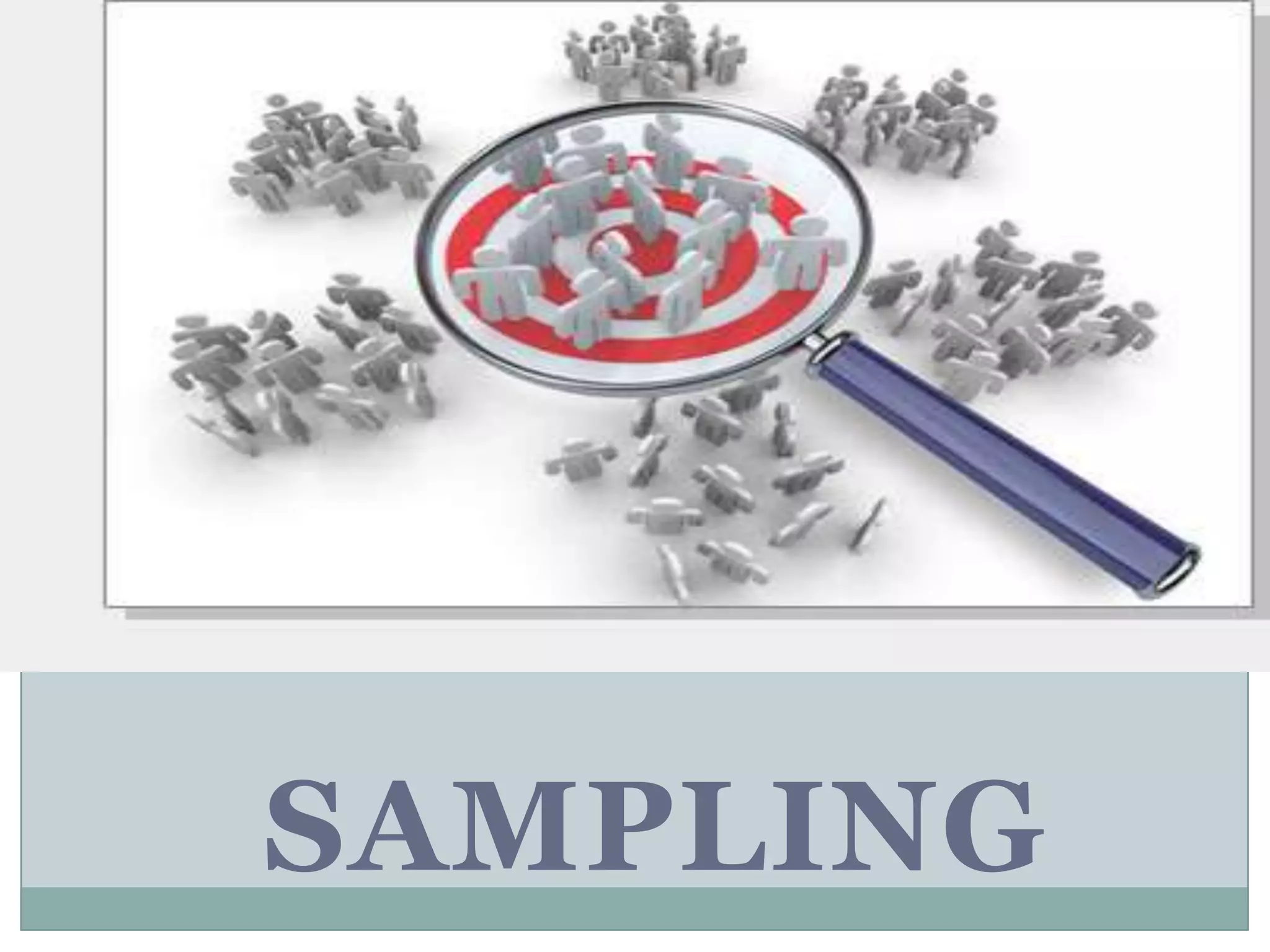
SamplingSampling is simply the process of learning about the population on the basis of a sample drawn from it.Sampling is a tool which helps to know the characteristics of the universe or population by examining only a small part of it.
TerminologyPopulation - Population is the group which is used to generalize the study.Sample - Sample is the group of people that is to be selected for study.Census- A census is the process of obtaining information about every member of a populationSampling Design- It is a technique or procedure for selecting item for the sample.
Sampling frame- The listing of the accessible population from which the sample is drawn is called sampling frame.Response- Response is a specific measurement value that a sampling unit supplies.Population Parameter – When mean or average is calculated on entire population, this is not referred as statistics, it is a population parameter.
Why Sampling???Time constraintsCost constraintsEasy and convenient ProcessingReuse of populationLesser resources requiredHelpful in studying the hypothetical data.
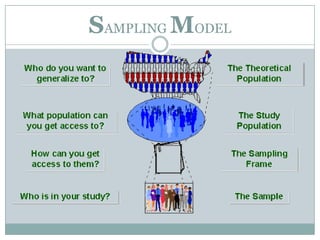
SAMPLING MODEL
Characteristic of samplingRepresentativenessAdequacyIndependenceHomogeneity
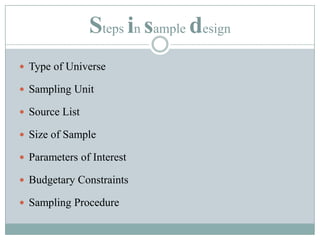
Steps in sample designType of UniverseSampling UnitSource ListSize of SampleParameters of InterestBudgetary ConstraintsSampling Procedure
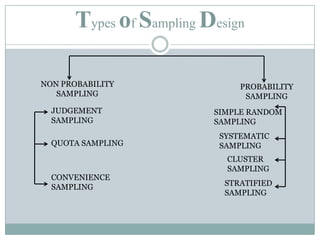
Types of Sampling DesignNON PROBABILITY SAMPLINGPROBABILITY SAMPLINGJUDGEMENT SAMPLINGSIMPLE RANDOM SAMPLINGSYSTEMATIC SAMPLINGQUOTA SAMPLINGCLUSTER SAMPLINGCONVENIENCE SAMPLINGSTRATIFIED SAMPLING
NON PROBABILIITY SAMPLINGIt is a sampling procedure which does not afford any basis for estimating the probability that each item in the population has of being included in the sample. Also known as deliberate sampling, purposive sampling.
PROBABILITY SAMPLINGProbability sampling is a sampling procedure where every item in the universe has an equal chances of inclusion in the sample. Also known as ‘random sampling’ or ‘chance sampling’.
CHARATERSTICS OF GOOD SAMPLE DESIGNMust result in a truly representative sampleMust result in small sampling errorsMust be viable in context of funds available for the research study.Must be such so that systematic bias can be controlled in a better way.
Techniques of selecting arandom sampleSize of sample			- Size of universe			- Resources available			- Degree of accuracy			- Homogeneity			- Nature of study			- Method of sampling adopted			- Nature of respondents
Merits of samplingLess time consumingLess costMore reliable resultsMore detailed informationPractical methodTo judge the accuracy of the information obtained on a census basis.
Limitations of samplingUnplanned sampling is often misleadingRequires expertsAt times complicatedNot appropriate when every unit in the domain has to be studied.
   Thank you   

Sampling

  • 1.
  • 2.
    SamplingSampling is simplythe process of learning about the population on the basis of a sample drawn from it.Sampling is a tool which helps to know the characteristics of the universe or population by examining only a small part of it.
  • 3.
    TerminologyPopulation - Populationis the group which is used to generalize the study.Sample - Sample is the group of people that is to be selected for study.Census- A census is the process of obtaining information about every member of a populationSampling Design- It is a technique or procedure for selecting item for the sample.
  • 4.
    Sampling frame- Thelisting of the accessible population from which the sample is drawn is called sampling frame.Response- Response is a specific measurement value that a sampling unit supplies.Population Parameter – When mean or average is calculated on entire population, this is not referred as statistics, it is a population parameter.
  • 5.
    Why Sampling???Time constraintsCostconstraintsEasy and convenient ProcessingReuse of populationLesser resources requiredHelpful in studying the hypothetical data.
  • 6.
  • 7.
  • 8.
    Steps in sampledesignType of UniverseSampling UnitSource ListSize of SampleParameters of InterestBudgetary ConstraintsSampling Procedure
  • 9.
    Types of SamplingDesignNON PROBABILITY SAMPLINGPROBABILITY SAMPLINGJUDGEMENT SAMPLINGSIMPLE RANDOM SAMPLINGSYSTEMATIC SAMPLINGQUOTA SAMPLINGCLUSTER SAMPLINGCONVENIENCE SAMPLINGSTRATIFIED SAMPLING
  • 10.
    NON PROBABILIITY SAMPLINGItis a sampling procedure which does not afford any basis for estimating the probability that each item in the population has of being included in the sample. Also known as deliberate sampling, purposive sampling.
  • 11.
    PROBABILITY SAMPLINGProbability samplingis a sampling procedure where every item in the universe has an equal chances of inclusion in the sample. Also known as ‘random sampling’ or ‘chance sampling’.
  • 12.
    CHARATERSTICS OF GOODSAMPLE DESIGNMust result in a truly representative sampleMust result in small sampling errorsMust be viable in context of funds available for the research study.Must be such so that systematic bias can be controlled in a better way.
  • 13.
    Techniques of selectingarandom sampleSize of sample - Size of universe - Resources available - Degree of accuracy - Homogeneity - Nature of study - Method of sampling adopted - Nature of respondents
  • 14.
    Merits of samplingLesstime consumingLess costMore reliable resultsMore detailed informationPractical methodTo judge the accuracy of the information obtained on a census basis.
  • 15.
    Limitations of samplingUnplannedsampling is often misleadingRequires expertsAt times complicatedNot appropriate when every unit in the domain has to be studied.
  • 16.
      Thank you   