

MUTUAL FUND


              S
Concept of Mutual Fund (MF’s)


S  Defined:- A fund that is created when a large number of investors
   put in their money, and is managed by professionally qualified
   persons.

S  It is a vehicle for collective investment, a way of becoming part-
   owner of the investment held under the scheme.

S  Till 1986, UTI was only mutual fund in India, which has
   outnumbered to 33 major emerged Mf’s.
Entities in MF’s operation

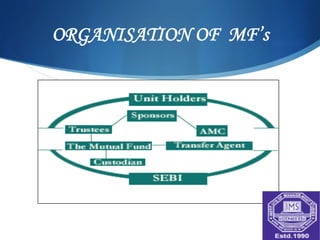
S  Sponsor:- It is like promoter of a company, maybe a
  bank, FI’s or a financial service company. For E.g.
  sponsor for Templeton Mutual Fund is Templeton
  international INC. Sponsor is responsible for setting up
  and establishing the mutual fund.
S  Trustee:- a corporate body appointed by sponsor. It
  appoints Asset Management Company(AMC), secure
  necessary approvals, periodically monitor AMC
  functions.
Entities in MF’s continues…

S  Asset Management Company(AMC):- also referred to as the
    investment manager, is separate company appointed the trustees to
    run the mutual fund. For E.G.: Templeton Asset Management
    Pvt. Is AMC of Templeton MF.
S  Custodian:- it handles investment back office operations of
    MF’s. It looks after receipt and delivery of securities, collection of
    income, distribution of dividends.
S  Registrar & Transfer Agents:- they handle investor related
    services such as sending fact sheet, annual reports. It may be
    outsourced to SEBI approved agents like KARVY & CAMS.
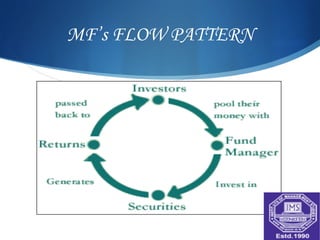
MF’s FLOW PATTERN


                    !
ORGANISATION OF MF’s


                       !
Mutual funds Classified


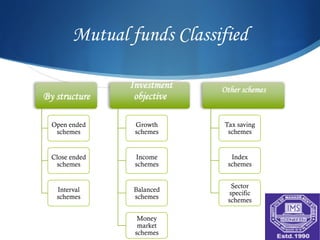
Open ended    Growth     Tax saving
 schemes      schemes     schemes


Close ended   Income       Index
 schemes      schemes     schemes


                            Sector
 Interval     Balanced
                           specific
 schemes      schemes
                          schemes

               Money
               market
              schemes
Classification Discussed…

S  Open ended schemes:- is the one that an investor can buy or sell as
   and when they intend to at a NAV based price.
S  Close-ended schemes:- it usually issue units to investors only once,
   when they launch an offer, called New Fund Offer (NFO).
   Thereafter, these units are listed in stock exchanges where they are
   traded on daily basis.
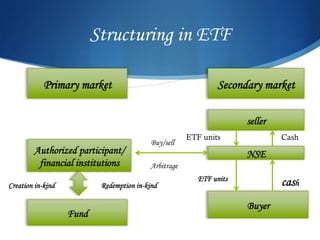
S  Exchange Traded Funds:- is a hybrid of close-ended & open-ended
   index funds. It is listed on stock exchange and like an open-ended
   fund it creates and redeems units in line with rise and fall of
   demand.
Open-ended Vs. Close-ended

      Open-ended index fund                    Close-ended index fund
S  Subscription on continuous basis.    S  subscription for limited period
                                             (usually 3months).
S  Permits investor to withdraw funds
   on continuing basis.                  S  Does not allow withdrawal as and
                                             when they like.
S  No fixed maturity period.
                                         S  Has a fixed maturity period(5 to 15 yrs).
S  Not listed in secondary market.
                                         S  Listed on secondary market.
Structuring in ETF


                                                ETF units      Cash
                                    Buy/sell

                                    Arbitrage
                                                   ETF units
Creation in-kind    Redemption in-kind                         cash
Mutual Fund Terminology


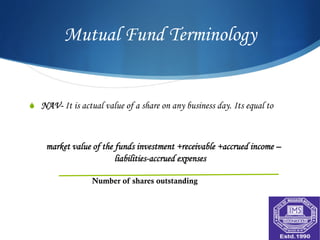
S  NAV- It is actual value of a share on any business day. Its equal to


    market value of the funds investment +receivable +accrued income –
                        liabilities-accrued expenses

                  Number of shares outstanding
Continues…


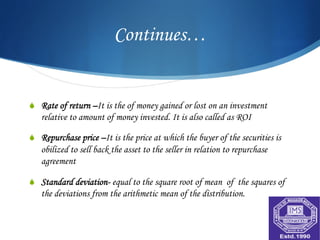
S  Rate of return –It is the of money gained or lost on an investment
   relative to amount of money invested. It is also called as ROI

S  Repurchase price –It is the price at which the buyer of the securities is
   obilized to sell back the asset to the seller in relation to repurchase
   agreement

S  Standard deviation- equal to the square root of mean of the squares of
   the deviations from the arithmetic mean of the distribution.
Continues…

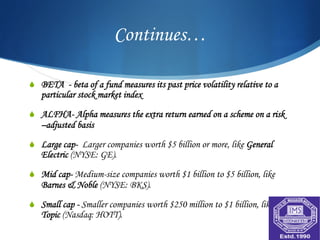
S  BETA - beta of a fund measures its past price volatility relative to a
   particular stock market index

S  ALFHA- Alpha measures the extra return earned on a scheme on a risk
   –adjusted basis
S  Large cap- Larger companies worth $5 billion or more, like General
   Electric (NYSE: GE).

S  Mid cap- Medium-size companies worth $1 billion to $5 billion, like
   Barnes & Noble (NYSE: BKS).

S  Small cap - Smaller companies worth $250 million to $1 billion, like Hot
   Topic (Nasdaq: HOTT).
Advantages of Mutual Funds

v Increased Diversification

v Daily Liquidity

v Professional Investment Management

v Ability to participate in investments that may be available only to larger investors

v Service & Convenience

v Government oversight

v Ease to comparison
Disadvantages of Mutual Funds

 v Fees

 v Less control over timing of recognition of gains

 v Less predictable income

 v No opportunity to customize
References of study

S  http://finance.indiamart.com/india_business_information/
   mutual_fund_companies.html

S  www.wikipedia.com/finance

S  http://sunseven.hubpages.com/hub/The-Top-10-Mutual-Funds-in-
   India

S  Security Analysis & Portfolio Management – Prassana & Chandra

S  Security Analysis & Portfolio Management- P. Pandian

S  http://www.e-investing.in/mutual-funds/106-reliance-mutual-fund-now-indias-
   largest-mf.html
AMIT KUMAR ROY
VIVEK SINGH
NITIN VERMA
PARITOSH JAIN

mutual funds

  • 1.
  • 2.
    Concept of MutualFund (MF’s) S  Defined:- A fund that is created when a large number of investors put in their money, and is managed by professionally qualified persons. S  It is a vehicle for collective investment, a way of becoming part- owner of the investment held under the scheme. S  Till 1986, UTI was only mutual fund in India, which has outnumbered to 33 major emerged Mf’s.
  • 3.
    Entities in MF’soperation S  Sponsor:- It is like promoter of a company, maybe a bank, FI’s or a financial service company. For E.g. sponsor for Templeton Mutual Fund is Templeton international INC. Sponsor is responsible for setting up and establishing the mutual fund. S  Trustee:- a corporate body appointed by sponsor. It appoints Asset Management Company(AMC), secure necessary approvals, periodically monitor AMC functions.
  • 4.
    Entities in MF’scontinues… S  Asset Management Company(AMC):- also referred to as the investment manager, is separate company appointed the trustees to run the mutual fund. For E.G.: Templeton Asset Management Pvt. Is AMC of Templeton MF. S  Custodian:- it handles investment back office operations of MF’s. It looks after receipt and delivery of securities, collection of income, distribution of dividends. S  Registrar & Transfer Agents:- they handle investor related services such as sending fact sheet, annual reports. It may be outsourced to SEBI approved agents like KARVY & CAMS.
  • 5.
  • 6.
  • 7.
    Mutual funds Classified Openended Growth Tax saving schemes schemes schemes Close ended Income Index schemes schemes schemes Sector Interval Balanced specific schemes schemes schemes Money market schemes
  • 8.
    Classification Discussed… S  Openended schemes:- is the one that an investor can buy or sell as and when they intend to at a NAV based price. S  Close-ended schemes:- it usually issue units to investors only once, when they launch an offer, called New Fund Offer (NFO). Thereafter, these units are listed in stock exchanges where they are traded on daily basis. S  Exchange Traded Funds:- is a hybrid of close-ended & open-ended index funds. It is listed on stock exchange and like an open-ended fund it creates and redeems units in line with rise and fall of demand.
  • 9.
    Open-ended Vs. Close-ended Open-ended index fund Close-ended index fund S  Subscription on continuous basis. S  subscription for limited period (usually 3months). S  Permits investor to withdraw funds on continuing basis. S  Does not allow withdrawal as and when they like. S  No fixed maturity period. S  Has a fixed maturity period(5 to 15 yrs). S  Not listed in secondary market. S  Listed on secondary market.
  • 10.
    Structuring in ETF ETF units Cash Buy/sell Arbitrage ETF units Creation in-kind Redemption in-kind cash
  • 11.
    Mutual Fund Terminology S NAV- It is actual value of a share on any business day. Its equal to market value of the funds investment +receivable +accrued income – liabilities-accrued expenses Number of shares outstanding
  • 12.
    Continues… S  Rate ofreturn –It is the of money gained or lost on an investment relative to amount of money invested. It is also called as ROI S  Repurchase price –It is the price at which the buyer of the securities is obilized to sell back the asset to the seller in relation to repurchase agreement S  Standard deviation- equal to the square root of mean of the squares of the deviations from the arithmetic mean of the distribution.
  • 13.
    Continues… S  BETA -beta of a fund measures its past price volatility relative to a particular stock market index S  ALFHA- Alpha measures the extra return earned on a scheme on a risk –adjusted basis S  Large cap- Larger companies worth $5 billion or more, like General Electric (NYSE: GE). S  Mid cap- Medium-size companies worth $1 billion to $5 billion, like Barnes & Noble (NYSE: BKS). S  Small cap - Smaller companies worth $250 million to $1 billion, like Hot Topic (Nasdaq: HOTT).
  • 14.
    Advantages of MutualFunds v Increased Diversification v Daily Liquidity v Professional Investment Management v Ability to participate in investments that may be available only to larger investors v Service & Convenience v Government oversight v Ease to comparison
  • 15.
    Disadvantages of MutualFunds v Fees v Less control over timing of recognition of gains v Less predictable income v No opportunity to customize
  • 16.
    References of study S http://finance.indiamart.com/india_business_information/ mutual_fund_companies.html S  www.wikipedia.com/finance S  http://sunseven.hubpages.com/hub/The-Top-10-Mutual-Funds-in- India S  Security Analysis & Portfolio Management – Prassana & Chandra S  Security Analysis & Portfolio Management- P. Pandian S  http://www.e-investing.in/mutual-funds/106-reliance-mutual-fund-now-indias- largest-mf.html
  • 17.
    AMIT KUMAR ROY VIVEKSINGH NITIN VERMA PARITOSH JAIN