1

Chapter
 12
               Enterprise and Global
                  Management of
              Information Technology


McGraw-Hill/Irwin     Copyright © 2004, The McGraw-Hill Companies, Inc. All rights reserved.
2


                    Learning Objectives
Identify  ways that information technology has
  affected the job of managers.

Identify  the seven major dimensions of a
  networked organization and explain how they
  can affect the success of a business.


McGraw-Hill/Irwin         Copyright © 2004, The McGraw-Hill Companies, Inc. All rights reserved.
3


                    Learning Objectives (continued)


Identify each of the three components of
  information technology management and use
  examples to show how they might be
  implemented in a business.

Explain  how failures in IT management can be
  reduced by the involvement of business
  managers in IS planning and management.

McGraw-Hill/Irwin          Copyright © 2004, The McGraw-Hill Companies, Inc. All rights reserved.
4


                    Learning Objectives (continued)


Identify cultural, political, and geoeconomic
  challenges that confront managers in the
  management of global information
  technologies.

Explain   the effect on global e-business strategy
  of the trend toward a transnational business
  strategy by international business
  organizations.
McGraw-Hill/Irwin          Copyright © 2004, The McGraw-Hill Companies, Inc. All rights reserved.
5


                    Learning Objectives (continued)


Identify   considerations that affect the choice
  of IT applications, IT platforms, data access
  policies, and systems development methods by
  a global business enterprise.


McGraw-Hill/Irwin          Copyright © 2004, The McGraw-Hill Companies, Inc. All rights reserved.
6


                       Section I


            Managing Information Technology


McGraw-Hill/Irwin       Copyright © 2004, The McGraw-Hill Companies, Inc. All rights reserved.
7


                    Business and IT
As    companies are transformed into global e-
  businesses and players in global e-commerce,
  it is vital for business managers and
  professionals to understand how to manage
  this vital function.


McGraw-Hill/Irwin       Copyright © 2004, The McGraw-Hill Companies, Inc. All rights reserved.
8


              The Impact of IT on Managers


A  major force for precipitating or enabling
  organizational and managerial change

Enables   innovative changes in managerial
  decision making, organizational structures,
  and managerial work activities


McGraw-Hill/Irwin       Copyright © 2004, The McGraw-Hill Companies, Inc. All rights reserved.
9


          The Impact of IT on Organizations
Key  dimensions of the networked enterprise
   Organizational structure

   Leadership and governance

   People and culture

   Coherence

   Knowledge

   Alliances


McGraw-Hill/Irwin      Copyright © 2004, The McGraw-Hill Companies, Inc. All rights reserved.
10


          Managing Information Technology
Three   major components
   Managing the joint development and

    implementation of e-business and IT
    strategies
   Managing the development of e-business

    applications and the research &
    implementation of new IT


McGraw-Hill/Irwin     Copyright © 2004, The McGraw-Hill Companies, Inc. All rights reserved.
11


                    Managing Information Technology (continued)


Three  major components (continued)
   Managing the IT processes, professionals, &

    subunits with the IT organization & IS
    function


McGraw-Hill/Irwin                 Copyright © 2004, The McGraw-Hill Companies, Inc. All rights reserved.
12


                    Managing the IS Function
Organizing   IT
   Centralization

   Decentralization

   Latest trend, hybrid


McGraw-Hill/Irwin           Copyright © 2004, The McGraw-Hill Companies, Inc. All rights reserved.
13


                    Managing the IS Function (continued)


Managing    Application Development
   Involves managing activities such as

     systems analysis and design

     prototyping

     applications programming

     project management

     quality assurance

     systems maintenance

McGraw-Hill/Irwin             Copyright © 2004, The McGraw-Hill Companies, Inc. All rights reserved.
14


                    Managing the IS Function (continued)


Managing    IS Operations
   Managing the use of hardware, software,

    network, and personnel resources in data
    centers/computer centers within an
    organization


McGraw-Hill/Irwin             Copyright © 2004, The McGraw-Hill Companies, Inc. All rights reserved.
15


                    Managing the IS Function (continued)


Managing   IS operations (continued)
   Operational activities requiring

    management
    Computer systems operations

    Network management

    Production control

    Production support


McGraw-Hill/Irwin             Copyright © 2004, The McGraw-Hill Companies, Inc. All rights reserved.
16


                    Managing the IS Function (continued)


Managing   IS Operations (continued)
   System Performance Monitors

    Monitor processing of computer jobs

    Helps develop a planned schedule

    Produce detailed stats for planning and

     control of computing capacity
    Chargeback systems

    Process control


McGraw-Hill/Irwin             Copyright © 2004, The McGraw-Hill Companies, Inc. All rights reserved.
17


                    Managing the IS Function (continued)


Human     Resource Management of IT
   Recruit qualified personnel

   Develop, organize, and direct the

    capabilities of existing personnel
   Train employees

   Design career paths and set salary and wage

    levels


McGraw-Hill/Irwin             Copyright © 2004, The McGraw-Hill Companies, Inc. All rights reserved.
18


                    Managing the IS Function (continued)


The  CIO and Other IT Executives
   Chief Information Officer (CIO)

    Oversees all use of IT in many companies.

    Brings the IT function into alignment with

     strategic business goals
    Concentrates on business/IT planning and

     strategy
    Helps develop strategic uses of IT in e-

     business and e-commerce
McGraw-Hill/Irwin             Copyright © 2004, The McGraw-Hill Companies, Inc. All rights reserved.
19


                    Managing the IS Function (continued)


Technology   Management
   All IT must be managed as a technology

    platform for integrated e-business and e-
    commerce systems
   May assign a Chief Technology Officer

    (CTO)
     In charge of all IT planning and

      deployment

McGraw-Hill/Irwin             Copyright © 2004, The McGraw-Hill Companies, Inc. All rights reserved.
20


                    Managing the IS Function (continued)


Managing    User Services
   Functions to support and manage end user

    and workgroup computing
   Provides both opportunities and problems

    for business unit managers
     Help desks

     Establish and enforce policies


McGraw-Hill/Irwin             Copyright © 2004, The McGraw-Hill Companies, Inc. All rights reserved.
21


                    Failures in IT Management
IT   is not being used effectively by companies
  that use IT primarily to computerize
  traditional business processes, instead of using
  it for innovative e-business processes

IT  is not being used efficiently by IS that
  provide poor response times and frequent
  down times or when application development
  projects are not managed properly
McGraw-Hill/Irwin            Copyright © 2004, The McGraw-Hill Companies, Inc. All rights reserved.
22


                    Failures in IT Management (continued)


Management      Involvement and Governance
   Senior management needs to be involved in

    critical business/IT decisions to optimize the
    business value and performance of the IT
    function.
     Requires development of governance

      structures that encourage active
      participation in planning and controlling
      the business uses of IT.
McGraw-Hill/Irwin             Copyright © 2004, The McGraw-Hill Companies, Inc. All rights reserved.
23


                     Failures in IT Management (continued)


Helps        avoid IS performance problems

Helps        improve the strategic business value of
  IT


McGraw-Hill/Irwin              Copyright © 2004, The McGraw-Hill Companies, Inc. All rights reserved.
24


                        Section II


                    Managing Global IT


McGraw-Hill/Irwin        Copyright © 2004, The McGraw-Hill Companies, Inc. All rights reserved.
25


                The International Dimension


A  vital part of managing an e-business
  enterprise in the internetworked global
  economies and markets of today.


McGraw-Hill/Irwin         Copyright © 2004, The McGraw-Hill Companies, Inc. All rights reserved.
26


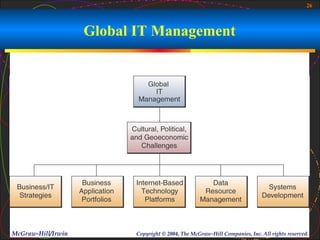
                    Global IT Management


McGraw-Hill/Irwin         Copyright © 2004, The McGraw-Hill Companies, Inc. All rights reserved.
27


    Cultural, Political, and Geoeconomic Challenges

Cultural   challenges
   Differences in languages

   Cultural interests

   Religions

   Customs

   Social attitudes

   Political philosophies


McGraw-Hill/Irwin     Copyright © 2004, The McGraw-Hill Companies, Inc. All rights reserved.
28


                    Cultural, Political, and Geoeconomic Challenges (continued)


Political challenges
   Rules regulating or prohibiting transfer of

    data across their national boundaries
   Severe restrictions, taxes, or prohibitions

    against imports of hardware and software
   Local content laws

   Reciprocal trade agreements


McGraw-Hill/Irwin                        Copyright © 2004, The McGraw-Hill Companies, Inc. All rights reserved.
29


                    Cultural, Political, and Geoeconomic Challenges (continued)


Geoeconomic      Challenges
   The effects of geography on the economic

    realities of international business activities
     Distance

     Real-time communication

     Lack of good-quality telephone and

      telecommunications service
     Lack of job skills

     Cost of living and labor costs
McGraw-Hill/Irwin                        Copyright © 2004, The McGraw-Hill Companies, Inc. All rights reserved.
30


                    Global e-Business Strategies
Moving   away from
   Autonomous foreign subsidiaries

   Autonomous foreign subsidiaries, dependent

    on headquarters for new processes,
    products, and ideas
   Close management of worldwide operations

    by headquarters


McGraw-Hill/Irwin             Copyright © 2004, The McGraw-Hill Companies, Inc. All rights reserved.
31


                    Global e-Business Strategies (continued)


Moving   toward
   Reliance on information systems and

    Internet technologies to help integrate global
    business activities
   An integrated, cooperative worldwide

    hardware, software, and Internet-based
    architecture for IT platforms


McGraw-Hill/Irwin              Copyright © 2004, The McGraw-Hill Companies, Inc. All rights reserved.
32


              Global e-Business Applications
IT  applications depend on a variety of global
  business drivers, caused by the nature of the
  industry and its competitive or environmental
  forces
   Global customers

   Global products

   Global operations

   Global resources

   Global collaboration
McGraw-Hill/Irwin        Copyright © 2004, The McGraw-Hill Companies, Inc. All rights reserved.
33


             Global IT Platforms
The      technology infrastructure
Technically complex

Major political and cultural implications

Challenges

   Managing international data
     communications networks
      Network management issues

      Regulatory issues

      Technology issues

      Country-oriented issues
McGraw-Hill/Irwin   Copyright © 2004, The McGraw-Hill Companies, Inc. All rights reserved.
34


                    Global IT Platforms (continued)


The   Internet as a Global IT Platform
   Companies can

     Expand markets

     Reduce communications and distribution

      costs
     Improve their profit margins

   Low cost interactive channel for

    communications and data exchange

McGraw-Hill/Irwin          Copyright © 2004, The McGraw-Hill Companies, Inc. All rights reserved.
35


                    Global Data Access Issues


Transborder   data flows (TDF)
   Data flow across international borders over

    telecommunications networks of global
    information systems


McGraw-Hill/Irwin            Copyright © 2004, The McGraw-Hill Companies, Inc. All rights reserved.
36


                    Global Data Access Issues (continued)


       Many   countries view TDF as violating
        their national sovereignty
       Others, as violating their laws to protect

        the local IT industry or to protect local
        jobs
       May view TDF as a violation of their

        privacy legislation


McGraw-Hill/Irwin             Copyright © 2004, The McGraw-Hill Companies, Inc. All rights reserved.
37


                    Global Data Access Issues (continued)


Internet Access Issues
   High government access fees

   Government monitored access

   Government filtered access

   No public access allowed


McGraw-Hill/Irwin             Copyright © 2004, The McGraw-Hill Companies, Inc. All rights reserved.
38


                Global Systems Development
Challenges

   Conflicts  over local versus global system
    requirements
   Difficulties agreeing on common system

    features
   Disturbances caused by systems

    implementation and maintenance activities


McGraw-Hill/Irwin        Copyright © 2004, The McGraw-Hill Companies, Inc. All rights reserved.
39


                    Global Systems Development (continued)


Challenges    (continued)
   Trade-offs between developing one system

    that can run on multiple computer and
    operating system platforms, or letting each
    local site customize the software for its own
    platform
   Global standardization of data definitions


McGraw-Hill/Irwin              Copyright © 2004, The McGraw-Hill Companies, Inc. All rights reserved.
40


                    Global Systems Development (continued)


Systems   Development Strategies
   Transforming an application used by the

    home office into a global application
   Setting up a multinational development

    team to ensure the system design meets the
    needs of local sites as well as headquarters
   Parallel development

   Centers of excellence


McGraw-Hill/Irwin              Copyright © 2004, The McGraw-Hill Companies, Inc. All rights reserved.
41


                    Discussion Questions
What    has been the impact of e-business
  technologies on the work relationships,
  activities, and resources of managers?

What   can business unit managers do about
  performance problems in the use of
  information technology and the development
  and operation of information systems in their
  business units?
McGraw-Hill/Irwin         Copyright © 2004, The McGraw-Hill Companies, Inc. All rights reserved.
42


                    Discussion Questions (continued)


How   are Internet technologies affecting the
  structure and work roles of modern
  organizations?
   Will middle management wither away?

    Will companies consist primarily of self-

    directed project teams of knowledge
    workers?


McGraw-Hill/Irwin           Copyright © 2004, The McGraw-Hill Companies, Inc. All rights reserved.
43


                    Discussion Questions (continued)


Should   the IS function in a business be
  centralized or decentralized? What recent
  developments support your answer?

How    will the Internet, intranets, and extranets
  affect each of the components of global
  information technology management?


McGraw-Hill/Irwin           Copyright © 2004, The McGraw-Hill Companies, Inc. All rights reserved.
44


                    Discussion Questions (continued)


How    might cultural, political, or geoeconomic
  challenges affect a global company’s use of the
  Internet?

Will  the increasing use of the Internet by firms
  with global e-business operations change their
  move toward a transnational business
  strategy?

McGraw-Hill/Irwin           Copyright © 2004, The McGraw-Hill Companies, Inc. All rights reserved.
45


                    Discussion Questions (continued)


How    might the Internet, intranets, and
  extranets affect the business drivers or
  requirements responsible for a company’s use
  of global IT, as shown in the chapter?


McGraw-Hill/Irwin           Copyright © 2004, The McGraw-Hill Companies, Inc. All rights reserved.
46


             Real World Case 1 – USG Corp.
Evaluating         the ROI of IT Investments

Why   do many companies fail to evaluate the
  return on investment of their IT projects?

Is    this good business practice?


McGraw-Hill/Irwin         Copyright © 2004, The McGraw-Hill Companies, Inc. All rights reserved.
47


                    Real World Case 1 (continued)


What    are some of the ROI measurement and
  incentive practices of the companies in this
  case that might help other companies evaluate
  the ROI of their IT investments?


McGraw-Hill/Irwin         Copyright © 2004, The McGraw-Hill Companies, Inc. All rights reserved.
48


                    Real World Case 1 (continued)


Should    business managers be responsible for
  justifying the ROI of IT investments that will
  benefit their business units?


McGraw-Hill/Irwin         Copyright © 2004, The McGraw-Hill Companies, Inc. All rights reserved.
49


                    Real World Case 1 (continued)


Who    should be involved in evaluating the ROI
  of the IT investment proposals of a company’s
  business units?

Why?


McGraw-Hill/Irwin         Copyright © 2004, The McGraw-Hill Companies, Inc. All rights reserved.
50


      Real World Case 2 – Agilent Technologies & Citibank

The       Challenges of Consolidating Global IT

Do  you agree with Agilent’s global IT
  consolidation goals and process?


McGraw-Hill/Irwin         Copyright © 2004, The McGraw-Hill Companies, Inc. All rights reserved.
51


                       Real World Case 2 (continued)


Why   did Agilent’s global IT consolidation get
  such a strong negative response from many
  business and IT stakeholders?

Could         this reaction have been avoided?


McGraw-Hill/Irwin            Copyright © 2004, The McGraw-Hill Companies, Inc. All rights reserved.
52


                    Real World Case 2 (continued)


What   are the business benefits of Citibank’s
  global IT consolidation project?

How   can a single global system still be
  customized for each country?


McGraw-Hill/Irwin         Copyright © 2004, The McGraw-Hill Companies, Inc. All rights reserved.
53


                     Real World Case 2 (continued)


What   challenges might arise in managing the
  global IT function at Agilent Technologies
  from this point on?

How        would you meet such challenges?


McGraw-Hill/Irwin          Copyright © 2004, The McGraw-Hill Companies, Inc. All rights reserved.
54


          Real World Case 3 – Cisco Systems
Failure            in Supply Chain Management

What  caused Cisco’s $2.2 billion loss in
  unneeded inventory?

Could         this situation have been avoided?


McGraw-Hill/Irwin            Copyright © 2004, The McGraw-Hill Companies, Inc. All rights reserved.
55


                    Real World Case 3 (continued)


How    is eHub supposed to avoid such losses in
  the future?

What   problems might arise with this new
  system?


McGraw-Hill/Irwin         Copyright © 2004, The McGraw-Hill Companies, Inc. All rights reserved.
56


                    Real World Case 3 (continued)


What    can be done in the supply chain
  management process of any company to avoid
  situations like Cisco’s?


McGraw-Hill/Irwin         Copyright © 2004, The McGraw-Hill Companies, Inc. All rights reserved.
57


   Real World Case 4 – Merrill Lynch & Co.
The Business Case for Global IT
  Consolidation

Why   has there been a trend toward
  centralizing systems among financial services
  firms?

What    are the potential benefits and limitations
  of this trend?
McGraw-Hill/Irwin    Copyright © 2004, The McGraw-Hill Companies, Inc. All rights reserved.
58


                    Real World Case 4 (continued)


What  are the business benefits of Merrill
  Lynch’s new global order processing system?

What   implementation challenges are
  involved?


McGraw-Hill/Irwin         Copyright © 2004, The McGraw-Hill Companies, Inc. All rights reserved.
59


                    Real World Case 4 (continued)


Does   the merger of Merrill’s global services
  division and its IT division make good business
  sense?


McGraw-Hill/Irwin         Copyright © 2004, The McGraw-Hill Companies, Inc. All rights reserved.
60


Real World Case 5 – Fireman’s Fund, Allmerica Financial, &
                          FMC

The       Business Case for IT Outsourcing

What   is the business value to Fireman’s Fund
  and Allmerica of outsourcing their computer
  operations?

What   are some potential limitations of such
  outsourcing arrangements?

McGraw-Hill/Irwin       Copyright © 2004, The McGraw-Hill Companies, Inc. All rights reserved.
61


                    Real World Case 5 (continued)


What   is FMC’s motivation for its IT
  outsourcing?

What    is the role of an IT organization at
  companies like those in this case, if much of
  their IT operations are outsourced?


McGraw-Hill/Irwin         Copyright © 2004, The McGraw-Hill Companies, Inc. All rights reserved.
62


                    Real World Case 5 (continued)


What    are the benefits and potential limitations
  of offshore and near-shore IT outsourcing
  arrangements?


McGraw-Hill/Irwin         Copyright © 2004, The McGraw-Hill Companies, Inc. All rights reserved.

Chap012 MIS

  • 1.
    1 Chapter 12 Enterprise and Global Management of Information Technology McGraw-Hill/Irwin Copyright © 2004, The McGraw-Hill Companies, Inc. All rights reserved.
  • 2.
    2 Learning Objectives Identify ways that information technology has affected the job of managers. Identify the seven major dimensions of a networked organization and explain how they can affect the success of a business. McGraw-Hill/Irwin Copyright © 2004, The McGraw-Hill Companies, Inc. All rights reserved.
  • 3.
    3 Learning Objectives (continued) Identify each of the three components of information technology management and use examples to show how they might be implemented in a business. Explain how failures in IT management can be reduced by the involvement of business managers in IS planning and management. McGraw-Hill/Irwin Copyright © 2004, The McGraw-Hill Companies, Inc. All rights reserved.
  • 4.
    4 Learning Objectives (continued) Identify cultural, political, and geoeconomic challenges that confront managers in the management of global information technologies. Explain the effect on global e-business strategy of the trend toward a transnational business strategy by international business organizations. McGraw-Hill/Irwin Copyright © 2004, The McGraw-Hill Companies, Inc. All rights reserved.
  • 5.
    5 Learning Objectives (continued) Identify considerations that affect the choice of IT applications, IT platforms, data access policies, and systems development methods by a global business enterprise. McGraw-Hill/Irwin Copyright © 2004, The McGraw-Hill Companies, Inc. All rights reserved.
  • 6.
    6 Section I Managing Information Technology McGraw-Hill/Irwin Copyright © 2004, The McGraw-Hill Companies, Inc. All rights reserved.
  • 7.
    7 Business and IT As companies are transformed into global e- businesses and players in global e-commerce, it is vital for business managers and professionals to understand how to manage this vital function. McGraw-Hill/Irwin Copyright © 2004, The McGraw-Hill Companies, Inc. All rights reserved.
  • 8.
    8 The Impact of IT on Managers A major force for precipitating or enabling organizational and managerial change Enables innovative changes in managerial decision making, organizational structures, and managerial work activities McGraw-Hill/Irwin Copyright © 2004, The McGraw-Hill Companies, Inc. All rights reserved.
  • 9.
    9 The Impact of IT on Organizations Key dimensions of the networked enterprise Organizational structure Leadership and governance People and culture Coherence Knowledge Alliances McGraw-Hill/Irwin Copyright © 2004, The McGraw-Hill Companies, Inc. All rights reserved.
  • 10.
    10 Managing Information Technology Three major components Managing the joint development and implementation of e-business and IT strategies Managing the development of e-business applications and the research & implementation of new IT McGraw-Hill/Irwin Copyright © 2004, The McGraw-Hill Companies, Inc. All rights reserved.
  • 11.
    11 Managing Information Technology (continued) Three major components (continued) Managing the IT processes, professionals, & subunits with the IT organization & IS function McGraw-Hill/Irwin Copyright © 2004, The McGraw-Hill Companies, Inc. All rights reserved.
  • 12.
    12 Managing the IS Function Organizing IT Centralization Decentralization Latest trend, hybrid McGraw-Hill/Irwin Copyright © 2004, The McGraw-Hill Companies, Inc. All rights reserved.
  • 13.
    13 Managing the IS Function (continued) Managing Application Development Involves managing activities such as systems analysis and design prototyping applications programming project management quality assurance systems maintenance McGraw-Hill/Irwin Copyright © 2004, The McGraw-Hill Companies, Inc. All rights reserved.
  • 14.
    14 Managing the IS Function (continued) Managing IS Operations Managing the use of hardware, software, network, and personnel resources in data centers/computer centers within an organization McGraw-Hill/Irwin Copyright © 2004, The McGraw-Hill Companies, Inc. All rights reserved.
  • 15.
    15 Managing the IS Function (continued) Managing IS operations (continued) Operational activities requiring management Computer systems operations Network management Production control Production support McGraw-Hill/Irwin Copyright © 2004, The McGraw-Hill Companies, Inc. All rights reserved.
  • 16.
    16 Managing the IS Function (continued) Managing IS Operations (continued) System Performance Monitors Monitor processing of computer jobs Helps develop a planned schedule Produce detailed stats for planning and control of computing capacity Chargeback systems Process control McGraw-Hill/Irwin Copyright © 2004, The McGraw-Hill Companies, Inc. All rights reserved.
  • 17.
    17 Managing the IS Function (continued) Human Resource Management of IT Recruit qualified personnel Develop, organize, and direct the capabilities of existing personnel Train employees Design career paths and set salary and wage levels McGraw-Hill/Irwin Copyright © 2004, The McGraw-Hill Companies, Inc. All rights reserved.
  • 18.
    18 Managing the IS Function (continued) The CIO and Other IT Executives Chief Information Officer (CIO) Oversees all use of IT in many companies. Brings the IT function into alignment with strategic business goals Concentrates on business/IT planning and strategy Helps develop strategic uses of IT in e- business and e-commerce McGraw-Hill/Irwin Copyright © 2004, The McGraw-Hill Companies, Inc. All rights reserved.
  • 19.
    19 Managing the IS Function (continued) Technology Management All IT must be managed as a technology platform for integrated e-business and e- commerce systems May assign a Chief Technology Officer (CTO) In charge of all IT planning and deployment McGraw-Hill/Irwin Copyright © 2004, The McGraw-Hill Companies, Inc. All rights reserved.
  • 20.
    20 Managing the IS Function (continued) Managing User Services Functions to support and manage end user and workgroup computing Provides both opportunities and problems for business unit managers Help desks Establish and enforce policies McGraw-Hill/Irwin Copyright © 2004, The McGraw-Hill Companies, Inc. All rights reserved.
  • 21.
    21 Failures in IT Management IT is not being used effectively by companies that use IT primarily to computerize traditional business processes, instead of using it for innovative e-business processes IT is not being used efficiently by IS that provide poor response times and frequent down times or when application development projects are not managed properly McGraw-Hill/Irwin Copyright © 2004, The McGraw-Hill Companies, Inc. All rights reserved.
  • 22.
    22 Failures in IT Management (continued) Management Involvement and Governance Senior management needs to be involved in critical business/IT decisions to optimize the business value and performance of the IT function. Requires development of governance structures that encourage active participation in planning and controlling the business uses of IT. McGraw-Hill/Irwin Copyright © 2004, The McGraw-Hill Companies, Inc. All rights reserved.
  • 23.
    23 Failures in IT Management (continued) Helps avoid IS performance problems Helps improve the strategic business value of IT McGraw-Hill/Irwin Copyright © 2004, The McGraw-Hill Companies, Inc. All rights reserved.
  • 24.
    24 Section II Managing Global IT McGraw-Hill/Irwin Copyright © 2004, The McGraw-Hill Companies, Inc. All rights reserved.
  • 25.
    25 The International Dimension A vital part of managing an e-business enterprise in the internetworked global economies and markets of today. McGraw-Hill/Irwin Copyright © 2004, The McGraw-Hill Companies, Inc. All rights reserved.
  • 26.
    26 Global IT Management McGraw-Hill/Irwin Copyright © 2004, The McGraw-Hill Companies, Inc. All rights reserved.
  • 27.
    27 Cultural, Political, and Geoeconomic Challenges Cultural challenges Differences in languages Cultural interests Religions Customs Social attitudes Political philosophies McGraw-Hill/Irwin Copyright © 2004, The McGraw-Hill Companies, Inc. All rights reserved.
  • 28.
    28 Cultural, Political, and Geoeconomic Challenges (continued) Political challenges Rules regulating or prohibiting transfer of data across their national boundaries Severe restrictions, taxes, or prohibitions against imports of hardware and software Local content laws Reciprocal trade agreements McGraw-Hill/Irwin Copyright © 2004, The McGraw-Hill Companies, Inc. All rights reserved.
  • 29.
    29 Cultural, Political, and Geoeconomic Challenges (continued) Geoeconomic Challenges The effects of geography on the economic realities of international business activities Distance Real-time communication Lack of good-quality telephone and telecommunications service Lack of job skills Cost of living and labor costs McGraw-Hill/Irwin Copyright © 2004, The McGraw-Hill Companies, Inc. All rights reserved.
  • 30.
    30 Global e-Business Strategies Moving away from Autonomous foreign subsidiaries Autonomous foreign subsidiaries, dependent on headquarters for new processes, products, and ideas Close management of worldwide operations by headquarters McGraw-Hill/Irwin Copyright © 2004, The McGraw-Hill Companies, Inc. All rights reserved.
  • 31.
    31 Global e-Business Strategies (continued) Moving toward Reliance on information systems and Internet technologies to help integrate global business activities An integrated, cooperative worldwide hardware, software, and Internet-based architecture for IT platforms McGraw-Hill/Irwin Copyright © 2004, The McGraw-Hill Companies, Inc. All rights reserved.
  • 32.
    32 Global e-Business Applications IT applications depend on a variety of global business drivers, caused by the nature of the industry and its competitive or environmental forces Global customers Global products Global operations Global resources Global collaboration McGraw-Hill/Irwin Copyright © 2004, The McGraw-Hill Companies, Inc. All rights reserved.
  • 33.
    33 Global IT Platforms The technology infrastructure Technically complex Major political and cultural implications Challenges Managing international data communications networks Network management issues Regulatory issues Technology issues Country-oriented issues McGraw-Hill/Irwin Copyright © 2004, The McGraw-Hill Companies, Inc. All rights reserved.
  • 34.
    34 Global IT Platforms (continued) The Internet as a Global IT Platform Companies can Expand markets Reduce communications and distribution costs Improve their profit margins Low cost interactive channel for communications and data exchange McGraw-Hill/Irwin Copyright © 2004, The McGraw-Hill Companies, Inc. All rights reserved.
  • 35.
    35 Global Data Access Issues Transborder data flows (TDF) Data flow across international borders over telecommunications networks of global information systems McGraw-Hill/Irwin Copyright © 2004, The McGraw-Hill Companies, Inc. All rights reserved.
  • 36.
    36 Global Data Access Issues (continued) Many countries view TDF as violating their national sovereignty Others, as violating their laws to protect the local IT industry or to protect local jobs May view TDF as a violation of their privacy legislation McGraw-Hill/Irwin Copyright © 2004, The McGraw-Hill Companies, Inc. All rights reserved.
  • 37.
    37 Global Data Access Issues (continued) Internet Access Issues High government access fees Government monitored access Government filtered access No public access allowed McGraw-Hill/Irwin Copyright © 2004, The McGraw-Hill Companies, Inc. All rights reserved.
  • 38.
    38 Global Systems Development Challenges Conflicts over local versus global system requirements Difficulties agreeing on common system features Disturbances caused by systems implementation and maintenance activities McGraw-Hill/Irwin Copyright © 2004, The McGraw-Hill Companies, Inc. All rights reserved.
  • 39.
    39 Global Systems Development (continued) Challenges (continued) Trade-offs between developing one system that can run on multiple computer and operating system platforms, or letting each local site customize the software for its own platform Global standardization of data definitions McGraw-Hill/Irwin Copyright © 2004, The McGraw-Hill Companies, Inc. All rights reserved.
  • 40.
    40 Global Systems Development (continued) Systems Development Strategies Transforming an application used by the home office into a global application Setting up a multinational development team to ensure the system design meets the needs of local sites as well as headquarters Parallel development Centers of excellence McGraw-Hill/Irwin Copyright © 2004, The McGraw-Hill Companies, Inc. All rights reserved.
  • 41.
    41 Discussion Questions What has been the impact of e-business technologies on the work relationships, activities, and resources of managers? What can business unit managers do about performance problems in the use of information technology and the development and operation of information systems in their business units? McGraw-Hill/Irwin Copyright © 2004, The McGraw-Hill Companies, Inc. All rights reserved.
  • 42.
    42 Discussion Questions (continued) How are Internet technologies affecting the structure and work roles of modern organizations? Will middle management wither away?  Will companies consist primarily of self- directed project teams of knowledge workers? McGraw-Hill/Irwin Copyright © 2004, The McGraw-Hill Companies, Inc. All rights reserved.
  • 43.
    43 Discussion Questions (continued) Should the IS function in a business be centralized or decentralized? What recent developments support your answer? How will the Internet, intranets, and extranets affect each of the components of global information technology management? McGraw-Hill/Irwin Copyright © 2004, The McGraw-Hill Companies, Inc. All rights reserved.
  • 44.
    44 Discussion Questions (continued) How might cultural, political, or geoeconomic challenges affect a global company’s use of the Internet? Will the increasing use of the Internet by firms with global e-business operations change their move toward a transnational business strategy? McGraw-Hill/Irwin Copyright © 2004, The McGraw-Hill Companies, Inc. All rights reserved.
  • 45.
    45 Discussion Questions (continued) How might the Internet, intranets, and extranets affect the business drivers or requirements responsible for a company’s use of global IT, as shown in the chapter? McGraw-Hill/Irwin Copyright © 2004, The McGraw-Hill Companies, Inc. All rights reserved.
  • 46.
    46 Real World Case 1 – USG Corp. Evaluating the ROI of IT Investments Why do many companies fail to evaluate the return on investment of their IT projects? Is this good business practice? McGraw-Hill/Irwin Copyright © 2004, The McGraw-Hill Companies, Inc. All rights reserved.
  • 47.
    47 Real World Case 1 (continued) What are some of the ROI measurement and incentive practices of the companies in this case that might help other companies evaluate the ROI of their IT investments? McGraw-Hill/Irwin Copyright © 2004, The McGraw-Hill Companies, Inc. All rights reserved.
  • 48.
    48 Real World Case 1 (continued) Should business managers be responsible for justifying the ROI of IT investments that will benefit their business units? McGraw-Hill/Irwin Copyright © 2004, The McGraw-Hill Companies, Inc. All rights reserved.
  • 49.
    49 Real World Case 1 (continued) Who should be involved in evaluating the ROI of the IT investment proposals of a company’s business units? Why? McGraw-Hill/Irwin Copyright © 2004, The McGraw-Hill Companies, Inc. All rights reserved.
  • 50.
    50 Real World Case 2 – Agilent Technologies & Citibank The Challenges of Consolidating Global IT Do you agree with Agilent’s global IT consolidation goals and process? McGraw-Hill/Irwin Copyright © 2004, The McGraw-Hill Companies, Inc. All rights reserved.
  • 51.
    51 Real World Case 2 (continued) Why did Agilent’s global IT consolidation get such a strong negative response from many business and IT stakeholders? Could this reaction have been avoided? McGraw-Hill/Irwin Copyright © 2004, The McGraw-Hill Companies, Inc. All rights reserved.
  • 52.
    52 Real World Case 2 (continued) What are the business benefits of Citibank’s global IT consolidation project? How can a single global system still be customized for each country? McGraw-Hill/Irwin Copyright © 2004, The McGraw-Hill Companies, Inc. All rights reserved.
  • 53.
    53 Real World Case 2 (continued) What challenges might arise in managing the global IT function at Agilent Technologies from this point on? How would you meet such challenges? McGraw-Hill/Irwin Copyright © 2004, The McGraw-Hill Companies, Inc. All rights reserved.
  • 54.
    54 Real World Case 3 – Cisco Systems Failure in Supply Chain Management What caused Cisco’s $2.2 billion loss in unneeded inventory? Could this situation have been avoided? McGraw-Hill/Irwin Copyright © 2004, The McGraw-Hill Companies, Inc. All rights reserved.
  • 55.
    55 Real World Case 3 (continued) How is eHub supposed to avoid such losses in the future? What problems might arise with this new system? McGraw-Hill/Irwin Copyright © 2004, The McGraw-Hill Companies, Inc. All rights reserved.
  • 56.
    56 Real World Case 3 (continued) What can be done in the supply chain management process of any company to avoid situations like Cisco’s? McGraw-Hill/Irwin Copyright © 2004, The McGraw-Hill Companies, Inc. All rights reserved.
  • 57.
    57 Real World Case 4 – Merrill Lynch & Co. The Business Case for Global IT Consolidation Why has there been a trend toward centralizing systems among financial services firms? What are the potential benefits and limitations of this trend? McGraw-Hill/Irwin Copyright © 2004, The McGraw-Hill Companies, Inc. All rights reserved.
  • 58.
    58 Real World Case 4 (continued) What are the business benefits of Merrill Lynch’s new global order processing system? What implementation challenges are involved? McGraw-Hill/Irwin Copyright © 2004, The McGraw-Hill Companies, Inc. All rights reserved.
  • 59.
    59 Real World Case 4 (continued) Does the merger of Merrill’s global services division and its IT division make good business sense? McGraw-Hill/Irwin Copyright © 2004, The McGraw-Hill Companies, Inc. All rights reserved.
  • 60.
    60 Real World Case5 – Fireman’s Fund, Allmerica Financial, & FMC The Business Case for IT Outsourcing What is the business value to Fireman’s Fund and Allmerica of outsourcing their computer operations? What are some potential limitations of such outsourcing arrangements? McGraw-Hill/Irwin Copyright © 2004, The McGraw-Hill Companies, Inc. All rights reserved.
  • 61.
    61 Real World Case 5 (continued) What is FMC’s motivation for its IT outsourcing? What is the role of an IT organization at companies like those in this case, if much of their IT operations are outsourced? McGraw-Hill/Irwin Copyright © 2004, The McGraw-Hill Companies, Inc. All rights reserved.
  • 62.
    62 Real World Case 5 (continued) What are the benefits and potential limitations of offshore and near-shore IT outsourcing arrangements? McGraw-Hill/Irwin Copyright © 2004, The McGraw-Hill Companies, Inc. All rights reserved.