ResearchMethod
SAMPLING
CS. Dr. Akhil Ramteke
• Sampling: It is a process of selecting some of the element
(Individuals, objects or event) in a population which enables to
draw conclusion about entire population.
• Population: All Individuals of interest to the researcher in
other words it is the total collection of element about which
the researcher wish to make inference.
• Population Element/Unit of Analysis: The individual
participants or object on which the measurement is taken.
• Sampling Frame: it is a process of listing of all population
element from which sample will be drawn.
• Sample: A sample is a subset of Population which comprise
only some element of Population.
• Census: It is a count of All element in population.
Introduction
Need of Sample/ Reason for sampling
• Lower Cost
• Greater accuracy of result
• Greater speed of data collection
• Availability of population element
Features of Good Sample
• Representativeness
• Sample shall be representative of the population from which it
was selected in order to draw valid inferences about the
population
• Validity:
• Accuracy (An accurate sample or unbiased sample)
• Precision of estimates which is measure by standard error of
estimates
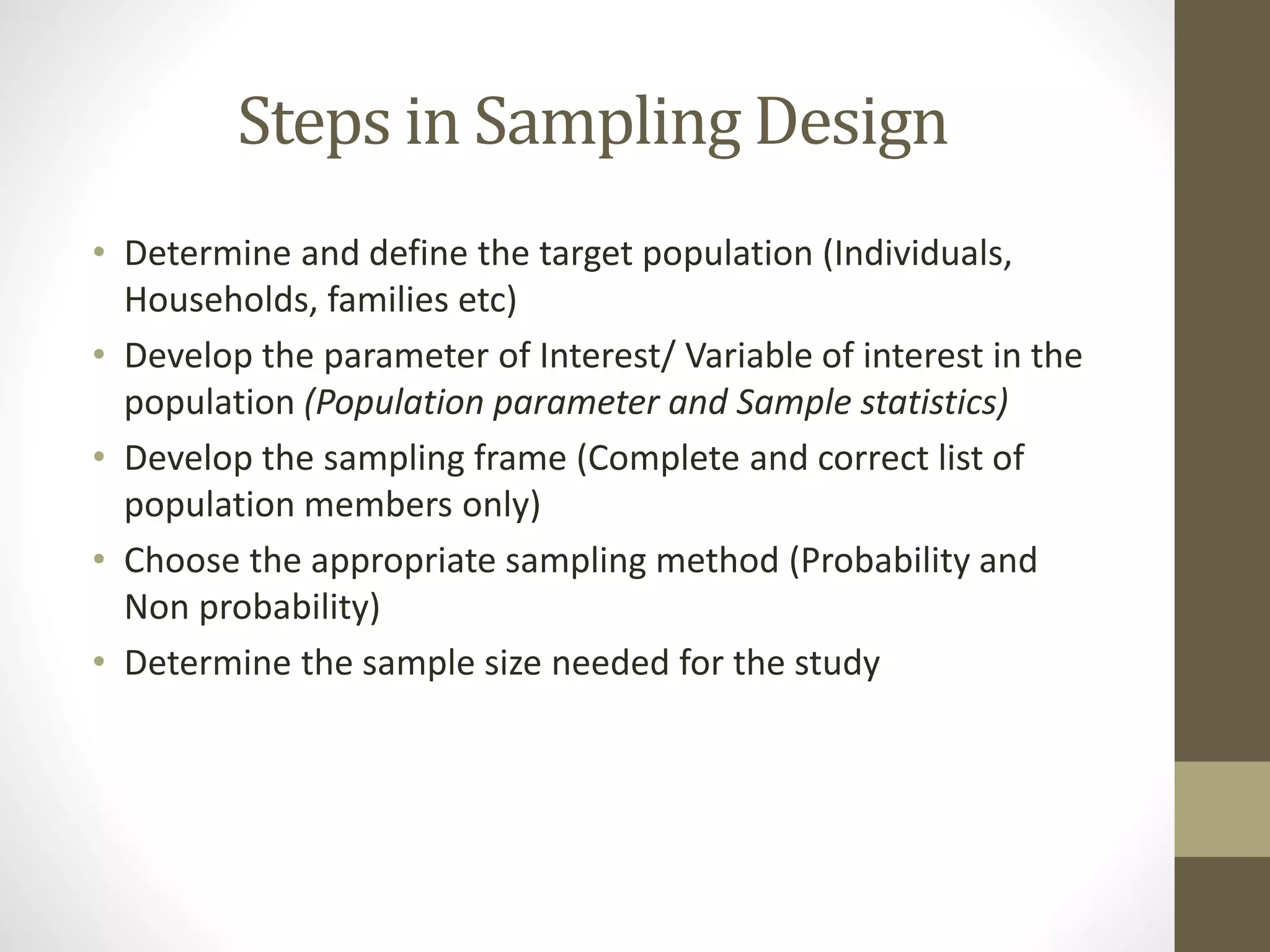
Steps in Sampling Design
• Determine and define the target population (Individuals,
Households, families etc)
• Develop the parameter of Interest/ Variable of interest in the
population (Population parameter and Sample statistics)
• Develop the sampling frame (Complete and correct list of
population members only)
• Choose the appropriate sampling method (Probability and
Non probability)
• Determine the sample size needed for the study
Sampling Vs. Non-Sampling Error
• Sampling Error: The sampling error occurs when the sample is
not representative or there is a difference between sample
mean and population mean.
• Techniques of reducing sampling error: Increase the sample size
• Non-Sampling Error: There are various reasons for Non-
sampling error such as:
• Wrong answer given by respondent
• Mistakes in converting data from questionnaire to spreadsheet
• Error at the time of Coding, tabulation and computation
• Population not properly defined
• Sampling frame error
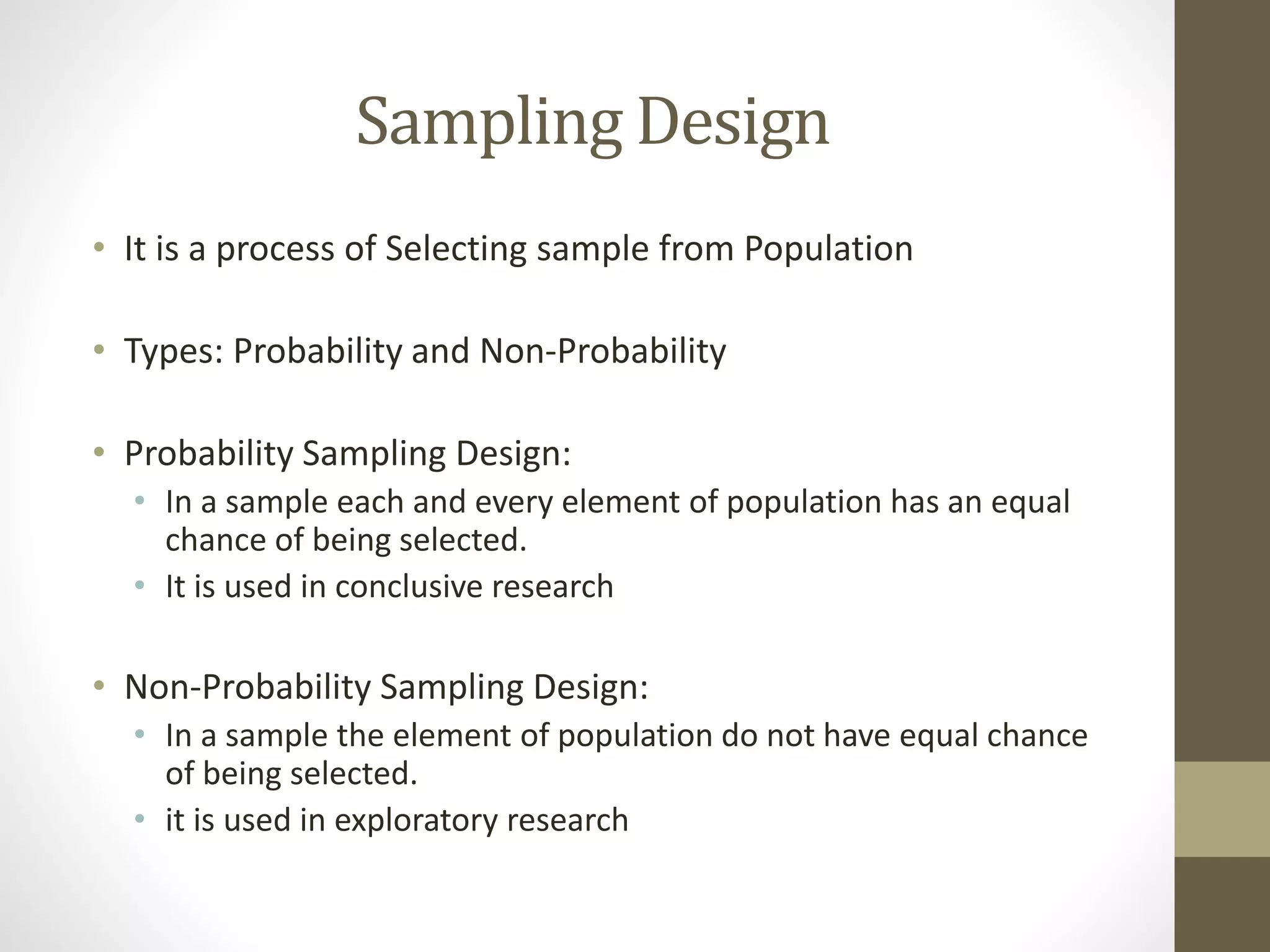
Sampling Design
• It is a process of Selecting sample from Population
• Types: Probability and Non-Probability
• Probability Sampling Design:
• In a sample each and every element of population has an equal
chance of being selected.
• It is used in conclusive research
• Non-Probability Sampling Design:
• In a sample the element of population do not have equal chance
of being selected.
• it is used in exploratory research
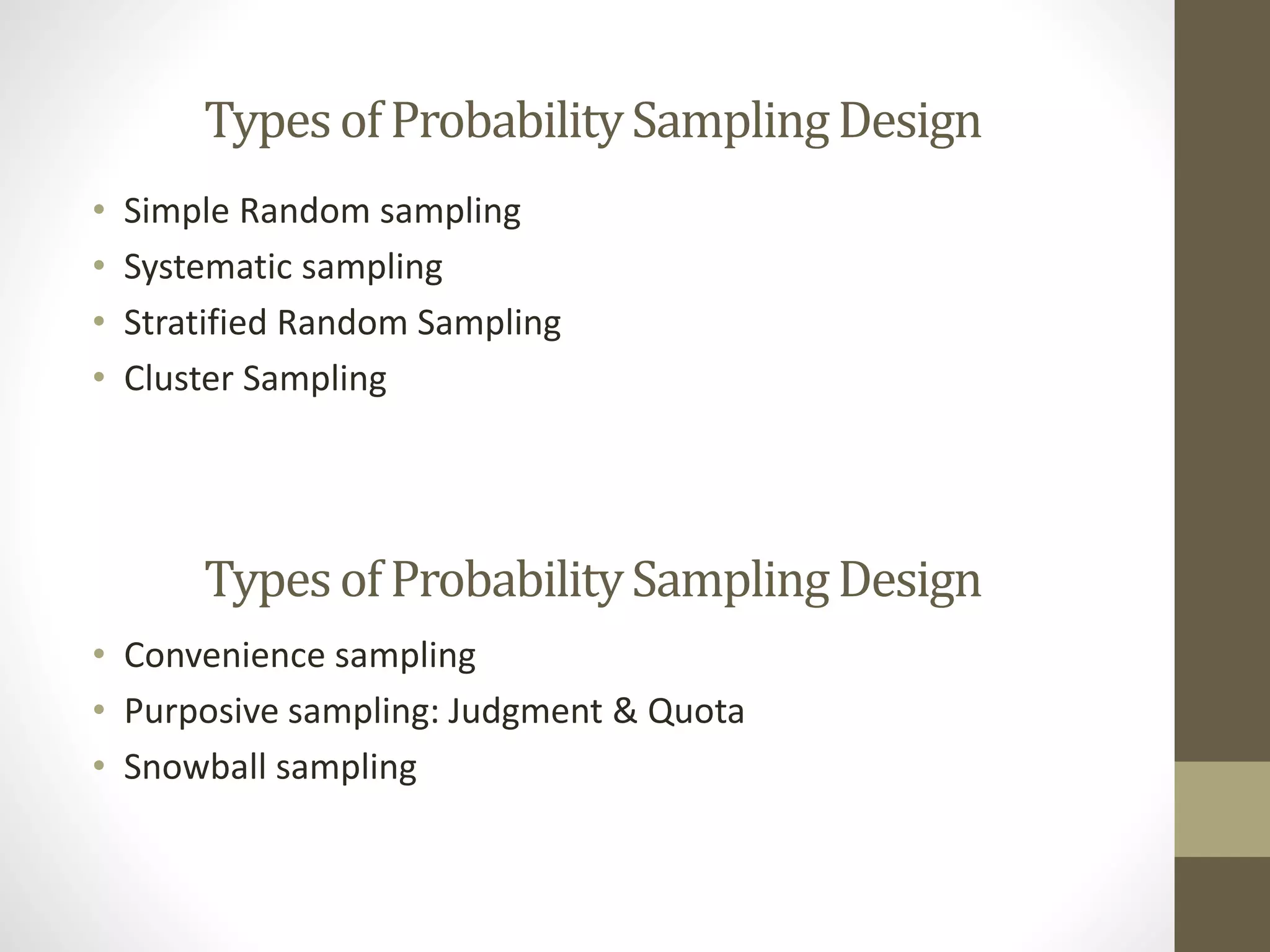
TypesofProbabilitySamplingDesign
• Simple Random sampling
• Systematic sampling
• Stratified Random Sampling
• Cluster Sampling
TypesofProbabilitySamplingDesign
• Convenience sampling
• Purposive sampling: Judgment & Quota
• Snowball sampling
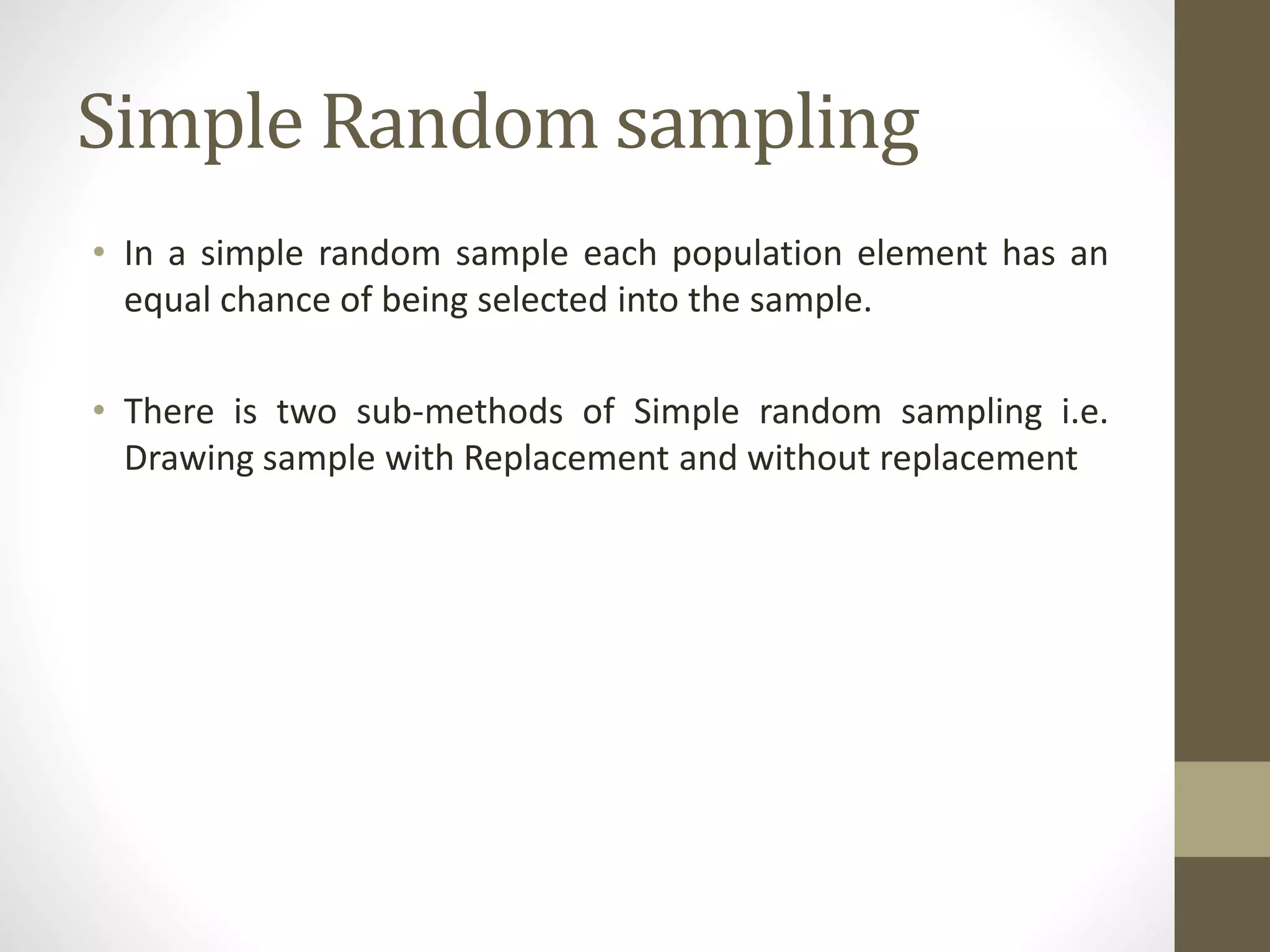
Simple Random sampling
• In a simple random sample each population element has an
equal chance of being selected into the sample.
• There is two sub-methods of Simple random sampling i.e.
Drawing sample with Replacement and without replacement
Systematic Sampling
• In this method the researcher select an element of the
population at the beginning and follows the skip interval.
• It is also called as mixed sampling as it involves Probability as
well as non probability sampling design.
Stratified Random Sampling
• The Population of Interest is divided into various strata and
simple random sample can be taken from within each stratum
(element from within subgroups)
• The criteria of grouping is homogeneity within subgroups and
heterogeneity between groups.
• Each stratum is homogeneous internally and heterogeneous
with other strata.
• Ex. College student can be divided into various class level that
is 1st Year, 2Nd Year, Final Year etc.
• Proportionate and Disproportionate sampling Techniques used
to allocate a total sample among various strata
Cluster Sampling
• The Population of Interest is divided into various subgroups
and randomly select several subgroups for in depth study.
• The criteria of grouping is Heterogeneity within subgroups and
homogeneity between groups.
• Ex. College student can be divided into various class level that
is 1st Year, 2Nd Year, Final Year etc.
Convenience Sampling
• In this type of sampling the researcher used to obtain
information as per the convenience of researcher.
• This techniques generally used in pre-testing purpose for
which the sampling unit is self - selected or because of easily
availability
Purposive Sampling
• The sample that conforms to certain criteria is a purposive
sampling
• Types
• A: Judgment- this method used when the required information
possessed by limited number of respondents
• B: Quota: it is used to select sample that conforms to certain
criteria or parameter of the study.
Snow Ball Sampling
• This type of sampling design used when respondents are
difficult to identify
• The respondents are best located through referral networks
Determination of Sample Size
• The size of sample depends upon basic characteristics such as
POPULATION, the type of INFORMATION required from
survey, COST involve etc.
• Steps in determining sample size:
• Population Size
• Margin of Error (Confidence Interval)
• Confidence level
• Standard Deviation
Thank You

Sampling

  • 1.
  • 2.
    • Sampling: Itis a process of selecting some of the element (Individuals, objects or event) in a population which enables to draw conclusion about entire population. • Population: All Individuals of interest to the researcher in other words it is the total collection of element about which the researcher wish to make inference. • Population Element/Unit of Analysis: The individual participants or object on which the measurement is taken. • Sampling Frame: it is a process of listing of all population element from which sample will be drawn. • Sample: A sample is a subset of Population which comprise only some element of Population. • Census: It is a count of All element in population. Introduction
  • 3.
    Need of Sample/Reason for sampling • Lower Cost • Greater accuracy of result • Greater speed of data collection • Availability of population element
  • 4.
    Features of GoodSample • Representativeness • Sample shall be representative of the population from which it was selected in order to draw valid inferences about the population • Validity: • Accuracy (An accurate sample or unbiased sample) • Precision of estimates which is measure by standard error of estimates
  • 5.
    Steps in SamplingDesign • Determine and define the target population (Individuals, Households, families etc) • Develop the parameter of Interest/ Variable of interest in the population (Population parameter and Sample statistics) • Develop the sampling frame (Complete and correct list of population members only) • Choose the appropriate sampling method (Probability and Non probability) • Determine the sample size needed for the study
  • 6.
    Sampling Vs. Non-SamplingError • Sampling Error: The sampling error occurs when the sample is not representative or there is a difference between sample mean and population mean. • Techniques of reducing sampling error: Increase the sample size • Non-Sampling Error: There are various reasons for Non- sampling error such as: • Wrong answer given by respondent • Mistakes in converting data from questionnaire to spreadsheet • Error at the time of Coding, tabulation and computation • Population not properly defined • Sampling frame error
  • 7.
    Sampling Design • Itis a process of Selecting sample from Population • Types: Probability and Non-Probability • Probability Sampling Design: • In a sample each and every element of population has an equal chance of being selected. • It is used in conclusive research • Non-Probability Sampling Design: • In a sample the element of population do not have equal chance of being selected. • it is used in exploratory research
  • 8.
    TypesofProbabilitySamplingDesign • Simple Randomsampling • Systematic sampling • Stratified Random Sampling • Cluster Sampling TypesofProbabilitySamplingDesign • Convenience sampling • Purposive sampling: Judgment & Quota • Snowball sampling
  • 9.
    Simple Random sampling •In a simple random sample each population element has an equal chance of being selected into the sample. • There is two sub-methods of Simple random sampling i.e. Drawing sample with Replacement and without replacement
  • 10.
    Systematic Sampling • Inthis method the researcher select an element of the population at the beginning and follows the skip interval. • It is also called as mixed sampling as it involves Probability as well as non probability sampling design.
  • 11.
    Stratified Random Sampling •The Population of Interest is divided into various strata and simple random sample can be taken from within each stratum (element from within subgroups) • The criteria of grouping is homogeneity within subgroups and heterogeneity between groups. • Each stratum is homogeneous internally and heterogeneous with other strata. • Ex. College student can be divided into various class level that is 1st Year, 2Nd Year, Final Year etc. • Proportionate and Disproportionate sampling Techniques used to allocate a total sample among various strata
  • 12.
    Cluster Sampling • ThePopulation of Interest is divided into various subgroups and randomly select several subgroups for in depth study. • The criteria of grouping is Heterogeneity within subgroups and homogeneity between groups. • Ex. College student can be divided into various class level that is 1st Year, 2Nd Year, Final Year etc.
  • 13.
    Convenience Sampling • Inthis type of sampling the researcher used to obtain information as per the convenience of researcher. • This techniques generally used in pre-testing purpose for which the sampling unit is self - selected or because of easily availability
  • 14.
    Purposive Sampling • Thesample that conforms to certain criteria is a purposive sampling • Types • A: Judgment- this method used when the required information possessed by limited number of respondents • B: Quota: it is used to select sample that conforms to certain criteria or parameter of the study.
  • 15.
    Snow Ball Sampling •This type of sampling design used when respondents are difficult to identify • The respondents are best located through referral networks
  • 16.
    Determination of SampleSize • The size of sample depends upon basic characteristics such as POPULATION, the type of INFORMATION required from survey, COST involve etc. • Steps in determining sample size: • Population Size • Margin of Error (Confidence Interval) • Confidence level • Standard Deviation
  • 17.