sampling lec5.ppt on sampling and its types about probability and non probability
1.
Sampling
• The procedureof selecting certain
number of study units from a defined
population is called Sampling.
• A representative sample has all
important characteristics of the
population from which it is drawn.
2.
Universe
A specified group(usually very large) of
the persons, objects, measurements or
values.
Study Population
Target Population
Reference Population
3.
Study Unit
The unitof selection in study population can be a
Person
Household
Family
School
Patient with a particular disease
Patient undergoing a particular
surgical procedure
Patient receiving a particular
medicine.
4.
Types of Sampling
1.Probability Sampling
2. Non Probability Sampling
Probability Sampling
When each sampling unit has an equal and
known chance of being included in sample.
Non Probability Sampling
When sampling units do not have an equal
chance of being included in the sample.
Convenience Sampling
In thismethod, the study
units that happen to be available
at the time of data collection, are
selected in the sample.
7.
Quota Sampling
This methodensure that a certain
number of study units from different
categories with specific characteristics
appear in the sample so that all these
characteristics are represented.
8.
Snow – ballSampling
When individuals with certain
characteristics are asked to
identify similar individuals for
inclusion in the study.
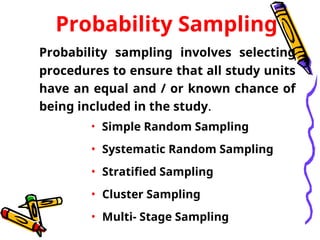
Probability Sampling
Probability samplinginvolves selecting
procedures to ensure that all study units
have an equal and / or known chance of
being included in the study.
• Simple Random Sampling
• Systematic Random Sampling
• Stratified Sampling
• Cluster Sampling
• Multi- Stage Sampling
11.
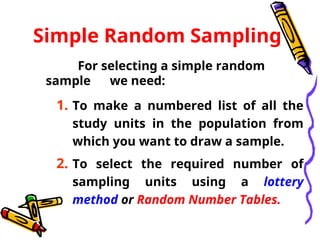
Simple Random Sampling
Forselecting a simple random
sample we need:
1. To make a numbered list of all the
study units in the population from
which you want to draw a sample.
2. To select the required number of
sampling units using a lottery
method or Random Number Tables.
12.
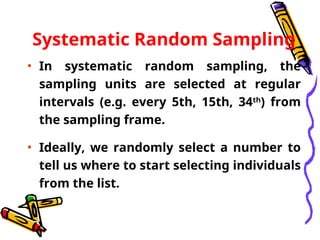
Systematic Random Sampling
•In systematic random sampling, the
sampling units are selected at regular
intervals (e.g. every 5th, 15th, 34th
) from
the sampling frame.
• Ideally, we randomly select a number to
tell us where to start selecting individuals
from the list.
13.
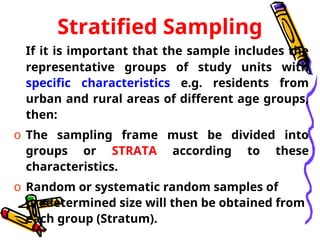
Stratified Sampling
If itis important that the sample includes the
representative groups of study units with
specific characteristics e.g. residents from
urban and rural areas of different age groups,
then:
o The sampling frame must be divided into
groups or STRATA according to these
characteristics.
o Random or systematic random samples of
predetermined size will then be obtained from
each group (Stratum).
14.
Cluster Sampling
InCluster Sampling, a simple random sample is
selected not of individual subjects but of groups
or clusters of individuals. The clusters may be
villages, apartments, classes, housing units,
families etc.
This is often a convenient method, especially
when there is no sampling frame showing all
individual subjects.
The clusters are often geographic unit (villages)
or organizational units (clinics, factories,
schools).
15.
Multi-stage Sampling
Invery large and diverse populations,
sampling may be done in two or more stages.
This is often the case in the community based
studies, where the people are to be contacted in
different villages and villages are to be chosen
from different areas.
The sampling procedure is carried out in
phases.
16.
Multi-stage : Example
Astudy of health care utilization is to be
carried out in a district and 150 households
are to be interviewed. The district has 6
Tehsils and each Tehsil has 10 to 15 villages.
Select 3 Tehsils out of 6 by simple random
sampling
From each Tehsil, select 5 villages by simple
random sampling
From each village select 10 households by
systematic random sampling.
17.
Sampling Procedure -1
o An important issue influencing the
choice of the most appropriate sample
is whether a Sampling Frame is
available or not.
o Sampling Frame is the listing of all the
units that form the study population.
18.
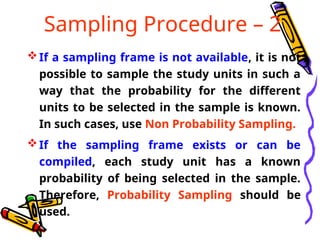
Sampling Procedure –2
If a sampling frame is not available, it is not
possible to sample the study units in such a
way that the probability for the different
units to be selected in the sample is known.
In such cases, use Non Probability Sampling.
If the sampling frame exists or can be
compiled, each study unit has a known
probability of being selected in the sample.
Therefore, Probability Sampling should be
used.
19.
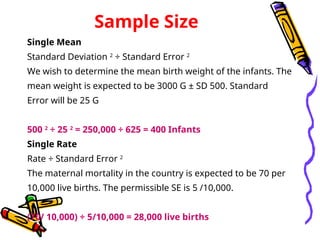
Sample Size
Single Mean
StandardDeviation 2
÷ Standard Error 2
We wish to determine the mean birth weight of the infants. The
mean weight is expected to be 3000 G ± SD 500. Standard
Error will be 25 G
500 2
÷ 25 2
= 250,000 ÷ 625 = 400 Infants
Single Rate
Rate ÷ Standard Error 2
The maternal mortality in the country is expected to be 70 per
10,000 live births. The permissible SE is 5 /10,000.
(70/ 10,000) ÷ 5/10,000 = 28,000 live births
20.
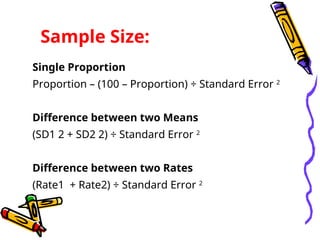
Sample Size:
Single Proportion
Proportion– (100 – Proportion) ÷ Standard Error 2
Difference between two Means
(SD1 2 + SD2 2) ÷ Standard Error 2
Difference between two Rates
(Rate1 + Rate2) ÷ Standard Error 2
21.
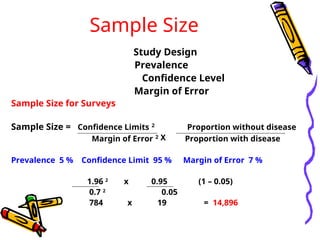
Sample Size
Study Design
Prevalence
ConfidenceLevel
Margin of Error
Sample Size for Surveys
Sample Size = Confidence Limits 2
Proportion without disease
Margin of Error 2
Proportion with disease
Prevalence 5 % Confidence Limit 95 % Margin of Error 7 %
1.96 2
x 0.95 (1 – 0.05)
0.7 2
0.05
784 x 19 = 14,896
X