Chapter 1
THE PROBLEM AND ITS BACKGROUND
Introduction
Organizations are open systems adapting continuously to changing
environments. All organizations exist in an environment which affects and is
further affected by the organization. Developmental processes within the
organization have positive effect on employee productivity and attitudes. The
creation of a positive learning environment within the educational organization of
institutions depends much on the existent working conditions provided within the
organization and is reflected by the level of job satisfaction that results from
performance at work. In every workplace, a creative environment is made
possible by conditions that include organizational support, motivating tasks with
sufficient resources and time (Mcshane, Glinow, 2003).
Teachers are individuals who are continuously connected to the
environment. The educational set-up with students, colleagues and the
community as well. As part of the organization, they are bound by the policies
and procedures pertaining to basic working conditions that they must be able to
live with to produce acceptable level of performance in teaching,. Organizational
2
stressors may come about from certain working conditions which are stressful
including downsizing or retrenching reducing number of employees causing
higher workload, feelings of guilt, increased job insecurity and loss of friends for
lay-off survivors (Mcshane 2003).
Stress once experienced is a deterrent factor in the learning process as it
envelops the entirety of the teacher’s life. The combination of stresses on the job
and in the personal life of the teacher makes a high point in the causation and
progression of stress.
It is personal encounter by the researcher who experienced elevation of
blood pressure, cholesterol, uric acid, blood sugar coupled with urinary tract
infection, dental problems and other hormonal imbalances that cropped up in the
course of rendering the teaching profession to its client students. These were
aggravated by personal stresses and daily work hassles that had to be endured
in the process of executing teaching roles and functions. This motivated the
researcher to delve into this study to find out if there is a relationship between
working condition and personal stress level of teachers.
Background of the Study
Working condition is a workplace that is conducive to the physical,
behavioral, sleep and emotional condition of the employee, the teacher. These
working conditions were categorized into several components:1. Attitude towards
work which includes working continuously, neglect of tasks, deciding on how to
do the job and decision making in the classroom. It also includes long hours of
3
work, time pressure and bullying. 2. Knowledge about the nature of work
includes clarity on job expectations, duties, responsibilities ,goals and objectives
of the organization, having a say on work speed and understanding how work fits
into the over-all goals of the organization. 3. Relationship with peers includes
reacting on group demands, personal harassment, supportive feedback and help
from colleagues at work. 4. Relationship with superiors include reliance on the
Principal who encourages and help through emotionally heavy work and strains
on relationships. Certain indicators used were physical, behavioral, sleep and
emotional with certain stress levels identified as high, moderate or low. .
The presence of poor or inadequate working conditions becomes sources
of stress for the worker for what affects him physically affects him psychologically
as well consciously or unconsciously make his day.(Martires, 2004). It is
therefore the tasks of the government and management of any organization to
work into the creation of a wholesome place for workers specifically the teachers
to ensure optimum provision of safe and learning lifestyle for the learning
community.
In the United Kingdom, It was noted that the common causes of stresses
teachers experience include poor classrooms with small rooms, many students,
lack of group facilities like heating, cooling, lighting, media facilities, noise and
room structure, low salaries, heavy workload and work taken home daily(Ken
Mrozek, 2000).
4
In the Philippines, problems on quality education were attributed to
teachers’ woes (www.fnf.org/liberopinion/crisis:public education Philippines) like
class size where 60-70% in two shifts of cramped makeshift room in
multipurpose covered courts with four to five class partitions, lacking instructional
materials, need for textbook revisions, mismatched training with actual jobs
resulting in large group of unemployed or underemployed workers. This scenario
of working conditions relates to teacher stress.
RA 4670 too of the Magna Carta for school teachers had recognized the
effect of the duties and activities of a school teacher which involved physical,
mental and emotional stresses as provided for the effects of the physical and
nervous strain on the teacher shall be recognized as compensable occupational
disease in accordance with laws.
Teachers are assigned a regular load of six to seven including handling of
advisory classes, remedial and alternative development modes. The ideal
maximum class size of 1:45 is oftentimes increased to 50 -55 as the regular
enrolment zooms up at the opening of classes. Under the K12 curriculum,
DEPED Order no 31, s.2012, the Policy Guidelines for the implementation of the
Grades 1 to 10, effective 2012-2013, aside from the regular time allotment noted
in DO 15, s.1993, Corrigendum to DECS no. 11, s.1989 which stated therein
that Science and Technology teachers have
regular load of four (4) or 80 minutes of teaching equivalent to a total of 320
minutes per day. Technology teachers likewise have the same load
5
assignments; there is an added period for Homeroom Guidance Program or
Independent Cooperative Learning hour for the students ranging from two to four
hours weekly to provide students the option to learn at their own time those
topics they can handle by themselves. Teaching schedules get tightly arranged
with fewer vacant periods hence the experience of inconvenience and
discomforts set in like hunger and fatigue. The presence of separate buildings
make things more difficult especially for the aging teachers with predisposition to
health imbalances for statements were noted of their expressed manifestations
of fatigue as they come up and down the top floors of one building to another
hour after hour hence the aggravation of their beginning frail health status.
The study focused on two schools in District Five of the Division of City
Schools in Quezon City namely Lagro High School and Novaliches High School
with a total population of 6,000 each, hence considered as big schools.
According to Darmody(2000)job satisfaction is somewhat high in big schools
where teachers might be stressed but their satisfaction levels were not affected.
On the other hand, Ken Mrozek (2011) stated that a high turnover coupled with
demographic tasks of increased school enrolment notes teaching as a highly
stressful profession. On the basis if these studies, there was a felt need to
assess the stress levels in the big schools. Both schools are composed of urban
communities with a mixing of average and depressed families within.
Novaliches High School is located within the Novaliches proper and
accessible via Quirino Highway in Quezon City within a thickly populated
6
community with markets, malls and churches on within its vicinity. These areas
too have varied source of livelihood.
Lagro High School is situated in Lagro Subdivision with a bigger number
students coming from Lagro Subdivision and nearby areas. It is adjacent to Lagro
Elementary School and likewise near church, market and plenty of business
establishments. The school is wide with several buildings and a spacious area for
the students to walk about and perform physical activities. Both schools have
student population of six thousand and teacher population of 176 for Novaliches
High School and 200 for Lagro High School. The respondents are male and
female teachers of age groups ranging from 60 to 20 year old bracket with length
of service range of more than 20 years down to 1 -5 years. All respondents
have high educational attainment from Doctorate Degree to Bachelor degree and
are of varied civil status.
Theoretical Framework
This study is based on Frederick Herrzberg Motivator-Hygiene theory
which proposed that employees are motivated primarily by growth or esteem
needs called motivators which are basically intrinsic needs and factors extrinsic
to the job called hygiene’s which involves job security, working conditions,
7
company policies, coworker relations and supervisor relations. The motivators
are the recognition, responsibility, advancement, achievement and personal
growth. The improvement of motivators will ensure satisfaction on the job but
may not decrease job dissatisfaction. On the other hand, hygiene’s when
improved will reduce job dissatisfaction but not ensure job satisfaction,
(Mcshane, 2003). This denotes that the job dissatisfaction produced by the work
context may be ascribed to the working conditions that are classified under
hygienes. These working conditions must be improved to motivate employees
through the work itself which may provide comfortable environment that is
paralleled with higher levels of productivity.
Hans Selye’s General Adaptation Syndrome (GAS) where three stages or
reactions are manifested: Alarm, Resistance and Exhaustion provides the
explanation for the occurrence of the stress phenomena underlying personal
stresses encountered by the teachers at work. According to Selye, this
syndrome appears when the organism is subjected to long continued stress and
every organ responds in its own particular way to stress. With the excessive
defensive or submissive body reactions are high blood pressure, kidney problem,
rheumatism, eye or vision problems, problems like inflammation of the eyes,
allergies, Infections, nervous and mental disease, digestive and metabolic
disorders. The body develops a physiological enlargement of the adrenal cortex,
shrinkage of thymus, spleen and lymph nodes and other lymphatic structures
with deep bleeding ulcers of the stomach and duodenum. These are non-specific
responses to diverse noxious stimuli. The alarm stage noted the occurrence of
8
the fight or flight response and is defensive and anti-inflammatory yet is a
limited reaction for it is fatal to exist in that stage where certain hormones are
released such as the catecholamines and adrenocorticotrophic
hormones(ACTH)(Brunner, 2008). Persons may respond physiologically and
psychologically to several chronic stressors arising from his life situation
including frustrations in the home and may manifest these through certain body
organs like the stomach, back, colon, nasal and mucous membrane which may
occur frequently as a response to traumatic personal situation.
Teachers are individual who responds to stimuli from the environment. As
an individual, a teacher is consistently connected to his environment. The
consistent interaction with the environment subject’s man to a multitude of forces
called stressors which occur between and outside individuals and may yield
positive or negative results (Chinn and Jacobs, 1983). The integrity of the
teacher is thereby established and maintained through more positive teaching
approaches and strategies that are dynamic, effective and innovative. The
interplay of the General Adaptation theory of Selye as strengthened by Wolff’s
theory on stress and its physiological as well as psychological effect on the body
organs justifies the magnitude of stress enveloping the vulnerable individual and
is further related to the Herzberg Motivator-Hygiene theories mentioned whereby
the working conditions affecting the teachers are closely examined to offer
relief and remedy where such is needed to improve the work situation of the
teachers with the end in view of clarifying and emphasizing the correlation of
9
Working Conditions
Stress Level
- Physical Indicator
- Sleep Indicator
- Behavioral Indicator
- Emotional Indicator
stress to the working conditions that affects teachers and students within the
teaching learning process .
Conceptual Framework
On the basis of these theories, the conceptual paradigm of this study is
illustrated in Figure 1
INDEPENDENT VARIABLE DEPENDENT VARIABLES
Figure 1 – Research Paradigm
As an independent variable, working conditions include hours of work,
rest periods, work schedules, remunerations, uniform, physical factors like
cleanliness, lighting, temperature and legal right and responsibilities that may
affect teachers in the performance of their work, The dependent variable is the
personal stress encountered which were assessed according to certain criteria
like physical, sleep, behavioral and emotional indicators. Physical indicators
10
were assessed based on physical or bodily manifestations which were more of
physiological or biological nature as felt by the teacher respondents in the course
of performing their teaching and other roles and functions as educators. Sleep
indicators were based on one’s difficulty in sleeping including presence of
disruptions or the use of inappropriate substances to acquire sleep. Behavioral
indicators were based on work habits and attitudes and the utilization of hobbies
or tasks that may provide relief or escape from the stressful situations.
Emotional indicators were based on ones’ perception of self and how one act and
react to common life situations positively or negatively.
These set of variables describe the connectivity between the working
conditions and the different indicators relative to personal stress by noting the
degree of frequency of occurrence from always to never and further rated as
danger, very high, high , medium to very low in a scale for personal stress
indicators.
Presentation of these set of variables described how teachers acquire
their stressful situation.
Statement of the Problem
11
This study was an attempt to determine the relationship of working
conditions and the stress affecting teachers in two schools in District 5 of the
Division of City Schools in Quezon City for School Year 2014 -2015.
Specifically, it sought to answer the following questions:
1. How do the respondents describe their working condition?
2. What is the personal stress level of the respondents in terms of:
3.1 Physical Indicator
3.2 Sleep Indicator
3.3 Behavior Indicator
3.4 Emotional Indicator
3. Is there a significant relationship between the respondents working condition
and their personal stress level?
Hypothesis
The researcher tested the given hypothesIs in the null form at the .05 level
of significance.
There is no significant relationship between working conditions and
personal stress level of the respondents.
Scope and Limitations of the Study
12
The study sought to examine the relationships of working conditions and
stress level of secondary public school teachers from two schools in District V of
Quezon City for School Year 2014-2015. Namely: Lagro High School and
Novaliches High School.
Significance of the Study
The researcher based on the findings of the study may eventually provide
essential information to the following groups:
Department of Education (DEPED). It will provide a wider perspective
on the relationship of stresses encountered by public school teachers to the
working conditions encountered in the workplace particularly in the classrooms
and the school premises. This is to enable the DEPED to make wide-scale
programs and action plans that will mitigate the existence of potential and actual
diseases caused by stress while teaching, prevent its progression, avoid
complications and promote a healthier life for the teacher. It will give
administrators in the government a clearer picture of the stress level and working
conditions of teachers to provide more vigilant measures on stress management
to effect quality education for the students.
School Administrators. The educational managers headed by the
Principal through the different department heads of each subject area may
likewise be able to execute more intensive faculty development programs under
a more innovative human resource development plan that implements better
13
leadership style that generates a stress-manageable working climate, if not
totally stress free.
Teachers. The classroom teachers through the assistance of their
department heads and chairmen or year-level heads may be able to effectively
deliver their instructional activities in a more conducive learning environment as
these teachers learn to lead a healthier life after gaining awareness and
knowledge of all the factors causing stress that may lead to diseases arising from
the classroom situation. The performance of teachers in performing their duties
and functions may likewise be improved.
Students The students who are the recipients of teaching will be provided
a more conducive learning environment by the teachers who are able to manage
their stress well
Future researchers they may be inspired tells to undertake similar
studies on occupational stress in all levels of the educational arena from
preschool to graduate school to provide an assessment of teachers’ behaviour as
they interact with the students.
The entire country will gain much from this study about stress for the
effects on a well-learned community is seen through the eyes of the students
who competently met the standards set by the government in the light of a
stress-less and stress-managed interaction within the teaching-learning process
in the respective classrooms as they are effectively managed by inspired and
healthy teachers.
14
Definition of Terms
The following terms are defined operationally and conceptually to properly
guide the readers of this study:
Behavioral Indicators – manifestations or actions reflecting the attitude of
teachers towards their work and classified as high, moderate and low.
Emotional Indicators. - a condition or direction related to one’s emotional
reactions towards given situations also classified as to high, moderate and low.
Hygiene. Dissatisfying factors extrinsic to the work which affects the extent to
which employees experience job dissatisfaction(Mcshane, 2003)
Motivator- Growth and esteem needs which motivates employees primarily
towards job satisfaction(Mcshane, 2003)
Physical Indicators. one’s physical and physiological state based on bodily
manifestations experienced by the teacher in the course of work and also
classified as to moderate, high or low,,
Sleep Indicators - level of sleep and relative details about the sleep process of
an individual also indicated as to high, moderate or low.
Task Performance.Goal-directed activities that are under the individual’s control
(Mcshane, 2003)
Teacher Stress. A situation where the teacher is exposed to
certain unwanted environmental factors which either exists within or
15
outside the educational institution which hamper the normal
routine life of the teacher by negatively affecting the performance at
work (Kahn, 2011)
Working Condition. The condition of a wholesome workplace which is free
from unnecessary hazards and conditions that constitute risk to the physical and
mental health of the employee. It is generated by certain indicators which are
physical, behavioral, sleep and emotional which at certain levels may cause the
occurrence of stress and described as high, moderate or low level..
16
Chapter 2
REVIEW OF RELATED LITERATURE AND STUDIES
This chapter presents the foreign and local literature and studies relevant
to this study providing input and direction.
Related literature and studies on the nature, causes, symptoms and all the
physiological and psychosocial factors governing the individual, his
predisposition and tendencies towards the stress phenomena will pave way for
improving the findings of the study. It will also shed light on the positive ways of
coping using mechanisms that are adaptive to the stress situation, Likewise, the
literature will strengthen the theoretical assertions made earlier in the study.
Foreign Literature
Stresses at work were caused by many factors that led to physical and
emotional ill health. Too much work to do was a common cause of stress due
to setting unrealistic deadlines. Unnecessary deadlines cause employees to work
at a faster than optimal pace resulting in decreased quality, increased stress and
increased health problems. (Aamodt, Michael G. ,2007 ) The hectic schedule of
a teacher who was given additional load; a class size more than the expected
number coupled with extra jobs of handling school organizations in the
department; handling advisory classes and independent cooperative learning
classes; training coaches in different subject competitions, mentorship in choir
17
and religious groups and membership in faculty cooperative including meetings
with parents and teachers monthly or as required. Additional tasks like
environmental concerns with the DENR Like tree-planting programs, vision
screening programs by the Division also cropped up. Disaster Management
activities related to earthquake drills added up to the teachers’ concerns as these
had to be done as required.
Some of the common sources of stress arose from specific working
conditions like job characteristics (role conflict, work integrity and role overload).
It also included organizational characteristics like noise, temperature, change of
relationship with others like conflicts in dealing with difficult people and angry
customers.(Borman,Ilger, Klimoski, 2003). These conditions are experienced by
teachers in the performance of their daily teaching activities. The environment
where the teacher works inclusive of temperature, workload and rest periods
were likewise considered affecting them. Rest periods must be sufficiently given
for their greatest effect occurs when work activity is continuous. (Aamodt, 2003).
It is thus important that vacant periods be given in the manner of right scheduling
to give ample time for respite from the strenuous rigid task of classroom
instruction.
It is the organization’s legal if not moral responsibility to ensure a
workplace that is free from hazards to the employees’ physical and mental
health. Task demands that relates to employees’ job including temperature,
noise and other working conditions could increase anxiety and further be
18
affected by role demands, interpersonal and organizational along with the
personal factors like family crisis, personality traits and susceptibility to stress.
(Decenzo, Robbins, 2002). Therefore the government is mainly tasked with the
development of positive working conditions that ensures the maintenance of
sound health for teachers in all aspects Management is responsible for
affording a wholesome workplace that is free from physical or mental risks to the
employees’ health. Based on research studies, new work designs have been
formulated where workers’ job satisfaction are increased through motivation.
Human resources management function to include worker orientation, physical
working conditions, motivation, performance evaluation, compensation, and
administration(Martires, 2004). Hours of work and remuneration, health
measures and injury benefits , leave and retirement benefits were all explicitly
stated in Article 3 to 5 of the Magna Carta for Public School Teachers 9(Republic
Act no, 4670).
Brunner and Suddarth (2008) have noted that older people need
resiliency and coping skills to confront stress. Resiliency increases with old age
because coping patterns and stress adaptation that develop in a lifetime remain
consistent later in life. Older teachers must have developed higher levels of
coping mechanisms to stress.
Humans are remarkably resistant to stress. Mild transient reactions may
quickly return to normal depending on one’s subjective or objective
interpretation of the stress process. (Aronson, Wilson, Akert, 2013). It is an
19
individual’s choice therefore to achieve control in the way we are bound to be
influenced by the environment to attain manageable levels of stress.
Marital status is an area of concern because one’s role as a father or
mother may come to conflict with the heavy demands of the teaching profession.
The result is role conflict which according to Brunner and Suddarth (2008), the
experience of illness precipitates many stressful feelings and reactions including
frustration, anxiety, anger, denial, shame grief and uncertainty. Based on
reported cases in some schools some teachers experience the above mentioned
illness and they suffered lapses in their performances. Reports about teachers
manifesting behaviours that were indifferent, punitive and inappropriate to the
students were aired over the radio, television, and published in local newspapers
several times in the past recent years. Causes of these behaviours can be
attributed to the phenomena of stress. Stress manifests in uneasiness, anxiety
and mood changes. According to Mcshane, stress is an adaptive response to a
situation that is perceived as challenging or threatening to the persons’ well-
being. The occurrence of stress eventually produces distress which has a highly
related effect on can be associated with tardiness, absenteeism and
turnover.(Mcshane,2003)
Stress is a manifestation of health problems like COPD (Chronic
Obstructive Pulmonary Disorder) which may come about with air pollution,
cigarette smoking along with a vulnerable pulmonary system. These included
20
metabolic imbalances and obesity. Stress has made the immune system weaker
and prone to more illnesses (pamilya in guard abs.cbn.news).
In the midst of these work-related stressors, the stress of family life is far
greater than many people realize. The individual and family have to adapt their
behaviour, attitudes and emotions in response to changing roles and life events
both pleasing and distressing (Reyes,2004) These family events in the life of a
teacher can be attributed to environmental causes related to socioeconomic
condition. These are non-work stressors that may spill over the workplace of a
teacher as in time-based factor like housework and children among married
career women of strong family values; strain-based or financial difficulties like
sending children to school or paying housing mortgages. (McShane,2003). Daily
challenges faced by teachers each day indicate the socioeconomic factor of low
salaries to meet family and leading them to a life in debt and material
insufficiency (http:area:correspondent.com).
According to (www.Philstar.com) the poor working condition of public
school teachers cause them to fall ill hence the need for comprehensive health
care services. Most of the teachers have families to support, children to rear and
send to school, old sickly parents to support and socio-cultural life to uphold
professionally.
Some common causes of occupational stress among teachers like job
mismatch, work overload, pupil teacher relationship, school management and
time factors were noted because some teachers have not reached the level of
21
competence to face job responsibilities and workloads. Recent reports over the
media about teachers inflicting corporal punishment to their students. Some of
the common causes of stress for teachers stem from personality traits, hereditary
traits, diet and environment. (Mcshane 2003) . It was also noted that certain
personality traits that were traced were type A and type B personality which
manifests certain behaviour patterns. Type A people who are hard driving,
competitive tend to be impatient and temperamental whereas Type B people
work steadily, relaxed and even-tempered. The interplay of these personality
traits is reflected in the way the teacher handles their own stress levels especially
in the classroom where they are supposed to be in control of the situation.
Additional behaviour patterns like the type C behaviour which is the cancer-prone
personality and the hardiness personality. Is also emphasized The levels of
illness drop when there are multiple buffers to stressors, thus, the teacher who
has commitment, control and perception of challenge has better chances of
adjustment.
(Lemon,Priscilla 2004) states that stress results frequently heightened at
the middle adult years in a state of transition. Both men and women must adapt
to change in physical appearance and learn to function to change their own self-
identity. Physical and psychosocial stressors may affect the young adults and
choices must be made about occupations and relationships. These stressors
increase the rate of illness.
22
Individuals respond to situations both of neurobiological and psychological
nature which all arise from the autonomic nervous system.(Lemone, 2004) This
experience of illness is attributed to anger or rage that leads to heart disease and
eventual gastrointestinal diseases. Teachers who are imperiled by a large class
size, a noisy classroom that lacks enough light and ventilation maybe stressed.
The sustained stimulation of the nervous system leads to increased production of
catecholamine which are potent vasopressors that constricts blood vessels
leading to destroy body tissues and organs.
(Brunner, 2008) states that some stress reactions are due to an excess of
defense or overabundance of submissive bodily reactions that may arouse the
emotions and lead to neuroendocrine responses thereby developing a pattern of
positive feedback that continuously stimulate the production of hormones and is
fed by bodily responses in a vicious cycle. These then manifests through the
disorders mentioned.
Long term exposure to stress hormone adrenocorticotrophic hormone and
cortisol contributes to hypertension, atherosclerosis and myocardial infarction
which destroys regions of the brain and shuts the (GABA) PATHWAYS
(Gammaaminobutyric Acid ) so that responses are led to be blocked to the point
of exhaustion hence aggeravating the process(Antai0Otong, 2003), According to
the OSHA 40% of all adults suffer adverse health effects from
stress(www.webmd.com),
23
The adaptability of Selye and the illness-wellness state of Dunn are
contributing to related health and how adaptation affected one’s position in the
illness or wellness of the individual. A disease process is accelerated as blood,
oxygen, glucose, ph are based on measures of balance or imbalance noted
through specific measurements of their rising levels with noticeable changes in
organ structures and perturbation or diurnal rhythm
(http://www.sage.pub.con/apm.data/44175.2.pdf). Hence the progression of
disease in a teacher may continue unnoticeably unless subjected to more tedious
physical examinations that may take a certain time frame for a teacher to
manage.
Overworking, being on the net are stressors which lead to sleep
deprivation that causes irritability, confusion of the mind, lack of concentration
and eventually, ill health (Arora,Anjali,2007). This oftentimes is experienced by
the teacher who sleep late at night checking student papers, planning lesson
plans, creating visual aids and working on the internet for additional hours of
study for the next day’s lessons. Sleep is a perplexing multistage and
predictable process and regardless of sleep stage, disruption often results in
negative physiologic results. One of these manifestations is sleep deprivation,
(Antai-Otong, 2003).
The relationship between food and stress lies in how the food was taken.
Some teachers experience nutritional problems resulting from overeating or poor
intake as a result of overwork. Food taken in a hurry or in a state of anger or
24
negative state of mind is bound to induce stress. (Walia, M.M.,2005). People who
are considered workaholics who do not find time to eat food at proper mealtimes
may be prone to stomach ulcers and other digestive problems. Likewise, lack of
sufficient amount of water intake in the body may cause damage to the entire
system in the form of constipation and other serious intestinal illnesses. It is
therefore imperative to nourish the body considerably with food and water for
stress-free living.
Reports on effects of stress on gender noted that prolonged periods of
stress can release hormones and can decrease proper cell function leading to
anxiety, heart attacks, stroke, hypertension and increased system disturbances
with increased susceptibility to infection (http://wwwnimb.niti gov). These findings
explain the physiology of stress as it affects the human being. The relationship
of these to gender further reveals that women have higher reports of stress than
man at sixty eight (68%) percent.
Teacher’s performance is a fundamental concern of all educational
institutions and is negatively influenced by different stress contributing factors
within or outside the educational institutions that impede the performance of
teachers resulting in lower individual and institutional productivity. The effects of
teacher stress on performance shows negative points in the shape of low
morale, absenteeism, poor teaching quality, less student satisfaction and
turnover .(Khan, 2012). However, certain factors like personality traits buffer the
negative effects of stress on performance like personal and job resources.
25
The huge volume of tasks expected of a teacher vary from primary
classroom hours to the planning and execution of visual materials, checking and
recording of test papers, test construction, computation of grades, preparation of
school forms like daily and monthly attendance reports, age profile and school
register reports which now include enlistment via electronic means through the
DepEd learning information system(LIS) , election assignments, community
development projects with parents and teachers and tie-up activities with other
agencies . These factors can be ascribed to the working conditions where
teachers are in constant interaction in the performance of their tasks.
Foreign Studies
In a study conducted in Ireland, teacher job satisfaction and working
conditions were significant to the teachers stay in the service as well as good
interpersonal relationships and student outcomes(Darmody, Smith, 2000). The
teachers’ level of dissatisfaction were seen through absenteeism and teachers
leaving their jobs,
In a report on June of 2002 issue of the National Association of Secondary
School Principals in the United Kingdom, the rise in secondary school enrolment
caused shortage of teachers which preceded the effects of stress. Some of the
school conditions related to teachers’ dissatisfaction that were ranked showed
50.1% up to 30.1% due to poor administrative support from both high poverty
urban public schools while 22% down to 7.6% ranked lowest as far as large
26
class size is concerned.(National Education Association Health Information
Network http: www. Neahin.org/program.)
A study on stress and coping behaviors among primary school teachers
was conducted by Jeffrey Springer in May, 2011. In this study, it was found out
that seventy two per cent (72%) considered teaching as extremely stressful.
Stress can give negative effects on the teacher’s mental and physical well-being.
The teacher is the primary carrier of stress and is most affected by the stressors
of day-to-day activities, (Springer, 2011). The multitude of stressors that the
teacher faces in every classroom interactions makes them too vulnerable to this
critical situation and lead most teachers to early retirement or shifting careers.
The high turnover rate of teachers in most schools in the United States result
from teacher stress affecting the learning environment, thus prevents the
teachers from attaining the educational goals leading to discontent, negligence,
bitterness and absenteeism (Springer, 2011).
According to Manjula 2007, the causes of stress depend on the
personality, general outlook in life, problem solving abilities and social support
system. The causation of stress starts from a threat that leads to fear which
escalates and deepens with uncertainty or generalized anxiety that is triggered
by psychological reactions, Cognitive dissonance (Manjula, 2007) exists when
what one does and what one thinks is hampered by a gap that crosses the
whole life of the individual and leads to the manifestation of stress symptoms.
27
The study conducted by U.K. Moksnes in 2011, of the Norweigian
University of Science and Technology used the basic transactional view that
stress is a relationship between environmental events and conditions with the
individual appraisal of the degree of challenge threat harm or loss. It is a
subjective individual experience and is appraised by the individual himself
(Moksnes, 2011). When teachers are able to get a clear insight into the
experience of stress from its early onset with symptoms and reactions the
capacity to counteract the stress progression process increases depending on
the specific factors inherent in the person and called forth in the situation. When
the stress process cannot be halted by the stress and left unchecked this will be
correlated with tension and irritability, fatigue, headache and sleep disorder.
Burnout has been found with people who are in emotionally charged
situations. It is often found among teachers and other service professionals.
Burnout is likely to occur in people who feel overworked and unappreciated.
Those who are dedicated and committed were more prone to burnout for they
work too much and too intensely (Spooner Lane 2004).
According to the study by Fisher in 2011, Analysis of Variance (ANOVA)
statistics were conducted that found the burnout levels between new and
experienced teachers are significantly different with novice teachers having
higher burnout. General views about teaching as emotionally taxing and
potentially frustrating (Lambert, O’Donnell, Kushermann and McCarthy,2006)
were supported by further studies which revealed high departure rates of
28
teachers in the first five years of practice due to burnout (McCarthy,Lambert,
O’Donnell, 2009). These studies of teachers who changed schools revealed
32% affected by poor working conditions, and 37% pursued jobs outside
teaching, Geving(2007) found poor student behaviour as main contribution to
teacher stress especially in the secondary levels.
The perception of control over the potentially threatening situation is
related to stress where time pressure and high self-expectation were considered
as main sources of stress for teachers (Ravichandran and Rajendran 2007).
(Ken Mrozek,2011) wrote in a list of common stressors as well as
prolonged physical stressors and cognitive behavioral /emotional stressors. He
cited that every societal malfunction affects the classroom be it drugs, alcohol,
disease or poverty. He added school conditions related to job dissatisfaction like
poor administrative support, lack of faculty influence, classroom interior and class
size which usually occurred in high poverty urban areas.
The teachers’ job satisfaction was directly related to emotional exhaustion
strongly related to time pressure whereas depersonalization and reduced
personal accomplishment were more strongly related to parents. It can be said
that teachers who felt unsatisfied are those teachers who experience high
stresses in terms of time limitations and parental intimidations.
A study on work stresses of primary and secondary teachers in Hongkong
by (Chan, 2010), noted that the health of teachers could be strongly affected by
stress which in turn can adversely affect the students in promoting the learning
29
environment which eventually leads to increase in teaching costs. perception and
readiness and the psychodynamic approach were noted for this may lead to
personality disorganization as a result of stress.
Researches by Anwar Khan(2011) in Pakistan noted that the success of
the educational institution is negatively affected by the stresses which exhibit
friction that inhibits performance and lowers down institutional and individual
productivity (Gillespie,Walsh, Winefield ,2001).
The researcher observes that the occurrence of personal stresses was
really affected by the working conditions that might cause less effectivity and
efficiency on the job. Thus, the researcher is inclined and feels obliged to carry
out a study on working conditions as it relates to the personal stresses that
might be linked to incidence of certain disease conditions . A close look into the
related diseases caused by stress is thereby needed to allow room for health
promotion, disease prevention, treatment and rehabilitation for concerned
teachers to further the goals of quality education. Effective rendition of teaching
merits quality performance through the healthy teacher of a healthy nation.
Local Literature
The nature of the teaching profession demands a sense of total
commitment to the tasks at hand. In our globalized era, added pressures and
expectations cropped up from the goals and objectives of EFA 15 (Millenium
Development Goals). As part of the ASEAN community, the Philippines had
embarked on the adoption and implementation of the K12 curriculum where
30
higher expectations from the government for teacher effectiveness is demanded
thereby prodding the teachers towards excellent performance towards a well-
rounded education from grade1 to 10 effective School Year 2012-2013. Under
DepEd Order no.31, s.2012 the Policy Guidelines for the Implementation of the
Grades 1 to 10 of the K12 Basic Education Curriculum (BEC) School Year 2012-
2013 was implemented in all public elementary and secondary schools and were
called upon to enhance the curriculum with corresponding guidelines as
enclosed. (DepED-PNU 2012) This was followed by DepEd Order no 8, s.2015
which adopted policy guidelines on classroom assessment as an integral part of
curriculum implementation to allow teachers to track and measure the learner’s
progress and make adjustments to instruction accordingly. (DepEd Order no.8,
s.2015)
The adoption of more innovative performance system pose higher
challenges on the teachers’ capabilities so as to make the students get higher
and passing marks on the National Achievement Tests Teachers are pressed
more to lead students to achieve acceptable passing marks as a reflection of
their teaching competencies. Teachers must learn newer strategies and augment
students’ knowledge, enhance skills and develop deeper appreciation and
integration of the right attitudes towards life time learning.
These newest developments in the field of education in the country
led teachers towards a heightened state of awareness that much work is in the
process especially when seminars in series where conducted all over the country
31
pertaining to the new curriculum and performance standards had also been
upgraded with the adoption of newer methods of classroom assessment and
higher performance targets were also imposed. Teachers have to be updated
hence most teachers felt obliged to enroll in their graduate studies as part of the
upgrading process, use new and more updated technologies using the internet
and even provide electronic learning thru research work and use of the websites .
Teachers and students are sound partners on the effective rendition and
execution of all educative processes. The sound physical, mental, social and
emotional as well as spiritual health of an individual is a necessity before the
teaching and learning processes can take place and progress effectively. A
teacher shall place premium upon self-respect and self-discipline as the principle
of personal behavior in all relationships with it others and in all situations as
quoted from Article XI Section 3, Code of Ethics for Professional Teachers
(Bilbao, Corpuz, Llagas and Salandanan(2006). This implies that the teacher
can perform her best when she possesses a healthy personality.
Article 4 of the Magna Carta for Public school teachers cited specific
provisions in maintaining teacher health through regular annual medical
examination. The effects of physical and nervous strain are likewise considered
or recognized as compensable under existing law (Bilbao et al 2006). Specifically
cited under CSC memorandum circular no.25, s. 2010 is the availment of the
Special Leave benefits under RA no. 9713. Said Memorandum Circular gives
female teachers and personnel enough coverage to undergo surgical operation
and prevent further worsening of their condition if left unattended
32
The book written jointly by Helping Hands and Hearts Inc. and Gary A.
Yupangco Foundation, Inc. states that the world today is full of tension.
Hospitals are full of patients who suffer from stress. It becomes a distress
when the person loses balance as it quickly affects the individuals. Stressful
energy situations squeeze and limit emotions and reactions and saps one’s
energy thus undermines one’s being. Among the causes of stress in the
workplace are work overload, conflicts in personality, overresponsibiliy and
underemployment. Occupational stress can be shown like fatigue, hypertension,
insomnia, headache, heartburn, poor concentration, appetite changes, poor
sexual interest, and hopelessness with a trapped feeling of being immobilized..
This includes being realistic to handle situations, to slow down and develop
honesty in dealing with people, and emphasis on health care as a matter of
concern with awareness of danger signals or symptoms of stress.
Hassles are little problems of daily living which may perk up to become a
major source of stress which are called micro stressors (Uriarte, 2008). A
teacher who may be caught in a traffic jam, heavy rains and flooding, losing or
misplacing her belongings is already predisposed to the experience of stress.
Stress that is too intense can have destructive physiological and
psychologicaeffect that may manifest thru allergies, headaches, high blood
pressure, heart disease, ulcer and aches. These are affected by factors like
predictability, control over duration, cognitive evaluation, feeling of competency
and social supports (Evangelista, 2004). These factors influence the severity of
33
stress that the individual encounters over a certain point in time which left
unmanaged and prolonged can lead to psychosomatic illness.
The common cause for resignation or early retirement of teachers were
attributed to occurrence of some illness notably cardiovascular diseases like
hypertension and heart attack, respiratory tract diseases like asthma and
pulmonary tuberculosis, urinary tract infections that oftentimes lead to serious
renal problems, dermatological problems that lead to asthma and skin allergies,
intestinal ailments like ulcers and hyperacidity, hormonal problems of organ
involvement like Diabetes Mellitus, specifically Type 2 or better classified as Non-
Insulin Dependent Diabetes Mellitus(NIDDM); goiter or hyperthyroidism. There
were also frequent reports of psychological and physiological imbalances that
suggested the occurrences of stress-related illness as causative factor. These
were suggestive of Psychosomatic diseases affecting mind and body as caused
by some stressful situations encountered on the job.
Reports from QCPSTA included teachers who incurred kidney disease
that led to kidney transplantation with the occurrence of eye problems that led to
surgical management. (www. Qcpsta.com).
In a book written by TIP (Technological Institute of the Philippines)
mentors, it was stated that most of the teachers are remembered by thousands
of people for most of their lives. New learnings that teachers empower the
students with is their lighthouse in the storms of their lives and the sun in the high
of their lives (Quirino, 2012). There is no doubt then that the performance of
34
these teachers in the lives of their students is par excellence. These are the
teachers who really taught so well and practically lived and coped with the events
of stresses, big and small in their daily teaching encounter with the students in
the classroom.
(Salandanan, 2009) noted that the teachers’ entire performance in a given
learning situation is essentially influenced by the methods she uses in and how
she regards teaching in the way she executes it given a wide range of diverse
learning situations. (Corpuz, 2011) stressed that the teachers’ personality
contains the capacity to adjust the relationships and allay the tension and save
time and effort for appropriate remediation. One’s ability to meet disquieting
situations with cool headedness is relevant to the alleviation of stress in the
classroom. (Bilbao, et al, 2006) noted that the teacher’s personality and
appearance are often obscured by personal problems coupled with many tasks
to attend to. They become so stiff, unattractive and unapproachable and the
students feel repulsed with no one to turn to.
However, statistics have shown that the profile of the Filipino teacher
particularly in Quezon City has not been too good in the last decade for it
revealed the existence of poverty and the inadequate facilities in terms of
structural machinery, building, electricity, water, telephone and toilets (Aquino,
2000). Undoubtedly, these conditions were too stressful to its secondary
teachers within a highly populated school given the voluminous tasks of school
management and actual classroom teaching.
35
The quest for quality education for all has not been truly satisfied since the
educational crisis was clearly felt. Some studies have identified various factors
that contributed to high dropout rate such as poverty, desire to do more
household chores be done by children of parents who were dropouts too, poor
health and high cost of going to school. Actual class sizes in highly urbanized
area exceeded 60 per class which was an indication of dwindling quality of
education in the public school sector. Reports of a patient who incurred arthritis
with pneumonitis were decided upon by the court in favour of the teacher who
contracted the disease in the course of her tasks as a teacher. She was
constantly exposed to heavily polluted air and congestion and to varying degree
of temperature along the way being assigned in the afternoon shift and used to
stand for long hours in the course of her travel to and from the school. Having
contact with two hundred fifty students a day who are carrier’s o flu or cold virus
or other bacterial diseases, and having inadequate nutritional intake, she is most
susceptible to airborne diseases. (www.lawphil.net)
Reports of long hours of workload, delayed payments of salaries and
benefits and cases of teachers who died waiting for the release of their
retirement pay were noted and documented (Ang, 2000).
Undoubtedly, these predicaments encountered by teachers are indeed
stressful and definitely affected the level of their performance on the job. Daily
challenges faced by teachers each day indicate the socio-economic facts of low
36
salaries to meet family needs, school needs of teachers, hence leading them to a
life in debt and material insufficiency (http//asiancorrespondent.com).
According to( Carino,), the most important component of the educational
system is the teacher and no educational reform can begin unless it first begins
with a teacher. As a member of a bigger organizational structure, (Salvador,
2010) emphasized Rensis Likert’s Supportive Theory of Organizational Behavior.
According to him, the teacher’s personal worth and importance is backed up by
this theory built upon organizational power and employee satisfaction through
motivation. This relates to the quality of performance that teachers are expected
to come up with as an outcome measure of the teaching learning processes of
the students
Performance to be truly effective must relieve the environmental climate of
the conflicts brought by stressors. No two people experience the same level and
amount of stress for one will have greater or lesser on stress than another.
Overstressed teachers may manifest less job performance, greater absenteeism
and workplace aggression characterized by hostility in interpersonal relationship
with students, co-teachers and administration (Arora, 2007). . Such performance
is justified by theories on expectancy, motivation and equity. It can be said that
those with higher self-efficacy develop greater reliance due to higher level of
efficiency unlike those with negative behaviour which tend to develop more
stress symptoms. A positive attitude helps the immune system in fighting
distress. People with positive emotions have a great ability to fight of infectious
37
diseases like the common cold. A supportive social system helps increase
immunity. Stress therefore should be kept within its limits. Emotions are stirred-
up states of the individual where the body responds as a whole. It involves
internal and external responses. Mild and strong emotions are called
disintegrative emotions producing body trembling and great mental upset.
(GaerlanLimpingco, Tria 2008.,)
Local Studies
Local and foreign studies will be of great help to strengthen the
foundations of the study. To add more depth and substance some local studies
were noted
Coping is a necessary component of facing crisis in the stressful situation
of a teacher. (Pureza, 2000) in a study emphasized that human beings respond
to stress by examination, judgment and adjustment of the emotional effect and
physiology as well as family to attain resolution of the crisis, hence the teacher
must develop insights into the crisis situation and turn these insights into action
to be able to form better ways to adaptation.
Studies by (Cabanting, 2011) noted that according to Gold and
Roth(1993), teacher awareness is a key component for managing stress.
According to the study, teachers who handle children with emotional behaviour
disorders experiences high stressful situations primarily with unwanted noise.
The challenges on teachers are bigger in terms of imparting the lesson and to
maintain orderliness of classes to attain effective learning.
38
Stress is undoubtedly inherent in teaching and this process is stressful.
Psychosomatic diseases are noted to develop if there is a prolonged exposure to
the job stressors. There is a need to find out the progress of stress, identify and
prevent exposure to it (Roxas, 2009). This study centered on the stresses among
public elementary school children in Baguio City. Work-related illness develops
because a person is unable to cope with the disorder associated with it. It can be
a significant cause of illness and is known to be linked with high level sickness,
absence, staff turnover and other issues such as more errors. (www.elib.gov.ph)
In a study (Langguyuan-Kadtong, 2013) among teachers in Cotabato City,
there were attempts to find out the relationship between work performance and
job satisfaction as their contentment on job satisfaction facets were asked in
terms of school policies, supervision, pay, interpersonal relations, opportunities
for promotion and growth, working conditions, work itself ,achievement,
recognition and responsibility. The study aimed to relate satisfaction with
productivity. Among the facets answered, pay have the lowest mean using
NCBTS tool kit. The teacher respondents felt that their salaries cannot move at
par with the present economic condition.
As a significant factor in the analysis of teacher performance, relationship
with colleagues is linked to the concept of good working conditions to achieve
maximum performance of professional tasks. In any organization, the positive
relationship between workers plays an important part in stress management.
Studies made in the last fifteen years have confirmed the health promoting power
39
of social interaction. At the UCLA School of Medicine, it was discovered that
senior citizens remained more mentally alert as they did simple things like
walking with a friend or having phone conversation with a relative played a part in
maintaining a strong healthy body (Reyes, 2004).
Synthesis of Reviewed Literature and Studies
Based on the foreign and local literature and studies, the current study is
not a form of duplication of any research in this paper.
The present study initially sought to describe the working conditions
experienced by teachers and assessed the personal stress levels using different
kinds of indicators using physical, sleep, behavioral and emotional aspects.
The present study is similar to the above cited studies because primarily,
the study conducted by J. Springer(2011) and supported by the study of
Spooner-Lane(2004) emphasized teaching as an extremely stressful job in daily
life and is felt in the learning environment, the long and intense hours of work are
felt and experienced by the teacher and resulting in burnout yet social support is
also found therein.
The multitude of unsatisfied needs by Ravichandran and Rajendran(2007)
and the perception of a threatening situation with time, pressure and self-
expectation is similar since these are potentially threatening situations. This is
also true with the works of Chan,Chen, Chang(2010) on the relationship of job
satisfaction to job stress. Health is affected by stress according to Chan. The
40
focus on personality and outlook in life with problem solving ability contributed to
a social support system by Manjula (2007) was also the concern of Ken Mrozek
(2011). Studies by Kadtong(.2013) on work performance and job satisfaction
noted teachers’ expressed satisfaction as regards to working conditions, work
achievement, recognition and responsibility.
Stress is a subjective individual response that is appraised by the teacher
through insights about stress and its interactions was studied by U.K Moksnes
who considered stress as subjective and objective as appraised by the
individual himself. This was also aligned with the study of Fisher(2011) who
noted the burnout levels that causes teaching to be emotionally taxing and
potentially frustrating.
These essential similarities are found in the present study whereby all the
possible work-related or occupational stressors and personal stressors are
considered in the analysis of the causation of stress and the incidence of
possible diseases physical, mental and emotional .that may arise in the teacher
in the performance of her duties and functions.
The difference of the present study are seen in the following aspects:
Kadtong’s studies specifically focused on the level of satisfaction and utilized the
NCBTS tool kit Jensen’s study noted that women have the most part in the
occurrence of expected simple stressors. Likewise, Springer’s studies were
focused on primary schools having high turnover rate for teachers. Fisher cited
effects of culture on people and response to stress varies in disease causation
41
and manifestation. Cabanting in her study focused on taking care of emotionally
disturbed children who are noisy.
Manjula’s Cognitive Dissonance is a more physiological process of
analyzing deeper effects of stress on individual performance.
These studies contributed much to this research study for it provided
much insights and enhanced the researcher ‘s view further about the subject
matter of stress clarifying the concepts that made strengthened the theoretical
framework and made it possible to illustrate their interactions and
interrelationships with the given paradigm.
42
Chapter 3
RESEARCH METHODOLOGY
This chapter describes the nature of the study. It also presents the
method of research used. It further discusses the instruments used in gathering
the data, the respondents of the study and the treatment of data.
Research Method Used
This study utilized the descriptive correlational research type. The
descriptive correlational research study are studies based on quantitative
measures on two or more parameters derived from a variety of statistical
techniques and instruments. Correlational studies are dependent on two or more
variables present as dimensions of the same occurrence. Measures on the two
variables are correlated to assess the level of probability that they are
interrelated with no cause and effect relationship expected (Carague, Castolo,
Naval, 2009.) The use of the descriptive method aimed to describe the level of
personal stresses and working conditions of selected public secondary school
teachers in different perspectives using different indicators as their health was
affected resulting in diminished output on their teaching tasks. The study further
denoted the insights into the disease conditions caused by stress and working
conditions as individual questionnaires shed light into its occurrence by
43
frequency using several scales that were descriptive of the degree of stress
experienced by the teacher respondents.
Population and Sample Size
The respondents of the study are public secondary school teachers from
the two big high schools in District V of the Division of City Schools of Quezon
City namely Lagro High School and Novaliches High School for the school year
2014-2015. There were a total of 235 teacher respondents from the two
schools.
The SLOVIN FORMULA was used in the determination of the number of
samples:
n = N/ 1+Ne²
Where n = sample size
N= population size
e= margin of error
To use 176 as sample population for the two schools with a
confidence level of 95% and 5=% acceptable error,
n= 176/1 + 176(.05)2
n= 176/1 + 176(.0025)
= (176/1) + (0.44)
44
=176/1 + 0.44
= 176/1.44
= 122,22
= 122 teachers
Table 1
Population and Sample Size
School Population Sample
Lagro High School 200 113
Novaliches High School 176 122
Total 376 235
The table presents the schools involved In this study namely: Lagro
High School with a teacher population of 200 and a target sample of 113
teachers and Novaliches High School which has a total population of 176 and a
target sample of 122 teachers. The total population for both schools is 376 with
a total sample size of 235 teacher respondents .
45
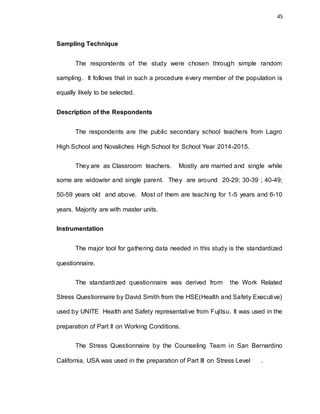
Sampling Technique
The respondents of the study were chosen through simple random
sampling. It follows that in such a procedure every member of the population is
equally likely to be selected.
Description of the Respondents
The respondents are the public secondary school teachers from Lagro
High School and Novaliches High School for School Year 2014-2015.
They are as Classroom teachers. Mostly are married and single while
some are widow/er and single parent. They are around 20-29; 30-39 ; 40-49;
50-59 years old and above. Most of them are teaching for 1-5 years and 6-10
years. Majority are with master units.
Instrumentation
The major tool for gathering data needed in this study is the standardized
questionnaire.
The standardized questionnaire was derived from the Work Related
Stress Questionnaire by David Smith from the HSE(Health and Safety Executive)
used by UNITE Health and Safety representative from Fujitsu. It was used in the
preparation of Part II on Working Conditions.
The Stress Questionnaire by the Counseling Team in San Bernardino
California, USA was used in the preparation of Part III on Stress Level .
46
Permission was sought through email to utilize the said questionnaires,
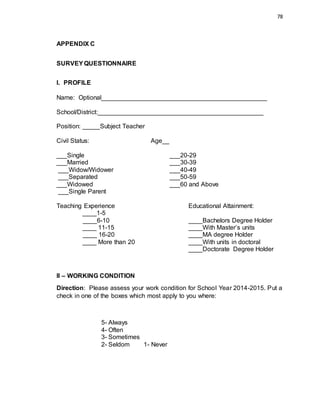
The questionnaire has two parts. Part I deals with working conditions
describing experiences at the work situation Part II deals with analysis of
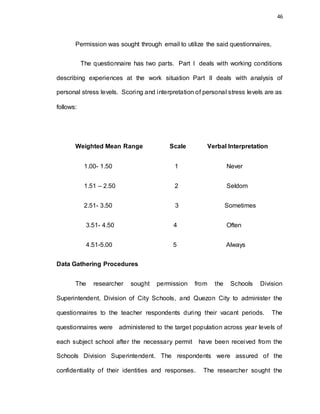
personal stress levels. Scoring and interpretation of personal stress levels are as
follows:
Weighted Mean Range Scale Verbal Interpretation
1.00- 1.50 1 Never
1.51 – 2.50 2 Seldom
2.51- 3.50 3 Sometimes
3.51- 4.50 4 Often
4.51-5.00 5 Always
Data Gathering Procedures
The researcher sought permission from the Schools Division
Superintendent, Division of City Schools, and Quezon City to administer the
questionnaires to the teacher respondents during their vacant periods. The
questionnaires were administered to the target population across year levels of
each subject school after the necessary permit have been received from the
Schools Division Superintendent. The respondents were assured of the
confidentiality of their identities and responses. The researcher sought the
47
assistance of the school principal and the head teachers of each department who
in turn distributed the questionnaires to the available teacher respondents in the
said units. Questionnaires were retrieved within five days to ensure the
promptness of returns. The researcher personally retrieved the questionnaires
from each department after five days.
Statistical Treatment of Data
The following statistical tools were used for the data gatherted in this
study:
1. Weighted Mean
The weighted mean was used to determine the working conditions and
personal stress levels of the respondents.
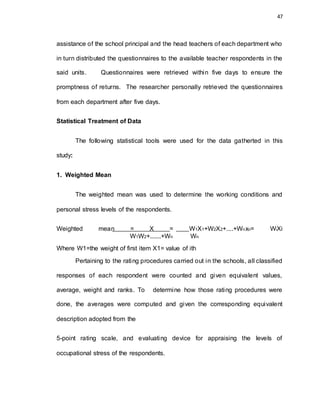
Weighted mean = X = W1X1+W2X2+....+Wnxn= WiXi
W1W2+.......+Wn Wn
Where W1=the weight of first item X1= value of ith
Pertaining to the rating procedures carried out in the schools, all classified
responses of each respondent were counted and given equivalent values,
average, weight and ranks. To determine how those rating procedures were
done, the averages were computed and given the corresponding equivalent
description adopted from the
5-point rating scale, and evaluating device for appraising the levels of
occupational stress of the respondents.
48
2. Pearson-r (Pearson Product-Moment Correlation(r)). This statistical
measure was done to measure correlation among the variables tested, The
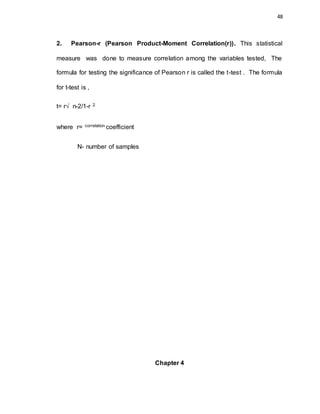
formula for testing the significance of Pearson r is called the t-test . The formula
for t-test is ,
t= r√ n-2/1-r 2
where r= correlation coefficient
N- number of samples
Chapter 4
49
PRESENTATION, ANALYSIS AND INTERPRETATION OF DATA
This chapter deals with the presentation and interpretation of data that
were gathered through the questionnaires prepared for the purpose of the study.
In the process of distributing questionnaires, some direct observations and
interviews were done with some of the head teachers and the principal to
supplement and strengthen the data obtained.
1. Respondents’ Working Condition
Table 2
Respondents’ Assessed Working Condition
Working Condition
A O So Se N
Mean Description5 4 3 2 1
Frequency
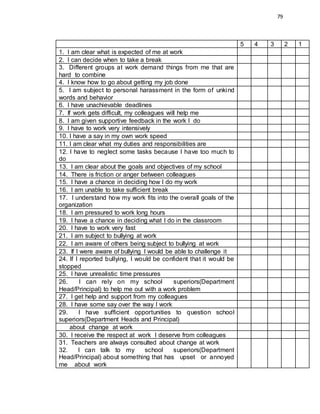
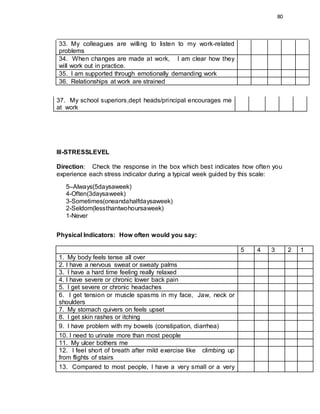
1. I am clear what is expected of
me at work
188 37 3 - 1 4.79 A
2. I can decide when to take a
break
110 64 31 7 13 4.12 O
*3. Different groups at work
demand things from me that are
hard to combine
7 23 73 66 55 2.38 Se
4. I know how to go about getting
my job done
157 62 7 1 2 4.62 A
*5. I am subject to personal
harassment in the form of unkind
words and behavior
81 42 28 18 52 3.37 So
*6. I have unachievable
deadlines
57 54 44 27 43 3.24 So
7. If work gets difficult, my
colleagues will help me
94 65 49 13 8 3.98 O
8. I am given supportive
feedback in the work I do
90 85 42 9 2 4.11 O
9. I have to work very intensively 95 95 30 6 2 4.21 O
10. I have a say in my own work 100 33 5 3 4.14 O
50
speed 83
11. I am clear what my duties
and responsibilities are
172 46 8 1 1 4.70 A
*12. I have to neglect some
tasks because I have too much
to do
39 48 57 44 41 3.00 So
13. I am clear about the goals
and objectives of my school
160 52 10 1 5 4.58 A
*14. There is friction or anger
between colleagues
60 56 36 49 28 3.31 So
15. I have a chance in deciding
how I do my work
94 100 23 4 6 4.20 O
*16. I am unable to take
sufficient break
31 52 57 43 44 2.93 So
17. I understand how my work
fits into the overall goals of the
organization
118 85 19 4 2 4.37 O
*18. I am pressured to work long
hours
29 52 65 37 44 2.93 So
19. I have a chance in deciding
what I do in the classroom
139 76 8 2 3 4.52 A
*20. I have to work very fast 8 13 61 85 60 2.22 Se
*21. I am subject to bullying at
work
97 40 24 31 34 3.60 O
22. I am aware of others being
subject to bullying at work
41 39 47 57 41 2.92 So
23. If I were aware of bullying I
would be able to challenge it
58 53 57 34 25 3.37 So
24. If I reported bullying, I would
be confident that it would be
stopped
66 69 47 21 23 3.59 O
*25. I have unrealistic time
pressures
40 51 60 39 34 3.11 So
26. I can rely on my school
superiors(Department
Head/Principal) to help me out
with a work problem
92 64 45 20 6 3.95 O
27. I get help and support from
my colleagues
99 84 37 6 3 4.18 O
28. I have some say over the
way I work
81 81 44 10 6 4.00 O
29. I have sufficient opportunities
to question school
superiors(Department Heads
52 34 47 41 52 2.97 So
51
and Principal) about change at
work
30. I receive the respect at work
I deserve from colleagues
122 72 30 1 3 4.36 O
31. Teachers are always
consulted about change at work
79 66 49 15 13 3.82 O
32. I can talk to my school
superiors(Department
Head/Principal) about something
that has upset or annoyed
me about work
67 57 55 24 18 3.59 O
33. My colleagues are willing to
listen to my work-related
problems
105 70 44 5 4 4.17 O
34. When changes are made at
work, I am clear how they will
work out in practice.
83 93 40 4 7 4.06 O
35. I am supported through
emotionally demanding work
52 92 59 13 8 3.75 O
*36. Relationships at work are
strained
24 41 76 45 37 2.87 So
37. My school superiors
(Department Head/Principal)
encourages me at work.
99 67 48 6 5 4.11 O
Overall Mean: 3.73 O
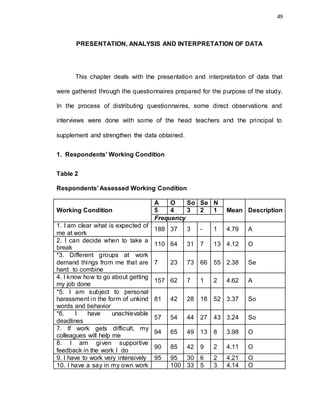
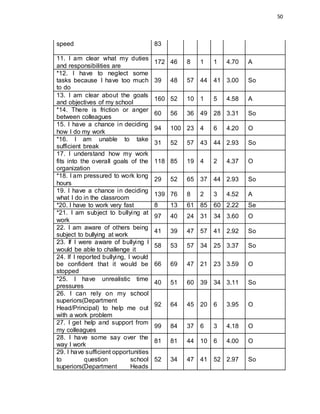
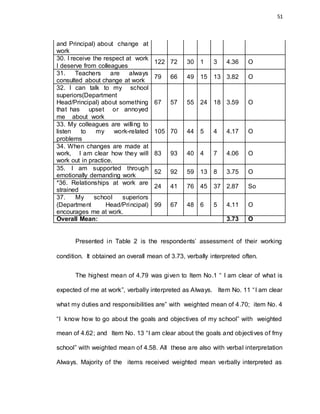
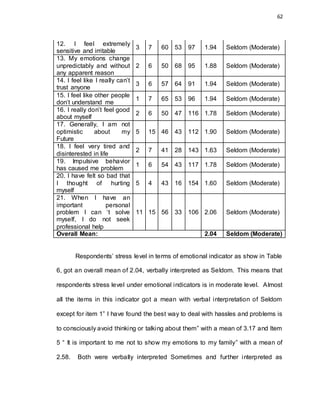
Presented in Table 2 is the respondents’ assessment of their working
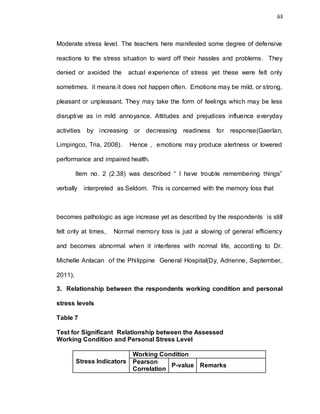
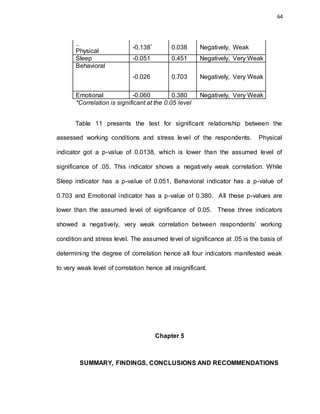
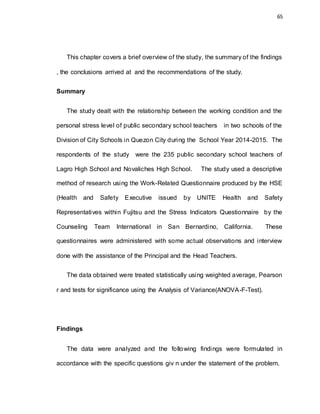
condition. It obtained an overall mean of 3.73, verbally interpreted often.
The highest mean of 4.79 was given to Item No.1 “ I am clear of what is
expected of me at work”, verbally interpreted as Always. Item No. 11 “I am clear
what my duties and responsibilities are” with weighted mean of 4.70; item No. 4
“I know how to go about the goals and objectives of my school” with weighted
mean of 4.62; and Item No. 13 “I am clear about the goals and objectives of fmy
school” with weighted mean of 4.58. All these are also with verbal interpretation
Always. Majority of the items received weighted mean verbally interpreted as
52
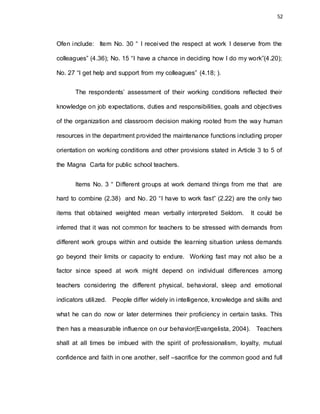
Ofen include: Item No. 30 “ I received the respect at work I deserve from the
colleagues” (4.36); No. 15 “I have a chance in deciding how I do my work”(4.20);
No. 27 “I get help and support from my colleagues” (4.18; ).
The respondents’ assessment of their working conditions reflected their
knowledge on job expectations, duties and responsibilities, goals and objectives
of the organization and classroom decision making rooted from the way human
resources in the department provided the maintenance functions including proper
orientation on working conditions and other provisions stated in Article 3 to 5 of
the Magna Carta for public school teachers.
Items No. 3 “ Different groups at work demand things from me that are
hard to combine (2.38) and No. 20 “I have to work fast” (2.22) are the only two
items that obtained weighted mean verbally interpreted Seldom. It could be
inferred that it was not common for teachers to be stressed with demands from
different work groups within and outside the learning situation unless demands
go beyond their limits or capacity to endure. Working fast may not also be a
factor since speed at work might depend on individual differences among
teachers considering the different physical, behavioral, sleep and emotional
indicators utilized. People differ widely in intelligence, knowledge and skills and
what he can do now or later determines their proficiency in certain tasks. This
then has a measurable influence on our behavior(Evangelista, 2004). Teachers
shall at all times be imbued with the spirit of professionalism, loyalty, mutual
confidence and faith in one another, self –sacrifice for the common good and full
53
cooperation with colleagues according to Section 1, Article V, Code of Ethics for
Professional Teachers (Bilbao, et al 2006).
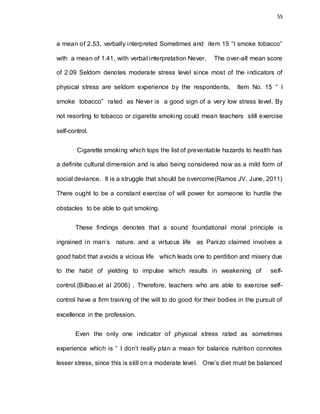
2. Respondents’ Personal Stress Levels
2.1 Physical indicators
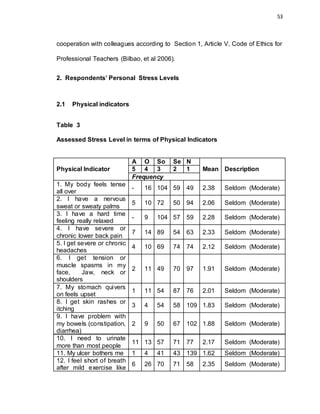
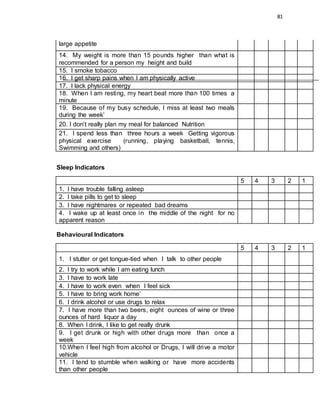
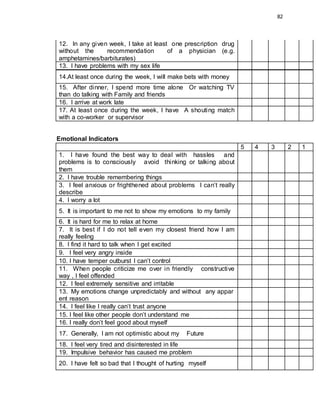
Table 3
Assessed Stress Level in terms of Physical Indicators
Physical Indicator
A O So Se N
Mean Description5 4 3 2 1
Frequency
1. My body feels tense
all over
- 16 104 59 49 2.38 Seldom (Moderate)
2. I have a nervous
sweat or sweaty palms
5 10 72 50 94 2.06 Seldom (Moderate)
3. I have a hard time
feeling really relaxed
- 9 104 57 59 2.28 Seldom (Moderate)
4. I have severe or
chronic lower back pain
7 14 89 54 63 2.33 Seldom (Moderate)
5. I get severe or chronic
headaches
4 10 69 74 74 2.12 Seldom (Moderate)
6. I get tension or
muscle spasms in my
face, Jaw, neck or
shoulders
2 11 49 70 97 1.91 Seldom (Moderate)
7. My stomach quivers
on feels upset
1 11 54 87 76 2.01 Seldom (Moderate)
8. I get skin rashes or
itching
3 4 54 58 109 1.83 Seldom (Moderate)
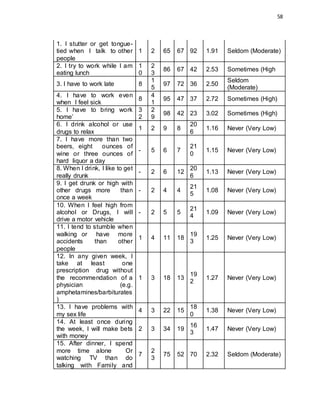
9. I have problem with
my bowels (constipation,
diarrhea)
2 9 50 67 102 1.88 Seldom (Moderate)
10. I need to urinate
more than most people
11 13 57 71 77 2.17 Seldom (Moderate)
11. My ulcer bothers me 1 4 41 43 139 1.62 Seldom (Moderate)
12. I feel short of breath
after mild exercise like
6 26 70 71 58 2.35 Seldom (Moderate)
54
climbing up from flights
of stairs
13. Compared to most
people, I have a very
small or a very large
appetite
5 21 93 55 55 2.41 Seldom (Moderate)
14. My weight is more
than 15 pounds higher
than what is
recommended for a
person my height and
build
8 25 60 50 82 2.23 Seldom (Moderate)
15. I smoke tobacco 3 4 29 13 181 1.41 Never (Very Low)
16. I get sharp pains
when I am physically
active
4 5 51 66 104 1.87 Seldom (Moderate)
17. I lack physical
energy
2 7 65 76 80 2.02 Seldom (Moderate)
18. When I am resting,
my heart beat more than
100 times a minute
3 5 55 57 103 1.87 Seldom (Moderate)
19. Because of my busy
schedule, I miss at least
two meals during the
week
8 10 70 61 81 2.14 Seldom (Moderate)
20. I don’t really plan my
meal for balanced
Nutrition
12 24 86 59 49 2.53 Sometimes (High)
21. I spend less than
three hours a week
Getting vigorous
physical exercise
(running, playing
basketball, tennis,
Swimming and others)
9 21 83 59 56 2.42 Seldom (Moderate)
Overall Mean: 2.09 Seldom (Moderate)
It is presented in Table 3 that the stress level of the respondents in terms
of physical indicator has an over all mean of 2.09, verbally interpreted Seldom.
Most of the items under this indicator got weighted mean verbally interpreted as
seldom except for item 20 “I don’t really plan my meal for balanced Nutrition” with
55
a mean of 2.53, verbally interpreted Sometimes and item 15 “I smoke tobacco”
with a mean of 1.41, with verbal interpretation Never. The over-all mean score
of 2.09 Seldom denotes moderate stress level since most of the indicators of
physical stress are seldom experience by the respondents, Item No. 15 “ I
smoke tobacco” rated as Never is a good sign of a very low stress level. By
not resorting to tobacco or cigarette smoking could mean teachers still exercise
self-control.
Cigarette smoking which tops the list of preventable hazards to health has
a definite cultural dimension and is also being considered now as a mild form of
social deviance. It is a struggle that should be overcome(Ramos JV, June, 2011)
There ought to be a constant exercise of will power for someone to hurdle the
obstacles to be able to quit smoking.
These findings denotes that a sound foundational moral principle is
ingrained in man’s nature. and a virtuous life as Panizo claimed involves a
good habit that avoids a vicious life which leads one to perdition and misery due
to the habit of yielding to impulse which results in weakening of self-
control.(Bilbao,et al 2006) . Therefore, teachers who are able to exercise self-
control have a firm training of the will to do good for their bodies in the pursuit of
excellence in the profession.
Even the only one indicator of physical stress rated as sometimes
experience which is “ I don’t really plan a mean for balance nutrition connotes
lesser stress, since this is still on a moderate level. One’s diet must be balanced
56
with all the required nutrients for healthy living Having regular food habits is
good therefore workaholics who fail to find sufficient time for proper mealtimes
are inviting stomach ulcers (Walia, MM 2005). Eating just a single food also
makes for poor nutrition (Macionis, John J 2000). One who has to keep the self
healthy must target the stress situation with a nutrient attack of varied minerals ,
vitamins ,proteins, fats , carbohydrates as stated in the food energy
pyramid,(Arora, Anjali, 2007). Constant pressure from work can cause much
anxiety coupled with bad eating habits hence the deleterious effects of industrial
social stress on bodily constitution affects learning ability and capacity.(Gaerlan,
Limpingco, Tria 2007) Keeping one’s nutritional intake adequate entails
adherence to healthy lifestyle practices .
2.2 Sleep Indicators
Table 4
Assessed Stress Level in terms of Sleep Aspect
Sleep Indicator
A O So Se N
Mean Description5 4 3 2 1
Frequency
1. I have trouble falling
asleep
6 20 84 39 73 2.31 Seldom (Moderate)
2. I take pills to get to sleep 1 2 45 6 169 1.48 Never (VeryLlow)
3. I have nightmares or
repeated bad dreams
- 4 50 35 134 1.66 Seldom (Moderate)
4. I wake up at least once
in the middle of the night
for no apparent reason
4 14 61 47 96 2.02 Seldom (Moderate)
Overall Mean: 1.87 Seldom (Moderate)
57
Table 4 presents the stress level of the respondents in terms of sleep
aspect. It has an overall mean of 1.87, verbally interpreted Seldom. All the sleep
indicators of stress are seldom experience by the respondents as represented by
the mean scores they received which are 2.31, 2.02 and 1.48 respectively. Item
2 “I take pills to get to sleep” got a mean of 1.48, verbally interpreted Never.#
which indicates a very low stress level. This means that respondents could still
sleep without resorting to the use of pills. While sleep is oftentimes deprived
from one , It also has its own restorative process for constant sleep deprivation
leads to stress and tension and difficulties in coping with the demands of life,
(Reyes, 2004). Researches by Walter Heiss, a Swiss neurophysiologist have
confirmed that certain localized brain structures actually induces sleep: high
frequency electrical impulses acting on the preoptic hypothalamic regions
produce sleep, hence even if surrounded by plenty of sensory stimuli, a person
can still g0o to sleep.(Gaerlan, Limpingco, Tria. 2007). This justified why people
can still sleep even in the absence of pills and within a stressful experience or
situation as perceived by the selected teacher respondents.
2.3 Behavioral Indicators
Table 5
Assessed Stress Level in terms of Behavioral Indicators
Behavioral Indicators
A O
S
o
S
e
N
Mea
n
Description
5 4 3 2 1
Frequency
58
1. I stutter or get tongue-
tied when I talk to other
people
1 2 65 67 92 1.91 Seldom (Moderate)
2. I try to work while I am
eating lunch
1
0
2
3
86 67 42 2.53 Sometimes (High
3. I have to work late 8
1
5
97 72 36 2.50
Seldom
(Moderate)
4. I have to work even
when I feel sick
8
4
1
95 47 37 2.72 Sometimes (High)
5. I have to bring work
home’
3
2
2
9
98 42 23 3.02 Sometimes (High)
6. I drink alcohol or use
drugs to relax
1 2 9 8
20
6
1.16 Never (Very Low)
7. I have more than two
beers, eight ounces of
wine or three ounces of
hard liquor a day
- 5 6 7
21
0
1.15 Never (Very Low)
8. When I drink, I like to get
really drunk
- 2 6 12
20
6
1.13 Never (Very Low)
9. I get drunk or high with
other drugs more than
once a week
- 2 4 4
21
5
1.08 Never (Very Low)
10. When I feel high from
alcohol or Drugs, I will
drive a motor vehicle
- 2 5 5
21
4
1.09 Never (Very Low)
11. I tend to stumble when
walking or have more
accidents than other
people
1 4 11 18
19
3
1.25 Never (Very Low)
12. In any given week, I
take at least one
prescription drug without
the recommendation of a
physician (e.g.
amphetamines/barbiturates
)
1 3 18 13
19
2
1.27 Never (Very Low)
13. I have problems with
my sex life
4 3 22 15
18
0
1.38 Never (Very Low)
14. At least once during
the week, I will make bets
with money
2 3 34 19
16
3
1.47 Never (Very Low)
15. After dinner, I spend
more time alone Or
watching TV than do
talking with Family and
7
2
3
75 52 70 2.32 Seldom (Moderate)
59
friends
16. I arrive at work late 7
1
0
67 72 71 2.16 Seldom (Moderate)
17. At least once during
the week, I have A
shouting match with a co-
worker or supervisor
1 5 37 18
16
7
1.49 Never (Very Low)
Overall Mean: 1.74
Seldom
(Moderate)
Table 5 shows the respondents stress level in terms of behavioral
indicators. An overall mean of 1.74 was given to this indicator with verbal
interpretation of Seldom. This means that in terms of behavior indicators
respondents have a moderate stress level. Ten out of seventeen indicators of
stress under behavioral obtained weighted mean verbally interpreted never. This
shows a very low stress level. Behavioral Indicator No. 2 “I try to work while I am
eating lunch” and Behavioral Indicator No. 5 “ I have to bring work home”
obtained mean of 2.53 and 3.02 respectively which are verbally interpreted
Sometimes which is further interpreted as moderate stress level.
It could also be noticed in this table that the lowest mean of 1.08 was
given to Item 9 “I get drunk or high with other drugs more than once a week”,
verbally interpreted as Never. Which is a good indicator that respondents’ stress
level is very low? They do not experience getting drunk which is really less
expected from teachers since teachers are considered as role model. Section 2
of Article X1 of the Code of Ethics for Professional Teachers states that a
teacher shall place premium upon self-respect and self-discipline as the principle
of personal behavior in all relationships with others and in all situations. Section
60
3 further states that a teacher shall maintain at all times a dignified personality
which could serve as model worthy of emulation by learners, peers, and others..
Section 3 of Article 111 also emphasized that teachers merit reasonable social
recognition for which his behavior reflects honor and dignity at all times and
must refrain from activities like gambling, smoking, drunkenness and other
excesses.(Bilbao, et al, 2006) Drinking is a double-edged sword impairing
mental judgement and can lead to a lot of diseases. (Olegario, Ivan,June, 2011).
According to Dr. Marcus Manalo of the University of Bristol, a study showed that
one particular genetic variant called DRD2 appeared to influence the “high” that
people derive from drugs or alcohol. People without this variant might derive less
pleasure from alcohol and my therefore drink less. (Gaerlan, Limpingco, Tria,
2007) This implies that the teacher does not use drugs or alcohol hence
validates the description (NEVER). Values have a behavioral, affective and
cognitive dimension and a teacher ought to live by that value. Training of the will
must be self-training for the habit of yielding to impulse results in the
enfeeblement of self-control. Habitually yielding to any vice diminish the ability to
resist temptation (Bilbao, et al 2006). This shows that at this indicator concerning
drinking, teachers have again exercised self-control considering the respondents’
set of accepted values. Values, goals and interests along with competencies are
among the most stable cognitive-affective units with emotion-eliciting properties
wherein the individual may place a negative value on certain habits where
aversion is likely to persist due to strong negative emotions correlating to the
habit. This is counter to the positive emotions that comes from patriotic values
61
that equates to security and attachment to one’s home (Feist, Jess, Feist,
Gregory,2010) This then related psychological dynamics that justified non-
drinking among certain groups of teacher respondents.
2.5 Emotional indicators
Table 6
Assessed Stress Level in terms of Emotional Aspect
Emotional Indicators
A O So Se N
Mean Description5 4 3 2 1
Frequency
1. I have found the best
way to deal with hassles
and problems is to
consciously avoid
thinking or talking about
them
29 52 89 26 23 3.17 Sometimes (High)
2. I have trouble
remembering things
3 18 88 66 48 2.38 Seldom (Moderate)
3. I feel anxious or
frightened about problems
I can’t really describe
2 6 78 61 76 2.09 Seldom (Moderate)
4. I worry a lot 1 8 79 60 75 2.10 Seldom (Moderate)
5. It is important to me not
to show my emotions to
my family
8 30 85 58 40 2.58 Seldom (Moderate)
6. It is hard for me to relax
at home
3 11 57 46 105 1.92 Seldom (Moderate)
7. It is best if I do not tell
even my closest friend
how I am really feeling
3 19 77 57 65 2.27 Seldom (Moderate)
8. I find it hard to talk
when I get excited
1 11 71 50 90 2.03 Seldom (Moderate)
9. I feel very angry inside 4 4 59 58 97 1.92 Seldom (Moderate)
10. I have temper outburst
I can’t control
2 6 67 43 103 1.92 Seldom (Moderate)
11. When people criticize
me over in friendly
constructive way , I feel
offended
2 7 62 60 90 1.96 Seldom (Moderate)
62
12. I feel extremely
sensitive and irritable
3 7 60 53 97 1.94 Seldom (Moderate)
13. My emotions change
unpredictably and without
any apparent reason
2 6 50 68 95 1.88 Seldom (Moderate)
14. I feel like I really can’t
trust anyone
3 6 57 64 91 1.94 Seldom (Moderate)
15. I feel like other people
don’t understand me
1 7 65 53 96 1.94 Seldom (Moderate)
16. I really don’t feel good
about myself
2 6 50 47 116 1.78 Seldom (Moderate)
17. Generally, I am not
optimistic about my
Future
5 15 46 43 112 1.90 Seldom (Moderate)
18. I feel very tired and
disinterested in life
2 7 41 28 143 1.63 Seldom (Moderate)
19. Impulsive behavior
has caused me problem
1 6 54 43 117 1.78 Seldom (Moderate)
20. I have felt so bad that
I thought of hurting
myself
5 4 43 16 154 1.60 Seldom (Moderate)
21. When I have an
important personal
problem I can ‘t solve
myself, I do not seek
professional help
11 15 56 33 106 2.06 Seldom (Moderate)
Overall Mean: 2.04 Seldom (Moderate)
Respondents’ stress level in terms of emotional indicator as show in Table
6, got an overall mean of 2.04, verbally interpreted as Seldom. This means that
respondents stress level under emotional indicators is in moderate level. Almost
all the items in this indicator got a mean with verbal interpretation of Seldom
except for item 1” I have found the best way to deal with hassles and problems is
to consciously avoid thinking or talking about them” with a mean of 3.17 and Item
5 “ It is important to me not to show my emotions to my family” with a mean of
2.58. Both were verbally interpreted Sometimes and further interpreted as
63
Moderate stress level. The teachers here manifested some degree of defensive
reactions to the stress situation to ward off their hassles and problems. They
denied or avoided the actual experience of stress yet these were felt only
sometimes. it means it does not happen often. Emotions may be mild, or strong,
pleasant or unpleasant. They may take the form of feelings which may be less
disruptive as in mild annoyance. Attitudes and prejudices influence everyday
activities by increasing or decreasing readiness for response(Gaerlan,
Limpingco, Tria, 2008). Hence , emotions may produce alertness or lowered
performance and impaired health.
Item no. 2 (2.38) was described “ I have trouble remembering things”
verbally interpreted as Seldom. This is concerned with the memory loss that
becomes pathologic as age increase yet as described by the respondents is still
felt only at times, Normal memory loss is just a slowing of general efficiency
and becomes abnormal when it interferes with normal life, according to Dr.
Michelle Anlacan of the Philippine General Hospital(Dy, Adrienne, September,
2011).
3. Relationship between the respondents working condition and personal
stress levels
Table 7
Test for Significant Relationship between the Assessed
Working Condition and Personal Stress Level
Stress Indicators
Working Condition
Pearson
Correlation
P-value Remarks
64
Table 11 presents the test for significant relationship between the
assessed working conditions and stress level of the respondents. Physical
indicator got a p-value of 0.0138, which is lower than the assumed level of
significance of .05. This indicator shows a negatively weak correlation. While
Sleep indicator has a p-value of 0.051, Behavioral indicator has a p-value of
0.703 and Emotional indicator has a p-value of 0.380. All these p-values are
lower than the assumed level of significance of 0.05. These three indicators
showed a negatively, very weak correlation between respondents’ working
condition and stress level. The assumed level of significance at .05 is the basis of
determining the degree of correlation hence all four indicators manifested weak
to very weak level of correlation hence all insignificant.
Chapter 5
SUMMARY, FINDINGS, CONCLUSIONS AND RECOMMENDATIONS
..
Physical
-0.138* 0.038 Negatively, Weak
Sleep -0.051 0.451 Negatively, Very Weak
Behavioral
-0.026 0.703 Negatively, Very Weak
Emotional -0.060 0.380 Negatively, Very Weak
*Correlation is significant at the 0.05 level
65
This chapter covers a brief overview of the study, the summary of the findings
, the conclusions arrived at and the recommendations of the study.
Summary
The study dealt with the relationship between the working condition and the
personal stress level of public secondary school teachers in two schools of the
Division of City Schools in Quezon City during the School Year 2014-2015. The
respondents of the study were the 235 public secondary school teachers of
Lagro High School and Novaliches High School. The study used a descriptive
method of research using the Work-Related Questionnaire produced by the HSE
(Health and Safety Executive issued by UNITE Health and Safety
Representatives within Fujitsu and the Stress Indicators Questionnaire by the
Counseling Team International in San Bernardino, California. These
questionnaires were administered with some actual observations and interview
done with the assistance of the Principal and the Head Teachers.
The data obtained were treated statistically using weighted average, Pearson
r and tests for significance using the Analysis of Variance(ANOVA-F-Test).
Findings
The data were analyzed and the following findings were formulated in
accordance with the specific questions giv n under the statement of the problem.
66
1. The assessment of the respondents’ working conditions with items no
1,4,11,13 and 19 each gained mean scores of 4.79; 4.62; 4.70; 4.58; and 4.52
respectively. These areas covered clarity of job expectations, knowledge of the
job, clarity of duties and responsibilities, goals and objectives of the school and
classroom decision making. Rated as Often were item no. 17 with mean score of
4.37; item no 9 with score of 4.21 and item no. 7 with a mean score of 3.98.
These areas covered understanding how work fits with the over-all goals of the
organization; working very intensively and help or support from colleagues. The
items which were rated sometimes, seldom or never were less felt as justified by
their lower frequencies and mean average. The respondents assessed working
condition was a pleasant one..
2. For respondents’ stress level, all the indicators evaluated obtained mean
which are verbally interpreted as Seldom and further interpreted as Moderate
stress level: Physical Indicators (2.09); Sleep Indicators (1.87); Behavior
Indicators (1.74) and Emotional Indicators(2.04).
3. The test of significant relationship between the assessed working conditions
and stress level of the respondents reveals that Physical indicator got a p-value
of 0.0138, which is lower than the assumed level of significance of .05. This
indicator shows a negatively weak correlation. While Sleep indicator has a p-
value of 0.051, Behavioral indicator has a p-value of 0.703 and Emotional
indicator has a p-value of 0.380. All these p-values are lower than the assumed
67
level of significance of 0.05. These three indicators showed a negatively, very
weak correlation between respondents’ working condition and stress level.
Conclusions
In the light of the foregoing findings, the following conclusions were drawn
1. The working conditions that the respondents always experience in their work
environments which covered areas on job expectations ,knowledge of job,
duties and responsibilities, goals and objectives of the school and classroom
decision-making as well as the indicators that are often experience by the
respondents like fitness of work to over-all goals of the organization; support or
help from colleagues and intensive work are reflective of a pleasant working
condition.
2. The respondents have moderate personal stress level in all areas evaluated
namely physical, sleep, behavioral and emotional indicators.
3. Teachers working condition is not related to the following personal stress
indicators: physical, sleep, behavioral and emotional.
Recommendations
68
In view of the findings, and conclusions, the following recommendations
are hereby given:
1. Improvement of the working conditions of teachers entails focusing on
leadership empowerment that will pave the way for improvement of faculty
facilities and resources, class sizes and physical structure in the work
environment. There should be a concerted effort on the part of the government
for allocations towards the provision of a safe supportive environment for each
teacher in every division or district through a manageable work climate that
rebounds to improvement of student learning. Principals who are to serve as
instructional leaders who prioritizes and provides avenues for teacher growth
and teacher empowerment must be called for this task. More intensive policy
recommendations towards better working atmosphere through a strengthened
School Improvement Program at both the school and district level is highly and
strongly recommended.
2. An innovative Stress Management Program is suggested that will be diffused
to each and every school through the Principal and its Heads down to the
classroom teachers where there will be a positive impact on the educational
environment through self-reflection, cognitive restructuring techniques,
meditation, physical measures like massage and exercise, music and drawing
activities in a quiet place for respite will help reduce or tone down the moderate
stress levels encountered by teachers each day is further recommended.
Parents must also be involved in the process to ensure the cooperation and
69
participation of the whole school community. Based on a quote by Dolly Parton
“Nobody gonna live for ya” she meant that mental health be given priority and to
avoid toxic influences in life for stress is only a perception and you have control
of your perceptions.” Hence more positive ways of looking at life itself is a must
for every teacher in every school to adopt as a philosophy in the teaching craft.
3. Since the result of this study showed weak and very weak relationship
between working condition and personal stress level of teachers, similar study in
other districts or divisions using the same instrument is recommended to other
researchers to validate the results of this study and other studies correlating
teachers personal stress level to other factors that cause stress to teachers are
also recommended.
70
REFERENCES
BOOKS:
Aamodt M, (2010) Industrial Organizational Psychology 6th ed. Wadsworth,Ca .
USA.
Ang, Armando ( 2009) Overpopulated Philippines
Antai-Otong, Deborah (2003) Psychiatric Nursing Biological and Behavioral
Concepts Delmar Thomson Learning
Aquino, Teresa, (2000) Problems of the Filipino Teacher Senate Committee on
Education
Aronson, E. Wilson T, Akert R(2010) –Social Psychology -8th ed Pearson
Education
NJ USA
Bilbao, P, Corpuz.B. , Llagas, A, ,& Salandanan, G. (2006) The Teaching
Profession Lorimar Publishing
Brunner, Suddarth ,(2008) Medical Surgical Nursing Vol. 11, 11th edition,
Lippincott ,
Carino , Isidro (1992) Will Education Succeed?, Cacho Hermana, Inc.
Carroll, S. & Smith, T (2000) The Complete Guide to Healthy Living
First American , Edition
Chinn, Jacobs (1983) Theories and Nursing, A Systematic Approach, CV
Mosby
Corpuz, B. & Salandanan, G. , (2011) Principles of Teaching Lorimar
Publishing
Decenzo, D., Robbins, Stephen P. Human Resources Management, John Wiley
& Sons 2002
Ellis, J. Hartley C. (2005) Managing and Coordinating Nursing Care, Lippincott,
71
Williams and Wilkins
Evangelista, Lourdes (2004) Introduction to Psychology Booklore Publishing
Corp.
Feist,Jess & Feist Gregory (2010) Theories of Personality 7th ed,McGraw Hill
Education(ASIA)
Gaerlan J, Limpingco D, Tria G. (2008) Principles of Mental Hygiene 5th
edition Metro Manila
Gaerlan J. Limpingco D. Tria G.(2007) Physiological Basis of Human Behavior,
2nd ed, Ken Inc. Quezon City
Lemone, Burke .(2004) Medical Surgical Nursing 3rd edition Vol 2 New Jersey
Lundin, Robert (2010) Theories and Systems of Psychology 4th ed. D.C. Heath &
Company, Lexington, Massachusetts, Toronto
Macionis, John J, (2000) Sociology 7th ed.Prentice Hall Upper Saddle River,
New Jersey
Martires, Concepcion (2004) Human Resources Management 3rd ed Philippine
Copyright
Mcshane, S.& Von Glinow,M. (2003) Organizational Behavior,Emerging Realities
for the Workplace Revolution, McGraw Hill, 2nd ed
Quirino, Teresita, (2012) “Team Teacher” A Tribute to the Filipino Teacher
Everywhere, Technological Institute of the Philippines, Quezon City,
Reyes, Diana (2004) You can Stay Young and Healthy, /worldlink Books
Salandanan, Gloria (2009) Methods of Teaching . Lorimar Publishing,
Salvador Samuel (2010) “ Essentials of Human Behavior in Organization,”
Selye, Hans (1986) The Stress of Life. New York: McGraw-Hill,
Uriarte, Gabriel (2008) Learning Psychology the Easy Way. SUG Publishing,
THESES/STUDIES
72
Cabanting, Aissa Limbio, (2011) “Teacher’s Awareness and Concern Towards
Students With Emotional and Behavioral Disorder(EBD): Basis in
Developing a Special Training Program (“MA Thesis”), New Era University
Chan, H.S. Alan, Chen, R., Chang, Elaine (2010) “Work Stress of Teacher for
Primary and Secondary Schools in Hongkong”
Darmody, Merike, Smyth Emer,(2000) “Job Satisfaction and Occupational Stress
Among Primary School Teacher and School Principals in Ireland”
Fisher, Molly, (2011) “Factors Affecting Stress, Burnout and Retention of
Secondary Teachers, University of Kentucky
Kadtong, Maeda Langguyan (2013) ”Work Performance and Job Satisfaction
Among Teachers”. Notre Dame University, Cotabato City
Khan, Anwar, Ishak Med Shah, Shafiq Gul, Sadif Khan, (2011) “Teacher Stress,
Performance and Resources, The Moderating Effects of Resources on
Stress and Performance
Mrozek, Ken (2011) Teacher Stress
Manjula, Chandresa,( 2007) “A Study on Personality Factors Causing Stress
among School Teachers “ Mother Teresa Women’s University, Kodaikanal
Moksnes, Unni Karin, (2011) “Stress and Health in Adolescents The Role of
Potential Protective Factors, Norweigian University of Science and
Technology
Pureza, Wilma, (2000) “The Relationship Between Occupational Stress and
Teachers Performance in Aromahan District , Division of City Schools,
Caloocan
Ravichandran, R; Rajendran R. (2007)“Perceived Sources of Stress Among
Teachers, National Institute of Technical Teacher Training and Research
Chennai
Roxas, Chona,(2009)“Stress Among Public Elementary School Teachers “2009
Spooner Lane, Rebecca (2004) “The Influence of Work Stress and Work Support
73
On Burnout”,
Springer, J.(2011) “Stress and Coping Behavior Among Primary School
Teachers” A Thesis The Scholarship
PAPERBACKS:
Arora, Anjali , (2007) “5 Steps to Counteract Stress”, Sterling Publisher, New
Delhi
Helping Hands and Hearts Inc, & Gary A. Yupangco Foundation Inc. (2009)
Sound Publishing Corporation
Reyes, Diana(2004) “You Can Stay Young and Healthy” World Link Book
Walia , M.M.(2005) “Stress-Free Living” Sterling Publisher, New Delhi
JOURNALS/MAGAZINES
Dy, Adrienne(2011) To Never Forget” Health Today,pp24-25
Olegario, Ivan (2011) “Bad Bad Boys” Health Today, p.50
Ramos, JV (2011) “How to Stop Smoking in 6 Steps, Health Today, pp.20-21
MODULES
Carague,O,Castolo,C Naval V.(2009)Modules on RSH 630 Research Seminar I
INTERNET WEBSITES:
www,educationworld.com/a-admin/admin413shtml
www.elib.gov.ph
www.nimb.niti.gov
74
www.pamilya in guard abs-cbn news
www.philstar.com
www.sage.pub. con/apmdata.ph
www.lawphil.net
www. QCPSTA .com
www.cedu.nni.com
www.webmd.com
www.deped.gov.ph
www.ourunion.org., uk
www.worksafe.vic gov.ou
www.slideshare.net/sajidatariq 16 stress management for teachers
75
APPENDICES
APPENDIX A
76
APPENDIX B
77
78
APPENDIX C
SURVEYQUESTIONNAIRE
I. PROFILE
Name: Optional_______________________________________________
School/District:_______________________________________________
Position: _____Subject Teacher
Civil Status: Age__
___Single ___20-29
___Married ___30-39
___Widow/Widower ___40-49
___Separated ___50-59
___Widowed ___60 and Above
___Single Parent
Teaching Experience Educational Attainment:
____1-5
____6-10 ____Bachelors Degree Holder
____ 11-15 ____With Master’s units
____ 16-20 ____MA degree Holder
____ More than 20 ____With units in doctoral
____Doctorate Degree Holder
II – WORKING CONDITION
Direction: Please assess your work condition for School Year 2014-2015. Put a
check in one of the boxes which most apply to you where:
5- Always
4- Often
3- Sometimes
2- Seldom 1- Never
79
5 4 3 2 1
1. I am clear what is expected of me at work
2. I can decide when to take a break
3. Different groups at work demand things from me that are
hard to combine
4. I know how to go about getting my job done
5. I am subject to personal harassment in the form of unkind
words and behavior
6. I have unachievable deadlines
7. If work gets difficult, my colleagues will help me
8. I am given supportive feedback in the work I do
9. I have to work very intensively
10. I have a say in my own work speed
11. I am clear what my duties and responsibilities are
12. I have to neglect some tasks because I have too much to
do
13. I am clear about the goals and objectives of my school
14. There is friction or anger between colleagues
15. I have a chance in deciding how I do my work
16. I am unable to take sufficient break
17. I understand how my work fits into the overall goals of the
organization
18. I am pressured to work long hours
19. I have a chance in deciding what I do in the classroom
20. I have to work very fast
21. I am subject to bullying at work
22. I am aware of others being subject to bullying at work
23. If I were aware of bullying I would be able to challenge it
24. If I reported bullying, I would be confident that it would be
stopped
25. I have unrealistic time pressures
26. I can rely on my school superiors(Department
Head/Principal) to help me out with a work problem
27. I get help and support from my colleagues
28. I have some say over the way I work
29. I have sufficient opportunities to question school
superiors(Department Heads and Principal)
about change at work
30. I receive the respect at work I deserve from colleagues
31. Teachers are always consulted about change at work
32. I can talk to my school superiors(Department
Head/Principal) about something that has upset or annoyed
me about work
80
33. My colleagues are willing to listen to my work-related
problems
34. When changes are made at work, I am clear how they
will work out in practice.
35. I am supported through emotionally demanding work
36. Relationships at work are strained
III-STRESSLEVEL
Direction: Check the response in the box which best indicates how often you
experience each stress indicator during a typical week guided by this scale:
5–Always(5daysaweek)
4-Often(3daysaweek)
3-Sometimes(oneandahalfdaysaweek)
2-Seldom(lessthantwohoursaweek)
1-Never
Physical Indicators: How often would you say:
5 4 3 2 1
1. My body feels tense all over
2. I have a nervous sweat or sweaty palms
3. I have a hard time feeling really relaxed
4. I have severe or chronic lower back pain
5. I get severe or chronic headaches
6. I get tension or muscle spasms in my face, Jaw, neck or
shoulders
7. My stomach quivers on feels upset
8. I get skin rashes or itching
9. I have problem with my bowels (constipation, diarrhea)
10. I need to urinate more than most people
11. My ulcer bothers me
12. I feel short of breath after mild exercise like climbing up
from flights of stairs
13. Compared to most people, I have a very small or a very
37. My school superiors,dept heads/principal encourages me
at work
81
large appetite
14. My weight is more than 15 pounds higher than what is
recommended for a person my height and build
15. I smoke tobacco
16. I get sharp pains when I am physically active
17. I lack physical energy
18. When I am resting, my heart beat more than 100 times a
minute
19. Because of my busy schedule, I miss at least two meals
during the week’
20. I don’t really plan my meal for balanced Nutrition
21. I spend less than three hours a week Getting vigorous
physical exercise (running, playing basketball, tennis,
Swimming and others)
Sleep Indicators
5 4 3 2 1
1. I have trouble falling asleep
2. I take pills to get to sleep
3. I have nightmares or repeated bad dreams
4. I wake up at least once in the middle of the night for no
apparent reason
Behavioural Indicators
5 4 3 2 1
1. I stutter or get tongue-tied when I talk to other people
2. I try to work while I am eating lunch
3. I have to work late
4. I have to work even when I feel sick
5. I have to bring work home’
6. I drink alcohol or use drugs to relax
7. I have more than two beers, eight ounces of wine or three
ounces of hard liquor a day
8. When I drink, I like to get really drunk
9. I get drunk or high with other drugs more than once a
week
10.When I feel high from alcohol or Drugs, I will drive a motor
vehicle
11. I tend to stumble when walking or have more accidents
than other people
82
12. In any given week, I take at least one prescription drug
without the recommendation of a physician (e.g.
amphetamines/barbiturates)
13. I have problems with my sex life
14.At least once during the week, I will make bets with money
15. After dinner, I spend more time alone Or watching TV
than do talking with Family and friends
16. I arrive at work late
17. At least once during the week, I have A shouting match
with a co-worker or supervisor
Emotional Indicators
5 4 3 2 1
1. I have found the best way to deal with hassles and
problems is to consciously avoid thinking or talking about
them
2. I have trouble remembering things
3. I feel anxious or frighthened about problems I can’t really
describe
4. I worry a lot
5. It is important to me not to show my emotions to my family
6. It is hard for me to relax at home
7. It is best if I do not tell even my closest friend how I am
really feeling
8. I find it hard to talk when I get excited
9. I feel very angry inside
10. I have temper outburst I can’t control
11. When people criticize me over in friendly constructive
way , I feel offended
12. I feel extremely sensitive and irritable
13. My emotions change unpredictably and without any appar
ent reason
14. I feel like I really can’t trust anyone
15. I feel like other people don’t understand me
16. I really don’t feel good about myself
17. Generally, I am not optimistic about my Future
18. I feel very tired and disinterested in life
19. Impulsive behavior has caused me problem
20. I have felt so bad that I thought of hurting myself
83
21. When I have an important personal problem I can ‘t solve
myself, I do not seek professional help
CURRICULUM VITAE
MARIA LUISA CRUZ ALANES
BLOCK 4 LOT 10 PHASE IB DIAMOND STREET
PLEASANT HILLS SUBDIVISION
SAN JOSE DEL MONTE CITYBULACAN
NATIONALITY- Filipino
DATE OF BIRTH- May 29, 1959
Female
CP # 0918-547-1656
EMAIL ADDRESS:marialuisaalanes@yahoo.com
PROFILE
Science Teacher II with 18 years experience in classroom teacher in the public
school
College Instructor of 16 years experience in nursing schools
84
Senior Clerk-Stenographer with 7 years experience in a government school
Staff Nurse with 1 year experience in a government hospital
WORK EXPERIENCES
August 1997 to Present - Regular Permanent Teacher II
Maligaya High School, Quezon City
June 1996 to March, 2008 – Part-time College Instructor
J.P. Sioson General Hospital and Colleges,Bago Bantay,
Quezon City
June 2003-March 2004 -Part-time College Instructor
World Citi College, Aurora Blvd. Quezon City
June 1996 – March 1997 - College Instructor and Clinical Coordinator
St. Dominic Savio College,Ciudad Real, SJDM Bul
January1993- March 1996 -Faculty Member,College of Nursing
Medical Secretarial Department
Coordinator, School of Midwifery,
J.P.Sioson Medical Center, School of Midwifery
Bago Bantay, Quezon City
May 27, 1992-Dec, 1992 – Registrar and Clinical Instructor
J.P. Sioson Medical Center, School of Midwifery
Bago Bantay, Quezon City
November 21,1983-June 1990 – Stenographer-Board of Trustees
Senior Clerk, Administrative Services Division.
Philippine Science High School
Diliman Quezon City
October, 1981 –December 1982- Staff Nurse
Philippine National Railways Hospital.
85
Caimito Road, Caloocan City
EDUCATION
Far Eastern University
Bachelor of Science in Nursing with 18 units of Education
Graduated in April, 1980
Polytechnic University of the Philippines-Open University
Pre-Master of Educational Management (18 units)
Summer April to May 2011
Polytechnic University of the Philippines –Open University
Master of Educational Management 36 units)
June 2011 – to March 2013
Passed Written Comprehensive Examinations – September 20, 2013
Vocational – Cora Doloroso Career Centre
Secretarial Course Career Development
July to September 1983 with 372 hrs on the job training(CDCP now PNCC )
Non –Education Units(Nursing)-Philippine Women’s University Manila
Master of Arts in Nursing – 30 units academic requirements completed
Nov.1992 to May 1995
PROFESSIONAL LICENSE/CIVIL SERVICE ELIGIBILITY
Licensure Examination for Teachers - August 24-25, 1996
Nurses Board Examination - April 26-27/May 1, 1980
Career Service Professional Examination- Dec, 7, 1980
86
Stenographer Examination - July 25, 1983
PERSONAL COMPETENCIES AND SKILLS
Languages spoken: tagalog, English
Skills: Nursing, teaching , writing
Hobbies: listening to music, poetry writing, drawing
AFFILIATIONS:
Philippine Public School Teachers Association
Quezon City Public School Teachers Association
Couples for Christ, Pleasant Hills, Subd. SJDM Bulacan

sample Thesis

  • 1.
    Chapter 1 THE PROBLEMAND ITS BACKGROUND Introduction Organizations are open systems adapting continuously to changing environments. All organizations exist in an environment which affects and is further affected by the organization. Developmental processes within the organization have positive effect on employee productivity and attitudes. The creation of a positive learning environment within the educational organization of institutions depends much on the existent working conditions provided within the organization and is reflected by the level of job satisfaction that results from performance at work. In every workplace, a creative environment is made possible by conditions that include organizational support, motivating tasks with sufficient resources and time (Mcshane, Glinow, 2003). Teachers are individuals who are continuously connected to the environment. The educational set-up with students, colleagues and the community as well. As part of the organization, they are bound by the policies and procedures pertaining to basic working conditions that they must be able to live with to produce acceptable level of performance in teaching,. Organizational
  • 2.
    2 stressors may comeabout from certain working conditions which are stressful including downsizing or retrenching reducing number of employees causing higher workload, feelings of guilt, increased job insecurity and loss of friends for lay-off survivors (Mcshane 2003). Stress once experienced is a deterrent factor in the learning process as it envelops the entirety of the teacher’s life. The combination of stresses on the job and in the personal life of the teacher makes a high point in the causation and progression of stress. It is personal encounter by the researcher who experienced elevation of blood pressure, cholesterol, uric acid, blood sugar coupled with urinary tract infection, dental problems and other hormonal imbalances that cropped up in the course of rendering the teaching profession to its client students. These were aggravated by personal stresses and daily work hassles that had to be endured in the process of executing teaching roles and functions. This motivated the researcher to delve into this study to find out if there is a relationship between working condition and personal stress level of teachers. Background of the Study Working condition is a workplace that is conducive to the physical, behavioral, sleep and emotional condition of the employee, the teacher. These working conditions were categorized into several components:1. Attitude towards work which includes working continuously, neglect of tasks, deciding on how to do the job and decision making in the classroom. It also includes long hours of
  • 3.
    3 work, time pressureand bullying. 2. Knowledge about the nature of work includes clarity on job expectations, duties, responsibilities ,goals and objectives of the organization, having a say on work speed and understanding how work fits into the over-all goals of the organization. 3. Relationship with peers includes reacting on group demands, personal harassment, supportive feedback and help from colleagues at work. 4. Relationship with superiors include reliance on the Principal who encourages and help through emotionally heavy work and strains on relationships. Certain indicators used were physical, behavioral, sleep and emotional with certain stress levels identified as high, moderate or low. . The presence of poor or inadequate working conditions becomes sources of stress for the worker for what affects him physically affects him psychologically as well consciously or unconsciously make his day.(Martires, 2004). It is therefore the tasks of the government and management of any organization to work into the creation of a wholesome place for workers specifically the teachers to ensure optimum provision of safe and learning lifestyle for the learning community. In the United Kingdom, It was noted that the common causes of stresses teachers experience include poor classrooms with small rooms, many students, lack of group facilities like heating, cooling, lighting, media facilities, noise and room structure, low salaries, heavy workload and work taken home daily(Ken Mrozek, 2000).
  • 4.
    4 In the Philippines,problems on quality education were attributed to teachers’ woes (www.fnf.org/liberopinion/crisis:public education Philippines) like class size where 60-70% in two shifts of cramped makeshift room in multipurpose covered courts with four to five class partitions, lacking instructional materials, need for textbook revisions, mismatched training with actual jobs resulting in large group of unemployed or underemployed workers. This scenario of working conditions relates to teacher stress. RA 4670 too of the Magna Carta for school teachers had recognized the effect of the duties and activities of a school teacher which involved physical, mental and emotional stresses as provided for the effects of the physical and nervous strain on the teacher shall be recognized as compensable occupational disease in accordance with laws. Teachers are assigned a regular load of six to seven including handling of advisory classes, remedial and alternative development modes. The ideal maximum class size of 1:45 is oftentimes increased to 50 -55 as the regular enrolment zooms up at the opening of classes. Under the K12 curriculum, DEPED Order no 31, s.2012, the Policy Guidelines for the implementation of the Grades 1 to 10, effective 2012-2013, aside from the regular time allotment noted in DO 15, s.1993, Corrigendum to DECS no. 11, s.1989 which stated therein that Science and Technology teachers have regular load of four (4) or 80 minutes of teaching equivalent to a total of 320 minutes per day. Technology teachers likewise have the same load
  • 5.
    5 assignments; there isan added period for Homeroom Guidance Program or Independent Cooperative Learning hour for the students ranging from two to four hours weekly to provide students the option to learn at their own time those topics they can handle by themselves. Teaching schedules get tightly arranged with fewer vacant periods hence the experience of inconvenience and discomforts set in like hunger and fatigue. The presence of separate buildings make things more difficult especially for the aging teachers with predisposition to health imbalances for statements were noted of their expressed manifestations of fatigue as they come up and down the top floors of one building to another hour after hour hence the aggravation of their beginning frail health status. The study focused on two schools in District Five of the Division of City Schools in Quezon City namely Lagro High School and Novaliches High School with a total population of 6,000 each, hence considered as big schools. According to Darmody(2000)job satisfaction is somewhat high in big schools where teachers might be stressed but their satisfaction levels were not affected. On the other hand, Ken Mrozek (2011) stated that a high turnover coupled with demographic tasks of increased school enrolment notes teaching as a highly stressful profession. On the basis if these studies, there was a felt need to assess the stress levels in the big schools. Both schools are composed of urban communities with a mixing of average and depressed families within. Novaliches High School is located within the Novaliches proper and accessible via Quirino Highway in Quezon City within a thickly populated
  • 6.
    6 community with markets,malls and churches on within its vicinity. These areas too have varied source of livelihood. Lagro High School is situated in Lagro Subdivision with a bigger number students coming from Lagro Subdivision and nearby areas. It is adjacent to Lagro Elementary School and likewise near church, market and plenty of business establishments. The school is wide with several buildings and a spacious area for the students to walk about and perform physical activities. Both schools have student population of six thousand and teacher population of 176 for Novaliches High School and 200 for Lagro High School. The respondents are male and female teachers of age groups ranging from 60 to 20 year old bracket with length of service range of more than 20 years down to 1 -5 years. All respondents have high educational attainment from Doctorate Degree to Bachelor degree and are of varied civil status. Theoretical Framework This study is based on Frederick Herrzberg Motivator-Hygiene theory which proposed that employees are motivated primarily by growth or esteem needs called motivators which are basically intrinsic needs and factors extrinsic to the job called hygiene’s which involves job security, working conditions,
  • 7.
    7 company policies, coworkerrelations and supervisor relations. The motivators are the recognition, responsibility, advancement, achievement and personal growth. The improvement of motivators will ensure satisfaction on the job but may not decrease job dissatisfaction. On the other hand, hygiene’s when improved will reduce job dissatisfaction but not ensure job satisfaction, (Mcshane, 2003). This denotes that the job dissatisfaction produced by the work context may be ascribed to the working conditions that are classified under hygienes. These working conditions must be improved to motivate employees through the work itself which may provide comfortable environment that is paralleled with higher levels of productivity. Hans Selye’s General Adaptation Syndrome (GAS) where three stages or reactions are manifested: Alarm, Resistance and Exhaustion provides the explanation for the occurrence of the stress phenomena underlying personal stresses encountered by the teachers at work. According to Selye, this syndrome appears when the organism is subjected to long continued stress and every organ responds in its own particular way to stress. With the excessive defensive or submissive body reactions are high blood pressure, kidney problem, rheumatism, eye or vision problems, problems like inflammation of the eyes, allergies, Infections, nervous and mental disease, digestive and metabolic disorders. The body develops a physiological enlargement of the adrenal cortex, shrinkage of thymus, spleen and lymph nodes and other lymphatic structures with deep bleeding ulcers of the stomach and duodenum. These are non-specific responses to diverse noxious stimuli. The alarm stage noted the occurrence of
  • 8.
    8 the fight orflight response and is defensive and anti-inflammatory yet is a limited reaction for it is fatal to exist in that stage where certain hormones are released such as the catecholamines and adrenocorticotrophic hormones(ACTH)(Brunner, 2008). Persons may respond physiologically and psychologically to several chronic stressors arising from his life situation including frustrations in the home and may manifest these through certain body organs like the stomach, back, colon, nasal and mucous membrane which may occur frequently as a response to traumatic personal situation. Teachers are individual who responds to stimuli from the environment. As an individual, a teacher is consistently connected to his environment. The consistent interaction with the environment subject’s man to a multitude of forces called stressors which occur between and outside individuals and may yield positive or negative results (Chinn and Jacobs, 1983). The integrity of the teacher is thereby established and maintained through more positive teaching approaches and strategies that are dynamic, effective and innovative. The interplay of the General Adaptation theory of Selye as strengthened by Wolff’s theory on stress and its physiological as well as psychological effect on the body organs justifies the magnitude of stress enveloping the vulnerable individual and is further related to the Herzberg Motivator-Hygiene theories mentioned whereby the working conditions affecting the teachers are closely examined to offer relief and remedy where such is needed to improve the work situation of the teachers with the end in view of clarifying and emphasizing the correlation of
  • 9.
    9 Working Conditions Stress Level -Physical Indicator - Sleep Indicator - Behavioral Indicator - Emotional Indicator stress to the working conditions that affects teachers and students within the teaching learning process . Conceptual Framework On the basis of these theories, the conceptual paradigm of this study is illustrated in Figure 1 INDEPENDENT VARIABLE DEPENDENT VARIABLES Figure 1 – Research Paradigm As an independent variable, working conditions include hours of work, rest periods, work schedules, remunerations, uniform, physical factors like cleanliness, lighting, temperature and legal right and responsibilities that may affect teachers in the performance of their work, The dependent variable is the personal stress encountered which were assessed according to certain criteria like physical, sleep, behavioral and emotional indicators. Physical indicators
  • 10.
    10 were assessed basedon physical or bodily manifestations which were more of physiological or biological nature as felt by the teacher respondents in the course of performing their teaching and other roles and functions as educators. Sleep indicators were based on one’s difficulty in sleeping including presence of disruptions or the use of inappropriate substances to acquire sleep. Behavioral indicators were based on work habits and attitudes and the utilization of hobbies or tasks that may provide relief or escape from the stressful situations. Emotional indicators were based on ones’ perception of self and how one act and react to common life situations positively or negatively. These set of variables describe the connectivity between the working conditions and the different indicators relative to personal stress by noting the degree of frequency of occurrence from always to never and further rated as danger, very high, high , medium to very low in a scale for personal stress indicators. Presentation of these set of variables described how teachers acquire their stressful situation. Statement of the Problem
  • 11.
    11 This study wasan attempt to determine the relationship of working conditions and the stress affecting teachers in two schools in District 5 of the Division of City Schools in Quezon City for School Year 2014 -2015. Specifically, it sought to answer the following questions: 1. How do the respondents describe their working condition? 2. What is the personal stress level of the respondents in terms of: 3.1 Physical Indicator 3.2 Sleep Indicator 3.3 Behavior Indicator 3.4 Emotional Indicator 3. Is there a significant relationship between the respondents working condition and their personal stress level? Hypothesis The researcher tested the given hypothesIs in the null form at the .05 level of significance. There is no significant relationship between working conditions and personal stress level of the respondents. Scope and Limitations of the Study
  • 12.
    12 The study soughtto examine the relationships of working conditions and stress level of secondary public school teachers from two schools in District V of Quezon City for School Year 2014-2015. Namely: Lagro High School and Novaliches High School. Significance of the Study The researcher based on the findings of the study may eventually provide essential information to the following groups: Department of Education (DEPED). It will provide a wider perspective on the relationship of stresses encountered by public school teachers to the working conditions encountered in the workplace particularly in the classrooms and the school premises. This is to enable the DEPED to make wide-scale programs and action plans that will mitigate the existence of potential and actual diseases caused by stress while teaching, prevent its progression, avoid complications and promote a healthier life for the teacher. It will give administrators in the government a clearer picture of the stress level and working conditions of teachers to provide more vigilant measures on stress management to effect quality education for the students. School Administrators. The educational managers headed by the Principal through the different department heads of each subject area may likewise be able to execute more intensive faculty development programs under a more innovative human resource development plan that implements better
  • 13.
    13 leadership style thatgenerates a stress-manageable working climate, if not totally stress free. Teachers. The classroom teachers through the assistance of their department heads and chairmen or year-level heads may be able to effectively deliver their instructional activities in a more conducive learning environment as these teachers learn to lead a healthier life after gaining awareness and knowledge of all the factors causing stress that may lead to diseases arising from the classroom situation. The performance of teachers in performing their duties and functions may likewise be improved. Students The students who are the recipients of teaching will be provided a more conducive learning environment by the teachers who are able to manage their stress well Future researchers they may be inspired tells to undertake similar studies on occupational stress in all levels of the educational arena from preschool to graduate school to provide an assessment of teachers’ behaviour as they interact with the students. The entire country will gain much from this study about stress for the effects on a well-learned community is seen through the eyes of the students who competently met the standards set by the government in the light of a stress-less and stress-managed interaction within the teaching-learning process in the respective classrooms as they are effectively managed by inspired and healthy teachers.
  • 14.
    14 Definition of Terms Thefollowing terms are defined operationally and conceptually to properly guide the readers of this study: Behavioral Indicators – manifestations or actions reflecting the attitude of teachers towards their work and classified as high, moderate and low. Emotional Indicators. - a condition or direction related to one’s emotional reactions towards given situations also classified as to high, moderate and low. Hygiene. Dissatisfying factors extrinsic to the work which affects the extent to which employees experience job dissatisfaction(Mcshane, 2003) Motivator- Growth and esteem needs which motivates employees primarily towards job satisfaction(Mcshane, 2003) Physical Indicators. one’s physical and physiological state based on bodily manifestations experienced by the teacher in the course of work and also classified as to moderate, high or low,, Sleep Indicators - level of sleep and relative details about the sleep process of an individual also indicated as to high, moderate or low. Task Performance.Goal-directed activities that are under the individual’s control (Mcshane, 2003) Teacher Stress. A situation where the teacher is exposed to certain unwanted environmental factors which either exists within or
  • 15.
    15 outside the educationalinstitution which hamper the normal routine life of the teacher by negatively affecting the performance at work (Kahn, 2011) Working Condition. The condition of a wholesome workplace which is free from unnecessary hazards and conditions that constitute risk to the physical and mental health of the employee. It is generated by certain indicators which are physical, behavioral, sleep and emotional which at certain levels may cause the occurrence of stress and described as high, moderate or low level..
  • 16.
    16 Chapter 2 REVIEW OFRELATED LITERATURE AND STUDIES This chapter presents the foreign and local literature and studies relevant to this study providing input and direction. Related literature and studies on the nature, causes, symptoms and all the physiological and psychosocial factors governing the individual, his predisposition and tendencies towards the stress phenomena will pave way for improving the findings of the study. It will also shed light on the positive ways of coping using mechanisms that are adaptive to the stress situation, Likewise, the literature will strengthen the theoretical assertions made earlier in the study. Foreign Literature Stresses at work were caused by many factors that led to physical and emotional ill health. Too much work to do was a common cause of stress due to setting unrealistic deadlines. Unnecessary deadlines cause employees to work at a faster than optimal pace resulting in decreased quality, increased stress and increased health problems. (Aamodt, Michael G. ,2007 ) The hectic schedule of a teacher who was given additional load; a class size more than the expected number coupled with extra jobs of handling school organizations in the department; handling advisory classes and independent cooperative learning classes; training coaches in different subject competitions, mentorship in choir
  • 17.
    17 and religious groupsand membership in faculty cooperative including meetings with parents and teachers monthly or as required. Additional tasks like environmental concerns with the DENR Like tree-planting programs, vision screening programs by the Division also cropped up. Disaster Management activities related to earthquake drills added up to the teachers’ concerns as these had to be done as required. Some of the common sources of stress arose from specific working conditions like job characteristics (role conflict, work integrity and role overload). It also included organizational characteristics like noise, temperature, change of relationship with others like conflicts in dealing with difficult people and angry customers.(Borman,Ilger, Klimoski, 2003). These conditions are experienced by teachers in the performance of their daily teaching activities. The environment where the teacher works inclusive of temperature, workload and rest periods were likewise considered affecting them. Rest periods must be sufficiently given for their greatest effect occurs when work activity is continuous. (Aamodt, 2003). It is thus important that vacant periods be given in the manner of right scheduling to give ample time for respite from the strenuous rigid task of classroom instruction. It is the organization’s legal if not moral responsibility to ensure a workplace that is free from hazards to the employees’ physical and mental health. Task demands that relates to employees’ job including temperature, noise and other working conditions could increase anxiety and further be
  • 18.
    18 affected by roledemands, interpersonal and organizational along with the personal factors like family crisis, personality traits and susceptibility to stress. (Decenzo, Robbins, 2002). Therefore the government is mainly tasked with the development of positive working conditions that ensures the maintenance of sound health for teachers in all aspects Management is responsible for affording a wholesome workplace that is free from physical or mental risks to the employees’ health. Based on research studies, new work designs have been formulated where workers’ job satisfaction are increased through motivation. Human resources management function to include worker orientation, physical working conditions, motivation, performance evaluation, compensation, and administration(Martires, 2004). Hours of work and remuneration, health measures and injury benefits , leave and retirement benefits were all explicitly stated in Article 3 to 5 of the Magna Carta for Public School Teachers 9(Republic Act no, 4670). Brunner and Suddarth (2008) have noted that older people need resiliency and coping skills to confront stress. Resiliency increases with old age because coping patterns and stress adaptation that develop in a lifetime remain consistent later in life. Older teachers must have developed higher levels of coping mechanisms to stress. Humans are remarkably resistant to stress. Mild transient reactions may quickly return to normal depending on one’s subjective or objective interpretation of the stress process. (Aronson, Wilson, Akert, 2013). It is an
  • 19.
    19 individual’s choice thereforeto achieve control in the way we are bound to be influenced by the environment to attain manageable levels of stress. Marital status is an area of concern because one’s role as a father or mother may come to conflict with the heavy demands of the teaching profession. The result is role conflict which according to Brunner and Suddarth (2008), the experience of illness precipitates many stressful feelings and reactions including frustration, anxiety, anger, denial, shame grief and uncertainty. Based on reported cases in some schools some teachers experience the above mentioned illness and they suffered lapses in their performances. Reports about teachers manifesting behaviours that were indifferent, punitive and inappropriate to the students were aired over the radio, television, and published in local newspapers several times in the past recent years. Causes of these behaviours can be attributed to the phenomena of stress. Stress manifests in uneasiness, anxiety and mood changes. According to Mcshane, stress is an adaptive response to a situation that is perceived as challenging or threatening to the persons’ well- being. The occurrence of stress eventually produces distress which has a highly related effect on can be associated with tardiness, absenteeism and turnover.(Mcshane,2003) Stress is a manifestation of health problems like COPD (Chronic Obstructive Pulmonary Disorder) which may come about with air pollution, cigarette smoking along with a vulnerable pulmonary system. These included
  • 20.
    20 metabolic imbalances andobesity. Stress has made the immune system weaker and prone to more illnesses (pamilya in guard abs.cbn.news). In the midst of these work-related stressors, the stress of family life is far greater than many people realize. The individual and family have to adapt their behaviour, attitudes and emotions in response to changing roles and life events both pleasing and distressing (Reyes,2004) These family events in the life of a teacher can be attributed to environmental causes related to socioeconomic condition. These are non-work stressors that may spill over the workplace of a teacher as in time-based factor like housework and children among married career women of strong family values; strain-based or financial difficulties like sending children to school or paying housing mortgages. (McShane,2003). Daily challenges faced by teachers each day indicate the socioeconomic factor of low salaries to meet family and leading them to a life in debt and material insufficiency (http:area:correspondent.com). According to (www.Philstar.com) the poor working condition of public school teachers cause them to fall ill hence the need for comprehensive health care services. Most of the teachers have families to support, children to rear and send to school, old sickly parents to support and socio-cultural life to uphold professionally. Some common causes of occupational stress among teachers like job mismatch, work overload, pupil teacher relationship, school management and time factors were noted because some teachers have not reached the level of
  • 21.
    21 competence to facejob responsibilities and workloads. Recent reports over the media about teachers inflicting corporal punishment to their students. Some of the common causes of stress for teachers stem from personality traits, hereditary traits, diet and environment. (Mcshane 2003) . It was also noted that certain personality traits that were traced were type A and type B personality which manifests certain behaviour patterns. Type A people who are hard driving, competitive tend to be impatient and temperamental whereas Type B people work steadily, relaxed and even-tempered. The interplay of these personality traits is reflected in the way the teacher handles their own stress levels especially in the classroom where they are supposed to be in control of the situation. Additional behaviour patterns like the type C behaviour which is the cancer-prone personality and the hardiness personality. Is also emphasized The levels of illness drop when there are multiple buffers to stressors, thus, the teacher who has commitment, control and perception of challenge has better chances of adjustment. (Lemon,Priscilla 2004) states that stress results frequently heightened at the middle adult years in a state of transition. Both men and women must adapt to change in physical appearance and learn to function to change their own self- identity. Physical and psychosocial stressors may affect the young adults and choices must be made about occupations and relationships. These stressors increase the rate of illness.
  • 22.
    22 Individuals respond tosituations both of neurobiological and psychological nature which all arise from the autonomic nervous system.(Lemone, 2004) This experience of illness is attributed to anger or rage that leads to heart disease and eventual gastrointestinal diseases. Teachers who are imperiled by a large class size, a noisy classroom that lacks enough light and ventilation maybe stressed. The sustained stimulation of the nervous system leads to increased production of catecholamine which are potent vasopressors that constricts blood vessels leading to destroy body tissues and organs. (Brunner, 2008) states that some stress reactions are due to an excess of defense or overabundance of submissive bodily reactions that may arouse the emotions and lead to neuroendocrine responses thereby developing a pattern of positive feedback that continuously stimulate the production of hormones and is fed by bodily responses in a vicious cycle. These then manifests through the disorders mentioned. Long term exposure to stress hormone adrenocorticotrophic hormone and cortisol contributes to hypertension, atherosclerosis and myocardial infarction which destroys regions of the brain and shuts the (GABA) PATHWAYS (Gammaaminobutyric Acid ) so that responses are led to be blocked to the point of exhaustion hence aggeravating the process(Antai0Otong, 2003), According to the OSHA 40% of all adults suffer adverse health effects from stress(www.webmd.com),
  • 23.
    23 The adaptability ofSelye and the illness-wellness state of Dunn are contributing to related health and how adaptation affected one’s position in the illness or wellness of the individual. A disease process is accelerated as blood, oxygen, glucose, ph are based on measures of balance or imbalance noted through specific measurements of their rising levels with noticeable changes in organ structures and perturbation or diurnal rhythm (http://www.sage.pub.con/apm.data/44175.2.pdf). Hence the progression of disease in a teacher may continue unnoticeably unless subjected to more tedious physical examinations that may take a certain time frame for a teacher to manage. Overworking, being on the net are stressors which lead to sleep deprivation that causes irritability, confusion of the mind, lack of concentration and eventually, ill health (Arora,Anjali,2007). This oftentimes is experienced by the teacher who sleep late at night checking student papers, planning lesson plans, creating visual aids and working on the internet for additional hours of study for the next day’s lessons. Sleep is a perplexing multistage and predictable process and regardless of sleep stage, disruption often results in negative physiologic results. One of these manifestations is sleep deprivation, (Antai-Otong, 2003). The relationship between food and stress lies in how the food was taken. Some teachers experience nutritional problems resulting from overeating or poor intake as a result of overwork. Food taken in a hurry or in a state of anger or
  • 24.
    24 negative state ofmind is bound to induce stress. (Walia, M.M.,2005). People who are considered workaholics who do not find time to eat food at proper mealtimes may be prone to stomach ulcers and other digestive problems. Likewise, lack of sufficient amount of water intake in the body may cause damage to the entire system in the form of constipation and other serious intestinal illnesses. It is therefore imperative to nourish the body considerably with food and water for stress-free living. Reports on effects of stress on gender noted that prolonged periods of stress can release hormones and can decrease proper cell function leading to anxiety, heart attacks, stroke, hypertension and increased system disturbances with increased susceptibility to infection (http://wwwnimb.niti gov). These findings explain the physiology of stress as it affects the human being. The relationship of these to gender further reveals that women have higher reports of stress than man at sixty eight (68%) percent. Teacher’s performance is a fundamental concern of all educational institutions and is negatively influenced by different stress contributing factors within or outside the educational institutions that impede the performance of teachers resulting in lower individual and institutional productivity. The effects of teacher stress on performance shows negative points in the shape of low morale, absenteeism, poor teaching quality, less student satisfaction and turnover .(Khan, 2012). However, certain factors like personality traits buffer the negative effects of stress on performance like personal and job resources.
  • 25.
    25 The huge volumeof tasks expected of a teacher vary from primary classroom hours to the planning and execution of visual materials, checking and recording of test papers, test construction, computation of grades, preparation of school forms like daily and monthly attendance reports, age profile and school register reports which now include enlistment via electronic means through the DepEd learning information system(LIS) , election assignments, community development projects with parents and teachers and tie-up activities with other agencies . These factors can be ascribed to the working conditions where teachers are in constant interaction in the performance of their tasks. Foreign Studies In a study conducted in Ireland, teacher job satisfaction and working conditions were significant to the teachers stay in the service as well as good interpersonal relationships and student outcomes(Darmody, Smith, 2000). The teachers’ level of dissatisfaction were seen through absenteeism and teachers leaving their jobs, In a report on June of 2002 issue of the National Association of Secondary School Principals in the United Kingdom, the rise in secondary school enrolment caused shortage of teachers which preceded the effects of stress. Some of the school conditions related to teachers’ dissatisfaction that were ranked showed 50.1% up to 30.1% due to poor administrative support from both high poverty urban public schools while 22% down to 7.6% ranked lowest as far as large
  • 26.
    26 class size isconcerned.(National Education Association Health Information Network http: www. Neahin.org/program.) A study on stress and coping behaviors among primary school teachers was conducted by Jeffrey Springer in May, 2011. In this study, it was found out that seventy two per cent (72%) considered teaching as extremely stressful. Stress can give negative effects on the teacher’s mental and physical well-being. The teacher is the primary carrier of stress and is most affected by the stressors of day-to-day activities, (Springer, 2011). The multitude of stressors that the teacher faces in every classroom interactions makes them too vulnerable to this critical situation and lead most teachers to early retirement or shifting careers. The high turnover rate of teachers in most schools in the United States result from teacher stress affecting the learning environment, thus prevents the teachers from attaining the educational goals leading to discontent, negligence, bitterness and absenteeism (Springer, 2011). According to Manjula 2007, the causes of stress depend on the personality, general outlook in life, problem solving abilities and social support system. The causation of stress starts from a threat that leads to fear which escalates and deepens with uncertainty or generalized anxiety that is triggered by psychological reactions, Cognitive dissonance (Manjula, 2007) exists when what one does and what one thinks is hampered by a gap that crosses the whole life of the individual and leads to the manifestation of stress symptoms.
  • 27.
    27 The study conductedby U.K. Moksnes in 2011, of the Norweigian University of Science and Technology used the basic transactional view that stress is a relationship between environmental events and conditions with the individual appraisal of the degree of challenge threat harm or loss. It is a subjective individual experience and is appraised by the individual himself (Moksnes, 2011). When teachers are able to get a clear insight into the experience of stress from its early onset with symptoms and reactions the capacity to counteract the stress progression process increases depending on the specific factors inherent in the person and called forth in the situation. When the stress process cannot be halted by the stress and left unchecked this will be correlated with tension and irritability, fatigue, headache and sleep disorder. Burnout has been found with people who are in emotionally charged situations. It is often found among teachers and other service professionals. Burnout is likely to occur in people who feel overworked and unappreciated. Those who are dedicated and committed were more prone to burnout for they work too much and too intensely (Spooner Lane 2004). According to the study by Fisher in 2011, Analysis of Variance (ANOVA) statistics were conducted that found the burnout levels between new and experienced teachers are significantly different with novice teachers having higher burnout. General views about teaching as emotionally taxing and potentially frustrating (Lambert, O’Donnell, Kushermann and McCarthy,2006) were supported by further studies which revealed high departure rates of
  • 28.
    28 teachers in thefirst five years of practice due to burnout (McCarthy,Lambert, O’Donnell, 2009). These studies of teachers who changed schools revealed 32% affected by poor working conditions, and 37% pursued jobs outside teaching, Geving(2007) found poor student behaviour as main contribution to teacher stress especially in the secondary levels. The perception of control over the potentially threatening situation is related to stress where time pressure and high self-expectation were considered as main sources of stress for teachers (Ravichandran and Rajendran 2007). (Ken Mrozek,2011) wrote in a list of common stressors as well as prolonged physical stressors and cognitive behavioral /emotional stressors. He cited that every societal malfunction affects the classroom be it drugs, alcohol, disease or poverty. He added school conditions related to job dissatisfaction like poor administrative support, lack of faculty influence, classroom interior and class size which usually occurred in high poverty urban areas. The teachers’ job satisfaction was directly related to emotional exhaustion strongly related to time pressure whereas depersonalization and reduced personal accomplishment were more strongly related to parents. It can be said that teachers who felt unsatisfied are those teachers who experience high stresses in terms of time limitations and parental intimidations. A study on work stresses of primary and secondary teachers in Hongkong by (Chan, 2010), noted that the health of teachers could be strongly affected by stress which in turn can adversely affect the students in promoting the learning
  • 29.
    29 environment which eventuallyleads to increase in teaching costs. perception and readiness and the psychodynamic approach were noted for this may lead to personality disorganization as a result of stress. Researches by Anwar Khan(2011) in Pakistan noted that the success of the educational institution is negatively affected by the stresses which exhibit friction that inhibits performance and lowers down institutional and individual productivity (Gillespie,Walsh, Winefield ,2001). The researcher observes that the occurrence of personal stresses was really affected by the working conditions that might cause less effectivity and efficiency on the job. Thus, the researcher is inclined and feels obliged to carry out a study on working conditions as it relates to the personal stresses that might be linked to incidence of certain disease conditions . A close look into the related diseases caused by stress is thereby needed to allow room for health promotion, disease prevention, treatment and rehabilitation for concerned teachers to further the goals of quality education. Effective rendition of teaching merits quality performance through the healthy teacher of a healthy nation. Local Literature The nature of the teaching profession demands a sense of total commitment to the tasks at hand. In our globalized era, added pressures and expectations cropped up from the goals and objectives of EFA 15 (Millenium Development Goals). As part of the ASEAN community, the Philippines had embarked on the adoption and implementation of the K12 curriculum where
  • 30.
    30 higher expectations fromthe government for teacher effectiveness is demanded thereby prodding the teachers towards excellent performance towards a well- rounded education from grade1 to 10 effective School Year 2012-2013. Under DepEd Order no.31, s.2012 the Policy Guidelines for the Implementation of the Grades 1 to 10 of the K12 Basic Education Curriculum (BEC) School Year 2012- 2013 was implemented in all public elementary and secondary schools and were called upon to enhance the curriculum with corresponding guidelines as enclosed. (DepED-PNU 2012) This was followed by DepEd Order no 8, s.2015 which adopted policy guidelines on classroom assessment as an integral part of curriculum implementation to allow teachers to track and measure the learner’s progress and make adjustments to instruction accordingly. (DepEd Order no.8, s.2015) The adoption of more innovative performance system pose higher challenges on the teachers’ capabilities so as to make the students get higher and passing marks on the National Achievement Tests Teachers are pressed more to lead students to achieve acceptable passing marks as a reflection of their teaching competencies. Teachers must learn newer strategies and augment students’ knowledge, enhance skills and develop deeper appreciation and integration of the right attitudes towards life time learning. These newest developments in the field of education in the country led teachers towards a heightened state of awareness that much work is in the process especially when seminars in series where conducted all over the country
  • 31.
    31 pertaining to thenew curriculum and performance standards had also been upgraded with the adoption of newer methods of classroom assessment and higher performance targets were also imposed. Teachers have to be updated hence most teachers felt obliged to enroll in their graduate studies as part of the upgrading process, use new and more updated technologies using the internet and even provide electronic learning thru research work and use of the websites . Teachers and students are sound partners on the effective rendition and execution of all educative processes. The sound physical, mental, social and emotional as well as spiritual health of an individual is a necessity before the teaching and learning processes can take place and progress effectively. A teacher shall place premium upon self-respect and self-discipline as the principle of personal behavior in all relationships with it others and in all situations as quoted from Article XI Section 3, Code of Ethics for Professional Teachers (Bilbao, Corpuz, Llagas and Salandanan(2006). This implies that the teacher can perform her best when she possesses a healthy personality. Article 4 of the Magna Carta for Public school teachers cited specific provisions in maintaining teacher health through regular annual medical examination. The effects of physical and nervous strain are likewise considered or recognized as compensable under existing law (Bilbao et al 2006). Specifically cited under CSC memorandum circular no.25, s. 2010 is the availment of the Special Leave benefits under RA no. 9713. Said Memorandum Circular gives female teachers and personnel enough coverage to undergo surgical operation and prevent further worsening of their condition if left unattended
  • 32.
    32 The book writtenjointly by Helping Hands and Hearts Inc. and Gary A. Yupangco Foundation, Inc. states that the world today is full of tension. Hospitals are full of patients who suffer from stress. It becomes a distress when the person loses balance as it quickly affects the individuals. Stressful energy situations squeeze and limit emotions and reactions and saps one’s energy thus undermines one’s being. Among the causes of stress in the workplace are work overload, conflicts in personality, overresponsibiliy and underemployment. Occupational stress can be shown like fatigue, hypertension, insomnia, headache, heartburn, poor concentration, appetite changes, poor sexual interest, and hopelessness with a trapped feeling of being immobilized.. This includes being realistic to handle situations, to slow down and develop honesty in dealing with people, and emphasis on health care as a matter of concern with awareness of danger signals or symptoms of stress. Hassles are little problems of daily living which may perk up to become a major source of stress which are called micro stressors (Uriarte, 2008). A teacher who may be caught in a traffic jam, heavy rains and flooding, losing or misplacing her belongings is already predisposed to the experience of stress. Stress that is too intense can have destructive physiological and psychologicaeffect that may manifest thru allergies, headaches, high blood pressure, heart disease, ulcer and aches. These are affected by factors like predictability, control over duration, cognitive evaluation, feeling of competency and social supports (Evangelista, 2004). These factors influence the severity of
  • 33.
    33 stress that theindividual encounters over a certain point in time which left unmanaged and prolonged can lead to psychosomatic illness. The common cause for resignation or early retirement of teachers were attributed to occurrence of some illness notably cardiovascular diseases like hypertension and heart attack, respiratory tract diseases like asthma and pulmonary tuberculosis, urinary tract infections that oftentimes lead to serious renal problems, dermatological problems that lead to asthma and skin allergies, intestinal ailments like ulcers and hyperacidity, hormonal problems of organ involvement like Diabetes Mellitus, specifically Type 2 or better classified as Non- Insulin Dependent Diabetes Mellitus(NIDDM); goiter or hyperthyroidism. There were also frequent reports of psychological and physiological imbalances that suggested the occurrences of stress-related illness as causative factor. These were suggestive of Psychosomatic diseases affecting mind and body as caused by some stressful situations encountered on the job. Reports from QCPSTA included teachers who incurred kidney disease that led to kidney transplantation with the occurrence of eye problems that led to surgical management. (www. Qcpsta.com). In a book written by TIP (Technological Institute of the Philippines) mentors, it was stated that most of the teachers are remembered by thousands of people for most of their lives. New learnings that teachers empower the students with is their lighthouse in the storms of their lives and the sun in the high of their lives (Quirino, 2012). There is no doubt then that the performance of
  • 34.
    34 these teachers inthe lives of their students is par excellence. These are the teachers who really taught so well and practically lived and coped with the events of stresses, big and small in their daily teaching encounter with the students in the classroom. (Salandanan, 2009) noted that the teachers’ entire performance in a given learning situation is essentially influenced by the methods she uses in and how she regards teaching in the way she executes it given a wide range of diverse learning situations. (Corpuz, 2011) stressed that the teachers’ personality contains the capacity to adjust the relationships and allay the tension and save time and effort for appropriate remediation. One’s ability to meet disquieting situations with cool headedness is relevant to the alleviation of stress in the classroom. (Bilbao, et al, 2006) noted that the teacher’s personality and appearance are often obscured by personal problems coupled with many tasks to attend to. They become so stiff, unattractive and unapproachable and the students feel repulsed with no one to turn to. However, statistics have shown that the profile of the Filipino teacher particularly in Quezon City has not been too good in the last decade for it revealed the existence of poverty and the inadequate facilities in terms of structural machinery, building, electricity, water, telephone and toilets (Aquino, 2000). Undoubtedly, these conditions were too stressful to its secondary teachers within a highly populated school given the voluminous tasks of school management and actual classroom teaching.
  • 35.
    35 The quest forquality education for all has not been truly satisfied since the educational crisis was clearly felt. Some studies have identified various factors that contributed to high dropout rate such as poverty, desire to do more household chores be done by children of parents who were dropouts too, poor health and high cost of going to school. Actual class sizes in highly urbanized area exceeded 60 per class which was an indication of dwindling quality of education in the public school sector. Reports of a patient who incurred arthritis with pneumonitis were decided upon by the court in favour of the teacher who contracted the disease in the course of her tasks as a teacher. She was constantly exposed to heavily polluted air and congestion and to varying degree of temperature along the way being assigned in the afternoon shift and used to stand for long hours in the course of her travel to and from the school. Having contact with two hundred fifty students a day who are carrier’s o flu or cold virus or other bacterial diseases, and having inadequate nutritional intake, she is most susceptible to airborne diseases. (www.lawphil.net) Reports of long hours of workload, delayed payments of salaries and benefits and cases of teachers who died waiting for the release of their retirement pay were noted and documented (Ang, 2000). Undoubtedly, these predicaments encountered by teachers are indeed stressful and definitely affected the level of their performance on the job. Daily challenges faced by teachers each day indicate the socio-economic facts of low
  • 36.
    36 salaries to meetfamily needs, school needs of teachers, hence leading them to a life in debt and material insufficiency (http//asiancorrespondent.com). According to( Carino,), the most important component of the educational system is the teacher and no educational reform can begin unless it first begins with a teacher. As a member of a bigger organizational structure, (Salvador, 2010) emphasized Rensis Likert’s Supportive Theory of Organizational Behavior. According to him, the teacher’s personal worth and importance is backed up by this theory built upon organizational power and employee satisfaction through motivation. This relates to the quality of performance that teachers are expected to come up with as an outcome measure of the teaching learning processes of the students Performance to be truly effective must relieve the environmental climate of the conflicts brought by stressors. No two people experience the same level and amount of stress for one will have greater or lesser on stress than another. Overstressed teachers may manifest less job performance, greater absenteeism and workplace aggression characterized by hostility in interpersonal relationship with students, co-teachers and administration (Arora, 2007). . Such performance is justified by theories on expectancy, motivation and equity. It can be said that those with higher self-efficacy develop greater reliance due to higher level of efficiency unlike those with negative behaviour which tend to develop more stress symptoms. A positive attitude helps the immune system in fighting distress. People with positive emotions have a great ability to fight of infectious
  • 37.
    37 diseases like thecommon cold. A supportive social system helps increase immunity. Stress therefore should be kept within its limits. Emotions are stirred- up states of the individual where the body responds as a whole. It involves internal and external responses. Mild and strong emotions are called disintegrative emotions producing body trembling and great mental upset. (GaerlanLimpingco, Tria 2008.,) Local Studies Local and foreign studies will be of great help to strengthen the foundations of the study. To add more depth and substance some local studies were noted Coping is a necessary component of facing crisis in the stressful situation of a teacher. (Pureza, 2000) in a study emphasized that human beings respond to stress by examination, judgment and adjustment of the emotional effect and physiology as well as family to attain resolution of the crisis, hence the teacher must develop insights into the crisis situation and turn these insights into action to be able to form better ways to adaptation. Studies by (Cabanting, 2011) noted that according to Gold and Roth(1993), teacher awareness is a key component for managing stress. According to the study, teachers who handle children with emotional behaviour disorders experiences high stressful situations primarily with unwanted noise. The challenges on teachers are bigger in terms of imparting the lesson and to maintain orderliness of classes to attain effective learning.
  • 38.
    38 Stress is undoubtedlyinherent in teaching and this process is stressful. Psychosomatic diseases are noted to develop if there is a prolonged exposure to the job stressors. There is a need to find out the progress of stress, identify and prevent exposure to it (Roxas, 2009). This study centered on the stresses among public elementary school children in Baguio City. Work-related illness develops because a person is unable to cope with the disorder associated with it. It can be a significant cause of illness and is known to be linked with high level sickness, absence, staff turnover and other issues such as more errors. (www.elib.gov.ph) In a study (Langguyuan-Kadtong, 2013) among teachers in Cotabato City, there were attempts to find out the relationship between work performance and job satisfaction as their contentment on job satisfaction facets were asked in terms of school policies, supervision, pay, interpersonal relations, opportunities for promotion and growth, working conditions, work itself ,achievement, recognition and responsibility. The study aimed to relate satisfaction with productivity. Among the facets answered, pay have the lowest mean using NCBTS tool kit. The teacher respondents felt that their salaries cannot move at par with the present economic condition. As a significant factor in the analysis of teacher performance, relationship with colleagues is linked to the concept of good working conditions to achieve maximum performance of professional tasks. In any organization, the positive relationship between workers plays an important part in stress management. Studies made in the last fifteen years have confirmed the health promoting power
  • 39.
    39 of social interaction.At the UCLA School of Medicine, it was discovered that senior citizens remained more mentally alert as they did simple things like walking with a friend or having phone conversation with a relative played a part in maintaining a strong healthy body (Reyes, 2004). Synthesis of Reviewed Literature and Studies Based on the foreign and local literature and studies, the current study is not a form of duplication of any research in this paper. The present study initially sought to describe the working conditions experienced by teachers and assessed the personal stress levels using different kinds of indicators using physical, sleep, behavioral and emotional aspects. The present study is similar to the above cited studies because primarily, the study conducted by J. Springer(2011) and supported by the study of Spooner-Lane(2004) emphasized teaching as an extremely stressful job in daily life and is felt in the learning environment, the long and intense hours of work are felt and experienced by the teacher and resulting in burnout yet social support is also found therein. The multitude of unsatisfied needs by Ravichandran and Rajendran(2007) and the perception of a threatening situation with time, pressure and self- expectation is similar since these are potentially threatening situations. This is also true with the works of Chan,Chen, Chang(2010) on the relationship of job satisfaction to job stress. Health is affected by stress according to Chan. The
  • 40.
    40 focus on personalityand outlook in life with problem solving ability contributed to a social support system by Manjula (2007) was also the concern of Ken Mrozek (2011). Studies by Kadtong(.2013) on work performance and job satisfaction noted teachers’ expressed satisfaction as regards to working conditions, work achievement, recognition and responsibility. Stress is a subjective individual response that is appraised by the teacher through insights about stress and its interactions was studied by U.K Moksnes who considered stress as subjective and objective as appraised by the individual himself. This was also aligned with the study of Fisher(2011) who noted the burnout levels that causes teaching to be emotionally taxing and potentially frustrating. These essential similarities are found in the present study whereby all the possible work-related or occupational stressors and personal stressors are considered in the analysis of the causation of stress and the incidence of possible diseases physical, mental and emotional .that may arise in the teacher in the performance of her duties and functions. The difference of the present study are seen in the following aspects: Kadtong’s studies specifically focused on the level of satisfaction and utilized the NCBTS tool kit Jensen’s study noted that women have the most part in the occurrence of expected simple stressors. Likewise, Springer’s studies were focused on primary schools having high turnover rate for teachers. Fisher cited effects of culture on people and response to stress varies in disease causation
  • 41.
    41 and manifestation. Cabantingin her study focused on taking care of emotionally disturbed children who are noisy. Manjula’s Cognitive Dissonance is a more physiological process of analyzing deeper effects of stress on individual performance. These studies contributed much to this research study for it provided much insights and enhanced the researcher ‘s view further about the subject matter of stress clarifying the concepts that made strengthened the theoretical framework and made it possible to illustrate their interactions and interrelationships with the given paradigm.
  • 42.
    42 Chapter 3 RESEARCH METHODOLOGY Thischapter describes the nature of the study. It also presents the method of research used. It further discusses the instruments used in gathering the data, the respondents of the study and the treatment of data. Research Method Used This study utilized the descriptive correlational research type. The descriptive correlational research study are studies based on quantitative measures on two or more parameters derived from a variety of statistical techniques and instruments. Correlational studies are dependent on two or more variables present as dimensions of the same occurrence. Measures on the two variables are correlated to assess the level of probability that they are interrelated with no cause and effect relationship expected (Carague, Castolo, Naval, 2009.) The use of the descriptive method aimed to describe the level of personal stresses and working conditions of selected public secondary school teachers in different perspectives using different indicators as their health was affected resulting in diminished output on their teaching tasks. The study further denoted the insights into the disease conditions caused by stress and working conditions as individual questionnaires shed light into its occurrence by
  • 43.
    43 frequency using severalscales that were descriptive of the degree of stress experienced by the teacher respondents. Population and Sample Size The respondents of the study are public secondary school teachers from the two big high schools in District V of the Division of City Schools of Quezon City namely Lagro High School and Novaliches High School for the school year 2014-2015. There were a total of 235 teacher respondents from the two schools. The SLOVIN FORMULA was used in the determination of the number of samples: n = N/ 1+Ne² Where n = sample size N= population size e= margin of error To use 176 as sample population for the two schools with a confidence level of 95% and 5=% acceptable error, n= 176/1 + 176(.05)2 n= 176/1 + 176(.0025) = (176/1) + (0.44)
  • 44.
    44 =176/1 + 0.44 =176/1.44 = 122,22 = 122 teachers Table 1 Population and Sample Size School Population Sample Lagro High School 200 113 Novaliches High School 176 122 Total 376 235 The table presents the schools involved In this study namely: Lagro High School with a teacher population of 200 and a target sample of 113 teachers and Novaliches High School which has a total population of 176 and a target sample of 122 teachers. The total population for both schools is 376 with a total sample size of 235 teacher respondents .
  • 45.
    45 Sampling Technique The respondentsof the study were chosen through simple random sampling. It follows that in such a procedure every member of the population is equally likely to be selected. Description of the Respondents The respondents are the public secondary school teachers from Lagro High School and Novaliches High School for School Year 2014-2015. They are as Classroom teachers. Mostly are married and single while some are widow/er and single parent. They are around 20-29; 30-39 ; 40-49; 50-59 years old and above. Most of them are teaching for 1-5 years and 6-10 years. Majority are with master units. Instrumentation The major tool for gathering data needed in this study is the standardized questionnaire. The standardized questionnaire was derived from the Work Related Stress Questionnaire by David Smith from the HSE(Health and Safety Executive) used by UNITE Health and Safety representative from Fujitsu. It was used in the preparation of Part II on Working Conditions. The Stress Questionnaire by the Counseling Team in San Bernardino California, USA was used in the preparation of Part III on Stress Level .
  • 46.
    46 Permission was soughtthrough email to utilize the said questionnaires, The questionnaire has two parts. Part I deals with working conditions describing experiences at the work situation Part II deals with analysis of personal stress levels. Scoring and interpretation of personal stress levels are as follows: Weighted Mean Range Scale Verbal Interpretation 1.00- 1.50 1 Never 1.51 – 2.50 2 Seldom 2.51- 3.50 3 Sometimes 3.51- 4.50 4 Often 4.51-5.00 5 Always Data Gathering Procedures The researcher sought permission from the Schools Division Superintendent, Division of City Schools, and Quezon City to administer the questionnaires to the teacher respondents during their vacant periods. The questionnaires were administered to the target population across year levels of each subject school after the necessary permit have been received from the Schools Division Superintendent. The respondents were assured of the confidentiality of their identities and responses. The researcher sought the
  • 47.
    47 assistance of theschool principal and the head teachers of each department who in turn distributed the questionnaires to the available teacher respondents in the said units. Questionnaires were retrieved within five days to ensure the promptness of returns. The researcher personally retrieved the questionnaires from each department after five days. Statistical Treatment of Data The following statistical tools were used for the data gatherted in this study: 1. Weighted Mean The weighted mean was used to determine the working conditions and personal stress levels of the respondents. Weighted mean = X = W1X1+W2X2+....+Wnxn= WiXi W1W2+.......+Wn Wn Where W1=the weight of first item X1= value of ith Pertaining to the rating procedures carried out in the schools, all classified responses of each respondent were counted and given equivalent values, average, weight and ranks. To determine how those rating procedures were done, the averages were computed and given the corresponding equivalent description adopted from the 5-point rating scale, and evaluating device for appraising the levels of occupational stress of the respondents.
  • 48.
    48 2. Pearson-r (PearsonProduct-Moment Correlation(r)). This statistical measure was done to measure correlation among the variables tested, The formula for testing the significance of Pearson r is called the t-test . The formula for t-test is , t= r√ n-2/1-r 2 where r= correlation coefficient N- number of samples Chapter 4
  • 49.
    49 PRESENTATION, ANALYSIS ANDINTERPRETATION OF DATA This chapter deals with the presentation and interpretation of data that were gathered through the questionnaires prepared for the purpose of the study. In the process of distributing questionnaires, some direct observations and interviews were done with some of the head teachers and the principal to supplement and strengthen the data obtained. 1. Respondents’ Working Condition Table 2 Respondents’ Assessed Working Condition Working Condition A O So Se N Mean Description5 4 3 2 1 Frequency 1. I am clear what is expected of me at work 188 37 3 - 1 4.79 A 2. I can decide when to take a break 110 64 31 7 13 4.12 O *3. Different groups at work demand things from me that are hard to combine 7 23 73 66 55 2.38 Se 4. I know how to go about getting my job done 157 62 7 1 2 4.62 A *5. I am subject to personal harassment in the form of unkind words and behavior 81 42 28 18 52 3.37 So *6. I have unachievable deadlines 57 54 44 27 43 3.24 So 7. If work gets difficult, my colleagues will help me 94 65 49 13 8 3.98 O 8. I am given supportive feedback in the work I do 90 85 42 9 2 4.11 O 9. I have to work very intensively 95 95 30 6 2 4.21 O 10. I have a say in my own work 100 33 5 3 4.14 O
  • 50.
    50 speed 83 11. Iam clear what my duties and responsibilities are 172 46 8 1 1 4.70 A *12. I have to neglect some tasks because I have too much to do 39 48 57 44 41 3.00 So 13. I am clear about the goals and objectives of my school 160 52 10 1 5 4.58 A *14. There is friction or anger between colleagues 60 56 36 49 28 3.31 So 15. I have a chance in deciding how I do my work 94 100 23 4 6 4.20 O *16. I am unable to take sufficient break 31 52 57 43 44 2.93 So 17. I understand how my work fits into the overall goals of the organization 118 85 19 4 2 4.37 O *18. I am pressured to work long hours 29 52 65 37 44 2.93 So 19. I have a chance in deciding what I do in the classroom 139 76 8 2 3 4.52 A *20. I have to work very fast 8 13 61 85 60 2.22 Se *21. I am subject to bullying at work 97 40 24 31 34 3.60 O 22. I am aware of others being subject to bullying at work 41 39 47 57 41 2.92 So 23. If I were aware of bullying I would be able to challenge it 58 53 57 34 25 3.37 So 24. If I reported bullying, I would be confident that it would be stopped 66 69 47 21 23 3.59 O *25. I have unrealistic time pressures 40 51 60 39 34 3.11 So 26. I can rely on my school superiors(Department Head/Principal) to help me out with a work problem 92 64 45 20 6 3.95 O 27. I get help and support from my colleagues 99 84 37 6 3 4.18 O 28. I have some say over the way I work 81 81 44 10 6 4.00 O 29. I have sufficient opportunities to question school superiors(Department Heads 52 34 47 41 52 2.97 So
  • 51.
    51 and Principal) aboutchange at work 30. I receive the respect at work I deserve from colleagues 122 72 30 1 3 4.36 O 31. Teachers are always consulted about change at work 79 66 49 15 13 3.82 O 32. I can talk to my school superiors(Department Head/Principal) about something that has upset or annoyed me about work 67 57 55 24 18 3.59 O 33. My colleagues are willing to listen to my work-related problems 105 70 44 5 4 4.17 O 34. When changes are made at work, I am clear how they will work out in practice. 83 93 40 4 7 4.06 O 35. I am supported through emotionally demanding work 52 92 59 13 8 3.75 O *36. Relationships at work are strained 24 41 76 45 37 2.87 So 37. My school superiors (Department Head/Principal) encourages me at work. 99 67 48 6 5 4.11 O Overall Mean: 3.73 O Presented in Table 2 is the respondents’ assessment of their working condition. It obtained an overall mean of 3.73, verbally interpreted often. The highest mean of 4.79 was given to Item No.1 “ I am clear of what is expected of me at work”, verbally interpreted as Always. Item No. 11 “I am clear what my duties and responsibilities are” with weighted mean of 4.70; item No. 4 “I know how to go about the goals and objectives of my school” with weighted mean of 4.62; and Item No. 13 “I am clear about the goals and objectives of fmy school” with weighted mean of 4.58. All these are also with verbal interpretation Always. Majority of the items received weighted mean verbally interpreted as
  • 52.
    52 Ofen include: ItemNo. 30 “ I received the respect at work I deserve from the colleagues” (4.36); No. 15 “I have a chance in deciding how I do my work”(4.20); No. 27 “I get help and support from my colleagues” (4.18; ). The respondents’ assessment of their working conditions reflected their knowledge on job expectations, duties and responsibilities, goals and objectives of the organization and classroom decision making rooted from the way human resources in the department provided the maintenance functions including proper orientation on working conditions and other provisions stated in Article 3 to 5 of the Magna Carta for public school teachers. Items No. 3 “ Different groups at work demand things from me that are hard to combine (2.38) and No. 20 “I have to work fast” (2.22) are the only two items that obtained weighted mean verbally interpreted Seldom. It could be inferred that it was not common for teachers to be stressed with demands from different work groups within and outside the learning situation unless demands go beyond their limits or capacity to endure. Working fast may not also be a factor since speed at work might depend on individual differences among teachers considering the different physical, behavioral, sleep and emotional indicators utilized. People differ widely in intelligence, knowledge and skills and what he can do now or later determines their proficiency in certain tasks. This then has a measurable influence on our behavior(Evangelista, 2004). Teachers shall at all times be imbued with the spirit of professionalism, loyalty, mutual confidence and faith in one another, self –sacrifice for the common good and full
  • 53.
    53 cooperation with colleaguesaccording to Section 1, Article V, Code of Ethics for Professional Teachers (Bilbao, et al 2006). 2. Respondents’ Personal Stress Levels 2.1 Physical indicators Table 3 Assessed Stress Level in terms of Physical Indicators Physical Indicator A O So Se N Mean Description5 4 3 2 1 Frequency 1. My body feels tense all over - 16 104 59 49 2.38 Seldom (Moderate) 2. I have a nervous sweat or sweaty palms 5 10 72 50 94 2.06 Seldom (Moderate) 3. I have a hard time feeling really relaxed - 9 104 57 59 2.28 Seldom (Moderate) 4. I have severe or chronic lower back pain 7 14 89 54 63 2.33 Seldom (Moderate) 5. I get severe or chronic headaches 4 10 69 74 74 2.12 Seldom (Moderate) 6. I get tension or muscle spasms in my face, Jaw, neck or shoulders 2 11 49 70 97 1.91 Seldom (Moderate) 7. My stomach quivers on feels upset 1 11 54 87 76 2.01 Seldom (Moderate) 8. I get skin rashes or itching 3 4 54 58 109 1.83 Seldom (Moderate) 9. I have problem with my bowels (constipation, diarrhea) 2 9 50 67 102 1.88 Seldom (Moderate) 10. I need to urinate more than most people 11 13 57 71 77 2.17 Seldom (Moderate) 11. My ulcer bothers me 1 4 41 43 139 1.62 Seldom (Moderate) 12. I feel short of breath after mild exercise like 6 26 70 71 58 2.35 Seldom (Moderate)
  • 54.
    54 climbing up fromflights of stairs 13. Compared to most people, I have a very small or a very large appetite 5 21 93 55 55 2.41 Seldom (Moderate) 14. My weight is more than 15 pounds higher than what is recommended for a person my height and build 8 25 60 50 82 2.23 Seldom (Moderate) 15. I smoke tobacco 3 4 29 13 181 1.41 Never (Very Low) 16. I get sharp pains when I am physically active 4 5 51 66 104 1.87 Seldom (Moderate) 17. I lack physical energy 2 7 65 76 80 2.02 Seldom (Moderate) 18. When I am resting, my heart beat more than 100 times a minute 3 5 55 57 103 1.87 Seldom (Moderate) 19. Because of my busy schedule, I miss at least two meals during the week 8 10 70 61 81 2.14 Seldom (Moderate) 20. I don’t really plan my meal for balanced Nutrition 12 24 86 59 49 2.53 Sometimes (High) 21. I spend less than three hours a week Getting vigorous physical exercise (running, playing basketball, tennis, Swimming and others) 9 21 83 59 56 2.42 Seldom (Moderate) Overall Mean: 2.09 Seldom (Moderate) It is presented in Table 3 that the stress level of the respondents in terms of physical indicator has an over all mean of 2.09, verbally interpreted Seldom. Most of the items under this indicator got weighted mean verbally interpreted as seldom except for item 20 “I don’t really plan my meal for balanced Nutrition” with
  • 55.
    55 a mean of2.53, verbally interpreted Sometimes and item 15 “I smoke tobacco” with a mean of 1.41, with verbal interpretation Never. The over-all mean score of 2.09 Seldom denotes moderate stress level since most of the indicators of physical stress are seldom experience by the respondents, Item No. 15 “ I smoke tobacco” rated as Never is a good sign of a very low stress level. By not resorting to tobacco or cigarette smoking could mean teachers still exercise self-control. Cigarette smoking which tops the list of preventable hazards to health has a definite cultural dimension and is also being considered now as a mild form of social deviance. It is a struggle that should be overcome(Ramos JV, June, 2011) There ought to be a constant exercise of will power for someone to hurdle the obstacles to be able to quit smoking. These findings denotes that a sound foundational moral principle is ingrained in man’s nature. and a virtuous life as Panizo claimed involves a good habit that avoids a vicious life which leads one to perdition and misery due to the habit of yielding to impulse which results in weakening of self- control.(Bilbao,et al 2006) . Therefore, teachers who are able to exercise self- control have a firm training of the will to do good for their bodies in the pursuit of excellence in the profession. Even the only one indicator of physical stress rated as sometimes experience which is “ I don’t really plan a mean for balance nutrition connotes lesser stress, since this is still on a moderate level. One’s diet must be balanced
  • 56.
    56 with all therequired nutrients for healthy living Having regular food habits is good therefore workaholics who fail to find sufficient time for proper mealtimes are inviting stomach ulcers (Walia, MM 2005). Eating just a single food also makes for poor nutrition (Macionis, John J 2000). One who has to keep the self healthy must target the stress situation with a nutrient attack of varied minerals , vitamins ,proteins, fats , carbohydrates as stated in the food energy pyramid,(Arora, Anjali, 2007). Constant pressure from work can cause much anxiety coupled with bad eating habits hence the deleterious effects of industrial social stress on bodily constitution affects learning ability and capacity.(Gaerlan, Limpingco, Tria 2007) Keeping one’s nutritional intake adequate entails adherence to healthy lifestyle practices . 2.2 Sleep Indicators Table 4 Assessed Stress Level in terms of Sleep Aspect Sleep Indicator A O So Se N Mean Description5 4 3 2 1 Frequency 1. I have trouble falling asleep 6 20 84 39 73 2.31 Seldom (Moderate) 2. I take pills to get to sleep 1 2 45 6 169 1.48 Never (VeryLlow) 3. I have nightmares or repeated bad dreams - 4 50 35 134 1.66 Seldom (Moderate) 4. I wake up at least once in the middle of the night for no apparent reason 4 14 61 47 96 2.02 Seldom (Moderate) Overall Mean: 1.87 Seldom (Moderate)
  • 57.
    57 Table 4 presentsthe stress level of the respondents in terms of sleep aspect. It has an overall mean of 1.87, verbally interpreted Seldom. All the sleep indicators of stress are seldom experience by the respondents as represented by the mean scores they received which are 2.31, 2.02 and 1.48 respectively. Item 2 “I take pills to get to sleep” got a mean of 1.48, verbally interpreted Never.# which indicates a very low stress level. This means that respondents could still sleep without resorting to the use of pills. While sleep is oftentimes deprived from one , It also has its own restorative process for constant sleep deprivation leads to stress and tension and difficulties in coping with the demands of life, (Reyes, 2004). Researches by Walter Heiss, a Swiss neurophysiologist have confirmed that certain localized brain structures actually induces sleep: high frequency electrical impulses acting on the preoptic hypothalamic regions produce sleep, hence even if surrounded by plenty of sensory stimuli, a person can still g0o to sleep.(Gaerlan, Limpingco, Tria. 2007). This justified why people can still sleep even in the absence of pills and within a stressful experience or situation as perceived by the selected teacher respondents. 2.3 Behavioral Indicators Table 5 Assessed Stress Level in terms of Behavioral Indicators Behavioral Indicators A O S o S e N Mea n Description 5 4 3 2 1 Frequency
  • 58.
    58 1. I stutteror get tongue- tied when I talk to other people 1 2 65 67 92 1.91 Seldom (Moderate) 2. I try to work while I am eating lunch 1 0 2 3 86 67 42 2.53 Sometimes (High 3. I have to work late 8 1 5 97 72 36 2.50 Seldom (Moderate) 4. I have to work even when I feel sick 8 4 1 95 47 37 2.72 Sometimes (High) 5. I have to bring work home’ 3 2 2 9 98 42 23 3.02 Sometimes (High) 6. I drink alcohol or use drugs to relax 1 2 9 8 20 6 1.16 Never (Very Low) 7. I have more than two beers, eight ounces of wine or three ounces of hard liquor a day - 5 6 7 21 0 1.15 Never (Very Low) 8. When I drink, I like to get really drunk - 2 6 12 20 6 1.13 Never (Very Low) 9. I get drunk or high with other drugs more than once a week - 2 4 4 21 5 1.08 Never (Very Low) 10. When I feel high from alcohol or Drugs, I will drive a motor vehicle - 2 5 5 21 4 1.09 Never (Very Low) 11. I tend to stumble when walking or have more accidents than other people 1 4 11 18 19 3 1.25 Never (Very Low) 12. In any given week, I take at least one prescription drug without the recommendation of a physician (e.g. amphetamines/barbiturates ) 1 3 18 13 19 2 1.27 Never (Very Low) 13. I have problems with my sex life 4 3 22 15 18 0 1.38 Never (Very Low) 14. At least once during the week, I will make bets with money 2 3 34 19 16 3 1.47 Never (Very Low) 15. After dinner, I spend more time alone Or watching TV than do talking with Family and 7 2 3 75 52 70 2.32 Seldom (Moderate)
  • 59.
    59 friends 16. I arriveat work late 7 1 0 67 72 71 2.16 Seldom (Moderate) 17. At least once during the week, I have A shouting match with a co- worker or supervisor 1 5 37 18 16 7 1.49 Never (Very Low) Overall Mean: 1.74 Seldom (Moderate) Table 5 shows the respondents stress level in terms of behavioral indicators. An overall mean of 1.74 was given to this indicator with verbal interpretation of Seldom. This means that in terms of behavior indicators respondents have a moderate stress level. Ten out of seventeen indicators of stress under behavioral obtained weighted mean verbally interpreted never. This shows a very low stress level. Behavioral Indicator No. 2 “I try to work while I am eating lunch” and Behavioral Indicator No. 5 “ I have to bring work home” obtained mean of 2.53 and 3.02 respectively which are verbally interpreted Sometimes which is further interpreted as moderate stress level. It could also be noticed in this table that the lowest mean of 1.08 was given to Item 9 “I get drunk or high with other drugs more than once a week”, verbally interpreted as Never. Which is a good indicator that respondents’ stress level is very low? They do not experience getting drunk which is really less expected from teachers since teachers are considered as role model. Section 2 of Article X1 of the Code of Ethics for Professional Teachers states that a teacher shall place premium upon self-respect and self-discipline as the principle of personal behavior in all relationships with others and in all situations. Section
  • 60.
    60 3 further statesthat a teacher shall maintain at all times a dignified personality which could serve as model worthy of emulation by learners, peers, and others.. Section 3 of Article 111 also emphasized that teachers merit reasonable social recognition for which his behavior reflects honor and dignity at all times and must refrain from activities like gambling, smoking, drunkenness and other excesses.(Bilbao, et al, 2006) Drinking is a double-edged sword impairing mental judgement and can lead to a lot of diseases. (Olegario, Ivan,June, 2011). According to Dr. Marcus Manalo of the University of Bristol, a study showed that one particular genetic variant called DRD2 appeared to influence the “high” that people derive from drugs or alcohol. People without this variant might derive less pleasure from alcohol and my therefore drink less. (Gaerlan, Limpingco, Tria, 2007) This implies that the teacher does not use drugs or alcohol hence validates the description (NEVER). Values have a behavioral, affective and cognitive dimension and a teacher ought to live by that value. Training of the will must be self-training for the habit of yielding to impulse results in the enfeeblement of self-control. Habitually yielding to any vice diminish the ability to resist temptation (Bilbao, et al 2006). This shows that at this indicator concerning drinking, teachers have again exercised self-control considering the respondents’ set of accepted values. Values, goals and interests along with competencies are among the most stable cognitive-affective units with emotion-eliciting properties wherein the individual may place a negative value on certain habits where aversion is likely to persist due to strong negative emotions correlating to the habit. This is counter to the positive emotions that comes from patriotic values
  • 61.
    61 that equates tosecurity and attachment to one’s home (Feist, Jess, Feist, Gregory,2010) This then related psychological dynamics that justified non- drinking among certain groups of teacher respondents. 2.5 Emotional indicators Table 6 Assessed Stress Level in terms of Emotional Aspect Emotional Indicators A O So Se N Mean Description5 4 3 2 1 Frequency 1. I have found the best way to deal with hassles and problems is to consciously avoid thinking or talking about them 29 52 89 26 23 3.17 Sometimes (High) 2. I have trouble remembering things 3 18 88 66 48 2.38 Seldom (Moderate) 3. I feel anxious or frightened about problems I can’t really describe 2 6 78 61 76 2.09 Seldom (Moderate) 4. I worry a lot 1 8 79 60 75 2.10 Seldom (Moderate) 5. It is important to me not to show my emotions to my family 8 30 85 58 40 2.58 Seldom (Moderate) 6. It is hard for me to relax at home 3 11 57 46 105 1.92 Seldom (Moderate) 7. It is best if I do not tell even my closest friend how I am really feeling 3 19 77 57 65 2.27 Seldom (Moderate) 8. I find it hard to talk when I get excited 1 11 71 50 90 2.03 Seldom (Moderate) 9. I feel very angry inside 4 4 59 58 97 1.92 Seldom (Moderate) 10. I have temper outburst I can’t control 2 6 67 43 103 1.92 Seldom (Moderate) 11. When people criticize me over in friendly constructive way , I feel offended 2 7 62 60 90 1.96 Seldom (Moderate)
  • 62.
    62 12. I feelextremely sensitive and irritable 3 7 60 53 97 1.94 Seldom (Moderate) 13. My emotions change unpredictably and without any apparent reason 2 6 50 68 95 1.88 Seldom (Moderate) 14. I feel like I really can’t trust anyone 3 6 57 64 91 1.94 Seldom (Moderate) 15. I feel like other people don’t understand me 1 7 65 53 96 1.94 Seldom (Moderate) 16. I really don’t feel good about myself 2 6 50 47 116 1.78 Seldom (Moderate) 17. Generally, I am not optimistic about my Future 5 15 46 43 112 1.90 Seldom (Moderate) 18. I feel very tired and disinterested in life 2 7 41 28 143 1.63 Seldom (Moderate) 19. Impulsive behavior has caused me problem 1 6 54 43 117 1.78 Seldom (Moderate) 20. I have felt so bad that I thought of hurting myself 5 4 43 16 154 1.60 Seldom (Moderate) 21. When I have an important personal problem I can ‘t solve myself, I do not seek professional help 11 15 56 33 106 2.06 Seldom (Moderate) Overall Mean: 2.04 Seldom (Moderate) Respondents’ stress level in terms of emotional indicator as show in Table 6, got an overall mean of 2.04, verbally interpreted as Seldom. This means that respondents stress level under emotional indicators is in moderate level. Almost all the items in this indicator got a mean with verbal interpretation of Seldom except for item 1” I have found the best way to deal with hassles and problems is to consciously avoid thinking or talking about them” with a mean of 3.17 and Item 5 “ It is important to me not to show my emotions to my family” with a mean of 2.58. Both were verbally interpreted Sometimes and further interpreted as
  • 63.
    63 Moderate stress level.The teachers here manifested some degree of defensive reactions to the stress situation to ward off their hassles and problems. They denied or avoided the actual experience of stress yet these were felt only sometimes. it means it does not happen often. Emotions may be mild, or strong, pleasant or unpleasant. They may take the form of feelings which may be less disruptive as in mild annoyance. Attitudes and prejudices influence everyday activities by increasing or decreasing readiness for response(Gaerlan, Limpingco, Tria, 2008). Hence , emotions may produce alertness or lowered performance and impaired health. Item no. 2 (2.38) was described “ I have trouble remembering things” verbally interpreted as Seldom. This is concerned with the memory loss that becomes pathologic as age increase yet as described by the respondents is still felt only at times, Normal memory loss is just a slowing of general efficiency and becomes abnormal when it interferes with normal life, according to Dr. Michelle Anlacan of the Philippine General Hospital(Dy, Adrienne, September, 2011). 3. Relationship between the respondents working condition and personal stress levels Table 7 Test for Significant Relationship between the Assessed Working Condition and Personal Stress Level Stress Indicators Working Condition Pearson Correlation P-value Remarks
  • 64.
    64 Table 11 presentsthe test for significant relationship between the assessed working conditions and stress level of the respondents. Physical indicator got a p-value of 0.0138, which is lower than the assumed level of significance of .05. This indicator shows a negatively weak correlation. While Sleep indicator has a p-value of 0.051, Behavioral indicator has a p-value of 0.703 and Emotional indicator has a p-value of 0.380. All these p-values are lower than the assumed level of significance of 0.05. These three indicators showed a negatively, very weak correlation between respondents’ working condition and stress level. The assumed level of significance at .05 is the basis of determining the degree of correlation hence all four indicators manifested weak to very weak level of correlation hence all insignificant. Chapter 5 SUMMARY, FINDINGS, CONCLUSIONS AND RECOMMENDATIONS .. Physical -0.138* 0.038 Negatively, Weak Sleep -0.051 0.451 Negatively, Very Weak Behavioral -0.026 0.703 Negatively, Very Weak Emotional -0.060 0.380 Negatively, Very Weak *Correlation is significant at the 0.05 level
  • 65.
    65 This chapter coversa brief overview of the study, the summary of the findings , the conclusions arrived at and the recommendations of the study. Summary The study dealt with the relationship between the working condition and the personal stress level of public secondary school teachers in two schools of the Division of City Schools in Quezon City during the School Year 2014-2015. The respondents of the study were the 235 public secondary school teachers of Lagro High School and Novaliches High School. The study used a descriptive method of research using the Work-Related Questionnaire produced by the HSE (Health and Safety Executive issued by UNITE Health and Safety Representatives within Fujitsu and the Stress Indicators Questionnaire by the Counseling Team International in San Bernardino, California. These questionnaires were administered with some actual observations and interview done with the assistance of the Principal and the Head Teachers. The data obtained were treated statistically using weighted average, Pearson r and tests for significance using the Analysis of Variance(ANOVA-F-Test). Findings The data were analyzed and the following findings were formulated in accordance with the specific questions giv n under the statement of the problem.
  • 66.
    66 1. The assessmentof the respondents’ working conditions with items no 1,4,11,13 and 19 each gained mean scores of 4.79; 4.62; 4.70; 4.58; and 4.52 respectively. These areas covered clarity of job expectations, knowledge of the job, clarity of duties and responsibilities, goals and objectives of the school and classroom decision making. Rated as Often were item no. 17 with mean score of 4.37; item no 9 with score of 4.21 and item no. 7 with a mean score of 3.98. These areas covered understanding how work fits with the over-all goals of the organization; working very intensively and help or support from colleagues. The items which were rated sometimes, seldom or never were less felt as justified by their lower frequencies and mean average. The respondents assessed working condition was a pleasant one.. 2. For respondents’ stress level, all the indicators evaluated obtained mean which are verbally interpreted as Seldom and further interpreted as Moderate stress level: Physical Indicators (2.09); Sleep Indicators (1.87); Behavior Indicators (1.74) and Emotional Indicators(2.04). 3. The test of significant relationship between the assessed working conditions and stress level of the respondents reveals that Physical indicator got a p-value of 0.0138, which is lower than the assumed level of significance of .05. This indicator shows a negatively weak correlation. While Sleep indicator has a p- value of 0.051, Behavioral indicator has a p-value of 0.703 and Emotional indicator has a p-value of 0.380. All these p-values are lower than the assumed
  • 67.
    67 level of significanceof 0.05. These three indicators showed a negatively, very weak correlation between respondents’ working condition and stress level. Conclusions In the light of the foregoing findings, the following conclusions were drawn 1. The working conditions that the respondents always experience in their work environments which covered areas on job expectations ,knowledge of job, duties and responsibilities, goals and objectives of the school and classroom decision-making as well as the indicators that are often experience by the respondents like fitness of work to over-all goals of the organization; support or help from colleagues and intensive work are reflective of a pleasant working condition. 2. The respondents have moderate personal stress level in all areas evaluated namely physical, sleep, behavioral and emotional indicators. 3. Teachers working condition is not related to the following personal stress indicators: physical, sleep, behavioral and emotional. Recommendations
  • 68.
    68 In view ofthe findings, and conclusions, the following recommendations are hereby given: 1. Improvement of the working conditions of teachers entails focusing on leadership empowerment that will pave the way for improvement of faculty facilities and resources, class sizes and physical structure in the work environment. There should be a concerted effort on the part of the government for allocations towards the provision of a safe supportive environment for each teacher in every division or district through a manageable work climate that rebounds to improvement of student learning. Principals who are to serve as instructional leaders who prioritizes and provides avenues for teacher growth and teacher empowerment must be called for this task. More intensive policy recommendations towards better working atmosphere through a strengthened School Improvement Program at both the school and district level is highly and strongly recommended. 2. An innovative Stress Management Program is suggested that will be diffused to each and every school through the Principal and its Heads down to the classroom teachers where there will be a positive impact on the educational environment through self-reflection, cognitive restructuring techniques, meditation, physical measures like massage and exercise, music and drawing activities in a quiet place for respite will help reduce or tone down the moderate stress levels encountered by teachers each day is further recommended. Parents must also be involved in the process to ensure the cooperation and
  • 69.
    69 participation of thewhole school community. Based on a quote by Dolly Parton “Nobody gonna live for ya” she meant that mental health be given priority and to avoid toxic influences in life for stress is only a perception and you have control of your perceptions.” Hence more positive ways of looking at life itself is a must for every teacher in every school to adopt as a philosophy in the teaching craft. 3. Since the result of this study showed weak and very weak relationship between working condition and personal stress level of teachers, similar study in other districts or divisions using the same instrument is recommended to other researchers to validate the results of this study and other studies correlating teachers personal stress level to other factors that cause stress to teachers are also recommended.
  • 70.
    70 REFERENCES BOOKS: Aamodt M, (2010)Industrial Organizational Psychology 6th ed. Wadsworth,Ca . USA. Ang, Armando ( 2009) Overpopulated Philippines Antai-Otong, Deborah (2003) Psychiatric Nursing Biological and Behavioral Concepts Delmar Thomson Learning Aquino, Teresa, (2000) Problems of the Filipino Teacher Senate Committee on Education Aronson, E. Wilson T, Akert R(2010) –Social Psychology -8th ed Pearson Education NJ USA Bilbao, P, Corpuz.B. , Llagas, A, ,& Salandanan, G. (2006) The Teaching Profession Lorimar Publishing Brunner, Suddarth ,(2008) Medical Surgical Nursing Vol. 11, 11th edition, Lippincott , Carino , Isidro (1992) Will Education Succeed?, Cacho Hermana, Inc. Carroll, S. & Smith, T (2000) The Complete Guide to Healthy Living First American , Edition Chinn, Jacobs (1983) Theories and Nursing, A Systematic Approach, CV Mosby Corpuz, B. & Salandanan, G. , (2011) Principles of Teaching Lorimar Publishing Decenzo, D., Robbins, Stephen P. Human Resources Management, John Wiley & Sons 2002 Ellis, J. Hartley C. (2005) Managing and Coordinating Nursing Care, Lippincott,
  • 71.
    71 Williams and Wilkins Evangelista,Lourdes (2004) Introduction to Psychology Booklore Publishing Corp. Feist,Jess & Feist Gregory (2010) Theories of Personality 7th ed,McGraw Hill Education(ASIA) Gaerlan J, Limpingco D, Tria G. (2008) Principles of Mental Hygiene 5th edition Metro Manila Gaerlan J. Limpingco D. Tria G.(2007) Physiological Basis of Human Behavior, 2nd ed, Ken Inc. Quezon City Lemone, Burke .(2004) Medical Surgical Nursing 3rd edition Vol 2 New Jersey Lundin, Robert (2010) Theories and Systems of Psychology 4th ed. D.C. Heath & Company, Lexington, Massachusetts, Toronto Macionis, John J, (2000) Sociology 7th ed.Prentice Hall Upper Saddle River, New Jersey Martires, Concepcion (2004) Human Resources Management 3rd ed Philippine Copyright Mcshane, S.& Von Glinow,M. (2003) Organizational Behavior,Emerging Realities for the Workplace Revolution, McGraw Hill, 2nd ed Quirino, Teresita, (2012) “Team Teacher” A Tribute to the Filipino Teacher Everywhere, Technological Institute of the Philippines, Quezon City, Reyes, Diana (2004) You can Stay Young and Healthy, /worldlink Books Salandanan, Gloria (2009) Methods of Teaching . Lorimar Publishing, Salvador Samuel (2010) “ Essentials of Human Behavior in Organization,” Selye, Hans (1986) The Stress of Life. New York: McGraw-Hill, Uriarte, Gabriel (2008) Learning Psychology the Easy Way. SUG Publishing, THESES/STUDIES
  • 72.
    72 Cabanting, Aissa Limbio,(2011) “Teacher’s Awareness and Concern Towards Students With Emotional and Behavioral Disorder(EBD): Basis in Developing a Special Training Program (“MA Thesis”), New Era University Chan, H.S. Alan, Chen, R., Chang, Elaine (2010) “Work Stress of Teacher for Primary and Secondary Schools in Hongkong” Darmody, Merike, Smyth Emer,(2000) “Job Satisfaction and Occupational Stress Among Primary School Teacher and School Principals in Ireland” Fisher, Molly, (2011) “Factors Affecting Stress, Burnout and Retention of Secondary Teachers, University of Kentucky Kadtong, Maeda Langguyan (2013) ”Work Performance and Job Satisfaction Among Teachers”. Notre Dame University, Cotabato City Khan, Anwar, Ishak Med Shah, Shafiq Gul, Sadif Khan, (2011) “Teacher Stress, Performance and Resources, The Moderating Effects of Resources on Stress and Performance Mrozek, Ken (2011) Teacher Stress Manjula, Chandresa,( 2007) “A Study on Personality Factors Causing Stress among School Teachers “ Mother Teresa Women’s University, Kodaikanal Moksnes, Unni Karin, (2011) “Stress and Health in Adolescents The Role of Potential Protective Factors, Norweigian University of Science and Technology Pureza, Wilma, (2000) “The Relationship Between Occupational Stress and Teachers Performance in Aromahan District , Division of City Schools, Caloocan Ravichandran, R; Rajendran R. (2007)“Perceived Sources of Stress Among Teachers, National Institute of Technical Teacher Training and Research Chennai Roxas, Chona,(2009)“Stress Among Public Elementary School Teachers “2009 Spooner Lane, Rebecca (2004) “The Influence of Work Stress and Work Support
  • 73.
    73 On Burnout”, Springer, J.(2011)“Stress and Coping Behavior Among Primary School Teachers” A Thesis The Scholarship PAPERBACKS: Arora, Anjali , (2007) “5 Steps to Counteract Stress”, Sterling Publisher, New Delhi Helping Hands and Hearts Inc, & Gary A. Yupangco Foundation Inc. (2009) Sound Publishing Corporation Reyes, Diana(2004) “You Can Stay Young and Healthy” World Link Book Walia , M.M.(2005) “Stress-Free Living” Sterling Publisher, New Delhi JOURNALS/MAGAZINES Dy, Adrienne(2011) To Never Forget” Health Today,pp24-25 Olegario, Ivan (2011) “Bad Bad Boys” Health Today, p.50 Ramos, JV (2011) “How to Stop Smoking in 6 Steps, Health Today, pp.20-21 MODULES Carague,O,Castolo,C Naval V.(2009)Modules on RSH 630 Research Seminar I INTERNET WEBSITES: www,educationworld.com/a-admin/admin413shtml www.elib.gov.ph www.nimb.niti.gov
  • 74.
    74 www.pamilya in guardabs-cbn news www.philstar.com www.sage.pub. con/apmdata.ph www.lawphil.net www. QCPSTA .com www.cedu.nni.com www.webmd.com www.deped.gov.ph www.ourunion.org., uk www.worksafe.vic gov.ou www.slideshare.net/sajidatariq 16 stress management for teachers
  • 75.
  • 76.
  • 77.
  • 78.
    78 APPENDIX C SURVEYQUESTIONNAIRE I. PROFILE Name:Optional_______________________________________________ School/District:_______________________________________________ Position: _____Subject Teacher Civil Status: Age__ ___Single ___20-29 ___Married ___30-39 ___Widow/Widower ___40-49 ___Separated ___50-59 ___Widowed ___60 and Above ___Single Parent Teaching Experience Educational Attainment: ____1-5 ____6-10 ____Bachelors Degree Holder ____ 11-15 ____With Master’s units ____ 16-20 ____MA degree Holder ____ More than 20 ____With units in doctoral ____Doctorate Degree Holder II – WORKING CONDITION Direction: Please assess your work condition for School Year 2014-2015. Put a check in one of the boxes which most apply to you where: 5- Always 4- Often 3- Sometimes 2- Seldom 1- Never
  • 79.
    79 5 4 32 1 1. I am clear what is expected of me at work 2. I can decide when to take a break 3. Different groups at work demand things from me that are hard to combine 4. I know how to go about getting my job done 5. I am subject to personal harassment in the form of unkind words and behavior 6. I have unachievable deadlines 7. If work gets difficult, my colleagues will help me 8. I am given supportive feedback in the work I do 9. I have to work very intensively 10. I have a say in my own work speed 11. I am clear what my duties and responsibilities are 12. I have to neglect some tasks because I have too much to do 13. I am clear about the goals and objectives of my school 14. There is friction or anger between colleagues 15. I have a chance in deciding how I do my work 16. I am unable to take sufficient break 17. I understand how my work fits into the overall goals of the organization 18. I am pressured to work long hours 19. I have a chance in deciding what I do in the classroom 20. I have to work very fast 21. I am subject to bullying at work 22. I am aware of others being subject to bullying at work 23. If I were aware of bullying I would be able to challenge it 24. If I reported bullying, I would be confident that it would be stopped 25. I have unrealistic time pressures 26. I can rely on my school superiors(Department Head/Principal) to help me out with a work problem 27. I get help and support from my colleagues 28. I have some say over the way I work 29. I have sufficient opportunities to question school superiors(Department Heads and Principal) about change at work 30. I receive the respect at work I deserve from colleagues 31. Teachers are always consulted about change at work 32. I can talk to my school superiors(Department Head/Principal) about something that has upset or annoyed me about work
  • 80.
    80 33. My colleaguesare willing to listen to my work-related problems 34. When changes are made at work, I am clear how they will work out in practice. 35. I am supported through emotionally demanding work 36. Relationships at work are strained III-STRESSLEVEL Direction: Check the response in the box which best indicates how often you experience each stress indicator during a typical week guided by this scale: 5–Always(5daysaweek) 4-Often(3daysaweek) 3-Sometimes(oneandahalfdaysaweek) 2-Seldom(lessthantwohoursaweek) 1-Never Physical Indicators: How often would you say: 5 4 3 2 1 1. My body feels tense all over 2. I have a nervous sweat or sweaty palms 3. I have a hard time feeling really relaxed 4. I have severe or chronic lower back pain 5. I get severe or chronic headaches 6. I get tension or muscle spasms in my face, Jaw, neck or shoulders 7. My stomach quivers on feels upset 8. I get skin rashes or itching 9. I have problem with my bowels (constipation, diarrhea) 10. I need to urinate more than most people 11. My ulcer bothers me 12. I feel short of breath after mild exercise like climbing up from flights of stairs 13. Compared to most people, I have a very small or a very 37. My school superiors,dept heads/principal encourages me at work
  • 81.
    81 large appetite 14. Myweight is more than 15 pounds higher than what is recommended for a person my height and build 15. I smoke tobacco 16. I get sharp pains when I am physically active 17. I lack physical energy 18. When I am resting, my heart beat more than 100 times a minute 19. Because of my busy schedule, I miss at least two meals during the week’ 20. I don’t really plan my meal for balanced Nutrition 21. I spend less than three hours a week Getting vigorous physical exercise (running, playing basketball, tennis, Swimming and others) Sleep Indicators 5 4 3 2 1 1. I have trouble falling asleep 2. I take pills to get to sleep 3. I have nightmares or repeated bad dreams 4. I wake up at least once in the middle of the night for no apparent reason Behavioural Indicators 5 4 3 2 1 1. I stutter or get tongue-tied when I talk to other people 2. I try to work while I am eating lunch 3. I have to work late 4. I have to work even when I feel sick 5. I have to bring work home’ 6. I drink alcohol or use drugs to relax 7. I have more than two beers, eight ounces of wine or three ounces of hard liquor a day 8. When I drink, I like to get really drunk 9. I get drunk or high with other drugs more than once a week 10.When I feel high from alcohol or Drugs, I will drive a motor vehicle 11. I tend to stumble when walking or have more accidents than other people
  • 82.
    82 12. In anygiven week, I take at least one prescription drug without the recommendation of a physician (e.g. amphetamines/barbiturates) 13. I have problems with my sex life 14.At least once during the week, I will make bets with money 15. After dinner, I spend more time alone Or watching TV than do talking with Family and friends 16. I arrive at work late 17. At least once during the week, I have A shouting match with a co-worker or supervisor Emotional Indicators 5 4 3 2 1 1. I have found the best way to deal with hassles and problems is to consciously avoid thinking or talking about them 2. I have trouble remembering things 3. I feel anxious or frighthened about problems I can’t really describe 4. I worry a lot 5. It is important to me not to show my emotions to my family 6. It is hard for me to relax at home 7. It is best if I do not tell even my closest friend how I am really feeling 8. I find it hard to talk when I get excited 9. I feel very angry inside 10. I have temper outburst I can’t control 11. When people criticize me over in friendly constructive way , I feel offended 12. I feel extremely sensitive and irritable 13. My emotions change unpredictably and without any appar ent reason 14. I feel like I really can’t trust anyone 15. I feel like other people don’t understand me 16. I really don’t feel good about myself 17. Generally, I am not optimistic about my Future 18. I feel very tired and disinterested in life 19. Impulsive behavior has caused me problem 20. I have felt so bad that I thought of hurting myself
  • 83.
    83 21. When Ihave an important personal problem I can ‘t solve myself, I do not seek professional help CURRICULUM VITAE MARIA LUISA CRUZ ALANES BLOCK 4 LOT 10 PHASE IB DIAMOND STREET PLEASANT HILLS SUBDIVISION SAN JOSE DEL MONTE CITYBULACAN NATIONALITY- Filipino DATE OF BIRTH- May 29, 1959 Female CP # 0918-547-1656 EMAIL ADDRESS:marialuisaalanes@yahoo.com PROFILE Science Teacher II with 18 years experience in classroom teacher in the public school College Instructor of 16 years experience in nursing schools
  • 84.
    84 Senior Clerk-Stenographer with7 years experience in a government school Staff Nurse with 1 year experience in a government hospital WORK EXPERIENCES August 1997 to Present - Regular Permanent Teacher II Maligaya High School, Quezon City June 1996 to March, 2008 – Part-time College Instructor J.P. Sioson General Hospital and Colleges,Bago Bantay, Quezon City June 2003-March 2004 -Part-time College Instructor World Citi College, Aurora Blvd. Quezon City June 1996 – March 1997 - College Instructor and Clinical Coordinator St. Dominic Savio College,Ciudad Real, SJDM Bul January1993- March 1996 -Faculty Member,College of Nursing Medical Secretarial Department Coordinator, School of Midwifery, J.P.Sioson Medical Center, School of Midwifery Bago Bantay, Quezon City May 27, 1992-Dec, 1992 – Registrar and Clinical Instructor J.P. Sioson Medical Center, School of Midwifery Bago Bantay, Quezon City November 21,1983-June 1990 – Stenographer-Board of Trustees Senior Clerk, Administrative Services Division. Philippine Science High School Diliman Quezon City October, 1981 –December 1982- Staff Nurse Philippine National Railways Hospital.
  • 85.
    85 Caimito Road, CaloocanCity EDUCATION Far Eastern University Bachelor of Science in Nursing with 18 units of Education Graduated in April, 1980 Polytechnic University of the Philippines-Open University Pre-Master of Educational Management (18 units) Summer April to May 2011 Polytechnic University of the Philippines –Open University Master of Educational Management 36 units) June 2011 – to March 2013 Passed Written Comprehensive Examinations – September 20, 2013 Vocational – Cora Doloroso Career Centre Secretarial Course Career Development July to September 1983 with 372 hrs on the job training(CDCP now PNCC ) Non –Education Units(Nursing)-Philippine Women’s University Manila Master of Arts in Nursing – 30 units academic requirements completed Nov.1992 to May 1995 PROFESSIONAL LICENSE/CIVIL SERVICE ELIGIBILITY Licensure Examination for Teachers - August 24-25, 1996 Nurses Board Examination - April 26-27/May 1, 1980 Career Service Professional Examination- Dec, 7, 1980
  • 86.
    86 Stenographer Examination -July 25, 1983 PERSONAL COMPETENCIES AND SKILLS Languages spoken: tagalog, English Skills: Nursing, teaching , writing Hobbies: listening to music, poetry writing, drawing AFFILIATIONS: Philippine Public School Teachers Association Quezon City Public School Teachers Association Couples for Christ, Pleasant Hills, Subd. SJDM Bulacan