Sample collection and preservation of biological samples
The document provides guidelines for the collection and preservation of biological samples in forensic science, detailing proper packing, labeling, sealing, and chain of custody protocols to maintain sample integrity. It describes specific procedures for various types of biological samples, including blood, semen, saliva, and hair, emphasizing the importance of avoiding contamination and proper handling. Additionally, it outlines necessary documentation and requirements for forwarding samples for examination.
General directions
Packing andLabeling
I. Each particle should be separately packed
II. Serial numbers should be mentioned
III. Labels should be numbered consecutively
IV. Should bears the signature of forwarding officer
along with the date and other required details.
V. Labels must not be pasted on weapons or
instruments, suspected to contain stains.
3.
Sealing
I. All parcelsshould be sealed by dispatching
officers and packed in such a manner that they
cannot be opened without destroying the seal
II. Impressions of keys, coins, metal, button, weights
etc must not be used as seal
Chain Of Custody Of Exhibits
I. Chain of custody must be maintained to maintain the
integrity.
II. Record must be maintained of the persons through
whom exhibits passed and to whom they were
delivered together with the time and date of such
receipt and delivery
4.
Forwarding
I. A forwardingletter must be enclosed in the parcel so
that the connection of exhibit with the relevant cases
is maintained.
II. Forwarding letter should contain following particulars:
Report Number
Case Reference
Brief History Of Case
Description Of Each Articles In Parcel
Nature Of Examination Required
Forwarding Note Of The Officer
Name Of I.O.
Facsimile Of The Seal Used
Certificate Of Authority To Examine
6.
Types of CrimeExhibits
• Blood/ Blood stains
• Semen/ Semen stains
• Saliva stains
• Hair
• Bone
• Flesh
7.
• All thesamples should be collected by wearing
hand gloves with all the precautions being taken
to avoid any contamination of the specimens.
• The samples should be labelled with information
including type of specimen, (e.g.
Blood/urine/vaginal swab/anal swab etc.), case
number, name, age and sex of the patient, date
of collection, site of collection, name of
concerned police official and name with
designation of the doctor.
8.
• Blood samplescollected by the doctors during
MLC or Post-mortem should be preferred on
gauze cloth piece thoroughly dried in shade
not in direct sunlight and packed in paper or
cloth.
• The blood samples should never be packed in
damp/wet conditions and never be packed in
polythene/plastic Container/ Air-tight
Container.
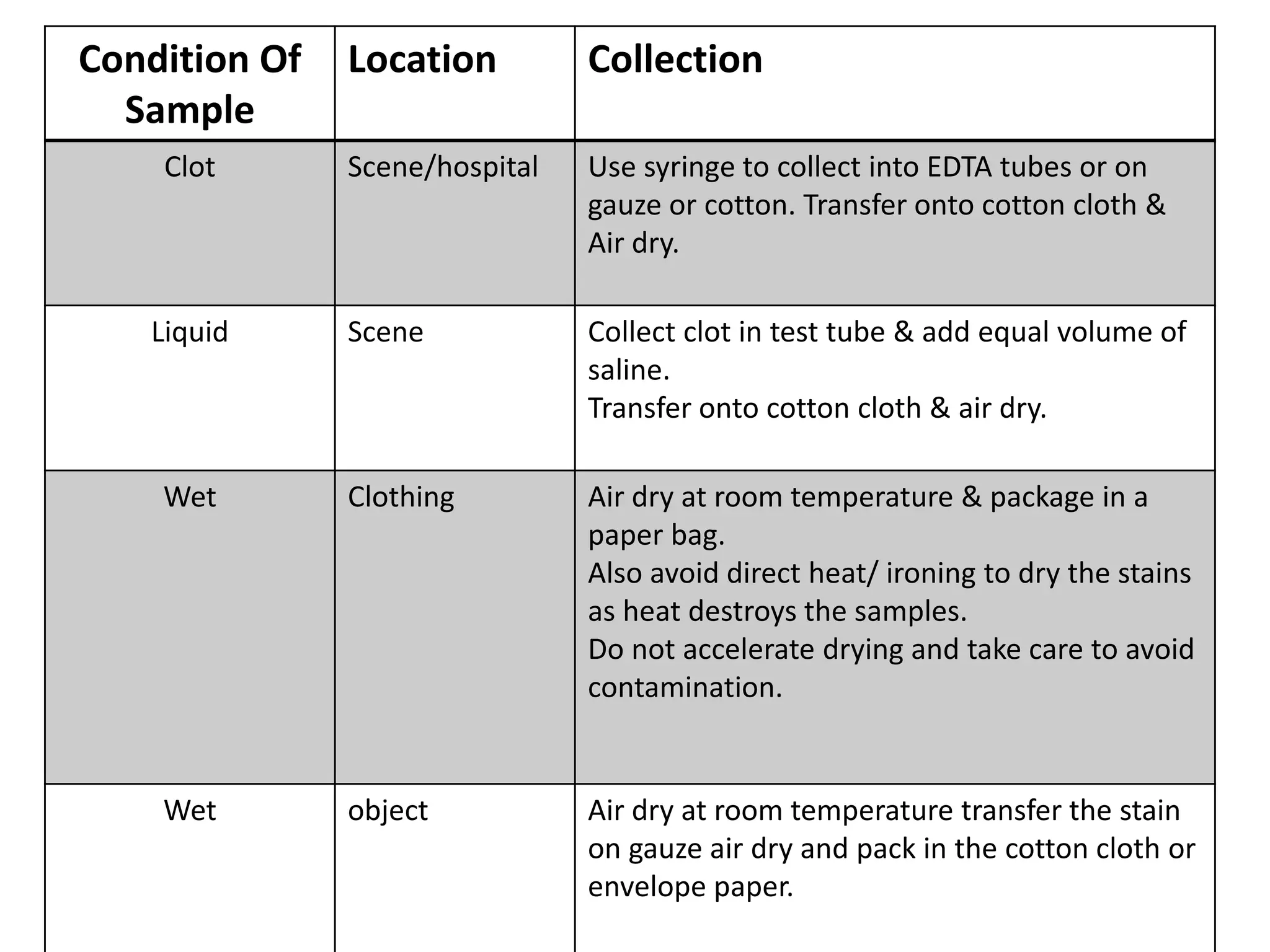
Condition Of
Sample
Location Collection
ClotScene/hospital Use syringe to collect into EDTA tubes or on
gauze or cotton. Transfer onto cotton cloth &
Air dry.
Liquid Scene Collect clot in test tube & add equal volume of
saline.
Transfer onto cotton cloth & air dry.
Wet Clothing Air dry at room temperature & package in a
paper bag.
Also avoid direct heat/ ironing to dry the stains
as heat destroys the samples.
Do not accelerate drying and take care to avoid
contamination.
Wet object Air dry at room temperature transfer the stain
on gauze air dry and pack in the cotton cloth or
envelope paper.
11.
Condition
Of Sample
Location Collection
CrustsSmall Object Scratch crust into paper packet. Collect control
blank
stains Weapon of
offence
Collect item directly.
Should be packed separately in boxes with stained
areas covered by paper
stains Large Object Collect entire item, if it is smaller one. For the larger
object transfer the stain on gauze soaked in saline
and air dry.
stains Upholstery ,Carpet
Wallpaper .Wood
Cut out stained area. Package separately. Collect
control.
stains Unmovable
surface Concrete
wall
Do not scrape
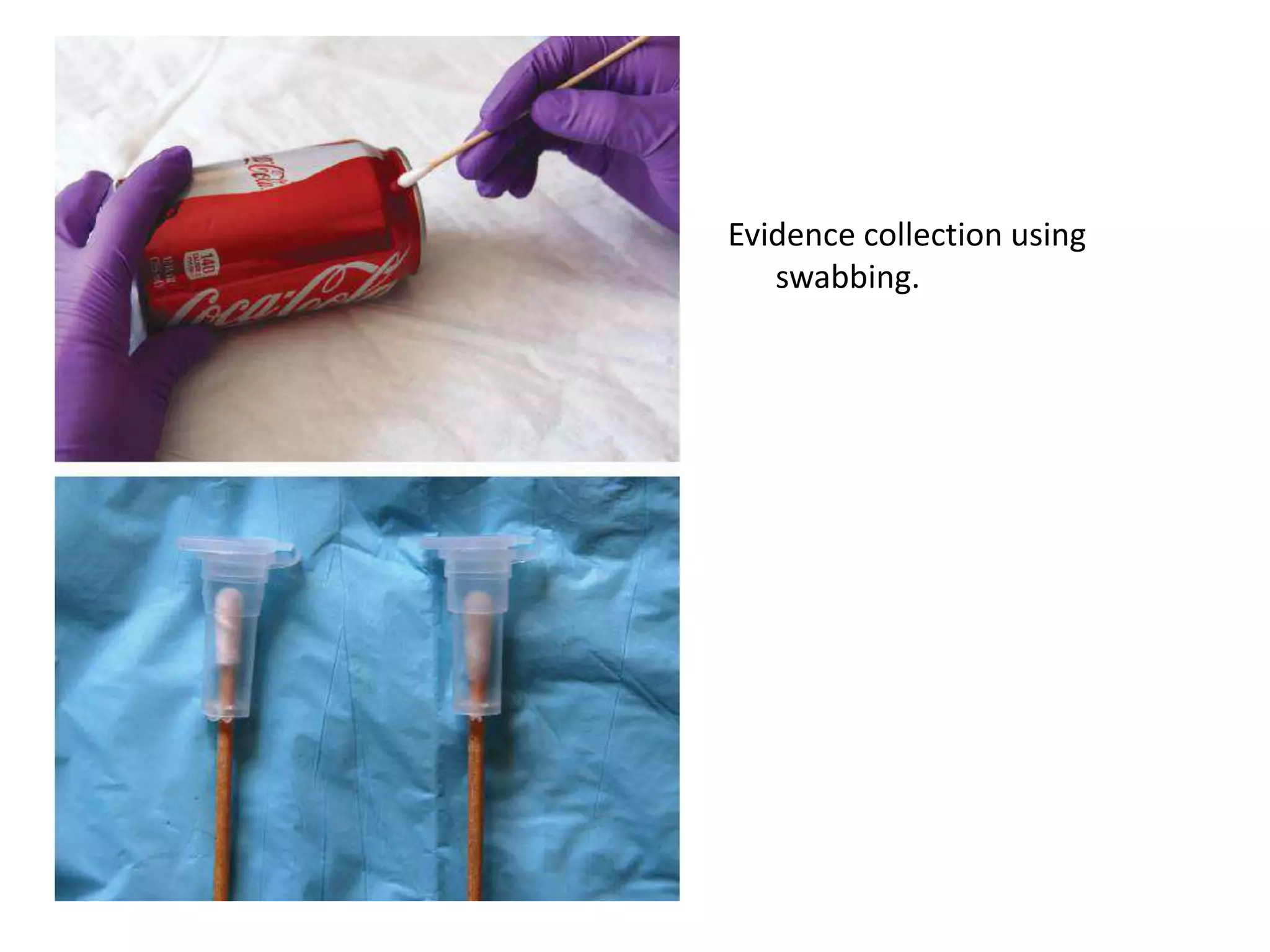
collected by swabbing.
double swab method involves applying a moistened
cotton swab followed by a second dry cotton swab
onto the same target surface of evidence. The
target surface is swabbed using a moistened swab
first. The moisture left by the first swab is absorbed
by the second dry swab.
Condition
Of Sample
Location Collection
liquidVictim Collect sample with swabs and should be air dried and
packed in paper envelopes.
Smear preparation on slide is more suitable than swab
for sperm examination.
Reference samples of victim and accused must be
taken.
stain Victim Collect sample with swabs and should be air dried and
packed in paper envelopes instead of Airtight Plastic
container
liquid Scene Transfer on to cotton cloth. Air dry.
wet Clothing Air dry at room temperature and package in a paper
bag. Avoid direct heat /ironing to dry the stains as heat
destroys the samples. Do not accelerate drying and
take care to avoid contamination
Condition
Of Sample
Location Collection
objectsCigarette Completely dry cigarette ends and pack
separately in paper bag or envelope.
Store in a cool, dry environment
stain Clothing Completely dry cigarette ends and pack
separately in paper bag or envelope.
Store in a cool, dry environment
objects Cups or glasses Should be sent after drying and wrapping it with
paper.
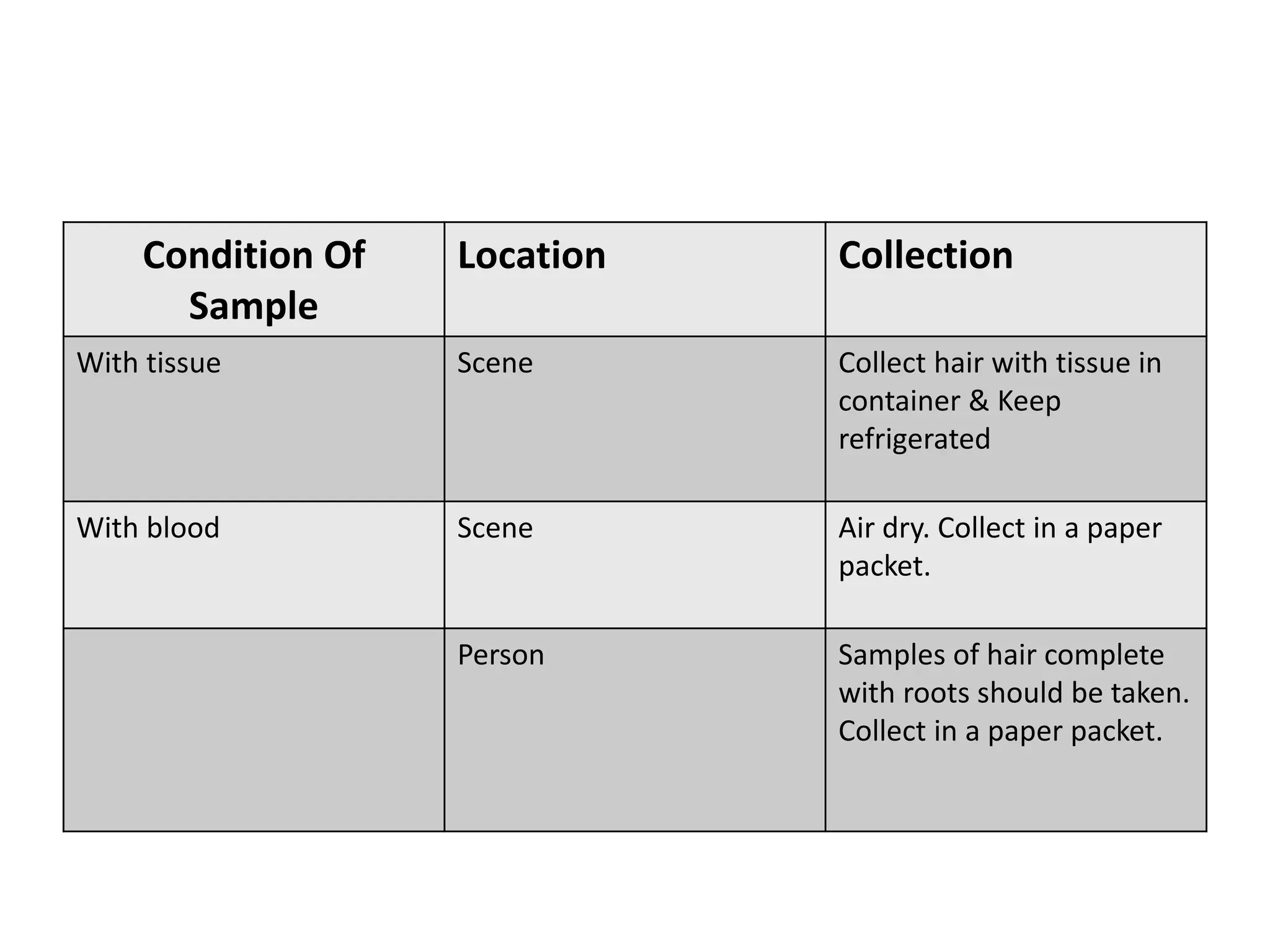
Condition Of
Sample
Location Collection
Withtissue Scene Collect hair with tissue in
container & Keep
refrigerated
With blood Scene Air dry. Collect in a paper
packet.
Person Samples of hair complete
with roots should be taken.
Collect in a paper packet.
Location Collection
Hospital Tissuesamples and Foetus should be
stored in normal saline. Formalin should
never be used as preservative. Glass
container should not be used.
Blood sample of the mother should be
sent along with Foetus
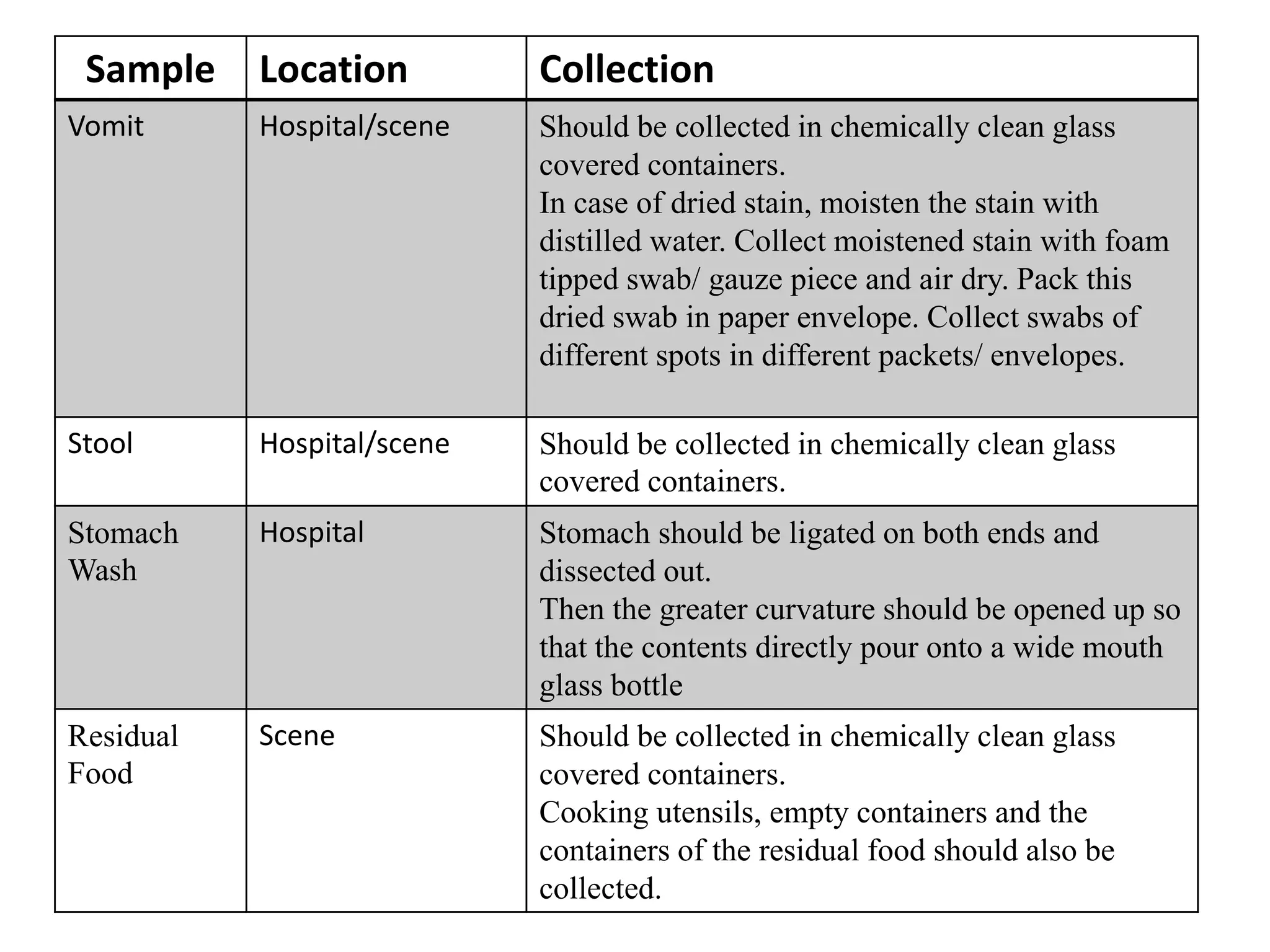
Sample Location Collection
VomitHospital/scene Should be collected in chemically clean glass
covered containers.
In case of dried stain, moisten the stain with
distilled water. Collect moistened stain with foam
tipped swab/ gauze piece and air dry. Pack this
dried swab in paper envelope. Collect swabs of
different spots in different packets/ envelopes.
Stool Hospital/scene Should be collected in chemically clean glass
covered containers.
Stomach
Wash
Hospital Stomach should be ligated on both ends and
dissected out.
Then the greater curvature should be opened up so
that the contents directly pour onto a wide mouth
glass bottle
Residual
Food
Scene Should be collected in chemically clean glass
covered containers.
Cooking utensils, empty containers and the
containers of the residual food should also be
collected.
26.
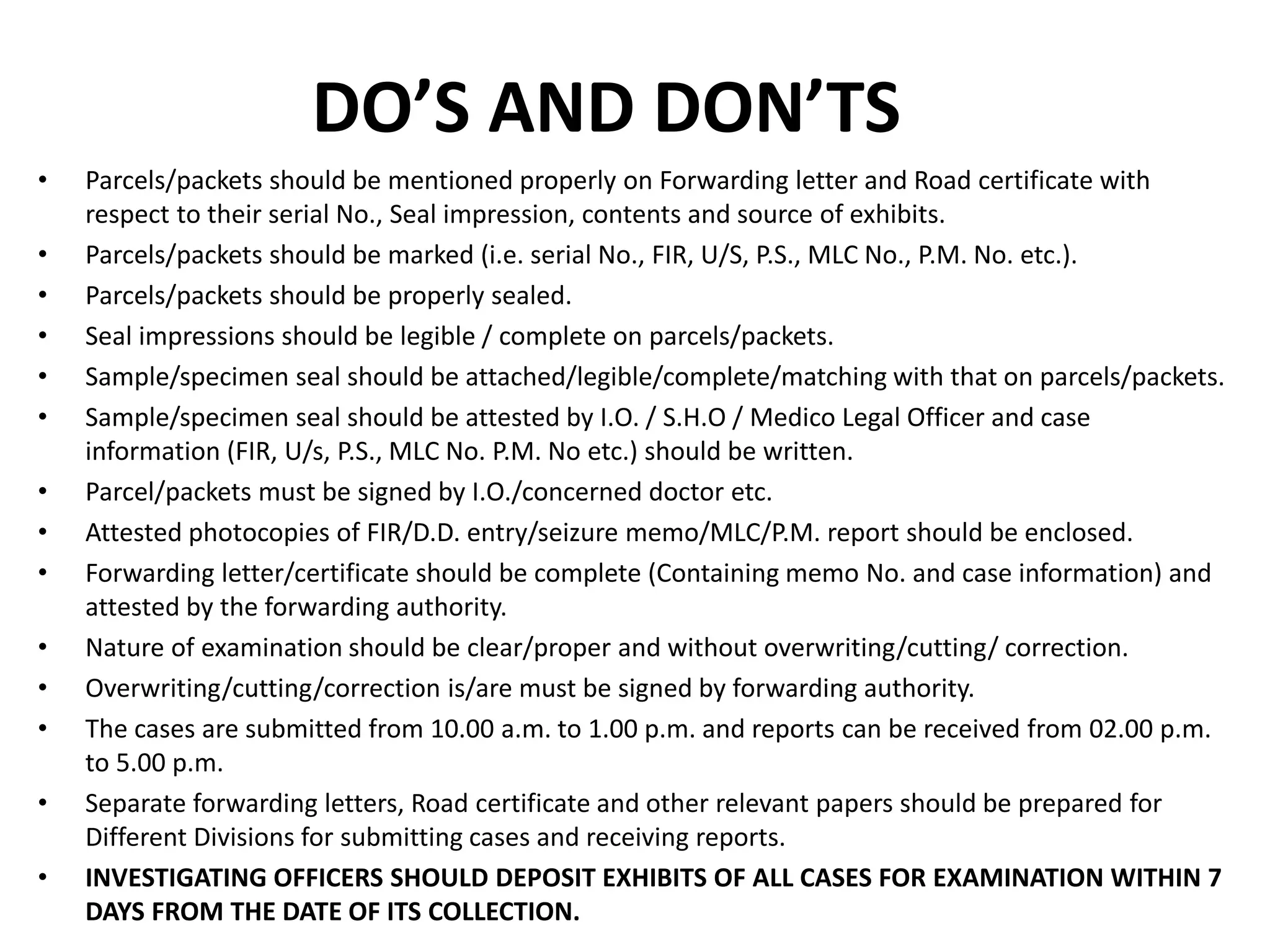
DO’S AND DON’TS
•Parcels/packets should be mentioned properly on Forwarding letter and Road certificate with
respect to their serial No., Seal impression, contents and source of exhibits.
• Parcels/packets should be marked (i.e. serial No., FIR, U/S, P.S., MLC No., P.M. No. etc.).
• Parcels/packets should be properly sealed.
• Seal impressions should be legible / complete on parcels/packets.
• Sample/specimen seal should be attached/legible/complete/matching with that on parcels/packets.
• Sample/specimen seal should be attested by I.O. / S.H.O / Medico Legal Officer and case
information (FIR, U/s, P.S., MLC No. P.M. No etc.) should be written.
• Parcel/packets must be signed by I.O./concerned doctor etc.
• Attested photocopies of FIR/D.D. entry/seizure memo/MLC/P.M. report should be enclosed.
• Forwarding letter/certificate should be complete (Containing memo No. and case information) and
attested by the forwarding authority.
• Nature of examination should be clear/proper and without overwriting/cutting/ correction.
• Overwriting/cutting/correction is/are must be signed by forwarding authority.
• The cases are submitted from 10.00 a.m. to 1.00 p.m. and reports can be received from 02.00 p.m.
to 5.00 p.m.
• Separate forwarding letters, Road certificate and other relevant papers should be prepared for
Different Divisions for submitting cases and receiving reports.
• INVESTIGATING OFFICERS SHOULD DEPOSIT EXHIBITS OF ALL CASES FOR EXAMINATION WITHIN 7
DAYS FROM THE DATE OF ITS COLLECTION.