Sampling
Population vs Sample
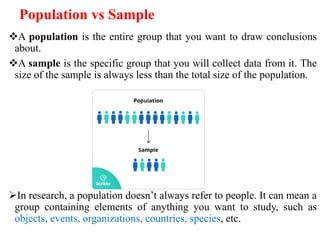
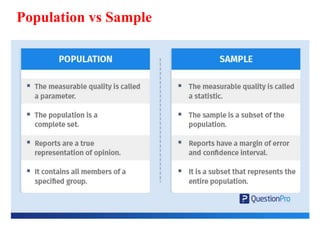
A population is the entire group that you want to draw conclusions
about.
A sample is the specific group that you will collect data from it. The
size of the sample is always less than the total size of the population.
In research, a population doesn’t always refer to people. It can mean a
group containing elements of anything you want to study, such as
objects, events, organizations, countries, species, etc.
Population vs Sample
Types of Population
According to criteria of population, it can be
classified as follows as:
Homogeneous population: population with
little variation, e. g. All female Muslim internee
doctors in DMC
Heterogeneous population: population with
wide variation, e. g. All students of Dhaka
university
Finite population: Number of units in
population is finite and countable, e. g. Number
of students in class
Types of Population
Infinite population: Number of units in
population is infinite and not easily countable, e.
g. Mosquito in Dhaka city
Static population: population unit do not
change frequently, e. g. Stars in the sky.
Dynamic population: population unit change
frequently, e. g. Patients in hospital.
Sampling
Sampling: A sample is an unbiased number of
observations taken from a population. So the
sampling is the process of selecting a sample from
the population. In other words, it is a portion, part,
or fraction of the whole group, and acts as a subset
of the population.
Advantages of sampling:
1. Low cost of sampling; 2. Less time consuming in
sampling; 3. Scope of sampling is high; 4. Accuracy
of data is high; 5. Organization of convenience; and
6in. Suitable limited resources.
Sampling
Disadvantages of sampling:
1. Chances of bias; 2. Difficulties in selecting truly
a representative sample; 3. Need for subject specific
knowledge; 4. changeability of sampling units; and
5. impossibility of sampling.
https://accountlearning.com/advantages-and-
disadvantages-of-sampling/
Sampling
Sampling unit: The population divided into a
finite number of distinct and identifiable units is
called sampling units. OR The individuals whose
characteristics are to be measured in the analysis
are called elementary or sampling units.
Sampling
Sampling Frame: The sampling frame lies between the
population and sample.
The list of all the sampling units with a proper identification (which
represents the population to be covered is called sampling frame). The
frame may consist of either a list of units or a map of area (in case
sample of area is being taken), such that every element in the population
belongs to one and only one unit. The frame should be accurate, free
from omission and duplication (overlapping), adequate, up to data and
the units must cover the whole of the population and should be well
identified.
Example: From the population of 1000 students of IU, for any research
purpose if we select a sample of 100 students; every student will be
sampling unit and the total list of all 1000 students in IU will be the
sampling frame.
Sampling
Sample size: By the term sample, we mean a part of
population chosen at random for participation in the study. The
units under study are called sampling units, and the number of
units in a sample is called sample size.
Sampling Frame: List of each and every individual in the
population. All sampling units have a logical and have
numerical identifier. The frame is organized in a logical and
systematic manner. the sampling frame has some additional
information about the units that allow the use of more
advanced sampling frames. every element of the population of
interest is present in the frame.
A good maximum sample size is usually around 10% of the
population, as long as this does not exceed 1000. For
example, in a population of 5000, 10% would be 500. In a
population of 200,000, 10% would be 20,000. This exceeds
1000, so in this case the maximum would be 1000.
Sampling Error
Sampling error: A sampling error occurs when the
sample used in the study is not representative of the whole
population.
Sampling error is the difference between a population
parameter and a sample statistic used to estimate it. For
example, the difference between a population mean and
a sample mean is sampling error.
How to reduce the sampling error:
Increase the sample size. ...
Divide the population into groups. ...
Know your population. ...
Randomize selection to eliminate bias. ...
Train your team. ...
Perform an external record check.
Criteria of Good Sampling
Criteria:
(1)Goal-oriented: A sample design should be goal
oriented.
(2)Accurate representative of the universe: A
sample should be an accurate representative of
the universe from which it is taken.
(3)Proportional: A sample should be proportional.
(4)Random selection: A sample should be selected
at random.
(5)Economical: A sample should be economical
(6)Practical: A sample design should be practical.
(7)Actual information provider:
Sample Design
A sample design is the framework, or road map, that
serves as the basis for the selection of a survey sample. It
provides the basic plan and methodology for selecting the
sample.
While developing a sampling design, the researcher must
pay attention to the following points:
Type of universe:
Sampling unit:
Source list:
Size of sample:
Parameters of interest:
Budgetary constraint:
Sampling procedure:
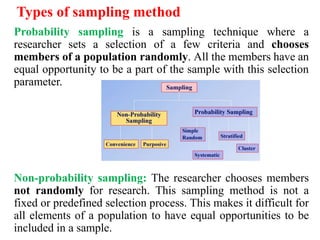
Types of sampling method
Probability sampling is a sampling technique where a
researcher sets a selection of a few criteria and chooses
members of a population randomly. All the members have an
equal opportunity to be a part of the sample with this selection
parameter.
Non-probability sampling: The researcher chooses members
not randomly for research. This sampling method is not a
fixed or predefined selection process. This makes it difficult for
all elements of a population to have equal opportunities to be
included in a sample.
Simple random sampling (SRS)
Simple random sampling: It is the reliable method of
obtaining information where every single member of a
population is chosen randomly, merely by chance.
Advantages:
Good for small, homogeneous and easily available
population.
Reliable and unbiased.
Needs minimum knowledge about the population.
Disadvantages:
Needs up to date complete sampling frame.
Difficult to do in large, infinite population.
Not suitable in heterogeneous population.
Systematic random sampling
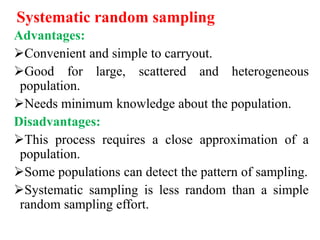
Systematic random sampling: Systematic
sampling is similar to simple random sampling, but
it is usually slightly easier to conduct. Every
member of the population is listed with a
number, but instead of randomly generating
numbers, individuals are chosen at regular
intervals.
Systematic random sampling
Advantages:
Convenient and simple to carryout.
Good for large, scattered and heterogeneous
population.
Needs minimum knowledge about the population.
Disadvantages:
This process requires a close approximation of a
population.
Some populations can detect the pattern of sampling.
Systematic sampling is less random than a simple
random sampling effort.
Stratified sampling
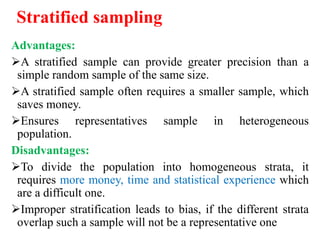
Stratified sampling involves
dividing the population into
subpopulations that may differ
in important ways. It allows you
draw more precise conclusions
by ensuring that every subgroup
is properly represented in the
sample.
To use this sampling method,
you divide the population into
subgroups (called strata) based
on the relevant characteristic
(e.g. gender, age range, income
bracket, job role). https://www.scribbr.com/methodology/sampli
ng-methods/
Stratified sampling
Advantages:
A stratified sample can provide greater precision than a
simple random sample of the same size.
A stratified sample often requires a smaller sample, which
saves money.
Ensures representatives sample in heterogeneous
population.
Disadvantages:
To divide the population into homogeneous strata, it
requires more money, time and statistical experience which
are a difficult one.
Improper stratification leads to bias, if the different strata
overlap such a sample will not be a representative one
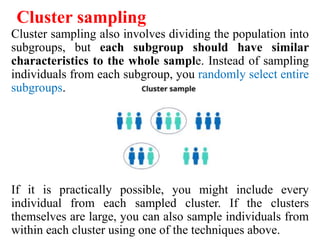
Cluster sampling
Cluster sampling also involves dividing the population into
subgroups, but each subgroup should have similar
characteristics to the whole sample. Instead of sampling
individuals from each subgroup, you randomly select entire
subgroups.
If it is practically possible, you might include every
individual from each sampled cluster. If the clusters
themselves are large, you can also sample individuals from
within each cluster using one of the techniques above.
Multistage sampling
Multistage sampling is defined as a sampling
method that divides the population into groups
(or clusters) for conducting research. It is a
complex form of cluster sampling which involves
dividing the population into groups. During this
sampling method, significant clusters of the
selected people are split into sub-groups at various
stages to make it simpler for primary data
collection.
Multistage sampling is done stage by stage,
where stages are determined by area.
Ref. abc of research p-118
Multistage sampling
Advantages
Cost and speed that the survey can be done in
convenience of finding the survey sample
Normally more accurate than cluster sampling
for the same size sample
Disadvantages
Not as accurate as Simple Random
Sample[ambiguous] if the sample is the same size.
More testing is difficult to do.
Thank you all

Sampling.pptx

  • 1.
  • 2.
    Population vs Sample Apopulation is the entire group that you want to draw conclusions about. A sample is the specific group that you will collect data from it. The size of the sample is always less than the total size of the population. In research, a population doesn’t always refer to people. It can mean a group containing elements of anything you want to study, such as objects, events, organizations, countries, species, etc.
  • 3.
  • 4.
    Types of Population Accordingto criteria of population, it can be classified as follows as: Homogeneous population: population with little variation, e. g. All female Muslim internee doctors in DMC Heterogeneous population: population with wide variation, e. g. All students of Dhaka university Finite population: Number of units in population is finite and countable, e. g. Number of students in class
  • 5.
    Types of Population Infinitepopulation: Number of units in population is infinite and not easily countable, e. g. Mosquito in Dhaka city Static population: population unit do not change frequently, e. g. Stars in the sky. Dynamic population: population unit change frequently, e. g. Patients in hospital.
  • 6.
    Sampling Sampling: A sampleis an unbiased number of observations taken from a population. So the sampling is the process of selecting a sample from the population. In other words, it is a portion, part, or fraction of the whole group, and acts as a subset of the population. Advantages of sampling: 1. Low cost of sampling; 2. Less time consuming in sampling; 3. Scope of sampling is high; 4. Accuracy of data is high; 5. Organization of convenience; and 6in. Suitable limited resources.
  • 7.
    Sampling Disadvantages of sampling: 1.Chances of bias; 2. Difficulties in selecting truly a representative sample; 3. Need for subject specific knowledge; 4. changeability of sampling units; and 5. impossibility of sampling. https://accountlearning.com/advantages-and- disadvantages-of-sampling/
  • 8.
    Sampling Sampling unit: Thepopulation divided into a finite number of distinct and identifiable units is called sampling units. OR The individuals whose characteristics are to be measured in the analysis are called elementary or sampling units.
  • 9.
    Sampling Sampling Frame: Thesampling frame lies between the population and sample. The list of all the sampling units with a proper identification (which represents the population to be covered is called sampling frame). The frame may consist of either a list of units or a map of area (in case sample of area is being taken), such that every element in the population belongs to one and only one unit. The frame should be accurate, free from omission and duplication (overlapping), adequate, up to data and the units must cover the whole of the population and should be well identified. Example: From the population of 1000 students of IU, for any research purpose if we select a sample of 100 students; every student will be sampling unit and the total list of all 1000 students in IU will be the sampling frame.
  • 10.
    Sampling Sample size: Bythe term sample, we mean a part of population chosen at random for participation in the study. The units under study are called sampling units, and the number of units in a sample is called sample size. Sampling Frame: List of each and every individual in the population. All sampling units have a logical and have numerical identifier. The frame is organized in a logical and systematic manner. the sampling frame has some additional information about the units that allow the use of more advanced sampling frames. every element of the population of interest is present in the frame. A good maximum sample size is usually around 10% of the population, as long as this does not exceed 1000. For example, in a population of 5000, 10% would be 500. In a population of 200,000, 10% would be 20,000. This exceeds 1000, so in this case the maximum would be 1000.
  • 11.
    Sampling Error Sampling error:A sampling error occurs when the sample used in the study is not representative of the whole population. Sampling error is the difference between a population parameter and a sample statistic used to estimate it. For example, the difference between a population mean and a sample mean is sampling error. How to reduce the sampling error: Increase the sample size. ... Divide the population into groups. ... Know your population. ... Randomize selection to eliminate bias. ... Train your team. ... Perform an external record check.
  • 12.
    Criteria of GoodSampling Criteria: (1)Goal-oriented: A sample design should be goal oriented. (2)Accurate representative of the universe: A sample should be an accurate representative of the universe from which it is taken. (3)Proportional: A sample should be proportional. (4)Random selection: A sample should be selected at random. (5)Economical: A sample should be economical (6)Practical: A sample design should be practical. (7)Actual information provider:
  • 13.
    Sample Design A sampledesign is the framework, or road map, that serves as the basis for the selection of a survey sample. It provides the basic plan and methodology for selecting the sample. While developing a sampling design, the researcher must pay attention to the following points: Type of universe: Sampling unit: Source list: Size of sample: Parameters of interest: Budgetary constraint: Sampling procedure:
  • 14.
    Types of samplingmethod Probability sampling is a sampling technique where a researcher sets a selection of a few criteria and chooses members of a population randomly. All the members have an equal opportunity to be a part of the sample with this selection parameter. Non-probability sampling: The researcher chooses members not randomly for research. This sampling method is not a fixed or predefined selection process. This makes it difficult for all elements of a population to have equal opportunities to be included in a sample.
  • 15.
    Simple random sampling(SRS) Simple random sampling: It is the reliable method of obtaining information where every single member of a population is chosen randomly, merely by chance. Advantages: Good for small, homogeneous and easily available population. Reliable and unbiased. Needs minimum knowledge about the population. Disadvantages: Needs up to date complete sampling frame. Difficult to do in large, infinite population. Not suitable in heterogeneous population.
  • 16.
    Systematic random sampling Systematicrandom sampling: Systematic sampling is similar to simple random sampling, but it is usually slightly easier to conduct. Every member of the population is listed with a number, but instead of randomly generating numbers, individuals are chosen at regular intervals.
  • 17.
    Systematic random sampling Advantages: Convenientand simple to carryout. Good for large, scattered and heterogeneous population. Needs minimum knowledge about the population. Disadvantages: This process requires a close approximation of a population. Some populations can detect the pattern of sampling. Systematic sampling is less random than a simple random sampling effort.
  • 18.
    Stratified sampling Stratified samplinginvolves dividing the population into subpopulations that may differ in important ways. It allows you draw more precise conclusions by ensuring that every subgroup is properly represented in the sample. To use this sampling method, you divide the population into subgroups (called strata) based on the relevant characteristic (e.g. gender, age range, income bracket, job role). https://www.scribbr.com/methodology/sampli ng-methods/
  • 19.
    Stratified sampling Advantages: A stratifiedsample can provide greater precision than a simple random sample of the same size. A stratified sample often requires a smaller sample, which saves money. Ensures representatives sample in heterogeneous population. Disadvantages: To divide the population into homogeneous strata, it requires more money, time and statistical experience which are a difficult one. Improper stratification leads to bias, if the different strata overlap such a sample will not be a representative one
  • 20.
    Cluster sampling Cluster samplingalso involves dividing the population into subgroups, but each subgroup should have similar characteristics to the whole sample. Instead of sampling individuals from each subgroup, you randomly select entire subgroups. If it is practically possible, you might include every individual from each sampled cluster. If the clusters themselves are large, you can also sample individuals from within each cluster using one of the techniques above.
  • 21.
    Multistage sampling Multistage samplingis defined as a sampling method that divides the population into groups (or clusters) for conducting research. It is a complex form of cluster sampling which involves dividing the population into groups. During this sampling method, significant clusters of the selected people are split into sub-groups at various stages to make it simpler for primary data collection. Multistage sampling is done stage by stage, where stages are determined by area. Ref. abc of research p-118
  • 22.
    Multistage sampling Advantages Cost andspeed that the survey can be done in convenience of finding the survey sample Normally more accurate than cluster sampling for the same size sample Disadvantages Not as accurate as Simple Random Sample[ambiguous] if the sample is the same size. More testing is difficult to do.
  • 23.