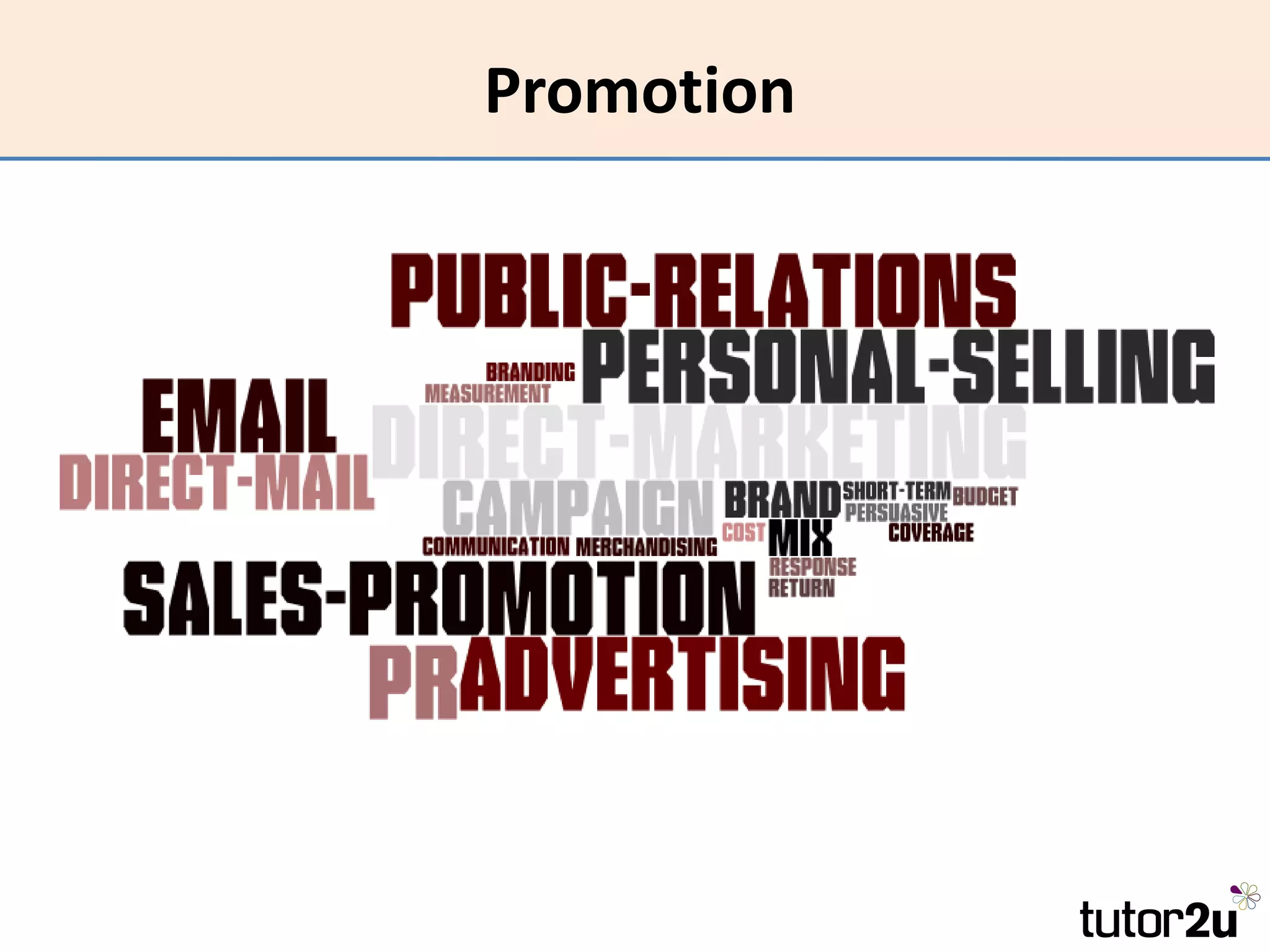
Promotion
What this topic is about

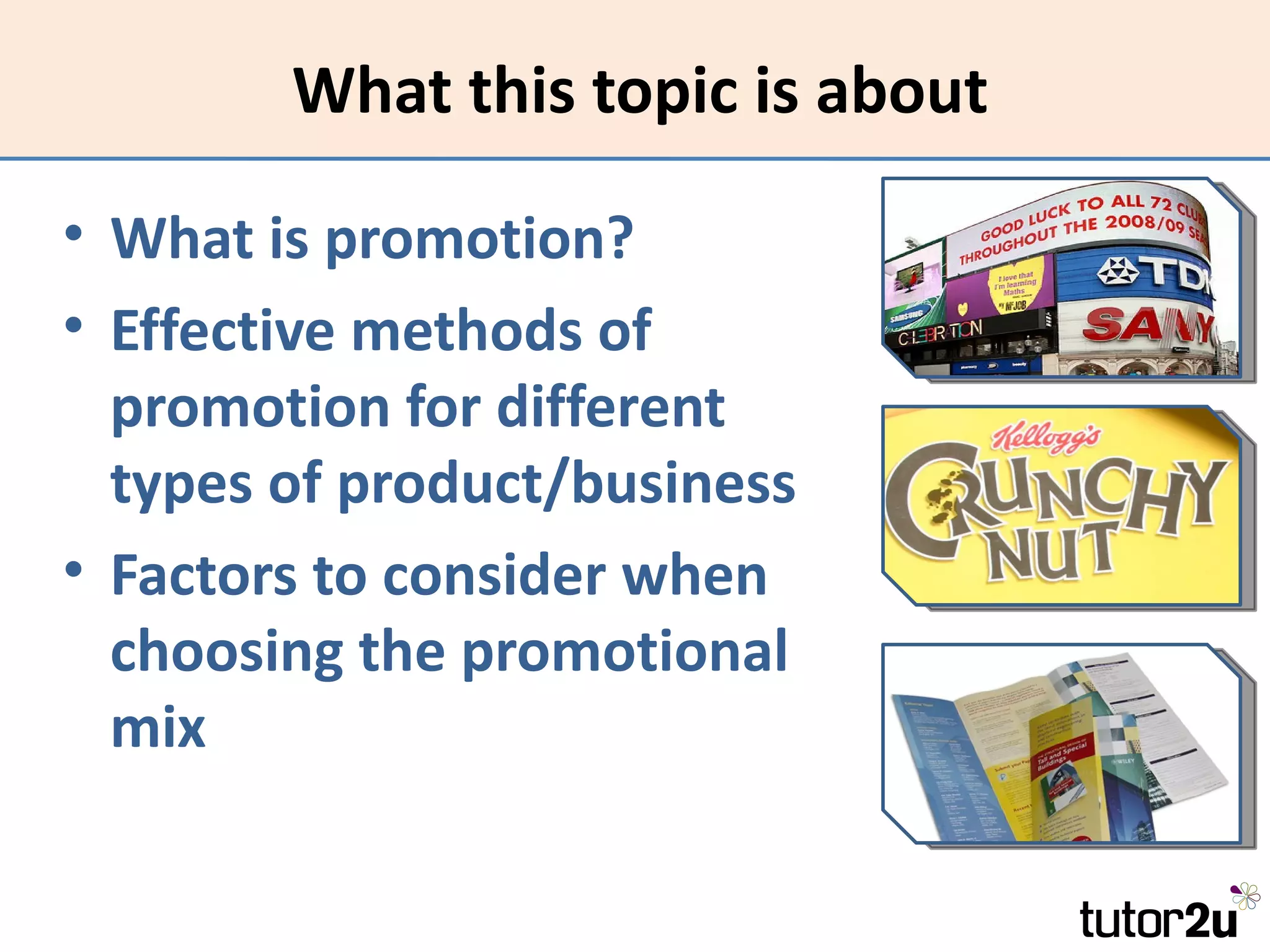
• What is promotion?
• Effective methods of
  promotion for different
  types of product/business
• Factors to consider when
  choosing the promotional
  mix
Promotion = marketing communication

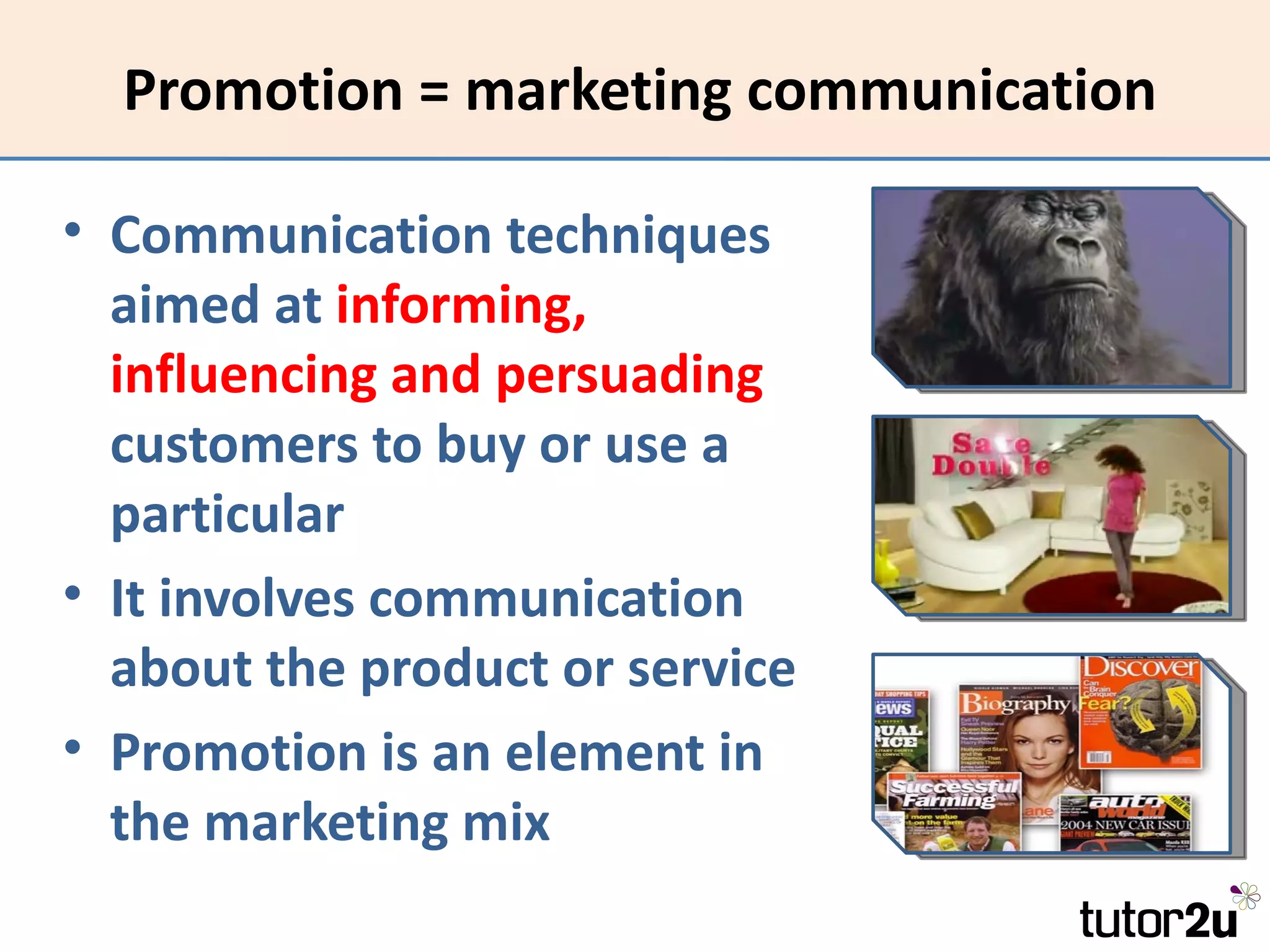
• Communication techniques
  aimed at informing,
  influencing and persuading
  customers to buy or use a
  particular
• It involves communication
  about the product or service
• Promotion is an element in
  the marketing mix
The Many Uses of Promotion
• Increase sales          • Change attitudes
• Attract new customers   • Create an image
• Encourage customer      • Position a product
  loyalty
• Encourage trial         • Encourage brand
                            switching
• Create awareness
• Inform                  • To support a
                            distribution channel
• Remind potential
  customers
• Reassure new
  customers
Main Aims of Promotion

• The main aim of promotion is to ensure
  that customers are aware of the existence
  and positioning of products
• Promotion is also used to persuade
  customers that the product is better than
  competing products and to remind
  customers about why they may want to
  buy
Promotional mix
• The specific mix of promotional methods that
  a business uses to pursue its marketing
  objectives
• The main elements of the mix are:
  –   Advertising (offline & online)
  –   Sales promotion & merchandising
  –   Personal selling
  –   Public relations/publicity / Sponsorship
  –   Direct marketing
• The elements must be integrated in a
  cohesive, consistent and logical manner
Composition of promotional mix depends on:

Stage in the         E.g. advertising & PR are often important
product’s life cycle at the launch stage
Nature of the       What information do customers require
product             before they buy?
Competition         What are rivals doing ? What promotional
                    methods are traditionally effective in a
                    market?
Marketing budget How much can the firm afford?
Marketing strategy Other elements of the mix
Target market       Appropriate ways to reach the target
                    market
Two tests of promotional effort

Was it       Did it achieve its objectives?
effective?   How was response measured?

Was it       Were objectives achieved at the
efficient?   acceptable cost?

             Were any promotional
             overspends justified by better-
             than-expected sales?
Promotional effectiveness and efficiency

            Effective             Ineffective

Efficient   Objectives achieved   Low promotion
            at lowest costs       budget but objectives
            Effective and cost    not achieved
            efficient
Inefficient Objective achieved    Expensive promotion
            but at high cost      which fails to achieve
                                  objective
Advertising
• Paid-for communication
• Many different advertising
  media
  – TV & radio, newspapers &
    magazines, online, cinema,
    billboards
• Consumers subjected to many
  advertising messages each
  day = hard to get through
• Mass market advertising is
  very expensive
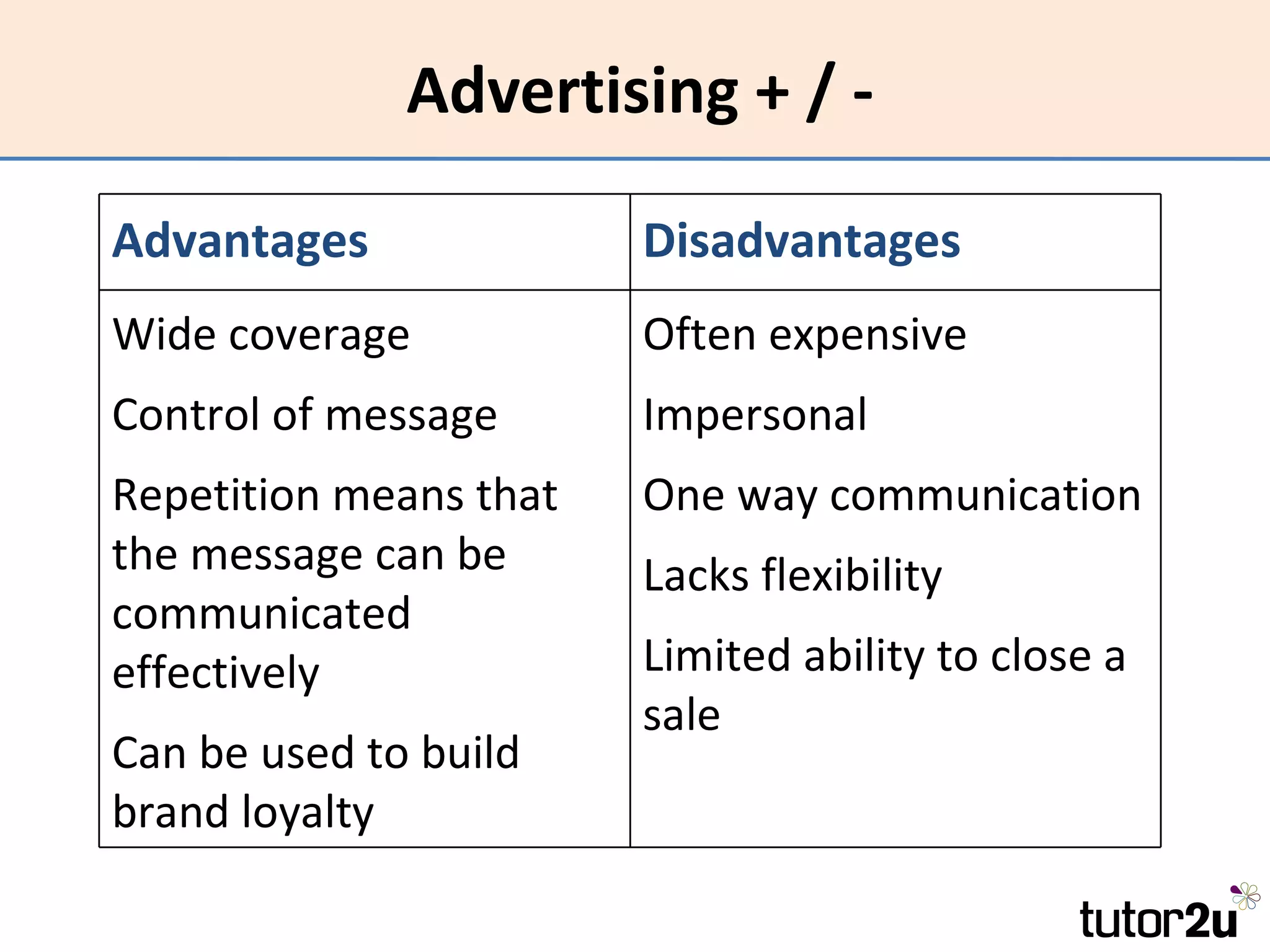
Advertising + / -

Advantages              Disadvantages
Wide coverage           Often expensive
Control of message      Impersonal
Repetition means that   One way communication
the message can be      Lacks flexibility
communicated
effectively             Limited ability to close a
                        sale
Can be used to build
brand loyalty
Personal selling
• Promotion on a person to
  person basis
• Two way communications
• Meeting with potential
  customers to close a sale
• By telephone, at meetings, in
  retail outlets and by knocking
  on doors
• Highly priced, low volume and
  highly technical products rely
  heavily on personal selling
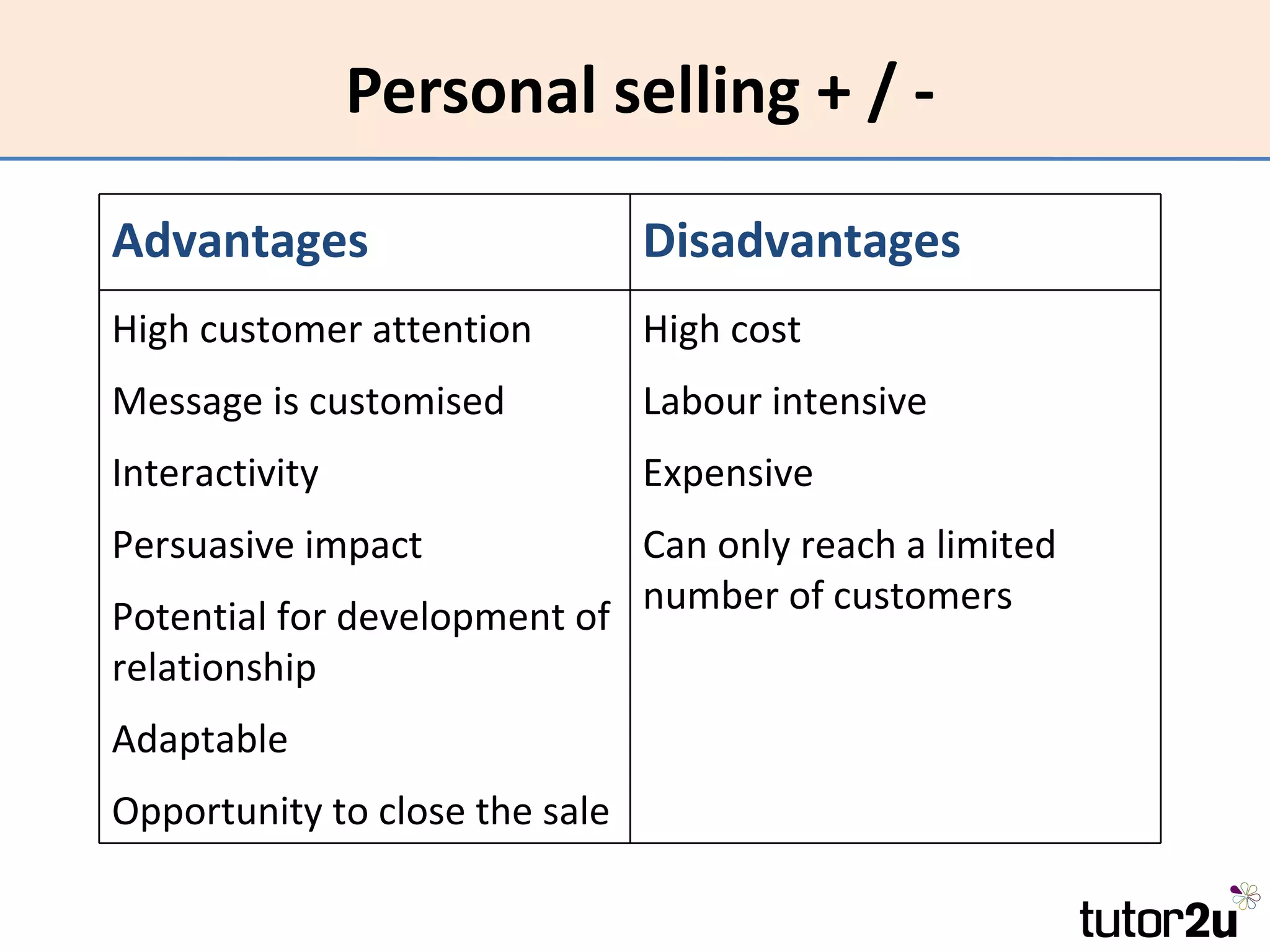
Personal selling + / -

Advantages                      Disadvantages
High customer attention         High cost
Message is customised           Labour intensive
Interactivity                   Expensive
Persuasive impact            Can only reach a limited
Potential for development of number of customers
relationship
Adaptable
Opportunity to close the sale
Sales promotion
• Tactical, point of sale
  material or other incentives
  designed to stimulate
  purchases
• Short term incentives to
  increase sales
• Some promotions aimed at
  consumers; -others at
  intermediaries or sales force
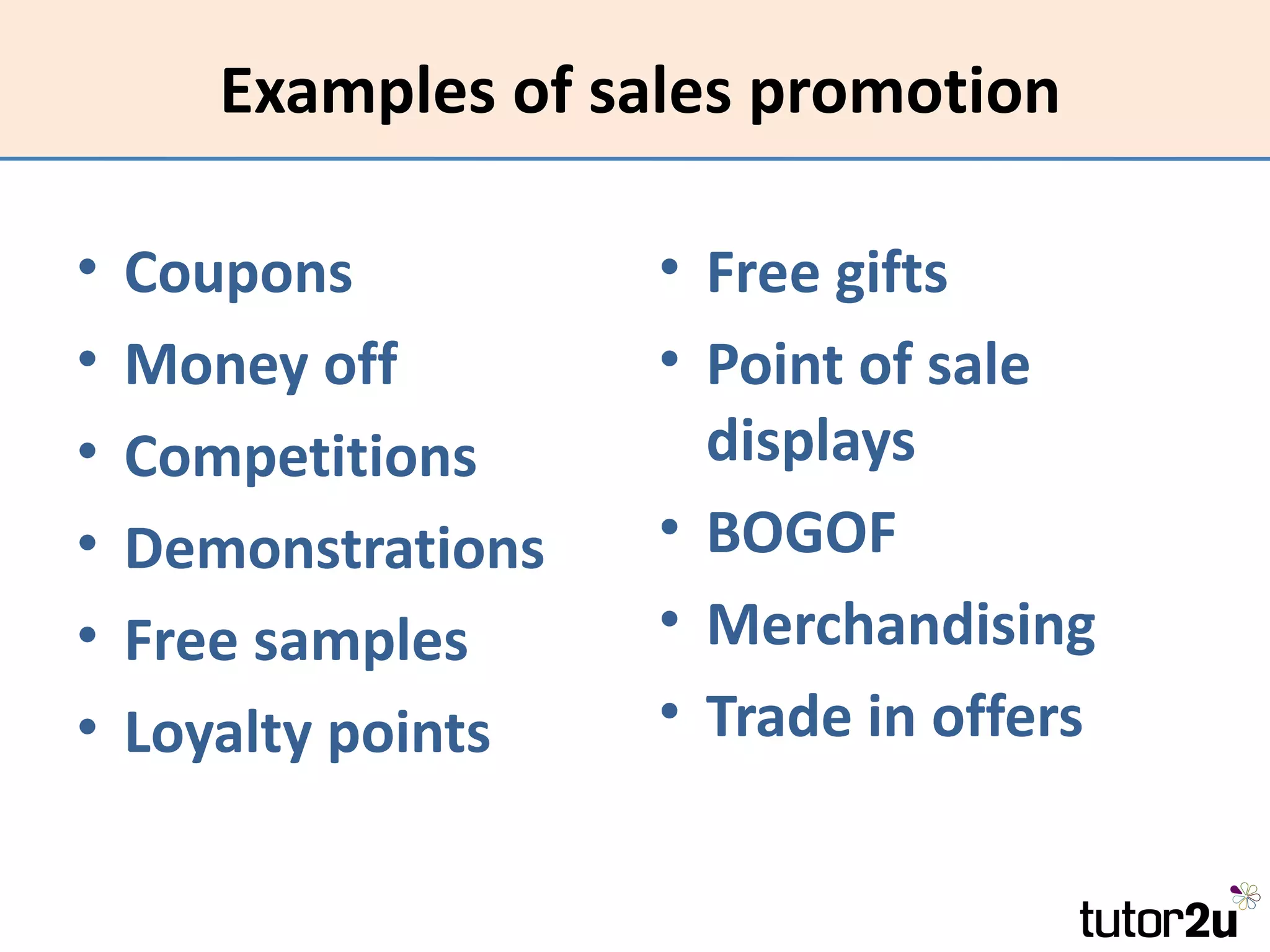
Examples of sales promotion

•   Coupons          • Free gifts
•   Money off        • Point of sale
•   Competitions       displays
•   Demonstrations   • BOGOF
•   Free samples     • Merchandising
•   Loyalty points   • Trade in offers
Sales Promotion + / -

Advantages                    Disadvantages
Effective at achieving a quick Sales effect may only be
boost to sales                 short-term
Encourages customers to       Customers may come to
trial a product or switch     expect or anticipate further
brands                        promotions
                              May damage brand image
Merchandising

• The process of maximising
  the effectiveness of retail
  distribution
• Displaying products to
  maximise sales
• Usually operates at the
  “point-of-sale”
Public relations (“PR”)


Activities that create
 goodwill toward an
individual, business,
  cause or product
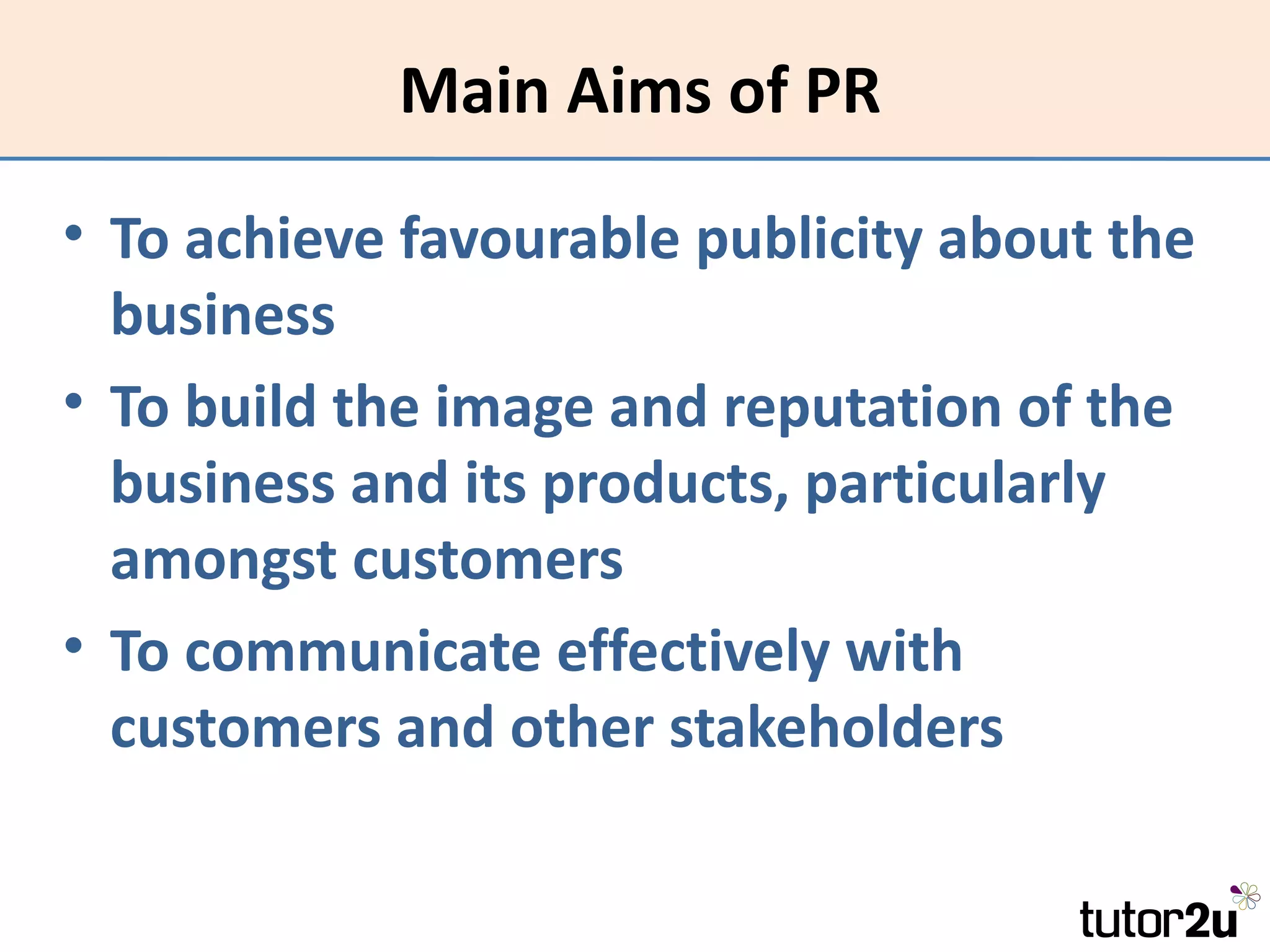
Main Aims of PR

• To achieve favourable publicity about the
  business
• To build the image and reputation of the
  business and its products, particularly
  amongst customers
• To communicate effectively with
  customers and other stakeholders
Typical PR Activities
• Promoting new products
• Enhancing public awareness
• Projecting a business image
• Promote social responsibility
• Projecting business as a good
  employer
• Obtain favourable product
  reviews / recommendations
Sponsorship
• Sponsorship takes place when a
  payment for an event, person,
  organisation is given in return
  some consideration of benefit
• A specialised form of public
  relations
• Common in the worlds of arts and
  sport
• Sponsorship should benefit both
  sides
Direct Marketing

  Promotional material
 directed through mail,
  email or telephone to
individual households or
       businesses
Why Use Direct Marketing?
• Allows a business to generate a specific
  response from targeted groups of
  customers
• Allows a business to focus on several
  marketing objectives:
  – increasing sales to existing customers
  – building customer loyalty
  – re-establishing lapsed customer relationships
  – generating new business
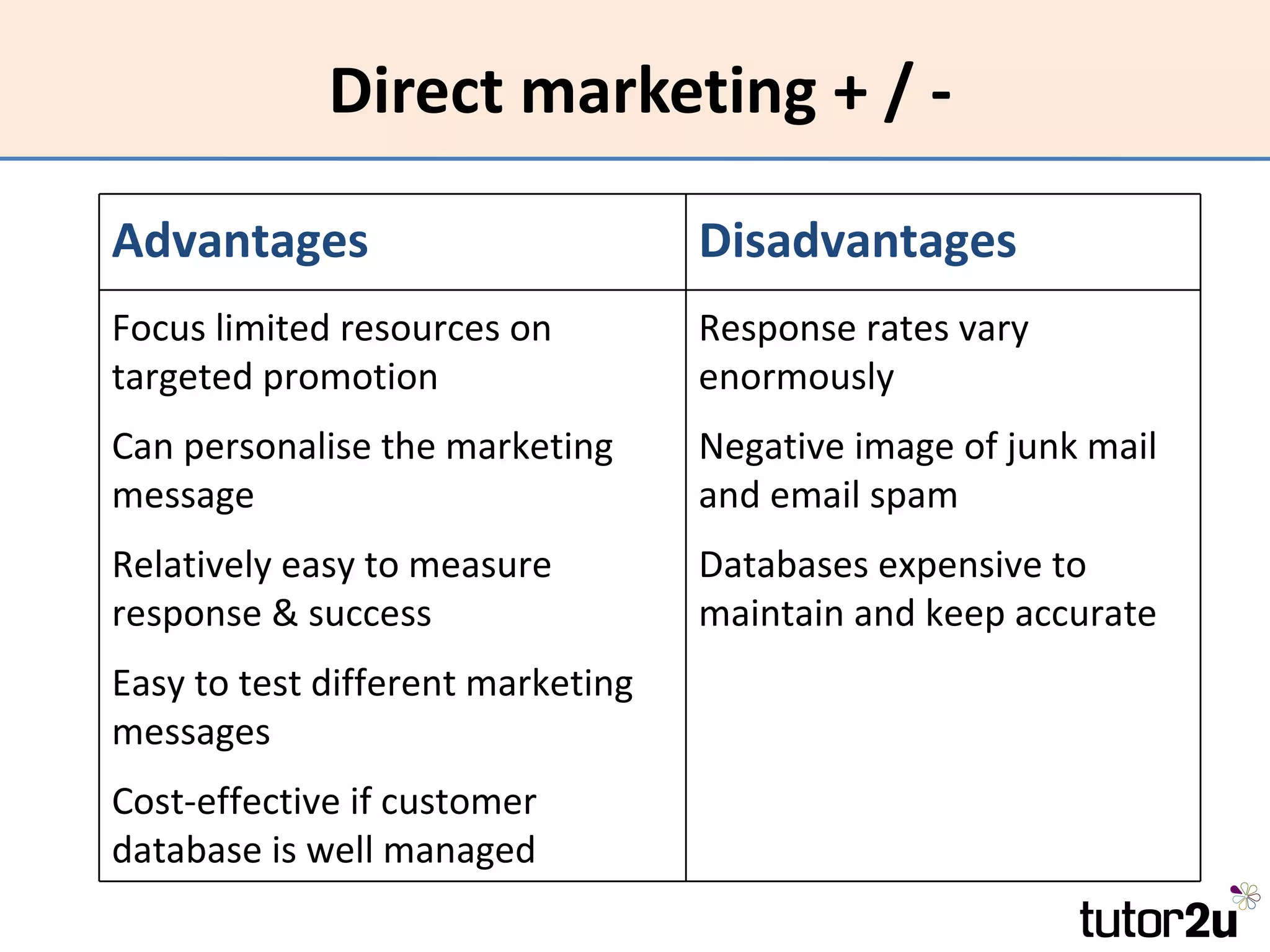
Direct marketing + / -

Advantages                         Disadvantages
Focus limited resources on         Response rates vary
targeted promotion                 enormously
Can personalise the marketing      Negative image of junk mail
message                            and email spam
Relatively easy to measure         Databases expensive to
response & success                 maintain and keep accurate
Easy to test different marketing
messages
Cost-effective if customer
database is well managed
Test Your Understanding


http://www.tutor2u.net/business/quiz/promotion/quiz.html
Promotion

Marketing - Promotion

  • 1.
  • 2.
    What this topicis about • What is promotion? • Effective methods of promotion for different types of product/business • Factors to consider when choosing the promotional mix
  • 3.
    Promotion = marketingcommunication • Communication techniques aimed at informing, influencing and persuading customers to buy or use a particular • It involves communication about the product or service • Promotion is an element in the marketing mix
  • 4.
    The Many Usesof Promotion • Increase sales • Change attitudes • Attract new customers • Create an image • Encourage customer • Position a product loyalty • Encourage trial • Encourage brand switching • Create awareness • Inform • To support a distribution channel • Remind potential customers • Reassure new customers
  • 5.
    Main Aims ofPromotion • The main aim of promotion is to ensure that customers are aware of the existence and positioning of products • Promotion is also used to persuade customers that the product is better than competing products and to remind customers about why they may want to buy
  • 6.
    Promotional mix • Thespecific mix of promotional methods that a business uses to pursue its marketing objectives • The main elements of the mix are: – Advertising (offline & online) – Sales promotion & merchandising – Personal selling – Public relations/publicity / Sponsorship – Direct marketing • The elements must be integrated in a cohesive, consistent and logical manner
  • 7.
    Composition of promotionalmix depends on: Stage in the E.g. advertising & PR are often important product’s life cycle at the launch stage Nature of the What information do customers require product before they buy? Competition What are rivals doing ? What promotional methods are traditionally effective in a market? Marketing budget How much can the firm afford? Marketing strategy Other elements of the mix Target market Appropriate ways to reach the target market
  • 8.
    Two tests ofpromotional effort Was it Did it achieve its objectives? effective? How was response measured? Was it Were objectives achieved at the efficient? acceptable cost? Were any promotional overspends justified by better- than-expected sales?
  • 9.
    Promotional effectiveness andefficiency Effective Ineffective Efficient Objectives achieved Low promotion at lowest costs budget but objectives Effective and cost not achieved efficient Inefficient Objective achieved Expensive promotion but at high cost which fails to achieve objective
  • 10.
    Advertising • Paid-for communication •Many different advertising media – TV & radio, newspapers & magazines, online, cinema, billboards • Consumers subjected to many advertising messages each day = hard to get through • Mass market advertising is very expensive
  • 11.
    Advertising + /- Advantages Disadvantages Wide coverage Often expensive Control of message Impersonal Repetition means that One way communication the message can be Lacks flexibility communicated effectively Limited ability to close a sale Can be used to build brand loyalty
  • 12.
    Personal selling • Promotionon a person to person basis • Two way communications • Meeting with potential customers to close a sale • By telephone, at meetings, in retail outlets and by knocking on doors • Highly priced, low volume and highly technical products rely heavily on personal selling
  • 13.
    Personal selling +/ - Advantages Disadvantages High customer attention High cost Message is customised Labour intensive Interactivity Expensive Persuasive impact Can only reach a limited Potential for development of number of customers relationship Adaptable Opportunity to close the sale
  • 14.
    Sales promotion • Tactical,point of sale material or other incentives designed to stimulate purchases • Short term incentives to increase sales • Some promotions aimed at consumers; -others at intermediaries or sales force
  • 15.
    Examples of salespromotion • Coupons • Free gifts • Money off • Point of sale • Competitions displays • Demonstrations • BOGOF • Free samples • Merchandising • Loyalty points • Trade in offers
  • 16.
    Sales Promotion +/ - Advantages Disadvantages Effective at achieving a quick Sales effect may only be boost to sales short-term Encourages customers to Customers may come to trial a product or switch expect or anticipate further brands promotions May damage brand image
  • 17.
    Merchandising • The processof maximising the effectiveness of retail distribution • Displaying products to maximise sales • Usually operates at the “point-of-sale”
  • 18.
    Public relations (“PR”) Activitiesthat create goodwill toward an individual, business, cause or product
  • 19.
    Main Aims ofPR • To achieve favourable publicity about the business • To build the image and reputation of the business and its products, particularly amongst customers • To communicate effectively with customers and other stakeholders
  • 20.
    Typical PR Activities •Promoting new products • Enhancing public awareness • Projecting a business image • Promote social responsibility • Projecting business as a good employer • Obtain favourable product reviews / recommendations
  • 21.
    Sponsorship • Sponsorship takesplace when a payment for an event, person, organisation is given in return some consideration of benefit • A specialised form of public relations • Common in the worlds of arts and sport • Sponsorship should benefit both sides
  • 22.
    Direct Marketing Promotional material directed through mail, email or telephone to individual households or businesses
  • 23.
    Why Use DirectMarketing? • Allows a business to generate a specific response from targeted groups of customers • Allows a business to focus on several marketing objectives: – increasing sales to existing customers – building customer loyalty – re-establishing lapsed customer relationships – generating new business
  • 24.
    Direct marketing +/ - Advantages Disadvantages Focus limited resources on Response rates vary targeted promotion enormously Can personalise the marketing Negative image of junk mail message and email spam Relatively easy to measure Databases expensive to response & success maintain and keep accurate Easy to test different marketing messages Cost-effective if customer database is well managed
  • 25.
  • 26.