DEMAND FORECASTING CASE
STUDY:
An Analytical solution towards Demand
Forecasting in supply chain.
BUSINESS PROBLEM:
 Leading businesses experience significant footfall on the number of
customers because of mismanagement of resources in supply chain due to
incorrect forecast of consumer demand on products.
 Companies utilize various consumer engaging methodologies like online
marketing campaigns, social media and search engine promotions, store
membership and corporate tie-ups for loyal customers instead of all this
footfall in consumers is observed.
 A traditional method being used to forecast demand of products at store
level for products which is a potential reason on footfall in number of
customers.
 High error in demand forecasting affecting production policy,
Expenditures, Sales Policy, price policy, Sales targets, Controls, Incentives,
Financial requirements and resource planning.
 Tribal method for demand forecasting also affecting buying behaviour for
consumption and incurring losses on raw materials purchased.
ANALYTICAL APPROACH:
 Business complexity and increased volatility have rendered traditional forecasting methods
less effective. Demand more often than not seems like a pattern of partially constrained
chaos, buffeted by factors that drive it up and down in ways that can’t be understood by
simply looking at historic sales volumes. Most forecasting systems produce disappointing
results and significant errors.
 Machine learning can help companies reliably model the many causes of demand variation.
Machine learning is a computer-based discipline where algorithms “learn” from the data.
Rather than following programmed instructions, the algorithms use data to build and
constantly refine a model to make predictions.
 Machine learning systems reduce perceived demand variability by capturing and modeling
the attributes that shape demand while filtering out the “noise”—random and unpredictable
demand fluctuations. They learn from the data that they process, and modify their operation
accordingly.
KEY DRIVERS FOR DEMAND:
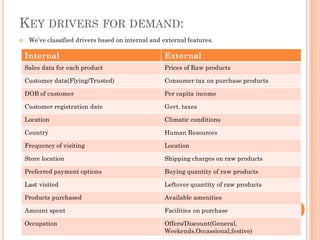
 We’ve classified drivers based on internal and external features.
Internal External
Sales data for each product Prices of Raw products
Customer data(Flying/Trusted) Consumer tax on purchase products
DOB of customer Per capita income
Customer registration date Govt. taxes
Location Climatic conditions
Country Human Resources
Frequency of visiting Location
Store location Shipping charges on raw products
Preferred payment options Buying quantity of raw products
Last visited Leftover quantity of raw products
Products purchased Available amenities
Amount spent Facilities on purchase
Occupation Offers/Discount(General,
Weekends,Occassional,festive)
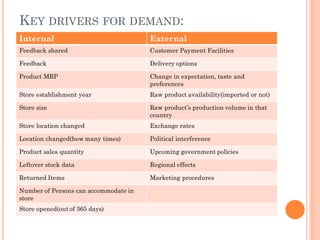
KEY DRIVERS FOR DEMAND:
Internal External
Feedback shared Customer Payment Facilities
Feedback Delivery options
Product MRP Change in expectation, taste and
preferences
Store establishment year Raw product availability(imported or not)
Store size Raw product’s production volume in that
country
Store location changed Exchange rates
Location changed(how many times) Political interference
Product sales quantity Upcoming government policies
Leftover stock data Regional effects
Returned Items Marketing procedures
Number of Persons can accommodate in
store
Store opened(out of 365 days)
REQUIRED DATA:
 We’ll be needing required customer data and sales data and demand
of each products based on a business day along with all the data
mentioned as external features in prior slides in order to have a
proper relationship between my independent and dependent
features.
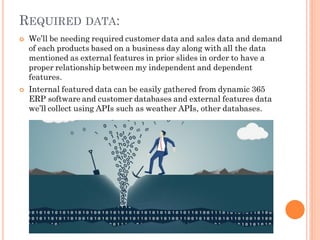
 Internal featured data can be easily gathered from dynamic 365
ERP software and customer databases and external features data
we’ll collect using APIs such as weather APIs, other databases.
ANALYTICAL TECHNIQUES:
 Once we gather all the required data now we need to look forward towards our data
pre-processing and model building approach.
 Based on the data columns we can try featuring out some columns which can have an
impact on my dependent features like date columns, from how many years that store
is running etc. It can be clearly seen that some columns have categorical values, we
need to have proper representation of categorical columns into a numeric ones since
ML model fails to recognise text format data.
 Since we’re dealing with a regression problem and our dependent feature is the
demand value our dataset should be free from multi-colinear problem.
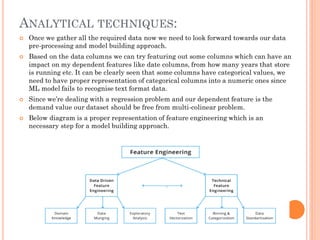
 Below diagram is a proper representation of feature engineering which is an
necessary step for a model building approach.
ANALYTICAL TECHNIQUES:
 Since we’re dealing with a regression problem proper scaling of independent
columns are necessary to identify hidden patterns and less computational time
for our model.
 In a regression problem it is always necessary to have proper treatment for
outliers in the dataset we can consider outliers based on various approaches like
IQR, Standard deviation and standard normal test statistic etc.
 Any missing values in our dataset need to be imputed because presence of null
values will lead to failure in model training process. There are various kind of
approaches for handling missing values like imputation with mean values,
imputation with the help of other columns present in the dataset. We can also
leverage a ML model to help predicting the missing values present in the dataset
like K-nearest neighbour regressor or a tree-based approach(Random Forest).
 Once we’re done with all the necessary pre-processing on the dataset we can
proceed towards the model building approach. But before that we need to decide
how many models do we need to forecast our demand on each product. Since
we’re dealing with a dataset which has a variety of products and sales data
points from various countries. Do we require multiple models or only one model is
necessary?
 We can try creating different models by partitioning our data points based on
countries/products but we need to estimate our demand and we don’t have future
data points present with us so that our ML model can predict the future demand.
We need to find an effective approach for estimation of our demand on each
product and frequency(daily).
ANALYTICAL TECHNIQUES:
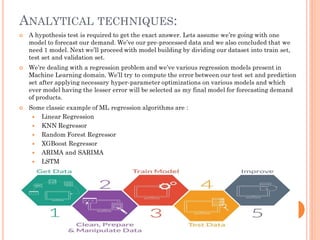
 A hypothesis test is required to get the exact answer. Lets assume we’re going with one
model to forecast our demand. We’ve our pre-processed data and we also concluded that we
need 1 model. Next we’ll proceed with model building by dividing our dataset into train set,
test set and validation set.
 We’re dealing with a regression problem and we’ve various regression models present in
Machine Learning domain. We’ll try to compute the error between our test set and prediction
set after applying necessary hyper-parameter optimizations on various models and which
ever model having the lesser error will be selected as my final model for forecasting demand
of products.
 Some classic example of ML regression algorithms are :
 Linear Regression
 KNN Regressor
 Random Forest Regressor
 XGBoost Regressor
 ARIMA and SARIMA
 LSTM
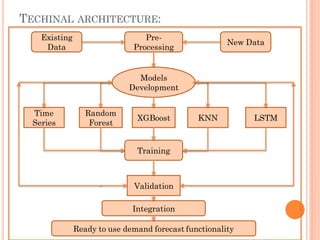
TECHINAL ARCHITECTURE:
Pre-
Processing
Existing
Data
New Data
Models
Development
Time
Series
Random
Forest
XGBoost KNN LSTM
Training
Validation
Integration
Ready to use demand forecast functionality
WHY DEMAND FORECASTING IS ESSENTIAL?
 There is always a context surrounding customer behavior. It may be an upcoming holiday,
the weather or a recent event. As real product demand varies, businesses may face
few challenges:
 Income and profit loss when a product is out of stock or a service is unavailable
 Cash tied up in stock or
 The reduced margins that come with getting it out of warehouses
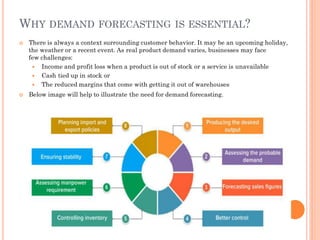
 Below image will help to illustrate the need for demand forecasting.
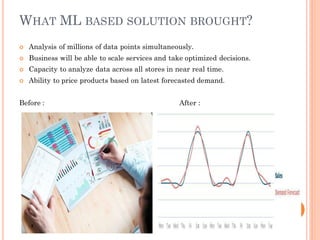
WHAT ML BASED SOLUTION BROUGHT?
 Analysis of millions of data points simultaneously.
 Business will be able to scale services and take optimized decisions.
 Capacity to analyze data across all stores in near real time.
 Ability to price products based on latest forecasted demand.
Before : After :
THANK YOU
Please share your valuable insights via e-mail at
devnathrupam@gmail.com

Demand forecasting case study

  • 1.
    DEMAND FORECASTING CASE STUDY: AnAnalytical solution towards Demand Forecasting in supply chain.
  • 2.
    BUSINESS PROBLEM:  Leadingbusinesses experience significant footfall on the number of customers because of mismanagement of resources in supply chain due to incorrect forecast of consumer demand on products.  Companies utilize various consumer engaging methodologies like online marketing campaigns, social media and search engine promotions, store membership and corporate tie-ups for loyal customers instead of all this footfall in consumers is observed.  A traditional method being used to forecast demand of products at store level for products which is a potential reason on footfall in number of customers.  High error in demand forecasting affecting production policy, Expenditures, Sales Policy, price policy, Sales targets, Controls, Incentives, Financial requirements and resource planning.  Tribal method for demand forecasting also affecting buying behaviour for consumption and incurring losses on raw materials purchased.
  • 3.
    ANALYTICAL APPROACH:  Businesscomplexity and increased volatility have rendered traditional forecasting methods less effective. Demand more often than not seems like a pattern of partially constrained chaos, buffeted by factors that drive it up and down in ways that can’t be understood by simply looking at historic sales volumes. Most forecasting systems produce disappointing results and significant errors.  Machine learning can help companies reliably model the many causes of demand variation. Machine learning is a computer-based discipline where algorithms “learn” from the data. Rather than following programmed instructions, the algorithms use data to build and constantly refine a model to make predictions.  Machine learning systems reduce perceived demand variability by capturing and modeling the attributes that shape demand while filtering out the “noise”—random and unpredictable demand fluctuations. They learn from the data that they process, and modify their operation accordingly.
  • 4.
    KEY DRIVERS FORDEMAND:  We’ve classified drivers based on internal and external features. Internal External Sales data for each product Prices of Raw products Customer data(Flying/Trusted) Consumer tax on purchase products DOB of customer Per capita income Customer registration date Govt. taxes Location Climatic conditions Country Human Resources Frequency of visiting Location Store location Shipping charges on raw products Preferred payment options Buying quantity of raw products Last visited Leftover quantity of raw products Products purchased Available amenities Amount spent Facilities on purchase Occupation Offers/Discount(General, Weekends,Occassional,festive)
  • 5.
    KEY DRIVERS FORDEMAND: Internal External Feedback shared Customer Payment Facilities Feedback Delivery options Product MRP Change in expectation, taste and preferences Store establishment year Raw product availability(imported or not) Store size Raw product’s production volume in that country Store location changed Exchange rates Location changed(how many times) Political interference Product sales quantity Upcoming government policies Leftover stock data Regional effects Returned Items Marketing procedures Number of Persons can accommodate in store Store opened(out of 365 days)
  • 6.
    REQUIRED DATA:  We’llbe needing required customer data and sales data and demand of each products based on a business day along with all the data mentioned as external features in prior slides in order to have a proper relationship between my independent and dependent features.  Internal featured data can be easily gathered from dynamic 365 ERP software and customer databases and external features data we’ll collect using APIs such as weather APIs, other databases.
  • 7.
    ANALYTICAL TECHNIQUES:  Oncewe gather all the required data now we need to look forward towards our data pre-processing and model building approach.  Based on the data columns we can try featuring out some columns which can have an impact on my dependent features like date columns, from how many years that store is running etc. It can be clearly seen that some columns have categorical values, we need to have proper representation of categorical columns into a numeric ones since ML model fails to recognise text format data.  Since we’re dealing with a regression problem and our dependent feature is the demand value our dataset should be free from multi-colinear problem.  Below diagram is a proper representation of feature engineering which is an necessary step for a model building approach.
  • 8.
    ANALYTICAL TECHNIQUES:  Sincewe’re dealing with a regression problem proper scaling of independent columns are necessary to identify hidden patterns and less computational time for our model.  In a regression problem it is always necessary to have proper treatment for outliers in the dataset we can consider outliers based on various approaches like IQR, Standard deviation and standard normal test statistic etc.  Any missing values in our dataset need to be imputed because presence of null values will lead to failure in model training process. There are various kind of approaches for handling missing values like imputation with mean values, imputation with the help of other columns present in the dataset. We can also leverage a ML model to help predicting the missing values present in the dataset like K-nearest neighbour regressor or a tree-based approach(Random Forest).  Once we’re done with all the necessary pre-processing on the dataset we can proceed towards the model building approach. But before that we need to decide how many models do we need to forecast our demand on each product. Since we’re dealing with a dataset which has a variety of products and sales data points from various countries. Do we require multiple models or only one model is necessary?  We can try creating different models by partitioning our data points based on countries/products but we need to estimate our demand and we don’t have future data points present with us so that our ML model can predict the future demand. We need to find an effective approach for estimation of our demand on each product and frequency(daily).
  • 9.
    ANALYTICAL TECHNIQUES:  Ahypothesis test is required to get the exact answer. Lets assume we’re going with one model to forecast our demand. We’ve our pre-processed data and we also concluded that we need 1 model. Next we’ll proceed with model building by dividing our dataset into train set, test set and validation set.  We’re dealing with a regression problem and we’ve various regression models present in Machine Learning domain. We’ll try to compute the error between our test set and prediction set after applying necessary hyper-parameter optimizations on various models and which ever model having the lesser error will be selected as my final model for forecasting demand of products.  Some classic example of ML regression algorithms are :  Linear Regression  KNN Regressor  Random Forest Regressor  XGBoost Regressor  ARIMA and SARIMA  LSTM
  • 10.
    TECHINAL ARCHITECTURE: Pre- Processing Existing Data New Data Models Development Time Series Random Forest XGBoostKNN LSTM Training Validation Integration Ready to use demand forecast functionality
  • 11.
    WHY DEMAND FORECASTINGIS ESSENTIAL?  There is always a context surrounding customer behavior. It may be an upcoming holiday, the weather or a recent event. As real product demand varies, businesses may face few challenges:  Income and profit loss when a product is out of stock or a service is unavailable  Cash tied up in stock or  The reduced margins that come with getting it out of warehouses  Below image will help to illustrate the need for demand forecasting.
  • 12.
    WHAT ML BASEDSOLUTION BROUGHT?  Analysis of millions of data points simultaneously.  Business will be able to scale services and take optimized decisions.  Capacity to analyze data across all stores in near real time.  Ability to price products based on latest forecasted demand. Before : After :
  • 13.
    THANK YOU Please shareyour valuable insights via e-mail at devnathrupam@gmail.com