Virtual Reality

 Shivani Anerao
  Sybsc IT(B)
      102
Intro To Virtual Reality
 First introduced in the late 1950s
 A computer simulation of a real or imaginary
  system
 Enables a user to perform operations on the
  simulated system
 Shows the effects in real time
 Douglas Engelbart came up with the idea of
  VR machines
Factors For Development

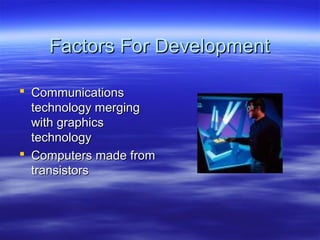
 Communications
  technology merging
  with graphics
  technology
 Computers made from
  transistors
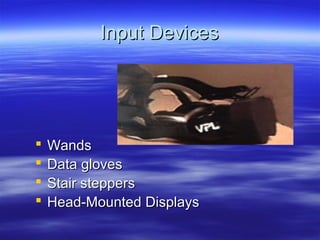
Input Devices


   Wands
   Data gloves
   Stair steppers
   Head-Mounted Displays
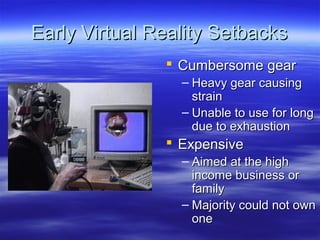
Early Virtual Reality Setbacks
                Cumbersome gear
                 – Heavy gear causing
                   strain
                 – Unable to use for long
                   due to exhaustion
                Expensive
                 – Aimed at the high
                   income business or
                   family
                 – Majority could not own
                   one
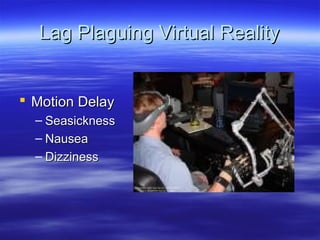
Lag Plaguing Virtual Reality


 Motion Delay
  – Seasickness
  – Nausea
  – Dizziness
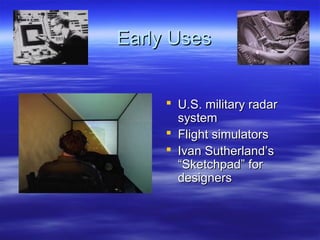
Early Uses


      U.S. military radar
       system
      Flight simulators
      Ivan Sutherland’s
       “Sketchpad” for
       designers
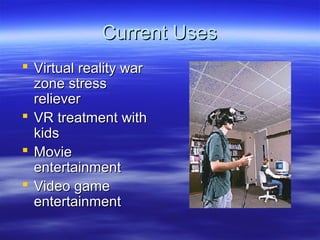
Current Uses
 Virtual reality war
  zone stress
  reliever
 VR treatment with
  kids
 Movie
  entertainment
 Video game
  entertainment
War Zone Stress Reliever
   Treat post-traumatic stress disorder in troops
   Provides effect of reactions on the battlefield
   Isolate things that were causing war-related stress
Treatment With Kids
 VR provides an effective distraction utility
 “Alleviates pain for those that have severe
  injuries or illnesses”
 Minimizes stress during long operations
 Increases endurance in certain situations if
  allow to interact with the VR items
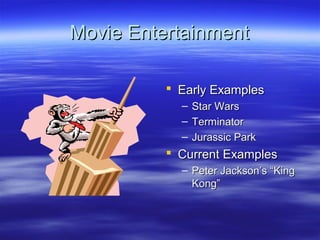
Movie Entertainment

           Early Examples
            –   Star Wars
            –   Terminator
            –   Jurassic Park
           Current Examples
            – Peter Jackson’s “King
              Kong”
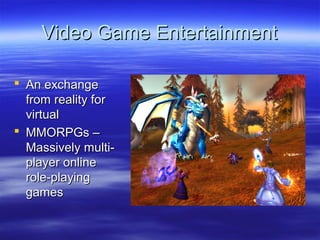
Video Game Entertainment

 An exchange
  from reality for
  virtual
 MMORPGs –
  Massively multi-
  player online
  role-playing
  games
Choices
   Frame rate refresh versus resolution
   File size versus detail and interaction quality
   Better algorithm versus time to create it
   Accessibility versus power
Research & Development
 “Images must become sharper and more
  detailed.
 Movements need to be tracked more
  rapidly, and hence more realistically.
 Technology needs to be more expansive
  while, in many instances, becoming lighter,
  smaller, more portable”
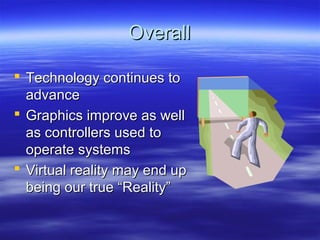
Overall

 Technology continues to
  advance
 Graphics improve as well
  as controllers used to
  operate systems
 Virtual reality may end up
  being our true “Reality”
Works Cited
 In Love With Reality Truly, Madly, Virtually , The New York
  Times, January 8, 2006 Sunday, Late Edition - Final, Section 2;
  Column 1; Arts and Leisure Desk; ART; Pg. 36, 1254 words, By
  MICHAEL RUSH. Michael Rush is the director of the Rose Art Museum
  at Brandeis University and the author of ''Video Art'' (Thames &
  Hudson, 2003) and ''New Media in Art'' (Thames & Hudson World of
  Art, 2005).
 Cancer kids treated with virtual reality, The Australian, September 27,
  2005 Tuesday IT Tabloid Edition, FEATURES; IT Alive / Computers;
  Pg. 107, 557 words, Barbara Gengler
 Military Turns To Virtual Reality To Treat Post-Traumatic Stress;
  Recreating An Iraqi War Zone; Technology also helps treat auto
  accident victims and people with a fear of flying, Investor’s Business
  Daily, July 13, 2005 Wednesday, SECTION INTERNET

Sahiba

  • 1.
    Virtual Reality ShivaniAnerao Sybsc IT(B) 102
  • 2.
    Intro To VirtualReality  First introduced in the late 1950s  A computer simulation of a real or imaginary system  Enables a user to perform operations on the simulated system  Shows the effects in real time  Douglas Engelbart came up with the idea of VR machines
  • 3.
    Factors For Development Communications technology merging with graphics technology  Computers made from transistors
  • 4.
    Input Devices  Wands  Data gloves  Stair steppers  Head-Mounted Displays
  • 5.
    Early Virtual RealitySetbacks  Cumbersome gear – Heavy gear causing strain – Unable to use for long due to exhaustion  Expensive – Aimed at the high income business or family – Majority could not own one
  • 6.
    Lag Plaguing VirtualReality  Motion Delay – Seasickness – Nausea – Dizziness
  • 7.
    Early Uses  U.S. military radar system  Flight simulators  Ivan Sutherland’s “Sketchpad” for designers
  • 8.
    Current Uses  Virtualreality war zone stress reliever  VR treatment with kids  Movie entertainment  Video game entertainment
  • 9.
    War Zone StressReliever  Treat post-traumatic stress disorder in troops  Provides effect of reactions on the battlefield  Isolate things that were causing war-related stress
  • 10.
    Treatment With Kids VR provides an effective distraction utility  “Alleviates pain for those that have severe injuries or illnesses”  Minimizes stress during long operations  Increases endurance in certain situations if allow to interact with the VR items
  • 11.
    Movie Entertainment  Early Examples – Star Wars – Terminator – Jurassic Park  Current Examples – Peter Jackson’s “King Kong”
  • 12.
    Video Game Entertainment An exchange from reality for virtual  MMORPGs – Massively multi- player online role-playing games
  • 13.
    Choices  Frame rate refresh versus resolution  File size versus detail and interaction quality  Better algorithm versus time to create it  Accessibility versus power
  • 14.
    Research & Development “Images must become sharper and more detailed.  Movements need to be tracked more rapidly, and hence more realistically.  Technology needs to be more expansive while, in many instances, becoming lighter, smaller, more portable”
  • 15.
    Overall  Technology continuesto advance  Graphics improve as well as controllers used to operate systems  Virtual reality may end up being our true “Reality”
  • 16.
    Works Cited  InLove With Reality Truly, Madly, Virtually , The New York Times, January 8, 2006 Sunday, Late Edition - Final, Section 2; Column 1; Arts and Leisure Desk; ART; Pg. 36, 1254 words, By MICHAEL RUSH. Michael Rush is the director of the Rose Art Museum at Brandeis University and the author of ''Video Art'' (Thames & Hudson, 2003) and ''New Media in Art'' (Thames & Hudson World of Art, 2005).  Cancer kids treated with virtual reality, The Australian, September 27, 2005 Tuesday IT Tabloid Edition, FEATURES; IT Alive / Computers; Pg. 107, 557 words, Barbara Gengler  Military Turns To Virtual Reality To Treat Post-Traumatic Stress; Recreating An Iraqi War Zone; Technology also helps treat auto accident victims and people with a fear of flying, Investor’s Business Daily, July 13, 2005 Wednesday, SECTION INTERNET

Editor's Notes

  • #3 “ Engelbart envisioned them as tools for digital display. He knew from his days with radar that any digital information could be viewed on a screen. Why not, he then reasoned, connect the computer to a screen and use both to solve problems?”
  • #4 “ Communications technology was intersecting with computing and graphics technology. The fi rst computers based on transistors rather than vacuum tubes became available. This synergy yielded more user-friendly computers, which laid the groundwork for personal computers, computer graphics, and later on, the emergence of virtual reality.”
  • #12 Hollywood’s use of dazzling special effects were computer generated.
  • #14 How do you maintain an acceptable level of frame refresh while also improving the resolution of the images and increasing the ease with which people can interact with the virtual environment? Conversely, how can the resolution of images be improved without sacrificing data and refresh rate? Can the size of the datasets be reduced while maintaining the quality of interaction and detail? Can better algorithms simplify the calculations involved in rendering an image? Can VR become more accessible by linking hundreds of cheaper but less powerful workstations over high-speed networks so that they function as one supercomputer?