Title Slide: Virtual Reality: Transforming Experiences
Introduction:
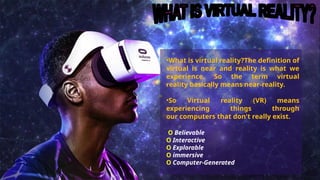
Define virtual reality and its significance in creating immersive experiences that simulate real or imagined environments.
Briefly discuss the evolution of VR technology and its growing impact on various industries.
Slide 1: What is Virtual Reality?
Definition: Explain VR as a computer-generated simulation that allows users to interact with a 3D environment using specialized equipment.
Components: Introduce key components of VR, including VR headsets, motion tracking, and haptic feedback.
Slide 2: History of Virtual Reality
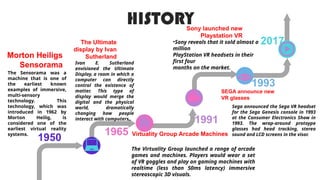
Early Concepts: Discuss the origins of VR, including early devices like the Sensorama (1962) and the first head-mounted displays.
Development Milestones: Highlight significant advancements in the 1980s and 1990s, including the work of Jaron Lanier and the Virtuality Group.
Slide 3: How Virtual Reality Works
Immersion: Explain the concept of immersion and how VR creates a sense of presence in a virtual environment.
Technology: Discuss the technology behind VR, including 3D graphics, motion tracking, and spatial audio.
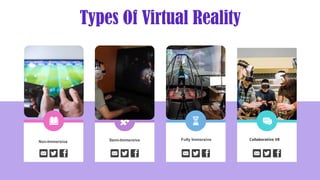
Slide 4: Types of Virtual Reality
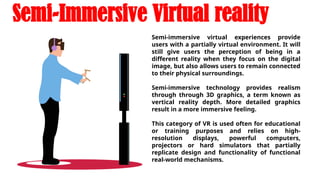
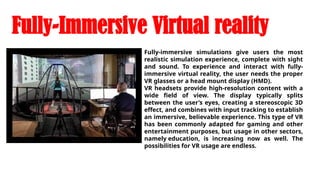
Fully Immersive VR: Describe systems that use headsets and motion tracking for complete immersion.
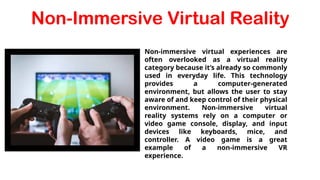
Non-Immersive VR: Explain experiences that use a computer screen and input devices without full immersion.
Augmented Reality (AR) and Mixed Reality (MR): Briefly differentiate these technologies from VR.
Slide 5: Applications of Virtual Reality
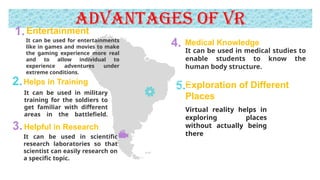
Gaming: Explore how VR has revolutionized the gaming industry, providing players with immersive experiences.
Training and Simulation: Discuss VR's use in fields like aviation, medicine, and military training for realistic simulations.
Education: Highlight the potential of VR in classrooms, allowing students to explore virtual field trips and interactive learning environments.
Slide 6: Virtual Reality in Healthcare
Therapeutic Uses: Discuss how VR is used for pain management, exposure therapy, and rehabilitation.
Medical Training: Explain the benefits of VR in training medical professionals through realistic simulations.
Slide 7: Challenges and Limitations
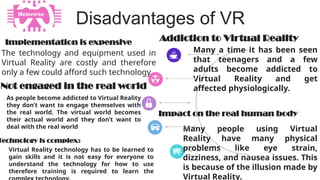
Technical Limitations: Address issues such as motion sickness, hardware costs, and accessibility.
Ethical Considerations: Discuss concerns related to privacy, data security, and the psychological effects of VR experiences.
Slide 8: The Future of Virtual Reality
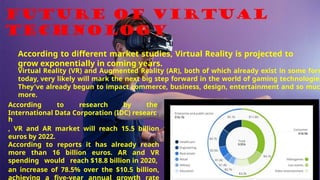
Emerging Trends: Explore advancements in VR technology, including improved graphics, AI integration, and social VR experiences.
Potential Impact: Speculate on how VR could shape industries like entertainment, education, and remote work in the coming years.